HB 2244: PUC; Ratemaking; Performance-Based Incentives; Hawaii Ratepayer Protection Act
- Session Year: 2025-2026
- House: House
- Latest Version Date: 2026-02-17
Current Status:
Failed
(2026-02-18: Passed Second Reading as amended in HD 1 and referred to the committee(s) on CPC with none voting aye with reservations; none voting no (0) and none excused (0).)
Introduced
In Committee
First Chamber
In Committee
Second Chamber
Final Decking
Enacted
What does this bill do?
The bill tells the Public Utilities Commission that, for electric utilities, "performance-based incentives" include revenue adjustment tools, cost-control mechanisms, rewards for good performance, and penalties for poor performance, and it lets the commission use alternative ways to set electric rates. It also says that if the commission resets a utility's allowed revenues based on the utility's costs, it should favor using historical cost trends and outside indexes that encourage cost control instead of relying on future cost forecasts.
The summary is provided by generative AI which can make mistakes. For original language, please view the details in the table below.
Clarifies that, for electric utilities, "performance-based incentives" include revenue adjustment mechanisms, cost control mechanisms, rewards for superior performance, and penalties for subpar performance. Authorizes the Public Utilities Commission to adopt alternative ratemaking procedures to establish electric utility rates and performance-based incentives. Requires the Commission to apply a presumption in favor of considering historical cost trends and external indices that reflect incentives to control costs if the Commission resets an electric utility's allowed revenues based on consideration of the utility's costs. Effective 7/1/3000. (HD1)
Clarifies that, for electric utilities, "performance-based incentives" include revenue adjustment mechanisms, cost control mechanisms, rewards for superior performance, and penalties for subpar performance. Confirms that the Public Utilities Commission may adopt alternative ratemaking procedures to establish electric utility rates and performance-based incentives. Requires the Commission to apply a presumption in favor of considering historical cost trends and external indices that reflect incentives to control costs if the Commission resets an electric utility's allowed revenues based on consideration of the utility's costs.
|
HOUSE OF REPRESENTATIVES |
H.B. NO. |
2244 |
|
THIRTY-THIRD LEGISLATURE, 2026 |
H.D. 1 |
|
|
STATE OF HAWAII |
|
|
|
|
|
|
|
|
||
|
|
||
A BILL FOR AN ACT
RELATING TO THE PUBLIC UTILITIES COMMISSION.
BE IT ENACTED BY THE LEGISLATURE OF THE STATE OF HAWAII:
Act 5 directed the public utilities commission to establish a performance-based model for utility regulation and ratemaking based on performance incentives that "directly tie an electric [utility's] revenues to that utility's achievement on performance metrics and break the direct link between allowed revenues and investment levels." The intent of this performance-based model was to depart from the traditional cost‑of-service model that rewards utilities for increasing the utility's capital expenditures and bases allowed revenues on the value of the rate base, irrespective of the utility's performance. The legislature recognized that the traditional model misaligned the interests of customers and utilities because it created a possible bias toward utilities that expended capital on utility-owned projects, rather than utilities that supported more efficient or cost-effective options like customer-owned distributed energy resources or independent, third-party projects. The legislature concluded that the State needed a shift away from the traditional focus on utility costs to a more modern focus on performance.
The legislature further finds that, in response to the Hawaii Ratepayer Protection Act, the public utilities commission opened its performance-based regulation proceeding as a historic, multi-phase process that included participation from local and national experts. In December 2020, the commission established a comprehensive framework for performance-based regulation that has since been nationally recognized as a leading model. The guiding principles for this framework include a customer-centric approach, including day-one savings for customers; administrative efficiency through a simplified regulatory framework; and utility financial integrity with the opportunity to earn profits and rewards through performance. The main features of the framework include a multi-year rate period of five years, during which the utility's allowed revenues are determined not by traditional rate cases but by an objective index tied to general inflation. The utility's profits are driven largely by its ability to capture cost savings and efficiencies. The framework also includes performance incentive mechanisms to reward or penalize a utility based on its performance on public interest priorities like reliability, accelerated progress toward renewable energy, and improved customer service. The commission emphasized that, with the transition away from traditional cost-of-service regulation, customers would benefit from lower utility costs.
In establishing the performance-based framework, the public utilities commission recognized the need for a transformative and lasting shift away from cost-of-service regulation. The commission made clear that, after the five-year rate control period, the commission anticipated continuing to refine the performance-based framework and did not envision returning to cost-of-service regulation. However, now that the end of the rate control period is approaching, the legislature is concerned about the integrity of the performance-based framework and the commission's compliance with the Hawaii Ratepayer Protection Act. For example, last year, the commission adopted the utility's proposal to initiate a traditional, cost-of-service rate to "re-base" the utility's allowed revenues using its projected increased costs. This cost-based rebasing of revenues backtracks on the progress and reforms the State has made and violates the commission's previous commitment not to return to cost-of-service regulation.
The legislature is also aware that the public utilities commission has insisted on requiring a "forward test year" approach to the rate case, in which a utility requests a rate increase based on future cost projections, rather than the historical cost trends that have been controlled under the performance-based framework. This return to forecast cost‑of‑service ratemaking encourages utilities to make "wish lists" of capital projects to boost utility profits, thereby inflating customer rates. However, the predominant practice in rate cases is to use historical costs adjusted for known and measurable changes, rather than forecast future costs, as the basis for regulatory rate analyses. Jurisdictions using forecast costs instead of historical costs end up paying substantially higher rates.
The legislature recognizes that the public utilities commission has expressed the belief that it is constrained by existing legal provisions to follow certain traditional cost-bound methods, notwithstanding the mandates of the Hawaii Ratepayer Protection Act. As a result, the commission is inviting a return to "cost-plus" ratemaking that threatens to undermine the benefits and progress achieved under the performance-based framework. This poses the risk of significant rate increases for customers.
Based on this stance by the public utilities commission and the risk of rate increases for customers, the legislature believes that further clarification and guidance are needed to ensure that the commission upholds the legislature's original intent under the Hawaii Ratepayer Protection Act and continues the progress made under the commission's performance-based regulatory framework. These clarifications will help ensure that both electric utilities and ratepayers will continue to benefit from the utilities' improved performance, lower costs, and lower rates.
Accordingly, the purpose of this Act is to provide clarification and guidance by:
(2) Authorizing the public utilities commission to adopt alternative ratemaking procedures to establish electric utility rates and performance-based incentives that fulfill the requirements of section 269-16.1, Hawaii Revised Statutes; and
(3) Requiring the public utilities commission to apply a presumption in favor of considering historical cost trends and external indices that reflect incentives to control costs if resetting an electric utility's allowed revenues based on consideration of the utility's costs.
SECTION 2. This Act shall be known and may be cited as the Hawaii Ratepayer Protection Act of 2026.
SECTION 3. Section 269-16.1, Hawaii Revised Statutes, is amended to read as follows:
"§269-16.1
[Performance incentive
and penalty mechanisms] Performance-based
incentives; regulation of electric utility rates. (a)
On or before January 1, [2020,] 2027, the public utilities
commission shall establish [performance] performance‑based
incentives, including revenue adjustment mechanisms, cost control
mechanisms, and reward and penalty mechanisms, that directly tie an
electric [[]utility's[]] revenues to that utility's [achievement
on] performance [metrics] and break the direct link between allowed
revenues and investment levels. The [performance]
performance-based incentives [and penalty mechanisms], as may be
amended by the public utilities commission from time to time, shall apply to
the regulation of electric utility rates under [section 269-16.] this
chapter.
(b) Notwithstanding any law to the contrary, including the ratemaking procedures described in section 269-16, the public utilities commission may adopt, by commission order, alternative ratemaking procedures to establish electric utility rates and performance-based incentives for purposes of subsection (a); provided that the rates shall be derived from a performance‑based model for determining utility revenues.
(c) If resetting an electric utility's allowed revenues based on consideration of the utility's costs, the commission shall apply a presumption in favor of considering historical cost trends and external indices that reflect incentives to control costs, rather than relying on a forward test period.
[(b)]
(d) In developing [performance
incentive and penalty mechanisms,] performance-based incentives, the
public utilities commission's review of electric utility performance shall
consider[, but not be limited to,] the [following]:
(1) [The economic] Economic
incentives and cost-recovery mechanisms described in section 269-6(e);
(2) Volatility and affordability of electric rates and customer electric bills;
(3) [Electric service
reliability;] Reliability of electric service;
(4) [Customer] Level
of customer engagement and satisfaction, including customer options for
managing electricity costs;
(5) [Access to] Accessibility
of utility system information, including [but not limited to public
access to] electric system planning data [and], aggregated
customer energy use data [and individual access to], and granular
information about an individual customer's own energy use data;
(6) Rapid integration of renewable energy sources, including quality interconnection of customer-sited resources; and
(7) Timely execution of competitive procurement, third‑party interconnection, and other business processes.
[(c)]
(e) This section shall not apply
to a member-owned cooperative electric utility."
SECTION 4. Statutory material to be repealed is bracketed and stricken. New statutory material is underscored.
SECTION 5. This Act shall take effect on July 1, 3000.
Report Title:
PUC; Ratemaking; Performance-Based Incentives; Hawaii Ratepayer Protection Act
Description:
Clarifies that, for electric utilities, "performance-based incentives" include revenue adjustment mechanisms, cost control mechanisms, rewards for superior performance, and penalties for subpar performance. Authorizes the Public Utilities Commission to adopt alternative ratemaking procedures to establish electric utility rates and performance-based incentives. Requires the Commission to apply a presumption in favor of considering historical cost trends and external indices that reflect incentives to control costs if the Commission resets an electric utility's allowed revenues based on consideration of the utility's costs. Effective 7/1/3000. (HD1)
The summary description of legislation appearing on this page is for informational purposes only and is not legislation or evidence of legislative intent.
|
HOUSE OF REPRESENTATIVES |
H.B. NO. |
2244 |
|
THIRTY-THIRD LEGISLATURE, 2026 |
|
|
|
STATE OF HAWAII |
|
|
|
|
|
|
|
|
||
|
|
||
A BILL FOR AN ACT
relating to the public utilities commission.
BE IT ENACTED BY THE LEGISLATURE OF THE STATE OF HAWAII:
Act 5 directed the public utilities commission to establish a performance-based model for utility regulation and ratemaking based on performance incentives that "directly tie an electric [utility's] revenues to that utility's achievement on performance metrics and break the direct link between allowed revenues and investment levels." The intent of this performance-based model was to depart from the traditional cost‑of-service model that rewards utilities for increasing the utility's capital expenditures and bases allowed revenues on the value of the rate base, irrespective of the utility's performance. The legislature recognized that the traditional model misaligned the interests of customers and utilities because it created a possible bias toward utilities that expended capital on utility-owned projects, rather than utilities that supported more efficient or cost-effective options like customer-owned distributed energy resources or independent, third-party projects. The legislature concluded that the State needed a shift away from the traditional focus on utility costs to a more modern focus on performance.
The legislature further finds that, in response to the Hawaii Ratepayer Protection Act, the public utilities commission opened its performance-based regulation proceeding as a historic, multi-phase process that included participation from local and national experts. In December 2020, the commission established a comprehensive framework for performance-based regulation that has since been nationally recognized as a leading model. The guiding principles for this framework include a customer-centric approach, including day-one savings for customers; administrative efficiency through a simplified regulatory framework; and utility financial integrity with the opportunity to earn profits and rewards through performance. The main features of the framework include a multi-year rate period of five years, during which the utility's allowed revenues are determined not by traditional rate cases but by an objective index tied to general inflation. The utility's profits are driven largely by its ability to capture cost savings and efficiencies. The framework also includes performance incentive mechanisms to reward or penalize a utility based on its performance on public interest priorities like reliability, accelerated progress toward renewable energy, and improved customer service. The commission emphasized that, with the transition away from traditional cost-of-service regulation, customers would benefit from lower utility costs.
In establishing the performance-based framework, the public utilities commission recognized the need for a transformative and lasting shift away from cost-of-service regulation. The commission made clear that, after the five-year rate control period, the commission anticipated continuing to refine the performance-based framework and did not envision returning to cost-of-service regulation. However, now that the end of the rate control period is approaching, the legislature is concerned about the integrity of the performance-based framework and the commission's compliance with the Hawaii Ratepayer Protection Act. For example, last year, the commission adopted the utility's proposal to initiate a traditional, cost-of-service rate to "re-base" the utility's allowed revenues using its projected increased costs. This cost-based rebasing of revenues backtracks on the progress and reforms the State has made and violates the commission's previous commitment not to return to cost-of-service regulation.
The legislature is also aware that the public utilities commission has insisted on requiring a "forward test year" approach to the rate case, in which a utility requests a rate increase based on future cost projections, rather than the historical cost trends that have been controlled under the performance-based framework. This return to forecasted cost‑of‑service ratemaking encourages utilities to make "wish lists" of capital projects to boost utility profits, thereby inflating customer rates. However, the predominant practice in rate cases is to use historical costs adjusted for known and measurable changes, rather than forecasted future costs, as the basis for regulatory rate analyses. Jurisdictions using forecasted costs instead of historical costs end up paying substantially higher rates.
The legislature recognizes that the public utilities commission has expressed the commission's belief that it is constrained by existing legal provisions to follow certain traditional cost-bound methods, notwithstanding the mandates of the Hawaii Ratepayer Protection Act. As a result, the commission is inviting a return to "cost-plus" ratemaking that threatens to undermine the benefits and progress achieved under the performance-based framework. This poses the risk of significant rate increases for customers.
Based on this stance by the public utilities commission, and the risk of rate increases for customers, the legislature believes that further clarification and guidance are needed to ensure that the commission upholds the legislature's original intent under the Hawaii Ratepayer Protection Act and continues the progress made under the commission's performance-based regulatory framework. These clarifications will help ensure that both electric utilities and ratepayers will continue to benefit from the utilities' improved performance, lower costs, and lower rates.
Accordingly, the purpose of this Act is to provide clarification and guidance by:
(2) Confirming that the public utilities commission may adopt alternative ratemaking procedures to establish electric utility rates and performance-based incentives that fulfill the requirements of section 269-16.1, Hawaii Revised Statutes; and
(3) Requiring the commission to apply a presumption in favor of considering historical cost trends and external indices that reflect incentives to control costs if resetting an electric utility's allowed revenues based on consideration of the utility's costs.
SECTION 2. This Act shall be known and may be cited as the Hawaii Ratepayer Protection Act of 2026.
SECTION 3. Section 269-16.1, Hawaii Revised Statutes, is amended to read as follows:
"§269-16.1
[Performance incentive
and penalty mechanisms] Performance-based
incentives; regulation of electric utility rates. (a)
On or before January 1, [2020,] 2027, the public utilities
commission shall establish [performance] performance‑based
incentives, including revenue adjustment mechanisms, cost control
mechanisms, and reward and penalty mechanisms, that directly tie an
electric [[]utility's[]] revenues to that utility's [achievement
on] performance [metrics] and break the direct link between allowed
revenues and investment levels. The [performance]
performance-based incentives [and penalty mechanisms], as may be
amended by the public utilities commission from time to time, shall apply to
the regulation of electric utility rates under [section 269-16.] this
chapter.
(b) Notwithstanding any law to the contrary, including the ratemaking procedures described in section 269-16, the public utilities commission may adopt, by commission order, alternative ratemaking procedures to establish electric utility rates and performance-based incentives for purposes of subsection (a); provided that the rates shall be derived from a performance‑based model for determining utility revenues.
(c) If resetting an electric utility's allowed revenues based on consideration of the utility's costs, the commission shall apply a presumption in favor of considering historical cost trends and external indices that reflect incentives to control costs, rather than relying on a forward test period.
[(b)]
(d) In developing [performance
incentive and penalty mechanisms,] performance-based incentives, the
public utilities commission's review of electric utility performance shall
consider[, but not be limited to,] the [following]:
(1) [The economic] Economic
incentives and cost-recovery mechanisms described in section 269-6(e);
(2) Volatility and affordability of electric rates and customer electric bills;
(3) [Electric service
reliability;] Reliability of electric service;
(4) [Customer] Level
of customer engagement and satisfaction, including customer options for
managing electricity costs;
(5) [Access to] Accessibility
of utility system information, including [but not limited to public
access to] electric system planning data [and], aggregated
customer energy use data [and individual access to], and granular
information about an individual customer's own energy use data;
(6) Rapid integration of renewable energy sources, including quality interconnection of customer-sited resources; and
(7) Timely execution of competitive procurement, third‑party interconnection, and other business processes.
[(c)]
(e) This section shall not apply
to a member-owned cooperative electric utility."
SECTION 4. Statutory material to be repealed is bracketed and stricken. New statutory material is underscored.
SECTION 5. This Act shall take effect upon its approval.
|
INTRODUCED BY: |
_____________________________ |
|
|
|
Report Title:
PUC; Ratemaking; Performance-Based Incentives; Hawaii Ratepayer Protection Act
Description:
Clarifies that, for electric utilities, "performance-based incentives" include revenue adjustment mechanisms, cost control mechanisms, rewards for superior performance, and penalties for subpar performance. Confirms that the Public Utilities Commission may adopt alternative ratemaking procedures to establish electric utility rates and performance-based incentives. Requires the Commission to apply a presumption in favor of considering historical cost trends and external indices that reflect incentives to control costs if the Commission resets an electric utility's allowed revenues based on consideration of the utility's costs.
The summary description of legislation appearing on this page is for informational purposes only and is not legislation or evidence of legislative intent.
|
Date
|
Status
|
|---|---|
| Feb 18, 2026 | Passed Second Reading as amended in HD 1 and referred to the committee(s) on CPC with none voting aye with reservations; none voting no (0) and none excused (0). |
| Feb 18, 2026 | Reported from EEP (Stand. Com. Rep. No. 447-26) as amended in HD 1, recommending passage on Second Reading and referral to CPC. |
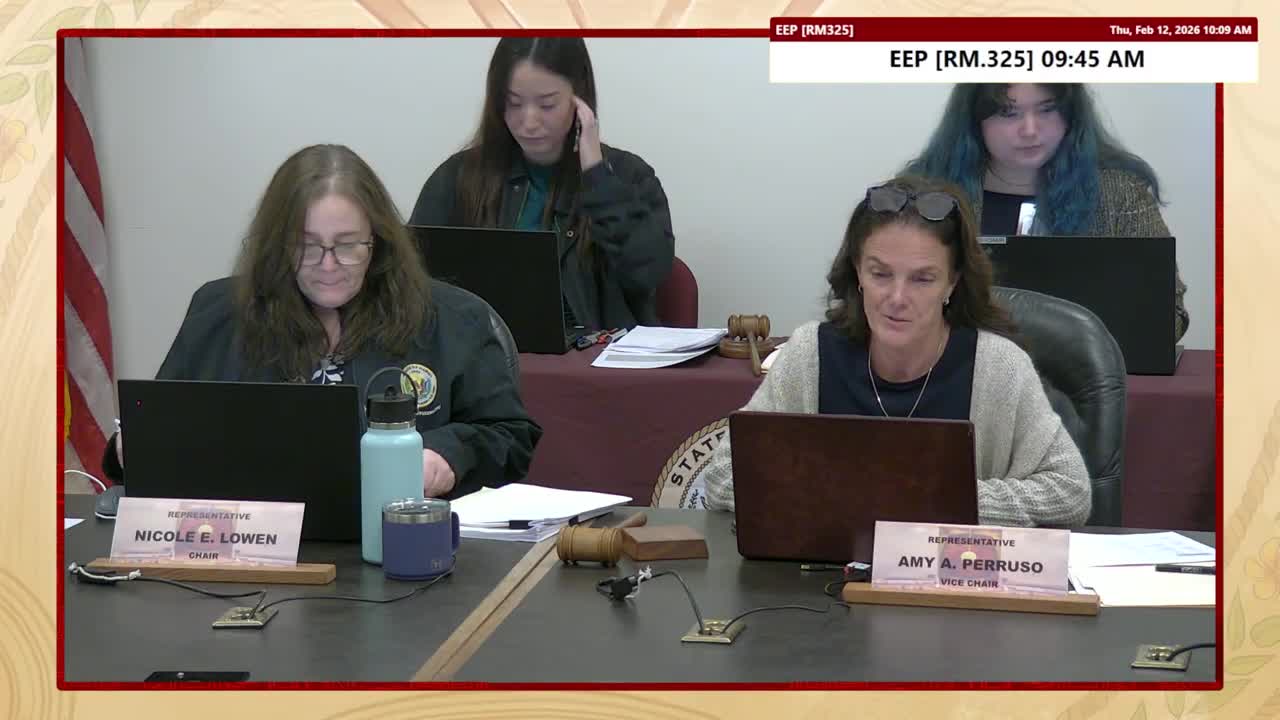
| Feb 12, 2026 | The committee on EEP recommend that the measure be PASSED, WITH AMENDMENTS. The votes were as follows: 7 Ayes: Representative(s) Lowen, Perruso, Chun, Kahaloa, Kusch, Quinlan, Matsumoto; Ayes with reservations: none; Noes: none; and Excused: none. |
| Feb 6, 2026 | Bill scheduled to be heard by EEP on Thursday, 02-12-26 9:45AM in House conference room 325 VIA VIDEOCONFERENCE. |
| Jan 30, 2026 | Referred to EEP, CPC, referral sheet 5 |
| Jan 28, 2026 | Introduced and Pass First Reading. |
| Jan 26, 2026 | Pending introduction. |
|
Date
|
Description
|
Location
|
Votes
|
|
|---|---|---|---|---|
| Feb 12, 2026 | The committee on EEP recommend that the measure be PASSED, WITH AMENDMENTS | House Standing Committee on Energy & Environmental Protection |
Passed |
This list shows positions taken on this bill by organizations on the date displayed, which is linked to the original source.
Positions by individuals are not included.
|
Organization
|
Position
|
Date
|
|---|---|---|
| Earthjustice - Mid-Pacific Office | *** Support | Feb 12, 2026 |
| Ulupono Initiative | *** Support | Feb 12, 2026 |
| Ulupono Initiative and Earthjustice | ** Support |
STAND. COM. REP. NO. 447-26
Honolulu, Hawaii
, 2026
RE: H.B. No. 2244
H.D. 1
Honorable Nadine K. Nakamura
Speaker, House of Representatives
Thirty-Third State Legislature
Regular Session of 2026
State of Hawaii
Madame:
Your Committee on Energy & Environmental Protection, to which was referred H.B. No. 2244 entitled:
"A BILL FOR AN ACT RELATING TO THE PUBLIC UTILITIES COMMISSION,"
begs leave to report as follows:
The purpose of this measure is to:
(1) Clarify that performance‑based incentives include revenue adjustment mechanisms, cost‑control mechanisms, and rewards and penalties tied to utility performance;
(2) Authorize the Public Utilities Commission to adopt alternative ratemaking procedures to establish electric utility rates and performance‑based incentives; and
(3) Require the Commission to apply a presumption in favor of using historical cost trends and external indices that encourage cost control when resetting an electric utility's allowed revenues based on costs.
Your Committee finds that the Hawaii Ratepayer Protection Act was enacted in 2018 to transition electric utilities away from a traditional cost‑of‑service model that directly linked utility revenues to investment levels and toward a performance‑based model that aligns utility incentives with customer interests. Your Committee further finds that recent Public Utilities Commission actions create uncertainty about continued adherence to performance‑based regulation, raising concerns that the Commission would enable a utility's allowed revenues to be reset using projected increased costs to boost profits, rather than historical costs. This measure provides clarification to ensure the Commission maintains a performance‑based framework that promotes cost control and protects ratepayers.
Your Committee has amended this measure by:
(1) Changing the effective date to July 1, 3000, to encourage further discussion; and
(2) Making technical, nonsubstantive amendments for the purposes of clarity, consistency, and style.
As affirmed by the record of votes of the members of your Committee on Energy & Environmental Protection that is attached to this report, your Committee is in accord with the intent and purpose of H.B. No. 2244, as amended herein, and recommends that it pass Second Reading in the form attached hereto as H.B. No. 2244, H.D. 1, and be referred to your Committee on Consumer Protection & Commerce.
Respectfully submitted on behalf of the members of the Committee on Energy & Environmental Protection,
|
|
|
____________________________ NICOLE E. LOWEN, Chair |
|
|
|
|
|
Date
|
Testimony PDF
|
|---|---|
| Feb 12, 2026 | HB2244_TESTIMONY_EEP_02-12-26_.PDF |
Discussed in Hearing
 20MIN
House Standing Committee on Energy & Environmental Protection
20MIN
House Standing Committee on Tourism
 24SEC
House Standing Committee on Energy & Environmental Protection
24SEC
House Standing Committee on Tourism
Bill Author