SB 3228: DBEDT; Travel and Tourism; Sustainable Infrastructure; Climate Resilience; Matching Grant Program; Reports; Appropriation
- Session Year: 2025-2026
- House: Senate
- Latest Version Date: 2026-02-17
Current Status:
Failed
(2026-02-17: Report adopted; Passed Second Reading, as amended (SD 1) and referred to WAM.)
Introduced
In Committee
First Chamber
In Committee
Second Chamber
Final Decking
Enacted
What does this bill do?
The bill creates a Sustainable Tourism Infrastructure Matching Grant Program in the Department of Business, Economic Development, and Tourism to award competitive matching grants to hotels, cruise operators, passenger terminals, ports, and other visitor-serving facilities for one-time capital projects that reduce emissions, save energy or water, cut waste, or improve climate resilience. Grants must be matched by private funds, cannot pay for routine operating costs, and the department must report to the Legislature each year on grants, matching funds, project types, and measurable outcomes.
The summary is provided by generative AI which can make mistakes. For original language, please view the details in the table below.
Establishes the Sustainable Tourism Infrastructure Matching Grant Program within the Department of Business, Economic Development, and Tourism to support one-time capital investments that advance measurable sustainability and climate resilience outcomes within the State's visitor industry. Requires annual reports to the Legislature. Appropriates funds. Effective 7/1/2050. (SD1)
Establishes the sustainable tourism infrastructure matching grant program within the Department of Business, Economic Development, and Tourism to support one-time capital investments that advance measurable sustainability and climate resilience outcomes within the State's visitor industry. Requires annual reports to the Legislature. Appropriates funds.
|
THE SENATE |
S.B. NO. |
3228 |
|
THIRTY-THIRD LEGISLATURE, 2026 |
S.D. 1 |
|
|
STATE OF HAWAII |
|
|
|
|
|
|
|
|
||
|
|
||
A BILL FOR AN ACT
RELATING TO A SUSTAINABLE TOURISM INFRASTRUCTURE.
BE IT ENACTED BY THE LEGISLATURE OF THE STATE OF HAWAII:
The legislature further finds that strategic, capital-based sustainability and climate resilience investments in visitor industry facilities, particularly in hotels, cruise ship operations, passenger terminals, and port-related infrastructure, can reduce greenhouse gas emissions, improve energy and water efficiency, mitigate climate risks, and reduce long-term public infrastructure and disaster recovery costs borne by the State.
Additionally, the legislature finds that in 2025, the State enacted a 0.75 per cent increase to the transient accommodations tax, commonly referred to as the "Green Fee", to create a dedicated funding source to support climate resilience, environmental protection, and sustainability initiatives related to the visitor industry. According to the office of the governor, the increased transient accommodations tax is projected to generate approximately $100 million in tax revenues annually.
Furthermore, the legislature finds that leveraging limited public funds to support voluntary, outcome-driven, private-sector investments through competitive, matching grants can achieve measurable environmental and economic benefits without imposing new regulatory mandates or creating ongoing financial obligations for the State.
Accordingly, the purpose of this Act is to establish within the department of business, economic development, and tourism a time-limited, performance-based matching grant program to support voluntary sustainability and climate resilience investments in visitor industry infrastructure, maximize the return on public investment, and ensure transparency and accountability in the use of public funds.
SECTION 2. Chapter 201, Hawaii Revised Statutes, is amended by adding a new section to part I to be appropriately designated and to read as follows:
"§201- Sustainable tourism infrastructure matching grant program. (a) There is established within the department a competitive, performance-based sustainable tourism infrastructure matching grant program to support one-time capital investments that advance measurable sustainability and climate resilience outcomes within the State's visitor industry.
(b) Eligible applicants may include but are not limited to:
(1) Hotels, resorts, and other transient accommodations;
(2) Cruise ship operators;
(3) Passenger terminal operators;
(4) Port or harbor facilities that directly support visitor transportation; and
(5) Other visitor-serving facilities, as determined by the department, that demonstrate a clear nexus to sustainability or climate resilience outcomes.
(c) Grant funds shall be used exclusively for one-time capital expenditures that produce measurable sustainability or climate resilience outcomes, including but not limited to:
(1) Energy efficiency retrofits or electrification;
(2) Renewable energy or emissions-reduction infrastructure;
(3) Water efficiency, conservation, or reuse systems;
(4) Waste reduction or materials management infrastructure;
(5) Climate adaptation or resilience improvements, including flood mitigation; and
(6) Passenger terminal or port facility improvements that reduce environmental impacts.
(d) Grant funds shall not be used for ongoing operating expenses, routine maintenance, or activities that are otherwise required by law.
(e) All grants awarded under this section shall require a private-sector matching contribution, in an amount determined by the department, to ensure shared investment, fiscal discipline, and leverage of state funds.
(f) In awarding grants, the department shall prioritize projects that:
(1) Are implementation-ready;
(2) Demonstrate clear, measurable outcomes;
(3) Leverage significant private capital;
(4) Reduce long-term infrastructure risk or public cost exposure; and
(5) Align with statewide climate and economic resilience goals.
(g) The department shall submit an annual report of its findings and recommendations, including any proposed legislation, on the grant program to the legislature no later than twenty days prior to the convening of each regular session, beginning with the regular session of 2027. The report shall include, at a minimum:
(1) The number and amount of grants awarded;
(2) Types and locations of projects funded;
(3) Amount of private matching funds leveraged;
(4) Quantifiable sustainability or climate outcomes achieved; and
(5) An assessment of program effectiveness relative to stated goals.
(h) The department may adopt rules pursuant to chapter 91 to carry out the purposes of this section."
SECTION 3. There is appropriated out of the general revenues of the State of Hawaii the sum of $ or so much thereof as may be necessary for fiscal year 2026-2027 for the sustainable tourism infrastructure matching grant program established pursuant to section 2 of this Act.
The sum appropriated shall be expended by the department of business, economic development, and tourism for the purposes of this Act.
SECTION 4. New statutory material is underscored.
SECTION 5. This Act shall take effect on July 1, 2050.
Report Title:
DBEDT; Travel and Tourism; Sustainable Infrastructure; Climate Resilience; Matching Grant Program; Reports; Appropriation
Description:
Establishes the Sustainable Tourism Infrastructure Matching Grant Program within the Department of Business, Economic Development, and Tourism to support one-time capital investments that advance measurable sustainability and climate resilience outcomes within the State's visitor industry. Requires annual reports to the Legislature. Appropriates funds. Effective 7/1/2050. (SD1)
The summary description of legislation appearing on this page is for informational purposes only and is not legislation or evidence of legislative intent.
|
THE SENATE |
S.B. NO. |
3228 |
|
THIRTY-THIRD LEGISLATURE, 2026 |
|
|
|
STATE OF HAWAII |
|
|
|
|
|
|
|
|
||
|
|
||
A BILL FOR AN ACT
RELATING TO A sustainable tourism infrastructure.
BE IT ENACTED BY THE LEGISLATURE OF THE STATE OF HAWAII:
The legislature further finds that strategic, capital-based sustainability and climate resilience investments in visitor industry facilities, particularly in hotels, cruise ship operations, passenger terminals, and port-related infrastructure, can reduce greenhouse gas emissions, improve energy and water efficiency, mitigate climate risks, and reduce long-term public infrastructure and disaster recovery costs borne by the State.
Additionally, the legislature finds that in 2025, the State enacted a 0.75 per cent increase to the transient accommodations tax, commonly referred to as the "Green Fee", to create a dedicated funding source to support climate resilience, environmental protection, and sustainability initiatives related to the visitor industry. According to the office of the governor, the increased transient accommodations is projected to generate approximately $100 million in tax revenues annually.
Furthermore, the legislature finds that leveraging limited public funds to support voluntary, outcome-driven private-sector investments through competitive, matching grants can achieve measurable environmental and economic benefits without imposing new regulatory mandates or creating ongoing financial obligations for the State.
Accordingly, the purpose of this Act is to establish within the department of business, economic development, and tourism a time-limited, performance-based matching grant program to support voluntary sustainability and climate resilience investments in visitor industry infrastructure, maximize the return on public investment, and ensure transparency and accountability in the use of public funds.
SECTION 2. Chapter 201, Hawaii Revised Statutes, is amended by adding a new section to be appropriately designated and to read as follows:
"§201- Sustainable tourism infrastructure matching grant program. (a) There is established within the department of business, economic development, and tourism, a competitive, performance-based sustainable tourism infrastructure matching grant program to support one-time capital investments that advance measurable sustainability and climate resilience outcomes within the State's visitor industry.
(b) Eligible applicants may include but are not limited to:
(1) Hotels, resorts, and other transient accommodations;
(2) Cruise ship operators;
(3) Passenger terminal operators;
(4) Port or harbor facilities that directly support visitor transportation; and
(5) Other visitor-serving facilities, as determined by the department, that demonstrate a clear nexus to sustainability or climate resilience outcomes.
(c) Grant funds shall be used exclusively for one-time capital expenditures that produce measurable sustainability or climate resilience outcomes, including but not limited to:
(1) Energy efficiency retrofits or electrification;
(2) Renewable energy or emissions-reduction infrastructure;
(3) Water efficiency, conservation, or reuse systems;
(4) Waste reduction or materials management infrastructure;
(5) Climate adaptation or resilience improvements, including flood mitigation; and
(6) Passenger terminal or port facility improvements that reduce environmental impacts.
(d) Grant funds shall not be used for ongoing operating expenses, routine maintenance, or activities that are otherwise required by law.
(e) All grants awarded under this section shall require a private-sector matching contribution, in an amount determined by the department, to ensure shared investment, fiscal discipline, and leverage of state funds.
(f) In awarding grants, the department shall prioritize projects that:
(1) Are implementation-ready;
(2) Demonstrate clear, measurable outcomes;
(3) Leverage significant private capital;
(4) Reduce long-term infrastructure risk or public cost exposure; and
(5) Align with statewide climate and economic resilience goals.
(g) The department shall submit an annual report of its findings and recommendations, including any proposed legislation, on the grant program to the legislature no later than twenty days prior to the convening of each regular session, beginning with the regular session of 2027. The report shall include, at a minimum:
(1) The number and amount of grants awarded;
(2) Types and locations of projects funded;
(3) Amount of private matching funds leveraged;
(4) Quantifiable sustainability or climate outcomes achieved; and
(5) An assessment of program effectiveness relative to stated goals.
(h) The department may adopt rules pursuant to chapter 91 to carry out the purposes of this section."
SECTION 3. There is appropriated out of the general revenues of the State of Hawaii the sum of $ or so much thereof as may be necessary for fiscal year 2026-2027 for the sustainable tourism infrastructure matching grant program established under section 2 of this Act.
The sum appropriated shall be expended by the department of business, economic development, and tourism for the purposes of this Act.
SECTION 4. New statutory material is underscored.
SECTION 5. This Act shall take effect on July 1, 2026.
|
INTRODUCED BY: |
_____________________________ |
|
|
|
Report Title:
DBEDT; Travel and Tourism; Sustainable Infrastructure; Climate Resilience; Matching Grant Program; Reports; Appropriation
Description:
Establishes the sustainable tourism infrastructure matching grant program within the Department of Business, Economic Development, and Tourism to support one-time capital investments that advance measurable sustainability and climate resilience outcomes within the State's visitor industry. Requires annual reports to the Legislature. Appropriates funds.
The summary description of legislation appearing on this page is for informational purposes only and is not legislation or evidence of legislative intent.
|
Date
|
Status
|
|---|---|
| Feb 17, 2026 | Report adopted; Passed Second Reading, as amended (SD 1) and referred to WAM. |
| Feb 17, 2026 | Reported from EDT (Stand. Com. Rep. No. 2306) with recommendation of passage on Second Reading, as amended (SD 1) and referral to WAM. |
| Feb 10, 2026 | The committee(s) on EDT recommend(s) that the measure be PASSED, WITH AMENDMENTS. The votes in EDT were as follows: 4 Aye(s): Senator(s) DeCoite, Wakai; Aye(s) with reservations: Senator(s) Kim, Fevella ; 0 No(es): none; and 1 Excused: Senator(s) Fukunaga. |
| Feb 6, 2026 | The committee(s) on EDT has scheduled a public hearing on 02-10-26 1:02PM; Conference Room 229 & Videoconference. |
| Feb 2, 2026 | Referred to EDT, WAM. |
| Jan 28, 2026 | Passed First Reading. |
| Jan 28, 2026 | Introduced. |
|
Date
|
Description
|
Location
|
Votes
|
|
|---|---|---|---|---|
| Feb 10, 2026 | The committee(s) on EDT recommend(s) that the measure be PASSED, WITH AMENDMENTS | Senate Standing Committee on Economic Development and Tourism |
Passed |
This list shows positions taken on this bill by organizations on the date displayed, which is linked to the original source.
Positions by individuals are not included.
|
Organization
|
Position
|
Date
|
|---|---|---|
| Chamber of Commerce Hawaii | ** Support |
STAND. COM. REP. NO. 2306
Honolulu, Hawaii
RE: S.B. No. 3228
S.D. 1
Honorable Ronald D. Kouchi
President of the Senate
Thirty-Third State Legislature
Regular Session of 2026
State of Hawaii
Sir:
Your Committee on Economic Development and Tourism, to which was referred S.B. No. 3228 entitled:
"A BILL FOR AN ACT RELATING TO A SUSTAINABLE TOURISM INFRASTRUCTURE,"
begs leave to report as follows:
The purpose and intent of this measure is to:
(1) Establish the Sustainable Tourism Infrastructure Matching Grant Program within the Department of Business, Economic Development, and Tourism to support one-time capital investments that advance measurable sustainability and climate resilience outcomes within the State's visitor industry;
(2) Require annual reports to the Legislature; and
(3) Appropriate funds.
Your Committee received testimony in support of this measure from the Chamber of Commerce Hawaii.
Your Committee finds that environmental stewardship is a core economic imperative for the State because the health of natural assets is inseparable from the success of the visitor economy. The long-term resilience of the tourism industry is increasingly threatened by climate-related risks to energy, water, transportation, and coastal assets. This measure will support economic stability by advancing measurable sustainability and climate resilience outcomes in the visitor industry.
Your Committee has amended this measure by:
(1) Inserting an effective date of July 1, 2050, to encourage further discussion; and
(2) Making technical, nonsubstantive amendments for the purposes of clarity and consistency.
As affirmed by the record of votes of the members of your Committee on Economic Development and Tourism that is attached to this report, your Committee is in accord with the intent and purpose of S.B. No. 3228, as amended herein, and recommends that it pass Second Reading in the form attached hereto as S.B. No. 3228, S.D. 1, and be referred to your Committee on Ways and Means.
Respectfully submitted on behalf of the members of the Committee on Economic Development and Tourism,
|
|
|
________________________________ LYNN DECOITE, Chair |
|
|
|
|
|
Date
|
Testimony PDF
|
|---|---|
| Feb 10, 2026 | SB3228_TESTIMONY_EDT_02-10-26_.PDF |
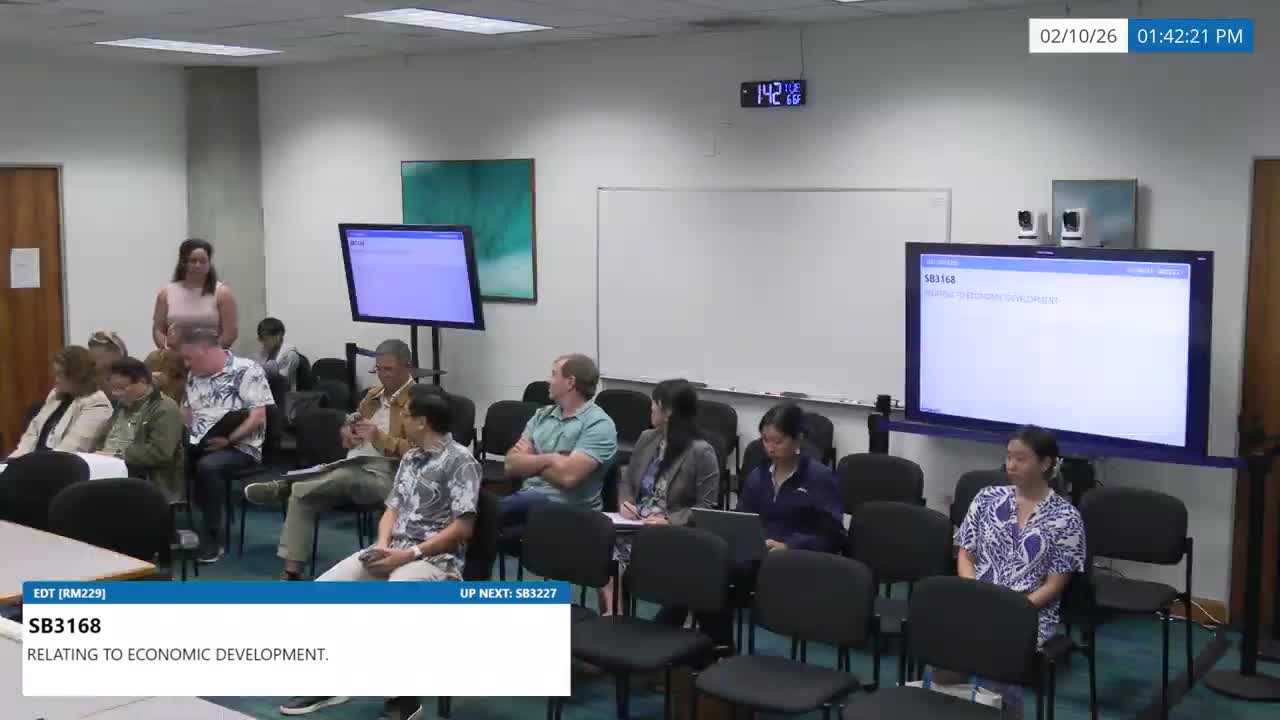
Discussed in Hearing
 5MIN
Senate Standing Committee on Housing
5MIN
Senate Standing Committee on Economic Development and Tourism
34SEC
Senate Standing Committee on Housing
34SEC
Senate Standing Committee on Economic Development and Tourism
Bill Author

Bill Co-Author(s):