SB 2457: Property Forfeiture; Crime; Conviction Requirement
- Session Year: 2025-2026
- House: Senate
- Latest Version Date: 2026-01-21
Current Status:
Failed
(2026-02-19: Report adopted; Passed Second Reading and referred to WAM.)
Introduced
In Committee
First Chamber
In Committee
Second Chamber
Final Decking
Enacted
What does this bill do?
The bill stops the state from permanently taking (forfeiting) property seized in connection with a crime unless the property owner is convicted of the related offense. Police may still seize property before a conviction, but the state cannot sell or keep it unless the owner is convicted; if no charge is filed within one year the property must be returned, except for illegal items which may be disposed of under existing rules.
The summary is provided by generative AI which can make mistakes. For original language, please view the details in the table below.
Amends forfeiture laws to require the owner of property seized in relation to a crime to be convicted of the covered offense before the property may be forfeited.
|
THE SENATE |
S.B. NO. |
2457 |
|
THIRTY-THIRD LEGISLATURE, 2026 |
|
|
|
STATE OF HAWAII |
|
|
|
|
|
|
|
|
||
|
|
||
A BILL FOR AN ACT
RELATING TO PROPERTY FORFEITURE.
BE IT ENACTED BY THE LEGISLATURE OF THE STATE OF HAWAII:
Accordingly, the purpose of this Act is to make property forfeiture under chapter 712A, Hawaii Revised Statutes, more just by restricting the forfeiture of property seized in relation to a crime to cases where the property owner has been convicted of the covered offense.
SECTION 2. Section 712A-5, Hawaii Revised Statutes, is amended by amending subsection (3) to read as follows:
"(3) The following limitations shall apply to the forfeiture of property under this chapter; provided that nothing in this subsection shall be construed to prevent the seizure of property before conviction pursuant to section 712A-6:
(a) No property shall be forfeited under this chapter by reason of the commission of any covered offense unless the owner has received a charge for the covered offense. If no such charge is filed within one year from the date of seizure, all property seized shall be returned to the legal owner, as determined by the department or agency in possession of the property, one year from the date of seizure; provided that property that is contraband or otherwise unlawful shall not be returned and shall be disposed of pursuant to rules adopted by the attorney general; provided further that if the legal owner cannot be determined or located, the department or agency in possession of the property shall follow procedures set forth in rules adopted by the attorney general to determine or locate the owner;
(b) No property shall be forfeited under this chapter by reason of any act or omission established by the owner to have been committed or omitted without the knowledge and consent of the owner;
(c) No conveyance used by any person as a common carrier in the transaction of a business as a common carrier shall be subject to forfeiture under this section unless it appears that the owner or other person in charge of the conveyance is a consenting party or privy to a violation of this chapter;
(d) No conveyance shall be subject to
forfeiture under this section by reason of any act or omission established by
the owner thereof to have been committed or omitted without the owner's
knowledge or consent; [and]
(e) A forfeiture of a conveyance encumbered
by a bona fide security interest shall be subject to the interest of the
secured party if the secured party neither had knowledge of nor consented to
the act or omission[.]; and
(f) No property shall be forfeited under this chapter unless the owner has been convicted of a covered offense by verdict or plea, including a no contest plea or a deferred acceptance of guilty plea or no contest plea."
SECTION 3. This Act does not affect rights and duties that matured, penalties that were incurred, and proceedings that were begun before its effective date.
SECTION 4. Statutory material to be repealed is bracketed and stricken. New statutory material is underscored.
SECTION 5. This Act shall take effect upon its approval.
|
INTRODUCED BY: |
_____________________________ |
|
|
|
Report Title:
Property Forfeiture; Crime; Conviction Requirement
Description:
Amends forfeiture laws to require the owner of property seized in relation to a crime to be convicted of the covered offense before the property may be forfeited.
The summary description of legislation appearing on this page is for informational purposes only and is not legislation or evidence of legislative intent.
|
Date
|
Status
|
|---|---|
| Feb 19, 2026 | Report adopted; Passed Second Reading and referred to WAM. |
| Feb 19, 2026 | Reported from JDC (Stand. Com. Rep. No. 2469) with recommendation of passage on Second Reading and referral to WAM. |
| Feb 6, 2026 | The committee(s) on JDC recommend(s) that the measure be PASSED, UNAMENDED. The votes in JDC were as follows: 5 Aye(s): Senator(s) Rhoads, Gabbard, Chang, San Buenaventura, Awa; Aye(s) with reservations: none ; 0 No(es): none; and 0 Excused: none. |
| Feb 2, 2026 | The committee(s) on JDC has scheduled a public hearing on 02-06-26 9:00AM; Conference Room 016 & Videoconference. |
| Jan 28, 2026 | Referred to JDC, WAM. |
| Jan 22, 2026 | Passed First Reading. |
| Jan 22, 2026 | Introduced. |
|
Date
|
Description
|
Location
|
Votes
|
|
|---|---|---|---|---|
| Feb 6, 2026 | The committee(s) on JDC recommend(s) that the measure be PASSED, UNAMENDED | Senate Standing Committee on Judiciary |
Passed |
This list shows positions taken on this bill by organizations on the date displayed, which is linked to the original source.
Positions by individuals are not included.
|
Organization
|
Position
|
Date
|
|---|---|---|
| ACLU Hawaiʻi | ** Support | |
| and Honolulu Police Department | ** Against | |
| Community Alliance on Prisons | ** Support | |
| Department of the Attorney General | ** Against | |
| Department of the Attorney General | *** Against | Feb 6, 2026 |
| Department of the Prosecuting Attorney of the City and County of Honolulu | ** Against | |
| Department of the Prosecuting Attorney of the County of Maui | ** Against | |
| Drug Policy Forum of Hawaii | ** Support | |
| Drug Policy Forum of Hawaii | *** Support | Feb 6, 2026 |
| Grassroot Institute of Hawaii | ** Support | |
| League of Women Voters of Hawaii | ** Support | |
| Office of the Public Defender | ** Support |
STAND. COM. REP. NO. 2469
Honolulu, Hawaii
RE: S.B. No. 2457
Honorable Ronald D. Kouchi
President of the Senate
Thirty-Third State Legislature
Regular Session of 2026
State of Hawaii
Sir:
Your Committee on Judiciary, to which was referred S.B. No. 2457 entitled:
"A BILL FOR AN ACT RELATING TO PROPERTY FORFEITURE,"
begs leave to report as follows:
The purpose and intent of this measure is to amend forfeiture laws to require the owner of property seized in relation to a crime to be convicted of the covered offense before the property may be forfeited.
Your Committee received testimony in support of this measure from the Office of the Public Defender, Community Alliance on Prisons, Grassroot Institute of Hawaii, ACLU Hawaiʻi, Drug Policy Forum of Hawaii, League of Women Voters of Hawaii, and two individuals.
Your Committee received testimony in opposition to this measure from the Department of the Attorney General, Department of the Prosecuting Attorney of the City and County of Honolulu, Department of the Prosecuting Attorney of the County of Maui, and Honolulu Police Department.
Your Committee received comments on this measure from one individual.
Your Committee finds that civil forfeiture laws disproportionately affect low-income individuals who do not have the financial means or wherewithal to challenge seizures in court. Additionally, civil forfeiture proceedings are subject to a lower standard of proof than criminal trials, meaning that property may be seized when it only has a tenuous connection to an alleged underlying offense. Your Committee further finds that the State's forfeiture laws were recently amended to require a formal charge to be brought within one year of the asset seizure and if not, then the property would need to be returned to the owner. However, once a charge is filed within the one-year time frame, the enforcement agency is then allowed to sell the asset seized and retain the proceeds without ever going to trial and obtaining a conviction against the owner. This process of seizing private property then selling it and retaining the proceeds deprives the owner of due process and just compensation that are guaranteed and required under the United States Constitution when the government decides to take property. This measure seeks to resolve this problem and inequitable situation by requiring the enforcement agency to obtain a conviction against the owner before the agency is allowed to sell the asset and retain the proceeds. Further, this measure will strengthen due process protections for property owners and promote accountability and transparency in law enforcement's property seizure practices by requiring sufficient legal justification and tying property forfeiture to a criminal conviction.
As affirmed by the record of votes of the members of your Committee on Judiciary that is attached to this report, your Committee is in accord with the intent and purpose of S.B. No. 2457 and recommends that it pass Second Reading and be referred to your Committee on Ways and Means.
Respectfully submitted on behalf of the members of the Committee on Judiciary,
|
|
|
________________________________ KARL RHOADS, Chair |
|
|
|
|
|
Date
|
Testimony PDF
|
|---|---|
| Feb 6, 2026 | SB2457_TESTIMONY_JDC_02-06-26_.PDF |
Discussed in Hearing
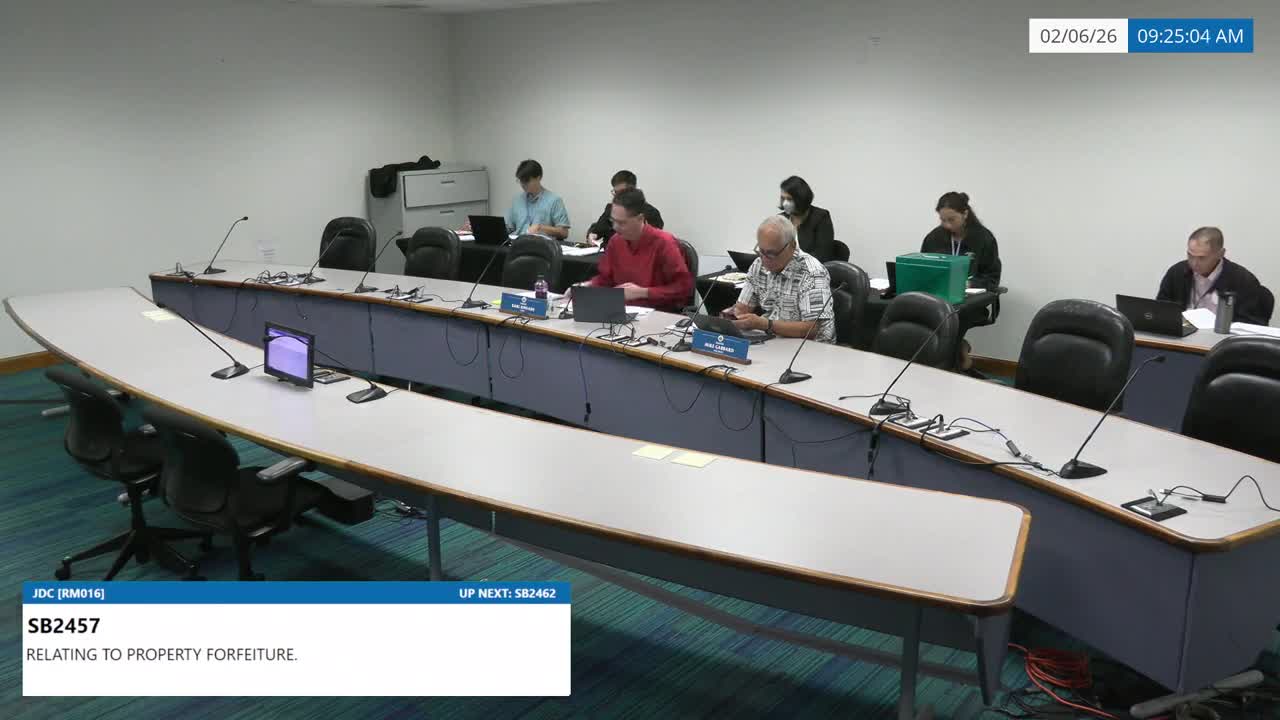 8MIN
Senate Standing Committee on Judiciary
31SEC
Senate Standing Committee on Judiciary
Bill Author