SB 2289: Certificates of Need; Exemptions
- Session Year: 2025-2026
- House: Senate
- Latest Version Date: 2026-02-13
Current Status:
Failed
(2026-02-17: Report adopted; Passed Second Reading, as amended (SD 1) and referred to WAM.)
Introduced
In Committee
First Chamber
In Committee
Second Chamber
Final Decking
Enacted
Exempts from the certificate of need requirements certain health care facilities and services that provide certain health care services, serve federally designated medically underserved rural areas, lower patient costs, are unlikely to be overprescribed, and assist certain vulnerable populations. (SD1)
Exempts from the certificate of need requirements certain health care facilities and services that address maternal and pediatric health, serve federally designated medically underserved rural areas, lower patient costs, are unlikely to be overprescribed, and assist certain vulnerable populations.
|
THE SENATE |
S.B. NO. |
2289 |
|
THIRTY-THIRD LEGISLATURE, 2026 |
S.D. 1 |
|
|
STATE OF HAWAII |
|
|
|
|
|
|
|
|
||
|
|
||
A BILL FOR AN ACT
RELATING TO CERTIFICATES OF NEED.
BE IT ENACTED BY THE LEGISLATURE OF THE STATE OF HAWAII:
SECTION 1. Section 323D-54, Hawaii Revised Statutes, is amended to read as follows:
"§323D-54 Exemptions from certificate of need requirements. Nothing in this part or rules with respect to the requirement for certificates of need applies to:
(1) Offices of physicians, dentists, or other practitioners of the healing arts in private practice as distinguished from organized ambulatory health care facilities, except in any case of purchase or acquisition of equipment attendant to the delivery of health care service and the instruction or supervision for any private office or clinic involving a total expenditure in excess of the expenditure minimum;
(2) Laboratories, as defined in section 321-11(12), except in any case of purchase or acquisition of equipment attendant to the delivery of health care service and the instruction or supervision for any laboratory involving a total expenditure in excess of the expenditure minimum;
(3) Dispensaries and first aid stations
located within business or industrial establishments and maintained solely for
the use of employees; provided [such] that the facilities do not
regularly provide inpatient or resident beds for patients or employees on a
daily twenty-four-hour basis;
(4) Dispensaries or infirmaries in correctional or educational facilities;
(5) Dwelling establishments, such as hotels, motels, and rooming or boarding houses that do not regularly provide health care facilities or health care services;
(6) Any home or institution conducted only for those who, pursuant to the teachings, faith, or belief of any group, depend for healing upon prayer or other spiritual means;
(7) Dental clinics;
(8) Nonpatient areas of care facilities such as parking garages and administrative offices;
(9) Bed changes that involve ten per cent or ten beds of existing licensed bed types, whichever is less, of a facility's total existing licensed beds within a two‑year period;
(10) Projects that are wholly dedicated to meeting the State's obligations under court orders, including consent decrees, that have already determined that need for the projects exists;
(11) Replacement of existing equipment with its modern-day equivalent;
(12) Primary care clinics [under the
expenditure thresholds referenced in section 323D-2];
(13) Equipment and services related to [that]
the equipment, that are primarily invented and used for research
purposes as opposed to usual and customary diagnostic and therapeutic care;
(14) Capital expenditures that are required:
(A) To eliminate or prevent imminent safety hazards as defined by federal, state, or county fire, building, or life safety codes or regulations;
(B) To comply with state licensure standards; or
(C) To comply with accreditation standards,
compliance with which is required to receive reimbursements under Title XVIII
of the Social Security Act or payments under a state plan for medical
assistance approved under Title XIX of [such] the Act;
(15) Extended care adult residential care
homes and assisted living facilities; [or]
(16) Facilities offering substance abuse treatment programs that employ health care providers or certified substance abuse counselors;
(17) Intermediate care facilities for persons having intellectual disabilities as referenced in section 1905(c) of the Social Security Act, as amended;
(18) Home care agencies licensed under section 321‑14.8;
(19) Kidney disease treatment centers including freestanding hemodialysis units;
(20) Services offered in neonatal intensive care units of hospitals;
(21) Services offered in burn care units of hospitals;
(22) Facilities, and services offered at facilities, located in federally designated medically underserved rural areas; and
[(16)] (23)
Other facilities or services that the agency through the statewide
council chooses to exempt, by rules pursuant to section 323D-62."
SECTION 2. Statutory material to be repealed is bracketed and stricken. New statutory material is underscored.
SECTION 3. This Act shall take effect upon its approval.
Report Title:
Certificates of Need; Exemptions
Description:
Exempts from the certificate of need requirements certain health care facilities and services that provide certain health care services, serve federally designated medically underserved rural areas, lower patient costs, are unlikely to be overprescribed, and assist certain vulnerable populations. (SD1)
The summary description of legislation appearing on this page is for informational purposes only and is not legislation or evidence of legislative intent.
|
THE SENATE |
S.B. NO. |
2289 |
|
THIRTY-THIRD LEGISLATURE, 2026 |
|
|
|
STATE OF HAWAII |
|
|
|
|
|
|
|
|
||
|
|
||
A BILL FOR AN ACT
relating to certificates of need.
BE IT ENACTED BY THE LEGISLATURE OF THE STATE OF HAWAII:
SECTION 1. Section 323D-54, Hawaii Revised Statutes, is amended to read as follows:
"§323D-54 Exemptions from certificate of need requirements. Nothing in this part or rules with respect to the requirement for certificates of need applies to:
(1) Offices of physicians, dentists, or other practitioners of the healing arts in private practice as distinguished from organized ambulatory health care facilities, except in any case of purchase or acquisition of equipment attendant to the delivery of health care service and the instruction or supervision for any private office or clinic involving a total expenditure in excess of the expenditure minimum;
(2) Laboratories, as defined in section 321-11(12), except in any case of purchase or acquisition of equipment attendant to the delivery of health care service and the instruction or supervision for any laboratory involving a total expenditure in excess of the expenditure minimum;
(3) Dispensaries and first aid stations
located within business or industrial establishments and maintained solely for
the use of employees; provided [such] the facilities do not
regularly provide inpatient or resident beds for patients or employees on a
daily twenty-four-hour basis;
(4) Dispensaries or infirmaries in correctional or educational facilities;
(5) Dwelling establishments, such as hotels, motels, and rooming or boarding houses that do not regularly provide health care facilities or health care services;
(6) Any home or institution conducted only for those who, pursuant to the teachings, faith, or belief of any group, depend for healing upon prayer or other spiritual means;
(7) Dental clinics;
(8) Nonpatient areas of care facilities such as parking garages and administrative offices;
(9) Bed changes that involve ten per cent or ten beds of existing licensed bed types, whichever is less, of a facility's total existing licensed beds within a two‑year period;
(10) Projects that are wholly dedicated to meeting the State's obligations under court orders, including consent decrees, that have already determined that need for the projects exists;
(11) Replacement of existing equipment with its modern-day equivalent;
(12) Primary care clinics [under the
expenditure thresholds referenced in section 323D-2];
(13) Equipment and services related to [that]
the equipment, that are primarily invented and used for research
purposes as opposed to usual and customary diagnostic and therapeutic care;
(14) Capital expenditures that are required:
(A) To eliminate or prevent imminent safety hazards as defined by federal, state, or county fire, building, or life safety codes or regulations;
(B) To comply with state licensure standards; or
(C) To comply with accreditation standards,
compliance with which is required to receive reimbursements under Title XVIII
of the Social Security Act or payments under a state plan for medical
assistance approved under Title XIX of [such] the Act;
(15) Extended care adult residential care
homes and assisted living facilities; [or]
(16) Facilities offering substance abuse treatment programs that employ health care providers or certified substance abuse counselors;
(17) Intermediate care facilities for persons having intellectual disabilities as referenced in section 1905(c) of the Social Security Act, as amended;
(18) Hospital beds dedicated to pediatric and neonatal intensive care unit patients;
(19) Organized ambulatory health care facilities that operate as surgical centers;
(20) Home care agencies licensed under section 321‑14.8;
(21) Kidney disease treatment centers including freestanding hemodialysis units;
(22) Hospice homes as defined in section 321-15.1;
(23) Services offered in neonatal intensive care units of hospitals;
(24) Services offered in burn care units of hospitals;
(25) Facilities, and services offered at facilities, located in federally designated medically underserved rural areas; and
[(16)] (26)
Other facilities or services that the agency through the statewide
council chooses to exempt, by rules pursuant to section 323D-62."
SECTION 2. Statutory material to be repealed is bracketed and stricken. New statutory material is underscored.
SECTION 3. This Act shall take effect upon its approval.
|
INTRODUCED BY: |
_____________________________ |
|
|
|
Report Title:
Certificates of Need; Exemptions
Description:
Exempts from the certificate of need requirements certain health care facilities and services that address maternal and pediatric health, serve federally designated medically underserved rural areas, lower patient costs, are unlikely to be overprescribed, and assist certain vulnerable populations.
The summary description of legislation appearing on this page is for informational purposes only and is not legislation or evidence of legislative intent.
|
Date
|
Status
|
|---|---|
| Feb 17, 2026 | Report adopted; Passed Second Reading, as amended (SD 1) and referred to WAM. |
| Feb 17, 2026 | Reported from HHS (Stand. Com. Rep. No. 2296) with recommendation of passage on Second Reading, as amended (SD 1) and referral to WAM. |
| Feb 6, 2026 | The committee(s) on HHS recommend(s) that the measure be PASSED, WITH AMENDMENTS. The votes in HHS were as follows: 4 Aye(s): Senator(s) San Buenaventura, McKelvey, Keohokalole, Fevella; Aye(s) with reservations: none ; 0 No(es): none; and 1 Excused: Senator(s) Kanuha. |
| Feb 3, 2026 | The committee(s) on HHS has scheduled a public hearing on 02-06-26 1:00PM; Conference Room 225 & Videoconference. |
| Jan 26, 2026 | Referred to HHS, WAM. |
| Jan 21, 2026 | Introduced and passed First Reading. |
| Jan 15, 2026 | Pending Introduction. |
|
Date
|
Description
|
Location
|
Votes
|
|
|---|---|---|---|---|
| Feb 6, 2026 | The committee(s) on HHS recommend(s) that the measure be PASSED, WITH AMENDMENTS | Senate Standing Committee on Health and Human Services |
Passed |
This list shows positions taken on this bill by organizations on the date displayed, which is linked to the original source.
Positions by individuals are not included.
|
Organization
|
Position
|
Date
|
|---|---|---|
| Bristol Hospice | ** Against | |
| Bristol Hospice | *** Against | Feb 6, 2026 |
| Grassroot Institute of Hawaii | ** Support | |
| Hawaiʻi Care Choices | ** Against | |
| Hawai‘i Care Choices | *** Against | Feb 6, 2026 |
| Knee Regulatory Research Center (West Virginia University) | *** Support | Feb 6, 2026 |
| Liberty Dialysis-Hawaii | ** Against | |
| Maui Health System | ** Against | |
| State Health Planning and Development Agency | ** Support | |
| U.S. Renal Care | *** Against | Feb 6, 2026 |
STAND. COM. REP. NO. 2296
Honolulu, Hawaii
RE: S.B. No. 2289
S.D. 1
Honorable Ronald D. Kouchi
President of the Senate
Thirty-Third State Legislature
Regular Session of 2026
State of Hawaii
Sir:
Your Committee on Health and Human Services, to which was referred S.B. No. 2289 entitled:
"A BILL FOR AN ACT RELATING TO CERTIFICATES OF NEED,"
begs leave to report as follows:
The purpose and intent of this measure is to exempt from the certificate of need requirements certain health care facilities and services that address maternal and pediatric health, serve federally designated medically underserved rural areas, lower patient costs, are unlikely to be overprescribed, and assist certain vulnerable populations.
Your Committee received testimony in support of this measure from the State Health Planning and Development Agency, Grassroot Institute of Hawaii, and two individuals.
Your Committee received testimony in opposition to this measure from the Maui Health System, Liberty Dialysis-Hawaii, Hawaiʻi Care Choices, and Bristol Hospice.
Your Committee received comments on this measure from the Healthcare Association of Hawaii, Hawaiʻi Pacific Health, Navian Hawaii, U.S. Renal Care, The Queen's Health Systems, and one individual.
Your Committee finds that the State's restrictive certificate of need program has become a barrier to affordable and accessible health care in the State, especially in rural areas and for vulnerable populations. Given the health care workforce shortages across the State and subsequent shortage of health care services, your Committee further finds that is necessary to establish certain certificate-of-need exemptions for facilities and services that help vulnerable populations, reduce costs, or are unlikely to be used unnecessarily. This measure further streamlines the State's certificate of need program by establishing certain exemptions.
Your Committee has amended this measure by:
(1) Deleting language that would have exempted hospital beds dedicated to pediatric and neonatal intensive care unit patients from certificate of need requirements;
(2) Deleting language that would have exempted organized ambulatory health care facilities that operate as surgical centers from certificate of need requirements;
(3) Deleting language that would have exempted hospice homes as defined in section 321-15.1, Hawaii Revised Statutes, from certificate of need requirements; and
(4) Making technical, nonsubstantive amendments for the purposes of clarity and consistency.
As affirmed by the record of votes of the members of your Committee on Health and Human Services that is attached to this report, your Committee is in accord with the intent and purpose of S.B. No. 2289, as amended herein, and recommends that it pass Second Reading in the form attached hereto as S.B. No. 2289, S.D. 1, and be referred to your Committee on Ways and Means.
Respectfully submitted on behalf of the members of the Committee on Health and Human Services,
|
|
|
________________________________ JOY A. SAN BUENAVENTURA, Chair |
|
|
|
|
|
Date
|
Testimony PDF
|
|---|---|
| Feb 6, 2026 | SB2289_TESTIMONY_HHS_02-06-26_.PDF |
Discussed in Hearing
 5MIN
Senate Standing Committee on Health and Human Services
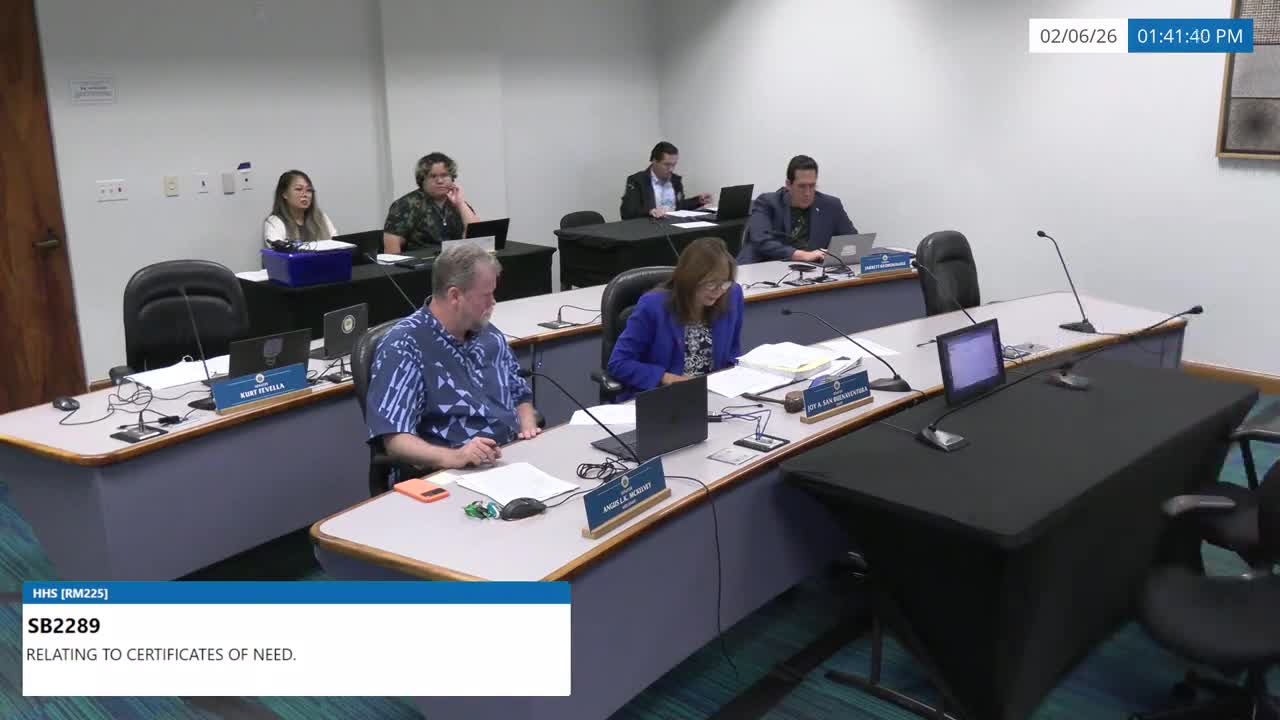 9SEC
Senate Standing Committee on Health and Human Services
Bill Author