HB 2079: Hawaii Council of Mayors Package; Wastewater; Cesspool Upgrade, Conversion, or Connection; Income Tax Credit
- Session Year: 2025-2026
- House: House
- Latest Version Date: 2026-02-17
Current Status:
Failed
(2026-02-18: Passed Second Reading as amended in HD 1 and referred to the committee(s) on FIN with none voting aye with reservations; none voting no (0) and none excused (0).)
Introduced
In Committee
First Chamber
In Committee
Second Chamber
Final Decking
Enacted
What does this bill do?
This bill restores a state income tax credit for taxpayers who upgrade, convert, or connect cesspools to a Department of Health–approved wastewater system or to a sewer system. The credit covers qualified costs up to $10,000 per cesspool, is not available if the taxpayer received a federal, state, county, or private grant, and requires certification by the Department of Health.
The summary is provided by generative AI which can make mistakes. For original language, please view the details in the table below.
Reestablishes the cesspool upgrade, conversion, or connection income tax credit. Applies to taxable years beginning after 12/31/2026. Effective 7/1/3000. (HD1)
Reestablishes the cesspool upgrade, conversion, or connection income tax credit. Applies to taxable years beginning after 12/31/2026.
|
HOUSE OF REPRESENTATIVES |
H.B. NO. |
2079 |
|
THIRTY-THIRD LEGISLATURE, 2026 |
H.D. 1 |
|
|
STATE OF HAWAII |
|
|
|
|
|
|
|
|
||
|
|
||
A BILL FOR AN ACT
RELATING TO CESSPOOLS.
BE IT ENACTED BY THE LEGISLATURE OF THE STATE OF HAWAII:
SECTION 1. The legislature finds that water pollution from nonpoint contamination sources that flow off the land directly, rather than through pipes or ditches, poses a significant threat to the State's water resources, including streams, groundwater, and the ocean. As a nonpoint contamination source, cesspools are substandard systems that discharge raw, untreated sewage into the ground. Cesspool pollution poses a significant risk to the State's finite groundwater, drinking water, streams, ocean, and other aquatic resources.
The legislature further finds that cesspools in Hawaii release approximately fifty-three million gallons of untreated sewage into the ground each day. There are approximately eighty-eight thousand cesspools in the State, with nearly fifty thousand located on Hawaii island, approximately fourteen thousand on Kauai, over twelve thousand on Maui, over eleven thousand on Oahu, and over one thousand four hundred on Molokai. Of these cesspools, forty-three thousand pose a risk to the State's water resources.
To address the ongoing threat of water contamination caused by cesspools, the legislature passed Act 125, Session Laws of Hawaii 2017, which requires the upgrade, conversion, or connection of all cesspools before January 1, 2050.
Prior to this, Act 120, Session Laws of Hawaii 2015, established an income tax credit for the costs to upgrade or convert a qualified cesspool into a septic system or an aerobic treatment unit system, or to connect a qualified cesspool to a sewer system, effective for taxable years beginning after December 31, 2015. This tax credit expired on December 31, 2020. Before its expiration, the tax credit was claimed on sixty-four tax returns for tax year 2019, and the amounts claimed totaled $371,000. For tax year 2018, the tax credit was claimed on forty-one tax returns, and the amounts claimed totaled $219,000, up from $143,000 claimed for tax year 2017.
Current average costs to upgrade or convert a cesspool to a septic system range between $20,000 and $40,000; to convert to an aerobic treatment unit system, the cost ranges between $20,000 and $50,000. Current estimated costs to connect to a sewer system, the most environmentally desirable option, approach $80,000.
The purpose of this Act is to reinstate the cesspool upgrade, conversion, or connection income tax credit.
SECTION 2. Chapter 235, Hawaii Revised Statutes, is amended by adding a new section to be appropriately designated and to read as follows:
"§235- Cesspool upgrade, conversion, or connection; income tax credit. (a) There shall be allowed to each taxpayer subject to the tax imposed under this chapter a cesspool upgrade, conversion, or connection income tax credit that shall be deductible from the taxpayer's net income tax liability, if any, imposed by this chapter for the taxable year in which the credit is properly claimed.
(b) The cesspool upgrade, conversion, or connection income tax credit may be claimed for every cesspool that is upgraded or converted to a director of health-approved wastewater system or connected to a sewerage system by a taxpayer during the taxable year for which it is claimed. The amount of the credit shall be equal to the lesser of one hundred per cent of the qualified expenses of the taxpayer or the cap amount established by subsection (d).
(c) In the case of a partnership, S corporation, estate, or trust, the tax credit allowable is for qualified expenses incurred by the entity for the taxable year. The expenses upon which the tax credit is computed shall be determined at the entity level. Distribution and share of credit shall be determined by rule.
(d) The amount of credit allowed shall not exceed $10,000 for each cesspool that is upgraded or converted to a director of health-approved wastewater system or connected to a sewerage system.
(e) Any taxpayer who has received a federal, state, county, or private grant to support the upgrade or conversion to a director of health-approved wastewater system or connection to a sewerage system shall be ineligible for the tax credit.
(f) The department of health shall:
(1) Collect and maintain a record of all qualified expenses certified by an appropriate government agency for the taxable year; and
(2) Certify to each taxpayer the amount of credit the taxpayer may claim.
The director of health may adopt rules under chapter 91 as necessary to implement the certification requirements under this section.
(g) The director of taxation:
(1) Shall prepare any forms that may be necessary to claim a tax credit under this section;
(2) May require the taxpayer to furnish reasonable information to ascertain the validity of the claim for the tax credit made under this section; and
(3) May adopt rules under chapter 91 necessary to effectuate the purposes of this section.
(h) If the tax credit under this section exceeds the taxpayer's income tax liability, the excess of the credit over liability may be used as a credit against the taxpayer's income tax liability in subsequent years until exhausted; provided that if the taxpayer has an adjusted gross income below $ :
(1) The excess of credit over payments due shall be refunded to the taxpayer;
(2) If the taxpayer has no income tax liability, the tax credit properly claimed shall be paid to the taxpayer; and
(3) No refunds or payments on account of the tax credit allowed by this section shall be made for amounts less than $1.
All claims for the tax credit under this section, including amended claims, shall be filed on or before the end of the twelfth month following the close of the taxable year for which the credit may be claimed. Failure to comply with the foregoing provision shall constitute a waiver of their right to claim the credit.
(i) As used in this section:
"Cesspool" has the same meaning as in section 342D-72.
"Qualified expenses" means costs that are necessary and directly incurred by the taxpayer to upgrade or convert a cesspool to a director of health-approved wastewater system or to connect a cesspool to a sewerage system, and that are certified as such by the appropriate government agency.
"Sewerage system" has the same meaning as in section 342D‑1."
SECTION 3. Section 23-95, Hawaii Revised Statutes, is amended by amending subsection (c) to read as follows:
"(c) This section shall apply to the following:
(1) Section 235-5.5--Deduction for individual housing account deposit;
(2) Section 235-7(f)--Deduction of property loss due to a natural disaster;
(3) Section [235-16.5]
235- --Credit for cesspool upgrade, conversion, or
connection;
(4) Section 235-19--Deduction for maintenance of an exceptional tree;
(5) Section 235-55.91--Credit for the employment of a vocational rehabilitation referral;
(6) Section 235-110.2--Credit for in-kind services contribution for public school repair and maintenance; and
(7) Sections 235-110.8 and 241-4.7--Credit for ownership of a qualified low-income housing building."
SECTION 4. Statutory material to be repealed is bracketed and stricken. New statutory material is underscored.
SECTION 5. This Act shall take effect on July 1, 3000, and shall apply to taxable years beginning after December 31, 2026.
Report Title:
Hawaii Council of Mayors Package; Wastewater; Cesspool Upgrade, Conversion, or Connection; Income Tax Credit
Description:
Reestablishes the cesspool upgrade, conversion, or connection income tax credit. Applies to taxable years beginning after 12/31/2026. Effective 7/1/3000. (HD1)
The summary description of legislation appearing on this page is for informational purposes only and is not legislation or evidence of legislative intent.
|
HOUSE OF REPRESENTATIVES |
H.B. NO. |
2079 |
|
THIRTY-THIRD LEGISLATURE, 2026 |
|
|
|
STATE OF HAWAII |
|
|
|
|
|
|
|
|
||
|
|
||
A BILL FOR AN ACT
RELATING TO CESSPOOLS.
BE IT ENACTED BY THE LEGISLATURE OF THE STATE OF HAWAII:
SECTION 1. The legislature finds that water pollution from nonpoint contamination sources that flow off the land directly, rather than through pipes or ditches, poses a significant threat to the State's water resources, including streams, groundwater, and the ocean. As a nonpoint contamination source, cesspools are substandard systems that discharge raw, untreated sewage into the ground. Cesspool pollution poses a significant risk to the State's finite groundwater, drinking water, streams, ocean, and other aquatic resources.
The legislature additionally finds that cesspools in Hawaii release approximately fifty-three million gallons of untreated sewage into the ground each day. There are approximately eighty-eight thousand cesspools in the State, with nearly fifty thousand located on Hawaii island, approximately fourteen thousand on Kauai, over twelve thousand on Maui, over eleven thousand on Oahu, and over one thousand four hundred on Molokai. Of these cesspools, forty-three thousand pose a risk to the State's water resources.
To address the ongoing threat of water contamination caused by cesspools, the legislature passed Act 125, Session Laws of Hawaii 2017, which requires the upgrade, conversion, or connection of all cesspools before January 1, 2050.
Prior to this, Act 120, Session Laws of Hawaii 2015, established an income tax credit for the costs to upgrade or convert a qualified cesspool into a septic system or an aerobic treatment unit system, or to connect a qualified cesspool to a sewer system, effective for taxable years beginning after December 31, 2015. This tax credit expired on December 31, 2020. Before its expiration, the tax credit was claimed on sixty-four tax returns for tax year 2019, and the amounts claimed totaled $371,000. For tax year 2018, the tax credit was claimed on forty-one tax returns, and the amounts claimed totaled $219,000, up from $143,000 claimed for tax year 2017.
Current average costs to upgrade or convert a cesspool to a septic system range between $20,000 and $40,000; to convert to an aerobic treatment unit system, the cost ranges between $20,000 and $50,000. Current estimated costs to connect to a sewer system, the most environmentally desirable option, approach $80,000.
The purpose of this Act is to reinstate the cesspool upgrade, conversion, or connection income tax credit, with the credit amount adjusted for inflation since the original credit was established in 2015.
SECTION 2. Chapter 235, Hawaii Revised Statutes, is amended by adding a new section to be appropriately designated and to read as follows:
"§235- Cesspool upgrade, conversion, or connection; income tax credit. (a) There shall be allowed to each taxpayer subject to the tax imposed under this chapter a cesspool upgrade, conversion, or connection income tax credit that shall be deductible from the taxpayer's net income tax liability, if any, imposed by this chapter for the taxable year in which the credit is properly claimed.
(b) The cesspool upgrade, conversion, or connection income tax credit may be claimed for every cesspool that undergoes an upgrade or conversion to a septic system or aerobic treatment unit system, or connection to a sewerage system that is installed and placed in service in the State by a taxpayer during the taxable year for which it is claimed. The amount of the credit shall be equal to either thirty-five per cent of the qualified expenses of the taxpayer or the applicable cap amount established by subsection (d), whichever is less; provided that in the case of a qualified cesspool that is a residential large capacity cesspool, the amount of the credit shall be equal to thirty-five per cent of the qualified expenses of the taxpayer per residential dwelling connected to the cesspool or the applicable cap amount established by subsection (d), whichever is less.
(c) In the case of a partnership, S corporation, estate, or trust, the tax credit allowable is for qualified expenses incurred by the entity for the taxable year. The expenses upon which the tax credit is computed shall be determined at the entity level. Distribution and share of credit shall be determined by rule.
(d) The amount of credit allowed shall not exceed the applicable cap amount, which is determined as follows:
(1) $14,000 for each cesspool upgrade or conversion to a septic system;
(2) $17,500 for each cesspool upgrade or conversion to an aerobic treatment unit system; and
(3) $28,000 for each cesspool eliminated through connection to a sewerage system.
(e) Any taxpayer who has received a federal, state, county, or private grant to support the upgrade or conversion to a septic system or aerobic treatment unit system or connection to a sewerage system is ineligible for the tax credit.
(f) The department of health shall:
(1) Collect and maintain a record of all qualified expenses certified by an appropriate government agency for the taxable year; and
(2) Certify to each taxpayer the amount of credit the taxpayer may claim.
The director of health may adopt rules under chapter 91 as necessary to implement the certification requirements under this section.
(g) The director of taxation:
(1) Shall prepare any forms that may be necessary to claim a tax credit under this section;
(2) May require the taxpayer to furnish reasonable information to ascertain the validity of the claim for the tax credit made under this section; and
(3) May adopt rules under chapter 91 necessary to effectuate the purposes of this section.
(h) If the tax credit under this section exceeds the taxpayer's income tax liability, the excess of the credit over liability may be used as a credit against the taxpayer's income tax liability in subsequent years until exhausted. All claims for the tax credit under this section, including amended claims, shall be filed on or before the end of the twelfth month following the close of the taxable year for which the credit may be claimed. Failure to comply with the foregoing provision shall constitute a waiver of their right to claim the credit.
(i) As used in this section:
"Cesspool" has the same meaning as in section 342D-72.
"Qualified expenses" means costs that are necessary and directly incurred by the taxpayer for upgrading or converting a cesspool into a septic system or an aerobic treatment unit system, or connecting a cesspool to a sewerage system, and that are certified as such by the appropriate government agency. "Residential large capacity cesspool" means a cesspool that is connected to more than one residential dwelling.
"Sewerage system" has the same meaning as in section 342D‑1."
SECTION 3. Section 23-95, Hawaii Revised Statutes, is amended by amending subsection (c) to read as follows:
"(c) This section shall apply to the following:
(1) Section 235-5.5--Deduction for individual housing account deposit;
(2) Section 235-7(f)--Deduction of property loss due to a natural disaster;
(3) Section [235-16.5]
235- --Credit for cesspool
upgrade, conversion, or connection;
(4) Section 235-19--Deduction for maintenance of an exceptional tree;
(5) Section 235-55.91--Credit for the employment of a vocational rehabilitation referral;
(6) Section 235-110.2--Credit for in-kind services contribution for public school repair and maintenance; and
(7) Sections 235-110.8 and 241-4.7--Credit for ownership of a qualified low-income housing building."
SECTION 4. Statutory material to be repealed is bracketed and stricken. New statutory material is underscored.
SECTION 5. This Act shall take effect on July 1, 2026, and shall apply to taxable years beginning after December 31, 2026.
|
INTRODUCED BY: |
_____________________________ |
|
|
By Request |
Report Title:
Hawaii Council of Mayors Package; Wastewater; Cesspool Upgrade, Conversion, or Connection; Income Tax Credit
Description:
Reestablishes the cesspool upgrade, conversion, or connection income tax credit. Applies to taxable years beginning after 12/31/2026.
The summary description of legislation appearing on this page is for informational purposes only and is not legislation or evidence of legislative intent.
|
Date
|
Status
|
|---|---|
| Feb 18, 2026 | Passed Second Reading as amended in HD 1 and referred to the committee(s) on FIN with none voting aye with reservations; none voting no (0) and none excused (0). |
| Feb 18, 2026 | Reported from EEP (Stand. Com. Rep. No. 386-26) as amended in HD 1, recommending passage on Second Reading and referral to FIN. |
| Feb 5, 2026 | The committee on EEP recommend that the measure be PASSED, WITH AMENDMENTS. The votes were as follows: 7 Ayes: Representative(s) Lowen, Perruso, Chun, Kahaloa, Kusch, Quinlan, Matsumoto; Ayes with reservations: none; Noes: none; and Excused: none. |
| Feb 2, 2026 | Bill scheduled to be heard by EEP on Thursday, 02-05-26 9:00AM in House conference room 325 VIA VIDEOCONFERENCE. |
| Jan 30, 2026 | Re-referred to EEP, FIN, referral sheet 5 |
| Jan 28, 2026 | Referred to EEP, WAL, FIN, referral sheet 3 |
| Jan 26, 2026 | Introduced and Pass First Reading. |
| Jan 23, 2026 | Pending introduction. |
|
Date
|
Description
|
Location
|
Votes
|
|
|---|---|---|---|---|
| Feb 5, 2026 | The committee on EEP recommend that the measure be PASSED, WITH AMENDMENTS | House Standing Committee on Energy & Environmental Protection |
Passed |
This list shows positions taken on this bill by organizations on the date displayed, which is linked to the original source.
Positions by individuals are not included.
|
Organization
|
Position
|
Date
|
|---|---|---|
| County of Hawaiʻi (Office of the Mayor) | *** Support | Feb 5, 2026 |
| County of Kauaʻi (Office of the Mayor) | *** Support | Feb 5, 2026 |
| Department of Environmental Services of the City and County of Honolulu | ** Support | |
| Department of Health | ** Support | |
| Department of Health | *** Support | Feb 5, 2026 |
| Department of Land and Natural Resources | ** Support | |
| Hawaiʻi Association of REALTORS | ** Support | |
| Office of Planning and Sustainable Development | ** Support | |
| Office of Climate Change Sustainability and Resiliency of the City and County of Honolulu | ** Support | |
| Office of the Mayor of the County of Hawaiʻi | ** Support | |
| Office of the Mayor of the County of Kauaʻi | ** Support | |
| The Nature Conservancy (Hawaiʻi and Palmyra) | *** Support | Feb 5, 2026 |
| The Nature Conservancy Hawaiʻi and Palmyra | ** Support | |
| University of Hawaiʻi Sea Grant College Program | ** Support | |
| University of Hawaiʻi Water Resources Research Center | ** Support | |
| Water Resources Research Center | *** Support | Feb 5, 2026 |
STAND. COM. REP. NO. 386-26
Honolulu, Hawaii
, 2026
RE: H.B. No. 2079
H.D. 1
Honorable Nadine K. Nakamura
Speaker, House of Representatives
Thirty-Third State Legislature
Regular Session of 2026
State of Hawaii
Madame:
Your Committee on Energy & Environmental Protection, to which was referred H.B. No. 2079 entitled:
"A BILL FOR AN ACT RELATING TO CESSPOOLS,"
begs leave to report as follows:
Your Committee received testimony in support of this measure from the Department of Land and Natural Resources; Department of Health; Office of Planning and Sustainable Development; University of Hawaiʻi Sea Grant College Program; University of Hawaiʻi Water Resources Research Center; Office of the Mayor of the County of Hawaiʻi; Office of the Mayor of the County of Kauaʻi; Department of Environmental Services of the City and County of Honolulu; Office of Climate Change Sustainability and Resiliency of the City and County of Honolulu; Hawaiʻi Association of REALTORS; The Nature Conservancy Hawaiʻi and Palmyra; and two individuals. Your Committee received comments on this measure from the Department of Taxation and Tax Foundation of Hawaii.
Your Committee finds that cesspools are a major source of contamination and threaten the State's groundwater, drinking water, streams, and ocean resources. Your Committee further finds that the high cost of upgrades has hindered compliance with the 2050 deadline for upgrade, conversion, or connection and that new funding mechanisms are necessary to offset costs to residents. This measure seeks to reduce financial barriers and support efforts to protect the State's water resources by reestablishing the Cesspool Upgrade, Conversion, or Connection Income Tax Credit to assist with costs associated with cesspool upgrade, conversion, or connection.
Your Committee has amended this measure by:
(1) Clarifying that the credit applies to cesspools upgraded or converted to Director of Health-approved wastewater systems or connected to a sewerage system;
(2) Amending the amount of the credit to the lesser of one hundred per cent of the qualified expenses or $10,000 per cesspool;
(3) Removing provisions establishing credit amounts for residential large capacity cesspools;
(4) Removing the different cap amounts for different conversion methods and applying a single $10,000 cap for each cesspool that is upgraded, converted, or connected;
(5) Making the credit refundable for taxpayers with an adjusted gross income below an unspecified amount;
(6) Changing the effective date to July 1, 3000, to encourage further discussion; and
(7) Making technical, nonsubstantive amendments for the purposes of clarity, consistency, and style.
As affirmed by the record of votes of the members of your Committee on Energy & Environmental Protection that is attached to this report, your Committee is in accord with the intent and purpose of H.B. No. 2079, as amended herein, and recommends that it pass Second Reading in the form attached hereto as H.B. No. 2079, H.D. 1, and be referred to your Committee on Finance.
Respectfully submitted on behalf of the members of the Committee on Energy & Environmental Protection,
|
|
|
____________________________ NICOLE E. LOWEN, Chair |
|
|
|
|
|
Date
|
Testimony PDF
|
|---|---|
| Feb 5, 2026 | HB2079_TESTIMONY_EEP_02-05-26_.PDF |
Discussed in Hearing
 8MIN
House Standing Committee on Energy & Environmental Protection
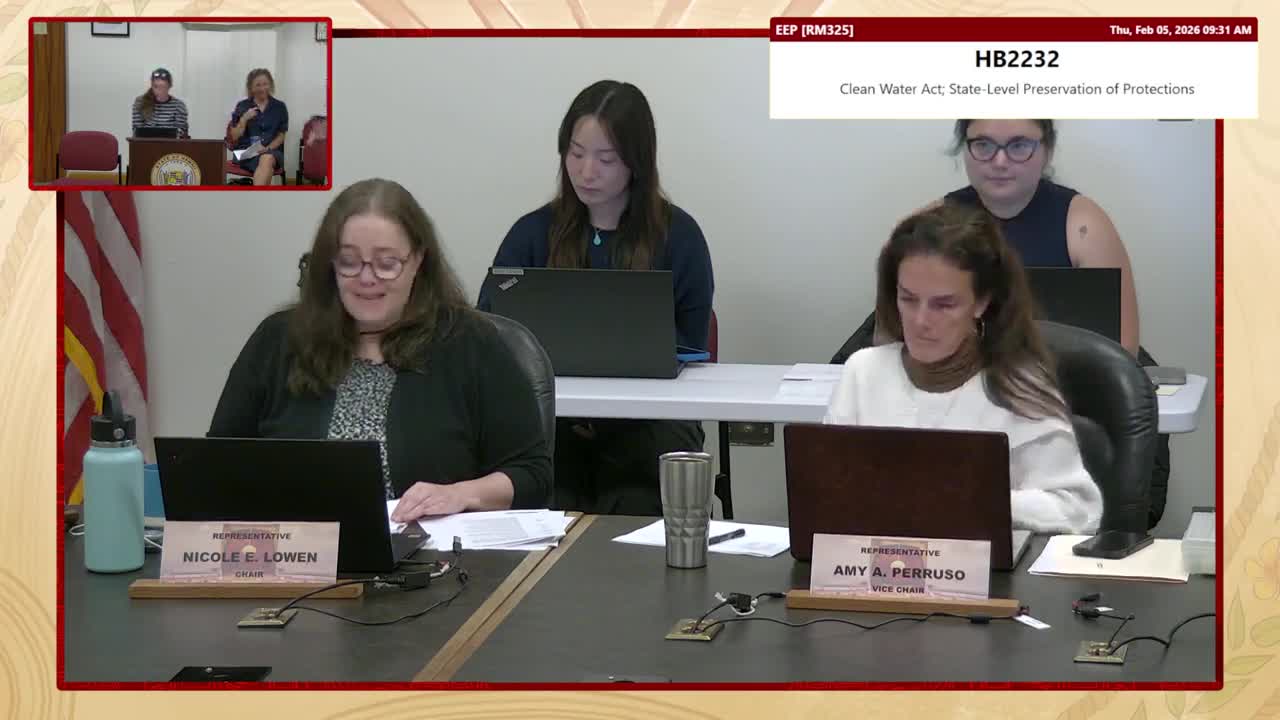 1MIN
House Standing Committee on Energy & Environmental Protection
Bill Author
Bill Co-Author(s):