SB 2712: Department of Agriculture and Biosecurity; Industrial Hemp; Agriculture; Hawaii Hemp Special Fund; Hemp Paper Packaging Pilot Program; Reports; Appropriation
- Session Year: 2025-2026
- House: Senate
- Latest Version Date: 2026-02-19
Current Status:
Failed
(2026-02-20: Report adopted; Passed Second Reading, as amended (SD 1) and referred to WAM/JDC.)
Introduced
In Committee
First Chamber
In Committee
Second Chamber
Final Decking
Enacted
Establishes the Hawaii Hemp Special Fund. Establishes the Hemp Paper Packaging Pilot Program. Requires reports to the Legislature. Appropriates funds. Sunsets 6/30/2030. Effective 7/1/2050. (SD1)
Establishes the Hawaii Hemp Fiber Special Fund. Establishes the Hemp Paper Packaging Pilot Program. Establishes the Industrial Hemp License Surcharge. Requires reports to the Legislature. Appropriates funds. Sunsets 6/30/2030.
|
THE SENATE |
S.B. NO. |
2712 |
|
THIRTY-THIRD LEGISLATURE, 2026 |
S.D. 1 |
|
|
STATE OF HAWAII |
|
|
|
|
|
|
|
|
||
|
|
||
A BILL FOR AN ACT
RELATING TO HEMP.
BE IT ENACTED BY THE LEGISLATURE OF THE STATE OF HAWAII:
Accordingly, the purpose of this Act is to:
(1) Establish the Hawaii hemp special fund to provide grants, per-ton incentives, and pilot projects that expand industrial hemp production, processing, and in-state manufacturing with strong equity and fiscal controls;
(2) Establish the hemp paper packaging pilot program;
(3) Require reports to the legislature; and
(4) Appropriate funds.
SECTION 2. Chapter 141, Hawaii Revised Statutes, is amended by adding a new part to be appropriately designated and to read as follows:
"Part . Industrial hemp
§141-A Definitions. As used in this part:
"Approved processor" means any processor licensed under this chapter that meets quality assurance, safety, and measurement standards adopted by the department by rule.
"Department" means the department of agriculture and biosecurity.
"Fund" or "special fund" means the Hawaii hemp special fund.
"Hemp paper packaging" means paper, paperboard, or molded-fiber packaging made primarily from industrial hemp biomass and water, containing no intentionally added per- and polyfluoroalkyl substances and no oxo-degradable additives or bisphenols, and meeting compostability or recyclability standards adopted by the department by rule in consultation with the department of health and the state procurement office, which may reference nationally recognized standards including ASTM D6400 or D6868 and Federal Trade Commission Green Guides.
"Industrial hemp" means the plant Cannabis sativa L. and any part of that plant, including the seeds thereof and all derivatives, extracts, cannabinoids, isomers, acids, salts, and salts of isomers, whether growing or not, with a delta-9 tetrahydrocannabinol concentration of not more than 0.3 percent on a dry weight basis.
"Industrial hemp biomass" means non-viable hemp plant material, including foliage, stalk, hurd, bast fiber, and root, excluding viable seed, for industrial uses consistent with this chapter.
"Native Hawaiian-owned" means a business at least fifty-one per cent owned by Native Hawaiians, as defined in section 10-2.
"Producer" means a person or entity licensed by the department to cultivate industrial hemp.
"Smallholder farm" means a farm with annual gross receipts under $500,000.
§141-B Hawaii hemp special fund; established. (a) There is established within the state treasury a special fund to be designated as the Hawaii hemp special fund to be administered by the department to provide grants, per-ton incentives, and pilots for industrial hemp production and all industrial uses, including fiber, textiles, construction, biomass, seeds, oil, food, packaging, and other non-cannabinoid derivative uses. Moneys deposited in the special fund shall be used to fulfill the purposes of this part and shall include:
(1) Any moneys appropriated by the legislature to the special fund;
(2) Any moneys received from the federal government or from private contributions; and
(3) The interest or return on investments earned from moneys in the special fund.
(b) Moneys in the fund shall be used for the following, subject to rules adopted under chapter 91 and, as applicable, procurement under chapter 103D:
(1) Producers grants for cultivation, harvest, drying, and equipment and on-farm processing that supports industrial hemp production;
(2) Processor grants, not more than $500,000 per award, for equipment and site readiness including decortation, drying, power upgrades, material handling, metering, and quality assurance systems;
(3) Converter and manufacturer grants, not more than $500,000 per award, to establish or expand Hawaii-based converting or finishing of industrial hemp materials including, tooling, line setup, testing, and quality systems;
(4) Grants to nonprofit organizations and public institutions of higher education for training, testing, workforce development, demonstrations, and research and development related to industrial hemp; provided that the grants shall comply with chapter 42F, as applicable, and shall produce public reports or shareable technical materials;
(5) Per-ton incentives of $300 per delivered dry ton of industrial hemp biomass to an approved processor, verified by scale tickets and geotagged field maps. For the purposes of this paragraph "dry ton" shall be defined by rule, including moisture-content methodology; provided that the department may prohibit reimbursement of any cost item already reimbursed by a separate award to prevent duplication of benefits;
(6) The hemp paper packaging pilot program; and
(7) Administrative costs not exceeding ten per cent of annual expenditures from the fund.
(c) Grants awarded pursuant to this section:
(1) For producers, shall not exceed more than $500,000 per fiscal year and not more than $1,000,000 in the aggregate over any thirty-six month rolling period per applicant; provided that per-ton incentive payments pursuant to subsection (b)(5) shall not count towards the grant awards; provided further that to receive a producer grant, any per-ton incentive payment under subsection (b)(5) shall not exceed $150,000 per licensed producer per fiscal year;
(2) For processors, shall not exceed more than $750,000 per fiscal year and not more than $1,500,000 in the aggregate over any thirty-six month rolling period per applicant; provided that not more than thirty-five per cent of the fund's total annual disbursements shall be awarded to processors in any fiscal year. For the purposes of this paragraph "disbursements" includes any grant, incentive payment, or other cash outlay from the fund;
(3) For converters and manufacturers, shall not exceed $500,000 per fiscal year and not more than $1,000,000 in the aggregate over any thirty-six month rolling period per applicant; and
(4) For nonprofit organizations and public institutions of higher education, shall not exceed $400,000 per fiscal year and not more than $800,000 in the aggregate over any thirty-six month rolling period per applicant.
(d) An applicant may receive more than one award in a fiscal year; provided that:
(1) The scopes of each application do not overlap;
(2) Awards do not reimburse the same cost items; and
(3) The caps provided under paragraphs (c)(1) through (c)(4) are not exceeded.
The department may sequence or consolidate awards to administer these caps.
(e) The department shall require disclosure of all other public funding for the same project or cost items and may deny, reduce, or condition any award to prevent duplication of benefits. Applicants shall certify the accuracy of the disclosures under penalty of administrative sanctions.
(f) The chairperson of the board of agriculture and biosecurity may waive the caps in subsection (c) for a project of statewide importance that serves two or more counties, documents at least twenty-five per cent non-state cost share, and demonstrates supply chain benefits to both farming and processing; provided that any waiver and its rationale shall be included in the report required by section 141-C(e)(5).
(g) All award agreements shall include audit rights and repayment obligations for nonperformance, fraud, or misuse of funds. Any awardee who knowingly makes a false statement or misrepresentation in connection with an application, claim, or report under this section shall be subject to administrative sanctions, in addition to any other remedies available at law or in equity, including debarment from future awards.
(h) Any geospatial data submitted by applicants shall be treated as confidential to the extent permitted by chapter 92F and used solely for program verification and reporting in aggregated form.
(i) Applications for grants under this section shall be submitted to the department in a manner and form prescribed by the department. At a minimum, the applicant shall:
(1) Be licensed or accredited, pursuant to federal, state, or county statutes, rules, or ordinances to conduct the activities or provide the services for which a grant is awarded;
(2) Provide a detailed planning outline of the scope, objectives, and projected impact of the project or projects and a clear breakdown of how grant funds shall be utilized;
(3) Agree to use state funds exclusively for the purposes of these programs;
(4) Indicate capability to properly use the grant for the purpose of these grant programs;
(5) Comply with all applicable federal and state laws prohibiting discrimination against any person on the basis of race, color, national origin, religion, creed, sex, age, sexual orientation, disability, or any other characteristic protected under applicable federal or state law;
(6) Agree to refrain from using state funds for purposes of entertainment or perquisites;
(7) Comply with other requirements prescribed by the department;
(8) Comply with all applicable federal, state, and county statutes, rules, or ordinances;
(9) Agree to indemnify and hold harmless the State and its officers, agents, and employees from and against any and all claims arising out of or resulting from activities carried out or projects undertaken with funds provided hereunder and procure sufficient insurance to provide this indemnification if requested to do so by department; and
(10) Agree to make available to the department all records the applicant may have relating to the grant to allow state agencies to monitor the applicant's compliance with this section.
(j) To be eligible for producer grants and incentives under this section, an applicant shall demonstrate successful cultivation of at least one industrial hemp crop under a United States Department of Agriculture approved hemp program before January 1, 2025.
(k) Nothing in this section shall authorize cannabinoid production or use. All activities shall comply with federal law and state licensing requirements under this chapter.
§141-C Hemp paper packaging pilot program; established. (a) There is established within the department a hemp paper packaging pilot program to evaluate locally manufactured or converted hemp paper packaging for state and county uses, including retail bags, food-service items, protective wraps, hang tags, and shipping inserts.
(b) The hemp paper packaging pilot program shall provide funds to qualified entities engaged in hemp paper packaging to cover converter tooling and line setup; test runs and samples; third-party testing for food safety, compostability, recyclability, and environmental product declarations; and logistics for limited deployments.
(c) To be eligible for receipt of funds, hemp paper packaging product items:
(1) Shall not contain intentionally added per- and polyfluoroalkyl substances and oxo-degradable additives; meet compostability or recyclability criteria adopted by rule, which may reference nationally recognized standards including ASTM D6400 or D6868 and Federal Trade Commission Green Guides; and disclose biobased content as required by rule; and
(2) In contact with food shall comply with department of health requirements and all applicable United States Food and Drug Administration regulations.
(d) For solicitations issued after July 1, 2027, state and county purchasing agencies may apply a price preference of up to five per cent for qualified hemp paper packaging meeting subsection (c) and subject to chapter 103D and availability; provided that the product is comparable in quality and availability and the evaluated bid cost shall not exceed the lowest responsive bid by more than five per cent. The state procurement office may issue guidance.
(e) The department shall:
(1) Establish a competitive evaluation system that prioritizes awards to smallholder farms, entities located in or serving rural or economically distressed communities, Native Hawaiian-owned businesses, Native Hawaiian organizations as defined in title 15 United States Code section 637(a)(15), and businesses controlled by the organizations;
(2) Set a program goal that at least thirty per cent of annual pilot program dollars shall be made to applicants meeting any of the priority categories pursuant to paragraph (1), to the extent practicable and consistent with applicable law, without creating a set-aside or quota; provided that applications shall be evaluated with priority scoring for sustainable practices, including water-efficient cultivation and soil remediation, to align with state climate and soil goals; provided further that in scoring applications, the department shall give additional consideration to projects that establish in-state converting capacity for hemp paper packaging and that demonstrate off-take commitments from local end users or public procurement pilots;
(3) Establish performance metrics, including acres planted, dry tons processed, jobs created and retained (full-time equivalents), private match ratio, import substitution value, units of hemp paper packaging piloted and end markets served, and tons of carbon dioxide equivalent avoided;
(4) Establish a schedule and methodology for the development and periodic updating of Hawaii-specific life-cycle assessments and environmental product declarations; and
(5) No later than September 1 of each year, submit an annual report to the chairpersons of the senate standing committees on agriculture and environment and ways and means, chairpersons of the house standing committees on agriculture and food systems and finance, and the state auditor, detailing:
(A) Sources and uses of the fund;
(B) Awardees, amounts, islands served, and priority categories met;
(C) Acres planted, dry tons processed, and jobs created and retained;
(D) Local content and import substitution estimates;
(E) The status of life-cycle assessment and environmental product declaration publications and public-pilot outcomes;
(F) The number of awards per applicant;
(G) Any waivers granted under section 141-B(f); and
(H) Outcomes of the hemp paper packaging pilot program including unit costs, compostability or recyclability performance, greenhouse gas impacts, and supply chain readiness;
(6) Collaborate with the department of business, economic development, and tourism; department of accounting and general services; department of health; and state procurement office to effectuate the hemp paper packaging pilot program; and
(7) Publish a non-confidential program summary on its website, including aggregated metrics and award lists by island.
(f) The department and the state auditor may conduct financial and performance audits as necessary. If key metrics are not met, including on-time and on-budget delivery of at least ninety per cent, unallocated funds may revert for reprogramming within the fund.
§141-D Oversight; producers and processors. Nothing in this part shall be construed to impose additional state license fees, taxes, surcharges, or regulatory requirements on industrial hemp producers or processors beyond those required pursuant to federal law or existing state licensing requirements."
SECTION 3. Chapter 712, Hawaii Revised Statutes, is amended by adding a new section to part IV to be appropriately designated and to read as follows:
"§712- Industrial hemp. The possession, cultivation, sale, receipt, or transfer of industrial hemp as authorized under part of chapter 141 shall not constitute an offense under this part."
SECTION 4. (a) The department of agriculture and biosecurity shall adopt rules pursuant to chapter 91, Hawaii Revised Statutes, to implement this Act, including eligibility criteria, application and award procedures, licensing, monitoring and reporting requirements, claw-back provisions for nonperformance, compostability and recyclability standards for packaging pilots, and data collection for life-cycle assessments and environmental product declarations.
(b) The department of agriculture and biosecurity shall initiate rulemaking within ninety days of the effective date of this Act and adopt rules, including any temporary or expedited rules as permitted under chapter 91, Hawaii Revised Statutes, no later than twelve months after the effective date. Indirect costs charged to a grant under this Act shall not exceed ten per cent of the award.
SECTION 5. Nothing in this Act shall be construed to authorize cannabinoid production or use. All activities shall comply with federal law, including the Agriculture Improvement Act of 2018 (title 7 United States Code section 1639o, et seq.), state licensing under this chapter, and any amendments thereto.
SECTION 6. There is appropriated out of the general revenues of the State of Hawaii the sum of $ or so much thereof as may be necessary for fiscal year 2026-2027 to be deposited into the Hawaii hemp special fund.
SECTION 7. There is appropriated out of the Hawaii hemp special fund the sum of $ or so much thereof as may be necessary for fiscal year 2026-2027 for the hemp paper packaging pilot program; provided that money appropriated pursuant to this section shall not lapse at the end of the fiscal year for which the moneys have been appropriated; provided further that any moneys appropriated pursuant to this section that are unexpended or unencumbered as of June 30, 2030, shall lapse on that date.
The sum appropriated shall be expended by the department of agriculture and biosecurity for the purposes of this Act.
SECTION 8. If any provision of this Act, or the application thereof to any person or circumstance, is held invalid, the invalidity does not affect other provisions or applications of the Act that can be given effect without the invalid provision or application, and to this end the provisions of this Act are severable.
SECTION 9. In codifying the new sections added by section 2 of this Act, the revisor of statutes shall substitute appropriate section numbers for the letters used in designating the new sections in this Act.
SECTION 10. This Act shall take effect on July 1, 2050, and shall be repealed on June 30, 2030.
Report Title:
Department of Agriculture and Biosecurity; Industrial Hemp; Agriculture; Hawaii Hemp Special Fund; Hemp Paper Packaging Pilot Program; Reports; Appropriation
Description:
Establishes the Hawaii Hemp Special Fund. Establishes the Hemp Paper Packaging Pilot Program. Requires reports to the Legislature. Appropriates funds. Sunsets 6/30/2030. Effective 7/1/2050. (SD1)
The summary description of legislation appearing on this page is for informational purposes only and is not legislation or evidence of legislative intent.
|
THE SENATE |
S.B. NO. |
2712 |
|
THIRTY-THIRD LEGISLATURE, 2026 |
|
|
|
STATE OF HAWAII |
|
|
|
|
|
|
|
|
||
|
|
||
A BILL FOR AN ACT
relating to hemp.
BE IT ENACTED BY THE LEGISLATURE OF THE STATE OF HAWAII:
The legislature further finds that the State faces high import costs for packaging and building material, ongoing recovery needs related to wildfires, waste management challenges, and long-standing soil health challenges. Fiber hemp can contribute to soil improvement, sequester carbon, and provide locally sourced feedstock for products such as paper, molded fiber packaging, insulation, and erosion-control materials. Targeted incentives, transparent reporting, and sunset review are appropriate to accelerate private investment while ensuring accountability.
Accordingly, the purpose of this Act is to:
(1) Establish the Hawaii hemp fiber special fund to provide grants, per-ton incentives, and pilot projects that expand fiber-only hemp production, processing, and in-state manufacturing with strong equity and fiscal controls;
(2) Establish the hemp paper packaging pilot program;
(3) Establish the industrial hemp license surcharge;
(4) Require reports to the legislature; and
(5) Appropriate funds.
SECTION 2. Chapter 141, Hawaii Revised Statutes, is amended by adding a new part to be appropriately designated and to read as follows:
"Part Industrial hemp
§141-A Definitions. As used in this part:
"Affiliate" means any entity that, directly or indirectly, controls, is controlled by, or is under common control with the applicant, including through ownership of more than fifty per cent of the voting interests or the power to direct management and policies.
"Approved processor" means any processor licensed under this chapter that meets quality assurance, safety, and measurement standards adopted by the department by rule.
"Department" means the department of agriculture and biosecurity.
"Fiber materials" means products derived from industrial hemp biomass, including textiles, paper, building materials such as hemp-lime and insulation, bioplastics, composite panels, rope, mulch, and animal bedding, excluding any cannabinoid-derived products.
"Fund" means the Hawaii hemp fiber fund.
"Hemp paper packaging" means paper, paperboard, or molded-fiber packaging made primarily from industrial hemp biomass and water, containing no intentionally added per- and polyfluoroalkyl substances and no oxo-degradable additives or bisphenols, and meeting compostability or recyclability standards adopted by the department by rule in consultation with the department of health and the state procurement office, which may reference nationally recognized standards including ASTM D6400 or D6868 and Federal Trade Commission Green Guides.
"Industrial hemp" means the plant Cannabis sativa L. and any part of that plant, including the seeds thereof and all derivatives, extracts, cannabinoids, isomers, acids, salts, and salts of isomers, whether growing or not, with a delta-9 tetrahydrocannabinol concentration of not more than 0.3 percent on a dry weight basis.
"Industrial hemp biomass" means non-viable hemp plant material, including foliage, stalk, hurd, bast fiber, and root, excluding viable seed, for industrial uses consistent with this chapter.
"Native Hawaiian-owned" means a business at least fifty-one per cent owned by Native Hawaiians, as defined in section 10-2.
"Producer" means a person or entity licensed by the department to cultivate industrial hemp.
"Smallholder farm" means a farm with annual gross receipts under $500,000.
§141-B Hawaii hemp fiber special fund; established. (a) There is established within the state treasury a special fund to be designated as the Hawaii hemp fiber special fund to be administered by the department to provide grants, per-ton incentives, and pilots for fiber-only industrial hemp production, processing, and in-state manufacturing. Moneys deposited in the special fund shall be used to fulfill the purposes of this part and shall include:
(1) Any moneys appropriated by the legislature to the special fund;
(2) Any moneys received from the federal government or from private contributions;
(3) Any moneys from the industrial hemp license surcharge collected pursuant to section 141-C; and
(4) The interest or return on investments earned from moneys in the special fund.
(b) Moneys in the fund shall be used for the following, subject to rules adopted under chapter 91 and, as applicable, procurement under chapter 103D:
(1) Producers grants for cultivation, harvest, drying, and fiber-handling equipment and on-farm processing that supports fiber-only production;
(2) Processer grants, not more than $500,000 per award, for equipment and site readiness including decortation, drying, power upgrades, material handling, metering, and quality assurance systems;
(3) Converter and manufacturer grants, not more than $500,000 per award, to establish or expand Hawaii-based converting or finishing of fiber materials including hemp paper packaging, tooling, line setup, testing, and quality systems;
(4) Grants to nonprofit organizations and public institutions of higher education for training, testing, workforce development, demonstrations, and research and development related to industrial hemp fiber, including paper and packaging applications; provided that the grants shall comply with chapter 42F, as applicable, and shall produce public reports or shareable technical materials;
(5) Per-ton incentives of $300 per delivered dry ton of industrial hemp biomass to an approved processor, verified by scale tickets and geotagged field maps. For the purposes of this paragraph "dry ton" shall be defined by rule, including moisture-content methodology; provided that the department may prohibit reimbursement of any cost item already reimbursed by a separate award to prevent duplication of benefits;
(6) The hemp paper packaging pilot program; and
(7) Administrative costs not exceeding ten per cent of annual expenditures from the fund.
(c) Grants awarded pursuant to this section:
(1) For producers, shall not exceed more than $500,000 per fiscal year and not more than $1,000,000 in the aggregate over any thirty-six month rolling period per applicant; provided that per-ton incentive payments pursuant to subsection (b)(5) shall not count towards the grant awards; provided further that to receive a producer grant, any per-ton incentive payment under subsection (b)(5) shall not exceed $150,000 per licensed producer per fiscal year;
(2) For processors, shall not exceed more than $750,000 per fiscal year and not more than $1,500,000 in the aggregate over any thirty-six month rolling period per applicant; provided that not more than thirty-five per cent of the fund's total annual disbursements shall be awarded to processors in any fiscal year. For the purposes of this paragraph "disbursements" includes any grant, incentive payment, or other cash outlay from the fund;
(3) For converters and manufacturers, shall not exceed $500,000 per fiscal year and not more than $1,000,000 in the aggregate over any thirty-six month rolling period per applicant; and
(4) For nonprofit organizations and public institutions of higher education, shall not exceed $400,000 per fiscal year and not more than $800,000 in the aggregate over any thirty-six month rolling period per applicant.
(d) An applicant may receive more than one award in a fiscal year; provided that:
(1) The scopes of each application do not overlap;
(2) Awards do not reimburse the same cost items; and
(3) The caps provided under paragraphs (c)(1) through (c)(4) are not exceeded.
The department may sequence or consolidate awards to administer these caps.
(e) The department shall require disclosure of all other public funding for the same project or cost items and may deny, reduce, or condition any award to prevent duplication of benefits. Applicants shall certify the accuracy of the disclosures under penalty of administrative sanctions.
(f) The chairperson of the board of agriculture and biosecurity may waive the caps in subsection (c) for a project of statewide importance that serves two or more counties, documents at least twenty-five per cent non-state cost share, and demonstrates supply chain benefits to both farming and processing; provided that any waiver and its rationale shall be included in the report required by section 141-D(e)(5).
(g) All award agreements shall include audit rights and repayment obligations for nonperformance, fraud, or misuse of funds. Any awardee who knowingly makes a false statement or misrepresentation in connection with an application, claim, or report under this section shall be subject to administrative sanctions, in addition to any other remedies available at law or in equity, including debarment from future awards.
(h) Any geospatial data submitted by applicants shall be treated as confidential to the extent permitted by chapter 92F and used solely for program verification and reporting in aggregated form.
(i) Nothing in this section authorizes cannabinoid production or use. All activities shall comply with federal law and state licensing under this chapter.
§141-C Industrial hemp license surcharge; established. (a) In addition to any license fee established and levied by the department under this part, there shall be levied, assessed, and collected an industrial hemp license surcharge equal to five per cent of the license fee on each industrial hemp producer or processor license issued pursuant to this part.
(b) The surcharge shall be deposited into the Hawaii hemp fiber special fund established pursuant to section 141-B.
(c) The department shall establish minimum and maximum dollar amounts for the surcharge to avoid disproportionate impacts on smallholder farms.
§141-D Hemp paper packaging pilot program; established. (a) There is established within the department a hemp paper packaging pilot program to evaluate locally manufactured or converted hemp paper packaging for state and county uses, including retail bags, food-service items, protective wraps, hang tags, and shipping inserts.
(b) The hemp paper packaging pilot program shall provide funds to qualified entities engaged in hemp paper packaging to cover converter tooling and line setup; test runs and samples; third-party testing for food safety, compostability, recyclability, and environmental product declarations; and logistics for limited deployments.
(c) To be eligible for receipt of funds, hemp paper packaging product items:
(1) Shall not contain intentionally added per- and polyfluoroalkyl substances and oxo-degradable additives; meet compostability or recyclability criteria adopted by rule, which may reference nationally recognized standards including ASTM D6400 or D6868 and Federal Trade Commission Green Guides; and disclose biobased content as required by rule; and
(2) In contact with food shall comply with department of health requirements and all applicable United States Food and Drug Administration regulations.
(d) For solicitations issued after July 1, 2027, state and county purchasing agencies may apply a price preference of up to five per cent for qualified hemp paper packaging meeting subsection (c) and subject to chapter 103D and availability; provided that the product is comparable in quality and availability and the evaluated bid cost shall not exceed the lowest responsive bid by more than five per cent. The state procurement office may issue guidance.
(e) The department shall:
(1) Establish a competitive evaluation system that prioritizes awards to smallholder farms, entities located in or serving rural or economically distressed communities, Native Hawaiian-owned businesses, native Hawaiian organizations as defined in title 15 United States Code section 637(a)(15), and businesses controlled by the organizations;
(2) Set a program goal that at least thirty per cent of annual pilot program dollars shall be made to applicants meeting any of the priority categories pursuant to paragraph (1), to the extent practicable and consistent with applicable law, without creating a set-aside or quota; provided that applications shall be evaluated with priority scoring for sustainable practices, including water-efficient cultivation and soil remediation, to align with state climate and soil goals; provided further that in scoring applications, the department shall give additional consideration to projects that establish in-state converting capacity for hemp paper packaging and that demonstrate off-take commitments from local end users or public procurement pilots;
(3) Establish performance metrics, including acres planted, dry tons processed, jobs created and retained (full-time equivalents), private match ratio, import substitution value, units of hemp paper packaging piloted and end markets served, and tons of carbon dioxide equivalent avoided;
(4) Establish a schedule and methodology for the development and periodic updating of Hawaii-specific life-cycle assessments and environmental product declarations; and
(5) No later than September 1 of each year, submit an annual report to the chairpersons of the senate committees on agriculture and environment and ways and means, chairpersons of the house committees on agriculture and food systems and finance, and the state auditor, detailing:
(A) Sources and uses of the fund;
(B) Awardees, amounts, islands served, and priority categories met;
(C) Acres planted, dry tons processed, and jobs created and retained;
(D) Local content and import substitution estimates;
(E) The status of life-cycle assessment and environmental product declaration publications and public-pilot outcomes;
(F) The number of awards per applicant;
(G) Any waivers granted under section 141-B(f); and
(H) Outcomes of the hemp paper packaging pilot program including unit costs, compostability or recyclability performance, greenhouse gas impacts, and supply chain readiness;
(6) Collaborate with the department of business, economic development, and tourism; department of accounting and general services; department of health; and state procurement office to effectuate the hemp paper packaging pilot program; and
(7) Publish a non-confidential program summary on its website, including aggregated metrics and award lists by island.
(f) The department and the state auditor may conduct financial and performance audits as necessary. If key metrics are not met, including on-time and on-budget delivery of at least ninety per cent, unallocated funds may revert for reprogramming within the fund."
SECTION 3. Chapter 712, Hawaii Revised Statutes, is amended by adding a new section to part IV to be appropriately designated and to read as follows:
"§712- Industrial hemp. The possession, cultivation, sale, receipt, or transfer of industrial hemp as authorized under part of chapter 141 shall not constitute an offense under this part."
SECTION 4. (a) The department of agriculture and biosecurity shall adopt rules pursuant to chapter 91, Hawaii Revised Statutes, to implement this Act, including eligibility criteria, application and award procedures, licensing, monitoring and reporting requirements, claw-back provisions for nonperformance, compostability and recyclability standards for packaging pilots, and data collection for life-cycle assessments and environmental product declarations.
(b) The department of agriculture and biosecurity shall initiate rulemaking within ninety days of the effective date of this Act and adopt rules, including any temporary or expedited rules as permitted under chapter 91, Hawaii Revised Statutes, no later than twelve months after the effective date. Indirect costs charged to a grant under this Act shall not exceed ten per cent of the award.
SECTION 5. Nothing in this Act shall be construed to authorize cannabinoid production or use. All activities shall comply with federal law, including the Agriculture Improvement Act of 2018 (title 7 United States Code section 1639o, et seq.), state licensing under this chapter, and any amendments thereto.
SECTION 6. There is appropriated out of the general revenues of the State of Hawaii the sum of $25,000,000 or so much thereof as may be necessary for fiscal year 2026-2027 to be deposited into the Hawaii hemp fiber special fund.
SECTION 7. There is appropriated out of the Hawaii hemp fiber special fund the sum of $ or so much thereof as may be necessary for fiscal year 2026-2026 for the hemp paper packaging pilot program; provided that money appropriated pursuant to this section shall not lapse at the end of the fiscal year for which the moneys have been appropriated; provided further that any moneys appropriated pursuant to this section that are unexpended or unencumbered as of June 30, 2030, shall lapse on that date.
The sum appropriated shall be expended by the department of agriculture and biosecurity for the purposes of this Act.
SECTION 8. If any provision of this Act, or the application thereof to any person or circumstance, is held invalid, the invalidity does not affect other provisions or applications of the Act that can be given effect without the invalid provision or application, and to this end the provisions of this Act are severable.
SECTION 9. In codifying the new sections added by section 2 of this Act, the revisor of statutes shall substitute appropriate section numbers for the letters used in designating the new sections in this Act.
SECTION 10. This Act shall take effect on July 1, 2026, and shall be repealed on June 30, 2030.
|
INTRODUCED BY: |
_____________________________ |
|
|
|
Report Title:
Department of Agriculture and Biosecurity; Industrial Hemp; Agriculture; Hawaii Hemp Fiber Special Fund; Hemp Paper Packaging Pilot Program; Reports; Appropriation
Description:
Establishes the Hawaii Hemp Fiber Special Fund. Establishes the Hemp Paper Packaging Pilot Program. Establishes the Industrial Hemp License Surcharge. Requires reports to the Legislature. Appropriates funds. Sunsets 6/30/2030.
The summary description of legislation appearing on this page is for informational purposes only and is not legislation or evidence of legislative intent.
|
Date
|
Status
|
|---|---|
| Feb 20, 2026 | Report adopted; Passed Second Reading, as amended (SD 1) and referred to WAM/JDC. |
| Feb 20, 2026 | Reported from AEN (Stand. Com. Rep. No. 2645) with recommendation of passage on Second Reading, as amended (SD 1) and referral to WAM/JDC. |
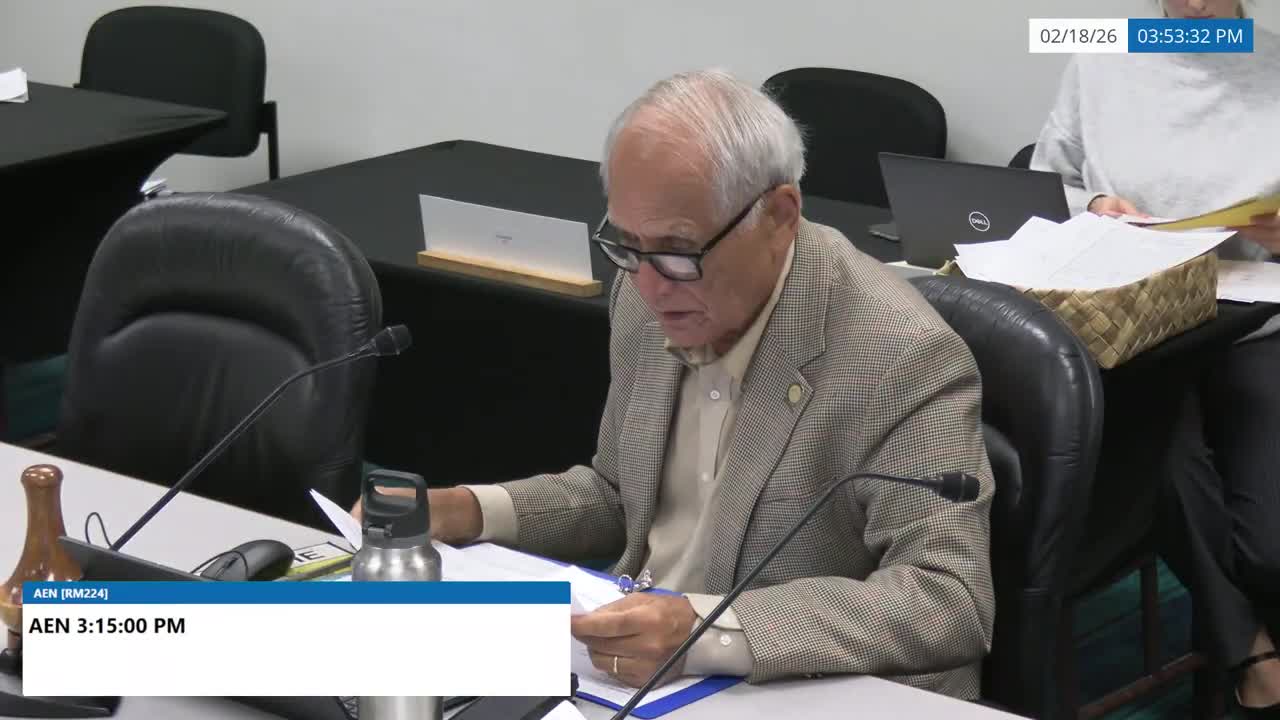
| Feb 18, 2026 | The committee(s) on AEN recommend(s) that the measure be PASSED, WITH AMENDMENTS. The votes in AEN were as follows: 4 Aye(s): Senator(s) Gabbard, Richards, DeCoite, Rhoads; Aye(s) with reservations: none ; 0 No(es): none; and 1 Excused: Senator(s) Awa. |
| Feb 13, 2026 | The committee(s) on AEN has scheduled a public hearing on 02-18-26 3:15PM; Conference Room 224 & Videoconference. |
| Jan 28, 2026 | Referred to AEN, WAM/JDC. |
| Jan 26, 2026 | Passed First Reading. |
| Jan 23, 2026 | Introduced. |
|
Date
|
Description
|
Location
|
Votes
|
|
|---|---|---|---|---|
| Feb 18, 2026 | The committee(s) on AEN recommend(s) that the measure be PASSED, WITH AMENDMENTS | Senate Standing Committee on Agriculture and Environment |
Passed |
This list shows positions taken on this bill by organizations on the date displayed, which is linked to the original source.
Positions by individuals are not included.
|
Organization
|
Position
|
Date
|
|---|---|---|
| Department of Agriculture and Biosecurity | ** Support | |
| Hawaiʻi Farm Bureau | ** Support | |
| Hawaiʻi Sustainable Farms | ** Support | |
| Hawai‘i Farm Bureau | *** Support | Feb 18, 2026 |
| Hawai’i Hemp Farmers Association | *** Support | Feb 18, 2026 |
| Hawai’i Hemp Task Force | *** Support | Feb 18, 2026 |
| Hawai’i Sustainable Farms | *** Support | Feb 18, 2026 |
| Hemp Feed Coalition | *** Support | Feb 18, 2026 |
| Keki O ka ʻĀina Farms Inc. | *** Support | Feb 18, 2026 |
STAND. COM. REP. NO. 2645
Honolulu, Hawaii
RE: S.B. No. 2712
S.D. 1
Honorable Ronald D. Kouchi
President of the Senate
Thirty-Third State Legislature
Regular Session of 2026
State of Hawaii
Sir:
Your Committee on Agriculture and Environment, to which was referred S.B. No. 2712 entitled:
"A BILL FOR AN ACT RELATING TO HEMP,"
begs leave to report as follows:
The purpose and intent of this measure is to:
(1) Establish the Hawaii Hemp Fiber Special Fund;
(2) Establish the Hemp Paper Packaging Pilot Program;
(3) Establish the Industrial Hemp License Surcharge;
(4) Require reports to the Legislature; and
(5) Appropriate funds.
Your Committee received testimony in support of this measure from the Department of Agriculture and Biosecurity, Hawaiʻi Farm Bureau, Hawaiʻi Sustainable Farms, and four individuals.
Your Committee received comments on this measure from the Department of the Attorney General.
Your Committee finds that industrial hemp is an essential agricultural product and has the potential to create local jobs, support local manufacturing, reduce dependence on importation of goods, and overall strengthen the State's economy. However, there is currently a lack of targeted incentives and support programs to encourage sustainable private investment. Your Committee believes that industrial hemp fiber represents a potential opportunity within a diversified agricultural portfolio, particularly in processing, manufacturing, and downstream product development within the State. By expanding the authority, responsibilities, and resources of the Department of Agriculture and Biosecurity, this measure will support value-added agriculture, strengthen local manufacturing capacity, and reduce the State's reliance on imported materials.
Your Committee acknowledges the concerns raised in testimony by the Department of the Attorney General that pursuant to the Hawaii State Constitution, this measure requires language establishing appropriate standards for state agencies to issue grants. Your Committee further acknowledges the concerns raised in testimony by Hawaii Sustainable Farms regarding the limitations on the ability to grow hemp due to additional and unnecessary regulatory burdens proposed in this measure in its current form and the need to expand industrial hemp production in the State. Therefore, amendments to this measure are necessary to address these concerns.
Accordingly, your Committee has amended this measure by:
(1) Deleting the definition of "fiber materials";
(2) Renaming the Hawaii Hemp Fiber Special Fund to the Hawaii Hemp Special Fund;
(3) Specifying that all eligible industrial hemp production and all industrial uses shall be eligible for grants from the Hawaii Hemp Special Fund;
(4) Inserting language establishing appropriate standards for the Department of Agriculture and Biosecurity to issue grants for industrial hemp production;
(5) Inserting language to clarify that to qualify for grant moneys under the Hawaii Hemp Special Fund, an applicant shall demonstrate successful cultivation of at least one industrial hemp crop under a United States Department of Agriculture approved hemp program before January 1, 2025;
(6) Deleting language that would have established the industrial hemp license surcharge;
(7) Inserting language that clarifies that no additional state license fees, taxes, surcharges, or regulatory requirements shall be imposed on industrial hemp producers or processors beyond those required pursuant to federal law or existing state licensing requirements;
(8) Inserting a blank appropriation amount;
(9) Amending section 1 to reflect its amended purpose;
(10) Inserting an effective date of July 1, 2050, to encourage further discussion; and
(11) Making technical, nonsubstantive amendments for the purposes of clarity and consistency.
Your Committee notes that this measure, as amended, contains an unspecified appropriation amount. Should your Committees on Ways and Means and Judiciary choose to deliberate on this measure, your Committee respectfully requests that they consider inserting an appropriation amount of $25,000,000 for the Hawaii Hemp Special Fund.
As affirmed by the record of votes of the members of your Committee on Agriculture and Environment that is attached to this report, your Committee is in accord with the intent and purpose of S.B. No. 2712, as amended herein, and recommends that it pass Second Reading in the form attached hereto as S.B. No. 2712, S.D. 1, and be referred to your Committees on Ways and Means and Judiciary.
Respectfully submitted on behalf of the members of the Committee on Agriculture and Environment,
|
|
|
________________________________ MIKE GABBARD, Chair |
|
|
|
|
|
Date
|
Testimony PDF
|
|---|---|
| Feb 18, 2026 | SB2712_TESTIMONY_AEN_02-18-26_.PDF |
Discussed in Hearing
 3MIN
Senate Standing Committee on Agriculture and Environment
3MIN
Senate Standing Committee on Government Operations
3MIN
Senate Standing Committee on Economic Development and Tourism
3MIN
Senate Standing Committee on Energy and Intergovernmental Affairs
3MIN
Senate Standing Committee on Water, Land, Culture and the Arts
3MIN
Senate Standing Committee on Agriculture and Environment
3MIN
Senate Standing Committee on Government Operations
3MIN
Senate Standing Committee on Economic Development and Tourism
Bill Author
Bill Co-Author(s):