SB 850: State Council on Developmental Disabilities; Developmental Disabilities; Intellectual Disabilities; Health Disparities; Health Equity; Report; Appropriations
- Session Year: 2025-2026
- House: Senate
- Latest Version Date: 2025-04-24
Current Status:
In Progress
(2025-07-02: Act 275, on 07/02/2025 (Gov. Msg. No. 1378).)
Introduced
In Committee
First Chamber
In Committee
Second Chamber
Final Decking
Enacted
Requires the State Council on Developmental Disabilities to collect data and submit to the Legislature a report focused on the health disparities experienced by individuals with intellectual or developmental disabilities in the State prior to the convening of the Regular Session of 2027. Appropriates funds. (CD1)
Requires the State Council on Developmental Disabilities to collect data and submit to the Legislature a report focused on the health disparities experienced by individuals with intellectual or developmental disabilities in the State prior to the convening of the Regular Session of 2027. Appropriates funds. Effective 7/1/3000. (HD1)
Requires the State Council on Developmental Disabilities to collect data and submit to the Legislature a report focused on the health disparities experienced by individuals with intellectual or developmental disabilities in the State prior to the convening of the Regular Session of 2027. Appropriates funds. Effective 12/31/2050. (SD2)
Requires the State Council on Developmental Disabilities to collect data and submit to the Legislature a report focused on the health disparities experienced by individuals with intellectual or developmental disabilities in the State prior to the convening of the Regular Session of 2027. Appropriates funds. Effective 12/31/2050. (SD1)
Requires the State Council on Developmental Disabilities to collect data and submit to the Legislature a report focused on the health disparities experienced by individuals with intellectual or developmental disabilities in the State prior to the convening of the Regular Session of 2027. Appropriates funds.
|
THE SENATE |
S.B. NO. |
850 |
|
THIRTY-THIRD LEGISLATURE, 2025 |
S.D. 2 |
|
|
STATE OF HAWAII |
H.D. 1 |
|
|
|
C.D. 1 |
|
|
|
||
|
|
||
A BILL FOR AN ACT
RELATING TO DISABILITY HEALTH DISPARITY.
BE IT ENACTED BY THE LEGISLATURE OF THE STATE OF HAWAII:
Decades of research have clearly established that members of minority groups living in the United States receive poor health care and have poor health outcomes resulting from social determinants of health. On a national level, racial and ethnic disparities in access to health care and health outcomes are a persistent, pervasive public health problem. In the State, underserved populations, such as Native Hawaiians and other Pacific Islanders, have been historically underrepresented in health care, as data does not accurately reflect the health disparities currently faced by this group. Additionally, individuals from the neighbor islands are also underrepresented and underserved, as access to health care resources and services are limited. However, even less is known about the extent of racial and ethnic health disparities among adults with intellectual or developmental disabilities. Accordingly, there is an urgent need to create an updated, accurate set of data that reflects the State's unique need to assist certain agencies to better understand the needs of individuals with intellectual or developmental disabilities in their communities.
The legislature further finds troubling gaps in the health disparities of people with intellectual or developmental disabilities and their social determinants of health in the State. Certain recent health surveys in the State and existing related initiatives do not segregate data pertaining to individuals with intellectual or developmental disabilities, nor is the data publicly available. Presently, the State relies on prevalence rate data from the federal government published in 1994-1995 that does not reflect the State's current population and its specific needs. The State's prevalence rate is 1.58 per cent, which equals approximately twenty-two thousand people who have an intellectual or developmental disability. Additionally, the only substantial data the state council on developmental disabilities collects on intellectual or developmental disabilities is through the medicaid waiver program, which serves approximately three thousand people. As there is a gap of approximately nineteen thousand people who may have an intellectual or developmental disability in the State, there is little information on quality of life, health care access, and health care outcomes for uncounted individuals with intellectual or developmental disabilities.
Accordingly, the legislature finds that further research is needed to understand the health disparities of people with intellectual or developmental disabilities and their social determinants of health. It is therefore imperative for the State to establish fundamental baseline data for service evaluation, policy development, and research to serve the current and future needs of individuals with intellectual or developmental disabilities. Accurate, current data will also help the State to provide culturally appropriate health care, address barriers to health care access, reduce health disparities, increase employment opportunities, and support individuals with developmental or intellectual disabilities to live healthy lives in the community.
Therefore, the purpose of this Act is to require, and appropriate funds for, the state council on developmental disabilities to study the health disparities experienced by individuals with intellectual or developmental disabilities in the State to develop data to inform the State's public health policies and practices.
SECTION 2. (a) The state council on developmental disabilities shall collect comprehensive data to identify gaps in social determinants of health, especially in the areas of health care access and quality and economic stability, that affect health outcomes and health disparities experienced by individuals with intellectual or development disabilities in the State and that can be addressed with policy, legislative, or stakeholder action.
(b) The state council on developmental disabilities shall submit a report to the legislature no later than twenty days prior to the convening of the regular session of 2027, which shall include a list of recommendations and proposals, based on the council's findings, on how state agencies and departments can implement legislation and policies to reduce health disparities experienced by individuals with intellectual or developmental disabilities. The report shall also include:
(1) A definition of the State's intellectual or developmental disability population for public health administration purposes, including the health conditions, duration, and level of severity required to qualify for disability status;
(2) A definition of the social determinants of health as used by the United States Department of Health and Human Services;
(3) Population-level differences in the State between individuals with and without intellectual or developmental disabilities on health indicators and social determinants of health, including:
(A) Access to necessary health care;
(B) Access to preventive health care, including wellness programs and emotional support services;
(C) Health behaviors, including the percentage of individuals who engage in physical activities or smoke cigarettes;
(D) Health status and outcomes, including the percentage of individuals who are considered obese or diagnosed with chronic diseases, including diabetes, hypertension, and cardiovascular diseases;
(E) Drivers of health outcomes, including the impetus to seek health care and how individuals seek health care;
(F) Emergency preparedness, including evacuation planning and ability;
(G) Health insurance coverage;
(H) Social determinants of health and health outcomes, including household income, employment status, education level, access to health information technology tools and systems, access to transportation, and the social and community environment; and
(I) Other indicators and determinants that contribute to an individual's physical and mental health;
(4) Factors contributing to the population-level differences, including race, ethnicity, gender, age, county of residence, and economic and social disadvantages and discrimination;
(5) A determination of the population-level differences and contributing factors that are preventable or avoidable;
(6) Any other information that would assist the State in determining safe, equitable, and culturally appropriate public health actions that would improve health care and address the health disparities experienced by individuals in the State with intellectual or developmental disabilities; and
(7) Proposed legislation, including best practices, for the State to reduce the health disparities experienced by individuals in the State with intellectual or developmental disabilities.
(c) In preparing the report, the state council on developmental disabilities may consult with community stakeholders on the following:
(1) Improvements to provider training about intellectual or developmental disabilities;
(2) Life experiences of individuals with intellectual or developmental disabilities;
(3) Accessibility mandates for health infrastructure that include the needs of individuals with intellectual or developmental disabilities;
(4) Communication guidelines and standards for health care providers to communicate with individuals with intellectual or developmental disabilities; and
(5) Other topics as deemed relevant by the state council on developmental disabilities.
(d) For the purposes of this Act:
"Health disparities" means population-level differences in health outcomes that are related to a history of social, economic, or environmental disadvantages that are avoidable and not primarily caused by underlying health conditions that led to the disability.
"Intellectual or developmental disability" means a lifelong physical or mental disability, or both, that typically arises before adulthood that uniquely influences the trajectory of the individual's physical, intellectual, behavioral, and emotional development and impacts how individuals experience the world around them.
SECTION 3. There is appropriated out of the general revenues of the State of Hawaii the sum of $550,000 or so much thereof as may be necessary for fiscal year 2025-2026 and the same sum or so much thereof as may be necessary for fiscal year 2026-2027 for the state council on developmental disabilities to collect comprehensive data and compile and submit to the legislature a report pursuant to this Act.
The sums appropriated shall be expended by the department of health for the purposes of this Act.
SECTION 4. This Act shall take effect on July 1, 2025.
Report Title:
State Council on Developmental Disabilities; Developmental Disabilities; Intellectual Disabilities; Health Disparities; Health Equity; Report; Appropriations
Description:
Requires the State Council on Developmental Disabilities to collect data and submit to the Legislature a report focused on the health disparities experienced by individuals with intellectual or developmental disabilities in the State prior to the convening of the Regular Session of 2027. Appropriates funds. (CD1)
The summary description of legislation appearing on this page is for informational purposes only and is not legislation or evidence of legislative intent.
|
THE SENATE |
S.B. NO. |
850 |
|
THIRTY-THIRD LEGISLATURE, 2025 |
S.D. 2 |
|
|
STATE OF HAWAII |
H.D. 1 |
|
|
|
|
|
|
|
||
|
|
||
A BILL FOR AN ACT
RELATING TO DISABILITY HEALTH DISPARITY.
BE IT ENACTED BY THE LEGISLATURE OF THE STATE OF HAWAII:
Decades of research have clearly established that members of minority groups living in the United States receive poor health care and have poor health outcomes resulting from social determinants of health. On a national level, racial and ethnic disparities in access to health care and health outcomes are a persistent, pervasive public health problem. In the State, underserved populations, such as Native Hawaiians and other Pacific Islanders, have been historically underrepresented in health care, as data does not accurately reflect the health disparities currently faced by this group. Additionally, individuals from the neighbor islands are also underrepresented and underserved, as access to health care resources and services are limited. However, even less is known about the extent of racial and ethnic health disparities among adults with intellectual or developmental disabilities. Accordingly, there is an urgent need to create an updated, accurate set of data that reflects the State's unique need to assist certain agencies to better understand the needs of individuals with intellectual or developmental disabilities in their communities.
The legislature further finds troubling gaps in the health disparities of people with intellectual or developmental disabilities and their social determinants of health in the State. Certain recent health surveys in the State and existing related initiatives do not segregate data pertaining to individuals with intellectual or developmental disabilities, nor is the data publicly available. Presently, the State relies on prevalence rate data from the federal government published in 1994-1995 that does not reflect the State's current population and its specific needs. The State's prevalence rate is 1.58 per cent, which equals approximately twenty-two thousand people who have an intellectual or developmental disability. Additionally, the only substantial data the state council on developmental disabilities collects on intellectual or developmental disabilities is through the medicaid waiver program, which serves approximately three thousand people. As there is a gap of approximately nineteen thousand people who may have an intellectual or developmental disability in the State, there is little information on quality of life, health care access, and health care outcomes for uncounted individuals with intellectual or developmental disabilities.
Accordingly, the legislature finds that further research is needed to understand the health disparities of people with intellectual or developmental disabilities and their social determinants of health. It is therefore imperative for the State to establish fundamental baseline data for service evaluation, policy development, and research to serve the current and future needs of individuals with intellectual or developmental disabilities. Accurate, current data will also help the State to provide culturally appropriate health care, address barriers to health care access, reduce health disparities, increase employment opportunities, and support individuals with developmental or intellectual disabilities to live healthy lives in the community.
Therefore, the purpose of this Act is to require, and appropriate funds for, the state council on developmental disabilities to study the health disparities experienced by individuals with intellectual or developmental disabilities in the State to develop data to inform the State's public health policies and practices.
SECTION 2. (a) The state council on developmental disabilities shall collect comprehensive data to identify gaps in social determinants of health, especially in the areas of health care access and quality and economic stability, that affect health outcomes and health disparities experienced by individuals with intellectual or development disabilities in the State and that can be addressed with policy, legislative, or stakeholder action.
(b) The state council on developmental disabilities shall submit a report to the legislature no later than twenty days prior to the convening of the regular session of 2027, which shall include a list of recommendations and proposals, based on the council's findings, on how state agencies and departments can implement legislation and policies to reduce health disparities experienced by individuals with intellectual or developmental disabilities. The report shall also include:
(1) A definition of the State's intellectual or developmental disability population for public health administration purposes, including the health conditions, duration, and level of severity required to qualify for disability status;
(2) A definition of the social determinants of health as used by the United States Department of Health and Human Services;
(3) Population-level differences in the State between individuals with and without intellectual or developmental disabilities on health indicators and social determinants of health, including:
(A) Access to necessary health care;
(B) Access to preventive health care, including wellness programs and emotional support services;
(C) Health behaviors, including the percentage of individuals who engage in physical activities or smoke cigarettes;
(D) Health status and outcomes, including the percentage of individuals who are considered obese or diagnosed with chronic diseases, including diabetes, hypertension, and cardiovascular diseases;
(E) Drivers of health outcomes, including the impetus to seek health care and how individuals seek health care;
(F) Emergency preparedness, including evacuation planning and ability;
(G) Health insurance coverage;
(H) Social determinants of health and health outcomes, including household income, employment status, education level, access to health information technology tools and systems, access to transportation, and the social and community environment; and
(I) Other indicators and determinants that contribute to an individual's physical and mental health;
(4) Factors contributing to the population-level differences, including race, ethnicity, gender, age, county of residence, and economic and social disadvantages and discrimination;
(5) A determination of the population-level differences and contributing factors that are preventable or avoidable;
(6) Any other information that would assist the State in determining safe, equitable, and culturally appropriate public health actions that would improve health care and address the health disparities experienced by individuals in the State with intellectual or developmental disabilities; and
(7) Proposed legislation, including best practices, for the State to reduce the health disparities experienced by individuals in the State with intellectual or developmental disabilities.
(c) In preparing the report, the state council on developmental disabilities may consult with community stakeholders on the following:
(1) Improvements to provider training about intellectual or developmental disabilities;
(2) Life experiences of individuals with intellectual or developmental disabilities;
(3) Accessibility mandates for health infrastructure that include the needs of individuals with intellectual or developmental disabilities;
(4) Communication guidelines and standards for health care providers to communicate with individuals with intellectual or developmental disabilities; and
(5) Other topics as deemed relevant by the state council on developmental disabilities.
(d) For the purposes of this Act:
"Health disparities" means population-level differences in health outcomes that are related to a history of social, economic, or environmental disadvantages that are avoidable and not primarily caused by underlying health conditions that led to the disability.
"Intellectual or developmental disability" means a lifelong physical or mental disability, or both, that typically arises before adulthood that uniquely influences the trajectory of the individual's physical, intellectual, behavioral, and emotional development and impacts how individuals experience the world around them.
SECTION 3. There is appropriated out of the general revenues of the State of Hawaii the sum of $ or so much thereof as may be necessary for fiscal year 2025-2026 and the same sum or so much thereof as may be necessary for fiscal year 2026-2027 for the state council on developmental disabilities to collect comprehensive data and compile and submit to the legislature a report focused on the health disparities experienced by individuals with intellectual or developmental disabilities in the State prior to the convening of the regular session of 2027.
The sums appropriated shall be expended by the department of health for the
purposes of this Act.
SECTION 4. This Act shall take effect on July 1, 3000.
Report Title:
State Council on Developmental Disabilities; Developmental Disabilities; Intellectual Disabilities; Health Disparities; Health Equity; Report; Appropriation
Description:
Requires the State Council on Developmental Disabilities to collect data and submit to the Legislature a report focused on the health disparities experienced by individuals with intellectual or developmental disabilities in the State prior to the convening of the Regular Session of 2027. Appropriates funds. Effective 7/1/3000. (HD1)
The summary description of legislation appearing on this page is for informational purposes only and is not legislation or evidence of legislative intent.
|
THE SENATE |
S.B. NO. |
850 |
|
THIRTY-THIRD LEGISLATURE, 2025 |
S.D. 2 |
|
|
STATE OF HAWAII |
|
|
|
|
|
|
|
|
||
|
|
||
A BILL FOR AN ACT
RELATING TO DISABILITY HEALTH DISPARITY.
BE IT ENACTED BY THE LEGISLATURE OF THE STATE OF HAWAII:
Decades of research have clearly established that people of minority groups living in the United States receive poor health care and have poor health outcomes resulting from social determinants of health. On a national level, racial and ethnic disparities in access to health care and health outcomes are a persistent, pervasive public health problem. In the State, underserved populations, such as Native Hawaiians and other Pacific Islanders, have been historically underrepresented in health care, as data does not accurately reflect the health disparities currently faced by this group. Additionally, individuals from the neighbor islands are also underrepresented and underserved, as access to health care resources and services are limited. However, even less is known about the extent of racial and ethnic health disparities among adults with intellectual or developmental disabilities. Accordingly, there is an urgent need to create an updated, accurate set of data that reflects the State's unique need to assist certain agencies to better understand the needs of individuals with intellectual or developmental disabilities in their communities.
The legislature further finds troubling gaps in the health disparities of people with intellectual or developmental disabilities and their social determinants of health in the State. Certain recent health surveys in the State and existing related initiatives do not segregate data pertaining to individuals with intellectual or developmental disabilities, nor is the data publicly available. Presently, the State relies on prevalence rate data from the federal government published in 1994-1995 that does not reflect the State's current population and its specific needs. The State's prevalence rate is 1.58 per cent, which equals approximately twenty-two thousand people who have an intellectual or developmental disability. Additionally, the only substantial data the state council on developmental disabilities collects on intellectual or developmental disabilities is through the medicaid waiver program, which serves approximately three thousand people. As there is a gap of approximately nineteen thousand people who may have an intellectual or developmental disability in the State, there is little information on quality of life, health care access, and health care outcomes for uncounted individuals with intellectual or developmental disabilities.
Accordingly, further research is needed to understand the health disparities of people with intellectual or developmental disabilities and their social determinants of health. It is therefore imperative for the State to establish fundamental baseline data for service evaluation, policy development, and research to serve the current and future needs of individuals with intellectual or developmental disabilities. Accurate, current data will also help the State to provide culturally appropriate health care, address barriers to health care access, reduce health disparities, increase employment opportunities, and support individuals with developmental or intellectual disabilities to live healthy lives in the community.
Therefore, the purpose of this Act is to appropriate funds and require the state council on developmental disabilities to study the health disparities experienced by individuals with intellectual or developmental disabilities in the State to yield much needed results to help guide the future of public health policy and practice.
SECTION 2. (a) The state council on developmental disabilities shall collect comprehensive data to identify gaps in social determinants of health, especially in the areas of health care access and quality and economic stability, that affect health outcomes and health disparities experienced by individuals with intellectual or development disabilities in the State and that can be addressed with policy, legislative, or stakeholder action, and shall submit a report to the legislature no later than twenty days prior to the convening of the regular session of 2027. Within the report, the state council on developmental disabilities shall compile a list of recommendations and proposals, based on the council's findings, on how state agencies and departments can implement legislation and policies to reduce health disparities experienced by individuals with intellectual or developmental disabilities. The report shall also include:
(1) A definition of the State's intellectual or developmental disability population for public health administration purposes, including the health conditions, duration, and level of severity required to qualify for disability status;
(2) A definition of the social determinants of health as used by the United States Department of Health and Human Services;
(3) Population-level differences in the State between individuals with and without intellectual or developmental disabilities on health indicators and social determinants of health, including:
(A) Access to necessary health care;
(B) Access to preventive health care, including wellness programs and emotional support services;
(C) Health behaviors, including the percentage of individuals who engage in physical activities or smoke cigarettes;
(D) Health status and outcomes, including the percentage of individuals who are considered obese or diagnosed with chronic diseases, including diabetes, hypertension, and cardiovascular diseases;
(E) Drivers of health outcomes, including the impetus to seek health care and how individuals seek health care;
(F) Emergency preparedness, including evacuation planning and ability;
(G) Health insurance coverage;
(H) Social determinants of health and health outcomes, including household income, employment status, education level, access to health information technology tools and systems, access to transportation, and the social and community environment; and
(I) Other indicators and determinants that contribute to an individual's physical and mental health;
(4) Factors contributing to the population-level differences, including race, ethnicity, gender, age, county of residence, and economic and social disadvantages and discrimination;
(5) A determination of the population-level differences and contributing factors that are preventable or avoidable;
(6) Any other information that would assist the State in determining safe, equitable, and culturally appropriate public health actions that would improve health care and address the health disparities experienced by individuals in the State with developmental or intellectual disabilities; and
(7) Proposed legislation, including best practices, for the State to reduce the health disparities experienced by individuals in the State with developmental or intellectual disabilities.
(b) In preparing the report, the state council on developmental disabilities may consult with community stakeholders on the following:
(1) Improvements to provider training about intellectual or developmental disabilities;
(2) Life experiences of individuals with intellectual or developmental disabilities;
(3) Accessibility mandates for health infrastructure that include the needs of individuals with intellectual or developmental disabilities;
(4) Communication guidelines and standards for health care providers to communicate with individuals with intellectual or developmental disabilities; and
(5) Other topics as deemed relevant by the state council on developmental disabilities.
(c) For the purposes of this Act:
"Health disparities" means population-level differences in health outcomes that are related to a history of social, economic, or environmental disadvantages that are avoidable and not primarily caused by underlying health conditions that led to the disability.
"Intellectual or developmental disabilities" means a lifelong difference that typically arises before adulthood that uniquely influences the trajectory of the individual's physical, intellectual, behavioral, and emotional development and impacts how individuals experience the world around them.
SECTION 3. There is appropriated out of the general revenues of the State of Hawaii the sum of $ or so much thereof as may be necessary for fiscal year 2025-2026 and the same sum or so much thereof as may be necessary for fiscal year 2026-2027 for the state council on developmental disabilities to collect comprehensive data and compile and submit to the legislature a report focused on the health disparities experienced by individuals with developmental or intellectual disabilities in the State prior to the convening of the regular session of 2027.
The sums appropriated shall be expended by the department of health for the purposes of this Act.
SECTION 4. This Act shall take effect on December 31, 2050.
Report Title:
SCDD; Developmental Disabilities; Intellectual Disabilities; Health Disparities; Health Equity; Report; Appropriations
Description:
Requires the State Council on Developmental Disabilities to collect data and submit to the Legislature a report focused on the health disparities experienced by individuals with intellectual or developmental disabilities in the State prior to the convening of the Regular Session of 2027. Appropriates funds. Effective 12/31/2050. (SD2)
The summary description of legislation appearing on this page is for informational purposes only and is not legislation or evidence of legislative intent.
|
THE SENATE |
S.B. NO. |
850 |
|
THIRTY-THIRD LEGISLATURE, 2025 |
S.D. 1 |
|
|
STATE OF HAWAII |
|
|
|
|
|
|
|
|
||
|
|
||
A BILL FOR AN ACT
RELATING TO DISABILITY HEALTH DISPARITY.
BE IT ENACTED BY THE LEGISLATURE OF THE STATE OF HAWAII:
Decades of research have clearly established that people of minority groups living in the United States receive poor health care and have poor health outcomes resulting from social determinants of health. On a national level, racial and ethnic disparities in access to health care and health outcomes are a persistent, pervasive public health problem. In the State, underserved populations, such as Native Hawaiians and other Pacific Islanders, have been historically underrepresented in health care, as data does not accurately reflect the health disparities currently faced by this group. Additionally, individuals from the neighbor islands are also underrepresented and underserved, as access to health care resources and services are limited. However, even less is known about the extent of racial and ethnic health disparities among adults with intellectual or developmental disabilities. Accordingly, there is an urgent need to create an updated, accurate set of data that reflects the State's unique need to assist certain agencies to better understand the needs of individuals with intellectual or developmental disabilities in their communities.
The legislature further finds troubling gaps in the health disparities of people with intellectual or developmental disabilities and their social determinants of health in the State. Certain recent health surveys in the State and existing related initiatives do not segregate data pertaining to individuals with intellectual or developmental disabilities, nor is the data publicly available. Presently, the State relies on prevalence rate data from the federal government published in 1994-1995 that does not reflect the State's current population and its specific needs. The State's prevalence rate is 1.58 per cent, which equals approximately twenty-two thousand people who have an intellectual or developmental disability. Additionally, the only substantial data the state council on developmental disabilities collects on intellectual or developmental disabilities is through the medicaid waiver program, which serves approximately three thousand people. As there is a gap of approximately nineteen thousand people who may have an intellectual or developmental disability in the State, there is little information on quality of life, health care access, and health care outcomes for uncounted individuals with intellectual or developmental disabilities.
Accordingly, further research is needed to understand the health disparities of people with intellectual or developmental disabilities and their social determinants of health. It is therefore imperative for the State to establish fundamental baseline data for service evaluation, policy development, and research to serve the current and future needs of individuals with intellectual or developmental disabilities. Accurate, current data will also help the State to provide culturally appropriate health care, address barriers to health care access, reduce health disparities, increase employment opportunities, and support individuals with developmental or intellectual disabilities to live healthy lives in the community.
Therefore, the purpose of this Act is to appropriate funds and require the state council on developmental disabilities to study the health disparities experienced by individuals with intellectual or developmental disabilities in the State to yield much needed results to help guide the future of public health policy and practice.
SECTION 2. (a) The state council on developmental disabilities shall collect comprehensive data to identify gaps in social determinants of health, especially in the areas of health care access and quality and economic stability, that affect health outcomes and health disparities experienced by individuals with intellectual or development disabilities in the State and that can be addressed with policy, legislative, or stakeholder action, and shall submit a report to the legislature no later than twenty days prior to the convening of the regular session of 2027. The report shall include:
(1) A definition of the State's intellectual or developmental disability population for public health administration purposes, including the health conditions, duration, and level of severity required to qualify for disability status;
(2) A definition of the social determinants of health as used by the United States Department of Health and Human Services;
(3) Population-level differences in the State between individuals with and without intellectual or developmental disabilities on health indicators and social determinants of health, including:
(A) Access to necessary health care;
(B) Access to preventive health care, including wellness programs and emotional support services;
(C) Health behaviors, including the percentage of individuals who engage in physical activities or smoke cigarettes;
(D) Health status and outcomes, including the percentage of individuals who are considered obese or diagnosed with chronic diseases, including diabetes, hypertension, and cardiovascular diseases;
(E) Drivers of health outcomes, including the impetus to seek health care and how individuals seek health care;
(F) Emergency preparedness, including evacuation planning and ability;
(G) Health insurance coverage;
(H) Social determinants of health and health outcomes, including household income, employment status, education level, access to health information technology tools and systems, access to transportation, and the social and community environment; and
(I) Other indicators and determinants that contribute to an individual's physical and mental health;
(4) Factors contributing to the population-level differences, including race, ethnicity, gender, age, county of residence, and economic and social disadvantages and discrimination;
(5) A determination of the population-level differences and contributing factors that are preventable or avoidable;
(6) Any other information that would assist the State in determining safe, equitable, and culturally appropriate public health actions that would improve health care and address the health disparities experienced by individuals in the State with developmental or intellectual disabilities; and
(7) Proposed legislation, including best practices, for the State to reduce the health disparities experienced by individuals in the State with developmental or intellectual disabilities.
(b) In preparing the report, the state council on developmental disabilities may consult with community stakeholders on the following:
(1) Improvements to provider training about intellectual or developmental disabilities;
(2) Life experiences of individuals with intellectual or developmental disabilities;
(3) Accessibility mandates for health infrastructure that include the needs of individuals with intellectual or developmental disabilities;
(4) Communication guidelines and standards for health care providers to communicate with individuals with intellectual or developmental disabilities; and
(5) Other topics as deemed relevant by the state council on developmental disabilities.
(c) For the purposes of this Act:
"Health disparities" means population-level differences in health outcomes that are related to a history of social, economic, or environmental disadvantages that are avoidable and not primarily caused by underlying health conditions that led to the disability.
"Intellectual or developmental disabilities" means a lifelong difference that typically arises before adulthood that uniquely influences the trajectory of the individual's physical, intellectual, behavioral, and emotional development and impacts how individuals experience the world around them.
SECTION 3. There is appropriated out of the general revenues of the State of Hawaii the sum of $ or so much thereof as may be necessary for fiscal year 2025-2026 and the same sum or so much thereof as may be necessary for fiscal year 2026-2027 for the state council on developmental disabilities to collect comprehensive data and compile and submit to the legislature a report focused on the health disparities experienced by individuals with developmental or intellectual disabilities in the State prior to the convening of the regular session of 2027.
The sums appropriated shall be expended by the department of health for the purposes of this Act.
SECTION 4. This Act shall take effect on December 31, 2050.
Report Title:
SCDD; Developmental Disabilities; Intellectual Disabilities; Health Disparities; Health Equity; Report; Appropriations
Description:
Requires the State Council on Developmental Disabilities to collect data and submit to the Legislature a report focused on the health disparities experienced by individuals with intellectual or developmental disabilities in the State prior to the convening of the Regular Session of 2027. Appropriates funds. Effective 12/31/2050. (SD1)
The summary description of legislation appearing on this page is for informational purposes only and is not legislation or evidence of legislative intent.
|
THE SENATE |
S.B. NO. |
850 |
|
THIRTY-THIRD LEGISLATURE, 2025 |
|
|
|
STATE OF HAWAII |
|
|
|
|
|
|
|
|
||
|
|
||
A BILL FOR AN ACT
relating to disability health disparity.
BE IT ENACTED BY THE LEGISLATURE OF THE STATE OF HAWAII:
Decades of research has clearly established that people of minority groups living in the United States receive poor health care and have poor health outcomes resulting from social determinants of health. On a national level, racial and ethnic disparities in access to health care and health outcomes are a persistent, pervasive public health problem. In the State, underserved populations, such as Native Hawaiian and Pacific Islanders, have been historically underrepresented in health care, as data does not accurately reflect the health disparities currently faced by this group. Additionally, individuals from the neighbor islands are also underrepresented and underserved, as access to health care resources and services are limited. However, even less is known about the extent of racial and ethnic health disparities among adults with intellectual or developmental disabilities. Accordingly, there is an urgent need to create an updated, accurate set of data that reflects the State's unique needs to assist certain agencies to better understand the needs of individuals with intellectual or developmental disabilities in their communities.
The legislature further finds troubling gaps in the health disparities of people with intellectual or developmental disabilities and their social determinants of health in the State. Certain recent health surveys in the State and existing related initiatives do not segregate data pertaining to individuals with intellectual or developmental disabilities, nor is the data publicly available. Presently, the State relies on prevalence rate data from the federal government published in 1994-1995 that does not reflect the State's population and its specific needs. The State's prevalence rate is 1.58 per cent, which equals approximately twenty-two thousand people who have an intellectual or developmental disability. Additionally, the only substantial data the state council on developmental disabilities collects on intellectual or developmental disabilities is through the medicaid waiver program, which serves approximately three thousand people. As there is a gap of approximately nineteen thousand people who may have an intellectual or developmental disability in the State, there is little information on quality of life, health care access, and health care outcomes for unaccounted individuals with intellectual or developmental disabilities.
Accordingly, further research is needed to understand the health disparities of people with intellectual or developmental disabilities and their social determinants of health. It is therefore imperative for the State to establish fundamental baseline data for service evaluation, policy development, and research to serve the current and future needs of individuals with intellectual or developmental disabilities. Accurate, current data will also help the State provide culturally appropriate health care, address barriers to health care access, reduce health disparities, increase employment opportunities, and support individuals with developmental or intellectual disabilities to live healthy lives in the community.
Therefore, the purpose of this Act is to appropriate funds and require the state council on developmental disabilities to study the health disparities experienced by individuals with intellectual or developmental disabilities in the State to yield much needed results to help guide the future of public health policy and practice.
SECTION 2. (a) The state council on developmental disabilities shall collect comprehensive data to identify gaps in social determinants of health, especially in the areas of health care access and quality and economic stability, that affect health outcomes and health disparities experienced by individuals with intellectual or development disabilities in the State that can be addressed with policy, legislative, or stakeholder action, and shall submit a report to the legislature no later than twenty days prior to the convening of the regular session of 2027. The report shall include:
(1) A definition of the State's intellectual or developmental disability population for public health administration purposes, including the health conditions, duration, and level of severity required to qualify for disability status;
(2) A definition of the social determinants of health as used by the United States Department of Health and Human Services;
(3) Population-level differences in the State between individuals with and without intellectual or developmental disabilities on health indicators and social determinants of health, including:
(A) Access to necessary health care;
(B) Access to preventive health care, including wellness programs and emotional support services;
(C) Health behaviors, including the percentage of individuals who engage in physical activities or smoke cigarettes;
(D) Health status and outcomes, including the percentage of individuals who are considered obese or diagnosed with chronic diseases, including diabetes, hypertension, and cardiovascular diseases;
(E) Drivers of health outcomes, including the impetus to seek health care and how individuals seek health care;
(F) Emergency preparedness, including evacuation planning and ability;
(G) Health insurance coverage;
(H) Social determinants of health and health outcomes, including household income, employment status, education level, access to health information technology tools and systems, access to transportation, and the social and community environment; and
(I) Other indicators and determinants that contribute to an individual's physical and mental health;
(4) Factors contributing to the population-level differences, including race, ethnicity, gender, age, county of residence, and economic and social disadvantages and discrimination;
(5) A determination of the population-level differences and contributing factors that are preventable or avoidable;
(6) Any other information that would assist the State in determining safe, equitable, and culturally appropriate public health actions that would improve health care and address the health disparities experienced by individuals in the State with developmental or intellectual disabilities; and
(7) Proposed legislation, including best practices, for the State to reduce the health disparities experienced by individuals in the State with developmental or intellectual disabilities.
(b) In preparing the report, the state council on developmental disabilities may consult with community stakeholders on the following:
(1) Improvements to provider training about intellectual or developmental disabilities;
(2) Life experiences of individuals with intellectual or developmental disabilities;
(3) Accessibility mandates for health infrastructure that include the needs of individuals with intellectual or developmental disabilities;
(4) Communication guidelines and standards for health care providers to communicate with individuals with intellectual or developmental disabilities; and
(5) Other topics as deemed relevant by the state council on developmental disabilities.
(c) For the purposes of this Act:
"Health disparities" means population-level differences in health outcomes that are related to a history of social, economic, or environmental disadvantages that are avoidable and not primarily caused by underlying health conditions that led to the disability.
"Intellectual or developmental disabilities" means a lifelong difference that typically arises before adulthood that uniquely influences the trajectory of the individual's physical, intellectual, behavioral, and emotional development and impacts how individuals experience the world around them.
SECTION 3. There is appropriated out of the general revenues of the State of Hawaii the sum of $ or so much thereof as may be necessary for fiscal year 2025-2026 and the same sum or so much thereof as may be necessary for fiscal year 2026-2027 for the state council on developmental disabilities to collect comprehensive data and compile and submit to the legislature a report focused on the health disparities experienced by individuals with developmental or intellectual disabilities in the State prior to the convening of the regular session of 2027.
The sums appropriated shall be expended by the department of health for the purposes of this Act.
SECTION 4. This Act shall take effect on July 1, 2025.
|
INTRODUCED BY: |
_____________________________ |
|
|
|
Report Title:
SCDD; Developmental Disabilities; Intellectual Disabilities; Health Disparities; Health Equity; Report; Appropriations
Description:
Requires the State Council on Developmental Disabilities to collect data and submit to the Legislature a report focused on the health disparities experienced by individuals with intellectual or developmental disabilities in the State prior to the convening of the Regular Session of 2027. Appropriates funds.
The summary description of legislation appearing on this page is for informational purposes only and is not legislation or evidence of legislative intent.
|
Date
|
Status
|
|---|---|
| Jul 2, 2025 | Act 275, on 07/02/2025 (Gov. Msg. No. 1378). |
| Jul 2, 2025 | Act 275, 07/02/2025 (Gov. Msg. No. 1378). |
| May 2, 2025 | Enrolled to Governor. |
| May 2, 2025 | Received notice of passage on Final Reading in House (Hse. Com. No. 821). |
| May 1, 2025 | Received notice of Final Reading (Sen. Com. No. 888). |
| Apr 30, 2025 | Passed Final Reading as amended in CD 1 with none voting aye with reservations; none voting no (0) and Representative(s) Cochran, Pierick excused (2). |
| Apr 30, 2025 | Passed Final Reading, as amended (CD 1). Ayes, 25; Aye(s) with reservations: none . 0 No(es): none. 0 Excused: none. |
| Apr 24, 2025 | Forty-eight (48) hours notice Wednesday, 04-30-25. |
| Apr 24, 2025 | Reported from Conference Committee (Conf Com. Rep. No. 64) as amended in (CD 1). |
| Apr 24, 2025 | 48 Hrs. Notice (as amended CD 1) 04-30-25. |
| Apr 24, 2025 | Reported from Conference Committee as amended CD 1 (Conf. Com. Rep. No. 64). |
| Apr 23, 2025 | The Conference committee recommends that the measure be PASSED, WITH AMENDMENTS. The votes of the Senate Conference Managers were as follows: 4 Aye(s): Senator(s) San Buenaventura, Kanuha, Hashimoto, Fevella; Aye(s) with reservations: none ; 0 No(es): none; and 0 Excused: none. |
| Apr 23, 2025 | The Conference Committee recommends that the measure be Passed, with Amendments. The votes were as follows: 3 Ayes: Representative(s) Takayama, Keohokapu-Lee Loy, Alcos; Ayes with reservations: none; 0 Noes: none; and 0 Excused: none. |
| Apr 22, 2025 | Conference committee meeting scheduled for 04-23-25 3:30PM; Conference Room 329. |
| Apr 21, 2025 | Received notice of appointment of House conferees (Hse. Com. No. 754). |
| Apr 17, 2025 | House Conferees Appointed: Takayama, Keohokapu-Lee Loy Co-Chairs; Alcos. |
| Apr 15, 2025 | Received notice of Senate conferees (Sen. Com. No. 789). |
| Apr 15, 2025 | Senate Conferees Appointed: San Buenaventura Chair; Kanuha Co-Chair; Hashimoto, Fevella. |
| Apr 8, 2025 | Received notice of disagreement (Sen. Com. No. 774). |
| Apr 8, 2025 | Senate disagrees with House amendments. |
| Apr 8, 2025 | Received from House (Hse. Com. No. 586). |
| Apr 4, 2025 | Passed Third Reading with none voting aye with reservations; none voting no (0) and Representative(s) Cochran, Kapela excused (2). Transmitted to Senate. |
| Apr 4, 2025 | Passed Second Reading; placed on the calendar for Third Reading with none voting aye with reservations; none voting no (0) and Representative(s) Cochran, Kapela excused (2). |
| Apr 4, 2025 | Reported from FIN (Stand. Com. Rep. No. 1959), recommending passage on Third Reading. |
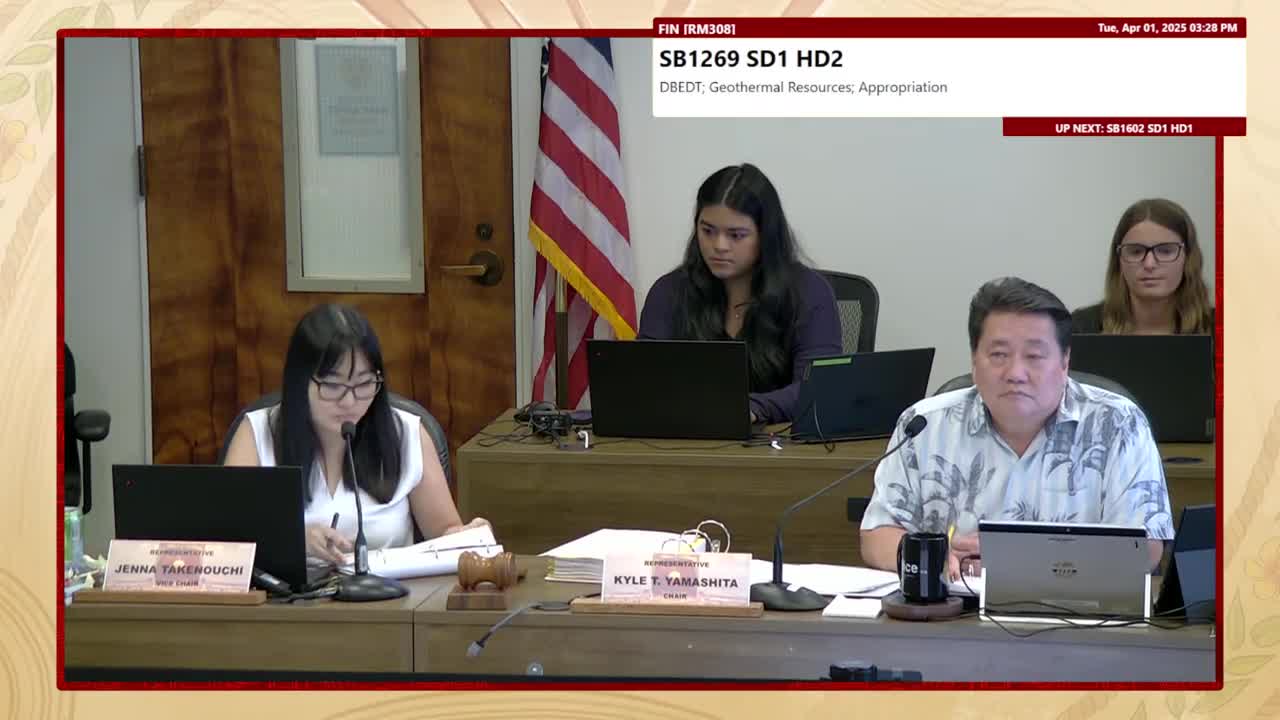
| Apr 1, 2025 | The committee on FIN recommend that the measure be PASSED, UNAMENDED. The votes were as follows: 14 Ayes: Representative(s) Yamashita, Takenouchi, Grandinetti, Holt, Hussey, Keohokapu-Lee Loy, Kitagawa, Kusch, Lamosao, Lee, M., Miyake, Morikawa, Templo, Reyes Oda; Ayes with reservations: none; Noes: none; and 1 Excused: Representative(s) Alcos. |
| Mar 28, 2025 | Bill scheduled to be heard by FIN on Tuesday, 04-01-25 2:00PM in House conference room 308 VIA VIDEOCONFERENCE. |
| Mar 21, 2025 | Passed Second Reading as amended in HD 1 and referred to the committee(s) on FIN with none voting aye with reservations; none voting no (0) and Representative(s) Cochran, Garrett, Kapela, Kitagawa, Ward excused (5). |
| Mar 21, 2025 | Reported from HLT (Stand. Com. Rep. No. 1418) as amended in HD 1, recommending passage on Second Reading and referral to FIN. |
| Mar 19, 2025 | The committee on HLT recommend that the measure be PASSED, WITH AMENDMENTS. The votes were as follows: 9 Ayes: Representative(s) Takayama, Keohokapu-Lee Loy, Amato, Chun, Marten, Olds, Takenouchi, Alcos, Garcia; Ayes with reservations: none; 0 Noes: none; and 0 Excused: none. |
| Mar 14, 2025 | Bill scheduled to be heard by HLT on Wednesday, 03-19-25 9:05AM in House conference room 329 VIA VIDEOCONFERENCE. |
| Mar 6, 2025 | Referred to HLT, FIN, referral sheet 19 |
| Mar 6, 2025 | Pass First Reading |
| Mar 4, 2025 | Received from Senate (Sen. Com. No. 210) in amended form (SD 2). |
| Mar 4, 2025 | Report adopted; Passed Third Reading, as amended (SD 2). Ayes, 25; Aye(s) with reservations: none . Noes, 0 (none). Excused, 0 (none). Transmitted to House. |
| Feb 27, 2025 | 48 Hrs. Notice 03-04-25. |
| Feb 27, 2025 | Reported from WAM (Stand. Com. Rep. No. 765) with recommendation of passage on Third Reading, as amended (SD 2). |
| Feb 19, 2025 | The committee(s) on WAM recommend(s) that the measure be PASSED, WITH AMENDMENTS. The votes in WAM were as follows: 13 Aye(s): Senator(s) Dela Cruz, Moriwaki, Aquino, DeCoite, Elefante, Hashimoto, Inouye, Kanuha, Kidani, Kim, Lee, C., Wakai, Fevella; Aye(s) with reservations: none ; 0 No(es): none; and 0 Excused: none. |
| Feb 14, 2025 | The committee(s) on WAM will hold a public decision making on 02-19-25 10:02AM; Conference Room 211 & Videoconference. |
| Feb 14, 2025 | Report adopted; Passed Second Reading, as amended (SD 1) and referred to WAM. |
| Feb 14, 2025 | Reported from HHS (Stand. Com. Rep. No. 628) with recommendation of passage on Second Reading, as amended (SD 1) and referral to WAM. |
| Feb 12, 2025 | The committee(s) on HHS recommend(s) that the measure be PASSED, WITH AMENDMENTS. The votes in HHS were as follows: 5 Aye(s): Senator(s) San Buenaventura, Aquino, Hashimoto, Keohokalole, Fevella; Aye(s) with reservations: none ; 0 No(es): none; and 0 Excused: none. |
| Feb 7, 2025 | The committee(s) on HHS has scheduled a public hearing on 02-12-25 1:00PM; Conference Room 225 & Videoconference. |
| Jan 23, 2025 | Referred to HHS, WAM. |
| Jan 21, 2025 | Passed First Reading. |
| Jan 17, 2025 | Introduced. |
|
Date
|
Description
|
Location
|
Votes
|
|
|---|---|---|---|---|
| Apr 30, 2025 | Final Reading | House Floor |
Passed |
|
| Apr 30, 2025 | Final Reading | Senate Floor |
Passed |
|
| Apr 4, 2025 | Third Reading | House Floor |
Passed |
|
| Apr 1, 2025 | The committee on FIN recommend that the measure be PASSED, UNAMENDED | House Standing Committee on Finance |
Passed |
|
| Mar 19, 2025 | The committee on HLT recommend that the measure be PASSED, WITH AMENDMENTS | House Standing Committee on Health |
Passed |
|
| Mar 4, 2025 | Third Reading | Senate Floor |
Passed |
|
| Feb 19, 2025 | The committee(s) on WAM recommend(s) that the measure be PASSED, WITH AMENDMENTS | Senate Standing Committee on Ways and Means |
Passed |
|
| Feb 12, 2025 | The committee(s) on HHS recommend(s) that the measure be PASSED, WITH AMENDMENTS | Senate Standing Committee on Health and Human Services |
Passed |
This list shows positions taken on this bill by organizations on the date displayed, which is linked to the original source.
Positions by individuals are not included.
|
Organization
|
Position
|
Date
|
|---|---|---|
| College of Social Sciences | *** Support | Mar 18, 2025 |
| Disability and Communication Access Board | ** Support | |
| Easterseals Hawaii | ** Support | |
| Executive Office on Aging | ** Support | |
| Executive Office on Aging (attached agency to the Department of Health) | *** Support | Mar 31, 2025 |
| Full Life | ** Support | |
| Hawaii Disability Rights Center | ** Support | |
| Hawaii Self Advocacy Advisory Council | ** Support | |
| Hawaii Self-Advocacy Advisory Council | *** Support | Mar 18, 2025 |
| Hawaii Self-Advocacy Advisory Council | ** Support | |
| Hawaiʻi State Council on Developmental Disabilities | *** Support | Mar 31, 2025 |
| Office of the Governor | *** Support | Mar 18, 2025 |
| Office of Wellness and Resilience | ** Support | |
| Office of Wellness and Resilience (Office of the Governor) | *** Support | Mar 31, 2025 |
| Social Science Research Institute | *** Support | Feb 18, 2025 |
| State Council on Developmental Disabilities | ** Support | |
| UHealthy Hawaiʻi program | *** Support | Feb 18, 2025 |
| UHERO | *** Support | Feb 18, 2025 |
| University of Hawaii System | ** Support |
CONFERENCE COMMITTEE REP. NO. 64
Honolulu, Hawaii
, 2025
RE: S.B. No. 850
S.D. 2
H.D. 1
C.D. 1
Honorable Ronald D. Kouchi
President of the Senate
Thirty-Third State Legislature
Regular Session of 2025
State of Hawaii
Honorable Nadine K. Nakamura
Speaker, House of Representatives
Thirty-Third State Legislature
Regular Session of 2025
State of Hawaii
Sir and Madam:
Your Committee on Conference on the disagreeing vote of the Senate to the amendments proposed by the House of Representatives in S.B. No. 850, S.D. 2, H.D. 1, entitled:
"A BILL FOR AN ACT RELATING TO DISABILITY HEALTH DISPARITY,"
having met, and after full and free discussion, has agreed to recommend and does recommend to the respective Houses the final passage of this bill in an amended form.
The purpose of this measure is to require the State Council on Developmental Disabilities to collect data and submit to the Legislature a report focused on the health disparities experienced by individuals with intellectual or developmental disabilities in the State prior to the convening of the Regular Session of 2027.
Your Committee on Conference finds that adults with intellectual or developmental disabilities experience disproportionate health disparities compared to those without disabilities. Your Committee on Conference further finds that it is imperative for the State to gather fundamental baseline data for service evaluation, policy development, and research to serve the current and future needs of individuals with intellectual or developmental disabilities, including culturally appropriate health care, reduced barriers to health care access, reduced health disparities, and increased employment opportunities.
Your Committee on Conference has amended this measure by:
(1) Inserting an appropriation amount of $550,000 for the fiscal biennium for the State Council on Developmental Disabilities to collect comprehensive data and compile and submit a report to the Legislature;
(2) Changing its effective date to July 1, 2025; and
(3) Making technical, nonsubstantive amendments for the purposes of clarity and consistency.
As affirmed by the record of votes of the managers of your Committee on Conference that is attached to this report, your Committee on Conference is in accord with the intent and purpose of S.B. No. 850, S.D. 2, H.D. 1, as amended herein, and recommends that it pass Final Reading in the form attached hereto as S.B. No. 850, S.D. 2, H.D. 1, C.D. 1.
Respectfully submitted on behalf of the managers:
|
ON THE PART OF THE HOUSE |
|
ON THE PART OF THE SENATE |
|
____________________________ GREGG TAKAYAMA Co-Chair |
|
____________________________ JOY A. SAN BUENAVENTURA Chair |
|
____________________________ SUE L. KEOHOKAPU-LEE LOY Co-Chair |
|
____________________________ DRU KANUHA Co-Chair |
|
|
|
|
|
|
|
|
STAND. COM. REP. NO. 1959
Honolulu, Hawaii
, 2025
RE: S.B. No. 850
S.D. 2
H.D. 1
Honorable Nadine K. Nakamura
Speaker, House of Representatives
Thirty-Third State Legislature
Regular Session of 2025
State of Hawaii
Madame:
Your Committee on Finance, to which was referred S.B. No. 850, S.D. 2, H.D. 1, entitled:
"A BILL FOR AN ACT RELATING TO DISABILITY HEALTH DISPARITY,"
begs leave to report as follows:
(1) Study the social determinants of health that affect health disparities experienced by individuals with intellectual or developmental disabilities in the State and can be addressed with policy, legislative, or stakeholder action; and
(2) Report to the Legislature recommendations and proposals on how state agencies can reduce these health disparities.
Your Committee received testimony in support of this measure from the Office of Wellness and Resilience; University of Hawaii System; Executive Office on Aging; State Council on Developmental Disabilities; Disability and Communication Access Board; and Full Life.
As affirmed by the record of votes of the members of your Committee on Finance that is attached to this report, your Committee is in accord with the intent and purpose of S.B. No. 850, S.D. 2, H.D. 1, and recommends that it pass Third Reading.
Respectfully submitted on behalf of the members of the Committee on Finance,
|
|
|
____________________________ KYLE T. YAMASHITA, Chair |
|
|
|
|
STAND. COM. REP. NO. 1418
Honolulu, Hawaii
, 2025
RE: S.B. No. 850
S.D. 2
H.D. 1
Honorable Nadine K. Nakamura
Speaker, House of Representatives
Thirty-Third State Legislature
Regular Session of 2025
State of Hawaii
Madame:
Your Committee on Health, to which was referred S.B. No. 850, S.D. 2, entitled:
"A BILL FOR AN ACT RELATING TO DISABILITY HEALTH DISPARITY,"
begs leave to report as follows:
The purpose of this measure is to require, and appropriate funds for, the State Council on Developmental Disabilities to study health disparities experienced by individuals with intellectual or developmental disabilities in the State to develop data to inform the State's public health policies and practices.
Your Committee received testimony in support of this measure from the Office of Wellness and Resilience; University of Hawaii System; Executive Office on Aging; Disability and Communication Access Board; State Council on Developmental Disabilities; Hawaii Self-Advocacy Advisory Council; Hawaii Disability Rights Center; Easterseals Hawaii; and four individuals.
Your Committee finds that adults with intellectual or developmental disabilities experience disproportionate health disparities in comparison to their peers without disabilities. Your Committee further finds that there is a critical lack of information on the health disparities and social determinants of health for individuals with intellectual or developmental disabilities in the State, leading to gaps in research, health care, and policies that unnecessarily create challenges for people with intellectual or developmental disabilities. Your Committee believes that there is a pressing need to develop an updated, accurate set of data on the health disparities of individuals with intellectual or developmental disabilities and their social determinants of health, including the development of baseline data and prevalence rates, to ensure individuals with intellectual or developmental disabilities in Hawaii are provided with appropriate resources, health care, and social services.
Your Committee has amended this measure by:
(1) Changing the effective date to July 1, 3000, to encourage further discussion; and
(2) Making technical, nonsubstantive amendments for the purposes of clarity, consistency, and style.
Your Committee respectfully requests your Committee on Finance, should it deliberate on this measure, to consider an appropriation amount of $550,000.
As affirmed by the record of votes of the members of your Committee on Health that is attached to this report, your Committee is in accord with the intent and purpose of S.B. No. 850, S.D. 2, as amended herein, and recommends that it pass Second Reading in the form attached hereto as S.B. No. 850, S.D. 2, H.D. 1, and be referred to your Committee on Finance.
Respectfully submitted on behalf of the members of the Committee on Health,
|
|
|
____________________________ GREGG TAKAYAMA, Chair |
|
|
|
|
STAND. COM. REP. NO. 765
Honolulu, Hawaii
RE: S.B. No. 850
S.D. 2
Honorable Ronald D. Kouchi
President of the Senate
Thirty-Third State Legislature
Regular Session of 2025
State of Hawaii
Sir:
Your Committee on Ways and Means, to which was referred S.B. No. 850, S.D. 1, entitled:
"A BILL FOR AN ACT RELATING TO DISABILITY HEALTH DISPARITY,"
begs leave to report as follows:
The purpose and intent of this measure is to require and appropriate moneys for the State Council on Developmental Disabilities to collect data and report to the Legislature on health disparities experienced by persons with intellectual or developmental disabilities.
Your Committee received written comments in support of this measure from the University of Hawaii System, Office of Wellness and Resilience in the Office of the Governor, Executive Office on Aging, Hawaii State Council on Developmental Disabilities, Disability and Communication Access Board, Hawaii Disability Rights Center, Hawaii Self-Advocacy Advisory Council, Full of Life, and five individuals.
Your Committee received written comments in opposition to this measure from Honolulu Tower.
Your Committee finds that persons with intellectual or developmental disabilities have historically been a medically underserved population. Your Committee believes that the data collected pursuant to this measure will help support equitable access to health care by informing policy decisions, identifying systemic barriers, and highlighting gaps in services.
Your Committee has amended this measure by clarifying that the State Council on Developmental Disabilities' report to the Legislature should include a list of recommendations and proposals, based on the Council's findings, on how state agencies and departments can implement legislation and policies to reduce health disparities experienced by persons with intellectual or developmental disabilities.
As affirmed by the record of votes of the members of your Committee on Ways and Means that is attached to this report, your Committee is in accord with the intent and purpose of S.B. No. 850, S.D. 1, as amended herein, and recommends that it pass Third Reading in the form attached hereto as S.B. No. 850, S.D. 2.
Respectfully submitted on behalf of the members of the Committee on Ways and Means,
|
|
|
________________________________ DONOVAN M. DELA CRUZ, Chair |
|
|
|
|
STAND. COM. REP. NO. 628
Honolulu, Hawaii
RE: S.B. No. 850
S.D. 1
Honorable Ronald D. Kouchi
President of the Senate
Thirty-Third State Legislature
Regular Session of 2025
State of Hawaii
Sir:
Your Committee on Health and Human Services, to which was referred S.B. No. 850 entitled:
"A BILL FOR AN ACT RELATING TO DISABILITY HEALTH DISPARITY,"
begs leave to report as follows:
The purpose and intent of this measure is to:
(1) Require the State Council on Developmental Disabilities to collect data and submit to the Legislature a report focused on the health disparities experienced by individuals with intellectual or developmental disabilities in the State prior to the convening of the Regular Session of 2027; and
(2) Appropriate funds.
Your Committee received testimony in support of this measure from the Executive Office on Aging, Office of Wellness and Resilience, Disability and Communication Access Board, State Council on Developmental Disabilities, Hawaii Disability Rights Center, Full Life, Hawaii Self Advocacy Advisory Council, and two individuals.
Your Committee finds that individuals with intellectual or developmental disabilities (ID/DD) face many health challenges as they age including multiple chronic health conditions, vision or hearing sensory impairments, limited mobility, and poor oral health. Your Committee further finds that more data is needed to better understand the needs of individuals with ID/DD as they age and to identify what services would best support and improve their lives. This measure initiates the collection of critical data that will inform efforts to improve access to health care for individuals with disabilities.
Your Committee has amended this measure by:
(1) Inserting an effective date of December 31, 2050, to encourage further discussion; and
(2) Making technical, nonsubstantive amendments for the purposes of clarity and consistency.
As affirmed by the record of votes of the members of your Committee on Health and Human Services that is attached to this report, your Committee is in accord with the intent and purpose of S.B. No. 850, as amended herein, and recommends that it pass Second Reading in the form attached hereto as S.B. No. 850, S.D. 1, and be referred to your Committee on Ways and Means.
Respectfully submitted on behalf of the members of the Committee on Health and Human Services,
|
|
|
________________________________ JOY A. SAN BUENAVENTURA, Chair |
|
|
|
|
|
Date
|
Testimony PDF
|
|---|---|
| Mar 31, 2025 | SB850_HD1_TESTIMONY_FIN_04-01-25_.PDF |
| Mar 18, 2025 | SB850_SD2_TESTIMONY_HLT_03-19-25_.PDF |
| Feb 18, 2025 | SB850_SD1_TESTIMONY_WAM_02-19-25_.PDF |
| Feb 12, 2025 | SB850_TESTIMONY_HHS_02-12-25_.PDF |
Discussed in Hearing
 2MIN
Conference Committee
 4MIN
House Standing Committee on Finance
 2MIN
House Standing Committee on Health
2MIN
House Standing Committee on Human Services & Homelessness
 1MIN
Senate Standing Committee on Health and Human Services
1MIN
Senate Standing Committee on Higher Education
 51SEC
Senate Standing Committee on Health and Human Services
51SEC
Senate Standing Committee on Higher Education
Bill Author