HB 643: Department of Agriculture; University of Hawaii; Coconut Rhinoceros Beetle; Prevention; Appropriations
- Session Year: 2025-2026
- House: House
- Latest Version Date: 2025-03-31
Current Status:
Failed
(2026-04-17: Re-Referred to EDU/AEN, WAM.)
Introduced
In Committee
First Chamber
In Committee
Second Chamber
Final Decking
Enacted
Establishes short-term management initiatives for the coconut rhinoceros beetle response program. Appropriates funds for activities and positions related to coconut rhinoceros beetle infestation control. Effective 7/1/3000. (SD1)
Establishes short-term management initiatives for the coconut rhinoceros beetle response program. Appropriates funds for activities and positions related to coconut rhinoceros beetle infestation control. Effective 7/1/3000. (HD2)
Establishes short-term management initiatives for the coconut rhinoceros beetle response program. Appropriates funds for activities and positions related to coconut rhinoceros beetle infestation control. Effective 7/1/3000. (HD1)
Establishes short-term management initiatives for the coconut rhinoceros beetle response program. Appropriates funds for activities and positions related to coconut rhinoceros beetle infestation control.
|
HOUSE OF REPRESENTATIVES |
H.B. NO. |
643 |
|
THIRTY-THIRD LEGISLATURE, 2025 |
H.D. 2 |
|
|
STATE OF HAWAII |
S.D. 1 |
|
|
|
|
|
|
|
||
|
|
||
A BILL FOR AN ACT
RELATING TO THE COCONUT RHINOCEROS BEETLE PROGRAM.
BE IT ENACTED BY THE LEGISLATURE OF THE STATE OF HAWAII:
SECTION 1. The legislature finds that Oryctes rhinoceros, or the coconut rhinoceros beetle, can have devastating impacts on palm species that are foundational to the State's agricultural economy, cultural heritage, and ecosystems. Native to Southeast Asia, adult coconut rhinoceros beetles feed on emerging palm fronds, causing damage that can often be severe enough to kill the plant. The coconut rhinoceros beetle was first detected in the State in 2013 and is now established on Oahu, with smaller infestations on the windward side of Kauai, Waikoloa village on Hawaii island, and other parts of the State.
The legislature further finds that the coconut rhinoceros beetle response program is a coordinated partnership among the university of Hawaii, United States Department of Agriculture, Hawaii department of agriculture, and other key organizations. At the university of Hawaii at Manoa lab, the program investigates new control methods and best practices; a data team analyzes information from traps, mulch surveys, and tree damage; and an outreach team provides information to the public and professionals while supporting community response efforts. While the expertise and methodology developed were not available at the start of the infestation on Oahu, they can now be deployed to prevent infestations on islands that are not yet infested. For infested areas, the program currently educates arborists and tree trimmers to protect trees with contact pesticides.
Additionally, the program is working on a long-term solution through biocontrol, which has been found to be effective in other parts of the world. The program is also working on bringing in agents and hosting range studies in early 2026. Researchers have a rearing colony of coconut rhinoceros beetles at the university and need to test whether the viral strains that kill the beetles affect any native species. Once an appropriate strain is identified, it could be released on infected beetles to spread and suppress the population in the wild.
The legislature also finds that emergency response funding from the United States Department of Agriculture is ending, as it is no longer considered an emergency after more than ten years. Stable year-to—year funding to the university of Hawaii to support key positions within the core coconut rhinoceros beetle response program would assist in leveraging additional federal funds.
The legislature declares that the management of coconut rhinoceros beetles is a matter of statewide concern.
The purpose of this Act is to:
(1) Establish short-term management initiatives for the coconut rhinoceros beetle response program; and
(2) Appropriate funds to support the coconut rhinoceros beetle response program's activities and positions.
SECTION 2. In its coconut rhinoceros beetle response, the university of Hawaii shall incorporate the following short-term management initiatives:
(1) Engaging with tree trimmers, arborists, and the landscaping industry to educate them on the current best management practices and combat the misinformation circulating about coconut rhinoceros beetle treatment options; provided that annual workshops shall be held on each island; provided further that a list of companies that receive the training shall be posted online for use by consumers;
(2) Subsidizing canopy treatments for residential palm owners;
(3) Extending services by the coconut rhinoceros beetle response program to Hawaii island and the islands of Maui, Molokai, Kauai, and Lanai when coconut rhinoceros beetles are detected;
(4) Performing canine inspections, in coordination with the department of agriculture, on high-risk cargo moving between islands; and
(5) Conducting research with an emphasis on biocontrol.
SECTION 3. Applications for grants subsidizing canopy treatment for residential palm owners pursuant to section 2(2) of this Act shall be made to the university of Hawaii. At a minimum, the applicant shall:
(1) Be licensed or accredited, in accordance with federal, state, or county statutes, rules, or ordinances, to conduct the activities or provide the services for which a grant is awarded;
(2) Provide a detailed plan outlining the scope, objectives, and projected impact of the project or projects and a clear breakdown of how grant funds will be utilized;
(3) Agree to use state funds exclusively for canopy treatment;
(4) Indicate capability to properly use the grant for canopy treatment;
(5) Agree not to use state funds for purposes of entertainment or perquisites;
(6) Agree to make available to the university of Hawaii all records the applicant may have relating to the grant, to allow state agencies to monitor the applicant's compliance with this section;
(7) Agree to indemnify and save harmless the State and its officers, agents, and employees from and against any and all claims arising out of or resulting from activities carried out or projects undertaken with funds provided hereunder and procure sufficient insurance to provide this indemnification if requested to do so by the university of Hawaii;
(8) Comply with all applicable federal, state, and county statutes, rules, and ordinances;
(9) Comply with other requirements as the university of Hawaii may prescribe; and
(10) Comply with all applicable federal and state laws prohibiting discrimination against any person on the basis of race, color, national origin, religion, creed, sex, age, sexual orientation, disability, or any other characteristic protected under applicable federal or state law.
SECTION 4. There is appropriated out of the general revenues of the State of Hawaii the sum of $ or so much thereof as may be necessary for fiscal year 2025-2026 and the same sum or so much thereof as may be necessary for fiscal year 2026-2027 to be allocated as follows:
(1) $ for training tree trimmers, arborists, and the landscaping industry on the current best management practices about coconut rhinoceros beetles;
(2) $ for subsidizing canopy treatments for residential palm owners;
(3) $ for extending deployment of coconut rhinoceros beetle response teams to Hawaii island and the islands of Maui, Molokai, Kauai, and Lanai when coconut rhinoceros beetles are detected;
(4) $ to perform canine inspections, in coordination with the department of agriculture, for coconut rhinoceros beetles for high-risk cargo moving between islands;
(5) $ for three drones for Hawaii island and the islands of Maui and Kauai; and
(6) $ for full-time equivalent ( FTE) permanent positions for biocontrol research, including technician and graduate student positions.
The sums appropriated shall be expended by the department of agriculture for the purposes of this Act; provided that the department of agriculture contracts with the college of tropical agriculture and human resilience at the university of Hawaii at Manoa.
SECTION 5. This Act shall take effect on July 1, 3000.
Report Title:
Department of Agriculture; University of Hawaii; Coconut Rhinoceros Beetle; Prevention; Appropriations
Description:
Establishes short-term management initiatives for the coconut rhinoceros beetle response program. Appropriates funds for activities and positions related to coconut rhinoceros beetle infestation control. Effective 7/1/3000. (SD1)
The summary description of legislation appearing on this page is for informational purposes only and is not legislation or evidence of legislative intent.
|
HOUSE OF REPRESENTATIVES |
H.B. NO. |
643 |
|
THIRTY-THIRD LEGISLATURE, 2025 |
H.D. 2 |
|
|
STATE OF HAWAII |
|
|
|
|
|
|
|
|
||
|
|
||
A BILL FOR AN ACT
RELATING TO THE COCONUT RHINOCEROS BEETLE PROGRAM.
BE IT ENACTED BY THE LEGISLATURE OF THE STATE OF HAWAII:
SECTION 1. The legislature finds that Oryctes rhinoceros, or the coconut rhinoceros beetle, can have devastating impacts on palm species that are foundational to the State's agricultural economy, cultural heritage, and ecosystems. Native to Southeast Asia, adult coconut rhinoceros beetles feed on emerging palm fronds, causing damage that can often be severe enough to kill the plant. The coconut rhinoceros beetle was first detected in the State in 2013 and is now established on Oahu, with smaller infestations on the windward side of Kauai, Waikoloa village on Hawaii island, and throughout the State.
The legislature further finds that the coconut rhinoceros beetle response program is a coordinated partnership among the university of Hawaii, United States Department of Agriculture, Hawaii department of agriculture, and other key organizations. At the university of Hawaii at Manoa lab, the program investigates new control methods and best practices, and a data team analyzes information from traps, mulch surveys, and tree damage. An outreach team also provides information to the public and professionals while supporting community response efforts. While the expertise and methodology developed were not available at the start of the infestation on Oahu, they can now be deployed to prevent infestations on islands that are not yet infested. For infested areas, the program currently educates arborists and tree trimmers to protect trees with contact pesticides.
Additionally, the program is working on a long-term solution through biocontrol, which has been found to be effective in other parts of the world. The program is also working on permitting to bring in agents and hopes to host range studies in early 2026. Researchers have a rearing colony of coconut rhinoceros beetles at the university and need to test whether the viral strains that kill the beetles affect any native species. Once an appropriate strain is identified, it could be released on infected beetles to spread and suppress the population in the wild.
The legislature also finds that emergency response funding from the United States Department of Agriculture is ending, as it is no longer considered an emergency after more than ten years. Stable year-to—year funding to the university of Hawaii to support key positions within the core coconut rhinoceros beetle response program would assist in leveraging additional federal funds.
The legislature declares that the management of coconut rhinoceros beetles is a matter of statewide concern.
The purpose of this Act is to:
(1) Establish short-term management initiatives for the coconut rhinoceros beetle response program; and
(2) Appropriate funds to support the coconut rhinoceros beetle response program's activities and positions.
SECTION 2. In its coconut rhinoceros beetle response, the university of Hawaii shall incorporate the following short-term management initiatives:
(1) Engagement with tree trimmers, arborists, and the landscaping industry to educate them on the current best management practices and combat the misinformation circulating about coconut rhinoceros beetle treatment options; provided that annual workshops shall be held on each island; provided further that a list of companies that receive the training shall be posted online for use by consumers;
(2) Subsidizing canopy treatments for residential palm owners;
(3) Extending services by the coconut rhinoceros beetle response program to Hawaii island and the islands of Maui, Molokai, Kauai, and Lanai when coconut rhinoceros beetles are detected;
(4) Performing canine inspections, in coordination with the department of agriculture, on high-risk cargo moving between islands; and
(5) Conducting research with an emphasis on biocontrol.
SECTION 3. Applications for grants subsidizing canopy treatment for residential palm owners pursuant to section 2(2) of this Act shall be made to the university of Hawaii. At a minimum, the applicant shall:
(1) Be licensed or accredited, in accordance with federal, state, or county statutes, rules, or ordinances, to conduct the activities or provide the services for which a grant is awarded;
(2) Provide a detailed plan outlining the scope, objectives, and projected impact of the project or projects and a clear breakdown of how grant funds will be utilized;
(3) Agree to use state funds exclusively for canopy treatment;
(4) Indicate capability to properly use the grant for canopy treatment;
(5) Comply with all applicable federal and state laws prohibiting discrimination against any person on the basis of race, color, national origin, religion, creed, sex, age, sexual orientation, disability, or any other characteristic protected under applicable federal or state law;
(6) Agree not to use state funds for purposes of entertainment or perquisites;
(7) Comply with other requirements as the university of Hawaii may prescribe;
(8) Comply with all applicable federal, state, and county statutes, rules, and ordinances;
(9) Agree to indemnify and save harmless the State and its officers, agents, and employees from and against any and all claims arising out of or resulting from activities carried out or projects undertaken with funds provided hereunder and procure sufficient insurance to provide this indemnification if requested to do so by the university of Hawaii; and
(10) Agree to make available to the university of Hawaii all records the applicant may have relating to the grant, to allow state agencies to monitor the applicant's compliance with this section.
SECTION 4. There is appropriated out of the general revenues of the State of Hawaii the sum of $ or so much thereof as may be necessary for fiscal year 2025-2026 and the same sum or so much thereof as may be necessary for fiscal year 2026-2027 to be allocated as follows:
(1) $ for training tree trimmers, arborists, and the landscaping industry on the current best management practices about coconut rhinoceros beetles;
(2) $ for subsidizing canopy treatments for residential palm owners;
(3) $ for extending deployment of coconut rhinoceros beetle response teams to Hawaii island and the islands of Maui, Molokai, Kauai, and Lanai when coconut rhinoceros beetles are detected;
(4) $ to perform canine inspections, in coordination with the department of agriculture, for coconut rhinoceros beetles for high-risk cargo moving between islands;
(5) $ for three drones for Hawaii island and the islands of Maui and Kauai; and
(6) $ for full-time equivalent ( FTE) permanent positions for biocontrol research, including technician and graduate student positions.
The sums appropriated shall be expended by the university of Hawaii for the purposes of this Act.
SECTION 5. This Act shall take effect on July 1, 3000.
Report Title:
Coconut Rhinoceros Beetle; Prevention; University of Hawaii; Appropriation
Description:
Establishes short-term management initiatives for the coconut rhinoceros beetle response program. Appropriates funds for activities and positions related to coconut rhinoceros beetle infestation control. Effective 7/1/3000. (HD2)
The summary description of legislation appearing on this page is for informational purposes only and is not legislation or evidence of legislative intent.
|
HOUSE OF REPRESENTATIVES |
H.B. NO. |
643 |
|
THIRTY-THIRD LEGISLATURE, 2025 |
H.D. 1 |
|
|
STATE OF HAWAII |
|
|
|
|
|
|
|
|
||
|
|
||
A BILL FOR AN ACT
RELATING TO THE COCONUT RHINOCEROS BEETLE PROGRAM.
BE IT ENACTED BY THE LEGISLATURE OF THE STATE OF HAWAII:
SECTION 1. The legislature finds that Oryctes rhinoceros, or the coconut rhinoceros beetle, can have devastating impacts on palm species that are foundational to the State's agricultural economy, cultural heritage, and ecosystems. Native to Southeast Asia, adult coconut rhinoceros beetles feed on emerging palm fronds, causing damage that can often be severe enough to kill the plant. The coconut rhinoceros beetle was first detected in the State in 2013 and is now established on Oahu, with smaller infestations on the windward side of Kauai, Waikoloa village on Hawaii island, and throughout the State.
The legislature further finds that the coconut rhinoceros beetle response program is a coordinated partnership among the university of Hawaii, United States Department of Agriculture, Hawaii department of agriculture, and other key organizations. At the university of Hawaii at Manoa lab, the program investigates new control methods and best practices, and a data team analyzes information from traps, mulch surveys, and tree damage. An outreach team also provides information to the public and professionals while supporting community response efforts. While the expertise and methodology developed were not available at the start of the infestation on Oahu, they can now be deployed to prevent infestations on islands that are not yet infested. For infested areas, the program currently educates arborists and tree trimmers to protect trees with contact pesticides.
Additionally, the program is working on a long-term solution through biocontrol, which has been found to be effective in other parts of the world. The program is also working on permitting to bring in agents and hopes to host range studies in early 2026. Researchers have a rearing colony of coconut rhinoceros beetles at the university and need to test whether the viral strains that kill the beetles affect any native species. Once an appropriate strain is identified, it could be released on infected beetles to spread and suppress the population in the wild.
The legislature also finds that emergency response funding from the United States Department of Agriculture is ending, as it is no longer considered an emergency after more than ten years. Stable year-to—year funding to the university of Hawaii to support key positions within the core coconut rhinoceros beetle response program would assist in leveraging additional federal funds.
The purpose of this Act is to:
(1) Establish short-term management initiatives for the coconut rhinoceros beetle response program; and
(2) Appropriate funds to support the coconut rhinoceros beetle response program's activities and positions.
SECTION 2. In its coconut rhinoceros beetle response, the university of Hawaii shall incorporate the following short-term management initiatives:
(1) Engagement with tree trimmers, arborists, and the landscaping industry by educating them on the current best management practices and combating the misinformation circulating about coconut rhinoceros beetle treatment options; provided that annual workshops shall be held on each island; provided further that a list of companies that receive the training shall be posted online for use by consumers;
(2) Subsidizing canopy treatments for residential palm owners;
(3) Extending services by the coconut rhinoceros beetle response program to Hawaii island and the islands of Maui, Molokai, Kauai, and Lanai when coconut rhinoceros beetles are detected;
(4) Performing canine inspections, in coordination with the department of agriculture, on high-risk cargo moving between islands; and
(5) Conducting research with an emphasis on biocontrol.
SECTION 3. There is appropriated out of the general revenues of the State of Hawaii the sum of $ or so much thereof as may be necessary for fiscal year 2025-2026 and the same sum or so much thereof as may be necessary for fiscal year 2026-2027 to be allocated as follows:
(1) $ for training tree trimmers, arborists, and the landscaping industry on the current best management practices about coconut rhinoceros beetles;
(2) $ for subsidizing canopy treatments for residential palm owners;
(3) $ for extending deployment of coconut rhinoceros beetle response teams to Hawaii island and the islands of Maui, Molokai, Kauai, and Lanai when coconut rhinoceros beetles are detected;
(4) $ to perform canine inspections, in coordination with the department of agriculture, for coconut rhinoceros beetles for high-risk cargo moving between islands;
(5) $ for three drones for Hawaii island and the islands of Maui and Kauai; and
(6) $ for full-time equivalent ( FTE) permanent positions for biocontrol research, including technician and graduate student positions.
The sums appropriated shall be expended by the university of Hawaii for the purposes of this Act.
SECTION 4. This Act shall take effect on July 1, 3000.
Report Title:
Coconut Rhinoceros Beetle; Prevention; University of Hawaii; Appropriation
Description:
Establishes short-term management initiatives for the coconut rhinoceros beetle response program. Appropriates funds for activities and positions related to coconut rhinoceros beetle infestation control. Effective 7/1/3000. (HD1)
The summary description of legislation appearing on this page is for informational purposes only and is not legislation or evidence of legislative intent.
|
HOUSE OF REPRESENTATIVES |
H.B. NO. |
643 |
|
THIRTY-THIRD LEGISLATURE, 2025 |
|
|
|
STATE OF HAWAII |
|
|
|
|
|
|
|
|
||
|
|
||
A BILL FOR AN ACT
relating to the coconut rhinoceros beetle program.
BE IT ENACTED BY THE LEGISLATURE OF THE STATE OF HAWAII:
SECTION 1. The legislature finds that Oryctes rhinoceros, or the coconut rhinoceros beetle, can have devastating impacts on palm species that are foundational to the State's agricultural economy, cultural heritage, and ecosystems. Native to Southeast Asia, adult coconut rhinoceros beetles feed on emerging palm fronds, causing damage that can often be severe enough to kill the plant. The coconut rhinoceros beetle was first detected in the State in 2013 and is now established on Oahu, with smaller infestations on the windward side of Kauai, Waikaloa village on Hawaii island, and throughout the State.
The legislature further finds that the coconut rhinoceros beetle response program is a coordinated partnership among the university of Hawaii, United States Department of Agriculture, Hawaii department of agriculture, and other key organizations. At the university of Hawaii at Manoa lab, the program investigates new control methods and best practices, and a data team analyzes information from traps, mulch surveys, and tree damage. An outreach team also provides information to the public and professionals while supporting community response efforts. While the expertise and methodology developed was not available at the start of the infestation on Oahu, it can now be deployed to prevent infestations on islands that are not yet infested. For infested areas, the program currently educates arborists and tree trimmers to protect trees with contact pesticides.
Additionally, the program is working on a long-term solution through a biocontrol, which has been found to be effective in other parts of the world. The program is also working on permitting to bring in agents and hopes to host range studies in early 2026. Researchers have a rearing colony of coconut rhinoceros beetles at the university and need to test whether the viral strains that kill the beetles affect any native species. Once an appropriate strain is identified, it could be released on infected beetles to spread and suppress the population in the wild.
The legislature also finds that emergency response funding from the United States Department of Agriculture is ending, as it is no longer considered an emergency after more than ten years. Stable year-to—year funding to the university of Hawaii to support key positions within the core coconut rhinoceros beetle response program would assist in leveraging additional federal funds.
The purpose of this Act is to:
(1) Establish short-term management initiatives for the coconut rhinoceros beetle response program; and
(2) Appropriate funds to support the coconut rhinoceros beetle response program's activities and positions.
SECTION 2. In its coconut rhinoceros beetle response, the university of Hawaii shall incorporate the following short-term management initiatives:
(1) Engagement with tree trimmers, arborists, and the landscaping industry by educating them on the current best management practices and combating the misinformation circulating about coconut rhinoceros beetle treatment options; provided that annual workshops shall be held on each island; provided further that a list of companies that receive the training shall be posted online for use by consumers;
(2) Subsidizing canopy treatments for residential palm owners;
(3) Extending services by the coconut rhinoceros beetle response program to Hawaii island and the islands of Maui, Molokai, and Lanai when coconut rhinoceros beetles are detected;
(4) Performing canine inspections, in cooperation with the department of agriculture, on high-risk cargo moving between islands;
(5) Subsidizing container fumigation of high-risk materials traveling between islands; and
(6) Conducting research with an emphasis on biocontrol.
SECTION 3. There is appropriated out of the general revenues of the State of Hawaii the sum of $ or so much thereof as may be necessary for fiscal year 2025-2026 and the same sum or so much thereof as may be necessary for fiscal year 2026-2027 to be allocated as follows:
(1) $15,000 for training tree trimmers, arborists, and the landscaping industry on the current best management practices about coconut rhinoceros beetles;
(2) $160,000 for subsidizing canopy treatments for residential palm owners;
(3) $ for extending deployment of coconut rhinoceros beetle response teams to Hawaii island and the islands of Maui, Molokai, and Lanai when coconut rhinoceros beetles are detected;
(4) $250,000 to perform canine inspections for coconut rhinoceros beetles for high-risk cargo moving between islands;
(5) $ for subsidizing container fumigation of high-risk materials traveling between islands; and
(6) $200,000 for full-time equivalent ( FTE) permanent positions for biocontrol research.
The sums appropriated shall be expended by the university of Hawaii for the purposes of this Act.
SECTION 4. This Act shall take effect on July 1, 2025.
|
INTRODUCED BY: |
_____________________________ |
|
|
|
Report Title:
Coconut Rhinoceros Beetle; Prevention; University of Hawaii; Appropriation
Description:
Establishes short-term management initiatives for the coconut rhinoceros beetle response program. Appropriates funds for activities and positions related to coconut rhinoceros beetle infestation control.
The summary description of legislation appearing on this page is for informational purposes only and is not legislation or evidence of legislative intent.
|
Date
|
Status
|
|---|---|
| Apr 17, 2026 | Re-Referred to EDU/AEN, WAM. |
| Mar 20, 2026 | Received notice of all Senate conferees being discharged (Sen. Com. No. 409). |
| Mar 20, 2026 | Senate Conferee(s) discharged. |
| Dec 8, 2025 | Carried over to 2026 Regular Session. |
| Apr 17, 2025 | Received notice of Senate conferees (Sen. Com. No. 826). |
| Apr 17, 2025 | Senate Conferees Appointed: Kim Chair; Gabbard, DeCoite Co-Chairs; Fevella. |
| Apr 8, 2025 | Received notice of disagreement (Hse. Com. No. 559). |
| Apr 4, 2025 | House disagrees with Senate amendment (s). |
| Apr 3, 2025 | Returned from Senate (Sen. Com. No. 548) in amended form (SD 1). |
| Apr 3, 2025 | Report Adopted; Passed Third Reading, as amended (SD 1). Ayes, 25; Aye(s) with reservations: none. Noes, 0 (none). Excused, 0 (none). Transmitted to House. |
| Apr 1, 2025 | 48 Hrs. Notice 04-03-25. |
| Apr 1, 2025 | Reported from WAM (Stand. Com. Rep. No. 1482) with recommendation of passage on Third Reading, as amended (SD 1). |
| Mar 28, 2025 | The committee(s) on WAM recommend(s) that the measure be PASSED, WITH AMENDMENTS. The votes in WAM were as follows: 12 Aye(s): Senator(s) Dela Cruz, Moriwaki, Aquino, DeCoite, Elefante, Hashimoto, Inouye, Kanuha, Kidani, Kim, Wakai, Fevella; Aye(s) with reservations: none ; 0 No(es): none; and 1 Excused: Senator(s) Lee, C.. |
| Mar 25, 2025 | The committee(s) on WAM will hold a public decision making on 03-28-25 10:02AM; Conference Room 211 & Videoconference. |
| Mar 21, 2025 | Report adopted; Passed Second Reading and referred to WAM. |
| Mar 21, 2025 | Reported from HRE/AEN (Stand. Com. Rep. No. 1245) with recommendation of passage on Second Reading and referral to WAM. |
| Mar 17, 2025 | The committee(s) on AEN recommend(s) that the measure be PASSED, UNAMENDED. The votes in AEN were as follows: 5 Aye(s): Senator(s) Gabbard, Richards, DeCoite, Rhoads, Awa; Aye(s) with reservations: none ; 0 No(es): none; and 0 Excused: none. |
| Mar 17, 2025 | The committee(s) on HRE recommend(s) that the measure be PASSED, UNAMENDED. The votes in HRE were as follows: 5 Aye(s): Senator(s) Kim, Kidani, Fukunaga, Hashimoto, Fevella; Aye(s) with reservations: none ; 0 No(es): none; and 0 Excused: none. |
| Mar 10, 2025 | The committee(s) on HRE/AEN has scheduled a public hearing on 03-17-25 1:00PM; Conference Room 224 & Videoconference. |
| Mar 4, 2025 | Referred to HRE/AEN, WAM. |
| Feb 28, 2025 | Passed First Reading. |
| Feb 28, 2025 | Received from House (Hse. Com. No. 29). |
| Feb 27, 2025 | Passed Third Reading with none voting aye with reservations; none voting no (0) and Representative(s) Cochran, Pierick, Templo, Ward excused (4). Transmitted to Senate. |
| Feb 27, 2025 | Reported from FIN (Stand. Com. Rep. No. 871), recommending passage on Third Reading. |
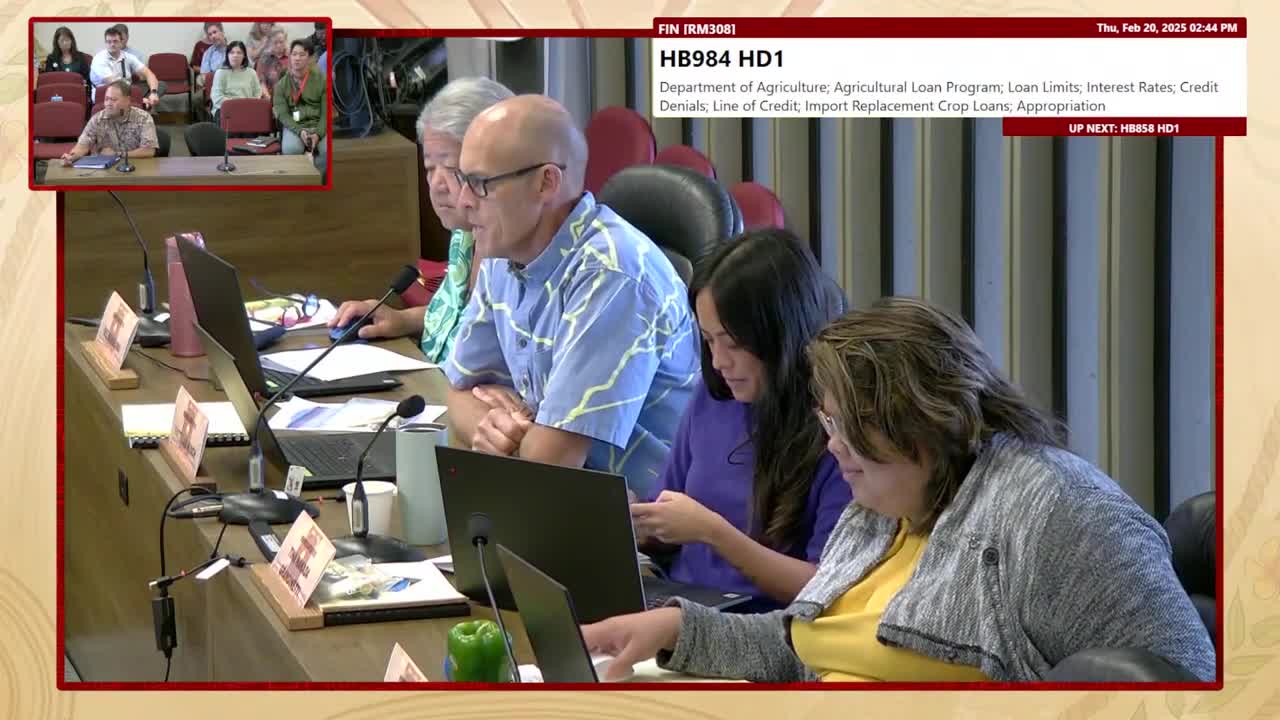
| Feb 20, 2025 | The committee on FIN recommend that the measure be PASSED, UNAMENDED. The votes were as follows: 14 Ayes: Representative(s) Yamashita, Takenouchi, Grandinetti, Holt, Hussey, Keohokapu-Lee Loy, Kitagawa, Kusch, Lamosao, Lee, M., Miyake, Morikawa, Templo, Reyes Oda; Ayes with reservations: none; Noes: none; and 2 Excused: Representative(s) Alcos, Ward. |
| Feb 18, 2025 | Bill scheduled to be heard by FIN on Thursday, 02-20-25 2:00PM in House conference room 308 VIA VIDEOCONFERENCE. |
| Feb 12, 2025 | Report adopted; referred to the committee(s) on FIN as amended in HD 2 with none voting aye with reservations; none voting no (0) and Representative(s) Cochran, Sayama, Ward excused (3). |
| Feb 12, 2025 | Reported from HED (Stand. Com. Rep. No. 438) as amended in HD 2, recommending referral to FIN. |
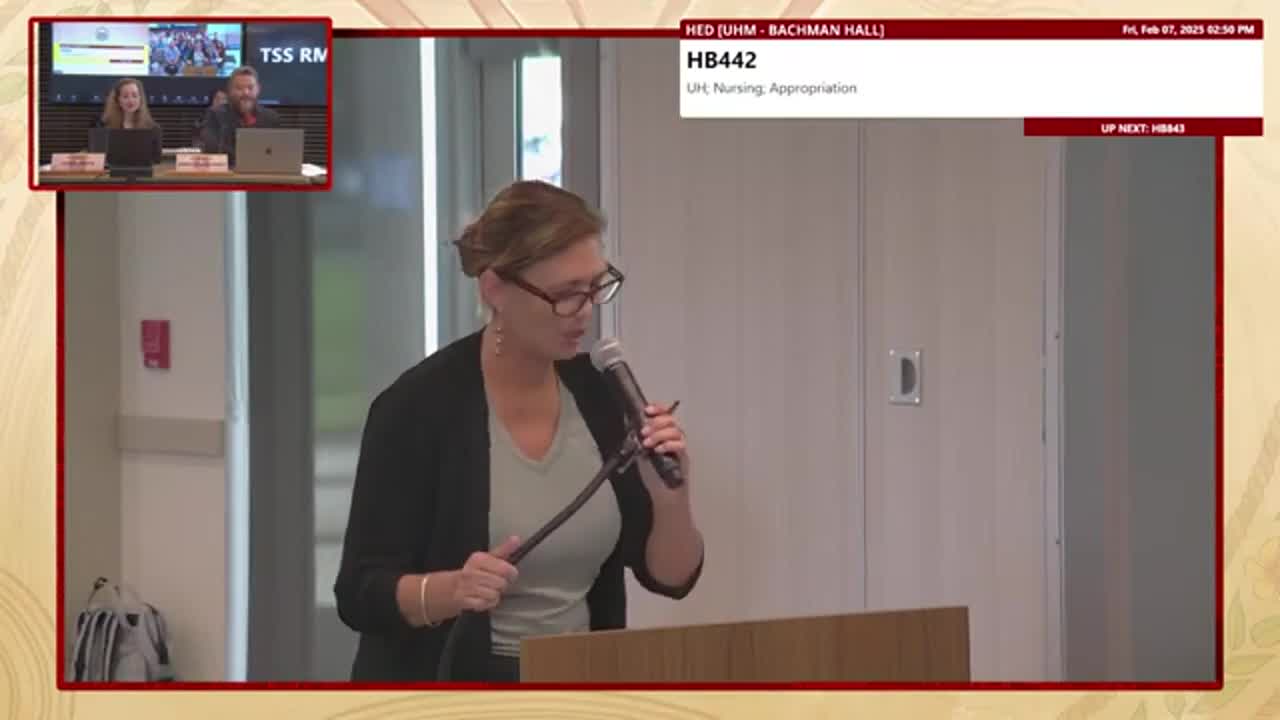
| Feb 7, 2025 | The committee on HED recommend that the measure be PASSED, WITH AMENDMENTS. The votes were as follows: 9 Ayes: Representative(s) Garrett, Amato, Kapela, Kila, La Chica, Olds, Sayama, Woodson, Souza; Ayes with reservations: none; Noes: none; and 2 Excused: Representative(s) Evslin, Muraoka. |
| Feb 4, 2025 | Bill scheduled to be heard by HED on Friday, 02-07-25 2:00PM in University of Hawaii at Manoa, Bachman Hall, Board of Regents Conference Room 106, 2444 Dole Street VIA VIDEOCONFERENCE. |
| Feb 3, 2025 | Passed Second Reading as amended in HD 1 and referred to the committee(s) on HED with none voting aye with reservations; none voting no (0) and Representative(s) Cochran, Ward excused (2). |
| Feb 3, 2025 | Reported from AGR (Stand. Com. Rep. No. 36) as amended in HD 1, recommending passage on Second Reading and referral to HED. |
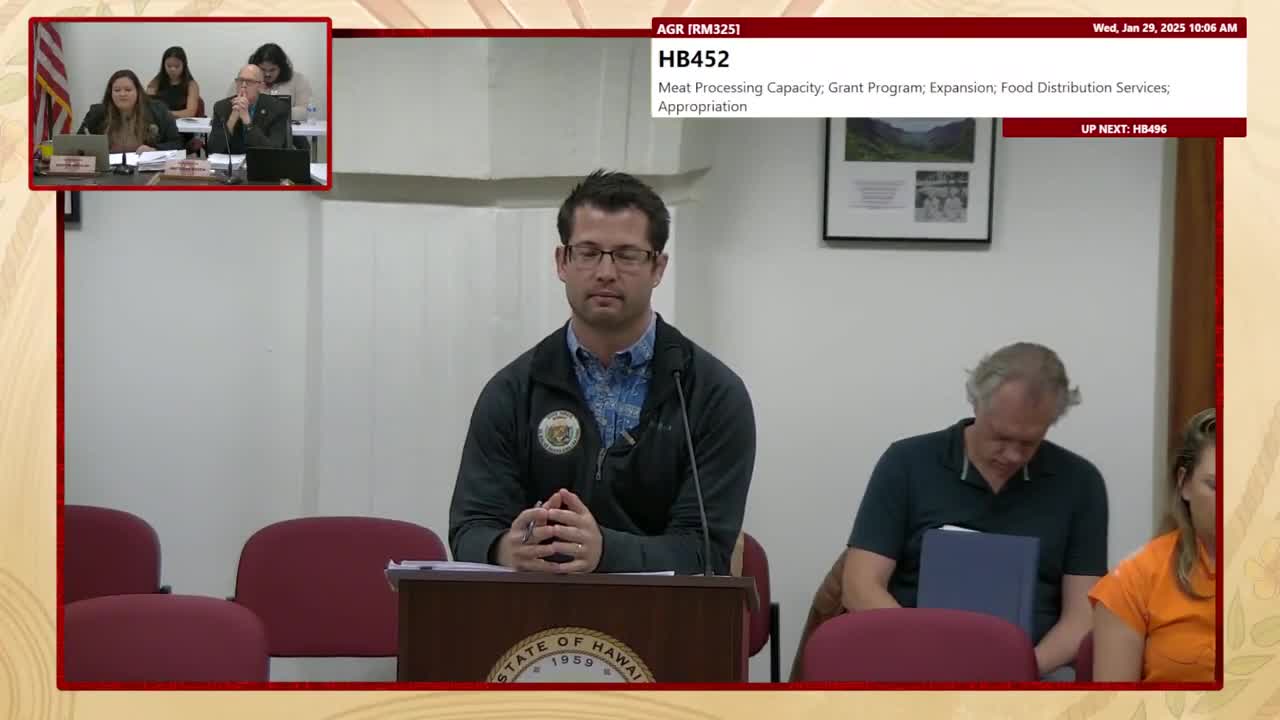
| Jan 29, 2025 | The committee on AGR recommend that the measure be PASSED, WITH AMENDMENTS. The votes were as follows: 5 Ayes: Representative(s) Kahaloa, Kusch, Lowen, Perruso, Quinlan; Ayes with reservations: none; Noes: none; and 1 Excused: Representative(s) Ward. |
| Jan 23, 2025 | Bill scheduled to be heard by AGR on Wednesday, 01-29-25 9:30AM in House conference room 325 VIA VIDEOCONFERENCE. |
| Jan 21, 2025 | Referred to AGR, HED, FIN, referral sheet 2 |
| Jan 21, 2025 | Introduced and Pass First Reading. |
| Jan 17, 2025 | Pending introduction. |
|
Date
|
Description
|
Location
|
Votes
|
|
|---|---|---|---|---|
| Apr 3, 2025 | Third Reading | Senate Floor |
Passed |
|
| Mar 28, 2025 | The committee(s) on WAM recommend(s) that the measure be PASSED, WITH AMENDMENTS | Senate Standing Committee on Ways and Means |
Passed |
|
| Mar 17, 2025 | The committee(s) on AEN recommend(s) that the measure be PASSED, UNAMENDED | Senate Standing Committee on Agriculture and Environment |
Passed |
|
| Mar 17, 2025 | The committee(s) on HRE recommend(s) that the measure be PASSED, UNAMENDED | Senate Standing Committee on Higher Education |
Passed |
|
| Feb 27, 2025 | Third Reading | House Floor |
Passed |
|
| Feb 20, 2025 | The committee on FIN recommend that the measure be PASSED, UNAMENDED | House Standing Committee on Finance |
Passed |
|
| Feb 7, 2025 | The committee on HED recommend that the measure be PASSED, WITH AMENDMENTS | House Standing Committee on Higher Education |
Passed |
|
| Jan 29, 2025 | The committee on AGR recommend that the measure be PASSED, WITH AMENDMENTS | House Standing Committee on Agriculture & Food Systems |
Passed |
This list shows positions taken on this bill by organizations on the date displayed, which is linked to the original source.
Positions by individuals are not included.
|
Organization
|
Position
|
Date
|
|---|---|---|
| Akatsuka | *** Support | Jan 29, 2025 |
| Big Island Invasive Species Committee | ** Support | |
| Board of Agriculture | *** Support | Mar 27, 2025 |
| Carol Kwan Consulting LLC | *** Support | Mar 27, 2025 |
| College of Tropical Agriculture and Human Resilience | *** Support | Feb 7, 2025 |
| College of Tropical Agriculture and Human Resources | *** Support | Mar 27, 2025 |
| Coordinating Group on Alien Pest Species | ** Support | |
| County of Kaua'i Office of Economic Development | *** Support | Mar 17, 2025 |
| County of Maui | *** Support | Mar 17, 2025 |
| Department of Land and Natural Resources | *** Support | Mar 27, 2025 |
| Department of Research and Development of the County of Hawaii | ** Support | |
| Hawai‘i Farm Bureau | *** Support | Feb 7, 2025 |
| Hawaiʻi Farm Bureau | *** Support | Mar 27, 2025 |
| Hawaiʻi Farmers Union | *** Support | Mar 27, 2025 |
| Hawaiʻi Invasive Species Council | *** Support | Mar 27, 2025 |
| Hawaii Island Palm Society | ** Support | |
| Hawaii Oil Seed Producers | ** Support | |
| Hawaii Oil Seed Producers (HOSPRO) | *** Support | Mar 17, 2025 |
| Hawaii Pacific University | *** Support | Feb 20, 2025 |
| Kaua‘i County Council | *** Support | Mar 17, 2025 |
| Kauai Invasive Species Committee | ** Support | |
| Kingdom of The Hawaiian Islands | *** Support | Mar 27, 2025 |
| Malama ‘aina landscape & masonry design llc | *** Against | Jan 29, 2025 |
| Malama Kaua’i | *** Support | Feb 20, 2025 |
| Nahenahe Farm, LLC | *** Support | Jan 29, 2025 |
| National Tropical Botanical Garden | *** Support | Feb 20, 2025 |
| Oʻahu Invasive Species Committee | ** Support | |
| Office of Economic Development - County of Kaua‘i | *** Support | Mar 27, 2025 |
| Office of Economic Development, County of Kaua'i | *** Support | Feb 7, 2025 |
| Office of Economic Development, County of Kaua‘i | *** Support | Feb 20, 2025 |
| Office of Economic Development of the County of Kauai | ** Support | |
| Office of Economic Development of the County of Kauaʻi | ** Support | |
| Office of Hawaiian Affairs | ** Support | |
| Office of the Mayor of the County of Maui | ** Support | |
| Ohana Unity Party | *** Support | Mar 27, 2025 |
| State of Hawaiʻi Department of Agriculture | *** Support | Mar 27, 2025 |
| The Nature Conservancy - Hawaiʻi and Palmyra | *** Support | Mar 27, 2025 |
| University of Hawaiʻi | *** Support | Mar 27, 2025 |
| University of Hawaiʻi at Manoa | *** Support | Mar 27, 2025 |
| University of Hawaiʻi at Manoā College of Tropical Agriculture and Human Resilience | ** Support | |
| University of Hawaiʻi (College of Tropical Agriculture and Human Resilience) | *** Support | Feb 20, 2025 |
| Windward Coalition | *** Support | Mar 27, 2025 |
STAND. COM. REP. NO. 1482
Honolulu, Hawaii
RE: H.B. No. 643
H.D. 2
S.D. 1
Honorable Ronald D. Kouchi
President of the Senate
Thirty-Third State Legislature
Regular Session of 2025
State of Hawaii
Sir:
Your Committee on Ways and Means, to which was referred H.B. No. 643, H.D. 2, entitled:
"A BILL FOR AN ACT RELATING TO THE COCONUT RHINOCEROS BEETLE PROGRAM,"
begs leave to report as follows:
The purpose and intent of this measure is to establish short-term initiatives for the coconut rhinoceros beetle response program; and appropriate moneys to support the coconut rhinoceros beetle response program's activities and positions.
Your Committee received written comments in support of this measure from the Department of Agriculture; Department of Land and Natural Resources; Hawaii Invasive Species Council; Office of Hawaiian Affairs; University of Hawaii; County of Maui; Office of the County Clerk, Council Services Division, County of Kauai; Office of Economic Development of the County of Kauai; Carol Kwan Consulting, LLC; Hawaii Farm Bureau; Hawaii Farmers Union; Ohana Unity Party & Kingdom of The Hawaiian Islands; The Nature Conservancy; Windward Coalition; and five individuals.
Your Committee finds that the State must be protected from invasive species such as the coconut rhinoceros beetle. The beetle's damage to coconut palms and other vegetation may lead to significant economic loss, especially in agriculture and tourism, and disrupt the State's delicate ecological balance. Moneys appropriated by this Act will address and mitigate the negative impact of the coconut rhinoceros beetle's presence in Hawaii.
Your Committee has amended this measure by:
(1) Inserting language to specify that appropriated moneys shall be expended by the Department of Agriculture on the condition that the department contracts with the College of Tropical Agriculture and Human Resilience at the University of Hawaii at Manoa; and
(2) Making technical nonsubstantive amendments for purposes of clarity, consistency, and style.
As affirmed by the record of votes of the members of your Committee on Ways and Means that is attached to this report, your Committee is in accord with the intent and purpose of H.B. No. 643, H.D. 2, as amended herein, and recommends that it pass Third Reading in the form attached hereto as H.B. No. 643, H.D. 2, S.D. 1.
Respectfully submitted on behalf of the members of the Committee on Ways and Means,
|
|
|
________________________________ DONOVAN M. DELA CRUZ, Chair |
|
|
|
|
STAND. COM. REP. NO. 1245
Honolulu, Hawaii
RE: H.B. No. 643
H.D. 2
Honorable Ronald D. Kouchi
President of the Senate
Thirty-Third State Legislature
Regular Session of 2025
State of Hawaii
Sir:
Your Committees on Higher Education and Agriculture and Environment, to which was referred H.B. No. 643, H.D. 2, entitled:
"A BILL FOR AN ACT RELATING TO THE COCONUT RHINOCEROS BEETLE PROGRAM,"
beg leave to report as follows:
The purpose and intent of this measure is to:
(1) Establish short-term management initiatives for the Coconut Rhinoceros Beetle Response Program; and
(2) Appropriate funds to support the Coconut Rhinoceros Beetle Response Program's activities and positions.
Your Committees received testimony in support of this measure from the Department of Agriculture; Department of Land and Natural Resources; Office of Hawaiian Affairs; University of Hawaiʻi System; Office of Economic Development of the County of Kauaʻi; two members of the Kauaʻi County Council; Office of the Mayor of the County of Maui; Hawaii Oil Seed Producers; The Nature Conservancy, Hawaiʻi and Palmyra; Big Island Invasive Species Committee; Carol Kwan Consulting LLC; Hawaiʻi Farmers Union United; Hawaii Island Palm Society; Windward Coalition; Hawaiʻi Farm Bureau; and nine individuals.
Your Committees find that the coconut rhinoceros beetle poses an existential threat to the State's agricultural industry and food security and self-sufficiency. Your Committees further find that the Coconut Rhinoceros Beetle Response Program is a coordinated partnership that investigates new control methods and best practices to mitigate the effects of coconut rhinoceros beetle infestations and prevent them from occurring elsewhere in the State. This measure ensures that the important work of the Coconut Rhinoceros Beetle Response Program will continue.
As affirmed by the records of votes of the members of your Committees on Higher Education and Agriculture and Environment that are attached to this report, your Committees are in accord with the intent and purpose of H.B. No. 643, H.D. 2, and recommend that it pass Second Reading and be referred to your Committee on Ways and Means.
Respectfully submitted on behalf of the members of the Committees on Higher Education and Agriculture and Environment,
|
________________________________ MIKE GABBARD, Chair |
|
________________________________ DONNA MERCADO KIM, Chair |
|
|
|
|
STAND. COM. REP. NO. 871
Honolulu, Hawaii
, 2025
RE: H.B. No. 643
H.D. 2
Honorable Nadine K. Nakamura
Speaker, House of Representatives
Thirty-Third State Legislature
Regular Session of 2025
State of Hawaii
Madame:
Your Committee on Finance, to which was referred H.B. No. 643, H.D. 2, entitled:
"A BILL FOR AN ACT RELATING TO THE COCONUT RHINOCEROS BEETLE PROGRAM,"
begs leave to report as follows:
The purpose of this measure is to:
(1) Establish short-term management initiatives for the Coconut Rhinoceros Beetle Response Program, including subsidies for canopy treatments for residential palm owners; and
(2) Appropriate funds to support the Program's activities and positions.
Your Committee received testimony in support of this measure from the Department of Agriculture; Hawaiʻi Invasive Species Council; Big Island Invasive Species Committee; Hawaiʻi Farm Bureau; Mālama Kauaʻi; Coordinating Group on Alien Pest Species; and five individuals. Your Committee received comments on this measure from the Department of Land and Natural Resources; University of Hawaiʻi System; one member of the Kauaʻi County Council; Office of Economic Development of the County of Kauaʻi; and National Tropical Botanical Garden.
As affirmed by the record of votes of the members of your Committee on Finance that is attached to this report, your Committee is in accord with the intent and purpose of H.B. No. 643, H.D. 2, and recommends that it pass Third Reading.
Respectfully submitted on behalf of the members of the Committee on Finance,
|
|
|
____________________________ KYLE T. YAMASHITA, Chair |
|
|
|
|
STAND. COM. REP. NO. 438
Honolulu, Hawaii
, 2025
RE: H.B. No. 643
H.D. 2
Honorable Nadine K. Nakamura
Speaker, House of Representatives
Thirty-Third State Legislature
Regular Session of 2025
State of Hawaii
Madame:
Your Committee on Higher Education, to which was referred H.B. No. 643, H.D. 1, entitled:
"A BILL FOR AN ACT RELATING TO THE COCONUT RHINOCEROS BEETLE PROGRAM,"
begs leave to report as follows:
The purpose of this measure is to:
(1) Establish short-term management initiatives for the Coconut Rhinoceros Beetle Response Program; and
(2) Appropriate funds to support the Program's activities and positions.
Your Committee received testimony in support of this measure from the Department of Land and Natural Resources; University of Hawaiʻi at Manoā College of Tropical Agriculture and Human Resilience; Hawaii Invasive Species Council; one member of the Kauaʻi County Council; Office of Economic Development of the County of Kauaʻi; Hawaiʻi Farmers Union United; Big Island Invasive Species Committee; Hawaiʻi Farm Bureau; and two individuals. Your Committee received comments on this measure from the Department of the Attorney General.
Your Committee finds that the coconut rhinoceros beetle is a significant pest that poses a significant threat to Hawaii's agricultural landscape, particularly its coconut and palm populations. In response, the Coconut Rhinoceros Beetle Response Program was established to combat the growing population of coconut rhinoceros beetles. Your Committee believes that establishing short-term management initiatives for the Program is essential in protecting farms and natural resources in the State from this invasive species. Additionally, further funding for the Program will enable the implementation of immediate actions to manage and mitigate coconut rhinoceros beetles.
Your Committee has amended this measure by:
(1) Inserting language establishing standards for the distribution of the funds appropriated to subsidize canopy treatment for residential palm owners;
(2) Amending the preamble to declare that the management of coconut rhinoceros beetles is a matter of statewide concern; and
(3) Making technical, nonsubstantive amendments for the purposes of clarity, consistency, and style.
As affirmed by the record of votes of the members of your Committee on Higher Education that is attached to this report, your Committee is in accord with the intent and purpose of H.B. No. 643, H.D. 1, as amended herein, and recommends that it be referred to your Committee on Finance in the form attached hereto as H.B. No. 643, H.D. 2.
Respectfully submitted on behalf of the members of the Committee on Higher Education,
|
|
|
____________________________ ANDREW TAKUYA GARRETT, Chair |
STAND. COM. REP. NO. 36
Honolulu, Hawaii
, 2025
RE: H.B. No. 643
H.D. 1
Honorable Nadine K. Nakamura
Speaker, House of Representatives
Thirty-Third State Legislature
Regular Session of 2025
State of Hawaii
Madame:
Your Committee on Agriculture & Food Systems, to which was referred H.B. No. 643 entitled:
"A BILL FOR AN ACT RELATING TO THE COCONUT RHINOCEROS BEETLE PROGRAM,"
begs leave to report as follows:
The purpose of this measure is to:
(1) Establish short-term management initiatives for the Coconut Rhinoceros Beetle Response Program; and
(2) Appropriate funds to support the Program's activities and positions.
Your Committee received testimony in support of this measure from the Department of Land and Natural Resources; Department of Agriculture; University of Hawaii System; Hawaii Invasive Species Council; two members of the Kauai County Council; Department of Agriculture of the County of Maui; Department of Research and Development of the County of Hawaii; Office of Economic Development of the County of Kauai; Coordinating Group on Alien Pest Species; Hawaii Farm Bureau; Oʻahu Invasive Species Committee; Kauai Invasive Species Committee; Big Island Invasive Species Committee; and numerous individuals. Your Committee received testimony in opposition to this measure from Malama Aina Landscape and Masonry Design, LLC; and one individual.
Your Committee finds that the coconut rhinoceros beetle can have devastating impacts on palm species that are foundational to the State's agricultural economy, cultural heritage, and ecosystems. Your Committee further finds that the Coconut Rhinoceros Beetle Response Program, a coordinated partnership among the University of Hawaii, United States Department of Agriculture, Hawaii Department of Agriculture, and other key organizations, investigates new control methods and best practices to combat the coconut rhinoceros beetle. This measure ensures that the program incorporates strategic short-term management initiatives and has sufficient funding and personnel.
Your Committee notes that the Coconut Rhinoceros Beetle Response Program has been primarily funded by the federal government and that the program may or may not receive continued funding later this year if continued funding is not reapproved.
Your Committee has amended this measure by:
(1) Including the island of Kauai among the islands to be served by the Coconut Rhinoceros Beetle Response Program;
(2) Clarifying that the University of Hawaii shall perform canine inspections in coordination with the Department of Agriculture on high-risk cargo moving between islands;
(3) Deleting language related to subsidizing container fumigation of high-risk materials traveling between islands;
(4) Changing the appropriation allocations to unspecified amounts;
(5) Appropriating an unspecified amount for three drones to be used on Hawaii island and the islands of Maui and Kauai;
(6) Specifying the types of positions being established for biocontrol research;
(7) Changing the effective date to July 1, 3000, to encourage further discussion; and
(8) Making technical, nonsubstantive amendments for the purposes of clarity, consistency, and style.
Your Committee respectfully requests your Committee on Finance, should it deliberate on this measure, to consider an appropriation allocation amount of $15,000 for training tree trimmers, arborists, and the landscaping industry; $160,000 for subsidizing canopy treatments for residential palm owners; $25,000 for extending deployment of coconut rhinoceros beetle response teams to Hawaii island and the islands of Maui, Molokai, Kauai, and Lanai; $250,000 for canine inspections for high-risk cargo moving between islands; $60,000 for drones; and $200,000 for one Technician position and two Graduate Student positions for biocontrol research.
As affirmed by the record of votes of the members of your Committee on Agriculture & Food Systems that is attached to this report, your Committee is in accord with the intent and purpose of H.B. No. 643, as amended herein, and recommends that it pass Second Reading in the form attached hereto as H.B. No. 643, H.D. 1, and be referred to your Committee on Higher Education.
Respectfully submitted on behalf of the members of the Committee on Agriculture & Food Systems,
|
|
|
____________________________ KIRSTIN KAHALOA, Chair |
|
|
|
|
|
Date
|
Testimony PDF
|
|---|---|
| Mar 27, 2025 | HB643_HD2_TESTIMONY_WAM_03-28-25_.PDF |
| Mar 17, 2025 | HB643_HD2_TESTIMONY_HRE-AEN_03-17-25_.PDF |
| Feb 20, 2025 | HB643_HD2_TESTIMONY_FIN_02-20-25_.PDF |
| Feb 7, 2025 | HB643_HD1_TESTIMONY_HED_02-07-25_.PDF |
| Jan 29, 2025 | HB643_TESTIMONY_AGR_01-29-25_.PDF |
Discussed in Hearing
 21SEC
Senate Floor
 13MIN
Senate Standing Committee on Agriculture and Environment
13MIN
Senate Standing Committee on Higher Education
 3MIN
House Standing Committee on Finance
 6MIN
House Standing Committee on Higher Education
 8MIN
House Standing Committee on Agriculture & Food Systems
Bill Author

Bill Co-Author(s):