HB 557: RELATING TO TELEHEALTH.
- Session Year: 2025-2026
- House: House
- Latest Version Date: 2025-02-13
Current Status:
Failed
(2025-12-08: Carried over to 2026 Regular Session.)
Introduced
In Committee
First Chamber
In Committee
Second Chamber
Final Decking
Enacted
Extends the sunset date of Act 107, SLH 2023, which allows for the reimbursement of services provided through telehealth via an interactive telecommunications system, until 12/31/2026. (HD2)
Amends the definition of "interactive telecommunications system" for purposes of reimbursement for services provided through telehealth. Requires health care providers to append a modifier to any claim for telehealth services using two-way, real-time, audio-only communications technology. Requires the Insurance Commissioner to report to the Legislature on reimbursements claimed in the previous year for certain telehealth services. Repeals the sunset date of Act 107, SLH 2023. (HD1)
Updates the State's laws on telehealth services to conform with federal Medicare regulations. Requires the Insurance Commissioner to report to the Legislature on reimbursements claimed in the previous year for certain telehealth services. Repeals the sunset date of Act 107, Session Laws of Hawaii 2023.
|
HOUSE OF REPRESENTATIVES |
H.B. NO. |
557 |
|
THIRTY-THIRD LEGISLATURE, 2025 |
H.D. 2 |
|
|
STATE OF HAWAII |
|
|
|
|
|
|
|
|
||
|
|
||
A BILL FOR AN ACT
RELATING TO TELEHEALTH.
BE IT ENACTED BY THE LEGISLATURE OF THE STATE OF HAWAII:
SECTION 1. Act 107, Session Laws of Hawaii 2023, is amended by amending section 8 to read as follows:
"SECTION 8. This Act shall take effect upon its approval;
provided that on December 31, [2025,] 2026, this Act shall be
repealed and sections 346-59.1, 431:10A-116.3, 432:1-601.5, 432D-23.5, and 453‑1.3,
Hawaii Revised Statutes, shall be reenacted in the form in which they read on
the day prior to the effective date of this Act."
SECTION 2. Statutory material to be repealed is bracketed and stricken. New statutory material is underscored.
SECTION 3. This Act shall take effect upon its approval.
Report Title:
Telehealth; Interactive Telecommunications Systems; Insurance Reimbursement
Description:
Extends the sunset date of Act 107, SLH 2023, which allows for the reimbursement of services provided through telehealth via an interactive telecommunications system, until 12/31/2026. (HD2)
The summary description of legislation appearing on this page is for informational purposes only and is not legislation or evidence of legislative intent.
|
HOUSE OF REPRESENTATIVES |
H.B. NO. |
557 |
|
THIRTY-THIRD LEGISLATURE, 2025 |
H.D. 1 |
|
|
STATE OF HAWAII |
|
|
|
|
|
|
|
|
||
|
|
||
A BILL FOR AN ACT
RELATING TO TELEHEALTH.
BE IT ENACTED BY THE LEGISLATURE OF THE STATE OF HAWAII:
SECTION 1. Section 346-59.1, Hawaii Revised Statutes, is amended as follows:
1. By amending subsection (b) to read:
"(b) Reimbursement for services provided through
telehealth via an interactive telecommunications system shall be equivalent to
reimbursement for the same services provided via in-person contact between a
health care provider and a patient[; provided that reimbursement for the
diagnosis, evaluation, or treatment of a mental health disorder delivered
through an interactive telecommunications system using two-way, real-time
audio-only communication technology shall meet the requirements of title 42
Code of Federal Regulations section 410.78.
Nothing in this section shall require a health care provider to be
physically present with the patient at an originating site unless a health care
provider at the distant site deems it necessary]."
2. By amending subsection (g) to read:
"(g) For the purposes of this section:
"Distant site" means the location of the health care provider delivering services through telehealth at the time the services are provided.
"Health care provider" means a provider of services, as defined in title 42 United States Code section 1395x(u), a provider of medical and other health services, as defined in title 42 United States Code section 1395x(s), other practitioners licensed by the State and working within their scope of practice, and any other person or organization who furnishes, bills, or is paid for health care in the normal course of business, including but not limited to primary care providers, mental health providers, oral health providers, physicians and osteopathic physicians licensed under chapter 453, advanced practice registered nurses licensed under chapter 457, psychologists licensed under chapter 465, and dentists licensed under chapter 448.
"Interactive telecommunications
system" [has the same meaning as the term is defined in title 42 Code
of Federal Regulations section 410.78(a).] means multimedia
communications equipment that includes, at a minimum, audio and video equipment
permitting two-way, real-time interactive telecommunications between the
patient and distant site health care provider. "Interactive telecommunications
system" may also include two‑way, real-time, audio-only
communications technology for services furnished for the purposes of diagnosis,
evaluation, or treatment of a mental health disorder to a patient in the
patient's home if the distant site health care provider is technically capable
of using an interactive telecommunications system but the patient is not
capable of, or does not consent to, the use of video technology; provided that a
modifier designated by the Centers for Medicaid and Medicare services shall be
appended to any claim for telehealth services furnished using two-way,
real-time, audio-only communications technology to verify that the required
conditions have been met.
"Originating site" means the location where the patient is located, whether accompanied or not by a health care provider, at the time services are provided by a health care provider through telehealth, including but not limited to a health care provider's office, hospital, critical access hospital, rural health clinic, federally qualified health center, a patient's home, and other nonmedical environments such as school-based health centers, university-based health centers, or the work location of a patient.
"Telehealth" means the use of telecommunications services, as defined in section 269-1, to encompass four modalities: store and forward technologies, remote monitoring, live consultation, and mobile health; and which shall include but not be limited to real-time video conferencing-based communication, secure interactive and non-interactive web-based communication, and secure asynchronous information exchange, to transmit patient medical information, including diagnostic-quality digital images and laboratory results for medical interpretation and diagnosis, for the purpose of delivering enhanced health care services and information while a patient is at an originating site and the health care provider is at a distant site. Except as provided through an interactive telecommunications system, standard telephone contacts, facsimile transmissions, or e-mail text, in combination or alone, do not constitute telehealth services."
SECTION 2. Section 431:2-211, Hawaii Revised Statutes, is amended to read as follows:
"§431:2-211 Annual report. The commissioner, as early each year as
accurate preparation enables, shall prepare and submit to the legislature a
report [which] that shall contain:
(1) The condition of
all insurers authorized to do business in this State during the preceding year[.];
(2) A summary of
abuses and deficiencies in benefit payments, the complaints made to the
commissioner and their disposition, and the extent of compliance and
noncompliance by each insurer with the provisions of this code[.];
(3) A summary of the telehealth claims reimbursed during the preceding year, pursuant to Act , Session Laws of Hawaii 2025; and
[(3) Such] (4)
Any additional information and comments relative to insurance activities
in this State [as] that the commissioner deems proper."
SECTION 3. Section 431:10A-116.3, Hawaii Revised Statutes, is amended as follows:
1. By amending subsection (c) to read:
"(c) Reimbursement for services provided through
telehealth via an interactive telecommunications system shall be equivalent to reimbursement
for the same services provided via in-person contact between a health care
provider and a patient; provided that [reimbursement for two-way, real-time
audio-only communication technology for purposes of diagnosis, evaluation, or
treatment of a mental health disorder to a patient in the patient's home shall
be equivalent to eighty per cent of the reimbursement for the same services
provided via in-person contact between a health care provider and a
patient. To] to be reimbursed for telehealth via
an interactive telecommunications system using two-way, real-time audio-only
communication technology in accordance with this subsection, the health care
provider shall first conduct an in-person visit [or a telehealth visit that
is not audio only,] within six months prior to the initial audio-only
visit, or within twelve months prior to any subsequent audio-only visit. [The telehealth visit required prior to
the initial or subsequent audio-only visit in this subsection shall not be
provided using audio-only communication.
Nothing in this section shall require a health care
provider to be physically present with the patient at an originating site
unless a health care provider at the distant site deems it necessary.]"
2. By amending subsection (g) to read:
"(g) For the purposes of this section:
"Distant site" means the location of the health care provider delivering services through telehealth at the time the services are provided.
"Health care provider" means a provider of services, as defined in title 42 United States Code section 1395x(u), a provider of medical and other health services, as defined in title 42 United States Code section 1395x(s), other practitioners licensed by the State and working within their scope of practice, and any other person or organization who furnishes, bills, or is paid for health care in the normal course of business, including but not limited to primary care providers, mental health providers, oral health providers, physicians and osteopathic physicians licensed under chapter 453, advanced practice registered nurses licensed under chapter 457, psychologists licensed under chapter 465, and dentists licensed under chapter 448.
"Interactive telecommunications
system" [has the same meaning as the term is defined in title 42 Code
of Federal Regulations section 410.78(a).] means multimedia
communications equipment that includes, at a minimum, audio and video equipment
permitting two-way, real-time interactive telecommunications between the
patient and distant site health care provider. "Interactive
telecommunications system" may also include two‑way, real-time,
audio-only communications technology for services furnished for the purposes of
diagnosis, evaluation, or treatment of a mental health disorder to a patient in
the patient's home if the distant site health care provider is technically
capable of using an interactive telecommunications system but the patient is
not capable of, or does not consent to, the use of video technology; provided
that a modifier designated by the Centers for Medicaid and Medicare services
shall be appended to any claim for telehealth services furnished using two-way,
real-time, audio-only communications technology to verify that the required
conditions have been met. "Originating site" means the
location where the patient is located, whether accompanied or not by a health
care provider, at the time services are provided by a health care provider
through telehealth, including but not limited to a health care provider's
office, hospital, health care facility, a patient's home, and other nonmedical
environments such as school-based health centers, university-based health
centers, or the work location of a patient.
"Telehealth" means the use of telecommunications services, as defined in section 269-1, to encompass four modalities: store and forward technologies, remote monitoring, live consultation, and mobile health; and which shall include but not be limited to real-time video conferencing-based communication, secure interactive and non-interactive web-based communication, and secure asynchronous information exchange, to transmit patient medical information, including diagnostic-quality digital images and laboratory results for medical interpretation and diagnosis, for the purpose of delivering enhanced health care services and information while a patient is at an originating site and the health care provider is at a distant site. Except as provided through an interactive telecommunications system, standard telephone contacts, facsimile transmissions, or e-mail text, in combination or alone, do not constitute telehealth services."
SECTION 4. Section 432:1-601.5, Hawaii Revised Statutes, is amended as follows:
1. By amending subsection (c) to read:
"(c) Reimbursement for services provided through
telehealth via an interactive telecommunications system shall be equivalent to
reimbursement for the same services provided via in-person contact between a
health care provider and a patient; provided that [reimbursement for
two-way, real-time audio-only communication technology for purposes of
diagnosis, evaluation, or treatment of a mental health disorder to a patient in
the patient's home shall be equivalent to eighty per cent of the reimbursement
for the same services provided via in-person contact between a health care
provider and a patient. To] to
be reimbursed for telehealth via an interactive telecommunications system using
two-way, real-time audio-only communication technology in accordance with this
subsection, the health care provider shall first conduct an in-person visit [or
a telehealth visit that is not audio only,] within six months prior to the
initial audio-only visit, or within twelve months prior to any subsequent
audio-only visit. [The telehealth
visit required prior to the initial or subsequent audio-only visit in this
subsection shall not be provided using audio-only communication. Nothing in this section shall require a
health care provider to be physically present with the patient at an
originating site unless a health care provider at the distant site deems it
necessary.]"
2. By amending subsection (g) to read:
"(g) For the purposes of this section:
"Health care provider" means a provider of services, as defined in title 42 United States Code section 1395x(u), a provider of medical and other health services, as defined in title 42 United States Code section 1395x(s), other practitioners licensed by the State and working within their scope of practice, and any other person or organization who furnishes, bills, or is paid for health care in the normal course of business, including but not limited to primary care providers, mental health providers, oral health providers, physicians and osteopathic physicians licensed under chapter 453, advanced practice registered nurses licensed under chapter 457, psychologists licensed under chapter 465, and dentists licensed under chapter 448.
"Interactive telecommunications
system" [has the same meaning as the term is defined in title 42 Code
of Federal Regulations section 410.78(a).] means multimedia
communications equipment that includes, at a minimum, audio and video equipment
permitting two‑way, real-time interactive telecommunications between the
patient and distant site health care provider. "Interactive
telecommunications system" may also include two‑way, real-time,
audio-only communications technology for services furnished for the purposes of
diagnosis, evaluation, or treatment of a mental health disorder to a patient in
the patient's home if the distant site health care provider is technically
capable of using an interactive telecommunications system but the patient is
not capable of, or does not consent to, the use of video technology; provided
that a modifier designated by the Centers for Medicaid and Medicare services
shall be appended to any claim for telehealth services furnished using two-way,
real-time, audio-only communications technology to verify that the required
conditions have been met. "Originating site" means the
location where the patient is located, whether accompanied or not by a health
care provider, at the time services are provided by a health care provider
through telehealth, including but not limited to a health care provider's
office, hospital, health care facility, a patient's home, and other nonmedical
environments such as school-based health centers, university-based health
centers, or the work location of a patient.
"Telehealth" means the use of telecommunications services, as defined in section 269-1, to encompass four modalities: store and forward technologies, remote monitoring, live consultation, and mobile health; and which shall include but not be limited to real-time video conferencing-based communication, secure interactive and non-interactive web-based communication, and secure asynchronous information exchange, to transmit patient medical information, including diagnostic-quality digital images and laboratory results for medical interpretation and diagnosis, for the purpose of delivering enhanced health care services and information while a patient is at an originating site and the health care provider is at a distant site. Except as provided through an interactive telecommunications system, standard telephone contacts, facsimile transmissions, or e-mail text, in combination or alone, do not constitute telehealth services."
SECTION 5. Section 432D-23.5, Hawaii Revised Statutes, is amended as follows:
1. By amending subsection (c) to read:
"(c) Reimbursement for services provided through
telehealth via an interactive telecommunications system shall be equivalent to
reimbursement for the same services provided via in-person contact between a
health care provider and a patient; provided that [reimbursement for
two-way, real-time audio-only communication technology for purposes of
diagnosis, evaluation, or treatment of a mental health disorder to a patient in
the patient's home shall be equivalent to eighty per cent of the reimbursement
for the same services provided via in-person contact between a health care
provider and a patient. To] to
be reimbursed for telehealth via an interactive telecommunications system using
two-way, real-time audio-only communication technology in accordance with this
subsection, the health care provider shall first conduct an in-person visit [or
a telehealth visit that is not audio only,] within six months prior to the
initial audio-only visit, or within twelve months prior to any subsequent
audio-only visit. [The telehealth
visit required prior to the initial or subsequent audio-only visit in this
subsection shall not be provided using audio-only communication. Nothing in this section shall require a
health care provider to be physically present with the patient at an
originating site unless a health care provider at the distant site deems it
necessary.]"
2. By amending subsection (g) to read:
"(g) For the purposes of this section:
"Distant site" means the location of the health care provider delivering services through telehealth at the time the services are provided.
"Health care provider" means a provider of services, as defined in title 42 United States Code section 1395x(u), a provider of medical and other health services, as defined in title 42 United States Code section 1395x(s), other practitioners licensed by the State and working within their scope of practice, and any other person or organization who furnishes, bills, or is paid for health care in the normal course of business, including but not limited to primary care providers, mental health providers, oral health providers, physicians and osteopathic physicians licensed under chapter 453, advanced practice registered nurses licensed under chapter 457, psychologists licensed under chapter 465, and dentists licensed under chapter 448.
"Interactive telecommunications
system" [has the same meaning as the term is defined in title 42 Code
of Federal Regulations section 410.78(a).] means multimedia
communications equipment that includes, at a minimum, audio and video equipment
permitting two-way, real-time interactive telecommunications between the
patient and distant site health care provider. "Interactive
telecommunications system" may also include two‑way, real-time,
audio-only communications technology for services furnished for the purposes of
diagnosis, evaluation, or treatment of a mental health disorder to a patient in
the patient's home if the distant site health care provider is technically
capable of using an interactive telecommunications system but the patient is
not capable of, or does not consent to, the use of video technology; provided
that a modifier designated by the Centers for Medicaid and Medicare services
shall be appended to any claim for telehealth services furnished using two-way,
real-time, audio-only communications technology to verify that the required
conditions have been met.
"Originating site" means the location where the patient is located, whether accompanied or not by a health care provider, at the time services are provided by a health care provider through telehealth, including but not limited to a health care provider's office, hospital, health care facility, a patient's home, and other nonmedical environments such as school-based health centers, university-based health centers, or the work location of a patient.
"Telehealth" means the use of telecommunications services, as defined in section 269-1, to encompass four modalities: store and forward technologies, remote monitoring, live consultation, and mobile health; and which shall include but not be limited to real‑time video conferencing-based communication, secure interactive and non-interactive web-based communication, and secure asynchronous information exchange, to transmit patient medical information, including diagnostic-quality digital images and laboratory results for medical interpretation and diagnosis, for the purpose of delivering enhanced health care services and information while a patient is at an originating site and the health care provider is at a distant site. Except as provided through an interactive telecommunications system, standard telephone contacts, facsimile transmissions, or e-mail text, in combination or alone, do not constitute telehealth services."
SECTION 6. Section 453-1.3, Hawaii Revised Statutes, is amended as follows:
1. By amending subsection (h) to read:
"(h) Unless otherwise provided by law,
reimbursement for behavioral health services provided through telehealth via an
interactive telecommunications system shall be equivalent to reimbursement for
the same services provided via in-person contact between a health care provider
and a patient; provided that [reimbursement for two-way, real-time
audio-only communication technology for purposes of diagnosis, evaluation, or
treatment of a mental health disorder to a patient in the patient's home shall
be equivalent to eighty per cent of the reimbursement for the same services
provided via in-person contact between a health care provider and a
patient. To] to be reimbursed
for telehealth via an interactive telecommunications system using two-way,
real-time audio-only communication technology in accordance with this
subsection, the health care provider shall first conduct an in‑person
visit [or a telehealth visit that is not audio only,] within six months
prior to the initial audio-only visit, or within twelve months prior to any
subsequent audio-only visit. [The
telehealth visit required prior to the initial or subsequent audio-only visit
in this subsection shall not be provided using audio-only communication.]"
2. By amending subsection (j) to read:
"(j) For the purposes of this section:
"Distant site" means the location of the physician delivering services through telehealth at the time the services are provided.
"Interactive telecommunications
system" [has the same meaning as the term is defined in title 42 Code
of Federal Regulations section 410.78(a).] means multimedia
communications equipment that includes, at a minimum, audio and video equipment
permitting two‑way, real-time interactive telecommunications between the
patient and distant site physician. "Interactive telecommunications
system" may also include two‑way, real-time, audio-only
communication technology for services furnished for the purposes of diagnosis,
evaluation, or treatment of a mental health disorder to a patient in the
patient's home if the distant site physician is technically capable of using an
interactive telecommunications system but the patient is not capable of, or
does not consent to, the use of video technology; provided that a modifier
designated by the Centers for Medicaid and Medicare services shall be appended
to any claim for telehealth services furnished using two-way, real-time,
audio-only communications technology to verify that the required conditions
have been met.
"Originating site" means the location where the patient is located, whether accompanied or not by a health care provider, at the time services are provided by a physician through telehealth, including but not limited to a physician's office, hospital, health care facility, a patient's home, and other non‑medical environments such as school-based health centers, university-based health centers, or the work location of a patient.
"Telehealth" means the use of telecommunications as defined in section 269-1, to encompass four modalities: store and forward technologies, remote monitoring, live consultation, and mobile health; and which shall include but not be limited to real-time video conferencing-based communication, secure interactive and non-interactive web-based communication, and secure asynchronous information exchange, to transmit patient medical information, including diagnostic-quality digital images and laboratory results for medical interpretation and diagnosis, for the purposes of: delivering enhanced health care services and information while a patient is at an originating site and the physician is at a distant site; establishing a physician‑patient relationship; evaluating a patient; or treating a patient. Except as provided through an interactive telecommunications system, standard telephone contacts, facsimile transmissions, or e-mail text, in combination or alone, do not constitute telehealth services."
SECTION 7. Beginning with the regular session of 2026 and each regular session thereafter, the insurance commissioner's annual report to the legislature shall include the total number of claims reimbursed in the previous calendar year for:
(1) Telehealth services;
(2) Telehealth services related to mental health;
(3) Audio-only telehealth services related to mental health; and
(4) Telehealth services not related to mental health.
SECTION 8. Act 107, Session Laws of Hawaii 2023, is amended by amending section 8 to read as follows:
"SECTION 8. This Act shall take effect upon its approval[;
provided that on December 31, 2025, this Act shall be repealed and sections
346-59.1, 431:10A-116.3, 432:1-601.5, 432D-23.5, and 453‑1.3, Hawaii Revised
Statutes, shall be reenacted in the form in which they read on the day prior to
the effective date of this Act]."
SECTION 9. This Act does not affect rights and duties that matured, penalties that were incurred, and proceedings that were begun before its effective date.
SECTION 10. Statutory material to be repealed is bracketed and stricken. New statutory material is underscored.
SECTION 11. This Act shall take effect upon its approval.
Report Title:
Telehealth; Interactive Telecommunications systems; Insurance Reimbursement
Description:
Amends the definition of "interactive telecommunications system" for purposes of reimbursement for services provided through telehealth. Requires health care providers to append a modifier to any claim for telehealth services using two-way, real-time, audio-only communications technology. Requires the Insurance Commissioner to report to the Legislature on reimbursements claimed in the previous year for certain telehealth services. Repeals the sunset date of Act 107, SLH 2023. (HD1)
The summary description of legislation appearing on this page is for informational purposes only and is not legislation or evidence of legislative intent.
|
HOUSE OF REPRESENTATIVES |
H.B. NO. |
557 |
|
THIRTY-THIRD LEGISLATURE, 2025 |
|
|
|
STATE OF HAWAII |
|
|
|
|
|
|
|
|
||
|
|
||
A BILL FOR AN ACT
relating to telehealth.
BE IT ENACTED BY THE LEGISLATURE OF THE STATE OF HAWAII:
SECTION 1. Section 346-59.1, Hawaii Revised Statutes, is amended as follows:
1. By amending subsection (b) to read:
"(b) Reimbursement for services provided through
telehealth via an interactive telecommunications system shall be equivalent to
reimbursement for the same services provided via in-person contact between a
health care provider and a patient[; provided that reimbursement for the
diagnosis, evaluation, or treatment of a mental health disorder delivered
through an interactive telecommunications system using two-way, real-time
audio-only communication technology shall meet the requirements of title 42
Code of Federal Regulations section 410.78.
Nothing in this section shall require a health care provider to be
physically present with the patient at an originating site unless a health care
provider at the distant site deems it necessary]."
2. By amending subsection (g) to read:
"(g) For the purposes of this section:
"Distant site" means the location of the health care provider delivering services through telehealth at the time the services are provided.
"Health care provider" means a provider of services, as defined in title 42 United States Code section 1395x(u), a provider of medical and other health services, as defined in title 42 United States Code section 1395x(s), other practitioners licensed by the State and working within their scope of practice, and any other person or organization who furnishes, bills, or is paid for health care in the normal course of business, including but not limited to primary care providers, mental health providers, oral health providers, physicians and osteopathic physicians licensed under chapter 453, advanced practice registered nurses licensed under chapter 457, psychologists licensed under chapter 465, and dentists licensed under chapter 448.
"Interactive telecommunications
system" [has the same meaning as the term is defined in title 42 Code
of Federal Regulations section 410.78(a).] means multimedia
communications equipment that includes, at a minimum, audio and video equipment
permitting two-way, real-time interactive telecommunications between the
patient and distant site physician or practitioner. "Interactive telecommunications system"
may also include two‑way, real-time, audio-only communication technology
for any telehealth service furnished to a patient in the patient's home if the
distant site physician or practitioner is technically capable of using an
interactive telecommunications system but the patient is not capable of, or
does not consent to, the use of video technology; provided that verification of
the patient's lack of video capability or consent shall be appended to any
claim for telehealth services furnished using two-way, real‑time,
audio-only communications technology.
"Originating site" means the location where the patient is located, whether accompanied or not by a health care provider, at the time services are provided by a health care provider through telehealth, including but not limited to a health care provider's office, hospital, critical access hospital, rural health clinic, federally qualified health center, a patient's home, and other nonmedical environments such as school-based health centers, university-based health centers, or the work location of a patient.
"Telehealth" means the use of telecommunications services, as defined in section 269-1, to encompass four modalities: store and forward technologies, remote monitoring, live consultation, and mobile health; and which shall include but not be limited to real-time video conferencing-based communication, secure interactive and non-interactive web-based communication, and secure asynchronous information exchange, to transmit patient medical information, including diagnostic-quality digital images and laboratory results for medical interpretation and diagnosis, for the purpose of delivering enhanced health care services and information while a patient is at an originating site and the health care provider is at a distant site. Except as provided through an interactive telecommunications system, standard telephone contacts, facsimile transmissions, or e-mail text, in combination or alone, do not constitute telehealth services."
SECTION 2. Section 431:2-211, Hawaii Revised Statutes, is amended to read as follows:
"§431:2-211 Annual report. The commissioner, as early each year as
accurate preparation enables, shall prepare and submit to the legislature a
report [which] that shall contain:
(1) The condition of
all insurers authorized to do business in this State during the preceding year[.];
(2) A summary of
abuses and deficiencies in benefit payments, the complaints made to the
commissioner and their disposition, and the extent of compliance and noncompliance
by each insurer with the provisions of this code[.];
(3) A summary of the telehealth claims reimbursed during the preceding year, pursuant to Act , Session Laws of Hawaii 2025; and
[(3) Such] (4)
Any additional information and comments relative to insurance activities
in this State [as] that the commissioner deems proper."
SECTION 3. Section 431:10A-116.3, Hawaii Revised Statutes, is amended as follows:
1. By amending subsection (c) to read:
"(c) Reimbursement for services provided through
telehealth via an interactive telecommunications system shall be equivalent to
reimbursement for the same services provided via in-person contact between a
health care provider and a patient; provided that [reimbursement for
two-way, real-time audio-only communication technology for purposes of
diagnosis, evaluation, or treatment of a mental health disorder to a patient in
the patient's home shall be equivalent to eighty per cent of the reimbursement
for the same services provided via in-person contact between a health care
provider and a patient. To] to
be reimbursed for telehealth via an interactive telecommunications system using
two-way, real-time audio-only communication technology in accordance with this
subsection, the health care provider shall first conduct an in-person visit [or
a telehealth visit that is not audio only,] within six months prior to the
initial audio-only visit, or within twelve months prior to any subsequent
audio-only visit. [The telehealth
visit required prior to the initial or subsequent audio-only visit in this
subsection shall not be provided using audio-only communication. Nothing in this section shall
require a health care provider to be physically present with the patient at an
originating site unless a health care provider at the distant site deems it
necessary.]"
2. By amending subsection (g) to read:
"(g) For the purposes of this section:
"Distant site" means the location of the health care provider delivering services through telehealth at the time the services are provided.
"Health care provider" means a provider of services, as defined in title 42 United States Code section 1395x(u), a provider of medical and other health services, as defined in title 42 United States Code section 1395x(s), other practitioners licensed by the State and working within their scope of practice, and any other person or organization who furnishes, bills, or is paid for health care in the normal course of business, including but not limited to primary care providers, mental health providers, oral health providers, physicians and osteopathic physicians licensed under chapter 453, advanced practice registered nurses licensed under chapter 457, psychologists licensed under chapter 465, and dentists licensed under chapter 448.
"Interactive telecommunications
system" [has the same meaning as the term is defined in title 42 Code
of Federal Regulations section 410.78(a).] means multimedia
communications equipment that includes, at a minimum, audio and video equipment
permitting two-way, real-time interactive telecommunications between the
patient and distant site physician or practitioner. "Interactive telecommunications
system" may also include two‑way, real-time, audio-only
communication technology for any telehealth service furnished to a patient in
the patient's home if the distant site physician or practitioner is technically
capable of using an interactive telecommunications system but the patient is
not capable of, or does not consent to, the use of video technology; provided
that verification of the patient's lack of video capability or consent shall be
appended to any claim for telehealth services furnished using two-way, real‑time,
audio-only communications technology.
"Originating site" means the location where the patient is located, whether accompanied or not by a health care provider, at the time services are provided by a health care provider through telehealth, including but not limited to a health care provider's office, hospital, health care facility, a patient's home, and other nonmedical environments such as school-based health centers, university-based health centers, or the work location of a patient.
"Telehealth" means the use of telecommunications services, as defined in section 269-1, to encompass four modalities: store and forward technologies, remote monitoring, live consultation, and mobile health; and which shall include but not be limited to real-time video conferencing-based communication, secure interactive and non-interactive web-based communication, and secure asynchronous information exchange, to transmit patient medical information, including diagnostic-quality digital images and laboratory results for medical interpretation and diagnosis, for the purpose of delivering enhanced health care services and information while a patient is at an originating site and the health care provider is at a distant site. Except as provided through an interactive telecommunications system, standard telephone contacts, facsimile transmissions, or e-mail text, in combination or alone, do not constitute telehealth services."
SECTION 4. Section 432:1-601.5, Hawaii Revised Statutes, is amended as follows:
1. By amending subsection (c) to read:
"(c) Reimbursement for services provided through
telehealth via an interactive telecommunications system shall be equivalent to
reimbursement for the same services provided via in-person contact between a
health care provider and a patient; provided that [reimbursement for
two-way, real-time audio-only communication technology for purposes of
diagnosis, evaluation, or treatment of a mental health disorder to a patient in
the patient's home shall be equivalent to eighty per cent of the reimbursement
for the same services provided via in-person contact between a health care
provider and a patient. To] to
be reimbursed for telehealth via an interactive telecommunications system using
two-way, real-time audio-only communication technology in accordance with this
subsection, the health care provider shall first conduct an in-person visit [or
a telehealth visit that is not audio only,] within six months prior to the
initial audio-only visit, or within twelve months prior to any subsequent
audio-only visit. [The telehealth
visit required prior to the initial or subsequent audio-only visit in this
subsection shall not be provided using audio-only communication. Nothing in this section shall require a
health care provider to be physically present with the patient at an
originating site unless a health care provider at the distant site deems it
necessary.]"
2. By amending subsection (g) to read:
"(g) For the purposes of this section:
"Health care provider" means a provider of services, as defined in title 42 United States Code section 1395x(u), a provider of medical and other health services, as defined in title 42 United States Code section 1395x(s), other practitioners licensed by the State and working within their scope of practice, and any other person or organization who furnishes, bills, or is paid for health care in the normal course of business, including but not limited to primary care providers, mental health providers, oral health providers, physicians and osteopathic physicians licensed under chapter 453, advanced practice registered nurses licensed under chapter 457, psychologists licensed under chapter 465, and dentists licensed under chapter 448.
"Interactive telecommunications
system" [has the same meaning as the term is defined in title 42 Code
of Federal Regulations section 410.78(a).] means multimedia
communications equipment that includes, at a minimum, audio and video equipment
permitting two‑way, real-time interactive telecommunications between the
patient and distant site physician or practitioner. "Interactive telecommunications
system" may also include two‑way, real-time, audio-only
communication technology for any telehealth service furnished to a patient in
the patient's home if the distant site physician or practitioner is technically
capable of using an interactive telecommunications system but the patient is
not capable of, or does not consent to, the use of video technology; provided
that verification of the patient's lack of video capability or consent shall be
appended to any claim for telehealth services furnished using two-way, real‑time,
audio-only communications technology.
"Originating site" means the location where the patient is located, whether accompanied or not by a health care provider, at the time services are provided by a health care provider through telehealth, including but not limited to a health care provider's office, hospital, health care facility, a patient's home, and other nonmedical environments such as school-based health centers, university-based health centers, or the work location of a patient.
"Telehealth" means the use of telecommunications services, as defined in section 269-1, to encompass four modalities: store and forward technologies, remote monitoring, live consultation, and mobile health; and which shall include but not be limited to real-time video conferencing-based communication, secure interactive and non-interactive web-based communication, and secure asynchronous information exchange, to transmit patient medical information, including diagnostic-quality digital images and laboratory results for medical interpretation and diagnosis, for the purpose of delivering enhanced health care services and information while a patient is at an originating site and the health care provider is at a distant site. Except as provided through an interactive telecommunications system, standard telephone contacts, facsimile transmissions, or e-mail text, in combination or alone, do not constitute telehealth services."
SECTION 5. Section 432D-23.5, Hawaii Revised Statutes, is amended as follows:
1. By amending subsection (c) to read:
"(c) Reimbursement for services provided through
telehealth via an interactive telecommunications system shall be equivalent to
reimbursement for the same services provided via in-person contact between a
health care provider and a patient; provided that [reimbursement for two-way,
real-time audio-only communication technology for purposes of diagnosis,
evaluation, or treatment of a mental health disorder to a patient in the
patient's home shall be equivalent to eighty per cent of the reimbursement for
the same services provided via in-person contact between a health care provider
and a patient. To] to be
reimbursed for telehealth via an interactive telecommunications system using
two-way, real-time audio-only communication technology in accordance with this
subsection, the health care provider shall first conduct an in-person visit [or
a telehealth visit that is not audio only,] within six months prior to the
initial audio-only visit, or within twelve months prior to any subsequent
audio-only visit. [The telehealth
visit required prior to the initial or subsequent audio-only visit in this
subsection shall not be provided using audio-only communication. Nothing in this section shall require a
health care provider to be physically present with the patient at an
originating site unless a health care provider at the distant site deems it
necessary.]"
2. By amending subsection (g) to read:
"(g) For the purposes of this section:
"Distant site" means the location of the health care provider delivering services through telehealth at the time the services are provided.
"Health care provider" means a provider of services, as defined in title 42 United States Code section 1395x(u), a provider of medical and other health services, as defined in title 42 United States Code section 1395x(s), other practitioners licensed by the State and working within their scope of practice, and any other person or organization who furnishes, bills, or is paid for health care in the normal course of business, including but not limited to primary care providers, mental health providers, oral health providers, physicians and osteopathic physicians licensed under chapter 453, advanced practice registered nurses licensed under chapter 457, psychologists licensed under chapter 465, and dentists licensed under chapter 448.
"Interactive telecommunications
system" [has the same meaning as the term is defined in title 42 Code
of Federal Regulations section 410.78(a).] means multimedia
communications equipment that includes, at a minimum, audio and video equipment
permitting two-way, real-time interactive telecommunications between the
patient and distant site physician or practitioner. "Interactive telecommunications
system" may also include two‑way, real-time, audio-only
communication technology for any telehealth service furnished to a patient in
the patient's home if the distant site physician or practitioner is technically
capable of using an interactive telecommunications system but the patient is
not capable of, or does not consent to, the use of video technology; provided
that verification of the patient's lack of video capability or consent shall be
appended to any claim for telehealth services furnished using two-way, real‑time,
audio-only communications technology.
"Originating site" means the location where the patient is located, whether accompanied or not by a health care provider, at the time services are provided by a health care provider through telehealth, including but not limited to a health care provider's office, hospital, health care facility, a patient's home, and other nonmedical environments such as school-based health centers, university-based health centers, or the work location of a patient.
"Telehealth" means the use of telecommunications services, as defined in section 269-1, to encompass four modalities: store and forward technologies, remote monitoring, live consultation, and mobile health; and which shall include but not be limited to real‑time video conferencing-based communication, secure interactive and non-interactive web-based communication, and secure asynchronous information exchange, to transmit patient medical information, including diagnostic-quality digital images and laboratory results for medical interpretation and diagnosis, for the purpose of delivering enhanced health care services and information while a patient is at an originating site and the health care provider is at a distant site. Except as provided through an interactive telecommunications system, standard telephone contacts, facsimile transmissions, or e-mail text, in combination or alone, do not constitute telehealth services."
SECTION 6. Section 453-1.3, Hawaii Revised Statutes, is amended as follows:
1. By amending subsection (h) to read:
"(h) Unless otherwise provided by law,
reimbursement for behavioral health services provided through telehealth via an
interactive telecommunications system shall be equivalent to reimbursement for
the same services provided via in-person contact between a health care provider
and a patient; provided that [reimbursement for two-way, real-time
audio-only communication technology for purposes of diagnosis, evaluation, or
treatment of a mental health disorder to a patient in the patient's home shall
be equivalent to eighty per cent of the reimbursement for the same services
provided via in-person contact between a health care provider and a
patient. To] to be reimbursed
for telehealth via an interactive telecommunications system using two-way,
real-time audio-only communication technology in accordance with this
subsection, the health care provider shall first conduct an in‑person
visit [or a telehealth visit that is not audio only,] within six months
prior to the initial audio-only visit, or within twelve months prior to any
subsequent audio-only visit. [The
telehealth visit required prior to the initial or subsequent audio-only visit
in this subsection shall not be provided using audio-only communication.]"
2. By amending subsection (j) to read:
"(j) For the purposes of this section:
"Distant site" means the location of the physician delivering services through telehealth at the time the services are provided.
"Interactive telecommunications
system" [has the same meaning as the term is defined in title 42 Code
of Federal Regulations section 410.78(a).] means multimedia
communications equipment that includes, at a minimum, audio and video equipment
permitting two‑way, real-time interactive telecommunications between the
patient and distant site physician or practitioner. "Interactive telecommunications
system" may also include two‑way, real-time, audio-only
communication technology for any telehealth service furnished to a patient in
the patient's home if the distant site physician or practitioner is technically
capable of using an interactive telecommunications system but the patient is
not capable of, or does not consent to, the use of video technology; provided
that verification of the patient's lack of video capability or consent shall be
appended to any claim for telehealth services furnished using two-way, real‑time,
audio-only communications technology.
"Originating site" means the location where the patient is located, whether accompanied or not by a health care provider, at the time services are provided by a physician through telehealth, including but not limited to a physician's office, hospital, health care facility, a patient's home, and other non‑medical environments such as school-based health centers, university-based health centers, or the work location of a patient.
"Telehealth" means the use of telecommunications as defined in section 269-1, to encompass four modalities: store and forward technologies, remote monitoring, live consultation, and mobile health; and which shall include but not be limited to real-time video conferencing-based communication, secure interactive and non-interactive web-based communication, and secure asynchronous information exchange, to transmit patient medical information, including diagnostic-quality digital images and laboratory results for medical interpretation and diagnosis, for the purposes of: delivering enhanced health care services and information while a patient is at an originating site and the physician is at a distant site; establishing a physician‑patient relationship; evaluating a patient; or treating a patient. Except as provided through an interactive telecommunications system, standard telephone contacts, facsimile transmissions, or e-mail text, in combination or alone, do not constitute telehealth services."
SECTION 7. Beginning with the regular session of 2026 and each regular session thereafter, the insurance commissioner's annual report to the legislature shall include the total number of claims reimbursed in the previous calendar year for:
(1) Telehealth services;
(2) Telehealth services related to mental health;
(3) Audio-only telehealth services related to mental health;
(4) Telehealth services not related to mental health; and
(5) Audio-only telehealth services not related to mental health.
SECTION 8. Act 107, Session Laws of Hawaii 2023, is amended by amending section 8 to read as follows:
"SECTION 8. This Act shall take effect upon its approval[;
provided that on December 31, 2025, this Act shall be repealed and sections
346-59.1, 431:10A-116.3, 432:1-601.5, 432D-23.5, and 453‑1.3, Hawaii
Revised Statutes, shall be reenacted in the form in which they read on the day
prior to the effective date of this Act]."
SECTION 9. This Act does not affect rights and duties that matured, penalties that were incurred, and proceedings that were begun before its effective date.
SECTION 10. Statutory material to be repealed is bracketed and stricken. New statutory material is underscored.
SECTION 11. This Act shall take effect upon its approval.
|
INTRODUCED BY: |
_____________________________ |
|
|
|
Report Title:
Telehealth; Audio-Only; Medicare; Insurance Reimbursement
Description:
Updates the State's laws on telehealth services to conform with federal Medicare regulations. Requires the Insurance Commissioner to report to the Legislature on reimbursements claimed in the previous year for certain telehealth services. Repeals the sunset date of Act 107, Session Laws of Hawaii 2023.
The summary description of legislation appearing on this page is for informational purposes only and is not legislation or evidence of legislative intent.
|
Date
|
Status
|
|---|---|
| Dec 8, 2025 | Carried over to 2026 Regular Session. |
| Feb 14, 2025 | Report adopted; referred to the committee(s) on FIN as amended in HD 2 with none voting aye with reservations; none voting no (0) and Representative(s) Cochran, Matayoshi, Poepoe, Ward excused (4). |
| Feb 14, 2025 | Reported from CPC (Stand. Com. Rep. No. 673) as amended in HD 2, recommending referral to FIN. |
| Feb 11, 2025 | The committee on CPC recommend that the measure be PASSED, WITH AMENDMENTS. The votes were as follows: 10 Ayes: Representative(s) Matayoshi, Chun, Ilagan, Ichiyama, Iwamoto, Kong, Lowen, Marten, Tam, Pierick; Ayes with reservations: none; Noes: none; and Excused: none. |
| Feb 7, 2025 | Bill scheduled to be heard by CPC on Tuesday, 02-11-25 2:00PM in House conference room 329 VIA VIDEOCONFERENCE. |
| Feb 3, 2025 | Passed Second Reading as amended in HD 1 and referred to the committee(s) on CPC with none voting aye with reservations; none voting no (0) and Representative(s) Cochran, Ward excused (2). |
| Feb 3, 2025 | Reported from HLT (Stand. Com. Rep. No. 34) as amended in HD 1, recommending passage on Second Reading and referral to CPC. |
| Jan 29, 2025 | The committee on HLT recommend that the measure be PASSED, WITH AMENDMENTS. The votes were as follows: 9 Ayes: Representative(s) Takayama, Keohokapu-Lee Loy, Amato, Chun, Marten, Olds, Takenouchi, Garcia; Ayes with reservations: Representative(s) Alcos; Noes: none; and Excused: none. |
| Jan 23, 2025 | Bill scheduled to be heard by HLT on Wednesday, 01-29-25 10:00AM in House conference room 329 VIA VIDEOCONFERENCE. |
| Jan 21, 2025 | Referred to HLT, CPC, FIN, referral sheet 2 |
| Jan 21, 2025 | Introduced and Pass First Reading. |
| Jan 17, 2025 | Pending introduction. |
|
Date
|
Description
|
Location
|
Votes
|
|
|---|---|---|---|---|
| Feb 11, 2025 | The committee on CPC recommend that the measure be PASSED, WITH AMENDMENTS | House Standing Committee on Consumer Protection & Commerce |
Passed |
|
| Jan 29, 2025 | The committee on HLT recommend that the measure be PASSED, WITH AMENDMENTS | House Standing Committee on Health |
Passed |
This list shows positions taken on this bill by organizations on the date displayed, which is linked to the original source.
Positions by individuals are not included.
|
Organization
|
Position
|
Date
|
|---|---|---|
| AARP Hawaiʻi | ** Support | |
| AlohaCare | *** Support | Feb 11, 2025 |
| AlohaCare | ** Support | |
| Alzheimer's Association - Hawaii Chapter | ** Support | |
| American Cancer Society Cancer Action Network | ** Support | |
| Catholic Charities Hawaii | ** Support | |
| Department of Health | ** Support | |
| Department of Health | *** Support | Jan 29, 2025 |
| Hawaiian Islands Association for Marriage and Family Therapy (HIAMFT) | *** Support | Jan 29, 2025 |
| Hawaii Association of Health Plans | ** Against | |
| Hawaii Counselors Association | ** Support | |
| Hawaii Counselors Association | *** Support | Jan 29, 2025 |
| Hawaii Medical Service Association | ** Against | |
| Hawaii Medical Service Association (HMSA) | *** Against | Feb 11, 2025 |
| Hawaiʻi Mental Health Coalition | ** Support | |
| Hawai‘i Mental Health Hui | *** Support | Feb 11, 2025 |
| Hawaii Pacific Health | ** Support | |
| Hawaiʻi Primary Care Association | ** Support | |
| Hawaii Psychological Association | ** Support | |
| Hawaii Substance Abuse Coalition | ** Support | |
| Hina Mauka | ** Support | |
| John A. Burns School of Medicine | *** Support | Jan 29, 2025 |
| National Association of Social Workers Hawaii Chapter | ** Support | |
| Office of Hawaiian Affairs | ** Support | |
| OhanaPsych | ** Support | |
| State Health Planning and Development Agency | ** Support | |
| The Hawaiian Islands Association for Marriage and Family Therapy | ** Support | |
| The Queen's Health Systems | ** Support | |
| University of Hawai‘i at Mānoa | *** Support | Jan 29, 2025 |
| University of Hawaii at Mānoa John A. Burns School of Medicine | ** Support | |
| University of Hawai‘i System | *** Support | Jan 29, 2025 |
| Waianae Coast Comprehensive Health Center | ** Support |
STAND. COM. REP. NO. 673
Honolulu, Hawaii
, 2025
RE: H.B. No. 557
H.D. 2
Honorable Nadine K. Nakamura
Speaker, House of Representatives
Thirty-Third State Legislature
Regular Session of 2025
State of Hawaii
Madame:
Your Committee on Consumer Protection & Commerce, to which was referred H.B. No. 557, H.D. 1, entitled:
"A BILL FOR AN ACT RELATING TO TELEHEALTH,"
begs leave to report as follows:
The purpose of this measure is to:
(1) Update the State's laws on telehealth services to conform with federal Medicare regulations;
(2) Require the Insurance Commissioner to report to the Legislature on reimbursements claimed in the previous year for certain telehealth services; and
(3) Repeal the sunset date of Act 107, Session Laws of Hawaii 2023.
Your Committee received testimony in support of this measure from the Office of Hawaiian Affairs; State Health Planning and Development Agency; AARP Hawaiʻi; Hawaii Substance Abuse Coalition; Hina Mauka; Hawaiʻi Primary Care Association; American Cancer Society Cancer Action Network; Hawaiʻi Mental Health Coalition; AlohaCare; Alzheimer's Association - Hawaii Chapter; and Waianae Coast Comprehensive Health Center. Your Committee received testimony in opposition to this measure from the Hawaii Medical Service Association. Your Committee received comments on this measure from the Department of Commerce and Consumer Affairs; Department of Health; Department of Human Services; University of Hawaiʻi System; Hawaiʻi Pacific Health; Healthcare Association of Hawaii; Hawaii Medical Association; The Queen's Health Systems; Hawaii Association of Health Plans; and ATA Action.
Your Committee finds that the use and expansion of telehealth services and technology in the State have been recognized as a way to increase access and reduce delays to health care, particularly in rural areas of the State. Due to the COVID-19 pandemic, telehealth became essential as the health care system and patients adjusted to the new realties, and as a result, the United States Centers for Medicare and Medicaid Services authorized, among other changes, reimbursement for audio-only telehealth services.
Your Committee further finds that this measure is intended to conform telehealth definitions under state law to be consistent with recent federal guidance. However, your Committee notes that there are currently numerous uncertainties regarding federal health care policy, including how the federal government may interpret reimbursement guidelines for audio-only telehealth services. Given the lack of certainty surrounding federal policies in this area, your Committee believes that attempting to conform state law to federal regulations may be premature at this point.
Accordingly, your Committee has amended this measure by:
(1) Deleting the provisions that would have codified updates to the State's laws on telehealth services to conform with federal Medicare regulations and required the Insurance Commissioner to report certain reimbursement information to the Legislature;
(2) Extending the sunset date of Act 107, Session Laws of Hawaii 2023, to December 31, 2026; and
(3) Making technical, nonsubstantive amendments for the purposes of clarity, consistency, and style.
As affirmed by the record of votes of the members of your Committee on Consumer Protection & Commerce that is attached to this report, your Committee is in accord with the intent and purpose of H.B. No. 557, H.D. 1, as amended herein, and recommends that it be referred to your Committee on Finance in the form attached hereto as H.B. No. 557, H.D. 2.
Respectfully submitted on behalf of the members of the Committee on Consumer Protection & Commerce,
|
|
|
____________________________ SCOT Z. MATAYOSHI, Chair |
|
|
|
|
STAND. COM. REP. NO. 34
Honolulu, Hawaii
, 2025
RE: H.B. No. 557
H.D. 1
Honorable Nadine K. Nakamura
Speaker, House of Representatives
Thirty-Third State Legislature
Regular Session of 2025
State of Hawaii
Madame:
Your Committee on Health, to which was referred H.B. No. 557 entitled:
"A BILL FOR AN ACT RELATING TO TELEHEALTH,"
begs leave to report as follows:
The purpose of this measure is to:
(1) Update the State's laws on telehealth services to conform with federal Medicare regulations;
(2) Require the Insurance Commissioner to report to the Legislature on reimbursements claimed in the previous year for certain telehealth services; and
(3) Repeal the sunset date of Act 107, Session Laws of Hawaii 2023.
Your Committee received testimony in support of this measure from the Department of Health; State Health Planning and Development Agency; University of Hawaii at Mānoa John A. Burns School of Medicine; Hawaii Primary Care Association; Hawaii Pacific Health; OhanaPsych; Hawaii Psychological Association; Hawaii Counselors Association; The Hawaiian Islands Association for Marriage and Family Therapy; National Association of Social Workers Hawaii Chapter; AARP Hawaii; American Cancer Society Cancer Action Network; Catholic Charities Hawaii; AlohaCare; The Queen's Health Systems; Alzheimer's Association Hawaii Chapter; and three individuals. Your Committee received testimony in opposition to this measure from the Hawaii Medical Service Association and Hawaii Association of Health Plans. Your Committee received comments on this measure from the Department of Human Services and Department of Commerce and Consumer Affairs.
Your Committee finds that the State's rural and underprivileged communities are often cut off from receiving essential health care services through telehealth because they lack the broadband coverage necessary to access this care. Your Committee further finds that the use of standard telephone contact in telehealth during the COVID-19 pandemic demonstrated the effectiveness of this tool as a mode of essential health care delivery, particularly for residents living in rural, isolated, or underprivileged communities. Your Committee recognizes the concerns raised in testimony that the existing Medicare flexibility for expanded audio-only modalities is set to expire on March 31, 2025. Your Committee further recognizes the concerns that while Medicare guidelines do allow for the use of audio-only modalities for all services, these guidelines must be considered in parallel with the telehealth coverage provisions of section 1834(m) of the Social Security Act, which limits the kinds of health care services that can be provided in the home to mental health services, substance use disorder services, and end-stage renal dialysis.
Accordingly, your Committee has amended this measure by:
(1) Clarifying the definition of "interactive telecommunications system" by:
(A) Restricting the provision of two-way, real-time, audio-only communication technology between a patient and distant site health care provider for services furnished for the purposes of diagnosis, evaluation, or treatment of a mental health disorder; and
(B) Requiring health care providers to append a modifier designated by the Centers for Medicaid and Medicare Services to any claim for two-way, real-time audio-only communications technology to verify that the requirements for audio-only telehealth services have been met;
(2) Removing the requirement that the Insurance Commissioner include the total number of claims for audio-only telehealth services not related to mental health from the required annual report to the Legislature; and
(3) Making technical, nonsubstantive amendments for the purposes of clarity, consistency, and style.
As affirmed by the record of votes of the members of your Committee on Health that is attached to this report, your Committee is in accord with the intent and purpose of H.B. No. 557, as amended herein, and recommends that it pass Second Reading in the form attached hereto as H.B. No. 557, H.D. 1, and be referred to your Committee on Consumer Protection & Commerce.
Respectfully submitted on behalf of the members of the Committee on Health,
|
|
|
____________________________ GREGG TAKAYAMA, Chair |
|
|
|
|
|
Date
|
Testimony PDF
|
|---|---|
| Feb 11, 2025 | HB557_HD1_TESTIMONY_CPC_02-11-25_.PDF |
| Jan 29, 2025 | HB557_TESTIMONY_HLT_01-29-25_.PDF |
Discussed in Hearing
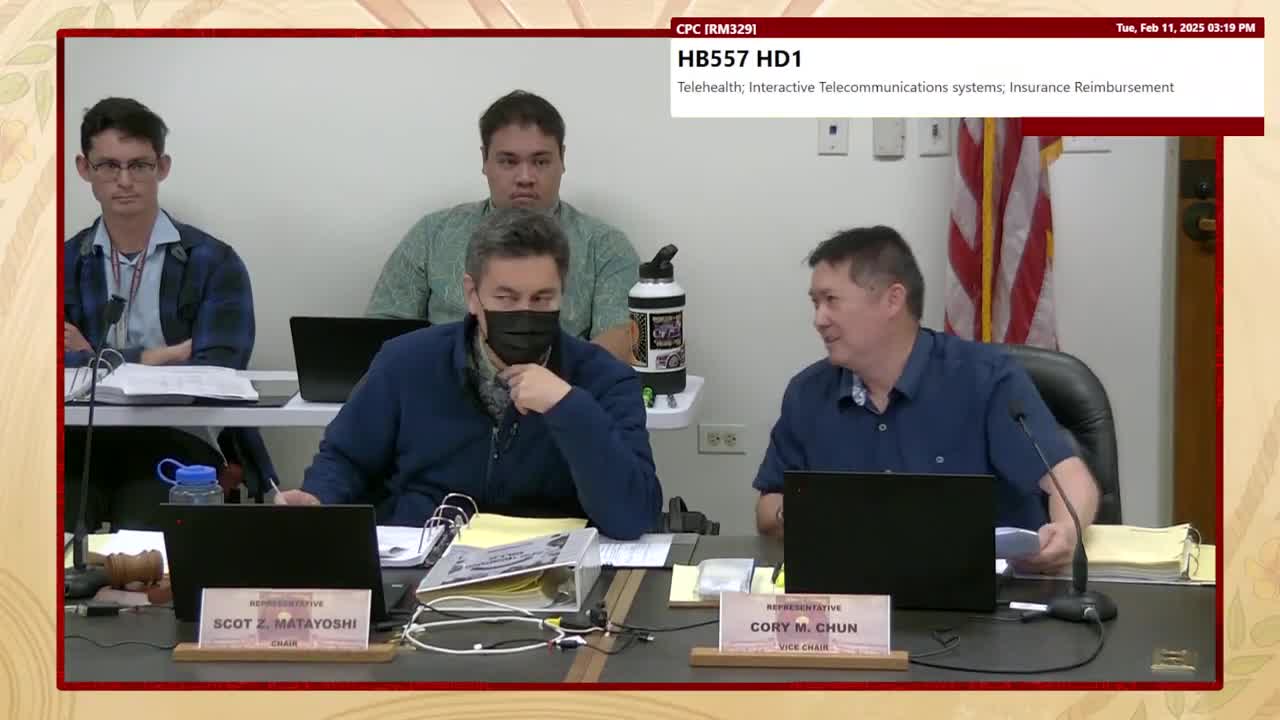 14MIN
House Standing Committee on Consumer Protection & Commerce
 21MIN