HB 1939: DBEDT; Motion Picture, Digital Media, and Film Production Income Tax Credit; Local Workforce Incentive; Qualified Production Incentives; Third-Party Certification; Per Production Cap; Waiver; Hawaii Film Office; Reports
- Session Year: 2025-2026
- House: House
- Latest Version Date: 2026-03-24
Current Status:
Failed
(2026-03-25: Report adopted; Passed Second Reading, as amended (SD 1) and referred to WAM.)
Introduced
In Committee
First Chamber
In Committee
Second Chamber
Final Decking
Enacted
Amends the Motion Picture, Digital Media, and Film Production Income Tax Credit (film tax credit) by providing additional credits to qualified productions that have a workforce of at least eighty per cent local hires in the first taxable year or second consecutive taxable year and meet other specific requirements, then increasing the local workforce threshold to eighty-two per cent in the third or fourth consecutive taxable year and eighty-five per cent in the fifth consecutive taxable year, that the additional credit is claimed; requiring independent third-party certification of qualified production costs for all film productions claiming the film tax credit; authorizing DBEDT to waive the credit cap per qualified production for one qualified production each fiscal year; and requiring the Hawaii Film Office to submit an annual report to the Legislature. Sunsets 1/1/2033. Effective 7/1/3050. (SD1)
Amends the Motion Picture, Digital Media, and Film Production Income Tax Credit (film tax credit) by providing additional credits to qualified productions that have a workforce of at least eighty per cent local hires in the first taxable year or second consecutive taxable year and meet other specific requirements, then increasing the local workforce threshold to eighty-two per cent in the third or fourth consecutive taxable year and eighty-five per cent in the fifth consecutive taxable year, that the additional credit is claimed; requiring independent third-party certification of qualified production costs for all film productions claiming the film tax credit; authorizing DBEDT to waive the credit cap per qualified production for one qualified production each fiscal year; and requiring the Hawaii Film Office to submit an annual report to the Legislature. Sunsets 1/1/2033. Effective 7/1/3000. (HD2)
Amends the Motion Picture, Digital Media, and Film Production Income Tax Credit (film tax credit) by providing additional credits to qualified productions that have a workforce of at least eighty per cent local hires and meet other specific requirements, then increasing the local workforce threshold to eighty-two per cent in the third consecutive taxable year and eighty-five per cent in the fifth taxable year, that the additional credit is claimed; requiring independent third-party certification of qualified production costs for all film productions claiming the film tax credit; authorizing DBEDT to waive the credit cap per qualified production for one qualified production each fiscal year; and requiring the Hawaii Film Office to submit an annual report to the Legislature. Repeals 1/1/2033. Effective 7/1/3000. (HD1)
Amends the Motion Picture, Digital Media, and Film Production Income Tax Credit by providing additional credits to qualified productions that have a workforce of at least eighty per cent local hires and that either have an above-the-line workforce of at least thirty per cent local hires, invest in qualified production infrastructure, feature indigenous content, or conduct post-production in the State; establishing that the minimum local hires requirement will increase to eighty-two per cent in the third consecutive taxable year that the additional credit is claimed and to eighty-five per cent in the fifth consecutive taxable year; authorizing the Department of Business, Economic Development, and Tourism to waive the credit cap per qualified production for one qualified production each fiscal year; and requiring the Hawaii Film Office to submit an annual report to the Legislature.
|
HOUSE OF REPRESENTATIVES |
H.B. NO. |
1939 |
|
THIRTY-THIRD LEGISLATURE, 2026 |
H.D. 2 |
|
|
STATE OF HAWAII |
S.D. 1 |
|
|
|
|
|
|
|
||
|
|
||
A BILL FOR AN ACT
RELATING TO TAXATION.
BE IT ENACTED BY THE LEGISLATURE OF THE STATE OF HAWAII:
SECTION 1. Section 235-17, Hawaii Revised Statutes, is amended to read as follows:
"§235-17 Motion picture, digital
media, and film production income tax credit. (a)
Any law to the contrary notwithstanding, there shall be allowed to each
taxpayer subject to the taxes imposed by this chapter, an income tax credit
that shall be deductible from the taxpayer's net income tax liability, if any,
imposed by this chapter for the taxable year in which the credit is properly
claimed. The amount of the credit shall
be[:] equal to the sum of the following:
(1) Either:
(A) Twenty-two per cent of the qualified production costs incurred by a qualified production in any county of the State with a population of over seven hundred thousand; or
[(2)] (B) Twenty-seven per cent of the qualified
production costs incurred by a qualified production in any county of the State
with a population of seven hundred thousand or less[.];
(2) An additional five per cent of the qualified production costs incurred by a qualified production with a workforce of at least:
(A) Eighty per cent local hires in the first taxable year or second consecutive taxable year that the additional credit amount is claimed;
(B) Eighty-two per cent local hires in the third or fourth consecutive taxable year that the additional credit amount is claimed; and
(C) Eighty-five per cent local hires in the fifth consecutive taxable year that the additional credit amount is claimed; and
(3) Of the following, a single option that represents the greatest value:
(A) An additional five per cent of the qualified production costs incurred by a qualified production with an above-the-line workforce of at least thirty per cent local hires;
(B) An additional three per cent of the qualified production costs incurred by a qualified production that invests in qualified production infrastructure;
(C) An additional three per cent of the qualified production costs incurred by a qualified production that features indigenous content; or
(D) An additional two per cent of the qualified production costs incurred by a qualified production that conducts post-production in the State for qualified productions filmed in the State;
provided that the Hawaii film office, in collaboration with the department of taxation, shall establish policies to determine standards and minimum qualifications for investment in qualified production infrastructure and featuring of indigenous content pursuant to subparagraphs (B) and (C).
A qualified production occurring in more than one county may prorate its expenditures based upon the amounts spent in each county, if the population bases differ enough to change the percentage of tax credit.
In the case of a partnership, S corporation, estate, or trust, the tax credit allowable is for qualified production costs incurred by the entity for the taxable year. The cost upon which the tax credit is computed shall be determined at the entity level. Distribution and share of credit shall be determined by rule.
If a deduction is taken under section 179 (with respect to election to expense depreciable business assets) of the Internal Revenue Code of 1986, as amended, no tax credit shall be allowed for those costs for which the deduction is taken.
The basis for eligible property for depreciation of accelerated cost recovery system purposes for state income taxes shall be reduced by the amount of credit allowable and claimed.
(b) The credit allowed under this section shall be claimed against the net income tax liability for the taxable year. For the purposes of this section, "net income tax liability" means net income tax liability reduced by all other credits allowed under this chapter.
(c) If the tax credit under this section exceeds the taxpayer's income tax liability, the excess of credits over liability shall be refunded to the taxpayer; provided that no refunds or payment on account of the tax credits allowed by this section shall be made for amounts less than $1. All claims, including any amended claims, for tax credits under this section shall be filed on or before the end of the twelfth month following the close of the taxable year for which the credit may be claimed. Failure to comply with any of the foregoing provision shall constitute a waiver of the right to claim the credit.
(d) To qualify for this tax credit, a production shall:
(1) Meet the
definition of a qualified production specified in subsection [(o);] (p);
(2) Have qualified production costs totaling at least $100,000;
(3) Provide the State a qualified Hawaii promotion, which shall be at a minimum, a shared-card, end-title screen credit, where applicable;
(4) Provide evidence of reasonable efforts to hire local talent and crew;
(5) Provide evidence when making any claim for products or services acquired or rendered outside of this State that reasonable efforts were unsuccessful to secure and use comparable products or services within this State;
(6) Provide evidence of financial or in-kind contributions or educational or workforce development efforts, in partnership with related local industry labor organizations, educational institutions, or both, toward the furtherance of the local film and television and digital media industries;
(7) Provide evidence of reasonable efforts to comply with all applicable requirements under title 14, including tax return filing and payments; and
(8) Provide complete responses to the department of taxation's inquiries and document requests, in the form prescribed by the department, no later than ninety days from the inquiry or request;
provided that a taxpayer shall be given notice of and an opportunity to cure any failure to meet the requirements of this subsection, including chapter 237, within thirty days of receipt of the notice; provided further that nothing in this subsection shall be interpreted as waiving any act required by this section.
(e) On or after July 1, 2006, no qualified production cost that has been financed by investments for which a credit was claimed by any taxpayer pursuant to section 235-110.9 is eligible for credits under this section.
(f) To receive the tax credit, the taxpayer shall first prequalify the production for the credit by registering with the department of business, economic development, and tourism during the development or preproduction stage.
(g) The director of taxation shall prepare forms as may be necessary to claim a credit under this section. The director may also require the taxpayer to furnish information to ascertain the validity of the claim for credit made under this section and may adopt rules necessary to effectuate the purposes of this section pursuant to chapter 91.
(h) Every taxpayer claiming a tax credit under this section for a qualified production shall, no later than ninety days following the end of each taxable year in which qualified production costs were expended, submit a written, sworn statement to the department of business, economic development, and tourism that identifies:
(1) All qualified production costs as provided by subsection (a), if any, incurred in the previous taxable year;
(2) The amount of tax credits claimed pursuant to this section, if any, in the previous taxable year; and
(3) The number of total hires versus the number of local hires by category and by county.
This information may be reported from the department of business, economic development, and tourism to the legislature pursuant to subsection (i)(4). No later than January 1, 2027, and each January 1 thereafter, each film production that is claiming a tax credit pursuant to this section shall obtain an independent third-party certification of qualified production costs eligible for the motion picture, digital media, and film production income tax credit in the form of a tax opinion, as required under this subsection, which shall be submitted to the department of business, economic development, and tourism.
(i) The department of business, economic development, and tourism shall:
(1) Maintain records of the names of the taxpayers and qualified productions thereof claiming the tax credits under subsection (a);
(2) Obtain and total the aggregate amounts of all qualified production costs per qualified production and per qualified production per taxable year;
(3) Provide a letter to the director of taxation specifying the amount of the tax credit per qualified production for each taxable year that a tax credit is claimed and the cumulative amount of the tax credit for all years claimed; and
(4) Submit a report to the legislature no later than twenty days prior to the convening of each regular session detailing the non-aggregated qualified production costs that form the basis of the tax credit claims and expenditures, itemized by taxpayer, in a redacted format to preserve the confidentiality and that shall include the dollar amount claimed, name of company, and name of the qualified production of the taxpayers claiming the credit.
(j) Upon each determination required under subsection (i), the department of business, economic development, and tourism shall issue a letter to the taxpayer, regarding the qualified production, specifying the qualified production costs and the tax credit amount qualified for in each taxable year a tax credit is claimed; provided that the department of business, economic development, and tourism shall issue the letter to the taxpayer no later than seven months after receipt of the taxpayer's statement under subsection (h). The taxpayer for each qualified production shall file the letter with the taxpayer's tax return for the qualified production to the department of taxation. Notwithstanding the authority of the department of business, economic development, and tourism under this section, the director of taxation may audit and adjust the tax credit amount to conform to the information filed by the taxpayer.
(k) Each taxpayer claiming a tax credit under this section shall submit to the department of business, economic development, and tourism a fee for the motion picture, digital media, and film production income tax credit in an amount equal to 0.2 per cent of the tax credit claimed by the qualified production no later than the deadline stated in subsection (c). The department of business, economic development, and tourism may prescribe the form and method by which this fee is remitted, including through electronic means. The fees collected under this subsection shall be deposited into the Hawaii film and creative industries development special fund under section 201-113.
(l)
Total tax credits claimed per qualified production shall not exceed
$17,000,000[.]; provided that:
(1) The department of business, economic development, and tourism may waive this cap amount for one qualified production each taxable year; provided further that the total tax credits claimed by a qualified production in any taxable year shall not exceed seventy per cent of the total amount of tax credits allowed under this section pursuant to subsection (n);
(2) No qualified production shall have the cap amount waived for more than two taxable years; and
(3) The department of business, economic development, and tourism shall submit a report to the legislature no later than twenty days prior to the convening of each regular session that provides a justification for the selection of the qualified production designated for the waiver and the status of the qualified production.
(m) Qualified productions shall comply with subsections (d), (e), (f), (h), and (k).
(n) The total amount of tax credits allowed under this section in any particular year shall be $50,000,000; however, if the total amount of credits applied for in any particular year exceeds the aggregate amount of credits allowed for that year under this section, the excess shall be treated as having been applied for in the subsequent year and shall be claimed in the subsequent year; provided that no excess shall be allowed to be claimed after December 31, 2032.
(o) The Hawaii film office shall submit an annual report to the legislature no later than twenty days prior to the convening of each regular session. The annual report shall include the following information:
(1) A list of the qualified productions that received the tax credit;
(2) How funds received from the tax credit were spent in the State and to what extent local communities, workers, and businesses benefited;
(3) The impact of the tax credit on tax revenue, job creation, industry development, and tourism; and
(4) An analysis of why the tax credit provides greater long-term value to the State than other tax credits and alternative uses of state funds.
[(o)] (p) For the purposes of this section:
"Above-the-line workforce" means the employees involved with the production of a qualified production whose salaries are negotiated before the commencement of production, including but not limited to actors, directors, producers, and writers.
"Commercial":
(1) Means an advertising message that is filmed using film, videotape, or digital media, for dissemination via television broadcast or theatrical distribution;
(2) Includes a series of advertising messages if all parts are produced at the same time over the course of six consecutive weeks; and
(3) Does not include an advertising message with Internet-only distribution.
"Digital media" means production methods and platforms directly related to the creation of cinematic imagery and content, specifically using digital means, including but not limited to digital cameras, digital sound equipment, and computers, to be delivered via film, videotape, interactive game platform, or other digital distribution media.
"Hawaii film office" means the film industry branch of the creative industries division of the department of business, economic development, and tourism.
"Post-production" means production activities and services conducted after principal photography is completed, including but not limited to editing, film and video transfers, duplication, transcoding, dubbing, subtitling, credits, closed captioning, audio production, special effects (visual and sound), graphics, and animation.
"Production" means a series of activities that are directly related to the creation of visual and cinematic imagery to be delivered via film, videotape, or digital media and to be sold, distributed, or displayed as entertainment or the advertisement of products for mass public consumption, including but not limited to scripting, casting, set design and construction, transportation, videography, photography, sound recording, interactive game design, and post-production.
"Qualified production":
(1) Means a production, with expenditures in the State, for the total or partial production of a feature-length motion picture, short film, made-for-television movie, commercial, music video, interactive game, television series pilot, single season (up to twenty-two episodes) of a television series regularly filmed in the State (if the number of episodes per single season exceeds twenty-two, additional episodes for the same season shall constitute a separate qualified production), television special, single television episode that is not part of a television series regularly filmed or based in the State, national magazine show, or national talk show. For the purposes of subsections (d) and (l), each of the aforementioned qualified production categories shall constitute separate, individual qualified productions; and
(2) Does not include:
(A) News;
(B) Public affairs programs;
(C) Non-national magazine or talk shows;
(D) Televised sporting events or activities;
(E) Productions that solicit funds;
(F) Productions produced primarily for industrial, corporate, institutional, or other private purposes; and
(G) Productions that include any material or performance prohibited by chapter 712.
"Qualified production costs" means the costs incurred by a qualified production within the State that are subject to the general excise tax under chapter 237 at the highest rate of tax or income tax under this chapter if the costs are not subject to general excise tax and that have not been financed by any investments for which a credit was or will be claimed pursuant to section 235-110.9. "Qualified production costs" include but are not limited to:
(1) Costs incurred during preproduction such as location scouting and related services;
(2) Costs of set construction and operations, purchases or rentals of wardrobe, props, accessories, food, office supplies, transportation, equipment, and related services;
(3) Wages or salaries of cast, crew, and musicians;
(4) Costs of photography, sound synchronization, lighting, and related services;
(5) Costs of editing, visual effects, music, other post-production, and related services;
(6) Rentals and fees for use of local facilities and locations, including rentals and fees for use of state and county facilities and locations that are not subject to general excise tax under chapter 237 or income tax under this chapter;
(7) Rentals of vehicles and lodging for cast and crew;
(8) Airfare for flights to or from Hawaii, and interisland flights;
(9) Insurance and bonding;
(10) Shipping of equipment and supplies to or from Hawaii, and interisland shipments; and
(11) Other direct production costs specified by the department in consultation with the department of business, economic development, and tourism;
provided that any government-imposed fines, penalties, or interest that are incurred by a qualified production within the State shall not be "qualified production costs". "Qualified production costs" does not include any costs funded by any grant, forgivable loan, or other amounts not included in gross income for purposes of this chapter."
SECTION 2. Act 143, Session Laws of Hawaii 2017, is amended by amending section 6 to read as follows:
"SECTION 6. [No later than January 1, 2018, and each
January 1 thereafter, each film production that has production expenditures of
$1,000,000 or more and is claiming a tax credit pursuant to section 235-17,
Hawaii Revised Statutes, shall obtain an independent third party certification
of qualified production costs eligible for the motion picture, digital media,
and film production income tax credit in the form of a tax opinion, as required
under section 235-17(h), Hawaii Revised Statutes, submitted to the department
of business, economic development, and tourism.] Repealed."
SECTION 3. Statutory material to be repealed is bracketed and stricken. New statutory material is underscored.
SECTION 4. This Act shall take effect on July 1, 3050, and shall apply to costs incurred after December 31, 2025; provided that on January 1, 2033, this Act shall be repealed to coincide with the repeal date of Act 88, Session Laws of Hawaii 2006, as amended by Act 89, Session Laws of Hawaii 2013, as amended by Act 143, Session Laws of Hawaii 2017, as amended by Act 217, Session Laws of Hawaii 2022, and section 235‑17, Hawaii Revised Statutes, shall be reenacted in the form in which it read on the day before the effective date of Act 88, Session Laws of Hawaii 2006.
Report Title:
DBEDT; Motion Picture, Digital Media, and Film Production Income Tax Credit; Local Workforce Incentive; Qualified Production Incentives; Third-Party Certification; Per Production Cap; Waiver; Hawaii Film Office; Reports
Description:
Amends the Motion Picture, Digital Media, and Film Production Income Tax Credit (film tax credit) by providing additional credits to qualified productions that have a workforce of at least eighty per cent local hires in the first taxable year or second consecutive taxable year and meet other specific requirements, then increasing the local workforce threshold to eighty-two per cent in the third or fourth consecutive taxable year and eighty-five per cent in the fifth consecutive taxable year, that the additional credit is claimed; requiring independent third-party certification of qualified production costs for all film productions claiming the film tax credit; authorizing DBEDT to waive the credit cap per qualified production for one qualified production each fiscal year; and requiring the Hawaii Film Office to submit an annual report to the Legislature. Sunsets 1/1/2033. Effective 7/1/3050. (SD1)
The summary description of legislation appearing on this page is for informational purposes only and is not legislation or evidence of legislative intent.
|
HOUSE OF REPRESENTATIVES |
H.B. NO. |
1939 |
|
THIRTY-THIRD LEGISLATURE, 2026 |
H.D. 2 |
|
|
STATE OF HAWAII |
|
|
|
|
|
|
|
|
||
|
|
||
A BILL FOR AN ACT
RELATING TO TAXATION.
BE IT ENACTED BY THE LEGISLATURE OF THE STATE OF HAWAII:
SECTION 1. Section 235-17, Hawaii Revised Statutes, is amended to read as follows:
"§235-17 Motion picture, digital
media, and film production income tax credit. (a)
Any law to the contrary notwithstanding, there shall be allowed to each
taxpayer subject to the taxes imposed by this chapter, an income tax credit
that shall be deductible from the taxpayer's net income tax liability, if any,
imposed by this chapter for the taxable year in which the credit is properly
claimed. The amount of the credit shall
be[:] equal to the sum of the following:
(1) Either:
(A) Twenty-two per cent of the qualified production costs incurred by a qualified production in any county of the State with a population of over seven hundred thousand; or
[(2)] (B) Twenty-seven
per cent of the qualified production costs incurred by a qualified production
in any county of the State with a population of seven hundred thousand or less[.];
(2) An additional five per cent of the qualified production costs incurred by a qualified production with a workforce of at least:
(A) Eighty per cent local hires in the first taxable year or second consecutive taxable year that the additional credit amount is claimed;
(B) Eighty-two per cent local hires in the third or fourth consecutive taxable year that the additional credit amount is claimed; and
(C) Eighty-five per cent local hires in the fifth consecutive taxable year that the additional credit amount is claimed; and
(3) Of the following, a single option that represents the greatest value:
(A) An additional five per cent of the qualified production costs incurred by a qualified production with an above-the-line workforce of at least thirty per cent local hires;
(B) An additional three per cent of the qualified production costs incurred by a qualified production that invests in qualified production infrastructure;
(C) An additional three per cent of the qualified production costs incurred by a qualified production that features indigenous content; or
(D) An additional two per cent of the qualified production costs incurred by a qualified production that conducts post-production in the State for qualified productions filmed in the State;
provided that the Hawaii film office, in collaboration with the department of taxation, shall establish policies to determine standards and minimum qualifications for investment in qualified production infrastructure and featuring of indigenous content pursuant to subparagraphs (B) and (C).
A qualified production occurring in more than one county may prorate its expenditures based upon the amounts spent in each county, if the population bases differ enough to change the percentage of tax credit.
In the case of a partnership, S corporation, estate, or trust, the tax credit allowable is for qualified production costs incurred by the entity for the taxable year. The cost upon which the tax credit is computed shall be determined at the entity level. Distribution and share of credit shall be determined by rule.
If a deduction is taken under section 179 (with respect to election to expense depreciable business assets) of the Internal Revenue Code of 1986, as amended, no tax credit shall be allowed for those costs for which the deduction is taken.
The basis for eligible property for depreciation of accelerated cost recovery system purposes for state income taxes shall be reduced by the amount of credit allowable and claimed.
(b) The credit allowed under this section shall be claimed against the net income tax liability for the taxable year. For the purposes of this section, "net income tax liability" means net income tax liability reduced by all other credits allowed under this chapter.
(c) If the tax credit under this section exceeds the taxpayer's income tax liability, the excess of credits over liability shall be refunded to the taxpayer; provided that no refunds or payment on account of the tax credits allowed by this section shall be made for amounts less than $1. All claims, including any amended claims, for tax credits under this section shall be filed on or before the end of the twelfth month following the close of the taxable year for which the credit may be claimed. Failure to comply with any of the foregoing provision shall constitute a waiver of the right to claim the credit.
(d) To qualify for this tax credit, a production shall:
(1) Meet the
definition of a qualified production specified in subsection [(o);] (p);
(2) Have qualified production costs totaling at least $100,000;
(3) Provide the State a qualified Hawaii promotion, which shall be at a minimum, a shared-card, end-title screen credit, where applicable;
(4) Provide evidence of reasonable efforts to hire local talent and crew;
(5) Provide evidence when making any claim for products or services acquired or rendered outside of this State that reasonable efforts were unsuccessful to secure and use comparable products or services within this State;
(6) Provide evidence of financial or in-kind contributions or educational or workforce development efforts, in partnership with related local industry labor organizations, educational institutions, or both, toward the furtherance of the local film and television and digital media industries;
(7) Provide evidence of reasonable efforts to comply with all applicable requirements under title 14, including tax return filing and payments; and
(8) Provide complete responses to the department of taxation's inquiries and document requests, in the form prescribed by the department, no later than ninety days from the inquiry or request;
provided that a taxpayer shall be given notice of and an opportunity to cure any failure to meet the requirements of this subsection, including chapter 237, within thirty days of receipt of the notice; provided further that nothing in this subsection shall be interpreted as waiving any act required by this section.
(e) On or after July 1, 2006, no qualified production cost that has been financed by investments for which a credit was claimed by any taxpayer pursuant to section 235-110.9 is eligible for credits under this section.
(f) To receive the tax credit, the taxpayer shall first prequalify the production for the credit by registering with the department of business, economic development, and tourism during the development or preproduction stage.
(g) The director of taxation shall prepare forms as may be necessary to claim a credit under this section. The director may also require the taxpayer to furnish information to ascertain the validity of the claim for credit made under this section and may adopt rules necessary to effectuate the purposes of this section pursuant to chapter 91.
(h) Every taxpayer claiming a tax credit under this section for a qualified production shall, no later than ninety days following the end of each taxable year in which qualified production costs were expended, submit a written, sworn statement to the department of business, economic development, and tourism that identifies:
(1) All qualified production costs as provided by subsection (a), if any, incurred in the previous taxable year;
(2) The amount of tax credits claimed pursuant to this section, if any, in the previous taxable year; and
(3) The number of total hires versus the number of local hires by category and by county.
This information may be reported from the department of business, economic development, and tourism to the legislature pursuant to subsection (i)(4). No later than January 1, 2027, and each January 1 thereafter, each film production that is claiming a tax credit pursuant to this section shall obtain an independent third-party certification of qualified production costs eligible for the motion picture, digital media, and film production income tax credit in the form of a tax opinion, as required under this subsection, submitted to the department of business, economic development, and tourism.
(i) The department of business, economic development, and tourism shall:
(1) Maintain records of the names of the taxpayers and qualified productions thereof claiming the tax credits under subsection (a);
(2) Obtain and total the aggregate amounts of all qualified production costs per qualified production and per qualified production per taxable year;
(3) Provide a letter to the director of taxation specifying the amount of the tax credit per qualified production for each taxable year that a tax credit is claimed and the cumulative amount of the tax credit for all years claimed; and
(4) Submit a report to the legislature no later than twenty days prior to the convening of each regular session detailing the non-aggregated qualified production costs that form the basis of the tax credit claims and expenditures, itemized by taxpayer, in a redacted format to preserve the confidentiality and that shall include the dollar amount claimed, name of company, and name of the qualified production of the taxpayers claiming the credit.
(j) Upon each determination required under subsection (i), the department of business, economic development, and tourism shall issue a letter to the taxpayer, regarding the qualified production, specifying the qualified production costs and the tax credit amount qualified for in each taxable year a tax credit is claimed; provided that the department of business, economic development, and tourism shall issue the letter to the taxpayer no later than seven months after receipt of the taxpayer's statement under subsection (h). The taxpayer for each qualified production shall file the letter with the taxpayer's tax return for the qualified production to the department of taxation. Notwithstanding the authority of the department of business, economic development, and tourism under this section, the director of taxation may audit and adjust the tax credit amount to conform to the information filed by the taxpayer.
(k) Each taxpayer claiming a tax credit under this section shall submit to the department of business, economic development, and tourism a fee for the motion picture, digital media, and film production income tax credit in an amount equal to 0.2 per cent of the tax credit claimed by the qualified production no later than the deadline stated in subsection (c). The department of business, economic development, and tourism may prescribe the form and method by which this fee is remitted, including through electronic means. The fees collected under this subsection shall be deposited into the Hawaii film and creative industries development special fund under section 201-113.
(l)
Total tax credits claimed per qualified production shall not exceed
$17,000,000[.]; provided that:
(1) The department of business, economic development, and tourism may waive this cap amount for one qualified production each taxable year; provided further that the total tax credits claimed by a qualified production in any taxable year shall not exceed seventy per cent of the total amount of tax credits allowed under this section pursuant to subsection (n);
(2) No qualified production shall have the cap amount waived for more than two taxable years; and
(3) The department of business, economic development, and tourism shall submit a report to the legislature no later than twenty days prior to the convening of each regular session that provides a justification for the selection of the qualified production designated for the waiver and the status of the qualified production.
(m) Qualified productions shall comply with subsections (d), (e), (f), (h), and (k).
(n) The total amount of tax credits allowed under this section in any particular year shall be $50,000,000; however, if the total amount of credits applied for in any particular year exceeds the aggregate amount of credits allowed for that year under this section, the excess shall be treated as having been applied for in the subsequent year and shall be claimed in the subsequent year; provided that no excess shall be allowed to be claimed after December 31, 2032.
(o) The Hawaii film office shall submit an annual report to the legislature no later than twenty days prior to the convening of each regular session. The annual report shall include the following information:
(1) A list of the qualified productions that received the tax credit;
(2) How funds received from the tax credit were spent in the State and to what extent local communities, workers, and businesses benefited;
(3) The impact of the tax credit on tax revenue, job creation, industry development, and tourism; and
(4) An analysis of why the tax credit provides greater long-term value to the State than other tax credits and alternative uses of state funds.
[(o)] (p) For the purposes of this section:
"Above-the-line workforce" means the employees involved with the production of a qualified production whose salaries are negotiated before the commencement of production, including but not limited to actors, directors, producers, and writers.
"Commercial":
(1) Means an advertising message that is filmed using film, videotape, or digital media, for dissemination via television broadcast or theatrical distribution;
(2) Includes a series of advertising messages if all parts are produced at the same time over the course of six consecutive weeks; and
(3) Does not include an advertising message with Internet-only distribution.
"Digital media" means production methods and platforms directly related to the creation of cinematic imagery and content, specifically using digital means, including but not limited to digital cameras, digital sound equipment, and computers, to be delivered via film, videotape, interactive game platform, or other digital distribution media.
"Post-production" means production activities and services conducted after principal photography is completed, including but not limited to editing, film and video transfers, duplication, transcoding, dubbing, subtitling, credits, closed captioning, audio production, special effects (visual and sound), graphics, and animation.
"Production" means a series of activities that are directly related to the creation of visual and cinematic imagery to be delivered via film, videotape, or digital media and to be sold, distributed, or displayed as entertainment or the advertisement of products for mass public consumption, including but not limited to scripting, casting, set design and construction, transportation, videography, photography, sound recording, interactive game design, and post-production.
"Qualified production":
(1) Means a production, with expenditures in the State, for the total or partial production of a feature-length motion picture, short film, made-for-television movie, commercial, music video, interactive game, television series pilot, single season (up to twenty-two episodes) of a television series regularly filmed in the State (if the number of episodes per single season exceeds twenty-two, additional episodes for the same season shall constitute a separate qualified production), television special, single television episode that is not part of a television series regularly filmed or based in the State, national magazine show, or national talk show. For the purposes of subsections (d) and (l), each of the aforementioned qualified production categories shall constitute separate, individual qualified productions; and
(2) Does not include:
(A) News;
(B) Public affairs programs;
(C) Non-national magazine or talk shows;
(D) Televised sporting events or activities;
(E) Productions that solicit funds;
(F) Productions produced primarily for industrial, corporate, institutional, or other private purposes; and
(G) Productions that include any material or performance prohibited by chapter 712.
"Qualified production costs" means the costs incurred by a qualified production within the State that are subject to the general excise tax under chapter 237 at the highest rate of tax or income tax under this chapter if the costs are not subject to general excise tax and that have not been financed by any investments for which a credit was or will be claimed pursuant to section 235-110.9. Qualified production costs include but are not limited to:
(1) Costs incurred during preproduction such as location scouting and related services;
(2) Costs of set construction and operations, purchases or rentals of wardrobe, props, accessories, food, office supplies, transportation, equipment, and related services;
(3) Wages or salaries of cast, crew, and musicians;
(4) Costs of photography, sound synchronization, lighting, and related services;
(5) Costs of editing, visual effects, music, other post-production, and related services;
(6) Rentals and fees for use of local facilities and locations, including rentals and fees for use of state and county facilities and locations that are not subject to general excise tax under chapter 237 or income tax under this chapter;
(7) Rentals of vehicles and lodging for cast and crew;
(8) Airfare for flights to or from Hawaii, and interisland flights;
(9) Insurance and bonding;
(10) Shipping of equipment and supplies to or from Hawaii, and interisland shipments; and
(11) Other direct production costs specified by the department in consultation with the department of business, economic development, and tourism;
provided that any government-imposed fines, penalties, or interest that are incurred by a qualified production within the State shall not be "qualified production costs". "Qualified production costs" does not include any costs funded by any grant, forgivable loan, or other amounts not included in gross income for purposes of this chapter."
SECTION 2. Act 143, Session Laws of Hawaii 2017, is amended by amending section 6 to read as follows:
"SECTION 6. [No later than January 1, 2018, and each
January 1 thereafter, each film production that has production expenditures of
$1,000,000 or more and is claiming a tax credit pursuant to section 235-17,
Hawaii Revised Statutes, shall obtain an independent third party certification
of qualified production costs eligible for the motion picture, digital media,
and film production income tax credit in the form of a tax opinion, as required
under section 235-17(h), Hawaii Revised Statutes, submitted to the department
of business, economic development, and tourism.] Repealed."
SECTION 3. Statutory material to be repealed is bracketed and stricken. New statutory material is underscored.
SECTION 4. This Act shall take effect on July 1, 3000, and shall apply to taxable years beginning after December 31, 2025; provided that on January 1, 2033, this Act shall be repealed to coincide with the repeal date of Act 88, Session Laws of Hawaii 2006, as amended by Act 89, Session Laws of Hawaii 2013, as amended by Act 143, Session Laws of Hawaii 2017, as amended by Act 217, Session Laws of Hawaii 2022, and section 235‑17, Hawaii Revised Statutes, shall be reenacted in the form in which it read on the day before the effective date of Act 88, Session Laws of Hawaii 2006.
Report Title:
DBEDT; Motion Picture, Digital Media, and Film Production Income Tax Credit; Local Workforce Incentive; Qualified Production Incentives; Third-party Certification; Per Production Cap; Waiver; Hawaii Film Office; Report
Description:
Amends the Motion Picture, Digital Media, and Film Production Income Tax Credit (film tax credit) by providing additional credits to qualified productions that have a workforce of at least eighty per cent local hires in the first taxable year or second consecutive taxable year and meet other specific requirements, then increasing the local workforce threshold to eighty-two per cent in the third or fourth consecutive taxable year and eighty-five per cent in the fifth consecutive taxable year, that the additional credit is claimed; requiring independent third-party certification of qualified production costs for all film productions claiming the film tax credit; authorizing DBEDT to waive the credit cap per qualified production for one qualified production each fiscal year; and requiring the Hawaii Film Office to submit an annual report to the Legislature. Sunsets 1/1/2033. Effective 7/1/3000. (HD2)
The summary description of legislation appearing on this page is for informational purposes only and is not legislation or evidence of legislative intent.
|
HOUSE OF REPRESENTATIVES |
H.B. NO. |
1939 |
|
THIRTY-THIRD LEGISLATURE, 2026 |
H.D. 1 |
|
|
STATE OF HAWAII |
|
|
|
|
|
|
|
|
||
|
|
||
A BILL FOR AN ACT
RELATING TO TAXATION.
BE IT ENACTED BY THE LEGISLATURE OF THE STATE OF HAWAII:
SECTION 1. Section 235-17, Hawaii Revised Statutes, is amended to read as follows:
"§235-17 Motion picture, digital
media, and film production income tax credit. (a)
Any law to the contrary notwithstanding, there shall be allowed to each
taxpayer subject to the taxes imposed by this chapter, an income tax credit
that shall be deductible from the taxpayer's net income tax liability, if any,
imposed by this chapter for the taxable year in which the credit is properly
claimed. The amount of the credit shall
be[:] equal to the sum of the following:
(1) Either:
(A) Twenty-two per cent of the qualified production costs incurred by a qualified production in any county of the State with a population of over seven hundred thousand; or
[(2)] (B) Twenty-seven
per cent of the qualified production costs incurred by a qualified production
in any county of the State with a population of seven hundred thousand or less[.];
(2) An additional five per cent of the qualified production costs incurred by a qualified production with a workforce of at least:
(A) Eighty per cent local hires in the first taxable year or second consecutive taxable year that the additional credit amount is claimed;
(B) Eighty-two per cent local hires in the third consecutive taxable year that the additional credit amount is claimed; and
(C) Eighty-five per cent local hires in the fifth consecutive taxable year that the additional credit amount is claimed; and
(3) The greatest of either:
(B) Three per cent of the qualified production costs incurred by a qualified production that invests in qualified production infrastructure;
(C) Three per cent of the qualified production costs incurred by a qualified production that features indigenous content; or
(D) Two per cent of the qualified production costs incurred by a qualified production that conducts post-production in the State for qualified productions filmed in the State;
provided that the Hawaii film office, in collaboration with the department of taxation, shall establish policies to determine standards and minimum qualifications for investment in qualified production infrastructure and featuring of indigenous content pursuant to subparagraphs (B) and (C).
A qualified production occurring in more than one county may prorate its expenditures based upon the amounts spent in each county, if the population bases differ enough to change the percentage of tax credit.
In the case of a partnership, S corporation, estate, or trust, the tax credit allowable is for qualified production costs incurred by the entity for the taxable year. The cost upon which the tax credit is computed shall be determined at the entity level. Distribution and share of credit shall be determined by rule.
If a deduction is taken under section 179 (with respect to election to expense depreciable business assets) of the Internal Revenue Code of 1986, as amended, no tax credit shall be allowed for those costs for which the deduction is taken.
The basis for eligible property for depreciation of accelerated cost recovery system purposes for state income taxes shall be reduced by the amount of credit allowable and claimed.
For the purposes of this subsection, "above-the-line workforce" means the employees involved with the production of a qualified production whose salaries are negotiated before the commencement of production, including but not limited to actors, directors, producers, and writers.
(b) The credit allowed under this section shall be claimed against the net income tax liability for the taxable year. For the purposes of this section, "net income tax liability" means net income tax liability reduced by all other credits allowed under this chapter.
(c) If the tax credit under this section exceeds the taxpayer's income tax liability, the excess of credits over liability shall be refunded to the taxpayer; provided that no refunds or payment on account of the tax credits allowed by this section shall be made for amounts less than $1. All claims, including any amended claims, for tax credits under this section shall be filed on or before the end of the twelfth month following the close of the taxable year for which the credit may be claimed. Failure to comply with any of the foregoing provision shall constitute a waiver of the right to claim the credit.
(d) To qualify for this tax credit, a production shall:
(1) Meet the definition of a qualified production specified in subsection (o);
(2) Have qualified production costs totaling at least $100,000;
(3) Provide the State a qualified Hawaii promotion, which shall be at a minimum, a shared-card, end-title screen credit, where applicable;
(4) Provide evidence of reasonable efforts to hire local talent and crew;
(5) Provide evidence when making any claim for products or services acquired or rendered outside of this State that reasonable efforts were unsuccessful to secure and use comparable products or services within this State;
(6) Provide evidence of financial or in-kind contributions or educational or workforce development efforts, in partnership with related local industry labor organizations, educational institutions, or both, toward the furtherance of the local film and television and digital media industries;
(7) Provide evidence of reasonable efforts to comply with all applicable requirements under title 14, including tax return filing and payments; and
(8) Provide complete responses to the department of taxation's inquiries and document requests, in the form prescribed by the department, no later than ninety days from the inquiry or request;
provided that a taxpayer shall be given notice of and an opportunity to cure any failure to meet the requirements of this subsection, including chapter 237, within thirty days of receipt of the notice; provided further that nothing in this subsection shall be interpreted as waiving any act required by this section.
(e) On or after July 1, 2006, no qualified production cost that has been financed by investments for which a credit was claimed by any taxpayer pursuant to section 235-110.9 is eligible for credits under this section.
(f) To receive the tax credit, the taxpayer shall first prequalify the production for the credit by registering with the department of business, economic development, and tourism during the development or preproduction stage.
(g) The director of taxation shall prepare forms as may be necessary to claim a credit under this section. The director may also require the taxpayer to furnish information to ascertain the validity of the claim for credit made under this section and may adopt rules necessary to effectuate the purposes of this section pursuant to chapter 91.
(h) Every taxpayer claiming a tax credit under this section for a qualified production shall, no later than ninety days following the end of each taxable year in which qualified production costs were expended, submit a written, sworn statement to the department of business, economic development, and tourism that identifies:
(1) All qualified production costs as provided by subsection (a), if any, incurred in the previous taxable year;
(2) The amount of tax credits claimed pursuant to this section, if any, in the previous taxable year; and
(3) The number of total hires versus the number of local hires by category and by county.
This information may be reported from the department of business, economic development, and tourism to the legislature pursuant to subsection (i)(4). No later than January 1, 2027, and each January 1 thereafter, each film production that is claiming a tax credit pursuant to this section shall obtain an independent third-party certification of qualified production costs eligible for the motion picture, digital media, and film production income tax credit in the form of a tax opinion, as required under this subsection, submitted to the department of business, economic development, and tourism.
(i) The department of business, economic development, and tourism shall:
(1) Maintain records of the names of the taxpayers and qualified productions thereof claiming the tax credits under subsection (a);
(2) Obtain and total the aggregate amounts of all qualified production costs per qualified production and per qualified production per taxable year;
(3) Provide a letter to the director of taxation specifying the amount of the tax credit per qualified production for each taxable year that a tax credit is claimed and the cumulative amount of the tax credit for all years claimed; and
(4) Submit a report to the legislature no later than twenty days prior to the convening of each regular session detailing the non-aggregated qualified production costs that form the basis of the tax credit claims and expenditures, itemized by taxpayer, in a redacted format to preserve the confidentiality and that shall include the dollar amount claimed, name of company, and name of the qualified production of the taxpayers claiming the credit.
(j) Upon each determination required under subsection (i), the department of business, economic development, and tourism shall issue a letter to the taxpayer, regarding the qualified production, specifying the qualified production costs and the tax credit amount qualified for in each taxable year a tax credit is claimed; provided that the department of business, economic development, and tourism shall issue the letter to the taxpayer no later than seven months after receipt of the taxpayer's statement under subsection (h). The taxpayer for each qualified production shall file the letter with the taxpayer's tax return for the qualified production to the department of taxation. Notwithstanding the authority of the department of business, economic development, and tourism under this section, the director of taxation may audit and adjust the tax credit amount to conform to the information filed by the taxpayer.
(k) Each taxpayer claiming a tax credit under this section shall submit to the department of business, economic development, and tourism a fee for the motion picture, digital media, and film production income tax credit in an amount equal to 0.2 per cent of the tax credit claimed by the qualified production no later than the deadline stated in subsection (c). The department of business, economic development, and tourism may prescribe the form and method by which this fee is remitted, including through electronic means. The fees collected under this subsection shall be deposited into the Hawaii film and creative industries development special fund under section 201-113.
(l)
Total tax credits claimed per qualified production shall not exceed
$17,000,000[.]; provided that:
(1) The department of business, economic development, and tourism may waive this cap for one qualified production each fiscal year; provided further that the total tax credits claimed by a qualified production in any fiscal year shall not exceed seventy per cent of the total amount of tax credits allowed under this section pursuant to subsection (n);
(2) No qualified production shall have the cap waived for more than two fiscal years; and
(3) The department of business, economic development, and tourism shall submit a report to the legislature no later than twenty days prior to the convening of each regular session that provides a justification for the selection of the qualified production designated for the waiver and the status of the qualified production.
(m) Qualified productions shall comply with subsections (d), (e), (f), (h), and (k).
(n) The total amount of tax credits allowed under this section in any particular year shall be $50,000,000; however, if the total amount of credits applied for in any particular year exceeds the aggregate amount of credits allowed for that year under this section, the excess shall be treated as having been applied for in the subsequent year and shall be claimed in the subsequent year; provided that no excess shall be allowed to be claimed after December 31, 2032.
(o) The Hawaii film office shall submit an annual report to the legislature no later than twenty days prior to the convening of each regular session. The annual report shall include the following information:
(1) A list of the qualified productions that received the tax credit;
(2) How funds received from the tax credit were spent in the State and to what extent local communities, workers, and businesses benefited;
(3) The impact of the tax credit on tax revenue, job creation, industry development, and tourism; and
(4) An analysis of why the tax credit provides greater long-term value to the State than other tax credits and alternative uses of state funds.
[(o)] (p) For the purposes of this section:
"Commercial":
(1) Means an advertising message that is filmed using film, videotape, or digital media, for dissemination via television broadcast or theatrical distribution;
(2) Includes a series of advertising messages if all parts are produced at the same time over the course of six consecutive weeks; and
(3) Does not include an advertising message with Internet-only distribution.
"Digital media" means production methods and platforms directly related to the creation of cinematic imagery and content, specifically using digital means, including but not limited to digital cameras, digital sound equipment, and computers, to be delivered via film, videotape, interactive game platform, or other digital distribution media.
"Post-production" means production activities and services conducted after principal photography is completed, including but not limited to editing, film and video transfers, duplication, transcoding, dubbing, subtitling, credits, closed captioning, audio production, special effects (visual and sound), graphics, and animation.
"Production" means a series of activities that are directly related to the creation of visual and cinematic imagery to be delivered via film, videotape, or digital media and to be sold, distributed, or displayed as entertainment or the advertisement of products for mass public consumption, including but not limited to scripting, casting, set design and construction, transportation, videography, photography, sound recording, interactive game design, and post-production.
"Qualified production":
(1) Means a production, with expenditures in the State, for the total or partial production of a feature-length motion picture, short film, made-for-television movie, commercial, music video, interactive game, television series pilot, single season (up to twenty-two episodes) of a television series regularly filmed in the State (if the number of episodes per single season exceeds twenty-two, additional episodes for the same season shall constitute a separate qualified production), television special, single television episode that is not part of a television series regularly filmed or based in the State, national magazine show, or national talk show. For the purposes of subsections (d) and (l), each of the aforementioned qualified production categories shall constitute separate, individual qualified productions; and
(2) Does not include:
(A) News;
(B) Public affairs programs;
(C) Non-national magazine or talk shows;
(D) Televised sporting events or activities;
(E) Productions that solicit funds;
(F) Productions produced primarily for industrial, corporate, institutional, or other private purposes; and
(G) Productions that include any material or performance prohibited by chapter 712.
"Qualified production costs" means the costs incurred by a qualified production within the State that are subject to the general excise tax under chapter 237 at the highest rate of tax or income tax under this chapter if the costs are not subject to general excise tax and that have not been financed by any investments for which a credit was or will be claimed pursuant to section 235-110.9. Qualified production costs include but are not limited to:
(1) Costs incurred during preproduction such as location scouting and related services;
(2) Costs of set construction and operations, purchases or rentals of wardrobe, props, accessories, food, office supplies, transportation, equipment, and related services;
(3) Wages or salaries of cast, crew, and musicians;
(4) Costs of photography, sound synchronization, lighting, and related services;
(5) Costs of editing, visual effects, music, other post-production, and related services;
(6) Rentals and fees for use of local facilities and locations, including rentals and fees for use of state and county facilities and locations that are not subject to general excise tax under chapter 237 or income tax under this chapter;
(7) Rentals of vehicles and lodging for cast and crew;
(8) Airfare for flights to or from Hawaii, and interisland flights;
(9) Insurance and bonding;
(10) Shipping of equipment and supplies to or from Hawaii, and interisland shipments; and
(11) Other direct production costs specified by the department in consultation with the department of business, economic development, and tourism;
provided that any government-imposed fines, penalties, or interest that are incurred by a qualified production within the State shall not be "qualified production costs". "Qualified production costs" does not include any costs funded by any grant, forgivable loan, or other amounts not included in gross income for purposes of this chapter."
SECTION 2. Act 143, Session Laws of Hawaii 2017, is amended by amending section 6 to read as follows:
"SECTION 6. [No later than January 1, 2018, and each
January 1 thereafter, each film production that has production expenditures of
$1,000,000 or more and is claiming a tax credit pursuant to section 235-17,
Hawaii Revised Statutes, shall obtain an independent third party certification
of qualified production costs eligible for the motion picture, digital media,
and film production income tax credit in the form of a tax opinion, as required
under section 235-17(h), Hawaii Revised Statutes, submitted to the department
of business, economic development, and tourism.] Repealed."
SECTION 3. Statutory material to be repealed is bracketed and stricken. New statutory material is underscored.
SECTION 4. This Act shall take effect on July 1, 3000, and shall apply to taxable years beginning after December 31, 2025; provided that on January 1, 2033, this Act shall be repealed to coincide with the repeal date of Act 88, Session Laws of Hawaii 2006, as amended by Act 89, Session Laws of Hawaii 2013, as amended by Act 143, Session Laws of Hawaii 2017, as amended by Act 217, Session Laws of Hawaii 2022, and section 235‑17, Hawaii Revised Statutes, shall be reenacted in the form in which it read on the day before the effective date of Act 88, Session Laws of Hawaii 2006.
Report Title:
DBEDT; Motion Picture, Digital Media, and Film Production Income Tax Credit; Local Workforce Incentive; Qualified Production Incentives; Third-party Certification; Per Production Cap; Waiver; Hawaii Film Office; Report
Description:
Amends the Motion Picture, Digital Media, and Film Production Income Tax Credit (film tax credit) by providing additional credits to qualified productions that have a workforce of at least eighty per cent local hires and meet other specific requirements, then increasing the local workforce threshold to eighty-two per cent in the third consecutive taxable year and eighty-five per cent in the fifth taxable year, that the additional credit is claimed; requiring independent third-party certification of qualified production costs for all film productions claiming the film tax credit; authorizing DBEDT to waive the credit cap per qualified production for one qualified production each fiscal year; and requiring the Hawaii Film Office to submit an annual report to the Legislature. Repeals 1/1/2033. Effective 7/1/3000. (HD1)
The summary description of legislation appearing on this page is for informational purposes only and is not legislation or evidence of legislative intent.
|
HOUSE OF REPRESENTATIVES |
H.B. NO. |
1939 |
|
THIRTY-THIRD LEGISLATURE, 2026 |
|
|
|
STATE OF HAWAII |
|
|
|
|
|
|
|
|
||
|
|
||
A BILL FOR AN ACT
relating to taxation.
BE IT ENACTED BY THE LEGISLATURE OF THE STATE OF HAWAII:
SECTION 1. Section 235-17, Hawaii Revised Statutes, is amended to read as follows:
"§235-17 Motion picture, digital
media, and film production income tax credit. (a)
Any law to the contrary notwithstanding, there shall be allowed to each
taxpayer subject to the taxes imposed by this chapter, an income tax credit
that shall be deductible from the taxpayer's net income tax liability, if any,
imposed by this chapter for the taxable year in which the credit is properly
claimed. The amount of the credit shall
be[:] equal to the sum of the following:
(1) Either:
(A) Twenty-two per cent of the qualified production costs incurred by a qualified production in any county of the State with a population of over seven hundred thousand; or
[(2)] (B) Twenty-seven
per cent of the qualified production costs incurred by a qualified production
in any county of the State with a population of seven hundred thousand or less[.];
(2) An additional five per cent of the qualified production costs incurred by a qualified production with a workforce of at least:
(A) Eighty per cent local hires in the first taxable year or second consecutive taxable year that the additional credit amount is claimed;
(B) Eighty-two per cent local hires in the third consecutive taxable year that the additional credit amount is claimed; and
(C) Eighty-five per cent local hires in the fifth consecutive taxable year that the additional credit amount is claimed; and
(3) The greatest of either:
(B) Three per cent of the qualified production costs incurred by a qualified production that invests in qualified production infrastructure;
(C) Three per cent of the qualified production costs incurred by a qualified production that features indigenous content; or
(D) Two per cent of the qualified production costs incurred by a qualified production that conducts post-production in the State for qualified productions filmed in the State.
A qualified production occurring in more than one county may prorate its expenditures based upon the amounts spent in each county, if the population bases differ enough to change the percentage of tax credit.
In the case of a partnership, S corporation, estate, or trust, the tax credit allowable is for qualified production costs incurred by the entity for the taxable year. The cost upon which the tax credit is computed shall be determined at the entity level. Distribution and share of credit shall be determined by rule.
If a deduction is taken under section 179 (with respect to election to expense depreciable business assets) of the Internal Revenue Code of 1986, as amended, no tax credit shall be allowed for those costs for which the deduction is taken.
The basis for eligible property for depreciation of accelerated cost recovery system purposes for state income taxes shall be reduced by the amount of credit allowable and claimed.
For the purposes of this subsection, "above-the-line workforce" means the employees involved with the production of a qualified production whose salaries are negotiated before the commencement of production, including but not limited to actors, directors, producers, and writers.
(b) The credit allowed under this section shall be claimed against the net income tax liability for the taxable year. For the purposes of this section, "net income tax liability" means net income tax liability reduced by all other credits allowed under this chapter.
(c) If the tax credit under this section exceeds the taxpayer's income tax liability, the excess of credits over liability shall be refunded to the taxpayer; provided that no refunds or payment on account of the tax credits allowed by this section shall be made for amounts less than $1. All claims, including any amended claims, for tax credits under this section shall be filed on or before the end of the twelfth month following the close of the taxable year for which the credit may be claimed. Failure to comply with any of the foregoing provision shall constitute a waiver of the right to claim the credit.
(d) To qualify for this tax credit, a production shall:
(1) Meet the definition of a qualified production specified in subsection (o);
(2) Have qualified production costs totaling at least $100,000;
(3) Provide the State a qualified Hawaii promotion, which shall be at a minimum, a shared-card, end-title screen credit, where applicable;
(4) Provide evidence of reasonable efforts to hire local talent and crew;
(5) Provide evidence when making any claim for products or services acquired or rendered outside of this State that reasonable efforts were unsuccessful to secure and use comparable products or services within this State;
(6) Provide evidence of financial or in-kind contributions or educational or workforce development efforts, in partnership with related local industry labor organizations, educational institutions, or both, toward the furtherance of the local film and television and digital media industries;
(7) Provide evidence of reasonable efforts to comply with all applicable requirements under title 14, including tax return filing and payments; and
(8) Provide complete responses to the department of taxation's inquiries and document requests, in the form prescribed by the department, no later than ninety days from the inquiry or request;
provided that a taxpayer shall be given notice of and an opportunity to cure any failure to meet the requirements of this subsection, including chapter 237, within thirty days of receipt of the notice; provided further that nothing in this subsection shall be interpreted as waiving any act required by this section.
(e) On or after July 1, 2006, no qualified production cost that has been financed by investments for which a credit was claimed by any taxpayer pursuant to section 235-110.9 is eligible for credits under this section.
(f) To receive the tax credit, the taxpayer shall first prequalify the production for the credit by registering with the department of business, economic development, and tourism during the development or preproduction stage.
(g) The director of taxation shall prepare forms as may be necessary to claim a credit under this section. The director may also require the taxpayer to furnish information to ascertain the validity of the claim for credit made under this section and may adopt rules necessary to effectuate the purposes of this section pursuant to chapter 91.
(h) Every taxpayer claiming a tax credit under this section for a qualified production shall, no later than ninety days following the end of each taxable year in which qualified production costs were expended, submit a written, sworn statement to the department of business, economic development, and tourism that identifies:
(1) All qualified production costs as provided by subsection (a), if any, incurred in the previous taxable year;
(2) The amount of tax credits claimed pursuant to this section, if any, in the previous taxable year; and
(3) The number of total hires versus the number of local hires by category and by county.
This information may be reported from the department of business, economic development, and tourism to the legislature pursuant to subsection (i)(4).
(i) The department of business, economic development, and tourism shall:
(1) Maintain records of the names of the taxpayers and qualified productions thereof claiming the tax credits under subsection (a);
(2) Obtain and total the aggregate amounts of all qualified production costs per qualified production and per qualified production per taxable year;
(3) Provide a letter to the director of taxation specifying the amount of the tax credit per qualified production for each taxable year that a tax credit is claimed and the cumulative amount of the tax credit for all years claimed; and
(4) Submit a report to the legislature no later than twenty days prior to the convening of each regular session detailing the non-aggregated qualified production costs that form the basis of the tax credit claims and expenditures, itemized by taxpayer, in a redacted format to preserve the confidentiality and that shall include the dollar amount claimed, name of company, and name of the qualified production of the taxpayers claiming the credit.
(j) Upon each determination required under subsection (i), the department of business, economic development, and tourism shall issue a letter to the taxpayer, regarding the qualified production, specifying the qualified production costs and the tax credit amount qualified for in each taxable year a tax credit is claimed; provided that the department of business, economic development, and tourism shall issue the letter to the taxpayer no later than seven months after receipt of the taxpayer's statement under subsection (h). The taxpayer for each qualified production shall file the letter with the taxpayer's tax return for the qualified production to the department of taxation. Notwithstanding the authority of the department of business, economic development, and tourism under this section, the director of taxation may audit and adjust the tax credit amount to conform to the information filed by the taxpayer.
(k) Each taxpayer claiming a tax credit under this section shall submit to the department of business, economic development, and tourism a fee for the motion picture, digital media, and film production income tax credit in an amount equal to 0.2 per cent of the tax credit claimed by the qualified production no later than the deadline stated in subsection (c). The department of business, economic development, and tourism may prescribe the form and method by which this fee is remitted, including through electronic means. The fees collected under this subsection shall be deposited into the Hawaii film and creative industries development special fund under section 201-113.
(l)
Total tax credits claimed per qualified production shall not exceed
$17,000,000[.]; provided that:
(1) The department of business, economic development, and tourism may waive this cap for one qualified production each fiscal year; provided further that the total tax credits claimed by a qualified production in any fiscal year shall not exceed seventy per cent of the total amount of tax credits allowed under this section pursuant to subsection (n);
(2) No qualified production shall have the cap waived for more than two fiscal years; and
(3) The department of business, economic development, and tourism shall submit a report to the legislature no later than twenty days prior to the convening of each regular session that provides a justification for the selection of the qualified production designated for the waiver and the status of the qualified production.
(m) Qualified productions shall comply with subsections (d), (e), (f), (h), and (k).
(n) The total amount of tax credits allowed under this section in any particular year shall be $50,000,000; however, if the total amount of credits applied for in any particular year exceeds the aggregate amount of credits allowed for that year under this section, the excess shall be treated as having been applied for in the subsequent year and shall be claimed in the subsequent year; provided that no excess shall be allowed to be claimed after December 31, 2032.
(o) The Hawaii film office shall submit an annual report to the legislature no later than twenty days prior to the convening of each regular session. The annual report shall include the following information:
(1) A list of the qualified productions that received the tax credit;
(2) How funds received from the tax credit were spent in the State and to what extent local communities, workers, and businesses benefited;
(3) The impact of the tax credit on tax revenue, job creation, industry development, and tourism; and
(4) An analysis of why the tax credit provides greater long-term value to the State than other tax credits and alternative uses of state funds.
[(o)] (p) For the purposes of this section:
"Commercial":
(1) Means an advertising message that is filmed using film, videotape, or digital media, for dissemination via television broadcast or theatrical distribution;
(2) Includes a series of advertising messages if all parts are produced at the same time over the course of six consecutive weeks; and
(3) Does not include an advertising message with Internet-only distribution.
"Digital media" means production methods and platforms directly related to the creation of cinematic imagery and content, specifically using digital means, including but not limited to digital cameras, digital sound equipment, and computers, to be delivered via film, videotape, interactive game platform, or other digital distribution media.
"Post-production" means production activities and services conducted after principal photography is completed, including but not limited to editing, film and video transfers, duplication, transcoding, dubbing, subtitling, credits, closed captioning, audio production, special effects (visual and sound), graphics, and animation.
"Production" means a series of activities that are directly related to the creation of visual and cinematic imagery to be delivered via film, videotape, or digital media and to be sold, distributed, or displayed as entertainment or the advertisement of products for mass public consumption, including but not limited to scripting, casting, set design and construction, transportation, videography, photography, sound recording, interactive game design, and post-production.
"Qualified production":
(1) Means a production, with expenditures in the State, for the total or partial production of a feature-length motion picture, short film, made-for-television movie, commercial, music video, interactive game, television series pilot, single season (up to twenty-two episodes) of a television series regularly filmed in the State (if the number of episodes per single season exceeds twenty-two, additional episodes for the same season shall constitute a separate qualified production), television special, single television episode that is not part of a television series regularly filmed or based in the State, national magazine show, or national talk show. For the purposes of subsections (d) and (l), each of the aforementioned qualified production categories shall constitute separate, individual qualified productions; and
(2) Does not include:
(A) News;
(B) Public affairs programs;
(C) Non-national magazine or talk shows;
(D) Televised sporting events or activities;
(E) Productions that solicit funds;
(F) Productions produced primarily for industrial, corporate, institutional, or other private purposes; and
(G) Productions that include any material or performance prohibited by chapter 712.
"Qualified production costs" means the costs incurred by a qualified production within the State that are subject to the general excise tax under chapter 237 at the highest rate of tax or income tax under this chapter if the costs are not subject to general excise tax and that have not been financed by any investments for which a credit was or will be claimed pursuant to section 235-110.9. Qualified production costs include but are not limited to:
(1) Costs incurred during preproduction such as location scouting and related services;
(2) Costs of set construction and operations, purchases or rentals of wardrobe, props, accessories, food, office supplies, transportation, equipment, and related services;
(3) Wages or salaries of cast, crew, and musicians;
(4) Costs of photography, sound synchronization, lighting, and related services;
(5) Costs of editing, visual effects, music, other post-production, and related services;
(6) Rentals and fees for use of local facilities and locations, including rentals and fees for use of state and county facilities and locations that are not subject to general excise tax under chapter 237 or income tax under this chapter;
(7) Rentals of vehicles and lodging for cast and crew;
(8) Airfare for flights to or from Hawaii, and interisland flights;
(9) Insurance and bonding;
(10) Shipping of equipment and supplies to or from Hawaii, and interisland shipments; and
(11) Other direct production costs specified by the department in consultation with the department of business, economic development, and tourism;
provided that any government-imposed fines, penalties, or interest that are incurred by a qualified production within the State shall not be "qualified production costs". "Qualified production costs" does not include any costs funded by any grant, forgivable loan, or other amounts not included in gross income for purposes of this chapter."
SECTION 2. Statutory material to be repealed is bracketed and stricken. New statutory material is underscored.
SECTION 3. This Act, upon its approval, shall apply to taxable years beginning after December 31, 2025; provided that on January 1, 2033, this Act shall be repealed to coincide with the repeal date of Act 88, Session Laws of Hawaii 2006, as amended by Act 89, Session Laws of Hawaii 2013, as amended by Act 143, Session Laws of Hawaii 2017, as amended by Act 217, Session Laws of Hawaii 2022, and section 235‑17, Hawaii Revised Statutes, shall be reenacted in the form in which it read on the day before the effective date of Act 88, Session Laws of Hawaii 2006.
|
INTRODUCED BY: |
_____________________________ |
|
|
|
Report Title:
Motion Picture, Digital Media, and Film Production Income Tax Credit; Local Workforce Incentive; Qualified Production Infrastructure Incentive; Indigenous Content Incentive; Local Post-Production Incentive; Per Production Cap; Waiver; Hawaii Film Office; Report
Description:
Amends the Motion Picture, Digital Media, and Film Production Income Tax Credit by providing additional credits to qualified productions that have a workforce of at least eighty per cent local hires and that either have an above-the-line workforce of at least thirty per cent local hires, invest in qualified production infrastructure, feature indigenous content, or conduct post-production in the State; establishing that the minimum local hires requirement will increase to eighty-two per cent in the third consecutive taxable year that the additional credit is claimed and to eighty-five per cent in the fifth consecutive taxable year; authorizing the Department of Business, Economic Development, and Tourism to waive the credit cap per qualified production for one qualified production each fiscal year; and requiring the Hawaii Film Office to submit an annual report to the Legislature.
The summary description of legislation appearing on this page is for informational purposes only and is not legislation or evidence of legislative intent.
|
Date
|
Status
|
|---|---|
| Mar 25, 2026 | Report adopted; Passed Second Reading, as amended (SD 1) and referred to WAM. |
| Mar 25, 2026 | Reported from EDT (Stand. Com. Rep. No. 3197) with recommendation of passage on Second Reading, as amended (SD 1) and referral to WAM. |
| Mar 19, 2026 | The committee(s) on EDT recommend(s) that the measure be PASSED, WITH AMENDMENTS. The votes in EDT were as follows: 5 Aye(s): Senator(s) DeCoite, Wakai, Fukunaga, Kim, Fevella; Aye(s) with reservations: none ; 0 No(es): none; and 0 Excused: none. |
| Mar 16, 2026 | The committee(s) on EDT has scheduled a public hearing on 03-19-26 1:00PM; Conference Room 229 & Videoconference. |
| Mar 12, 2026 | Referred to EDT, WAM. |
| Mar 12, 2026 | Passed First Reading. |
| Mar 12, 2026 | Received from House (Hse. Com. No. 319). |
| Mar 10, 2026 | Passed Third Reading as amended in HD 2 with none voting aye with reservations; none voting no (0) and Representative(s) Pierick excused (1). Transmitted to Senate. |
| Mar 6, 2026 | Forty-eight (48) hours notice Tuesday, 03-10-26. |
| Mar 6, 2026 | Reported from FIN (Stand. Com. Rep. No. 1113-26) as amended in HD 2, recommending passage on Third Reading. |
| Mar 3, 2026 | The committee on FIN recommend that the measure be PASSED, WITH AMENDMENTS. The votes were as follows: 16 Ayes: Representative(s) Todd, Takenouchi, Hartsfield, Hussey, Keohokapu-Lee Loy, Kitagawa, Kusch, Lee, M., Miyake, Morikawa, Perruso, Templo, Yamashita, Alcos, Gedeon, Reyes Oda; Ayes with reservations: none; 0 Noes: none; and 0 Excused: none. |
| Feb 27, 2026 | Bill scheduled to be heard by FIN on Tuesday, 03-03-26 10:00AM in House conference room 308 VIA VIDEOCONFERENCE. |
| Feb 18, 2026 | Passed Second Reading as amended in HD 1 and referred to the committee(s) on FIN with none voting aye with reservations; none voting no (0) and none excused (0). |
| Feb 18, 2026 | Reported from ECD (Stand. Com. Rep. No. 427-26) as amended in HD 1, recommending passage on Second Reading and referral to FIN. |
| Feb 6, 2026 | The committee on ECD recommend that the measure be PASSED, WITH AMENDMENTS. The votes were as follows: 7 Ayes: Representative(s) Ilagan, Hussey, Holt, Tam, Templo, Yamashita, Gedeon; Ayes with reservations: none; Noes: none; and Excused: none. |
| Feb 2, 2026 | Bill scheduled to be heard by ECD on Friday, 02-06-26 8:30AM in House conference room 423 VIA VIDEOCONFERENCE. |
| Jan 28, 2026 | Referred to ECD, FIN, referral sheet 3 |
| Jan 26, 2026 | Introduced and Pass First Reading. |
| Jan 23, 2026 | Pending introduction. |
|
Date
|
Description
|
Location
|
Votes
|
|
|---|---|---|---|---|
| Mar 19, 2026 | The committee(s) on EDT recommend(s) that the measure be PASSED, WITH AMENDMENTS | Senate Standing Committee on Economic Development and Tourism |
Passed |
|
| Mar 10, 2026 | Third Reading | House Floor |
Passed |
|
| Mar 3, 2026 | The committee on FIN recommend that the measure be PASSED, WITH AMENDMENTS | House Standing Committee on Finance |
Passed |
|
| Feb 6, 2026 | The committee on ECD recommend that the measure be PASSED, WITH AMENDMENTS | House Standing Committee on Economic Development & Technology |
Passed |
This list shows positions taken on this bill by organizations on the date displayed, which is linked to the original source.
Positions by individuals are not included.
|
Organization
|
Position
|
Date
|
|---|---|---|
| Ala Moana-Kakaʻako Neighborhood Board No. 11 | *** Support | Mar 19, 2026 |
| Aloha Aina party | *** Support | Mar 19, 2026 |
| Fandoms of MagnumPI | *** Support | Mar 19, 2026 |
| Hawaiʻi Film Alliance | *** Support | Mar 19, 2026 |
| Hawaii Film Alliance | *** Support | Mar 19, 2026 |
| Hawaii Media Inc. | *** Support | Feb 6, 2026 |
| Hawaii Medica Inc. | ** Support | |
| Hawaii State AFL-CIO | *** Support | Mar 19, 2026 |
| Hawaii Teamsters Local 996 | *** Support | Mar 19, 2026 |
| Honolulu Film Office, City and County of Honolulu | *** Support | Mar 19, 2026 |
| IATSE 665 | *** Support | Mar 19, 2026 |
| IATSE Local 665 | *** Support | Mar 19, 2026 |
| Kingdom of the Hawaiian Islands | *** Support | Mar 19, 2026 |
| Magnum P.I. fandom | *** Support | Mar 19, 2026 |
| Office of the Governor | *** Support | Mar 3, 2026 |
| Office of the Governor | *** Support | Mar 19, 2026 |
| Ohana Unity Party | *** Support | Mar 19, 2026 |
| ʻOhina Labs | ** Support | |
| Pride at Work - Hawaiʻi | ** Support | |
| Pride at Work – Hawai‘i | *** Support | Feb 6, 2026 |
| Sacred Light ʻOhana | *** Support | Mar 19, 2026 |
| SAG-AFTRA | *** Support | Mar 19, 2026 |
| SAG-AFTRA Hawaiʻi Local | *** Support | Mar 19, 2026 |
| Tyler Young Films, LLC. | *** Support | Mar 19, 2026 |
STAND. COM. REP. NO. 1113-26
Honolulu, Hawaii
, 2026
RE: H.B. No. 1939
H.D. 2
Honorable Nadine K. Nakamura
Speaker, House of Representatives
Thirty-Third State Legislature
Regular Session of 2026
State of Hawaii
Madame:
Your Committee on Finance, to which was referred H.B. No. 1939, H.D. 1, entitled:
"A BILL FOR AN ACT RELATING TO TAXATION,"
begs leave to report as follows:
(1) Providing additional credits to qualified productions that have a workforce of at least eighty percent local hires, ramping up the local workforce threshold in subsequent taxable years of claiming the credit;
(2) Providing additional credits for meeting an above-the-line workforce, infrastructure investment, indigenous content, or in-state post-production threshold;
(3) Requiring independent third-party certification of qualified production costs for all film productions claiming the film tax credit;
(4) Authorizing the Department of Business, Economic Development, and Tourism to waive the credit cap per qualified production for one qualified production each fiscal year; and
(5) Requiring the Hawaii Film Office to submit an annual report to the Legislature.
Your Committee received testimony in support of this measure from the Office of the Governor; Hawaii State AFL‑CIO; SAG-AFTRA Hawaii Local; Hawaiʻi Film Alliance; Hawaii Teamsters Local 996; ʻOhina Labs; Sacred Light ʻOhana; and numerous individuals. Your Committee received comments on this measure from the Department of Business, Economic Development, and Tourism; Department of the Attorney General; Department of Taxation; and Tax Foundation of Hawaii.
Your Committee has amended this measure by:
(1) Clarifying that the additional credit amount may be claimed during the fourth consecutive year; and
(2) Making technical, nonsubstantive amendments for the purposes of clarity, consistency, and style.
As affirmed by the record of votes of the members of your Committee on Finance that is attached to this report, your Committee is in accord with the intent and purpose of H.B. No. 1939, H.D. 1, as amended herein, and recommends that it pass Third Reading in the form attached hereto as H.B. No. 1939, H.D. 2.
Respectfully submitted on behalf of the members of the Committee on Finance,
|
|
|
____________________________ CHRIS TODD, Chair |
STAND. COM. REP. NO. 427-26
Honolulu, Hawaii
, 2026
RE: H.B. No. 1939
H.D. 1
Honorable Nadine K. Nakamura
Speaker, House of Representatives
Thirty-Third State Legislature
Regular Session of 2026
State of Hawaii
Madame:
Your Committee on Economic Development & Technology, to which was referred H.B. No. 1939 entitled:
"A BILL FOR AN ACT RELATING TO TAXATION,"
begs leave to report as follows:
(1) Providing additional credits to qualified productions that have a workforce of at least eighty percent local hires and meet other specific requirements;
(2) Increase the local workforce threshold to eighty-two percent in the third consecutive taxable year and eighty-five percent in the fifth consecutive taxable year that the additional credit is claimed;
(3) Authorizing the Department of Business, Economic Development, and Tourism to waive the per‑production credit cap for one qualified production per fiscal year, subject to limitations and reporting; and
(4) Requiring the Hawaii Film Office to submit annual reports to the Legislature on program outcomes.
Your Committee received testimony in support of this measure from SAG-AFTRA Hawaiʻi Local; ʻOhina Labs; Pride at Work - Hawaiʻi; Hawaiʻi Film Alliance; Tyler Young Films, LLC; Local IATSE 665; Hawaii Medica Inc.; and numerous individuals. Your Committee received comments on this measure from the Department of the Attorney General; Department of Taxation; Department of Business, Economic Development, and Tourism; Tax Foundation of Hawaii; and one individual.
Your Committee finds that Hawaii's film industry is a vital sector of the economy and that the Motion Picture, Digital Media, and Film Production Income Tax Credit (film tax credit) is a key financing mechanism that supports film productions in the State. Your Committee further finds that the film tax credit should be structured in a way that supports local hiring, encourages development of film infrastructure in the State, promotes indigenous storytelling, and helps keep post-production activity in the State. This measure seeks to amend the film tax credit by providing additional credit amounts to productions that align with these initiatives and ensuring that qualified production costs reported by film productions are accurate and third-party certified.
Your Committee notes the concerns raised in testimony by the Department of the Attorney General regarding the provisions of this measure that provide tax credits to productions based on the percentage of local hires and the possibility of constitutional challenges pursuant to the Commerce Clause. Your Committee further finds, however, that the Department of the Attorney General has not provided a justification for why these provisions may violate the Commerce Clause. Therefore, your Committee has retained these provisions.
Your Committee has amended this measure by:
(1) Requiring the Hawaii Film Office, in collaboration with the Department of Taxation, to establish policies to determine standards and minimum qualifications for productions claiming additional credit amounts for investment in qualified production infrastructure or featuring indigenous content;
(2) Requiring independent third-party certification of qualified production costs for all film productions claiming the Motion Picture, Digital Media, and Film Production Income Tax Credit, rather than only those with production expenditures of $1,000,000 or more;
(3) Changing the effective date to July 1, 3000, to encourage further discussion; and
(4) Making technical, nonsubstantive amendments for the purposes of clarity, consistency, and style.
As affirmed by the record of votes of the members of your Committee on Economic Development & Technology that is attached to this report, your Committee is in accord with the intent and purpose of H.B. No. 1939, as amended herein, and recommends that it pass Second Reading in the form attached hereto as H.B. No. 1939, H.D. 1, and be referred to your Committee on Finance.
Respectfully submitted on behalf of the members of the Committee on Economic Development & Technology,
|
|
|
____________________________ GREGGOR ILAGAN, Chair |
|
|
|
|
|
Date
|
Testimony PDF
|
|---|---|
| Mar 19, 2026 | HB1939_HD2_TESTIMONY_EDT_03-19-26_.PDF |
| Mar 3, 2026 | HB1939_HD1_TESTIMONY_FIN_03-03-26_.PDF |
| Feb 6, 2026 | HB1939_TESTIMONY_ECD_02-06-26_.PDF |
Discussed in Hearing
 21MIN
Senate Standing Committee on Economic Development and Tourism
2MIN
Senate Standing Committee on Economic Development and Tourism
 2MIN
House Floor
 6MIN
House Standing Committee on Finance
 1MIN
House Standing Committee on Finance
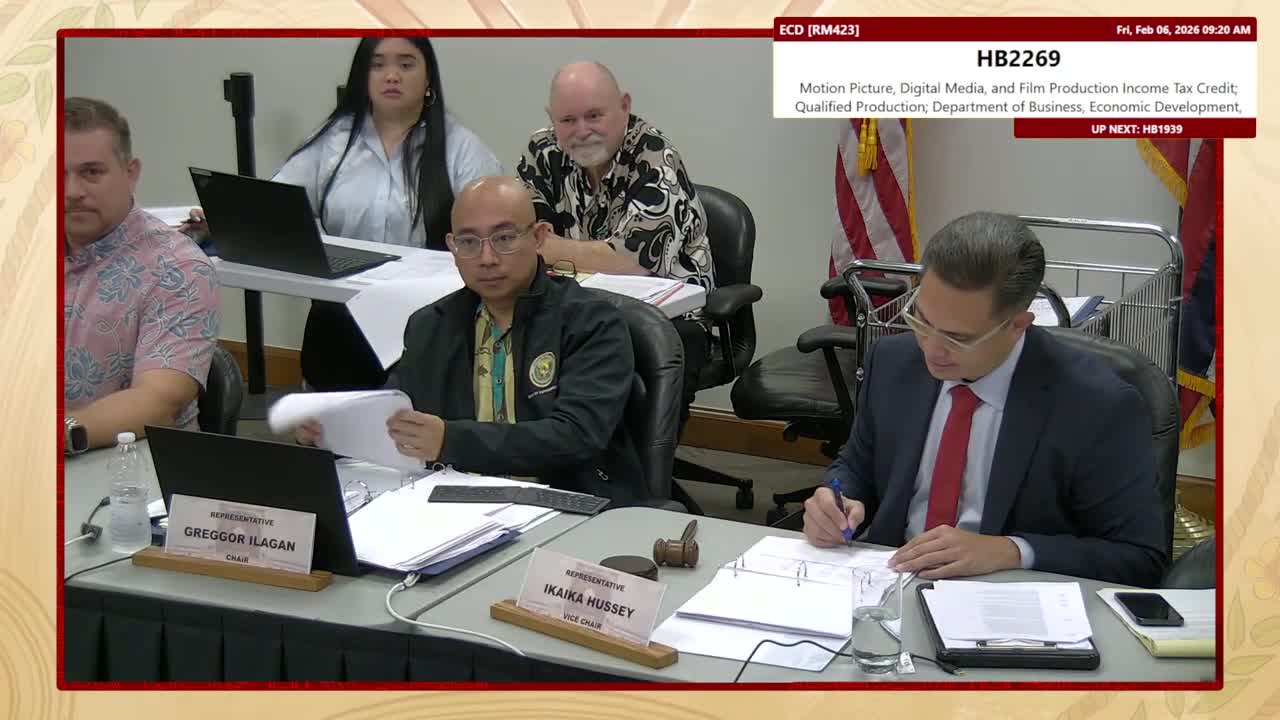 5MIN
House Standing Committee on Economic Development & Technology
 1MIN