HB 1802: DLNR; BLNR; Conservation Banks
- Session Year: 2025-2026
- House: House
- Latest Version Date: 2026-05-01
Current Status:
Passed
(2026-07-09: Act 208, on 07/08/2026 (Gov. Msg. No. 1310).)
Introduced
In Committee
First Chamber
In Committee
Second Chamber
Final Decking
Enacted
Authorizes the Department of Land and Natural Resources and certain public or private entities to seek the approval of the Board of Land and Natural Resources to operate conservation banks for situations where a person or entity is required to provide compensatory mitigation to offset adverse impacts to threatened, endangered, candidate, or proposed species as part of an approved incidental take license and habitat conservation plan. Adds the associate director of the United States Geological Survey, Ecosystem Mission Area, to the membership of the Endangered Species Recovery Committee. Requires the Endangered Species Recovery Committee to review applications and proposals for conservation banks and conservation bank instruments conduct subsequent reviews and oversight. (CD1)
Authorizes the Department of Land and Natural Resources and certain public or private entities to operate conservation banks, subject to approval from the Board of Land and Natural Resources, for situations where a person or entity is required to provide compensatory mitigation to offset adverse impacts to threatened, endangered, candidate, or proposed species as part of an approved incidental take license and habitat conservation plan. Adds the associate director of the United States Geological Survey, Ecosystem Mission Area, to the membership of the Endangered Species Recovery Committee. Requires the Endangered Species Recovery Committee to review applications and proposals for conservation banks and conduct subsequent reviews and oversight. Effective 7/1/3000. (SD1)
Authorizes the Department of Land and Natural Resources and certain public or private entities to operate conservation banks, subject to approval from the Board of Land and Natural Resources, for situations where a person or entity is required to provide compensatory mitigation to offset adverse impacts to threatened, endangered, candidate, or proposed species as part of an approved incidental take license and habitat conservation plan. Adds the associate director of the United States Geological Survey, Ecosystem Mission Area, to the membership of the Endangered Species Recovery Committee. Requires the Endangered Species Recovery Committee to review applications and proposals for conservation banks and conduct subsequent reviews and oversight. Effective 7/1/3000. (HD1)
Authorizes the Department of Land and Natural Resources to establish and operate conservation mitigation banks to restore, create, enhance, or preserve species, their habitats, or resources as compensatory mitigation, or for past damages. Authorizes the department to contract with a third-party administrator for the operation of the conservation mitigation banks. Clarifies the sale of credits involved in conservation mitigation banking.
|
HOUSE OF REPRESENTATIVES |
H.B. NO. |
1802 |
|
THIRTY-THIRD LEGISLATURE, 2026 |
H.D. 1 |
|
|
STATE OF HAWAII |
S.D. 1 |
|
|
|
C.D. 1 |
|
|
|
||
|
|
||
A BILL FOR AN ACT
RELATING TO CONSERVATION MITIGATION BANKS.
BE IT ENACTED BY THE LEGISLATURE OF THE STATE OF HAWAII:
SECTION 1. The legislature finds that the use of conservation banks as compensatory mitigation projects for incidental take licensees with habitat conservation plans increases certainty that the mitigation obligation is complete, expedites project review, and makes project costs more predictable for incidental take licensees. Conservation banks provide long-term, landscape-scale protection to the State's threatened, endangered, candidate, and proposed species.
Accordingly, the purpose of this Act is to:
(1) Authorize the department of land and natural resources and certain public or private entities to seek the approval of the board of land and natural resources to operate conservation banks for situations where a person or entity is required to provide compensatory mitigation to offset adverse impacts to threatened, endangered, candidate, or proposed species as part of an approved incidental take license and habitat conservation plan;
(2) Add the associate director of the United States Geological Survey, Ecosystem Mission Area, to the membership of the endangered species recovery committee; and
(3) Require the endangered species recovery committee to review applications and proposals for conservation banks and conservation bank instruments and conduct subsequent reviews and oversight.
SECTION 2. Chapter 195D, Hawaii Revised Statutes, is amended by adding a new part to be appropriately designated and to read as follows:
"Part . Conservation banking
§195D-A Definitions. As used in this part:
"Adaptive management strategy" means the actions to be taken if the resource management plan is not achieving its goals.
"Administrative amendments" means changes to the bank sponsor's name, address, or contact information.
"Bank sponsor" means any public or private entity responsible for establishing or operating a conservation bank.
"Compensatory mitigation" means actions taken to fulfill, in whole or in part, mitigation requirements pursuant to this part.
"Conservation bank" means a site or suite of sites established under a conservation bank instrument for the purposes of restoring, creating, enhancing, or protecting populations of threatened, endangered, candidate, or proposed species and their habitats expressed as credits.
"Conservation bank instrument" means an agreement between the board and a bank sponsor that establishes a conservation bank and describes the terms and conditions of its operation, including a system for assessing and releasing credits to be used for compensatory mitigation.
"Credit" means a value based on defined units representing the increase in numbers of a listed species or attainment of enhanced ecological functions or services essential to the survival of a listed species at a conservation bank and released as the conservation bank meets performance criteria included in its conservation bank instrument.
"Credit bundling" means a single unit of a conservation bank that provides two or more spatially overlapping ecosystem functions or services that are grouped together into a single credit type and used as a single commodity to compensate for a single permitted action.
"Credit stacking" means a single unit of a conservation bank that provides two or more credit types representing spatially overlapping ecosystem functions or services that can be unstacked and used as separate commodities to compensate for different permitted actions.
"Maintenance plan" means a bank sponsor's plan to ensure the conservation bank remains viable after construction and throughout the life of the conservation bank, including a description of management requirements and a schedule for their implementation. "Maintenance plan" includes infrastructure and ecological management components within the project area and an identification of regular or recurring actions needed for upkeep of the conservation bank site.
"Major amendments" means changes that are not administrative amendments. "Major amendments" includes changes to the bank sponsor, species that the conservation bank is established to protect, resource management plan, financial assurances, system for assessing and releasing credits, or site protection instrument.
"Monitoring requirements" means a description of parameters to be monitored and a methodology to monitor those requirements to determine if the conservation bank is on track to meet performance standards or if an adaptive management strategy is needed.
"Performance standards" mean ecologically based standards that are used to determine whether the conservation bank is achieving objectives in the resource management plan and that describe the attribute to be measured, the level that constitutes success, and the time period to achieve success.
"Resource management plan" means the plan identified by a conservation bank instrument and described in section 195D-B.
"Site protection instrument" means an interest in real property that protects a conservation bank for long-term stewardship or in perpetuity, such as a conservation easement, deed restriction, condition, or covenant.
(b) Applications to establish and operate a conservation bank shall include a proposed conservation bank instrument that identifies:
(1) The geographic area encompassed by the conservation bank and the ecosystems, natural communities, or habitat types within the conservation bank;
(2) The threatened, endangered, candidate, or proposed species that the conservation bank is established to protect;
(3) A resource management plan for long-term stewardship that includes:
(A) Goals and objectives;
(B) A review of the presence or absence of any threatened, endangered, candidate or proposed species on the property, including the species identified in paragraph (2);
(C) Performance standards;
(D) Monitoring requirements;
(E) A maintenance plan; and
(F) An adaptive management strategy;
(4) Any other information that the department requires in rules adopted pursuant to section 195D-C;
(5) A system for assessing and releasing credits; and
(6) The measures for property protection.
(c) In addition to the requirements set forth in subsection (b), for applications from bank sponsors other than the department, the proposed conservation bank instrument shall contain:
(1) Assurances that the bank sponsor has the scientific and technical competence required to perform the necessary conservation actions for the species identified in subsection (b)(2);
(2) Financial assurances necessary to ensure the successful completion of habitat construction, management, monitoring, and remedial actions;
(3) A site protection instrument; and
(4) A provision requiring the bank sponsor to submit an annual report on the current status of the conservation bank to the department within ninety days after the end of each fiscal year ending June 30.
(d) After consultation with the endangered species recovery committee, the board may approve a conservation bank instrument for the operation of a conservation bank by the department or bank sponsor if the board determines that:
(1) The conservation bank will further the purposes of this chapter by restoring, creating, enhancing, or protecting populations of threatened, endangered, candidate, or proposed species and their habitats;
(2) The system for assessing and releasing credits is based on the best available scientific information, and where there is uncertainty about what constitutes the best available scientific information, the rationale used for developing the system for assessing and releasing credits gives the benefit of the doubt to the species;
(3) For a conservation bank operated by a bank sponsor other than the department:
(A) The bank sponsor has the scientific and technical competencies required to perform the necessary conservation actions for the species identified in subsection (b)(2);
(B) The bank sponsor's funding source is adequate to ensure the successful completion of habitat construction, management, monitoring, and remedial actions;
(C) The nature and duration of the site protection instrument are adequate to ensure the successful completion of habitat construction, management, monitoring, or remedial actions; and
(D) The conservation bank instrument shall run with the land for the term specified in the site protection instrument and shall not be assignable or transferable separate from the land;
(4) For a conservation bank operated by the department, the conservation bank shall be established on land managed by the department; and
(5) The conservation bank instrument satisfies all requirements in subsections (b) and (c).
Board approval shall require an affirmative vote of no less than two-thirds of the authorized membership of the board. The board shall not approve a conservation bank instrument that the majority of the endangered species recovery committee recommended for disapproval.
(e) The board's approval of a conservation bank instrument for a conservation bank operated by a sponsor other than the department does not relieve the bank sponsor of its obligation to secure a temporary license pursuant to section 195D-4(f) or (g) before causing take of any threatened, endangered, candidate, or proposed species.
(f) After a conservation bank has created a credit following the system for assessing and releasing credits identified in the conservation bank instrument, the bank sponsor may transfer or sell the credit to an incidental take licensee for use of an approved conservation bank as compensatory mitigation; provided that:
(1) The use of the credit as compensatory mitigation for incidental take of threatened or endangered species is part of a habitat conservation plan and satisfies incidental take license requirements pursuant to section 195D-4(g) and habitat conservation plan requirements in section 195D-21(b);
(2) A majority of the endangered species recovery committee approves the use of the credit as compensatory mitigation;
(3) Credit stacking is prohibited;
(4) Credit bundling may be used to compensate for all or a subset of the functions or services included in the credit type but shall be used only once; and
(5) Once a credit is transferred or sold, that credit is retired and cannot be used again.
(g) Notwithstanding any other law to the contrary, the board shall suspend or revoke the approval of any conservation bank instrument approved under this section if the board determines that:
(1) The bank sponsor or its successor has breached its obligations under the conservation bank instrument and has failed to cure the breach in a timely manner, and the effect of the breach will diminish the likelihood that the conservation bank will achieve its goals within the time frame or manner set forth in the conservation bank instrument;
(2) For a conservation bank operated by a bank sponsor other than the department, the conservation bank no longer has the funding source specified in subsection (d)(3)(B) or another sufficient funding source to ensure the successful completion of the habitat construction, management, monitoring, and remedial actions in accordance with the conservation bank instrument; or
(3) Continued operation of the conservation bank would appreciably reduce the likelihood of survival or recovery of any threatened or endangered species in the wild.
If approval of a conservation bank instrument is suspended, then the bank sponsor shall not sell or transfer any credits from that conservation bank. Any bank sponsor whose conservation bank instrument has been revoked shall not be eligible to apply to operate another conservation bank.
(h) An approved conservation bank instrument may be amended through administrative amendment or major amendment; provided that:
(1) The department may process administrative amendments without recommendation from the endangered species recovery committee and without approval from the board; and
(2) Major amendments shall be reviewed and recommended for approval by the endangered species recovery committee and approved by the board pursuant to an affirmative vote of no less than two-thirds of the authorized membership of the board; provided that the board shall not approve a major amendment that the majority of the endangered species recovery committee recommended for disapproval.
(i) The department may collect from bank sponsors fees or payment for costs incurred by the department during:
(1) Its rulemaking process;
(2) Application processing; and
(3) Establishment, monitoring, and oversight of the bank sponsor's conservation bank.
(j) This part shall not apply to aquatic life or their habitats.
§195D-C Rulemaking. The department may adopt rules pursuant to chapter 91 necessary to implement this part."
SECTION 3. Section 195D-25, Hawaii Revised Statutes, is amended by amending subsections (a) and (b) to read as follows:
"(a)
There is established within the department for administrative purposes
only, the endangered species recovery committee, which shall serve as a
consultant to the board and the department on matters relating to endangered,
threatened, proposed, and candidate species.
The committee shall consist of two field biologists with expertise in
conservation biology, the chairperson of the board or the chairperson's
designee, the ecoregion director of the United States Fish and Wildlife Service
or the director's designee, [the director of the United States Geological
Survey, Biological Resources Division or the director's designee,] the
associate director of the United States Geological Survey, Ecosystem Mission
Area, or the associate director's designee, the dean of the University of
Hawaii at Manoa college of natural sciences or the dean's designee, and a
person possessing a background in native Hawaiian
traditional and customary practices, as evidenced by:
(1) A college degree in a relevant field, such as Hawaiian studies, native Hawaiian law, native Hawaiian traditional and customary practices, or related subject area;
(2) Work history that demonstrates an appropriate level of knowledge in native Hawaiian traditional and customary practices; or
(3) Substantial experience in native Hawaiian traditional and customary practices.
Nongovernmental members shall be appointed by the governor pursuant to section 26-34. Nongovernmental members shall not serve for more than two consecutive terms. Nongovernmental members shall serve for four-year staggered terms, except that one of the members first appointed shall serve for two years.
Governmental members from the federal agencies are requested but not required to serve on the committee. The ability of the committee to carry out its functions and purposes shall not be affected by the vacancy of any position allotted to a federal governmental member.
(b) The endangered species recovery committee shall:
(1) Review all applications and proposals for
habitat conservation plans, safe harbor agreements, [and] incidental
take licenses, and conservation banks and conservation bank instruments
and make recommendations, based on a full review of the best available
scientific and other reliable data and at least one site visit to each property
that is the subject of the proposed action, and in consideration of the
cumulative impacts of the proposed action on the recovery potential of the
endangered, threatened, proposed, or candidate species, to the department and
the board as to whether or not they should be approved, amended, or rejected;
(2) Review all habitat conservation plans, safe
harbor agreements, [and] incidental take licenses, and conservation
banks and conservation bank instruments on an annual basis to ensure
compliance with agreed to activities and, on the basis of any available
monitoring reports[,] and scientific and other reliable data, make
recommendations for any necessary changes;
(3) Consider and recommend appropriate incentives to encourage landowners to voluntarily engage in efforts that restore and conserve endangered, threatened, proposed, and candidate species;
(4) Perform [such] other duties as provided
in this chapter;
(5) Consult with persons possessing expertise in [such]
areas [as] the committee may deem appropriate and necessary in the
course of exercising its duties; and
(6) Not conduct more than one site visit per year
to each property that is the subject of a habitat conservation plan [or]
safe harbor agreement[.], or conservation bank instrument."
SECTION 4. In codifying the new sections added by section 2 of this Act, the revisor of statutes shall substitute appropriate section numbers for the letters used in designating the new sections in this Act.
SECTION 5. Statutory material to be repealed is bracketed and stricken. New statutory material is underscored.
SECTION 6. This Act shall take effect upon its approval.
Report Title:
DLNR; BLNR; Conservation Banks
Description:
Authorizes the Department of Land and Natural Resources and certain public or private entities to seek the approval of the Board of Land and Natural Resources to operate conservation banks for situations where a person or entity is required to provide compensatory mitigation to offset adverse impacts to threatened, endangered, candidate, or proposed species as part of an approved incidental take license and habitat conservation plan. Adds the associate director of the United States Geological Survey, Ecosystem Mission Area, to the membership of the Endangered Species Recovery Committee. Requires the Endangered Species Recovery Committee to review applications and proposals for conservation banks and conservation bank instruments conduct subsequent reviews and oversight. (CD1)
The summary description of legislation appearing on this page is for informational purposes only and is not legislation or evidence of legislative intent.
|
HOUSE OF REPRESENTATIVES |
H.B. NO. |
1802 |
|
THIRTY-THIRD LEGISLATURE, 2026 |
H.D. 1 |
|
|
STATE OF HAWAII |
S.D. 1 |
|
|
|
|
|
|
|
||
|
|
||
A BILL FOR AN ACT
RELATING TO CONSERVATION MITIGATION BANKS.
BE IT ENACTED BY THE LEGISLATURE OF THE STATE OF HAWAII:
SECTION 1. The legislature finds that the use of conservation banks as compensatory mitigation projects for incidental take licensees with habitat conservation plans increases certainty that the mitigation obligation is complete, expedites project review, and makes project costs more predictable for incidental take licensees. Conservation banks provide long-term, landscape-scale protection to the State's threatened, endangered, candidate, and proposed species.
Accordingly, the purpose of this Act is to:
(1) Authorize the department of land and natural resources and certain public or private entities to operate conservation banks, subject to approval from the board of land and natural resources, for situations where a person or entity is required to provide compensatory mitigation to offset adverse impacts to threatened, endangered, candidate, or proposed species as part of an approved incidental take license and habitat conservation plan;
(2) Add the associate director of the United States Geological Survey, Ecosystem Mission Area, to the membership of the endangered species recovery committee; and
(3) Require the endangered species recovery committee to review applications and proposals for conservation banks and conduct subsequent reviews and oversight.
SECTION 2. Chapter 195D Hawaii Revised Statutes, is amended by adding a new part to be appropriately designated and to read as follows:
"Part . Conservation banking
§195D-A Definitions. As used in this part:
"Adaptive management strategy" means the actions to be taken if the resource management plan is not achieving its goals.
"Administrative amendments" means changes to the bank sponsor's name, address, or contact information.
"Bank sponsor" means any public or private entity responsible for establishing or operating a conservation bank.
"Compensatory mitigation" means actions taken to fulfill, in whole or in part, mitigation requirements pursuant to this part.
"Conservation bank" means a site or suite of sites established under a conservation bank instrument for the purposes of restoring, creating, enhancing, or protecting populations of threatened, endangered, candidate, or proposed species and their habitats expressed as credits.
"Conservation bank instrument" means an agreement between the board and a bank sponsor that establishes a conservation bank and describes the terms and conditions of its operation, including a system for assessing and releasing credits to be used for compensatory mitigation.
"Credit" means a value based on defined units representing the increase in numbers of a listed species or attainment of enhanced ecological functions or services essential to the survival of a listed species at a conservation bank and released as the conservation bank meets performance criteria included in its conservation bank instrument.
"Credit bundling" means a single unit of a conservation bank that provides two or more spatially overlapping ecosystem functions or services that are grouped together into a single credit type and used as a single commodity to compensate for a single permitted action.
"Credit stacking" means a single unit of a conservation bank that provides two or more credit types representing spatially overlapping ecosystem functions or services that can be unstacked and used as separate commodities to compensate for different permitted actions.
"Maintenance plan" means a bank sponsor's plan to ensure the conservation bank remains viable after construction and throughout the life of the conservation bank, including a description of management requirements and a schedule for their implementation. "Maintenance plan" includes infrastructure and ecological management components within the project area and an identification of regular or recurring actions needed for upkeep of the conservation bank site.
"Major amendments" are changes that are not administrative amendments. "Major amendments" include changes to the bank sponsor, species that the conservation bank is established to protect, resource management plan, financial assurances, system for assessing and releasing credits, or the site protection instrument.
"Monitoring requirements" means a description of parameters to be monitored and a methodology to monitor those requirements to determine if the conservation bank is on track to meet performance standards or if an adaptive management strategy is needed.
"Performance standards" mean ecologically based standards that are used to determine whether the conservation bank is achieving objectives in the resource management plan and that describe the attribute to be measured, the level that constitutes success, and the time period to achieve success.
"Resource management plan" means the plan identified by a conservation bank instrument and described in section 195D-B.
"Site protection instrument" means an interest in real property that protects a conservation bank for long-term stewardship or in perpetuity, such as a conservation easement, deed restriction, condition, or covenant.
(b) Applications to establish and operate a conservation bank shall include a proposed conservation bank instrument that identifies:
(1) The geographic area encompassed by the conservation bank and the ecosystems, natural communities, or habitat types within the conservation bank;
(2) The endangered, threatened, proposed, or candidate species that the conservation bank is established to protect;
(3) A resource management plan for long-term stewardship that includes:
(A) Goals and objectives;
(B) A review of the presence or absence of any endangered or threatened species on the property including the species identified in paragraph (2);
(C) Performance standards;
(D) Monitoring requirements;
(E) A maintenance plan; and
(F) An adaptive management strategy;
(4) Any other information that the department requires in rules adopted pursuant to section 195D-C;
(5) A system for assessing and releasing credits; and
(6) The measures for property protection.
(c) In addition to the requirements set forth in subsection (b), for applications from bank sponsors other than the department, the proposed conservation bank instrument shall contain:
(1) Assurances that the bank sponsor has the scientific and technical competence required to perform the necessary conservation actions for the species identified in subsection (b)(2);
(2) Financial assurances necessary to ensure the successful completion of habitat construction, management, monitoring, and remedial actions;
(3) A site protection instrument; and
(4) A provision requiring the bank sponsor to submit an annual report on the current status of the conservation bank to the department within ninety days after the end of each fiscal year ending June 30.
(d) After consultation with the endangered species recovery committee, the board may approve a conservation bank instrument for the operation of a conservation bank by the department or bank sponsor if the board determines that:
(1) The conservation bank will further the purposes of this chapter by restoring, creating, enhancing, or protecting populations of threatened, endangered, candidate, or proposed species and their habitats;
(2) The system for assessing and releasing credits is based on the best available scientific information, and where there is uncertainty about what constitutes the best available scientific information, the rationale used for developing the system for assessing and releasing credits gives the benefit of the doubt to the species;
(3) For a conservation bank operated by a bank sponsor other than the department:
(A) The bank sponsor has the scientific and technical competencies required to perform the necessary conservation actions for the species identified in subsection (b)(2);
(B) The bank sponsor's funding source is adequate to ensure the successful completion of habitat construction, management, monitoring, and remedial actions;
(C) The nature and duration of the site protection instrument is adequate to ensure the successful completion of habitat construction, management, monitoring, or remedial actions; and
(D) The conservation bank instrument shall run with the land for the term specified in the site protection instrument and shall not be assignable or transferable separate from the land;
(4) For a conservation bank operated by the department, the conservation bank shall be established on land managed by the department; and
(5) The conservation bank instrument satisfies all requirements in subsections (b) and (c).
Board approval shall require an affirmative vote of no less than two-thirds of the authorized membership of the board. The board shall not approve a conservation bank instrument that the majority of the endangered species recovery committee recommended for disapproval.
(e) The board's approval of a conservation bank instrument for a conservation bank operated by a sponsor other than the department does not relieve the bank sponsor of its obligation to secure a temporary license pursuant to section 195D-4(f) or (g) before causing take of any endangered, threatened, proposed, or candidate species.
(f) After a conservation bank has created a credit following the system for assessing and releasing credits identified in the conservation bank instrument, the bank sponsor may transfer or sell the credit to an incidental take licensee for use of an approved conservation bank as compensatory mitigation; provided that:
(1) The use of the credit as compensatory mitigation for incidental take of threatened or endangered species is part of a habitat conservation plan and satisfies incidental take license requirements pursuant to section 195D-4(g) and habitat conservation plan requirements in section 195D-21(b);
(2) A majority of the endangered species recovery committee approves the use of the credit as compensatory mitigation;
(3) Credit stacking is prohibited;
(4) Credit bundling may be used to compensate for all or a subset of the functions or services included in the credit type but shall be used only once; and
(5) Once a credit is transferred or sold, that credit is retired and cannot be used again.
(g) Notwithstanding any other law to the contrary, the board shall suspend or revoke the approval of any conservation bank instrument approved under this section if the board determines that:
(1) The bank sponsor or its successor has breached its obligations under the conservation bank instrument and has failed to cure the breach in a timely manner, and the effect of the breach will diminish the likelihood that the conservation bank will achieve its goals within the time frame or manner set forth in the conservation bank instrument;
(2) For a conservation bank operated by a bank sponsor other than the department, the conservation bank no longer has the funding source specified in subsection (d)(3)(B) or another sufficient funding source to ensure the successful completion of the habitat construction, management, monitoring, and remedial actions in accordance with the conservation bank instrument; or
(3) Continued operation of the conservation bank would appreciably reduce the likelihood of survival or recovery of any threatened or endangered species in the wild.
If approval of a conservation bank instrument is suspended, then the bank sponsor shall not sell or transfer any credits from that conservation bank. Any bank sponsor whose conservation bank instrument has been revoked shall not be eligible to apply to operate another conservation bank.
(h) An approved conservation bank instrument may be amended through administrative amendment or major amendment; provided that:
(1) The department may process administrative amendments without recommendation from the endangered species recovery committee and without approval from the board; and
(2) Major amendments shall be reviewed and recommended for approval by the endangered species recovery committee and approved by the board pursuant to an affirmative vote of no less than two-thirds of the authorized membership of the board; provided that the board shall not approve a major amendment that the majority of the endangered species recovery committee recommended for disapproval.
(i) The department may collect from bank sponsors fees or payment for costs incurred by the department during:
(1) Its rulemaking process;
(2) Application processing; and
(3) Establishment, monitoring, and oversight of the bank sponsor's conservation bank.
(j) This part shall not apply to aquatic life or their habitats.
§195D-C Rulemaking. The department may adopt rules pursuant to chapter 91 necessary to implement this part."
SECTION 3. Section 195D-25, Hawaii Revised Statutes, is amended by amending subsections (a) and (b) to read as follows:
"(a)
There is established within the department for administrative purposes
only, the endangered species recovery committee, which shall serve as a
consultant to the board and the department on matters relating to endangered,
threatened, proposed, and candidate species.
The committee shall consist of two field biologists with expertise in
conservation biology, the chairperson of the board or the chairperson's
designee, the ecoregion director of the United States Fish and Wildlife Service
or the director's designee, [the director of the United States Geological
Survey, Biological Resources Division or the director's designee,] the
associate director of the United States Geological Survey, Ecosystem Mission
Area, or the associate director's designee, the dean of the University of
Hawaii at Manoa college of natural sciences or the dean's designee, and a
person possessing a background in [native] Native
Hawaiian traditional and customary practices, as evidenced by:
(1) A
college degree in a relevant field, such as Hawaiian studies, [native] Native Hawaiian
law, [native] Native Hawaiian traditional and customary
practices, or related subject area;
(2) Work
history that demonstrates an appropriate level of knowledge in [native] Native
Hawaiian traditional and customary practices; or
(3) Substantial
experience in [native] Native Hawaiian traditional and customary
practices.
Nongovernmental members shall be appointed by the governor pursuant to section 26-34. Nongovernmental members shall not serve for more than two consecutive terms. Nongovernmental members shall serve for four-year staggered terms, except that one of the members first appointed shall serve for two years.
Governmental members from the federal agencies are requested but not required to serve on the committee. The ability of the committee to carry out its functions and purposes shall not be affected by the vacancy of any position allotted to a federal governmental member.
(b) The endangered species recovery committee shall:
(1) Review all applications and proposals for
habitat conservation plans, safe harbor agreements, [and] incidental
take licenses, and conservation banks and make recommendations, based on
a full review of the best available scientific and other reliable data and at
least one site visit to each property that is the subject of the proposed
action, and in consideration of the cumulative impacts of the proposed action
on the recovery potential of the endangered, threatened, proposed, or candidate
species, to the department and the board as to whether or not they should be
approved, amended, or rejected;
(2) Review all habitat conservation plans, safe
harbor agreements, [and] incidental take licenses, and conservation
banks on an annual basis to ensure compliance with agreed to activities
and, on the basis of any available monitoring reports[,] and scientific
and other reliable data, make recommendations for any necessary changes;
(3) Consider and recommend appropriate incentives to encourage landowners to voluntarily engage in efforts that restore and conserve endangered, threatened, proposed, and candidate species;
(4) Perform [such] other duties as provided
in this chapter;
(5) Consult with persons possessing expertise in [such]
areas [as] the committee may deem appropriate and necessary in the
course of exercising its duties; and
(6) Not conduct more than one site visit per year
to each property that is the subject of a habitat conservation plan [or]
safe harbor agreement[.], or conservation bank instrument."
SECTION 4. In codifying the new sections added by section 2 of this Act, the revisor of statutes shall substitute appropriate section numbers for the letters used in designating the new sections in this Act.
SECTION 5. Statutory material to be repealed is bracketed and stricken. New statutory material is underscored.
SECTION 6. This Act shall take effect on July 1, 3000.
Report Title:
DLNR; BLNR; Conservation Banks
Description:
Authorizes the Department of Land and Natural Resources and certain public or private entities to operate conservation banks, subject to approval from the Board of Land and Natural Resources, for situations where a person or entity is required to provide compensatory mitigation to offset adverse impacts to threatened, endangered, candidate, or proposed species as part of an approved incidental take license and habitat conservation plan. Adds the associate director of the United States Geological Survey, Ecosystem Mission Area, to the membership of the Endangered Species Recovery Committee. Requires the Endangered Species Recovery Committee to review applications and proposals for conservation banks and conduct subsequent reviews and oversight. Effective 7/1/3000. (SD1)
The summary description of legislation appearing on this page is for informational purposes only and is not legislation or evidence of legislative intent.
|
HOUSE OF REPRESENTATIVES |
H.B. NO. |
1802 |
|
THIRTY-THIRD LEGISLATURE, 2026 |
H.D. 1 |
|
|
STATE OF HAWAII |
|
|
|
|
|
|
|
|
||
|
|
||
A BILL FOR AN ACT
RELATING TO CONSERVATION MITIGATION BANKS.
BE IT ENACTED BY THE LEGISLATURE OF THE STATE OF HAWAII:
SECTION 1. The legislature finds that the use of conservation banks as compensatory mitigation projects for incidental take licensees with habitat conservation plans increases certainty that the mitigation obligation is complete, expedites project review, and makes project costs more predictable for incidental take licensees. Conservation banks provide long-term, landscape-scale protection to Hawaii's threatened, endangered, candidate, and proposed species.
Accordingly, the purpose of this Act is to:
(1) Authorize the department of land and natural resources and certain public or private entities to operate conservation banks, subject to approval from the board of land and natural resources, for situations where a person or entity is required to provide compensatory mitigation to offset adverse impacts to threatened, endangered, candidate, or proposed species as part of an approved incidental take license and habitat conservation plan;
(2) Add the associate director of the United States Geological Survey, Ecosystem Mission Area, to the membership of the endangered species recovery committee; and
(3) Require the endangered species recovery committee to review applications and proposals for conservation banks and conduct subsequent reviews and oversight.
SECTION 2. Chapter 195D Hawaii Revised Statutes, is amended by adding a new part to be appropriately designated and to read as follows:
"Part . Conservation banking
§195D-A Definitions. As used in this part:
"Adaptive management strategy" means the actions to be taken if the resource management plan is not achieving its goals.
"Administrative amendments" means changes to the bank sponsor's name, address, or contact information.
"Bank sponsor" means any public or private entity responsible for establishing or operating a conservation bank.
"Compensatory mitigation" means actions taken to fulfill, in whole or in part, mitigation requirements pursuant to this chapter.
"Conservation bank" means a site or suite of sites established under a conservation bank instrument for the purposes of restoring, creating, enhancing, or protecting populations of threatened, endangered, candidate, or proposed species and their habitats expressed as credits.
"Conservation bank instrument" means an agreement between the board and a bank sponsor that establishes a conservation bank and describes the terms and conditions of its operation, including a system for assessing and releasing credits to be used for compensatory mitigation.
"Credit" means a value based on defined units representing the increase in numbers of a listed species or attainment of enhanced ecological functions or services essential to the survival of a listed species at a conservation bank and released as the conservation bank meets performance criteria included in its conservation bank instrument.
"Credit bundling" means a single unit of a conservation bank that provides two or more spatially overlapping ecosystem functions or services that are grouped together into a single credit type and used as a single commodity to compensate for a single permitted action.
"Credit stacking" means a single unit of a conservation bank that provides two or more credit types representing spatially overlapping ecosystem functions or services that can be unstacked and used as separate commodities to compensate for different permitted actions.
"Maintenance plan" means a bank sponsor's plan to ensure the conservation bank remains viable after construction and throughout the life of the conservation bank, including a description of management requirements and a schedule for their implementation. "Maintenance plan" includes infrastructure and ecological management components within the project area and an identification of regular or recurring actions needed for upkeep of the conservation bank site.
"Major amendments" are changes that are not administrative amendments. "Major amendments" include changes to the bank sponsor, species that the conservation bank is established to protect, resource management plan, financial assurances, system for assessing and releasing credits, or the site protection instrument.
"Monitoring requirements" means a description of parameters to be monitored and a methodology to monitor those requirements to determine if the conservation bank is on track to meet performance standards or if an adaptive management strategy is needed.
"Performance standards" mean ecologically based standards that are used to determine whether the conservation bank is achieving objectives in the resource management plan and that describe the attribute to be measured, the level that constitutes success, and the time period to achieve success.
"Resource management plan" means the plan identified by a conservation bank instrument and described in section 195D-B.
"Site protection instrument" means an interest in real property that protects a conservation bank for either long-term stewardship or in perpetuity, such as a conservation easement, deed restriction, condition, or covenant.
(b) Applications to establish and operate a conservation bank shall include a proposed conservation bank instrument that identifies:
(1) The geographic area encompassed by the conservation bank and the ecosystems, natural communities, or habitat types within the conservation bank;
(2) The endangered, threatened, proposed, or candidate species that the conservation bank is established to protect;
(3) A resource management plan for long-term stewardship that includes:
(A) Goals and objectives;
(B) A review of the presence or absence of any endangered or threatened species on the property including the species identified in paragraph (2);
(C) Performance standards;
(D) Monitoring requirements;
(E) A maintenance plan; and
(F) An adaptive management strategy;
(4) Any other information that the department requires in rules adopted pursuant to section 195D-C;
(5) A system for assessing and releasing credits; and
(6) The measures for property protection.
(c) In addition to the requirements set forth in subsection (b), for applications from bank sponsors other than the department, the proposed conservation bank instrument shall contain:
(1) Assurances that the bank sponsor has the scientific and technical competence required to perform the necessary conservation actions for the species identified in subsection (b)(2);
(2) Financial assurances necessary to ensure the successful completion of habitat construction, management, monitoring, and remedial actions;
(3) A site protection instrument; and
(4) A provision requiring the bank sponsor to submit an annual report on the current status of the conservation bank to the department within ninety days after the end of each fiscal year ending June 30.
(d) After consultation with the endangered species recovery committee, the board may approve a conservation bank instrument for the operation of a conservation bank by the department or bank sponsor if the board determines that:
(1) The conservation bank will further the purposes of this chapter by restoring, creating, enhancing, or protecting populations of threatened, endangered, candidate, or proposed species and their habitats;
(2) The system for assessing and releasing credits is based on the best available scientific information, and where there is uncertainty about what constitutes the best available scientific information, the rationale used for developing the system for assessing and releasing credits gives the benefit of the doubt to the species;
(3) For a conservation bank operated by a bank sponsor other than the department:
(A) The bank sponsor has the scientific and technical competencies required to perform the necessary conservation actions for the species identified in subsection (b)(2);
(B) The bank sponsor's funding source is adequate to ensure the successful completion of habitat construction, management, monitoring, and remedial actions;
(C) The nature and duration of the site protection instrument is adequate to ensure the successful completion of habitat construction, management, monitoring, or remedial actions; and
(D) The conservation bank instrument shall run with the land for the term specified in the site protection instrument and shall not be assignable or transferable separate from the land;
(4) For a conservation bank operated by the department, the conservation bank shall be established on land managed by the department; and
(5) The conservation bank instrument satisfies all requirements in subsections (b) and (c).
Board approval shall require an affirmative vote of no less than two-thirds of the authorized membership of the board. The board shall not approve a conservation bank instrument that the majority of the endangered species recovery committee recommended for disapproval.
(e) The board's approval of a conservation bank instrument for a conservation bank operated by a sponsor other than the department does not relieve the bank sponsor of its obligation to secure a temporary license pursuant to section 195D-4(f) or (g) before causing take of any endangered, threatened, proposed, or candidate species.
(f) After a conservation bank has created a credit following the system for assessing and releasing credits identified in the conservation bank instrument, the bank sponsor may transfer or sell the credit to an incidental take licensee for use of an approved conservation bank as compensatory mitigation; provided that:
(1) The use of the credit as compensatory mitigation for incidental take of threatened or endangered species is part of a habitat conservation plan and satisfies incidental take license requirements pursuant to section 195D-4(g) and habitat conservation plan requirements in section 195D-21(b);
(2) A majority of the endangered species recovery committee approves the use of the credit as compensatory mitigation;
(3) Credit stacking is prohibited;
(4) Credit bundling may be used to compensate for all or a subset of the functions or services included in the credit type but shall be used only once; and
(5) Once a credit is transferred or sold, that credit is retired and cannot be used again.
(g) Notwithstanding any other law to the contrary, the board shall suspend or revoke the approval of any conservation bank instrument approved under this section if the board determines that:
(1) The bank sponsor or its successor has breached its obligations under the conservation bank instrument and has failed to cure the breach in a timely manner, and the effect of the breach will diminish the likelihood that the conservation bank will achieve its goals within the time frame or manner set forth in the conservation bank instrument;
(2) For a conservation bank operated by a bank sponsor other than the department, the conservation bank no longer has the funding source specified in subsection (d)(3)(B) or another sufficient funding source to ensure the successful completion of the habitat construction, management, monitoring, and remedial actions in accordance with the conservation bank instrument; or
(3) Continued operation of the conservation bank would appreciably reduce the likelihood of survival or recovery of any threatened or endangered species in the wild.
If approval of a conservation bank instrument is suspended, then the bank sponsor shall not sell or transfer any credits from that conservation bank. Any bank sponsor whose conservation bank instrument has been revoked shall not be eligible to apply to operate another conservation bank.
(h) An approved conservation bank instrument may be amended through administrative amendment or major amendment; provided that:
(1) The department may process administrative amendments without recommendation from the endangered species recovery committee and without approval from the board; and
(2) Major amendments shall be reviewed and recommended for approval by the endangered species recovery committee and approved by the board pursuant to an affirmative vote of no less than two-thirds of the authorized membership of the board; provided that the board shall not approve a major amendment that the majority of the endangered species recovery committee recommended for disapproval.
(i) The department may collect from bank sponsors fees or payment for costs incurred by the department during:
(1) Its rulemaking process;
(2) Application processing; and
(3) Establishment, monitoring, and oversight of the bank sponsor's conservation bank.
(j) This part shall not apply to aquatic life or their habitats.
§195D-C Rulemaking. The department may adopt rules pursuant to chapter 91 necessary to implement this part."
SECTION 3. Section 195D-25, Hawaii Revised Statutes, is amended by amending subsections (a) and (b) to read as follows:
"(a)
There is established within the department for administrative purposes
only, the endangered species recovery committee, which shall serve as a
consultant to the board and the department on matters relating to endangered,
threatened, proposed, and candidate species.
The committee shall consist of two field biologists with expertise in
conservation biology, the chairperson of the board or the chairperson's
designee, the ecoregion director of the United States Fish and Wildlife Service
or the director's designee, [the director of the United States Geological
Survey, Biological Resources Division or the director's designee,] the
associate director of the United States Geological Survey, Ecosystem Mission
Area, or the associate director's designee, the dean of the University of
Hawaii at Manoa college of natural sciences or the dean's designee, and a
person possessing a background in native Hawaiian traditional and customary
practices, as evidenced by:
(1) A college degree in a relevant field, such as Hawaiian studies, native Hawaiian law, native Hawaiian traditional and customary practices, or related subject area;
(2) Work history that demonstrates an appropriate level of knowledge in native Hawaiian traditional and customary practices; or
(3) Substantial experience in native Hawaiian traditional and customary practices.
Nongovernmental members shall be appointed by the governor pursuant to section 26-34. Nongovernmental members shall not serve for more than two consecutive terms. Nongovernmental members shall serve for four-year staggered terms, except that one of the members first appointed shall serve for two years.
Governmental members from the federal agencies are requested but not required to serve on the committee. The ability of the committee to carry out its functions and purposes shall not be affected by the vacancy of any position allotted to a federal governmental member.
(b) The endangered species recovery committee shall:
(1) Review all applications and proposals for
habitat conservation plans, safe harbor agreements, [and] incidental
take licenses, and conservation banks and make recommendations, based on
a full review of the best available scientific and other reliable data and at
least one site visit to each property that is the subject of the proposed
action, and in consideration of the cumulative impacts of the proposed action
on the recovery potential of the endangered, threatened, proposed, or candidate
species, to the department and the board as to whether or not they should be
approved, amended, or rejected;
(2) Review all habitat conservation plans, safe
harbor agreements, [and] incidental take licenses, and conservation
banks on an annual basis to ensure compliance with agreed to activities
and, on the basis of any available monitoring reports, and scientific and other
reliable data, make recommendations for any necessary changes;
(3) Consider and recommend appropriate incentives to encourage landowners to voluntarily engage in efforts that restore and conserve endangered, threatened, proposed, and candidate species;
(4) Perform such other duties as provided in this chapter;
(5) Consult with persons possessing expertise in such areas as the committee may deem appropriate and necessary in the course of exercising its duties; and
(6) Not conduct more than one site visit per year
to each property that is the subject of a habitat conservation plan [or]
safe harbor agreement[.], or conservation bank instrument."
SECTION 4. In codifying the new sections added by section 2 of this Act, the revisor of statutes shall substitute appropriate section numbers for the letters used in designating the new sections in this Act.
SECTION 5. Statutory material to be repealed is bracketed and stricken. New statutory material is underscored.
SECTION 6. This Act shall take effect on July 1, 3000.
Report Title:
DLNR; BLNR; Conservation Banks
Description:
Authorizes the Department of Land and Natural Resources and certain public or private entities to operate conservation banks, subject to approval from the Board of Land and Natural Resources, for situations where a person or entity is required to provide compensatory mitigation to offset adverse impacts to threatened, endangered, candidate, or proposed species as part of an approved incidental take license and habitat conservation plan. Adds the associate director of the United States Geological Survey, Ecosystem Mission Area, to the membership of the Endangered Species Recovery Committee. Requires the Endangered Species Recovery Committee to review applications and proposals for conservation banks and conduct subsequent reviews and oversight. Effective 7/1/3000. (HD1)
The summary description of legislation appearing on this page is for informational purposes only and is not legislation or evidence of legislative intent.
|
HOUSE OF REPRESENTATIVES |
H.B. NO. |
1802 |
|
THIRTY-THIRD LEGISLATURE, 2026 |
|
|
|
STATE OF HAWAII |
|
|
|
|
|
|
|
|
||
|
|
||
A BILL FOR AN ACT
relating to conservation mitigation banks.
BE IT ENACTED BY THE LEGISLATURE OF THE STATE OF HAWAII:
SECTION 1. The legislature finds that mitigation banks restore, create, enhance, or preserve habitats or resources to recover the ecological functions, services, and values of resources lost by adverse impacts to other similar habitats. By 2001, the federal government and at least thirty-one states had developed successful mitigation bank guidelines and programs. Mitigation banking has a number of advantages over traditional permittee-responsible compensatory mitigation because of the ability of mitigation banking programs to:
(1) Reduce uncertainty about whether compensatory mitigation will be successful in offsetting project impacts;
(2) Assemble and apply extensive financial resources, planning, and scientific expertise not always available to many permittee-responsible compensatory mitigation proposals;
(3) Reduce permit processing times and provide more cost‑effective compensatory mitigation opportunities; and
(4) Enable the efficient use of limited agency resources in the review and compliance monitoring of compensatory mitigation projects because of consolidation.
Mitigation banks would serve as a mechanism to restore or replace resources and ecological functions of habitats either prospectively or after they have been damaged.
The purpose of this Act is to authorize the department of land and natural resources to establish and operate conservation mitigation banks to restore, create, enhance, or preserve species, their habitats, or resources as compensatory mitigation where the issuance of an incidental take license requires the licensee to provide mitigation as part of a habitat conservation plan and the use of banked mitigation is approved by the agency requiring mitigation, or for past damages to conservation habitats or resources.
SECTION 2. The Hawaii Revised Statutes is amended by adding a new chapter to be appropriately designated and to read as follows:
"Chapter
Conservation mitigation banks
§ -1 Definitions. As used in this chapter:
"Board" means the board of land and natural resources.
"Conservation mitigation bank" means a site established under a conservation mitigation bank instrument approved by the department that is conserved and managed to provide ecological functions and services expressed as credits for wildlife or listed species.
"Conservation mitigation bank instrument" means an interest in real property that protects a conservation mitigation bank in perpetuity, such as a conservation easement, deed restriction, condition, or covenant.
"Credit" means a value based on defined units representing the accrual or attainment of ecological functions or services at the conservation mitigation bank and released as the conservation mitigation bank meets performance criteria.
"Department" means the department of land and natural resources.
"Habitat conservation plan" means a plan developed pursuant to sections 195D-4 and 195D-21.
"Incidental take license" means a temporary license issued by the board as part of a habitat conservation plan that allows take of a threatened or endangered species that is incidental to and not the purpose of the carrying out of an otherwise lawful activity.
"Wildlife" means any non-domesticated member of the animal kingdom, whether reared in captivity or not, including any part, product, egg, or offspring thereof, except aquatic life as defined in section 195D-2.
§ -2 Conservation mitigation banking. The department may establish and operate conservation mitigation banks, the purpose of which shall be to restore, create, enhance, or preserve species, their habitats, or resources as compensatory mitigation where the issuance of an incidental take license requires the licensee to provide mitigation as part of a habitat conservation plan and the use of banked mitigation is approved by the agency requiring mitigation, or for past damages to conservation habitats or resources.
§ -3 Conservation mitigation banking administrator. The department may contract with a third-party administrator that specializes in conservation mitigation banking to operate and manage the conservation mitigation banks established pursuant to section -2.
§ -4 Conservation mitigation bank; sale of credits. (a) A conservation mitigation bank shall be established under a legal conservation mitigation bank instrument.
(b) The department may sell credits generated from listed-species conservation activities to incidental take licensees.
(c) Third-party conversation mitigation bank administrators shall not be required to own the parcel of land and may be authorized by the department to sell the credits.
§ -5 Rules. The department may adopt rules pursuant to chapter 91 to implement this chapter."
SECTION 3. This Act shall take effect upon its approval.
|
INTRODUCED BY: |
_____________________________ |
|
|
|
Report Title:
DLNR; Conservation Mitigation Banks
Description:
Authorizes the Department of Land and Natural Resources to establish and operate conservation mitigation banks to restore, create, enhance, or preserve species, their habitats, or resources as compensatory mitigation, or for past damages. Authorizes the department to contract with a third-party administrator for the operation of the conservation mitigation banks. Clarifies the sale of credits involved in conservation mitigation banking.
The summary description of legislation appearing on this page is for informational purposes only and is not legislation or evidence of legislative intent.
|
Date
|
Status
|
|---|---|
| Jul 9, 2026 | Act 208, on 07/08/2026 (Gov. Msg. No. 1310). |
| Jul 9, 2026 | Act 208, 07/08/2026 (Gov. Msg. No. 1310). |
| May 8, 2026 | Received notice of passage on Final Reading in House (Hse. Com. No. 888). |
| May 7, 2026 | Transmitted to Governor. |
| May 6, 2026 | Received notice of Final Reading (Sen. Com. No. 816). |
| May 6, 2026 | Passed Final Reading, as amended (CD 1). Ayes, 22; Aye(s) with reservations: none. Noes, 3 (Senator(s) Awa, DeCorte, Fevella). Excused, 0 (none). |
| May 6, 2026 | Passed Final Reading as amended in CD 1 with none voting aye with reservations; none voting no (0) and none excused (0). |
| May 1, 2026 | 48 Hrs. Notice (as amended CD 1) 05-06-26 |
| May 1, 2026 | Reported from Conference Committee as amended CD 1 (Conf. Com. Rep. No. 165-26). |
| May 1, 2026 | Forty-eight (48) hours notice Wednesday, 05-06-26. |
| May 1, 2026 | Reported from Conference Committee (Conf Com. Rep. No. 165-26) as amended in (CD 1). |
| Apr 30, 2026 | The Conference committee recommends that the measure be PASSED, WITH AMENDMENTS. The votes of the Senate Conference Managers were as follows: 3 Aye(s): Senator(s) Lee, C., Inouye, Lamosao; Aye(s) with reservations: none ; 0 No(es): none; and 0 Excused: none. |
| Apr 30, 2026 | The Conference Committee recommends that the measure be Passed, with Amendments. The votes were as follows: 4 Ayes: Representative(s) Lowen, Hashem, Perruso, Matsumoto; Ayes with reservations: none; 0 Noes: none; and 0 Excused: none. |
| Apr 29, 2026 | Conference Committee Meeting will reconvene on Thursday 04-30-26 10:10AM in conference room 325. |
| Apr 28, 2026 | Conference Committee Meeting will reconvene on Wednesday 04-29-26 10:10AM in conference room 325. |
| Apr 27, 2026 | Conference Committee Meeting will reconvene on Tuesday 04-28-26 10:10AM in conference room 325. |
| Apr 24, 2026 | Bill scheduled for Conference Committee Meeting on Monday, 04-27-26 10:10AM in conference room 325. |
| Apr 23, 2026 | Received notice of Senate conferees (Sen. Com. No. 725). |
| Apr 22, 2026 | Senate Conferees Appointed: Lee, C. Chairs; Inouye Co-Chair; Lamosao. |
| Apr 20, 2026 | Received notice of appointment of House conferees (Hse. Com. No. 786). |
| Apr 20, 2026 | House Conferees Appointed: Lowen, Hashem, Perruso Co-Chairs; Matsumoto. |
| Apr 16, 2026 | Received notice of disagreement (Hse. Com. No. 599). |
| Apr 14, 2026 | House disagrees with Senate amendment (s). |
| Apr 10, 2026 | Returned from Senate (Sen. Com. No. 529) in amended form (SD 1). |
| Apr 10, 2026 | Report Adopted; Passed Third Reading. Ayes, 22; Aye(s) with reservations: none. Noes, 3 (Senator(s) Awa, DeCorte, Fevella). Excused, 0 (none). Transmitted to House. |
| Apr 9, 2026 | One Day Notice 04-10-26. |
| Apr 9, 2026 | Reported from WAM (Stand. Com. Rep. No. 3642) with recommendation of passage on Third Reading. |
| Apr 7, 2026 | The committee(s) on WAM recommend(s) that the measure be PASSED, UNAMENDED. The votes in WAM were as follows: 12 Aye(s): Senator(s) Dela Cruz, Moriwaki, DeCoite, Elefante, Hashimoto, Inouye, Kanuha, Kidani, Kim, Richards, Wakai, Fevella; Aye(s) with reservations: none ; 0 No(es): none; and 1 Excused: Senator(s) Lee, C.. |
| Apr 2, 2026 | The committee(s) on WAM will hold a public decision making on 04-07-26 10:31AM; Conference Room 211 & Videoconference. |
| Mar 30, 2026 | Report adopted; Passed Second Reading, as amended (SD 1) and referred to WAM. |
| Mar 30, 2026 | Reported from WLA (Stand. Com. Rep. No. 3244) with recommendation of passage on Second Reading, as amended (SD 1) and referral to WAM. |
| Mar 18, 2026 | The committee(s) on WLA recommend(s) that the measure be PASSED, WITH AMENDMENTS. The votes in WLA were as follows: 5 Aye(s): Senator(s) Lee, C., Inouye, Chang, Lamosao, DeCorte; Aye(s) with reservations: none ; 0 No(es): none; and 0 Excused: none. |
| Mar 16, 2026 | The committee(s) on WLA deferred the measure until 03-18-26 1:05PM; Conference Room 224 & Videoconference. |
| Mar 12, 2026 | The committee(s) on WLA has scheduled a public hearing on 03-16-26 1:00PM; Conference Room 224 & Videoconference. |
| Mar 10, 2026 | Referred to WLA, WAM. |
| Mar 6, 2026 | Passed First Reading. |
| Mar 6, 2026 | Received from House (Hse. Com. No. 49). |
| Mar 5, 2026 | Passed Third Reading with none voting aye with reservations; none voting no (0) and Representative(s) Perruso excused (1). Transmitted to Senate. |
| Mar 5, 2026 | Reported from FIN (Stand. Com. Rep. No. 876-26), recommending passage on Third Reading. |
| Mar 2, 2026 | The committee on FIN recommend that the measure be PASSED, UNAMENDED. The votes were as follows: 15 Ayes: Representative(s) Todd, Takenouchi, Hartsfield, Hussey, Keohokapu-Lee Loy, Kitagawa, Kusch, Lee, M., Miyake, Morikawa, Perruso, Templo, Yamashita, Gedeon, Reyes Oda; Ayes with reservations: none; Noes: none; and 1 Excused: Representative(s) Alcos. |
| Feb 27, 2026 | Bill scheduled to be heard by FIN on Monday, 03-02-26 10:00AM in House conference room 308 VIA VIDEOCONFERENCE. |
| Feb 17, 2026 | Report adopted; referred to the committee(s) on FIN with none voting aye with reservations; none voting no (0) and Representative(s) Cochran, Lee, M., Poepoe excused (3). |
| Feb 17, 2026 | Reported from WAL (Stand. Com. Rep. No. 336-26), recommending referral to FIN. |
| Feb 12, 2026 | The committee on WAL recommend that the measure be PASSED, UNAMENDED. The votes were as follows: 9 Ayes: Representative(s) Hashem, Morikawa, Belatti, Ichiyama, Iwamoto, Poepoe, Woodson, Shimizu, Souza; Ayes with reservations: none; Noes: none; and Excused: none. |
| Feb 10, 2026 | Bill scheduled to be heard by WAL on Thursday, 02-12-26 9:00AM in House conference room 411 VIA VIDEOCONFERENCE. |
| Feb 4, 2026 | Passed Second Reading as amended in HD 1 and referred to the committee(s) on WAL with none voting aye with reservations; none voting no (0) and Representative(s) Kitagawa excused (1). |
| Feb 4, 2026 | Reported from EEP (Stand. Com. Rep. No. 10-26) as amended in HD 1, recommending passage on Second Reading and referral to WAL. |
| Jan 29, 2026 | The committee on EEP recommend that the measure be PASSED, WITH AMENDMENTS. The votes were as follows: 5 Ayes: Representative(s) Lowen, Perruso, Kahaloa, Kusch, Matsumoto; Ayes with reservations: none; Noes: none; and 2 Excused: Representative(s) Chun, Quinlan. |
| Jan 26, 2026 | Bill scheduled to be heard by EEP on Thursday, 01-29-26 9:30AM in House conference room 325 VIA VIDEOCONFERENCE. |
| Jan 26, 2026 | Referred to EEP, WAL, FIN, referral sheet 1 |
| Jan 23, 2026 | Introduced and Pass First Reading. |
| Jan 22, 2026 | Pending introduction. |
|
Date
|
Description
|
Location
|
Votes
|
|
|---|---|---|---|---|
| May 6, 2026 | Final Reading | Senate Floor |
Passed |
|
| May 6, 2026 | Final Reading | House Floor |
Passed |
|
| Apr 10, 2026 | Third Reading | Senate Floor |
Passed |
|
| Apr 7, 2026 | The committee(s) on WAM recommend(s) that the measure be PASSED, UNAMENDED | Senate Standing Committee on Ways and Means |
Passed |
|
| Mar 18, 2026 | The committee(s) on WLA recommend(s) that the measure be PASSED, WITH AMENDMENTS | Senate Standing Committee on Water, Land, Culture and the Arts |
Passed |
|
| Mar 5, 2026 | Third Reading | House Floor |
Passed |
|
| Mar 2, 2026 | The committee on FIN recommend that the measure be PASSED, UNAMENDED | House Standing Committee on Finance |
Passed |
|
| Feb 12, 2026 | The committee on WAL recommend that the measure be PASSED, UNAMENDED | House Standing Committee on Water & Land |
Passed |
|
| Jan 29, 2026 | The committee on EEP recommend that the measure be PASSED, WITH AMENDMENTS | House Standing Committee on Energy & Environmental Protection |
Passed |
This list shows positions taken on this bill by organizations on the date displayed, which is linked to the original source.
Positions by individuals are not included.
|
Organization
|
Position
|
Date
|
|---|---|---|
| Center For Biological Diversity | ** Against | |
| Climate Protectors Hawaii | *** Support | Apr 7, 2026 |
| Department of Land and Natural Resources | *** Support | Apr 7, 2026 |
| Earthjustice, Mid-Pacific Office | *** Support | Apr 7, 2026 |
| Hawaii Reef and Ocean Coalition | *** Support | Apr 7, 2026 |
| Sierra Club of Hawai‘i | *** Support | Apr 7, 2026 |
| Tawhiri Power LLC | *** Support | Mar 16, 2026 |
| The Nature Conservancy Hawaiʻi and Palmyra | *** Support | Apr 7, 2026 |
STAND. COM. REP. NO. 876-26
Honolulu, Hawaii
, 2026
RE: H.B. No. 1802
H.D. 1
Honorable Nadine K. Nakamura
Speaker, House of Representatives
Thirty-Third State Legislature
Regular Session of 2026
State of Hawaii
Madame:
Your Committee on Finance, to which was referred H.B. No. 1802, H.D. 1, entitled:
"A BILL FOR AN ACT RELATING TO CONSERVATION MITIGATION BANKS,"
begs leave to report as follows:
The purpose of this measure is to:
(1) Authorize the Department of Land and Natural Resources and certain public or private entities to operate conservation banks, subject to approval from the Board of Land and Natural Resources, for situations where a person or entity is required to provide compensatory mitigation to offset adverse impacts to threatened, endangered, candidate, or proposed species as part of an approved incidental take license and habitat conservation plan;
(2) Add the Associate Director of the United States Geological Survey, Ecosystem Mission Area, to the membership of the Endangered Species Recovery Committee; and
(3) Require the Endangered Species Recovery Committee to review applications and proposals for conservation banks and conduct subsequent reviews and oversight.
Your Committee received testimony in support of this measure from the Department of Land and Natural Resources; Hawaiʻi Reef and Ocean Coalition; Sierra Club of Hawaiʻi; Tawhiri Power LLC; and Earthjustice.
As affirmed by the record of votes of the members of your Committee on Finance that is attached to this report, your Committee is in accord with the intent and purpose of H.B. No. 1802, H.D. 1, and recommends that it pass Third Reading.
Respectfully submitted on behalf of the members of the Committee on Finance,
|
|
|
____________________________ CHRIS TODD, Chair |
|
|
|
|
STAND. COM. REP. NO. 336-26
Honolulu, Hawaii
, 2026
RE: H.B. No. 1802
H.D. 1
Honorable Nadine K. Nakamura
Speaker, House of Representatives
Thirty-Third State Legislature
Regular Session of 2026
State of Hawaii
Madame:
Your Committee on Water & Land, to which was referred H.B. No. 1802, H.D. 1, entitled:
"A BILL FOR AN ACT RELATING TO CONSERVATION MITIGATION BANKS,"
begs leave to report as follows:
The purpose of this measure is to:
(1) Authorize the Department of Land and Natural Resources and certain public or private entities to operate conservation banks, subject to approval from the Board of Land and Natural Resources, for situations where a person or entity is required to provide compensatory mitigation to offset adverse impacts to threatened, endangered, candidate, or proposed species as part of an approved incidental take license and habitat conservation plan;
(2) Add the Associate Director of the United States Geological Survey, Ecosystem Mission Area, to the membership of the Endangered Species Recovery Committee; and
(3) Require the Endangered Species Recovery Committee to review applications and proposals for conservation banks and conduct subsequent reviews and oversight.
Your Committee received testimony in support of this measure from the Department of Land and Natural Resources; Earthjustice; and Sierra Club of Hawaiʻi. Your Committee received comments on this measure from one individual.
Your Committee finds that conservation banks are large-scale projects designed to increase populations of threatened or endangered species or to enhance their habitats. Conservation banks serve as useful tools for incidental take permit holders with habitat conservation plans that require mitigation to offset the impact on threatened and endangered species. Your Committee further finds that this measure addresses the complex policy issues involved in establishing an entirely new conservation mitigation program and would ensure adequate protection for imperiled species.
As affirmed by the record of votes of the members of your Committee on Water & Land that is attached to this report, your Committee is in accord with the intent and purpose of H.B. No. 1802, H.D. 1, and recommends that it be referred to your Committee on Finance.
Respectfully submitted on behalf of the members of the Committee on Water & Land,
|
|
|
____________________________ MARK J. HASHEM, Chair |
|
|
|
|
STAND. COM. REP. NO. 10-26
Honolulu, Hawaii
, 2026
RE: H.B. No. 1802
H.D. 1
Honorable Nadine K. Nakamura
Speaker, House of Representatives
Thirty-Third State Legislature
Regular Session of 2026
State of Hawaii
Madame:
Your Committee on Energy & Environmental Protection, to which was referred H.B. No. 1802 entitled:
"A BILL FOR AN ACT RELATING TO CONSERVATION MITIGATION BANKS,"
begs leave to report as follows:
The purpose of this measure is to:
(1) Authorize the Department of Land and Natural Resources to:
(A) Establish and operate conservation mitigation banks to restore, create, enhance, or preserve species, their habitats, or resources as compensatory mitigation where the issuance of an incidental take license requires the licensee to provide mitigation as part of a habitat conservation plan and the use of banked mitigation is approved by the agency requiring mitigation, or for past damages; and
(B) Contract with a third-party administrator for the operation and management of the conservation mitigation banks; and
(2) Clarify procedures for the sale of credits involved in conservation and mitigation banking.
Your Committee finds that conservation banks function by selling credits to developers, construction companies, and other entities to offset incidental environmental harm those entities have caused or may cause. Your Committee further finds that conservation banking can serve as a mechanism to restore or replace resources and ecological functions of habitats prospectively or after they have been damaged. This measure seeks to provide an alternative method for offsetting environmental harm by authorizing the establishment and operation of conservation banks.
Your Committee has amended this measure by:
(1) Changing the process for the establishment of conservation banks to a process in which the Department of Land and Natural Resources and certain entities may seek approval of a conservation bank instrument to operate a conservation bank from the Board of Land and Natural Resources;
(2) Adding the Associate Director of the United States Geological Survey, Ecosystem Mission Area, to the membership of the Endangered Species Committee;
(3) Requiring the Endangered Species Recovery Committee to conduct certain review and oversight tasks related to conservation banks;
(4) Changing the effective date to July 1, 3000, to encourage further discussion; and
(5) Making technical, nonsubstantive amendments for the purposes of clarity, consistency, and style.
As affirmed by the record of votes of the members of your Committee on Energy & Environmental Protection that is attached to this report, your Committee is in accord with the intent and purpose of H.B. No. 1802, as amended herein, and recommends that it pass Second Reading in the form attached hereto as H.B. No. 1802, H.D. 1, and be referred to your Committee on Water & Land.
Respectfully submitted on behalf of the members of the Committee on Energy & Environmental Protection,
|
|
|
____________________________ NICOLE E. LOWEN, Chair |
|
|
|
|
|
Date
|
Testimony PDF
|
|---|---|
| Apr 7, 2026 | HB1802_SD1_TESTIMONY_WAM_04-07-26_.PDF |
| Mar 16, 2026 | HB1802_HD1_TESTIMONY_WLA_03-16-26_.PDF |
| Mar 2, 2026 | HB1802_HD1_TESTIMONY_FIN_03-02-26_.PDF |
| Feb 12, 2026 | HB1802_HD1_TESTIMONY_WAL_02-12-26_.PDF |
| Jan 29, 2026 | HB1802_TESTIMONY_EEP_01-29-26_.PDF |
Discussed in Hearing
 24SEC
Senate Floor
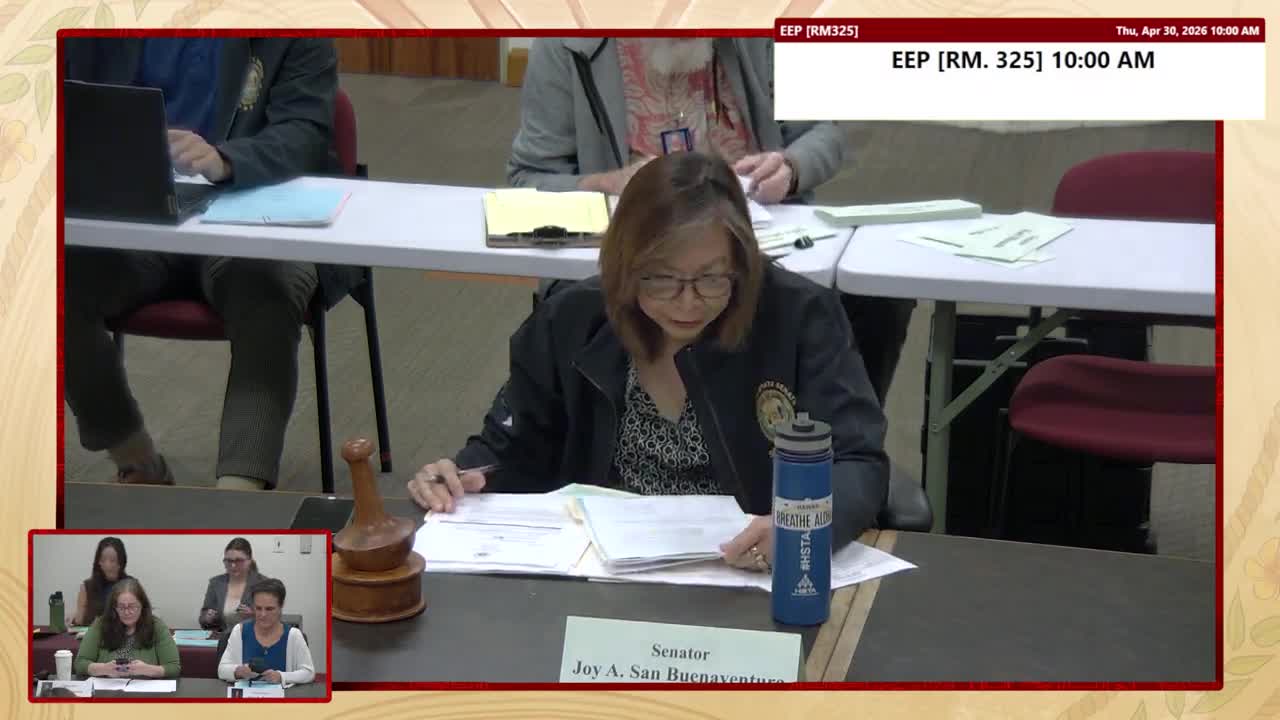 2MIN
Conference Committee
 48SEC
Conference Committee
 42SEC
Conference Committee
 44SEC
Conference Committee
 12SEC
Senate Standing Committee on Commerce and Consumer Protection
12SEC
Senate Standing Committee on Ways and Means
 1MIN