SB 3233: DAB; ADC; State Agencies; Agricultural Workforce Housing Incentives; Agricultural Leases; State Procurement; Preferences; Report
- Session Year: 2025-2026
- House: Senate
- Latest Version Date: 2026-03-27
Current Status:
Failed
(2026-05-01: Conference committee meeting to reconvene on 05-01-26 5:00 PM; Conference Room 411.)
Introduced
In Committee
First Chamber
In Committee
Second Chamber
Final Decking
Enacted
Requires state agencies that administer agricultural leases, licenses, development programs, or procurement involving agricultural products to award points or preferences to agricultural projects incorporating agricultural workforce housing. Requires the Department of Agriculture and Biosecurity to submit a report to the Legislature. Effective 7/1/3000. (HD2)
Requires state agencies, including the Department of Agriculture and Biosecurity and Agribusiness Development Corporation, that administer agricultural leases, licenses, development programs, or procurement involving agricultural products to award points or preferences to agricultural projects incorporating agricultural workforce housing. Requires a report to the Legislature. Effective 7/1/3000. (HD1)
Requires state agencies, including the Department of Agriculture and Biosecurity and Agribusiness Development Corporation, that administer agricultural leases, licenses, development programs, or procurement involving agricultural products to award points or preferences to agricultural projects incorporating agricultural workforce housing. Requires a report to the Legislature. Effective 7/1/2050. (SD1)
Requires state agencies, including the Department of Agriculture and Biosecurity and Agribusiness Development Corporation, that administer agricultural leases, licenses, development programs, or procurement involving agricultural products to award points or preferences to agricultural projects incorporating agricultural workforce housing. Requires a report to the Legislature.
|
THE SENATE |
S.B. NO. |
3233 |
|
THIRTY-THIRD LEGISLATURE, 2026 |
S.D. 1 |
|
|
STATE OF HAWAII |
H.D. 2 |
|
|
|
|
|
|
|
||
|
|
||
A BILL FOR AN ACT
RELATING TO AGRICULTURAL WORKFORCE HOUSING.
BE IT ENACTED BY THE LEGISLATURE OF THE STATE OF HAWAII:
SECTION 1. The legislature finds that agricultural workforce housing is essential to developing and sustaining the workforce needed to move Hawaii's agricultural sector forward. Agriculture across the State, particularly on the neighbor islands, faces persistent labor shortages driven in part by limited and high-cost housing options that make it difficult to recruit and retain workers. Without reliable and proximate housing, farms struggle to maintain stable operations, expand production, or meet institutional and local food demand.
The legislature further finds that agricultural workforce housing produces broad public benefits that extend far beyond individual employers. These benefits include improved food security, greater production reliability, strengthened rural and neighbor island economies, enhanced worker safety, and more resilient communities. Because these benefits accrue statewide and support the State's long-term goals for food production and economic diversification, it is appropriate to recognize agricultural workforce housing as a public good worthy of incentive, rather than impose new regulatory mandates on farmers.
The legislature also finds that Hawaii's agricultural workforce is experiencing significant decline and demographic pressure. According to the United States Department of Agriculture's 2022 Census of Agriculture, the total number of farms in Hawaii has decreased by approximately ten per cent over the most recent reporting period, and nearly half of the State's agricultural producers are sixty-five years of age or older. These trends underscore the urgent need for policies that attract, retain, and stabilize the next generation of agricultural workers. Workforce housing remains one of the most critical barriers to building a reliable agricultural labor force, especially on the neighbor islands where housing scarcity and high costs pose substantial challenges.
The purpose of this Act is to support Hawaii's agricultural workforce by incorporating agricultural workforce housing as a scored public benefit within existing state evaluation and decision-making processes.
SECTION 2. (a) Any state agency administering agricultural leases, licenses, development programs, or procurement involving agricultural products, in accordance with sections 103D-302 and 103D-303, Hawaii Revised Statutes, including but not limited to the department of agriculture and biosecurity and agribusiness development corporation, shall award additional points or preferences to agricultural projects that voluntarily provide:
(1) On-site or proximate workforce housing for agricultural workers; or
(2) Formal partnerships that secure housing for a portion of the agricultural workforce associated with the project.
(b) Any state agency awarding points and preferences pursuant to subsection (a) shall develop scoring rubrics and guidelines for awarding additional points or preferences, which shall include:
(1) Preference for projects that provide housing for workers from multiple independent farm operations;
(2) Formal partnerships that secure housing for a portion of the agricultural workforce associated with the project; and
(3) A cap ensuring that no single agricultural operation or affiliated entity shall be allocated more than fifty per cent of the total units within a state-funded or state-incentivized agricultural workforce housing project.
(c) To qualify for additional points or preferences under subsection (a), an agricultural project shall demonstrate plans to provide housing for at least twenty per cent of the agricultural workforce associated with the project; provided that state agencies under subsection (a) may authorize:
(1) Phased implementation over time;
(2) Scaled requirements based on farm size, project type, or labor needs; and
(3) Region-specific flexibility to account for neighbor island conditions, available housing stock, and infrastructure capacity.
(d) Notwithstanding any other law or rule to the contrary, state agencies may update existing scoring rubrics, guidelines, or program rules to implement this Act.
(e) Nothing in this Act shall be construed to:
(1) Create a mandate that agricultural operators provide workforce housing;
(2) Penalize applicants that do not provide workforce housing; or
(3) Supersede or alter existing health, safety, or land-use requirements applicable to housing development.
(f) For the purposes of this section:
"Agricultural project" means any agricultural, aquacultural, or agroforestry project that includes subdivision and capital improvements to the land and is applying for or participating in a:
(1) State agricultural land lease or license;
(2) State-supported agricultural development program; or
(3) State procurement, in accordance with sections 103D‑302 and 103D-303, Hawaii Revised Statutes, grant, or institutional purchasing contract that includes agricultural production.
"Agricultural workforce housing" means on-site, proximate, or partnered housing arrangements intended to accommodate agricultural workers employed by, contracted with, or directly supporting an agricultural project.
"State agency" means all executive departments, boards, and commissions of the State and all public corporations created by the legislature. "State agency" does not include any contractor with the State.
SECTION 3. The department of agriculture and biosecurity shall submit a report of its findings and recommendations, including any proposed legislation, to the legislature no later than twenty days prior to the convening of the regular session of 2027. The report shall include:
(1) Implementation of the incentive scoring provisions in this Act;
(2) The number of applicants that received additional points or preference pursuant to this Act;
(3) Challenges encountered; and
(4) Recommendations for improving or expanding the
incentive framework.
SECTION 4. This Act shall take effect on July 1, 3000.
Report Title:
DAB; ADC; State Agencies; Agricultural Workforce Housing Incentives; Agricultural Leases; State Procurement; Preferences; Report
Description:
Requires state agencies that administer agricultural leases, licenses, development programs, or procurement involving agricultural products to award points or preferences to agricultural projects incorporating agricultural workforce housing. Requires the Department of Agriculture and Biosecurity to submit a report to the Legislature. Effective 7/1/3000. (HD2)
The summary description of legislation appearing on this page is for informational purposes only and is not legislation or evidence of legislative intent.
|
THE SENATE |
S.B. NO. |
3233 |
|
THIRTY-THIRD LEGISLATURE, 2026 |
S.D. 1 |
|
|
STATE OF HAWAII |
H.D. 1 |
|
|
|
|
|
|
|
||
|
|
||
A BILL FOR AN ACT
RELATING TO AGRICULTURAL WORKFORCE HOUSING.
BE IT ENACTED BY THE LEGISLATURE OF THE STATE OF HAWAII:
SECTION 1. The legislature finds that agricultural workforce housing is essential to developing and sustaining the workforce needed to move Hawaii's agricultural sector forward. Agriculture across the State, particularly on the neighbor islands, faces persistent labor shortages driven in part by limited and high-cost housing options that make it difficult to recruit and retain workers. Without reliable and proximate housing, farms struggle to maintain stable operations, expand production, or meet institutional and local food demand.
The legislature further finds that agricultural workforce housing produces broad public benefits that extend far beyond individual employers. These benefits include improved food security, greater production reliability, strengthened rural and neighbor island economies, enhanced worker safety, and more resilient communities. Because these benefits accrue statewide and support the State's long-term goals for food production and economic diversification, it is appropriate to recognize agricultural workforce housing as a public good worthy of incentive, rather than impose new regulatory mandates on farmers.
The legislature also finds that Hawaii's agricultural workforce is experiencing significant decline and demographic pressure. According to the United States Department of Agriculture's 2022 Census of Agriculture, the total number of farms in Hawaii has decreased by approximately ten per cent over the most recent reporting period, and nearly half of the State's agricultural producers are sixty-five years of age or older. These trends underscore the urgent need for policies that attract, retain, and stabilize the next generation of agricultural workers. Workforce housing remains one of the most critical barriers to building a reliable agricultural labor force, especially on the neighbor islands where housing scarcity and high costs pose substantial challenges.
The purpose of this Act is to support Hawaii's agricultural workforce by incorporating agricultural workforce housing as a scored public benefit within existing state evaluation and decision-making processes.
SECTION 2. (a) Any state agency administering agricultural leases, licenses, development programs, or procurement involving agricultural products, in accordance with sections 103D-302 and 103D-303, Hawaii Revised Statutes, including but not limited to the department of agriculture and biosecurity and agribusiness development corporation, shall award additional points or preferences to agricultural projects that voluntarily provide:
(1) On-site or proximate workforce housing for agricultural workers; or
(2) Formal partnerships that secure housing for a portion of the agricultural workforce associated with the project.
(b) Any state agency awarding points and preferences pursuant to subsection (a) shall develop scoring rubrics and guidelines for awarding additional points or preferences, which shall include:
(1) Preference for projects that provide housing for workers from multiple independent farm operations;
(2) Formal partnerships that secure housing for a portion of the agricultural workforce associated with the project; and
(3) A cap ensuring that no single agricultural operation or affiliated entity shall be allocated more than fifty per cent of the total units within a state-funded or state-incentivized agricultural workforce housing project.
(c) To qualify for additional points or preferences under subsection (a), an agricultural project shall demonstrate plans to provide housing for at least twenty per cent of the agricultural workforce associated with the project; provided that state agencies under subsection (a) may authorize:
(1) Phased implementation over time;
(2) Scaled requirements based on farm size, project type, or labor needs; and
(3) Region-specific flexibility to account for neighbor island conditions, available housing stock, and infrastructure capacity.
(d) State agencies may update existing scoring rubrics, guidelines, or program rules to implement this Act without the need for additional statutory authority.
(e) Nothing in this Act shall be construed to:
(1) Create a mandate that agricultural operators provide workforce housing;
(2) Penalize applicants that do not provide workforce housing; or
(3) Supersede or alter existing health, safety, or land-use requirements applicable to housing development.
(f) For the purposes of this section:
"Agricultural project" means any agricultural, aquacultural, or agroforestry project that includes subdivision and capital improvements to the land and is applying for or participating in a:
(1) State agricultural land lease or license;
(2) State-supported agricultural development program; or
(3) State procurement, in accordance with sections 103D‑302 and 103D-303, Hawaii Revised Statutes, grant, or institutional purchasing contract that includes agricultural production.
"Agricultural workforce housing" means on-site, proximate, or partnered housing arrangements intended to accommodate agricultural workers employed by, contracted with, or directly supporting an agricultural project.
"State agency" means all executive departments, boards, and commissions of the State and all public corporations created by the legislature. "State agency" does not include any contractor with the State.
SECTION 3. The department of agriculture and biosecurity shall submit a report of its findings and recommendations, including any proposed legislation, to the legislature no later than twenty days prior to the convening of the regular session of 2027. The report shall include:
(1) Implementation of the incentive scoring provisions in this Act;
(2) The number of applicants that received additional points or preference pursuant to this Act;
(3) Challenges encountered; and
(4) Recommendations for improving or expanding the
incentive framework.
SECTION 4. This Act shall take effect on July 1, 3000.
Report Title:
DAB; ADC; State Agencies; Agricultural Workforce Housing Incentives; Agricultural Leases; State Procurement; Preferences; Report
Description:
Requires state agencies, including the Department of Agriculture and Biosecurity and Agribusiness Development Corporation, that administer agricultural leases, licenses, development programs, or procurement involving agricultural products to award points or preferences to agricultural projects incorporating agricultural workforce housing. Requires a report to the Legislature. Effective 7/1/3000. (HD1)
The summary description of legislation appearing on this page is for informational purposes only and is not legislation or evidence of legislative intent.
|
THE SENATE |
S.B. NO. |
3233 |
|
THIRTY-THIRD LEGISLATURE, 2026 |
S.D. 1 |
|
|
STATE OF HAWAII |
|
|
|
|
|
|
|
|
||
|
|
||
A BILL FOR AN ACT
RELATING TO AGRICULTURAL WORKFORCE HOUSING.
BE IT ENACTED BY THE LEGISLATURE OF THE STATE OF HAWAII:
SECTION 1. The legislature finds that agricultural workforce housing is essential to developing and sustaining the workforce needed to move Hawaii's agricultural sector forward. Agriculture across the State, particularly on the neighbor islands, faces persistent labor shortages driven in part by limited and high-cost housing options that make it difficult to recruit and retain workers. Without reliable and proximate housing, farms struggle to maintain stable operations, expand production, or meet institutional and local food demand.
The legislature further finds that agricultural workforce housing produces broad public benefits that extend far beyond individual employers. These benefits include improved food security, greater production reliability, strengthened rural and neighbor island economies, enhanced worker safety, and more resilient communities. Because these benefits accrue statewide and support the State's long-term goals for food production and economic diversification, it is appropriate to recognize agricultural workforce housing as a public good worthy of incentive, rather than impose new regulatory mandates on farmers.
The legislature also finds that Hawaii's agricultural workforce is experiencing significant decline and demographic pressure. According to the United States Department of Agriculture's 2022 Census of Agriculture, the total number of farms in Hawaii has decreased by approximately ten per cent over the most recent reporting period, and nearly half of the State's agricultural producers are sixty-five years of age or older. These trends underscore the urgent need for policies that attract, retain, and stabilize the next generation of agricultural workers. Workforce housing remains one of the most critical barriers to building a reliable agricultural labor force, especially on the neighbor islands where housing scarcity and high costs pose substantial challenges.
The purpose of this Act is to support Hawaii's agricultural workforce by incorporating agricultural workforce housing as a scored public benefit within existing state evaluation and decision-making processes.
SECTION 2. (a) Any state agency administering agricultural leases, licenses, development programs, or procurement involving agricultural products, in accordance with sections 103D-302 and 103D-303, Hawaii Revised Statutes, including but not limited to the department of agriculture and biosecurity and the agribusiness development corporation, shall award additional points or preferences to agricultural projects that voluntarily provide:
(1) On-site or proximate workforce housing for agricultural workers; or
(2) Formal partnerships that secure housing for a portion of the agricultural workforce associated with the project.
(b) Any state agency awarding points and preferences pursuant to subsection (a), shall develop scoring rubrics and guidelines for awarding additional points or preferences, which shall include:
(1) Preference for projects that provide housing for workers from multiple independent farm operations;
(2) Formal partnerships that secure housing for a portion of the agricultural workforce associated with the project; and
(3) A cap ensuring that no single agricultural operation or affiliated entity shall be allocated more than fifty per cent of the total units within a state-funded or state-incentivized agricultural workforce housing project.
(c) To qualify for additional points or preferences under subsection (a), an agricultural project shall demonstrate plans to provide housing for at least twenty per cent of the agricultural workforce associated with the project; provided that state agencies under subsection (a) may authorize:
(1) Phased implementation over time;
(2) Scaled requirements based on farm size, project type, or labor needs; and
(3) Region-specific flexibility to account for neighbor island conditions, available housing stock, and infrastructure capacity.
(d) State agencies may update existing scoring rubrics, guidelines, or program rules to implement this section without the need for additional statutory authority.
(e) Nothing in this Act shall be construed to:
(1) Create a mandate that agricultural operators provide workforce housing;
(2) Penalize applicants that do not provide workforce housing; or
(3) Supersede or alter existing health, safety, or land-use requirements applicable to housing development.
(f) For the purposes of this section:
"Agricultural project" means any agricultural, aquacultural, or agroforestry project applying for or participating in a:
(1) State agricultural land lease or license;
(2) State-supported agricultural development program; or
(3) State procurement, in accordance with sections 103D‑302 and 103D-303, Hawaii Revised Statutes, grant, or institutional purchasing contract that includes agricultural production.
"Agricultural workforce housing" means on-site, proximate, or partnered housing arrangements intended to accommodate agricultural workers employed by, contracted with, or directly supporting an agricultural project.
"State agency" means all executive departments, boards, and commissions of the State and all public corporations created by the legislature. "State agency" does not include any contractor with the State.
SECTION 3. The department of agriculture and biosecurity shall submit a report of its findings and recommendations, including any proposed legislation, to the legislature no later than twenty days prior to the convening of the regular session of 2027. The report shall include:
(1) Implementation of the incentive scoring provisions in this Act;
(2) The number of applicants that received additional points or preference;
(3) Challenges encountered; and
(4) Recommendations for improving or expanding the incentive framework.
SECTION 4. This Act shall take effect on July 1, 2050.
Report Title:
DAB; ADC; State Agencies; Agricultural Workforce Housing Incentives; Agricultural Leases; State Procurement; Preferences; Report
Description:
Requires state agencies, including the Department of Agriculture and Biosecurity and Agribusiness Development Corporation, that administer agricultural leases, licenses, development programs, or procurement involving agricultural products to award points or preferences to agricultural projects incorporating agricultural workforce housing. Requires a report to the Legislature. Effective 7/1/2050. (SD1)
The summary description of legislation appearing on this page is for informational purposes only and is not legislation or evidence of legislative intent.
|
THE SENATE |
S.B. NO. |
3233 |
|
THIRTY-THIRD LEGISLATURE, 2026 |
|
|
|
STATE OF HAWAII |
|
|
|
|
|
|
|
|
||
|
|
||
A BILL FOR AN ACT
relating to agricultural workforce housing.
BE IT ENACTED BY THE LEGISLATURE OF THE STATE OF HAWAII:
SECTION 1. The legislature finds that agricultural workforce housing is essential to developing and sustaining the workforce needed to move Hawaii's agricultural sector forward. Agriculture across the State, particularly on the neighbor islands, faces persistent labor shortages driven in part by limited and high-cost housing options that make it difficult to recruit and retain workers. Without reliable and proximate housing, farms struggle to maintain stable operations, expand production, or meet institutional and local food demand.
The legislature further finds that agricultural workforce housing produces broad public benefits that extend far beyond individual employers. These benefits include improved food security, greater production reliability, strengthened rural and neighbor island economies, enhanced worker safety, and more resilient communities. Because these benefits accrue statewide and support the State's long-term goals for food production and economic diversification, it is appropriate to recognize agricultural workforce housing as a public good worthy of incentive, rather than impose new regulatory mandates on farmers.
The legislature also finds that Hawaii's agricultural workforce is experiencing significant decline and demographic pressure. According to the United States Department of Agriculture's 2022 Census of Agriculture, the total number of farms in Hawaii has decreased by approximately ten per cent over the most recent reporting period, and nearly half of the State's agricultural producers are sixty-five years of age or older. These trends underscore the urgent need for policies that attract, retain, and stabilize the next generation of agricultural workers. Workforce housing remains one of the most critical barriers to building a reliable agricultural labor force, especially on the neighbor islands where housing scarcity and high costs pose substantial challenges.
The purpose of this Act is to support Hawaii's agricultural workforce by incorporating agricultural workforce housing as a scored public benefit within existing state evaluation and decision-making processes.
SECTION 2. (a) Any state agency administering agricultural leases, licenses, development programs, or procurement involving agricultural products, including but not limited to the department of agriculture and biosecurity and the agribusiness development corporation, shall award additional points or preferences to agricultural projects that voluntarily provide:
(1) On-site or proximate workforce housing for agricultural workers; or
(2) Formal partnerships that secure housing for a portion of the agricultural workforce associated with the project.
(b) To qualify for additional points or preferences under subsection (a), an agricultural project shall demonstrate plans to provide housing for at least twenty per cent of the agricultural workforce associated with the project; provided that state agencies under subsection (a) may authorize:
(1) Phased implementation over time;
(2) Scaled requirements based on farm size, project type, or labor needs; and
(3) Region-specific flexibility to account for neighbor island conditions, available housing stock, and infrastructure capacity.
(c) State agencies may update existing scoring rubrics, guidelines, or program rules to implement this section without the need for additional statutory authority.
(d) Nothing in this Act shall be construed to:
(1) Create a mandate that agricultural operators provide workforce housing;
(2) Penalize applicants that do not provide workforce housing; or
(3) Supersede or alter existing health, safety, or land-use requirements applicable to housing development.
(e) For the purposes of this section:
"Agricultural project" means any agricultural, aquacultural, or agroforestry project applying for or participating in a:
(1) State agricultural land lease or license;
(2) State-supported agricultural development program; or
(3) State procurement, grant, or institutional purchasing contract that includes agricultural production.
"Agricultural workforce housing" means on-site, proximate, or partnered housing arrangements intended to accommodate agricultural workers employed by, contracted with, or directly supporting an agricultural project.
"State agency" means all executive departments, boards, and commissions of the State and all public corporations created by the legislature. "State agency" does not include any contractor with the State.
SECTION 3. The department of agriculture and biosecurity shall submit a report of its findings and recommendations, including any proposed legislation, to the legislature no later than twenty days prior to the convening of the regular session of 2027. The report shall include:
(1) Implementation of the incentive scoring provisions in this Act;
(2) The number of applicants that received additional points or preference;
(3) Challenges encountered; and
(4) Recommendations for improving or expanding the incentive framework.
SECTION 4. This Act shall take effect on July 1, 2026.
|
INTRODUCED BY: |
_____________________________ |
|
|
|
Report Title:
State Agencies; DAB; Agribusiness Development Corporation; Agricultural Workforce Housing Incentives; Agricultural Leases; State Procurement; Preferences
Description:
Requires state agencies, including the Department of Agriculture and Biosecurity and Agribusiness Development Corporation, that administer agricultural leases, licenses, development programs, or procurement involving agricultural products to award points or preferences to agricultural projects incorporating agricultural workforce housing. Requires a report to the Legislature.
The summary description of legislation appearing on this page is for informational purposes only and is not legislation or evidence of legislative intent.
|
Date
|
Status
|
|---|---|
| May 1, 2026 | Conference committee meeting to reconvene on 05-01-26 5:00 PM; Conference Room 411. |
| May 1, 2026 | Conference committee meeting to reconvene on 05-01-26 12:45 PM; Conference Room 325. |
| Apr 30, 2026 | Conference committee meeting to reconvene on 05-01-26 9:15AM; Conference Room 325. |
| Apr 29, 2026 | Conference committee meeting to reconvene on 04-30-26 9:30AM; Conference Room 325. |
| Apr 28, 2026 | Conference committee meeting to reconvene on 04-29-26 9:30AM; Conference Room 325. |
| Apr 24, 2026 | Conference committee meeting to reconvene on 04-28-26 9:30AM; Conference Room 325. |
| Apr 23, 2026 | Conference committee meeting scheduled for 04-24-26 11:00AM; Conference Room 325. |
| Apr 23, 2026 | Received notice of appointment of House conferees (Hse. Com. No. 811). |
| Apr 22, 2026 | House Conferees Appointed: Chun, Miyake, Kusch Co-Chairs; Matsumoto. |
| Apr 21, 2026 | Received notice of Senate conferees (Sen. Com. No. 718). |
| Apr 21, 2026 | Senate Conferees Appointed: Gabbard Chair; McKelvey, Richards Co-Chairs; Rhoads. |
| Apr 10, 2026 | Received notice of disagreement (Sen. Com. No. 564). |
| Apr 10, 2026 | Senate disagrees with House amendments. |
| Apr 10, 2026 | Received from House (Hse. Com. No. 529). |
| Apr 9, 2026 | Passed Third Reading with none voting aye with reservations; Representative(s) Pierick voting no (1) and Representative(s) Cochran excused (1). Transmitted to Senate. |
| Apr 9, 2026 | Reported from FIN (Stand. Com. Rep. No. 1997-26), recommending passage on Third Reading. |
| Apr 7, 2026 | The committee on FIN recommend that the measure be PASSED, UNAMENDED. The votes were as follows: 15 Ayes: Representative(s) Todd, Takenouchi, Hartsfield, Hussey, Keohokapu-Lee Loy, Kitagawa, Kusch, Lee, M., Miyake, Perruso, Templo, Yamashita, Alcos, Gedeon, Reyes Oda; Ayes with reservations: none; 0 Noes: none; and 1 Excused: Representative(s) Morikawa. |
| Apr 2, 2026 | Bill scheduled for decision making on Tuesday, 04-07-26 10:10AM in conference room 308 VIA VIDEOCONFERENCE. |
| Apr 2, 2026 | The committee(s) on FIN recommend(s) that the measure be deferred until 04-07-26. |
| Mar 31, 2026 | Bill scheduled to be heard by FIN on Thursday, 04-02-26 2:00PM in House conference room 308 VIA VIDEOCONFERENCE. |
| Mar 30, 2026 | Report adopted; referred to the committee(s) on FIN as amended in HD 2 with none voting aye with reservations; Representative(s) Pierick voting no (1) and Representative(s) Cochran, Lowen, Perruso, Quinlan excused (4). |
| Mar 30, 2026 | Reported from HSG (Stand. Com. Rep. No. 1516-26) as amended in HD 2, recommending referral to FIN. |
| Mar 25, 2026 | The committee on HSG recommend that the measure be PASSED, WITH AMENDMENTS. The votes were as follows: 9 Ayes: Representative(s) Evslin, Miyake, Grandinetti, Kila, Kitagawa, La Chica, Pierick; Ayes with reservations: Representative(s) Cochran, Muraoka; Noes: none; and Excused: none. |
| Mar 20, 2026 | Bill scheduled to be heard by HSG on Wednesday, 03-25-26 10:00AM in House conference room 430 VIA VIDEOCONFERENCE. |
| Mar 20, 2026 | Passed Second Reading as amended in HD 1 and referred to the committee(s) on HSG with none voting aye with reservations; Representative(s) Pierick voting no (1) and Representative(s) Quinlan excused (1). |
| Mar 20, 2026 | Reported from AGR (Stand. Com. Rep. No. 1252-26) as amended in HD 1, recommending passage on Second Reading and referral to HSG. |
| Mar 18, 2026 | The committee on AGR recommend that the measure be PASSED, WITH AMENDMENTS. The votes were as follows: 7 Ayes: Representative(s) Chun, Kusch, Kahaloa, Lowen, Perruso, Quinlan, Matsumoto; Ayes with reservations: none; Noes: none; and Excused: none. |
| Mar 12, 2026 | Bill scheduled to be heard by AGR on Wednesday, 03-18-26 9:30AM in House conference room 325 VIA VIDEOCONFERENCE. |
| Mar 12, 2026 | This measure has been deleted from the meeting scheduled on Friday 03-13-26 10:00AM in conference room 325 VIA VIDEOCONFERENCE. |
| Mar 11, 2026 | Bill scheduled to be heard by AGR on Friday, 03-13-26 10:00AM in House conference room 325 VIA VIDEOCONFERENCE. |
| Mar 10, 2026 | Referred to AGR, HSG, FIN, referral sheet 16 |
| Mar 10, 2026 | Pass First Reading |
| Mar 6, 2026 | Received from Senate (Sen. Com. No. 125) in amended form (SD 1). |
| Mar 6, 2026 | Report Adopted; Passed Third Reading. Ayes, 24; Aye(s) with reservations: none. Noes, 0 (none). Excused, 1 (Senator(s) Ihara). Transmitted to House. |
| Mar 5, 2026 | One Day Notice 03-06-26. |
| Mar 5, 2026 | Reported from WAM (Stand. Com. Rep. No. 2746) with recommendation of passage on Third Reading. |
| Mar 3, 2026 | The committee(s) on WAM recommend(s) that the measure be PASSED, UNAMENDED. The votes in WAM were as follows: 12 Aye(s): Senator(s) Dela Cruz, Moriwaki, DeCoite, Elefante, Hashimoto, Inouye, Kanuha, Kidani, Kim, Lee, C., Richards, Wakai; Aye(s) with reservations: none ; 0 No(es): none; and 1 Excused: Senator(s) Fevella. |
| Feb 25, 2026 | The committee(s) on WAM deferred the measure until 03-03-26 10:15AM; Conference Room 211 & Videoconference. |
| Feb 23, 2026 | The committee(s) on WAM will hold a public decision making on 02-25-26 10:56AM; Conference Room 211 & Videoconference. |
| Feb 20, 2026 | Report adopted; Passed Second Reading, as amended (SD 1) and referred to WAM. |
| Feb 20, 2026 | Reported from AEN/GVO (Stand. Com. Rep. No. 2500) with recommendation of passage on Second Reading, as amended (SD 1) and referral to WAM. |
| Feb 12, 2026 | The committee(s) on AEN recommend(s) that the measure be PASSED, WITH AMENDMENTS. The votes in AEN were as follows: 4 Aye(s): Senator(s) Gabbard, Richards, Rhoads, Awa; Aye(s) with reservations: none ; 0 No(es): none; and 1 Excused: Senator(s) DeCoite. |
| Feb 12, 2026 | The committee(s) on GVO recommend(s) that the measure be PASSED, WITH AMENDMENTS. The votes in GVO were as follows: 5 Aye(s): Senator(s) McKelvey, Gabbard, Hashimoto, Moriwaki, Awa; Aye(s) with reservations: none ; 0 No(es): none; and 0 Excused: none. |
| Feb 9, 2026 | The committee(s) on AEN/GVO has scheduled a public hearing on 02-12-26 3:05PM; Conference Room 225 & Videoconference. |
| Feb 2, 2026 | Referred to AEN/GVO, WAM. |
| Jan 28, 2026 | Passed First Reading. |
| Jan 28, 2026 | Introduced. |
|
Date
|
Description
|
Location
|
Votes
|
|
|---|---|---|---|---|
| Apr 7, 2026 | The committee on FIN recommend that the measure be PASSED, UNAMENDED | House Standing Committee on Finance |
Passed |
|
| Mar 25, 2026 | The committee on HSG recommend that the measure be PASSED, WITH AMENDMENTS | House Standing Committee on Housing |
Passed |
|
| Mar 18, 2026 | The committee on AGR recommend that the measure be PASSED, WITH AMENDMENTS | House Standing Committee on Agriculture & Food Systems |
Passed |
|
| Mar 6, 2026 | Third Reading | Senate Floor |
Passed |
|
| Mar 3, 2026 | The committee(s) on WAM recommend(s) that the measure be PASSED, UNAMENDED | Senate Standing Committee on Ways and Means |
Passed |
|
| Feb 12, 2026 | The committee(s) on AEN recommend(s) that the measure be PASSED, WITH AMENDMENTS | Senate Standing Committee on Agriculture and Environment |
Passed |
|
| Feb 12, 2026 | The committee(s) on GVO recommend(s) that the measure be PASSED, WITH AMENDMENTS | Senate Standing Committee on Government Operations |
Passed |
This list shows positions taken on this bill by organizations on the date displayed, which is linked to the original source.
Positions by individuals are not included.
|
Organization
|
Position
|
Date
|
|---|---|---|
| Agribusiness Development Corporation | *** Support | Mar 24, 2026 |
| Agriculture Stewardship Hawai'i | *** Support | Apr 2, 2026 |
| Chamber of Commerce Hawaii | *** Support | Apr 2, 2026 |
| Food+ Policy Internship | *** Support | Apr 2, 2026 |
| Hawaiʻi Farm Bureau | *** Support | Apr 2, 2026 |
| Hawaiʻi Farmers Union | *** Support | Apr 2, 2026 |
| Hawai‘i Farm Bureau | *** Support | Mar 24, 2026 |
| Hawai‘i Island Chamber of Commerce | *** Support | Apr 2, 2026 |
| Maui Chamber of Commerce | *** Support | Apr 2, 2026 |
| Office of Planning & Sustainable Development | *** Support | Apr 2, 2026 |
STAND. COM. REP. NO. 2746
Honolulu, Hawaii
RE: S.B. No. 3233
S.D. 1
Honorable Ronald D. Kouchi
President of the Senate
Thirty-Third State Legislature
Regular Session of 2026
State of Hawaii
Sir:
Your Committee on Ways and Means, to which was referred S.B. No. 3233, S.D. 1, entitled:
"A BILL FOR AN ACT RELATING TO AGRICULTURAL WORKFORCE HOUSING,"
begs leave to report as follows:
The purpose and intent of this measure is to support Hawaii's agricultural workforce by incorporating agricultural workforce housing as a scored public benefit within existing state evaluation and decision-making processes.
More specifically, this measure:
(1) Requires any state agency administering agricultural leases, licenses, development programs, or procurements involving agricultural products to award additional points and preferences to projects that voluntarily provide agricultural workforce housing; and
(2) Requires the Department of Agriculture and Biosecurity to submit a report to the Legislature prior to the 2027 Regular Session on the implementation, challenges, and potential expansion of the incentive scoring provisions established by this measure.
Your Committee received written comments in support of this measure from the Office of Planning and Sustainable Development, Agribusiness Development Corporation, Chamber of Commerce Hawaii, Hawaii Farm Bureau, and one individual.
Your Committee received written comments on this measure from the Department of Agriculture and Biosecurity, Hawaii Farmers Union, and one individual.
Your Committee finds that access to safe, affordable housing for agricultural workers is fundamental to maintaining a stable and reliable food supply. Farmworkers face significant housing shortages, living space overcrowding, and long work commutes due to limited available and affordable housing stock. By incentivizing reliable and proximate agricultural workforce housing this measure will not only directly help agricultural workers and producers but will also have additional benefits for the general public by helping to secure a sustainable food supply, ease traffic congestion, and support local communities.
As affirmed by the record of votes of the members of your Committee on Ways and Means that is attached to this report, your Committee is in accord with the intent and purpose of S.B. No. 3233, S.D. 1, and recommends that it pass Third Reading.
Respectfully submitted on behalf of the members of the Committee on Ways and Means,
|
|
|
________________________________ DONOVAN M. DELA CRUZ, Chair |
|
|
|
|
STAND. COM. REP. NO. 2500
Honolulu, Hawaii
RE: S.B. No. 3233
S.D. 1
Honorable Ronald D. Kouchi
President of the Senate
Thirty-Third State Legislature
Regular Session of 2026
State of Hawaii
Sir:
Your Committees on Agriculture and Environment and Government Operations, to which was referred S.B. No. 3233 entitled:
"A BILL FOR AN ACT RELATING TO AGRICULTURAL WORKFORCE HOUSING,"
beg leave to report as follows:
The purpose and intent of this measure is to:
(1) Require state agencies, including the Department of Agriculture and Biosecurity and Agribusiness Development Corporation, that administer agricultural leases, licenses, development programs, or procurement involving agricultural products to award points or preferences to agricultural projects incorporating agricultural workforce housing; and
(2) Require a report to the Legislature.
Your Committees received testimony in support of this measure from the Office of Planning and Sustainable Development, Agribusiness Development Corporation, Hawaiʻi Farm Bureau, Chamber of Commerce Hawaii, Hawaiʻi Food+ Policy, and one individual.
Your Committees received comments on this measure from the State Procurement Office and Hawaiʻi Farmers Union United.
Your Committees find that agriculture across the State, particularly on the neighbor islands, faces persistent labor shortages driven in part by limited and high-cost housing options that make it difficult to recruit and retain workers. Without reliable and proximate housing, farms struggle to maintain stable operations, expand production, or meet institutional and local food demand. By prioritizing agricultural projects that include dedicated agricultural worker housing, this measure seeks to protect the State's food security and ensure continuity in food production.
Your Committees acknowledge the concerns raised in testimony by the State Procurement Office that providing preference to agricultural projects that provide workforce housing may lead to reduced economic competition. Your Committees further acknowledge the concerns raised in testimony by the Hawaii Farmers Union United that the preferential scoring system, as currently proposed, could lock out small-scale producers from accessing state agricultural leases. Therefore, amendments to this measure are necessary to address these concerns.
Your Committees have amended this measure by:
(1) Specifying that all procurement involving agricultural products shall be conducted in accordance with the structured competitive procedures required by the Hawaii Public Procurement Code governing competitive sealed bidding and competitive sealed proposals;
(2) Inserting language that outlines the scoring rubric for a state agency to award additional points or preferences;
(4) Inserting an effective date of July 1, 2050, to encourage further discussion.
As affirmed by the records of votes of the members of your Committees on Agriculture and Environment and Government Operations that are attached to this report, your Committees are in accord with the intent and purpose of S.B. No. 3233, as amended herein, and recommend that it pass Second Reading in the form attached hereto as S.B. No. 3233, S.D. 1, and be referred to your Committee on Ways and Means.
Respectfully submitted on behalf of the members of the Committees on Agriculture and Environment and Government Operations,
|
________________________________ ANGUS L.K. MCKELVEY, Chair |
|
________________________________ MIKE GABBARD, Chair |
|
|
|
|
|
Date
|
Testimony PDF
|
|---|---|
| Apr 2, 2026 | SB3233_HD2_TESTIMONY_FIN_04-02-26_.PDF |
| Mar 24, 2026 | SB3233_HD1_TESTIMONY_HSG_03-25-26_.PDF |
| Mar 17, 2026 | SB3233_SD1_TESTIMONY_AGR_03-18-26_.PDF |
| Feb 24, 2026 | SB3233_SD1_TESTIMONY_WAM_02-25-26_.PDF |
| Feb 12, 2026 | SB3233_TESTIMONY_AEN-GVO_02-12-26_.PDF |
Discussed in Hearing
 1MIN
Conference Committee
 31SEC
Conference Committee
 29SEC
Conference Committee
 35SEC
Conference Committee
 1MIN
Conference Committee
 20MIN
House Standing Committee on Housing
 1MIN
House Standing Committee on Housing
 7MIN
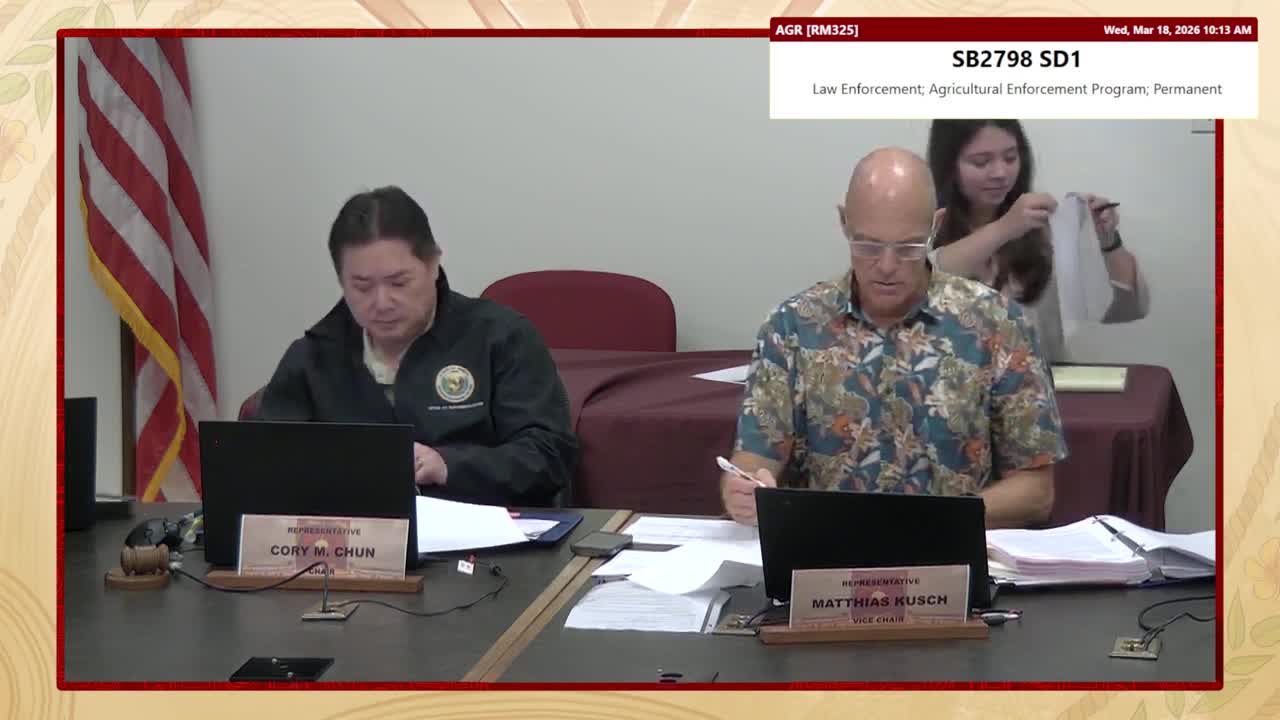
House Standing Committee on Agriculture & Food Systems
Bill Author

Bill Co-Author(s):