HB 427: DOA; Biosecurity Emergency Declaration; Quarantine; Transitional Facilities; Certified Biosecurity Compliance Auditors; Penalties; Readiness and Response Agreements; Pest Dashboard; Biosecurity and Pest Management Plans; Plant Care Component Program; Hawaii Invasive Species Council; Rules; Appropriations
- Session Year: 2025-2026
- House: House
- Latest Version Date: 2025-04-26
Current Status:
In Progress
(2025-06-27: Act 236, on 06/27/2025 (Gov. Msg. No. 1338).)
Introduced
In Committee
First Chamber
In Committee
Second Chamber
Final Decking
Enacted
Part I: Renames the Department of Agriculture as the Department of Agriculture and Biosecurity (Department) and the Board of Agriculture as the Board of Agriculture and Biosecurity. Part II: Establishes a Deputy Chairperson for Biosecurity. Part III: Authorizes and specifies conditions under which the Department may declare a biosecurity emergency, during which the Department and Governor may take certain actions to prevent the establishment or spread of pests and prohibited or restricted organisms. Broadens the objectives and general actions of the Biosecurity Program. Part IV: Authorizes the Department to establish transitional facilities. Requires the Department to certify and train biosecurity compliance auditors to inspect imported plants and animals. Requires inspection of various items transported interisland. Increases penalties for illegally transporting plants, animals, and microorganisms. Part V: Authorizes the Department to enter into government‑industry agreements for readiness and response to unwanted organisms in the State. Authorizes biosecurity and pest management plans to address, contain, or eradicate pests. Requires the Department to establish a pest dashboard by 12/1/2025. Part VI: Authorizes the Department to adopt rules to establish and enforce the Plant Care Component Program. Authorizes the Department to assess administrative penalties for the enforcement of the Plant Care Component Program. Part VII: Transfers the Hawaii Invasive Species Council from the Department of Land and Natural Resources to the Department. Part VIII: Appropriates funds. (CD1)
Renames the Department of Agriculture to the Department of Agriculture and Biosecurity (Department) and the Board of Agriculture to the Board of Agriculture and Biosecurity. Establishes a Deputy Chairperson for Biosecurity. Requires the Department to establish a Biosecurity Emergency Response Program. Authorizes the Chairperson of the Board of Agriculture and Biosecurity to quarantine any area under certain circumstances. Authorizes the Department to establish transitional facilities. Requires the Department of Commerce and Consumer Affairs to license and train biosecurity inspectors to inspect imported plants and animals. Requires inspection of various items transported interisland. Increases penalties for illegally transporting plants, animals, and microorganisms. Requires the Department to establish government‑industry agreements to detect and respond to unwanted organisms in the State. Require the Department to establish an invasive species dashboard by 12/1/2025. Transfers the Hawaii Invasive Species Council from the Department of Land and Natural Resources to the Department. Authorizes pest management plans to address, contain, or eradicate pests. Authorizes the Department to adopt rules to establish and enforce the Plant Care Component Program. Authorizes the Department to assess administrative penalties for the enforcement of the Plant Care Component Program. Establishes positions. Appropriates funds. Effective 1/1/2050. (SD2)
Renames the Department of Agriculture to the Department of Agriculture and Biosecurity (Department) and the Board of Agriculture to the Board of Agriculture and Biosecurity. Establishes a Deputy Chairperson for Biosecurity. Requires the Department to establish a Biosecurity Emergency Response Program. Authorizes the Chairperson of the Board of Agriculture and Biosecurity to quarantine any area under certain circumstances. Authorizes the Department to establish transitional facilities. Requires the Department of Commerce and Consumer Affairs to license and train biosecurity inspectors to inspect imported plants and animals. Requires inspection of various items transported interisland. Increases penalties for illegally transporting plants, animals, and microorganisms. Requires the Department to establish government‑industry agreements to detect and respond to unwanted organisms in the State. Require the Department to establish an invasive species dashboard by 12/1/2025. Authorizes pest management plans to address, contain, or eradicate pests. Authorizes the Department to adopt rules to establish and enforce the Plant Care Component Program. Authorizes the Department to assess administrative penalties for the enforcement of the Plant Care Component Program. Establishes positions. Appropriates funds. Effective 1/1/2050. (SD1)
Part I: Renames the Department of Agriculture to the "Department of Agriculture and Biosecurity". Renames the Board of Agriculture to the "Board of Agriculture and Biosecurity". Part II: Establishes and appropriates funds for a Deputy Director of Biosecurity. Part III: Changes references to the plant and animal declaration form to the "biosecurity form". Part IV: Authorizes and specifies conditions under which the Department of Agriculture and Biosecurity may declare a biosecurity emergency, during which the Department and Governor may take certain actions to prevent the establishment or spread of pests and prohibited or restricted organisms. Broadens the objectives and general actions of the Biosecurity Program. Part V: Appropriates funds for positions for the Department of Agriculture and Biosecurity. Effective 7/1/3000. (HD2)
Part I: Renames the Department of Agriculture to the "Department of Agriculture and Biosecurity". Renames the Board of Agriculture to the "Board of Agriculture and Biosecurity". Part II: Establishes and appropriates funds for a Deputy Director of Biosecurity. Part III: Changes references to the plant and animal declaration form to the "biosecurity form". Part IV: Authorizes and specifies conditions under which the Department of Agriculture and Biosecurity may declare a biosecurity emergency, during which the Department and Governor may take certain actions to prevent the establishment or spread of pests and prohibited or restricted organisms. Broadens the objectives and general actions of the Biosecurity Program. Part V: Appropriates funds for positions for the Department of Agriculture and Biosecurity. Effective 7/1/3000. (HD1)
Part I: Renames the Department of Agriculture to the "Department of Agriculture and Biosecurity". Renames the Board of Agriculture to the "Board of Agriculture and Biosecurity". Part II: Establishes and appropriates funds for a Deputy Director of Biosecurity. Part III: Changes references to the plant and animal declaration form to the "biosecurity form". Part IV: Authorizes and specifies conditions under which the Department of Agriculture and Biosecurity may declare a biosecurity emergency, during which the Department and Governor may take certain actions to prevent the establishment or spread of pests and prohibited or restricted organisms. Broadens the objectives and general actions of the Biosecurity Program. Part V: Appropriates funds for positions for the Department of Agriculture and Biosecurity.
|
HOUSE OF REPRESENTATIVES |
H.B. NO. |
427 |
|
THIRTY-THIRD LEGISLATURE, 2025 |
H.D. 2 |
|
|
STATE OF HAWAII |
S.D. 2 |
|
|
|
C.D. 1 |
|
|
|
||
|
|
||
A BILL FOR AN ACT
RELATING TO BIOSECURITY.
BE IT ENACTED BY THE LEGISLATURE OF THE STATE OF HAWAII:
SECTION 1. The purpose of this part is to:
(1) Rename the department of agriculture as the department of agriculture and biosecurity, and the board of agriculture as the board of agriculture and biosecurity; and
(2) Clarify the composition of the board of agriculture and biosecurity.
SECTION 2. Section 26-16, Hawaii Revised Statutes, is amended by amending its title and subsection (a) to read as follows:
"§26-16
Department of agriculture[.] and biosecurity. (a) The department of agriculture and
biosecurity shall be headed by an executive board to be known as the board
of agriculture[.] and biosecurity. The board shall consist of ten members:
(1) One who shall be a resident of the county of Hawaii;
(2) One who shall be a resident of the county of Maui;
(3) One who shall be a resident of the county of Kauai;
(4) Four at large; and
(5) The chairperson of the board
of land and natural resources; the director of business, economic development,
and tourism; and the dean of the University of Hawaii college of tropical
agriculture and human [resources,] resilience, or their
designated representatives, who shall serve as ex officio[[],[]]
voting members.
The
majority of the members of the board described in paragraphs (1)
through (4) shall be from the agricultural
community or [the] agricultural support sector[.], with
at least one member having a background in biosecurity. The appointment, tenure, and removal of the
members and the filling of vacancies on the board shall be as provided in
section 26-34. The governor shall
appoint a chairperson of the board from the members."
SECTION 3. Section 26-56, Hawaii Revised Statutes, is amended by amending subsection (b) to read as follows:
"(b) The commission shall review and recommend an appropriate salary for the governor, lieutenant governor, members of the legislature, justices and judges of all state courts, administrative director of the State or an equivalent position, and department heads or executive officers and the deputies or assistants to the department heads of the departments of:
(1) Accounting and general services;
(2) Agriculture[;] and
biosecurity;
(3) The attorney general;
(4) Budget and finance;
(5) Business, economic development, and tourism;
(6) Commerce and consumer affairs;
(7) Corrections and rehabilitation;
(8) Defense;
(9) Hawaiian home lands;
(10) Health;
(11) Human resources development;
(12) Human services;
(13) Labor and industrial relations;
(14) Land and natural resources;
(15) Law enforcement;
(16) Taxation; and
(17) Transportation.
The commission shall not review the salary of any position in the department of education or the University of Hawaii.
The commission may recommend different salaries for department heads and executive officers and different salary ranges for deputies or assistants to department heads; provided that the commission shall recommend the same salary range for deputies or assistants to department heads within the same department; provided further that the appointing official shall specify the salary for a particular position within the applicable range.
The commission shall not recommend salaries lower than salary amounts recommended by prior commissions replaced by this section."
SECTION 4. Section 141-42, Hawaii Revised Statutes, is amended by amending subsection (b) to read as follows:
"(b) An individual or entity licensed to produce
hemp pursuant to subsection (a) may transport hemp within the State to a
facility authorized by law to process hemp or to another licensed producer's
grow area; provided that the transportation has been reported to the department
of agriculture[.] and biosecurity. The department of agriculture and
biosecurity may require movement reports that include copies of the United
States Department of Agriculture test results for the hemp to be transported
and may deny authorization if the hemp is found to not comply with any law or
regulation."
SECTION 5. Section 142-18, Hawaii Revised Statutes, is amended to read as follows:
"§142-18 Disposal of tuberculous animals. The owner of all cattle reacting to the
tuberculin test shall, subject to section 142-16, cause them to be segregated
immediately and, within a reasonable time thereafter, to be delivered for
slaughter at such time and place as may be designated by the department of
agriculture[.] and biosecurity.
The slaughter shall be under the direct supervision of the department
and in accordance with the meat inspection regulations of the United States
Department of Agriculture."
SECTION 6. Section 142-21, Hawaii Revised Statutes, is amended to read as follows:
"§142-21 Cooperation with federal authorities. The department of agriculture and biosecurity may cooperate with the United States Department of Agriculture in its efforts to eradicate bovine tuberculosis or any other transmissible disease of animals, and may make appraisals of condemned animals and report on the salvage derived from the sale of the animals in conformity with the regulations of the United States Department of Agriculture."
SECTION 7. Section 147-52, Hawaii Revised Statutes, is amended to read as follows:
"§147-52 Grades, standards and classifications; changes. The standards for grading and classifying food products that have been or may be hereafter adopted, prescribed, or announced by the United States Department of Agriculture or by or under authority of the Congress of the United States are hereby declared to be the official standards for grading and classifying such food products for the State; provided that the department of agriculture and biosecurity may establish and prescribe other and different, or additional, standards for grading and classifying any such products, to the extent permitted by the laws of the United States, which standards, so established and prescribed by the department, shall be the official standards for grading and classifying any such food products for the State. The department may also establish and prescribe official standards for grading and classifying any or all food products for which no standards have been adopted, prescribed, or announced by the United States Department of Agriculture or by or under authority of the Congress. The department may change any standards established and prescribed by it hereunder from time to time."
SECTION 8. Section 147-53, Hawaii Revised Statutes, is amended to read as follows:
"§147-53
Department; grades, standards, and classifications; factors. In establishing any grades, standards, or
classifications for any food product, the department of agriculture[,] and
biosecurity, in addition to such factors as may be specified in any other
law, shall take into account and base the grades, standards, or classifications
upon such of the following factors as shall be applicable to the product
involved: degree of maturity; size,
measured by dimensions or weight; degree of freshness, as determined by
physical examination or chemical test or analysis; moisture content;
uniformity; color; firmness; tenderness; defects; injury; damage; diseases;
appearance; mixture of varieties; decay; conformation; soundness; varietal
characteristics or type; number of specimens per pound; nature of pack;
presence of dirt or other foreign material; condition as to temperature and
extent to which the product is hot or heating or is in a sour condition; extent
to which product is satisfactory for human or other consumption or use; extent
to which the product has been affected by handling or treatment; extent to
which the product has a commercially objectionable flavor or odor; and other
factors indicative of class, quality, or condition, and of the value or
suitability of the product involved for the commercial or other use to be made
thereof. In addition, the
department shall take into account any grades, standards, or classifications
for such product established by the United States Department of Agriculture and
also applicable federal grades and standard laws."
SECTION 9. Section 147-57, Hawaii Revised Statutes, is amended to read as follows:
"§147-57 Department, rules and regulations, contracts,
cooperation, fees.
The department of agriculture[,] and biosecurity, in
addition to powers granted by this part or any other law, shall have all powers
necessary or convenient to carry out and effectuate this part, including the
following:
(1) To prescribe rules and regulations, not inconsistent with this part, respecting: the standards for grading and classifying, and the grades, standards, and classification for, food products; the inspection, grading, and classification of food products; the determination and certification of the grade, classification, quality, and condition of food products and such other pertinent facts as the department may deem advisable; the licensing of inspectors, graders, and samplers and the duties of such inspectors, graders, and samplers; methods of test, analysis, and examination in determining the grade, classification, quality, and condition of food products; the official word or words, figure, or letter to indicate official grade or standards of quality or condition of food products; the design, form, and use of official labels and statements for use on packages or containers of products inspected, graded, classified, and certified under this part; and continuous factory inspection, grading, classification, and certification of food products;
(2) To contract with the United States Department of Agriculture for the services of an inspector or inspectors employed by the department and the establishment of a cooperative inspection service with the United States government;
(3) To cooperate with the United States or any department thereof, in accomplishing the matters or things provided for herein; and
(4) To fix, assess, and collect, or cause to be
collected, fees for inspecting or classifying food products, such fees to be on
a uniform basis in an amount reasonably necessary to cover, as nearly as may
be, the cost of the inspection and the administration of this part; provided
that the department may adjust the fees to be collected hereunder to meet the
expenses necessary to carry out the provisions hereof and may prescribe a
different scale of fees for different localities; [and] provided further
that the department may prescribe a reasonable charge for traveling expenses
and services. Charges for continuous
factory inspection and grading may be fixed, assessed, and collected on such
contract basis as will reimburse the State for the salary and all expenses of
the factory inspector or grader, to which shall be added an appropriate
percentage of charges assessed to cover, as nearly as practicable,
administrative overhead expense."
SECTION 10. Section 147-74, Hawaii Revised Statutes, is amended to read as follows:
"§147-74 Grading standards and regulations. Subject to chapter 91, the department of agriculture and biosecurity may make rules with respect to:
(1) Sale and transportation for sale of eggs for human consumption;
(2) Specific grades or standards of quality, condition, and size or weight classes which shall conform when practical to those established by the United States Department of Agriculture as local conditions will permit;
(3) Inspection and classification;
(4) Assessment and collection of fees for requested certification as to grade, standard of quality, condition, and size or weight classes;
(5) Labeling of containers of imported and locally produced eggs and marking of individual imported eggs as to origin;
(6) Seller's invoice for sale of eggs;
(7) Records of imported shell eggs of foreign origin;
(8) Methods of determining egg quality, which shall not include recandling or any other method applied to eggs in interstate commerce which is discriminatory or impairs that commerce in any way or requires a cost increase of eggs in interstate commerce; and
(9) Enforcement of this part and of the rules adopted under this part."
SECTION 11. Section 147-93, Hawaii Revised Statutes, is amended to read as follows:
"§147-93 Cooperating with federal authority. The department of agriculture and biosecurity may enter into cooperative agreements with the United States Department of Agriculture for the purpose of grading beef, pork, mutton, and lamb carcasses."
SECTION 12. Section 159-2, Hawaii Revised Statutes, is amended to read as follows:
"[[]§159-2[]] Findings and declaration of necessity. It is hereby declared that the meat industry
is a paramount agricultural industry of this State and the production and
marketing of meat is an enterprise that is of significant importance to the
economy of this State and to the health of the consuming public. It is essential to the public health and
welfare of consumers that they be protected by assuring that meat and meat
products distributed to them are wholesome, not adulterated, and properly
marked, labeled, and packaged.
Unwholesome, adulterated, or misbranded meat or meat products are
injurious to the public health and welfare, destroy markets for wholesome,
unadulterated, and properly labeled and packaged meat and meat products and
result in sundry losses to livestock producers and processors of meat and meat
products, as well as injury to consumers.
The unwholesome, adulterated, mislabeled, or deceptively packaged articles
can be sold at lower prices and compete unfairly with the wholesome, unadulterated,
and properly labeled and packaged articles, to the detriment of consumers and
the public generally. It is hereby found
that regulation by the department of agriculture and biosecurity and
cooperation by this State with the United States Department of Agriculture as
contemplated by this Hawaii Meat Inspection Act is appropriate to protect the
health and welfare of consumers and otherwise to effectuate the purposes of
this chapter.
Congress enacted the Meat Inspection Act in 1907 (Public Law 59-242), as amended by the Wholesome Meat Act in 1967 (Public Law 90-201) which is now redesignated as the Federal Meat Inspection Act. The Federal Meat Inspection Act is intended to protect the consuming public from adulterated or misbranded meat and meat products and to assist the states in their efforts to accomplish this objective. The Federal Meat Inspection Act authorizes the Secretary of Agriculture to furnish financial and related assistance to states for the administration of meat inspection programs which conform to established federal standards up to fifty per cent of the estimated total cost of the cooperative program. Presently, the meat processing industry in this State is not subject to any meat inspection law or rules and regulations that meet the minimum federal requirement in this area. This State, in order to qualify for the cooperative program, must demonstrate "progressive action" by November 15, 1969; and, further, all physical facilities must be upgraded in accordance with the established federal standards by November 15, 1970. Failure to comply with the federal standards prescribed by the Federal Meat Inspection Act will result in federal control of the meat and meat processing industries of the State. Accordingly, the State deems it to be in the best interest of the public health and welfare to take those steps as are necessary to qualify for federal financial and related assistance for the administration of a meat inspection program which conforms to federal standards prescribed in the Federal Meat Inspection Act."
SECTION 13. Section 161-2, Hawaii Revised Statutes, is amended to read as follows:
"§161-2 Findings and declaration of necessity. It is hereby declared that the poultry industry is a paramount agricultural industry of this State and the production and marketing of poultry is an enterprise that is of significant importance to the economy of the State and to the health of the consuming public. It is essential to the public health and welfare of consumers that they be protected by assuring that poultry or poultry products distributed to them are wholesome, not adulterated, and properly marked, labeled, and packaged. Unwholesome, adulterated, or misbranded poultry or poultry products are injurious to the public health and welfare, destroy markets for wholesome, not adulterated, and properly labeled and packaged poultry or poultry products, and result in sundry losses to poultry producers and processors of poultry as well as injury to consumers. The unwholesome, adulterated, mislabeled, or deceptively packaged articles can be sold at lower prices and compete unfairly with the wholesome, not adulterated, and properly labeled and packaged articles, to the detriment of consumers and the public generally. It is hereby found that regulation by the department of agriculture and biosecurity and cooperation by this State with the United States Department of Agriculture as contemplated by this chapter is appropriate to protect the health and welfare of consumers and otherwise to effectuate the purposes of this chapter.
The
90th Congress enacted Public Law 90-492, entitled "The Wholesome Poultry
Products Act", which is now redesignated as the "Poultry Products
Inspection Act". The Poultry
Products Inspection Act is intended to protect the consuming public from
adulterated or misbranded poultry or poultry products and to assist the states
in their efforts to accomplish this objective.
The Poultry Products Inspection Act authorizes the United States
Secretary of Agriculture to furnish financial and related assistance to states
for the administration of poultry inspection programs which conform to
established federal standards up to fifty per cent of the estimated total cost
of the cooperative program. Hawaii's
poultry industry is not subject to poultry inspection law or rules and
regulations that meet the minimum federal requirement in this area. In order to qualify for the cooperative
program, the State must demonstrate "progressive action" by July 18,
1970; and, further, all physical facilities must be upgraded in accordance with
the established federal standards by July 18, 1971. Failure to comply with the standards
prescribed by the Poultry Products Inspection Act will result in federal
control of the poultry or poultry processing industries of the State. Accordingly, the State of Hawaii deems it to
be in the interest of the State's public health and welfare to take [such]
steps as are necessary to qualify for federal financial and related assistance
for the administration of a poultry inspection program which conforms to
federal standards prescribed in the Poultry Products Inspection Act."
SECTION 14. Section 205-47, Hawaii Revised Statutes, is amended by amending subsection (b) to read as follows:
"(b) Each county shall develop maps of potential
lands to be considered for designation as important agricultural lands in
consultation and cooperation with landowners[,]; the department
of agriculture[,] and biosecurity; agricultural interest groups,
including representatives from the Hawaii Farm Bureau Federation and other
agricultural organizations[,]; the United States Department of
Agriculture – Natural Resources Conservation Service[,]; the
office of planning and sustainable development[,]; and other
groups as necessary."
SECTION 15. Section 219-8, Hawaii Revised Statutes, is amended to read as follows:
"§219-8 Participation in loans by the department.
(1) The department of agriculture and
biosecurity may provide funds for a share, not to exceed ninety per cent,
of the principal amount of a loan made to a qualified aquaculturist by a
private lender who is otherwise unable [otherwise] to lend the
applicant sufficient funds at reasonable rates where the qualified farmer is
unable to obtain sufficient funds for the same purpose from the United States
Department of Agriculture;
(2) Participation loans under this section
shall be limited by the provisions of section 219-6 and the department of [agriculture's]
agriculture and biosecurity's share shall not exceed the maximum amounts
specified therefor;
(3) Interest charged on the private lender's share of the loan shall not be more than the sum of two per cent above the lowest rate of interest charged by all state or national banks authorized to accept or hold deposits in the State on secured short term loans made to borrowers who have the highest credit rating with those banks;
(4) The private lender's share of the loan may be insured by the department up to ninety per cent of the principal balance of the loan, under section 219-7;
(5) When a participation loan has been approved by the department, its share shall be paid to the participating private lender for disbursement to the borrower. The private lender shall collect all payments from the borrower and otherwise service the loan;
(6) Out of interest collected, the private
lender may be paid a service fee to be determined by the department [which
fee] that shall not exceed one per cent of the unpaid principal
balance of the loan; provided that this fee shall not be added to any amount
which the borrower is obligated to pay;
(7) The participating private lender may take over a larger percentage or the full principal balance of the loan at any time that it has determined, to the satisfaction of the department, that the borrower is able to pay any increased interest charges resulting; and
(8) Security for participation loans shall be limited by section 219-5(a)(6). All collateral documents shall be held by the private lender. Division of interest in collateral received shall be in proportion to participation by the department and the private lender."
SECTION 16. Section 460J-26, Hawaii Revised Statutes, is amended to read as follows:
"§460J-26 Exemptions. This chapter shall not apply to:
(1) Officials of the federal government on military reservations;
(2) Personnel of the United States
Department of Agriculture, [the] state department of agriculture[, or]
and biosecurity, state department of land and natural resources, or [the]
United States Public Health Service in the performance of their official
duties;
(3) Other government employees who conduct research on pesticides or pest control or who use pesticides in the performance of their duties;
(4) Qualified scientific personnel specially exempted by the board;
(5) Persons engaged in pest control for agricultural purposes; or
(6) Engineers or architects licensed under chapter 464 who:
(A) Draft or prepare design documents that prescribe anti-termite or anti-pest measures, including the specification of termiticides, that are required by the building code and other governmental agencies;
(B) Conduct building condition or assessment surveys to observe and evaluate the condition of the building or structure, if the primary purpose of these surveys is not to report on the identification of infestations; or
(C) Prepare reports based on the results of the surveys specified in subparagraph (B) that identify the location, extent, and probable cause of the pest damage (e.g., "termite damage"); provided that where a report concerns termite damage, the particular type or species of termite shall not be specified unless the report is written in consultation with a licensed pest control operator licensed in termite control or other duly recognized expert in urban entomology, such as an insect taxonomist or urban entomologist with expertise in the identification or control of termites; and provided further that if a licensed pest control operator is not consulted, the report shall include a recommendation that a licensed pest control operator be contracted for further assessment or treatment."
SECTION 17. Sections 6E-61, 23-12, 26-4, 26-16(d), 46-67, 141-1, 141-3, 141-3.6, 141-4, 141-5, 141-6, 141‑7, 141‑9, 141-12, 141-12.5, 141-13, 141-14, 141-15, 141-16, 141-17, 141-43, 141-51, 141-53, 141D-1, 141D-2, 142-1, 142-2, 142-3, 142-3.5, 142-4, 142-5, 142-6, 142-7, 142-8, 142-9, 142-12, 142‑13, 142‑16, 142-19, 142-20, 142-22, 142-23, 142-23.1, 142‑23.5, 142-29, 142‑31, 142-41, 142-43, 142-49, 142-92, 142‑93, 142-98, 142-100, 142-101, 142-111, 143-2.2, 144-1, 145‑1, 145-3, 145-7, 145-8, 145-9, 145-27, 145D-5, 146-22, 147‑1, 147-21, 147-31, 147-32, 147-51, 147-54, 147-55, 147-56, 147-58, 147-59, 147-60, 147-73, 147-75, 147-76, 147-78, 147-80, 147-91, 147-92, 147-94, 147-95, 147-96, 147-97, 147-101, 147‑102, 147-111, 147-116, 147-122, 148-1, 148-2, 148-61, 148‑62, 148-63, 148-64, 148-66, 149A-2, 150-21, 150A-2, 150A‑6.3, 150A-11.5, 152-1, 155-1, 155-2, 155-4, 155-5, 155-5.5, 155-5.6, 155-6, 155-6.5, 155-8, 155-9, 155-11, 155-12, 155-13, 155-14, 155-31, 155D-1, 157-1, 157-13, 159-3, 159-15, 161-3, 161-6, 163D-4, 166-2, 166-3, 166-11, 166E-1, 166E-2, 166E-3, 167-22, 167-23, 169-1, 171-2, 171-3, 171-37.5, 171-55.5, 171-59, 171-64.7, 171-112, 171-117, 173A-4, 173A-5, 174C-31, 187A-6.5, 194-2, 205-6, 205-44.5, 205-45, 205-45.5, 205-48, 205-49, 205‑50, 205A‑62, 206E-34, 219-2, 219-4, 219-7, 219-9, 235‑110.93, 261‑4.5, 266-21.5, 269-26.5, 342G-47, 421-6, 421‑21.6, 460J-21, 460J-24.5, and 486-1, Hawaii Revised Statutes, and the title of chapter 141, Hawaii Revised Statutes, are amended by substituting the term "department of agriculture and biosecurity", or similar term, wherever the term "department of agriculture", or similar term, appears, except within the term "United States Department of Agriculture", as the context requires.
SECTION 18. Sections 10-41, 26-34, 84-17, 84-18, 128E-2, 141-6, 141-9, 141-12, 141-51, 141D-2, 142-3.5, 142-3.6, 142-23.1, 142-28.5, 142-29, 142-31, 144-10, 145-22, 145-27, 147‑9, 147-24, 147-34, 147-58, 147-59, 147-60, 148-1, 149A-2, 149A-32.5, 150A-2, 155-3, 155-5.6, 155-6.5, 155-9, 155‑13, 155‑14, 155-33, 157-1, 157-14, 157-15, 157-18, 157-22, 157-23, 157-24, 157-25, 157-26, 157-27, 157-29, 157-41, 157-42, 159-3, 161-3, 163D-3, 166-2, 166-3, 166-4, 166-5, 166-6, 166-11, 166E‑1, 166E-2, 166E-3, 167-1, 167-2, 167-3, 167-4, 167-5, 167‑6, 167-7, 167-9, 167-11, 167-12, 167-13, 167-14, 167-15, 167-16, 167-17, 167-18, 167-19, 167-20, 167-21, 167-22, 168-1, 168-2, 168-3, 168-4, 168-5, 168-6, 168-7, 168-8, 169-3, 195-6, 205-44, 210D-5, 219-2, 219-3, 219-4, 220-1, 225P-3, 225P-4, 279A-4, 330C-3, 371-19, 460J-2, and 486-1, Hawaii Revised Statutes, are amended by substituting the term "board of agriculture and biosecurity", or similar term, wherever the term "board of agriculture", or similar term, appears, as the context requires.
SECTION 19. Sections 26-52 and 194-2(b), Hawaii Revised Statutes, are amended by substituting the words "agriculture and biosecurity", or similar term, wherever the word "agriculture", or similar term, appears, as the context requires.
PART II
SECTION 20. The purpose of this part is to establish a new deputy chairperson position within the department of agriculture and biosecurity, to be known as the deputy chairperson for biosecurity.
SECTION 21. Chapter 141, Hawaii Revised Statutes, is amended by adding a new section to be appropriately designated and to read as follows:
"§141- Deputy chairperson for biosecurity; established. (a) There is established within the department a deputy chairperson for biosecurity. The deputy chairperson for biosecurity shall oversee all of the department's biosecurity initiatives, including programs under chapters 142 and 150A and sections 141-5, 261-4.5, and 266-21.5.
(b) The deputy chairperson for biosecurity shall be a deputy to the chairperson of the board of agriculture and biosecurity and be appointed, without regard to chapter 76, by the governor. The salary of the deputy chairperson for biosecurity shall be as provided in section 26-53 for first deputies or first assistants to the head of any department."
PART III
SECTION 22. Chapter 150A, Hawaii Revised Statutes, is amended by adding a new section to part VI to be appropriately designated and to read as follows:
"§150A- Biosecurity emergency. (a) The department, with the approval of the governor, may declare a biosecurity emergency if:
(1) There has been in the State an outbreak or occurrence of a pest or prohibited or restricted organism that has the potential to cause significant economic or environmental loss if the pest or organism becomes established in the State;
(2) There is established in one area of the State a pest or prohibited or restricted organism that has the potential to cause significant economic or environmental loss if the pest or organism expands to other areas within a county or becomes established in another area of the State; or
(3) A pest or prohibited or restricted organism is, or threatens to be, beyond the State's ability to control.
(b) A biosecurity emergency shall automatically terminate one hundred calendar days after its declaration, unless the declaration is extended by the department with the approval of the governor.
(c) For the duration of a declared biosecurity emergency:
(1) The department shall be exempt from chapter 103D;
(2) The Hawaii invasive species council shall work with the chairperson; and
(3) The governor may transfer moneys to the department from any account within the governor's control.
(d) The governor may requisition and take control of any goods, real property, or watercraft required for the purposes of this section, or requisition and take control of the temporary use thereof; provided that:
(1) This subsection shall not apply to any vessel that:
(A) Has anti-fouling hull coating; and
(B) Does not discharge ballast water, uses freshwater for ballasting, or is equipped with ultraviolet filtration systems for ballast water;
(2) The requisition shall be made by serving notice upon any person found in occupation of the premises or having the property in the person's custody, possession, or control, and a like notice shall also be served upon any person who has filed with the governor, or with a person the governor designates for the purpose, a request for notice with respect to the property; provided further that if any person entitled to compensation for the property is unable to be served, the governor shall publish a notice of the requisition at the earliest practicable date; and
(3) A requisition shall terminate automatically one hundred calendar days after the declaration of a biosecurity emergency, or by a separate proclamation of the governor, whichever occurs first.
(e) If the governor requisitions and takes control of any property or the temporary use thereof, the owner, or other person entitled thereto, shall be paid a sum, determined by the governor to be fair and just compensation for the property or use, within twenty days after the property has been requisitioned and taken, or in monthly or lesser installments if the property is taken for temporary use.
If any person is unwilling to accept the sum determined by the governor as full and complete compensation for the property or use, the person shall be paid seventy-five per cent of that sum and may sue the State for an additional sum that, when added to the sum already received by the person, the person may consider fair and just compensation for the property or use, in the manner provided by chapter 661 for actions against the State; provided that:
(1) Any suit under this section shall be instituted within two years after the requisition in the case of the taking of real property in fee simple, or within one year after the requisition in all other cases, subject to sections 657-13 to 657-15, which are hereby made applicable to the suit;
(2) No more than six months shall be allowed for the bringing of a suit after the appointment of a conservator of a person under disability, or the removal of the disability, or after the appointment of personal representatives; and
(3) Recovery shall be confined to the fair market value of the property or its fair rental value, as the case may be, without any allowance for prospective profits, or punitive or other damages.
If the owner of property, or other person entitled to compensation for the requisitioning of property or use thereof, is under a disability, or has died, and no conservator or personal representative has been appointed, the State, acting through the attorney general, may apply for the appointment of a conservator or for the appointment of a personal representative.
(f) The governor shall appoint a board of three disinterested certified appraisers with whom may be filed any claim for damages arising out of any failure to return private property, the temporary use of which was requisitioned, or which was leased, or any claim for damages arising out of the condition in which the private property is returned. No claim may be filed for deterioration of property resulting from ordinary wear and tear and not for any deterioration or damage, except any that is shown to have resulted from the taking or use of the property; provided that any claim shall be filed within thirty days after the return of the property or after the governor proclaims that all private property has been returned to the owners, whichever is earlier. The decision of the appraisers shall be final and binding upon the governor and the claimant. Either party may file a petition in the circuit court within sixty days after the rendering of a decision of the board of appraisers, praying for the decision of the court upon the claim. The petition, if filed by the State, shall be entitled in the name of the State by the attorney general and shall be heard and decided by the circuit court without the intervention of a jury. If filed by any other party, the petition shall be filed, heard, and decided in the manner provided for suits against the State. Appellate review may be had, subject to chapter 602, in the manner provided for civil appeals from the circuit courts. The court may order the joinder of other parties or may allow other parties to intervene. Any award that has become final shall be paid out of any funds available under this chapter and, if not sufficient, out of the general revenues of the State as appropriated."
SECTION 23. Section 150A-52, Hawaii Revised Statutes, is amended to read as follows:
"§150A-52 Objectives of biosecurity program. The objectives of the biosecurity program shall be to:
(1) Establish a multi-dimensional system to survey for and prevent the entry into the State and interisland movement of pests and prohibited or restricted organisms without a permit;
(2) Respond effectively to eradicate, control, reduce, and suppress incipient pest populations and established pests and seize and dispose of prohibited or restricted organisms without a permit; and
(3) Coordinate with partner agencies and
organizations to direct the control and eradication of [invasive species.]
pests."
SECTION 24. Section 150A-53, Hawaii Revised Statutes, is amended to read as follows:
"§150A-53 General actions to achieve objectives. (a) To achieve the objectives of the biosecurity program, the department shall plan for and, within available legislative appropriations or through funding from other sources, implement the following:
(1) Work with government agencies and agricultural commodity exporters of other states and countries to establish pre-entry inspection programs under which inbound cargo into the State is inspected at the ports of departure or other points outside the State;
(2) Establish, operate, or participate in operating port-of-entry facilities where multiple government agencies may inspect, quarantine, fumigate, disinfect, destroy, or exclude as appropriate, articles that may harbor pests or prohibited or restricted organisms or exclude articles that are prohibited or restricted without a permit, with the goals of:
(A) Performing inspections in an efficient, effective, and expeditious manner for the government agencies involved and for cargo owners, carriers, and importers; and
(B) Providing for the proper and safe storage and handling of cargo, especially agricultural and food commodities, awaiting inspection;
(3) Develop, implement, and coordinate post-entry measures to eradicate, control, reduce, and suppress pests and, as appropriate, eradicate or seize and dispose of prohibited or restricted organisms without a permit that have entered the State;
(4) Collaborate with relevant government agencies, agricultural commodity importers, and other persons to examine and develop joint integrated systems to better implement the biosecurity program;
(5) Improve cargo inspection capabilities and methods, including enhancement of the content and submission requirements for cargo manifests and agricultural commodity ownership and movement certificates;
(6) Promote the production of agricultural commodities in the State to reduce cargo shipments of imported commodities into the State; and
(7) Provide public education on [the]:
(A) The negative effects of pests
and prohibited or restricted organisms without a permit, to the environment and
economy of the State[.];
(B) Reporting pests and prohibited or restricted organisms without a permit that are discovered or suspected to be present in imported products; and
(C) Protecting imported products to prevent pest infestation.
(b) For purposes of the biosecurity program, the department may:
(1) Subpoena any necessary documentation from importers relating to a discovered or suspected infestation of a pest or prohibited or restricted organism; and
(2) Declare a biosecurity emergency pursuant to section 150A- .
[(b)] (c) The department shall establish parameters and
construction requirements for biosecurity facilities that provide for and
ensure the safety of agricultural and food commodities consumed by Hawaii
residents, including cold storage facilities established by private-public
partnerships to preserve the quality and ensure the safety of the commodities
arriving at the State's airports and harbors."
PART IV
SECTION 25. The legislature finds that New Zealand's use of transitional facilities has increased the country's biosecurity while improving the efficiency of importing goods. In New Zealand, most imported goods subject to inspection are transported away from the airport or seaport to one of six thousand five hundred privately-run secure transitional facilities. At the transitional facility, a private individual licensed by the government inspects the goods for disease, infection, infestation, and other matters of concern.
The legislature further finds that New Zealand's process allows for a more efficient flow of goods entering the country by reducing delays or stoppages at the ports of entry while also ensuring that all relevant goods are properly inspected before delivery to their destination.
The purpose of this part is to enhance Hawaii's biosecurity measures by authorizing the establishment of similar transitional facilities in the State along with licenses for private individuals to inspect the imported goods.
SECTION 26. Chapter 150A, Hawaii Revised Statutes, is amended by adding five new sections to part II to be appropriately designated and to read as follows:
"§150A-A Transitional facilities; uses. (a) Upon notification by the department, items at a pier, airport, or other place where the items are first received may be transported to a transitional facility suitable for the items.
(b) Items transported pursuant to subsection (a) shall be transported in a manner that they will not spread or be likely to spread any infestation or infection of insects or diseases that may be present.
(c) All costs and expenses incident to the use of a transitional facility shall be borne by the importer or the importer's agent. For the purposes of this subsection, "import" (and any nounal, verbal, adjectival, adverbial, and other equivalent for the term used interchangeably in this subsection) means to bring or attempt to bring goods or products into the State, and includes items labeled or designated as samples, even if not intended for retail sale, subject to this chapter.
(d) No items shall be transported out of a transitional facility unless:
(1) Authorized by the department; or
(2) Certified by a biosecurity compliance auditor that the items are free of diseases, infections, infestations, and other items that the department deems relevant.
§150A-B Transitional facilities; established. The department shall establish standards for transitional facilities, including standards for the construction, maintenance, and operation of transitional facilities. The department may establish standards for transitional facilities pursuant to the types of items stored by those facilities, and corresponding classes of licensure.
§150A-C Transitional facility license. (a) No person shall operate a transitional facility without a transitional facility license and under the terms of a signed compliance agreement.
(b) A person may apply to the department for a transitional facility license. The application shall be made under oath on forms provided by the department and shall contain information as prescribed by the department, including the following:
(1) The name, business address, telephone number, social security number, and, where applicable, the federal tax identification number of the applicant;
(2) The proposed location of the transitional facility; and
(3) The type of items the transitional facility will hold.
(c) The department shall establish standards for transitional facilities, including:
(1) Standards for construction, maintenance, security, and operation; and
(2) Quarterly inspections; provided that the department may perform periodic random inspections to ensure compliance.
(d) The department may suspend or revoke a transitional facility license if the transitional facility does not satisfy the standards established by the department under subsection (c) or the department determines that the transitional facility is not in compliance under the terms of the compliance agreement.
§150A-D Biosecurity compliance auditor; certification. (a) The department shall certify biosecurity compliance auditors and offer training to individuals seeking a biosecurity compliance auditor certification.
(b) The training shall include:
(1) The identification of diseases, infections, infestations, and other subjects that the department deems relevant; and
(2) Procedures following the identification of a disease, infection, infestation, or other subject that the department deems relevant.
(c) Upon completion of the training and satisfaction of other requirements under the compliance agreement, the department shall issue a biosecurity compliance auditor certification to the individual. The certification shall be valid for one year, shall identify the specific transitional facility where the biosecurity compliance auditor is authorized to conduct compliance audits, and may be renewed under requirements established by the department.
(d) The department may require each biosecurity compliance auditor to complete additional training as needed, including any emergency training in the interests of biosecurity.
(e) The department may revoke or suspend any biosecurity compliance auditor certification for good cause.
(f) A biosecurity compliance auditor may be employed by the owner of a transitional facility.
(g) The department may charge reasonable fees for the training, certification, and certification renewal under this section.
§150A-E Biosecurity compliance auditor; powers. (a) Subject to the terms of the compliance agreement, a certified biosecurity compliance auditor may certify items located in a transitional facility as free of diseases, infections, infestations, and other items that the department deems relevant.
(b) Unless authorized by the department, a certified biosecurity compliance auditor shall not certify any items located outside a transitional facility where the certified biosecurity compliance auditor is authorized to conduct inspections to ensure compliance."
SECTION 27. Section 150A-2, Hawaii Revised Statutes, is amended by adding two new definitions to be appropriately inserted and to read as follows:
""Biosecurity compliance auditor" means an individual with a valid biosecurity compliance auditor certification issued under section 150A-D.
"Transitional facility" means a facility with a valid transitional facility license issued under section 150A-C."
SECTION 28. Section 150A-5, Hawaii Revised Statutes, is amended to read as follows:
"§150A-5 Conditions of importation. The importation into the State of any of the following articles, viz., nursery-stock, tree, shrub, herb, vine, cut-flower, cut-foliage, cutting, graft, scion, bud, seed, leaf, root, or rhizome; nut, fruit, or vegetable; grain, cereal, or legume in the natural or raw state; moss, hay, straw, dry-grass, or other forage; unmanufactured log, limb, or timber, or any other plant-growth or plant-product, unprocessed or in the raw state; soil; microorganisms; live bird, reptile, nematode, insect, or any other animal in any stage of development (that is in addition to the so-called domestic animal, the quarantine of which is provided for in chapter 142); box, vehicle, baggage, or any other container in which the articles have been transported or any packing material used in connection therewith shall be made in the manner hereinafter set forth:
(1) Notification of arrival. Any person who receives for transport or
brings or causes to be brought to the State as freight, air freight, baggage,
or otherwise, for the purpose of debarkation or entry therein, or as ship's
stores, any of the foregoing articles, shall, immediately upon the arrival
thereof, notify the department[, in writing,] of the arrival, giving the
waybill number, container number, name and address of the consignor, name and
address of the consignee or the consignee's agent in the State, marks, number
of packages, description of contents of each package, port at which laden, and
any other information that may be necessary to locate or identify the same, and
shall hold the articles at the pier, airport, [or] any other place where
they are first received or discharged, or a transitional facility, in a
manner that they will not spread or be likely to spread any infestation or
infection of insects or diseases that may be present until inspection and
examination can be made by the inspector or a certified biosecurity
compliance auditor to determine whether [or not] any article, or any
portion thereof, is infested or infected with or contains any pest. The department may adopt rules to require
identification of specific articles on negotiable and non-negotiable warehouse
receipts, bills of lading, or other documents of title for inspection of
pests. In addition, the department shall
adopt rules to designate restricted articles that shall require:
(A) A permit from the department in advance of importation; or
(B) A department letter of authorization or registration in advance of importation.
The restricted articles shall include but not be limited to certain microorganisms or living insects. Failure to obtain the permit, letter of authorization, or registration in advance is a violation of this section;
(2) Individual passengers, officers, and crew.
(A) It shall be the responsibility of the
transportation company to distribute, prior to the debarkation of passengers
and baggage, the State of Hawaii [plant and animal] biosecurity declaration
[form in paper or electronic form] to each passenger, officer, and crew
member of any aircraft or vessel originating in the continental United States
or its possessions or from any other area not under the jurisdiction of the
appropriate federal agency in order that the passenger, officer, or crew member
can comply with the directions and requirements appearing thereon. All passengers, officers, and crew members,
whether or not they are bringing or causing to be brought for entry into the
State [the] any articles listed [on the form], shall
complete the declaration, except that one adult member of a family may complete
the declaration for other family members.
Any person who [defaces the declaration form required under this
section,] gives false information, fails to declare restricted articles in
the person's possession or baggage, or fails to declare in cargo manifests is
in violation of this section;
(B) [Completed paper forms shall be
collected by the transportation company and be delivered, immediately upon
arrival, to the inspector at the first airport or seaport of arrival. Completed electronic forms shall be transmitted
to the inspector before passengers depart the first airport or seaport of
arrival. Failure to distribute or
collect paper declaration forms, immediately deliver completed paper forms, or
transmit completed electronic forms before passengers depart the first airport
or seaport of arrival is a violation of this section; and] All
passengers, officers, and crew members who are bringing or causing to be
brought for entry into the State domestic and other animals cited in chapter
142, in addition to the articles enumerated in this chapter, shall immediately
upon arrival or prior to arrival notify the department of the arrival of any
restricted article. The department may
adopt rules necessary to effectuate this subparagraph; and
(C) It shall be the responsibility of the officers and crew of an aircraft or vessel originating in the continental United States or its possessions or from any other area not under the jurisdiction of the appropriate federal agency to immediately report all sightings of any plants and animals to the plant quarantine branch. Failure to comply with this requirement is a violation of this section;
[(3) Plant and animal declaration
form. The form shall include directions
for declaring domestic and other animals cited in chapter 142, in addition to
the articles enumerated in this chapter;
(4)] (3) Labels. Each container in which any of the above‑mentioned
articles are imported into the State shall be plainly and legibly marked, in a
conspicuous manner and place, with the name and address of the shipper or owner
forwarding or shipping the same, the name or mark of the person to whom the
same is forwarded or shipped or the person's agent, the name of the country,
state, or territory and locality therein where the product was grown or
produced, and a statement of the contents of the container. Upon failure to comply with this paragraph,
the importer or carrier is in violation of this section;
[(5)] (4) Authority to inspect. Whenever the inspector has good cause to
believe that the provisions of this chapter are being violated, the inspector
may:
(A) Enter and inspect any aircraft, vessel, or other carrier at any time after its arrival within the boundaries of the State, whether offshore, at the pier, or at the airport, for the purpose of determining whether any of the articles or pests enumerated in this chapter or rules adopted thereto, is present;
(B) Enter into or upon any pier, warehouse,
airport, or any other place in the State where any of the above-mentioned
articles are moved or stored, for the purpose of ascertaining, by inspection
and examination, whether [or not] any of the articles is infested or
infected with any pest or disease or contaminated with soil or contains
prohibited plants or animals; and
(C) Inspect any baggage or personal effects of disembarking passengers, officers, and crew members on aircraft or vessels arriving in the State to ascertain if they contain any of the articles or pests enumerated in this chapter. No baggage or other personal effects of the passengers or crew members shall be released until the baggage or effects have been passed.
Baggage or cargo inspection shall be made at the discretion of the inspector, on the pier, vessel, or aircraft or in any quarantine or inspection area.
Whenever
the inspector has good cause to believe that the provisions of this chapter are
being violated, the inspector may require that any box, package, suitcase, or
any other container carried as ship's stores, cargo, or otherwise by any vessel
or aircraft moving between the continental United States and Hawaii or between
the [Hawaiian Islands,] islands of the State, be opened for
inspection to determine whether any article or pest prohibited by this chapter
or by rules adopted pursuant thereto is present. It is a violation of this section if any
prohibited article or any pest or any plant, fruit, or vegetable infested with
plant pests is found;
[(6)] (5) Request for importation and
inspection. In addition to requirements
of the United States customs authorities concerning invoices or other
formalities incident to importations into the State, the importer shall be required
to file a written statement with the department, signed by the importer or the
importer's agent, setting forth the importer's desire to import certain of the
above-mentioned articles into the State and:
(A) Giving the following additional information:
(i) The kind (scientific name), quantity, and description;
(ii) The locality where same were grown or produced;
(iii) Certification that all animals to be imported are the progeny of captive populations or have been held in captivity for a period of one year immediately before importation or have been specifically approved for importation by the board;
(iv) The port from which the same were last shipped;
(v) The name of the shipper; and
(vi) The name of the consignee; and
(B) Containing:
(i) A request that the department, by its duly authorized agent, examine the articles described;
(ii) An agreement by the importer to be responsible for all costs, charges, or expenses; and
(iii) A waiver of all claims for damages incident to the inspection or the fumigation, disinfection, quarantine, or destruction of the articles, or any of them, as hereinafter provided, if any treatment is deemed necessary.
Failure or refusal to file a statement, including the agreement and waiver, is a violation of this section and may, in the discretion of the department, be sufficient cause for refusing to permit the entry of the articles into the State;
[(7)] (6) Place of inspection. If, in the judgment of the [inspector,]
department, it is deemed necessary or advisable to move any of the
above-mentioned articles, or any portion thereof, to a transitional facility
or another place more suitable for inspection than the pier, airport, or
any other place where they are first received or discharged, the [inspector]
department is authorized to do so[.] or order the importer or
importer's agent to do so. All costs
and expenses incident to the movement and transportation of the articles to any
other place shall be borne by the importer or the importer's agent. If the importer, importer's agent, or
transportation company requests inspection of sealed containers of the
above-mentioned articles at locations other than where the articles are first
received or discharged or a transitional facility and the department
determines that inspection at the other place is appropriate, the department
may require payment of costs necessitated by these inspections, including
overtime costs;
[(8)] (7) Disinfection or quarantine. If, upon inspection, any article received or
brought into the State for the purpose of debarkation or entry therein is found
to be infested or infected or there is reasonable cause to presume that it is
infested or infected and the infestation or infection can, in the judgment of
the inspector, be eradicated, a treatment shall be given [such] to
the article. The treatment shall be
at the expense of the owner or the owner's agent, and the treatment shall be as
prescribed by the department. The
article shall be held in quarantine at the expense of the owner or the owner's
agent at a satisfactory place approved by the department for a sufficient
length of time to determine that eradication has been accomplished. If the infestation or infection is of the
nature or extent that it cannot be effectively and completely eradicated, or if
it is a potentially destructive pest or it is not widespread in the State, or
after treatment it is determined that the infestation or infection is not
completely eradicated, or if the owner or the owner's agent refuses to allow
the article to be treated or to be responsible for the cost of treatment and
quarantine, the article, or any portion thereof, together with all packing and
containers, may, at the discretion of the inspector, be destroyed or sent out
of the State at the expense of the owner or the owner's agent. The destruction or exclusion shall not be
made the basis of a claim against the department or the inspector for damage or
loss incurred;
[(9)] (8) Disposition. Upon completion of inspection, either at the
time of arrival or at any time thereafter should any article be held for
inspection, treatment, or quarantine, the inspector shall affix to the article
or the container or to the delivery order in a conspicuous place thereon, a
tag, label, or stamp to indicate that the article has been inspected and
passed. This action shall constitute a
permit to bring the article into the State; and
[(10)] (9) Ports of entry. None of the articles mentioned in this
section shall be allowed entry into the State except through the airports and
seaports in the State designated and approved by the board."
SECTION 29. Section 150A-5.5, Hawaii Revised Statutes, is amended by amending subsection (b) to read as follows:
"(b) In legal effect, articles landed for the
purpose of inspection or quarantine shall be construed to be still outside the
State seeking entry, and shall not, in whole or in part, be considered suitable
for entry into the State unless a tag, label, or stamp has been affixed to the
article, its container, or its delivery order by the inspector as provided in
section [150A-5(9),] 150A-5(8), except that articles quarantined
in the biocontrol containment facilities of the department or of other
government agencies engaged in joint projects with the department may be
released upon issuance of a permit approved by the board."
SECTION 30. Section 150A-8, Hawaii Revised Statutes, is amended to read as follows:
"§150A-8 Transporting in State. (a) Flora and fauna specified by rules and regulations of the department shall not be moved from one island to another island within the State or from one locality to another on the same island except by a permit issued by the department.
(b) The movement between the islands of the State of the following articles, viz., nursery‑stock, tree, shrub, herb, vine, cut-flower, cut-foliage, cutting, graft, scion, bud, seed, leaf, root, or rhizome; nut, fruit, or vegetable; grain, cereal, or legume in the natural or raw state; moss, hay, straw, dry-grass, or other forage; unmanufactured log, limb, or timber, or any other plant-growth or plant‑product, unprocessed or in the raw state; soil; microorganisms; live bird, reptile, nematode, insect, or any other animal in any stage of development (that is in addition to the so-called domestic animal, the quarantine of which is provided for in chapter 142); box, vehicle, baggage, or any other container in which the articles have been transported or any packing material used in connection therewith shall be made in the manner hereinafter set forth:
(1) Inspectional requirements. Any person who receives for transport, or brings or causes movement between the islands of the State, as freight, air freight, baggage, as ship's stores, or otherwise, any of the foregoing articles, shall ensure that the articles comply with inspectional requirements pursuant to rules and shall provide upon the inspector's request the waybill number, container number, name and address of the consignor, name and address of the consignee or the consignee's agent, marks, number of packages, description of contents of each package, and any other information that may be necessary to inspect, locate, or identify the same. If the articles are not inspected pursuant to rules, the articles shall be held in a manner that they will not spread or be likely to spread any infestation or infection of insects, diseases, or pests that may be present until an inspection can be made by the inspector to determine whether any article, or any portion thereof, is infested or infected with insects or diseases, or contains any pest. The department may adopt rules to define inspectional requirements of specific articles. Failure to obtain certification that the articles have met the inspectional requirements prior to movement between the islands of the State is a violation of this section;
(2) Labels. Each container in which any of the above‑mentioned articles are transported between the islands of the State shall be plainly and legibly marked, in a conspicuous manner and place, with the name and address of the shipper or owner forwarding or shipping the same, the name or mark of the person to whom the same is forwarded or shipped or the person's agent, and a statement of the contents of the container. Failure to comply with this paragraph is a violation of this section;
(3) Authority to inspect. Whenever the inspector has good cause to believe that the provisions of this chapter are being violated, the inspector shall:
(A) Enter and inspect any aircraft, vessel, or other carrier at any time whether offshore, at the pier, or at the airport, for the purpose of determining whether any of the articles or pests enumerated in this chapter or rules adopted thereto, is present;
(B) Enter into or upon any pier, warehouse, airport, or any other place in the State where any of the above-mentioned articles are moved or stored, for the purpose of ascertaining, by inspection and examination, whether or not any of the articles is infested or infected with any pest or disease or contaminated with soil or contains prohibited plants or animals;
(C) Inspect any baggage or personal effects of passengers, officers, and crew members on aircraft or vessels moving between the islands of the State to ascertain if they contain any of the articles or pests enumerated in this chapter;
(D) Baggage or cargo inspection shall be made at the discretion of the inspector, on the pier, vessel, or aircraft or in any quarantine or inspection area; and
(E) Whenever the inspector has good cause to believe that the provisions of this chapter are being violated, the inspector shall require that any box, package, suitcase, or any other container carried as ship's stores, cargo, or otherwise by any vessel or aircraft moving between the islands of the State, be opened for inspection to determine whether any article or pest prohibited by this chapter or by rules adopted pursuant thereto is present. It is a violation of this section if any prohibited article, pest, or any article infested with an insect or disease is found;
(4) Place of inspection. The inspector shall make a determination whether it is necessary or advisable to move any of the above-mentioned articles, or any portion thereof, to a place more suitable for inspection than the pier, airport, or any other place where they are initially presented for inspection. All costs and expenses incident to the movement and transportation of the articles to such place shall be borne by the consignee or the consignee's agent;
(5) Disinfection or quarantine. If, upon inspection, any article intended for movement between the islands of the State is found to be infested or infected with an insect, disease, or pest, or there is reasonable cause to presume that it is infested or infected and the infestation or infection can, in the judgment of the inspector, be eradicated, a treatment shall be given such article prior to movement between the islands of the State. The treatment shall be at the expense of the owner or the owner's agent, and the treatment shall be as prescribed by the department. The article shall be quarantined at the expense of the owner or the owner's agent at a satisfactory place approved by the department for a sufficient length of time to determine that eradication has been accomplished. If the infestation or infection is of such nature or extent that it cannot be effectively and completely eradicated, or after treatment it is determined that the infestation or infection is not completely eradicated, or if the owner or the owner's agent refuses to allow the article to be treated or to be responsible for the cost of treatment and quarantine, the shipment, article, or any portion thereof, together with all packing and containers, shall not be certified for movement between the islands of the State. An article infested or infected with an insect, disease, or pest that is not widespread in the State shall be destroyed at the expense of the owner or the owner's agent; provided that no treatment exists that would eradicate the insect, disease, or pest to the satisfaction of the department. Such destruction shall not be made the basis of a claim against the department or the inspector for damage or loss incurred; and
(6) Disposition. Upon completion of inspection, the inspector shall conspicuously affix to the article, container, or to the delivery order or other similar document, a tag, label, or stamp to indicate that the article has been inspected and can be moved between the islands of the State."
SECTION 31. Section 150A-14, Hawaii Revised Statutes, is amended by amending subsections (b) through (g) to read as follows:
"(b) Any person who violates section 150A-5 or
150A-F shall be [guilty of a petty misdemeanor and] fined [not]
no less than [$50] $100 and [not] no more
than [$5,000.] $10,000.
For a second [offense] violation committed within five
years of a prior [offense,] violation, the person may be fined [not]
no less than [$250] $500 and [not] no more
than [$15,000.] $25,000.
(c) Any person who:
(1) Violates section 150A-6(3) or [150A-6(4),]
(4), or owns or intentionally transports, possesses, harbors, transfers,
or causes the importation of any snake or other prohibited animal seized under
section 150A‑7(b), or whose violation involves an animal that is
prohibited [or], a plant[,] that is restricted, or an
animal[,] or microorganism that is restricted[,] or unlisted,
without a permit, shall be guilty of a misdemeanor and subject to a fine of [not]
no less than $5,000, but [not] no more than $20,000;
(2) Intentionally transports, transfers,
possesses, harbors, or imports with the intent to propagate, sell, or
release any animal that is prohibited [or any plant, animal], a plant
that is restricted, or an animal or microorganism that is
restricted[,] or unlisted, without a permit, shall be guilty of a
class C felony and subject to a fine of [not] no less than
$50,000, but [not] no more than $200,000; or
(3) Intentionally imports, possesses,
harbors, transfers, or transports, including through interisland or intraisland
movement, with the intent to propagate, sell, or release, any pest designated
by statute or rule, unless otherwise allowed by law, shall be guilty of a class
C felony and subject to a fine of [not] no less than $50,000, but
[not] no more than $200,000.
(d) Whenever a court sentences a person or
organization pursuant to subsection (a) or (c) for an offense [which] that
has resulted in the escape or establishment of any pest or animal or microorganism that is restricted or unlisted and caused the department to initiate a program to
capture, control, or eradicate that pest[,] or animal or microorganism that is restricted or unlisted,
the court shall also require that the person or organization pay to the state
general fund an amount of money to be determined in the discretion of the court
upon advice of the department, based upon the cost of the development and
implementation of the program.
(e) The department may, at its discretion, refuse
entry, confiscate, or destroy any prohibited [articles or],
restricted, or unlisted articles that are brought into the State without
a permit issued by the department, or order the return of any plant, fruit,
vegetable, or any other article infested with insects, diseases, or
pests to its place of origin or otherwise dispose of it or such part thereof as
may be necessary to comply with this chapter.
Any expense or loss in connection therewith shall be borne by the owner
or the owner's agent.
(f) Any person or organization that voluntarily surrenders any pest, prohibited animal, or any restricted plant, animal, or microorganism without a permit issued by the department, prior to the initiation of any seizure action by the department, shall be exempt from the penalties of this section.
(g) For purposes of this section, "intent to propagate" shall be presumed when the person in question is found to possess, transfer, transport, harbor, or import:
(1) Any two or more animal specimens of the opposite sex that are prohibited, unlisted, or restricted, without a permit, or are a pest designated by statute or rule;
(2) Any three or more animal specimens of either sex that are prohibited, unlisted, or restricted, without a permit, or are a pest designated by statute or rule;
(3) Any plant that is restricted or
microorganism that is restricted or unlisted, having the inherent
capability to reproduce [and that is restricted], without a permit; or
(4) Any specimen that is in the process of reproduction."
SECTION 32. Section 150A-54, Hawaii Revised Statutes, is amended by amending subsection (a) to read as follows:
"(a) The department shall set and impose charges
for the inspection, quarantine, and eradication of pests in accordance with
this chapter and chapter 141[.], including imposing charges on an importer for using a
transitional facility.
The department shall deposit the charges into the pest inspection,
quarantine, and eradication fund established pursuant to
section 150A-4.5."
PART V
SECTION 33. The purpose of this part is to:
(1) Authorize the department of agriculture and biosecurity to enter into agreements with private industries for readiness and response to prevent and address unwanted organisms; and
(2) Establish a pest dashboard.
SECTION 34. Chapter 150A, Hawaii Revised Statutes, is amended by adding two new sections to part VI to be appropriately designated and to read as follows:
"§150A-F Government-industry agreements for readiness and response. (a) The department may enter into readiness and response agreements with businesses and representatives of businesses in the plant and animal industries of the State, including businesses that grow, harvest, or produce animals and plants or products from animals and plants.
(b) The agreements shall include:
(1) Readiness activities that:
(A) Prevent unwanted organisms from entering the State; and
(B) Detect unwanted organisms; and
(2) Response activities that:
(A) Facilitate the immediate investigation of an unwanted organism after detection, including timely reporting of the unwanted organism's detection to the department;
(B) Minimize the impact of the unwanted organism on natural and physical resources, human health, and overseas market access for Hawaii products;
(C) Control the spread of an unwanted organism;
(D) Reduce the geographical distribution of an unwanted organism;
(E) Eradicate the unwanted organism; and
(F) Include providing the department with relevant information for posting to the pest dashboard pursuant to section 141-3.5.
(c) A violation of an applicable readiness plan shall be subject to penalties under section 150A-14.
§150A-G Biosecurity and pest management plans. (a) Any person, including any unit of state or local government, may submit to the board a proposed biosecurity or pest management plan. The proposed biosecurity or pest management plan shall include:
(1) The name of the person or organization submitting the proposed biosecurity or pest management plan;
(2) The organism proposed to be classified as a pest; provided that a proposed biosecurity or pest management plan may encompass a category of organisms proposed to be classified as pests;
(3) A description of the organism's adverse effects;
(4) A description of the region of the proposed plan or whether the proposed plan will be implemented statewide;
(5) The reason for the proposed plan;
(6) Objectives of the proposed plan;
(7) The principal measures to achieve the objectives and alternative measures, if any;
(8) An allocation of the costs, if applicable;
(9) Proposed funding; and
(10) Other information as required by the department.
(b) The board shall review the proposed plan, taking into consideration:
(1) Whether the implementation of the proposed plan is likely to eradicate or effectively manage the organism proposed to be declared a pest;
(2) Whether the proposed plan is inconsistent with any federal or state requirement, activity, or policy;
(3) Any harmful effects of denying the proposed biosecurity or pest management plan;
(4) Whether the benefits of the proposed plan would outweigh the costs; and
(5) Other considerations established by the department.
(c) At a public hearing, the board shall approve the proposed plan, deny the proposed plan, or approve the proposed plan with modifications.
(d) The department may negotiate with the person who submitted the proposed plan or any other person before taking action.
(e) The board shall publish each proposed plan it approves and each proposed plan it approves with modifications. These shall be known as "approved plans".
(f) The department may enter into contracts to implement approved plans.
(g) A pest management plan that was previously disapproved may be resubmitted to the board upon the chairperson's determination that the proposed management plan is significantly different from the previously disapproved request."
SECTION 35. Section 141-3.5, Hawaii Revised Statutes, is amended to read as follows:
"§141-3.5 Control or eradication programs. (a) The department of agriculture and biosecurity shall develop and implement a detailed control or eradication program for any pest designated in section 141-3, using the best available technology in a manner consistent with state and federal law.
(b) The department of agriculture and biosecurity shall:
(1) Lead and coordinate the State's invasive pest control and eradication biosecurity efforts;
(2) Engage in memorandums of understanding with interagency partners and private organizations;
(3) Approve of memorandums of understanding with submitted working plans to execute control and eradication programs; and
(4) Include in its annual report to the legislature pursuant to section 150A-57 any memorandums of understanding and partnerships pursuant to paragraphs (2) and (3) to advance the State's invasive pest control and eradication biosecurity efforts.
(c) For any pest designated by emergency rule as provided in section 141-3, the department of agriculture and biosecurity shall implement an emergency program using the best available technology in a manner consistent with state and federal law.
(d) The department of agriculture[:] and
biosecurity:
(1) In conjunction with the department of land and natural resources; department of health; department of transportation; department of business, economic development, and tourism; university of Hawaii system; or state and privately organized agencies and programs, as applicable, shall identify best practices for the treatment of pests designated in section 141-3;
(2) Shall post on its website [any]
infestation updates and data, including [any] real-time geographic
information system map data, and best practices identified for the treatment of
pests designated in section 141-3, as prioritized by the department[;]. No later than December 1, 2025, the
department shall establish a pest dashboard to provide real-time data and
information for treatment areas of pests designated in section 141-3 to the
public. The dashboard shall be updated
regularly and be hosted and managed by the department;
(3) Shall, along with contracted parties, document past responses in the department's geographic information system database; provided that the information shall include date, location, names of individual participants, organization, activities performed, and presence and absence of pests; provided further that the disclosure of information shall be under the jurisdiction of the department; and
(4) Shall, along with contracted parties, provide notice to the department's pesticides branch prior to usage of pesticides in the course of controlling pests. Upon receipt of notification, pesticide inspectors may perform random inspections to ensure compliance with pesticide laws and regulations. The department of agriculture and biosecurity, department of land and natural resources, and contracted parties pursuant to section 150A-F shall regularly and timely post treatment area information to the pest dashboard.
(e) Any state department, agency, political subdivision, or contracted party pursuant to section 150A-F that does not provide information for the pest dashboard in compliance with this section shall not receive or expend public funds. The deputy chairperson for biosecurity shall be responsible for ensuring compliance with this section."
PART VI
SECTION 36. The legislature finds that treating plant care components, which includes any quantity of wood chips, compost, or filter socks, reduces potential pests and increases the State's overall biosecurity. Act 197, Session Laws of Hawaii 2024 (Act 197), requires the department of agriculture to certify plant care component treatments performed within the State. The purpose of this part is to expressly provide the department of agriculture and biosecurity with the rulemaking authority to adopt administrative rules and to assess administrative penalties to fully effectuate Act 197.
SECTION 37. Section 141-2, Hawaii Revised Statutes, is amended to read as follows:
"§141-2 Rules. Subject to chapter 91, the department of agriculture and biosecurity shall adopt, amend, and repeal rules not inconsistent with law, for and concerning:
(1) The introduction, transportation, and propagation of trees, shrubs, herbs, and other plants;
(2) The quarantine, inspection, fumigation, disinfection, destruction, or exclusion, either upon introduction into the State, or at any time or place within the State, of any nursery-stock, tree, shrub, herb, vine, cut-flower, cut-foliage, cutting, graft, scion, bud, seed, leaf, root, or rhizome; any nut, fruit, or vegetable; any grain, cereal, or legume in the natural or raw state; any moss, hay, straw, dry-grass, or other forage; any unmanufactured log, limb, or timber; or any other plant growth or plant product unprocessed or in the raw state; any sand, soil, or earth; any live bird, reptile, insect, or other animal, in any stage of development, that is in addition to the so-called domestic animals, which are provided for in section 142-2; and any box, barrel, crate, or other containers in which the articles, substances, or objects have been transported or contained, and any packing material used in connection therewith, that is or may be diseased or infested with insects or likely to assist in the transmission or dissemination of any insect or plant disease injurious, harmful, or detrimental, or likely to become injurious, harmful, or detrimental to the agricultural or horticultural industries or the forests of the State, or that is or may be in itself injurious, harmful, or detrimental to the same; provided that included therein may be rules governing the transportation of any of the articles, substances, or objects enumerated above in this section between different localities on any one of the islands within the State;
(3) The prohibition of importation into the State, from any or all foreign countries or from other parts of the United States, or the shipment from one island within the State to another island therein, or the transportation from one part or locality of any island to another part or locality of the same island, of any specific article, substance, or object or class of articles, substances, or objects, among those enumerated above in this section, that is diseased or infested with insects or likely to assist in the transmission or dissemination of any insect or plant disease injurious, harmful, or detrimental or likely to be injurious, harmful, or detrimental to the agricultural or horticultural industries, or the forests of the State, or that is or may be in itself injurious, harmful, or detrimental to the same;
(4) The preparation by cargo carriers of manifests of cargo transported into the State or between islands of the State and the submission of the manifests to the department;
(5) The establishment, maintenance, and
enforcement of compliance agreements with federal or state departments of
agriculture authorizing agriculture inspectors from the state of origin in the
case of imports to the State, or state agricultural inspectors in the case of
state exports, to monitor the growing and packing of plant commodities and any
treatment procedures to ensure compliance with quarantine laws, and further
authorizing the assessment of fees for conducting inspections required under
the compliance agreement; [and]
(6) The manner in which agricultural product
promotion and research activities may be undertaken, after coordinating with
the agribusiness development corporation[.];
(7) The establishment, fee schedule, appropriate treatments, certification requirements, restrictions, and enforcement of or for a plant care component program; and
(8) Any other purpose within this part.
All rules adopted under this section shall have the force and effect of law."
SECTION 38. Section 141-18, Hawaii Revised Statutes, is amended to read as follows:
"[[]§141-18[]] Plant care
components; fumigation;
treatment; certification; fees; restrictions. (a) The department of agriculture[:] and
biosecurity:
(1) Shall certify plant care component treatments performed within the State;
(2) May certify and permit entities to conduct plant care component treatments before shipment; and
(3) Shall deposit any fees collected for certifications of plant care component treatment pursuant to section 150A-21 into the pest inspection, quarantine, and eradication fund established pursuant to section 150A‑4.5.
(b) No person shall distribute
within the State any plant care component that originated outside the State,
unless [the]:
(1) The plant care component was subject to a treatment before entering the State; or
(2) The plant care
component has been treated immediately after [entering] arriving in
the State, as certified by the department of agriculture[.] and
biosecurity.
(c) No person shall transport any plant care component:
(1) Between the islands of the State; or
(2) From a location within the State to a location outside the State,
without prior certification from the department of agriculture and biosecurity that the component has been treated pursuant to this section; provided that the component shall be stored in a manner to prohibit infestation post-treatment.
(d) Any person who violates any provision of this section or rules adopted under this section may be assessed an administrative penalty by the board of not more than $10,000 for each offense. No administrative penalty shall be assessed unless the person charged has been given notice and an opportunity for a hearing on the specific charge. The administrative penalty and any proposed action contained in the notice of finding of violation shall become a final order unless, within twenty days of receipt of the notice, the person or persons charged make a written request for a hearing. In determining the amount of penalty, the board shall consider the appropriateness of the penalty to the size of the business of the person charged, the effect on the person's ability to continue business, and the gravity of the violation.
(e) In case of inability to collect the administrative penalty or failure of any person to pay all or a portion of the administrative penalty as the board may determine, the board shall refer the matter to the attorney general, who shall recover the amount by action in the appropriate court. For any judicial proceeding to recover the administrative penalty imposed, the attorney general need only show that notice was given, a hearing was held or the time granted for requesting a hearing has expired without such a request, the administrative penalty was imposed, and the penalty remains unpaid.
(f) When construing and enforcing this section, the act, omission, or failure of any officer, agent, or other person acting for or employed by any person shall in every case be also deemed to be the act, omission, or failure of such person as well as that of the person employed.
[(d)] (g) For the purposes of this section:
"Board" means board of agriculture and biosecurity.
"Filter sock" means a mesh tube that contains organic plant material, which is used for erosion control.
"Person" means an individual, firm, corporation, association, or partnership or any organized group of persons whether incorporated or not.
"Plant care component" or "component" means any
quantity of wood chips[,] or compost[,] that is used in
the propagation of plants or in a filter [socks.] sock.
"Treat" or "treatment" means fumigation or heat treatment."
PART VII
SECTION 39. All rights, powers, functions, and duties of the Hawaii invasive species council are transferred from the department of land and natural resources to the department of agriculture and biosecurity.
All officers and employees whose functions are transferred by this Act shall be transferred with their functions and shall continue to perform their regular duties upon their transfer, subject to the state personnel laws and this Act.
No officer or employee of the State having tenure shall suffer any loss of salary, seniority, prior service credit, vacation, sick leave, or other employee benefit or privilege as a consequence of this Act, and such officer or employee may be transferred or appointed to a civil service position without the necessity of examination; provided that the officer or employee possesses the minimum qualifications for the position to which transferred or appointed; and provided that subsequent changes in status may be made pursuant to applicable civil service and compensation laws.
An officer or employee of the State who does not have tenure and who may be transferred or appointed to a civil service position as a consequence of this Act shall become a civil service employee without the loss of salary, seniority, prior service credit, vacation, sick leave, or other employee benefits or privileges and without the necessity of examination; provided that such officer or employee possesses the minimum qualifications for the position to which transferred or appointed.
If an office or position held by an officer or employee having tenure is abolished, the officer or employee shall not thereby be separated from public employment, but shall remain in the employment of the State with the same pay and classification and shall be transferred to some other office or position for which the officer or employee is eligible under the personnel laws of the State as determined by the head of the department or the governor.
SECTION 40. All appropriations, records, equipment, machines, files, supplies, contracts, books, papers, documents, maps, and other personal property heretofore made, used, acquired, or held by the department of land and natural resources relating to the functions of the Hawaii invasive special council that are transferred to the department of agriculture and biosecurity shall be transferred with the functions to which they relate.
PART VIII
SECTION 41. There is appropriated out of the general revenues of the State of Hawaii the sum of $4,250,000 or much thereof as may be necessary for fiscal year 2025-2026 for the operations of the Hawaii invasive species council.
The sum appropriated shall be expended by the department of land and natural resources for the purposes of this Act.
SECTION 42. There is appropriated out of the general revenues of the State of Hawaii the sum of $4,250,000 or so much thereof as may be necessary for fiscal year 2026-2027 for the operations of the Hawaii invasive species council.
The sum appropriated shall be expended by the department of agriculture and biosecurity for the purposes of this Act.
SECTION 43. There is appropriated out of the general revenues of the State of Hawaii the sum of $500,000 or much thereof as may be necessary for the fiscal year 2025-2026 and the same sum or so much thereof as may be necessary for fiscal year 2026-2027 for the operations of the Hawaii Ant Lab.
SECTION 44. There is appropriated out of the general revenues of the State of Hawaii the sum of $500,000 or so much thereof as may be necessary for fiscal year 2025-2026 and the same sum or so much thereof as may be necessary for fiscal year 2026-2027 for the operations of the coconut rhinoceros beetle response under the university of Hawaii.
The sums appropriated shall be expended by the university of Hawaii for the purposes of this Act.
PART IX
SECTION 45. In codifying the new sections added by sections 26 and 34 of this Act, the revisor of statutes shall substitute appropriate section numbers for the letters used in designating the new sections in this Act.
SECTION 46. Statutory material to be repealed is bracketed and stricken. New statutory material is underscored.
SECTION 47. This Act shall take effect as follows:
(1) Part I shall take effect upon approval of this Act; provided that if part I takes effect before June 30, 2025, the amendments made to section 167-6, Hawaii Revised Statutes, by section 18 of this Act shall not be repealed when that section is repealed and reenacted on June 30, 2025, pursuant to Act 223, Session Laws of Hawaii 2014;
(2) Part II shall take effect on January 1, 2027;
(3) Part III and sections 25, 26, 27, and 32 shall take effect on January 1, 2028;
(4) Sections 30 and 31 and parts V and VIII shall take effect on July 1, 2025;
(5) Part VI shall take effect upon approval of this Act;
(6) Part VII shall take effect on January 1, 2030; and
(7) Sections 28 and 29 and Part IX shall take effect upon approval of this Act.
Report Title:
DOA; Biosecurity Emergency Declaration; Quarantine; Transitional Facilities; Certified Biosecurity Compliance Auditors; Penalties; Readiness and Response Agreements; Pest Dashboard; Biosecurity and Pest Management Plans; Plant Care Component Program; Hawaii Invasive Species Council; Rules; Appropriations
Description:
Part I: Renames the Department of Agriculture as the Department of Agriculture and Biosecurity (Department) and the Board of Agriculture as the Board of Agriculture and Biosecurity. Part II: Establishes a Deputy Chairperson for Biosecurity. Part III: Authorizes and specifies conditions under which the Department may declare a biosecurity emergency, during which the Department and Governor may take certain actions to prevent the establishment or spread of pests and prohibited or restricted organisms. Broadens the objectives and general actions of the Biosecurity Program. Part IV: Authorizes the Department to establish transitional facilities. Requires the Department to certify and train biosecurity compliance auditors to inspect imported plants and animals. Requires inspection of various items transported interisland. Increases penalties for illegally transporting plants, animals, and microorganisms. Part V: Authorizes the Department to enter into government‑industry agreements for readiness and response to unwanted organisms in the State. Authorizes biosecurity and pest management plans to address, contain, or eradicate pests. Requires the Department to establish a pest dashboard by 12/1/2025. Part VI: Authorizes the Department to adopt rules to establish and enforce the Plant Care Component Program. Authorizes the Department to assess administrative penalties for the enforcement of the Plant Care Component Program. Part VII: Transfers the Hawaii Invasive Species Council from the Department of Land and Natural Resources to the Department. Part VIII: Appropriates funds. (CD1)
The summary description of legislation appearing on this page is for informational purposes only and is not legislation or evidence of legislative intent.
|
HOUSE OF REPRESENTATIVES |
H.B. NO. |
427 |
|
THIRTY-THIRD LEGISLATURE, 2025 |
H.D. 2 |
|
|
STATE OF HAWAII |
S.D. 2 |
|
|
|
|
|
|
|
||
|
|
||
A BILL FOR AN ACT
RELATING TO BIOSECURITY.
BE IT ENACTED BY THE LEGISLATURE OF THE STATE OF HAWAII:
SECTION 1. The purpose of this part is to:
(1) Rename the department of agriculture as the department of agriculture and biosecurity, and the board of agriculture as the board of agriculture and biosecurity; and
(2) Clarify the composition of the board of agriculture.
SECTION 2. Section 26-16, Hawaii Revised Statutes, is amended by amending its title and subsection (a) to read as follows:
"§26-16 Department of agriculture[.] and
biosecurity. (a) The department of agriculture and
biosecurity shall be headed by an executive board to be known as the board
of agriculture[.] and biosecurity. The board shall consist of ten members:
(1) One who shall be a resident of the county of Hawaii;
(2) One who shall be a resident of the county of Maui;
(3) One who shall be a resident of the county of Kauai;
(4) Four at large; and
(5) The chairperson of the board
of land and natural resources; the director of business, economic development,
and tourism; and the dean of the University of Hawaii college of tropical
agriculture and human [resources,] resilience, or their
designated representatives, who shall serve as ex officio[[],[]]
voting members.
The
majority of the members of the board described in paragraphs (1)
through (4) shall be from the agricultural
community [or], the agricultural support sector[.], the
invasive species response community, or the environmental conservation
community with demonstrated biosecurity expertise, with at least one member
from each of these categories.
The appointment, tenure, and removal of the members and the filling of
vacancies on the board shall be as provided in section 26-34. The governor shall appoint a chairperson of
the board from the members."
SECTION 3. Section 141-42, Hawaii Revised Statutes, is amended by amending subsection (b) to read as follows:
"(b) An individual or entity licensed to produce
hemp pursuant to subsection (a) may transport hemp within the State to a
facility authorized by law to process hemp or to another licensed producer's
grow area; provided that the transportation has been reported to the department
of agriculture[.] and biosecurity. The department of agriculture and
biosecurity may require movement reports that include copies of the United
States Department of Agriculture test results for the hemp to be transported
and may deny authorization if the hemp is found to not comply with any law or
regulation."
SECTION 4. Section 142-18, Hawaii Revised Statutes, is amended to read as follows:
"§142-18 Disposal of tuberculous animals. The owner of all cattle reacting to the
tuberculin test shall, subject to section 142-16, cause them to be segregated
immediately and, within a reasonable time thereafter, to be delivered for
slaughter at such time and place as may be designated by the department of
agriculture[.] and biosecurity.
The slaughter shall be under the direct supervision of the department
and in accordance with the meat inspection regulations of the United States
Department of Agriculture."
SECTION 5. Section 142-21, Hawaii Revised Statutes, is amended to read as follows:
"§142-21 Cooperation with federal authorities. The department of agriculture and biosecurity may cooperate with the United States Department of Agriculture in its efforts to eradicate bovine tuberculosis or any other transmissible disease of animals, and may make appraisals of condemned animals and report on the salvage derived from the sale of the animals in conformity with the regulations of the United States Department of Agriculture."
SECTION 6. Section 147-52, Hawaii Revised Statutes, is amended to read as follows:
"§147-52 Grades, standards and classifications; changes. The standards for grading and classifying food products that have been or may be hereafter adopted, prescribed, or announced by the United States Department of Agriculture or by or under authority of the Congress of the United States are hereby declared to be the official standards for grading and classifying such food products for the State; provided that the department of agriculture and biosecurity may establish and prescribe other and different, or additional, standards for grading and classifying any such products, to the extent permitted by the laws of the United States, which standards, so established and prescribed by the department, shall be the official standards for grading and classifying any such food products for the State. The department may also establish and prescribe official standards for grading and classifying any or all food products for which no standards have been adopted, prescribed, or announced by the United States Department of Agriculture or by or under authority of the Congress. The department may change any standards established and prescribed by it hereunder from time to time."
SECTION 7. Section 147-53, Hawaii Revised Statutes, is amended to read as follows:
"§147-53
Department; grades, standards and classifications; factors. In establishing any grades, standards, or
classifications for any food product, the department of agriculture[,] and
biosecurity, in addition to such factors as may be specified in any other
law, shall take into account and base the grades, standards, or classifications
upon such of the following factors as shall be applicable to the product
involved: degree of maturity; size,
measured by dimensions or weight; degree of freshness, as determined by
physical examination or chemical test or analysis; moisture content;
uniformity; color; firmness; tenderness; defects; injury; damage; diseases;
appearance; mixture of varieties; decay; conformation; soundness; varietal
characteristics or type; number of specimens per pound; nature of pack;
presence of dirt or other foreign material; condition as to temperature and
extent to which the product is hot or heating or is in a sour condition; extent
to which product is satisfactory for human or other consumption or use; extent
to which the product has been affected by handling or treatment; extent to
which the product has a commercially objectionable flavor or odor; and other
factors indicative of class, quality, or condition, and of the value or
suitability of the product involved for the commercial or other use to be made
thereof. In addition, the
department shall take into account any grades, standards, or classifications
for such product established by the United States Department of Agriculture and
also applicable federal grades and standard laws."
SECTION 8. Section 147-57, Hawaii Revised Statutes, is amended to read as follows:
"§147-57 Department, rules and regulations, contracts,
cooperation, fees.
The department of agriculture[,] and biosecurity, in
addition to powers granted by this part or any other law, shall have all powers
necessary or convenient to carry out and effectuate this part, including the
following:
(1) To prescribe rules and regulations, not inconsistent with this part, respecting: the standards for grading and classifying, and the grades, standards, and classification for, food products; the inspection, grading, and classification of food products; the determination and certification of the grade, classification, quality, and condition of food products and such other pertinent facts as the department may deem advisable; the licensing of inspectors, graders, and samplers and the duties of such inspectors, graders, and samplers; methods of test, analysis, and examination in determining the grade, classification, quality, and condition of food products; the official word or words, figure, or letter to indicate official grade or standards of quality or condition of food products; the design, form, and use of official labels and statements for use on packages or containers of products inspected, graded, classified, and certified under this part; and continuous factory inspection, grading, classification, and certification of food products;
(2) To contract with the United States Department of Agriculture for the services of an inspector or inspectors employed by the department and the establishment of a cooperative inspection service with the United States government;
(3) To cooperate with the United States or any department thereof, in accomplishing the matters or things provided for herein; and
(4) To fix, assess, and collect, or cause to be collected, fees for inspecting or classifying food products, such fees to be on a uniform basis in an amount reasonably necessary to cover, as nearly as may be, the cost of the inspection and the administration of this part; provided that the department may adjust the fees to be collected hereunder to meet the expenses necessary to carry out the provisions hereof and may prescribe a different scale of fees for different localities; and provided further that the department may prescribe a reasonable charge for traveling expenses and services. Charges for continuous factory inspection and grading may be fixed, assessed, and collected on such contract basis as will reimburse the State for the salary and all expenses of the factory inspector or grader, to which shall be added an appropriate percentage of charges assessed to cover, as nearly as practicable, administrative overhead expense."
SECTION 9. Section 147-74, Hawaii Revised Statutes, is amended to read as follows:
"§147-74 Grading standards and regulations. Subject to chapter 91, the department of agriculture and biosecurity may make rules with respect to:
(1) Sale and transportation for sale of eggs for human consumption;
(2) Specific grades or standards of quality, condition, and size or weight classes which shall conform when practical to those established by the United States Department of Agriculture as local conditions will permit;
(3) Inspection and classification;
(4) Assessment and collection of fees for requested certification as to grade, standard of quality, condition, and size or weight classes;
(5) Labeling of containers of imported and locally produced eggs and marking of individual imported eggs as to origin;
(6) Seller's invoice for sale of eggs;
(7) Records of imported shell eggs of foreign origin;
(8) Methods of determining egg quality, which shall not include recandling or any other method applied to eggs in interstate commerce which is discriminatory or impairs that commerce in any way or requires a cost increase of eggs in interstate commerce; and
(9) Enforcement of this part and of the rules adopted under this part."
SECTION 10. Section 147-93, Hawaii Revised Statutes, is amended to read as follows:
"§147-93 Cooperating with federal authority. The department of agriculture and biosecurity may enter into cooperative agreements with the United States Department of Agriculture for the purpose of grading beef, pork, mutton, and lamb carcasses."
SECTION 11. Section 159-2, Hawaii Revised Statutes, is amended to read as follows:
"[[]§159-2[]] Findings and declaration of necessity. It is hereby declared that the meat industry
is a paramount agricultural industry of this State and the production and
marketing of meat is an enterprise that is of significant importance to the
economy of this State and to the health of the consuming public. It is essential to the public health and
welfare of consumers that they be protected by assuring that meat and meat
products distributed to them are wholesome, not adulterated, and properly
marked, labeled, and packaged.
Unwholesome, adulterated, or misbranded meat or meat products are
injurious to the public health and welfare, destroy markets for wholesome,
unadulterated, and properly labeled and packaged meat and meat products and
result in sundry losses to livestock producers and processors of meat and meat
products, as well as injury to consumers.
The unwholesome, adulterated, mislabeled, or deceptively packaged
articles can be sold at lower prices and compete unfairly with the wholesome,
unadulterated, and properly labeled and packaged articles, to the detriment of
consumers and the public generally. It
is hereby found that regulation by the department of agriculture and
biosecurity and cooperation by this State with the United States Department
of Agriculture as contemplated by this Hawaii Meat Inspection Act is
appropriate to protect the health and welfare of consumers and otherwise to
effectuate the purposes of this chapter.
Congress enacted the Meat Inspection Act in 1907 (Public Law 59-242), as amended by the Wholesome Meat Act in 1967 (Public Law 90-201) which is now redesignated as the Federal Meat Inspection Act. The Federal Meat Inspection Act is intended to protect the consuming public from adulterated or misbranded meat and meat products and to assist the states in their efforts to accomplish this objective. The Federal Meat Inspection Act authorizes the Secretary of Agriculture to furnish financial and related assistance to states for the administration of meat inspection programs which conform to established federal standards up to fifty per cent of the estimated total cost of the cooperative program. Presently, the meat processing industry in this State is not subject to any meat inspection law or rules and regulations that meet the minimum federal requirement in this area. This State, in order to qualify for the cooperative program, must demonstrate "progressive action" by November 15, 1969; and, further, all physical facilities must be upgraded in accordance with the established federal standards by November 15, 1970. Failure to comply with the federal standards prescribed by the Federal Meat Inspection Act will result in federal control of the meat and meat processing industries of the State. Accordingly, the State deems it to be in the best interest of the public health and welfare to take those steps as are necessary to qualify for federal financial and related assistance for the administration of a meat inspection program which conforms to federal standards prescribed in the Federal Meat Inspection Act."
SECTION 12. Section 161-2, Hawaii Revised Statutes, is amended to read as follows:
"§161-2 Findings and declaration of necessity. It is hereby declared that the poultry industry is a paramount agricultural industry of this State and the production and marketing of poultry is an enterprise that is of significant importance to the economy of the State and to the health of the consuming public. It is essential to the public health and welfare of consumers that they be protected by assuring that poultry or poultry products distributed to them are wholesome, not adulterated, and properly marked, labeled, and packaged. Unwholesome, adulterated, or misbranded poultry or poultry products are injurious to the public health and welfare, destroy markets for wholesome, not adulterated, and properly labeled and packaged poultry or poultry products, and result in sundry losses to poultry producers and processors of poultry as well as injury to consumers. The unwholesome, adulterated, mislabeled, or deceptively packaged articles can be sold at lower prices and compete unfairly with the wholesome, not adulterated, and properly labeled and packaged articles, to the detriment of consumers and the public generally. It is hereby found that regulation by the department of agriculture and biosecurity and cooperation by this State with the United States Department of Agriculture as contemplated by this chapter is appropriate to protect the health and welfare of consumers and otherwise to effectuate the purposes of this chapter.
The
90th Congress enacted Public Law 90-492, entitled "The Wholesome Poultry
Products Act", which is now redesignated as the "Poultry Products
Inspection Act". The Poultry
Products Inspection Act is intended to protect the consuming public from
adulterated or misbranded poultry or poultry products and to assist the states
in their efforts to accomplish this objective.
The Poultry Products Inspection Act authorizes the United States
Secretary of Agriculture to furnish financial and related assistance to states
for the administration of poultry inspection programs which conform to
established federal standards up to fifty per cent of the estimated total cost
of the cooperative program. Hawaii's
poultry industry is not subject to poultry inspection law or rules and
regulations that meet the minimum federal requirement in this area. In order to qualify for the cooperative
program, the State must demonstrate "progressive action" by July 18,
1970; and, further, all physical facilities must be upgraded in accordance with
the established federal standards by July 18, 1971. Failure to comply with the standards
prescribed by the Poultry Products Inspection Act will result in federal
control of the poultry or poultry processing industries of the State. Accordingly, the State of Hawaii deems it to
be in the interest of the State's public health and welfare to take [such]
steps as are necessary to qualify for federal financial and related assistance
for the administration of a poultry inspection program which conforms to
federal standards prescribed in the Poultry Products Inspection Act."
SECTION 13. Section 205-47, Hawaii Revised Statutes, is amended by amending subsection (b) to read as follows:
"(b) Each county shall develop maps of potential
lands to be considered for designation as important agricultural lands in
consultation and cooperation with landowners[,]; the department
of agriculture[,] and biosecurity; agricultural interest groups,
including representatives from the Hawaii Farm Bureau Federation and other
agricultural organizations[,]; the United States Department of
Agriculture – Natural Resources Conservation Service[,]; the
office of planning and sustainable development[,]; and other
groups as necessary."
SECTION 14. Section 219-8, Hawaii Revised Statutes, is amended to read as follows:
"§219-8 Participation in loans by the department.
(1) The department of agriculture and
biosecurity may provide funds for a share, not to exceed ninety per cent,
of the principal amount of a loan made to a qualified aquaculturist by a
private lender who is otherwise unable [otherwise] to lend the
applicant sufficient funds at reasonable rates where the qualified farmer is
unable to obtain sufficient funds for the same purpose from the United States
Department of Agriculture;
(2) Participation loans under this section
shall be limited by the provisions of section 219-6 and the department of [agriculture's]
agriculture and biosecurity's share shall not exceed the maximum amounts
specified therefor;
(3) Interest charged on the private lender's share of the loan shall not be more than the sum of two per cent above the lowest rate of interest charged by all state or national banks authorized to accept or hold deposits in the State on secured short term loans made to borrowers who have the highest credit rating with those banks;
(4) The private lender's share of the loan may be insured by the department up to ninety per cent of the principal balance of the loan, under section 219-7;
(5) When a participation loan has been approved by the department, its share shall be paid to the participating private lender for disbursement to the borrower. The private lender shall collect all payments from the borrower and otherwise service the loan;
(6) Out of interest collected, the private
lender may be paid a service fee to be determined by the department [which
fee] that shall not exceed one per cent of the unpaid principal
balance of the loan; provided that this fee shall not be added to any amount
which the borrower is obligated to pay;
(7) The participating private lender may take over a larger percentage or the full principal balance of the loan at any time that it has determined, to the satisfaction of the department, that the borrower is able to pay any increased interest charges resulting; and
(8) Security for participation loans shall be limited by section 219-5(a)(6). All collateral documents shall be held by the private lender. Division of interest in collateral received shall be in proportion to participation by the department and the private lender."
SECTION 15. Section 460J-26, Hawaii Revised Statutes, is amended to read as follows:
"§460J-26 Exemptions. This chapter shall not apply to:
(1) Officials of the federal government on military reservations;
(2) Personnel of the United States
Department of Agriculture, the state department of agriculture[,] and
biosecurity, or state department of land and natural resources, or the
United States Public Health Service in the performance of their official
duties;
(3) Other government employees who conduct research on pesticides or pest control or who use pesticides in the performance of their duties;
(4) Qualified scientific personnel specially exempted by the board;
(5) Persons engaged in pest control for agricultural purposes; or
(6) Engineers or architects licensed under chapter 464 who:
(A) Draft or prepare design documents that prescribe anti-termite or anti-pest measures, including the specification of termiticides, that are required by the building code and other governmental agencies;
(B) Conduct building condition or assessment surveys to observe and evaluate the condition of the building or structure, if the primary purpose of these surveys is not to report on the identification of infestations; or
(C) Prepare reports based on the results of the surveys specified in subparagraph (B) that identify the location, extent, and probable cause of the pest damage (e.g., "termite damage"); provided that where a report concerns termite damage, the particular type or species of termite shall not be specified unless the report is written in consultation with a licensed pest control operator licensed in termite control or other duly recognized expert in urban entomology, such as an insect taxonomist or urban entomologist with expertise in the identification or control of termites; and provided further that if a licensed pest control operator is not consulted, the report shall include a recommendation that a licensed pest control operator be contracted for further assessment or treatment."
SECTION 16. Sections 6E-61, 23-12, 26-4, 26-16, 46-67, 141-1, 141-3, 141-3.5, 141-3.6, 141-4, 141-5, 141-6, 141‑7, 141‑9, 141-12, 141-12.5, 141-13, 141-14, 141-15, 141-16, 141-17, 141-43, 141-51, 141-53, 141D-1, 141D-2, 142-1, 142-2, 142-3, 142-3.5, 142-4, 142-5, 142-6, 142-7, 142-8, 142-9, 142-12, 142‑13, 142‑16, 142-19, 142-20, 142-22, 142-23, 142-23.1, 142‑23.5, 142-29, 142‑31, 142-41, 142-43, 142-49, 142-92, 142‑93, 142-98, 142-100, 142-101, 142-111, 143-2.2, 144-1, 145‑1, 145-3, 145-7, 145-8, 145-9, 145-27, 145D-5, 146-22, 147‑1, 147-21, 147-31, 147-32, 147-51, 147-54, 147-55, 147-56, 147-58, 147-59, 147-60, 147-73, 147-75, 147-76, 147-78, 147-80, 147-91, 147-92, 147-94, 147-95, 147-96, 147-97, 147-101, 147‑102, 147-111, 147-116, 147-122, 148-1, 148-2, 148-61, 148‑62, 148-63, 148-64, 148-66, 149A-2, 150-21, 150A-2, 150A‑6.3, 150A-11.5, 152-1, 155-1, 155-2, 155-4, 155-5, 155-5.5, 155-5.6, 155-6, 155-6.5, 155-8, 155-9, 155-11, 155-12, 155-13, 155-14, 155-31, 155D-1, 157-1, 157-13, 159-3, 159-15, 161-3, 161-6, 163D-4, 166-2, 166-3, 166-11, 166E-1, 166E-2, 166E-3, 167-22, 167-23, 169-1, 171-2, 171-3, 171-37.5, 171-55.5, 171-59, 171-64.7, 171-112, 171-117, 173A-4, 173A-5, 174C-31, 187A-6.5, 194-2, 205-6, 205-44.5, 205-45, 205-45.5, 205-48, 205-49, 205‑50, 205A‑62, 206E-34, 219-2, 219-4, 219-7, 219-9, 235‑110.93, 261‑4.5, 266-21.5, 269-26.5, 342G-47, 421-6, 421‑21.6, 460J-21, 460J-24.5, and 486-1, Hawaii Revised Statutes, are amended by substituting the term "department of agriculture and biosecurity", or similar term, wherever the term "department of agriculture", or similar term, appears, except within the term "United States Department of Agriculture", as context requires.
SECTION 17. Sections 10-41, 26-16, 26-34, 84-17, 84-18, 128E-2, 141-6, 141-9, 141-12, 141-51, 141D-2, 142-3.5, 142-3.6, 142-23.1, 142-28.5, 142-29, 142-31, 144-10, 145-22, 145-27, 147‑9, 147-24, 147-34, 147-58, 147-59, 147-60, 148-1, 149A-2, 149A-32.5, 150A-2, 155-3, 155-5.6, 155-6.5, 155-9, 155‑13, 155‑14, 155-33, 157-1, 157-14, 157-15, 157-18, 157-22, 157-23, 157-24, 157-25, 157-26, 157-27, 157-29, 157-41, 157-42, 159-3, 161-3, 163D-3, 166-2, 166-3, 166-4, 166-5, 166-6, 166-11, 166E‑1, 166E-2, 166E-3, 167-1, 167-2, 167-3, 167-4, 167-5, 167‑6, 167-7, 167-9, 167-11, 167-12, 167-13, 167-14, 167-15, 167-16, 167-17, 167-18, 167-19, 167-20, 167-21, 167-22, 168-1, 168-2, 168-3, 168-4, 168-5, 168-6, 168-7, 168-8, 169-3, 195-6, 205-44, 210D-5, 219-2, 219-3, 219-4, 220-1, 225P-3, 225P-4, 279A-4, 330C-3, 371-19, 460J-2, and 486-1, Hawaii Revised Statutes, are amended by substituting the term "board of agriculture and biosecurity", or similar term, wherever the term "board of agriculture", or similar term, appears, as context requires.
PART II
SECTION 18. The purpose of this part is to establish a new deputy chairperson position within the department of agriculture, to be known as the deputy chairperson for biosecurity.
SECTION 19. Chapter 141, Hawaii Revised Statutes, is amended by adding a new section to be appropriately designated and to read as follows:
"§141- Deputy chairperson of biosecurity; established. (a) There is established within the department a deputy chairperson for biosecurity. The deputy chairperson for biosecurity shall oversee all of the department's biosecurity initiatives, including programs under chapters 142 and 150A and sections 141-5, 261-4.5, and 266-21.5.
(b) The deputy chairperson for biosecurity shall be a deputy to the chairperson of the board of agriculture and biosecurity and be appointed, without regard to chapter 76, by the governor. The salary of the deputy chairperson of biosecurity shall be as provided in section 26-53 for first deputies or first assistants to the head of any department."
PART III
SECTION 20. The purpose of this part is to authorize the department of agriculture and biosecurity to exercise certain emergency powers if a biosecurity emergency occurs.
SECTION 21. Chapter 150A, Hawaii Revised Statutes, is amended by adding three new sections to part VI to be appropriately designated and to read as follows:
"§150A- Biosecurity emergency response program established. (a) The chairperson shall establish within the department a biosecurity emergency response program to:
(1) Provide for the delivery of prompt services in the event of an emergency due to a breach of the State's biosecurity measures;
(2) Provide for critical incident stress debriefing for biosecurity personnel;
(3) Provide for immediate delivery of services to respond to a new organism introduced to the State;
(4) Coordinate the use of other public and private resources or services for the immediate and long-term; biosecurity needs of the State; and
(5) Advise state government and other personnel in the planning of and responses to biosecurity events and emergencies.
(b) The chairperson shall organize an emergency response team, giving priority to state and county employees having experience dealing with the containment and eradication of organisms. The chairperson shall make a reasonable effort to appoint at least one member from each island except Niihau. If a qualified representative cannot be appointed from each island, the chairperson, at a minimum, shall appoint one member from each county. Each team appointed shall serve for a period of four years; provided that the chairperson shall have the flexibility of appointing additional special teams for shorter or longer periods of time as the need arises. Members of a biosecurity response team shall receive continuing professional education and training on the provision of assistance to be ready to provide services whenever a biosecurity event or emergency occurs. The team members shall receive reimbursement for actual expenses incurred for each day of service provided under this section, including participation in training required by the chairperson.
(c) The team shall be activated by the chairperson whenever the chairperson finds that assistance is appropriate following a biosecurity event or an emergency.
(d) The chairperson shall adopt rules under chapter 91 to implement the emergency response program, including the qualifications of and appointment process for biosecurity emergency response team members.
(e) For the duration of a declared biosecurity emergency:
(1) Procurements executed by the department shall be exempt from chapter 103D; and
(2) Notwithstanding chapter 194 to the contrary, the Hawaii invasive species council shall work with the chairperson.
§150A- Volunteer emergency disaster response personnel. (a) All volunteer emergency biosecurity disaster response personnel, while engaged in the emergency response to a biosecurity event or condition, including participation during periods of biosecurity training, shall be deemed state employees or county employees, as the case may be, and shall have those same powers, duties, rights, and privileges in the performance of their duties as prescribed by or under the authority of the governor or a county.
(b) In the case of injury or death arising out of and in the performance of duty under this section, including duty performed during periods of training, all volunteer emergency biosecurity disaster response personnel and their dependents shall be entitled to all of the benefits provided in chapter 386, including medical services and supplies. In the case of injury or death, no public official shall be excluded from coverage of chapter 386. Benefits shall be based on average weekly wages under section 386-51, or based on earnings from the usual employment of the person, or based on earnings at the rate of $20 a week, whichever is most favorable to the claimant. Nothing in this section shall adversely affect the right of any person to receive any benefits or compensation under any act of Congress.
(c) Except in cases of wilful misconduct, the State, any county, or any volunteer emergency biosecurity disaster response personnel engaged in the emergency response to a mass biosecurity event or condition under this section (including volunteers whose services are accepted by any authorized person), shall not be liable for the death of or injury to any person, or for damage to property, as a result of any act or omission in the course of rendering professional biosecurity care under a mass biosecurity event or condition. No act or omission shall be imputed to the owner of any vehicle by reason of ownership thereof; provided that nothing in this section shall preclude recovery by any person for injury or damage sustained from the operation of any vehicle that may be insured under section 41D-8 to the extent of the insurance. Unless specifically provided, insurance under section 41D-8 shall not include coverage of risk during an emergency period.
§150A- Rapid response quarantine authority. The chairperson is authorized to quarantine any area that is known or reasonably suspected to be infested with a newly detected invasive species or pest, a new population of an invasive species or pest, an invasive species or pest that is being actively controlled in the State, or a prohibited or restricted organism, to prevent the movement of materials to or from the location."
PART IV
SECTION 22. The legislature finds that New Zealand's use of transitional facilities has increased the country's biosecurity while improving the efficiency of importing goods. In New Zealand, most imported goods subject to inspection are transported away from the airport or seaport to one of six thousand five hundred privately-run secure transitional facilities. At the transitional facility, a private individual licensed by the government inspects the goods for disease, infection, infestation, and other matters of concern.
The legislature further finds that New Zealand's process allows for a more efficient flow of goods entering the country by reducing delays or stoppages at the ports of entry while also ensuring that all relevant goods are properly inspected before delivery to their destination.
The purpose of this part is to enhance Hawaii's biosecurity measures by authorizing the establishment of similar transitional facilities in the State along with licenses for private individuals to inspect the imported goods.
SECTION 23. Chapter 150A, Hawaii Revised Statutes, is amended by adding five new sections to part II to be appropriately designated and to read as follows:
"§150A-A Transitional facilities; uses. (a) Upon order by the department, items at a pier, airport, or other place where the items are first received shall be transported to a transitional facility suitable for the items. Absent an order from the department, any person who receives for transport or brings or causes to be brought to the State under section 150A‑5(1) may transport their own items at a pier, airport, or other place where they are first received to a transitional facility after notifying the department in the same manner prescribed by section 150A-5(1).
(b) Items transported pursuant to subsection (a) shall be transported in a manner that they will not spread or be likely to spread any infestation or infection of insects or diseases that may be present.
(c) All costs and expenses incident to the use of a transitional facility shall be borne by the importer or the importer's agent.
(d) No items shall be transported out of a transitional facility unless:
(1) Authorized by the department; or
(2) Certified by a biosecurity inspector that the items are free of diseases, infections, infestations, and other items that the department deems relevant.
§150A-B Transitional facilities; established. The department shall establish standards for transitional facilities, including standards for the construction, maintenance, and operation of transitional facilities. The department may establish standards for transitional facilities pursuant to the types of items stored by those facilities, and corresponding classes of licensure.
§150A-C Transitional facility license. (a) No person shall operate a transitional facility without a transitional facility license.
(b) A person may apply to the department for a transitional facility license. The application shall be made under oath on forms provided by the department and shall contain information as prescribed by the department, including the following:
(1) The name, business address, telephone number, social security number and, where applicable, the federal tax identification number of the applicant;
(2) The proposed location of the transitional facility; and
(3) The type of items the transitional facility will hold.
(c) The department shall adopt rules under chapter 91 that establish standards for transitional facilities, including:
(1) Standards for construction, maintenance, security, and operation; and
(2) Periodic and random inspections.
(d) The department may suspend or revoke a transitional facility license if the transitional facility does not satisfy the standards established by the department under subsection (c).
§150A-D Biosecurity inspector; license. (a) The department of commerce and consumer affairs shall license biosecurity inspectors and offer training to individuals seeking a biosecurity inspector license.
(b) The training shall include:
(1) The identification of diseases, infections, infestations, and other subjects that the department of commerce and consumer affairs in collaboration with the department of agriculture and biosecurity deems relevant; and
(2) Procedures following the identification of a disease, infection, infestation, or other subject that the department of commerce and consumer affairs deems relevant.
(c) Upon completion of the training, passage of an examination established by the department of commerce and consumer affairs, and satisfaction of other requirements established by the department of commerce and consumer affairs, the department of commerce and consumer affairs shall issue a biosecurity inspector license to the individual. The biosecurity inspector license shall be valid for one year, shall identify the specific transitional facility where the biosecurity inspector is authorized to conduct inspections, and may be renewed under requirements established by the department of commerce and consumer affairs.
(d) The department of commerce and consumer affairs may require each biosecurity inspector to complete additional training as needed, including any emergency training in the interests of biosecurity.
(e) The department of commerce and consumer affairs may revoke or suspend any biosecurity inspector license for good cause.
(f) A biosecurity inspector may be employed by the owner of a transitional facility.
(g) The department of commerce and consumer affairs may charge reasonable fees for the training, examination, licensure, and licensure renewal under this section.
(h) The department of commerce and consumer affairs shall adopt rules under chapter 91 for purposes of this section.
§150A-E Biosecurity inspector; powers. (a) Subject to rules adopted by the department of commerce and consumer affairs under chapter 91, a licensed biosecurity inspector may certify items located in a transitional facility as free of diseases, infections, infestations, and other items that the department of agriculture and biosecurity deems relevant.
(b) Unless authorized by the department of commerce and consumer affairs, a licensed biosecurity inspector shall not certify any items located outside a transitional facility where the licensed biosecurity inspector is authorized to conduct inspections."
SECTION 24. Section 150A-2, Hawaii Revised Statutes, is amended by adding two new definitions to be appropriately inserted and to read as follows:
""Biosecurity inspector" means an individual with a valid biosecurity inspector license issued under section 150A-D.
"Transitional facility" means a facility with a valid transitional facility license issued under section 150A-C."
SECTION 25. Section 150A-5, Hawaii Revised Statutes, is amended to read as follows:
"§150A-5 Conditions of importation. The importation into the State of any of the following articles, viz., nursery-stock, tree, shrub, herb, vine, cut-flower, cutting, graft, scion, bud, seed, leaf, root, or rhizome; nut, fruit, or vegetable; grain, cereal, or legume in the natural or raw state; moss, hay, straw, dry-grass, or other forage; unmanufactured log, limb, or timber, or any other plant-growth or plant-product, unprocessed or in the raw state; soil; microorganisms; live bird, reptile, nematode, insect, or any other animal in any stage of development (that is in addition to the so-called domestic animal, the quarantine of which is provided for in chapter 142); box, vehicle, baggage, or any other container in which the articles have been transported or any packing material used in connection therewith shall be made in the manner hereinafter set forth:
(1) Notification of arrival. Any person who receives for transport or
brings or causes to be brought to the State as freight, air freight, baggage,
or otherwise, for the purpose of debarkation or entry therein, or as ship's
stores, any of the foregoing articles, shall, immediately upon the arrival
thereof, notify the department, in writing, of the arrival, giving the waybill
number, container number, name and address of the consignor, name and address
of the consignee or the consignee's agent in the State, marks, number of
packages, description of contents of each package, port at which laden, and any
other information that may be necessary to locate or identify the same, and
shall hold the articles at the pier, airport, [or] any other place where
they are first received or discharged, or a transitional facility, in a
manner that they will not spread or be likely to spread any infestation or
infection of insects or diseases that may be present until inspection and
examination can be made by the inspector or a licensed biosecurity inspector
to determine whether [or not] any article, or any portion thereof, is
infested or infected with or contains any pest.
The department may adopt rules to require identification of specific
articles on negotiable and non-negotiable warehouse receipts, bills of lading,
or other documents of title for inspection of pests. In addition, the department shall adopt rules
to designate restricted articles that shall require:
(A) A permit from the department in advance of importation; or
(B) A department letter of authorization or registration in advance of importation.
The restricted articles shall include but not be limited to certain microorganisms or living insects. Failure to obtain the permit, letter of authorization, or registration in advance is a violation of this section;
(2) Individual passengers, officers, and crew.
(A) It shall be the responsibility of the
transportation company to distribute, prior to the debarkation of passengers
and baggage, the State of Hawaii [plant and animal declaration] biosecurity
form in paper or electronic form to each passenger, officer, and crew member of
any aircraft or vessel originating in the continental United States or its
possessions or from any other area not under the jurisdiction of the
appropriate federal agency in order that the passenger, officer, or crew member
can comply with the directions and requirements appearing thereon. All passengers, officers, and crew members,
whether or not they are bringing or causing to be brought for entry into the
State the articles listed on the form, shall complete the [declaration,]
form, except that one adult member of a family may complete the [declaration]
form for other family members.
Any person who defaces the [declaration] form required under this
section, gives false information, fails to declare restricted articles in the
person's possession or baggage, or fails to declare in cargo manifests is in
violation of this section;
(B) Completed paper forms shall be
collected by the transportation company and be delivered, immediately upon
arrival, to the inspector at the first airport or seaport of arrival. Completed electronic forms shall be transmitted
to the inspector before passengers depart the first airport or seaport of
arrival. Failure to distribute or
collect paper [declaration] forms, immediately deliver completed paper
forms, or transmit completed electronic forms before passengers depart the
first airport or seaport of arrival is a violation of this section; and
(C) It shall be the responsibility of the officers and crew of an aircraft or vessel originating in the continental United States or its possessions or from any other area not under the jurisdiction of the appropriate federal agency to immediately report all sightings of any plants and animals to the plant quarantine branch. Failure to comply with this requirement is a violation of this section;
(3) [Plant and animal declaration] Biosecurity
form. The form shall include directions
for declaring domestic and other animals cited in chapter 142, in addition to
the articles enumerated in this chapter;
(4) Labels. Each container in which any of the above‑mentioned articles are imported into the State shall be plainly and legibly marked, in a conspicuous manner and place, with the name and address of the shipper or owner forwarding or shipping the same, the name or mark of the person to whom the same is forwarded or shipped or the person's agent, the name of the country, state, or territory and locality therein where the product was grown or produced, and a statement of the contents of the container. Upon failure to comply with this paragraph, the importer or carrier is in violation of this section;
(5) Authority to inspect. Whenever the inspector has good cause to believe that the provisions of this chapter are being violated, the inspector may:
(A) Enter and inspect any aircraft, vessel, or other carrier at any time after its arrival within the boundaries of the State, whether offshore, at the pier, or at the airport, for the purpose of determining whether any of the articles or pests enumerated in this chapter or rules adopted thereto, is present;
(B) Enter into or upon any pier, warehouse,
airport, or any other place in the State where any of the above-mentioned
articles are moved or stored, for the purpose of ascertaining, by inspection
and examination, whether [or not] any of the articles is infested or
infected with any pest or disease or contaminated with soil or contains
prohibited plants or animals; and
(C) Inspect any baggage or personal effects of disembarking passengers, officers, and crew members on aircraft or vessels arriving in the State to ascertain if they contain any of the articles or pests enumerated in this chapter. No baggage or other personal effects of the passengers or crew members shall be released until the baggage or effects have been passed.
Baggage or cargo inspection shall be made at the discretion of the inspector, on the pier, vessel, or aircraft or in any quarantine or inspection area.
Whenever
the inspector has good cause to believe that the provisions of this chapter are
being violated, the inspector may require that any box, package, suitcase, or
any other container carried as ship's stores, cargo, or otherwise by any vessel
or aircraft moving between the continental United States and Hawaii or between
the [Hawaiian Islands,] islands of the State, be opened for
inspection to determine whether any article or pest prohibited by this chapter
or by rules adopted pursuant thereto is present. It is a violation of this section if any
prohibited article or any pest or any plant, fruit, or vegetable infested with
plant pests is found;
(6) Request for importation and inspection. In addition to requirements of the United States customs authorities concerning invoices or other formalities incident to importations into the State, the importer shall be required to file a written statement with the department, signed by the importer or the importer's agent, setting forth the importer's desire to import certain of the above-mentioned articles into the State and:
(A) Giving the following additional information:
(i) The kind (scientific name), quantity, and description;
(ii) The locality where same were grown or produced;
(iii) Certification that all animals to be imported are the progeny of captive populations or have been held in captivity for a period of one year immediately before importation or have been specifically approved for importation by the board;
(iv) The port from which the same were last shipped;
(v) The name of the shipper; and
(vi) The name of the consignee; and
(B) Containing:
(i) A request that the department, by its duly authorized agent, examine the articles described;
(ii) An agreement by the importer to be responsible for all costs, charges, or expenses; and
(iii) A waiver of all claims for damages incident to the inspection or the fumigation, disinfection, quarantine, or destruction of the articles, or any of them, as hereinafter provided, if any treatment is deemed necessary.
Failure or refusal to file a statement, including the agreement and waiver, is a violation of this section and may, in the discretion of the department, be sufficient cause for refusing to permit the entry of the articles into the State;
(7) Place of inspection. If, in the judgment of the [inspector,]
department, it is deemed necessary or advisable to move any of the
above-mentioned articles, or any portion thereof, to a transitional facility
or another place more suitable for inspection than the pier, airport, or
any other place where they are first received or discharged, the [inspector]
department is authorized to do so[.] or order the importer or
importer's agent to do so. All costs
and expenses incident to the movement and transportation of the articles to any
other place shall be borne by the importer or the importer's agent. If the importer, importer's agent, or
transportation company requests inspection of sealed containers of the
above-mentioned articles at locations other than where the articles are first
received or discharged or a transitional facility and the department
determines that inspection at the other place is appropriate, the department
may require payment of costs necessitated by these inspections, including
overtime costs;
(8) Disinfection or quarantine. If, upon inspection, any article received or
brought into the State for the purpose of debarkation or entry therein is found
to be infested or infected or there is reasonable cause to presume that it is
infested or infected and the infestation or infection can, in the judgment of
the inspector, be eradicated, a treatment shall be given [such] to
the article. The treatment shall be
at the expense of the owner or the owner's agent, and the treatment shall be as
prescribed by the department. The
article shall be held in quarantine at the expense of the owner or the owner's
agent at a satisfactory place approved by the department for a sufficient
length of time to determine that eradication has been accomplished. If the infestation or infection is of the
nature or extent that it cannot be effectively and completely eradicated, or if
it is a potentially destructive pest or it is not widespread in the State, or
after treatment it is determined that the infestation or infection is not
completely eradicated, or if the owner or the owner's agent refuses to allow
the article to be treated or to be responsible for the cost of treatment and
quarantine, the article, or any portion thereof, together with all packing and
containers, may, at the discretion of the inspector, be destroyed or sent out
of the State at the expense of the owner or the owner's agent. The destruction or exclusion shall not be
made the basis of a claim against the department or the inspector for damage or
loss incurred;
(9) Disposition. Upon completion of inspection, either at the time of arrival or at any time thereafter should any article be held for inspection, treatment, or quarantine, the inspector shall affix to the article or the container or to the delivery order in a conspicuous place thereon, a tag, label, or stamp to indicate that the article has been inspected and passed. This action shall constitute a permit to bring the article into the State; and
(10) Ports of entry. None of the articles mentioned in this section shall be allowed entry into the State except through the airports and seaports in the State designated and approved by the board."
SECTION 26. Section 150A-8, Hawaii Revised Statutes, is amended to read as follows:
"§150A-8
Transporting in State. (a) Flora [and], fauna, and pest
host material specified by rules and regulations of the department shall
not be moved from one island to another island within the State or from one
locality to another on the same island except by a permit issued by the
department.
(b) The movement between the islands of the State of the following articles, viz., nursery‑stock, tree, shrub, herb, vine, cut-flower, cutting, graft, scion, bud, seed, leaf, root, or rhizome; nut, fruit, or vegetable; grain, cereal, or legume in the natural or raw state; moss, hay, straw, dry-grass, or other forage; unmanufactured log, limb, or timber, or any other plant-growth or plant‑product, unprocessed or in the raw state; soil; microorganisms; live bird, reptile, nematode, insect, or any other animal in any stage of development (that is in addition to the so-called domestic animal, the quarantine of which is provided for in chapter 142); box, vehicle, baggage, or any other container in which the articles have been transported or any packing material used in connection therewith shall be made in the manner hereinafter set forth:
(1) Inspectional requirements. Any person who receives for transport, or brings or causes movement between the islands of the State, as freight, air freight, baggage, as ship's stores, or otherwise, any of the foregoing articles, shall ensure that the articles have been inspected prior to movement between the islands of the State and shall provide upon the inspector’s request, the waybill number, container number, name and address of the consignor, name and address of the consignee or the consignee's agent, marks, number of packages, description of contents of each package, and any other information that may be necessary to inspect, locate, or identify the same. If the articles are not inspected, the articles shall be held in a manner that they will not spread or be likely to spread any infestation or infection of insects, diseases, or pests that may be present until an inspection can be made by the inspector to determine whether any article, or any portion thereof, is infested or infected with insects or diseases, or contains any pest. The department may adopt rules to define inspection requirements of specific articles. Failure to obtain certification that the articles have met the inspection requirements prior to movement between the islands of the State is a violation of this section;
(2) Labels. Each container in which any of the above‑mentioned articles are transported between the islands of the State shall be plainly and legibly marked, in a conspicuous manner and place, with the name and address of the shipper or owner forwarding or shipping the same, the name or mark of the person to whom the same is forwarded or shipped or the person's agent, and a statement of the contents of the container. Failure to comply with this paragraph is a violation of this section;
(3) Authority to inspect. Whenever the inspector has good cause to believe that the provisions of this chapter are being violated, the inspector shall:
(A) Enter and inspect any aircraft, vessel, or other carrier at any time whether offshore, at the pier, or at the airport, for the purpose of determining whether any of the articles or pests enumerated in this chapter or rules adopted thereto, is present;
(B) Enter into or upon any pier, warehouse, airport, or any other place in the State where any of the above-mentioned articles are moved or stored, for the purpose of ascertaining, by inspection and examination, whether or not any of the articles is infested or infected with any pest or disease or contaminated with soil or contains prohibited plants or animals;
(C) Inspect any baggage or personal effects of passengers, officers, and crew members on aircraft or vessels moving between the islands of the State to ascertain if they contain any of the articles or pests enumerated in this chapter;
(D) Baggage or cargo inspection shall be made at the discretion of the inspector, on the pier, vessel, or aircraft or in any quarantine or inspection area; and
(E) Whenever the inspector has good cause to believe that the provisions of this chapter are being violated, the inspector shall require that any box, package, suitcase, or any other container carried as ship's stores, cargo, or otherwise by any vessel or aircraft moving between the islands of the State, be opened for inspection to determine whether any article or pest prohibited by this chapter or by rules adopted pursuant thereto is present. It is a violation of this section if any prohibited article, pest, or any article infested with an insect or disease is found;
(4) Place of inspection. The inspector shall make a determination whether it is necessary or advisable to move any of the above-mentioned articles, or any portion thereof, to a place more suitable for inspection than the pier, airport, or any other place where they are initially presented for inspection. All costs and expenses incident to the movement and transportation of the articles to such place shall be borne by the consignee or the consignee's agent;
(5) Disinfection or quarantine. If, upon inspection, any article intended for movement between the islands of the State is found to be infested or infected with an insect, disease, or pest, or there is reasonable cause to presume that it is infested or infected and the infestation or infection can, in the judgment of the inspector, be eradicated, a treatment shall be given such article prior to movement between the islands of the State. The treatment shall be at the expense of the owner or the owner's agent, and the treatment shall be as prescribed by the department. The article shall be quarantined at the expense of the owner or the owner's agent at a satisfactory place approved by the department for a sufficient length of time to determine that eradication has been accomplished. If the infestation or infection is of such nature or extent that it cannot be effectively and completely eradicated, or after treatment it is determined that the infestation or infection is not completely eradicated, or if the owner or the owner's agent refuses to allow the article to be treated or to be responsible for the cost of treatment and quarantine, the shipment, article, or any portion thereof, together with all packing and containers, shall not be certified for movement between the islands of the State. An article infested or infected with an insect, disease, or pest that is not widespread in the State shall be destroyed at the expense of the owner or the owner's agent; provided that no treatment exists that would eradicate the insect, disease, or pest to the satisfaction of the department. Such destruction shall not be made the basis of a claim against the department or the inspector for damage or loss incurred; and
(6) Disposition. Upon completion of inspection, the inspector shall conspicuously affix to the article, container, or to the delivery order or other similar document, a tag, label, or stamp to indicate that the article has been inspected and can be moved between the islands of the State."
SECTION 27. Section 150A-14, Hawaii Revised Statutes, is amended by amending subsections (b) through (g) to read as follows:
"(b) Any person who violates section 150A-5 shall
be [guilty of a petty misdemeanor and] fined not less than [$50] $100
and not more than [$5,000.] $10,000. For a second [offense] violation
committed within five years of a prior [offense,] violation, the
person may be fined not less than [$250] $500 and not more than [$15,000.]
$25,000.
(c) Any person who:
(1) Violates section 150A-6(3) or
150A-6(4), or owns or intentionally transports, possesses, harbors, transfers,
or causes the importation of any snake or other prohibited animal seized under
section 150A‑7(b), or whose violation involves an animal that is
prohibited [or], a plant[,] that is restricted, or an
animal[,] or microorganism that is restricted[,] or unlisted,
without a permit, shall be guilty of a misdemeanor and subject to a fine of not
less than $5,000, but not more than $20,000;
(2) Intentionally transports, transfers,
possesses, harbors, or imports with the intent to propagate, sell, or
release any animal that is prohibited [or any plant, animal], a plant
that is restricted, or an animal or microorganism that is
restricted[,] or unlisted, without a permit, shall be guilty of a
class C felony and subject to a fine of not less than $50,000, but not more
than $200,000; or
(3) Intentionally imports, possesses, harbors, transfers, or transports, including through interisland or intraisland movement, with the intent to propagate, sell, or release, any pest designated by statute or rule, unless otherwise allowed by law, shall be guilty of a class C felony and subject to a fine of not less than $50,000, but not more than $200,000.
(d) Whenever a court sentences a person or
organization pursuant to subsection (a) or (c) for an offense which has
resulted in the escape or establishment of any pest or animal or microorganism that is restricted or unlisted and caused the department to initiate a program to
capture, control, or eradicate that pest[,] or animal or microorganism that is restricted or unlisted,
the court shall also require that the person or organization pay to the state
general fund an amount of money to be determined in the discretion of the court
upon advice of the department, based upon the cost of the development and
implementation of the program.
(e) The department shall refuse entry,
confiscate, or destroy any prohibited [articles or], restricted,
or unlisted articles that are brought into the State without a permit
issued by the department, or order the return of any plant, fruit, vegetable,
or any other article infested with insects, diseases, or pests to its
place of origin or otherwise dispose of it or such part thereof as may be
necessary to comply with this chapter.
Any expense or loss in connection therewith shall be borne by the owner
or the owner's agent.
(f) Any person or organization that voluntarily surrenders any pest, prohibited animal, or any restricted plant, animal, or microorganism without a permit issued by the department, prior to the initiation of any seizure action by the department, shall be exempt from the penalties of this section.
(g) For purposes of this section, "intent to propagate" shall be presumed when the person in question is found to possess, transfer, transport, harbor, or import:
(1) Any two or more animal specimens of the opposite sex that are prohibited, unlisted, or restricted, without a permit, or are a pest designated by statute or rule;
(2) Any three or more animal specimens of either sex that are prohibited, unlisted, or restricted, without a permit, or are a pest designated by statute or rule;
(3) Any plant that is restricted or
microorganism that is restricted or unlisted, having the inherent
capability to reproduce [and that is restricted], without a permit; or
(4) Any specimen that is in the process of reproduction."
SECTION 28. Section 150A-54, Hawaii Revised Statutes, is amended by amending subsection (a) to read as follows:
"(a) The department shall set and impose charges
for the inspection, quarantine, and eradication of pests in accordance with
this chapter and chapter 141[.], including imposing charges on an importer for using a
transitional facility.
The department shall deposit the charges into the pest inspection,
quarantine, and eradication fund established pursuant to
section 150A-4.5."
PART V
SECTION 29. The purpose of this part is to:
(1) Require the department of agriculture and biosecurity to enter into agreements with private industries for readiness and response to prevent and address unwanted organisms;
(2) Establish an invasive species dashboard; and
(3) Allow persons to propose plans for the management and eradication of pests.
SECTION 30. Chapter 150A, Hawaii Revised Statutes, is amended by adding three new sections to part VI to be appropriately designated and to read as follows:
"§150A-F Government-industry agreements for readiness and response. (a) The department shall enter into readiness and response agreements with businesses and representatives of businesses in the plant and animal industries of the State, including businesses that grow, harvest, or produce animals and plants or products from animals and plants.
(b) The agreements shall include:
(1) Readiness activities that:
(A) Prevent unwanted organisms from entering the State; and
(B) Detect unwanted organisms; and
(2) Response activities that:
(A) Facilitate the immediate investigation of an unwanted organism after detection, including timely reporting;
(B) Minimize the impact of the unwanted organism on natural and physical resources, human health, and overseas market access for Hawaii products;
(C) Control the spread of an unwanted organism;
(D) Reduce the geographical distribution of an unwanted organism; and
(E) Eradicate the unwanted organism.
(c) A violation of an applicable readiness plan shall be subject to penalties under section 150A-14.
§150A-G Invasive species dashboard; establishment; requirements. (a) No later than December 1, 2025, the department shall establish an invasive species dashboard to provide real-time data and information for treatment areas to the public. The dashboard shall be updated regularly and be hosted and managed by the department.
(b) The department of agriculture and biosecurity, department of land and natural resources, and contracted parties pursuant to section 150A-F shall regularly and timely post treatment area information to the dashboard.
(c) Any state department, agency, political subdivision, or contracted party pursuant to section 150A-F that does not provide information for the invasive species dashboard in compliance with this section shall not receive or expend public funds. The deputy chairperson for biosecurity shall be responsible for ensuring compliance with this section.
§150A-H Pest management plans. (a) Any person, including any unit of state or local government, may submit to the board a proposed pest management plan. The proposed pest management plan shall include:
(1) The name of the person submitting the proposed pest management plan;
(2) The organism proposed to be classified as a pest; provided that a proposed pest management plan may encompass a category of organisms proposed to be classified as pests;
(3) A description of the organism’s adverse effects;
(4) A description of the region of the proposed plan or whether the proposed plan will be implemented statewide;
(5) The reason for the proposed plan;
(6) Objectives of the proposed plan;
(7) The principal measures to achieve the objectives and alternative measures, if any;
(8) An allocation of the costs, if applicable;
(9) Proposed funding; and
(10) Other information as required by the department.
(b) The board shall review the proposed plan, taking into consideration:
(1) Whether the implementation of the proposed plan is likely to eradicate or effectively manage the organism proposed to be declared a pest;
(2) Whether the proposed plan is inconsistent with any federal or state requirement, activity, or policy;
(3) Any harmful effects of denying the proposed pest management plan;
(4) Whether the benefits of the proposed plan would outweigh the costs; and
(5) Other considerations established by the department.
(c) At a public hearing, the board shall approve the proposed plan, deny the proposed plan, or approve the proposed plan with modifications.
(d) The department may negotiate with the person who submitted the proposed plan or any other person before taking action.
(e) The board shall publish each proposed plan it approves, and any proposed plan that the board approves with modifications. These shall be known as "approved plans".
(f) The department may enter into contracts to implement approved plans."
PART VI
SECTION 31. The legislature finds that treating plant care components, which includes any quantity of wood chips, compost, or filter socks, reduces potential pests and increases the State's overall biosecurity. Act 197, Session Laws of Hawaii 2024, (Act 197) requires the department of agriculture to certify plant care component treatments performed within the State. The purpose of this part is to expressly provide the department of agriculture and biosecurity with the rulemaking authority to adopt administrative rules and to assess administrative penalties to fully effectuate Act 197.
SECTION 32. Section 141-2, Hawaii Revised Statutes, is amended to read as follows:
"§141-2 Rules. Subject to chapter 91, the department of agriculture and biosecurity shall adopt, amend, and repeal rules not inconsistent with law, for and concerning:
(1) The introduction, transportation, and propagation of trees, shrubs, herbs, and other plants;
(2) The quarantine, inspection, fumigation, disinfection, destruction, or exclusion, either upon introduction into the State, or at any time or place within the State, of any nursery-stock, tree, shrub, herb, vine, cut-flower, cutting, graft, scion, bud, seed, leaf, root, or rhizome; any nut, fruit, or vegetable; any grain, cereal, or legume in the natural or raw state; any moss, hay, straw, dry-grass, or other forage; any unmanufactured log, limb, or timber; or any other plant growth or plant product unprocessed or in the raw state; any sand, soil, or earth; any live bird, reptile, insect, or other animal, in any stage of development, that is in addition to the so-called domestic animals, which are provided for in section 142-2; and any box, barrel, crate, or other containers in which the articles, substances, or objects have been transported or contained, and any packing material used in connection therewith, that is or may be diseased or infested with insects or likely to assist in the transmission or dissemination of any insect or plant disease injurious, harmful, or detrimental, or likely to become injurious, harmful, or detrimental to the agricultural or horticultural industries or the forests of the State, or that is or may be in itself injurious, harmful, or detrimental to the same; provided that included therein may be rules governing the transportation of any of the articles, substances, or objects enumerated above in this section between different localities on any one of the islands within the State;
(3) The prohibition of importation into the State, from any or all foreign countries or from other parts of the United States, or the shipment from one island within the State to another island therein, or the transportation from one part or locality of any island to another part or locality of the same island, of any specific article, substance, or object or class of articles, substances, or objects, among those enumerated above in this section, that is diseased or infested with insects or likely to assist in the transmission or dissemination of any insect or plant disease injurious, harmful, or detrimental or likely to be injurious, harmful, or detrimental to the agricultural or horticultural industries, or the forests of the State, or that is or may be in itself injurious, harmful, or detrimental to the same;
(4) The preparation by cargo carriers of manifests of cargo transported into the State or between islands of the State and the submission of the manifests to the department;
(5) The establishment, maintenance, and
enforcement of compliance agreements with federal or state departments of
agriculture authorizing agriculture inspectors from the state of origin in the
case of imports to the State, or state agricultural inspectors in the case of
state exports, to monitor the growing and packing of plant commodities and any
treatment procedures to ensure compliance with quarantine laws, and further
authorizing the assessment of fees for conducting inspections required under
the compliance agreement; [and]
(6) The manner in which agricultural product
promotion and research activities may be undertaken, after coordinating with
the agribusiness development corporation[.];
(7) The establishment, fee schedule, appropriate treatments, certification requirements, restrictions, and enforcement of or for a plant care component program; and
(8) Any other purpose within this part.
All rules adopted under this section shall have the force and effect of law."
SECTION 33. Section 141-18, Hawaii Revised Statutes, is amended to read as follows:
"[[]§141-18[]] Plant care
components; fumigation;
treatment; certification; fees; restrictions. (a) The department of agriculture[:] and
biosecurity:
(1) Shall certify plant care component treatments performed within the State;
(2) May certify and permit entities to conduct plant care component treatments before shipment; and
(3) Shall deposit any fees collected for certifications of plant care component treatment pursuant to section 150A-21 into the pest inspection, quarantine, and eradication fund established pursuant to section 150A‑4.5.
(b) No person shall distribute
within the State any plant care component that originated outside the State,
unless [the]:
(1) The plant care component was subject to a treatment before entering the State; or
(2) The plant care
component has been treated immediately after [entering] arriving in
the State, as certified by the department of agriculture[.] and
biosecurity.
(c) No person shall transport any plant care component:
(1) Between the islands of the State; or
(2) From a location within the State to a location outside the State,
without prior certification from the department of agriculture and biosecurity that the component has been treated pursuant to this section; provided that the component shall be stored in a manner to prohibit infestation post-treatment.
(d) Any person who violates any provision of this section or rules adopted under this section may be assessed an administrative penalty by the board of not more than $10,000 for each offense. No administrative penalty shall be assessed unless the person charged has been given notice and an opportunity for a hearing on the specific charge. The administrative penalty and any proposed action contained in the notice of finding of violation shall become a final order unless, within twenty days of receipt of the notice, the person or persons charged makes a written request for a hearing. In determining the amount of penalty, the board shall consider the appropriateness of the penalty to the size of the business of the person charged, the effect on the person's ability to continue business, and the gravity of the violation.
(e) In case of inability to collect the administrative penalty or failure of any person to pay all or a portion of the administrative penalty as the board may determine, the board shall refer the matter to the attorney general, who shall recover the amount by action in the appropriate court. For any judicial proceeding to recover the administrative penalty imposed, the attorney general need only show that notice was given, a hearing was held or the time granted for requesting a hearing has expired without such a request, the administrative penalty was imposed, and that the penalty remains unpaid.
(f) When construing and enforcing this section, the act, omission, or failure of any officer, agent, or other person acting for or employed by any person shall in every case be also deemed to be the act, omission, or failure of such person as well as that of the person employed.
[(d)] (g) For the purposes of this section:
"Board" means board of agriculture and biosecurity.
"Filter sock" means a mesh tube that contains organic plant material, which is used for erosion control.
"Person" means an individual, firm, corporation, association, or partnership or any organized group of persons whether incorporated or not.
"Plant care component" or "component" means any
quantity of wood chips[,] or compost[,] that is used in
the propagation of plants or in a filter [socks.] sock.
"Treat" or "treatment" means fumigation or heat treatment."
PART VII
SECTION 34. All rights, powers, functions, and duties of the invasive species council are transferred from the department of land and natural resources to the department of agriculture and biosecurity.
All officers and employees whose functions are transferred by this Act shall be transferred with their functions and shall continue to perform their regular duties upon their transfer, subject to the state personnel laws and this Act.
No officer or employee of the State having tenure shall suffer any loss of salary, seniority, prior service credit, vacation, sick leave, or other employee benefit or privilege as a consequence of this Act, and such officer or employee may be transferred or appointed to a civil service position without the necessity of examination; provided that the officer or employee possesses the minimum qualifications for the position to which transferred or appointed; and provided that subsequent changes in status may be made pursuant to applicable civil service and compensation laws.
An officer or employee of the State who does not have tenure and who may be transferred or appointed to a civil service position as a consequence of this Act shall become a civil service employee without the loss of salary, seniority, prior service credit, vacation, sick leave, or other employee benefits or privileges and without the necessity of examination; provided that such officer or employee possesses the minimum qualifications for the position to which transferred or appointed.
If an office or position held by an officer or employee having tenure is abolished, the officer or employee shall not thereby be separated from public employment, but shall remain in the employment of the State with the same pay and classification and shall be transferred to some other office or position for which the officer or employee is eligible under the personnel laws of the State as determined by the head of the department or the governor.
SECTION 35. All appropriations, records, equipment, machines, files, supplies, contracts, books, papers, documents, maps, and other personal property heretofore made, used, acquired, or held by the department of land and natural resources relating to the functions of the invasive special council that are transferred to the department of agriculture and biosecurity shall be transferred with the functions to which they relate.
PART VIII
SECTION 36. There is appropriated out of the general revenues of the State of Hawaii the sum of $ or much thereof as may be necessary for the fiscal year 2025-2026 and the same sum or so much thereof as may be necessary for fiscal year 2026-2027 for the operations of the Hawaii invasive species council.
The sum appropriated for fiscal year 2025-2026 shall be expended by the department of land and natural resources. The sum appointed for fiscal year 2026-2027 shall be expended by the department of agriculture and biosecurity for the purposes of this Act.
SECTION 37. There is appropriated out of the general revenues of the State of Hawaii the sum of $ or much thereof as may be necessary for the fiscal year 2025-2026 and the same sum or so much thereof as may be necessary for fiscal year 2026-2027 for the operations of the Hawaii ant lab.
SECTION 38.
There is appropriated out of the general revenues of the State of Hawaii
the sum of $ or
much thereof as may be necessary for the fiscal year 2025-2026 and the same sum
or so much thereof as may be necessary for fiscal year 2026-2027 for personnel
services as follows:
|
Prog ID: AGR122 |
New |
Salary Difference |
|
|
EB |
PQ Insp VI (Compliance) SR-26 |
PQ Insp VIII (Deputy)SR-30 |
$22,932.00 |
|
EB |
PQ Insp III |
PQ Insp VII (Operations) SR-28 |
$31,968.00 |
|
EB |
PQ Insp III |
PQ Insp VII (Permitting/Compliance) SR-28 |
$31,968.00 |
|
EB |
PQ Insp III |
PQ Insp VII (Response) SR-28 |
$31,968.00 |
|
EB |
PQ Insp III |
PQ Insp VII (Military) SR-28 |
$31,968.00 |
|
EB |
PQ Insp III |
General Professional (Data Scientist) SR-28 |
$40,212.00 |
|
EB |
PQ Insp V (Entomologist) SR-24 |
PQ Insp VI (Entomologist) SR-26 |
$6,756.00 |
|
EB |
PQ Insp V (Nursery) SR-24 |
PQ Insp VI (Nursery) SR-26 |
-$11,244.00 |
|
EB |
PQ Insp V (Plant) SR-24 |
PQ Insp VI (Plant) SR-26 |
$7,896.00 |
|
EB |
PQ Insp V (Micro) SR-24 |
PQ Insp VI (Micro) SR-26 |
$8,244.00 |
|
EB |
PQ Insp V (Vertebrate) |
PQ Insp VI (Vertebrate) SR-26 |
$6,756.00 |
|
EB |
PQ Insp V (Aqua) |
PQ Insp VI (Aqua) SR-26 |
$6,504.00 |
|
EB |
PQ Insp V (Biotech) |
PQ Insp VI (Biotech) SR-26 |
$7,392.00 |
|
EB |
PQ Insp V (Trainer/Outreach) SR-24 |
PQ Insp VI (Trainer/Outreach) SR-26 |
$6,504.00 |
|
EB |
PQ Insp V (Oahu Airport Supervisor) SR-24 |
PQ Insp VI (Oahu Airport Supervisor) SR-26 |
$18,804.00 |
|
EB |
PQ Insp V (Oahu Maritime Supervisor) SR-24 |
PQ Insp VI (Oahu Maritime Supervisor) SR-26 |
$8,244.00 |
|
EB |
PQ Insp V (Maui Port Supervisor) SR-24 |
PQ Insp VI (Maui Port Supervisor) SR-26 |
$7,392.00 |
|
EB |
PQ Insp V (Hilo Port Supervisor) SR-24 |
PQ Insp VI (Hilo Port Supervisor) SR-26 |
$6,756.00 |
|
EB |
PQ Insp III |
PQ Insp VI (BTS) SR-26 |
$20,724.00 |
|
EB |
PQ Insp III |
PQ Insp VI (GIS) SR-26 |
$20,724.00 |
|
EB |
Pest Control Tech III SR-11 |
Ag Research Tech V |
$24,012.00 |
|
EB |
Pest Control Tech III SR-11 |
Ag Research Tech V |
$24,012.00 |
|
EB |
Pest Control Tech III SR-11 |
Planner (IV) SR-22 |
$21,276.00 |
|
EB |
PQ Insp IV (Oahu Master Journeyman) SR-22 |
PQ Insp V (Oahu Master Journeyman) SR-24 |
$7,920.00 |
|
EB |
PQ Insp IV (Oahu Master Journeyman) SR-22 |
PQ Insp V (Oahu Master Journeyman) SR-24 |
$8,856.00 |
|
EB |
PQ Insp IV (Maui Master Journeyman) SR-22 |
PQ Insp V (Maui Master Journeyman) SR-24 |
$8,856.00 |
|
EB |
PQ Insp IV (Kona Master Journeyman) SR-22 |
PQ Insp V (Kona Master Journeyman) SR-24 |
$8,856.00 |
|
EB |
PQ Insp IV (Hilo Master Journeyman) SR-22 |
PQ Insp V (Hilo Master Journeyman) SR-24 |
$8,856.00 |
|
EB |
PQ Insp IV (Master Journeyman) SR-22 |
PQ Insp V (Master Journeyman) SR-24 |
$8,856.00 |
|
EB |
PQ Insp IV (Master Journeyman) SR-22 |
PQ Insp V (Master Journeyman) SR-24 |
$8,856.00 |
|
EB |
PQ Insp IV (Master Journeyman) SR-22 |
PQ Insp V (Master Journeyman) SR-24 |
$8,856.00 |
|
EB |
PQ Insp IV (Master Journeyman) SR-22 |
PQ Insp V (Master Journeyman) SR-24 |
$8,856.00 |
|
EB |
PQ Insp IV (Master Journeyman) SR-22 |
PQ Insp V (Master Journeyman) SR-24 |
$8,856.00 |
|
EB |
PQ Insp IV (Master Journeyman) SR-22 |
PQ Insp V (Master Journeyman) SR-24 |
$8,856.00 |
|
ED |
Noxious Weed Specialist IV (Oahu) SR-22 |
Noxious Weed Specialist V (Oahu) SR-24 |
$7,920.00 |
|
ED |
Noxious Weed Specialist IV (Hawaii) SR-22 |
Noxious Weed Specialist V (Hawaii) SR-24 |
$8,856.00 |
|
ED |
Noxious Weed Specialist IV (Maui) SR-22 |
Noxious Weed Specialist V (Maui) SR-24 |
$8,508.00 |
|
ED |
Noxious Weed Specialist IV (Kauai) SR-22 |
Noxious Weed Specialist V (Kauai) SR-24 |
$14,148.00 |
|
ED |
Pest Control Tech III (Hawaii )SR-11 |
Ag Research Tech V (Hawaii) SR-16 |
$24,012.00 |
|
ED |
Pest Control Tech III (Maui) SR-11 |
Ag Research Tech V (Maui) SR-16 |
$24,012.00 |
|
ED |
Pest Control Tech III (Kauai) SR-11 |
Ag Research Tech V (Kauai) SR-16 |
$24,012.00 |
The sums appropriated shall be expended by the department of agriculture and biosecurity for the purposes of this Act.
SECTION 39. There is appropriated out of the general revenues of the State of Hawaii the sum of $ or so much thereof as may be necessary for fiscal year 2025-2026 and the same sum or so much thereof as may be necessary for fiscal year 2026-2027 to be allocated as follows:
(1) $ for construction at the Halawa animal quarantine station; and
(2) $ for construction at the Halawa animal industry facility.
The sums appropriated shall be expended by the department of agriculture and biosecurity for the purposes of this Act.
PART IX
SECTION 40. In codifying the new sections added by sections 23 and 30 of this Act, the revisor of statutes shall substitute appropriate section numbers for the letters used in designating the new sections in this Act.
SECTION 41. Statutory material to be repealed is bracketed and stricken. New statutory material is underscored.
SECTION 42. This Act shall take effect on January 1, 2050; provided that:
(1) The amendments made to section 167-6, Hawaii Revised Statutes, by section 17 of this Act shall not be repealed when that section is repealed and reenacted pursuant to Act 223, Session Laws of Hawaii 2014;
(2) Part I shall take effect upon its approval;
(3) Part II shall take effect on November 1, 2027;
(4) Part III and sections 22, 23, 24, and 28 shall take effect on January 1, 2028;
(5) Sections 26 and 27 and parts V and VIII shall take effect on July 1, 2025; and
(6) Part VII shall take effect on July 1, 2026.
Report Title:
DOA; DCCA; Biosecurity Emergency Response Program; Quarantine; Transitional Facilities; Licensed Biosecurity Inspectors; Penalties; Readiness and Response Agreements; Invasive Species Dashboard; Pest Management Plans; Plant Care Component Program; Rules; Positions; Appropriations
Description:
Renames the Department of Agriculture to the Department of Agriculture and Biosecurity (Department) and the Board of Agriculture to the Board of Agriculture and Biosecurity. Establishes a Deputy Chairperson for Biosecurity. Requires the Department to establish a Biosecurity Emergency Response Program. Authorizes the Chairperson of the Board of Agriculture and Biosecurity to quarantine any area under certain circumstances. Authorizes the Department to establish transitional facilities. Requires the Department of Commerce and Consumer Affairs to license and train biosecurity inspectors to inspect imported plants and animals. Requires inspection of various items transported interisland. Increases penalties for illegally transporting plants, animals, and microorganisms. Requires the Department to establish government‑industry agreements to detect and respond to unwanted organisms in the State. Require the Department to establish an invasive species dashboard by 12/1/2025. Transfers the Hawaii Invasive Species Council from the Department of Land and Natural Resources to the Department. Authorizes pest management plans to address, contain, or eradicate pests. Authorizes the Department to adopt rules to establish and enforce the Plant Care Component Program. Authorizes the Department to assess administrative penalties for the enforcement of the Plant Care Component Program. Establishes positions. Appropriates funds. Effective 1/1/2050. (SD2)
The summary description of legislation appearing on this page is for informational purposes only and is not legislation or evidence of legislative intent.
|
HOUSE OF REPRESENTATIVES |
H.B. NO. |
427 |
|
THIRTY-THIRD LEGISLATURE, 2025 |
H.D. 2 |
|
|
STATE OF HAWAII |
S.D. 1 |
|
|
|
|
|
|
|
||
|
|
||
A BILL FOR AN ACT
RELATING TO BIOSECURITY.
BE IT ENACTED BY THE LEGISLATURE OF THE STATE OF HAWAII:
SECTION 1. The purpose of this Act is to improve Hawaii's biosecurity.
PART II
SECTION 2. The purpose of this part is to:
(1) Rename the department of agriculture as the department of agriculture and biosecurity, and the board of agriculture as the board of agriculture and biosecurity; and
(2) Clarify the composition of the board of agriculture.
SECTION 3. Section 26-16, Hawaii Revised Statutes, is amended by amending its title and subsection (a) to read as follows:
"§26-16 Department of agriculture[.]
and biosecurity. (a) The department of agriculture and
biosecurity shall be headed by an executive board to be known as the board
of agriculture[.] and biosecurity. The board shall consist of ten members:
(1) One who shall be a resident of the county of Hawaii;
(2) One who shall be a resident of the county of Maui;
(3) One who shall be a resident of the county of Kauai;
(4) Four at large; and
(5) The chairperson of the board
of land and natural resources; the director of business, economic development,
and tourism; and the dean of the University of Hawaii college of tropical
agriculture and human [resources,] resilience, or their
designated representatives, who shall serve as ex officio[[],[]]
voting members.
The
majority of the members of the board described in paragraphs (1)
through (4) shall be from the agricultural
community [or], the agricultural support sector[.], the
invasive species response community, or the environmental conservation
community with demonstrated biosecurity expertise, with at least one member
from each of these categories.
The appointment, tenure, and removal of the members and the filling of
vacancies on the board shall be as provided in section 26-34. The governor shall appoint a chairperson of
the board from the members."
SECTION 4. Section 141-42, Hawaii Revised Statutes, is amended by amending subsection (b) to read as follows:
"(b) An individual or entity licensed to produce
hemp pursuant to subsection (a) may transport hemp within the State to a
facility authorized by law to process hemp or to another licensed producer's
grow area; provided that the transportation has been reported to the department
of agriculture[.] and biosecurity. The department of agriculture and
biosecurity may require movement reports that include copies of the United
States Department of Agriculture test results for the hemp to be transported
and may deny authorization if the hemp is found to not comply with any law or
regulation."
SECTION 5. Section 142-18, Hawaii Revised Statutes, is amended to read as follows:
"§142-18 Disposal of tuberculous animals. The owner of all cattle reacting to the
tuberculin test shall, subject to section 142-16, cause them to be segregated
immediately and, within a reasonable time thereafter, to be delivered for
slaughter at such time and place as may be designated by the department of
agriculture[.] and biosecurity.
The slaughter shall be under the direct supervision of the department
and in accordance with the meat inspection regulations of the United States
Department of Agriculture."
SECTION 6. Section 142-21, Hawaii Revised Statutes, is amended to read as follows:
"§142-21 Cooperation with federal authorities. The department of agriculture and biosecurity may cooperate with the United States Department of Agriculture in its efforts to eradicate bovine tuberculosis or any other transmissible disease of animals, and may make appraisals of condemned animals and report on the salvage derived from the sale of the animals in conformity with the regulations of the United States Department of Agriculture."
SECTION 7. Section 147-52, Hawaii Revised Statutes, is amended to read as follows:
"§147-52 Grades, standards and classifications; changes. The standards for grading and classifying food products that have been or may be hereafter adopted, prescribed, or announced by the United States Department of Agriculture or by or under authority of the Congress of the United States are hereby declared to be the official standards for grading and classifying such food products for the State; provided that the department of agriculture and biosecurity may establish and prescribe other and different, or additional, standards for grading and classifying any such products, to the extent permitted by the laws of the United States, which standards, so established and prescribed by the department, shall be the official standards for grading and classifying any such food products for the State. The department may also establish and prescribe official standards for grading and classifying any or all food products for which no standards have been adopted, prescribed, or announced by the United States Department of Agriculture or by or under authority of the Congress. The department may change any standards established and prescribed by it hereunder from time to time."
SECTION 8. Section 147-53, Hawaii Revised Statutes, is amended to read as follows:
"§147-53
Department; grades, standards and classifications; factors. In establishing any grades, standards, or
classifications for any food product, the department of agriculture[,] and
biosecurity, in addition to such factors as may be specified in any other
law, shall take into account and base the grades, standards, or classifications
upon such of the following factors as shall be applicable to the product
involved: degree of maturity; size,
measured by dimensions or weight; degree of freshness, as determined by
physical examination or chemical test or analysis; moisture content;
uniformity; color; firmness; tenderness; defects; injury; damage; diseases;
appearance; mixture of varieties; decay; conformation; soundness; varietal
characteristics or type; number of specimens per pound; nature of pack;
presence of dirt or other foreign material; condition as to temperature and
extent to which the product is hot or heating or is in a sour condition; extent
to which product is satisfactory for human or other consumption or use; extent
to which the product has been affected by handling or treatment; extent to
which the product has a commercially objectionable flavor or odor; and other
factors indicative of class, quality, or condition, and of the value or suitability
of the product involved for the commercial or other use to be made
thereof. In addition the department
shall take into account any grades, standards, or classifications for such
product established by the United States Department of Agriculture and also
applicable federal grades and standard laws."
SECTION 9. Section 147-57, Hawaii Revised Statutes, is amended to read as follows:
"§147-57 Department, rules and regulations, contracts,
cooperation, fees.
The department of agriculture[,] and biosecurity, in
addition to powers granted by this part or any other law, shall have all powers
necessary or convenient to carry out and effectuate this part, including the
following:
(1) To prescribe rules and regulations, not inconsistent with this part, respecting: the standards for grading and classifying, and the grades, standards, and classification for, food products; the inspection, grading, and classification of food products; the determination and certification of the grade, classification, quality, and condition of food products and such other pertinent facts as the department may deem advisable; the licensing of inspectors, graders, and samplers and the duties of such inspectors, graders, and samplers; methods of test, analysis, and examination in determining the grade, classification, quality, and condition of food products; the official word or words, figure, or letter to indicate official grade or standards of quality or condition of food products; the design, form, and use of official labels and statements for use on packages or containers of products inspected, graded, classified, and certified under this part; and continuous factory inspection, grading, classification, and certification of food products;
(2) To contract with the United States Department of Agriculture for the services of an inspector or inspectors employed by the department and the establishment of a cooperative inspection service with the United States government;
(3) To cooperate with the United States or any department thereof, in accomplishing the matters or things provided for herein; and
(4) To fix, assess, and collect, or cause to be collected, fees for inspecting or classifying food products, such fees to be on a uniform basis in an amount reasonably necessary to cover, as nearly as may be, the cost of the inspection and the administration of this part; provided that the department may adjust the fees to be collected hereunder to meet the expenses necessary to carry out the provisions hereof and may prescribe a different scale of fees for different localities; and provided further that the department may prescribe a reasonable charge for traveling expenses and services. Charges for continuous factory inspection and grading may be fixed, assessed, and collected on such contract basis as will reimburse the State for the salary and all expenses of the factory inspector or grader, to which shall be added an appropriate percentage of charges assessed to cover, as nearly as practicable, administrative overhead expense."
SECTION 10. Section 147-74, Hawaii Revised Statutes, is amended to read as follows:
"§147-74 Grading standards and regulations. Subject to chapter 91, the department of agriculture and biosecurity may make rules with respect to:
(1) Sale and transportation for sale of eggs for human consumption;
(2) Specific grades or standards of quality, condition and size or weight classes which shall conform when practical to those established by the United States Department of Agriculture as local conditions will permit;
(3) Inspection and classification;
(4) Assessment and collection of fees for requested certification as to grade, standard of quality, condition, and size or weight classes;
(5) Labeling of containers of imported and locally produced eggs and marking of individual imported eggs as to origin;
(6) Seller's invoice for sale of eggs;
(7) Records of imported shell eggs of foreign origin;
(8) Methods of determining egg quality, which shall not include recandling or any other method applied to eggs in interstate commerce which is discriminatory or impairs that commerce in any way or requires a cost increase of eggs in interstate commerce; and
(9) Enforcement of this part and of the rules adopted under this part."
SECTION 11. Section 147-93, Hawaii Revised Statutes, is amended to read as follows:
"§147-93 Cooperating with federal authority. The department of agriculture and biosecurity may enter into cooperative agreements with the United States Department of Agriculture for the purpose of grading beef, pork, mutton, and lamb carcasses."
SECTION 12. Section 159-2, Hawaii Revised Statutes, is amended to read as follows:
"[[]§159-2[]] Findings and declaration of necessity. It is hereby declared that the meat industry
is a paramount agricultural industry of this State and the production and
marketing of meat is an enterprise that is of significant importance to the
economy of this State and to the health of the consuming public. It is essential to the public health and
welfare of consumers that they be protected by assuring that meat and meat
products distributed to them are wholesome, not adulterated, and properly
marked, labeled, and packaged.
Unwholesome, adulterated, or misbranded meat or meat products are
injurious to the public health and welfare, destroy markets for wholesome,
unadulterated, and properly labeled and packaged meat and meat products and
result in sundry losses to livestock producers and processors of meat and meat
products, as well as injury to consumers.
The unwholesome, adulterated, mislabeled, or deceptively packaged
articles can be sold at lower prices and compete unfairly with the wholesome,
unadulterated, and properly labeled and packaged articles, to the detriment of
consumers and the public generally. It
is hereby found that regulation by the department of agriculture and
biosecurity and cooperation by this State with the United States Department
of Agriculture as contemplated by this Hawaii Meat Inspection Act is
appropriate to protect the health and welfare of consumers and otherwise to
effectuate the purposes of this chapter.
Congress enacted the Meat Inspection Act in 1907 (Public Law 59-242), as amended by the Wholesome Meat Act in 1967 (Public Law 90-201) which is now redesignated as the Federal Meat Inspection Act. The Federal Meat Inspection Act is intended to protect the consuming public from adulterated or misbranded meat and meat products and to assist the states in their efforts to accomplish this objective. The Federal Meat Inspection Act authorizes the Secretary of Agriculture to furnish financial and related assistance to states for the administration of meat inspection programs which conform to established federal standards up to fifty per cent of the estimated total cost of the cooperative program. Presently, the meat processing industry in this State is not subject to any meat inspection law or rules and regulations that meet the minimum federal requirement in this area. This State, in order to qualify for the cooperative program, must demonstrate "progressive action" by November 15, 1969; and, further, all physical facilities must be upgraded in accordance with the established federal standards by November 15, 1970. Failure to comply with the federal standards prescribed by the Federal Meat Inspection Act will result in federal control of the meat and meat processing industries of the State. Accordingly, the State deems it to be in the best interest of the public health and welfare to take those steps as are necessary to qualify for federal financial and related assistance for the administration of a meat inspection program which conforms to federal standards prescribed in the Federal Meat Inspection Act."
SECTION 13. Section 161-2, Hawaii Revised Statutes, is amended to read as follows:
"§161-2 Findings and declaration of necessity. It is hereby declared that the poultry industry is a paramount agricultural industry of this State and the production and marketing of poultry is an enterprise that is of significant importance to the economy of the State and to the health of the consuming public. It is essential to the public health and welfare of consumers that they be protected by assuring that poultry or poultry products distributed to them are wholesome, not adulterated, and properly marked, labeled, and packaged. Unwholesome, adulterated, or misbranded poultry or poultry products are injurious to the public health and welfare, destroy markets for wholesome, not adulterated, and properly labeled and packaged poultry or poultry products, and result in sundry losses to poultry producers and processors of poultry as well as injury to consumers. The unwholesome, adulterated, mislabeled, or deceptively packaged articles can be sold at lower prices and compete unfairly with the wholesome, not adulterated, and properly labeled and packaged articles, to the detriment of consumers and the public generally. It is hereby found that regulation by the department of agriculture and biosecurity and cooperation by this State with the United States Department of Agriculture as contemplated by this chapter is appropriate to protect the health and welfare of consumers and otherwise to effectuate the purposes of this chapter.
The 90th Congress enacted Public Law 90-492, entitled "The Wholesome Poultry Products Act", which is now redesignated as the "Poultry Products Inspection Act". The Poultry Products Inspection Act is intended to protect the consuming public from adulterated or misbranded poultry or poultry products and to assist the states in their efforts to accomplish this objective. The Poultry Products Inspection Act authorizes the United States Secretary of Agriculture to furnish financial and related assistance to states for the administration of poultry inspection programs which conform to established federal standards up to fifty per cent of the estimated total cost of the cooperative program. Hawaii's poultry industry is not subject to poultry inspection law or rules and regulations that meet the minimum federal requirement in this area. In order to qualify for the cooperative program, the State must demonstrate "progressive action" by July 18, 1970; and, further, all physical facilities must be upgraded in accordance with the established federal standards by July 18, 1971. Failure to comply with the standards prescribed by the Poultry Products Inspection Act will result in federal control of the poultry or poultry processing industries of the State. Accordingly, the State of Hawaii deems it to be in the interest of the State's public health and welfare to take such steps as are necessary to qualify for federal financial and related assistance for the administration of a poultry inspection program which conforms to federal standards prescribed in the Poultry Products Inspection Act."
SECTION 14. Section 205-47, Hawaii Revised Statutes, is amended by amending subsection (b) to read as follows:
"(b) Each county shall develop maps of potential
lands to be considered for designation as important agricultural lands in
consultation and cooperation with landowners[,]; the department
of agriculture[,] and biosecurity; agricultural interest groups,
including representatives from the Hawaii Farm Bureau Federation and other
agricultural organizations[,]; the United States Department of
Agriculture – Natural Resources Conservation Service[,]; the
office of planning and sustainable development[,]; and other
groups as necessary."
SECTION 15. Section 219-8, Hawaii Revised Statutes, is amended to read as follows:
"§219-8 Participation in loans by the department.
(1) The department of agriculture and
biosecurity may provide funds for a share, not to exceed ninety per cent,
of the principal amount of a loan made to a qualified aquaculturist by a
private lender who is otherwise unable [otherwise] to lend the
applicant sufficient funds at reasonable rates where the qualified farmer is
unable to obtain sufficient funds for the same purpose from the United States
Department of Agriculture;
(2) Participation loans under this section
shall be limited by the provisions of section 219-6 and the department of [agriculture's]
agriculture and biosecurity's share shall not exceed the maximum amounts
specified therefor;
(3) Interest charged on the private lender's share of the loan shall not be more than the sum of two per cent above the lowest rate of interest charged by all state or national banks authorized to accept or hold deposits in the State on secured short term loans made to borrowers who have the highest credit rating with those banks;
(4) The private lender's share of the loan may be insured by the department up to ninety per cent of the principal balance of the loan, under section 219-7;
(5) When a participation loan has been approved by the department, its share shall be paid to the participating private lender for disbursement to the borrower. The private lender shall collect all payments from the borrower and otherwise service the loan;
(6) Out of interest collected, the private
lender may be paid a service fee to be determined by the department [which
fee] that shall not exceed one per cent of the unpaid principal
balance of the loan; provided that this fee shall not be added to any amount
which the borrower is obligated to pay;
(7) The participating private lender may take over a larger percentage or the full principal balance of the loan at any time that it has determined, to the satisfaction of the department, that the borrower is able to pay any increased interest charges resulting; and
(8) Security for participation loans shall be limited by section 219-5(a)(6). All collateral documents shall be held by the private lender. Division of interest in collateral received shall be in proportion to participation by the department and the private lender."
SECTION 16. Section 460J-26, Hawaii Revised Statutes, is amended to read as follows:
"§460J-26 Exemptions. This chapter shall not apply to:
(1) Officials of the federal government on military reservations;
(2) Personnel of the United States
Department of Agriculture, the state department of agriculture[,] and
biosecurity, or state department of land and natural resources, or the
United States Public Health Service in the performance of their official
duties;
(3) Other government employees who conduct research on pesticides or pest control or who use pesticides in the performance of their duties;
(4) Qualified scientific personnel specially exempted by the board;
(5) Persons engaged in pest control for agricultural purposes; or
(6) Engineers or architects licensed under chapter 464 who:
(A) Draft or prepare design documents that prescribe anti-termite or anti-pest measures, including the specification of termiticides, that are required by the building code and other governmental agencies;
(B) Conduct building condition or assessment surveys to observe and evaluate the condition of the building or structure, if the primary purpose of these surveys is not to report on the identification of infestations; or
(C) Prepare reports based on the results of the surveys specified in subparagraph (B) that identify the location, extent, and probable cause of the pest damage (e.g., "termite damage"); provided that where a report concerns termite damage, the particular type or species of termite shall not be specified unless the report is written in consultation with a licensed pest control operator licensed in termite control or other duly recognized expert in urban entomology, such as an insect taxonomist or urban entomologist with expertise in the identification or control of termites; and provided further that if a licensed pest control operator is not consulted, the report shall include a recommendation that a licensed pest control operator be contracted for further assessment or treatment."
SECTION 17. Sections 6E-61, 23-12, 26-4, 26-16, 46-67, 141-1, 141-3, 141-3.5, 141-3.6, 141-4, 141-5, 141-6, 141‑7, 141‑9, 141-12, 141-12.5, 141-13, 141-14, 141-15, 141-16, 141-17, 141-43, 141-51, 141-53, 141D-1, 141D-2, 142-1, 142-2, 142-3, 142-3.5, 142-4, 142-5, 142-6, 142-7, 142-8, 142-9, 142-12, 142‑13, 142‑16, 142-19, 142-20, 142-22, 142-23, 142-23.1, 142‑23.5, 142-29, 142‑31, 142-41, 142-43, 142-49, 142-92, 142‑93, 142-98, 142-100, 142-101, 142-111, 143-2.2, 144-1, 145‑1, 145-3, 145-7, 145-8, 145-9, 145-27, 145D-5, 146-22, 147‑1, 147-21, 147-31, 147-32, 147-51, 147-54, 147-55, 147-56, 147-58, 147-59, 147-60, 147-73, 147-75, 147-76, 147-78, 147-80, 147-91, 147-92, 147-94, 147-95, 147-96, 147-97, 147-101, 147‑102, 147-111, 147-116, 147-122, 148-1, 148-2, 148-61, 148‑62, 148-63, 148-64, 148-66, 149A-2, 150-21, 150A-2, 150A‑6.3, 150A-11.5, 152-1, 155-1, 155-2, 155-4, 155-5, 155-5.5, 155-5.6, 155-6, 155-6.5, 155-8, 155-9, 155-11, 155-12, 155-13, 155-14, 155-31, 155D-1, 157-1, 157-13, 159-3, 159-15, 161-3, 161-6, 163D-4, 166-2, 166-3, 166-11, 166E-1, 166E-2, 166E-3, 167-22, 167-23, 169-1, 171-2, 171-3, 171-37.5, 171-55.5, 171-59, 171-64.7, 171-112, 171-117, 173A-4, 173A-5, 174C-31, 187A-6.5, 194-2, 205-6, 205-44.5, 205-45, 205-45.5, 205-48, 205-49, 205‑50, 205A‑62, 206E-34, 219-2, 219-4, 219-7, 219-9, 235‑110.93, 261‑4.5, 266-21.5, 269-26.5, 342G-47, 421-6, 421‑21.6, 460J-21, 460J-24.5, and 486-1, Hawaii Revised Statutes, are amended by substituting the term "department of agriculture and biosecurity", or similar term, wherever the term "department of agriculture", or similar term, appears, except within the term "United States Department of Agriculture", as context requires.
SECTION 18. Sections 10-41, 26-16, 26-34, 84-17, 84-18, 128E-2, 141-6, 141-9, 141-12, 141-51, 141D-2, 142-3.5, 142-3.6, 142-23.1, 142-28.5, 142-29, 142-31, 144-10, 145-22, 145-27, 147‑9, 147-24, 147-34, 147-58, 147-59, 147-60, 148-1, 149A-2, 149A-32.5, 150A-2, 155-3, 155-5.6, 155-6.5, 155-9, 155‑13, 155‑14, 155-33, 157-1, 157-14, 157-15, 157-18, 157-22, 157-23, 157-24, 157-25, 157-26, 157-27, 157-29, 157-41, 157-42, 159-3, 161-3, 163D-3, 166-2, 166-3, 166-4, 166-5, 166-6, 166-11, 166E‑1, 166E-2, 166E-3, 167-1, 167-2, 167-3, 167-4, 167-5, 167‑6, 167-7, 167-9, 167-11, 167-12, 167-13, 167-14, 167-15, 167-16, 167-17, 167-18, 167-19, 167-20, 167-21, 167-22, 168-1, 168-2, 168-3, 168-4, 168-5, 168-6, 168-7, 168-8, 169-3, 195-6, 205-44, 210D-5, 219-2, 219-3, 219-4, 220-1, 225P-3, 225P-4, 279A-4, 330C-3, 371-19, 460J-2, and 486-1, Hawaii Revised Statutes, are amended by substituting the term "board of agriculture and biosecurity", or similar term, wherever the term "board of agriculture", or similar term, appears, as context requires.
PART III
SECTION 19. The purpose of this part is to establish a new deputy chairperson position within the department of agriculture, to be known as the deputy chairperson for biosecurity.
SECTION 20. Chapter 141, Hawaii Revised Statutes, is amended by adding a new section to be appropriately designated and to read as follows:
"§141- Deputy chairperson of biosecurity; established. (a) There is established within the department a deputy chairperson for biosecurity. The deputy chairperson for biosecurity shall oversee all of the department's biosecurity initiatives, including programs under chapters 142 and 150A and sections 141-5, 261-4.5, and 266-21.5.
(b) The deputy chairperson for biosecurity shall be a deputy to the chairperson of the board of agriculture and biosecurity and be appointed, without regard to chapter 76, by the governor."
PART IV
SECTION 21. The purpose of this part is to authorize the department of agriculture and biosecurity to exercise certain emergency powers if a biosecurity emergency occurs.
SECTION 22. Chapter 150A, Hawaii Revised Statutes, is amended by adding three new sections to part VI to be appropriately designated and to read as follows:
"§150A- Biosecurity emergency response program established. (a) The chairperson shall establish within the department a biosecurity emergency response program to:
(1) Provide for the delivery of prompt services in the event of an emergency due to a breach of the State's biosecurity measures;
(2) Provide for critical incident stress debriefing for biosecurity personnel;
(3) Provide for immediate delivery of services to respond to a new organism introduced to the State;
(4) Coordinate the use of other public and private resources or services for the immediate and long-term; biosecurity needs of the State; and
(5) Advise state government and other personnel in the planning of and responses to biosecurity events and emergencies.
(b) The chairperson shall organize an emergency response team, giving priority to state and county employees having experience dealing with the containment and eradication of organisms. The chairperson shall make a reasonable effort to appoint at least one member from each island except Niihau. If a qualified representative cannot be appointed from each island, the chairperson, at a minimum, shall appoint one member from each county. Each team appointed shall serve for a period of four years; provided that the chairperson shall have the flexibility of appointing additional special teams for shorter or longer periods of time as the need arises. Members of a biosecurity response team shall receive continuing professional education and training on the provision of assistance to be ready to provide services whenever a biosecurity event or emergency occurs. The team members shall receive reimbursement for actual expenses incurred for each day of service provided under this section, including participation in training required by the chairperson.
(c) The team shall be activated by the chairperson whenever the chairperson finds that assistance is appropriate following a biosecurity event or an emergency related to biosecurity is declared by the governor under chapter 127A.
(d) The chairperson shall adopt rules under chapter 91 to implement the emergency response program, including the qualifications of and appointment process for biosecurity emergency response team members.
§150A- Volunteer emergency disaster response personnel. (a) All volunteer emergency biosecurity disaster response personnel, while engaged in the emergency response to a biosecurity event or condition, including participation during periods of biosecurity training, shall be deemed state employees or county employees, as the case may be, and shall have those same powers, duties, rights, and privileges in the performance of their duties as prescribed by or under the authority of the governor or a county.
(b) In the case of injury or death arising out of and in the performance of duty under this section, including duty performed during periods of training, all volunteer emergency biosecurity disaster response personnel and their dependents shall be entitled to all of the benefits provided in chapter 386, including medical services and supplies. In the case of injury or death, no public official shall be excluded from coverage of chapter 386. Benefits shall be based on average weekly wages under section 386-51, or based on earnings from the usual employment of the person, or based on earnings at the rate of $20 a week, whichever is most favorable to the claimant. Nothing in this section shall adversely affect the right of any person to receive any benefits or compensation under any act of Congress.
(c) Except in cases of wilful misconduct, the State, any county, or any volunteer emergency biosecurity disaster response personnel engaged in the emergency response to a mass biosecurity event or condition under this section (including volunteers whose services are accepted by any authorized person), shall not be liable for the death of or injury to any person, or for damage to property, as a result of any act or omission in the course of rendering professional biosecurity care under a mass biosecurity event or condition. No act or omission shall be imputed to the owner of any vehicle by reason of ownership thereof; provided that nothing in this section shall preclude recovery by any person for injury or damage sustained from the operation of any vehicle that may be insured under section 41D-8 to the extent of the insurance. Unless specifically provided, insurance under section 41D-8 shall not include coverage of risk during an emergency period.
§150A- Rapid response quarantine authority. The chairperson is authorized to quarantine any area that is known or reasonably suspected to be infested with a newly detected invasive species or pest, a new population of an invasive species or pest, an invasive species or pest that is being actively controlled in the State, or a prohibited or restricted organism, to prevent the movement of materials to or from the location."
PART V
SECTION 23. The legislature finds that New Zealand's use of transitional facilities has increased the country's biosecurity while improving the efficiency of importing goods. In New Zealand, most imported goods subject to inspection are transported away from the airport or seaport to one of six thousand five hundred privately-run secure transitional facilities. At the transitional facility, a private individual licensed by the government inspects the goods for disease, infection, infestation, and other matters of concern.
The legislature further finds that New Zealand's process allows for a more efficient flow of goods entering the country by reducing delays or stoppages at the ports of entry while also ensuring that all relevant goods are properly inspected before delivery to their destination.
The purpose of this part is to enhance Hawaii's biosecurity measures by authorizing the establishment of similar transitional facilities in the State along with licenses for private individuals to inspect the imported goods.
SECTION 24. Chapter 150A, Hawaii Revised Statutes, is amended by adding five new sections to part II to be appropriately designated and to read as follows:
"§150A-A Transitional facilities; uses. (a) Upon order by the department, items at a pier, airport, or other place where the items are first received shall be transported to a transitional facility suitable for the items. Absent an order from the department, any person who receives for transport or brings or causes to be brought to the State under section 150A‑5(1) may transport their own items at a pier, airport, or other place where they are first received to a transitional facility after notifying the department in the same manner prescribed by section 150A-5(1).
(b) Items transported pursuant to subsection (a) shall be transported in a manner that they will not spread or be likely to spread any infestation or infection of insects or diseases that may be present.
(c) All costs and expenses incident to the use of a transitional facility shall be borne by the importer or the importer's agent.
(d) No items shall be transported out of a transitional facility unless:
(1) Authorized by the department; or
(2) Certified by a biosecurity inspector that the items are free of diseases, infections, infestations, and other items that the department deems relevant.
§150A-B Transitional facilities; established. The department shall establish standards for transitional facilities, including standards for the construction, maintenance, and operation of transitional facilities. The department may establish standards for transitional facilities pursuant to the types of items stored by those facilities, and corresponding classes of licensure.
§150A-C Transitional facility license. (a) No person shall operate a transitional facility without a transitional facility license.
(b) A person may apply to the department for a transitional facility license. The application shall be made under oath on forms provided by the department and shall contain information as prescribed by the department, including the following:
(1) The name, business address, telephone number, social security number and, where applicable, the federal tax identification number of the applicant;
(2) The proposed location of the transitional facility; and
(3) The type of items the transitional facility will hold.
(c) The department shall adopt rules under chapter 91 that establish standards for transitional facilities, including:
(1) Standards for construction, maintenance, security, and operation; and
(2) Periodic and random inspections.
(d) The department may suspend or revoke a transitional facility license if the transitional facility does not satisfy the standards established by the department under subsection (c).
§150A-D Biosecurity inspector; license. (a) The department of commerce and consumer affairs shall license biosecurity inspectors and offer training to individuals seeking a biosecurity inspector license.
(b) The training shall include:
(1) The identification of diseases, infections, infestations, and other subjects that the department of commerce and consumer affairs deems relevant; and
(2) Procedures following the identification of a disease, infection, infestation, or other subject that the department of commerce and consumer affairs deems relevant.
(c) Upon completion of the training, passage of an examination established by the department of commerce and consumer affairs, and satisfaction of other requirements established by the department of commerce and consumer affairs, the department of commerce and consumer affairs shall issue a biosecurity inspector license to the individual. The biosecurity inspector license shall be valid for one year, shall identify the specific transitional facility where the biosecurity inspector is authorized to conduct inspections, and may be renewed under requirements established by the department of commerce and consumer affairs.
(d) The department of commerce and consumer affairs may require each biosecurity inspector to complete additional training as needed, including any emergency training in the interests of biosecurity.
(e) The department of commerce and consumer affairs may revoke or suspend any biosecurity inspector license for good cause.
(f) A biosecurity inspector may be employed by the owner of a transitional facility.
(g) The department of commerce and consumer affairs may charge reasonable fees for the training, examination, licensure, and licensure renewal under this section.
(h) The department of commerce and consumer affairs shall adopt rules under chapter 91 for purposes of this section.
§150A-E Biosecurity inspector; powers. (a) Subject to rules adopted by the department of commerce and consumer affairs under chapter 91, a licensed biosecurity inspector may certify items located in a transitional facility as free of diseases, infections, infestations, and other items that the department of agriculture and biosecurity deems relevant.
(b) Unless authorized by the department of commerce and consumer affairs, a licensed biosecurity inspector shall not certify any items located outside a transitional facility where the licensed biosecurity inspector is authorized to conduct inspections."
SECTION 25. Section 150A-2, Hawaii Revised Statutes, is amended by adding two new definitions to be appropriately inserted and to read as follows:
""Biosecurity inspector" means an individual with a valid biosecurity inspector license issued under section 150A-D.
"Transitional facility" means a facility with a valid transitional facility license issued under section 150A-C."
SECTION 26. Section 150A-5, Hawaii Revised Statutes, is amended to read as follows:
§150A-5 Conditions of importation. The importation into the State of any of the following articles, viz., nursery-stock, tree, shrub, herb, vine, cut-flower, cutting, graft, scion, bud, seed, leaf, root, or rhizome; nut, fruit, or vegetable; grain, cereal, or legume in the natural or raw state; moss, hay, straw, dry-grass, or other forage; unmanufactured log, limb, or timber, or any other plant-growth or plant-product, unprocessed or in the raw state; soil; microorganisms; live bird, reptile, nematode, insect, or any other animal in any stage of development (that is in addition to the so-called domestic animal, the quarantine of which is provided for in chapter 142); box, vehicle, baggage, or any other container in which the articles have been transported or any packing material used in connection therewith shall be made in the manner hereinafter set forth:
(1) Notification of arrival. Any person who receives for transport or
brings or causes to be brought to the State as freight, air freight, baggage,
or otherwise, for the purpose of debarkation or entry therein, or as ship's
stores, any of the foregoing articles, shall, immediately upon the arrival
thereof, notify the department, in writing, of the arrival, giving the waybill
number, container number, name and address of the consignor, name and address
of the consignee or the consignee's agent in the State, marks, number of
packages, description of contents of each package, port at which laden, and any
other information that may be necessary to locate or identify the same, and
shall hold the articles at the pier, airport, [or] any other place where
they are first received or discharged, or a transitional facility, in a
manner that they will not spread or be likely to spread any infestation or
infection of insects or diseases that may be present until inspection and
examination can be made by the inspector or a licensed biosecurity inspector
to determine whether [or not] any article, or any portion thereof, is
infested or infected with or contains any pest.
The department may adopt rules to require identification of specific
articles on negotiable and non-negotiable warehouse receipts, bills of lading,
or other documents of title for inspection of pests. In addition, the department shall adopt rules
to designate restricted articles that shall require:
(A) A permit from the department in advance of importation; or
(B) A department letter of authorization or registration in advance of importation.
The restricted articles shall include but not be limited to certain microorganisms or living insects. Failure to obtain the permit, letter of authorization, or registration in advance is a violation of this section;
(2) Individual passengers, officers, and crew.
(A) It shall be the responsibility of the
transportation company to distribute, prior to the debarkation of passengers
and baggage, the State of Hawaii [plant and animal declaration] biosecurity
form in paper or electronic form to each passenger, officer, and crew member of
any aircraft or vessel originating in the continental United States or its
possessions or from any other area not under the jurisdiction of the
appropriate federal agency in order that the passenger, officer, or crew member
can comply with the directions and requirements appearing thereon. All passengers, officers, and crew members,
whether or not they are bringing or causing to be brought for entry into the
State the articles listed on the form, shall complete the [declaration,]
form, except that one adult member of a family may complete the [declaration]
form for other family members.
Any person who defaces the [declaration] form required under this
section, gives false information, fails to declare restricted articles in the
person's possession or baggage, or fails to declare in cargo manifests is in
violation of this section;
(B) Completed paper forms shall be
collected by the transportation company and be delivered, immediately upon
arrival, to the inspector at the first airport or seaport of arrival. Completed electronic forms shall be transmitted
to the inspector before passengers depart the first airport or seaport of
arrival. Failure to distribute or
collect paper [declaration] forms, immediately deliver completed paper
forms, or transmit completed electronic forms before passengers depart the
first airport or seaport of arrival is a violation of this section; and
(C) It shall be the responsibility of the officers and crew of an aircraft or vessel originating in the continental United States or its possessions or from any other area not under the jurisdiction of the appropriate federal agency to immediately report all sightings of any plants and animals to the plant quarantine branch. Failure to comply with this requirement is a violation of this section;
(3) [Plant and animal declaration] Biosecurity
form. The form shall include directions
for declaring domestic and other animals cited in chapter 142, in addition to
the articles enumerated in this chapter;
(4) Labels. Each container in which any of the above‑mentioned articles are imported into the State shall be plainly and legibly marked, in a conspicuous manner and place, with the name and address of the shipper or owner forwarding or shipping the same, the name or mark of the person to whom the same is forwarded or shipped or the person's agent, the name of the country, state, or territory and locality therein where the product was grown or produced, and a statement of the contents of the container. Upon failure to comply with this paragraph, the importer or carrier is in violation of this section;
(5) Authority to inspect. Whenever the inspector has good cause to believe that the provisions of this chapter are being violated, the inspector may:
(A) Enter and inspect any aircraft, vessel, or other carrier at any time after its arrival within the boundaries of the State, whether offshore, at the pier, or at the airport, for the purpose of determining whether any of the articles or pests enumerated in this chapter or rules adopted thereto, is present;
(B) Enter into or upon any pier, warehouse,
airport, or any other place in the State where any of the above-mentioned
articles are moved or stored, for the purpose of ascertaining, by inspection
and examination, whether [or not] any of the articles is infested or
infected with any pest or disease or contaminated with soil or contains
prohibited plants or animals; and
(C) Inspect any baggage or personal effects of disembarking passengers, officers, and crew members on aircraft or vessels arriving in the State to ascertain if they contain any of the articles or pests enumerated in this chapter. No baggage or other personal effects of the passengers or crew members shall be released until the baggage or effects have been passed.
Baggage or cargo inspection shall be made at the discretion of the inspector, on the pier, vessel, or aircraft or in any quarantine or inspection area.
Whenever
the inspector has good cause to believe that the provisions of this chapter are
being violated, the inspector may require that any box, package, suitcase, or
any other container carried as ship's stores, cargo, or otherwise by any vessel
or aircraft moving between the continental United States and Hawaii or between
the [Hawaiian Islands,] islands of the State, be opened for
inspection to determine whether any article or pest prohibited by this chapter
or by rules adopted pursuant thereto is present. It is a violation of this section if any
prohibited article or any pest or any plant, fruit, or vegetable infested with
plant pests is found;
(6) Request for importation and inspection. In addition to requirements of the United States customs authorities concerning invoices or other formalities incident to importations into the State, the importer shall be required to file a written statement with the department, signed by the importer or the importer's agent, setting forth the importer's desire to import certain of the above-mentioned articles into the State and:
(A) Giving the following additional information:
(i) The kind (scientific name), quantity, and description;
(ii) The locality where same were grown or produced;
(iii) Certification that all animals to be imported are the progeny of captive populations or have been held in captivity for a period of one year immediately before importation or have been specifically approved for importation by the board;
(iv) The port from which the same were last shipped;
(v) The name of the shipper; and
(vi) The name of the consignee; and
(B) Containing:
(i) A request that the department, by its duly authorized agent, examine the articles described;
(ii) An agreement by the importer to be responsible for all costs, charges, or expenses; and
(iii) A waiver of all claims for damages incident to the inspection or the fumigation, disinfection, quarantine, or destruction of the articles, or any of them, as hereinafter provided, if any treatment is deemed necessary.
Failure or refusal to file a statement, including the agreement and waiver, is a violation of this section and may, in the discretion of the department, be sufficient cause for refusing to permit the entry of the articles into the State;
(7) Place of inspection. If, in the judgment of the [inspector,]
department, it is deemed necessary or advisable to move any of the
above-mentioned articles, or any portion thereof, to a transitional facility
or another place more suitable for inspection than the pier, airport, or
any other place where they are first received or discharged, the [inspector]
department is authorized to do so[.] or order the importer or
importer's agent to do so. All costs
and expenses incident to the movement and transportation of the articles to any
other place shall be borne by the importer or the importer's agent. If the importer, importer's agent, or
transportation company requests inspection of sealed containers of the
above-mentioned articles at locations other than where the articles are first
received or discharged or a transitional facility and the department
determines that inspection at the other place is appropriate, the department
may require payment of costs necessitated by these inspections, including
overtime costs;
(8) Disinfection or quarantine. If, upon inspection, any article received or
brought into the State for the purpose of debarkation or entry therein is found
to be infested or infected or there is reasonable cause to presume that it is
infested or infected and the infestation or infection can, in the judgment of
the inspector, be eradicated, a treatment shall be given [such] to
the article. The treatment shall be
at the expense of the owner or the owner's agent, and the treatment shall be as
prescribed by the department. The
article shall be held in quarantine at the expense of the owner or the owner's
agent at a satisfactory place approved by the department for a sufficient
length of time to determine that eradication has been accomplished. If the infestation or infection is of the
nature or extent that it cannot be effectively and completely eradicated, or if
it is a potentially destructive pest or it is not widespread in the State, or
after treatment it is determined that the infestation or infection is not
completely eradicated, or if the owner or the owner's agent refuses to allow
the article to be treated or to be responsible for the cost of treatment and
quarantine, the article, or any portion thereof, together with all packing and
containers, may, at the discretion of the inspector, be destroyed or sent out
of the State at the expense of the owner or the owner's agent. The destruction or exclusion shall not be
made the basis of a claim against the department or the inspector for damage or
loss incurred;
(9) Disposition. Upon completion of inspection, either at the time of arrival or at any time thereafter should any article be held for inspection, treatment, or quarantine, the inspector shall affix to the article or the container or to the delivery order in a conspicuous place thereon, a tag, label, or stamp to indicate that the article has been inspected and passed. This action shall constitute a permit to bring the article into the State; and
(10) Ports of entry. None of the articles mentioned in this section shall be allowed entry into the State except through the airports and seaports in the State designated and approved by the board."
SECTION 27. Section 150A-8, Hawaii Revised Statutes, is amended to read as follows:
"§150A-8
Transporting in State. (a) Flora [and], fauna, and pest
host material specified by rules and regulations of the department shall
not be moved from one island to another island within the State or from one
locality to another on the same island except by a permit issued by the
department.
(b) The movement between the islands of the State of the following articles, viz., nursery‑stock, tree, shrub, herb, vine, cut-flower, cutting, graft, scion, bud, seed, leaf, root, or rhizome; nut, fruit, or vegetable; grain, cereal, or legume in the natural or raw state; moss, hay, straw, dry-grass, or other forage; unmanufactured log, limb, or timber, or any other plant-growth or plant‑product, unprocessed or in the raw state; soil; microorganisms; live bird, reptile, nematode, insect, or any other animal in any stage of development (that is in addition to the so-called domestic animal, the quarantine of which is provided for in chapter 142); box, vehicle, baggage, or any other container in which the articles have been transported or any packing material used in connection therewith shall be made in the manner hereinafter set forth:
(1) Inspectional requirements. Any person who receives for transport, or brings or causes movement between the islands of the State, as freight, air freight, baggage, as ship's stores, or otherwise, any of the foregoing articles, shall ensure that the articles have been inspected prior to movement between the islands of the State and shall provide upon the inspector’s request, the waybill number, container number, name and address of the consignor, name and address of the consignee or the consignee's agent, marks, number of packages, description of contents of each package, and any other information that may be necessary to inspect, locate, or identify the same. If the articles are not inspected, the articles shall be held in a manner that they will not spread or be likely to spread any infestation or infection of insects, diseases, or pests that may be present until an inspection can be made by the inspector to determine whether any article, or any portion thereof, is infested or infected with insects or diseases, or contains any pest. The department may adopt rules to define inspection requirements of specific articles. Failure to obtain certification that the articles have met the inspection requirements prior to movement between the islands of the State is a violation of this section;
(2) Labels. Each container in which any of the above‑mentioned articles are transported between the islands of the State shall be plainly and legibly marked, in a conspicuous manner and place, with the name and address of the shipper or owner forwarding or shipping the same, the name or mark of the person to whom the same is forwarded or shipped or the person's agent, and a statement of the contents of the container. Failure to comply with this paragraph is a violation of this section;
(3) Authority to inspect. Whenever the inspector has good cause to believe that the provisions of this chapter are being violated, the inspector shall:
(A) Enter and inspect any aircraft, vessel, or other carrier at any time whether offshore, at the pier, or at the airport, for the purpose of determining whether any of the articles or pests enumerated in this chapter or rules adopted thereto, is present;
(B) Enter into or upon any pier, warehouse, airport, or any other place in the State where any of the above-mentioned articles are moved or stored, for the purpose of ascertaining, by inspection and examination, whether or not any of the articles is infested or infected with any pest or disease or contaminated with soil or contains prohibited plants or animals;
(C) Inspect any baggage or personal effects of passengers, officers, and crew members on aircraft or vessels moving between the islands of the State to ascertain if they contain any of the articles or pests enumerated in this chapter;
(D) Baggage or cargo inspection shall be made at the discretion of the inspector, on the pier, vessel, or aircraft or in any quarantine or inspection area; and
(E) Whenever the inspector has good cause to believe that the provisions of this chapter are being violated, the inspector shall require that any box, package, suitcase, or any other container carried as ship's stores, cargo, or otherwise by any vessel or aircraft moving between the islands of the State, be opened for inspection to determine whether any article or pest prohibited by this chapter or by rules adopted pursuant thereto is present. It is a violation of this section if any prohibited article, pest, or any article infested with an insect or disease is found;
(4) Place of inspection. The inspector shall make a determination whether it is necessary or advisable to move any of the above-mentioned articles, or any portion thereof, to a place more suitable for inspection than the pier, airport, or any other place where they are initially presented for inspection. All costs and expenses incident to the movement and transportation of the articles to such place shall be borne by the consignee or the consignee's agent;
(5) Disinfection or quarantine. If, upon inspection, any article intended for movement between the islands of the State is found to be infested or infected with an insect, disease, or pest, or there is reasonable cause to presume that it is infested or infected and the infestation or infection can, in the judgment of the inspector, be eradicated, a treatment shall be given such article prior to movement between the islands of the State. The treatment shall be at the expense of the owner or the owner's agent, and the treatment shall be as prescribed by the department. The article shall be quarantined at the expense of the owner or the owner's agent at a satisfactory place approved by the department for a sufficient length of time to determine that eradication has been accomplished. If the infestation or infection is of such nature or extent that it cannot be effectively and completely eradicated, or after treatment it is determined that the infestation or infection is not completely eradicated, or if the owner or the owner's agent refuses to allow the article to be treated or to be responsible for the cost of treatment and quarantine, the shipment, article, or any portion thereof, together with all packing and containers, shall not be certified for movement between the islands of the State. An article infested or infected with an insect, disease, or pest that is not widespread in the State shall be destroyed at the expense of the owner or the owner's agent; provided that no treatment exists that would eradicate the insect, disease, or pest to the satisfaction of the department. Such destruction shall not be made the basis of a claim against the department or the inspector for damage or loss incurred; and
(6) Disposition. Upon completion of inspection, the inspector shall conspicuously affix to the article, container, or to the delivery order or other similar document, a tag, label, or stamp to indicate that the article has been inspected and can be moved between the islands of the State."
SECTION 28. Section 150A-14, Hawaii Revised Statutes, is amended by amending subsections (b) through (g) to read as follows:
"(b) Any person who violates section 150A-5 shall
be [guilty of a petty misdemeanor and] fined not less than [$50] $100
and not more than [$5,000.] $10,000. For a second [offense] violation
committed within five years of a prior [offense,] violation, the
person may be fined not less than [$250] $500 and not more than [$15,000.]
$25,000.
(c) Any person who:
(1) Violates section 150A-6(3) or
150A-6(4), or owns or intentionally transports, possesses, harbors, transfers,
or causes the importation of any snake or other prohibited animal seized under
section 150A‑7(b), or whose violation involves an animal that is
prohibited [or], a plant[,] that is restricted, or an
animal[,] or microorganism that is restricted[,] or unlisted,
without a permit, shall be guilty of a misdemeanor and subject to a fine of not
less than $5,000, but not more than $20,000;
(2) Intentionally transports, transfers,
possesses, harbors, or imports with the intent to propagate, sell, or
release any animal that is prohibited [or any plant, animal], a plant
that is restricted, or an animal or microorganism that is
restricted[,] or unlisted, without a permit, shall be guilty of a
class C felony and subject to a fine of not less than $50,000, but not more
than $200,000; or
(3) Intentionally imports, possesses, harbors, transfers, or transports, including through interisland or intraisland movement, with the intent to propagate, sell, or release, any pest designated by statute or rule, unless otherwise allowed by law, shall be guilty of a class C felony and subject to a fine of not less than $50,000, but not more than $200,000.
(d) Whenever a court sentences a person or
organization pursuant to subsection (a) or (c) for an offense which has
resulted in the escape or establishment of any pest or animal or microorganism that is restricted or unlisted and caused the department to initiate a program to
capture, control, or eradicate that pest[,] or animal or microorganism that is restricted or unlisted,
the court shall also require that the person or organization pay to the state
general fund an amount of money to be determined in the discretion of the court
upon advice of the department, based upon the cost of the development and
implementation of the program.
(e) The department shall refuse entry,
confiscate, or destroy any prohibited [articles or], restricted,
or unlisted articles that are brought into the State without a permit
issued by the department, or order the return of any plant, fruit, vegetable,
or any other article infested with insects, diseases, or pests to its
place of origin or otherwise dispose of it or such part thereof as may be
necessary to comply with this chapter.
Any expense or loss in connection therewith shall be borne by the owner
or the owner's agent.
(f) Any person or organization that voluntarily surrenders any pest, prohibited animal, or any restricted plant, animal, or microorganism without a permit issued by the department, prior to the initiation of any seizure action by the department, shall be exempt from the penalties of this section.
(g) For purposes of this section, "intent to propagate" shall be presumed when the person in question is found to possess, transfer, transport, harbor, or import:
(1) Any two or more animal specimens of the opposite sex that are prohibited, unlisted, or restricted, without a permit, or are a pest designated by statute or rule;
(2) Any three or more animal specimens of either sex that are prohibited, unlisted, or restricted, without a permit, or are a pest designated by statute or rule;
(3) Any plant that is restricted or
microorganism that is restricted or unlisted, having the inherent
capability to reproduce [and that is restricted], without a permit; or
(4) Any specimen that is in the process of reproduction."
SECTION 29. Section 150A-54, Hawaii Revised Statutes, is amended by amending subsection (a) to read as follows:
"(a) The department shall set and impose charges
for the inspection, quarantine, and eradication of pests in accordance with
this chapter and chapter 141[.], including imposing charges on an importer for using a
transitional facility.
The department shall deposit the charges into the pest inspection,
quarantine, and eradication fund established pursuant to
section 150A-4.5."
PART VI
SECTION 30. The purpose of this part is to:
(1) Require the department of agriculture and biosecurity to enter into agreements with private industries for readiness and response to prevent and address unwanted organisms;
(2) Establish an invasive species dashboard; and
(3) Allow persons to propose plans for the management and eradication of pests.
SECTION 31. Chapter 150A, Hawaii Revised Statutes, is amended by adding three new sections to part VI to be appropriately designated and to read as follows:
"§150A-F Government-industry agreements for readiness and response. (a) The department shall enter into readiness and response agreements with businesses and representatives of businesses in the plant and animal industries of the State, including businesses that grow, harvest, or produce animals and plants or products from animals and plants.
(b) The agreements shall include:
(1) Readiness activities that:
(A) Prevent unwanted organisms from entering the State; and
(B) Detect unwanted organisms; and
(2) Response activities that:
(A) Facilitate the immediate investigation of an unwanted organism after detection, including timely reporting;
(B) Minimize the impact of the unwanted organism on natural and physical resources, human health, and overseas market access for Hawaii products;
(C) Control the spread of an unwanted organism;
(D) Reduce the geographical distribution of an unwanted organism; and
(E) Eradicate the unwanted organism.
(c) A violation of an applicable readiness plan shall be subject to penalties under section 150A-14.
§150A-G Invasive species dashboard; establishment; requirements. (a) No later than December 1, 2025, the department shall establish an invasive species dashboard to provide real-time data and information for treatment areas to the public. The dashboard shall be updated regularly and be hosted and managed by the department.
(b) The department of agriculture and biosecurity, department of land and natural resources, and contracted parties pursuant to section 150A-F shall regularly and timely post treatment area information to the dashboard.
(c) Any state department, agency, political subdivision, or contracted party pursuant to section 150A-F that does not provide information for the invasive species dashboard in compliance with this section shall not receive or expend public funds. The deputy chairperson for biosecurity shall be responsible for ensuring compliance with this section.
§150A-H Pest management plans. (a) Any person, including any unit of state or local government, may submit to the board a proposed pest management plan. The proposed pest management plan shall include:
(1) The name of the person submitting the proposed pest management plan;
(2) The organism proposed to be classified as a pest; provided that a proposed pest management plan may encompass a category of organisms proposed to be classified as pests;
(3) A description of the organism’s adverse effects;
(4) A description of the region of the proposed plan or whether the proposed plan will be implemented statewide;
(5) The reason for the proposed plan;
(6) Objectives of the proposed plan;
(7) The principal measures to achieve the objectives and alternative measures, if any;
(8) An allocation of the costs, if applicable;
(9) Proposed funding; and
(10) Other information as required by the department.
(b) The board shall review the proposed plan, taking into consideration:
(1) Whether the implementation of the proposed plan is likely to eradicate or effectively manage the organism proposed to be declared a pest;
(2) Whether the proposed plan is inconsistent with any federal or state requirement, activity, or policy;
(3) Any harmful effects of denying the proposed pest management plan;
(4) Whether the benefits of the proposed plan would outweigh the costs; and
(5) Other considerations established by the department.
(c) At a public hearing, the board shall approve the proposed plan, deny the proposed plan, or approve the proposed plan with modifications.
(d) The department may negotiate with the person who submitted the proposed plan or any other person before taking action.
(e) The board shall publish each proposed plan it approves, and any proposed plan that the board approves with modifications. These shall be known as "approved plans".
(f) The department may enter into contracts to implement approved plans."
PART VII
SECTION 32. The legislature finds that treating plant care components, which includes any quantity of wood chips, compost, or filter socks, reduces potential pests and increases the State's overall biosecurity. Act 197, Session Laws of Hawaii 2024, (Act 197) requires the department of agriculture to certify plant care component treatments performed within the State. The purpose of this part is to expressly provide the department of agriculture and biosecurity with the rulemaking authority to adopt administrative rules and to assess administrative penalties to fully effectuate Act 197.
SECTION 33. Section 141-2, Hawaii Revised Statutes, is amended to read as follows:
"§141-2 Rules. Subject to chapter 91, the department of agriculture and biosecurity shall adopt, amend, and repeal rules not inconsistent with law, for and concerning:
(1) The introduction, transportation, and propagation of trees, shrubs, herbs, and other plants;
(2) The quarantine, inspection, fumigation, disinfection, destruction, or exclusion, either upon introduction into the State, or at any time or place within the State, of any nursery-stock, tree, shrub, herb, vine, cut-flower, cutting, graft, scion, bud, seed, leaf, root, or rhizome; any nut, fruit, or vegetable; any grain, cereal, or legume in the natural or raw state; any moss, hay, straw, dry-grass, or other forage; any unmanufactured log, limb, or timber; or any other plant growth or plant product unprocessed or in the raw state; any sand, soil, or earth; any live bird, reptile, insect, or other animal, in any stage of development, that is in addition to the so-called domestic animals, which are provided for in section 142-2; and any box, barrel, crate, or other containers in which the articles, substances, or objects have been transported or contained, and any packing material used in connection therewith, that is or may be diseased or infested with insects or likely to assist in the transmission or dissemination of any insect or plant disease injurious, harmful, or detrimental, or likely to become injurious, harmful, or detrimental to the agricultural or horticultural industries or the forests of the State, or that is or may be in itself injurious, harmful, or detrimental to the same; provided that included therein may be rules governing the transportation of any of the articles, substances, or objects enumerated above in this section between different localities on any one of the islands within the State;
(3) The prohibition of importation into the State, from any or all foreign countries or from other parts of the United States, or the shipment from one island within the State to another island therein, or the transportation from one part or locality of any island to another part or locality of the same island, of any specific article, substance, or object or class of articles, substances, or objects, among those enumerated above in this section, that is diseased or infested with insects or likely to assist in the transmission or dissemination of any insect or plant disease injurious, harmful, or detrimental or likely to be injurious, harmful, or detrimental to the agricultural or horticultural industries, or the forests of the State, or that is or may be in itself injurious, harmful, or detrimental to the same;
(4) The preparation by cargo carriers of manifests of cargo transported into the State or between islands of the State and the submission of the manifests to the department;
(5) The establishment, maintenance, and
enforcement of compliance agreements with federal or state departments of
agriculture authorizing agriculture inspectors from the state of origin in the
case of imports to the State, or state agricultural inspectors in the case of
state exports, to monitor the growing and packing of plant commodities and any
treatment procedures to ensure compliance with quarantine laws, and further
authorizing the assessment of fees for conducting inspections required under
the compliance agreement; [and]
(6) The manner in which agricultural product
promotion and research activities may be undertaken, after coordinating with
the agribusiness development corporation[.];
(7) The establishment, fee schedule, appropriate treatments, certification requirements, restrictions, and enforcement of or for a plant care component program; and
(8) Any other purpose within this part.
All rules adopted under this section shall have the force and effect of law."
SECTION 34. Section 141-18, Hawaii Revised Statutes, is amended to read as follows:
"§141-18 Plant care components; fumigation; treatment; certification;
fees; restrictions. (a)
The department of agriculture[:] and biosecurity:
(1) Shall certify plant care component treatments performed within the State;
(2) May certify and permit entities to conduct plant care component treatments before shipment; and
(3) Shall deposit any fees collected for certifications of plant care component treatment pursuant to section 150A-21 into the pest inspection, quarantine, and eradication fund established pursuant to section 150A‑4.5.
(b) No person shall distribute
within the State any plant care component that originated outside the State,
unless [the]:
(1) The plant care component was subject to a treatment before entering the State; or
(2) The plant care
component has been treated immediately after [entering] arriving in
the State, as certified by the department of agriculture[.] and
biosecurity.
(c) No person shall transport any plant care component:
(1) Between the islands of the State; or
(2) From a location within the State to a location outside the State,
without prior certification from the department of agriculture and biosecurity that the component has been treated pursuant to this section; provided that the component shall be stored in a manner to prohibit infestation post-treatment.
(d) Any person who violates any provision of this section or rules adopted under this section may be assessed an administrative penalty by the board of not more than $10,000 for each offense. No administrative penalty shall be assessed unless the person charged has been given notice and an opportunity for a hearing on the specific charge. The administrative penalty and any proposed action contained in the notice of finding of violation shall become a final order unless, within twenty days of receipt of the notice, the person or persons charged makes a written request for a hearing. In determining the amount of penalty, the board shall consider the appropriateness of the penalty to the size of the business of the person charged, the effect on the person's ability to continue business, and the gravity of the violation.
(e) In case of inability to collect the administrative penalty or failure of any person to pay all or a portion of the administrative penalty as the board may determine, the board shall refer the matter to the attorney general, who shall recover the amount by action in the appropriate court. For any judicial proceeding to recover the administrative penalty imposed, the attorney general need only show that notice was given, a hearing was held or the time granted for requesting a hearing has expired without such a request, the administrative penalty was imposed, and that the penalty remains unpaid.
(f) When construing and enforcing provisions of this section, the act, omission, or failure of any officer, agent, or other person acting for or employed by any person shall in every case be also deemed to be the act, omission, or failure of such person as well as that of the person employed.
[(d)] (g) For the purposes of this section:
"Board" means board of agriculture and biosecurity.
"Filter sock" means a mesh tube that contains organic plant material, which is used for erosion control.
"Person" means an individual, firm, corporation, association, or partnership or any organized group of persons whether incorporated or not.
"Plant care component" or "component" means any
quantity of wood chips[,] or compost[,] that is used in
the propagation of plants or in a filter [socks.] sock.
"Treat" or "treatment" means fumigation or heat treatment."
PART VIII
SECTION 35. There is appropriated out of the general revenues of the State of Hawaii the sum of $ or so much thereof as may be necessary for fiscal year 2025-2026 and the same sum or so much thereof as may be necessary for fiscal year 2026-2027 for the biosecurity requirements of this Act.
The sums appropriated shall be expended by the department of agriculture and biosecurity for the purposes of this Act.
SECTION 36. There is appropriated out of the general revenues of the State of Hawaii the sum of $ or so much thereof as may be necessary for fiscal year 2025-2026 and the same sum or so much thereof as may be necessary for the fiscal year 2026-2027 for the implementation and performance of the plant care component program and for the establishment of full-time equivalent ( FTE), permanent civil service plant quarantine inspector III positions and full‑time equivalent ( FTE), permanent civil service plant quarantine inspector IV positions within the department of agriculture and biosecurity, plant industry division, plant quarantine branch to effectuate this Act.
The sums appropriated shall be expended by the department of agriculture and biosecurity for the purposes of this Act.
SECTION 37. There is appropriated out of the general revenues of the State of Hawaii the sum of $ or so much thereof as may be necessary for fiscal year 2025-2026 and the same sum or so much thereof as may be necessary for fiscal year 2026-2027 for the continuation of the programs in Act 231, Session Laws of Hawaii 2024, including forty-four full-time equivalent (44.0 FTE) positions.
The sums appropriated shall be expended by the department of agriculture and biosecurity for the purposes of this Act.
SECTION 38. There is appropriated out of the general revenues of the State of Hawaii the sum of $ or so much thereof as may be necessary for fiscal year 2025-2026 and the same sum or so much thereof as may be necessary for fiscal year 2026-2027 to be allocated as follows:
(1) $ for construction at the Halawa animal quarantine station; and
(2) $ for construction at the Halawa animal industry facility.
The sums appropriated shall be expended by the department of agriculture and biosecurity for the purposes of this Act.
PART IX
SECTION 39. In codifying the new sections added by sections 24 and 31 of this Act, the revisor of statutes shall substitute appropriate section numbers for the letters used in designating the new sections in this Act.
SECTION 40. Statutory material to be repealed is bracketed and stricken. New statutory material is underscored.
SECTION 41. This Act shall take effect on January 1, 2050; provided that:
(1) The amendments made to section 167-6, Hawaii Revised Statutes, by section 18 of this Act shall not be repealed when that section is repealed and reenacted pursuant to Act 223, Session Laws of Hawaii 2014;
(2) Part II shall take effect upon its approval;
(3) Part III shall take effect on November 1, 2027;
(4) Part IV and sections 21, 22, 23, 24, 25, 29, and 31 shall take effect on January 1, 2027; and
(5) Part VIII and sections 27, 28, and 32 shall take effect on July 1, 2025.
Report Title:
DOA; DCCA; Biosecurity Emergency Response Program; Quarantine; Transitional Facilities; Licensed Biosecurity Inspectors; Penalties; Readiness and Response Agreements; Invasive Species Dashboard; Pest Management Plans; Plant Care Component Program; Rules; Positions; Appropriations
Description:
Renames the Department of Agriculture to the Department of Agriculture and Biosecurity (Department) and the Board of Agriculture to the Board of Agriculture and Biosecurity. Establishes a Deputy Chairperson for Biosecurity. Requires the Department to establish a Biosecurity Emergency Response Program. Authorizes the Chairperson of the Board of Agriculture and Biosecurity to quarantine any area under certain circumstances. Authorizes the Department to establish transitional facilities. Requires the Department of Commerce and Consumer Affairs to license and train biosecurity inspectors to inspect imported plants and animals. Requires inspection of various items transported interisland. Increases penalties for illegally transporting plants, animals, and microorganisms. Requires the Department to establish government‑industry agreements to detect and respond to unwanted organisms in the State. Require the Department to establish an invasive species dashboard by 12/1/2025. Authorizes pest management plans to address, contain, or eradicate pests. Authorizes the Department to adopt rules to establish and enforce the Plant Care Component Program. Authorizes the Department to assess administrative penalties for the enforcement of the Plant Care Component Program. Establishes positions. Appropriates funds. Effective 1/1/2050. (SD1)
The summary description of legislation appearing on this page is for informational purposes only and is not legislation or evidence of legislative intent.
|
HOUSE OF REPRESENTATIVES |
H.B. NO. |
427 |
|
THIRTY-THIRD LEGISLATURE, 2025 |
H.D. 2 |
|
|
STATE OF HAWAII |
|
|
|
|
|
|
|
|
||
|
|
||
A BILL FOR AN ACT
RELATING TO BIOSECURITY.
BE IT ENACTED BY THE LEGISLATURE OF THE STATE OF HAWAII:
PART I
SECTION 1. Section 26-16, Hawaii Revised Statutes, is amended as follows:
1. By amending its title and subsection (a) to read:
"§26-16 Department of agriculture[.]
and biosecurity. (a) The department of agriculture and
biosecurity shall be headed by an executive board to be known as the board
of agriculture[.] and biosecurity. The board shall consist of ten members:
(1) One who shall be a resident of the county of Hawaii;
(2) One who shall be a resident of the county of Maui;
(3) One who shall be a resident of the county of Kauai;
(4) Four at large; and
(5) The chairperson of the
board of land and natural resources; the director of business, economic
development, and tourism; and the dean of the [University] university
of Hawaii college of tropical agriculture and human resources, or their
designated representatives, who shall serve as ex officio[,] voting
members.
The majority of the members of the board shall be from the agricultural community or the agricultural support sector. The appointment, tenure, and removal of the members and the filling of vacancies on the board shall be as provided in section 26-34. The governor shall appoint a chairperson of the board from the members."
2. By amending subsection (d) to read:
"(d) The functions and authority heretofore
exercised by the board of commissioners of agriculture and forestry (except the
management of state parks and the conservation, development, and utilization of
forest resources, including regulatory powers over the forest reserve provided
in Act 234, section 2, Session Laws of Hawaii 1957, and of fish and game
resources transferred to the department of land and natural resources), by the
farm loan board as heretofore constituted, and by the [University] university
of Hawaii with respect to the crop and livestock reporting service and market
news service, are transferred to the department of agriculture and
biosecurity established by this chapter."
SECTION 2. Chapter 141, Hawaii Revised Statutes, is amended by amending its title to read:
"CHAPTER 141
DEPARTMENT OF AGRICULTURE AND BIOSECURITY"
SECTION 3. Section 194-2, Hawaii Revised Statutes, is amended by amending subsections (a) and (b) to read as follows:
"(a) There is established the invasive species council for the special purpose of providing policy level direction, coordination, and planning among state departments, federal agencies, and international and local initiatives for the control and eradication of harmful invasive species infestations throughout the State and for preventing the introduction of other invasive species that may be potentially harmful. The council shall:
(1) Maintain a broad overview of the invasive species problem in the State;
(2) Advise, consult, and coordinate invasive species-related efforts with and
between the departments of agriculture[,] and biosecurity, land
and natural resources, health, and transportation, as well as state, federal,
international, and privately organized programs and policies;
(3) Identify and prioritize each lead agency's organizational and resource shortfalls with respect to invasive species;
(4) After consulting with appropriate state agencies, create and implement a plan that includes the prevention, early detection, rapid response, control, enforcement, and education of the public with respect to invasive species, as well as fashion a mission statement articulating the State's position against invasive species; provided that the appropriate state agencies shall collaborate with the counties and communities to develop and implement a systematic approach to reduce and control coqui frog infestations on public lands that are near or adjacent to communities, and shall provide annual reports on the progress made in achieving this objective;
(5) Coordinate and promote the State's position with respect to federal issues, including:
(A) Quarantine preemption;
(B) International trade agreements that ignore the problem of invasive species in Hawaii;
(C) [First class] First-class mail
inspection prohibition;
(D) Whether quarantine of domestic pests arriving from the mainland should be provided by the federal government;
(E) Coordinating efforts with federal agencies to maximize resources and reduce or eliminate system gaps and leaks, including deputizing the United States Department of Agriculture's plant protection and quarantine inspectors to enforce Hawaii's laws;
(F) Promoting the amendment of federal laws as
necessary, including the Lacey Act Amendments of 1981, [Title] title
16 United States Code sections 3371-3378[;], Public Law 97-79,
and laws related to inspection of domestic airline passengers, baggage, and
cargo; and
(G) Coordinating efforts and issues with the federal Invasive Species Council and its National Invasive Species Management Plan;
(6) Identify and record all invasive species present in the State;
(7) Designate the department of agriculture[,] and biosecurity,
health, or land and natural resources as the lead agency for each function of
invasive species control, including prevention, rapid response, eradication,
enforcement, and education;
(8) Identify all state, federal, and other moneys expended for the purposes of the invasive species problem in the State;
(9) Identify all federal and private funds available to the State to fight invasive species and advise and assist state departments to acquire these funds;
(10) Advise the governor and legislature on budgetary and other issues regarding invasive species;
(11) Provide annual reports on budgetary and other related issues to the
legislature twenty days [prior to] before each regular session;
(12) Include and coordinate with the counties in the fight against invasive species to increase resources and funding and to address county-sponsored activities that involve invasive species;
(13) Review state agency mandates and commercial interests that sometimes call for the maintenance of potentially destructive alien species as resources for sport hunting, aesthetic resources, or other values;
(14) Review the structure of fines and penalties to ensure maximum deterrence for invasive species-related crimes;
(15) Suggest appropriate legislation to improve the State's administration of invasive species programs and policies;
(16) Incorporate and expand upon the department of [agriculture's] agriculture
and biosecurity's weed risk assessment protocol to the extent appropriate
for the council's invasive species control and eradication efforts; and
(17) Perform any other function necessary to effectuate the purposes of this chapter.
(b) The council shall be placed within the department of land and natural resources for administrative purposes only and shall be composed of:
(1) The president of the University of Hawaii, or the president's designated representative;
(2) The director, or the director's designated representative, of each of the following departments:
(A) Business, economic development, and tourism;
(B) Health; and
(C) Transportation; and
(3) The chairperson, or the chairperson's designated representative, of each of the following departments:
(A) Agriculture[;] and biosecurity;
and
(B) Land and natural resources."
SECTION 4. Section 205-47, Hawaii Revised Statutes, is amended by amending subsection (b) to read as follows:
"(b) Each county shall develop maps of potential
lands to be considered for designation as important agricultural lands in
consultation and cooperation with landowners[,]; the department
of agriculture[,] and biosecurity; agricultural interest groups,
including representatives from the Hawaii Farm Bureau Federation and other
agricultural organizations[,]; the United States Department of
Agriculture – Natural Resources Conservation Service[,]; the
office of planning and sustainable development[,]; and other
groups as necessary."
SECTION 5. Section 219-8, Hawaii Revised Statutes, is amended to read as follows:
"§219-8 Participation in loans by the department.
(1) The department of
agriculture and biosecurity may provide funds for a share, not to exceed
ninety per cent, of the principal amount of a loan made to a qualified
aquaculturist by a private lender who is otherwise unable [otherwise]
to lend the applicant sufficient funds at reasonable rates where the qualified
farmer is unable to obtain sufficient funds for the same purpose from the
United States Department of Agriculture;
(2) Participation
loans under this section shall be limited by the provisions of section 219-6
and the department of [agriculture's] agriculture and biosecurity's
share shall not exceed the maximum amounts specified therefor;
(3) Interest charged on the private lender's share of the loan shall not be more than the sum of two per cent above the lowest rate of interest charged by all state or national banks authorized to accept or hold deposits in the State on secured short term loans made to borrowers who have the highest credit rating with those banks;
(4) The private lender's share of the loan may be insured by the department up to ninety per cent of the principal balance of the loan, under section 219-7;
(5) When a participation loan has been approved by the department, its share shall be paid to the participating private lender for disbursement to the borrower. The private lender shall collect all payments from the borrower and otherwise service the loan;
(6) Out of interest
collected, the private lender may be paid a service fee to be determined by the
department [which] that fee shall not exceed one per cent of the
unpaid principal balance of the loan; provided that this fee shall not be added
to any amount which the borrower is obligated to pay;
(7) The participating private lender may take over a larger percentage or the full principal balance of the loan at any time that it has determined, to the satisfaction of the department, that the borrower is able to pay any increased interest charges resulting; and
(8) Security for participation loans shall be limited by section 219-5(a)(6). All collateral documents shall be held by the private lender. Division of interest in collateral received shall be in proportion to participation by the department and the private lender."
SECTION 6. (a) Sections 6E-61, 23-12, 26-4, 46-67, 141-1, 141-2, 141-3, 141-3.5, 141-3.6, 141-4, 141-5, 141-6, 141-7, 141-9, 141-12, 141-12.5, 141-13, 141-14, 141-15, 141-16, 141-17, 141-18, 141-43, 141-51, 141-53, 141D-1, 141D-2, 142-1, 142-2, 142-3, 142-4, 142-5, 142-6, 142-7, 142-8, 142-9, 142-12, 142-13, 142-16, 142-19, 142-20, 142-22, 142-23, 142-23.1, 142-29, 142-31, 142-41, 142-43, 142-49, 142-92, 142-93, 142-98, 142-100, 142-101, 142-111, 143-2.2, 144-1, 145-1, 145-3, 145-7, 145-8, 145-9, 145-27, 145D-5, 146-22, 147-1, 147-21, 147-31, 147-32, 147-51, 147-54, 147-55, 147-56, 147-58, 147-59, 147-60, 147-73, 147-75, 147-76, 147-78, 147-80, 147-91, 147-92, 147-94, 147-95, 147-96, 147-97, 147-101, 147-102, 147-111, 147-116, 147-122, 148-1, 148-2, 148-61, 148-62, 148-63, 148-64, 148-66, 150-21, 150A-2, 150A-6.3, 150A-11.5, 152-1, 155-1, 155-2, 155-4, 155-5, 155-5.5, 155-5.6, 155-6, 155-6.5, 155-8, 155-9, 155-11, 155-12, 155-13, 155-14, 155-31, 155D-1, 157-1, 157-13, 159-3, 159-15, 161-3, 161-6, 163D-4, 166-2, 166-3, 166-11, 166E-1, 166E-2, 166E-3, 167-22, 167-23, 169-1, 171-2, 171-3, 171-37.5, 171-55.5, 171-59, 171-64.7, 171-112, 171-117, 173A-4, 173A-5, 174C-31, 187A-6.5, 205-6, 205-44.5, 205-45, 205-45.5, 205-48, 205-49, 205-50, 205A-62, 206E-34, 219-2, 219-4, 219-7, 219-9, 235-110.93, 261-4.5, 266-21.5, 269-26.5, 342G-47, 421-6, 421-21.6, 460J-21, 460J-24.5, and 486-1, Hawaii Revised Statutes, are amended by substituting the phrase "department of agriculture and biosecurity", or similar term, wherever the phrase "department of agriculture", or similar term, appears, as the context requires.
(b) Sections 141-42(b), 142-18, 142-21, 147-52, 147-53, 147-57, 147-74, 147-93, 149A-2, 159-2, 161-2, and 460J-26, Hawaii Revised Statutes, are amended by substituting the phrase "department of agriculture and biosecurity", or similar term, wherever the phrase "department of agriculture" appears, except within the term "United States Department of Agriculture", as the context requires.
(c) Sections 141D-1, 142-3.5, 142-23.5, and 235-110.93, Hawaii Revised Statutes, are amended by substituting the phrase "department of agriculture and biosecurity's", or similar term, wherever the phrase "department of agriculture's", or similar term, appears, as the context requires.
(d) Sections 10-41, 26-34, 84-17, 84-18, 128E-2, 141-6, 141-9, 141-12, 141-51, 141D-2, 142-3.5, 142-3.6, 142-23.1, 142-28.5, 142-29, 142-31, 144-10, 145-22, 145-27, 147-9, 147-24, 147-34, 147-58, 147-59, 147-60, 148-1, 149A-2, 149A-32.5, 150A-2, 155-3, 155-5.6, 155-6.5, 155-9, 155-13, 155-14, 155-33, 157-1, 157-14, 157-15, 157-18, 157-22, 157-23, 157-24, 157-25, 157-26, 157-27, 157-29, 157-41, 157-42, 159-3, 161-3, 163D-3, 166-2, 166-3, 166-4, 166-5, 166-6, 166-11, 166E-1, 166E-2, 166E-3, 167-1, 167-2, 167-3, 167-4, 167-5, 167-6, 167-7, 167-9, 167-11, 167-12, 167-13, 167-14, 167-15, 167-16, 167-17, 167-18, 167-19, 167-20, 167-21, 167-22, 168-1, 168-2, 168-3, 168-4, 168-5, 168-6, 168-7, 168-8, 169-3, 195-6, 205-44, 210D-5, 219-2, 219-3, 219-4, 220-1, 225P-3, 225P-4, 279A-4, 330C-3, 371-19, 460J-2, and 486-1, Hawaii Revised Statutes, are amended by substituting the phrase "board of agriculture and biosecurity", or similar term, wherever the phrase "board of agriculture", or similar term, appears, as the context requires.
SECTION 7. Section 26-52, Hawaii Revised Statutes, is amended to read as follows:
"§26-52 Department heads and executive officers. The salaries of the following state officers shall be as follows:
(1) The salary of the superintendent of education shall be set by the board of education. The superintendent shall be subject to an annual performance evaluation that is in alignment with other employee evaluations within the department of education and are based on outcomes determined by the board of education; provided that nothing shall prohibit the board of education from conditioning a portion of the salary on performance;
(2) The salary of the president of the university of Hawaii shall be set by the board of regents;
(3) Effective July 1,
2004, the salaries of all department heads or executive officers of the
departments of accounting and general services; agriculture[;] and
biosecurity; attorney general; budget and finance; business, economic
development, and tourism; commerce and consumer affairs; corrections and
rehabilitation; Hawaiian home lands; health; human resources development; human
services; labor and industrial relations; land and natural resources; law
enforcement; taxation; and transportation shall be as last recommended by the
executive salary commission. Effective
July 1, 2007, and every six years thereafter, the salaries shall be as last
recommended by the commission on salaries pursuant to section 26-56, unless rejected by the
legislature; and
(4) The salary of the adjutant general shall be $85,302 a year. Effective July 1, 2007, and every six years thereafter, the salary of the adjutant general shall be as last recommended by the commission on salaries pursuant to section 26-56, unless rejected by the legislature, except that if the state salary is in conflict with the pay and allowance fixed by the tables of the regular Army or Air Force of the United States, the latter shall prevail."
SECTION 8. Section 26-56, Hawaii Revised Statutes, is amended by amending subsection (b) to read as follows:
"(b) The commission shall review and recommend an appropriate salary for the governor, lieutenant governor, members of the legislature, justices and judges of all state courts, administrative director of the State or an equivalent position, and department heads or executive officers and the deputies or assistants to the department heads of the departments of:
(1) Accounting and general services;
(2) Agriculture[;]
and biosecurity;
(3) The attorney general;
(4) Budget and finance;
(5) Business, economic development, and tourism;
(6) Commerce and consumer affairs;
(7) Corrections and rehabilitation;
(8) Defense;
(9) Hawaiian home lands;
(10) Health;
(11) Human resources development;
(12) Human services;
(13) Labor and industrial relations;
(14) Land and natural resources;
(15) Law enforcement;
(16) Taxation; and
(17) Transportation.
The commission shall not review the salary of any position in the department of education or the University of Hawaii.
The commission may recommend different salaries for department heads and executive officers and different salary ranges for deputies or assistants to department heads; provided that the commission shall recommend the same salary range for deputies or assistants to department heads within the same department; provided further that the appointing official shall specify the salary for a particular position within the applicable range.
The commission shall not recommend salaries lower than salary amounts recommended by prior commissions replaced by this section."
SECTION 9. All rights, powers, functions, and duties of the department of agriculture are transferred to the department of agriculture and biosecurity.
All employees who occupy civil service positions and whose functions are transferred to the department of agriculture and biosecurity by this Act shall retain their civil service status, whether permanent or temporary. Employees shall be transferred without loss of salary, seniority (except as prescribed by applicable collective bargaining agreements), retention points, prior service credit, any vacation and sick leave credits previously earned, and other rights, benefits, and privileges, in accordance with state personnel laws and this Act; provided that the employees possess the minimum qualifications and public employment requirements for the class or position to which transferred or appointed, as applicable; provided further that subsequent changes in status may be made pursuant to applicable civil service and compensation laws.
Any employee who, before this Act, is exempt from civil service and is transferred as a consequence of this Act may retain the employee's exempt status, but shall not be appointed to a civil service position as a consequence of this Act. An exempt employee who is transferred by this Act shall not suffer any loss of prior service credit, vacation or sick leave credits previously earned, or other employee benefits or privileges as a consequence of this Act; provided that the employees possess legal and public employment requirements for the position to which transferred or appointed, as applicable; provided further that subsequent changes in status may be made pursuant to applicable employment and compensation laws. The chairperson of the board of agriculture and biosecurity may prescribe the duties and qualifications of these employees and fix their salaries without regard to chapter 76, Hawaii Revised Statutes.
PART II
SECTION 10. Chapter 141, Hawaii Revised Statutes, is amended by adding a new section to be appropriately designated and to read as follows:
"§141- Deputy director of biosecurity. (a) The governor shall appoint a deputy director of biosecurity, not subject to the advice and consent of the senate, to serve as a deputy to the chairperson of the board of agriculture and biosecurity. The deputy director of biosecurity shall oversee the biosecurity program established pursuant to this part.
(b) The salary of the deputy director of biosecurity shall be as provided in section 26-53 for first deputies or first assistants to the head of any department."
SECTION 11. There is appropriated out of the general revenues of the State of Hawaii the sum of $ or so much thereof as may be necessary for fiscal year 2025-2026 and the same sum or so much thereof as may be necessary for fiscal year 2026-2027 to establish full-time equivalent ( FTE) permanent deputy director of biosecurity in the department of agriculture and biosecurity.
The sums appropriated shall be expended by the department of agriculture and biosecurity for the purposes of this Act.
PART III
SECTION 12. Section 150A-5, Hawaii Revised Statutes, is amended to read as follows:
"§150A-5 Conditions of importation. The importation into the State of any of the following articles, viz., nursery-stock, tree, shrub, herb, vine, cut-flower, cutting, graft, scion, bud, seed, leaf, root, or rhizome; nut, fruit, or vegetable; grain, cereal, or legume in the natural or raw state; moss, hay, straw, dry-grass, or other forage; unmanufactured log, limb, or timber, or any other plant-growth or plant-product, unprocessed or in the raw state; soil; microorganisms; live bird, reptile, nematode, insect, or any other animal in any stage of development (that is in addition to the so-called domestic animal, the quarantine of which is provided for in chapter 142); box, vehicle, baggage, or any other container in which the articles have been transported or any packing material used in connection therewith shall be made in the manner hereinafter set forth:
(1) Notification of
arrival. Any person who receives for
transport or brings or causes to be brought to the State as freight, air
freight, baggage, or otherwise, for the purpose of debarkation or entry
therein, or as ship's stores, any of the foregoing articles, shall, immediately
upon the arrival thereof, notify the department, in writing, of the arrival,
giving the waybill number, container number, name and address of the consignor,
name and address of the consignee or the consignee's agent in the State, marks,
number of packages, description of contents of each package, port at which
laden, and any other information that may be necessary to locate or identify
the same, and shall hold the articles at the pier, airport, or any other place
where they are first received or discharged, in a manner that they will not
spread or be likely to spread any infestation or infection of insects or
diseases that may be present until inspection and examination can be made by
the inspector to determine whether [or not] any article, or any portion
thereof, is infested or infected with or contains any pest. The department may adopt rules to require
identification of specific articles on negotiable and non-negotiable warehouse
receipts, bills of lading, or other documents of title for inspection of
pests. In addition, the department shall
adopt rules to designate restricted articles that shall require:
(A) A permit from the department in advance of importation; or
(B) A department letter of authorization or registration in advance of importation.
The restricted articles shall
include but not be limited to certain microorganisms or living insects. Failure to obtain the permit, letter of
authorization, or registration in advance [is] shall be a
violation of this section;
(2) Individual passengers, officers, and crew.
(A) It shall be the
responsibility of the transportation company to distribute, [prior to] before
the debarkation of passengers and baggage, the State of Hawaii [plant and
animal declaration] biosecurity form in paper or electronic form to
each passenger, officer, and crew member of any aircraft or vessel originating
in the continental United States or its possessions or from any other area not
under the jurisdiction of the appropriate federal agency in order that the
passenger, officer, or crew member can comply with the directions and
requirements appearing thereon. All
passengers, officers, and crew members, regardless of whether [or not]
they are bringing or causing to be brought for entry into the State the
articles listed on the form, shall complete the [declaration, except] form;
provided that one adult member of a family may complete the [declaration]
form for other family members.
Any person who defaces the [declaration] biosecurity form
required under this section, gives false information, fails to declare
restricted articles in the person's possession or baggage, or fails to declare
in cargo manifests is in violation of this section;
(B) Completed paper
forms shall be collected by the transportation company and be delivered,
immediately upon arrival, to the inspector at the first airport or seaport of
arrival. Completed electronic forms
shall be transmitted to the inspector before passengers depart the first
airport or seaport of arrival. Failure
to distribute or collect paper [declaration] biosecurity forms,
immediately deliver completed paper forms, or transmit completed electronic
forms before passengers depart the first airport or seaport of arrival [is]
shall be a violation of this section; and
(C) It shall be the
responsibility of the officers and crew of an aircraft or vessel originating in
the continental United States or its possessions or from any other area not
under the jurisdiction of the appropriate federal agency to immediately report
all sightings of any plants and animals to the plant quarantine branch. Failure to comply with this requirement [is]
shall be a violation of this section;
(3) [Plant and
animal declaration] Biosecurity form. The form shall include directions for
declaring domestic and other animals cited in chapter 142, in addition to the
articles enumerated in this chapter;
(4) Labels. Each container in which any of the
above-mentioned articles are imported into the State shall be plainly and
legibly marked, in a conspicuous manner and place, with the name and address of
the shipper or owner forwarding or shipping the same, the name or mark of the
person to whom the same is forwarded or shipped or the person's agent, the name
of the country, state, or territory and locality therein where the product was
grown or produced, and a statement of the contents of the container. Upon failure to comply with this paragraph,
the importer or carrier [is] shall be in violation of this
section;
(5) Authority to inspect. Whenever the inspector has good cause to believe that the provisions of this chapter are being violated, the inspector may:
(A) Enter and inspect any aircraft, vessel, or other carrier at any time after its arrival within the boundaries of the State, whether offshore, at the pier, or at the airport, for the purpose of determining whether any of the articles or pests enumerated in this chapter or rules adopted thereto, is present;
(B) Enter into or upon
any pier, warehouse, airport, or any other place in the State where any of the
above-mentioned articles are moved or stored, for the purpose of ascertaining,
by inspection and examination, whether [or not] any of the articles is
infested or infected with any pest or disease or contaminated with soil or
contains prohibited plants or animals; and
(C) Inspect any baggage or personal effects of disembarking passengers, officers, and crew members on aircraft or vessels arriving in the State to ascertain if they contain any of the articles or pests enumerated in this chapter. No baggage or other personal effects of the passengers or crew members shall be released until the baggage or effects have been passed.
Baggage or cargo inspection shall be made at the discretion of the inspector, on the pier, vessel, or aircraft or in any quarantine or inspection area.
Whenever the inspector has
good cause to believe that the provisions of this chapter are being violated,
the inspector may require that any box, package, suitcase, or any other
container carried as ship's stores, cargo, or otherwise by any vessel or aircraft
moving between the continental United States and Hawaii or between the Hawaiian
Islands, be opened for inspection to determine whether any article or pest
prohibited by this chapter or by rules adopted pursuant thereto is present. It [is] shall be a violation of
this section if any prohibited article or any pest or any plant, fruit, or
vegetable infested with plant pests is found;
(6) Request for importation and inspection. In addition to requirements of the United States customs authorities concerning invoices or other formalities incident to importations into the State, the importer shall be required to file a written statement with the department, signed by the importer or the importer's agent, setting forth the importer's desire to import certain of the above-mentioned articles into the State and:
(A) Giving the following additional information:
(i) The kind (scientific name), quantity, and description;
(ii) The locality where same were grown or produced;
(iii) Certification that all animals to be imported are the progeny of captive populations or have been held in captivity for a period of one year immediately before importation or have been specifically approved for importation by the board;
(iv) The port from which the same were last shipped;
(v) The name of the shipper; and
(vi) The name of the consignee; and
(B) Containing:
(i) A request that the department, by its duly authorized agent, examine the articles described;
(ii) An agreement by the importer to be responsible for all costs, charges, or expenses; and
(iii) A waiver of all claims for damages incident to the inspection or the fumigation, disinfection, quarantine, or destruction of the articles, or any of them, as hereinafter provided, if any treatment is deemed necessary.
Failure or refusal to file
a statement, including the agreement and waiver, [is] shall be a
violation of this section and may, in the discretion of the department, be
sufficient cause for refusing to permit the entry of the articles into the
State;
(7) Place of
inspection. If, in the judgment of the
inspector, it is deemed necessary or advisable to move any of the
above-mentioned articles, or any portion thereof, to a place more suitable for
inspection than the pier, airport, or any other place where they are first
received or discharged, the inspector [is] shall be authorized to
do so. All costs and expenses incident
to the movement and transportation of the articles to any other place shall be
borne by the importer or the importer's agent.
If the importer, importer's agent, or transportation company requests
inspection of sealed containers of the above-mentioned articles at locations
other than where the articles are first received or discharged and the
department determines that inspection at the other place is appropriate, the
department may require payment of costs necessitated by these inspections,
including overtime costs;
(8) Disinfection or
quarantine. If, upon inspection, any
article received or brought into the State for the purpose of debarkation or
entry therein is found to be infested or infected or there is reasonable cause
to presume that it is infested or infected and the infestation or infection
can, in the judgment of the inspector, be eradicated, a treatment shall be
given [such] to the article.
The treatment shall be at the expense of the owner or the owner's agent,
and the treatment shall be as prescribed by the department. The article shall be held in quarantine at
the expense of the owner or the owner's agent at a satisfactory place approved
by the department for a sufficient length of time to determine that eradication
has been accomplished. If the
infestation or infection is of the nature or extent that it cannot be
effectively and completely eradicated, or if it is a potentially destructive
pest or it is not widespread in the State, or after treatment it is determined
that the infestation or infection is not completely eradicated, or if the owner
or the owner's agent refuses to allow the article to be treated or to be
responsible for the cost of treatment and quarantine, the article, or any
portion thereof, together with all packing and containers, may, at the
discretion of the inspector, be destroyed or sent out of the State at the
expense of the owner or the owner's agent.
The destruction or exclusion shall not be made the basis of a claim
against the department or the inspector for damage or loss incurred;
(9) Disposition. Upon completion of inspection, either at the time of arrival or at any time thereafter should any article be held for inspection, treatment, or quarantine, the inspector shall affix to the article or the container or to the delivery order in a conspicuous place thereon, a tag, label, or stamp to indicate that the article has been inspected and passed. This action shall constitute a permit to bring the article into the State; and
(10) Ports of entry. None of the articles mentioned in this section shall be allowed entry into the State except through the airports and seaports in the State designated and approved by the board."
PART IV
SECTION 13. Chapter 150A, Hawaii Revised Statutes, is amended by adding a new section to part VI to be appropriately designated and to read as follows:
"§150A- Biosecurity emergency. (a) The department, with the approval of the governor, may declare a biosecurity emergency if:
(1) There has been in the State an outbreak or occurrence of a pest or prohibited or restricted organism that has the potential to cause significant economic or environmental loss if the pest or organism becomes established in the State;
(2) There is established in one area of the State a pest or prohibited or restricted organism that has the potential to cause significant economic or environmental loss if the pest or organism expands to other areas within a county or becomes established in another area of the State; or
(3) A pest or prohibited or restricted organism is, or threatens to be, beyond the State's ability to control.
(b) A biosecurity emergency shall automatically terminate one hundred calendar days after its declaration, unless the declaration is extended by the department with the approval of the governor.
(c) For the duration of a declared biosecurity emergency:
(1) The department shall be exempt from chapter 103D;
(2) The Hawaii invasive species council shall work with the chairperson; and
(3) The governor may transfer moneys to the department from any account within the governor's control.
(d) The governor may requisition and take control of any goods, real property, or watercraft required for the purposes of this section, or requisition and take control of the temporary use thereof; provided that:
(1) This subsection shall not apply to any vessel that:
(A) Has anti-fouling hull coating; and
(B) Does not discharge ballast water, uses freshwater for ballasting, or is equipped with ultraviolet filtration systems for ballast water;
(2) The requisition shall be made by serving notice upon any person found in occupation of the premises or having the property in the person's custody, possession, or control, and a like notice shall also be served upon any person who has filed with the governor, or with a person the governor designates for the purpose, a request for notice with respect to the property; provided further that if any person entitled to compensation for the property is unable to be served, the governor shall publish a notice of the requisition at the earliest practicable date; and
(3) A requisition shall terminate automatically one hundred calendar days after the declaration of a biosecurity emergency, or by a separate proclamation of the governor, whichever occurs first.
(e) If the governor requisitions and takes control of any property or the temporary use thereof, the owner, or other person entitled thereto, shall be paid a sum, determined by the governor to be fair and just compensation for the property or use, within twenty days after the property has been requisitioned and taken, or in monthly or lesser installments if the property is taken for temporary use.
If any person is unwilling to accept the sum determined by the governor as full and complete compensation for the property or use, the person shall be paid seventy-five per cent of that sum and may sue the State for an additional sum that, when added to the sum already received by the person, the person may consider fair and just compensation for the property or use, in the manner provided by chapter 661 for actions against the State; provided that:
(1) Any suit under this section shall be instituted within two years after the requisition in the case of the taking of real property in fee simple, or within one year after the requisition in all other cases, subject to sections 657-13 to 657-15, which are hereby made applicable to the suit;
(2) No more than six months shall be allowed for the bringing of a suit after the appointment of a conservator of a person under disability, or the removal of the disability, or after the appointment of personal representatives; and
(3) Recovery shall be confined to the fair market value of the property or its fair rental value, as the case may be, without any allowance for prospective profits, or punitive or other damages.
If the owner of property, or other person entitled to compensation for the requisitioning of property or use thereof, is under a disability, or has died, and no conservator or personal representative has been appointed, the State, acting through the attorney general, may apply for the appointment of a conservator or for the appointment of a personal representative.
(f) The governor shall appoint a board of three disinterested certified appraisers with whom may be filed any claim for damages arising out of any failure to return private property, the temporary use of which was requisitioned, or which was leased, or any claim for damages arising out of the condition in which the private property is returned. No claim may be filed for deterioration of property resulting from ordinary wear and tear and not for any deterioration or damage, except any that is shown to have resulted from the taking or use of the property; provided that any claim shall be filed within thirty days after the return of the property or after the governor proclaims that all private property has been returned to the owners, whichever is earlier. The decision of the appraisers shall be final and binding upon the governor and the claimant. Either party may file a petition in the circuit court within sixty days after the rendering of a decision of the board of appraisers, praying for the decision of the court upon the claim. The petition, if filed by the State, shall be entitled in the name of the State by the attorney general and shall be heard and decided by the circuit court without the intervention of a jury. If filed by any other party, the petition shall be filed, heard, and decided in the manner provided for suits against the State. Appellate review may be had, subject to chapter 602, in the manner provided for civil appeals from the circuit courts. The court may order the joinder of other parties or may allow other parties to intervene. Any award that has become final shall be paid out of any funds available under this chapter and, if not sufficient, out of the general revenues of the State as appropriated."
SECTION 14. Section 150A-52, Hawaii Revised Statutes, is amended to read as follows:
"§150A-52 Objectives of biosecurity program. The objectives of the biosecurity program shall be to:
(1) Establish a multi-dimensional system to survey for and prevent the entry into the State and interisland movement of pests and prohibited or restricted organisms without a permit;
(2) Respond effectively to eradicate, control, reduce, and suppress incipient pest populations and established pests and seize and dispose of prohibited or restricted organisms without a permit; and
(3) Coordinate
with partner agencies and organizations to direct the control and eradication
of [invasive species.] pests."
SECTION 15. Section 150A-53, Hawaii Revised Statutes, is amended to read as follows:
"§150A-53 General actions to achieve objectives. (a) To achieve the objectives of the biosecurity program, the department shall plan for and, within available legislative appropriations or through funding from other sources, implement the following:
(1) Work with government agencies and agricultural commodity exporters of other states and countries to establish pre-entry inspection programs under which inbound cargo into the State is inspected at the ports of departure or other points outside the State;
(2) Establish, operate, or participate in operating port-of-entry facilities where multiple government agencies may inspect, quarantine, fumigate, disinfect, destroy, or exclude as appropriate, articles that may harbor pests or prohibited or restricted organisms or exclude articles that are prohibited or restricted without a permit, with the goals of:
(A) Performing inspections in an efficient, effective, and expeditious manner for the government agencies involved and for cargo owners, carriers, and importers; and
(B) Providing for the proper and safe storage and handling of cargo, especially agricultural and food commodities, awaiting inspection;
(3) Develop, implement, and coordinate post-entry measures to eradicate, control, reduce, and suppress pests and, as appropriate, eradicate or seize and dispose of prohibited or restricted organisms without a permit that have entered the State;
(4) Collaborate with relevant government agencies, agricultural commodity importers, and other persons to examine and develop joint integrated systems to better implement the biosecurity program;
(5) Improve cargo inspection capabilities and methods, including enhancement of the content and submission requirements for cargo manifests and agricultural commodity ownership and movement certificates;
(6) Promote the production of agricultural commodities in the State to reduce cargo shipments of imported commodities into the State; and
(7) Provide public
education on [the]:
(A) The
negative effects of pests and prohibited or restricted organisms without a
permit, to the environment and economy of the State[.];
(B) Reporting pests and prohibited or restricted organisms without a permit that are discovered or suspected to be present in imported products; and
(C) Protecting imported products to prevent pest infestation.
(b) For purposes of the biosecurity program, the department may:
(1) Subpoena any necessary documentation from importers relating to a discovered or suspected infestation of a pest or prohibited or restricted organism; and
(2) Declare a biosecurity emergency pursuant to section 150A- .
[(b)]
(c) The department shall
establish parameters and construction requirements for biosecurity facilities
that provide for and ensure the safety of agricultural and food commodities
consumed by Hawaii residents, including cold storage facilities established by
private-public partnerships to preserve the quality and ensure the safety of
the commodities arriving at the State's airports and harbors."
PART V
SECTION 16. There is appropriated out of the general revenues of the State of Hawaii the sum of $ or so much thereof as may be necessary for fiscal year 2025-2026 and the same sum or so much thereof as may be necessary for fiscal year 2026-2027 for full-time equivalent ( FTE) positions within the department of agriculture and biosecurity; provided that the funds shall be allocated as follows:
(1) $ for full-time equivalent ( FTE) positions under plant pest and disease control (AGR122); and
(2) $ for full-time equivalent ( FTE) positions under pesticides (AGR846).
The sums appropriated shall be expended by the department of agriculture and biosecurity for the purposes of this Act.
PART VI
SECTION 17. If any provision of this Act, or the application thereof to any person or circumstance, is held invalid, the invalidity does not affect other provisions or applications of the Act that can be given effect without the invalid provision or application, and to this end the provisions of this Act are severable.
SECTION 18. Statutory material to be repealed is bracketed and stricken. New statutory material is underscored.
SECTION 19. This Act shall take effect on July 1, 3000.
Report Title:
Department of Agriculture and Biosecurity; Deputy Director of Biosecurity; Biosecurity Form; Pests; Biosecurity Emergency; Appropriation
Description:
Part I: Renames the Department of Agriculture to the "Department of Agriculture and Biosecurity". Renames the Board of Agriculture to the "Board of Agriculture and Biosecurity". Part II: Establishes and appropriates funds for a Deputy Director of Biosecurity. Part III: Changes references to the plant and animal declaration form to the "biosecurity form". Part IV: Authorizes and specifies conditions under which the Department of Agriculture and Biosecurity may declare a biosecurity emergency, during which the Department and Governor may take certain actions to prevent the establishment or spread of pests and prohibited or restricted organisms. Broadens the objectives and general actions of the Biosecurity Program. Part V: Appropriates funds for positions for the Department of Agriculture and Biosecurity. Effective 7/1/3000. (HD2)
The summary description of legislation appearing on this page is for informational purposes only and is not legislation or evidence of legislative intent.
|
HOUSE OF REPRESENTATIVES |
H.B. NO. |
427 |
|
THIRTY-THIRD LEGISLATURE, 2025 |
H.D. 1 |
|
|
STATE OF HAWAII |
|
|
|
|
|
|
|
|
||
|
|
||
A BILL FOR AN ACT
RELATING TO BIOSECURITY.
BE IT ENACTED BY THE LEGISLATURE OF THE STATE OF HAWAII:
PART I
SECTION 1. Section 26-16, Hawaii Revised Statutes, is amended as follows:
1. By amending its title and subsection (a) to read:
"§26-16 Department of agriculture[.]
and biosecurity. (a) The department of agriculture and
biosecurity shall be headed by an executive board to be known as the board
of agriculture[.] and biosecurity. The board shall consist of ten members:
(1) One who shall be a resident of the county of Hawaii;
(2) One who shall be a resident of the county of Maui;
(3) One who shall be a resident of the county of Kauai;
(4) Four at large; and
(5) The chairperson of the
board of land and natural resources; the director of business, economic
development, and tourism; and the dean of the University of Hawaii college of
tropical agriculture and human resources, or their designated representatives,
who shall serve as ex officio[,] voting members.
The majority of the members of the board shall be from the agricultural community or the agricultural support sector. The appointment, tenure, and removal of the members and the filling of vacancies on the board shall be as provided in section 26-34. The governor shall appoint a chairperson of the board from the members."
2. By amending subsection (d) to read:
"(d) The functions and authority heretofore exercised by the board of commissioners of agriculture and forestry (except the management of state parks and the conservation, development, and utilization of forest resources, including regulatory powers over the forest reserve provided in Act 234, section 2, Session Laws of Hawaii 1957, and of fish and game resources transferred to the department of land and natural resources), by the farm loan board as heretofore constituted, and by the University of Hawaii with respect to the crop and livestock reporting service and market news service, are transferred to the department of agriculture and biosecurity established by this chapter."
SECTION 2. Chapter 141, Hawaii Revised Statutes, is amended by amending its title to read:
"CHAPTER 141
DEPARTMENT OF AGRICULTURE AND BIOSECURITY"
SECTION 3. Section 194-2, Hawaii Revised Statutes, is amended by amending subsection (a) to read as follows:
"(a) There is established the invasive species council for the special purpose of providing policy level direction, coordination, and planning among state departments, federal agencies, and international and local initiatives for the control and eradication of harmful invasive species infestations throughout the State and for preventing the introduction of other invasive species that may be potentially harmful. The council shall:
(1) Maintain a broad overview of the invasive species problem in the State;
(2) Advise, consult, and coordinate invasive species-related efforts with and between the departments of agriculture, land and natural resources, health, and transportation, as well as state, federal, international, and privately organized programs and policies;
(3) Identify and prioritize each lead agency's organizational and resource shortfalls with respect to invasive species;
(4) After consulting with appropriate state agencies, create and implement a plan that includes the prevention, early detection, rapid response, control, enforcement, and education of the public with respect to invasive species, as well as fashion a mission statement articulating the State's position against invasive species; provided that the appropriate state agencies shall collaborate with the counties and communities to develop and implement a systematic approach to reduce and control coqui frog infestations on public lands that are near or adjacent to communities, and shall provide annual reports on the progress made in achieving this objective;
(5) Coordinate and promote the State's position with respect to federal issues, including:
(A) Quarantine preemption;
(B) International trade agreements that ignore the problem of invasive species in Hawaii;
(C) First class mail inspection prohibition;
(D) Whether quarantine of domestic pests arriving from the mainland should be provided by the federal government;
(E) Coordinating efforts with federal agencies to maximize resources and reduce or eliminate system gaps and leaks, including deputizing the United States Department of Agriculture's plant protection and quarantine inspectors to enforce Hawaii's laws;
(F) Promoting the amendment of federal laws as necessary, including the Lacey Act Amendments of 1981, Title 16 United States Code sections 3371-3378; Public Law 97-79, and laws related to inspection of domestic airline passengers, baggage, and cargo; and
(G) Coordinating efforts and issues with the federal Invasive Species Council and its National Invasive Species Management Plan;
(6) Identify and record all invasive species present in the State;
(7) Designate the department of agriculture[,] and biosecurity,
health, or land and natural resources as the lead agency for each function of
invasive species control, including prevention, rapid response, eradication,
enforcement, and education;
(8) Identify all state, federal, and other moneys expended for the purposes of the invasive species problem in the State;
(9) Identify all federal and private funds available to the State to fight invasive species and advise and assist state departments to acquire these funds;
(10) Advise the governor and legislature on budgetary and other issues regarding invasive species;
(11) Provide annual reports on budgetary and other related issues to the legislature twenty days prior to each regular session;
(12) Include and coordinate with the counties in the fight against invasive species to increase resources and funding and to address county-sponsored activities that involve invasive species;
(13) Review state agency mandates and commercial interests that sometimes call for the maintenance of potentially destructive alien species as resources for sport hunting, aesthetic resources, or other values;
(14) Review the structure of fines and penalties to ensure maximum deterrence for invasive species-related crimes;
(15) Suggest appropriate legislation to improve the State's administration of invasive species programs and policies;
(16) Incorporate and expand upon the department of [agriculture's] agriculture
and biosecurity's weed risk assessment protocol to the extent appropriate
for the council's invasive species control and eradication efforts; and
(17) Perform any other function necessary to effectuate the purposes of this chapter."
SECTION 4. Section 205-47, Hawaii Revised Statutes, is amended by amending subsection (b) to read as follows:
"(b) Each county shall develop maps of potential
lands to be considered for designation as important agricultural lands in
consultation and cooperation with landowners[,]; the department
of agriculture[,] and biosecurity; agricultural interest groups,
including representatives from the Hawaii Farm Bureau Federation and other
agricultural organizations[,]; the United States Department of
Agriculture – Natural Resources Conservation Service[,]; the
office of planning and sustainable development[,]; and other
groups as necessary."
SECTION 5. Section 219-8, Hawaii Revised Statutes, is amended to read as follows:
"§219-8 Participation in loans by the department.
(1) The department of agriculture and biosecurity may provide funds for a share, not to exceed ninety per cent, of the principal amount of a loan made to a qualified aquaculturist by a private lender who is unable otherwise to lend the applicant sufficient funds at reasonable rates where the qualified farmer is unable to obtain sufficient funds for the same purpose from the United States Department of Agriculture;
(2) Participation
loans under this section shall be limited by the provisions of section 219-6
and the department of [agriculture's] agriculture and biosecurity's
share shall not exceed the maximum amounts specified therefor;
(3) Interest charged on the private lender's share of the loan shall not be more than the sum of two per cent above the lowest rate of interest charged by all state or national banks authorized to accept or hold deposits in the State on secured short term loans made to borrowers who have the highest credit rating with those banks;
(4) The private lender's share of the loan may be insured by the department up to ninety per cent of the principal balance of the loan, under section 219-7;
(5) When a participation loan has been approved by the department, its share shall be paid to the participating private lender for disbursement to the borrower. The private lender shall collect all payments from the borrower and otherwise service the loan;
(6) Out of interest collected, the private lender may be paid a service fee to be determined by the department which fee shall not exceed one per cent of the unpaid principal balance of the loan; provided that this fee shall not be added to any amount which the borrower is obligated to pay;
(7) The participating private lender may take over a larger percentage or the full principal balance of the loan at any time that it has determined, to the satisfaction of the department, that the borrower is able to pay any increased interest charges resulting; and
(8) Security for participation loans shall be limited by section 219-5(a)(6). All collateral documents shall be held by the private lender. Division of interest in collateral received shall be in proportion to participation by the department and the private lender."
SECTION 6. (a) Sections 6E-61, 23-12, 26-4, 46-67, 141-1, 141-2, 141-3, 141-3.5, 141-3.6, 141-4, 141-5, 141-6, 141-7, 141-9, 141-12, 141-12.5, 141-13, 141-14, 141-15, 141-16, 141-17, 141-18, 141-43, 141-51, 141-53, 141D-1, 141D-2, 142-1, 142-2, 142-3, 142-4, 142-5, 142-6, 142-7, 142-8, 142-9, 142-12, 142-13, 142-16, 142-19, 142-20, 142-22, 142-23, 142-23.1, 142-29, 142-31, 142-41, 142-43, 142-49, 142-92, 142-93, 142-98, 142-100, 142-101, 142-111, 143-2.2, 144-1, 145-1, 145-3, 145-7, 145-8, 145-9, 145-27, 145D-5, 146-22, 147-1, 147-21, 147-31, 147-32, 147-51, 147-54, 147-55, 147-56, 147-58, 147-59, 147-60, 147-73, 147-75, 147-76, 147-78, 147-80, 147-91, 147-92, 147-94, 147-95, 147-96, 147-97, 147-101, 147-102, 147-111, 147-116, 147-122, 148-1, 148-2, 148-61, 148-62, 148-63, 148-64, 148-66, 149A-2, 150-21, 150A-2, 150A-6.3, 150A-11.5, 152-1, 155-1, 155-2, 155-4, 155-5, 155-5.5, 155-5.6, 155-6, 155-6.5, 155-8, 155-9, 155-11, 155-12, 155-13, 155-14, 155-31, 155D-1, 157-1, 157-13, 159-3, 159-15, 161-3, 161-6, 163D-4, 166-2, 166-3, 166-11, 166E-1, 166E-2, 166E-3, 167-22, 167-23, 169-1, 171-2, 171-3, 171-37.5, 171-55.5, 171-59, 171-64.7, 171-112, 171-117, 173A-4, 173A-5, 174C-31, 187A-6.5, 194-2, 205-6, 205-44.5, 205-45, 205-45.5, 205-48, 205-49, 205-50, 205A-62, 206E-34, 219-2, 219-4, 219-7, 219-9, 235-110.93, 261-4.5, 266-21.5, 269-26.5, 342G-47, 421-6, 421-21.6, 460J-21, 460J-24.5, and 486-1, Hawaii Revised Statutes, are amended by substituting the phrase "department of agriculture and biosecurity", or similar term, wherever the phrase "department of agriculture", or similar term, appears, as the context requires.
(b) Sections 141-42(b), 142-18, 142-21, 147-52, 147-53, 147-57, 147-74, 147-93, 159-2, 161-2, and 460J-26, Hawaii Revised Statutes, are amended by substituting the phrase "department of agriculture and biosecurity", or similar term, wherever the phrase "department of agriculture" appears, except within the term "United States Department of Agriculture", as the context requires.
(c) Sections 141D-1, 142-3.5, 142-23.5, and 235-110.93, Hawaii Revised Statutes, are amended by substituting the phrase "department of agriculture and biosecurity's", or similar term, wherever the phrase "department of agriculture's", or similar term, appears, as the context requires.
(d) Sections 10-41, 26-34, 84-17, 84-18, 128E-2, 141-6, 141-9, 141-12, 141-51, 141D-2, 142-3.5, 142-3.6, 142-23.1, 142-28.5, 142-29, 142-31, 144-10, 145-22, 145-27, 147-9, 147-24, 147-34, 147-58, 147-59, 147-60, 148-1, 149A-2, 149A-32.5, 150A-2, 155-3, 155-5.6, 155-6.5, 155-9, 155-13, 155-14, 155-33, 157-1, 157-14, 157-15, 157-18, 157-22, 157-23, 157-24, 157-25, 157-26, 157-27, 157-29, 157-41, 157-42, 159-3, 161-3, 163D-3, 166-2, 166-3, 166-4, 166-5, 166-6, 166-11, 166E-1, 166E-2, 166E-3, 167-1, 167-2, 167-3, 167-4, 167-5, 167-6, 167-7, 167-9, 167-11, 167-12, 167-13, 167-14, 167-15, 167-16, 167-17, 167-18, 167-19, 167-20, 167-21, 167-22, 168-1, 168-2, 168-3, 168-4, 168-5, 168-6, 168-7, 168-8, 169-3, 195-6, 205-44, 210D-5, 219-2, 219-3, 219-4, 220-1, 225P-3, 225P-4, 279A-4, 330C-3, 371-19, 460J-2, and 486-1, Hawaii Revised Statutes, are amended by substituting the phrase "board of agriculture and biosecurity", or similar term, wherever the phrase "board of agriculture", or similar term, appears, as the context requires.
SECTION 7. All rights, powers, functions, and duties of the department of agriculture are transferred to the department of agriculture and biosecurity.
All employees who occupy civil service positions and whose functions are transferred to the department of agriculture and biosecurity by this Act shall retain their civil service status, whether permanent or temporary. Employees shall be transferred without loss of salary, seniority (except as prescribed by applicable collective bargaining agreements), retention points, prior service credit, any vacation and sick leave credits previously earned, and other rights, benefits, and privileges, in accordance with state personnel laws and this Act; provided that the employees possess the minimum qualifications and public employment requirements for the class or position to which transferred or appointed, as applicable; provided further that subsequent changes in status may be made pursuant to applicable civil service and compensation laws.
Any employee who, prior to this Act, is exempt from civil service and is transferred as a consequence of this Act may retain the employee's exempt status, but shall not be appointed to a civil service position as a consequence of this Act. An exempt employee who is transferred by this Act shall not suffer any loss of prior service credit, vacation or sick leave credits previously earned, or other employee benefits or privileges as a consequence of this Act; provided that the employees possess legal and public employment requirements for the position to which transferred or appointed, as applicable; provided further that subsequent changes in status may be made pursuant to applicable employment and compensation laws. The chairperson of the board of agriculture and biosecurity may prescribe the duties and qualifications of these employees and fix their salaries without regard to chapter 76, Hawaii Revised Statutes.
PART II
SECTION 8. Chapter 141, Hawaii Revised Statutes, is amended by adding a new section to be appropriately designated and to read as follows:
"§141- Deputy director of biosecurity. (a) The governor shall appoint a deputy director of biosecurity, not subject to the advice and consent of the senate, to serve as a deputy to the chairperson. The deputy director of biosecurity shall oversee the biosecurity program established pursuant to this part.
(b) The salary of the deputy director of biosecurity shall be as provided in section 26-53 for first deputies or first assistants to the head of any department."
SECTION 9. There is appropriated out of the general revenues of the State of Hawaii the sum of $ or so much thereof as may be necessary for fiscal year 2025-2026 and the same sum or so much thereof as may be necessary for fiscal year 2026-2027 to establish full-time equivalent ( FTE) permanent deputy director of biosecurity in the department of agriculture and biosecurity.
The sums appropriated shall be expended by the department of agriculture and biosecurity for the purposes of this Act.
PART III
SECTION 10. Section 150A-5, Hawaii Revised Statutes, is amended to read as follows:
"§150A-5 Conditions of importation. The importation into the State of any of the following articles, viz., nursery-stock, tree, shrub, herb, vine, cut-flower, cutting, graft, scion, bud, seed, leaf, root, or rhizome; nut, fruit, or vegetable; grain, cereal, or legume in the natural or raw state; moss, hay, straw, dry-grass, or other forage; unmanufactured log, limb, or timber, or any other plant-growth or plant-product, unprocessed or in the raw state; soil; microorganisms; live bird, reptile, nematode, insect, or any other animal in any stage of development (that is in addition to the so-called domestic animal, the quarantine of which is provided for in chapter 142); box, vehicle, baggage, or any other container in which the articles have been transported or any packing material used in connection therewith shall be made in the manner hereinafter set forth:
(1) Notification of arrival. Any person who receives for transport or brings or causes to be brought to the State as freight, air freight, baggage, or otherwise, for the purpose of debarkation or entry therein, or as ship's stores, any of the foregoing articles, shall, immediately upon the arrival thereof, notify the department, in writing, of the arrival, giving the waybill number, container number, name and address of the consignor, name and address of the consignee or the consignee's agent in the State, marks, number of packages, description of contents of each package, port at which laden, and any other information that may be necessary to locate or identify the same, and shall hold the articles at the pier, airport, or any other place where they are first received or discharged, in a manner that they will not spread or be likely to spread any infestation or infection of insects or diseases that may be present until inspection and examination can be made by the inspector to determine whether or not any article, or any portion thereof, is infested or infected with or contains any pest. The department may adopt rules to require identification of specific articles on negotiable and non-negotiable warehouse receipts, bills of lading, or other documents of title for inspection of pests. In addition, the department shall adopt rules to designate restricted articles that shall require:
(A) A permit from the department in advance of importation; or
(B) A department letter of authorization or registration in advance of importation.
The restricted articles shall include but not be limited to certain microorganisms or living insects. Failure to obtain the permit, letter of authorization, or registration in advance is a violation of this section;
(2) Individual passengers, officers, and crew.
(A) It shall be the
responsibility of the transportation company to distribute, prior to the
debarkation of passengers and baggage, the State of Hawaii [plant and animal
declaration] biosecurity form in paper or electronic form to each
passenger, officer, and crew member of any aircraft or vessel originating in
the continental United States or its possessions or from any other area not
under the jurisdiction of the appropriate federal agency in order that the
passenger, officer, or crew member can comply with the directions and
requirements appearing thereon. All
passengers, officers, and crew members, whether or not they are bringing or
causing to be brought for entry into the State the articles listed on the form,
shall complete the [declaration,] form, except that one adult
member of a family may complete the [declaration] form for other
family members. Any person who defaces
the [declaration] biosecurity form required under this section,
gives false information, fails to declare restricted articles in the person's
possession or baggage, or fails to declare in cargo manifests is in violation
of this section;
(B) Completed paper
forms shall be collected by the transportation company and be delivered,
immediately upon arrival, to the inspector at the first airport or seaport of
arrival. Completed electronic forms
shall be transmitted to the inspector before passengers depart the first
airport or seaport of arrival. Failure
to distribute or collect paper [declaration] biosecurity forms,
immediately deliver completed paper forms, or transmit completed electronic
forms before passengers depart the first airport or seaport of arrival is a
violation of this section; and
(C) It shall be the responsibility of the officers and crew of an aircraft or vessel originating in the continental United States or its possessions or from any other area not under the jurisdiction of the appropriate federal agency to immediately report all sightings of any plants and animals to the plant quarantine branch. Failure to comply with this requirement is a violation of this section;
(3) [Plant and
animal declaration] Biosecurity form. The form shall include directions for
declaring domestic and other animals cited in chapter 142, in addition to the
articles enumerated in this chapter;
(4) Labels. Each container in which any of the above-mentioned articles are imported into the State shall be plainly and legibly marked, in a conspicuous manner and place, with the name and address of the shipper or owner forwarding or shipping the same, the name or mark of the person to whom the same is forwarded or shipped or the person's agent, the name of the country, state, or territory and locality therein where the product was grown or produced, and a statement of the contents of the container. Upon failure to comply with this paragraph, the importer or carrier is in violation of this section;
(5) Authority to inspect. Whenever the inspector has good cause to believe that the provisions of this chapter are being violated, the inspector may:
(A) Enter and inspect any aircraft, vessel, or other carrier at any time after its arrival within the boundaries of the State, whether offshore, at the pier, or at the airport, for the purpose of determining whether any of the articles or pests enumerated in this chapter or rules adopted thereto, is present;
(B) Enter into or upon any pier, warehouse, airport, or any other place in the State where any of the above-mentioned articles are moved or stored, for the purpose of ascertaining, by inspection and examination, whether or not any of the articles is infested or infected with any pest or disease or contaminated with soil or contains prohibited plants or animals; and
(C) Inspect any baggage or personal effects of disembarking passengers, officers, and crew members on aircraft or vessels arriving in the State to ascertain if they contain any of the articles or pests enumerated in this chapter. No baggage or other personal effects of the passengers or crew members shall be released until the baggage or effects have been passed.
Baggage or cargo inspection shall be made at the discretion of the inspector, on the pier, vessel, or aircraft or in any quarantine or inspection area.
Whenever the inspector has good cause to believe that the provisions of this chapter are being violated, the inspector may require that any box, package, suitcase, or any other container carried as ship's stores, cargo, or otherwise by any vessel or aircraft moving between the continental United States and Hawaii or between the Hawaiian Islands, be opened for inspection to determine whether any article or pest prohibited by this chapter or by rules adopted pursuant thereto is present. It is a violation of this section if any prohibited article or any pest or any plant, fruit, or vegetable infested with plant pests is found;
(6) Request for importation and inspection. In addition to requirements of the United States customs authorities concerning invoices or other formalities incident to importations into the State, the importer shall be required to file a written statement with the department, signed by the importer or the importer's agent, setting forth the importer's desire to import certain of the above-mentioned articles into the State and:
(A) Giving the following additional information:
(i) The kind (scientific name), quantity, and description;
(ii) The locality where same were grown or produced;
(iii) Certification that all animals to be imported are the progeny of captive populations or have been held in captivity for a period of one year immediately before importation or have been specifically approved for importation by the board;
(iv) The port from which the same were last shipped;
(v) The name of the shipper; and
(vi) The name of the consignee; and
(B) Containing:
(i) A request that the department, by its duly authorized agent, examine the articles described;
(ii) An agreement by the importer to be responsible for all costs, charges, or expenses; and
(iii) A waiver of all claims for damages incident to the inspection or the fumigation, disinfection, quarantine, or destruction of the articles, or any of them, as hereinafter provided, if any treatment is deemed necessary.
Failure or refusal to file a statement, including the agreement and waiver, is a violation of this section and may, in the discretion of the department, be sufficient cause for refusing to permit the entry of the articles into the State;
(7) Place of inspection. If, in the judgment of the inspector, it is deemed necessary or advisable to move any of the above-mentioned articles, or any portion thereof, to a place more suitable for inspection than the pier, airport, or any other place where they are first received or discharged, the inspector is authorized to do so. All costs and expenses incident to the movement and transportation of the articles to any other place shall be borne by the importer or the importer's agent. If the importer, importer's agent, or transportation company requests inspection of sealed containers of the above-mentioned articles at locations other than where the articles are first received or discharged and the department determines that inspection at the other place is appropriate, the department may require payment of costs necessitated by these inspections, including overtime costs;
(8) Disinfection or quarantine. If, upon inspection, any article received or brought into the State for the purpose of debarkation or entry therein is found to be infested or infected or there is reasonable cause to presume that it is infested or infected and the infestation or infection can, in the judgment of the inspector, be eradicated, a treatment shall be given such article. The treatment shall be at the expense of the owner or the owner's agent, and the treatment shall be as prescribed by the department. The article shall be held in quarantine at the expense of the owner or the owner's agent at a satisfactory place approved by the department for a sufficient length of time to determine that eradication has been accomplished. If the infestation or infection is of the nature or extent that it cannot be effectively and completely eradicated, or if it is a potentially destructive pest or it is not widespread in the State, or after treatment it is determined that the infestation or infection is not completely eradicated, or if the owner or the owner's agent refuses to allow the article to be treated or to be responsible for the cost of treatment and quarantine, the article, or any portion thereof, together with all packing and containers, may, at the discretion of the inspector, be destroyed or sent out of the State at the expense of the owner or the owner's agent. The destruction or exclusion shall not be made the basis of a claim against the department or the inspector for damage or loss incurred;
(9) Disposition. Upon completion of inspection, either at the time of arrival or at any time thereafter should any article be held for inspection, treatment, or quarantine, the inspector shall affix to the article or the container or to the delivery order in a conspicuous place thereon, a tag, label, or stamp to indicate that the article has been inspected and passed. This action shall constitute a permit to bring the article into the State; and
(10) Ports of entry. None of the articles mentioned in this section shall be allowed entry into the State except through the airports and seaports in the State designated and approved by the board."
PART IV
SECTION 11. Chapter 150A, Hawaii Revised Statutes, is amended by adding a new section to part VI to be appropriately designated and to read as follows:
"§150A- Biosecurity emergency. (a) The department, with the approval of the governor, may declare a biosecurity emergency if:
(1) There has been in the State an outbreak or occurrence of a pest or prohibited or restricted organism that has the potential to cause significant economic or environmental loss if the pest or organism becomes established in the State;
(2) There is established in one area of the State a pest or prohibited or restricted organism that has the potential to cause significant economic or environmental loss if the pest or organism expands to other areas within a county or becomes established in another area of the State; or
(3) A pest or prohibited or restricted organism is, or threatens to be, beyond the State's ability to control.
(b) A biosecurity emergency shall automatically terminate one hundred calendar days after its declaration, unless the declaration is extended by the department with the approval of the governor.
(c) For the duration of a declared biosecurity emergency:
(1) The department shall be exempt from chapter 103D;
(2) Notwithstanding chapter 194 to the contrary, the Hawaii invasive species council shall work with the chairperson; and
(3) The governor may transfer moneys to the department from any account within the governor's control.
(d) The governor may requisition and take control of any goods, real property, or watercraft required for the purposes of this section, or requisition and take control of the temporary use thereof; provided that:
(1) This subsection shall not apply to any vessel that:
(A) Has anti-fouling hull coating; and
(B) Does not discharge ballast water, uses freshwater for ballasting, or is equipped with ultraviolet filtration systems for ballast water;
(2) The requisition shall be made by serving notice upon any person found in occupation of the premises or having the property in the person's custody, possession, or control, and a like notice shall also be served upon any person who has filed with the governor, or with a person the governor designates for the purpose, a request for notice with respect to the property; provided further that if any person entitled to compensation for the property is unable to be served, the governor shall publish a notice of the requisition at the earliest practicable date; and
(3) A requisition shall terminate automatically one hundred calendar days after the declaration of a biosecurity emergency, or by a separate proclamation of the governor, whichever occurs first.
(e) If the governor requisitions and takes control of any property or the temporary use thereof, the owner, or other person entitled thereto, shall be paid a sum, determined by the governor to be fair and just compensation for the property or use, within twenty days after the property has been requisitioned and taken, or in monthly or lesser installments if the property is taken for temporary use.
If any person is unwilling to accept the sum determined by the governor as full and complete compensation for the property or use, the person shall be paid seventy-five per cent of that sum and may sue the State for an additional sum that, when added to the sum already received by the person, the person may consider fair and just compensation for the property or use, in the manner provided by chapter 661 for actions against the State; provided that:
(1) Any suit under this section shall be instituted within two years after the requisition in the case of the taking of real property in fee simple, or within one year after the requisition in all other cases, subject to sections 657-13 to 657-15, which are hereby made applicable to the suit;
(2) No more than six months shall be allowed for the bringing of a suit after the appointment of a conservator of a person under disability, or the removal of the disability, or after the appointment of personal representatives; and
(3) Recovery shall be confined to the fair market value of the property or its fair rental value, as the case may be, without any allowance for prospective profits, or punitive or other damages.
If the owner of property, or other person entitled to compensation for the requisitioning of property or use thereof, is under a disability, or has died, and no conservator or personal representative has been appointed, the State, acting through the attorney general, may apply for the appointment of a conservator or for the appointment of a personal representative.
(f) The governor shall appoint a board of three disinterested certified appraisers with whom may be filed any claim for damages arising out of any failure to return private property, the temporary use of which was requisitioned, or which was leased, or any claim for damages arising out of the condition in which the private property is returned. No claim may be filed for deterioration of property resulting from ordinary wear and tear and not for any deterioration or damage, except any that is shown to have resulted from the taking or use of the property; provided that any claim shall be filed within thirty days after the return of the property or after the governor proclaims that all private property has been returned to the owners, whichever is earlier. The decision of the appraisers shall be final and binding upon the governor and the claimant. Either party may file a petition in the circuit court within sixty days after the rendering of a decision of the board of appraisers, praying for the decision of the court upon the claim. The petition, if filed by the State, shall be entitled in the name of the State by the attorney general and shall be heard and decided by the circuit court without the intervention of a jury. If filed by any other party, the petition shall be filed, heard, and decided in the manner provided for suits against the State. Appellate review may be had, subject to chapter 602, in the manner provided for civil appeals from the circuit courts. The court may order the joinder of other parties or may allow other parties to intervene. Any award that has become final shall be paid out of any funds available under this chapter and, if not sufficient, out of the general revenues of the State as appropriated."
SECTION 12. Section 150A-52, Hawaii Revised Statutes, is amended to read as follows:
"§150A-52 Objectives of biosecurity program. The objectives of the biosecurity program shall be to:
(1) Establish a multi-dimensional system to survey for and prevent the entry into the State and interisland movement of pests and prohibited or restricted organisms without a permit;
(2) Respond effectively to eradicate, control, reduce, and suppress incipient pest populations and established pests and seize and dispose of prohibited or restricted organisms without a permit; and
(3) Coordinate
with partner agencies and organizations to direct the control and eradication
of [invasive species.] pests."
SECTION 13. Section 150A-53, Hawaii Revised Statutes, is amended to read as follows:
"§150A-53 General actions to achieve objectives. (a) To achieve the objectives of the biosecurity program, the department shall plan for and, within available legislative appropriations or through funding from other sources, implement the following:
(1) Work with government agencies and agricultural commodity exporters of other states and countries to establish pre-entry inspection programs under which inbound cargo into the State is inspected at the ports of departure or other points outside the State;
(2) Establish, operate, or participate in operating port-of-entry facilities where multiple government agencies may inspect, quarantine, fumigate, disinfect, destroy, or exclude as appropriate, articles that may harbor pests or prohibited or restricted organisms or exclude articles that are prohibited or restricted without a permit, with the goals of:
(A) Performing inspections in an efficient, effective, and expeditious manner for the government agencies involved and for cargo owners, carriers, and importers; and
(B) Providing for the proper and safe storage and handling of cargo, especially agricultural and food commodities, awaiting inspection;
(3) Develop, implement, and coordinate post-entry measures to eradicate, control, reduce, and suppress pests and, as appropriate, eradicate or seize and dispose of prohibited or restricted organisms without a permit that have entered the State;
(4) Collaborate with relevant government agencies, agricultural commodity importers, and other persons to examine and develop joint integrated systems to better implement the biosecurity program;
(5) Improve cargo inspection capabilities and methods, including enhancement of the content and submission requirements for cargo manifests and agricultural commodity ownership and movement certificates;
(6) Promote the production of agricultural commodities in the State to reduce cargo shipments of imported commodities into the State; and
(7) Provide public
education on [the]:
(A) The
negative effects of pests and prohibited or restricted organisms without a
permit, to the environment and economy of the State[.];
(B) Reporting pests and prohibited or restricted organisms without a permit that are discovered or suspected to be present in imported products; and
(C) Protecting imported products to prevent pest infestation.
(b) For purposes of the biosecurity program, the department may:
(1) Subpoena any necessary documentation from importers relating to a discovered or suspected infestation of a pest or prohibited or restricted organism; and
(2) Declare a biosecurity emergency pursuant to section 150A- .
[(b)]
(c) The department shall
establish parameters and construction requirements for biosecurity facilities
that provide for and ensure the safety of agricultural and food commodities
consumed by Hawaii residents, including cold storage facilities established by
private-public partnerships to preserve the quality and ensure the safety of
the commodities arriving at the State's airports and harbors."
PART V
SECTION 14. There is appropriated out of the general revenues of the State of Hawaii the sum of $ or so much thereof as may be necessary for fiscal year 2025-2026 and the same sum or so much thereof as may be necessary for fiscal year 2026-2027 for full-time equivalent ( FTE) positions within the department of agriculture and biosecurity; provided that the funds shall be allocated as follows:
(1) $ for full-time equivalent ( FTE) positions under plant pest and disease control (AGR122); and
(2) $ for full-time equivalent ( FTE) positions under pesticides (AGR846).
The sums appropriated shall be expended by the department of agriculture and biosecurity for the purposes of this Act.
PART VI
SECTION 15. If any provision of this Act, or the application thereof to any person or circumstance, is held invalid, the invalidity does not affect other provisions or applications of the Act that can be given effect without the invalid provision or application, and to this end the provisions of this Act are severable.
SECTION 16. Statutory material to be repealed is
bracketed and stricken. New statutory
material is underscored.
SECTION 17. This Act shall take effect on July 1, 3000.
Report Title:
Department of Agriculture and Biosecurity; Deputy Director of Biosecurity; Biosecurity Form; Pests; Biosecurity Emergency; Appropriation
Description:
Part I: Renames the Department of Agriculture to the "Department of Agriculture and Biosecurity". Renames the Board of Agriculture to the "Board of Agriculture and Biosecurity". Part II: Establishes and appropriates funds for a Deputy Director of Biosecurity. Part III: Changes references to the plant and animal declaration form to the "biosecurity form". Part IV: Authorizes and specifies conditions under which the Department of Agriculture and Biosecurity may declare a biosecurity emergency, during which the Department and Governor may take certain actions to prevent the establishment or spread of pests and prohibited or restricted organisms. Broadens the objectives and general actions of the Biosecurity Program. Part V: Appropriates funds for positions for the Department of Agriculture and Biosecurity. Effective 7/1/3000. (HD1)
The summary description of legislation appearing on this page is for informational purposes only and is not legislation or evidence of legislative intent.
|
HOUSE OF REPRESENTATIVES |
H.B. NO. |
427 |
|
THIRTY-THIRD LEGISLATURE, 2025 |
|
|
|
STATE OF HAWAII |
|
|
|
|
|
|
|
|
||
|
|
||
A BILL FOR AN ACT
relating to biosecurity.
BE IT ENACTED BY THE LEGISLATURE OF THE STATE OF HAWAII:
PART I
SECTION 1. Section 26-16, Hawaii Revised Statutes, is amended as follows:
1. By amending subsection (a) to read:
"(a) The department of agriculture and
biosecurity shall be headed by an executive board to be known as the board
of agriculture[.] and biosecurity. The board shall consist of ten members:
(1) One who shall be a resident of the county of Hawaii;
(2) One who shall be a resident of the county of Maui;
(3) One who shall be a resident of the county of Kauai;
(4) Four at large; and
(5) The chairperson of the board of land and natural resources; the director of business, economic development, and tourism; and the dean of the University of Hawaii college of tropical agriculture and human resources, or their designated representatives, who shall serve as ex officio[,] voting members.
The majority of the members of the board shall be from the agricultural community or the agricultural support sector. The appointment, tenure, and removal of the members and the filling of vacancies on the board shall be as provided in section 26-34. The governor shall appoint a chairperson of the board from the members."
2. By amending subsection (d) to read:
"(d) The functions and authority heretofore exercised by the board of commissioners of agriculture and forestry (except the management of state parks and the conservation, development, and utilization of forest resources, including regulatory powers over the forest reserve provided in Act 234, section 2, Session Laws of Hawaii 1957, and of fish and game resources transferred to the department of land and natural resources), by the farm loan board as heretofore constituted, and by the University of Hawaii with respect to the crop and livestock reporting service and market news service, are transferred to the department of agriculture and biosecurity established by this chapter."
SECTION 2. Chapter 141, Hawaii Revised Statutes, is amended by amending its title to read:
"CHAPTER 141
DEPARTMENT OF AGRICULTURE AND BIOSECURITY"
SECTION 3. Section 194-2, Hawaii Revised Statutes, is amended by amending subsection (a) to read as follows:
"(a) There is established the invasive species council for the special purpose of providing policy level direction, coordination, and planning among state departments, federal agencies, and international and local initiatives for the control and eradication of harmful invasive species infestations throughout the State and for preventing the introduction of other invasive species that may be potentially harmful. The council shall:
(1) Maintain a broad overview of the invasive species problem in the State;
(2) Advise, consult, and coordinate invasive species-related efforts with and between the departments of agriculture, land and natural resources, health, and transportation, as well as state, federal, international, and privately organized programs and policies;
(3) Identify and prioritize each lead agency's organizational and resource shortfalls with respect to invasive species;
(4) After consulting with appropriate state agencies, create and implement a plan that includes the prevention, early detection, rapid response, control, enforcement, and education of the public with respect to invasive species, as well as fashion a mission statement articulating the State's position against invasive species; provided that the appropriate state agencies shall collaborate with the counties and communities to develop and implement a systematic approach to reduce and control coqui frog infestations on public lands that are near or adjacent to communities, and shall provide annual reports on the progress made in achieving this objective;
(5) Coordinate and promote the State's position with respect to federal issues, including:
(A) Quarantine preemption;
(B) International trade agreements that ignore the problem of invasive species in Hawaii;
(C) First class mail inspection prohibition;
(D) Whether quarantine of domestic pests arriving from the mainland should be provided by the federal government;
(E) Coordinating efforts with federal agencies to maximize resources and reduce or eliminate system gaps and leaks, including deputizing the United States Department of Agriculture's plant protection and quarantine inspectors to enforce Hawaii's laws;
(F) Promoting the amendment of federal laws as necessary, including the Lacey Act Amendments of 1981, Title 16 United States Code sections 3371-3378; Public Law 97-79, and laws related to inspection of domestic airline passengers, baggage, and cargo; and
(G) Coordinating efforts and issues with the federal Invasive Species Council and its National Invasive Species Management Plan;
(6) Identify and record all invasive species present in the State;
(7) Designate the department of agriculture[,] and biosecurity,
health, or land and natural resources as the lead agency for each function of
invasive species control, including prevention, rapid response, eradication,
enforcement, and education;
(8) Identify all state, federal, and other moneys expended for the purposes of the invasive species problem in the State;
(9) Identify all federal and private funds available to the State to fight invasive species and advise and assist state departments to acquire these funds;
(10) Advise the governor and legislature on budgetary and other issues regarding invasive species;
(11) Provide annual reports on budgetary and other related issues to the legislature twenty days prior to each regular session;
(12) Include and coordinate with the counties in the fight against invasive species to increase resources and funding and to address county-sponsored activities that involve invasive species;
(13) Review state agency mandates and commercial interests that sometimes call for the maintenance of potentially destructive alien species as resources for sport hunting, aesthetic resources, or other values;
(14) Review the structure of fines and penalties to ensure maximum deterrence for invasive species-related crimes;
(15) Suggest appropriate legislation to improve the State's administration of invasive species programs and policies;
(16) Incorporate and expand upon the department of [agriculture's] agriculture
and biosecurity's weed risk assessment protocol to the extent appropriate
for the council's invasive species control and eradication efforts; and
(17) Perform any other function necessary to effectuate the purposes of this chapter."
SECTION 4. Section 205-47, Hawaii Revised Statutes, is amended by amending subsection (b) to read as follows:
"(b) Each county shall develop maps of potential
lands to be considered for designation as important agricultural lands in
consultation and cooperation with landowners[,]; the department
of agriculture[,] and biosecurity; agricultural interest groups,
including representatives from the Hawaii Farm Bureau Federation and other
agricultural organizations[,]; the United States Department of
Agriculture – Natural Resources Conservation Service[,]; the
office of planning and sustainable development[,]; and other
groups as necessary."
SECTION 5. Section 219-8, Hawaii Revised Statutes, is amended to read as follows:
"§219-8 Participation in loans by the department.
(1) The department of agriculture and biosecurity may provide funds for a share, not to exceed ninety per cent, of the principal amount of a loan made to a qualified aquaculturist by a private lender who is unable otherwise to lend the applicant sufficient funds at reasonable rates where the qualified farmer is unable to obtain sufficient funds for the same purpose from the United States Department of Agriculture;
(2) Participation
loans under this section shall be limited by the provisions of section 219-6
and the department of [agriculture's] agriculture and biosecurity's
share shall not exceed the maximum amounts specified therefor;
(3) Interest charged on the private lender's share of the loan shall not be more than the sum of two per cent above the lowest rate of interest charged by all state or national banks authorized to accept or hold deposits in the State on secured short term loans made to borrowers who have the highest credit rating with those banks;
(4) The private lender's share of the loan may be insured by the department up to ninety per cent of the principal balance of the loan, under section 219-7;
(5) When a participation loan has been approved by the department, its share shall be paid to the participating private lender for disbursement to the borrower. The private lender shall collect all payments from the borrower and otherwise service the loan;
(6) Out of interest collected, the private lender may be paid a service fee to be determined by the department which fee shall not exceed one per cent of the unpaid principal balance of the loan; provided that this fee shall not be added to any amount which the borrower is obligated to pay;
(7) The participating private lender may take over a larger percentage or the full principal balance of the loan at any time that it has determined, to the satisfaction of the department, that the borrower is able to pay any increased interest charges resulting; and
(8) Security for participation loans shall be limited by section 219-5(a)(6). All collateral documents shall be held by the private lender. Division of interest in collateral received shall be in proportion to participation by the department and the private lender."
SECTION 6. (a) Sections 6E-61, 23-12, 26-4, 46-67, 141-1, 141-2, 141-3, 141-3.5, 141-3.6, 141-4, 141-5, 141-6, 141-7, 141-9, 141-12, 141-12.5, 141-13, 141-14, 141-15, 141-16, 141-17, 141-18, 141-43, 141-51, 141-53, 141D-1, 141D-2, 142-1, 142-2, 142-3, 142-4, 142-5, 142-6, 142-7, 142-8, 142-9, 142-12, 142-13, 142-16, 142-19, 142-20, 142-22, 142-23, 142-23.1, 142-29, 142-31, 142-41, 142-43, 142-49, 142-92, 142-93, 142-98, 142-100, 142-101, 142-111, 143-2.2, 144-1, 145-1, 145-3, 145-7, 145-8, 145-9, 145-27, 145D-5, 146-22, 147-1, 147-21, 147-31, 147-32, 147-51, 147-54, 147-55, 147-56, 147-58, 147-59, 147-60, 147-73, 147-75, 147-76, 147-78, 147-80, 147-91, 147-92, 147-94, 147-95, 147-96, 147-97, 147-101, 147-102, 147-111, 147-116, 147-122, 148-1, 148-2, 148-61, 148-62, 148-63, 148-64, 148-66, 149A-2, 150-21, 150A-2, 150A-6.3, 150A-11.5, 152-1, 155-1, 155-2, 155-4, 155-5, 155-5.5, 155-5.6, 155-6, 155-6.5, 155-8, 155-9, 155-11, 155-12, 155-13, 155-14, 155-31, 155D-1, 157-1, 157-13, 159-3, 159-15, 161-3, 161-6, 163D-4, 166-2, 166-3, 166-11, 166E-1, 166E-2, 166E-3, 167-22, 167-23, 169-1, 171-2, 171-3, 171-37.5, 171-55.5, 171-59, 171-64.7, 171-112, 171-117, 173A-4, 173A-5, 174C-31, 187A-6.5, 194-2, 205-6, 205-44.5, 205-45, 205-45.5, 205-48, 205-49, 205-50, 205A-62, 206E-34, 219-2, 219-4, 219-7, 219-9, 235-110.93, 261-4.5, 266-21.5, 269-26.5, 342G-47, 421-6, 421-21.6, 460J-21, 460J-24.5, and 486-1, Hawaii Revised Statutes, are amended by substituting the phrase "department of agriculture and biosecurity", or similar term, wherever the phrase "department of agriculture", or similar term, appears, as the context requires.
(b) Sections 141-42(b), 142-18, 142-21, 147-52, 147-53, 147-57, 147-74, 147-93, 159-2, 161-2, and 460J-26, Hawaii Revised Statutes, are amended by substituting the phrase "department of agriculture and biosecurity", or similar term, wherever the phrase "department of agriculture" appears, except within the term "United States Department of Agriculture", as the context requires.
(c) Sections 141D-1, 142-3.5, 142-23.5, and 235-110.93, Hawaii Revised Statutes, are amended by substituting the phrase "department of agriculture and biosecurity's", or similar term, wherever the phrase "department of agriculture's", or similar term, appears, as the context requires.
(d) Sections 10-41, 26-34, 84-17, 84-18, 128E-2, 141-6, 141-9, 141-12, 141-51, 141D-2, 142-3.5, 142-3.6, 142-23.1, 142-28.5, 142-29, 142-31, 144-10, 145-22, 145-27, 147-9, 147-24, 147-34, 147-58, 147-59, 147-60, 148-1, 149A-2, 149A-32.5, 150A-2, 155-3, 155-5.6, 155-6.5, 155-9, 155-13, 155-14, 155-33, 157-1, 157-14, 157-15, 157-18, 157-22, 157-23, 157-24, 157-25, 157-26, 157-27, 157-29, 157-41, 157-42, 159-3, 161-3, 163D-3, 166-2, 166-3, 166-4, 166-5, 166-6, 166-11, 166E-1, 166E-2, 166E-3, 167-1, 167-2, 167-3, 167-4, 167-5, 167-6, 167-7, 167-9, 167-11, 167-12, 167-13, 167-14, 167-15, 167-16, 167-17, 167-18, 167-19, 167-20, 167-21, 167-22, 168-1, 168-2, 168-3, 168-4, 168-5, 168-6, 168-7, 168-8, 169-3, 195-6, 205-44, 210D-5, 219-2, 219-3, 219-4, 220-1, 225P-3, 225P-4, 279A-4, 330C-3, 371-19, 460J-2, and 486-1, Hawaii Revised Statutes, are amended by substituting the phrase "board of agriculture and biosecurity", or similar term, wherever the phrase "board of agriculture", or similar term, appears, as the context requires.
SECTION 7. All rights, powers, functions, and duties of the department of agriculture are transferred to the department of agriculture and biosecurity.
All employees who occupy civil service positions and whose functions are transferred to the department of agriculture and biosecurity by this Act shall retain their civil service status, whether permanent or temporary. Employees shall be transferred without loss of salary, seniority (except as prescribed by applicable collective bargaining agreements), retention points, prior service credit, any vacation and sick leave credits previously earned, and other rights, benefits, and privileges, in accordance with state personnel laws and this Act; provided that the employees possess the minimum qualifications and public employment requirements for the class or position to which transferred or appointed, as applicable; provided further that subsequent changes in status may be made pursuant to applicable civil service and compensation laws.
Any employee who, prior to this Act, is exempt from civil service and is transferred as a consequence of this Act may retain the employee's exempt status, but shall not be appointed to a civil service position as a consequence of this Act. An exempt employee who is transferred by this Act shall not suffer any loss of prior service credit, vacation or sick leave credits previously earned, or other employee benefits or privileges as a consequence of this Act; provided that the employees possess legal and public employment requirements for the position to which transferred or appointed, as applicable; provided further that subsequent changes in status may be made pursuant to applicable employment and compensation laws. The chairperson of the board of agriculture and biosecurity may prescribe the duties and qualifications of these employees and fix their salaries without regard to chapter 76, Hawaii Revised Statutes.
PART II
SECTION 8. Chapter 150A, Hawaii Revised Statutes, is amended by adding a new section to part VI to be appropriately designated and to read as follows:
"§150A- Deputy director of biosecurity. (a) The chairperson shall appoint, without regard to chapter 76, a deputy director of biosecurity. The deputy director shall oversee the biosecurity program established pursuant to this part.
(b) The salary of the deputy director of biosecurity shall be as provided in section 26-53 for first deputies or first assistants to the head of any department."
SECTION 9. There is appropriated out of the general revenues of the State of Hawaii the sum of $ or so much thereof as may be necessary for fiscal year 2025-2026 and the same sum or so much thereof as may be necessary for fiscal year 2026-2027 to establish one full-time equivalent (1.0 FTE) permanent deputy director of biosecurity in the department of agriculture and biosecurity.
The sums appropriated shall be expended by the department of agriculture and biosecurity for the purposes of this Act.
PART III
SECTION 10. Section 150A-5, Hawaii Revised Statutes, is amended to read as follows:
"§150A-5 Conditions of importation. The importation into the State of any of the following articles, viz., nursery-stock, tree, shrub, herb, vine, cut-flower, cutting, graft, scion, bud, seed, leaf, root, or rhizome; nut, fruit, or vegetable; grain, cereal, or legume in the natural or raw state; moss, hay, straw, dry-grass, or other forage; unmanufactured log, limb, or timber, or any other plant-growth or plant-product, unprocessed or in the raw state; soil; microorganisms; live bird, reptile, nematode, insect, or any other animal in any stage of development (that is in addition to the so-called domestic animal, the quarantine of which is provided for in chapter 142); box, vehicle, baggage, or any other container in which the articles have been transported or any packing material used in connection therewith shall be made in the manner hereinafter set forth:
(1) Notification of arrival. Any person who receives for transport or brings or causes to be brought to the State as freight, air freight, baggage, or otherwise, for the purpose of debarkation or entry therein, or as ship's stores, any of the foregoing articles, shall, immediately upon the arrival thereof, notify the department, in writing, of the arrival, giving the waybill number, container number, name and address of the consignor, name and address of the consignee or the consignee's agent in the State, marks, number of packages, description of contents of each package, port at which laden, and any other information that may be necessary to locate or identify the same, and shall hold the articles at the pier, airport, or any other place where they are first received or discharged, in a manner that they will not spread or be likely to spread any infestation or infection of insects or diseases that may be present until inspection and examination can be made by the inspector to determine whether or not any article, or any portion thereof, is infested or infected with or contains any pest. The department may adopt rules to require identification of specific articles on negotiable and non-negotiable warehouse receipts, bills of lading, or other documents of title for inspection of pests. In addition, the department shall adopt rules to designate restricted articles that shall require:
(A) A permit from the department in advance of importation; or
(B) A department letter of authorization or registration in advance of importation.
The restricted articles shall include but not be limited to certain microorganisms or living insects. Failure to obtain the permit, letter of authorization, or registration in advance is a violation of this section;
(2) Individual passengers, officers, and crew.
(A) It shall be the
responsibility of the transportation company to distribute, prior to the
debarkation of passengers and baggage, the State of Hawaii [plant and animal
declaration] biosecurity form in paper or electronic form to each
passenger, officer, and crew member of any aircraft or vessel originating in
the continental United States or its possessions or from any other area not
under the jurisdiction of the appropriate federal agency in order that the
passenger, officer, or crew member can comply with the directions and
requirements appearing thereon. All
passengers, officers, and crew members, whether or not they are bringing or
causing to be brought for entry into the State the articles listed on the form,
shall complete the [declaration,] form, except that one adult
member of a family may complete the [declaration] form for other
family members. Any person who defaces
the [declaration] biosecurity form required under this section,
gives false information, fails to declare restricted articles in the person's
possession or baggage, or fails to declare in cargo manifests is in violation
of this section;
(B) Completed paper
forms shall be collected by the transportation company and be delivered,
immediately upon arrival, to the inspector at the first airport or seaport of
arrival. Completed electronic forms
shall be transmitted to the inspector before passengers depart the first
airport or seaport of arrival. Failure
to distribute or collect paper [declaration] biosecurity forms,
immediately deliver completed paper forms, or transmit completed electronic
forms before passengers depart the first airport or seaport of arrival is a
violation of this section; and
(C) It shall be the responsibility of the officers and crew of an aircraft or vessel originating in the continental United States or its possessions or from any other area not under the jurisdiction of the appropriate federal agency to immediately report all sightings of any plants and animals to the plant quarantine branch. Failure to comply with this requirement is a violation of this section;
(3) [Plant and
animal declaration] Biosecurity form. The form shall include directions for
declaring domestic and other animals cited in chapter 142, in addition to the
articles enumerated in this chapter;
(4) Labels. Each container in which any of the above-mentioned articles are imported into the State shall be plainly and legibly marked, in a conspicuous manner and place, with the name and address of the shipper or owner forwarding or shipping the same, the name or mark of the person to whom the same is forwarded or shipped or the person's agent, the name of the country, state, or territory and locality therein where the product was grown or produced, and a statement of the contents of the container. Upon failure to comply with this paragraph, the importer or carrier is in violation of this section;
(5) Authority to inspect. Whenever the inspector has good cause to believe that the provisions of this chapter are being violated, the inspector may:
(A) Enter and inspect any aircraft, vessel, or other carrier at any time after its arrival within the boundaries of the State, whether offshore, at the pier, or at the airport, for the purpose of determining whether any of the articles or pests enumerated in this chapter or rules adopted thereto, is present;
(B) Enter into or upon any pier, warehouse, airport, or any other place in the State where any of the above-mentioned articles are moved or stored, for the purpose of ascertaining, by inspection and examination, whether or not any of the articles is infested or infected with any pest or disease or contaminated with soil or contains prohibited plants or animals; and
(C) Inspect any baggage or personal effects of disembarking passengers, officers, and crew members on aircraft or vessels arriving in the State to ascertain if they contain any of the articles or pests enumerated in this chapter. No baggage or other personal effects of the passengers or crew members shall be released until the baggage or effects have been passed.
Baggage or cargo inspection shall be made at the discretion of the inspector, on the pier, vessel, or aircraft or in any quarantine or inspection area.
Whenever the inspector has good cause to believe that the provisions of this chapter are being violated, the inspector may require that any box, package, suitcase, or any other container carried as ship's stores, cargo, or otherwise by any vessel or aircraft moving between the continental United States and Hawaii or between the Hawaiian Islands, be opened for inspection to determine whether any article or pest prohibited by this chapter or by rules adopted pursuant thereto is present. It is a violation of this section if any prohibited article or any pest or any plant, fruit, or vegetable infested with plant pests is found;
(6) Request for importation and inspection. In addition to requirements of the United States customs authorities concerning invoices or other formalities incident to importations into the State, the importer shall be required to file a written statement with the department, signed by the importer or the importer's agent, setting forth the importer's desire to import certain of the above-mentioned articles into the State and:
(A) Giving the following additional information:
(i) The kind (scientific name), quantity, and description;
(ii) The locality where same were grown or produced;
(iii) Certification that all animals to be imported are the progeny of captive populations or have been held in captivity for a period of one year immediately before importation or have been specifically approved for importation by the board;
(iv) The port from which the same were last shipped;
(v) The name of the shipper; and
(vi) The name of the consignee; and
(B) Containing:
(i) A request that the department, by its duly authorized agent, examine the articles described;
(ii) An agreement by the importer to be responsible for all costs, charges, or expenses; and
(iii) A waiver of all claims for damages incident to the inspection or the fumigation, disinfection, quarantine, or destruction of the articles, or any of them, as hereinafter provided, if any treatment is deemed necessary.
Failure or refusal to file a statement, including the agreement and waiver, is a violation of this section and may, in the discretion of the department, be sufficient cause for refusing to permit the entry of the articles into the State;
(7) Place of inspection. If, in the judgment of the inspector, it is deemed necessary or advisable to move any of the above-mentioned articles, or any portion thereof, to a place more suitable for inspection than the pier, airport, or any other place where they are first received or discharged, the inspector is authorized to do so. All costs and expenses incident to the movement and transportation of the articles to any other place shall be borne by the importer or the importer's agent. If the importer, importer's agent, or transportation company requests inspection of sealed containers of the above-mentioned articles at locations other than where the articles are first received or discharged and the department determines that inspection at the other place is appropriate, the department may require payment of costs necessitated by these inspections, including overtime costs;
(8) Disinfection or quarantine. If, upon inspection, any article received or brought into the State for the purpose of debarkation or entry therein is found to be infested or infected or there is reasonable cause to presume that it is infested or infected and the infestation or infection can, in the judgment of the inspector, be eradicated, a treatment shall be given such article. The treatment shall be at the expense of the owner or the owner's agent, and the treatment shall be as prescribed by the department. The article shall be held in quarantine at the expense of the owner or the owner's agent at a satisfactory place approved by the department for a sufficient length of time to determine that eradication has been accomplished. If the infestation or infection is of the nature or extent that it cannot be effectively and completely eradicated, or if it is a potentially destructive pest or it is not widespread in the State, or after treatment it is determined that the infestation or infection is not completely eradicated, or if the owner or the owner's agent refuses to allow the article to be treated or to be responsible for the cost of treatment and quarantine, the article, or any portion thereof, together with all packing and containers, may, at the discretion of the inspector, be destroyed or sent out of the State at the expense of the owner or the owner's agent. The destruction or exclusion shall not be made the basis of a claim against the department or the inspector for damage or loss incurred;
(9) Disposition. Upon completion of inspection, either at the time of arrival or at any time thereafter should any article be held for inspection, treatment, or quarantine, the inspector shall affix to the article or the container or to the delivery order in a conspicuous place thereon, a tag, label, or stamp to indicate that the article has been inspected and passed. This action shall constitute a permit to bring the article into the State; and
(10) Ports of entry. None of the articles mentioned in this section shall be allowed entry into the State except through the airports and seaports in the State designated and approved by the board."
PART IV
SECTION 11. Chapter 150A, Hawaii Revised Statutes, is amended by adding a new section to part VI to be appropriately designated and to read as follows:
"§150A- Biosecurity emergency. (a) The department, with the approval of the governor, may declare a biosecurity emergency if:
(1) There has been in the State an outbreak or occurrence of a pest or prohibited or restricted organism that has the potential to cause significant economic or environmental loss if the pest or organism becomes established in the State;
(2) There is established in one area of the State a pest or prohibited or restricted organism that has the potential to cause significant economic or environmental loss if the pest or organism expands to other areas within a county or becomes established in another area of the State; or
(3) A pest or prohibited or restricted organism is, or threatens to be, beyond the State's ability to control.
(b) A biosecurity emergency shall automatically terminate one hundred calendar days after its declaration, unless the declaration is extended by the department with the approval of the governor.
(c) For the duration of a declared biosecurity emergency:
(1) The department shall be exempt from chapter 103D;
(2) Notwithstanding chapter 194 to the contrary, the Hawaii invasive species council shall report directly to the chairperson; and
(3) The governor may transfer moneys to the department from any account within the governor's control.
(d) The governor may requisition and take control of any goods, real property, or watercraft required for the purposes of this section, or requisition and take control of the temporary use thereof; provided that:
(1) This subsection shall not apply to any vessel that:
(A) Has anti-fouling hull coating; and
(B) Does not discharge ballast water, uses freshwater for ballasting, or is equipped with ultraviolet filtration systems for ballast water;
(2) The requisition shall be made by serving notice upon any person found in occupation of the premises or having the property in the person's custody, possession, or control, and a like notice shall also be served upon any person who has filed with the governor, or with a person the governor designates for the purpose, a request for notice with respect to the property; provided further that if any person entitled to compensation for the property is unable to be served, the governor shall publish a notice of the requisition at the earliest practicable date; and
(3) A requisition shall terminate automatically one hundred calendar days after the declaration of a biosecurity emergency, or by a separate proclamation of the governor, whichever occurs first.
(e) If the governor requisitions and takes control of any property or the temporary use thereof, the owner, or other person entitled thereto, shall be paid a sum, determined by the governor to be fair and just compensation for the property or use, within twenty days after the property has been requisitioned and taken, or in monthly or lesser installments if the property is taken for temporary use.
If any person is unwilling to accept the sum determined by the governor as full and complete compensation for the property or use, the person shall be paid seventy-five per cent of that sum and may sue the State for an additional sum that, when added to the sum already received by the person, the person may consider fair and just compensation for the property or use, in the manner provided by chapter 661 for actions against the State; provided that:
(1) Any suit under this section shall be instituted within two years after the requisition in the case of the taking of real property in fee simple, or within one year after the requisition in all other cases, subject to sections 657-13 to 657-15, which are hereby made applicable to the suit;
(2) No more than six months shall be allowed for the bringing of a suit after the appointment of a conservator of a person under disability, or the removal of the disability, or after the appointment of personal representatives; and
(3) Recovery shall be confined to the fair market value of the property or its fair rental value, as the case may be, without any allowance for prospective profits, or punitive or other damages.
If the owner of property, or other person entitled to compensation for the requisitioning of property or use thereof, is under a disability, or has died, and no conservator or personal representative has been appointed, the State, acting through the attorney general, may apply for the appointment of a conservator or for the appointment of a personal representative.
(f) The governor shall appoint a board of three disinterested certified appraisers with whom may be filed any claim for damages arising out of any failure to return private property, the temporary use of which was requisitioned, or which was leased, or any claim for damages arising out of the condition in which the private property is returned. No claim may be filed for deterioration of property resulting from ordinary wear and tear and not for any deterioration or damage, except any that is shown to have resulted from the taking or use of the property; provided that any claim shall be filed within thirty days after the return of the property or after the governor proclaims that all private property has been returned to the owners, whichever is earlier. The decision of the appraisers shall be final and binding upon the governor and the claimant. Either party may file a petition in the circuit court within sixty days after the rendering of a decision of the board of appraisers, praying for the decision of the court upon the claim. The petition, if filed by the State, shall be entitled in the name of the State by the attorney general and shall be heard and decided by the circuit court without the intervention of a jury. If filed by any other party, the petition shall be filed, heard, and decided in the manner provided for suits against the State. Appellate review may be had, subject to chapter 602, in the manner provided for civil appeals from the circuit courts. The court may order the joinder of other parties or may allow other parties to intervene. Any award that has become final shall be paid out of any funds available under this chapter and, if not sufficient, out of the general revenues of the State as appropriated."
SECTION 12. Section 150A-52, Hawaii Revised Statutes, is amended to read as follows:
"§150A-52 Objectives of biosecurity program. The objectives of the biosecurity program shall be to:
(1) Establish a multi-dimensional system to survey for and prevent the entry into the State and interisland movement of pests and prohibited or restricted organisms without a permit;
(2) Respond effectively to eradicate, control, reduce, and suppress incipient pest populations and established pests and seize and dispose of prohibited or restricted organisms without a permit; and
(3) Coordinate with partner agencies and organizations to direct the control and eradication of invasive species."
SECTION 13. Section 150A-53, Hawaii Revised Statutes, is amended to read as follows:
"§150A-53 General actions to achieve objectives. (a) To achieve the objectives of the biosecurity program, the department shall plan for and, within available legislative appropriations or through funding from other sources, implement the following:
(1) Work with government agencies and agricultural commodity exporters of other states and countries to establish pre-entry inspection programs under which inbound cargo into the State is inspected at the ports of departure or other points outside the State;
(2) Establish, operate, or participate in operating port-of-entry facilities where multiple government agencies may inspect, quarantine, fumigate, disinfect, destroy, or exclude as appropriate, articles that may harbor pests or prohibited or restricted organisms or exclude articles that are prohibited or restricted without a permit, with the goals of:
(A) Performing inspections in an efficient, effective, and expeditious manner for the government agencies involved and for cargo owners, carriers, and importers; and
(B) Providing for the proper and safe storage and handling of cargo, especially agricultural and food commodities, awaiting inspection;
(3) Develop, implement, and coordinate post-entry measures to eradicate, control, reduce, and suppress pests and, as appropriate, eradicate or seize and dispose of prohibited or restricted organisms without a permit that have entered the State;
(4) Collaborate with relevant government agencies, agricultural commodity importers, and other persons to examine and develop joint integrated systems to better implement the biosecurity program;
(5) Improve cargo inspection capabilities and methods, including enhancement of the content and submission requirements for cargo manifests and agricultural commodity ownership and movement certificates;
(6) Promote the production of agricultural commodities in the State to reduce cargo shipments of imported commodities into the State; and
(7) Provide public
education on [the]:
(A) The
negative effects of pests and prohibited or restricted organisms without a
permit, to the environment and economy of the State[.];
(B) Reporting pests and prohibited or restricted organisms that are known or suspected to be present in imported products; and
(C) Protecting imported products to prevent pest infestation.
(b) For purposes of the biosecurity program, the department may:
(1) Subpoena any necessary documentation from agricultural commodity importers relating to a known or suspected infestation of a pest or prohibited or restricted organism;
(2) Quarantine any farm, facility, or business that is known to be infested with a pest or prohibited or restricted organism to prevent the movement of materials to or from the location; and
(3) Declare a biosecurity emergency pursuant to section 150A- .
[(b)]
(c) The department shall
establish parameters and construction requirements for biosecurity facilities
that provide for and ensure the safety of agricultural and food commodities
consumed by Hawaii residents, including cold storage facilities established by
private-public partnerships to preserve the quality and ensure the safety of
the commodities arriving at the State's airports and harbors."
PART V
SECTION 14. There is appropriated out of the general revenues of the State of Hawaii the sum of $12,735,015 or so much thereof as may be necessary for fiscal year 2025-2026 and the same sum or so much thereof as may be necessary for fiscal year 2026-2027 for forty-four full-time equivalent (44.0 FTE) positions within the department of agriculture and biosecurity; provided that the funds shall be allocated as follows:
(1) $11,930,523 for thirty-two full-time equivalent (32.0 FTE) positions under plant pest and disease control (AGR122); and
(2) $804,492 for twelve full-time equivalent (12.0 FTE) positions under pesticides (AGR846).
The sums appropriated shall be expended by the department of agriculture and biosecurity for the purposes of this Act.
PART VI
SECTION 15. If any provision of this Act, or the application thereof to any person or circumstance, is held invalid, the invalidity does not affect other provisions or applications of the Act that can be given effect without the invalid provision or application, and to this end the provisions of this Act are severable.
SECTION 16. Statutory material to be repealed is bracketed and stricken. New statutory material is underscored.
SECTION 17. This Act shall take effect on July 1, 2025.
|
INTRODUCED BY: |
_____________________________ |
Report Title:
Department of Agriculture and Biosecurity; Deputy Director of Biosecurity; Biosecurity Form; Pests; Biosecurity Emergency; Appropriation
Description:
Part I: Renames the Department of Agriculture to the "Department of Agriculture and Biosecurity". Renames the Board of Agriculture to the "Board of Agriculture and Biosecurity". Part II: Establishes and appropriates funds for a Deputy Director of Biosecurity. Part III: Changes references to the plant and animal declaration form to the "biosecurity form". Part IV: Authorizes and specifies conditions under which the Department of Agriculture and Biosecurity may declare a biosecurity emergency, during which the Department and Governor may take certain actions to prevent the establishment or spread of pests and prohibited or restricted organisms. Broadens the objectives and general actions of the Biosecurity Program. Part V: Appropriates funds for positions for the Department of Agriculture and Biosecurity.
The summary description of legislation appearing on this page is for informational purposes only and is not legislation or evidence of legislative intent.
|
Date
|
Status
|
|---|---|
| Jun 27, 2025 | Act 236, on 06/27/2025 (Gov. Msg. No. 1338). |
| Jun 27, 2025 | Act 236, 06/27/2025 (Gov. Msg. No. 1338). |
| May 1, 2025 | Transmitted to Governor. |
| May 2, 2025 | Received notice of passage on Final Reading in House (Hse. Com. No. 821). |
| May 1, 2025 | Received notice of Final Reading (Sen. Com. No. 888). |
| Apr 30, 2025 | Passed Final Reading as amended in CD 1 with Representative(s) Iwamoto, Marten voting aye with reservations; Representative(s) Alcos, Garcia, Muraoka, Pierick, Shimizu voting no (5) and Representative(s) Cochran excused (1). |
| Apr 30, 2025 | Passed Final Reading, as amended (CD 1). Ayes, 25; Aye(s) with reservations: none . 0 No(es): none. 0 Excused: none. |
| Apr 25, 2025 | 48 Hrs. Notice (as amended CD 1) 04-30-25 |
| Apr 25, 2025 | Reported from Conference Committee as amended CD 1 (Conf. Com. Rep. No. 220). |
| Apr 25, 2025 | Forty-eight (48) hours notice Wednesday, 04-30-25. |
| Apr 25, 2025 | Reported from Conference Committee (Conf Com. Rep. No. 220) as amended in (CD 1). |
| Apr 25, 2025 | The Conference Committee recommends that the measure be Passed, with Amendments. The votes were as follows: 4 Ayes: Representative(s) Kahaloa, Tarnas, Yamashita, Matsumoto; Ayes with reservations: none; 0 Noes: none; and 1 Excused: Representative(s) Quinlan. |
| Apr 25, 2025 | The Conference committee recommends that the measure be PASSED, WITH AMENDMENTS. The votes of the Senate Conference Managers were as follows: 4 Aye(s): Senator(s) Gabbard, Lee, C., Wakai, Rhoads; Aye(s) with reservations: none ; 0 No(es): none; and 2 Excused: Senator(s) Keohokalole, Awa. |
| Apr 24, 2025 | Conference committee meeting to reconvene on 04-25-25 9:40AM; Conference Room 325. |
| Apr 23, 2025 | Conference committee meeting to reconvene on 04-24-25 9:30AM; Conference Room 325. |
| Apr 22, 2025 | Conference committee meeting to reconvene on 04-23-25 9:31AM; Conference Room 325. |
| Apr 21, 2025 | Conference committee meeting scheduled for 04-22-25 10:54AM; Conference Room 325. |
| Apr 17, 2025 | Received notice of Senate conferees (Sen. Com. No. 828). |
| Apr 17, 2025 | Senate Conferees Appointed: Gabbard Chair; Lee, C., Keohokalole, Wakai, Rhoads Co-Chairs; Awa. |
| Apr 15, 2025 | Received notice of appointment of House conferees (Hse. Com. No. 732). |
| Apr 14, 2025 | House Conferees Appointed: Kahaloa, Tarnas, Yamashita Co-Chairs; Quinlan, Matsumoto. |
| Apr 11, 2025 | Received notice of disagreement (Hse. Com. No. 704). |
| Apr 10, 2025 | House disagrees with Senate amendment (s). |
| Apr 8, 2025 | Returned from Senate (Sen. Com. No. 635) in amended form (SD 2). |
| Apr 8, 2025 | Report adopted; Passed Third Reading, as amended (SD 2). Ayes, 25; Aye(s) with reservations: none . Noes, 0 (none). Excused, 0 (none). Transmitted to House. |
| Apr 4, 2025 | 48 Hrs. Notice 04-08-25. |
| Apr 4, 2025 | Reported from WAM/JDC (Stand. Com. Rep. No. 1812) with recommendation of passage on Third Reading, as amended (SD 2). |
| Apr 1, 2025 | The committee(s) on JDC recommend(s) that the measure be PASSED, WITH AMENDMENTS. The votes in JDC were as follows: 5 Aye(s): Senator(s) Rhoads, Gabbard, Chang, San Buenaventura, Awa; Aye(s) with reservations: none ; 0 No(es): none; and 0 Excused: none. |
| Apr 1, 2025 | The committee(s) on WAM recommend(s) that the measure be PASSED, WITH AMENDMENTS. The votes in WAM were as follows: 11 Aye(s): Senator(s) Dela Cruz, Moriwaki, Aquino, Elefante, Hashimoto, Inouye, Kanuha, Kidani, Kim, Wakai, Fevella; Aye(s) with reservations: none ; 0 No(es): none; and 2 Excused: Senator(s) DeCoite, Lee, C.. |
| Mar 27, 2025 | The committee(s) on WAM/JDC will hold a public decision making on 04-01-25 10:00AM; Conference Room 211 & Videoconference. |
| Mar 21, 2025 | Report adopted; Passed Second Reading, as amended (SD 1) and referred to WAM/JDC. |
| Mar 21, 2025 | Reported from AEN/TCA/CPN (Stand. Com. Rep. No. 1341) with recommendation of passage on Second Reading, as amended (SD 1) and referral to WAM/JDC. |
| Mar 18, 2025 | The committee(s) on CPN recommend(s) that the measure be PASSED, WITH AMENDMENTS. The votes in CPN were as follows: 4 Aye(s): Senator(s) Keohokalole, Fukunaga, McKelvey, Richards; Aye(s) with reservations: none ; 0 No(es): none; and 1 Excused: Senator(s) Awa. |
| Mar 18, 2025 | The committee(s) on TCA recommend(s) that the measure be PASSED, WITH AMENDMENTS. The votes in TCA were as follows: 5 Aye(s): Senator(s) Lee, C., Inouye, Elefante, Kanuha, DeCorte; Aye(s) with reservations: none ; 0 No(es): none; and 0 Excused: none. |
| Mar 18, 2025 | The committee(s) on AEN recommend(s) that the measure be PASSED, WITH AMENDMENTS. The votes in AEN were as follows: 4 Aye(s): Senator(s) Gabbard, Richards, DeCoite, Awa; Aye(s) with reservations: none ; 0 No(es): none; and 1 Excused: Senator(s) Rhoads. |
| Mar 14, 2025 | The committee(s) on AEN/TCA/CPN has scheduled a public hearing on 03-18-25 9:45AM; Conference Room 229 & Videoconference. |
| Mar 4, 2025 | Referred to AEN/TCA/CPN, WAM/JDC. |
| Feb 28, 2025 | Passed First Reading. |
| Feb 28, 2025 | Received from House (Hse. Com. No. 15). |
| Feb 27, 2025 | Passed Third Reading with none voting aye with reservations; none voting no (0) and Representative(s) Cochran, Pierick, Templo, Ward excused (4). Transmitted to Senate. |
| Feb 27, 2025 | Reported from FIN (Stand. Com. Rep. No. 867), recommending passage on Third Reading. |
| Feb 20, 2025 | The committee on FIN recommend that the measure be PASSED, UNAMENDED. The votes were as follows: 14 Ayes: Representative(s) Yamashita, Takenouchi, Grandinetti, Holt, Hussey, Keohokapu-Lee Loy, Kitagawa, Kusch, Lamosao, Lee, M., Miyake, Morikawa, Templo, Reyes Oda; Ayes with reservations: none; Noes: none; and 2 Excused: Representative(s) Alcos, Ward. |
| Feb 18, 2025 | Bill scheduled to be heard by FIN on Thursday, 02-20-25 2:00PM in House conference room 308 VIA VIDEOCONFERENCE. |
| Feb 14, 2025 | Report adopted; referred to the committee(s) on FIN as amended in HD 2 with Representative(s) Garcia voting aye with reservations; none voting no (0) and Representative(s) Cochran, Matayoshi, Poepoe, Ward excused (4). |
| Feb 14, 2025 | Reported from JHA (Stand. Com. Rep. No. 739) as amended in HD 2, recommending referral to FIN. |
| Feb 11, 2025 | The committee on JHA recommend that the measure be PASSED, WITH AMENDMENTS. The votes were as follows: 9 Ayes: Representative(s) Tarnas, Poepoe, Belatti, Kahaloa, Perruso, Takayama, Todd, Shimizu; Ayes with reservations: Representative(s) Garcia; 0 Noes: none; and 2 Excused: Representative(s) Cochran, Hashem. |
| Feb 7, 2025 | Bill scheduled to be heard by JHA on Tuesday, 02-11-25 2:00PM in House conference room 325 VIA VIDEOCONFERENCE. |
| Feb 4, 2025 | Passed Second Reading as amended in HD 1 and referred to the committee(s) on JHA with Representative(s) Garcia voting aye with reservations; none voting no (0) and Representative(s) Cochran, Kong, Ward excused (3). |
| Feb 4, 2025 | Reported from AGR (Stand. Com. Rep. No. 85) as amended in HD 1, recommending passage on Second Reading and referral to JHA. |
| Jan 29, 2025 | The committee on AGR recommend that the measure be PASSED, WITH AMENDMENTS. The votes were as follows: 5 Ayes: Representative(s) Kahaloa, Kusch, Lowen, Perruso, Quinlan; Ayes with reservations: none; Noes: none; and 1 Excused: Representative(s) Ward. |
| Jan 23, 2025 | Bill scheduled to be heard by AGR on Wednesday, 01-29-25 9:30AM in House conference room 325 VIA VIDEOCONFERENCE. |
| Jan 21, 2025 | Referred to AGR, JHA, FIN, referral sheet 2 |
| Jan 21, 2025 | Introduced and Pass First Reading. |
| Jan 17, 2025 | Pending introduction. |
|
Date
|
Description
|
Location
|
Votes
|
|
|---|---|---|---|---|
| Apr 30, 2025 | Final Reading | House Floor |
Passed |
|
| Apr 30, 2025 | Final Reading | Senate Floor |
Passed |
|
| Apr 8, 2025 | Third Reading | Senate Floor |
Passed |
|
| Apr 1, 2025 | The committee(s) on JDC recommend(s) that the measure be PASSED, WITH AMENDMENTS | Senate Standing Committee on Judiciary |
Passed |
|
| Apr 1, 2025 | The committee(s) on WAM recommend(s) that the measure be PASSED, WITH AMENDMENTS | Senate Standing Committee on Ways and Means |
Passed |
|
| Mar 18, 2025 | The committee(s) on CPN recommend(s) that the measure be PASSED, WITH AMENDMENTS | Senate Standing Committee on Commerce and Consumer Protection |
Passed |
|
| Mar 18, 2025 | The committee(s) on TCA recommend(s) that the measure be PASSED, WITH AMENDMENTS | Senate Standing Committee on Transportation and Culture and the Arts |
Passed |
|
| Mar 18, 2025 | The committee(s) on AEN recommend(s) that the measure be PASSED, WITH AMENDMENTS | Senate Standing Committee on Agriculture and Environment |
Passed |
|
| Feb 27, 2025 | Third Reading | House Floor |
Passed |
|
| Feb 20, 2025 | The committee on FIN recommend that the measure be PASSED, UNAMENDED | House Standing Committee on Finance |
Passed |
|
| Feb 11, 2025 | The committee on JHA recommend that the measure be PASSED, WITH AMENDMENTS | House Standing Committee on Judiciary & Hawaiian Affairs |
Passed |
|
| Jan 29, 2025 | The committee on AGR recommend that the measure be PASSED, WITH AMENDMENTS | House Standing Committee on Agriculture & Food Systems |
Passed |
This list shows positions taken on this bill by organizations on the date displayed, which is linked to the original source.
Positions by individuals are not included.
|
Organization
|
Position
|
Date
|
|---|---|---|
| Big Island Invasive Species Committee | ** Support | |
| Board of Agriculture | *** Support | Mar 31, 2025 |
| Carol Kwan Consulting LLC | *** Against | Mar 31, 2025 |
| Democratic Party of Hawaiʻi | *** Support | Mar 31, 2025 |
| Department of Land and Natural Resources | ** Support | |
| Green Party of Hawaii | ** Support | |
| Hawaii Cattlemen’s Council | *** Support | Mar 31, 2025 |
| Hawaii Department of Agriculture | *** Support | Mar 31, 2025 |
| Hawaii Farm Bureau | *** Support | Mar 17, 2025 |
| Hawaii Food+ Policy | ** Support | |
| Hawaii Invasive Species Council | ** Support | |
| Hawaii Farmers Union United | ** Support | |
| Hawaiʻi Farm Bureau | *** Support | Mar 31, 2025 |
| HCN Warrington Kupuna for the Moopuna | *** Support | Jan 29, 2025 |
| Kauai County Council | *** Support | Mar 31, 2025 |
| Kaua‘i County Council | *** Support | Jan 29, 2025 |
| Kealia Ranch | ** Support | |
| Kupuna for the Moopuna | ** Support | |
| Larry Jefts Farms, LLC | ** Support | |
| Sierra Club of Hawaii | ** Support | |
| Sugarland Farms, Inc. | *** Support | Mar 31, 2025 |
CONFERENCE COMMITTEE REP. NO. 220
Honolulu, Hawaii
, 2025
RE: H.B. No. 427
H.D. 2
S.D. 2
C.D. 1
Honorable Nadine K. Nakamura
Speaker, House of Representatives
Thirty-Third State Legislature
Regular Session of 2025
State of Hawaii
Honorable Ronald D. Kouchi
President of the Senate
Thirty-Third State Legislature
Regular Session of 2025
State of Hawaii
Madam and Sir:
Your Committee on Conference on the disagreeing vote of the House of Representatives to the amendments proposed by the Senate in H.B. No. 427, H.D. 2, S.D. 2, entitled:
"A BILL FOR AN ACT RELATING TO BIOSECURITY,"
having met, and after full and free discussion, has agreed to recommend and does recommend to the respective Houses the final passage of this bill in an amended form.
The purpose of this measure is to:
(1) Rename the Department of Agriculture to the "Department of Agriculture and Biosecurity" (Department);
(2) Rename the Board of Agriculture to the "Board of Agriculture and Biosecurity" (Board);
(3) Establish a Deputy Chairperson for Biosecurity;
(4) Require the Department to establish a Biosecurity Emergency Response Program;
(5) Grant the Chairperson of the Board rapid response quarantine authority under certain circumstances;
(6) Authorize the Department to establish transitional facilities and require the Department to establish standards and a licensing framework for those facilities;
(7) Require the Department of Commerce and Consumer Affairs to license and train biosecurity inspectors to inspect imported plants and animals;
(8) Rename the State of Hawaii plant and animal declaration form as the State of Hawaii biosecurity declaration form;
(9) Require inspection of various items transported interisland;
(10) Increase penalties for illegally transporting plants, animals, and microorganisms;
(11) Require the Department to establish government‑industry agreements to detect and respond to unwanted organisms in the State;
(12) Require the Department to establish an invasive species dashboard by December 1, 2025;
(13) Transfer the Hawaii Invasive Species Council from the Department of Land and Natural Resources to the Department;
(14) Authorize pest management plans to address, contain, or eradicate pests;
(15) Authorize the Department to adopt rules to establish and enforce the Plant Care Component Program;
(16) Authorize the Department to assess administrative penalties for the enforcement of the Plant Care Component Program;
(17) Establish positions; and
(18) Appropriate funds.
Your Committee on Conference has amended this measure by:
(1) Clarifying the qualifications for members of the Board of Agriculture and Biosecurity to include at least one member with a background in biosecurity;
(2) Deleting language that would have required the Department of Agriculture and Biosecurity (Department) to establish a Biosecurity Emergency Response Program and would have granted the Chairperson of the Board rapid response quarantine authority;
(3) Authorizing and specifying conditions under which the Department may declare a biosecurity emergency, during which the Department and Governor may take certain actions to prevent the establishment or spread of pests and prohibited or restricted organisms;
(4) Broadening the objectives and general actions of the Biosecurity Program;
(5) Clarifying provisions related to transitional facilities;
(6) Inserting a definition for "import" as used in relation to transitional facilities;
(7) Clarifying provisions related to transitional facility licenses, including inspections to ensure compliance;
(8) Requiring the Department, rather than the Department of Commerce and Consumer Affairs, to certify and train biosecurity compliance auditors, rather than biosecurity inspectors, to inspect imported plants and animals;
(9) Including cut-foliage under the articles subject to conditions of importation into and transport within the State;
(10) Repealing language that made it a violation to fail to properly distribute or collect State of Hawaii plant and animal declaration forms;
(11) Establishing certain notification requirements for bringing or causing to be brought for entry any restricted articles into the State;
(12) Clarifying provisions related to inspectional requirements;
(13) Authorizing, rather than requiring, the Department to enter into government‑industry agreements for readiness and response to unwanted organisms in the State;
(14) Clarifying provisions related to the response activities included in the readiness and response agreements;
(15) Requiring the Department to establish a pest dashboard, rather than an invasive species dashboard;
(16) Clarifying provisions related to biosecurity and pest management plans;
(17) Inserting an appropriation amount of $4,250,000 for fiscal year 2025-2026 to the Department of Land and Natural Resources and fiscal year 2026-2027 to the Department, both to be used for the operations of the Hawaii Invasive Species Council;
(18) Inserting an appropriation amount of $500,000 for the operations of the Hawaii Ant Lab;
(19) Deleting language that would have appropriated funds for various personnel services and for construction at the Halawa Animal Quarantine Station and Halawa Animal Industry facility;
(20) Inserting an appropriation for $500,000 for fiscal year 2025-2026 and fiscal year 2026-2027 for the operations of the Coconut Rhinoceros Beetle Response under the University of Hawaii;
(21) Changing the effective date of part II (related to the establishment of a Deputy Chairperson for Biosecurity) to January 1, 2027;
(22) Changing the effective date of part VII (related to the transfer of the Hawaii Invasive Species Council from the Department of Land and Natural Resources to the Department) to January 1, 2030; and
(23) Making technical, nonsubstantive amendments for the purposes of clarity, consistency, and style.
As affirmed by the record of votes of the managers of your Committee on Conference that is attached to this report, your Committee on Conference is in accord with the intent and purpose of H.B. No. 427, H.D. 2, S.D. 2, as amended herein, and recommends that it pass Final Reading in the form attached hereto as H.B. No. 427, H.D. 2, S.D. 2, C.D. 1.
Respectfully submitted on behalf of the managers:
|
ON THE PART OF THE SENATE |
|
ON THE PART OF THE HOUSE |
|
____________________________ MIKE GABBARD Chair |
|
____________________________ KIRSTIN KAHALOA Co-Chair |
|
____________________________ CHRIS LEE Co-Chair |
|
____________________________ DAVID A. TARNAS Co-Chair |
|
____________________________ JARRETT KEOHOKALOLE Co-Chair |
|
____________________________ KYLE T. YAMASHITA Co-Chair |
|
____________________________ GLENN WAKAI Co-Chair |
|
|
|
____________________________ KARL RHOADS Co-Chair |
|
|
STAND. COM. REP. NO. 1812
Honolulu, Hawaii
RE: H.B. No. 427
H.D. 2
S.D. 2
Honorable Ronald D. Kouchi
President of the Senate
Thirty-Third State Legislature
Regular Session of 2025
State of Hawaii
Sir:
Your Committees on Ways and Means and Judiciary, to which was referred H.B. No. 427, H.D. 2, S.D. 1, entitled:
"A BILL FOR AN ACT RELATING TO BIOSECURITY,"
beg leave to report as follows:
The purpose and intent of this measure is to improve Hawaii's biosecurity.
Specifically, this measure:
(1) Renames the Department of Agriculture as the Department of Agriculture and Biosecurity;
(2) Establishes a Deputy Chairperson for Biosecurity position;
(3) Authorizes the Department of Agriculture and Biosecurity to exercise certain powers if a biosecurity emergency occurs;
(4) Authorizes the establishment of transitional facilities for the inspection of goods;
(5) Requires the Department of Agriculture and Biosecurity to enter into agreements with private industries for readiness and response to prevent and address unwanted organisms;
(6) Establishes an invasive species dashboard;
(7) Authorizes the proposal of plans for the management and eradication of pests;
(8) Appropriates moneys for biosecurity; and
(9) Appropriates moneys for the Halawa Animal Quarantine Station and the Halawa Animal Industry Facility.
Your Committees received written comments in support of this measure from the Department of Agriculture; Office of the County Clerk, Council Services Division, County of Kauai; Democratic Party of Hawaii; Hawaii Farm Bureau; Hawaii Cattlemen's Council; Sugarland Farms, Inc; and two individuals.
Your Committees received written comments in opposition to this measure from Carol Kwan Consulting, LLC.
Your Committees received comments on this measure from the Department of Commerce and Consumer Affairs; Department of Land and Natural Resources; Hawaii Invasive Species Council; Pest Control Board; Matson Navigation Company, Inc.; Retail Merchants of Hawaii; Coordinating Group on Alien Pest Species; Hawaii Ant Lab; Oahu Invasive Species Committee; Big Island Invasive Species Committee.
Your Committees find that Hawaii's ecosystem is considered one of the most invaded on Earth, with numerous invasive species damaging Hawaii's environment and economy. Your Committees believe that a focused biosecurity effort will save money and help to protect Hawaii's environment, agricultural industry, and economy.
Your Committees have amended this measure by:
(1) Adding language setting the salary of the Deputy Chairperson of Biosecurity;
(2) Adding language requiring that the Hawaii Invasive Species Council work with the Chairperson of the Board of Agriculture during a declared biosecurity emergency;
(3) Adding language to transfer the Invasive Species Council to the Department of Agriculture and Biosecurity on July 1, 2026;
(4) Deleting language appropriating moneys and positions for the Department of Agriculture, Plant Industry Division, Plant Quarantine Branch;
(5) Deleting language appropriating moneys to continue the programs in Act 231, Session Laws of Hawaii 2024;
(6) Adding three new sections appropriating unspecified amounts for the Hawaii Invasive Species Council, Hawaii Ant Lab, and personnel services salary adjustments for the Department of Agriculture and Biosecurity; and
(7) Making technical nonsubstantive amendments for purposes of clarity, consistency, and style.
Your Committees request that, if a Committee on Conference is convened on this measure, the Committee on Conference consider inserting the following amounts into the unspecified appropriations:
(1) $4,250,000 in section 36 for the Hawaii Invasive Species Council;
(2) $500,000 in section 37 for the Hawaii Ant Lab; and
(3) $598,716 in section 38 for personnel services salary differences.
As affirmed by the records of votes of the members of your Committees on Ways and Means and Judiciary that are attached to this report, your Committees are in accord with the intent and purpose of H.B. No. 427, H.D. 2, S.D. 1, as amended herein, and recommend that it pass Third Reading in the form attached hereto as H.B. No. 427, H.D. 2, S.D. 2.
Respectfully submitted on behalf of the members of the Committees on Ways and Means and Judiciary,
|
________________________________ KARL RHOADS, Chair |
|
________________________________ DONOVAN M. DELA CRUZ, Chair |
|
|
|
|
STAND. COM. REP. NO. 1341
Honolulu, Hawaii
RE: H.B. No. 427
H.D. 2
S.D. 1
Honorable Ronald D. Kouchi
President of the Senate
Thirty-Third State Legislature
Regular Session of 2025
State of Hawaii
Sir:
Your Committees on Agriculture and Environment, Transportation and Culture and the Arts, and Commerce and Consumer Protection, to which was referred H.B. No. 427, H.D. 2, entitled:
"A BILL FOR AN ACT RELATING TO BIOSECURITY,"
beg leave to report as follows:
The purpose and intent of this measure is to:
(1) Rename the "Department of Agriculture" to the "Department of Agriculture and Biosecurity" and the "Board of Agriculture" to the "Board of Agriculture and Biosecurity";
(2) Establish and appropriate funds for a Deputy Director of Biosecurity;
(3) Change references to the plant and animal declaration form to the "biosecurity form";
(4) Authorize and specify conditions under which the Department of Agriculture and Biosecurity may declare a biosecurity emergency, during which the Department and Governor may take certain actions to prevent the establishment or spread of pests and prohibited or restricted organisms;
(5) Broaden the objectives and general actions of the Biosecurity Program; and
(6) Appropriate funds for certain positions within the Department of Agriculture and Biosecurity.
Your Committees received testimony in support of this measure from Department of Agriculture; Department of Land and Natural Resources; Hawaii Invasive Species Council; Big Island Invasive Species Committee; Hawaiʻi Farm Bureau; Hawaii Cattlemen's Council, Inc.; Democratic Party of Hawaiʻi; Larry Jefts Farms, LLC; and three individuals.
Your Committees received testimony in opposition to this measure from Carol Kwan Consulting LLC.
Your Committees received comments on this measure from the Coordinating Group on Alien Pest Species and Retail Merchants of Hawaii.
Your Committees find that the introduction and spread of harmful pests continue to threaten the State's agricultural industry, environmental health, and the quality of life for its residents and visitors. Changing the name of the Department of Agriculture to the Department of Agriculture and Biosecurity (Department) and appointing a Deputy Chairperson focused on biosecurity supports the prominent issue of biosecurity in the State and the continued commitment to increasing the State's self‑sufficiency and sustainability. This measure further supports the Department's Biosecurity Program, which is essential to fully executing a comprehensive strategy to address the increasing number of invasive species entering the State.
Your Committees note that Senate Bill No. 1100, S.D. 2, (Regular Session of 2025), which was previously passed by the Senate, is a substantially similar measure that is preferable because it also requires the Department to establish a Biosecurity Emergency Response Program to respond to biosecurity events; authorizes the Department to establish transitional facilities that reduce delays or stoppages at ports of entry while ensuring that all relevant goods are properly inspected before delivery to their destination; requires the Department of Commerce and Consumer Affairs to license and train biosecurity inspectors and requires inspection for various items transported inter-island; increases penalties for illegally transporting plants, animals, and microorganisms; increases cooperation between the Department and stakeholders to promote readiness and response activities, share information, and develop pest management plans; and strengthens enforcement of the State's Plant Care Component Program, as infested plant care components are one of the largest vectors for pests and other invasive species.
While your Committees find that the language in S.B. No. 1100, S.D. 2 is preferable, your Committees further note a number of concerns, including the transfer of the Hawaii Invasive Species Council from the Department of Land and Natural Resources to the Department. Your Committees acknowledge the effectiveness of the Hawaii Invasive Species Council and recognize that its transfer may possibly impact the performance of its duties and its existing programs and initiatives. Your Committees further find that existing statutory language in section 150A-8, Hawaii Revised Statutes, which authorizes the Department to adopt administrative rules to regulate the intrastate movement of pests, is repealed in Senate Bill No. 1100, S.D. 2. Your Committees believe that the restoration of the existing language would support the enforcement of the State's administrative rules regarding the intrastate movement of pests and any host material containing pests.
Additionally, according to testimony on Senate Bill No. 1100, S.D. 2, although the response framework of the Biosecurity Emergency Response Program allows for engaging experienced personnel and authority for the Department to contract with private companies to respond rapidly, paying non-governmental employees that are selected by the Chairperson of the Board of Agriculture and Biosecurity to be part of an ongoing team may be an inefficient use of state funds and could result in the appearance of impropriety. Further, in a biosecurity event, the Department would need the authority to quarantine an area where the invasive species is detected to prevent movement of materials to or from the location. Additional amendments are therefore necessary to address these and other concerns.
Accordingly, your Committees have amended this measure by:
(1) Deleting its contents and inserting the contents of Senate Bill No. 1100, S.D. 2, a substantially similar measure, which:
(A) Renames the "Department of Agriculture" to the "Department of Agriculture and Biosecurity" and the "Board of Agriculture" to the "Board of Agriculture and Biosecurity";
(B) Establishes the position of Deputy Chairperson for Biosecurity and two additional deputies or assistants exempt from civil service laws;
(C) Requires the Department to establish a Biosecurity Emergency Response Program to respond to biosecurity events;
(D) Authorizes the Department to establish transitional facilities;
(E) Requires the Department of Commerce and Consumer Affairs to license and train biosecurity inspectors;
(F) Requires the inspection of various items transported interisland;
(G) Increases penalties for illegally transporting plants, animals, and microorganisms;
(H) Requires the Department to establish government‑industry agreements to detect and respond to unwanted organisms in the State;
(I) Requires the Department, Department of Land and Natural Resources, and other contracted parties to post an invasive species dashboard for treatment areas before December 1, 2025;
(J) Authorizes the establishment of pest management plans to address, contain, or eradicate pests;
(K) Authorizes the Department to adopt rules to establish and enforce the Plant Care Component Program and assess administrative penalties for the enforcement of the Plant Care Component Program; and
(L) Appropriates funds; and
(2) Further amending the measure by:
(A) Clarifying the composition of the Board of Agriculture and Biosecurity to require certain members to be from the agricultural community, the agricultural support sector, the invasive species response community, or the environmental conservation community with demonstrated biosecurity expertise, with at least one member from each of these categories;
(B) Clarifying that the Deputy Chairperson for Biosecurity shall be appointed by the Governor without regard to chapter 76, Hawaii Revised Statutes;
(C) Deleting language that would have established two additional deputies or assistants, either in charge of agriculture or biosecurity or other functions within the Department as may be assigned by the Chairperson of the Board, with the approval of the Governor;
(D) Clarifying the Chairperson of the Board shall organize an emergency response team, giving priority to state and county employees having experience managing the containment and eradication of organisms, and make a reasonable effort to appoint at least one member from each island except Niihau;
(E) Clarifying that emergency response team members shall receive reimbursement for actual expenses incurred for each day of service;
(F) Authorizing the Chairperson of the Board to quarantine any area that is known or reasonably suspected to be infested with certain invasive species, pests, or prohibited or restricted organisms, to prevent the movement of materials to or from the location;
(G) Restoring the existing language in section 150A-8, Hawaii Revised Statutes, and clarifying that flora, fauna, and pest host material specified by rules and regulations of the Department shall not be moved from one island to another island within the State or from one locality to another on the same island except by permit issued by the Department;
(H) Requiring a violation of a readiness and response agreement to be subject to penalties under section 150A-14, Hawaii Revised Statutes;
(I) Clarifying that any unit of state or local government may submit to the Board a proposed pest management plan;
(J) Deleting language that would have transferred the Hawaii Invasive Species Council from the Department of Land and Natural Resources to the Department;
(K) Inserting a new appropriation section to appropriate an unspecified amount of general funds to the Department for each year of the fiscal biennium for construction at the Halawa Animal Quarantine Station and Halawa Animal Industry Facility; and
(L) Making technical, nonsubstantive amendments for the purposes of clarity and consistency.
Your Committees additionally note that, to help the State prevent and address issues with invasive species, the Department of Land and Natural Resources should focus on the transfer of agricultural parcels pursuant to Act 90, Session Laws of Hawaii 2003, so that the Department can continue entering into long-term leases to ranchers that have been practicing good stewardship, addressing environmental issues, and preventing the introduction and spread of invasive species on state agricultural lands.
Your Committees further note the evolving concerns regarding the biosecurity of the State. Your Committees believe that though this measure, as amended, is a good first step in managing the significant impacts of invasive species and pests in the State, the establishment of a cabinet-level position may be necessary to effectively help address and elevate Hawaii's biosecurity needs.
As affirmed by the records of votes of the members of your Committees on Agriculture and Environment, Transportation and Culture and the Arts, and Commerce and Consumer Protection that are attached to this report, your Committees are in accord with the intent and purpose of H.B. No. 427, H.D. 2, as amended herein, and recommend that it pass Second Reading in the form attached hereto as H.B. No. 427, H.D. 2, S.D. 1, and be referred to your Committees on Ways and Means and Judiciary.
Respectfully submitted on behalf of the members of the Committees on Agriculture and Environment, Transportation and Culture and the Arts, and Commerce and Consumer Protection,
|
________________________________ CHRIS LEE, Chair |
|
________________________________ MIKE GABBARD, Chair |
|
|
|
________________________________ JARRETT KEOHOKALOLE, Chair |
STAND. COM. REP. NO. 867
Honolulu, Hawaii
, 2025
RE: H.B. No. 427
H.D. 2
Honorable Nadine K. Nakamura
Speaker, House of Representatives
Thirty-Third State Legislature
Regular Session of 2025
State of Hawaii
Madame:
Your Committee on Finance, to which was referred H.B. No. 427, H.D. 2, entitled:
"A BILL FOR AN ACT RELATING TO BIOSECURITY,"
begs leave to report as follows:
The purpose of this measure is to:
(1) Rename the Department of Agriculture to the "Department of Agriculture and Biosecurity";
(2) Rename the Board of Agriculture to the "Board of Agriculture and Biosecurity";
(3) Establish and appropriate funds for a Deputy Director of Biosecurity;
(4) Change references to the plant and animal declaration form to the "biosecurity form";
(5) Authorize and specify conditions under which the Department of Agriculture and Biosecurity may declare a biosecurity emergency, during which the Department and Governor may take certain actions to prevent the establishment or spread of pests and prohibited or restricted organisms;
(6) Broaden the objectives and general actions of the Biosecurity Program; and
(7) Appropriate funds for positions for the Department of Agriculture and Biosecurity.
Your Committee received testimony in support of this measure from the Department of Land and Natural Resources; Hawaii Invasive Species Council; Larry Jefts Farms, LLC; Hawaii Farm Bureau; and two individuals. Your Committee received comments on this measure from the Department of Agriculture; one member of the Kauai County Council; and Coordinating Group on Alien Pest Species.
As affirmed by the record of votes of the members of your Committee on Finance that is attached to this report, your Committee is in accord with the intent and purpose of H.B. No. 427, H.D. 2, and recommends that it pass Third Reading.
Respectfully submitted on behalf of the members of the Committee on Finance,
|
|
|
____________________________ KYLE T. YAMASHITA, Chair |
|
|
|
|
STAND. COM. REP. NO. 739
Honolulu, Hawaii
, 2025
RE: H.B. No. 427
H.D. 2
Honorable Nadine K. Nakamura
Speaker, House of Representatives
Thirty-Third State Legislature
Regular Session of 2025
State of Hawaii
Madame:
Your Committee on Judiciary & Hawaiian Affairs, to which was referred H.B. No. 427, H.D. 1, entitled:
"A BILL FOR AN ACT RELATING TO BIOSECURITY,"
begs leave to report as follows:
The purpose of this measure is to:
(1) Rename the Department of Agriculture to the "Department of Agriculture and Biosecurity";
(2) Rename the Board of Agriculture to the "Board of Agriculture and Biosecurity";
(3) Establish and appropriate funds for a Deputy Director of Biosecurity;
(4) Change references to the plant and animal declaration form to the "biosecurity form";
(5) Authorize and specify conditions under which the Department of Agriculture and Biosecurity may declare a biosecurity emergency, during which the Department and Governor may take certain actions to prevent the establishment or spread of pests and prohibited or restricted organisms;
(6) Broaden the objectives and general actions of the Biosecurity Program; and
(7) Appropriate funds for positions for the Department of Agriculture and Biosecurity.
Your Committee received testimony in support of this measure from the Department of Agriculture; Hawaiʻi Invasive Species Council; one member of the Kauaʻi County Council; Hawaii Food+ Policy; Hawaiʻi Farm Bureau; and Larry Jefts Farms, LLC. Your Committee received testimony in opposition to this measure from Carol Kwan Consulting LLC. Your Committee received comments on this measure from the Department of Land and Natural Resources; Coordinating Group on Alien Pest Species; Oʻahu Invasive Species Committee; and Matson Navigation Company, Inc.
Your Committee finds that Acts 197 and 231, Session Laws of Hawaii 2024, bolstered agriculture biosecurity in the State under the jurisdiction of the Department of Agriculture. Your Committee further finds that given the Department of Agriculture's growing presence is protecting the State from invasive species, that it is appropriate for the name of the Department change to reflect its growing priorities. This measure, among other things, renames the Department and Board of Agriculture to the Department of Agriculture and Biosecurity and Board of Agriculture and Biosecurity, respectively.
Your Committee has amended this measure by making technical, nonsubstantive amendments for the purposes of clarity, consistency, and style.
As affirmed by the record of votes of the members of your Committee on Judiciary & Hawaiian Affairs that is attached to this report, your Committee is in accord with the intent and purpose of H.B. No. 427, H.D. 1, as amended herein, and recommends that it be referred to your Committee on Finance in the form attached hereto as H.B. No. 427, H.D. 2.
Respectfully submitted on behalf of the members of the Committee on Judiciary & Hawaiian Affairs,
|
|
|
____________________________ DAVID A. TARNAS, Chair |
|
|
|
|
STAND. COM. REP. NO. 85
Honolulu, Hawaii
, 2025
RE: H.B. No. 427
H.D. 1
Honorable Nadine K. Nakamura
Speaker, House of Representatives
Thirty-Third State Legislature
Regular Session of 2025
State of Hawaii
Madame:
Your Committee on Agriculture & Food Systems, to which was referred H.B. No. 427 entitled:
"A BILL FOR AN ACT RELATING TO BIOSECURITY,"
begs leave to report as follows:
The purpose of this measure is to:
(1) Rename the Department of Agriculture to the "Department of Agriculture and Biosecurity";
(2) Rename the Board of Agriculture to the "Board of Agriculture and Biosecurity";
(3) Establish and appropriate funds for a Deputy Director of Biosecurity;
(4) Change references to the plant and animal declaration form to the "biosecurity form";
(5) Authorize and specify conditions under which the Department of Agriculture and Biosecurity may declare a biosecurity emergency, during which the Department and Governor may take certain actions to prevent the establishment or spread of pests and prohibited or restricted organisms;
(6) Broaden the objectives and general actions of the Biosecurity Program; and
(7) Appropriate funds for positions for the Department of Agriculture and Biosecurity.
Your Committee received testimony in support of this measure from the Department of Agriculture; Hawaii Invasive Species Council; one member of the Kauai County Council; Hawaii Cattlemen's Council; Hawaii Farm Bureau; Democratic Party of Hawaii; Kealia Ranch; Kupuna for the Moopuna; Larry Jefts Farms, LLC; Hawaii Farmers Union United; Sierra Club of Hawaii; Green Party of Hawaii; and numerous individuals. Your Committee received testimony in opposition to this measure from numerous individuals. Your Committee received comments on this measure from the Coordinating Group on Alien Pest Species; Oahu Invasive Species Committee; Matson Navigation Company, Inc.; Kauai Invasive Species Committee; and numerous individuals.
Your Committee finds that the impacts of invasive species to Hawaii have been severe, negative, and expensive and have included serious habitat degradation, extinction of native species, increased wildfire risk, increases in the cost of agriculture and livestock production, among other impacts. Strengthening the State's biosecurity response and resources, including broadening the conditions under which a biosecurity emergency may be declared, would facilitate more proactive and expedient mitigation of the risks posed by invasive species and their importation.
Your Committee notes that there were several organizations and individuals who submitted testimony indicating that they wanted more legislative oversight in the selection process of the Deputy Director of Biosecurity.
Your Committee has amended this measure by:
(1) Moving language that establishes the Deputy Director of Biosecurity from chapter 150A, Hawaii Revised Statutes, to chapter 141, Hawaii Revised Statutes;
(2) Clarifying that the Deputy Director of Biosecurity shall be appointed by the Governor, rather than the Chairperson of the Board of Agriculture, but not be subject to the advice and consent of the Senate;
(3) Changing the numbers for various positions, including for the Deputy Director of Biosecurity, to unspecified numbers;
(4) Clarifying that for the duration of a declared biosecurity emergency, the Hawaii Invasive Species Council shall work with the Chairperson of the Board of Agriculture, rather than report directly to the Chairperson;
(5) Clarifying the objectives of the Biosecurity Program related to the control and eradication of pests;
(6) Clarifying provisions related to providing public education on reporting pests and prohibited or restricted organisms under the Biosecurity Program;
(7) Clarifying provisions related to the Department of Agriculture's ability to subpoena certain documentation from importers for the purposes of the Biosecurity Program;
(8) Deleting language that would have granted the Department of Agriculture certain quarantine powers;
(9) Changing the appropriation and allocations to unspecified amounts;
(10) Changing the effective date to July 1, 3000, to encourage further discussion; and
(11) Making technical, nonsubstantive amendments for the purposes of clarity, consistency, and style.
Your Committee respectfully requests your Committee on Finance, should it deliberate on this measure, to consider establishing one full-time equivalent (1.0 FTE) permanent Deputy Director of Biosecurity position and $12,735,015 for forty-four full-time equivalent (44.0 FTE) positions within the Department of Agriculture and Biosecurity, including $11,930,523 for thirty-two full-time equivalent (32.0 FTE) positions under plant pest and disease control (program ID AGR122) and $804,492 for twelve full-time equivalent (12.0 FTE) positions under pesticides (program ID AGR846).
As affirmed by the record of votes of the members of your Committee on Agriculture & Food Systems that is attached to this report, your Committee is in accord with the intent and purpose of H.B. No. 427, as amended herein, and recommends that it pass Second Reading in the form attached hereto as H.B. No. 427, H.D. 1, and be referred to your Committee on Judiciary & Hawaiian Affairs.
Respectfully submitted on behalf of the members of the Committee on Agriculture & Food Systems,
|
|
|
____________________________ KIRSTIN KAHALOA, Chair |
|
|
|
|
|
Date
|
Testimony PDF
|
|---|---|
| Mar 31, 2025 | HB427_SD1_TESTIMONY_WAM-JDC_04-01-25_.PDF |
| Mar 17, 2025 | HB427_HD2_TESTIMONY_AEN-TCA-CPN_03-18-25_.PDF |
| Feb 20, 2025 | HB427_HD2_TESTIMONY_FIN_02-20-25_.PDF |
| Feb 11, 2025 | HB427_HD1_TESTIMONY_JHA_02-11-25_.PDF |
| Jan 29, 2025 | HB427_TESTIMONY_AGR_01-29-25_.PDF |
Discussed in Hearing
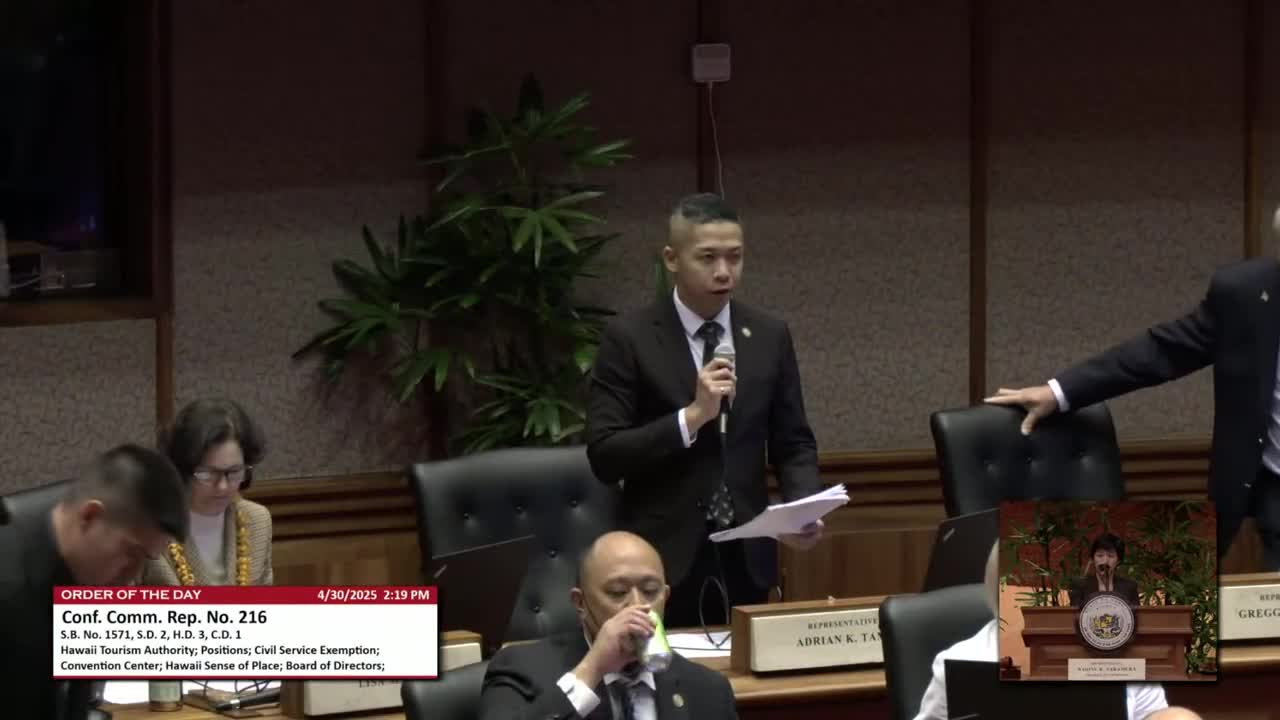 6MIN
House Floor
 13MIN
Conference Committee
 1MIN
Conference Committee
 1MIN
Conference Committee
 3MIN
House Standing Committee on Finance
 14MIN
House Standing Committee on Judiciary & Hawaiian Affairs
 8MIN
House Standing Committee on Agriculture & Food Systems
Bill Author

Bill Co-Author(s):