HB 2207: DAB; Rules; Fine Mesh Nets; Monofilament Netting; Coconut Rhinoceros Beetle
- Session Year: 2025-2026
- House: House
- Latest Version Date: 2026-05-01
Current Status:
Passed
(2026-06-05: Act 103, on 06/05/2026 (Gov. Msg. No. 1203).)
Introduced
In Committee
First Chamber
In Committee
Second Chamber
Final Decking
Enacted
Allows the use of certain monofilament netting for the protection of plants against invasive species. Requires the Department of Agriculture and Biosecurity to establish rules allowing the sale and distribution of fine mesh nets, including monofilament netting, in the State to protect plants from the coconut rhinoceros beetle. (CD1)
Requires the Department of Agriculture and Biosecurity to establish a Biosecurity Government-Industry Working Group. Clarifies that the Department and the counties, including officers, employees, and authorized agents of the Department and counties, shall not be liable for costs relating to the entering of private property to control and eradicate pests. Allows the use of certain monofilament netting for the protection of plants against invasive species. Requires the Department of Agriculture and Biosecurity to establish rules allowing the sale and distribution of fine mesh nets, including monofilament netting, in the State to protect plants from the coconut rhinoceros beetle. (SD2)
Requires the Department of Agriculture and Biosecurity to establish a Biosecurity Government-Industry Working Group. Clarifies that the Department and the counties, including officers, employees, and authorized agents of the Department and counties, shall not be liable for costs relating to the entering of private property to control and eradicate pests. Allows the use of certain monofilament netting for the protection of plants against invasive species. Requires the Department of Agriculture and Biosecurity to establish rules allowing the sale and distribution of fine mesh nets, including monofilament netting, in the State to protect plants from the coconut rhinoceros beetle. Effective 7/1/2050. (SD1)
Allows the use of certain monofilament netting for the protection of plants against invasive species. Requires the Department of Agriculture and Biosecurity to establish rules allowing the sale and distribution of fine mesh nets, including monofilament netting, in the State to protect plants from the coconut rhinoceros beetle. Effective 7/1/3000. (HD2)
Allows the use of certain monofilament netting for the protection of plants against invasive species. Subjects fine mesh nets, including certain monofilament netting, to certain federal and state requirements. Requires the Department of Agriculture and Biosecurity to establish rules allowing the sale and distribution of fine mesh nets, including monofilament netting, in the State to protect plants from the coconut rhinoceros beetle. Effective 7/1/3000. (HD1)
Requires the Department of Agriculture and Biosecurity to establish rules allowing the sale and distribution of fine mesh nets, including monofilament netting, in the State to protect plants from the coconut rhinoceros beetle.
|
HOUSE OF REPRESENTATIVES |
H.B. NO. |
2207 |
|
THIRTY-THIRD LEGISLATURE, 2026 |
H.D. 2 |
|
|
STATE OF HAWAII |
S.D. 2 |
|
|
|
C.D. 1 |
|
|
|
||
|
|
||
A BILL FOR AN ACT
RELATING TO INVASIVE SPECIES.
BE IT ENACTED BY THE LEGISLATURE OF THE STATE OF HAWAII:
The legislature further finds that even though Act 184, Session Laws of Hawaii 2024, authorizes the department of agriculture and biosecurity to adopt rules for the use of banned monofilament netting, such power is only extended for bird keeping. The legislature is concerned that, due to this limiting authority, the ability of the department to adopt rules to allow for the sale of monofilament netting for coconut rhinoceros beetle interdiction may be thwarted.
Accordingly, the purpose of this Act is to:
(1) Allow for the use of monofilament netting for purposes of protecting plants against invasive species under certain conditions; and
(2) Require the department of agriculture and biosecurity to establish rules allowing the sale and distribution of fine mesh nets, including certain monofilament netting, in the State to protect plants from the coconut rhinoceros beetle.
SECTION 2. Section 141-17, Hawaii Revised Statutes, is amended to read as follows:
"§141-17 Fine [meshed] mesh nets;
invasive species; permissible; rules. (a) Notwithstanding any other law to the
contrary, fine [meshed] mesh nets, including monofilament
netting of an appropriate mesh size, may be used for the protection of
plants against invasive species, as determined by the department of agriculture
and biosecurity; provided that the fine [meshed] mesh nets shall
be applied in a manner that is unlikely to entangle birds, become dislodged and
enter water, or entangle or disturb native and beneficial animals, including
but not limited to pollinators, ladybugs or lady beetles, and net‑winged
insects.
(b) The department of agriculture
and biosecurity shall adopt rules in accordance with chapter 91 to implement
this section, including but not limited to establishing requirements related to
filament diameter, color, and the inclusion of visual cues to prevent
non-targeted entanglement [and]; prohibiting the use of mist net
material [that is used] designed for bird work[.]; and
allowing the distribution and sale of fine mesh nets, including monofilament
netting of an appropriate mesh size, for the sole
purpose of protecting plants from the coconut rhinoceros beetle (Oryctes
rhinoceros)."
SECTION 3. Statutory material to be repealed is bracketed and stricken. New statutory material is underscored.
SECTION 4. This Act shall take effect upon its approval.
Report Title:
DAB; Rules; Fine Mesh Nets; Monofilament Netting; Coconut Rhinoceros Beetle
Description:
Allows the use of certain monofilament netting for the protection of plants against invasive species. Requires the Department of Agriculture and Biosecurity to establish rules allowing the sale and distribution of fine mesh nets, including monofilament netting, in the State to protect plants from the coconut rhinoceros beetle. (CD1)
The summary description of legislation appearing on this page is for informational purposes only and is not legislation or evidence of legislative intent.
|
HOUSE OF REPRESENTATIVES |
H.B. NO. |
2207 |
|
THIRTY-THIRD LEGISLATURE, 2026 |
H.D. 2 |
|
|
STATE OF HAWAII |
S.D. 2 |
|
|
|
|
|
|
|
||
|
|
||
A BILL FOR AN ACT
RELATING TO INVASIVE SPECIES.
BE IT ENACTED BY THE LEGISLATURE OF THE STATE OF HAWAII:
The legislature further finds that even though Act 184, Session Laws of Hawaii 2024, authorizes the department of agriculture and biosecurity to adopt rules for the use of banned monofilament netting, such power is only extended for bird keeping. The legislature is concerned that, due to this limiting authority, the ability of the department to adopt rules to allow for the sale of monofilament netting for coconut rhinoceros beetle interdiction may be thwarted.
The legislature further finds that Act 236, Session Laws of Hawaii 2025 (Act 236), authorizes the department of agriculture and biosecurity to enter into government-industry agreements, which are a critical component in the protection of the State's agriculture, people, economy, unique biodiversity, and environment from invasive species. The objective of government‑industry agreements is to increase collaboration between private industries and the government by formalizing commitments to bolster the biosecurity network, increase capacity in the response to current pests, and enhance capability and readiness in response to future pests. The department of agriculture and biosecurity is required to provide education and training, supplies and equipment, and pest management programs to equip private industries that are signatories to the agreements in the decision-making process. These signatory private industries are then required to provide manpower, treatment equipment, surveillance, and response readiness. However, the legislature further finds that, after the department of agriculture and biosecurity began discussions with private industry parties about the government-industry agreements, it became apparent that Act 236 should be refined to address certain issues.
Accordingly, the purpose of this Act is to:
(1) Establish a working group of private industry signatories for joint decision-making;
(2) Protect the department of agriculture and biosecurity and the counties, including officers, employees, and authorized agents of the department and counties, from liability when entering private property to control or eradicate pests;
(3) Allow for the use of monofilament netting for purposes of protecting plants against invasive species under certain conditions;
(4) Require the department of agriculture and biosecurity to establish rules allowing the sale and distribution of fine mesh nets, including certain monofilament netting, in the State to protect plants from the coconut rhinoceros beetle; and
(5) Rename government-industry agreements to biosecurity government-industry agreements to prevent confusion with a program with similar initials.
SECTION 2. Chapter 150A, Hawaii Revised Statutes, is amended by adding a new section to be appropriately designated and to read as follows:
"§150A- Biosecurity government-industry working group; established. (a) There is established the biosecurity government-industry working group.
(b) The working group shall consist of the following members:
(1) Deputy chairperson for biosecurity or their designee, who shall serve as chairperson of the working group;
(2) Dean of the university of Hawaii college of tropical agriculture and human resilience, or their designee; and
(3) Representatives of the signatory industries in the biosecurity government-industry agreements, to be invited by the chairperson of the working group.
All members of the working group shall serve without compensation but shall be entitled to reimbursement for necessary expenses in the discharge of their duties and responsibilities as members of the working group.
(c) The working group shall:
(1) Prepare policy recommendations to the chairperson of the board of agriculture and biosecurity which, upon approval, may serve as guidance for agricultural development in the State. The policies shall include but not be limited to objectives in the following areas:
(A) Plant inspection and quarantine;
(B) Pest management;
(C) Import replacement;
(D) Market access; and
(E) Industry analysis;
(2) Assist and provide technical expertise to the chairperson of the board of agriculture and biosecurity in developing programs, projects, and plans to promote optimal development of agriculture, including criteria to measure program effectiveness;
(3) Conduct systematic analysis of all existing and proposed agriculture and agriculture-related programs; and
(4) Recommend to the chairperson of the board of agriculture and biosecurity programs including agricultural product promotion and agricultural development that represent the most effective allocation of resources for optimal development of agriculture."
SECTION 3. Section 141-3.6, Hawaii Revised Statutes, is amended to read as follows:
"§141-3.6 Entry of private property to control or eradicate any pests. (a) The department of agriculture and biosecurity or applicable county shall give at least five days notice to the landowner and the occupier of any private property of its intention to enter the property for the control or eradication of a pest. Written notice sent to the landowner's last known address by certified mail, postage prepaid, return receipt requested, shall be deemed sufficient notice. If certified mail is impractical because the department or county, despite diligent efforts, cannot determine land ownership or because of urgent need to initiate control or eradication measures, notice given once in a daily or weekly publication of general circulation, in the county where any action or proposed action will be taken, or notice made as otherwise provided by law, shall be deemed sufficient notice. The notice shall set forth all pertinent information on the pest control program and the procedures and methods to be used for control or eradication.
(b) After notice as required by subsection (a), any member of the department, employee of the county, or any agent authorized by the department or county may enter at reasonable times any private property other than dwelling places to maintain a pest control or eradication program, being liable only for damage caused by acts beyond the scope of the person's authority, or the person's negligence, gross negligence, or intentional misconduct. If entry is refused, the department member, county employee, or any authorized agent may apply to the district court in the circuit in which the property is located for a warrant to enter on the premises to effectuate the purposes of this chapter. The district court may issue a warrant directing a police officer of the circuit to assist the department member, county employee, or any authorized agent in gaining entry onto the premises during regular working hours or at other reasonable times.
(c) In no case shall the department, county, or any officer, employee, or authorized agent thereof, be liable for costs in any action or proceeding that may be commenced pursuant to this chapter."
SECTION 4. Section 141-17, Hawaii Revised Statutes, is amended to read as follows:
"§141-17 Fine [meshed] mesh nets;
invasive species; permissible; rules. (a) Notwithstanding any other law to the
contrary, fine [meshed] mesh nets, including monofilament
netting of an appropriate mesh size, may be used for the protection of
plants against invasive species, as determined by the department of agriculture
and biosecurity; provided that the fine [meshed] mesh nets shall
be applied in a manner that is unlikely to entangle birds, become dislodged and
enter water, or entangle or disturb native and beneficial animals, including
but not limited to pollinators, ladybugs or lady beetles, and net‑winged
insects.
(b) The department of agriculture
and biosecurity shall adopt rules in accordance with chapter 91 to implement
this section, including but not limited to establishing requirements related to
filament diameter, color, and the inclusion of visual cues to prevent
non-targeted entanglement [and]; prohibiting the use of mist net
material [that is used] designed for bird work[.]; and
allowing the distribution and sale of fine mesh nets, including monofilament
netting of an appropriate mesh size, for the sole
purpose of protecting plants from the coconut rhinoceros beetle (Oryctes
rhinoceros)."
SECTION 5. Section 150A-58, Hawaii Revised Statutes, is amended to read as follows:
"[[]§150A-58[] Government-industry] Biosecurity
government-industry agreements for readiness and response. (a)
The department may enter into readiness and
response agreements with businesses and representatives of businesses in
the plant and animal industries of the State, including businesses that grow,
harvest, or produce animals and plants or products from animals and plants.
(b) The agreements shall include:
(1) Readiness activities that:
(A) Prevent unwanted organisms from entering the State; and
(B) Detect unwanted organisms; and
(2) Response activities that:
(A) Facilitate the immediate investigation of an unwanted organism after detection, including timely reporting of the unwanted organism's detection to the department;
(B) Minimize the impact of the unwanted organism on natural and physical resources, human health, and overseas market access for Hawaii products;
(C) Control the spread of an unwanted organism;
(D) Reduce the geographical distribution of an unwanted organism;
(E) Eradicate the unwanted organism; and
(F) Include providing the department with relevant information for posting to the pest dashboard pursuant to section 141-3.5.
(c) A violation of an applicable readiness plan shall be subject to penalties under section 150A-14.
(d) The department shall establish a biosecurity government‑industry working group pursuant to section 150A‑ , comprising members or representatives of private industry signatories to any biosecurity government-industry agreement, for joint decision-making pursuant to this section."
SECTION 6. Statutory material to be repealed is bracketed and stricken. New statutory material is underscored.
SECTION 7. This Act shall take effect upon its approval.
Report Title:
DAB; Biosecurity Government‑Industry Working Group; Liability; Fine Mesh Nets; Monofilament Netting; Coconut Rhinoceros Beetle; Rules; Government-Industry Agreements
Description:
Requires the Department of Agriculture and Biosecurity to establish a Biosecurity Government-Industry Working Group. Clarifies that the Department and the counties, including officers, employees, and authorized agents of the Department and counties, shall not be liable for costs relating to the entering of private property to control and eradicate pests. Allows the use of certain monofilament netting for the protection of plants against invasive species. Requires the Department of Agriculture and Biosecurity to establish rules allowing the sale and distribution of fine mesh nets, including monofilament netting, in the State to protect plants from the coconut rhinoceros beetle. (SD2)
The summary description of legislation appearing on this page is for informational purposes only and is not legislation or evidence of legislative intent.
|
HOUSE OF REPRESENTATIVES |
H.B. NO. |
2207 |
|
THIRTY-THIRD LEGISLATURE, 2026 |
H.D. 2 |
|
|
STATE OF HAWAII |
S.D. 1 |
|
|
|
|
|
|
|
||
|
|
||
A BILL FOR AN ACT
RELATING TO INVASIVE SPECIES.
BE IT ENACTED BY THE LEGISLATURE OF THE STATE OF HAWAII:
The legislature further finds that even though Act 184, Session Laws of Hawaii 2024, authorizes the department of agriculture and biosecurity to adopt rules for the use of banned monofilament netting, such power is only extended for bird keeping. The legislature is concerned that, due to this limiting authority, the ability of the department to adopt rules to allow for the sale of monofilament netting for coconut rhinoceros beetle interdiction may be thwarted.
The legislature further finds that Act 236, Session Laws of Hawaii 2025 (Act 236), authorizes the department of agriculture and biosecurity to enter into government-industry agreements, which are a critical component in the protection of the State's agriculture, people, economy, unique biodiversity, and environment from invasive species. The objective of government‑industry agreements is to increase collaboration between private industries and the government by formalizing commitments to bolster the biosecurity network, increase capacity in the response to current pests, and enhance capability and readiness in response to future pests. The department of agriculture and biosecurity is required to provide education and training, supplies and equipment, and pest management programs to equip private industries that are signatories to the agreements in the decision-making process. These signatory private industries are then required to provide manpower, treatment equipment, surveillance, and response readiness. However, the legislature further finds that, after the department of agriculture and biosecurity began discussions with private industry parties about the government-industry agreements, it became apparent that Act 236 should be refined to address certain issues.
Accordingly, the purpose of this Act is to:
(1) Establish a working group of private industry signatories for joint decision-making;
(2) Protect the department of agriculture and biosecurity and the counties, including officers, employees, and authorized agents of the department and counties, from liability when entering private property to control or eradicate pests;
(3) Allow for the use of monofilament netting for purposes of protecting plants against invasive species under certain conditions;
(4) Require the department of agriculture and biosecurity to establish rules allowing the sale and distribution of fine mesh nets, including certain monofilament netting, in the State to protect plants from the coconut rhinoceros beetle; and
(5) Rename government-industry agreements to biosecurity government-industry agreements to prevent confusion with a program with similar initials.
SECTION 2. Chapter 150A, Hawaii Revised Statutes, is amended by adding a new section to be appropriately designated and to read as follows:
"§150A- Biosecurity government-industry working group; established. (a) There is established the biosecurity government-industry working group.
(b) The working group shall consist of the following members:
(1) Deputy chairperson for biosecurity or their designee, who shall serve as chairperson of the working group;
(2) Dean of the university of Hawaii college of tropical agriculture and human resilience, or their designee; and
(3) Representatives of the signatory industries in the biosecurity government-industry agreements, to be invited by the chairperson of the working group.
All members of the working group shall serve without compensation but shall be entitled to reimbursement for necessary expenses in the discharge of their duties and responsibilities as members of the working group.
(c) The working group shall:
(1) Prepare policy recommendations to the chairperson of the board of agriculture and biosecurity which, upon approval, may serve as guidance for agricultural development in the State. The policies shall include but not be limited to objectives in the following areas:
(A) Plant inspection and quarantine;
(B) Pest management;
(C) Import replacement;
(D) Market access; and
(E) Industry analysis;
(2) Assist and provide technical expertise to the chairperson of the board of agriculture and biosecurity in developing programs, projects, and plans to promote optimal development of agriculture, including criteria to measure program effectiveness;
(3) Conduct systematic analysis of all existing and proposed agriculture and agriculture-related programs; and
(4) Recommend to the chairperson of the board of agriculture and biosecurity programs including agricultural product promotion and agricultural development that represent the most effective allocation of resources for optimal development of agriculture."
SECTION 3. Section 141-3.6, Hawaii Revised Statutes, is amended to read as follows:
"§141-3.6 Entry of private property to control or eradicate any pests. (a) The department of agriculture and biosecurity or applicable county shall give at least five days notice to the landowner and the occupier of any private property of its intention to enter the property for the control or eradication of a pest. Written notice sent to the landowner's last known address by certified mail, postage prepaid, return receipt requested, shall be deemed sufficient notice. If certified mail is impractical because the department or county, despite diligent efforts, cannot determine land ownership or because of urgent need to initiate control or eradication measures, notice given once in a daily or weekly publication of general circulation, in the county where any action or proposed action will be taken, or notice made as otherwise provided by law, shall be deemed sufficient notice. The notice shall set forth all pertinent information on the pest control program and the procedures and methods to be used for control or eradication.
(b) After notice as required by subsection (a), any member of the department, employee of the county, or any agent authorized by the department or county may enter at reasonable times any private property other than dwelling places to maintain a pest control or eradication program, being liable only for damage caused by acts beyond the scope of the person's authority, or the person's negligence, gross negligence, or intentional misconduct. If entry is refused, the department member, county employee, or any authorized agent may apply to the district court in the circuit in which the property is located for a warrant to enter on the premises to effectuate the purposes of this chapter. The district court may issue a warrant directing a police officer of the circuit to assist the department member, county employee, or any authorized agent in gaining entry onto the premises during regular working hours or at other reasonable times.
(c) In no case shall the department, county, or any officer, employee, or authorized agent thereof, be liable for costs in any action or proceeding that may be commenced pursuant to this chapter."
SECTION 4. Section 141-17, Hawaii Revised Statutes, is amended to read as follows:
"§141-17 Fine [meshed] mesh
nets; invasive species; permissible; rules. (a) Notwithstanding any other law to the
contrary, fine [meshed] mesh nets, including monofilament
netting of an appropriate mesh size, may be used for the protection of
plants against invasive species, as determined by the department of agriculture
and biosecurity; provided that the fine [meshed] mesh nets shall
be applied in a manner that is unlikely to entangle birds, become dislodged and
enter water, or entangle or disturb native and beneficial animals, including
but not limited to pollinators, ladybugs or lady beetles, and net‑winged
insects.
(b) The department of agriculture and
biosecurity shall adopt rules in accordance with chapter 91 to implement this
section, including but not limited to establishing requirements related to
filament diameter, color, and the inclusion of visual cues to prevent
non-targeted entanglement [and]; prohibiting the use of mist net
material [that is used] designed for bird work[.]; and
allowing the distribution and sale of fine mesh nets, including monofilament
netting of an appropriate mesh size, for the sole purpose
of protecting plants from the coconut rhinoceros beetle (Oryctes
rhinoceros)."
SECTION 5. Section 150A-58, Hawaii Revised Statutes, is amended to read as follows:
"[[]§150A-58[] Government-industry] Biosecurity
government-industry agreements for readiness and response. (a)
The department may enter into readiness and
response agreements with businesses and representatives of businesses in
the plant and animal industries of the State, including businesses that grow,
harvest, or produce animals and plants or products from animals and plants.
(b) The agreements shall include:
(1) Readiness activities that:
(A) Prevent unwanted organisms from entering the State; and
(B) Detect unwanted organisms; and
(2) Response activities that:
(A) Facilitate the immediate investigation of an unwanted organism after detection, including timely reporting of the unwanted organism's detection to the department;
(B) Minimize the impact of the unwanted organism on natural and physical resources, human health, and overseas market access for Hawaii products;
(C) Control the spread of an unwanted organism;
(D) Reduce the geographical distribution of an unwanted organism;
(E) Eradicate the unwanted organism; and
(F) Include providing the department with relevant information for posting to the pest dashboard pursuant to section 141-3.5.
(c) A violation of an applicable readiness plan shall be subject to penalties under section 150A-14.
(d) The department shall establish a biosecurity government‑industry working group pursuant to section 150A- , comprising members or representatives of private industry signatories to any biosecurity government-industry agreement, for joint decision-making pursuant to this section."
SECTION 6. Statutory material to be repealed is bracketed and stricken. New statutory material is underscored.
SECTION 7. This Act shall take effect on July 1, 2050.
Report Title:
DAB; Biosecurity Government‑Industry Working Group; Liability; Fine Mesh Nets; Monofilament Netting; Coconut Rhinoceros Beetle; Rules; Government-Industry Agreements
Description:
Requires the Department of Agriculture and Biosecurity to establish a Biosecurity Government-Industry Working Group. Clarifies that the Department and the counties, including officers, employees, and authorized agents of the Department and counties, shall not be liable for costs relating to the entering of private property to control and eradicate pests. Allows the use of certain monofilament netting for the protection of plants against invasive species. Requires the Department of Agriculture and Biosecurity to establish rules allowing the sale and distribution of fine mesh nets, including monofilament netting, in the State to protect plants from the coconut rhinoceros beetle. Effective 7/1/2050. (SD1)
The summary description of legislation appearing on this page is for informational purposes only and is not legislation or evidence of legislative intent.
|
HOUSE OF REPRESENTATIVES |
H.B. NO. |
2207 |
|
THIRTY-THIRD LEGISLATURE, 2026 |
H.D. 2 |
|
|
STATE OF HAWAII |
|
|
|
|
|
|
|
|
||
|
|
||
A BILL FOR AN ACT
RELATING TO INVASIVE SPECIES.
BE IT ENACTED BY THE LEGISLATURE OF THE STATE OF HAWAII:
The legislature further finds that even though Act 184, Session Laws of Hawaii 2024, authorizes the department of agriculture and biosecurity to adopt rules for the use of banned monofilament netting, such power is only extended for bird keeping. The legislature is concerned that, due to this limiting authority, the ability of the department to adopt rules to allow for the sale of monofilament netting for coconut rhinoceros beetle interdiction may be thwarted.
Accordingly, the purpose of this Act is to:
(1) Allow for the use of monofilament netting for purposes of protecting plants against invasive species under certain conditions; and
(2) Require the department of agriculture and biosecurity to establish rules allowing the sale and distribution of fine mesh nets, including certain monofilament netting, in the State to protect plants from the coconut rhinoceros beetle.
SECTION 2. Section 141-17, Hawaii Revised Statutes, is amended to read as follows:
"[[]§141-17[]] Fine [meshed]
mesh nets; invasive species; permissible; rules.
(a) Notwithstanding any other law
to the contrary, fine [meshed] mesh nets, including
monofilament netting of an appropriate mesh size, may be used for the
protection of plants against invasive species, as determined by the department
of agriculture and biosecurity; provided that the fine [meshed] mesh
nets shall be applied in a manner that is unlikely to entangle birds, become
dislodged and enter water, or entangle or disturb native and beneficial
animals, including but not limited to pollinators, ladybugs or lady beetles,
and net-winged insects.
(b) The department of agriculture and
biosecurity shall adopt rules in accordance with chapter 91 to implement this
section, including but not limited to establishing requirements related to
filament diameter, color, and the inclusion of visual cues to prevent
non-targeted entanglement [and]; prohibiting the use of mist net
material [that is used] designed for bird work[.]; and
allowing the distribution and sale of fine mesh nets, including monofilament
netting of an appropriate mesh size, for the sole
purpose of protecting plants from the coconut rhinoceros beetle (Oryctes
rhinoceros)."
SECTION 3. Statutory material to be repealed is bracketed and stricken. New statutory material is underscored.
SECTION 4. This Act shall take effect on July 1, 3000.
Report Title:
DAB; Rules; Fine Mesh Nets; Monofilament Netting; Coconut Rhinoceros Beetle
Description:
Allows the use of certain monofilament netting for the protection of plants against invasive species. Requires the Department of Agriculture and Biosecurity to establish rules allowing the sale and distribution of fine mesh nets, including monofilament netting, in the State to protect plants from the coconut rhinoceros beetle. Effective 7/1/3000. (HD2)
The summary description of legislation appearing on this page is for informational purposes only and is not legislation or evidence of legislative intent.
|
HOUSE OF REPRESENTATIVES |
H.B. NO. |
2207 |
|
THIRTY-THIRD LEGISLATURE, 2026 |
H.D. 1 |
|
|
STATE OF HAWAII |
|
|
|
|
|
|
|
|
||
|
|
||
A BILL FOR AN ACT
RELATING TO INVASIVE SPECIES.
BE IT ENACTED BY THE LEGISLATURE OF THE STATE OF HAWAII:
The legislature further finds that even though Act 184, Session Laws of Hawaii 2024, authorizes the department of agriculture and biosecurity to adopt rules for the use of banned monofilament netting, such power is only extended for bird keeping. The legislature is concerned that, due to this limiting authority, the ability of the department to adopt rules to allow for the sale of monofilament netting for coconut rhinoceros beetle interdiction may be thwarted.
Accordingly, the purpose of this Act is to:
(1) Allow for the use of monofilament netting for purposes of protecting plants against invasive species under certain conditions;
(2) Subject fine mesh nets, including certain monofilament netting, to certain federal and state requirements; and
(3) Require the department of agriculture and biosecurity to establish rules allowing the sale and distribution of fine mesh nets, including certain monofilament netting, in the State to protect plants from the coconut rhinoceros beetle.
SECTION 2. Section 141-17, Hawaii Revised Statutes, is amended to read as follows:
"[[]§141-17[]] Fine meshed
nets; invasive species; permissible; rules. (a) Notwithstanding any other law to the
contrary, fine meshed nets, including monofilament netting of an appropriate
mesh size, may be used for the protection of plants against invasive
species, as determined by the department of agriculture and biosecurity;
provided that the fine meshed nets shall be applied in a manner that is
unlikely to entangle birds, become dislodged and enter water, or entangle or
disturb native and beneficial animals, including but not limited to
pollinators, ladybugs or lady beetles, and net-winged insects.
(b) Fine meshed nets, including monofilament netting of an appropriate mesh size, that are regulated under the Federal Insecticide, Fungicide, and Rodenticide Act shall be subject to the requirements of title 40 Code of Federal Regulations part 152.500. The department of agriculture and biosecurity's pesticides branch shall approve a fine meshed net, including a monofilament netting of an appropriate mesh size, if the net meets the requirements of chapter 460J.
[(b)] (c) The department of agriculture and biosecurity
shall adopt rules in accordance with chapter 91 to implement this section,
including but not limited to establishing requirements related to filament
diameter, color, and the inclusion of visual cues to prevent non-targeted
entanglement [and]; prohibiting the use of mist net material [that
is used] designed for bird work[.]; and allowing the
distribution and sale of fine mesh nets, including monofilament netting of an
appropriate mesh size, for the sole purpose of
protecting plants from the coconut rhinoceros beetle (Oryctes rhinoceros)."
SECTION 3. Statutory material to be repealed is bracketed and stricken. New statutory material is underscored.
SECTION 4. This Act shall take effect on July 1, 3000.
Report Title:
DAB; Rules; Fine Mesh Nets; Monofilament Netting; Coconut Rhinoceros Beetle
Description:
Allows the use of certain monofilament netting for the protection of plants against invasive species. Subjects fine mesh nets, including certain monofilament netting, to certain federal and state requirements. Requires the Department of Agriculture and Biosecurity to establish rules allowing the sale and distribution of fine mesh nets, including monofilament netting, in the State to protect plants from the coconut rhinoceros beetle. Effective 7/1/3000. (HD1)
The summary description of legislation appearing on this page is for informational purposes only and is not legislation or evidence of legislative intent.
|
HOUSE OF REPRESENTATIVES |
H.B. NO. |
2207 |
|
THIRTY-THIRD LEGISLATURE, 2026 |
|
|
|
STATE OF HAWAII |
|
|
|
|
|
|
|
|
||
|
|
||
A BILL FOR AN ACT
relating to invasive species.
BE IT ENACTED BY THE LEGISLATURE OF THE STATE OF HAWAII:
The legislature further finds that even though Act 184, Session Laws of Hawaii 2024, authorizes the department of agriculture and biosecurity to adopt rules for the use of banned monofilament netting such power is only extended for bird keeping. The legislature is concerned that, due to this limiting authority, the ability of the department to promulgate rules to allow for the sale of monofilament netting for coconut rhinoceros beetle interdiction may be thwarted.
Accordingly, the purpose of this Act is to:
(1) Allow for the use of monofilament netting for purposes of protecting plants against invasive species under certain conditions; and
(2) Require the department of agriculture and biosecurity to establish rules allowing the sale and distribution of fine mesh nets in the State to protect plants from the coconut rhinoceros beetle.
SECTION 2. Section 141-17, Hawaii Revised Statutes, is amended to read as follows:
"[[]§141-17[]] Fine meshed
nets; invasive species; permissible; rules. (a) Notwithstanding any other law to the
contrary, fine meshed nets, including monofilament netting of an appropriate
mesh size may be used for the protection of plants against invasive
species, as determined by the department of agriculture and biosecurity;
provided that the fine meshed nets shall be applied in a manner that is
unlikely to entangle birds, become dislodged and enter water, or entangle or
disturb native and beneficial animals, including but not limited to
pollinators, ladybugs or lady beetles, and net-winged insects.
(b) The department of agriculture and
biosecurity shall adopt rules in accordance with chapter 91 to implement this
section, including but not limited to establishing requirements related to
filament diameter, color, and the inclusion of visual cues to prevent
non-targeted entanglement [and]; prohibiting the use of mist net
material [that is used] designed for bird work[.]; and
allowing the distribution and sale of fine mesh nets, including monofilament
netting of an appropriate mesh size; provided that fine mesh nets may be sold solely for the purpose of protecting plants from the coconut
rhinoceros beetle (Oryctes rhinoceros)."
SECTION 3. Statutory material to be repealed is bracketed and stricken. New statutory material is underscored.
SECTION 4. This Act shall take effect upon its approval.
|
INTRODUCED BY: |
_____________________________ |
|
|
|
Report Title:
DAB; Rules; Fine Mesh Nets; Monofilament Netting; Coconut Rhinoceros Beetle
Description:
Requires the Department of Agriculture and Biosecurity to establish rules allowing the sale and distribution of fine mesh nets, including monofilament netting, in the State to protect plants from the coconut rhinoceros beetle.
The summary description of legislation appearing on this page is for informational purposes only and is not legislation or evidence of legislative intent.
|
Date
|
Status
|
|---|---|
| Jun 5, 2026 | Act 103, on 06/05/2026 (Gov. Msg. No. 1203). |
| Jun 5, 2026 | Act 103, 06/05/2026 (Gov. Msg. No. 1203). |
| May 8, 2026 | Received notice of passage on Final Reading in House (Hse. Com. No. 888). |
| May 7, 2026 | Transmitted to Governor. |
| May 6, 2026 | Received notice of Final Reading (Sen. Com. No. 816). |
| May 6, 2026 | Passed Final Reading as amended in CD 1 with none voting aye with reservations; none voting no (0) and none excused (0). |
| May 6, 2026 | Passed Final Reading, as amended (CD 1). Ayes, 25; Aye(s) with reservations: none . 0 No(es): none. 0 Excused: none. |
| May 1, 2026 | 48 Hrs. Notice (as amended CD 1) 05-06-26 |
| May 1, 2026 | Reported from Conference Committee as amended CD 1 (Conf. Com. Rep. No. 118-26). |
| May 1, 2026 | Forty-eight (48) hours notice Wednesday, 05-06-26. |
| May 1, 2026 | Reported from Conference Committee (Conf Com. Rep. No. 118-26) as amended in (CD 1). |
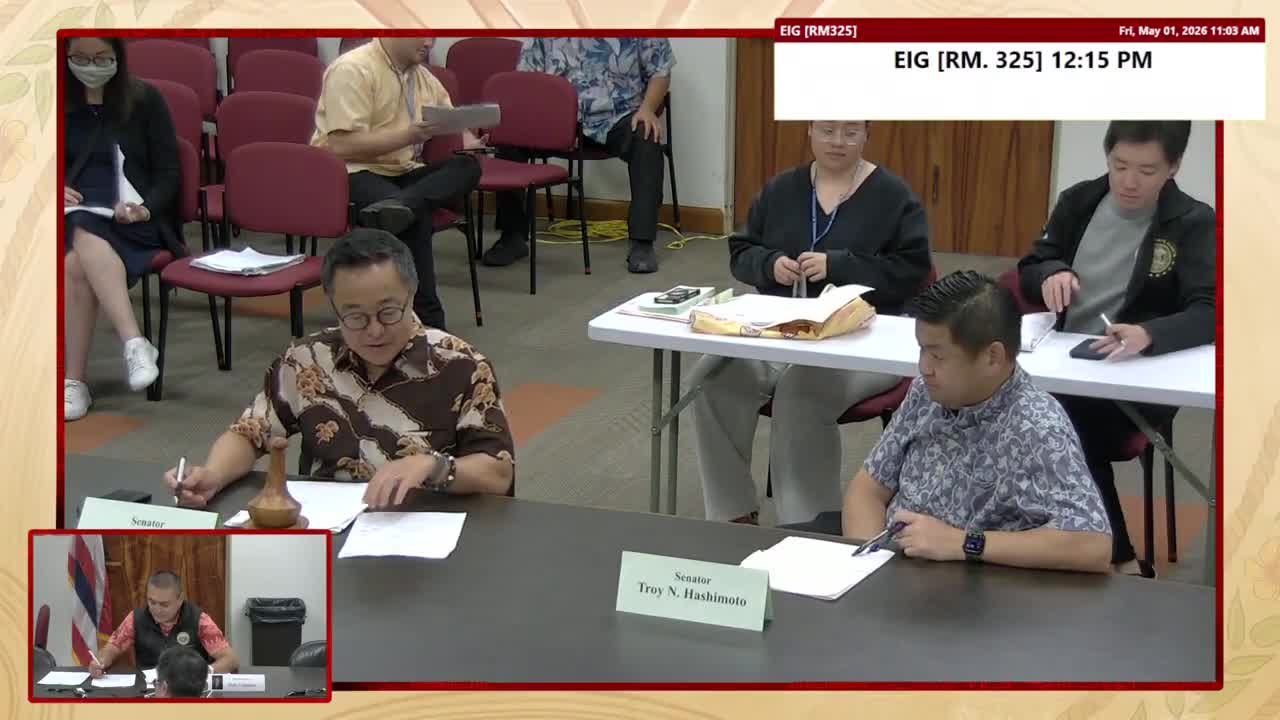
| May 1, 2026 | The Conference Committee recommends that the measure be Passed, with Amendments. The votes were as follows: 5 Ayes: Representative(s) Chun, Matayoshi, Kusch, Kahaloa, Matsumoto; Ayes with reservations: none; 0 Noes: none; and 0 Excused: none. |
| May 1, 2026 | The Conference committee recommends that the measure be PASSED, WITH AMENDMENTS. The votes of the Senate Conference Managers were as follows: 4 Aye(s): Senator(s) Gabbard, Kanuha, DeCoite, Richards; Aye(s) with reservations: none ; 0 No(es): none; and 0 Excused: none. |
| May 1, 2026 | Conference committee meeting to reconvene on 05-01-26 12:45 PM; Conference Room 325. |
| Apr 30, 2026 | Conference committee meeting to reconvene on 05-01-26 9:15AM; Conference Room 325. |
| Apr 28, 2026 | Bill scheduled for Conference Committee Meeting on Thursday, 04-30-26 9:35AM in conference room 325. |
| Apr 24, 2026 | Received notice of appointment of House conferees (Hse. Com. No. 820). |
| Apr 23, 2026 | House Conferees Appointed: Chun, Matayoshi, Kusch Co-Chairs; Kahaloa, Matsumoto. |
| Apr 23, 2026 | Re-referred to AGR, CPC, FIN, referral sheet 33 |
| Apr 20, 2026 | Received notice of Senate conferees (Sen. Com. No. 713). |
| Apr 20, 2026 | Senate Conferees Appointed: Gabbard Chair; Kanuha Co-Chair; DeCoite, Richards. |
| Apr 17, 2026 | Received notice of disagreement (Hse. Com. No. 780). |
| Apr 16, 2026 | House disagrees with Senate amendment (s). |
| Apr 14, 2026 | Returned from Senate (Sen. Com. No. 664) in amended form (SD 2). |
| Apr 14, 2026 | Report adopted; Passed Third Reading, as amended (SD 2). Ayes, 25; Aye(s) with reservations: none . Noes, 0 (none). Excused, 0 (none). Transmitted to House. |
| Apr 9, 2026 | 48 Hrs. Notice 04-14-26. |
| Apr 9, 2026 | Reported from WAM (Stand. Com. Rep. No. 3671) with recommendation of passage on Third Reading, as amended (SD 2). |
| Apr 6, 2026 | The committee(s) on WAM recommend(s) that the measure be PASSED, WITH AMENDMENTS. The votes in WAM were as follows: 12 Aye(s): Senator(s) Dela Cruz, Moriwaki, DeCoite, Elefante, Hashimoto, Inouye, Kanuha, Kidani, Kim, Richards, Wakai, Fevella; Aye(s) with reservations: none ; 0 No(es): none; and 1 Excused: Senator(s) Lee, C.. |
| Apr 1, 2026 | The committee(s) on WAM will hold a public decision making on 04-06-26 10:32AM; Conference Room 211 & Videoconference. |
| Mar 24, 2026 | Report adopted; Passed Second Reading, as amended (SD 1) and referred to WAM. |
| Mar 24, 2026 | Reported from AEN (Stand. Com. Rep. No. 3159) with recommendation of passage on Second Reading, as amended (SD 1) and referral to WAM. |
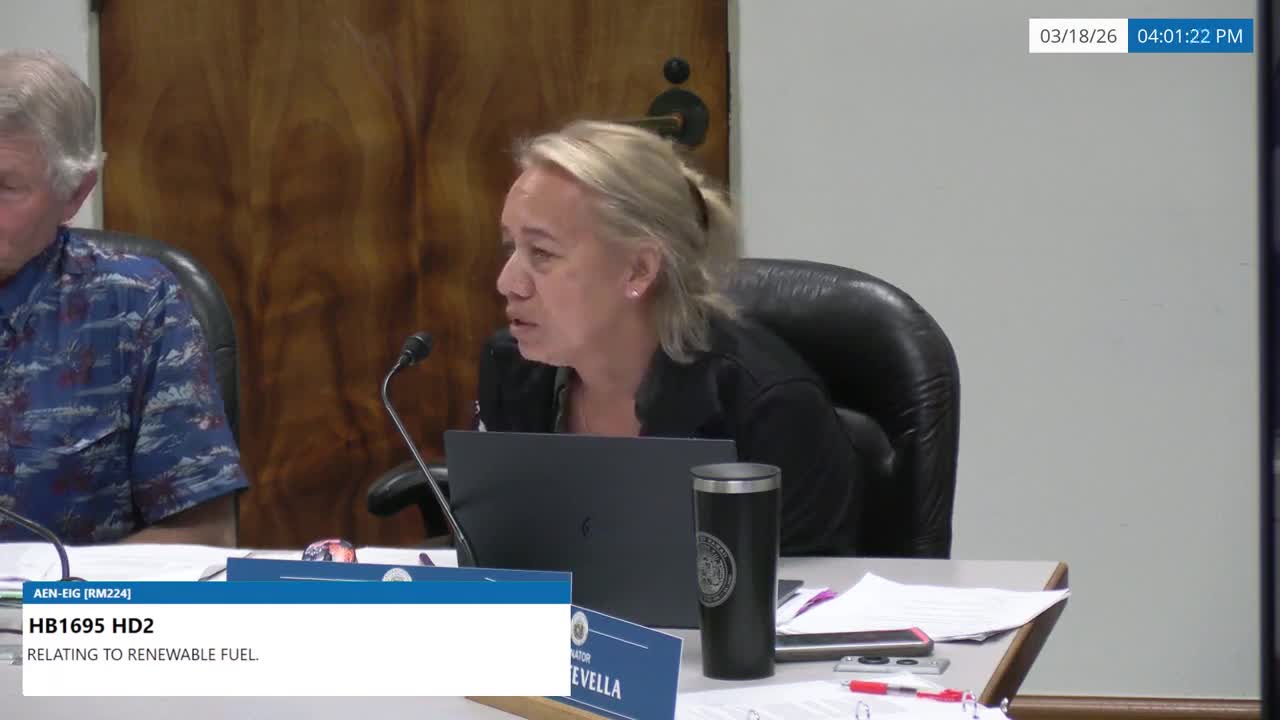
| Mar 18, 2026 | The committee(s) on AEN recommend(s) that the measure be PASSED, WITH AMENDMENTS. The votes in AEN were as follows: 5 Aye(s): Senator(s) Gabbard, Richards, DeCoite, Rhoads, Awa; Aye(s) with reservations: none ; 0 No(es): none; and 0 Excused: none. |
| Mar 13, 2026 | The committee(s) on AEN has scheduled a public hearing on 03-18-26 3:30PM; Conference Room 224 & Videoconference. |
| Mar 12, 2026 | Referred to AEN, WAM. |
| Mar 12, 2026 | Passed First Reading. |
| Mar 12, 2026 | Received from House (Hse. Com. No. 378). |
| Mar 10, 2026 | Passed Third Reading as amended in HD 2 with none voting aye with reservations; none voting no (0) and none excused (0). Transmitted to Senate. |
| Mar 6, 2026 | Forty-eight (48) hours notice Tuesday, 03-10-26. |
| Mar 6, 2026 | Reported from CPC (Stand. Com. Rep. No. 1040-26) as amended in HD 2, recommending passage on Third Reading. |
| Feb 24, 2026 | The committee on CPC recommend that the measure be PASSED, WITH AMENDMENTS. The votes were as follows: 11 Ayes: Representative(s) Matayoshi, Grandinetti, Chun, Ilagan, Ichiyama, Iwamoto, Kong, Lowen, Marten, Tam, Pierick; Ayes with reservations: none; Noes: none; and Excused: none. |
| Feb 20, 2026 | Bill scheduled to be heard by CPC on Tuesday, 02-24-26 2:00PM in House conference room 329 VIA VIDEOCONFERENCE. |
| Feb 18, 2026 | Passed Second Reading as amended in HD 1 and referred to the committee(s) on CPC with none voting aye with reservations; none voting no (0) and none excused (0). |
| Feb 18, 2026 | Reported from AGR (Stand. Com. Rep. No. 384-26) as amended in HD 1, recommending passage on Second Reading and referral to CPC. |
| Feb 11, 2026 | The committee on AGR recommend that the measure be PASSED, WITH AMENDMENTS. The votes were as follows: 5 Ayes: Representative(s) Chun, Kusch, Kahaloa, Perruso, Matsumoto; Ayes with reservations: none; Noes: none; and 2 Excused: Representative(s) Lowen, Quinlan. |
| Feb 6, 2026 | Bill scheduled to be heard by AGR on Wednesday, 02-11-26 9:30AM in House conference room 325 VIA VIDEOCONFERENCE. |
| Jan 30, 2026 | Referred to AGR, CPC, referral sheet 5 |
| Jan 28, 2026 | Introduced and Pass First Reading. |
| Jan 26, 2026 | Pending introduction. |
|
Date
|
Description
|
Location
|
Votes
|
|
|---|---|---|---|---|
| May 6, 2026 | Final Reading | House Floor |
Passed |
|
| May 6, 2026 | Final Reading | Senate Floor |
Passed |
|
| Apr 14, 2026 | Third Reading | Senate Floor |
Passed |
|
| Apr 6, 2026 | The committee(s) on WAM recommend(s) that the measure be PASSED, WITH AMENDMENTS | Senate Standing Committee on Ways and Means |
Passed |
|
| Mar 18, 2026 | The committee(s) on AEN recommend(s) that the measure be PASSED, WITH AMENDMENTS | Senate Standing Committee on Agriculture and Environment |
Passed |
|
| Mar 10, 2026 | Third Reading | House Floor |
Passed |
|
| Feb 24, 2026 | The committee on CPC recommend that the measure be PASSED, WITH AMENDMENTS | House Standing Committee on Consumer Protection & Commerce |
Passed |
|
| Feb 11, 2026 | The committee on AGR recommend that the measure be PASSED, WITH AMENDMENTS | House Standing Committee on Agriculture & Food Systems |
Passed |
This list shows positions taken on this bill by organizations on the date displayed, which is linked to the original source.
Positions by individuals are not included.
|
Organization
|
Position
|
Date
|
|---|---|---|
| Big Island Invasive Species Committee (BIISC) | *** Support | Mar 18, 2026 |
| Board of Agriculture and Biosecurity | *** Support | Apr 5, 2026 |
| CARES | ** Support | |
| County of Maui | *** Support | Mar 18, 2026 |
| Department of Agriculture & Biosecurity | *** Support | Apr 5, 2026 |
| Department of Land and Natural Resources | *** Support | Apr 5, 2026 |
| Hawaiʻi Farm Bureau | *** Support | Mar 18, 2026 |
| Hawaiʻi Farmers Union | *** Support | Mar 18, 2026 |
| Hawaiʻi Food+ Policy | *** Support | Mar 18, 2026 |
| Hawai‘i Farm Bureau | *** Support | Apr 5, 2026 |
| Office of Hawaiian Affairs | *** Support | Mar 18, 2026 |
STAND. COM. REP. NO. 1040-26
Honolulu, Hawaii
, 2026
RE: H.B. No. 2207
H.D. 2
Honorable Nadine K. Nakamura
Speaker, House of Representatives
Thirty-Third State Legislature
Regular Session of 2026
State of Hawaii
Madame:
Your Committee on Consumer Protection & Commerce, to which was referred H.B. No. 2207, H.D. 1, entitled:
"A BILL FOR AN ACT RELATING TO INVASIVE SPECIES,"
begs leave to report as follows:
(1) Specifying that monofilament netting of an appropriate mesh size may be used to protect plants against invasive species;
(2) Specifying that fine mesh nets regulated under the Federal Insecticide, Fungicide, and Rodenticide Act are subject to certain federal requirements;
(3) Specifying that the Department of Agriculture and Biosecurity must approve fine mesh nets if they meet the Department's efficacy and safety assessments for non-chemical pest control devices; and
(4) Requiring the Department to adopt rules allowing for the distribution and sale of fine mesh nets, including monofilament netting of an appropriate mesh size, for the sole purpose of protecting plants from the coconut rhinoceros beetle.
Your Committee received testimony in support of this measure from the Department of Agriculture and Biosecurity; Department of Land and Natural Resources; Hawaiʻi Farmers Union United; Hawaiʻi Farm Bureau; Hawaiʻi Food+ Policy; and two individuals. Your Committee received comments on this measure from the Department of the Attorney General.
Your Committee finds that the coconut rhinoceros beetle is a major pest across the Pacific Region. Its primary host is the coconut palm, which contributes to soil stabilization, helps prevent coastal erosion, serves as a food source, and is a cultural icon in the State. However, these beetles can also attack native forest species, such as the native palm loulu, which are already threatened or endangered, and hala, which are an essential part of native lowland wet forests.
Your Committee further finds that more tools are necessary to mitigate the impacts of the beetle due to the devastating damage the insect has caused in the State. Proper netting has been proven to be an effective, nonchemical method that can enhance the repertoire of control methods for the coconut rhinoceros beetle. This measure provides the Department of Agriculture and Biosecurity with the clear authority necessary to allow the use of fine mesh nets, including appropriate monofilament netting, to protect plants from coconut rhinoceros beetles.
Your Committee has amended this measure by:
(1) Deleting language that specified that:
(A) Fine mesh nets regulated under the Federal Insecticide, Fungicide, and Rodenticide Act are subject to certain federal requirements; and
(B) The Department of Agriculture and Biosecurity must approve fine mesh nets if they meet the Department's efficacy and safety assessments for non-chemical pest control devices; and
(2) Making technical, nonsubstantive amendments for the purposes of clarity, consistency, and style.
As affirmed by the record of votes of the members of your Committee on Consumer Protection & Commerce that is attached to this report, your Committee is in accord with the intent and purpose of H.B. No. 2207, H.D. 1, as amended herein, and recommends that it pass Third Reading in the form attached hereto as H.B. No. 2207, H.D. 2.
Respectfully submitted on behalf of the members of the Committee on Consumer Protection & Commerce,
|
|
|
____________________________ SCOT Z. MATAYOSHI, Chair |
|
|
|
|
STAND. COM. REP. NO. 384-26
Honolulu, Hawaii
, 2026
RE: H.B. No. 2207
H.D. 1
Honorable Nadine K. Nakamura
Speaker, House of Representatives
Thirty-Third State Legislature
Regular Session of 2026
State of Hawaii
Madame:
Your Committee on Agriculture & Food Systems, to which was referred H.B. No. 2207 entitled:
"A BILL FOR AN ACT RELATING TO INVASIVE SPECIES,"
begs leave to report as follows:
The purpose of this measure is to:
(1) Allow for the use of monofilament netting to protect plants against invasive species under certain conditions; and
(2) Require the Department of Agriculture and Biosecurity to establish rules allowing the sale and distribution of fine mesh nets, including monofilament netting, in the State to protect plants from the coconut rhinoceros beetle.
Your Committee received testimony in support of this measure from the Department of Land and Natural Resources; Department of Agriculture and Biosecurity; Hawaiʻi Farm Bureau; Hawaiʻi Farmers Union United; Hawaiʻi Food+ Policy; and CARES.
Your Committee finds that the coconut rhinoceros beetle can have devastating impacts on species of palm trees that are foundational to Hawaii's agricultural economy, cultural heritage, and ecosystems. Your Committee further finds that the use of fine meshed nets can effectively trap and prevent adult coconut rhinoceros beetles from accessing vulnerable plants and mitigate their impact on local plants and the environment.
Your Committee notes that although Act 184, Session Laws of Hawaii 2024, authorizes the Department of Agriculture and Biosecurity to adopt rules for the use of banned monofilament netting, such power is only extended for bird keeping. This narrow exemption can hinder the ability of the Department of Agriculture and Biosecurity to adopt rules to allow for the sale of monofilament netting for coconut rhinoceros beetle interdiction. This measure extends the allowable sale and distribution of fine mesh nets, including monofilament netting, for the purpose of protecting plants from the coconut rhinoceros beetle.
Your Committee has amended this measure by:
(1) Subjecting fine mesh nets, including monofilament netting, that are regulated under the Federal Insecticide, Fungicide, and Rodenticide Act to the requirements of federal law regarding requirements for certain pest devices;
(2) Requiring the Department of Agriculture and Biosecurity's Pesticides Branch to approve a fine meshed net, monofilament netting, if the net meets the requirements of chapter 460J, Hawaii Revised Statutes, which regulates pest control operators;
(3) Changing the effective date to July 1, 3000, to encourage further discussion; and
(4) Making technical, nonsubstantive amendments for the purposes of clarity, consistency, and style.
As affirmed by the record of votes of the members of your Committee on Agriculture & Food Systems that is attached to this report, your Committee is in accord with the intent and purpose of H.B. No. 2207, as amended herein, and recommends that it pass Second Reading in the form attached hereto as H.B. No. 2207, H.D. 1, and be referred to your Committee on Consumer Protection & Commerce.
Respectfully submitted on behalf of the members of the Committee on Agriculture & Food Systems,
|
|
|
____________________________ CORY CHUN, Chair |
|
|
|
|
|
Date
|
Testimony PDF
|
|---|---|
| Apr 5, 2026 | HB2207_SD1_TESTIMONY_WAM_04-06-26_.PDF |
| Mar 18, 2026 | HB2207_HD2_TESTIMONY_AEN_03-18-26_.PDF |
| Feb 24, 2026 | HB2207_HD1_TESTIMONY_CPC_02-24-26_.PDF |
| Feb 11, 2026 | HB2207_TESTIMONY_AGR_02-11-26_.PDF |
Discussed in Hearing
 1MIN
Conference Committee
 3MIN
Conference Committee
 1MIN
Conference Committee
 4MIN
Senate Standing Committee on Agriculture and Environment
4MIN
Senate Standing Committee on Housing
4MIN
Senate Standing Committee on Energy and Intergovernmental Affairs
37SEC
Senate Standing Committee on Agriculture and Environment
37SEC
Senate Standing Committee on Housing
Bill Author

Bill Co-Author(s):