HB 1976: DOH; HIEMA; Dementia; Alzheimer's Disease; First Responder Training; Executive Office on Aging; Counties; Law Enforcement Standards Board
- Session Year: 2025-2026
- House: House
- Latest Version Date: 2026-03-27
Current Status:
Failed
(2026-05-01: Conference Committee Meeting will reconvene on Friday, 05-01-26 at 5:30PM in Conference Room 329.)
Introduced
In Committee
First Chamber
In Committee
Second Chamber
Final Decking
Enacted
Requires the Hawaii Emergency Management Agency, fire chiefs, Law Enforcement Standards Board, and Department of Health to make available at least one hour of dementia‑specific training for first responders, including law enforcement officers, fire first responders, and emergency medical services personnel. Requires the Executive Office on Aging to take certain steps when reviewing and recommending dementia-specific training curricula. Effective 7/1/3000. (SD1)
Requires the Hawaii Emergency Management Agency, fire chiefs, Law Enforcement Standards Board, and Department of Health to provide or require the provision of at least one hour of dementia‑specific training for first responders, including law enforcement officers, fire first responders, and emergency medical services personnel. Requires the Executive Office on Aging to take certain steps when reviewing and recommending dementia-specific training curricula. Effective 7/1/3000. (HD1)
Requires the Hawaii Emergency Management Agency, fire chiefs, Law Enforcement Standards Board, and Department of Health to provide or require the provision of at least 1 hour of dementia‑specific training for first responders, including law enforcement officers, fire first responders, and emergency medical services personnel. Requires the Executive Office on Aging to review and recommend dementia-specific training curricula that address the recognition and signs of Alzheimer's disease and related types of dementia.
|
HOUSE OF REPRESENTATIVES |
H.B. NO. |
1976 |
|
THIRTY-THIRD LEGISLATURE, 2026 |
H.D. 1 |
|
|
STATE OF HAWAII |
S.D. 1 |
|
|
|
|
|
|
|
||
|
|
||
A BILL FOR AN ACT
RELATING TO DEMENTIA.
BE IT ENACTED BY THE LEGISLATURE OF THE STATE OF HAWAII:
This significant growth in the number of individuals living with Alzheimer's disease is expected to increase emergency department utilization, hospital readmissions, and overall health care costs. Data show that individuals with dementia experience 1,248 emergency department visits per one thousand persons annually, reflecting a high rate of readmittance and frequent interaction with emergency medical services personnel.
The legislature further finds that six in ten people living with dementia will wander, often repeatedly, and may forget their name or address or become disoriented even in familiar places. When individuals with dementia are lost, they may exhibit anxiety, fear, or hostility, which may escalate into aggressive behaviors. As the disease progresses and societal norms are forgotten, incidents may include filing false police reports, victimization, indecent exposure, and shoplifting. People with Alzheimer's disease may appear uncooperative, disruptive, or combative if they have difficulty communicating and understanding what is happening. First responders often lack the training needed to effectively assist these individuals, which may lead to confusion and unnecessary escalation.
The legislature further finds that police, emergency medical services, and fire department personnel are frequently the first responders who encounter wandering individuals or respond to dementia-related incidents. In particular, fire department personnel are often the first on scene for medical emergencies and fires and may need to rescue individuals living with dementia who are uncooperative or disoriented. The importance of managing these situations appropriately will become even more critical as Hawaii experiences an increase in the frequency and intensity of wildfires that require rapid evacuations and specialized communication strategies for vulnerable populations.
The legislature finds that dementia-specific training for first responders is cost effective and readily available. For example, the Alzheimer's Association offers free, one-hour online trainings for first responders. The Hawaii chapter of the Alzheimer's Association has partnered with the Honolulu police department to provide in-person dementia training to new recruits at no cost. These resources enable agencies to build dementia capability without additional appropriations.
The legislature further finds that evidence-based dementia training improves recognition, communication, and de-escalation skills, reducing preventable hospitalizations, emergency interventions, and crises, while strengthening community safety and resilience.
Accordingly, the purpose of this Act is to urge annual dementia-specific training for all first responders in Hawaii and to ensure that training content addresses recognition, assessment, and communication; abuse and neglect identification; caregiver engagement; disaster response; and safe return.
SECTION 2. Chapter 127A, Hawaii Revised Statutes, is amended by adding a new section to be appropriately designated and to read as follows:
"§127A- Dementia-specific training. (a) The director or the director's designee shall review the list of dementia‑specific training options recommended by the executive office on aging pursuant to section 349- and make available at least one hour of dementia‑specific training from that list to agency personnel. The dementia‑specific training shall be accessible at no cost to the agency personnel. The director or the director's designee shall begin offering dementia‑specific training to agency personnel by July 1, 2027.
(b) All agency personnel may complete a minimum of one hour of dementia-specific training annually.
(c) The dementia-specific training provided under this section shall not create or impose any civil or criminal liability upon any agency personnel, agency, or department.
(d) For purposes of this section, "dementia-specific training" means training curricula recommended by the executive office on aging for the purpose of first responder training pursuant to section 349- ."
SECTION 3. Chapter 132, Hawaii Revised Statutes, is amended by adding a new section to be appropriately designated and to read as follows:
"§132- Dementia-specific training. (a) Each county fire chief and the fire chief of the Hawaii state aircraft rescue fire fighting unit, or the respective fire chief's designee, shall review the list of dementia‑specific training options recommended by the executive office on aging pursuant to section 349- and make available at least one hour of dementia‑specific training from that list to fire first responders within the fire chief's department or unit. The dementia‑specific training shall be accessible at no cost to fire first responders. Each respective chief shall begin offering dementia‑specific training to fire first responders by July 1, 2027.
(b) All fire first responders within the State and counties may complete a minimum of one hour of dementia‑specific training annually.
(c) The dementia‑specific training provided under this section shall not create or impose any civil or criminal liability upon any fire first responder, agency, or department.
(d) For purposes of this section:
"Dementia-specific training" means training curricula recommended by the executive office on aging for the purpose of first responder training pursuant to section 349- .
"Fire first responder" means first responder personnel employed by state and county fire protection agencies and departments."
SECTION 4. Chapter 139, Hawaii Revised Statutes, is amended by adding a new section to be appropriately designated and to read as follows:
"§139- Dementia-specific training. (a) The board or the board's designee shall review the list of dementia‑specific training options recommended by the executive office on aging pursuant to section 349- and make available at least one hour of dementia‑specific training from that list to be provided to law enforcement officers. The dementia‑specific training shall be accessible at no cost to law enforcement officers. The board shall require law enforcement agencies to begin offering dementia‑specific training to law enforcement officers by July 1, 2027.
(b) All law enforcement officers within the State and counties may complete a minimum of one hour of dementia‑specific training annually.
(c) The dementia‑specific training provided under this section shall not create or impose any civil or criminal liability upon any law enforcement officer, agency, or department.
(d) For purposes of this section, "dementia-specific training" means training curricula recommended by the executive office on aging for the purpose of first responder training pursuant to section 349- ."
SECTION 5. Chapter 321, Hawaii Revised Statutes, is amended by adding a new section to part XVIII to be appropriately designated and to read as follows:
"§321- Dementia-specific training. (a) The director of health or the director's designee shall review the list of dementia‑specific training options recommended by the executive office on aging pursuant to section 349- and make available at least one hour of dementia‑specific training from that list to emergency medical services personnel and first responder personnel. The dementia‑specific training shall be accessible at no cost to emergency medical services personnel and first responder personnel. The director of health or the director's designee shall begin offering dementia‑specific training to emergency medical services personnel and first responder personnel by July 1, 2027.
(b) All emergency medical services personnel and first responder personnel may complete a minimum of one hour of dementia-specific training annually.
(c) The dementia‑specific training provided under this section shall not create or impose any civil or criminal liability upon any emergency medical services personnel, first responder personnel, employer, agency, or department.
(d) For purposes of this section, "dementia-specific training" means training curricula recommended by the executive office on aging for the purpose of first responder training pursuant to section 349- ."
SECTION 6. Chapter 349, Hawaii Revised Statutes, is amended by adding a new section to part I to be appropriately designated and to read as follows:
"§349- Dementia-specific first responder training curriculum content review. (a) The executive office on aging or the office's designee shall review and recommend a list of dementia‑specific training curricula for agencies that employ first responders to ensure statewide consistency and alignment with best practices. The dementia‑specific training shall address the recognition of and response to persons having Alzheimer's disease and related types of dementia. The executive office on aging shall make available a list of recommended dementia‑specific training curricula options that meet the requirements of this section.
(b) The executive office on aging shall seek low- to no‑cost dementia‑specific training curricula. The executive office on aging shall identify whether each training option has an associated fee or is available at no cost when developing the curriculum list.
(c) The dementia‑specific training curricula may include:
(1) Strategies for recognizing key signs of Alzheimer's disease and related types of dementia;
(2) Strategies for assessing cognition;
(3) Best practices for interacting with persons having Alzheimer's disease or related types of dementia, including during disaster response;
(4) Strategies to identify and intervene in situations in which persons having Alzheimer's disease or related types of dementia may be at risk of abuse or neglect; and
(5) Best practices to ensure the safe return of persons having Alzheimer's disease or related types of dementia.
(d) All dementia‑specific training curricula recommended by the executive office on aging shall include at least one hour of instruction time.
(e) The executive office on aging may coordinate with other agencies to review and recommend dementia‑specific training curricula developed by a first responder department or agency.
(f) The executive office on aging may use educational and training resources made available in the public and private sectors to develop dementia‑specific training curricula that meet the requirements of this section."
SECTION 7. Section 321-229.2, Hawaii Revised Statutes, is repealed.
["[§321-229.2] First responder personnel; dementia training.
(a) The employers of first
responder personnel may obtain dementia
training for first responder personnel, which may include:
(1) Recognizing the key signs of
Alzheimer's disease and related types of dementia;
(2) Strategies for assessing cognition;
(3) Best practices for interacting with
persons with Alzheimer's disease and related types of dementia; and
(4) Strategies to best identify and
intervene in situations where persons with Alzheimer's disease and related
types of dementia may be at particular risk of abuse or neglect.
(b) The training shall be offered
at no cost to the applicable first responder personnel and shall be funded by private contributions
from relevant non-profit organizations.
(c) The executive office on aging
may coordinate the training schedules and standards, as necessary, with all
public and private entities and agencies responsible for services provided by first
responder personnel, including entering
into agreements or memoranda of agreement with nonprofit organizations to
provide funding pursuant to subsection (b).
(d) The employers of first
responder personnel may utilize
existing educational and training resources available in the public and private
sectors when developing the training required under this section."]
SECTION 8. Statutory material to be repealed is bracketed and stricken. New statutory material is underscored.
SECTION 9. This Act shall take effect on July 1, 3000.
Report Title:
DOH; HIEMA; Dementia; Alzheimer's Disease; First Responder Training; Executive Office on Aging; Counties; Law Enforcement Standards Board
Description:
Requires the Hawaii Emergency Management Agency, fire chiefs, Law Enforcement Standards Board, and Department of Health to make available at least one hour of dementia‑specific training for first responders, including law enforcement officers, fire first responders, and emergency medical services personnel. Requires the Executive Office on Aging to take certain steps when reviewing and recommending dementia-specific training curricula. Effective 7/1/3000. (SD1)
The summary description of legislation appearing on this page is for informational purposes only and is not legislation or evidence of legislative intent.
|
HOUSE OF REPRESENTATIVES |
H.B. NO. |
1976 |
|
THIRTY-THIRD LEGISLATURE, 2026 |
H.D. 1 |
|
|
STATE OF HAWAII |
|
|
|
|
|
|
|
|
||
|
|
||
A BILL FOR AN ACT
RELATING TO DEMENTIA.
BE IT ENACTED BY THE LEGISLATURE OF THE STATE OF HAWAII:
This significant growth in the number of individuals living with Alzheimer's disease is expected to increase emergency department utilization, hospital readmissions, and overall health care costs. Data show that individuals with dementia experience 1,248 emergency department visits per one thousand persons annually, reflecting a high rate of re-admittance and frequent interaction with emergency medical services personnel.
The legislature further finds that six in ten people living with dementia will wander, often repeatedly, and may forget their name or address or become disoriented even in familiar places. When individuals with dementia are lost, they may exhibit anxiety, fear, or hostility, which may escalate into aggressive behaviors. As the disease progresses and societal norms are forgotten, incidents may include filing false police reports, victimization, indecent exposure, and shoplifting. People with Alzheimer's disease may appear uncooperative, disruptive, or combative if they have difficulty communicating and understanding what is happening. First responders often lack the training needed to effectively assist these individuals, which may lead to confusion and unnecessary escalation.
The legislature further finds that police, emergency medical services, and fire department personnel are frequently the first responders who encounter wandering individuals or respond to dementia-related incidents. In particular, fire department personnel are often the first on scene for medical emergencies and fires and may need to rescue individuals living with dementia who are uncooperative or disoriented. The importance of managing these situations appropriately will become even more critical as Hawaii experiences an increase in the frequency and intensity of wildfires that require rapid evacuations and specialized communication strategies for vulnerable populations.
The legislature finds that dementia-specific training for first responders is cost effective and readily available. For example, the Alzheimer's Association offers free, one-hour online trainings for first responders. The Hawaii chapter of the Alzheimer's Association has partnered with the Honolulu police department to provide in-person dementia training to new recruits at no cost. These resources enable agencies to build dementia capability without additional appropriations.
The legislature further finds that evidence-based dementia training improves recognition, communication, and de-escalation skills, reducing preventable hospitalizations, emergency interventions, and crises, while strengthening community safety and resilience.
Accordingly, the purpose of this Act is to require annual dementia-specific training for all first responders in Hawaii and to ensure that training content addresses recognition, assessment, and communication; abuse and neglect identification; caregiver engagement; disaster response; and safe return.
SECTION 2. Chapter 127A, Hawaii Revised Statutes, is amended by adding a new section to be appropriately designated and to read as follows:
"§127A- Dementia-specific training. (a) The director or the director's designee shall review the list of dementia‑specific training options recommended by the executive office on aging pursuant to section 349- and provide at least one hour of dementia‑specific training from that list to agency personnel. The dementia‑specific training offered shall be accessible at no cost to the agency personnel. The director or the director's designee shall begin offering dementia‑specific training to agency personnel by July 1, 2027.
(b) All agency personnel shall complete a minimum of one hour of dementia-specific training annually. The first annual training cycle shall be completed by June 30, 2028.
(c) The dementia-specific training provided under this section shall not create or impose any civil or criminal liability upon any agency personnel, agency, or department.
(d) For purposes of this section, "dementia-specific training" means training curricula recommended by the executive office on aging for the purpose of first responder training pursuant to section 349- ."
SECTION 3. Chapter 132, Hawaii Revised Statutes, is amended by adding a new section to be appropriately designated and to read as follows:
"§132- Dementia-specific training. (a) Each county fire chief and the fire chief of the Hawaii state aircraft rescue fire fighting unit, or the respective fire chief's designee, shall review the list of dementia‑specific training options recommended by the executive office on aging pursuant to section 349- and provide at least one hour of dementia‑specific training from that list to fire first responders within the fire chief's department or unit. The dementia‑specific training shall be accessible at no cost to fire first responders. Each respective chief shall begin offering dementia‑specific training to fire first responders by July 1, 2027.
(b) All fire first responders within the State and counties shall complete a minimum of one hour of dementia‑specific training annually. The first annual training cycle shall be completed by June 30, 2028.
(c) The dementia‑specific training provided under this section shall not create or impose any civil or criminal liability upon any fire first responder personnel, agency, or department.
(d) For purposes of this section:
"Dementia-specific training" means training curricula recommended by the executive office on aging for the purpose of first responder training pursuant to section 349- .
"Fire first responders" means first responder personnel employed by state and county fire protection agencies and departments."
SECTION 4. Chapter 139, Hawaii Revised Statutes, is amended by adding a new section to be appropriately designated and to read as follows:
"§139- Dementia training. (a) The board or the board's designee shall review the list of dementia‑specific training options recommended by the executive office on aging pursuant to section 349- and require at least one hour of dementia‑specific training from that list to be provided to law enforcement officers. The dementia‑specific training shall be accessible at no cost to law enforcement officers. The board shall require law enforcement agencies to begin offering dementia‑specific training to law enforcement officers by July 1, 2027.
(b) All law enforcement officers within the State and counties shall complete a minimum of one hour of dementia‑specific training annually. The first annual training cycle shall be completed by June 30, 2028.
(c) The dementia‑specific training provided under this section shall not create or impose any civil or criminal liability upon any law enforcement officer, agency, or department.
(d) For purposes of this section, "dementia-specific training" means training curricula recommended by the executive office on aging for the purpose of first responder training pursuant to section 349- ."
SECTION 5. Chapter 321, Hawaii Revised Statutes, is amended by adding a new section to part XVIII to be appropriately designated and to read as follows:
"§321- Dementia-specific training. (a) The director of health or the director's designee shall review the list of dementia‑specific training options recommended by the executive office on aging pursuant to section 349- and provide at least one hour of dementia‑specific training from that list to emergency medical services personnel and first responder personnel. The dementia‑specific training shall be accessible at no cost to emergency medical services personnel and first responder personnel. The director of health or the director's designee shall begin offering dementia‑specific training to emergency medical services personnel and first responder personnel by July 1, 2027.
(b) All emergency medical services personnel and first responder personnel shall complete a minimum of one hour of dementia-specific training annually. The first annual training cycle shall be completed by June 30, 2028.
(c) The dementia‑specific training provided under this section shall not create or impose any civil or criminal liability upon any emergency medical services personnel, first responder personnel, employer, agency, or department.
(d) For purposes of this section, "dementia-specific training" means training curricula recommended by the executive office on aging for the purpose of first responder training pursuant to section 349- ."
SECTION 6. Chapter 349, Hawaii Revised Statutes, is amended by adding a new section to part I to be appropriately designated and to read as follows:
"§349- Dementia-specific first responder training curriculum content review. (a) The executive office on aging or the office's designee shall review and recommend a list of dementia‑specific training curricula for agencies that employ first responders to ensure statewide consistency and alignment with best practices. The dementia‑specific training shall address the recognition of and response to persons having Alzheimer's disease and related types of dementia. The executive office on aging shall make available a list of recommended dementia‑specific training curricula options that meet the requirements of this section.
(b) The executive office on aging shall seek low- to no‑cost dementia‑specific training curricula. The executive office on aging shall identify whether each training option has an associated fee or is available at no cost when developing the curriculum list.
(c) The dementia‑specific training curricula may include:
(1) Strategies for recognizing key signs of Alzheimer's disease and related types of dementia;
(2) Strategies for assessing cognition;
(3) Best practices for interacting with persons having Alzheimer's disease or related types of dementia, including during disaster response;
(4) Strategies to identify and intervene in situations in which persons having Alzheimer's disease or related types of dementia may be at risk of abuse or neglect; and
(5) Best practices to ensure the safe return of persons having Alzheimer's disease or related types of dementia.
(d) All dementia‑specific training curricula recommended by the executive office on aging shall include at least one hour of instruction time.
(e) The executive office on aging may coordinate with other agencies to review and recommend dementia‑specific training curricula developed by a first responder department or agency.
(f) The executive office on aging may use educational and training resources made available in the public and private sectors to develop dementia‑specific training curricula that meet the requirements of this section."
SECTION 7. Section 321-229.2, Hawaii Revised Statutes, is repealed.
["[§321-229.2] First responder personnel; dementia training.
(a) The employers of first
responder personnel may obtain dementia
training for first responder personnel, which may include:
(1) Recognizing the key signs of
Alzheimer's disease and related types of dementia;
(2) Strategies for assessing cognition;
(3) Best practices for interacting with
persons with Alzheimer's disease and related types of dementia; and
(4) Strategies to best identify and
intervene in situations where persons with Alzheimer's disease and related
types of dementia may be at particular risk of abuse or neglect.
(b) The training shall be offered
at no cost to the applicable first responder personnel and shall be funded by private contributions
from relevant non-profit organizations.
(c) The executive office on aging
may coordinate the training schedules and standards, as necessary, with all
public and private entities and agencies responsible for services provided by first
responder personnel, including entering
into agreements or memoranda of agreement with nonprofit organizations to
provide funding pursuant to subsection (b).
(d) The employers of first
responder personnel may utilize
existing educational and training resources available in the public and private
sectors when developing the training required under this section."]
SECTION 8. Statutory material to be repealed is bracketed and stricken. New statutory material is underscored.
SECTION 9. This Act shall take effect on July 1, 3000.
Report Title:
Dementia; Alzheimer's Disease; First Responder Training; Executive Office on Aging; HIEMA; Counties; Law Enforcement Standards Board; DOH
Description:
Requires the Hawaii Emergency Management Agency, fire chiefs, Law Enforcement Standards Board, and Department of Health to provide or require the provision of at least one hour of dementia‑specific training for first responders, including law enforcement officers, fire first responders, and emergency medical services personnel. Requires the Executive Office on Aging to take certain steps when reviewing and recommending dementia-specific training curricula. Effective 7/1/3000. (HD1)
The summary description of legislation appearing on this page is for informational purposes only and is not legislation or evidence of legislative intent.
|
HOUSE OF REPRESENTATIVES |
H.B. NO. |
1976 |
|
THIRTY-THIRD LEGISLATURE, 2026 |
|
|
|
STATE OF HAWAII |
|
|
|
|
|
|
|
|
||
|
|
||
A BILL FOR AN ACT
RELATING TO DEMENTIA.
BE IT ENACTED BY THE LEGISLATURE OF THE STATE OF HAWAII:
This significant growth in the number of individuals living with Alzheimer's disease is expected to increase emergency department utilization, hospital readmissions, and overall health care costs. Data show that individuals having dementia experience 1,248 emergency department visits per one thousand persons annually, reflecting a high rate of re-admittance and frequent interaction with emergency medical services personnel.
The legislature further finds that six in ten people living with dementia will wander, often repeatedly, and may forget their name or address or become disoriented even in familiar places. When individuals with dementia are lost, they may exhibit anxiety, fear, or hostility, which may escalate into aggressive behaviors. As the disease progresses and societal norms are forgotten, incidents may include filing false police reports, victimization, indecent exposure, and shoplifting. People with Alzheimer's disease may appear uncooperative, disruptive, or combative if they have difficulty communicating and understanding what is happening. First responders often lack the training needed to effectively assist these individuals, which may lead to confusion and unnecessary escalation.
The legislature further finds that police, emergency medical services, and fire department personnel are frequently the first responders who encounter wandering individuals or respond to dementia-related incidents. In particular, fire department personnel are often the first on scene for medical emergencies and fires and may need to rescue individuals living with dementia who are uncooperative or disoriented. The importance of managing these situations appropriately will become even more critical as Hawaii experiences an increase in the frequency and intensity of wildfires that require rapid evacuations and specialized communication strategies for vulnerable populations.
The legislature finds that dementia-specific training for first responders is cost effective and readily available. For example, the Alzheimer's Association offers free, one-hour online trainings for first responders. The Hawaii chapter of the Alzheimer's Association has partnered with the Honolulu police department to provide in-person dementia training to new recruits at no cost. These resources enable agencies to build dementia capability without additional appropriations.
The legislature further finds that evidence-based dementia training improves recognition, communication, and de-escalation skills, reducing preventable hospitalizations, emergency interventions, and crises, while strengthening community safety and resilience.
Accordingly, the purpose of this Act is to require annual dementia-specific training for all first responders in Hawaii and to ensure that training content addresses recognition, assessment, and communication; abuse and neglect identification; caregiver engagement; disaster response; and safe return.
SECTION 2. Chapter 127A, Hawaii Revised Statutes, is amended by adding a new section to be appropriately designated and to read as follows:
"§127A- Dementia-specific training. (a) The director or the director's designee shall review the list of dementia‑specific training options recommended by the executive office on aging pursuant to section 349- and provide at least one hour of dementia‑specific training from that list to agency personnel. The dementia‑specific training offered shall be accessible at no cost to the agency personnel. The director or the director's designee shall begin offering dementia‑specific training to agency personnel by January 1, 2027.
(b) All agency personnel shall complete a minimum of one hour of dementia-specific training annually. The first annual training cycle shall be completed by December 31, 2027.
(c) The dementia-specific training provided under this section shall not create or impose any civil or criminal liability upon any agency personnel, agency, or department.
(d) For purposes of this section, "dementia-specific training" means training curricula recommended by the executive office on aging for the purpose of first responder training pursuant to section 349- ."
SECTION 3. Chapter 132, Hawaii Revised Statutes, is amended by adding a new section to be appropriately designated and to read as follows:
"§132- Dementia-specific training. (a) Each county fire chief and the fire chief of the Hawaii state aircraft rescue fire fighting unit, or the respective fire chief's designee, shall review the list of dementia‑specific training options recommended by the executive office on aging pursuant to section 349- and provide at least one hour of dementia‑specific training from that list to fire first responders within the fire chief's department or unit. The dementia‑specific training shall be accessible at no cost to the fire first responders. Each respective chief shall begin offering dementia‑specific training to fire first responders by January 1, 2027.
(b) All fire first responders within the State and counties shall complete a minimum of one hour of dementia‑specific training annually. The first annual training cycle shall be completed by December 31, 2027.
(c) The dementia‑specific training provided under this section shall not create or impose any civil or criminal liability upon any fire first responder personnel, agency, or department.
(d) For purposes of this section:
"Dementia-specific training" means training curricula recommended by the executive office on aging for the purpose of first responder training pursuant to section 349- .
"Fire first responders" means first responder personnel employed by state and county fire protection agencies and departments."
SECTION 4. Chapter 139, Hawaii Revised Statutes, is amended by adding a new section to be appropriately designated and to read as follows:
"§139- Dementia training. (a) The board or the board's designee shall review the list of dementia‑specific training options recommended by the executive office on aging pursuant to section 349- and require at least one hour of dementia‑specific training from that list to be provided to law enforcement officers. The dementia‑specific training shall be accessible at no cost to the law enforcement officers. The board shall require law enforcement agencies to begin offering dementia‑specific training to law enforcement officers by January 1, 2027.
(b) All law enforcement officers within the State and counties shall complete a minimum of one hour of dementia‑specific training annually. The first annual training cycle shall be completed by December 31, 2027.
(c) The dementia‑specific training provided under this section shall not create or impose any civil or criminal liability upon any law enforcement officer, agency, or department.
(d) For purposes of this section, "dementia-specific training" means training curricula recommended by the executive office on aging for the purpose of first responder training pursuant to section 349- ."
SECTION 5. Chapter 321, Hawaii Revised Statutes, is amended by adding a new section to part XVIII to be appropriately designated and to read as follows:
"§321- Dementia-specific training. (a) The director of health or the director's designee shall review the list of dementia‑specific training options recommended by the executive office on aging pursuant to section 349- and provide at least one hour of dementia‑specific training from that list to emergency medical services personnel and first responder personnel. The dementia‑specific training shall be accessible at no cost to the emergency medical services personnel and first responder personnel. The director of health or the director's designee shall begin offering dementia‑specific training to emergency medical services personnel and first responder personnel by January 1, 2027.
(b) All emergency medical services personnel and first responder personnel shall complete a minimum of one hour of dementia-specific training annually. The first annual training cycle shall be completed by December 31, 2027.
(c) The dementia‑specific training provided under this section shall not create or impose any civil or criminal liability upon any emergency medical services personnel, first responder personnel, employer, agency, or department.
(d) For purposes of this section, "dementia-specific training" means training curricula recommended by the executive office on aging for the purpose of first responder training pursuant to section 349- ."
SECTION 6. Chapter 349, Hawaii Revised Statutes, is amended by adding a new section to part I to be appropriately designated and to read as follows:
"§349- Dementia-specific first responder training curriculum content review. (a) The executive office on aging or the office's designee shall review and recommend dementia‑specific training curricula for agencies that employ first responders to ensure statewide consistency and alignment with best practices. The dementia‑specific training curricula shall address the recognition of and response to persons having Alzheimer's disease and related types of dementia. The executive office on aging shall make available a list of recommended dementia‑specific training curricula options that meet the requirements of this section.
(b) The executive office on aging shall seek low- to no‑cost dementia‑specific training curricula from nonprofit organizations in addition to any fee-based dementia‑specific training curricula. To the extent possible, at least one of the recommended dementia‑specific training curricula shall be available to first responders at no charge. If available, the no-cost dementia‑specific training curricula shall be funded by private contributions from relevant non-profit organizations.
(c) The dementia‑specific training curricula shall include:
(1) Strategies for recognizing key signs of Alzheimer's disease and related types of dementia;
(2) Strategies for assessing cognition;
(3) Best practices for interacting with persons having Alzheimer's disease or related types of dementia, including during disaster response;
(4) Strategies to identify and intervene in situations in which persons having Alzheimer's disease or related types of dementia may be at risk of abuse or neglect; and
(5) Best practices to ensure the safe return of persons having Alzheimer's disease or related types of dementia.
(d) All dementia‑specific training curricula recommended by the executive office on aging shall include at least one hour of instruction time.
(e) The executive office on aging may coordinate with other agencies to review and recommend dementia‑specific training curricula developed by a first responder department or agency.
(f) The executive office on aging may use educational and training resources made available in the public and private sectors to develop dementia‑specific training curricula that meet the requirements of this section."
SECTION 7. Section 321-229.2, Hawaii Revised Statutes, is repealed.
["[§321-229.2] First responder personnel; dementia training.
(a) The employers of first
responder personnel may obtain dementia
training for first responder personnel, which may include:
(1) Recognizing the key signs of
Alzheimer's disease and related types of dementia;
(2) Strategies for assessing cognition;
(3) Best practices for interacting with
persons with Alzheimer's disease and related types of dementia; and
(4) Strategies to best identify and
intervene in situations where persons with Alzheimer's disease and related
types of dementia may be at particular risk of abuse or neglect.
(b) The training shall be offered
at no cost to the applicable first responder personnel and shall be funded by private contributions
from relevant non-profit organizations.
(c) The executive office on aging
may coordinate the training schedules and standards, as necessary, with all
public and private entities and agencies responsible for services provided by first
responder personnel, including entering
into agreements or memoranda of agreement with nonprofit organizations to
provide funding pursuant to subsection (b).
(d) The employers of first
responder personnel may utilize
existing educational and training resources available in the public and private
sectors when developing the training required under this section."]
SECTION 8. Statutory material to be repealed is bracketed and stricken. New statutory material is underscored.
SECTION 9. This Act shall take effect upon its approval.
|
INTRODUCED BY: |
_____________________________ |
|
|
|
Report Title:
Dementia; Alzheimer's Disease; First Responder Training; Executive Office on Aging; HIEMA; Counties; Law Enforcement Standards Board; DOH
Description:
Requires the Hawaii Emergency Management Agency, fire chiefs, Law Enforcement Standards Board, and Department of Health to provide or require the provision of at least 1 hour of dementia‑specific training for first responders, including law enforcement officers, fire first responders, and emergency medical services personnel. Requires the Executive Office on Aging to review and recommend dementia-specific training curricula that address the recognition and signs of Alzheimer's disease and related types of dementia.
The summary description of legislation appearing on this page is for informational purposes only and is not legislation or evidence of legislative intent.
|
Date
|
Status
|
|---|---|
| May 1, 2026 | Conference Committee Meeting will reconvene on Friday, 05-01-26 at 5:30PM in Conference Room 329. |
| Apr 30, 2026 | Conference Committee Meeting will reconvene on Friday 05-01-26 3:45PM in conference room 329. |
| Apr 28, 2026 | Conference Committee Meeting will reconvene on Thursday 04-30-26 4:00PM in conference room 329. |
| Apr 27, 2026 | Bill scheduled for Conference Committee Meeting on Tuesday, 04-28-26 3:45PM in conference room 329. |
| Apr 23, 2026 | Received notice of Senate conferees (Sen. Com. No. 725). |
| Apr 22, 2026 | Senate Conferees Appointed: McKelvey Chair; Fukunaga, Moriwaki Co-Chairs. |
| Apr 20, 2026 | Received notice of appointment of House conferees (Hse. Com. No. 786). |
| Apr 20, 2026 | House Conferees Appointed: Takayama, Belatti, Keohokapu-Lee Loy Co-Chairs; Garcia. |
| Apr 16, 2026 | Received notice of disagreement (Hse. Com. No. 599). |
| Apr 14, 2026 | House disagrees with Senate amendment (s). |
| Apr 10, 2026 | Returned from Senate (Sen. Com. No. 542) in amended form (SD 1). |
| Apr 10, 2026 | Report Adopted; Passed Third Reading. Ayes, 25; Aye(s) with reservations: none. Noes, 0 (none). Excused, 0 (none). Transmitted to House. |
| Apr 9, 2026 | One Day Notice 04-10-26. |
| Apr 9, 2026 | Reported from WAM (Stand. Com. Rep. No. 3629) with recommendation of passage on Third Reading. |
| Apr 7, 2026 | The committee(s) on WAM recommend(s) that the measure be PASSED, UNAMENDED. The votes in WAM were as follows: 12 Aye(s): Senator(s) Dela Cruz, Moriwaki, DeCoite, Elefante, Hashimoto, Inouye, Kanuha, Kidani, Kim, Richards, Wakai, Fevella; Aye(s) with reservations: none ; 0 No(es): none; and 1 Excused: Senator(s) Lee, C.. |
| Apr 2, 2026 | The committee(s) on WAM will hold a public decision making on 04-07-26 10:31AM; Conference Room 211 & Videoconference. |
| Mar 30, 2026 | Report adopted; Passed Second Reading, as amended (SD 1) and referred to WAM. |
| Mar 30, 2026 | Reported from HHS/PSM (Stand. Com. Rep. No. 3307) with recommendation of passage on Second Reading, as amended (SD 1) and referral to WAM. |
| Mar 23, 2026 | The committee(s) on PSM recommend(s) that the measure be PASSED, WITH AMENDMENTS. The votes in PSM were as follows: 5 Aye(s): Senator(s) Fukunaga, Lee, C., Hashimoto, Inouye, DeCorte; Aye(s) with reservations: none ; 0 No(es): none; and 0 Excused: none. |
| Mar 23, 2026 | The committee(s) on HHS recommend(s) that the measure be PASSED, WITH AMENDMENTS. The votes in HHS were as follows: 5 Aye(s): Senator(s) San Buenaventura, McKelvey, Kanuha, Keohokalole, Fevella; Aye(s) with reservations: none ; 0 No(es): none; and 0 Excused: none. |
| Mar 17, 2026 | The committee(s) on HHS/PSM has scheduled a public hearing on 03-23-26 2:45PM; Conference Room 016 & Videoconference. |
| Mar 10, 2026 | Referred to HHS/PSM, WAM. |
| Mar 10, 2026 | Passed First Reading. |
| Mar 10, 2026 | Received from House (Hse. Com. No. 174). |
| Mar 6, 2026 | Passed Third Reading with none voting aye with reservations; none voting no (0) and Representative(s) Perruso, Quinlan, Sayama excused (3). Transmitted to Senate. |
| Mar 6, 2026 | Reported from FIN (Stand. Com. Rep. No. 975-26), recommending passage on Third Reading. |
| Mar 4, 2026 | The committee on FIN recommend that the measure be PASSED, UNAMENDED. The votes were as follows: 16 Ayes: Representative(s) Todd, Takenouchi, Hartsfield, Hussey, Keohokapu-Lee Loy, Kitagawa, Kusch, Lee, M., Miyake, Morikawa, Perruso, Templo, Yamashita, Alcos, Gedeon, Reyes Oda; Ayes with reservations: none; Noes: none; and Excused: none. |
| Mar 2, 2026 | Bill scheduled to be heard by FIN on Wednesday, 03-04-26 10:00AM in House conference room 308 VIA VIDEOCONFERENCE. |
| Feb 18, 2026 | Report adopted; referred to the committee(s) on FIN with none voting aye with reservations; none voting no (0) and none excused (0). |
| Feb 18, 2026 | Reported from PBS (Stand. Com. Rep. No. 395-26), recommending referral to FIN. |
| Feb 11, 2026 | The committee on PBS recommend that the measure be PASSED, UNAMENDED. The votes were as follows: 9 Ayes: Representative(s) Belatti, Iwamoto, Hashem, Ichiyama, Morikawa, Poepoe, Woodson, Shimizu, Souza; Ayes with reservations: none; 0 Noes: none; and 0 Excused: none. |
| Feb 6, 2026 | Bill scheduled to be heard by PBS on Wednesday, 02-11-26 8:40AM in House conference room 411 VIA VIDEOCONFERENCE. |
| Feb 6, 2026 | Passed Second Reading as amended in HD 1 and referred to the committee(s) on PBS with none voting aye with reservations; none voting no (0) and none excused (0). |
| Feb 6, 2026 | Reported from HLT (Stand. Com. Rep. No. 48-26) as amended in HD 1, recommending passage on Second Reading and referral to PBS. |
| Feb 4, 2026 | The committee on HLT recommend that the measure be PASSED, WITH AMENDMENTS. The votes were as follows: 9 Ayes: Representative(s) Takayama, Keohokapu-Lee Loy, Amato, Hartsfield, Marten, Olds, Takenouchi, Alcos, Garcia; Ayes with reservations: none; Noes: none; and Excused: none. |
| Jan 30, 2026 | Bill scheduled to be heard by HLT on Wednesday, 02-04-26 9:00AM in House conference room 329 VIA VIDEOCONFERENCE. |
| Jan 28, 2026 | Referred to HLT, PBS, FIN, referral sheet 3 |
| Jan 26, 2026 | Introduced and Pass First Reading. |
| Jan 23, 2026 | Pending introduction. |
|
Date
|
Description
|
Location
|
Votes
|
|
|---|---|---|---|---|
| Apr 10, 2026 | Third Reading | Senate Floor |
Passed |
|
| Apr 7, 2026 | The committee(s) on WAM recommend(s) that the measure be PASSED, UNAMENDED | Senate Standing Committee on Ways and Means |
Passed |
|
| Mar 23, 2026 | The committee(s) on PSM recommend(s) that the measure be PASSED, WITH AMENDMENTS | Senate Standing Committee on Public Safety and Military Affairs |
Passed |
|
| Mar 23, 2026 | The committee(s) on HHS recommend(s) that the measure be PASSED, WITH AMENDMENTS | Senate Standing Committee on Health and Human Services |
Passed |
|
| Mar 6, 2026 | Third Reading | House Floor |
Passed |
|
| Mar 4, 2026 | The committee on FIN recommend that the measure be PASSED, UNAMENDED | House Standing Committee on Finance |
Passed |
|
| Feb 11, 2026 | The committee on PBS recommend that the measure be PASSED, UNAMENDED | House Standing Committee on Public Safety |
Passed |
|
| Feb 4, 2026 | The committee on HLT recommend that the measure be PASSED, WITH AMENDMENTS | House Standing Committee on Health |
Passed |
This list shows positions taken on this bill by organizations on the date displayed, which is linked to the original source.
Positions by individuals are not included.
|
Organization
|
Position
|
Date
|
|---|---|---|
| AARP Hawai‘i | *** Support | Apr 7, 2026 |
| Alzheimer's Association - Hawaii | *** Support | Apr 7, 2026 |
| Alzheimer's Association of Hawai'i | *** Support | Apr 7, 2026 |
| Alzheimer's Caregiving & The Caregivers | ** Support | |
| Alzheimer’s Association (champion) | *** Support | Mar 4, 2026 |
| Alzheimer’s Caregiving @ The Caregivers | *** Support | Mar 23, 2026 |
| County of Hawai‘i Police Department | *** Against | Mar 23, 2026 |
| Disability and Communication Access Board | *** Support | Mar 23, 2026 |
| Executive Office on Aging | *** Support | Apr 7, 2026 |
| Executive Office on Aging (attached to the Department of Health) | *** Support | Apr 7, 2026 |
| Hawaii Alliance for Retired Americans | ** Support | |
| Hawaii Parkinson Association | ** Support | |
| Hawaii Alliance for Retired Americans | *** Support | Apr 7, 2026 |
| Hawaii Alliance for Retired Americans | *** Support | Mar 4, 2026 |
| Hawaii Alliance for Retired Americans (HARA) | *** Support | Apr 7, 2026 |
| Hawaii Disability Rights Center | *** Support | Apr 7, 2026 |
| Hawaii Law Enforcement Standards Board | *** Against | Apr 7, 2026 |
| Hawaii Law Enforcement Standards Board | *** Against | Mar 4, 2026 |
| Hawaii Parkinson Association | ** Support | |
| Hawaii Parkinson Association | *** Support | Feb 11, 2026 |
| Hawaii Primary Care Association | *** Support | Apr 7, 2026 |
| Hawaii Primary Care Association (HPCA) | *** Support | Apr 7, 2026 |
| Hear 4 Hope | *** Support | Mar 23, 2026 |
| Leading Age Pacific West | ** Support | |
| LeadingAge Pacific West | *** Support | Apr 7, 2026 |
| Policy Advisory Board for Elder Affairs (PABEA) | *** Support | Mar 23, 2026 |
| Policy Advisory Board for Elderly Affairs (PABEA) | *** Support | Apr 7, 2026 |
STAND. COM. REP. NO. 975-26
Honolulu, Hawaii
, 2026
RE: H.B. No. 1976
H.D. 1
Honorable Nadine K. Nakamura
Speaker, House of Representatives
Thirty-Third State Legislature
Regular Session of 2026
State of Hawaii
Madame:
Your Committee on Finance, to which was referred H.B. No. 1976, H.D. 1, entitled:
"A BILL FOR AN ACT RELATING TO DEMENTIA,"
begs leave to report as follows:
Your Committee received testimony in support of this measure from the Executive Office on Aging; Disability and Communication Access Board; AARP Hawaiʻi; Hear 4 Hope; Alzheimer's Association-Hawaiʻi; Hawaii Primary Care Association; Policy Advisory Board for Elder Affairs; Hawaii Disability Rights Center; Hawaii Alliance for Retired Americans; Alzheimer's Caregiving & The Caregivers; LeadingAge Pacific West; and numerous individuals. Your Committee received testimony in opposition to this measure from the Law Enforcement Standards Board.
As affirmed by the record of votes of the members of your Committee on Finance that is attached to this report, your Committee is in accord with the intent and purpose of H.B. No. 1976, H.D. 1, and recommends that it pass Third Reading.
Respectfully submitted on behalf of the members of the Committee on Finance,
|
|
|
____________________________ CHRIS TODD, Chair |
|
|
|
|
STAND. COM. REP. NO. 395-26
Honolulu, Hawaii
, 2026
RE: H.B. No. 1976
H.D. 1
Honorable Nadine K. Nakamura
Speaker, House of Representatives
Thirty-Third State Legislature
Regular Session of 2026
State of Hawaii
Madame:
Your Committee on Public Safety, to which was referred H.B. No. 1976, H.D. 1, entitled:
"A BILL FOR AN ACT RELATING TO DEMENTIA,"
begs leave to report as follows:
Your Committee received testimony in support of this measure from the Executive Office on Aging; Alzheimer's Association; AARP Hawaiʻi; Hawaii Primary Care Association; Hawaii Disability Rights Center; Hear 4 Hope; Hawaii Parkinson Association; Alzheimer's Caregiving & The Caregivers; Leading Age Pacific West; and numerous individuals. Your Committee received comments on this measure from the Hawaiʻi Emergency Management Agency.
Your Committee finds that Hawaii's aging population continues to increase, and the community, including first responders, needs the situational awareness and skills necessary to interact effectively with individuals who may have Alzheimers disease or related dementias. Your Committee further finds that this measure equips first responders with tools that enhance safety, reduce stress and miscommunication, and improve decision‑making during high‑pressure incidents.
As affirmed by the record of votes of the members of your Committee on Public Safety that is attached to this report, your Committee is in accord with the intent and purpose of H.B. No. 1976, H.D. 1, and recommends that it be referred to your Committee on Finance.
Respectfully submitted on behalf of the members of the Committee on Public Safety,
|
|
|
____________________________ DELLA AU BELATTI, Chair |
|
|
|
|
STAND. COM. REP. NO. 48-26
Honolulu, Hawaii
, 2026
RE: H.B. No. 1976
H.D. 1
Honorable Nadine K. Nakamura
Speaker, House of Representatives
Thirty-Third State Legislature
Regular Session of 2026
State of Hawaii
Madame:
Your Committee on Health, to which was referred H.B. No. 1976 entitled:
"A BILL FOR AN ACT RELATING TO DEMENTIA,"
begs leave to report as follows:
The purpose of this measure is to require annual dementia-specific training for all first responders in Hawaii.
Your Committee received testimony in support of this measure from the Executive Office on Aging; Hawaii Disability Rights Center; AARP Hawaiʻi; Alzheimer's Association-Hawaii; Hawaii Primary Care Association; Hawaii Parkinson Association; Hear 4 Hope; Hawaii Alliance for Retired Americans; Alzheimer's Caregiving & the Caregivers; and numerous individuals. Your Committee received comments on this measure from the Hawaiʻi Emergency Management Agency.
Your Committee finds that approximately 31,200 Hawaii residents aged sixty-five years or older currently live with Alzheimer's disease, and that long-term trends suggest that this figure could double to approximately sixty-two thousand individuals by 2050. Your Committee further finds that six in ten people living with dementia will wander and may forget their name or address or become disoriented even in familiar places, leading them to exhibit anxiety, fear, or hostility. Your Committee believes that it is vital to provide police, emergency medical services, and fire department personnel, who are frequently the first responders who encounter wandering individuals or respond to dementia-related incidents, with dementia-specific training to enable them to appropriately manage these situations so that persons with dementia can safely and effectively be rescued, even if they are uncooperative or disoriented.
Your Committee has amended this measure by:
(1) Changing the date by which dementia-specific training must be offered to first responders from January 1, 2027, to July 1, 2027, and the date by which the first annual training cycle must be completed to June 30, 2028, instead of December 31, 2027;
(2) Amending the responsibilities of the Executive Office on Aging relating to curriculum review and training options based on cost;
(3) Clarifying that the dementia-specific training may include certain components, rather than requiring the inclusion of these components;
(4) Changing the effective date to July 1, 3000, to encourage further discussion; and
(5) Making technical, nonsubstantive amendments for the purposes of clarity, consistency, and style.
As affirmed by the record of votes of the members of your Committee on Health that is attached to this report, your Committee is in accord with the intent and purpose of H.B. No. 1976, as amended herein, and recommends that it pass Second Reading in the form attached hereto as H.B. No. 1976, H.D. 1, and be referred to your Committee on Public Safety.
Respectfully submitted on behalf of the members of the Committee on Health,
|
|
|
____________________________ GREGG TAKAYAMA, Chair |
|
|
|
|
|
Date
|
Testimony PDF
|
|---|---|
| Apr 7, 2026 | HB1976_SD1_TESTIMONY_WAM_04-07-26_.PDF |
| Mar 23, 2026 | HB1976_HD1_TESTIMONY_PSM-HHS_03-23-26_.PDF |
| Mar 4, 2026 | HB1976_HD1_TESTIMONY_FIN_03-04-26_.PDF |
| Feb 11, 2026 | HB1976_HD1_TESTIMONY_PBS_02-11-26_.PDF |
| Feb 4, 2026 | HB1976_TESTIMONY_HLT-HSH_02-04-26_.PDF |
Discussed in Hearing
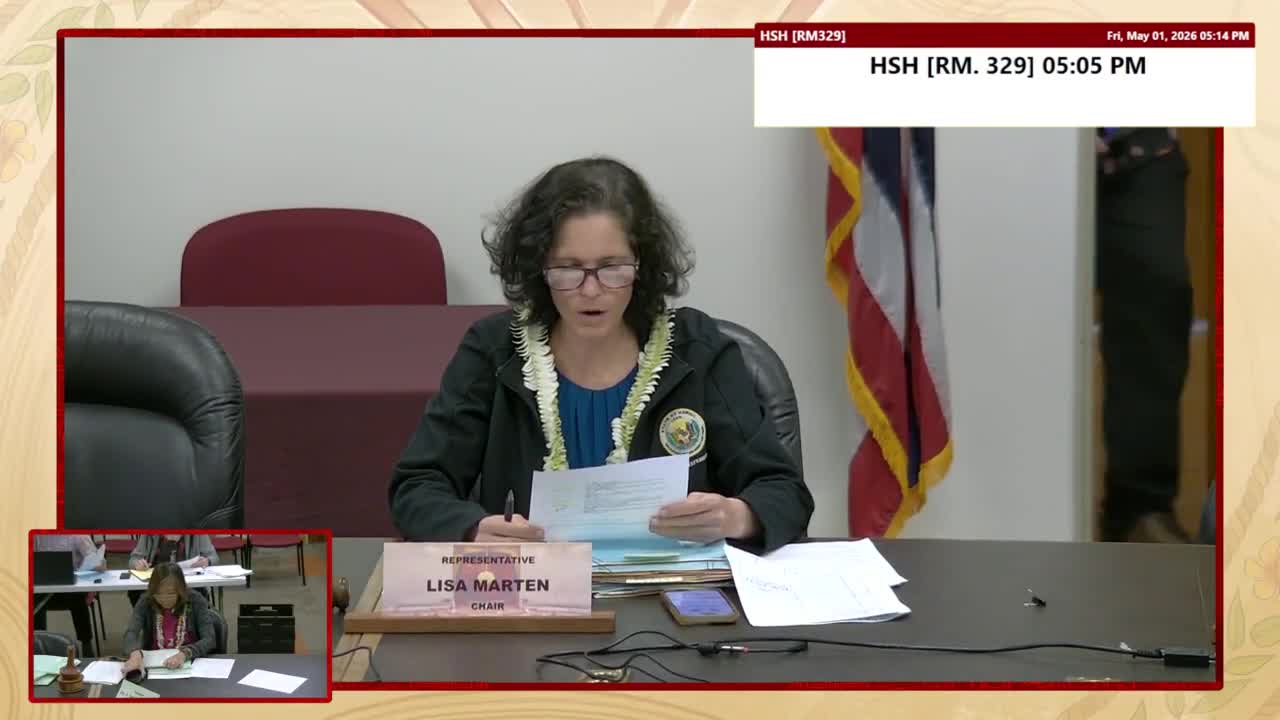 43SEC
Conference Committee
 2MIN
Conference Committee
 1MIN
Conference Committee
 5MIN
Senate Standing Committee on Health and Human Services
5MIN
Senate Standing Committee on Energy and Intergovernmental Affairs
5MIN
Senate Standing Committee on Public Safety and Military Affairs
2MIN
Senate Standing Committee on Health and Human Services
2MIN
Senate Standing Committee on Energy and Intergovernmental Affairs
Bill Author

Bill Co-Author(s):