HB 1591: Healthcare Preceptor Tax Credit; Physician Assistants; Dietitians; Social Workers; Residency Programs; Preceptor Credit Assurance Committee; Director of Health
- Session Year: 2025-2026
- House: House
- Latest Version Date: 2026-04-09
Current Status:
Failed
(2026-05-01: Conference Committee Meeting will reconvene on Friday, 05-01-26 at 5:38PM in Conference Room 329.)
Introduced
In Committee
First Chamber
In Committee
Second Chamber
Final Decking
Enacted
What does this bill do?
The bill expands Hawaii's healthcare preceptor tax credit for health care providers who supervise students (preceptors) by adding physician assistants, dietitians, and social workers, removing the "primary care" limit, and allowing accredited residency programs to qualify. It also clarifies what counts as a volunteer-based supervised clinical training rotation (at least 80 hours yearly), says preceptors may be paid for normal clinical work but not for extra training time, and adds the health director and residency program representatives to the committee that certifies credits.
The summary is provided by generative AI which can make mistakes. For original language, please view the details in the table below.
Expands the definitions of "preceptor" and "volunteer‑based supervised clinical training rotation" applicable to the Healthcare Preceptor Tax Credit to improve accessibility for providers to receive income tax credits for acting as preceptors, including removing "primary care" from the criteria to qualify as a preceptor. Adds physician assistants, dietitians, and social workers to the list of preceptors and eligible students. Expands eligibility for the tax credit to include accredited residency programs that require preceptor support. Adds the Director of Health and representatives of residency programs with eligible students to the Preceptor Credit Assurance Committee. Applies to taxable years beginning after 12/31/2026. Effective 7/1/2050. (SD2)
Expands the definitions of "preceptor" and "volunteer‑based supervised clinical training rotation" applicable to the Healthcare Preceptor Tax Credit to improve accessibility for providers to receive income tax credits for acting as preceptors, including removing "primary care" from the criteria to qualify as a preceptor. Adds physician assistants, dietitians, and social workers to the list of preceptors and eligible students. Expands eligibility for the tax credit to include accredited residency programs that require preceptor support. Adds the Director of Health and representatives of residency programs with eligible students to the Preceptor Credit Assurance Committee. Effective 1/1/2027. (SD1)
Expands the definitions of "preceptor" and "volunteer‑based supervised clinical training rotation" applicable to the Healthcare Preceptor Tax Credit to improve accessibility for providers to receive income tax credits for acting as preceptors, including removing "primary care" from the criteria to qualify as a preceptor. Adds physician assistants, dietitians, and social workers to the list of preceptors and eligible students. Expands eligibility for the tax credit to include accredited residency programs that require preceptor support. Adds the Director of Health and representatives of residency programs with eligible students to the Preceptor Credit Assurance Committee. Effective 7/1/3000. (HD1)
Expands the definitions of "preceptor" and "volunteer‑based supervised clinical training rotation" to improve accessibility for providers to receive income tax credits for acting as preceptors, including removing "primary care" from the criteria to qualify as a preceptor. Adds physician assistants and social workers to the list of preceptors and eligible students. Expands eligibility for the tax credit to include accredited residency programs that require preceptor support. Adds the Director of Health and representatives of residency programs with eligible students to the Preceptor Credit Assurance Committee. Applies to taxable years beginning after 12/31/2025.
|
HOUSE OF REPRESENTATIVES |
H.B. NO. |
1591 |
|
THIRTY-THIRD LEGISLATURE, 2026 |
H.D. 1 |
|
|
STATE OF HAWAII |
S.D. 2 |
|
|
|
|
|
|
|
||
|
|
||
A BILL FOR AN ACT
RELATING TO HEALTH CARE.
BE IT ENACTED BY THE LEGISLATURE OF THE STATE OF HAWAII:
SECTION 1. The legislature finds that there is a shortage of health care providers in the State, particularly primary care providers, which will be exacerbated by the projected retirement of current physicians, advanced practice registered nurses, pharmacists, and other health care workers. Although students are interested in pursuing careers in Hawaii's health care service industry, in-state educational institutions are constrained by the lack of clinical education sites in the State and the limited supply of qualified preceptors. One way to encourage the participation of preceptors is to offer an income tax credit for health care professionals who serve as preceptors.
The purpose of the existing healthcare preceptor tax credit is to incentivize volunteer preceptors to offer professional instruction, training, and supervision to students and residents seeking careers as health care providers in the State. The legislature finds that although many providers have trained eligible students, modifications to the existing program will amplify the success of the program.
The legislature further finds that the healthcare preceptor tax credit program has been successful in facilitating the growth of the preceptor program. The five-year evaluation of the program found a seventy-seven per cent increase in active preceptors who taught at least one rotation, and seventy-six providers started precepting during this five-year period. The evaluation also recommended that to improve the function of the program, additional health care provider professions that have established schools in Hawaii should be added to the tax credit eligibility, the primary care specialty requirement for preceptors should be removed, and the requirement that the preceptor credit should be only for precepting students enrolled in a primary care program should be removed.
The legislature recognizes that programs training physicians, advanced practice registered nurses, and pharmacists in primary care also require training from specialty preceptors. The legislature further recognizes that the health care workforce has shortages in professions beyond those included in the tax credit and whose workforce expansion is also limited by available preceptors, including social workers, dietitians, and physician assistants, as well as workers in high-demand specialties such as behavioral health. As such, the healthcare preceptor tax credit should not be limited to physicians, advanced practice registered nurses, and pharmacists and should be expanded to be applied across all eligible professions. Finally, the legislature finds that the definition of "volunteer-based supervised clinical training rotation" should be clarified to facilitate the preceptor credit assurance committee's implementation of the tax credit.
(1) Amending the definitions of "preceptor" and "volunteer‑based supervised clinical training rotation" to improve accessibility for providers to receive income tax credits for acting as preceptors, including removing "primary care" from the criteria to qualify as a preceptor;
(2) Adding physician assistants, dieticians, and social workers to the list of preceptors and in the definition of "eligible student";
(3) Expanding eligibility for the tax credit to include accredited residency programs that require preceptor support; and
(4) Revising the membership of the preceptor credit assurance committee to include the director of health and representatives of residency programs with eligible students.
SECTION 2. Section 235-110.25, Hawaii Revised Statutes, is amended by amending subsection (g) to read as follows:
"(g) For the purposes of this section:
"Academic program" means an academic degree granting program or graduate medical education program that:
(1) Holds either its principal accreditation or a physical location in Hawaii; and
(2) Provides education to students, of whom more than fifty per cent are residents of Hawaii.
"Advanced practice registered nurse student" means an individual participating in a nationally accredited academic program that is for the education of advanced practice registered nurses and recognized by the state board of nursing pursuant to chapter 457.
"Dietitian student" means an individual participating in an academic program that is nationally accredited for the training of individuals to become licensed dietitians pursuant to chapter 448B.
"Eligible professional degree
or training certificate" means a degree or certificate that fulfills a
requirement to be a physician or osteopathic physician, pursuant to chapter
453[,]; a physician assistant, pursuant to chapter 453; an
advanced practice registered nurse, pursuant to chapter 457[, or];
a pharmacist, pursuant to chapter 461[.]; a dietitian, pursuant to chapter
448B; or a social worker, pursuant to chapter 467E.
"Eligible student" means
an advanced practice registered nurse student, medical student,[or]
pharmacy student, physician assistant student, dietitian student, or social
work student, or resident, who is enrolled in an eligible academic
program[.], residency program, or fellowship.
"Medical student" means an individual participating in a nationally accredited academic program leading to the medical doctor or doctor of osteopathy degree. "Medical student" includes graduates from nationally accredited academic programs who have continued their training, in the role of resident or fellow, to obtain the additional qualifications needed for medical licensure, pursuant to chapter 453, or specialty certification.
"Nationally accredited"
means holding an institutional accreditation by name to offer post-secondary
medical [primary care] education.
For purposes of this definition, accreditation shall be offered by
the following institutions or bodies, or any other accreditation body
recognized by the preceptor credit assurance committee:
(1) Accreditation for
medical students shall be offered by the Liaison Committee on Medical Education
or American Osteopathic Association Commission on Osteopathic College
Accreditation[.];
(2) Accreditation for
advanced practice registered nurse students shall be offered by the Commission
on Collegiate Nursing Education[.];
(3) Accreditation for nursing residency programs shall be offered by the Commission on Collegiate Nursing Education, American Nurses Credentialing Center, or Consortium for Advanced Practice Providers;
(4) Accreditation for pharmacy students shall be offered by the Accreditation Council for Pharmacy Education;
(5) Accreditation for pharmacy residency programs shall be offered by the American Society of Health-System Pharmacists;
(6) Accreditation for physician assistant students shall be offered by the Accreditation Review Commission on Education for the Physician Assistant, Inc.;
(7) Accreditation for physician assistant residency programs shall be offered by the Consortium for Advanced Practice Providers or Accreditation Review Commission on Education for the Physician Assistant, Inc.;
(8) Accreditation for dietitian students shall be offered by the Accreditation Council for Education in Nutrition and Dietetics; and
(9) Accreditation for social work students shall be offered by the Council on Social Work Education.
New or additional accreditation bodies may be eligible; provided that they are recognized by the preceptor credit assurance committee.
"Pharmacy student" means an individual participating in an academic program that is nationally accredited for the training of individuals to become registered pharmacists pursuant to chapter 461.
"Physician assistant student" means an individual participating in an academic program that is nationally accredited for the education of physician assistants to become a nationally certified and licensed physician assistant pursuant to section 453-5.3.
"Preceptor" means a
physician or osteopathic physician, licensed pursuant to chapter 453[,];
a physician assistant, licensed pursuant to chapter 453; an advanced
practice registered nurse, licensed pursuant to chapter 457[, or];
a pharmacist, licensed pursuant to chapter 461[,]; a dietitian,
licensed pursuant to chapter 448B; or a social worker, licensed pursuant to
chapter 467E, who is a resident of Hawaii [and who],
maintains a professional [primary care] practice in [this] the
State[.], and whose specialty supports the development and training
of an eligible student for clinical health care practice.
["Primary care" means
the principal point of continuing care for patients provided by a healthcare
provider, including health promotion, disease prevention, health maintenance,
counseling, patient education, diagnosis and treatment of acute and chronic
illnesses, and coordination of other specialist care that the patient may need.]
"Residency program" means a residency or fellowship program that provides continuing training for eligible professions, in the role of resident or fellow, to obtain the additional qualifications that support professional practice. "Residency program" includes programs offered through employers or nationally accredited academic programs.
"Social work student" means an individual participating in an academic program that is nationally accredited for the training of individuals to become a social worker licensed pursuant to chapter 467E.
"Volunteer-based supervised
clinical training rotation" means [an uncompensated] a
period of supervised clinical training [of] to an eligible
student that totals at least eighty hours of supervisory time annually, in
which a preceptor provides personalized instruction, training, and supervision
to an eligible student to enable the eligible student to obtain an eligible
professional degree or training certificate[.]; provided that while a
preceptor may be compensated for providing standard clinical services, the
preceptor shall be uncompensated for:
(1) Clinical training above or beyond clinical salary or reimbursements for clinical services; and
(2) Provision of clinical training services from tuition funds or from state general funds."
SECTION 3. Section 321-2.7, Hawaii Revised Statutes, is amended as follows:
1. By amending subsections (a) and (b) to read:
"(a) There is established the preceptor credit assurance committee within the department of health. The committee shall develop and implement a plan for certifying healthcare preceptor tax credits under section 235-110.25, including:
(1) Developing a process ensuring that requests for credit certification are reviewed and verifications are processed no later than thirty days following the close of each calendar year; and
(2) Developing the documentation process for the committee to certify a preceptor for the tax credit; provided that the documentation to be collected shall include:
(A) The preceptor's name, address, place of practice, and Hawaii provider license number;
(B) Dates and hours of volunteer-based supervised clinical training rotation per eligible student;
(C) Attestation that the
preceptor is uncompensated for the volunteer-based supervised clinical training
rotation; [and] provided further that if the preceptor is compensated
for providing standard clinical services, attestation that the preceptor is
uncompensated for:
(i) Clinical training above or beyond clinical salary or reimbursements for clinical services; and
(ii) Provision of clinical training services from tuition funds or from state general funds; and
(D) Other information deemed necessary by the committee.
(b) The
committee shall be composed of [representatives of]:
(1) [The Hawaii/Pacific
basin area health education center;] The director of health, or the
director's designee; and
(2) [The center for
nursing; and] Representatives
of:
(A) The Hawaii/Pacific basin area health education center;
(B) The center for nursing;
(C) Academic programs with eligible students; and
(D) Residency programs with eligible students.
[(3) Academic
programs with eligible students.]"
2. By amending subsection (e) to read:
"(e) As used in this section, "academic program", "eligible student", "preceptor", "residency program", and "volunteer-based supervised clinical training rotation" shall have the same meanings as in section 235-110.25."
SECTION 4. Statutory material to be repealed is bracketed and stricken. New statutory material is underscored.
SECTION 5. This Act shall take effect on July 1, 2050; provided that sections 2 and 3 shall apply to taxable years beginning after December 31, 2026.
Report Title:
Healthcare Preceptor Tax Credit; Physician Assistants; Dietitians; Social Workers; Residency Programs; Preceptor Credit Assurance Committee; Director of Health
Description:
Expands the definitions of "preceptor" and "volunteer‑based supervised clinical training rotation" applicable to the Healthcare Preceptor Tax Credit to improve accessibility for providers to receive income tax credits for acting as preceptors, including removing "primary care" from the criteria to qualify as a preceptor. Adds physician assistants, dietitians, and social workers to the list of preceptors and eligible students. Expands eligibility for the tax credit to include accredited residency programs that require preceptor support. Adds the Director of Health and representatives of residency programs with eligible students to the Preceptor Credit Assurance Committee. Applies to taxable years beginning after 12/31/2026. Effective 7/1/2050. (SD2)
The summary description of legislation appearing on this page is for informational purposes only and is not legislation or evidence of legislative intent.
|
HOUSE OF REPRESENTATIVES |
H.B. NO. |
1591 |
|
THIRTY-THIRD LEGISLATURE, 2026 |
H.D. 1 |
|
|
STATE OF HAWAII |
S.D. 1 |
|
|
|
|
|
|
|
||
|
|
||
A BILL FOR AN ACT
RELATING TO HEALTH CARE.
BE IT ENACTED BY THE LEGISLATURE OF THE STATE OF HAWAII:
SECTION 1. The legislature finds that there is a shortage of health care providers in the State, particularly primary care providers, which will be exacerbated by the projected retirement of current physicians, advanced practice registered nurses, pharmacists, and other health care workers. Although students are interested in pursuing careers in Hawaii's health care service industry, in-state educational institutions are constrained by the lack of clinical education sites in the State and the limited supply of qualified preceptors. One way to encourage the participation of preceptors is to offer an income tax credit for health care professionals who serve as preceptors.
The purpose of the existing healthcare preceptor tax credit is to incentivize volunteer preceptors to offer professional instruction, training, and supervision to students and residents seeking careers as health care providers in the State. The legislature finds that although many providers have trained eligible students, modifications to the existing program will amplify the success of the program.
The legislature further finds that the healthcare preceptor tax credit program has been successful in facilitating the growth of the preceptor program. The five-year evaluation of the program found a seventy-seven per cent increase in active preceptors who taught at least one rotation, and seventy-six providers started precepting during this five-year period. The evaluation also recommended that to improve the function of the program, additional health care provider professions that have established schools in Hawaii should be added to the tax credit eligibility, the primary care specialty requirement for preceptors should be removed, and the requirement that the preceptor credit should be only for precepting students enrolled in a primary care program should be removed.
The legislature recognizes that programs training physicians, advanced practice registered nurses, and pharmacists in primary care also require training from specialty preceptors. The legislature further recognizes that the health care workforce has shortages in professions beyond those included in the tax credit and whose workforce expansion is also limited by available preceptors, including social workers, dietitians, and physician assistants, as well as workers in high-demand specialties such as behavioral health. As such, the healthcare preceptor tax credit should not be limited to physicians, advanced practice registered nurses, and pharmacists and should be expanded to be applied across all eligible professions. Finally, the legislature finds that the definition of "volunteer-based supervised clinical training rotation" should be clarified to facilitate the preceptor credit assurance committee's implementation of the tax credit.
(1) Amending the definitions of "preceptor" and "volunteer‑based supervised clinical training rotation" to improve accessibility for providers to receive income tax credits for acting as preceptors, including removing "primary care" from the criteria to qualify as a preceptor;
(2) Adding physician assistants, dieticians, and social workers to the list of preceptors and in the definition of "eligible student";
(3) Expanding eligibility for the tax credit to include accredited residency programs that require preceptor support; and
(4) Revising the membership of the preceptor credit assurance committee to include the director of health and representatives of residency programs with eligible students.
SECTION 2. Section 235-110.25, Hawaii Revised Statutes, is amended by amending subsection (g) to read as follows:
"(g) For the purposes of this section:
"Academic program" means an academic degree granting program or graduate medical education program that:
(1) Holds either its principal accreditation or a physical location in Hawaii; and
(2) Provides education to students, of whom more than fifty per cent are residents of Hawaii.
"Advanced practice registered nurse student" means an individual participating in a nationally accredited academic program that is for the education of advanced practice registered nurses and recognized by the state board of nursing pursuant to chapter 457.
"Dietitian student" means an individual participating in an academic program that is nationally accredited for the training of individuals to become licensed dietitians pursuant to chapter 448B.
"Eligible professional degree
or training certificate" means a degree or certificate that fulfills a
requirement to be a physician or osteopathic physician, pursuant to chapter
453[,]; a physician assistant, pursuant to chapter 453; an
advanced practice registered nurse, pursuant to chapter 457[, or];
a pharmacist, pursuant to chapter 461[.]; a dietitian, pursuant to chapter
448B; or a social worker, pursuant to chapter 467E.
"Eligible student" means
an advanced practice registered nurse student, medical student,[or]
pharmacy student, physician assistant student, dietitian student, or social
work student, or resident, who is enrolled in an eligible academic
program[.], residency program, or fellowship.
"Medical student" means an individual participating in a nationally accredited academic program leading to the medical doctor or doctor of osteopathy degree. "Medical student" includes graduates from nationally accredited academic programs who have continued their training, in the role of resident or fellow, to obtain the additional qualifications needed for medical licensure, pursuant to chapter 453, or specialty certification.
"Nationally accredited"
means holding an institutional accreditation by name to offer post-secondary
medical [primary care] education.
For purposes of this definition, accreditation shall be offered by
the following institutions or bodies, or any other accreditation body
recognized by the preceptor credit assurance committee:
(1) Accreditation for
medical students shall be offered by the Liaison Committee on Medical Education
or American Osteopathic Association Commission on Osteopathic College
Accreditation[.];
(2) Accreditation for
advanced practice registered nurse students shall be offered by the Commission
on Collegiate Nursing Education[.];
(3) Accreditation for nursing residency programs shall be offered by the Commission on Collegiate Nursing Education, American Nurses Credentialing Center, or Consortium for Advanced Practice Providers;
(4) Accreditation for pharmacy students shall be offered by the Accreditation Council for Pharmacy Education;
(5) Accreditation for pharmacy residency programs shall be offered by the American Society of Health System Pharmacists;
(6) Accreditation for physician assistant students shall be offered by the Accreditation Review Commission on Education for the Physician Assistant, Inc.;
(7) Accreditation for physician assistant residency programs shall be offered by the Consortium for Advanced Practice Providers or Accreditation Review Commission on Education for the Physician Assistant, Inc.;
(8) Accreditation for dietitian students shall be offered by the Accreditation Council for Education in Nutrition and Dietetics; and
(9) Accreditation for social work students shall be offered by the Council on Social Work Education.
New or additional accreditation bodies may be eligible; provided that they are recognized by the preceptor credit assurance committee.
"Pharmacy student" means an individual participating in an academic program that is nationally accredited for the training of individuals to become registered pharmacists pursuant to chapter 461.
"Physician assistant student" means an individual participating in an academic program that is nationally accredited for the education of physician assistants to become a nationally certified and licensed physician assistant pursuant to section 453-5.3.
"Preceptor" means a
physician or osteopathic physician, licensed pursuant to chapter 453[,];
a physician assistant, licensed pursuant to chapter 453; an advanced
practice registered nurse, licensed pursuant to chapter 457[, or];
a pharmacist, licensed pursuant to chapter 461[,]; a dietitian,
licensed pursuant to chapter 448B; or a social worker, licensed pursuant to
chapter 467E, who is a resident of Hawaii [and who],
maintains a professional [primary care] practice in [this] the
State[.], and whose specialty supports the development and training
of an eligible student for clinical health care practice.
["Primary care" means
the principal point of continuing care for patients provided by a healthcare
provider, including health promotion, disease prevention, health maintenance,
counseling, patient education, diagnosis and treatment of acute and chronic
illnesses, and coordination of other specialist care that the patient may need.]
"Residency program" means a residency or fellowship program that provides continuing training for eligible professions, in the role of resident or fellow, to obtain the additional qualifications that support professional practice. "Residency program" includes programs offered through employers or nationally accredited academic programs.
"Social work student" means an individual participating in an academic program that is nationally accredited for the training of individuals to become a social worker licensed pursuant to chapter 467E.
"Volunteer-based supervised
clinical training rotation" means [an uncompensated] a
period of supervised clinical training [of] to an eligible
student that totals at least eighty hours of supervisory time annually, in
which a preceptor provides personalized instruction, training, and supervision
to an eligible student to enable the eligible student to obtain an eligible
professional degree or training certificate[.]; provided that while a
preceptor may be compensated for providing standard clinical services, the
preceptor shall be uncompensated for:
(1) Clinical training above or beyond clinical salary or reimbursements for clinical services; and
(2) Provision of clinical training services from tuition funds or from state general funds."
SECTION 3. Section 321-2.7, Hawaii Revised Statutes, is amended as follows:
1. By amending subsections (a) and (b) to read:
"(a) There is established the preceptor credit assurance committee within the department of health. The committee shall develop and implement a plan for certifying healthcare preceptor tax credits under section 235-110.25, including:
(1) Developing a process ensuring that requests for credit certification are reviewed and verifications are processed no later than thirty days following the close of each calendar year; and
(2) Developing the documentation process for the committee to certify a preceptor for the tax credit; provided that the documentation to be collected shall include:
(A) The preceptor's name, address, place of practice, and Hawaii provider license number;
(B) Dates and hours of volunteer-based supervised clinical training rotation per eligible student;
(C) Attestation that the
preceptor is uncompensated for the volunteer-based supervised clinical training
rotation; [and] provided further that if the preceptor is compensated
for providing standard clinical services, attestation that the preceptor is
uncompensated for:
(i) Clinical training above or beyond clinical salary or reimbursements for clinical services; and
(ii) Provision of clinical training services from tuition funds or from state general funds; and
(D) Other information deemed necessary by the committee.
(b) The
committee shall be composed of [representatives of]:
(1) [The Hawaii/Pacific
basin area health education center;] The director of health, or the
director's designee; and
(2) [The center for
nursing; and] Representatives
of:
(A) The Hawaii/Pacific basin area health education center;
(B) The center for nursing;
(C) Academic programs with eligible students; and
(D) Residency programs with eligible students.
[(3) Academic
programs with eligible students.]"
2. By amending subsection (e) to read:
"(e) As used in this section, "academic program", "eligible student", "preceptor", "residency program", and "volunteer-based supervised clinical training rotation" shall have the same meanings as in section 235-110.25."
SECTION 4. Statutory material to be repealed is bracketed and stricken. New statutory material is underscored.
SECTION 5. This Act shall take effect on January 1, 2027.
Report Title:
Healthcare Preceptor Tax Credit; Physician Assistants; Dietitians; Social Workers; Residency Programs; Preceptor Credit Assurance Committee; Director of Health
Description:
Expands the definitions of "preceptor" and "volunteer‑based supervised clinical training rotation" applicable to the Healthcare Preceptor Tax Credit to improve accessibility for providers to receive income tax credits for acting as preceptors, including removing "primary care" from the criteria to qualify as a preceptor. Adds physician assistants, dietitians, and social workers to the list of preceptors and eligible students. Expands eligibility for the tax credit to include accredited residency programs that require preceptor support. Adds the Director of Health and representatives of residency programs with eligible students to the Preceptor Credit Assurance Committee. Effective 1/1/2027. (SD1)
The summary description of legislation appearing on this page is for informational purposes only and is not legislation or evidence of legislative intent.
|
HOUSE OF REPRESENTATIVES |
H.B. NO. |
1591 |
|
THIRTY-THIRD LEGISLATURE, 2026 |
H.D. 1 |
|
|
STATE OF HAWAII |
|
|
|
|
|
|
|
|
||
|
|
||
A BILL FOR AN ACT
RELATING TO HEALTH CARE.
BE IT ENACTED BY THE LEGISLATURE OF THE STATE OF HAWAII:
SECTION 1. The legislature finds that there is a shortage of health care providers in the State, particularly primary care providers, which will be exacerbated by the projected retirement of current physicians, advanced practice registered nurses, pharmacists, and other health care workers. Although students are interested in pursuing careers in Hawaii's health care service industry, in-state educational institutions are constrained by the lack of clinical education sites in the State and the limited supply of qualified preceptors. One way to encourage the participation of preceptors is to offer an income tax credit for health care professionals who serve as preceptors.
The purpose of the existing healthcare preceptor tax credit is to incentivize volunteer preceptors to offer professional instruction, training, and supervision to students and residents seeking careers as health care providers in the State. The legislature finds that although many providers have trained eligible students, modifications to the existing program will amplify the success of the program.
The legislature further finds that the healthcare preceptor tax credit program has been successful in facilitating the growth of the preceptor program. The five-year evaluation of the program found a seventy-seven per cent increase in active preceptors who taught at least one rotation, and seventy-six providers started precepting during this five-year period. The evaluation also recommended that to improve the function of the program, additional health care provider professions that have established schools in Hawaii should be added to the tax credit eligibility, the primary care specialty requirement for preceptors should be removed, and the requirement that the preceptor credit should be only for precepting students enrolled in a primary care program should be removed.
The legislature recognizes that programs training physicians, advanced practice registered nurses, and pharmacists in primary care also require training from specialty preceptors. The legislature further recognizes that the health care workforce has shortages in professions beyond those included in the tax credit and whose workforce expansion is also limited by available preceptors, including social workers, dietitians, and physician assistants, as well as workers in high-demand specialties such as behavioral health. As such, the healthcare preceptor tax credit should not be limited to physicians, advanced practice registered nurses, and pharmacists and should be expanded to be applied across all eligible professions. Finally, the legislature finds that the definition of "volunteer-based supervised clinical training rotation" should be clarified to facilitate the preceptor credit assurance committee's implementation of the tax credit.
(1) Amending the definitions of "preceptor" and "volunteer‑based supervised clinical training rotation" to improve accessibility for providers to receive income tax credits for acting as preceptors, including removing "primary care" from the criteria to qualify as a preceptor;
(2) Adding physician assistants, dieticians, and social workers to the list of preceptors and in the definition of "eligible student";
(3) Expanding eligibility for the tax credit to include accredited residency programs that require preceptor support; and
(4) Revising the membership of the preceptor credit assurance committee to include the director of health and representatives of residency programs with eligible students.
SECTION 2. Section 235-110.25, Hawaii Revised Statutes, is amended by amending subsection (g) to read as follows:
"(g) For the purposes of this section:
"Academic program" means an academic degree granting program or graduate medical education program that:
(1) Holds either its principal accreditation or a physical location in Hawaii; and
(2) Provides education to students, of whom more than fifty per cent are residents of Hawaii.
"Advanced practice registered nurse student" means an individual participating in a nationally accredited academic program that is for the education of advanced practice registered nurses and recognized by the state board of nursing pursuant to chapter 457.
"Dietitian student" means an individual participating in an academic program that is nationally accredited for the training of individuals to become licensed dietitians pursuant to chapter 448B.
"Eligible professional degree
or training certificate" means a degree or certificate that fulfills a
requirement to be a physician or osteopathic physician, pursuant to chapter
453[,]; a physician assistant, pursuant to chapter 453; an
advanced practice registered nurse[,] pursuant to chapter 457[, or];
a pharmacist[,] pursuant to chapter 461[.]; a dietitian,
pursuant to 448B; or a social worker pursuant to chapter 467E.
"Eligible student" means
an advanced practice registered nurse student, medical student,[or]
pharmacy student, physician assistant student, dietitian student, or social
work student or resident who is enrolled in an eligible academic
program[.], residency program, or fellowship.
"Medical student" means an individual participating in a nationally accredited academic program leading to the medical doctor or doctor of osteopathy degree. "Medical student" includes graduates from nationally accredited academic programs who have continued their training, in the role of resident or fellow, to obtain the additional qualifications needed for medical licensure, pursuant to chapter 453, or specialty certification.
"Nationally accredited"
means holding an institutional accreditation by name to offer post-secondary
medical [primary care] education.
For purposes of this definition, accreditation shall be offered by
the following institutions or bodies, or any other accreditation body
recognized by the preceptor credit assurance committee:
(1) Accreditation for
medical students shall be offered by the Liaison Committee on Medical Education
or American Osteopathic Association Commission on Osteopathic College
Accreditation[.];
(2) Accreditation for
advanced practice registered nurse students shall be offered by the Commission
on Collegiate Nursing Education[.];
(3) Accreditation for nursing residency programs shall be offered by the Commission on Collegiate Nursing Education, American Nurses Credentialing Center, or Consortium for Advanced Practice Providers;
(4) Accreditation for pharmacy students shall be offered by the Accreditation Council for Pharmacy Education;
(5) Accreditation for pharmacy residency programs shall be offered by the American Society of Health System Pharmacists;
(6) Accreditation for physician assistant students shall be offered by the Accreditation Review Commission on Education for the Physician Assistant, Inc.;
(7) Accreditation for physician assistant residency programs shall be offered by the Consortium for Advanced Practice Providers or Accreditation Review Commission on Education for the Physician Assistant, Inc.;
(8) Accreditation for dietitian students shall be offered by the Accreditation Council for Education in Nutrition and Dietetics; and
(9) Accreditation for social work students shall be offered by the Council on Social Work Education.
New or additional accreditation bodies may be eligible; provided that they are recognized by the preceptor credit assurance committee.
"Pharmacy student" means an individual participating in an academic program that is nationally accredited for the training of individuals to become registered pharmacists pursuant to chapter 461.
"Physician assistant student" means an individual participating in an academic program that is nationally accredited for the education of physician assistants to become a nationally certified and licensed physician assistant pursuant to section 453-5.3.
"Preceptor" means a
physician or osteopathic physician, licensed pursuant to chapter 453[,];
a physician assistant, licensed pursuant to chapter 453; an advanced
practice registered nurse[,] licensed pursuant to chapter 457[, or];
a pharmacist[,] licensed pursuant to chapter 461[,]; a
dietitian, licensed pursuant to chapter 448B; or a social worker licensed
pursuant to chapter 467E, who is a resident of Hawaii [and who],
maintains a professional [primary care] practice in [this] the
State[.], and whose specialty supports the development and training
of an eligible student for clinical health care practice.
["Primary care" means
the principal point of continuing care for patients provided by a healthcare
provider, including health promotion, disease prevention, health maintenance,
counseling, patient education, diagnosis and treatment of acute and chronic
illnesses, and coordination of other specialist care that the patient may need.]
"Residency program" means a residency or fellowship program that provides continuing training for eligible professions, in the role of resident or fellow, to obtain the additional qualifications that support professional practice. "Residency program" includes programs offered through employers or nationally accredited academic programs.
"Social work student" means an individual participating in an academic program that is nationally accredited for the training of individuals to become a social worker licensed pursuant to chapter 467E.
"Volunteer-based supervised
clinical training rotation" means [an uncompensated] a
period of supervised clinical training [of] to an eligible
student that totals at least eighty hours of supervisory time annually, in
which a preceptor provides personalized instruction, training, and supervision
to an eligible student to enable the eligible student to obtain an eligible
professional degree or training certificate[.]; provided that while a
preceptor may be compensated for providing standard clinical services, the
preceptor shall be uncompensated for:
(1) Clinical training above or beyond clinical salary or reimbursements for clinical services; and
(2) Provision of clinical training services from tuition funds or from state general funds."
SECTION 3. Section 321-2.7, Hawaii Revised Statutes, is amended as follows:
1. By amending subsections (a) and (b) to read:
"(a) There is established the preceptor credit assurance committee within the department of health. The committee shall develop and implement a plan for certifying healthcare preceptor tax credits under section 235-110.25, including:
(1) Developing a process ensuring that requests for credit certification are reviewed and verifications are processed no later than thirty days following the close of each calendar year; and
(2) Developing the documentation process for the committee to certify a preceptor for the tax credit; provided that the documentation to be collected shall include:
(A) The preceptor's name, address, place of practice, and Hawaii provider license number;
(B) Dates and hours of volunteer-based supervised clinical training rotation per eligible student;
(C) Attestation that the
preceptor is uncompensated for the volunteer-based supervised clinical training
rotation; [and] provided further that if the preceptor is compensated
for providing standard clinical services, attestation that the preceptor is
uncompensated for:
(i) Clinical training above or beyond clinical salary or reimbursements for clinical services; and
(ii) Provision of clinical training services from tuition funds or from state general funds; and
(D) Other information deemed necessary by the committee.
(b) The
committee shall be composed of [representatives of]:
(1) [The
Hawaii/Pacific basin area health education center;] The director of
health or the director's designee; and
(2) [The center for
nursing; and] Representatives
of:
(A) The Hawaii/Pacific basin area health education center;
(B) The center for nursing;
(C) Academic programs with eligible students; and
(D) Residency programs with eligible students.
[(3) Academic
programs with eligible students.]"
2. By amending subsection (e) to read:
"(e) As used in this section, "academic program", "eligible student", "preceptor", "residency program", and "volunteer-based supervised clinical training rotation" shall have the same meanings as in section 235-110.25."
SECTION 4. Statutory material to be repealed is bracketed and stricken. New statutory material is underscored.
SECTION 5. This Act shall take effect on July 1, 3000.
Report Title:
Healthcare Preceptor Tax Credit; Physician Assistants; Dietitians; Social Workers; Residency Programs; Preceptor Credit Assurance Committee; Director of Health
Description:
Expands the definitions of "preceptor" and "volunteer‑based supervised clinical training rotation" applicable to the Healthcare Preceptor Tax Credit to improve accessibility for providers to receive income tax credits for acting as preceptors, including removing "primary care" from the criteria to qualify as a preceptor. Adds physician assistants, dietitians, and social workers to the list of preceptors and eligible students. Expands eligibility for the tax credit to include accredited residency programs that require preceptor support. Adds the Director of Health and representatives of residency programs with eligible students to the Preceptor Credit Assurance Committee. Effective 7/1/3000. (HD1)
The summary description of legislation appearing on this page is for informational purposes only and is not legislation or evidence of legislative intent.
|
HOUSE OF REPRESENTATIVES |
H.B. NO. |
1591 |
|
THIRTY-THIRD LEGISLATURE, 2026 |
|
|
|
STATE OF HAWAII |
|
|
|
|
|
|
|
|
||
|
|
||
A BILL FOR AN ACT
relating to health care.
BE IT ENACTED BY THE LEGISLATURE OF THE STATE OF HAWAII:
SECTION 1. The legislature finds that there is a shortage of health care providers in the State, particularly primary care providers, which will be exacerbated by the projected retirement of current physicians, advanced practice registered nurses, pharmacists, and other health care workers. Although students are interested in pursuing careers in Hawaii's health care service industry, in-state educational institutions are constrained by the lack of clinical education sites in the State and the limited supply of qualified preceptors. One way to encourage the participation of preceptors is to offer an income tax credit for health care professionals who serve as preceptors.
The purpose of the existing healthcare preceptor income tax credit is to incentivize volunteer preceptors to offer professional instruction, training, and supervision to students and residents seeking careers as health care providers in the State. The legislature finds that although many providers have trained eligible students, modifications to the existing program will amplify the success of the program.
The legislature further finds that the preceptor tax credit program has been successful in facilitating the growth of the preceptor program. The five-year evaluation of the program found a seventy-seven per cent increase in active preceptors who taught at least one rotation, and seventy-six providers started precepting during this five-year period. The evaluation also recommended that to improve the function of the program, additional health care provider professions that have established schools in Hawaii should be added to the tax credit eligibility, the primary care specialty requirement for preceptors should be removed, and the requirement that the preceptor credit should be only for precepting students enrolled in a primary care program should be removed.
The legislature recognizes that programs training physicians, advanced practice registered nurses, and pharmacists in primary care also require training from specialty preceptors. The legislature further recognizes that the health care workforce has shortages in professions beyond those included in the tax credit and whose workforce expansion is also limited by available preceptors, including social workers and physician assistants, as well as workers in high-demand specialties such as behavioral health. As such, the healthcare preceptor tax credit should not be limited to physicians, advanced practice registered nurses, and pharmacists and should be expanded to be applied across all eligible professions. Finally, the legislature finds that the definition of "volunteer-based supervised clinical training rotation" should be clarified to facilitate the preceptor credit assurance committee's implementation of the tax credit.
Accordingly, the purpose of this Act is to:
(1) Amend the definitions of "preceptor" and "volunteer‑based supervised clinical training rotation" to improve accessibility for providers to receive income tax credits for acting as preceptors, including removing "primary care" from the criteria to qualify as a preceptor;
(2) Add physician assistants and social workers to the list of preceptors and in the definition of "eligible student";
(3) Expand eligibility for the tax credit to include accredited residency programs that require preceptor support; and
(4) Revise the membership of the preceptor credit assurance committee to include the director of health and representatives of residency programs with eligible students.
SECTION 2. Section 235-110.25, Hawaii Revised Statutes, is amended by amending subsection (g) to read as follows:
"(g) For the purposes of this section:
"Academic program" means an academic degree granting program or graduate medical education program that:
(1) Holds either its principal accreditation or a physical location in Hawaii; and
(2) Provides education to students, of whom more than fifty per cent are residents of Hawaii.
"Advanced practice registered nurse student" means an individual participating in a nationally accredited academic program that is for the education of advanced practice registered nurses and recognized by the state board of nursing pursuant to chapter 457.
"Eligible professional degree
or training certificate" means a degree or certificate that fulfills a
requirement to be a physician [or], osteopathic physician, or
physician assistant pursuant to chapter 453[,]; an advanced
practice registered nurse[,] pursuant to chapter 457[, or];
a pharmacist[,] pursuant to chapter 461[.]; or a social worker
pursuant to chapter 467E.
"Eligible student" means
an advanced practice registered nurse student, medical student,[or]
pharmacy student, physician assistant student, or social work student or
resident who is enrolled in an eligible academic program[.],
residency program, or fellowship.
"Medical student" means an individual participating in a nationally accredited academic program leading to the medical doctor or doctor of osteopathy degree. "Medical student" includes graduates from nationally accredited academic programs who have continued their training, in the role of resident or fellow, to obtain the additional qualifications needed for medical licensure, pursuant to chapter 453, or specialty certification.
"Nationally accredited"
means holding an institutional accreditation by name to offer post-secondary
medical [primary care] education.
Accreditation for medical students shall be offered by the Liaison
Committee on Medical Education [or], American Osteopathic
Association Commission on Osteopathic College Accreditation[.], or
any other accreditation body recognized by the preceptor credit assurance
committee. Accreditation for
advanced practice registered nurse students shall be offered by the Commission
on Collegiate Nursing Education[.] or any other accreditation body
recognized by the preceptor credit assurance committee. Accreditation for nursing residency programs
shall be offered by the Commission on Collegiate Nursing Education, American
Nurses Credentialing Center, Consortium for Advanced Practice Providers, or any
other accreditation body recognized by the preceptor credit assurance
committee. Accreditation for pharmacy
students shall be offered by the Accreditation Council for Pharmacy Education or
any other accreditation body recognized by the preceptor credit assurance
committee. Accreditation for pharmacy
residency programs shall be offered by the American Society of Health System
Pharmacists. Accreditation for physician
assistant students shall be offered by the Accreditation Review Commission on
Education for the Physician Assistant, Inc. or any other accreditation body
recognized by the preceptor credit assurance committee. Accreditation for physician assistant residency
programs shall be offered by the Consortium for Advanced Practice Providers; Accreditation
Review Commission on Education for the Physician Assistant, Inc.; or any other
accreditation body recognized by the preceptor credit assurance committee. Accreditation for social work students shall
be offered by the Council on Social Work Education or any other accreditation
body recognized by the preceptor credit assurance committee. New or additional accreditation bodies may be
eligible; provided that they are recognized by the preceptor credit assurance
committee.
"Pharmacy student" means an individual participating in an academic program that is nationally accredited for the training of individuals to become registered pharmacists pursuant to chapter 461.
"Physician assistant student" means an individual participating in an academic program that is nationally accredited for the education of physician assistants to become a nationally certified and licensed physician assistant pursuant to section 453-5.3.
"Preceptor" means a
physician [or], osteopathic physician, or physician assistant
licensed pursuant to chapter 453[,]; an advanced practice registered
nurse[,] licensed pursuant to chapter 457[, or]; a
pharmacist[,] licensed pursuant to chapter 461[,]; or a social
worker licensed pursuant to chapter 467E, who is a resident of Hawaii [and
who], maintains a professional [primary care] practice in [this]
the State[.], and whose specialty supports the development and
training of an eligible student for clinical health care practice.
["Primary care" means
the principal point of continuing care for patients provided by a healthcare
provider, including health promotion, disease prevention, health maintenance,
counseling, patient education, diagnosis and treatment of acute and chronic
illnesses, and coordination of other specialist care that the patient may need.]
"Residency program" means a residency or fellowship program that provides continuing training for eligible professions, in the role of resident or fellow, to obtain the additional qualifications that support professional practice. "Residency program" includes programs offered through employers or nationally accredited academic programs.
"Social work student" means an individual participating in an academic program that is nationally accredited for the training of individuals to become a social worker licensed pursuant to chapter 467E.
"Volunteer-based supervised
clinical training rotation" means [an uncompensated] a
period of supervised clinical training [of] to an eligible
student that totals at least eighty hours of supervisory time annually, in
which a preceptor provides personalized instruction, training, and supervision
to an eligible student to enable the eligible student to obtain an eligible
professional degree or training certificate[.]; provided that while a
preceptor may be compensated for providing standard clinical services, the
preceptor shall be uncompensated for:
(1) Clinical training above or beyond clinical salary or reimbursements for clinical services; and
(2) Provision of clinical training services from tuition funds or from state general funds."
SECTION 3. Section 321-2.7, Hawaii Revised Statutes, is amended as follows:
1. By amending subsections (a) and (b) to read:
"(a) There is established the preceptor credit assurance committee within the department of health. The committee shall develop and implement a plan for certifying healthcare preceptor tax credits under section 235-110.25, including:
(1) Developing a process ensuring that requests for credit certification are reviewed and verifications are processed no later than thirty days following the close of each calendar year; and
(2) Developing the documentation process for the committee to certify a preceptor for the tax credit; provided that the documentation to be collected shall include:
(A) The preceptor's name, address, place of practice, and Hawaii provider license number;
(B) Dates and hours of volunteer-based supervised clinical training rotation per eligible student;
(C) Attestation that the
preceptor is uncompensated for the volunteer-based supervised clinical training
rotation; [and] provided further that if the preceptor is compensated
for providing standard clinical services, attestation that the preceptor is
uncompensated for:
(i) Clinical training above or beyond clinical salary or reimbursements for clinical services; and
(ii) Provision of clinical training services from tuition funds or from state general funds; and
(D) Other information deemed necessary by the committee.
(b) The
committee shall be composed of [representatives of]:
(1) [The
Hawaii/Pacific basin area health education center;] The director of
health or the director's designee; and
(2) [The center for
nursing; and] Representatives
of:
(A) The Hawaii/Pacific basin area health education center;
(B) The center for nursing;
(C) Academic programs with eligible students; and
(D) Residency programs with eligible students.
[(3) Academic
programs with eligible students.]"
2. By amending subsection (e) to read:
"(e) As used in this section, "academic program", "eligible student", "preceptor", "residency program", and "volunteer-based supervised clinical training rotation" shall have the same meanings as in section 235-110.25."
SECTION 4. Statutory material to be repealed is bracketed and stricken. New statutory material is underscored.
SECTION 5. This Act, upon its approval, shall apply to taxable years beginning after December 31, 2025.
|
INTRODUCED BY: |
_____________________________ |
Report Title:
Healthcare Preceptor Tax Credit; Physician Assistants; Social Workers; Residency Programs; Preceptor Credit Assurance Committee; Director of Health
Description:
Expands the definitions of "preceptor" and "volunteer‑based supervised clinical training rotation" to improve accessibility for providers to receive income tax credits for acting as preceptors, including removing "primary care" from the criteria to qualify as a preceptor. Adds physician assistants and social workers to the list of preceptors and eligible students. Expands eligibility for the tax credit to include accredited residency programs that require preceptor support. Adds the Director of Health and representatives of residency programs with eligible students to the Preceptor Credit Assurance Committee. Applies to taxable years beginning after 12/31/2025.
The summary description of legislation appearing on this page is for informational purposes only and is not legislation or evidence of legislative intent.
|
Date
|
Status
|
|---|---|
| May 1, 2026 | Conference Committee Meeting will reconvene on Friday, 05-01-26 at 5:38PM in Conference Room 329. |
| Apr 30, 2026 | Conference Committee Meeting will reconvene on Friday 05-01-26 4:30PM in conference room 329. |
| Apr 29, 2026 | Bill scheduled for Conference Committee Meeting on Thursday, 04-30-26 4:30PM in conference room 329. |
| Apr 23, 2026 | Received notice of Senate conferees (Sen. Com. No. 725). |
| Apr 22, 2026 | Senate Conferees Appointed: San Buenaventura Chair; Lamosao, Kanuha Co-Chairs. |
| Apr 20, 2026 | Received notice of appointment of House conferees (Hse. Com. No. 786). |
| Apr 20, 2026 | House Conferees Appointed: Takayama, Keohokapu-Lee Loy Co-Chairs; Alcos. |
| Apr 17, 2026 | Received notice of disagreement (Hse. Com. No. 780). |
| Apr 16, 2026 | House disagrees with Senate amendment (s). |
| Apr 14, 2026 | Returned from Senate (Sen. Com. No. 590) in amended form (SD 2). |
| Apr 14, 2026 | Report adopted; Passed Third Reading, as amended (SD 2). Ayes, 25; Aye(s) with reservations: none . Noes, 0 (none). Excused, 0 (none). Transmitted to House. |
| Apr 10, 2026 | 48 Hrs. Notice 04-14-26. |
| Apr 10, 2026 | Reported from CPN/WAM (Stand. Com. Rep. No. 3712) with recommendation of passage on Third Reading, as amended (SD 2). |
| Apr 7, 2026 | The committee(s) on CPN recommend(s) that the measure be PASSED, WITH AMENDMENTS. The votes in CPN were as follows: 4 Aye(s): Senator(s) Keohokalole, Fukunaga, Lamosao, McKelvey; Aye(s) with reservations: none ; 0 No(es): none; and 1 Excused: Senator(s) Awa. |
| Apr 7, 2026 | The committee(s) on WAM recommend(s) that the measure be PASSED, WITH AMENDMENTS. The votes in WAM were as follows: 11 Aye(s): Senator(s) Dela Cruz, Moriwaki, DeCoite, Elefante, Hashimoto, Inouye, Kanuha, Kidani, Kim, Wakai, Fevella; Aye(s) with reservations: none ; 0 No(es): none; and 2 Excused: Senator(s) Lee, C., Richards. |
| Apr 2, 2026 | The committee(s) on CPN/WAM will hold a public decision making on 04-07-26 10:30AM; Conference Room 211 & Videoconference. |
| Mar 30, 2026 | Report adopted; Passed Second Reading, as amended (SD 1) and referred to CPN/WAM. |
| Mar 30, 2026 | Reported from HHS (Stand. Com. Rep. No. 3336) with recommendation of passage on Second Reading, as amended (SD 1) and referral to CPN/WAM. |
| Mar 18, 2026 | The committee(s) on HHS recommend(s) that the measure be PASSED, WITH AMENDMENTS. The votes in HHS were as follows: 5 Aye(s): Senator(s) San Buenaventura, McKelvey, Kanuha, Keohokalole, Fevella; Aye(s) with reservations: none ; 0 No(es): none; and 0 Excused: none. |
| Mar 13, 2026 | The committee(s) on HHS has scheduled a public hearing on 03-18-26 1:00PM; CR 225 & Videoconference. |
| Mar 10, 2026 | Referred to HHS, CPN/WAM. |
| Mar 6, 2026 | Passed First Reading. |
| Mar 6, 2026 | Received from House (Hse. Com. No. 24). |
| Mar 5, 2026 | Passed Third Reading with none voting aye with reservations; none voting no (0) and Representative(s) Perruso excused (1). Transmitted to Senate. |
| Mar 5, 2026 | Reported from FIN (Stand. Com. Rep. No. 848-26), recommending passage on Third Reading. |
| Feb 27, 2026 | The committee on FIN recommend that the measure be PASSED, UNAMENDED. The votes were as follows: 15 Ayes: Representative(s) Todd, Takenouchi, Hartsfield, Hussey, Keohokapu-Lee Loy, Kitagawa, Kusch, Miyake, Morikawa, Perruso, Templo, Yamashita, Alcos, Gedeon, Reyes Oda; Ayes with reservations: none; Noes: none; and 1 Excused: Representative(s) Lee, M.. |
| Feb 24, 2026 | Bill scheduled to be heard by FIN on Friday, 02-27-26 10:00AM in House conference room 308 VIA VIDEOCONFERENCE. |
| Feb 18, 2026 | Passed Second Reading as amended in HD 1 and referred to the committee(s) on FIN with none voting aye with reservations; none voting no (0) and none excused (0). |
| Feb 18, 2026 | Reported from HLT (Stand. Com. Rep. No. 364-26) as amended in HD 1, recommending passage on Second Reading and referral to FIN. |
| Feb 11, 2026 | The committee on HLT recommend that the measure be PASSED, WITH AMENDMENTS. The votes were as follows: 9 Ayes: Representative(s) Takayama, Keohokapu-Lee Loy, Amato, Hartsfield, Marten, Olds, Takenouchi, Alcos, Garcia; Ayes with reservations: none; Noes: none; and Excused: none. |
| Feb 6, 2026 | Bill scheduled to be heard by HLT on Wednesday, 02-11-26 9:00AM in House conference room 329 VIA VIDEOCONFERENCE. |
| Jan 26, 2026 | Referred to HLT, FIN, referral sheet 1 |
| Jan 21, 2026 | Introduced and Pass First Reading. |
| Jan 16, 2026 | Prefiled. |
|
Date
|
Description
|
Location
|
Votes
|
|
|---|---|---|---|---|
| Apr 14, 2026 | Third Reading | Senate Floor |
Passed |
|
| Apr 7, 2026 | The committee(s) on CPN recommend(s) that the measure be PASSED, WITH AMENDMENTS | Senate Standing Committee on Commerce and Consumer Protection |
Passed |
|
| Apr 7, 2026 | The committee(s) on WAM recommend(s) that the measure be PASSED, WITH AMENDMENTS | Senate Standing Committee on Ways and Means |
Passed |
|
| Mar 18, 2026 | The committee(s) on HHS recommend(s) that the measure be PASSED, WITH AMENDMENTS | Senate Standing Committee on Health and Human Services |
Passed |
|
| Mar 5, 2026 | Third Reading | House Floor |
Passed |
|
| Feb 27, 2026 | The committee on FIN recommend that the measure be PASSED, UNAMENDED | House Standing Committee on Finance |
Passed |
|
| Feb 11, 2026 | The committee on HLT recommend that the measure be PASSED, WITH AMENDMENTS | House Standing Committee on Health |
Passed |
This list shows positions taken on this bill by organizations on the date displayed, which is linked to the original source.
Positions by individuals are not included.
|
Organization
|
Position
|
Date
|
|---|---|---|
| Alii Health Care | *** Support | Feb 28, 2026 |
| Aliʻi Ambulatory Surgery Center | ** Support | |
| Aliʻi Health Care | ** Support | |
| Ali’I Health Center | *** Support | Feb 28, 2026 |
| Chaminade University of Honolulu | ** Support | |
| Chaminade University of Honolulu, School of Nursing and Health Professions | *** Support | Feb 28, 2026 |
| Department of Health | *** Support | Apr 7, 2026 |
| Hawai'i Pharmacists Association (HPhA) | *** Support | Apr 7, 2026 |
| Hawaii Island Community Health Center | ** Support | |
| Hawaii Academy of Physician Assistants | ** Support | |
| Hawaii Association of Professional Nurses | ** Support | |
| Hawaii Family Physicians | ** Support | |
| Hawaii Island Community Health Center | *** Support | Feb 28, 2026 |
| Hawaii Island Community Health Center (HICHC) | *** Support | Feb 28, 2026 |
| Hawaii Medical Association | *** Support | Apr 7, 2026 |
| Hawaii Primary Care Association | *** Support | Apr 7, 2026 |
| Hawaii Public Health Institute | *** Support | Apr 7, 2026 |
| Hawaii State Commission on the Status of Women | *** Support | Apr 7, 2026 |
| Hawaii Substance Abuse Coalition | *** Support | Apr 7, 2026 |
| Hawaiʻi Academy of Physician Assistants (HAPA) | *** Support | Apr 7, 2026 |
| Hawaiʻi Affiliate of the American College of Nurse-Midwives | ** Support | |
| Hawaiʻi Board of Nursing | *** Support | Mar 18, 2026 |
| Hawaiʻi-American Nurses Association | *** Support | Mar 18, 2026 |
| Hawai‘i Pacific Health | *** Support | Apr 7, 2026 |
| Hawai‘i Psychological Association | *** Support | Apr 7, 2026 |
| Hawai‘i State Center for Nursing | *** Support | Mar 18, 2026 |
| Hawai‘i State Center for Nursing, University of Hawai‘i at Mānoa | *** Support | Feb 28, 2026 |
| Hawai’i Pacific University (Physician Assistant Students) | *** Support | Apr 7, 2026 |
| Health Mothers Healthy Babies Coalition of Hawaii | ** Support | |
| Healthcare Association of Hawaii | *** Support | Apr 7, 2026 |
| Healthy Mothers Healthy Babies Coalition of Hawaii | *** Support | Mar 18, 2026 |
| Healthy Mothers Healthy Babies Coalition of Hawaii | *** Support | Feb 11, 2026 |
| Hina Mauka | *** Support | Mar 18, 2026 |
| Individual | *** Support | Feb 28, 2026 |
| John A. Burns School of Medicine | *** Support | Apr 7, 2026 |
| Kaiser Permanente Hawaiʻi | *** Support | Mar 18, 2026 |
| Kona Community Hospital | *** Support | Feb 28, 2026 |
| Queens Medical Center | *** Support | Apr 7, 2026 |
| School of Nursing and Dental Hygiene | *** Support | Mar 18, 2026 |
| State Council on Mental Health | *** Support | Apr 7, 2026 |
| The Queen’s Health Systems | *** Support | Apr 7, 2026 |
| Thompson School of Social Work and Public Health | *** Support | Mar 18, 2026 |
| UH Hilo Daniel K. Inouye College of Pharmacy | *** Support | Apr 7, 2026 |
| UH Manoa Thompson School of Social Work and Public Health | *** Support | Apr 7, 2026 |
| UH School of Nursing and Dental Hygiene | *** Support | Apr 7, 2026 |
| University of Hawai‘i System | *** Support | Apr 7, 2026 |
| University of Washington MEDEX | *** Support | Mar 18, 2026 |
| University of Washington MEDEX (Kona Campus) | *** Support | Mar 18, 2026 |
| University of Washington MEDEX - Kona | *** Support | Feb 28, 2026 |
| University of Washington MEDEX - PA Student | *** Support | Feb 28, 2026 |
| University of Washington MEDEX Northwest | *** Support | Mar 18, 2026 |
| University of Washington MEDEX PA Program - Kona Campus | *** Support | Feb 28, 2026 |
| University of Washington MEDEX PA Program, Kona Campus | *** Support | Apr 7, 2026 |
| Waianae Coast Comprehensive Health Center | *** Support | Apr 7, 2026 |
| Waikiki Health | *** Support | Feb 28, 2026 |
| ʻOhiʻa Midwifery & Wellness, LLC | ** Support |
STAND. COM. REP. NO. 848-26
Honolulu, Hawaii
, 2026
RE: H.B. No. 1591
H.D. 1
Honorable Nadine K. Nakamura
Speaker, House of Representatives
Thirty-Third State Legislature
Regular Session of 2026
State of Hawaii
Madame:
Your Committee on Finance, to which was referred H.B. No. 1591, H.D. 1, entitled:
"A BILL FOR AN ACT RELATING TO HEALTH CARE,"
begs leave to report as follows:
(1) Adding and amending various definitions to improve accessibility for providers to receive income tax credits for acting as preceptors, including removing "primary care" from the criteria to qualify as a preceptor;
(2) Adding physician assistants, dietitians, and social workers to the list of preceptors and eligible students;
(3) Expanding eligibility for the tax credit to include accredited residency programs that require preceptor support; and
(4) Revising the membership of the Preceptor Credit Assurance Committee to include the Director of Health and representatives of residency programs with eligible students.
Your Committee received testimony in support of this measure from the University of Hawaiʻi System; Board of Nursing; Hawaii State Commission on the Status of Women; Hawaiʻi State Center for Nursing; Chaminade University of Honolulu; Hawaii Substance Abuse Coalition; Hawaii Primary Care Association; Hawaiʻi Psychological Association; Hawaiʻi Public Health Institute; Hawaiʻi Pacific Health; Hawaii Family Physicians; Healthcare Association of Hawaii; The Queen's Health Systems; Aliʻi Ambulatory Surgery Center; Waianae Coast Comprehensive Health Center; Hawaii Island Community Health Center; Hawaii Association of Professional Nurses; Hawaii Medical Association; Hawaii Academy of Physician Assistants; Kaiser Permanente Hawaiʻi; Hina Mauka; Aliʻi Health Care; ʻOhiʻa Midwifery & Wellness, LLC; and numerous individuals. Your Committee received comments on this measure from the Department of Taxation and Tax Foundation of Hawaii.
As affirmed by the record of votes of the members of your Committee on Finance that is attached to this report, your Committee is in accord with the intent and purpose of H.B. No. 1591, H.D. 1, and recommends that it pass Third Reading.
Respectfully submitted on behalf of the members of the Committee on Finance,
|
|
|
____________________________ CHRIS TODD, Chair |
|
|
|
|
STAND. COM. REP. NO. 364-26
Honolulu, Hawaii
, 2026
RE: H.B. No. 1591
H.D. 1
Honorable Nadine K. Nakamura
Speaker, House of Representatives
Thirty-Third State Legislature
Regular Session of 2026
State of Hawaii
Madame:
Your Committee on Health, to which was referred H.B. No. 1591 entitled:
"A BILL FOR AN ACT RELATING TO HEALTH CARE,"
begs leave to report as follows:
The purpose of this measure is to make various amendments related to the Healthcare Preceptor Tax Credit, including:
(1) Amending the definitions of "preceptor" and "volunteer-based supervised clinical training rotation" to improve accessibility for providers to receive income tax credits for acting as preceptors, including removing "primary care" from the criteria to qualify as a preceptor;
(2) Adding physician assistants and social workers to the list of preceptors and in the definition of "eligible student";
(3) Expanding eligibility for the tax credit to include accredited residency programs that require preceptor support; and
(4) Revising the membership of the Preceptor Credit Assurance Committee to include the Director of Health and representatives of residency programs with eligible students.
Your Committee received testimony in support of this measure from the Department of Health; University of Hawaiʻi System; Hawaiʻi State Center for Nursing; Hawaii Substance Abuse Coalition; Hina Mauka; Health Mothers Healthy Babies Coalition of Hawaii; The Queen's Health Systems; Hawaii Medical Association; Hawaiʻi Pacific Health; Healthcare Association of Hawaii; Hawaiʻi Psychological Association; Hawaiʻi-American Nurses Association; Hawaiʻi Association of Professional Nurses; Hawaiʻi Affiliate of the American College of Nurse-Midwives; Kaiser Permanent Hawaiʻi; Hawaiʻi Public Health Institute; Hawaii Primary Care Association; and four individuals. Your Committee received comments on this measure from the Department of Taxation and Tax Foundation of Hawaii.
Your Committee finds that the State is experiencing a shortage of health care providers across many fields of practice, including behavioral health, substance abuse, and primary care. Your Committee further finds that the Healthcare Preceptor Tax Credit is intended to incentivize volunteer preceptors to offer professional instruction, training, and supervision to students and residents seeking careers as health care providers. However, only a small subset of providers meet the tax credit's eligibility requirements each year. Additionally, some classes of health care providers are statutorily ineligible for the tax credit. This measure is intended to increase eligibility for the tax credit by clarifying compensation limits for volunteer-based supervised clinical training rotations and expanding the definition of "preceptor" to include additional medical specialties.
Your Committee has amended this measure by:
(1) Amending the definitions of "eligible student" and "preceptor" to include dietitian students and dietitians, respectively;
(2) Changing the effective date to July 1, 3000, to encourage further discussion; and
(3) Making technical, nonsubstantive amendments for the purposes of clarity, consistency, and style.
As affirmed by the record of votes of the members of your Committee on Health that is attached to this report, your Committee is in accord with the intent and purpose of H.B. No. 1591, as amended herein, and recommends that it pass Second Reading in the form attached hereto as H.B. No. 1591, H.D. 1, and be referred to your Committee on Finance.
Respectfully submitted on behalf of the members of the Committee on Health,
|
|
|
____________________________ GREGG TAKAYAMA, Chair |
|
|
|
|
|
Date
|
Testimony PDF
|
|---|---|
| Apr 7, 2026 | HB1591_SD1_TESTIMONY_WAM-CPN_04-07-26_.PDF |
| Mar 18, 2026 | HB1591_HD1_TESTIMONY_HHS_03-18-26_.PDF |
| Feb 28, 2026 | HB1591_HD1_TESTIMONY_FIN_02-27-26_.PDF |
| Feb 11, 2026 | HB1591_TESTIMONY_HLT_02-11-26_.PDF |
Discussed in Hearing
 42SEC
Conference Committee
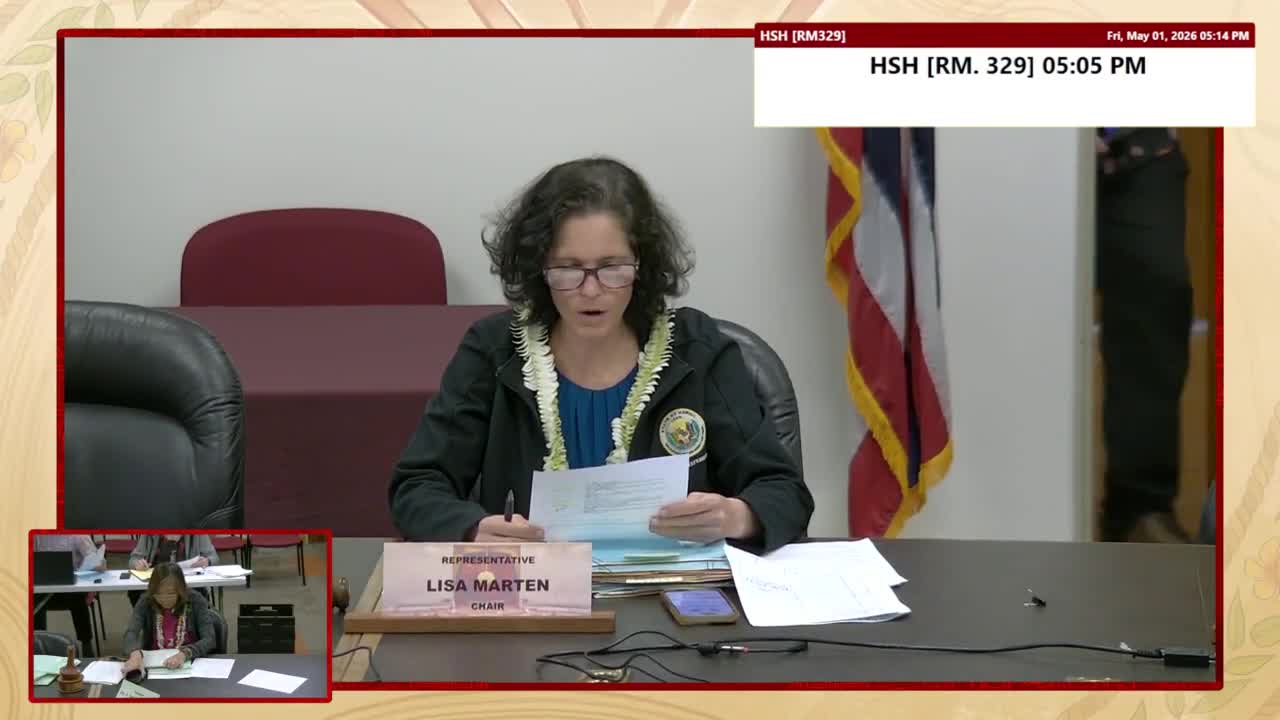 1MIN
Conference Committee
 36SEC
Conference Committee
 1MIN
Senate Standing Committee on Commerce and Consumer Protection
1MIN
Senate Standing Committee on Ways and Means
 8MIN
Senate Standing Committee on Health and Human Services
 39SEC
House Floor
 8MIN