SB 897: DCCA; PUC; Energy; Electric Utilities; Aggregate Liability Limit; Securitization; Electric Utility Infrastructure Resilience; Study; Report; Appropriation
- Session Year: 2025-2026
- House: Senate
- Latest Version Date: 2025-04-26
Current Status:
In Progress
(2025-07-01: Act 258, on 07/01/2025 (Gov. Msg. No. 1361).)
Introduced
In Committee
First Chamber
In Committee
Second Chamber
Final Decking
Enacted
Allows electric cooperatives to recover wildfire mitigation, repair, and restoration costs through an automatic rate adjustment or other mechanism. Requires the Public Utilities Commission to initiate a proceeding for the adoption of rules, subject to the Governor's approval, to determine an aggregate limit for liability for economic damages from a covered catastrophic wildfire. Authorizes securitization of certain costs for electric utilities. Requires the Public Utilities Commission to conduct studies on whether the framework established in the measure adequately balances electric utility interests and compensation owed to catastrophic wildfire victims and on the establishment and implementation of a wildfire recovery fund and report its findings and recommendations to the Legislature. Appropriates moneys. (CD1)
Allows electric cooperatives to recover wildfire mitigation, repaid, and restoration costs through an automatic rate adjustment or other mechanism. Establishes an aggregate limit for liability for economic damages from covered catastrophic wildfires. Authorizes securitization of certain costs for electric utilities. Establishes a working group to examine the establishment and implementation of a wildfire recovery fund and report its findings and recommendations to the Legislature. Effective 7/1/3000. (HD2)
Establishes an aggregate limit for liability for economic damages from catastrophic wildfires. Authorizes securitization of certain costs for public utilities. Effective 7/1/3000. (HD1)
Establishes the Wildfire Liability Trust Fund to be placed within the Department of Commerce and Consumer Affairs for administrative purposes. Specifies that the Wildfire Liability Trust Fund shall be administered by an Executive Director appointed by the Governor and confirmed by the Senate. Authorizes securitization for electric utilities. Requires the Public Utilities Commission to establish standards for each electric utility to replace fossil fuel resources with firm renewable energy sources in the renewable portfolio standard. Effective 5/13/2040. (SD3)
Establishes the Wildfire Liability Trust Fund to be administered by the Hawaii Electricity Reliability Administrator. Requires, rather than allows, the Public Utilities Commission to contract for a HERA and require payment of the Hawaii electricity reliability surcharge. Effective 5/13/2040. (SD2)
Requires, rather than allows, the Public Utilities Commission to contract for a Hawaii Electricity Reliability Administrator and require payment of the Hawaii electricity reliability surcharge. Establishes the Wildfire Recovery Fund. Expands the powers and duties of the Hawaii Electricity Reliability Administrator. Effective 5/13/2040. (SD1)
Requires, rather than allows, the Public Utilities Commission to contract for a Hawaii Electricity Reliability Administrator and require payment of the Hawaii electricity reliability surcharge. Establishes the Wildfire Recovery Fund. Expands the powers and duties of the Hawaii Electricity Reliability Administrator. (Proposed SD1)
Short form bill.
|
THE SENATE |
S.B. NO. |
897 |
|
THIRTY-THIRD LEGISLATURE, 2025 |
S.D. 3 |
|
|
STATE OF HAWAII |
H.D. 2 |
|
|
|
C.D. 1 |
|
|
|
||
|
|
||
A BILL FOR AN ACT
RELATING TO ENERGY.
BE IT ENACTED BY THE LEGISLATURE OF THE STATE OF HAWAII:
SECTION 1. Chapter 269, Hawaii Revised Statutes, is amended by adding two new sections to part I to be appropriately designated and to read as follows:
"§269-A Electric cooperative cost recovery for wildfire mitigation, repair, and restoration costs. (a) An electric cooperative may recover commission-approved wildfire mitigation, repair, and restoration costs through an automatic rate adjustment clause or other tariff recovery mechanism to be established by the commission.
(b) For purposes of this section, "electric cooperative" means a public utility that satisfies the requirements under section 269-31(c).
§269-B Determination of limitation on liability. (a) The commission shall initiate a proceeding for the adoption of rules pursuant to chapter 91 to establish the maximum amount each electric utility may pay to resolve claims arising from any covered catastrophic wildfires, as defined in section 663- , for set periods of time established by rules in accordance with this section. The commission shall have sole discretion to establish the maximum payable amounts and applicable periods of time. The rules adopted by the commission under this section shall have the force and effect of law.
(b) The commission shall adopt rules as soon as is practicable. The rules shall authorize the maximum payable amount each electric utility may pay to resolve qualifying damages arising from any covered catastrophic wildfires, as those terms are defined in section 663- , that occur within a set period of time, or per event, as determined by the commission, without harming ratepayers or materially impacting each electric utility's ability to provide adequate and safe service consistent with the public interest. In adopting rules to establish the maximum payable amount, the commission shall consider, at a minimum:
(1) Whether the maximum payable amount shall be delineated by the qualifying damages arising from covered catastrophic wildfires that occur:
(A) Within a set period of time that is determined by the commission; or
(B) Per event;
(2) Different approaches to establishing the maximum payable amount, such as a flat dollar limit for the set period of time, or per event; one based upon a percentage of the electric utility's market capitalization or rate base; or hybrid approaches, including examining frameworks adopted or considered in other wildfire-prone states and their effectiveness;
(3) Impacts on the electric utility's credit ratings, borrowing costs, and customer's electricity rates, and how the establishment of the maximum payable amount will help to achieve intended outcomes of improving the utility's credit rating and lowering costs passed on to customers;
(4) Impacts of the maximum payable amount upon the insurance market in the State;
(5) Impacts of the maximum payable amount on the indemnity, contribution, and subrogation rights of any person or entity;
(6) Impacts on the liability exposure of other hypothetical future co-defendants with respect to claims arising from a catastrophic wildfire;
(7) Impacts on potential future plaintiffs who could be negatively impacted by the establishment of the maximum payable amount;
(8) The affordability of electric utility service and the potential impacts on customer's electricity rates by the establishment of the maximum payable amount;
(9) Requirements to maintain or improve the quality of service to the electric utility's customers;
(10) Requirements to improve the management of the electric utility doing business in the State;
(11) Requirements to meet state policy goals for clean energy and climate;
(12) Requirements to implement wildfire mitigation plans and improve safety;
(13) Requirements to improve interconnection costs and timeliness; and
(14) The restriction or reduction of compensation packages and bonuses to officers and employees of the electric utility.
(c) The rules adopted pursuant to this section shall also include:
(1) Conditions to ensure that the establishment of the maximum payable amount is consistent with the public interest;
(2) Annual reporting requirements for compliance with any conditions established; and
(3) Procedures for corrective actions if the electric utility is not in compliance.
Rules required to be adopted under this section shall be adopted in a single rulemaking proceeding. Upon request by the commission, the electric utility or any state or county agency shall provide any information that is relevant to the rulemaking proceedings under this section.
(d) Notwithstanding any other law to the contrary, the rules adopted under this section shall be presented to, and subject to the approval of, the governor. If the governor approves the rules, the governor shall sign the rules, and the rules shall be adopted as provided in section 91-3. If the governor does not approve the rules, the governor may return the rules to the commission with the governor's reasons for disapproval. The governor shall have twenty-one days to consider the rules after the rules are presented to the governor, and if the rules are neither signed nor returned by the governor within that time, the rules shall be adopted as if the governor had signed them.
If the rules are returned to the commission, the commission may start anew the rule-making process set forth in subsection (b).
(e) On or before the last day of the preceding set period of time established by the commission with respect to each electric utility, the commission shall adopt rules pursuant to subsection (b) and (c) for the next subsequent proposed period of time.
(f) Notwithstanding any other law to the contrary, the supreme court shall have original jurisdiction over any petition to obtain a judicial determination as to the validity of the rules adopted under this section. The petition shall be filed with the clerk of the supreme court within thirty days of the filing of the rules with the lieutenant governor pursuant to section 91-4(b). After an action is filed pursuant to this paragraph, the supreme court shall give priority to the action over all other civil or administrative appeals or matters and shall render a final judgment and opinion as expeditiously as possible. No action challenging the validity of the rules may be brought except as provided in this subsection.
In all collateral proceedings, including any civil action to recover damages for a covered catastrophic wildfire, the maximum payable amounts established by the rules shall be conclusive and not subject to judicial review. Nothing in this section or rules adopted under this section shall be construed to create any property interest or entitlement of any kind in the electric utility, and no claim by any party, whether sounding in law or equity, or under article I, section 20, of the Hawaii State Constitution, may be brought against the commission, its commissioners, officials, and employees, or the State relating to rulemaking under this section.
(g) For purposes of this section:
"Electric utility" includes an electric cooperative, as defined in section 269‑A(b).
"Wildfire mitigation plan" means the plan that each electric utility shall file with the commission, and which shall be periodically updated at a frequency determined by the commission, that sets forth the utility's practices to protect public safety and reduce risk to customers from wildfires and to promote the resilience of the electric system to wildfire damage, pursuant to requirements established by the commission."
SECTION 2. Chapter 663, Hawaii Revised Statutes, is amended by adding a new section to be appropriately designated and to read as follows:
"§663- Limitation on aggregate liability; electric utilities. (a) The aggregate liability of an electric utility, including its affiliates, collectively, for qualifying damages arising from a covered catastrophic wildfire shall not exceed the least of the maximum payable amount authorized by the rules, adopted pursuant to section 269-B, for either the set period of time in which the covered catastrophic wildfire began or per event, as determined by the commission, or for the remainder of the maximum payable amount to the extent that the electric utility has already paid qualifying damages for the same time period or event.
(b) An electric utility that seeks to assert the limitation on aggregate liability set forth in subsection (a) shall:
(1) Have a wildfire mitigation plan, as defined in section 269-B, that is approved by the commission and shall have sought and received a determination from the commission that the plan is being implemented on the timeline approved by the commission; and
(2) Be in full compliance with any conditions and reporting requirements established by rule pursuant to subsection 269-B(c).
(c) All civil actions arising out of a catastrophic wildfire shall be brought in the circuit in which the catastrophic wildfire occurred. The court shall adopt procedures to equitably apply the limit set forth in subsection (a) to all filed civil claims, and notwithstanding any law to the contrary, joint and several liability shall not apply to qualifying damages, even as to any amount of qualifying damages in excess of the aggregate liability of an electric utility; provided that in any action to recover from a person or an entity in connection with a covered catastrophic wildfire, the person or entity may claim, in defense, apportionment of fault to any other person, entity, electric utility, or electric cooperative, even as to those who are not a party to the action. The exceptions to the abolition of joint and several liability set forth in section 663-10.9 shall not apply to any suit, claim, arbitration, or other civil action arising out of a covered catastrophic wildfire. All settlements or judgments for claims for qualifying damages shall be subject to approval by the court. The court shall not approve any settlement or judgment that would cause the aggregate liability of electric utilities to exceed the aggregate liability limit prescribed by the commission if the utility is entitled to invoke the limitation under subsection (a). No liability allocable to the electric utility that is not payable because of the aggregate liability limit shall be shifted, in any manner, to any other alleged tortfeasor or obligor.
(d) A court may consolidate cases arising from a covered catastrophic wildfire. Any circuit court that is not the consolidating court shall transfer any civil case to facilitate the consolidation.
(e) No later than twenty days prior to the convening of each regular session, the commission shall study and submit a report to the legislature that includes:
(1) An assessment of whether the factors considered pursuant to section 269-B(b) adequately balance the solvency interests of electric utilities with the compensation owed in the previous year to catastrophic wildfire victims, or whether additional factors should be considered; and
(2) Any other findings and recommendations, including any necessary proposed legislation.
(f) For the purposes of this section:
"Catastrophic wildfire" means a wildfire occurring in the State on or after the effective date of this Act that substantially damages or destroys more than five hundred commercial structures or residential structures designed for habitation or, for an electric cooperative, a wildfire that substantially damages or destroys more than fifty commercial structures or residential structures designed for habitation.
"Covered catastrophic wildfire" means a catastrophic wildfire that may have been caused, or whose severity may have been increased, by an electric utility's facilities or actions.
"Electric utility" means a public utility that exists for the furnishing of electrical power, including an electric cooperative.
"Electric cooperative" is an electric utility that has the same meaning as in section 269-31(c).
"Public utility" has the same meaning as in section 269‑1.
"Qualifying damages" means economic damages arising out of the loss of or damage to real or personal property from a covered catastrophic wildfire. "Qualifying damages" does not include claims for physical bodily harm or emotional harm."
PART II
SECTION 3. The Hawaii Revised Statutes is amended by adding a new chapter to be appropriately designated and to read as follows:
"CHAPTER
SECURITIZATION
§ -1 Definitions. As used in this chapter, unless the context otherwise requires:
"Ancillary agreement" means a bond insurance policy, letter of credit, reserve account, surety bond, swap arrangement, hedging arrangement, liquidity or credit support arrangement, or other similar agreement or arrangement entered into in connection with the issuance of bonds that is designed to promote the credit quality and marketability of the bonds or to mitigate the risk of an increase in interest rates.
"Assignee" means a legally recognized entity to which an electric utility assigns, sells, or transfers, other than as security, all or a portion of the electric utility's interest in or right to infrastructure resilience property. "Assignee" includes a corporation, limited liability company, general partnership or limited partnership, public authority, trust, financing entity, or any other legal entity to which an assignee assigns, sells, or transfers, other than as security, its interest in or right to infrastructure resilience property.
"Bond" means any bond, note, certificate of participation or beneficial interest, or other evidence of indebtedness or ownership that is issued by the financing entity under a financing order, the proceeds of which are used directly or indirectly to recover, finance, or refinance financing costs of any infrastructure resilience costs, and that are directly or indirectly secured by or payable from infrastructure resilience property.
"Commission" means the public utilities commission.
"Consumer" means any individual, governmental body, trust, business entity, or nonprofit organization that consumes electricity that has been transmitted or distributed by means of electric transmission or distribution facilities, whether those electric transmission or distribution facilities are owned by the consumer, the electric utility, or any other party.
"Electric utility" means a public utility that exists for the furnishing of electrical power.
"Executive officer" means any person who performs policy making functions and is employed by an electric utility subject to the approval of the board of directors, and includes the president, secretary, treasurer, and any vice president in charge of a principal business unit, division, or function of the electric utility.
"Financing costs" means the costs to issue, service, repay, or refinance bonds, whether incurred or paid upon issuance of the bonds or over the life of the bonds, if they are approved for recovery by the commission in a financing order. "Financing costs" may include any of the following:
(1) Principal, interest, and redemption premiums that are payable on bonds;
(2) A payment required under an ancillary agreement;
(3) An amount required to fund or replenish reserve accounts or other accounts established under an indenture, ancillary agreement, or other financing document related to the bonds;
(4) Taxes, franchise fees, or license fees imposed on a financing entity as a result of the issuance of the financing order; the assignment, sale, or transfer of any infrastructure resilience property; or the sale of the bonds, or imposed on the infrastructure resilience charges, or otherwise resulting from the collection of the infrastructure resilience charge, in any such case whether paid, payable, or accrued;
(5) Costs related to issuing and servicing bonds or the application for a financing order, including without limitation servicing fees and expenses, trustee fees and expenses, legal fees and expenses, accounting fees, administrative fees, underwriting and placement fees, financial advisory fees, original issue discount, capitalized interest, rating agency fees, and any other related costs that are approved for recovery in the financing order;
(6) Costs related to the engagement of services of a financial advisor by the commission; and
(7) Other costs as specifically authorized by a financing order.
"Financing entity" means an electric utility or an entity to which an electric utility or an affiliate of an electric utility sells, assigns, or pledges all or a portion of the electric utility's interest in infrastructure resilience property, including an affiliate of the electric utility or any unaffiliated entity, in each case as approved by the commission in a financing order.
Subject to section -6(c), an entity to which an electric utility sells, assigns, or pledges all or a portion of the electric utility's interest in infrastructure resilience property may include any governmental entity that is able to issue bonds that are exempt from federal tax pursuant to section 103 of the Internal Revenue Code of 1986, as amended, including the State or a political subdivision thereof or any department, agency, or instrumentality of the State or political subdivision; provided that the bonds issued shall not constitute a general obligation of the State or any political subdivision thereof or any department, agency, or instrumentality of the State or political subdivision and shall not constitute a pledge of the full faith and credit of the entity or of the State or any political subdivision thereof, but shall be payable solely from the funds provided under this chapter.
"Financing order" means an order of the commission under this chapter that has become final and no longer subject to appeal as provided by law and that authorizes the issuance of bonds and the imposition, adjustment from time to time, and collection of infrastructure resilience charges, and that shall include a procedure to require the expeditious approval by the commission of periodic adjustments to infrastructure resilience charges and to any associated fixed recovery tax amounts included in that financing order to ensure recovery of all infrastructure resilience costs and the costs associated with the proposed recovery, financing, or refinancing thereof, including the costs of servicing and retiring the bonds contemplated by the financing order.
"Financing party" means any holder of the bonds; any party to or beneficiary of an ancillary agreement; and any trustee, collateral agent, or other person acting for the benefit of any of the foregoing.
"Fixed recovery tax amounts" means those nonbypassable rates and other charges, including but not limited to distribution, connection, disconnection, and termination rates and charges, that are needed to recover federal and state taxes associated with infrastructure resilience charges authorized by the commission in a financing order, but are not approved as financing costs financed from proceeds of bonds.
"Infrastructure resilience charges" means the nonbypassable charges, including but not limited to distribution, connection, disconnection, and termination rates and charges, that are authorized in a financing order authorized under this chapter to be imposed on and collected from all existing and future consumers of an electric utility or any successor to recover principal, interest, and other financing costs relating to the bonds issued by its financing entity.
"Infrastructure resilience costs" means an electric utility's costs to implement its wildfire risk mitigation plan and other investments in infrastructure improvements, modernization, and replacement needed to reduce wildfire risks and increase reliability and resilience to natural disasters and weather-related events, as approved by the commission.
"Infrastructure resilience property" means the property right created pursuant to this chapter, including but not limited to the right, title, and interest of an electric utility, financing entity, or its assignee:
(1) In and to the infrastructure resilience charge established pursuant to a financing order, including the right to impose, bill, collect, and receive the infrastructure resilience charges under the financing order and all rights to obtain adjustments to the infrastructure resilience charge in accordance with section -3 and the financing order; and
(2) To be paid the amount that is determined in a financing order to be the amount that the electric utility or its assignee is lawfully entitled to receive pursuant to this chapter and the proceeds thereof, and in and to all revenues, collections, claims, payments, moneys, or proceeds of, or arising from, the infrastructure resilience charge that is the subject of a financing order.
"Infrastructure resilience property" does not include a right to be paid fixed recovery tax amounts. "Infrastructure resilience property" shall constitute a current property right, notwithstanding the fact that the value of the property right will depend on consumers using electricity or, in those instances where consumers are customers of the electric utility, the electric utility performing certain services.
"Investor-owned electric utility" means an electric utility that is owned by shareholders and overseen by a board of directors elected by shareholders.
"Public utility" has the same meaning as in section 269‑1.
"True-up adjustment" means a formulaic adjustment to the infrastructure resilience charges as they appear on consumer bills that is necessary to correct for any overcollection or undercollection of the infrastructure resilience charges authorized by a financing order and to otherwise ensure the timely and complete payment and recovery of infrastructure resilience costs over the authorized repayment term.
"Wildfire risk mitigation plan" means a plan, which may include a natural hazard mitigation report, in which an electric utility addresses how the electric utility will mitigate the risk to its equipment in the event of a wildfire.
§ -2 Applications to issue bonds and authorize infrastructure resilience charges. (a) An electric utility may apply to the commission for one or more financing orders to issue bonds to recover any infrastructure resilience costs, each of which authorizes the following:
(1) The imposition, charging, and collection of an infrastructure resilience charge, to become effective upon the issuance of the bonds, and an adjustment of any such infrastructure resilience charge in accordance with a true-up adjustment mechanism under this chapter in amounts sufficient to pay the principal and interest on the bonds and all other associated financing costs on a timely basis;
(2) The creation of infrastructure resilience property under the financing order; and
(3) The imposition, charging, and collection of fixed recovery tax amounts to recover any portion of the electric utility's federal and state taxes associated with those infrastructure resilience charges and not financed from the proceeds of bonds.
(b) The commission may issue a financing order that authorizes the issuance of bonds under subsection (a) only if:
(1) The electric utility, in good faith, has sought the maximum federal funding to offset the costs of infrastructure;
(2) After the effective date of this Act, the first $500,000,000 in infrastructure resilience capital investments, in the aggregate, must be made under this Act; and
(3) Any assets that are to be financed under securitization should not already be included in the electric utility's rate base.
(c) The application shall include all of the following:
(1) The infrastructure resilience costs to be financed through the issuance of bonds;
(2) The principal amount of the bonds proposed to be issued and the selection of a financing entity;
(3) An estimate of the date on which each series of bonds is expected to be issued;
(4) The scheduled final payment date, which shall not exceed thirty years, and a legal final maturity date, which may be longer, subject to rating agency and market considerations, during which term the infrastructure resilience charge associated with the issuance of each series of bonds is expected to be imposed and collected;
(5) An estimate of the financing costs associated with the issuance of each series of bonds;
(6) An estimate of the amount of the infrastructure resilience charge revenues necessary to pay principal and interest on the bonds and all other associated financing costs as set forth in the application and calculation for that estimate;
(7) A proposed design of the infrastructure resilience charge and a proposed methodology for allocating the infrastructure resilience charge among customer classes within the electric utility's service territory;
(8) A description of the financing entity selected by the electric utility;
(9) A description of a proposed true-up adjustment mechanism for the adjustment of the infrastructure resilience charge to correct for any overcollection or undercollection of the infrastructure resilience charge, and to otherwise ensure the timely payment of principal and interest on the bonds and all other associated financing costs; and
(10) Any other information required by the commission.
(d) An electric utility may file an application for a financing order, or as a joint applicant with one or more affiliate electric utilities, to issue bonds to recover infrastructure resilience costs. The application shall include a description of:
(1) How the infrastructure resilience charges will be allocated among the applicant electric utilities in a manner that is equitable and that need not correspond to the incurrence of infrastructure resilience costs by each electric utility; and
(2) Whether and how the consumers of any of the applicant electric utilities will be responsible for the payment of infrastructure resilience charges allocated to consumers of affiliate electric utilities.
In the alternative, an electric utility may apply for a financing order to issue bonds to recover infrastructure resilience costs, including infrastructure resilience costs incurred, or to be incurred, by the applicant and one or more of its affiliate electric utilities. In connection with the issuance of a financing order pursuant to this subsection, the commission shall issue a concurrent order to the affiliate electric utility or electric utilities directing the affiliate electric utility or electric utilities to impose rates on its or their consumers designed to generate revenue sufficient to pay credits over the life of the bonds to the applicant electric utility in the amount as the commission determines is equitable, just, and reasonable. The application shall describe the allocation method and adjustment mechanism for the affiliate electric utility credit payments proposed to be subject to the concurrent commission order.
(e) The commission shall issue an approval or denial of any application for a financing order filed pursuant to this section within ninety days of the last filing in the applicable docket.
(f) In exercising its duties under this section, the commission shall consider:
(1) Whether the issuance of the bonds, and the imposition and collection of infrastructure resilience charges, are consistent with the public interest;
(2) Whether the structuring, marketing, and pricing of the bonds are expected to result in the lowest infrastructure resilience charges consistent with market conditions at the time at which the bonds are priced and the terms of the financing order;
(3) Whether the terms and conditions of any bonds to be issued are just and reasonable;
(4) With respect to an application by an investor-owned electric utility, whether the recovery of infrastructure resilience costs through the designation of the infrastructure resilience charges and any associated fixed recovery tax amounts, and the issuance of bonds in connection with the infrastructure resilience charges, would result in net savings or mitigate rate impacts to consumers, as compared to rate recovery without securitization; and
(5) Any other factors that the commission deems reasonable and in the public interest.
If the commission makes the determination specified in this section, the commission shall establish, as part of the financing order, a procedure for the electric utility to submit applications from time to time to request the issuance of additional financing orders designating infrastructure resilience charges and any associated fixed recovery tax amounts as recoverable.
An electric utility may include in its application for a financing order a request for authorization to sell, transfer, assign, or pledge infrastructure resilience property to a governmental entity if the electric utility expects bonds issued by a governmental entity to result in a more cost-efficient means, taking into account all financing costs related to the bonds, than using another financing entity to issue bonds to finance the same infrastructure resilience costs, taking into account the costs of issuing the other financing entity's bonds.
(g) Infrastructure resilience charges and any associated fixed recovery tax amounts shall be imposed only on existing and future consumers in the utility service territory of the electric utility that is subject to such financing order. Consumers within the utility service territory of the electric utility that are subject to the financing order shall continue to pay infrastructure resilience charges and any associated fixed recovery tax amounts until the bonds and associated financing costs are paid in full by the financing entity.
§ -3 Infrastructure resilience financing order. (a) A financing order shall remain in effect until the bonds issued under the financing order and all financing costs related to the bonds have been paid in full or defeased by their terms. The aggregate of the financing orders shall be for no greater than $500,000,000 of the infrastructure resilience costs for a corporate family of the electric utility.
A financing order shall remain in effect and unabated notwithstanding the bankruptcy, reorganization, or insolvency of the electric utility or the commencement of any judicial or nonjudicial proceeding on the financing order.
(b) Notwithstanding any other law to the contrary, with respect to infrastructure resilience property that has been made the basis for the issuance of bonds and with respect to any associated fixed recovery tax amounts, the financing order, the infrastructure resilience charges, and any associated fixed recovery tax amounts shall be irrevocable. The State and its agencies, including the commission, pledge and agree with bondholders, the owners and assignees of the infrastructure resilience property, and other financing parties that the State and its agencies shall not take any action listed in this subsection. This subsection shall not preclude an action if the action would not adversely affect the interests of the electric utility, of assignees of the infrastructure resilience property, and of bondholders. The prohibited actions shall be the following:
(1) Alter the provisions of this chapter, which authorize the commission to create an irrevocable contract right or choose in action by the issuance of a financing order, to create infrastructure resilience property and make the infrastructure resilience charges imposed by a financing order irrevocable, binding, nonbypassable charges for all existing and future consumers;
(2) Take or permit any action that impairs or would impair the value of infrastructure resilience property or the security for the bonds or revise the infrastructure resilience costs for which recovery is authorized;
(3) In any way impair the rights and remedies of the bondholders, assignees, and other financing parties; and
(4) Except for changes made pursuant to the true-up adjustment authorized under subsection (d), reduce, alter, or impair infrastructure resilience charges that are to be imposed, billed, charged, collected, and remitted for the benefit of the bondholders, any assignee, and any other financing parties until any and all principal, interest, premium, financing costs, and other fees, expenses, or charges incurred, and any contracts to be performed, in connection with the related bonds have been paid and performed in full.
The financing entity may include this pledge in the bonds.
(c) Under a financing order, the electric utility shall retain sole discretion to select the financing entity and to cause bonds to be issued, including the right to defer or postpone the issuance, assignment, sale, or transfer of infrastructure resilience property.
(d) The commission may create, pursuant to an application from an electric utility, a nonbypassable charge referred to as an infrastructure resilience charge, which shall be applied to recover principal, interest, and other financing costs relating to the bonds. The infrastructure resilience charge shall be a dedicated, discrete tariff rider.
The commission, in any financing order, shall establish a procedure for periodic true-up adjustments to infrastructure resilience charges, which shall be made at least annually and may be made more frequently. Within thirty days after receiving an electric utility's filing of a true-up adjustment, the commission's review of the filing shall be limited to mathematical or clerical errors as determined in accordance with any true-up adjustment formulas set forth in the applicable financing order.
The commission shall either approve the filing or inform the electric utility of any mathematical or clerical errors in its calculation. If the commission informs the electric utility of mathematical or clerical errors in its calculation, the electric utility shall correct its error and refile its true-up adjustment. The timeframes previously described in this subsection shall apply to a refiled true-up adjustment.
(e) The commission may include in the financing order a requirement that, if the electric utility fails to transfer the wildfire recovery charges it has collected, the commission will order that those funds shall be withheld and paid directly to the applicable financing entity. Any order shall remain in full force and effect notwithstanding any bankruptcy, reorganization, or other insolvency proceedings with respect to the electric utility.
(f) Neither financing orders nor bonds issued under this chapter shall constitute a general obligation of the State or any of its political subdivisions, nor shall they constitute a pledge of the full faith and credit of the State or any of its political subdivisions, but shall be payable solely from the infrastructure resilience property provided under this chapter.
All bonds shall contain on the face thereof a statement to the following effect: "Neither the full faith and credit nor the taxing power of the State of Hawaii is pledged to the payment of the principal of, or interest and premium on, this bond."
The issuance of bonds under this chapter shall not directly, indirectly, or contingently obligate the State or any of its political subdivisions to levy or pledge any form of taxation or make any appropriation for their payment.
(g) Infrastructure resilience charges are infrastructure resilience property when, and to the extent that, a financing order authorizing the infrastructure resilience charges has become effective in accordance with this chapter, and the infrastructure resilience property shall thereafter continuously exist as property for all purposes, and all of the rights and privileges relating to that property shall continuously exist for the period and to the extent provided in the financing order, but in any event until the bonds, including all principal; premiums, if any; interest with respect to the bonds; and all other financing costs are paid in full. A financing order may provide that the creation of infrastructure resilience property shall be simultaneous with the sale of the infrastructure resilience property to an assignee as provided in the application of the pledge of the infrastructure resilience property to secure the bonds.
(h) Any successor to a financing entity shall be bound by the requirements of this chapter and shall perform and satisfy all obligations of and have the same rights under a financing order as, and to the same extent as, the financing entity.
(i) No electric utility approved for a financing order shall increase compensation for its executive officers unless the utility's wildfire risk mitigation plan compliance reports have been approved by the commission for five consecutive years; provided that the commission may consider an alternative symmetric performance incentive mechanism, if the commission deems appropriate. For the purposes of this subsection, "wildfire risk mitigation plan" has the same meaning as in section -1.
(j) As used in this section, "corporate family" means a group of corporations consisting of a parent corporation and all subsidiaries in which the parent corporation owns directly or indirectly a controlling interest.
(k) The commission, in its discretion, may engage the services of a financial adviser for the purposes of assisting the commission in its consideration of an application for a financing order and a subsequent issuance of bonds pursuant to a financing order.
§ -4 Bonds; issuance; infrastructure resilience property interests. (a) The electric utility may sell and assign all or portions of its interest in infrastructure resilience property to one or more financing entities that make that infrastructure resilience property the basis for issuance of bonds, to the extent approved in a financing order. The electric utility or financing entity may pledge infrastructure resilience property as collateral, directly or indirectly, for bonds to the extent approved in the pertinent financing orders providing for a security interest in the infrastructure resilience property, in the manner set forth in this section. In addition, infrastructure resilience property may be sold or assigned by either of the following:
(1) The financing entity or a trustee for the holders of bonds or the holders of an ancillary agreement in connection with the exercise of remedies upon a default under the terms of the bonds; or
(2) Any person acquiring the infrastructure resilience property after a sale or assignment pursuant to this chapter.
(b) To the extent that any interest in infrastructure resilience property is sold, assigned, or is pledged as collateral pursuant to subsection (a), the commission shall require the electric utility to contract with the financing entity or its assignees that the electric utility will:
(1) Continue to operate its system to provide service to consumers within its service territory;
(2) Collect amounts in respect of the infrastructure resilience charges for the benefit and account of the financing entity or its assignees; and
(3) Account for and remit these amounts to or for the account of the financing entity or its assignees.
Contracting with the financing entity or its assignees in accordance with that authorization shall not impair or negate the characterization of the sale, assignment, or pledge as an absolute transfer, a true sale, or a security interest, as applicable. To the extent that billing, collection, and other related services with respect to the provision of the electric utility's services are provided to a consumer by any person or entity other than the electric utility in whose service territory the consumer is located, that person or entity shall collect the infrastructure resilience charges and any associated fixed recovery tax amounts from the consumer for the benefit and account of the electric utility, financing entity, or assignees with the associated revenues remitted solely for the person's benefit as a condition to the provision of electric utility service to that consumer.
Each financing order shall impose terms and conditions, consistent with the purposes and objectives of this chapter, on any person or entity responsible for billing, collection, and other related services, including but not limited to collection of the infrastructure resilience charges and any associated fixed recovery tax amounts, that are the subject of the financing order.
(c) The financing entity may issue bonds upon approval by the commission in a financing order. Bonds shall be nonrecourse to the credit or any assets of the electric utility, other than the infrastructure resilience property as specified in that financing order.
(d) Infrastructure resilience property that is specified in a financing order shall constitute an existing, present property right, notwithstanding the fact that the imposition and collection of infrastructure resilience charges depend on the electric utility's continuing to provide services or continuing to perform its servicing functions relating to the collection of infrastructure resilience charges or on the level of future service consumption, such as consumption of an electric utility service. Infrastructure resilience property shall exist whether or not the infrastructure resilience charges have been billed, have accrued, or have been collected, and notwithstanding the fact that the value for a security interest in the infrastructure resilience property, or amount of the infrastructure resilience property, is dependent on the future provision of service to consumers. All infrastructure resilience property specified in a financing order shall continue to exist until the bonds issued pursuant to a financing order and all associated financing costs are paid in full.
(e) Infrastructure resilience property; infrastructure resilience charges; and the interests of an assignee, bondholder, or financing entity, or any pledgee in infrastructure resilience property and infrastructure resilience charges shall not be subject to setoff, counterclaim, surcharge, recoupment, or defense by the electric utility or any other person or in connection with the bankruptcy, reorganization, or other insolvency proceeding of the electric utility, any affiliate of the electric utility, or any other entity.
(f) Notwithstanding any law to the contrary, any requirement under this chapter or a financing order that the commission acts upon shall be binding upon the commission, as it may be constituted from time to time, and any successor agency exercising functions similar to the commission, and the commission shall have no authority to rescind, alter, or amend that requirement in a financing order.
§ -5 Infrastructure resilience charge. (a) The infrastructure resilience charge created pursuant to a financing order approved pursuant to section -2 shall be a nonbypassable charge of a financing entity that shall be applied to the repayment of bonds and related financing costs as described in this chapter. The infrastructure resilience charge and any associated fixed recovery tax amounts may be a usage‑based charge, a flat user charge, or a charge based upon customer revenues as determined by the commission for each consumer class in any financing order.
(b) As long as any bonds are outstanding and any financing costs have not been paid in full, any infrastructure resilience charge and any associated fixed recovery tax amounts authorized under a financing order shall be nonbypassable. Subject to any exceptions provided in a financing order, an infrastructure resilience charge and any associated fixed recovery tax amounts shall be paid by all existing and future consumers within the utility service territory.
(c) The infrastructure resilience charge shall be collected by an electric utility or its successors, in accordance with section -8(a), in full through a charge that is separate and apart from the electric utility's rates. The infrastructure resilience charge shall be collected by the public utilities or their successors as collection agents for the applicable financing entity, and such amounts shall be held in trust until transferred to the applicable financing entity.
(d) An electric utility may exercise the same rights and remedies under its tariff and applicable law and regulation based on a consumer's nonpayment of the infrastructure resilience charge as it could for a consumer's failure to pay any other charge payable to that electric utility.
§ -6 Security interests in infrastructure resilience property; financing statements. (a) A security interest in infrastructure resilience property is valid and enforceable against the pledgor and third parties, subject to the rights of any third parties holding security interests in the infrastructure resilience property perfected in the manner described in this section, and attaches when all of the following have occurred:
(1) The commission has issued a financing order authorizing the infrastructure resilience charge to be included in the infrastructure resilience property;
(2) Value has been given by the pledgees of the infrastructure resilience property; and
(3) The pledgor has signed a security agreement covering the infrastructure resilience property.
(b) A valid and enforceable security interest in infrastructure resilience property is perfected when it has attached and when a financing statement has been filed with the bureau of conveyances naming the pledgor of the infrastructure resilience property as "debtor" and identifying the infrastructure resilience property.
Any description of the infrastructure resilience property shall be sufficient if it refers to the financing order creating the infrastructure resilience property. A copy of the financing statement shall be filed with the commission by the electric utility that is the pledgor or transferor of the infrastructure resilience property. The commission may require the electric utility to make other filings with respect to the security interest in accordance with procedures that the commission may establish; provided that the filings shall not affect the perfection of the security interest.
(c) A perfected security interest in infrastructure resilience property shall be a continuously perfected security interest in all infrastructure resilience property revenues and proceeds arising with respect thereto, whether or not the revenues or proceeds have accrued. Conflicting security interests shall rank according to priority in time of perfection. Infrastructure resilience property shall constitute property for all purposes, including for contracts securing bonds, whether or not the infrastructure resilience property revenues and proceeds have accrued.
(d) Subject to the terms of the security agreement covering the infrastructure resilience property and the rights of any third parties holding security interests in the infrastructure resilience property, perfected in the manner described in this section, the validity and relative priority of a security interest created under this section shall not be defeated or adversely affected by the commingling of revenues arising with respect to the infrastructure resilience property with other funds of the electric utility that is the pledgor or transferor of the infrastructure resilience property, or by any security interest in a deposit account of that electric utility perfected under article 9 of chapter 490, into which the revenues are deposited.
Subject to the terms of the security agreement, upon compliance with the requirements of section 490:9-312(b)(1), the pledgees of the infrastructure resilience property shall have a perfected security interest in all cash and deposit accounts of the electric utility in which infrastructure resilience property revenues have been commingled with other funds.
(e) If default occurs under the security agreement covering the infrastructure resilience property, the pledgees of the infrastructure resilience property, subject to the terms of the security agreement, and upon receiving approval from the commission for a foreclosure request, shall be entitled to foreclose or otherwise enforce their security interest in the infrastructure resilience property, subject to the rights of any third parties holding prior security interests in the infrastructure resilience property perfected in the manner provided in this section.
In addition, the commission may require in the financing order creating the infrastructure resilience property that in the event of default by the electric utility in payment of infrastructure resilience property revenues, the commission and any successor thereto, upon the application by the pledgees or assignees, including assignees under section -4 of the infrastructure resilience property, and without limiting any other remedies available to the pledgees or assignees by reason of the default, shall order the sequestration and payment to the pledgees or assignees of infrastructure resilience property revenues. Any financing order shall remain in full force and effect notwithstanding any bankruptcy, reorganization, or other insolvency proceedings with respect to the debtor, pledgor, or transferor of the infrastructure resilience property. Any surplus in excess of amounts necessary to pay principal; premiums, if any; interest, costs, and arrearages on the bonds; and associated financing costs arising under the security agreement, shall be remitted to the debtor, pledgor, or transferor, for the purpose of remitting such amounts to customers via the electric utility.
(f) Sections 490:9-204 and 490:9-205 shall apply to a pledge of infrastructure resilience property by the electric utility, an affiliate of the electric utility, or a financing entity.
§ -7 Transfers of infrastructure resilience property. (a) A transfer or assignment of infrastructure resilience property by the electric utility to an assignee or to a financing entity, or by an assignee of the electric utility or a financing entity to another financing entity, which the parties in the governing documentation have expressly stated to be a sale or other absolute transfer, in a transaction approved in a financing order, shall be treated as an absolute transfer of all of the transferor's right, title, and interest, as in a true sale, and not as a pledge or other financing, of the infrastructure resilience property, other than for federal and state income and franchise tax purposes.
(b) The characterization of the sale, assignment, or transfer as an absolute transfer and true sale and the corresponding characterization of the property interest of the assignee shall not be affected or impaired by, among other things, the occurrence of any of the following:
(1) Commingling of infrastructure resilience charge revenues with other amounts;
(2) The retention by the seller of either of the following:
(A) A partial or residual interest, including an equity interest, in the financing entity or the infrastructure resilience property, whether direct or indirect, subordinate or otherwise; or
(B) The right to recover costs associated with taxes, franchise fees, or license fees imposed on the collection of infrastructure resilience charge;
(3) Any recourse that an assignee may have against the seller;
(4) Any indemnification rights, obligations, or repurchase rights made or provided by the seller;
(5) The obligation of the seller to collect infrastructure resilience charges on behalf of an assignee;
(6) The treatment of the sale, assignment, or transfer for tax, financial reporting, or other purpose; or
(7) Any true-up adjustment of the infrastructure resilience charge as provided in the financing order.
(c) A transfer of infrastructure resilience property shall be deemed perfected against third parties when:
(1) The commission issues the financing order authorizing the infrastructure resilience charge included in the infrastructure resilience property; and
(2) An assignment of the infrastructure resilience property in writing has been executed and delivered to the assignee.
(d) As between bona fide assignees of the same right for value without notice, the assignee first filing a financing statement with the bureau of conveyances in accordance with part 5 of article 9 of chapter 490, naming the assignor of the infrastructure resilience property as debtor and identifying the infrastructure resilience property, shall have priority. Any description of the infrastructure resilience property shall be sufficient if it refers to the financing order creating the infrastructure resilience property. A copy of the financing statement shall be filed by the assignee with the commission, and the commission may require the assignor or the assignee to make other filings with respect to the transfer in accordance with procedures the commission may establish; provided that these filings shall not affect the perfection of the transfer.
§ -8 Financing entity successor requirements; default of financing entity. (a) Any successor to an electric utility subject to a financing order, whether pursuant to any bankruptcy, reorganization, or other insolvency proceeding, or pursuant to any merger, sale, or transfer, by operation of law, or otherwise, shall be bound by the requirements of this chapter. The successor of the electric utility shall perform and satisfy all obligations of the electric utility under the financing order in the same manner and to the same extent as the electric utility, including the obligation to collect and pay the infrastructure resilience charge to any financing party as required by a financing order or any assignee. Any successor to the electric utility shall be entitled to receive any fixed recovery tax amounts otherwise payable to the electric utility.
(b) The commission may require in a financing order that, if a default by the electric utility in remittance of the infrastructure resilience charge collected arising with respect to infrastructure resilience property occurs, the commission, without limiting any other remedies available to any financing party by reason of the default, shall order the sequestration and payment to the beneficiaries of the infrastructure resilience charge collected arising with respect to the infrastructure resilience property. Any order shall remain in full force and effect notwithstanding any bankruptcy, reorganization, or other insolvency proceedings with respect to the electric utility.
§ -9 Report to legislature. No later than twenty days prior to the convening of each regular session, the commission shall submit a report to the legislature that includes:
(1) An update on its activities under this chapter, including how the securitization authorized under this chapter is being utilized; and
(2) Any other findings and recommendations, including any necessary proposed legislation.
§ -10 Severability. If any provision of this chapter is held to be invalid or is superseded, replaced, repealed, or expires for any reason:
(1) That occurrence shall not affect any action allowed under this chapter that is taken prior to that occurrence by the commission, a financing entity, a bondholder, or any financing party, and any such action shall remain in full force and effect; and
(2) The validity and enforceability of the rest of this chapter shall remain unaffected."
SECTION 4. Section 269-17, Hawaii Revised Statutes, is amended to read as follows:
"§269-17
Issuance of securities. A
public utility corporation may, on securing the prior approval of the public
utilities commission, and not otherwise, except as provided in section
-4, issue stocks and stock certificates, bonds, notes,
and other evidences of indebtedness, payable at periods of more than twelve
months after the date thereof, for the following purposes and no other,
namely: for the acquisition of property
or for the construction, completion, extension, or improvement of or addition
to its facilities or service, or for the discharge or lawful refunding of its
obligations or for the reimbursement of moneys actually expended from income or
from any other moneys in its treasury not secured by or obtained from the issue
of its stocks or stock certificates, or bonds, notes, or other evidences of
indebtedness, for any of the [aforesaid] purposes stated in this
section except maintenance of service, replacements, and substitutions not
constituting capital expenditure in cases where the corporation has kept its
accounts for [such] those expenditures in [such] a
manner [as to enable] that enables the commission to ascertain
the amount of moneys so expended and the purposes for which the expenditures
were made, and the sources of the funds in its treasury applied to the
expenditures. As used [herein,] in
this section, "property" and "facilities"[,]
mean property and facilities used in all operations of a public utility
corporation regardless of whether [or not] included in its public
utility operations or rate base. A
public utility corporation may not issue securities to acquire property or to
construct, complete, extend or improve or add to its facilities or service if
the commission determines that the proposed purpose will have a material
adverse effect on its public utility operations.
All stock and every stock certificate, and every bond, note, or other evidence of indebtedness of a public utility corporation not payable within twelve months, issued without an order of the commission authorizing the same, then in effect, shall be void."
PART III
(1) Provide efficient compensation for damage resulting from a future wildfire that was allegedly caused or exacerbated by an electric utility; and
(2) Help protect the financial integrity of Hawaii's regulated utilities.
(b) The public utilities commission shall review, examine, and consider the following:
(1) How a fund would impact utility credit ratings and costs to customers, including comparing how funds in other states have performed;
(2) Whether the establishment of a fund is recommended;
(3) If a fund is recommended, a determination of the size of the wildfire recovery fund, which may include commissioning of an actuarial study;
(4) If a fund is recommended, a determination of the best approach to capitalizing the fund and whether moneys used to capitalize the fund should come from ratepayers or shareholders, or both;
(5) If a fund is recommended, a determination of the proper governance of the public corporation that would oversee the wildfire recovery fund;
(6) If a fund is recommended, a consideration of the benefits of an administrative process to provide efficient and low-cost recovery for claimants, and the proper mechanism for providing such an administrative process; and
(7) A consideration of who can participate in the fund and if parties other than an electric utility should be considered for participation.
(c) The public utilities commission shall submit a report of its findings and recommendations, including any proposed legislation, to the legislature no later than twenty days prior to the convening of the regular session of 2026.
PART IV
SECTION 6. There is appropriated out of the general revenues of the State of Hawaii the sum of $500,000 or so much thereof as may be necessary for fiscal year 2025‑2026 for consultant contracts.
The sum appropriated shall be expended by the public utilities commission for the purposes of this Act.
SECTION 7. There is appropriated out of the public utilities commission special fund established under section 269‑33, Hawaii Revised Statutes, the sum of $900,000 or so much thereof as may be necessary for fiscal year 2025-2026 for consultant contracts for utility dockets.
The sum appropriated shall be expended by the division of consumer advocacy for the purposes of this section.
SECTION 8. There is appropriated out of the public utilities commission special fund established under section 269‑33, Hawaii Revised Statutes, the sum of $300,000 or so much thereof as may be necessary for fiscal year 2025-2026 for consultant contracts for utility dockets.
The sum appropriated shall be expended by the public utilities commission for the purposes of this section.
SECTION 9. There is appropriated out of the public utilities commission special fund established under section 269‑33, Hawaii Revised Statutes, the sum of $900,000 or so much thereof as may be necessary for fiscal year 2025-2026 for other current expenses related to the Maui wildfires.
The sum appropriated shall be expended by the public utilities commission for the purposes of this section.
PART V
SECTION 10. In codifying the new sections added by section 1 of this Act, the revisor of statutes shall substitute appropriate section numbers for the letters used in designating the new sections in this Act.
SECTION 11. Statutory material to be repealed is bracketed and stricken. New statutory material is underscored.
SECTION 12. This Act shall take effect on July 1, 2025.
Report Title:
DCCA; PUC; Energy; Electric Utilities; Aggregate Liability Limit; Securitization; Electric Utility Infrastructure Resilience; Study; Report; Appropriation
Description:
Allows electric cooperatives to recover wildfire mitigation, repair, and restoration costs through an automatic rate adjustment or other mechanism. Requires the Public Utilities Commission to initiate a proceeding for the adoption of rules, subject to the Governor's approval, to determine an aggregate limit for liability for economic damages from a covered catastrophic wildfire. Authorizes securitization of certain costs for electric utilities. Requires the Public Utilities Commission to conduct studies on whether the framework established in the measure adequately balances electric utility interests and compensation owed to catastrophic wildfire victims and on the establishment and implementation of a wildfire recovery fund and report its findings and recommendations to the Legislature. Appropriates moneys. (CD1)
The summary description of legislation appearing on this page is for informational purposes only and is not legislation or evidence of legislative intent.
|
THE SENATE |
S.B. NO. |
897 |
|
THIRTY-THIRD LEGISLATURE, 2025 |
S.D. 3 |
|
|
STATE OF HAWAII |
H.D. 2 |
|
|
|
|
|
|
|
||
|
|
||
A BILL FOR AN ACT
RELATING TO ENERGY.
BE IT ENACTED BY THE LEGISLATURE OF THE STATE OF HAWAII:
SECTION 1. Chapter 269, Hawaii Revised Statutes, is amended by adding a new section to part I to be appropriately designated and to read as follows:
"§269- Electric cooperative cost recovery for wildfire mitigation, repair, and restoration costs. (a) An electric cooperative may recover commission-approved wildfire mitigation, repair, and restoration costs through an automatic rate adjustment clause or other tariff recovery mechanism to be established by the commission.
(b) For purposes of this section, "electric cooperative" means a public utility that satisfies the requirements under section 269-31(c)."
SECTION 2. Chapter 663, Hawaii Revised Statutes, is amended by adding a new section to be appropriately designated and to read as follows:
"§663- Limitation on aggregate liability; electric utilities. (a) The aggregate liability of an electric utility for qualifying damages arising from a covered catastrophic wildfire shall not exceed the lesser of:
(1) $1,000,000,000;
(2) The average assessed value of commercial structures and residential structures designed for habitation in the county in which the covered catastrophic wildfire occurred, multiplied by the number of commercial structures or residential structures designed for habitation that were destroyed, plus the value of personal property lost; or
(3) The aggregate assessed replacement value of commercial structures and residential structures designed for habitation in the county in which the covered catastrophic wildfire occurred, plus the value of personal property lost.
(b) Notwithstanding any law to the contrary, joint and several liability shall not apply to any qualifying damages; provided that in any action to recover from a person or an entity in connection with a covered catastrophic wildfire, the person or entity may claim, in defense, apportionment of fault to any other person or entity regardless of whether that person or entity is a party to the action. The exceptions to the abolition of joint and several liability set forth in section 663-10.9 shall not apply to any suit, claim, arbitration, or other civil action arising out of a covered catastrophic wildfire.
(c) The director of Hawaii emergency management shall determine whether a wildfire is a covered catastrophic wildfire.
(d) All civil actions arising out of a catastrophic wildfire shall be brought in the circuit in which the catastrophic wildfire occurred. The court shall adopt procedures to equitably apply the limit set forth in subsection (a) to all filed civil claims. All settlements or judgments for claims for qualifying damages shall be subject to approval by the court. The court shall not approve any settlement or judgment that would cause the aggregate liability of electric utilities to exceed the aggregate liability limit.
(e) A court may consolidate cases arising from a covered catastrophic wildfire. Any circuit court that is not the consolidating court shall transfer any civil case to facilitate the consolidation.
(f) For the purposes of this section:
"Catastrophic wildfire" means a wildfire occurring in the State on or after the effective date of this Act that destroys more than five hundred commercial structures or residential structures designed for habitation.
"Covered catastrophic wildfire" means a catastrophic wildfire that may have been caused, or whose severity may have been increased, by a electric utility's facilities or actions.
"Electric utility" means a public utility that exists for the furnishing of electrical power.
"Public utility" has the same meaning as in section 269-1.
"Qualifying damages" means economic damages arising out of the loss of or damage to real or personal property from a covered catastrophic wildfire. "Qualifying damages" does not include claims for physical bodily harm or emotional harm."
PART II
SECTION 3. The Hawaii Revised Statutes is amended by adding a new chapter to be appropriately designated and to read as follows:
"CHAPTER
SECURITIZATION
§ -1 Definitions. As used in this chapter, unless the context otherwise requires:
"Ancillary agreement" means a bond insurance policy, letter of credit, reserve account, surety bond, swap arrangement, hedging arrangement, liquidity or credit support arrangement, or other similar agreement or arrangement entered into in connection with the issuance of bonds that is designed to promote the credit quality and marketability of the bonds or to mitigate the risk of an increase in interest rates.
"Assignee" means a legally recognized entity to which an electric utility assigns, sells, or transfers, other than as security, all or a portion of the electric utility's interest in or right to infrastructure resilience property. "Assignee" includes a corporation, limited liability company, general partnership or limited partnership, public authority, trust, financing entity, or any other legal entity to which an assignee assigns, sells, or transfers, other than as security, its interest in or right to infrastructure resilience property.
"Bond" means any bond, note, certificate of participation or beneficial interest, or other evidence of indebtedness or ownership that is issued by the financing entity under a financing order, the proceeds of which are used directly or indirectly to recover, finance, or refinance financing costs of any infrastructure resilience costs, and that are directly or indirectly secured by or payable from infrastructure resilience property.
"Commission" means the public utilities commission.
"Consumer" means any individual, governmental body, trust, business entity, or nonprofit organization that consumes electricity that has been transmitted or distributed by means of electric transmission or distribution facilities, whether those electric transmission or distribution facilities are owned by the consumer, the electric utility, or any other party.
"Electric utility" means a public utility that exists for the furnishing of electrical power.
"Executive officer" means any person who performs policy making functions and is employed by an electric utility subject to the approval of the board of directors, and includes the president, secretary, treasurer, and any vice president in charge of a principal business unit, division, or function of the electric utility.
"Financing costs" means the costs to issue, service, repay, or refinance bonds, whether incurred or paid upon issuance of the bonds or over the life of the bonds, if they are approved for recovery by the commission in a financing order. "Financing costs" may include any of the following:
(1) Principal, interest, and redemption premiums that are payable on bonds;
(2) A payment required under an ancillary agreement;
(3) An amount required to fund or replenish reserve accounts or other accounts established under an indenture, ancillary agreement, or other financing document related to the bonds;
(4) Taxes, franchise fees, or license fees imposed on a financing entity as a result of the issuance of the financing order; the assignment, sale, or transfer of any infrastructure resilience property; or the sale of the bonds, or imposed on the infrastructure resilience charges, or otherwise resulting from the collection of the infrastructure resilience charge, in any such case whether paid, payable, or accrued;
(5) Costs related to issuing and servicing bonds or the application for a financing order, including without limitation servicing fees and expenses, trustee fees and expenses, legal fees and expenses, accounting fees, administrative fees, underwriting and placement fees, financial advisory fees, original issue discount, capitalized interest, rating agency fees, and any other related costs that are approved for recovery in the financing order; and
(6) Other costs as specifically authorized by a financing order.
"Financing entity" means an electric utility or an entity to which an electric utility or an affiliate of an electric utility sells, assigns, or pledges all or a portion of the electric utility's interest in infrastructure resilience property, including an affiliate of the electric utility or any unaffiliated entity, in each case as approved by the commission in a financing order.
Subject to section -6(c), an entity to which an electric utility sells, assigns, or pledges all or a portion of the electric utility's interest in infrastructure resilience property may include any governmental entity that is able to issue bonds that are exempt from federal tax pursuant to section 103 of the Internal Revenue Code of 1986, as amended, including the State or a political subdivision thereof or any department, agency, or instrumentality of the State or political subdivision; provided that the bonds issued shall not constitute a general obligation of the State or any political subdivision thereof or any department, agency, or instrumentality of the State or political subdivision and shall not constitute a pledge of the full faith and credit of the entity or of the State or any political subdivision thereof, but shall be payable solely from the funds provided under this chapter.
"Financing order" means an order of the commission under this chapter that has become final and no longer subject to appeal as provided by law and that authorizes the issuance of bonds and the imposition, adjustment from time to time, and collection of infrastructure resilience charges, and that shall include a procedure to require the expeditious approval by the commission of periodic adjustments to infrastructure resilience charges and to any associated fixed recovery tax amounts included in that financing order to ensure recovery of all infrastructure resilience costs and the costs associated with the proposed recovery, financing, or refinancing thereof, including the costs of servicing and retiring the bonds contemplated by the financing order.
"Financing party" means any holder of the bonds; any party to or beneficiary of an ancillary agreement; and any trustee, collateral agent, or other person acting for the benefit of any of the foregoing.
"Fixed recovery tax amounts" means those nonbypassable rates and other charges, including but not limited to distribution, connection, disconnection, and termination rates and charges, that are needed to recover federal and state taxes associated with infrastructure resilience charges authorized by the commission in a financing order, but are not approved as financing costs financed from proceeds of bonds.
"Infrastructure resilience charges" means the nonbypassable charges, including but not limited to distribution, connection, disconnection, and termination rates and charges, that are authorized in a financing order authorized under this chapter to be imposed on and collected from all existing and future consumers of a financing entity or any successor to recover principal, interest, and other financing costs relating to the bonds.
"Infrastructure resilience costs" means an electric utility's costs to implement its wildfire risk mitigation plan and other investments in infrastructure improvements, modernization, and replacement needed to reduce wildfire risks and increase reliability and resilience to natural disasters and weather-related events, as approved by the commission.
"Infrastructure resilience property" means the property right created pursuant to this chapter, including but not limited to the right, title, and interest of an electric utility, financing entity, or its assignee:
(1) In and to the infrastructure resilience charge established pursuant to a financing order, including the right to impose, bill, collect, and receive such infrastructure resilience charges under the financing order and all rights to obtain adjustments to the infrastructure resilience charge in accordance with section -3 and the financing order; and
(2) To be paid the amount that is determined in a financing order to be the amount that the electric utility or its assignee is lawfully entitled to receive pursuant to this chapter and the proceeds thereof, and in and to all revenues, collections, claims, payments, moneys, or proceeds of, or arising from, the infrastructure resilience charge that is the subject of a financing order.
"Infrastructure resilience property" does not include a right to be paid fixed recovery tax amounts. "Infrastructure resilience property" shall constitute a current property right, notwithstanding the fact that the value of the property right will depend on consumers using electricity or, in those instances where consumers are customers of the electric utility, the electric utility performing certain services.
"Investor-owned electric utility" means an electric utility that is owned by shareholders and overseen by a board of directors elected by shareholders.
"Public utility" has the same meaning as in section 269-1.
"True-up adjustment" means a formulaic adjustment to the infrastructure resilience charges as they appear on consumer bills that is necessary to correct for any overcollection or undercollection of the infrastructure resilience charges authorized by a financing order and to otherwise ensure the timely and complete payment and recovery of infrastructure resilience costs over the authorized repayment term.
"Wildfire risk mitigation plan" means a plan, which may include a natural hazard mitigation report, in which an electric utility addresses how the electric utility will mitigate the risk to its equipment in the event of a wildfire.
§ -2 Applications to issue bonds and authorize infrastructure resilience charges. (a) An electric utility may apply to the commission for one or more financing orders to issue bonds to recover any infrastructure resilience costs, each of which authorizes the following:
(1) The imposition, charging, and collection of an infrastructure resilience charge, to become effective upon the issuance of the bonds, and an adjustment of any such infrastructure resilience charge in accordance with a true-up adjustment mechanism under this chapter in amounts sufficient to pay the principal and interest on the bonds and all other associated financing costs on a timely basis;
(2) The creation of infrastructure resilience property under the financing order; and
(3) The imposition, charging, and collection of fixed recovery tax amounts to recover any portion of the electric utility's federal and state taxes associated with those infrastructure resilience charges and not financed from the proceeds of bonds;
provided that the electric utility shall, in good faith, seek the maximum federal funding to offset the costs of infrastructure.
(b) The application shall include all of the following:
(1) The infrastructure resilience costs to be financed through the issuance of bonds;
(2) The principal amount of the bonds proposed to be issued and the selection of a financing entity;
(3) An estimate of the date on which each series of bonds is expected to be issued;
(4) The scheduled final payment date, which shall not exceed thirty years, and a legal final maturity date, which may be longer, subject to rating agency and market considerations, during which term the infrastructure resilience charge associated with the issuance of each series of bonds is expected to be imposed and collected;
(5) An estimate of the financing costs associated with the issuance of each series of bonds;
(6) An estimate of the amount of the infrastructure resilience charge revenues necessary to pay principal and interest on the bonds and all other associated financing costs as set forth in the application and calculation for that estimate;
(7) A proposed design of the infrastructure resilience charge and a proposed methodology for allocating the infrastructure resilience charge among customer classes within the electric utility's service territory;
(8) A description of the financing entity selected by the electric utility;
(9) A description of a proposed true-up adjustment mechanism for the adjustment of the infrastructure resilience charge to correct for any overcollection or undercollection of the infrastructure resilience charge, and to otherwise ensure the timely payment of principal and interest on the bonds and all other associated financing costs; and
(10) Any other information required by the commission.
(c) An electric utility may file an application for a financing order, or as a joint applicant with one or more affiliate electric utilities, to issue bonds to recover infrastructure resilience costs. The application shall include a description of:
(1) How the infrastructure resilience charges will be allocated among the applicant electric utilities in a manner that is equitable and that need not correspond to the incurrence of infrastructure resilience costs by each electric utility; and
(2) Whether and how the consumers of any of the applicant electric utilities will be responsible for the payment of infrastructure resilience charges allocated to consumers of affiliate electric utilities.
In the alternative, an electric utility may apply for a financing order to issue bonds to recover infrastructure resilience costs, including infrastructure resilience costs incurred, or to be incurred, by the applicant and one or more of its affiliate electric utilities. In connection with the issuance of a financing order pursuant to this subsection, the commission shall issue a concurrent order to the affiliate electric utility or electric utilities directing the affiliate electric utility or electric utilities to impose rates on its or their consumers designed to generate revenue sufficient to pay credits over the life of the bonds to the applicant electric utility in the amount as the commission determines is equitable, just, and reasonable. The application shall describe the allocation method and adjustment mechanism for the affiliate electric utility credit payments proposed to be subject to the concurrent commission order.
(d) The commission shall issue an approval or denial of any application for a financing order filed pursuant to this section within ninety days of the last filing in the applicable docket but no later than one year after the application is filed.
(e) In exercising its duties under this section, the commission shall consider:
(1) Whether the recovery of costs is consistent with the public interest;
(2) Whether the structuring, marketing, and pricing of the bonds are expected to result in the lowest infrastructure resilience charges consistent with market conditions at the time at which the bonds are priced and the terms of the financing order;
(3) Whether the terms and conditions of any bonds to be issued are just and reasonable;
(4) With respect to an application by an investor-owned electric utility, whether the recovery of infrastructure resilience costs through the designation of the infrastructure resilience charges and any associated fixed recovery tax amounts, and the issuance of bonds in connection with the infrastructure resilience charges, would result in net savings or mitigate rate impacts to consumers, as compared to rate recovery without securitization; and
(5) Any other factors that the commission deems reasonable and in the public interest.
If the commission makes the determination specified in this section, the commission shall establish, as part of the financing order, a procedure for the electric utility to submit applications from time to time to request the issuance of additional financing orders designating infrastructure resilience charges and any associated fixed recovery tax amounts as recoverable.
An electric utility may include in its application for a financing order a request for authorization to sell, transfer, assign, or pledge infrastructure resilience property to a governmental entity if the electric utility expects bonds issued by a governmental entity to result in a more cost-efficient means, taking into account all financing costs related to the bonds, than using another financing entity to issue bonds to finance the same infrastructure resilience costs, taking into account the costs of issuing the other financing entity's bonds.
(f) Infrastructure resilience charges and any associated fixed recovery tax amounts shall be imposed only on existing and future consumers in the utility service territory. Consumers within the utility service territory of the electric utility that are subject to the financing order shall continue to pay infrastructure resilience charges and any associated fixed recovery tax amounts until the bonds and associated financing costs are paid in full by the financing entity.
§ -3 Infrastructure resilience financing order. (a) A financing order shall remain in effect until the bonds issued under the financing order and all financing costs related to the bonds have been paid in full or defeased by their terms. The financing order shall be for no greater than $500,000,000 of the infrastructure resilience costs for a corporate family of the electric utility.
A financing order shall remain in effect and unabated notwithstanding the bankruptcy, reorganization, or insolvency of the electric utility or the commencement of any judicial or nonjudicial proceeding on the financing order.
(b) Notwithstanding any other law to the contrary, with respect to infrastructure resilience property that has been made the basis for the issuance of bonds and with respect to any associated fixed recovery tax amounts, the financing order, the infrastructure resilience charges, and any associated fixed recovery tax amounts shall be irrevocable. The State and its agencies, including the commission, pledge and agree with bondholders, the owners and assignees of the infrastructure resilience property, and other financing parties that the State and its agencies shall not take any action listed in this subsection. This subsection shall not preclude an action if the action would not adversely affect the interests of the electric utility and of assignees of the infrastructure resilience property. The prohibited actions shall be the following:
(1) Alter the provisions of this chapter, which authorize the commission to create an irrevocable contract right or choice in action by the issuance of a financing order, to create infrastructure resilience property and make the infrastructure resilience charges imposed by a financing order irrevocable, binding, nonbypassable charges for all existing and future consumers;
(2) Take or permit any action that impairs or would impair the value of infrastructure resilience property or the security for the bonds or revise the infrastructure resilience costs for which recovery is authorized;
(3) In any way impair the rights and remedies of the bondholders, assignees, and other financing parties; and
(4) Except for changes made pursuant to the true-up adjustment authorized under subsection (d), reduce, alter, or impair infrastructure resilience charges that are to be imposed, billed, charged, collected, and remitted for the benefit of the bondholders, any assignee, and any other financing parties until any and all principal, interest, premium, financing costs, and other fees, expenses, or charges incurred, and any contracts to be performed, in connection with the related bonds have been paid and performed in full.
The financing entity may include this pledge in the bonds.
(c) Under a financing order, the electric utility shall retain sole discretion to select the financing entity and to cause bonds to be issued, including the right to defer or postpone the issuance, assignment, sale, or transfer of infrastructure resilience property.
(d) The commission may create, pursuant to an application from an electric utility, a nonbypassable charge referred to as a infrastructure resilience charge, which shall be applied to recover principal, interest, and other financing costs relating to the bonds. The infrastructure resilience charge shall be a dedicated, discrete tariff rider.
The commission, in any financing order, shall establish a procedure for periodic true-up adjustments to infrastructure resilience charges, which shall be made at least annually and may be made more frequently. Within thirty days after receiving an electric utility's filing of a true-up adjustment, the commission's review of the filing shall be limited to mathematical or clerical errors as determined in accordance with any true-up adjustment formulas set forth in the applicable financing order.
The commission shall either approve the filing or inform the electric utility of any mathematical or clerical errors in its calculation. If the commission informs the electric utility of mathematical or clerical errors in its calculation, the electric utility shall correct its error and refile its true-up adjustment. The timeframes previously described in this subsection shall apply to a refiled true-up adjustment.
(e) Neither financing orders nor bonds issued under this chapter shall constitute a general obligation of the State or any of its political subdivisions, nor shall they constitute a pledge of the full faith and credit of the State or any of its political subdivisions, but shall be payable solely from the infrastructure resilience property provided under this chapter.
All bonds shall contain on the face thereof a statement to the following effect: "Neither the full faith and credit nor the taxing power of the State of Hawaii is pledged to the payment of the principal of, or interest and premium on, this bond."
The issuance of bonds under this chapter shall not directly, indirectly, or contingently obligate the State or any of its political subdivisions to levy or pledge any form of taxation or make any appropriation for their payment.
(f) Infrastructure resilience charges are infrastructure resilience property when, and to the extent that, a financing order authorizing the infrastructure resilience charges has become effective in accordance with this chapter, and the infrastructure resilience property shall thereafter continuously exist as property for all purposes, and all of the rights and privileges relating to that property shall continuously exist for the period and to the extent provided in the financing order, but in any event until the bonds, including all principal; premiums, if any; interest with respect to the bonds; and all other financing costs are paid in full. A financing order may provide that the creation of infrastructure resilience property shall be simultaneous with the sale of the infrastructure resilience property to an assignee as provided in the application of the pledge of the infrastructure resilience property to secure the bonds.
(g) Any successor to a financing entity shall be bound by the requirements of this chapter and shall perform and satisfy all obligations of and have the same rights under a financing order as, and to the same extent as, the financing entity.
(h) No electric utility approved for a financing order shall increase compensation for its executive officers unless the utility's wildfire risk mitigation plan compliance reports have been approved by the commission for five consecutive years; provided that the commission may consider an alternative symmetric performance incentive mechanism, if the commission deems appropriate. For the purposes of this subsection, "wildfire risk mitigation plan" has the same meaning as in section -1.
(i) As used in this section, "corporate family" means a group of corporations consisting of a parent corporation and all subsidiaries in which the parent corporation owns directly or indirectly a controlling interest.
§ -4 Bonds; issuance; infrastructure resilience property interests. (a) The electric utility may sell and assign all or portions of its interest in infrastructure resilience property to one or more financing entities that make that infrastructure resilience property the basis for issuance of bonds, to the extent approved in a financing order. The electric utility or financing entity may pledge infrastructure resilience property as collateral, directly or indirectly, for bonds to the extent approved in the pertinent financing orders providing for a security interest in the infrastructure resilience property, in the manner set forth in this section. In addition, infrastructure resilience property may be sold or assigned by either of the following:
(1) The financing entity or a trustee for the holders of bonds or the holders of an ancillary agreement in connection with the exercise of remedies upon a default under the terms of the bonds; or
(2) Any person acquiring the infrastructure resilience property after a sale or assignment pursuant to this chapter.
(b) To the extent that any interest in infrastructure resilience property is sold, assigned, or is pledged as collateral pursuant to subsection (a), the commission may authorize the electric utility to contract with the financing entity or its assignees that the electric utility will:
(1) Continue to operate its system to provide service to consumers within its service territory;
(2) Collect amounts in respect of the infrastructure resilience charges for the benefit and account of the financing entity or its assignees; and
(3) Account for and remit these amounts to or for the account of the financing entity or its assignees.
Contracting with the financing entity or its assignees in accordance with that authorization shall not impair or negate the characterization of the sale, assignment, or pledge as an absolute transfer, a true sale, or a security interest, as applicable. To the extent that billing, collection, and other related services with respect to the provision of the electric utility's services are provided to a consumer by any person or entity other than the electric utility in whose service territory the consumer is located, that person or entity shall collect the infrastructure resilience charges and any associated fixed recovery tax amounts from the consumer for the benefit and account of the electric utility, financing entity, or assignees with the associated revenues remitted solely for the person's benefit as a condition to the provision of electric utility service to that consumer.
Each financing order shall impose terms and conditions, consistent with the purposes and objectives of this chapter, on any person or entity responsible for billing, collection, and other related services, including but not limited to collection of the infrastructure resilience charges and any associated fixed recovery tax amounts, that are the subject of the financing order.
(c) The financing entity may issue bonds upon approval by the commission in a financing order. Bonds shall be nonrecourse to the credit or any assets of the electric utility, other than the infrastructure resilience property as specified in that financing order.
(d) Infrastructure resilience property that is specified in a financing order shall constitute an existing, present property right, notwithstanding the fact that the imposition and collection of infrastructure resilience charges depend on the electric utility's continuing to provide services or continuing to perform its servicing functions relating to the collection of infrastructure resilience charges or on the level of future service consumption, such as consumption of an electric utility service. Infrastructure resilience property shall exist whether or not the infrastructure resilience charges have been billed, have accrued, or have been collected, and notwithstanding the fact that the value for a security interest in the infrastructure resilience property, or amount of the infrastructure resilience property, is dependent on the future provision of service to consumers. All infrastructure resilience property specified in a financing order shall continue to exist until the bonds issued pursuant to a financing order and all associated financing costs are paid in full.
(e) Infrastructure resilience property; infrastructure resilience charges; and the interests of an assignee, bondholder, or financing entity, or any pledgee in infrastructure resilience property and infrastructure resilience charges shall not be subject to setoff, counterclaim, surcharge, recoupment, or defense by the electric utility or any other person or in connection with the bankruptcy, reorganization, or other insolvency proceeding of the electric utility, any affiliate of the electric utility, or any other entity.
(f) Notwithstanding any law to the contrary, any requirement under this chapter or a financing order that the commission acts upon shall be binding upon the commission, as it may be constituted from time to time, and any successor agency exercising functions similar to the commission, and the commission shall have no authority to rescind, alter, or amend that requirement in a financing order.
§ -5 Infrastructure resilience charge. (a) The infrastructure resilience charge created pursuant to a financing order approved pursuant to section -2 shall be a nonbypassable charge of a financing entity that shall be applied to the repayment of bonds and related financing costs as described in this chapter. The infrastructure resilience charge and any associated fixed recovery tax amounts may be a usage-based charge, a flat user charge, or a charge based upon customer revenues as determined by the commission for each consumer class in any financing order.
(b) As long as any bonds are outstanding and any financing costs have not been paid in full, any infrastructure resilience charge and any associated fixed recovery tax amounts authorized under a financing order shall be nonbypassable. Subject to any exceptions provided in a financing order, a infrastructure resilience charge and any associated fixed recovery tax amounts shall be paid by all existing and future consumers within the utility service territory.
(c) The infrastructure resilience charge shall be collected by an electric utility or its successors, in accordance with section -8(a), in full through a charge that is separate and apart from the electric utility's rates.
(d) An electric utility may exercise the same rights and remedies under its tariff and applicable law and regulation based on a consumer's nonpayment of the infrastructure resilience charge as it could for a consumer's failure to pay any other charge payable to that electric utility.
§ -6 Security interests in infrastructure resilience property; financing statements. (a) A security interest in infrastructure resilience property is valid and enforceable against the pledgor and third parties, subject to the rights of any third parties holding security interests in the infrastructure resilience property perfected in the manner described in this section, and attaches when all of the following have occurred:
(1) The commission has issued a financing order authorizing the infrastructure resilience charge to be included in the infrastructure resilience property;
(2) Value has been given by the pledgees of the infrastructure resilience property; and
(3) The pledgor has signed a security agreement covering the infrastructure resilience property.
(b) A valid and enforceable security interest in infrastructure resilience property is perfected when it has attached and when a financing statement has been filed with the bureau of conveyances naming the pledgor of the infrastructure resilience property as "debtor" and identifying the infrastructure resilience property.
Any description of the infrastructure resilience property shall be sufficient if it refers to the financing order creating the infrastructure resilience property. A copy of the financing statement shall be filed with the commission by the electric utility that is the pledgor or transferor of the infrastructure resilience property. The commission may require the electric utility to make other filings with respect to the security interest in accordance with procedures that the commission may establish; provided that the filings shall not affect the perfection of the security interest.
(c) A perfected security interest in infrastructure resilience property shall be a continuously perfected security interest in all infrastructure resilience property revenues and proceeds arising with respect thereto, whether or not the revenues or proceeds have accrued. Conflicting security interests shall rank according to priority in time of perfection. Infrastructure resilience property shall constitute property for all purposes, including for contracts securing bonds, whether or not the infrastructure resilience property revenues and proceeds have accrued.
(d) Subject to the terms of the security agreement covering the infrastructure resilience property and the rights of any third parties holding security interests in the infrastructure resilience property, perfected in the manner described in this section, the validity and relative priority of a security interest created under this section shall not be defeated or adversely affected by the commingling of revenues arising with respect to the infrastructure resilience property with other funds of the electric utility that is the pledgor or transferor of the infrastructure resilience property, or by any security interest in a deposit account of that electric utility perfected under article 9 of chapter 490, into which the revenues are deposited.
Subject to the terms of the security agreement, upon compliance with the requirements of section 490:9-312(b)(1), the pledgees of the infrastructure resilience property shall have a perfected security interest in all cash and deposit accounts of the electric utility in which infrastructure resilience property revenues have been commingled with other funds.
(e) If default occurs under the security agreement covering the infrastructure resilience property, the pledgees of the infrastructure resilience property, subject to the terms of the security agreement, shall have all rights and remedies of a secured party upon default under article 9 of chapter 490 and shall be entitled to foreclose or otherwise enforce their security interest in the infrastructure resilience property, subject to the rights of any third parties holding prior security interests in the infrastructure resilience property perfected in the manner provided in this section.
In addition, the commission may require in the financing order creating the infrastructure resilience property that in the event of default by the electric utility in payment of infrastructure resilience property revenues, the commission and any successor thereto, upon the application by the pledgees or assignees, including assignees under section -4 of the infrastructure resilience property, and without limiting any other remedies available to the pledgees or assignees by reason of the default, shall order the sequestration and payment to the pledgees or assignees of infrastructure resilience property revenues. Any financing order shall remain in full force and effect notwithstanding any bankruptcy, reorganization, or other insolvency proceedings with respect to the debtor, pledgor, or transferor of the infrastructure resilience property. Any surplus in excess of amounts necessary to pay principal; premiums, if any; interest, costs, and arrearages on the bonds; and associated financing costs arising under the security agreement, shall be remitted to the debtor, pledgor, or transferor, for the purpose of remitting such amounts to customers via the electric utility.
(f) Sections 490:9-204 and 490:9-205 shall apply to a pledge of infrastructure resilience property by the electric utility, an affiliate of the electric utility, or a financing entity.
§ -7 Transfers of infrastructure resilience property. (a) A transfer or assignment of infrastructure resilience property by the electric utility to an assignee or to a financing entity, or by an assignee of the electric utility or a financing entity to another financing entity, which the parties in the governing documentation have expressly stated to be a sale or other absolute transfer, in a transaction approved in a financing order, shall be treated as an absolute transfer of all of the transferor's right, title, and interest, as in a true sale, and not as a pledge or other financing, of the infrastructure resilience property, other than for federal and state income and franchise tax purposes.
(b) The characterization of the sale, assignment, or transfer as an absolute transfer and true sale and the corresponding characterization of the property interest of the assignee shall not be affected or impaired by, among other things, the occurrence of any of the following:
(1) Commingling of infrastructure resilience charge revenues with other amounts;
(2) The retention by the seller of either of the following:
(A) A partial or residual interest, including an equity interest, in the financing entity or the infrastructure resilience property, whether direct or indirect, subordinate or otherwise; or
(B) The right to recover costs associated with taxes, franchise fees, or license fees imposed on the collection of infrastructure resilience charge;
(3) Any recourse that an assignee may have against the seller;
(4) Any indemnification rights, obligations, or repurchase rights made or provided by the seller;
(5) The obligation of the seller to collect infrastructure resilience charges on behalf of an assignee;
(6) The treatment of the sale, assignment, or transfer for tax, financial reporting, or other purpose; or
(7) Any true-up adjustment of the infrastructure resilience charge as provided in the financing order.
(c) A transfer of infrastructure resilience property shall be deemed perfected against third parties when:
(1) The commission issues the financing order authorizing the infrastructure resilience charge included in the infrastructure resilience property; and
(2) An assignment of the infrastructure resilience property in writing has been executed and delivered to the assignee.
(d) As between bona fide assignees of the same right for value without notice, the assignee first filing a financing statement with the bureau of conveyances in accordance with part 5 of article 9 of chapter 490, naming the assignor of the infrastructure resilience property as debtor and identifying the infrastructure resilience property, shall have priority. Any description of the infrastructure resilience property shall be sufficient if it refers to the financing order creating the infrastructure resilience property. A copy of the financing statement shall be filed by the assignee with the commission, and the commission may require the assignor or the assignee to make other filings with respect to the transfer in accordance with procedures the commission may establish; provided that these filings shall not affect the perfection of the transfer.
§ -8 Financing entity successor requirements; default of financing entity. (a) Any successor to an electric utility subject to a financing order, whether pursuant to any bankruptcy, reorganization, or other insolvency proceeding, or pursuant to any merger, sale, or transfer, by operation of law, or otherwise, shall be bound by the requirements of this chapter. The successor of the electric utility shall perform and satisfy all obligations of the electric utility under the financing order in the same manner and to the same extent as the electric utility, including the obligation to collect and pay the infrastructure resilience charge to any financing party as required by a financing order or any assignee. Any successor to the electric utility shall be entitled to receive any fixed recovery tax amounts otherwise payable to the electric utility.
(b) The commission may require in a financing order that, if a default by the electric utility in remittance of the infrastructure resilience charge collected arising with respect to infrastructure resilience property occurs, the commission, without limiting any other remedies available to any financing party by reason of the default, shall order the sequestration and payment to the beneficiaries of the infrastructure resilience charge collected arising with respect to the infrastructure resilience property. Any order shall remain in full force and effect notwithstanding any bankruptcy, reorganization, or other insolvency proceedings with respect to the electric utility.
§ -9 Severability. If any provision of this chapter is held to be invalid or is superseded, replaced, repealed, or expires for any reason:
(1) That occurrence shall not affect any action allowed under this chapter that is taken prior to that occurrence by the commission, a financing entity, a bondholder, or any financing party, and any such action shall remain in full force and effect; and
(2) The validity and enforceability of the rest of this chapter shall remain unaffected."
SECTION 4. Section 269-17, Hawaii Revised Statutes, is amended to read as follows:
"§269-17 Issuance of securities. A public utility corporation may, on securing
the prior approval of the public utilities commission, and not otherwise, except
as provided in section -4, issue stocks and stock
certificates, bonds, notes, and other evidences of indebtedness, payable at
periods of more than twelve months after the date thereof, for the following
purposes and no other, namely: for the
acquisition of property or for the construction, completion, extension, or
improvement of or addition to its facilities or service, or for the discharge
or lawful refunding of its obligations or for the reimbursement of moneys
actually expended from income or from any other moneys in its treasury not
secured by or obtained from the issue of its stocks or stock certificates, or
bonds, notes, or other evidences of indebtedness, for any of the [aforesaid]
purposes stated in this section except maintenance of service,
replacements, and substitutions not constituting capital expenditure in cases
where the corporation has kept its accounts for [such] those
expenditures in [such] a manner [as to enable] that
enables the commission to ascertain the amount of moneys so expended and
the purposes for which the expenditures were made, and the sources of the funds
in its treasury applied to the expenditures.
As used [herein,] in this section, "property"
and "facilities"[,] mean property and facilities used in all
operations of a public utility corporation regardless of whether [or
not] included in its public utility operations or rate base. A public utility corporation may not issue
securities to acquire property or to construct, complete, extend or improve or
add to its facilities or service if the commission determines that the proposed
purpose will have a material adverse effect on its public utility operations.
All stock and every stock certificate, and every bond, note, or other evidence of indebtedness of a public utility corporation not payable within twelve months, issued without an order of the commission authorizing the same, then in effect, shall be void."
PART III
SECTION 5. (a) There shall be established a working group within the department of commerce and consumer affairs to examine the establishment and implementation of a wildfire recovery fund to provide efficient compensation for damage resulting from a future wildfire allegedly caused or exacerbated by an electric utility, while also helping to protect the financial integrity of Hawaii's regulated utilities.
(b) The working group shall review, examine, and analyze the provisions related to a wildfire recovery fund as proposed in the final version of House Bill No. 982 and Senate Bill No. 897 passing the legislature during the Regular Session of 2025, for the following:
(1) Determining the size of the wildfire recovery fund, which may include commissioning of an actuarial study;
(2) Studying the proper governance of the public corporation that would oversee the wildfire recovery fund;
(3) Considering the benefits of an administrative process to provide efficient and low-cost recovery for claimants, considering the proper mechanism for the fund to provide such an administrative process; and
(4) Comparing how similar funds in other state have affected the credit ratings of other electric utilities.
(c) The working group shall consist of:
(1) The director of commerce and consumer affairs, or the director's designee, who shall serve as the chairperson of the working group;
(2) A representative of the department of the attorney general, to be selected by the attorney general;
(3) A representative of the public utilities commission, to be selected by the chairperson of the commission;
(4) A representative of the division of consumer advocacy of the department of commerce and consumer affairs, to be selected by the consumer advocate; and
(5) A representative of the insurance division of the department of commerce and consumer affairs, to be selected by the insurance commissioner.
(d) The chairperson of the working group shall invite representatives of the following to be members of the working group:
(1) Hawaiian Electric;
(2) Kauai Island Utility Cooperative;
(3) Property insurers that conduct business in the State; and
(4) Any other individuals deemed necessary by the chairperson of the working group.
(e) The members of the working group shall serve without compensation.
(f) The working group shall submit a report of its findings and recommendations, including any proposed legislation, to the legislature no later than twenty days prior to the convening of the regular session of 2026.
(g) The working group shall cease on July 1, 2026.
PART IV
SECTION 5. Statutory material to be repealed is bracketed and stricken. New statutory material is underscored.
SECTION 6. This Act shall take effect on July 1, 3000.
Report Title:
DCCA; PUC; Energy; Electric Utilities; Aggregate Liability Limit; Securitization; Electric Utility Infrastructure Resilience; Working Group; Report
Description:
Allows electric cooperatives to recover wildfire mitigation, repaid, and restoration costs through an automatic rate adjustment or other mechanism. Establishes an aggregate limit for liability for economic damages from covered catastrophic wildfires. Authorizes securitization of certain costs for electric utilities. Establishes a working group to examine the establishment and implementation of a wildfire recovery fund and report its findings and recommendations to the Legislature. Effective 7/1/3000. (HD2)
The summary description of legislation appearing on this page is for informational purposes only and is not legislation or evidence of legislative intent.
|
THE SENATE |
S.B. NO. |
897 |
|
THIRTY-THIRD LEGISLATURE, 2025 |
S.D. 3 |
|
|
STATE OF HAWAII |
H.D. 1 |
|
|
|
|
|
|
|
||
|
|
||
A BILL FOR AN ACT
RELATING TO ENERGY.
BE IT ENACTED BY THE LEGISLATURE OF THE STATE OF HAWAII:
SECTION 1. Chapter 269, Hawaii Revised Statutes, is amended by adding a new section to part I to be appropriately designated and to read as follows:
"§269- Electric cooperative cost recovery for wildfire mitigation, repair, and restoration costs. (a) An electric cooperative may recover commission-approved wildfire mitigation, repair, and restoration costs through an automatic rate adjustment clause or other tariff recovery mechanism to be established by the commission.
(b) For purposes of this section, "electric cooperative" means a public utility that satisfies the requirements under section 269-31(c)."
SECTION 2. Chapter 663, Hawaii Revised Statutes, is amended by adding a new section to be appropriately designated and to read as follows:
"§663- Limitation on aggregate liability. (a) The aggregate liability of a public utility for qualifying damages arising from a covered catastrophic wildfire shall not exceed the lesser of:
(1) $1,000,000,000;
(2) The average assessed value of commercial structures and residential structures designed for habitation in the county in which the covered catastrophic wildfire occurred, multiplied by the number of commercial structures or residential structures designed for habitation that were destroyed, plus the value of personal property lost; or
(3) The aggregate assessed replacement value of commercial structures and residential structures designed for habitation in the county in which the covered catastrophic wildfire occurred, plus the value of personal property lost.
(b) All civil actions arising out of a catastrophic wildfire shall be brought in the circuit in which the catastrophic wildfire occurred. The court shall adopt procedures to equitably apply the limit set forth in subsection (a) to all filed civil claims. All settlements or judgments for claims for qualifying damages shall be subject to approval by the court. The court shall not approve any settlement or judgment that would cause the aggregate liability of public utilities to exceed the aggregate liability limit.
(c) A court may consolidate cases arising from a covered catastrophic wildfire. Any circuit court that is not the consolidating court shall transfer any civil case to facilitate the consolidation.
(d) For the purposes of this section:
"Catastrophic wildfire" means a wildfire occurring in the State on or after the effective date of this Act that destroys more than five hundred commercial structures or residential structures designed for habitation.
"Covered catastrophic wildfire" means a catastrophic wildfire that may have been caused, or whose severity may have been increased, by a public utility's facilities or actions.
"Public utility" has the same meaning as in section 269-1.
"Qualifying damages" means economic damages arising out of the loss of or damage to real or personal property from a covered catastrophic wildfire."
PART II
SECTION 3. The Hawaii Revised Statutes is amended by adding a new chapter to be appropriately designated and to read as follows:
"CHAPTER
SECURITIZATION
§ -1 Definitions. As used in this chapter, unless the context otherwise requires:
"Ancillary agreement" means a bond insurance policy, letter of credit, reserve account, surety bond, swap arrangement, hedging arrangement, liquidity or credit support arrangement, or other similar agreement or arrangement entered into in connection with the issuance of bonds that is designed to promote the credit quality and marketability of the bonds or to mitigate the risk of an increase in interest rates.
"Assignee" means a legally recognized entity to which a public utility assigns, sells, or transfers, other than as security, all or a portion of the public utility's interest in or right to infrastructure resilience property. "Assignee" includes a corporation, limited liability company, general partnership or limited partnership, public authority, trust, financing entity, or any other legal entity to which an assignee assigns, sells, or transfers, other than as security, its interest in or right to infrastructure resilience property.
"Bond" means any bond, note, certificate of participation or beneficial interest, or other evidence of indebtedness or ownership that is issued by the financing entity under a financing order, the proceeds of which are used directly or indirectly to recover, finance, or refinance financing costs of any infrastructure resilience costs, and that are directly or indirectly secured by or payable from infrastructure resilience property.
"Commission" means the public utilities commission.
"Consumer" means any individual, governmental body, trust, business entity, or nonprofit organization that consumes public utility services.
"Electric cooperative" means a public utility that satisfies the requirements under section 269-31(c).
"Electric cooperative wildfire claims costs" means costs incurred by an electric cooperative to resolve third-party liability claims arising from any wildfire occurring in the State that are not covered by insurance and that the commission finds to be just and reasonable. "Electric cooperative wildfire claims costs" do not include costs incurred by an investor-owned public utility.
"Executive officer" means any person who performs policy making functions and is employed by a public utility subject to the approval of the board of directors, and includes the president, secretary, treasurer, and any vice president in charge of a principal business unit, division, or function of the public utility.
"Financing costs" means the costs to issue, service, repay, or refinance bonds, whether incurred or paid upon issuance of the bonds or over the life of the bonds, if they are approved for recovery by the commission in a financing order. "Financing costs" may include any of the following:
(1) Principal, interest, and redemption premiums that are payable on bonds;
(2) A payment required under an ancillary agreement;
(3) An amount required to fund or replenish reserve accounts or other accounts established under an indenture, ancillary agreement, or other financing document related to the bonds;
(4) Taxes, franchise fees, or license fees imposed on a financing entity as a result of the issuance of the financing order; the assignment, sale, or transfer of any infrastructure resilience property; or the sale of the bonds, or imposed on the infrastructure resilience charges, or otherwise resulting from the collection of the infrastructure resilience charge, in any such case whether paid, payable, or accrued;
(5) Costs related to issuing and servicing bonds or the application for a financing order, including without limitation servicing fees and expenses, trustee fees and expenses, legal fees and expenses, accounting fees, administrative fees, underwriting and placement fees, financial advisory fees, original issue discount, capitalized interest, rating agency fees, and any other related costs that are approved for recovery in the financing order; and
(6) Other costs as specifically authorized by a financing order.
"Financing entity" means a public utility or an entity to which a public utility or an affiliate of a public utility sells, assigns, or pledges all or a portion of the public utility's interest in infrastructure resilience property, including an affiliate of the public utility or any unaffiliated entity, in each case as approved by the commission in a financing order.
Subject to section -6(c), an entity to which a public utility sells, assigns, or pledges all or a portion of the public utility's interest in infrastructure resilience property may include any governmental entity that is able to issue bonds that are exempt from federal tax pursuant to section 103 of the Internal Revenue Code of 1986, as amended, including the State or a political subdivision thereof or any department, agency, or instrumentality of the State or political subdivision; provided that the bonds issued shall not constitute a general obligation of the State or any political subdivision thereof or any department, agency, or instrumentality of the State or political subdivision and shall not constitute a pledge of the full faith and credit of the entity or of the State or any political subdivision thereof, but shall be payable solely from the funds provided under this chapter.
"Financing order" means an order of the commission under this chapter that has become final and no longer subject to appeal as provided by law and that authorizes the issuance of bonds and the imposition, adjustment from time to time, and collection of infrastructure resilience charges, and that shall include a procedure to require the expeditious approval by the commission of periodic adjustments to infrastructure resilience charges and to any associated fixed recovery tax amounts included in that financing order to ensure recovery of all infrastructure resilience costs and the costs associated with the proposed recovery, financing, or refinancing thereof, including the costs of servicing and retiring the bonds contemplated by the financing order.
"Financing party" means any holder of the bonds; any party to or beneficiary of an ancillary agreement; and any trustee, collateral agent, or other person acting for the benefit of any of the foregoing.
"Fixed recovery tax amounts" means those nonbypassable rates and other charges, including but not limited to distribution, connection, disconnection, and termination rates and charges, that are needed to recover federal and state taxes associated with infrastructure resilience charges authorized by the commission in a financing order, but are not approved as financing costs financed from proceeds of bonds.
"Infrastructure resilience charges" means the nonbypassable charges, including but not limited to distribution, connection, disconnection, and termination rates and charges, that are authorized in a financing order authorized under this chapter to be imposed on and collected from all existing and future consumers of a financing entity or any successor to recover principal, interest, and other financing costs relating to the bonds.
"Infrastructure resilience costs" means a public utility's costs to implement its wildfire risk mitigation plan and other investments in infrastructure improvements, modernization, and replacement needed to reduce wildfire risks and increase reliability and resilience to natural disasters and weather-related events, as approved by the commission.
"Infrastructure resilience property" means the property right created pursuant to this chapter, including but not limited to the right, title, and interest of a public utility, financing entity, or its assignee:
(1) In and to the infrastructure resilience charge established pursuant to a financing order, including the right to impose, bill, collect, and receive such infrastructure resilience charges under the financing order and all rights to obtain adjustments to the infrastructure resilience charge in accordance with section -3 and the financing order; and
(2) To be paid the amount that is determined in a financing order to be the amount that the public utility or its assignee is lawfully entitled to receive pursuant to this chapter and the proceeds thereof, and in and to all revenues, collections, claims, payments, moneys, or proceeds of, or arising from, the infrastructure resilience charge that is the subject of a financing order.
"Infrastructure resilience property" does not include a right to be paid fixed recovery tax amounts. "Infrastructure resilience property" shall constitute a current property right, notwithstanding the fact that the value of the property right will depend on consumers using public utility services or, in those instances where consumers are customers of the public utility, the public utility performing certain services.
"Investor-owned public utility" means a public utility that is owned by shareholders and overseen by a board of directors elected by shareholders.
"Public utility" has the same meaning as in section 269-1.
"True-up adjustment" means a formulaic adjustment to the infrastructure resilience charges as they appear on consumer bills that is necessary to correct for any overcollection or undercollection of the infrastructure resilience charges authorized by a financing order and to otherwise ensure the timely and complete payment and recovery of infrastructure resilience costs over the authorized repayment term.
"Wildfire risk mitigation plan" means a plan, which may include a natural hazard mitigation report, in which a public utility addresses how the public utility will mitigate the risk to its equipment in the event of a wildfire.
§ -2 Applications to issue bonds and authorize infrastructure resilience charges. (a) A public utility may apply to the commission for one or more financing orders to issue bonds to recover any infrastructure resilience costs, each of which authorizes the following:
(1) The imposition, charging, and collection of an infrastructure resilience charge, to become effective upon the issuance of the bonds, and an adjustment of any such infrastructure resilience charge in accordance with a true-up adjustment mechanism under this chapter in amounts sufficient to pay the principal and interest on the bonds and all other associated financing costs on a timely basis;
(2) The creation of infrastructure resilience property under the financing order; and
(3) The imposition, charging, and collection of fixed recovery tax amounts to recover any portion of the public utility's federal and state taxes associated with those infrastructure resilience charges and not financed from the proceeds of bonds.
(b) The application shall include all of the following:
(1) The infrastructure resilience costs to be financed through the issuance of bonds;
(2) The principal amount of the bonds proposed to be issued and the selection of a financing entity;
(3) An estimate of the date on which each series of bonds is expected to be issued;
(4) The scheduled final payment date, which shall not exceed thirty years, and a legal final maturity date, which may be longer, subject to rating agency and market considerations, during which term the infrastructure resilience charge associated with the issuance of each series of bonds is expected to be imposed and collected;
(5) An estimate of the financing costs associated with the issuance of each series of bonds;
(6) An estimate of the amount of the infrastructure resilience charge revenues necessary to pay principal and interest on the bonds and all other associated financing costs as set forth in the application and calculation for that estimate;
(7) A proposed design of the infrastructure resilience charge and a proposed methodology for allocating the infrastructure resilience charge among customer classes within the public utility's service territory;
(8) A description of the financing entity selected by the public utility;
(9) A description of a proposed true-up adjustment mechanism for the adjustment of the infrastructure resilience charge to correct for any overcollection or undercollection of the infrastructure resilience charge, and to otherwise ensure the timely payment of principal and interest on the bonds and all other associated financing costs; and
(10) Any other information required by the commission.
(c) A public utility may file an application for a financing order, or as a joint applicant with one or more affiliate public utilities, to issue bonds to recover infrastructure resilience costs. The application shall include a description of:
(1) How the infrastructure resilience charges will be allocated among the applicant public utilities in a manner that is equitable and that need not correspond to the incurrence of infrastructure resilience costs by each public utility; and
(2) Whether and how the consumers of any of the applicant public utilities will be responsible for the payment of infrastructure resilience charges allocated to consumers of affiliate public utilities.
In the alternative, a public utility may apply for a financing order to issue bonds to recover infrastructure resilience costs, including infrastructure resilience costs incurred, or to be incurred, by the applicant and one or more of its affiliate public utilities. In connection with the issuance of a financing order pursuant to this subsection, the commission shall issue a concurrent order to the affiliate public utility or public utilities directing the affiliate public utility or public utilities to impose rates on its or their consumers designed to generate revenue sufficient to pay credits over the life of the bonds to the applicant public utility in the amount as the commission determines is equitable, just, and reasonable. The application shall describe the allocation method and adjustment mechanism for the affiliate public utility credit payments proposed to be subject to the concurrent commission order.
(d) The commission shall issue an approval or denial of any application for a financing order filed pursuant to this section within ninety days of the last filing in the applicable docket but no later than one year after the application is filed.
(e) In exercising its duties under this section, the commission shall consider:
(1) Whether the recovery of costs is consistent with the public interest;
(2) Whether the structuring, marketing, and pricing of the bonds are expected to result in the lowest infrastructure resilience charges consistent with market conditions at the time at which the bonds are priced and the terms of the financing order;
(3) Whether the terms and conditions of any bonds to be issued are just and reasonable;
(4) With respect to an application by an investor-owned public utility, whether the recovery of infrastructure resilience costs through the designation of the infrastructure resilience charges and any associated fixed recovery tax amounts, and the issuance of bonds in connection with the infrastructure resilience charges, would result in net savings or mitigate rate impacts to consumers, as compared to rate recovery without securitization; and
(5) Any other factors that the commission deems reasonable and in the public interest.
If the commission makes the determination specified in this section, the commission shall establish, as part of the financing order, a procedure for the public utility to submit applications from time to time to request the issuance of additional financing orders designating infrastructure resilience charges and any associated fixed recovery tax amounts as recoverable.
A public utility may include in its application for a financing order a request for authorization to sell, transfer, assign, or pledge infrastructure resilience property to a governmental entity if the public utility expects bonds issued by a governmental entity to result in a more cost-efficient means, taking into account all financing costs related to the bonds, than using another financing entity to issue bonds to finance the same infrastructure resilience costs, taking into account the costs of issuing the other financing entity's bonds.
(f) Infrastructure resilience charges and any associated fixed recovery tax amounts shall be imposed only on existing and future consumers in the utility service territory. Consumers within the utility service territory of the public utility that are subject to the financing order shall continue to pay infrastructure resilience charges and any associated fixed recovery tax amounts until the bonds and associated financing costs are paid in full by the financing entity.
§ -3 Infrastructure resilience financing order. (a) A financing order shall remain in effect until the bonds issued under the financing order and all financing costs related to the bonds have been paid in full or defeased by their terms. The financing order shall be for no greater than $500,000,000 of the infrastructure resilience costs.
A financing order shall remain in effect and unabated notwithstanding the bankruptcy, reorganization, or insolvency of the public utility or the commencement of any judicial or nonjudicial proceeding on the financing order.
(b) Notwithstanding any other law to the contrary, with respect to infrastructure resilience property that has been made the basis for the issuance of bonds and with respect to any associated fixed recovery tax amounts, the financing order, the infrastructure resilience charges, and any associated fixed recovery tax amounts shall be irrevocable. The State and its agencies, including the commission, pledge and agree with bondholders, the owners and assignees of the infrastructure resilience property, and other financing parties that the State and its agencies shall not take any action listed in this subsection. This subsection shall not preclude an action if the action would not adversely affect the interests of the public utility and of assignees of the infrastructure resilience property. The prohibited actions shall be the following:
(1) Alter the provisions of this chapter, which authorize the commission to create an irrevocable contract right or choice in action by the issuance of a financing order, to create infrastructure resilience property and make the infrastructure resilience charges imposed by a financing order irrevocable, binding, nonbypassable charges for all existing and future consumers;
(2) Take or permit any action that impairs or would impair the value of infrastructure resilience property or the security for the bonds or revise the infrastructure resilience costs for which recovery is authorized;
(3) In any way impair the rights and remedies of the bondholders, assignees, and other financing parties; and
(4) Except for changes made pursuant to the true-up adjustment authorized under subsection (d), reduce, alter, or impair infrastructure resilience charges that are to be imposed, billed, charged, collected, and remitted for the benefit of the bondholders, any assignee, and any other financing parties until any and all principal, interest, premium, financing costs, and other fees, expenses, or charges incurred, and any contracts to be performed, in connection with the related bonds have been paid and performed in full.
The financing entity may include this pledge in the bonds.
(c) Under a financing order, the public utility shall retain sole discretion to select the financing entity and to cause bonds to be issued, including the right to defer or postpone the issuance, assignment, sale, or transfer of infrastructure resilience property.
(d) The commission may create, pursuant to an application from a public utility, a nonbypassable charge referred to as a infrastructure resilience charge, which shall be applied to recover principal, interest, and other financing costs relating to the bonds. The infrastructure resilience charge shall be a dedicated, discrete tariff rider.
The commission, in any financing order, shall establish a procedure for periodic true-up adjustments to infrastructure resilience charges, which shall be made at least annually and may be made more frequently. Within thirty days after receiving a public utility's filing of a true-up adjustment, the commission's review of the filing shall be limited to mathematical or clerical errors as determined in accordance with any true-up adjustment formulas set forth in the applicable financing order.
The commission shall either approve the filing or inform the public utility of any mathematical or clerical errors in its calculation. If the commission informs the public utility of mathematical or clerical errors in its calculation, the public utility shall correct its error and refile its true-up adjustment. The timeframes previously described in this subsection shall apply to a refiled true-up adjustment.
(e) Neither financing orders nor bonds issued under this chapter shall constitute a general obligation of the State or any of its political subdivisions, nor shall they constitute a pledge of the full faith and credit of the State or any of its political subdivisions, but shall be payable solely from the infrastructure resilience property provided under this chapter.
All bonds shall contain on the face thereof a statement to the following effect: "Neither the full faith and credit nor the taxing power of the State of Hawaii is pledged to the payment of the principal of, or interest and premium on, this bond."
The issuance of bonds under this chapter shall not directly, indirectly, or contingently obligate the State or any of its political subdivisions to levy or pledge any form of taxation or make any appropriation for their payment.
(f) Infrastructure resilience charges are infrastructure resilience property when, and to the extent that, a financing order authorizing the infrastructure resilience charges has become effective in accordance with this chapter, and the infrastructure resilience property shall thereafter continuously exist as property for all purposes, and all of the rights and privileges relating to that property shall continuously exist for the period and to the extent provided in the financing order, but in any event until the bonds, including all principal; premiums, if any; interest with respect to the bonds; and all other financing costs are paid in full. A financing order may provide that the creation of infrastructure resilience property shall be simultaneous with the sale of the infrastructure resilience property to an assignee as provided in the application of the pledge of the infrastructure resilience property to secure the bonds.
(g) Any successor to a financing entity shall be bound by the requirements of this chapter and shall perform and satisfy all obligations of and have the same rights under a financing order as, and to the same extent as, the financing entity.
(h) No public utility approved for a financing order shall increase compensation for its executive officers unless the utility's wildfire risk mitigation plan compliance reports have been approved by the commission for five consecutive years; provided that the commission may consider an alternative symmetric performance incentive mechanism, if the commission deems appropriate. For the purposes of this subsection, "wildfire risk mitigation plan" has the same meaning as in section -1.
§ -4 Bonds; issuance; infrastructure resilience property interests. (a) The public utility may sell and assign all or portions of its interest in infrastructure resilience property to one or more financing entities that make that infrastructure resilience property the basis for issuance of bonds, to the extent approved in a financing order. The public utility or financing entity may pledge infrastructure resilience property as collateral, directly or indirectly, for bonds to the extent approved in the pertinent financing orders providing for a security interest in the infrastructure resilience property, in the manner set forth in this section. In addition, infrastructure resilience property may be sold or assigned by either of the following:
(1) The financing entity or a trustee for the holders of bonds or the holders of an ancillary agreement in connection with the exercise of remedies upon a default under the terms of the bonds; or
(2) Any person acquiring the infrastructure resilience property after a sale or assignment pursuant to this chapter.
(b) To the extent that any interest in infrastructure resilience property is sold, assigned, or is pledged as collateral pursuant to subsection (a), the commission may authorize the public utility to contract with the financing entity or its assignees that the public utility will:
(1) Continue to operate its system to provide service to consumers within its service territory;
(2) Collect amounts in respect of the infrastructure resilience charges for the benefit and account of the financing entity or its assignees; and
(3) Account for and remit these amounts to or for the account of the financing entity or its assignees.
Contracting with the financing entity or its assignees in accordance with that authorization shall not impair or negate the characterization of the sale, assignment, or pledge as an absolute transfer, a true sale, or a security interest, as applicable. To the extent that billing, collection, and other related services with respect to the provision of the public utility's services are provided to a consumer by any person or entity other than the public utility in whose service territory the consumer is located, that person or entity shall collect the infrastructure resilience charges and any associated fixed recovery tax amounts from the consumer for the benefit and account of the public utility, financing entity, or assignees with the associated revenues remitted solely for the person's benefit as a condition to the provision of public utility service to that consumer.
Each financing order shall impose terms and conditions, consistent with the purposes and objectives of this chapter, on any person or entity responsible for billing, collection, and other related services, including but not limited to collection of the infrastructure resilience charges and any associated fixed recovery tax amounts, that are the subject of the financing order.
(c) The financing entity may issue bonds upon approval by the commission in a financing order. Bonds shall be nonrecourse to the credit or any assets of the public utility, other than the infrastructure resilience property as specified in that financing order.
(d) Infrastructure resilience property that is specified in a financing order shall constitute an existing, present property right, notwithstanding the fact that the imposition and collection of infrastructure resilience charges depend on the public utility's continuing to provide services or continuing to perform its servicing functions relating to the collection of infrastructure resilience charges or on the level of future service consumption, such as consumption of a public utility service. Infrastructure resilience property shall exist whether or not the infrastructure resilience charges have been billed, have accrued, or have been collected, and notwithstanding the fact that the value for a security interest in the infrastructure resilience property, or amount of the infrastructure resilience property, is dependent on the future provision of service to consumers. All infrastructure resilience property specified in a financing order shall continue to exist until the bonds issued pursuant to a financing order and all associated financing costs are paid in full.
(e) Infrastructure resilience property; infrastructure resilience charges; and the interests of an assignee, bondholder, or financing entity, or any pledgee in infrastructure resilience property and infrastructure resilience charges shall not be subject to setoff, counterclaim, surcharge, recoupment, or defense by the public utility or any other person or in connection with the bankruptcy, reorganization, or other insolvency proceeding of the public utility, any affiliate of the public utility, or any other entity.
(f) Notwithstanding any law to the contrary, any requirement under this chapter or a financing order that the commission acts upon shall be binding upon the commission, as it may be constituted from time to time, and any successor agency exercising functions similar to the commission, and the commission shall have no authority to rescind, alter, or amend that requirement in a financing order.
§ -5 Infrastructure resilience charge. (a) The infrastructure resilience charge created pursuant to a financing order approved pursuant to section -2 shall be a nonbypassable charge of a financing entity that shall be applied to the repayment of bonds and related financing costs as described in this chapter. The infrastructure resilience charge and any associated fixed recovery tax amounts may be a usage-based charge, a flat user charge, or a charge based upon customer revenues as determined by the commission for each consumer class in any financing order.
(b) As long as any bonds are outstanding and any financing costs have not been paid in full, any infrastructure resilience charge and any associated fixed recovery tax amounts authorized under a financing order shall be nonbypassable. Subject to any exceptions provided in a financing order, a infrastructure resilience charge and any associated fixed recovery tax amounts shall be paid by all existing and future consumers within the utility service territory.
(c) The infrastructure resilience charge shall be collected by a public utility or its successors, in accordance with section -8(a), in full through a charge that is separate and apart from the public utility's rates.
(d) A public utility may exercise the same rights and remedies under its tariff and applicable law and regulation based on a consumer's nonpayment of the infrastructure resilience charge as it could for a consumer's failure to pay any other charge payable to that public utility.
§ -6 Security interests in infrastructure resilience property; financing statements. (a) A security interest in infrastructure resilience property is valid and enforceable against the pledgor and third parties, subject to the rights of any third parties holding security interests in the infrastructure resilience property perfected in the manner described in this section, and attaches when all of the following have occurred:
(1) The commission has issued a financing order authorizing the infrastructure resilience charge to be included in the infrastructure resilience property;
(2) Value has been given by the pledgees of the infrastructure resilience property; and
(3) The pledgor has signed a security agreement covering the infrastructure resilience property.
(b) A valid and enforceable security interest in infrastructure resilience property is perfected when it has attached and when a financing statement has been filed with the bureau of conveyances naming the pledgor of the infrastructure resilience property as "debtor" and identifying the infrastructure resilience property.
Any description of the infrastructure resilience property shall be sufficient if it refers to the financing order creating the infrastructure resilience property. A copy of the financing statement shall be filed with the commission by the public utility that is the pledgor or transferor of the infrastructure resilience property. The commission may require the public utility to make other filings with respect to the security interest in accordance with procedures that the commission may establish; provided that the filings shall not affect the perfection of the security interest.
(c) A perfected security interest in infrastructure resilience property shall be a continuously perfected security interest in all infrastructure resilience property revenues and proceeds arising with respect thereto, whether or not the revenues or proceeds have accrued. Conflicting security interests shall rank according to priority in time of perfection. Infrastructure resilience property shall constitute property for all purposes, including for contracts securing bonds, whether or not the infrastructure resilience property revenues and proceeds have accrued.
(d) Subject to the terms of the security agreement covering the infrastructure resilience property and the rights of any third parties holding security interests in the infrastructure resilience property, perfected in the manner described in this section, the validity and relative priority of a security interest created under this section shall not be defeated or adversely affected by the commingling of revenues arising with respect to the infrastructure resilience property with other funds of the public utility that is the pledgor or transferor of the infrastructure resilience property, or by any security interest in a deposit account of that public utility perfected under article 9 of chapter 490, into which the revenues are deposited.
Subject to the terms of the security agreement, upon compliance with the requirements of section 490:9-312(b)(1), the pledgees of the infrastructure resilience property shall have a perfected security interest in all cash and deposit accounts of the public utility in which infrastructure resilience property revenues have been commingled with other funds.
(e) If default occurs under the security agreement covering the infrastructure resilience property, the pledgees of the infrastructure resilience property, subject to the terms of the security agreement, shall have all rights and remedies of a secured party upon default under article 9 of chapter 490 and shall be entitled to foreclose or otherwise enforce their security interest in the infrastructure resilience property, subject to the rights of any third parties holding prior security interests in the infrastructure resilience property perfected in the manner provided in this section.
In addition, the commission may require in the financing order creating the infrastructure resilience property that in the event of default by the public utility in payment of infrastructure resilience property revenues, the commission and any successor thereto, upon the application by the pledgees or assignees, including assignees under section -4 of the infrastructure resilience property, and without limiting any other remedies available to the pledgees or assignees by reason of the default, shall order the sequestration and payment to the pledgees or assignees of infrastructure resilience property revenues. Any financing order shall remain in full force and effect notwithstanding any bankruptcy, reorganization, or other insolvency proceedings with respect to the debtor, pledgor, or transferor of the infrastructure resilience property. Any surplus in excess of amounts necessary to pay principal; premiums, if any; interest, costs, and arrearages on the bonds; and associated financing costs arising under the security agreement, shall be remitted to the debtor, pledgor, or transferor, for the purpose of remitting such amounts to customers via the public utility.
(f) Sections 490:9-204 and 490:9-205 shall apply to a pledge of infrastructure resilience property by the public utility, an affiliate of the public utility, or a financing entity.
§ -7 Transfers of infrastructure resilience property. (a) A transfer or assignment of infrastructure resilience property by the public utility to an assignee or to a financing entity, or by an assignee of the public utility or a financing entity to another financing entity, which the parties in the governing documentation have expressly stated to be a sale or other absolute transfer, in a transaction approved in a financing order, shall be treated as an absolute transfer of all of the transferor's right, title, and interest, as in a true sale, and not as a pledge or other financing, of the infrastructure resilience property, other than for federal and state income and franchise tax purposes.
(b) The characterization of the sale, assignment, or transfer as an absolute transfer and true sale and the corresponding characterization of the property interest of the assignee shall not be affected or impaired by, among other things, the occurrence of any of the following:
(1) Commingling of infrastructure resilience charge revenues with other amounts;
(2) The retention by the seller of either of the following:
(A) A partial or residual interest, including an equity interest, in the financing entity or the infrastructure resilience property, whether direct or indirect, subordinate or otherwise; or
(B) The right to recover costs associated with taxes, franchise fees, or license fees imposed on the collection of infrastructure resilience charge;
(3) Any recourse that an assignee may have against the seller;
(4) Any indemnification rights, obligations, or repurchase rights made or provided by the seller;
(5) The obligation of the seller to collect infrastructure resilience charges on behalf of an assignee;
(6) The treatment of the sale, assignment, or transfer for tax, financial reporting, or other purpose; or
(7) Any true-up adjustment of the infrastructure resilience charge as provided in the financing order.
(c) A transfer of infrastructure resilience property shall be deemed perfected against third parties when:
(1) The commission issues the financing order authorizing the infrastructure resilience charge included in the infrastructure resilience property; and
(2) An assignment of the infrastructure resilience property in writing has been executed and delivered to the assignee.
(d) As between bona fide assignees of the same right for value without notice, the assignee first filing a financing statement with the bureau of conveyances in accordance with part 5 of article 9 of chapter 490, naming the assignor of the infrastructure resilience property as debtor and identifying the infrastructure resilience property, shall have priority. Any description of the infrastructure resilience property shall be sufficient if it refers to the financing order creating the infrastructure resilience property. A copy of the financing statement shall be filed by the assignee with the commission, and the commission may require the assignor or the assignee to make other filings with respect to the transfer in accordance with procedures the commission may establish; provided that these filings shall not affect the perfection of the transfer.
§ -8 Financing entity successor requirements; default of financing entity. (a) Any successor to a public utility subject to a financing order, whether pursuant to any bankruptcy, reorganization, or other insolvency proceeding, or pursuant to any merger, sale, or transfer, by operation of law, or otherwise, shall be bound by the requirements of this chapter. The successor of the public utility shall perform and satisfy all obligations of the public utility under the financing order in the same manner and to the same extent as the public utility, including the obligation to collect and pay the infrastructure resilience charge to any financing party as required by a financing order or any assignee. Any successor to the public utility shall be entitled to receive any fixed recovery tax amounts otherwise payable to the public utility.
(b) The commission may require in a financing order that, if a default by the public utility in remittance of the infrastructure resilience charge collected arising with respect to infrastructure resilience property occurs, the commission, without limiting any other remedies available to any financing party by reason of the default, shall order the sequestration and payment to the beneficiaries of the infrastructure resilience charge collected arising with respect to the infrastructure resilience property. Any order shall remain in full force and effect notwithstanding any bankruptcy, reorganization, or other insolvency proceedings with respect to the public utility.
§ -9 Severability. If any provision of this chapter is held to be invalid or is superseded, replaced, repealed, or expires for any reason:
(1) That occurrence shall not affect any action allowed under this chapter that is taken prior to that occurrence by the commission, a financing entity, a bondholder, or any financing party, and any such action shall remain in full force and effect; and
(2) The validity and enforceability of the rest of this chapter shall remain unaffected."
PART III
SECTION 5. This Act shall take effect on July 1, 3000.
Report Title:
DCCA; PUC; Energy; Aggregate Liability Limit; Securitization; Public Utility Infrastructure Resilience
Description:
Establishes an aggregate limit for liability for economic damages from catastrophic wildfires. Authorizes securitization of certain costs for public utilities. Effective 7/1/3000. (HD1)
The summary description of legislation appearing on this page is for informational purposes only and is not legislation or evidence of legislative intent.
|
THE SENATE |
S.B. NO. |
897 |
|
THIRTY-THIRD LEGISLATURE, 2025 |
S.D. 3 |
|
|
STATE OF HAWAII |
|
|
|
|
|
|
|
|
||
|
|
||
A BILL FOR AN ACT
RELATING TO ENERGY.
BE IT ENACTED BY THE LEGISLATURE OF THE STATE OF HAWAII:
SECTION 1. Chapter 269, Hawaii Revised Statutes, is amended by adding a new part to be appropriately designated and to read as follows:
"Part . wildfire liability trust fund
§269-A Definitions. As used in this part:
"Catastrophic wildfire" means a wildfire occurring in the State on or after the operation date that destroys more than five hundred commercial structures or residential structures designed for habitation.
"Commission" means the public utilities commission.
"Contributor" means a public utility that satisfies all requirements to participate in the wildfire liability trust fund.
"Covered catastrophic wildfire" means a catastrophic wildfire that may have been caused, or whose severity may have been increased, by a contributor's facilities or actions.
"Electric utility" means a public utility that exists for the furnishing of electrical power.
"Executive director" means the executive director of the wildfire liability trust fund.
"Fund" means the wildfire liability trust fund established pursuant to section 269-B.
"Government entity" means any government agency, department, division, subdivision, unit, component, bureau, commission, office, board, or instrumentality of any kind, including federal, state, and municipal entities.
"Investor-owned utility" means a public utility that is owned by shareholders and overseen by a board of directors elected by shareholders.
"Operation date" means the first date for contributors to elect to participate in the wildfire liability trust fund pursuant to section 269-C(a) and any rules adopted pursuant to this part.
"Property insurer" means a person or entity that indemnifies another by a contract of insurance for loss of or damage to real or personal property in the State.
"Property owner" means an owner of real property in the State.
"Qualified claimant" means any property owner, property insurer, or tenant who alleges any qualifying damages.
"Qualifying action" means a civil action by a qualifying claimant to recover qualifying damages.
"Qualifying damages" means damages arising out of the loss of or damage to real or personal property from a covered catastrophic wildfire.
"Tenant" means a person or entity lawfully entitled to occupy real property in the State that the person or entity does not own.
"Wildfire risk mitigation plan" means a plan, which may include a natural hazard mitigation report, in which a public utility addresses how the public utility will mitigate the risk to its equipment in the event of a wildfire.
§269-B Wildfire liability trust fund; establishment; executive director. (a) There is established outside the state treasury a wildfire liability trust fund and any accounts thereunder that are necessary to carry out the purposes of this part. All moneys in the fund shall be administered by the executive director and expended exclusively for the uses and purposes set forth in this section. The fund shall not be subject to chapter 431. Any moneys in the fund not required for immediate use shall be invested by the executive director for the benefit of the fund; provided that no assets of the fund shall be transferred to the general fund of the State or to any other fund of the State or otherwise encumbered or used for any purpose other than those specified for the fund; provided further that the fund shall not be considered the property or asset of any of its contributors for purposes of a bankruptcy reorganization or other insolvency proceeding.
(b) The wildfire liability trust fund shall be placed within the department of commerce and consumer affairs for administrative purposes.
(c) The governor shall appoint, subject to confirmation by the senate, an executive director of the wildfire liability trust fund, who shall be exempt from chapter 76. The governor shall fix the executive director's compensation. The executive director shall serve for a four-year term and may only be removed by the governor.
(d) The executive director shall be responsible for the day-to-day operations and management of the fund and shall perform all functions necessary to implement this part, including entering into contracts and other obligations related to the operation, management, and administration of the fund.
§269-C Eligibility for participation as a contributor; contributions. (a) To be eligible to participate as a contributor, a public utility shall:
(1) Have a wildfire risk mitigation plan that has been approved by the commission and adhered to by the utility;
(2) Notify the executive director, in the year before becoming a contributor, that the utility intends to participate in the fund; and
(3) Agree to make an initial contribution, the payment of which shall be a binding commitment enforceable by the executive director.
(b) The initial contributions from investor-owned electric utilities shall be $1,000,000,000 collectively, including:
(1) $ plus interest as provided in subsection (c) for amounts not securitized, which shall be recovered from its customers in nonbypassable rates; and
(2) $ , which shall be funded by shareholders of the investor-owned electric utilities and used exclusively for the payment of salaries of the executive director and of all other persons retained by the executive director to implement this part, with any funds remaining as of 2035 to be transferred to the fund.
(c) An investor-owned electric utility may elect to make the initial contribution set forth in subsection (b)(1), to the degree not paid for through securitization pursuant to chapter A, over a period not to exceed five years; provided that interest shall be added to any amounts paid after the first year, at an interest rate equal to the investor-owned electric utility's incremental cost of long‑term debt, with the interest recovered from customers in rates.
(d) The executive director shall determine the initial contributions from other public utilities based on an actuarial assessment of the risk of potential payments by the fund resulting from covered catastrophic wildfires created by a public utility.
(e) The executive director may propose that participating public utilities or other entities involved in transmitting or distributing electric energy for sale to the public make supplemental contributions to the fund.
(f) If a contributor fails to pay any part of an initial contribution or a supplemental contribution that the contributor agreed to make, or elects not to agree to make a supplemental contribution, that contributor shall no longer be a contributor as of the date on which the payment was due, and the contributor shall not receive any refund of payments previously made; provided that a contributor that elects not to make a supplemental contribution shall be a contributor as to any catastrophic wildfire that occurs before the election date. After failing to, or electing not to, make a payment, a public utility may rejoin the fund as a contributor on a prospective basis if the public utility makes all owed payments with interest.
(g) The executive director shall adopt rules pursuant to chapter 91 regarding the timing of initial and supplemental contributions, which may include upfront, annual, and retrospective payments, including payments made after a wildfire occurs.
(h) Initial and supplemental contributions made by investor‑owned electric utilities shall constitute wildfire recovery costs.
§269-D Determination of a covered catastrophic wildfire. The executive director shall adopt rules pursuant to chapter 91 regarding how to determine whether a wildfire is a covered catastrophic wildfire. The rules shall include a requirement that a wildfire shall be determined to be a covered catastrophic wildfire if a party makes non-frivolous allegations in a legal action that a contributor's facilities caused or contributed to the severity of a catastrophic wildfire.
§269-E Replenishment of the wildfire liability trust fund. (a) If the fund has made payments with respect to a covered catastrophic wildfire, and after resolution of substantially all third-party liability claims that were brought or could be brought against contributors arising from that covered catastrophic wildfire, each contributor whose facilities were implicated in the covered catastrophic wildfire shall initiate a proceeding before the commission to review the prudence of the public utility's conduct leading to the catastrophic wildfire.
(b) The commission shall determine whether the contributor acted prudently by:
(1) Considering only acts that may have caused the occurrence or contributed to the severity of the covered catastrophic wildfire;
(2) Evaluating the contributor's actions in the context of its overall systems, processes, and programs;
(3) Considering the recommendations of the executive director concerning the priority of wildfire risk mitigation capital expenditures, and the timeliness of contributor response; and
(4) Finding that any contributor's action was not prudent if the action meets the standard of gross negligence.
(c) If the commission determines that imprudent conduct by the contributor caused the occurrence or contributed to the severity of a covered catastrophic wildfire, the commission shall determine whether to order the contributor to replenish the fund in whole or in part for payments from the fund in connection with the catastrophic wildfire. In determining the amount of replenishment, if any, the commission shall consider the extent and severity of the contributor's imprudence and factors within and beyond the contributor's control that may have led to or exacerbated the costs from the covered catastrophic wildfire, including but not limited to humidity, temperature, winds, fuel, merged wildfires with independent ignitions, third-party actions that affected the spread of the wildfire, and fire suppression activities.
(d) Over any three-year period, the commission shall not order the contributor to reimburse the fund in an amount that exceeds twenty per cent of the contributor's transmission and distribution equity rate base.
(e) A contributor shall not recover in regulated rates any amount that the commission orders the contributor to pay to the fund as a replenishment under this section.
§269-F Claims for payment by qualified claimants; presentment requirement. (a) The executive director shall adopt rules pursuant to chapter 91 to create a process by which a qualified claimant that is not a government entity may submit to the fund a claim for payment of economic damages arising out of property damage resulting from a covered catastrophic wildfire, including a deadline to submit claims.
(b) A qualified claimant shall file a claim for payment for economic damages arising out of the loss of or damage to real or personal property from a covered catastrophic wildfire pursuant to this section. The claim of a qualified claimant that is not a property insurer shall be limited to uninsured economic damages. A qualified claimant shall not file or maintain a civil action against a contributor unless the qualified claimant rejects an offer of settlement from the fund. A qualified claimant who fails to file a claim by the deadline established by the executive director pursuant to rule shall be ineligible to receive payment from the fund.
(c) The executive director shall make an offer to settle each claim submitted, which the claimant may accept or reject. In determining the amount of each offer, the executive director shall consider, at a minimum:
(1) The economic damages sought by all qualified claimants in the aggregate;
(2) The amount available to the fund relative to the amount under paragraph (1);
(3) The weight of any evidence of contributor liability; and
(4) The weight of any evidence of the involvement of non‑contributor third-parties.
(d) If the amount available to the fund, including assets held by the fund and all payments contributors are obligated to make to the fund, is less than fifty per cent of the aggregate liability limit as calculated in section 269-H, the fund shall make payment only to contributors pursuant to section 269-G.
§269-G Claims for payment by contributors; rules. The executive director shall adopt rules pursuant to chapter 91 to create a process by which a contributor may obtain payment from the fund to satisfy settled or finally adjudicated claims for recovery of qualifying damages after exhausting the contributor's available insurance. The rules shall establish the standard for approving any settlement. To the extent that the fund lacks sufficient funds to make a payment to a participating utility when sought, the fund shall make the payment upon receipt of contributions that contributors are obligated to make to the fund under payment schedules.
§269-H Limitation on aggregate liability. (a) The aggregate liability of all contributors for qualifying damages arising from a covered catastrophic wildfire, including economic and non-economic damages, shall not exceed the lesser of:
(1) $500,000,000; or
(2) The average assessed value of commercial structures and residential structures designed for habitation in the county in which the covered catastrophic wildfire occurred, multiplied by the number of commercial structures or residential structures designed for habitation that were destroyed, plus the value of personal property lost; or
(3) The aggregate assessed replacement value of commercial structures and residential structures designed for habitation in the county in which the covered catastrophic wildfire occurred, plus the value of personal property lost.
(b) The following amounts shall be added to determine whether the aggregate liability limit has been reached:
(1) Payments from the fund pursuant to section 269-F; and
(2) Payments by a contributor in connection with any settlement or judgment on a claim for qualifying damages.
(c) All civil actions arising out of a catastrophic wildfire shall be brought in the circuit in which the catastrophic wildfire occurred. The court shall adopt procedures to equitably apply the limit set forth in subsection (a) to all filed civil claims. All settlements or judgments for claims for qualifying damages shall be subject to approval by the court. The court shall not approve any settlement or judgment that would cause the aggregate liability of contributors to exceed the aggregate liability limit.
(d) A court may consolidate cases arising from a covered catastrophic wildfire. Any circuit court that is not the consolidating court shall transfer any civil case to facilitate the consolidation.
§269-I Limitations on claims. (a) No qualifying action may be instituted or maintained by a qualified claimant against contributors or their affiliates, employees, agents, or insurers if the qualified claimant accepts an offer under section 269-F; provided that the rights of a property insurer to bring an action as a subrogee of its policyholder shall not be affected by a property owner's or tenant's acceptance of an offer under section 269-F and the subrogation rights shall be affected only if the property insurer elects to accept an offer under section 269-F.
(b) No suit, claim, arbitration, or other civil legal action for indemnity or contribution for amounts paid, or that may be paid, as a result of a covered catastrophic wildfire, shall be instituted or maintained by any persons or entities against contributors or their affiliates, employees, agents, or insurers for damages arising out of the loss of or damage to real or personal property from a covered catastrophic wildfire.
§269-J Several liability. Notwithstanding any law to the contrary, joint and several liability shall not apply to any qualifying damages; provided that, in any action to recover qualifying damages from a person or entity, the person or entity may claim, in defense, apportionment of fault to any other person or entity regardless of whether that person or entity is a party to the action.
§269-K Reporting; refunds authorized by legislature. (a) The executive director shall submit a report on the activities of the fund to the legislature no later than ninety days prior to the convening of each regular session through the regular session of 2034.
(b) No later than ninety days prior to the convening of the regular session of 2035, the executive director shall submit a comprehensive report to the legislature regarding the financial status and resources of the fund relative to the then‑current assessment of actuarial risk of a catastrophic wildfire.
(c) Based on the report submitted under subsection (b), the legislature may determine, based on recommendation by the executive director, that the fund is overfunded and direct the executive director to refund contributions, in whole or in part. Any payments made to the fund that were recovered in regulated rates from customers, and any investment earnings associated with those payments, shall be refunded first.
§269-L Admissibility of evidence. Any findings made or evidence submitted for purposes of proceedings under sections 269-D, 269-F, and 269-G shall be subject to the limits of admissibility under rule 408, Hawaii Rules of Evidence."
SECTION 2. Chapter 269, Hawaii Revised Statutes, is amended by adding a new section to part I to be appropriately designated and to read as follows:
"§269- Electric cooperative cost recovery for wildfire mitigation, repair, and restoration costs. (a) An electric cooperative may recover commission-approved wildfire mitigation, repair, and restoration costs through an automatic rate adjustment clause or other tariff recovery mechanism to be established by the commission.
(b) For purposes of this section, "electric cooperative" means an electric utility that satisfies the requirements under section 269-31(c)."
PART II
SECTION 3. The Hawaii Revised Statutes is amended by adding a new chapter to be appropriately designated and to read as follows:
"CHAPTER A
SECURITIZATION
§A-1 Definitions. As used in this chapter, unless the context otherwise requires:
"Ancillary agreement" means a bond insurance policy, letter of credit, reserve account, surety bond, swap arrangement, hedging arrangement, liquidity or credit support arrangement, or other similar agreement or arrangement entered into in connection with the issuance of bonds that is designed to promote the credit quality and marketability of the bonds or to mitigate the risk of an increase in interest rates.
"Assignee" means a legally recognized entity to which an electric utility assigns, sells, or transfers, other than as security, all or a portion of the electric utility's interest in or right to wildfire recovery property. "Assignee" includes a corporation, limited liability company, general partnership or limited partnership, public authority, trust, financing entity, or any other legal entity to which an assignee assigns, sells, or transfers, other than as security, its interest in or right to wildfire recovery property.
"Bond" means any bond, note, certificate of participation or beneficial interest, or other evidence of indebtedness or ownership that is issued by the financing entity under a financing order, the proceeds of which are used directly or indirectly to recover, finance, or refinance financing costs of any wildfire recovery costs, and that are directly or indirectly secured by or payable from wildfire recovery property.
"Commission" means the public utilities commission.
"Consumer" means any individual, governmental body, trust, business entity, or nonprofit organization that consumes electricity that has been transmitted or distributed by means of electric transmission or distribution facilities, whether those electric transmission or distribution facilities are owned by the consumer, the electric utility, or any other party.
"Electric cooperative" means an electric utility that satisfies the requirements under section 269-31(c).
"Electric cooperative wildfire claims costs" means costs incurred by an electric cooperative to resolve third-party liability claims arising from any wildfire occurring in the State that are not covered by insurance and that the commission finds to be just and reasonable. "Electric cooperative wildfire claims costs" do not include costs incurred by an investor-owned electric utility.
"Electric utility" means a public utility that exists for the furnishing of electrical power.
"Executive officer" means any person who performs policy making functions and is employed by an electric utility subject to the approval of the board of directors, and includes the president, secretary, treasurer, and any vice president in charge of a principal business unit, division, or function of the electric utility.
"Financing costs" means the costs to issue, service, repay, or refinance bonds, whether incurred or paid upon issuance of the bonds or over the life of the bonds, if they are approved for recovery by the commission in a financing order. "Financing costs" may include any of the following:
(1) Principal, interest, and redemption premiums that are payable on bonds;
(2) A payment required under an ancillary agreement;
(3) An amount required to fund or replenish reserve accounts or other accounts established under an indenture, ancillary agreement, or other financing document related to the bonds;
(4) Taxes, franchise fees, or license fees imposed on a financing entity as a result of the issuance of the financing order; the assignment, sale, or transfer of any wildfire recovery property; or the sale of the bonds, or imposed on the wildfire recovery charges, or otherwise resulting from the collection of the wildfire recovery charge, in any such case whether paid, payable, or accrued;
(5) Costs related to issuing and servicing bonds or the application for a financing order, including without limitation servicing fees and expenses, trustee fees and expenses, legal fees and expenses, accounting fees, administrative fees, underwriting and placement fees, financial advisory fees, original issue discount, capitalized interest, rating agency fees, and any other related costs that are approved for recovery in the financing order; and
(6) Other costs as specifically authorized by a financing order.
"Financing entity" means an electric utility or an entity to which an electric utility or an affiliate of an electric utility sells, assigns, or pledges all or a portion of the electric utility's interest in wildfire recovery property, including an affiliate of the electric utility or any unaffiliated entity, in each case as approved by the commission in a financing order.
Subject to section A-6(c), an entity to which an electric utility sells, assigns, or pledges all or a portion of the electric utility's interest in wildfire recovery property may include any governmental entity that is able to issue bonds that are exempt from federal tax pursuant to section 103 of the Internal Revenue Code of 1986, as amended, including the State or a political subdivision thereof or any department, agency, or instrumentality of the State or political subdivision; provided that the bonds issued shall not constitute a general obligation of the State or any political subdivision thereof or any department, agency, or instrumentality of the State or political subdivision and shall not constitute a pledge of the full faith and credit of the entity or of the State or any political subdivision thereof, but shall be payable solely from the funds provided under this chapter.
"Financing order" means an order of the commission under this chapter that has become final and no longer subject to appeal as provided by law and that authorizes the issuance of bonds and the imposition, adjustment from time to time, and collection of wildfire recovery charges, and that shall include a procedure to require the expeditious approval by the commission of periodic adjustments to wildfire recovery charges and to any associated fixed recovery tax amounts included in that financing order to ensure recovery of all wildfire recovery costs and the costs associated with the proposed recovery, financing, or refinancing thereof, including the costs of servicing and retiring the bonds contemplated by the financing order.
"Financing party" means any holder of the bonds; any party to or beneficiary of an ancillary agreement; and any trustee, collateral agent, or other person acting for the benefit of any of the foregoing.
"Fixed recovery tax amounts" means those nonbypassable rates and other charges, including but not limited to distribution, connection, disconnection, and termination rates and charges, that are needed to recover federal and state taxes associated with wildfire recovery charges authorized by the commission in a financing order, but are not approved as financing costs financed from proceeds of bonds.
"Investor-owned utility" means a public utility that is owned by shareholders and overseen by a board of directors elected by shareholders.
"Public utility" has the same meaning as defined in section 269-1.
"True-up adjustment" means a formulaic adjustment to the wildfire recovery charges as they appear on consumer bills that is necessary to correct for any overcollection or undercollection of the wildfire recovery charges authorized by a financing order and to otherwise ensure the timely and complete payment and recovery of wildfire recovery costs over the authorized repayment term.
"Wildfire recovery charges" means the nonbypassable charges, including but not limited to distribution, connection, disconnection, and termination rates and charges, that are authorized by section A-2 and in a financing order authorized under this chapter to be imposed on and collected from all existing and future consumers of a financing entity or any successor to recover principal, interest, and other financing costs relating to the bonds.
"Wildfire recovery costs" means an investor-owned electric utility's contributions to the wildfire liability trust fund, as set forth in part of chapter 269, and electric cooperative wildfire claims costs.
"Wildfire liability trust fund" means the wildfire recovery fund established by part of chapter 269.
"Wildfire recovery property" means the property right created pursuant to this chapter, including without limitation the right, title, and interest of the electric utility, financing entity, or its assignee:
(1) In and to the wildfire recovery charge established pursuant to a financing order, including the right to impose, bill, collect, and receive such wildfire recovery charges under the financing order and all rights to obtain adjustments to the wildfire recovery charge in accordance with section B-3 and the financing order; and
(2) To be paid the amount that is determined in a financing order to be the amount that the electric utility or its assignee is lawfully entitled to receive pursuant to this chapter and the proceeds thereof, and in and to all revenues, collections, claims, payments, moneys, or proceeds of, or arising from, the wildfire recovery charge that is the subject of a financing order.
"Wildfire recovery property" does not include a right to be paid fixed recovery tax amounts. "Wildfire recovery property" shall constitute a current property right, notwithstanding the fact that the value of the property right will depend on consumers using electricity or, in those instances where consumers are customers of the electric utility, the electric utility performing certain services.
§A-2 Applications to issue bonds and authorize wildfire recovery charges. (a) An electric utility may apply to the commission for one or more financing orders to issue bonds to recover any wildfire recovery costs, each of which authorizes the following:
(1) The imposition, charging, and collection of a wildfire recovery charge, to become effective upon the issuance of the bonds, and an adjustment of any such wildfire recovery charge in accordance with a true-up adjustment mechanism under this chapter in amounts sufficient to pay the principal and interest on the bonds and all other associated financing costs on a timely basis;
(2) The creation of wildfire recovery property under the financing order; and
(3) The imposition, charging, and collection of fixed recovery tax amounts to recover any portion of the electric utility's federal and state taxes associated with those wildfire recovery charges and not financed from the proceeds of bonds.
(b) The application shall include all of the following:
(1) The wildfire recovery costs to be financed through the issuance of bonds;
(2) The principal amount of the bonds proposed to be issued and the selection of a financing entity;
(3) An estimate of the date on which each series of bonds is expected to be issued;
(4) The scheduled final payment date, which shall not exceed thirty years, and a legal final maturity date, which may be longer, subject to rating agency and market considerations, during which term the wildfire recovery charge associated with the issuance of each series of bonds is expected to be imposed and collected;
(5) An estimate of the financing costs associated with the issuance of each series of bonds;
(6) An estimate of the amount of the wildfire recovery charge revenues necessary to pay principal and interest on the bonds and all other associated financing costs as set forth in the application and the calculation for that estimate;
(7) A proposed design of the wildfire recovery charge and a proposed methodology for allocating the wildfire recovery charge among customer classes within the electric utility's service territory;
(8) A description of the financing entity selected by the electric utility;
(9) A description of a proposed true-up adjustment mechanism for the adjustment of the wildfire recovery charge to correct for any overcollection or undercollection of the wildfire recovery charge, and to otherwise ensure the timely payment of principal and interest on the bonds and all other associated financing costs; and
(10) Any other information required by the commission.
(c) An electric utility may file an application for a financing order, or as a joint applicant with one or more affiliate electric utilities, to issue bonds to recover wildfire recovery costs. The application shall include a description of:
(1) How the wildfire recovery charges will be allocated among the applicant electric utilities in a manner that is equitable and that need not correspond to the incurrence of wildfire recovery costs by each electric utility; and
(2) Whether and how the consumers of any of the applicant electric utilities will be responsible for the payment of wildfire recovery charges allocated to consumers of affiliate electric utilities.
In the alternative, an electric utility may apply for a financing order to issue bonds to recover wildfire recovery costs, including wildfire recovery costs incurred, or to be incurred, by the applicant and one or more of its affiliate electric utilities. In connection with the issuance of a financing order pursuant to this subsection, the commission shall issue a concurrent order to the affiliate electric utility or electric utilities directing the affiliate electric utility or electric utilities to impose rates on its or their consumers designed to generate revenue sufficient to pay credits over the life of the bonds to the applicant electric utility in the amount as the commission determines is equitable, just, and reasonable. The application shall describe the allocation method and adjustment mechanism for the affiliate electric utility credit payments proposed to be subject to the concurrent commission order.
(d) The commission shall issue an approval or denial of any application for a financing order filed pursuant to this section within ninety days of the last filing in the applicable docket but no later than one year after the application is filed.
(e) In exercising its duties under this section, the commission shall consider:
(1) Whether the recovery of costs is consistent with the public interest;
(2) Whether the structuring, marketing, and pricing of the bonds are expected to result in the lowest wildfire recovery charges consistent with market conditions at the time at which the bonds are priced and the terms of the financing order;
(3) Whether the terms and conditions of any bonds to be issued are just and reasonable;
(4) With respect to an application by an investor-owned utility, whether the recovery of wildfire recovery costs through the designation of the wildfire recovery charges and any associated fixed recovery tax amounts, and the issuance of bonds in connection with the wildfire recovery charges, would result in net savings or mitigate rate impacts to consumers, as compared to rate recovery without securitization; and
(5) Any other factors that the commission deems reasonable and in the public interest.
If the commission makes the determination specified in this section, the commission shall establish, as part of the financing order, a procedure for the electric utility to submit applications from time to time to request the issuance of additional financing orders designating wildfire recovery charges and any associated fixed recovery tax amounts as recoverable.
At the option of the electric utility, the electric utility may include in its application for a financing order a request for authorization to sell, transfer, assign, or pledge wildfire recovery property to a governmental entity if the electric utility expects bonds issued by a governmental entity would result in a more cost-efficient means, taking into account all financing costs related to the bonds, than using another financing entity to issue bonds to finance the same wildfire recovery costs, taking into account the costs of issuing the other financing entity's bonds.
(f) Wildfire recovery charges and any associated fixed recovery tax amounts shall be imposed only on existing and future consumers in the utility service territory. Consumers within the utility service territory of the electric utility that are subject to the financing order shall continue to pay wildfire recovery charges and any associated fixed recovery tax amounts until the bonds and associated financing costs are paid in full by the financing entity.
§A-3 Wildfire recovery financing order. (a) A financing order shall remain in effect until the bonds issued under the financing order and all financing costs related to the bonds have been paid in full or defeased by their terms.
A financing order shall remain in effect and unabated notwithstanding the bankruptcy, reorganization, or insolvency of the electric utility or the commencement of any judicial or nonjudicial proceeding on the financing order.
(b) Notwithstanding any other law to the contrary, with respect to wildfire recovery property that has been made the basis for the issuance of bonds and with respect to any associated fixed recovery tax amounts, the financing order, the wildfire recovery charges, and any associated fixed recovery tax amounts shall be irrevocable. The State and its agencies, including the commission, pledge and agree with bondholders, the owners and assignees of the wildfire recovery property, and other financing parties that the State and its agencies shall not take any action listed in this subsection. This subsection shall not preclude an action if the action would not adversely affect the interests of the electric utility and of assignees of the wildfire recovery property. The prohibited actions shall be the following:
(1) Alter the provisions of this chapter, which authorize the commission to create an irrevocable contract right or choice in action by the issuance of a financing order, to create wildfire recovery property and make the wildfire recovery charges imposed by a financing order irrevocable, binding, nonbypassable charges for all existing and future consumers;
(2) Take or permit any action that impairs or would impair the value of wildfire recovery property or the security for the bonds or revise the wildfire recovery costs for which recovery is authorized;
(3) In any way impair the rights and remedies of the bondholders, assignees, and other financing parties;
(4) Except for changes made pursuant to the formula-based true-up mechanism authorized under subsection (d), reduce, alter, or impair wildfire recovery charges that are to be imposed, billed, charged, collected, and remitted for the benefit of the bondholders, any assignee, and any other financing parties until any and all principal, interest, premium, financing costs, and other fees, expenses, or charges incurred, and any contracts to be performed, in connection with the related bonds have been paid and performed in full.
The financing entity may include this pledge in the bonds.
(c) Under a financing order, the electric utility shall retain sole discretion to select the financing entity and to cause bonds to be issued, including the right to defer or postpone the issuance, assignment, sale, or transfer of wildfire recovery property.
(d) The commission may create, pursuant to an application from an electric utility, a nonbypassable charge referred to as a wildfire recovery charge, which shall be applied to recover principal, interest, and other financing costs relating to the bonds. The wildfire recovery charge shall be a dedicated, discrete tariff rider.
The commission, in any financing order, shall establish a procedure for periodic true-up adjustments to wildfire recovery charges, which shall be made at least annually and may be made more frequently. Within thirty days after receiving an electric utility's filing of a true-up adjustment, the commission's review of the filing shall be limited to mathematical or clerical errors as determined in accordance with any true-up adjustment formulas set forth in the applicable financing order.
The commission shall either approve the filing or inform the electric utility of any mathematical or clerical errors in its calculation. If the commission informs the electric utility of mathematical or clerical errors in its calculation, the electric utility shall correct its error and refile its true-up adjustment. The timeframes previously described in this subsection shall apply to a refiled true-up adjustment.
(e) Neither financing orders nor bonds issued under this chapter shall constitute a general obligation of the State or any of its political subdivisions, nor shall they constitute a pledge of the full faith and credit of the State or any of its political subdivisions, but shall be payable solely from the wildfire recovery property provided under this chapter.
All bonds shall contain on the face thereof a statement to the following effect: "Neither the full faith and credit nor the taxing power of the State of Hawaii is pledged to the payment of the principal of, or interest and premium on, this bond."
The issuance of bonds under this chapter shall not directly, indirectly, or contingently obligate the State or any of its political subdivisions to levy or pledge any form of taxation or to make any appropriation for their payment.
(f) Wildfire recovery charges are wildfire recovery property when, and to the extent that, a financing order authorizing the wildfire recovery charges has become effective in accordance with this chapter, and the wildfire recovery property shall thereafter continuously exist as property for all purposes, and all of the rights and privileges relating to that property shall continuously exist for the period and to the extent provided in the financing order, but in any event until the bonds, including all principal; premiums, if any; interest with respect to the bonds; and all other financing costs are paid in full. A financing order may provide that the creation of wildfire recovery property shall be simultaneous with the sale of the wildfire recovery property to an assignee as provided in the application of the pledge of the wildfire recovery property to secure the bonds.
(g) Any successor to a financing entity shall be bound by the requirements of this chapter and shall perform and satisfy all obligations of and have the same rights under a financing order as, and to the same extent as, the financing entity.
(h) No electric utility approved for a financing order shall increase compensation for its executive officers unless the utility's wildfire mitigation plan compliance reports have been approved by the commission for five consecutive years; provided that the commission may consider an alternative symmetric performance incentive mechanism, if the commission deems appropriate. For the purposes of this subsection, "wildfire mitigation plan compliance report" has the same meaning as defined in section A-1.
§A-4 Bonds; issuance; wildfire recovery property interests. (a) The electric utility may sell and assign all or portions of its interest in wildfire recovery property to one or more financing entities that make that wildfire recovery property the basis for issuance of bonds, to the extent approved in a financing order. The electric utility or financing entity may pledge wildfire recovery property as collateral, directly or indirectly, for bonds to the extent approved in the pertinent financing orders providing for a security interest in the wildfire recovery property, in the manner set forth in this section. In addition, wildfire recovery property may be sold or assigned by either of the following:
(1) The financing entity or a trustee for the holders of bonds or the holders of an ancillary agreement in connection with the exercise of remedies upon a default under the terms of the bonds; or
(2) Any person acquiring the wildfire recovery property after a sale or assignment pursuant to this chapter.
(b) To the extent that any interest in wildfire recovery property is sold, assigned, or is pledged as collateral pursuant to subsection (a), the commission may authorize the electric utility to contract with the financing entity or its assignees that the electric utility will:
(1) Continue to operate its system to provide service to consumers within its service territory;
(2) Collect amounts in respect of the wildfire recovery charges for the benefit and account of the financing entity or its assignees; and
(3) Account for and remit these amounts to or for the account of the financing entity or its assignees.
Contracting with the financing entity or its assignees in accordance with that authorization shall not impair or negate the characterization of the sale, assignment, or pledge as an absolute transfer, a true sale, or a security interest, as applicable. To the extent that billing, collection, and other related services with respect to the provision of the electric utility's services are provided to a consumer by any person or entity other than the electric utility in whose service territory the consumer is located, that person or entity shall collect the wildfire recovery charges and any associated fixed recovery tax amounts from the consumer for the benefit and account of the electric utility, financing entity, or assignees with the associated revenues remitted solely for the person's benefit as a condition to the provision of electric service to that consumer.
Each financing order shall impose terms and conditions, consistent with the purposes and objectives of this chapter, on any person or entity responsible for billing, collection, and other related services, including without limitation collection of the wildfire recovery charges and any associated fixed recovery tax amounts, that are the subject of the financing order.
(c) The financing entity may issue bonds upon approval by the commission in a financing order. Bonds shall be nonrecourse to the credit or any assets of the electric utility, other than the wildfire recovery property as specified in that financing order.
(d) Wildfire recovery property that is specified in a financing order shall constitute an existing, present property right, notwithstanding the fact that the imposition and collection of wildfire recovery charges depend on the electric utility's continuing to provide services or continuing to perform its servicing functions relating to the collection of wildfire recovery charges or on the level of future service consumption (e.g., electricity consumption). Wildfire recovery property shall exist whether or not the wildfire recovery charges have been billed, have accrued, or have been collected and notwithstanding the fact that the value for a security interest in the wildfire recovery property, or amount of the wildfire recovery property, is dependent on the future provision of service to consumers. All wildfire recovery property specified in a financing order shall continue to exist until the bonds issued pursuant to a financing order and all associated financing costs are paid in full.
(e) Wildfire recovery property; wildfire recovery charges; and the interests of an assignee, bondholder, or financing entity, or any pledgee in wildfire recovery property and wildfire recovery charges shall not be subject to setoff, counterclaim, surcharge, recoupment, or defense by the electric utility or any other person or in connection with the bankruptcy, reorganization, or other insolvency proceeding of the electric utility, any affiliate of the electric utility, or any other entity.
(f) Notwithstanding any law to the contrary, any requirement under this chapter or a financing order that the commission acts upon shall be binding upon the commission, as it may be constituted from time to time, and any successor agency exercising functions similar to the commission, and the commission shall have no authority to rescind, alter, or amend that requirement in a financing order.
§A-5 Wildfire recovery charge. (a) The wildfire recovery charge created pursuant to a financing order approved pursuant to section A-2 shall be a nonbypassable charge of a financing entity that shall be applied to the repayment of bonds and related financing costs as described in this chapter. The wildfire recovery charge and any associated fixed recovery tax amounts may be a usage-based charge, a flat user charge, or a charge based upon customer revenues as determined by the commission for each consumer class in any financing order.
(b) As long as any bonds are outstanding and any financing costs have not been paid in full, any wildfire recovery charge and any associated fixed recovery tax amounts authorized under a financing order shall be nonbypassable. Subject to any exceptions provided in a financing order, a wildfire recovery charge and any associated fixed recovery tax amounts shall be paid by all existing and future consumers within the utility service territory.
(c) The wildfire recovery charge shall be collected by an electric utility or its successors, in accordance with section A-8(a), in full through a charge that is separate and apart from the electric utility's rates.
(d) An electric utility may exercise the same rights and remedies under its tariff and applicable law and regulation based on a consumer's nonpayment of the wildfire recovery charge as it could for a consumer's failure to pay any other charge payable to that electric utility.
§A-6 Security interests in wildfire recovery property; financing statements. (a) A security interest in wildfire recovery property is valid and enforceable against the pledgor and third parties, subject to the rights of any third parties holding security interests in the wildfire recovery property perfected in the manner described in this section, and attaches when all of the following have occurred:
(1) The commission has issued a financing order authorizing the wildfire recovery charge to be included in the wildfire recovery property;
(2) Value has been given by the pledgees of the wildfire recovery property; and
(3) The pledgor has signed a security agreement covering the wildfire recovery property.
(b) A valid and enforceable security interest in wildfire recovery property is perfected when it has attached and when a financing statement has been filed with the bureau of conveyances of the State of Hawaii naming the pledgor of the wildfire recovery property as "debtor" and identifying the wildfire recovery property.
Any description of the wildfire recovery property shall be sufficient if it refers to the financing order creating the wildfire recovery property. A copy of the financing statement shall be filed with the commission by the electric utility that is the pledgor or transferor of the wildfire recovery property. The commission may require the electric utility to make other filings with respect to the security interest in accordance with procedures that the commission may establish; provided that the filings shall not affect the perfection of the security interest.
(c) A perfected security interest in wildfire recovery property shall be a continuously perfected security interest in all wildfire recovery property revenues and proceeds arising with respect thereto, whether or not the revenues or proceeds have accrued. Conflicting security interests shall rank according to priority in time of perfection. Wildfire recovery property shall constitute property for all purposes, including for contracts securing bonds, whether or not the wildfire recovery property revenues and proceeds have accrued.
(d) Subject to the terms of the security agreement covering the wildfire recovery property and the rights of any third parties holding security interests in the wildfire recovery property, perfected in the manner described in this section, the validity and relative priority of a security interest created under this section shall not be defeated or adversely affected by the commingling of revenues arising with respect to the wildfire recovery property with other funds of the electric utility that is the pledgor or transferor of the wildfire recovery property, or by any security interest in a deposit account of that electric utility perfected under article 9 of chapter 490, into which the revenues are deposited.
Subject to the terms of the security agreement, upon compliance with the requirements of section 490:9-312(b)(1), the pledgees of the wildfire recovery property shall have a perfected security interest in all cash and deposit accounts of the electric utility in which wildfire recovery property revenues have been commingled with other funds.
(e) If default occurs under the security agreement covering the wildfire recovery property, the pledgees of the wildfire recovery property, subject to the terms of the security agreement, shall have all rights and remedies of a secured party upon default under article 9 of chapter 490 and shall be entitled to foreclose or otherwise enforce their security interest in the wildfire recovery property, subject to the rights of any third parties holding prior security interests in the wildfire recovery property perfected in the manner provided in this section.
In addition, the commission may require in the financing order creating the wildfire recovery property that in the event of default by the electric utility in payment of wildfire recovery property revenues, the commission and any successor thereto, upon the application by the pledgees or assignees, including assignees under section B-5 of the wildfire recovery property, and without limiting any other remedies available to the pledgees or assignees by reason of the default, shall order the sequestration and payment to the pledgees or assignees of wildfire recovery property revenues. Any financing order shall remain in full force and effect notwithstanding any bankruptcy, reorganization, or other insolvency proceedings with respect to the debtor, pledgor, or transferor of the wildfire recovery property. Any surplus in excess of amounts necessary to pay principal; premiums, if any; interest, costs, and arrearages on the bonds; and associated financing costs arising under the security agreement, shall be remitted to the debtor, pledgor, or transferor, for the purpose of remitting such amounts to customers via the electric utility.
(f) Sections 490:9-204 and 490:9-205 shall apply to a pledge of wildfire recovery property by the electric utility, an affiliate of the electric utility, or a financing entity.
§A-7 Transfers of wildfire recovery property. (a) A transfer or assignment of wildfire recovery property by the electric utility to an assignee or to a financing entity, or by an assignee of the electric utility or a financing entity to another financing entity, which the parties in the governing documentation have expressly stated to be a sale or other absolute transfer, in a transaction approved in a financing order, shall be treated as an absolute transfer of all of the transferor's right, title, and interest, as in a true sale, and not as a pledge or other financing, of the wildfire recovery property, other than for federal and state income and franchise tax purposes.
(b) The characterization of the sale, assignment, or transfer as an absolute transfer and true sale and the corresponding characterization of the property interest of the assignee shall not be affected or impaired by, among other things, the occurrence of any of the following:
(1) Commingling of wildfire recovery charge revenues with other amounts;
(2) The retention by the seller of either of the following:
(A) A partial or residual interest, including an equity interest, in the financing entity or the wildfire recovery property, whether direct or indirect, subordinate or otherwise; or
(B) The right to recover costs associated with taxes, franchise fees, or license fees imposed on the collection of wildfire recovery charge;
(3) Any recourse that an assignee may have against the seller;
(4) Any indemnification rights, obligations, or repurchase rights made or provided by the seller;
(5) The obligation of the seller to collect wildfire recovery charges on behalf of an assignee;
(6) The treatment of the sale, assignment, or transfer for tax, financial reporting, or other purpose; or
(7) Any true-up adjustment of the wildfire recovery charge as provided in the financing order.
(c) A transfer of wildfire recovery property shall be deemed perfected against third parties when:
(1) The commission issues the financing order authorizing the wildfire recovery charge included in the wildfire recovery property; and
(2) An assignment of the wildfire recovery property in writing has been executed and delivered to the assignee.
(d) As between bona fide assignees of the same right for value without notice, the assignee first filing a financing statement with the bureau of conveyances of the State of Hawaii in accordance with part 5 of article 9 of chapter 490, naming the assignor of the wildfire recovery property as debtor and identifying the wildfire recovery property, shall have priority. Any description of the wildfire recovery property shall be sufficient if it refers to the financing order creating the wildfire recovery property. A copy of the financing statement shall be filed by the assignee with the commission, and the commission may require the assignor or the assignee to make other filings with respect to the transfer in accordance with procedures the commission may establish; provided that these filings shall not affect the perfection of the transfer.
§A-8 Financing entity successor requirements; default of financing entity. (a) Any successor to an electric utility subject to a financing order, whether pursuant to any bankruptcy, reorganization, or other insolvency proceeding, or pursuant to any merger, sale, or transfer, by operation of law, or otherwise, shall be bound by the requirements of this chapter. The successor of the electric utility shall perform and satisfy all obligations of the electric utility under the financing order in the same manner and to the same extent as the electric utility, including the obligation to collect and pay the wildfire recovery charge to any financing party as required by a financing order or any assignee. Any successor to the electric utility shall be entitled to receive any fixed recovery tax amounts otherwise payable to the electric utility.
(b) The commission may require in a financing order that, if a default by the electric utility in remittance of the wildfire recovery charge collected arising with respect to wildfire recovery property occurs, the commission, without limiting any other remedies available to any financing party by reason of the default, shall order the sequestration and payment to the beneficiaries of the wildfire recovery charge collected arising with respect to the wildfire recovery property. Any order shall remain in full force and effect notwithstanding any bankruptcy, reorganization, or other insolvency proceedings with respect to the electric utility.
§A-9 Severability. If any provision of this chapter is held to be invalid or is superseded, replaced, repealed, or expires for any reason:
(1) That occurrence shall not affect any action allowed under this chapter that is taken prior to that occurrence by the commission, a financing entity, a bondholder, or any financing party, and any such action shall remain in full force and effect; and
(2) The validity and enforceability of the rest of this chapter shall remain unaffected."
PART III
SECTION 4. Section 269-146, Hawaii Revised Statutes, is amended as follows:
1. By amending its title and subsection (a) to read:
"[[]§269-146[]] Hawaii
electricity reliability surcharge; authorization; cost recovery. (a)
The commission [may] shall require, by rule or order, that
all utilities, persons, businesses, or entities connecting to the Hawaii
electric system, or any other user, owner, or operator of any electric element
that is a part of an interconnection on the Hawaii electric system shall pay a
surcharge that shall be collected by Hawaii's
electric utilities[.] on behalf of the Hawaii electricity reliability
administrator. The commission shall
not contract or otherwise delegate the ability to create the Hawaii electricity
reliability surcharge under this section to any other entity. This surcharge amount shall be known as the
Hawaii electricity reliability surcharge."
2. By amending subsections (d) and (e) to read:
"(d) The commission may allow an electric utility, on behalf of the Hawaii electricity reliability administrator, to recover appropriate and reasonable costs under the Hawaii electricity reliability surcharge for any interconnection to the Hawaii electric system, including interconnection studies and other analysis associated with studying the impact or necessary infrastructure and operational requirements needed to reliably interconnect a generator, as well as from electric utility customers through a surcharge or assessment subject to review and approval by the commission under section 269-16.
(e) Nothing in this section shall create or be
construed to cause amounts collected through the Hawaii electricity reliability
surcharge to be considered state or public moneys subject to appropriation by
the legislature or be required to be deposited into the state treasury[.],
nor shall any amounts collected be considered a utility's property available to
satisfy an obligation of that utility."
SECTION 5. Section 269-147, Hawaii Revised Statutes, is amended to read as follows:
"[[]§269-147[]] Hawaii electricity reliability administrator;
contracting. (a) The commission [may] shall
contract for the performance of its functions under this part with a person,
business, or organization, except for a public utility as defined under this
chapter, that will serve as the Hawaii electricity reliability administrator
provided for under this part; provided that the commission shall not contract
for the performance of its functions under sections 269-142(a) and (b) and
269-146.
(b) Any entity contracted by the commission to
serve as the Hawaii electricity reliability administrator under this section
shall be selected by the commission in accordance with state law, including
chapter 103D. The Hawaii electricity
reliability administrator, [if so] when enabled by the commission
through mutual agreement under the laws of the State of Hawaii, shall hold the
powers and rights delegated by the commission under this part for the term of
the executed contract; provided that the commission shall retain full authority
over the Hawaii electricity reliability administrator and the exclusive
authority to carry out functions and responsibilities enumerated under sections
269-142(a) and (b) and 269-146."
PART IV
SECTION 6. Section 269-92, Hawaii Revised Statutes, is amended to read as follows:
"§269-92 Renewable portfolio standards. (a) Each electric utility company that sells electricity for consumption in the State shall establish a renewable portfolio standard of:
(1) Ten per cent of its net electricity sales by December 31, 2010;
(2) Fifteen per cent of its net electricity sales by December 31, 2015;
(3) Thirty per cent of its net electricity sales by December 31, 2020;
(4) Forty per cent of its net electricity generation by December 31, 2030;
(5) Seventy per cent of its net electricity generation by December 31, 2040; and
(6) One hundred per cent of its net electricity generation by December 31, 2045.
(b) The public utilities commission may establish standards for each electric utility company that prescribe the portion of the renewable portfolio standards that shall be met by specific types of renewable energy resources; provided that:
(1) Before January 1, 2015, at least fifty per cent of the renewable portfolio standards shall be met by electrical energy generated using renewable energy as the source, and after December 31, 2014, the entire renewable portfolio standard shall be met by electrical generation from renewable energy sources;
(2) Beginning January 1, 2015, electrical energy savings shall not count toward renewable energy portfolio standards;
(3) Where electrical energy is generated or displaced by a combination of renewable and nonrenewable means, the proportion attributable to the renewable means shall be credited as renewable energy; and
(4) Where fossil and renewable fuels are co-fired in the same generating unit, the unit shall be considered to generate renewable electrical energy (electricity) in direct proportion to the percentage of the total heat input value represented by the heat input value of the renewable fuels.
(c) The public utilities commission shall establish standards that require each electric utility company to remove from the rate base a commensurate amount of costs related to fossil fuel resources when adding new or converted firm renewable electrical energy and renewable energy resources, as defined in section 269-91.
[(c)] (d)
If the public utilities commission determines that an electric utility
company failed to meet the renewable portfolio standard, after a hearing in
accordance with chapter 91, the utility shall be subject to penalties to be
established by the public utilities commission; provided that if the commission
determines that the electric utility company is unable to meet the renewable
portfolio standards because of reasons beyond the reasonable control of the
electric utility company, as set forth in subsection (d), the commission, in
its discretion, may waive in whole or in part any otherwise applicable
penalties.
[(d)] (e)
Events or circumstances that are beyond an electric utility company's
reasonable control may include, to the extent the event or circumstance could
not be reasonably foreseen and ameliorated:
(1) Weather-related damage;
(2) Natural disasters;
(3) Mechanical or resource failure;
(4) Failure of renewable electrical energy producers to meet contractual obligations to the electric utility company;
(5) Labor strikes or lockouts;
(6) Actions of governmental authorities that adversely affect the generation, transmission, or distribution of renewable electrical energy under contract to an electric utility company;
(7) Inability to acquire sufficient renewable electrical energy due to lapsing of tax credits related to renewable energy development;
(8) Inability to obtain permits or land use approvals for renewable electrical energy projects;
(9) Inability to acquire sufficient cost-effective renewable electrical energy;
(10) Inability to acquire sufficient renewable electrical energy to meet the renewable portfolio standard goals beyond 2030 in a manner that is beneficial to Hawaii's economy in relation to comparable fossil fuel resources;
(11) Substantial limitations, restrictions, or prohibitions on utility renewable electrical energy projects;
(12) Non-renewable energy generated by electric generation facilities where the electric utility company otherwise does not have direct control or ownership of independent power producers, government and non-government agencies, and any persons or entities, including merchant or co-generation facilities; and
(13) Other events and circumstances of a similar nature.
(f) For purposes of this section, "firm renewable" means a renewable energy resource available on a continuous or relatively continuous basis as determined by the public utilities commission."
SECTION 7. Section 269-95, Hawaii Revised Statutes, is amended to read as follows:
"§269-95 Renewable portfolio standards study. The public utilities commission shall:
(1) By December 31, 2007, develop and implement a
utility ratemaking structure, which may include performance‑based
ratemaking, to provide incentives that encourage Hawaii's electric utility
companies to use cost‑effective renewable energy resources found in
Hawaii to meet the renewable portfolio standards established in section 269-92,
while allowing for deviation from the standards in the event that the standards
cannot be met in a cost-effective manner or as a result of events or
circumstances, such as described in section [269-92(d),] 269-92(e),
beyond the control of the electric utility company that could not have been
reasonably anticipated or ameliorated;
(2) Gather, review, and analyze empirical data to:
(A) Determine the extent to which any proposed utility ratemaking structure would impact electric utility companies' profit margins; and
(B) Ensure that the electric utility companies' opportunity to earn a fair rate of return is not diminished;
(3) Use funds from the public utilities special fund to contract with the Hawaii natural energy institute of the University of Hawaii to conduct independent studies to be reviewed by a panel of experts from entities such as the United States Department of Energy, National Renewable Energy Laboratory, Electric Power Research Institute, Hawaii electric utility companies, environmental groups, and other similar institutions with the required expertise. These studies shall include findings and recommendations regarding:
(A) The capability of Hawaii's electric utility companies to achieve renewable portfolio standards in a cost-effective manner and shall assess factors such as:
(i) The impact on consumer rates;
(ii) Utility system reliability and stability;
(iii) Costs and availability of appropriate renewable energy resources and technologies, including the impact of renewable portfolio standards, if any, on the energy prices offered by renewable energy developers;
(iv) Permitting approvals;
(v) Effects on the economy;
(vi) Balance of trade, culture, community, environment, land, and water;
(vii) Climate change policies;
(viii) Demographics;
(ix) Cost of fossil fuel volatility; and
(x) Other factors deemed appropriate by the commission; and
(B) Projected renewable portfolio standards to be set five and ten years beyond the then current standards;
(4) Evaluate the renewable portfolio standards every five years, beginning in 2013, and may revise the standards based on the best information available at the time to determine if the standards established by section 269‑92 remain effective and achievable; and
(5) Report its findings and revisions to the renewable portfolio standards, based on its own studies and other information, to the legislature no later than twenty days before the convening of the regular session of 2014, and every five years thereafter."
PART V
SECTION 9. Statutory material to be repealed is bracketed and stricken. New statutory material is underscored.
SECTION 10. This Act shall take effect on May 13, 2040.
Report Title:
DCCA; PUC; Energy; Wildfire Liability Trust Fund; Firm Renewable Energy
Description:
Establishes the Wildfire Liability Trust Fund to be placed within the Department of Commerce and Consumer Affairs for administrative purposes. Specifies that the Wildfire Liability Trust Fund shall be administered by an Executive Director appointed by the Governor and confirmed by the Senate. Authorizes securitization for electric utilities. Requires the Public Utilities Commission to establish standards for each electric utility to replace fossil fuel resources with firm renewable energy sources in the renewable portfolio standard. Effective 5/13/2040. (SD3)
The summary description of legislation appearing on this page is for informational purposes only and is not legislation or evidence of legislative intent.
|
THE SENATE |
S.B. NO. |
897 |
|
THIRTY-THIRD LEGISLATURE, 2025 |
S.D. 2 |
|
|
STATE OF HAWAII |
|
|
|
|
|
|
|
|
||
|
|
||
A BILL FOR AN ACT
RELATING TO ENERGY.
BE IT ENACTED BY THE LEGISLATURE OF THE STATE OF HAWAII:
The procurement of replacement clean energy resources by a certain investor-owned electric utility and its electric utility subsidiaries is ongoing in its stage 3 request for proposals and further anticipated in its first integrated grid planning request for proposals. These requests for proposals implement energy plans that are developed through extensive engagement with local stakeholders and communities and reviewed and approved by the public utilities commission. The legislature finds that successful procurement of clean energy resources is in the public interest and necessary to avoid significant detrimental reliability and affordability impacts to electric utility customers.
The legislature also finds that the development of clean energy resources is essential to achieve the State's goals of one hundred per cent net electricity sales from renewable sources by 2045, a zero emissions economy by 2045, and greater energy security and energy diversification, as established by the Hawaii State Planning Act and existing public utility laws.
Accordingly, the purpose of this Act is to:
(1) Establish the wildfire liability trust fund to be administered by the Hawaii electricity reliability administrator;
(2) Require the public utilities commission to:
(A) Contract for a Hawaii electricity reliability administrator; and
(B) Require payment of the Hawaii electricity reliability surcharge.
SECTION 2. Chapter 269, Hawaii Revised Statutes, is amended by adding a new part to be appropriately designated and to read as follows:
"Part . wildfire liability trust fund
§269-A Definitions. As used in this part:
"Administrator" means the Hawaii electricity reliability administrator established under part IX.
"Catastrophic wildfire" means a wildfire occurring in the State on or after the operation date that destroys more than five hundred commercial structures or residential structures designed for habitation.
"Commission" means the public utilities commission.
"Contributor" means a public utility that satisfies all requirements to participate in the wildfire liability trust fund.
"Covered catastrophic wildfire" means a catastrophic wildfire that may have been caused, or whose severity may have been increased, by a contributor's facilities or actions.
"Electric utility" means a public utility that exists for the furnishing of electrical power.
"Executive director" means the executive director of the wildfire liability trust fund under the administrator.
"Fund" means the wildfire liability trust fund established pursuant to section 269-B.
"Government entity" means any government agency, department, division, subdivision, unit, component, bureau, commission, office, board, or instrumentality of any kind, including federal, state, and municipal entities.
"Investor-owned utility" means a public utility that is owned by shareholders and overseen by a board of directors elected by shareholders.
"Low carbon fuel" means fuel with a lower amount of lifecycle greenhouse gas emissions than that of fossil fuels.
"Operation date" means the first date for contributors to elect to participate in the wildfire liability trust fund pursuant to section 269-C(a) and any rules adopted pursuant to this part.
"Property insurer" means a person or entity that indemnifies another by a contract of insurance for loss of or damage to real or personal property in the State.
"Property owner" means an owner of real property in the State.
"Qualified claimant" means any property owner, property insurer, or tenant who alleges any qualifying damages.
"Qualifying action" means a civil action by a qualifying claimant to recover qualifying damages.
"Qualifying damages" means damages arising out of the loss of or damage to real or personal property from a covered catastrophic wildfire.
"Tenant" means a person or entity lawfully entitled to occupy real property in the State that the person or entity does not own.
"Wildfire risk mitigation capital expenditures" means investments required by the administrator consistent with a wildfire risk mitigation plan.
"Wildfire risk mitigation plan" means a plan, which may include a natural hazard mitigation report, in which a public utility addresses how the public utility will mitigate the risk to its equipment in the event of a wildfire.
§269-B Wildfire liability trust fund; establishment; executive director. (a) There is established outside the state treasury a wildfire liability trust fund and any accounts thereunder to carry out the purposes of this part. All moneys in the fund shall be administered by the administrator and expended exclusively for the uses and purposes set forth in this section. The fund shall not be subject to chapter 431. Any moneys in the fund not required for immediate use shall be invested by the executive director for the benefit of the fund or wildfire risk mitigation capital expenditures for the benefit of ratepayer safety; provided that no assets of the fund shall be transferred to the general fund of the State or to any other fund of the State or otherwise encumbered or used for any purpose other than those specified for the fund.
(b) The governor shall appoint an advisor to the wildfire liability trust fund, who shall be exempt from chapter 76, and shall fix the executive director's compensation.
(c) The executive director shall be responsible for the day-to-day operations and management of the fund and shall perform all functions necessary to implement this part, including entering into contracts and other obligations related to the operation, management, and administration of the fund, pursuant to the terms of the contract governing the administrator. The executive director may be removed only by the terms of the contract establishing the administrator.
§269-C Eligibility for participation as a contributor; contributions. (a) To be eligible to participate as a contributor, a person or entity shall:
(1) Be a public utility that has a wildfire risk mitigation plan that has been approved or accepted by the commission;
(2) Notify the executive director, in the year before the person or entity becomes a contributor, that it intends to participate in the fund; and
(3) Agree to make an initial contribution, the payment of which shall be a binding commitment enforceable by the executive director.
(b) The initial contributions from investor-owned electric utilities collectively shall be:
(1) $1,000,000,000 plus interest as provided in subsection (c) for amounts not securitized, which amounts shall be recovered from its customers in nonbypassable rates; and
(2) $500,000,000, which amount shall be funded by shareholders of those investor-owned electric utilities and used exclusively for the payment of salaries of the executive director and of all other persons retained by the executive director to implement this part, with any funds remaining as of 2035 to be transferred to the fund.
(c) An investor-owned electric utility may elect to make the initial contribution set forth in subsection (b)(1), to the degree not paid for through securitization, over a period not to exceed five years; provided that interest shall be added to any amounts paid after the first year, at an interest rate equal to the investor-owned electric utility's incremental cost of long‑term debt, with the interest recovered from customers in rates.
(d) The executive director shall determine the initial contributions from other public utilities based on an actuarial assessment of the risk of potential payments by the fund resulting from covered catastrophic wildfires created by a public utility.
(e) The executive director may propose supplemental contributions to the fund by participating public utilities or other entities involved in transmitting or distributing electric energy for sale to the public.
(f) If a contributor fails to pay any part of an initial contribution or a supplemental contribution that the contributor agreed to make, or elects not to agree to make a supplemental contribution, that contributor shall no longer be a contributor as of the date on which the payment was due, and the contributor shall not receive any refund of payments previously made; provided that a contributor that elects not to make a supplemental contribution shall be a contributor as to any catastrophic wildfire that occurs before the election date. After failing to, or electing not to, make a payment, a public utility may rejoin the fund as a contributor on a prospective basis if the public utility makes owed payments with interest.
(g) The executive director shall adopt rules pursuant to chapter 91 regarding the timing of initial and supplemental contributions, which may include upfront, annual, and retrospective payments, including payments made after a wildfire occurs.
(h) Initial and supplemental contributions of investor‑owned electric utilities shall constitute wildfire recovery costs.
§269-D Determination of a covered catastrophic wildfire. The executive director shall adopt rules pursuant to chapter 91 regarding how to determine whether a wildfire is a covered catastrophic wildfire. The rules shall include a requirement that a wildfire shall be determined to be a covered catastrophic wildfire if a party makes non-frivolous allegations in a legal action that a contributor's facilities caused or contributed to the severity of a catastrophic wildfire.
§269-E Replenishment of the wildfire liability trust fund. (a) If the fund has made payments with respect to a covered catastrophic wildfire and after resolution of substantially all third-party liability claims that were brought or could be brought against contributors arising from that covered catastrophic wildfire, each contributor whose facilities were implicated in the covered catastrophic wildfire shall initiate a proceeding before the commission to review the prudence of the public utility's conduct leading to the catastrophic wildfire.
(b) The commission shall determine whether the contributor acted prudently by:
(1) Considering only acts that may have caused the occurrence or contributed to the severity of the covered catastrophic wildfire;
(2) Evaluating the contributor's actions in the context of its overall systems, processes, and programs;
(3) Considering the recommendations of the executive director concerning the priority of wildfire risk mitigation capital expenditures, and the timeliness of contributor response; and
(4) Preventing a finding that any contributor action was prudent if it meets the standard of gross negligence.
(c) If the commission determines that imprudent conduct by the contributor caused the occurrence or contributed to the severity of a covered catastrophic wildfire, the commission shall determine whether to order the contributor to replenish the fund in whole or in part for payments from the fund in connection with the catastrophic wildfire. In determining the amount of replenishment, if any, the commission shall consider the extent and severity of the contributor's imprudence and factors within and beyond the contributor's control that may have led to or exacerbated the costs from the covered catastrophic wildfire, including but not limited to humidity, temperature, winds, fuel, merged wildfires with independent ignitions, third-party actions that affected the spread of the wildfire, and fire suppression activities.
(d) For wildfire risk mitigation capital expenditures made by the executive director, the commission may determine whether to order the contributor to replenish the fund in whole or in part for payments from the fund in connection with the wildfire risk mitigation capital expenditures.
(e) Over any three-year period, the commission shall not order the contributor to reimburse the fund in an amount that exceeds twenty per cent of the contributor's transmission and distribution equity rate base.
(f) A contributor shall not recover in regulated rates any amount that the commission orders the contributor to pay to the fund as a replenishment under this section.
§269-F Claims for payment by qualified claimants; presentment requirement; wildfire risk mitigation capital expenditures by executive director. (a) The executive director shall adopt rules pursuant to chapter 91 to create a process:
(1) Through which a qualified claimant that is not a government entity may submit to the fund a claim for payment of economic damages arising out of property damage resulting from a covered catastrophic wildfire, including a deadline to submit claims; and
(2) By which the executive director can use the fund to make wildfire risk mitigation capital expenditures.
(b) A qualified claimant shall file a claim for payment for economic damages arising out of the loss of or damage to real or personal property from a covered catastrophic wildfire pursuant to this section. The claim of a qualified claimant that is not a property insurer shall be limited to uninsured economic damages. A qualified claimant shall not file or maintain a civil action against a contributor unless and until the qualified claimant rejects an offer of settlement from the fund. A qualified claimant who fails to file a claim by the deadline established by the executive director pursuant to rule shall be ineligible to receive payment from the fund and shall be barred from instituting or maintaining any qualifying action against a contributor.
(c) The executive director shall make an offer to settle each claim submitted, which the claimant may accept or reject. In determining the amount of each offer, the executive director shall consider, at a minimum:
(1) The economic damages sought by all qualified claimants in the aggregate;
(2) The amount available to the fund relative to the amount under paragraph (1);
(3) The weight of any evidence of contributor liability; and
(4) The weight of any evidence of involvement of non‑contributor third-parties.
(d) If the amount available to the fund, including assets held by the fund and all payments contributors are obligated to make to the fund, is less than fifty per cent of the aggregate liability limit as calculated in section 269-H, the fund shall make payment only to contributors pursuant to section 269-G.
(e) Wildfire risk mitigation capital expenditures undertaken by the executive director shall be chosen to reduce urgent risks that substantially increase the likelihood or magnitude of qualifying damages in the event of a covered catastrophic wildfire; provided that the expenditures shall be approved by the commission and shall not exceed a level to prevent claims for payment before the fund can be replenished.
§269-G Claims for payment by contributors; rules. The executive director shall adopt rules pursuant to chapter 91 to create a process through which a contributor may obtain payment from the fund to satisfy settled or finally adjudicated claims for recovery of qualifying damages after exhausting the contributor's available insurance. The rules shall establish the standard for approving any settlement. To the extent that the fund lacks sufficient funds to make a payment to a participating utility when sought, the fund shall make the payment upon receipt of contributions that contributors are obligated to make to the fund under payment schedules.
§269-H Limitation on aggregate liability. (a) The aggregate liability of all contributors for qualifying damages arising from a covered catastrophic wildfire, including economic and non-economic damages, shall not exceed the lesser of:
(1) $500,000,000; or
(2) The average assessed value of commercial structures and residential structures designed for habitation in the county in which the covered catastrophic wildfire occurred, multiplied by the number of commercial structures or residential structures designed for habitation that were destroyed, plus the value of personal property lost; or
(3) The aggregate assessed replacement value of commercial structures and residential structures designed for habitation in the county in which the covered catastrophic wildfire occurred, plus the value of personal property lost.
(b) The following amounts shall be added to determine whether the aggregate liability limit has been reached:
(1) Payments from the fund pursuant to section 269-F; and
(2) Payments by a contributor in connection with any settlement or judgment on a claim for qualifying damages.
(c) All civil actions arising out of a catastrophic wildfire shall be brought in the circuit in which the catastrophic wildfire occurred. The court shall adopt procedures to equitably apply the limit set forth in subsection (a) to all filed civil claims. All settlements or judgments for claims for qualifying damages shall be subject to approval by the court. The court shall not approve any settlement or judgment that would cause the aggregate liability of contributors to exceed the aggregate liability limit.
(d) A court shall consolidate cases arising from a covered catastrophic wildfire. Any circuit court that is not the consolidating court shall transfer any civil case to facilitate the consolidation.
§269-I Limitations on claims. (a) No qualifying action may be instituted or maintained by a qualified claimant against contributors or their affiliates, employees, agents, or insurers if the qualified claimant accepts an offer under section 269-F; provided that the rights of a property insurer to bring an action as a subrogee of its policyholder shall not be affected by a property owner's or tenant's acceptance of an offer under section 269-F and the subrogation rights shall be affected only if the property insurer elects to accept an offer under section 269-F.
(b) No suit, claim, arbitration, or other civil legal action for indemnity or contribution for amounts paid, or that may be paid, as a result of a covered catastrophic wildfire, shall be instituted or maintained by any persons or entities against contributors or their affiliates, employees, agents, or insurers for damages arising out of the loss of or damage to real or personal property from a covered catastrophic wildfire.
§269-J Several liability. Any law to the contrary notwithstanding, joint and several liability shall not apply to any qualifying damages; provided that, in any action to recover qualifying damages from a person or entity, the person or entity may claim, in defense, apportionment of fault to any other person or entity regardless of whether that person or entity is a party to the action.
§269-K Reporting; refunds authorized by legislature. (a) The executive director shall submit to the legislature an annual report regarding the fund no later than ninety days before the beginning of each regular session through 2034. The annual report submitted by the executive director shall include an update on the activities of the fund.
(b) No later than ninety days before the regular session of 2035, the executive director shall submit a report to the legislature regarding the financial status and resources of the fund relative to the then-current assessment of actuarial risk of a catastrophic wildfire.
(c) Based on the report in subsection (b), the legislature may determine, based on recommendation by the executive director, that the fund is overfunded and direct the executive director to refund contributions, in whole or in part. Any payments made to the fund that were recovered in regulated rates from customers, and any investment earnings associated with those payments, shall be refunded first.
§269-L Admissibility of evidence. Any findings made or evidence submitted for purposes of proceedings under sections 269-D, 269-F, and 269-G shall be subject to the limits of admissibility under rule 408, Hawaii rules of evidence."
SECTION 3. Section 76-16, Hawaii Revised Statutes, is amended by amending subsection (b) to read as follows:
(1) Commissioned and enlisted personnel of the Hawaii National Guard and positions in the Hawaii National Guard that are required by state or federal laws or regulations or orders of the National Guard to be filled from those commissioned or enlisted personnel;
(2) Positions filled by persons employed by contract where the director of human resources development has certified that the service is special or unique or is essential to the public interest and that, because of circumstances surrounding its fulfillment, personnel to perform the service cannot be obtained through normal civil service recruitment procedures. Any contract may be for any period not exceeding one year;
(3) Positions that must be filled without delay to comply with a court order or decree if the director determines that recruitment through normal recruitment civil service procedures would result in delay or noncompliance, such as the Felix-Cayetano consent decree;
(4) Positions filled by the legislature or by either house or any committee thereof;
(5) Employees in the office of the governor and office of the lieutenant governor, and household employees at Washington Place;
(6) Positions filled by popular vote;
(7) Department heads, officers, and members of any board, commission, or other state agency whose appointments are made by the governor or are required by law to be confirmed by the senate;
(8) Judges, referees, receivers, masters, jurors, notaries public, land court examiners, court commissioners, and attorneys appointed by a state court for a special temporary service;
(9) One bailiff for the chief justice of the supreme court who shall have the powers and duties of a court officer and bailiff under section 606-14; one secretary or clerk for each justice of the supreme court, each judge of the intermediate appellate court, and each judge of the circuit court; one secretary for the judicial council; one deputy administrative director of the courts; three law clerks for the chief justice of the supreme court, two law clerks for each associate justice of the supreme court and each judge of the intermediate appellate court, one law clerk for each judge of the circuit court, two additional law clerks for the civil administrative judge of the circuit court of the first circuit, two additional law clerks for the criminal administrative judge of the circuit court of the first circuit, one additional law clerk for the senior judge of the family court of the first circuit, two additional law clerks for the civil motions judge of the circuit court of the first circuit, two additional law clerks for the criminal motions judge of the circuit court of the first circuit, and two law clerks for the administrative judge of the district court of the first circuit; and one private secretary for the administrative director of the courts, the deputy administrative director of the courts, each department head, each deputy or first assistant, and each additional deputy, or assistant deputy, or assistant defined in paragraph (16);
(10) First deputy and deputy attorneys general, the administrative services manager of the department of the attorney general, one secretary for the administrative services manager, an administrator and any support staff for the criminal and juvenile justice resources coordination functions, and law clerks;
(11) (A) Teachers, principals, vice-principals, complex area superintendents, deputy and assistant superintendents, other certificated personnel, and no more than twenty noncertificated administrative, professional, and technical personnel not engaged in instructional work;
(B) Effective July 1, 2003, teaching assistants, educational assistants, bilingual or bicultural school-home assistants, school psychologists, psychological examiners, speech pathologists, athletic health care trainers, alternative school work study assistants, alternative school educational or supportive services specialists, alternative school project coordinators, and communications aides in the department of education;
(C) The special assistant to the state librarian and one secretary for the special assistant to the state librarian; and
(D) Members of the faculty of the University of Hawaii, including research workers, extension agents, personnel engaged in instructional work, and administrative, professional, and technical personnel of the university;
(12) Employees engaged in special, research, or demonstration projects approved by the governor;
(13) (A) Positions filled by inmates, patients of state institutions, and persons with severe physical or mental disabilities participating in the work experience training programs;
(B) Positions filled with students in accordance with guidelines for established state employment programs; and
(C) Positions that provide work experience training or temporary public service employment that are filled by persons entering the workforce or persons transitioning into other careers under programs such as the federal Workforce Investment Act of 1998, as amended, or the Senior Community Service Employment Program of the Employment and Training Administration of the United States Department of Labor, or under other similar state programs;
(14) A custodian or guide at Iolani Palace, the Royal Mausoleum, and Hulihee Palace;
(15) Positions filled by persons employed on a fee, contract, or piecework basis, who may lawfully perform their duties concurrently with their private business or profession or other private employment and whose duties require only a portion of their time, if it is impracticable to ascertain or anticipate the portion of time to be devoted to the service of the State;
(16) Positions of first deputies or first assistants of each department head appointed under or in the manner provided in section 6, article V, of the Hawaii State Constitution; three additional deputies or assistants either in charge of the highways, harbors, and airports divisions or other functions within the department of transportation as may be assigned by the director of transportation, with the approval of the governor; one additional deputy in the department of human services either in charge of welfare or other functions within the department as may be assigned by the director of human services; four additional deputies in the department of health, each in charge of one of the following: behavioral health, environmental health, hospitals, and health resources administration, including other functions within the department as may be assigned by the director of health, with the approval of the governor; two additional deputies in charge of the law enforcement programs, administration, or other functions within the department of law enforcement as may be assigned by the director of law enforcement, with the approval of the governor; three additional deputies each in charge of the correctional institutions, rehabilitation services and programs, and administration or other functions within the department of corrections and rehabilitation as may be assigned by the director of corrections and rehabilitation, with the approval of the governor; two administrative assistants to the state librarian; and an administrative assistant to the superintendent of education;
(17) Positions specifically exempted from this part by any other law; provided that:
(A) Any exemption created after July 1, 2014, shall expire three years after its enactment unless affirmatively extended by an act of the legislature; and
(B) All of the positions defined by paragraph (9) shall be included in the position classification plan;
(18) Positions in the state foster grandparent program and positions for temporary employment of senior citizens in occupations in which there is a severe personnel shortage or in special projects;
(19) Household employees at the official residence of the president of the University of Hawaii;
(20) Employees in the department of education engaged in the supervision of students during meal periods in the distribution, collection, and counting of meal tickets, and in the cleaning of classrooms after school hours on a less than half-time basis;
(21) Employees hired under the tenant hire program of the Hawaii public housing authority; provided that no more than twenty-six per cent of the authority's workforce in any housing project maintained or operated by the authority shall be hired under the tenant hire program;
(22) Positions of the federally funded expanded food and nutrition program of the University of Hawaii that require the hiring of nutrition program assistants who live in the areas they serve;
(23) Positions filled by persons with severe disabilities who are certified by the state vocational rehabilitation office that they are able to perform safely the duties of the positions;
(24) The sheriff;
(25) A gender and other fairness coordinator hired by the judiciary;
(26) Positions in the Hawaii National Guard youth and adult education programs;
(27) In the Hawaii state energy office in the department of business, economic development, and tourism, all energy program managers, energy program specialists, energy program assistants, and energy analysts;
(28) Administrative appeals hearing officers in the department of human services;
(29) In the Med-QUEST division of the department of human services, the division administrator, finance officer, health care services branch administrator, medical director, and clinical standards administrator;
(30) In the director's office of the department of human services, the enterprise officer, information security and privacy compliance officer, security and privacy compliance engineer, security and privacy compliance analyst, information technology implementation manager, assistant information technology implementation manager, resource manager, community or project development director, policy director, special assistant to the director, and limited English proficiency project manager or coordinator;
(31) The Alzheimer's disease and related dementia services coordinator in the executive office on aging;
(32) In the Hawaii emergency management agency, the executive officer, public information officer, civil defense administrative officer, branch chiefs, and emergency operations center state warning point personnel; provided that for state warning point personnel, the director shall determine that recruitment through normal civil service recruitment procedures would result in delay or noncompliance;
(33) The executive director and seven full-time administrative positions of the school facilities authority;
(34) Positions in the Mauna Kea stewardship and oversight authority;
(35) In the office of homeland security of the department of law enforcement, the statewide interoperable communications coordinator;
(36) In the social services division of the department of human services, the business technology analyst;
(37) The executive director and staff of the 911 board;
[[](38)[]]Senior software
developers in the department of taxation;
[[](39)[]]In
the department of law enforcement, five Commission on Accreditation for Law
Enforcement Agencies, Inc., coordinator positions;
[[](40)[]]The state fire marshal; [and
[](41)[]]The
administrator for the law enforcement standards board[.]; and
(42) The advisor of the wildfire liability trust fund.
The director shall determine the applicability of this section to specific positions.
Nothing in this section shall be deemed to affect the civil service status of any incumbent as it existed on July 1, 1955."
SECTION 4. Section 269-146, Hawaii Revised Statutes, is amended as follows:
1. By amending its title and subsection (a) to read:
"[[]§269-146[]] Hawaii electricity reliability surcharge;
authorization; cost recovery. (a) The commission [may] shall
require, by rule or order, that all utilities, persons, businesses, or entities
connecting to the Hawaii electric system, or any other user, owner, or operator
of any electric element that is a part of an interconnection on the Hawaii
electric system shall pay a surcharge that shall be collected by Hawaii's
electric utilities[.] on behalf of the
Hawaii electricity reliability administrator. The commission shall not contract or
otherwise delegate the ability to create the Hawaii electricity reliability
surcharge under this section to any other entity. This surcharge amount shall be known as the
Hawaii electricity reliability surcharge."
2. By amending subsections (d) and (e) to read:
"(d) The commission may allow an electric utility, on behalf of the Hawaii electricity reliability administrator, to recover appropriate and reasonable costs under the Hawaii electricity reliability surcharge for any interconnection to the Hawaii electric system, including interconnection studies and other analysis associated with studying the impact or necessary infrastructure and operational requirements needed to reliably interconnect a generator, as well as from electric utility customers through a surcharge or assessment subject to review and approval by the commission under section 269-16.
(e)
Nothing in this section shall create or
be construed to cause amounts collected through the Hawaii electricity
reliability surcharge to be considered state or public moneys subject to
appropriation by the legislature or be required to be deposited into the state
treasury[.], nor shall any amounts collected be considered a utility's
property available to satisfy an obligation of that utility."
SECTION 5. Section 269-147, Hawaii Revised Statutes, is amended to read as follows:
"[[]§269-147[]] Hawaii electricity reliability administrator;
contracting. (a) The commission [may] shall contract
for the performance of its functions under this part with a person, business,
or organization, except for a public utility as defined under this chapter,
that will serve as the Hawaii electricity reliability administrator provided for
under this part; provided that the commission shall not contract for the
performance of its functions under sections 269-142(a) and (b) and 269-146.
(b)
Any entity contracted by the commission
to serve as the Hawaii electricity reliability administrator under this section
shall be selected by the commission in accordance with state law, including
chapter 103D. The Hawaii electricity
reliability administrator, [if so] when enabled by the commission
through mutual agreement under the laws of the State of Hawaii, shall hold the
powers and rights delegated by the commission under this part for the term of
the executed contract; provided that the commission shall retain full authority
over the Hawaii electricity reliability administrator and the exclusive
authority to carry out functions and responsibilities enumerated under sections
269-142(a) and (b) and 269-146."
SECTION 6. In codifying the new sections added by section 2 of this Act, the revisor of statutes shall substitute appropriate section numbers for the letters used in designating the new sections in this Act.
SECTION 7. Statutory material to be repealed is bracketed and stricken. New statutory material is underscored.
SECTION 8. This Act shall take effect on May 13, 2040.
Report Title:
Energy; PUC; HERA; Hawaii Electricity Reliability Surcharge; Wildfire Liability Trust Fund
Description:
Establishes the Wildfire Liability Trust Fund to be administered by the Hawaii Electricity Reliability Administrator. Requires, rather than allows, the Public Utilities Commission to contract for a HERA and require payment of the Hawaii electricity reliability surcharge. Effective 5/13/2040. (SD2)
The summary description of legislation appearing on this page is for informational purposes only and is not legislation or evidence of legislative intent.
|
THE SENATE |
S.B. NO. |
897 |
|
THIRTY-THIRD LEGISLATURE, 2025 |
S.D. 1 |
|
|
STATE OF HAWAII |
|
|
|
|
|
|
|
|
||
|
|
||
A BILL FOR AN ACT
RELATING TO ENERGY.
BE IT ENACTED BY THE LEGISLATURE OF THE STATE OF HAWAII:
The procurement of replacement clean energy resources by a certain investor-owned electric utility and its electric utility subsidiaries is ongoing in its stage 3 request for proposals and further anticipated in its first integrated grid planning request for proposals. These requests for proposals implement energy plans that are developed through extensive engagement with local stakeholders and communities and reviewed and approved by the public utilities commission. The legislature finds that successful procurement of clean energy resources is in the public interest and necessary to avoid significant detrimental reliability and affordability impacts to electric utility customers.
The legislature also finds that the development of clean energy resources by independent power producers is essential to achieve the State's goals of one hundred per cent net electricity sales from renewable sources by 2045, a zero emissions economy by 2045, and greater energy security and energy diversification, as established by the Hawaii state planning act and existing public utility laws.
The legislature further finds that continued development of clean energy resources requires adequate assurances to independent power producers that prompt and full payments for purchased power will be made, irrespective of the financial strength of an electric utility. The current sub investment grade status of a certain investor-owned electric utility and its subsidiaries, arising from the tragic events that occurred in the 2023 Maui wildfires, has led independent power producers, and those who would finance renewable energy projects, to raise concerns about the reliability of payment by the utility and its subsidiaries under new power purchase agreements. Those concerns may cause independent power producers to cancel renewable energy projects or increase the prices they would charge for deliveries to address this perceived credit risk. Either outcome would be contrary to the interests of electric utility customers in the State.
The legislature therefore finds that the risk for independent power producers could be mitigated by requiring the Hawaii electricity reliability administrator to collect and administer funds to be held for the benefit of independent power producers.
Accordingly, the purpose of this Act is to:
(1) Require the public utilities commission to:
(A) Contract for a Hawaii electricity reliability administrator; and
(B) Require payment of the Hawaii electricity reliability surcharge;
(2) Establish the wildfire recovery fund; and
(3) Expand the powers and duties of the Hawaii electricity reliability administrator.
SECTION 2. Chapter 269, Hawaii Revised Statutes, is amended by adding a new part to be appropriately designated and to read as follows:
"Part . wildfire recovery fund
§269-A Definitions. As used in this part:
"Catastrophic wildfire" means a wildfire occurring in the State on or after the operation date that destroys more than five hundred commercial structures or residential structures designed for habitation.
"Commission" means the public utilities commission.
"Contributor" means a public utility that satisfies all requirements to participate in the wildfire recovery fund.
"Covered catastrophic wildfire" means a catastrophic wildfire that may have been caused, or whose severity may have been increased, by a contributor's facilities or actions.
"Electric utility" means a public utility that exists for the furnishing of electrical power.
"Executive director" means the executive director of the wildfire recovery fund under the Hawaii electricity reliability administrator.
"Fund" means the wildfire recovery fund established pursuant to section 269-B.
"Government entity" means any government agency, department, division, subdivision, unit, component, bureau, commission, office, board, or instrumentality of any kind, including federal, state, and municipal entities.
"Investor-owned utility" means a public utility that is owned by shareholders and overseen by a board of directors elected by shareholders.
"Operation date" means the first date for contributors to elect to participate in the wildfire recovery fund pursuant to section 269-C(a) and any rules adopted pursuant to this part.
"Property insurer" means a person or entity that indemnifies another by a contract of insurance for loss of or damage to real or personal property in the State.
"Property owner" means an owner of real property in the State.
"Qualifying action" means a civil action by a qualifying claimant to recover qualifying damages.
"Qualified claimant" means any property owner, property insurer, or tenant who alleges any qualifying damages.
"Qualifying damages" means damages arising out of the loss of or damage to real or personal property from a covered catastrophic wildfire.
"Tenant" means a person or entity lawfully entitled to occupy real property in the State that the person or entity does not own.
"Wildfire risk mitigation capital expenditures" means investments required by the Hawaii electricity reliability administrator consistent with a wildfire risk mitigation plan.
"Wildfire risk mitigation plan" means a plan, which may include a natural hazard mitigation report, in which a public utility addresses how the public utility will mitigate the risk to its equipment in the event of a wildfire.
§269-B Wildfire recovery fund; establishment; executive director. (a) There is established outside the state treasury a wildfire recovery fund and any accounts thereunder to carry out the purposes of this part. All moneys in the fund shall be administered by the Hawaii electricity reliability administrator and expended exclusively for the uses and purposes set forth in this section. The fund shall not be subject to chapter 431. Any moneys in the fund not required for immediate use shall be invested by the executive director for the benefit of the fund or wildfire risk mitigation capital expenditures for the benefit of ratepayer safety; provided that no assets of the fund shall be transferred to the general fund of the State or to any other fund of the State or otherwise encumbered or used for any purpose other than those specified for the fund.
(b) The governor shall appoint an advisor to the wildfire recovery fund, who shall be exempt from chapter 76, and shall fix the executive director's compensation.
(c) The executive director shall be responsible for the day-to-day operations and management of the fund and shall perform all functions necessary to implement this part, including entering into contracts and other obligations related to the operation, management, and administration of the fund, pursuant to the terms of the contract governing the Hawaii electricity reliability administrator. The executive director may be removed only by the terms of the contract establishing the Hawaii electricity reliability administrator.
§269-C Eligibility for participation as a contributor; contributions. (a) To be eligible to participate as a contributor, a person or entity shall:
(1) Be a public utility that has a wildfire risk mitigation plan that has been approved or accepted by the commission;
(2) Notify the executive director, in the year before the person or entity becomes a contributor, that it intends to participate in the fund; and
(3) Agree to make an initial contribution, the payment of which shall be a binding commitment enforceable by the executive director.
(b) The initial contributions from investor-owned electric utilities collectively shall be:
(1) $1,000,000,000 plus interest as provided in subsection (c) for amounts not securitized, which amounts shall be recovered from its customers in nonbypassable rates; and
(2) $500,000,000, which amount shall be funded by shareholders of those investor-owned electric utilities and used exclusively for the payment of salaries of the executive director and of all other persons retained by the executive director to implement this part, with any funds remaining as of 2035 to be transferred to the fund.
(c) An investor-owned electric utility may elect to make the initial contribution set forth in subsection (b)(1), to the degree not paid for through securitization, over a period not to exceed five years; provided that interest shall be added to any amounts paid after the first year, at an interest rate equal to the investor-owned electric utility's incremental cost of long‑term debt, with the interest recovered from customers in rates.
(d) The executive director shall determine the initial contributions from other public utilities based on an actuarial assessment of the risk of potential payments by the fund resulting from covered catastrophic wildfires created by a public utility.
(e) The executive director may propose supplemental contributions to the fund by participating public utilities, independent power producers, or other entities involved in transmitting or distributing electric energy for sale to the public.
(f) If a contributor fails to pay any part of an initial contribution or a supplemental contribution that the contributor agreed to make, or elects not to agree to make a supplemental contribution, that contributor shall no longer be a contributor as of the date on which the payment was due, and the contributor shall not receive any refund of payments previously made; provided that a contributor that elects not to make a supplemental contribution shall be a contributor as to any catastrophic wildfire that occurs before the election date. After failing to, or electing not to, make a payment, a public utility may rejoin the fund as a contributor on a prospective basis if the public utility makes owed payments with interest.
(g) The executive director shall adopt rules pursuant to chapter 91 regarding the timing of initial and supplemental contributions, which may include upfront, annual, and retrospective payments, including payments made after a wildfire occurs.
(h) Initial and supplemental contributions of investor‑owned electric utilities shall constitute wildfire recovery costs.
§269-D Determination of a covered catastrophic wildfire. The executive director shall adopt rules pursuant to chapter 91 regarding how to determine whether a wildfire is a covered catastrophic wildfire. The rules shall include a requirement that a wildfire shall be determined to be a covered catastrophic wildfire if a party makes non-frivolous allegations in a legal action that a contributor's facilities caused or contributed to the severity of a catastrophic wildfire.
§269-E Replenishment of the wildfire recovery fund. (a) If the fund has made payments with respect to a covered catastrophic wildfire and after resolution of substantially all third-party liability claims that were brought or could be brought against contributors arising from that covered catastrophic wildfire, each contributor whose facilities were implicated in the covered catastrophic wildfire shall initiate a proceeding before the commission to review the prudence of the public utility's conduct leading to the catastrophic wildfire.
(b) The commission shall determine whether the contributor acted prudently by:
(1) Considering only acts that may have caused the occurrence or contributed to the severity of the covered catastrophic wildfire;
(2) Evaluating the contributor's actions in the context of its overall systems, processes, and programs;
(3) Considering the recommendations of the executive director concerning the priority of wildfire risk mitigation capital expenditures, and the timeliness of contributor response; and
(4) Preventing a finding that any contributor action was prudent if it meets the standard of gross negligence.
(c) If the commission determines that imprudent conduct by the contributor caused the occurrence or contributed to the severity of a covered catastrophic wildfire, the commission shall determine whether to order the contributor to replenish the fund in whole or in part for payments from the fund in connection with the catastrophic wildfire. In determining the amount of replenishment, if any, the commission shall consider the extent and severity of the contributor's imprudence and factors within and beyond the contributor's control that may have led to or exacerbated the costs from the covered catastrophic wildfire, including but not limited to humidity, temperature, winds, fuel, merged wildfires with independent ignitions, third-party actions that affected the spread of the wildfire, and fire suppression activities.
(d) For wildfire risk mitigation capital expenditures made by the executive director, the commission may determine whether to order the contributor to replenish the fund in whole or in part for payments from the fund in connection with the wildfire risk mitigation capital expenditures.
(e) Over any three-year period, the commission shall not order the contributor to reimburse the fund in an amount that exceeds twenty per cent of the contributor's transmission and distribution equity rate base.
(f) A contributor shall not recover in regulated rates any amount that the commission orders the contributor to pay to the fund as a replenishment under this section.
§269-F Claims for payment by qualified claimants; presentment requirement; wildfire risk mitigation capital expenditures by executive director. (a) The executive director shall adopt rules pursuant to chapter 91 to create a process:
(1) Through which a qualified claimant that is not a government entity may submit to the fund a claim for payment of economic damages arising out of property damage resulting from a covered catastrophic wildfire, including a deadline to submit claims; and
(2) By which the executive director can use the fund to make wildfire risk mitigation capital expenditures.
(b) A qualified claimant shall file a claim for payment for economic damages arising out of the loss of or damage to real or personal property from a covered catastrophic wildfire pursuant to this section. The claim of a qualified claimant that is not a property insurer shall be limited to uninsured economic damages. A qualified claimant shall not file or maintain a civil action against a contributor unless and until the qualified claimant rejects an offer of settlement from the fund. A qualified claimant who fails to file a claim by the deadline established by the executive director pursuant to rule shall be ineligible to receive payment from the fund and shall be barred from instituting or maintaining any qualifying action against a contributor.
(c) The executive director shall make an offer to settle each claim submitted, which the claimant may accept or reject. In determining the amount of each offer, the executive director shall consider, at a minimum:
(1) The economic damages sought by all qualified claimants in the aggregate;
(2) The amount available to the fund relative to the amount under paragraph (1);
(3) The weight of any evidence of contributor liability; and
(4) The weight of any evidence of involvement of non‑contributor third-parties.
(d) If the amount available to the fund, including assets held by the fund and all payments contributors are obligated to make to the fund, is less than fifty per cent of the aggregate liability limit as calculated in section 269-H, the fund shall make payment only to contributors pursuant to section 269-G.
(e) Wildfire risk mitigation capital expenditures undertaken by the executive director shall be chosen to reduce urgent risks that substantially increase the likelihood or magnitude of qualifying damages in the event of a covered catastrophic wildfire; provided that the expenditures shall be approved by the commission and shall not exceed a level to prevent claims for payment before the fund can be replenished.
§269-G Claims for payment by contributors; rules. The executive director shall adopt rules pursuant to chapter 91 to create a process through which a contributor may obtain payment from the fund to satisfy settled or finally adjudicated claims for recovery of qualifying damages after exhausting the contributor's available insurance. The rules shall establish the standard for approving any settlement. To the extent that the fund lacks sufficient funds to make a payment to a participating utility when sought, the fund shall make the payment upon receipt of contributions that contributors are obligated to make to the fund under payment schedules.
§269-H Limitation on aggregate liability. (a) The aggregate liability of all contributors for qualifying damages arising from a covered catastrophic wildfire, including economic and non-economic damages, shall not exceed the lesser of:
(1) $500,000,000; or
(2) The average assessed value of commercial structures and residential structures designed for habitation in the county in which the covered catastrophic wildfire occurred, multiplied by the number of commercial structures or residential structures designed for habitation that were destroyed, plus the value of personal property lost; or
(3) The aggregate assessed replacement value of commercial structures and residential structures designed for habitation in the county in which the covered catastrophic wildfire occurred, plus the value of personal property lost.
(b) The following amounts shall be added to determine whether the aggregate liability limit has been reached:
(1) Payments from the fund pursuant to section 269-F; and
(2) Payments by a contributor in connection with any settlement or judgment on a claim for qualifying damages.
(c) All civil actions arising out of a catastrophic wildfire shall be brought in the circuit in which the catastrophic wildfire occurred. The court shall adopt procedures to equitably apply the limit set forth in subsection (a) to all filed civil claims. All settlements or judgments for claims for qualifying damages shall be subject to approval by the court. The court shall not approve any settlement or judgment that would cause the aggregate liability of contributors to exceed the aggregate liability limit.
(d) A court shall consolidate cases arising from a covered catastrophic wildfire. Any circuit court that is not the consolidating court shall transfer any civil case to facilitate the consolidation.
§269-I Limitations on claims. (a) No qualifying action may be instituted or maintained by a qualified claimant against contributors or their affiliates, employees, agents, or insurers if the qualified claimant accepts an offer under section 269-F; provided that the rights of a property insurer to bring an action as a subrogee of its policyholder shall not be affected by a property owner's or tenant's acceptance of an offer under section 269-F and the subrogation rights shall be affected only if the property insurer elects to accept an offer under section 269-F.
(b) No suit, claim, arbitration, or other civil legal action for indemnity or contribution for amounts paid, or that may be paid, as a result of a covered catastrophic wildfire, shall be instituted or maintained by any persons or entities against contributors or their affiliates, employees, agents, or insurers for damages arising out of the loss of or damage to real or personal property from a covered catastrophic wildfire.
§269-J Several liability. Any law to the contrary notwithstanding, joint and several liability shall not apply to any qualifying damages; provided that, in any action to recover qualifying damages from a person or entity, the person or entity may claim, in defense, apportionment of fault to any other person or entity regardless of whether that person or entity is a party to the action.
§269-K Reporting; refunds authorized by legislature. (a) The executive director shall submit to the legislature an annual report regarding the fund no later than ninety days before the beginning of each regular session through 2034. The annual plan submitted by the executive director shall include an update on the activities of the fund.
(b) No later than ninety days before the regular session of 2035, the executive director shall submit a report to the legislature regarding the financial status and resources of the fund relative to the then-current assessment of actuarial risk of a catastrophic wildfire.
(c) Based on the report in subsection (b), the legislature may determine, based on recommendation by the executive director, that the fund is overfunded and direct the executive director to refund contributions, in whole or in part. Any payments made to the fund that were recovered in regulated rates from customers, and any investment earnings associated with those payments, shall be refunded first.
§269-L Admissibility of evidence. Any findings made or evidence submitted for purposes of proceedings under sections 269-D, 269-F, and 269-G shall be subject to the limits of admissibility under rule 408, Hawaii rules of evidence."
SECTION 3. Section 269-16.22, Hawaii Revised Statutes, is amended to read as follows:
"[[]§269-16.22[]] Power
purchase agreements; cost recovery [for electric utilities]. All power purchase costs, including costs
related to capacity, operations and maintenance, and other costs that are
incurred by an electric utility company[,] or electricity reliability
administrator, arising out of power purchase agreements that have been
approved by the public utilities commission and are binding obligations [on
the electric utility company,] to purchase power, shall be allowed
to be recovered by the utility or electricity reliability administrator
from the customer base of the electric utility company through one or more
adjustable surcharges, which shall be established by the public utilities
commission. The costs shall be allowed
to be recovered if incurred as a result of [such] the agreements
unless, after review by the public utilities commission, any [such]
costs are determined by the commission to have been incurred in bad faith, out
of waste, out of an abuse of discretion, or in violation of law.
For purposes of this section[, an
"electric]:
"Electricity reliability administrator" means the Hawaii electricity reliability administrator established under part IX.
"Electric utility company" means a public utility as defined under section 269-1, for the production, conveyance, transmission, delivery, or furnishing of electric power."
SECTION 4. Section 269-27.2, Hawaii Revised Statutes, is amended by amending subsections (b) and (c) to read as follows:
"(b) The public utilities commission may direct
public utilities that supply electricity to the public or the Hawaii
electricity administrator established under part IX
to arrange for the acquisition of and to acquire electricity generated from
nonfossil fuel sources as is available from and the producers are willing and
able to make available [to the public utilities,] for sale, and
to employ and dispatch the nonfossil fuel generated electricity in a manner
consistent with the availability thereof to maximize the reduction in
consumption of fossil fuels in the generation of electricity to be provided to
the public[.]; provided that:
(1) The commission shall have an opportunity to review selections before power purchase contract negotiations begin;
(2) Power plants relying on combustion shall commit to using low carbon fuels upon commencement of operations to be eligible as nonfossil generators;
(3) Procurement of resources shall be on a rolling basis, to the extent practicable; and
(4) An entity in which an investor‑owned electric utility owns sixty per cent or more of the entity that is selling electricity to the public for profit, or is the parent entity of an electric utility selling electricity to the public, shall not qualify as an independent power producer.
(c) The rate payable by the public utility or electricity reliability administrator to the producer for the nonfossil fuel generated electricity supplied to the public utility shall be as agreed between the public utility or electricity reliability administrator and the supplier and as approved by the public utilities commission; provided that in the event the public utility and the supplier fail to reach an agreement for a rate, the rate shall be as prescribed by the public utilities commission according to the powers and procedures provided in this part.
The commission's determination of the just and reasonable rate shall be accomplished by establishing a methodology that removes or significantly reduces any linkage between the price of fossil fuels and the rate for the nonfossil fuel generated electricity to potentially enable utility customers to share in the benefits of fuel cost savings resulting from the use of nonfossil fuel generated electricity. As the commission deems appropriate, the just and reasonable rate for nonfossil fuel generated electricity supplied to the public utility by the producer may include mechanisms for reasonable and appropriate incremental adjustments, such as adjustments linked to consumer price indices for inflation or other acceptable adjustment mechanisms."
SECTION 5. Section 269-146, Hawaii Revised Statutes, is amended to read as follows:
"[[]§269-146[]] Hawaii electricity reliability surcharge;
authorization; cost recovery. (a) The commission [may] shall
require, by rule or order, that all utilities, persons, businesses, or entities
connecting to the Hawaii electric system, or any other user, owner, or operator
of any electric element that is a part of an interconnection on the Hawaii
electric system shall pay a surcharge that shall be collected by Hawaii's
electric utilities[.] on behalf of the Hawaii electricity reliability
administrator. The commission shall
not contract or otherwise delegate the ability to create the Hawaii electricity
reliability surcharge under this section to any other entity. This surcharge amount shall be known as the
Hawaii electricity reliability surcharge.
(b) Amounts collected through the Hawaii electricity reliability surcharge shall be transferred, in whole or in part, to any entity contracted by the commission to act as the Hawaii electricity reliability administrator provided for under this part.
(c) The Hawaii electricity reliability surcharge
shall be used for the purposes of ensuring the reliable operation of the Hawaii
electric system and overseeing grid access on the Hawaii electric system
through the activities of the Hawaii electricity reliability administrator
contracted under section 269-147[;] and shall be used exclusively to satisfy
the Hawaii electricity reliability administrator's authorities and obligations
to pay all accounts payable to independent power producers under power purchase
agreements approved by the commission pursuant to section 269-27.2 and the wildfire recovery fund established
pursuant to section 269-B; provided that amounts collected under the Hawaii
electricity reliability surcharge shall not be available to meet any current or
past general obligations of the State.
(d) The commission may allow an electric utility, on behalf of the Hawaii electricity reliability administrator, to recover appropriate and reasonable costs under the Hawaii electricity reliability surcharge for any interconnection to the Hawaii electric system, including interconnection studies and other analysis associated with studying the impact or necessary infrastructure and operational requirements needed to reliably interconnect a generator, as well as from electric utility customers through a surcharge or assessment subject to review and approval by the commission under section 269-16.
(e)
Nothing in this section shall create or
be construed to cause amounts collected through the Hawaii electricity
reliability surcharge to be considered state or public moneys subject to
appropriation by the legislature or be required to be deposited into the state
treasury[.], nor shall any amounts collected be considered a utility's
property available to satisfy an obligation of that utility for any purpose
other than the terms of a power purchase agreement established before any
electric utility default or the wildfire recovery fund established pursuant to
section 269-B."
SECTION 6. Section 269-147, Hawaii Revised Statutes, is amended to read as follows:
"[[]§269-147[]] Hawaii electricity reliability administrator;
contracting. (a) The commission [may] shall contract
for the performance of its functions under this part with a person, business,
or organization, except for a public utility as defined under this chapter,
that will serve as the Hawaii electricity reliability administrator provided for
under this part; provided that the commission shall not contract for the
performance of its functions under sections 269-142(a) and (b) and 269-146.
(b)
Any entity contracted by the commission
to serve as the Hawaii electricity reliability administrator under this section
shall be selected by the commission in accordance with state law, including
chapter 103D. The Hawaii electricity
reliability administrator, [if so] when enabled by the commission
through mutual agreement under the laws of the State of Hawaii, shall hold the
powers and rights delegated by the commission under this part for the term of
the executed contract; provided that the commission shall retain full authority
over the Hawaii electricity reliability administrator and the exclusive
authority to carry out functions and responsibilities enumerated under sections
269-142(a) and (b) and 269-146."
SECTION 7. Section 269-148, Hawaii Revised Statutes, is amended to read as follows:
"[[]§269-148[]] Hawaii electricity reliability administrator;
qualifications. Any entity contracted
by the commission to serve as the Hawaii electricity reliability administrator
shall:
(1) Satisfy
the qualification requirements established by the commission by rule or order[;],
including experience making prompt and full payments while serving as a trust
manager, escrow officer, or similar role;
(2) Maintain reasonable and necessary
staffing with appropriate skills and expertise to offer prudent and reasonable recommendations
on the development of reliability standards and interconnection requirements adopted
by the commission under this part, including the technical skills required to
properly monitor operations of the Hawaii electric system using information
provided under section 269-143[;]; to reliably add independent power
producers to the electric system under sections 269-142, 269-145, and
269-145.5, among others; and evaluate lifecycle greenhouse gas emissions of
proposed independent power producers, as required by section 269-6; and
(3) Maintain reasonable and necessary staffing with an appropriate level of independence to fairly and impartially review matters concerning interconnection to the Hawaii electric system under section 269-145, including independence of the entity from any electric utility, any user, owner, or operator of the Hawaii electric system, or any other person, business, or entity connecting to the Hawaii electric system."
SECTION 8. In codifying the new sections added by section 2 of this Act, the revisor of statutes shall substitute appropriate section numbers for the letters used in designating the new sections in this Act.
SECTION 9. Statutory material to be repealed is bracketed and stricken. New statutory material is underscored.
SECTION 10. This Act shall take effect on May 13, 2040.
Report Title:
Energy; PUC; Hawaii Electricity Reliability Administrator; Hawaii Electricity Reliability Surcharge; Wildfire Recovery Fund; Independent Power Purchasers
Description:
Requires, rather than allows, the Public Utilities Commission to contract for a Hawaii Electricity Reliability Administrator and require payment of the Hawaii electricity reliability surcharge. Establishes the Wildfire Recovery Fund. Expands the powers and duties of the Hawaii Electricity Reliability Administrator. Effective 5/13/2040. (SD1)
The summary description of legislation appearing on this page is for informational purposes only and is not legislation or evidence of legislative intent.
|
THE SENATE |
S.B. NO. |
897 |
|
THIRTY-THIRD LEGISLATURE, 2025 |
S.D. 1 |
|
|
STATE OF HAWAII |
Proposed |
|
|
|
|
|
|
|
||
|
|
||
A BILL FOR AN ACT
RELATING TO ENERGY.
BE IT ENACTED BY THE LEGISLATURE OF THE STATE OF HAWAII:
The procurement of replacement clean energy resources by a certain investor-owned electric utility and its electric utility subsidiaries is ongoing in its stage 3 request for proposals and further anticipated in its first integrated grid planning request for proposals. These requests for proposals implement energy plans that are developed through extensive engagement with local stakeholders and communities and reviewed and approved by the public utilities commission. The legislature finds that successful procurement of clean energy resources is in the public interest and necessary to avoid significant detrimental reliability and affordability impacts to electric utility customers.
The legislature also finds that the development of clean energy resources by independent power producers is essential to achieve the State's goals of one hundred per cent net electricity sales from renewable sources by 2045, a zero emissions economy by 2045, and greater energy security and energy diversification, as established by the Hawaii state planning act and existing public utility laws.
The legislature further finds that continued development of clean energy resources requires adequate assurances to independent power producers that prompt and full payments for purchased power will be made, irrespective of the financial strength of an electric utility. The current sub investment grade status of a certain investor-owned electric utility and its subsidiaries, arising from the tragic events that occurred in the 2023 Maui wildfires, has led independent power producers, and those who would finance renewable energy projects, to raise concerns about the reliability of payment by the utility and its subsidiaries under new power purchase agreements. Those concerns may cause independent power producers to cancel renewable energy projects or increase the prices they would charge for deliveries to address this perceived credit risk. Either outcome would be contrary to the interests of electric utility customers in the State.
The legislature therefore finds that the risk for independent power producers could be mitigated by requiring the Hawaii electricity reliability administrator to collect and administer funds to be held for the benefit of independent power producers.
Accordingly, the purpose of this Act is to:
(1) Require the public utilities commission to:
(A) Contract for a Hawaii electricity reliability administrator; and
(B) Require payment of the Hawaii electricity reliability surcharge;
(2) Establish the wildfire recovery fund; and
(3) Expand the powers and duties of the Hawaii electricity reliability administrator.
SECTION 2. Chapter 269, Hawaii Revised Statutes, is amended by adding a new part to be appropriately designated and to read as follows:
"Part . wildfire recovery fund
§269-A Definitions. As used in this part:
"Catastrophic wildfire" means a wildfire occurring in the State on or after the operation date that destroys more than five hundred commercial structures or residential structures designed for habitation.
"Commission" means the public utilities commission.
"Contributor" means a public utility that satisfies all requirements to participate in the wildfire recovery fund.
"Covered catastrophic wildfire" means a catastrophic wildfire that may have been caused, or whose severity may have been increased, by a contributor's facilities or actions.
"Electric utility" means a public utility that exists for the furnishing of electrical power.
"Executive director" means the executive director of the wildfire recovery fund under the Hawaii electricity reliability administrator.
"Fund" means the wildfire recovery fund established pursuant to section 269-B.
"Government entity" means any government agency, department, division, subdivision, unit, component, bureau, commission, office, board, or instrumentality of any kind, including federal, state, and municipal entities.
"Investor-owned utility" means a public utility that is owned by shareholders and overseen by a board of directors elected by shareholders.
"Operation date" means the first date for contributors to elect to participate in the wildfire recovery fund pursuant to section 269-C(a) and any rules adopted pursuant to this part.
"Property insurer" means a person or entity that indemnifies another by a contract of insurance for loss of or damage to real or personal property in the State.
"Property owner" means an owner of real property in the State.
"Qualifying action" means a civil action by a qualifying claimant to recover qualifying damages.
"Qualified claimant" means any property owner, property insurer, or tenant who alleges any qualifying damages.
"Qualifying damages" means damages arising out of the loss of or damage to real or personal property from a covered catastrophic wildfire.
"Tenant" means a person or entity lawfully entitled to occupy real property in the State that the person or entity does not own.
"Wildfire risk mitigation capital expenditures" means investments required by the Hawaii electricity reliability administrator consistent with a wildfire risk mitigation plan.
"Wildfire risk mitigation plan" means a plan, which may include a natural hazard mitigation report, in which a public utility addresses how the public utility will mitigate the risk to its equipment in the event of a wildfire.
§269-B Wildfire recovery fund; establishment; executive director. (a) There is established outside the state treasury a wildfire recovery fund and any accounts thereunder to carry out the purposes of this part. All moneys in the fund shall be administered by the Hawaii electricity reliability administrator and expended exclusively for the uses and purposes set forth in this section. The fund shall not be subject to chapter 431. Any moneys in the fund not required for immediate use shall be invested by the executive director for the benefit of the fund or wildfire risk mitigation capital expenditures for the benefit of ratepayer safety; provided that no assets of the fund shall be transferred to the general fund of the State or to any other fund of the State or otherwise encumbered or used for any purpose other than those specified for the fund.
(b) The governor shall appoint an advisor to the wildfire recovery fund, who shall be exempt from chapter 76, and shall fix the executive director's compensation.
(c) The executive director shall be responsible for the day-to-day operations and management of the fund and shall perform all functions necessary to implement this part, including entering into contracts and other obligations related to the operation, management, and administration of the fund, pursuant to the terms of the contract governing the Hawaii electricity reliability administrator. The executive director may be removed only by the terms of the contract establishing the Hawaii electricity reliability administrator.
§269-C Eligibility for participation as a contributor; contributions. (a) To be eligible to participate as a contributor, a person or entity shall:
(1) Be a public utility that has a wildfire risk mitigation plan that has been approved or accepted by the commission;
(2) Notify the executive director, in the year before the person or entity becomes a contributor, that it intends to participate in the fund; and
(3) Agree to make an initial contribution, the payment of which shall be a binding commitment enforceable by the executive director.
(b) The initial contributions from investor-owned electric utilities collectively shall be:
(1) $1,000,000,000 plus interest as provided in subsection (c) for amounts not securitized, which amounts shall be recovered from its customers in nonbypassable rates; and
(2) $500,000,000, which amount shall be funded by shareholders of those investor-owned electric utilities and used exclusively for the payment of salaries of the executive director and of all other persons retained by the executive director to implement this part, with any funds remaining as of 2035 to be transferred to the fund.
(c) An investor-owned electric utility may elect to make the initial contribution set forth in subsection (b)(1), to the degree not paid for through securitization, over a period not to exceed five years; provided that interest shall be added to any amounts paid after the first year, at an interest rate equal to the investor-owned electric utility's incremental cost of long‑term debt, with the interest recovered from customers in rates.
(d) The executive director shall determine the initial contributions from other public utilities based on an actuarial assessment of the risk of potential payments by the fund resulting from covered catastrophic wildfires created by a public utility.
(e) The executive director may propose supplemental contributions to the fund by participating public utilities, independent power producers, or other entities involved in transmitting or distributing electric energy for sale to the public.
(f) If a contributor fails to pay any part of an initial contribution or a supplemental contribution that the contributor agreed to make, or elects not to agree to make a supplemental contribution, that contributor shall no longer be a contributor as of the date on which the payment was due, and the contributor shall not receive any refund of payments previously made; provided that a contributor that elects not to make a supplemental contribution shall be a contributor as to any catastrophic wildfire that occurs before the election date. After failing to, or electing not to, make a payment, a public utility may rejoin the fund as a contributor on a prospective basis if the public utility makes owed payments with interest.
(g) The executive director shall adopt rules pursuant to chapter 91 regarding the timing of initial and supplemental contributions, which may include upfront, annual, and retrospective payments, including payments made after a wildfire occurs.
(h) Initial and supplemental contributions of investor‑owned electric utilities shall constitute wildfire recovery costs.
§269-D Determination of a covered catastrophic wildfire. The executive director shall adopt rules pursuant to chapter 91 regarding how to determine whether a wildfire is a covered catastrophic wildfire. The rules shall include a requirement that a wildfire shall be determined to be a covered catastrophic wildfire if a party makes non-frivolous allegations in a legal action that a contributor's facilities caused or contributed to the severity of a catastrophic wildfire.
§269-E Replenishment of the wildfire recovery fund. (a) If the fund has made payments with respect to a covered catastrophic wildfire and after resolution of substantially all third-party liability claims that were brought or could be brought against contributors arising from that covered catastrophic wildfire, each contributor whose facilities were implicated in the covered catastrophic wildfire shall initiate a proceeding before the commission to review the prudence of the public utility's conduct leading to the catastrophic wildfire.
(b) The commission shall determine whether the contributor acted prudently by:
(1) Considering only acts that may have caused the occurrence or contributed to the severity of the covered catastrophic wildfire;
(2) Evaluating the contributor's actions in the context of its overall systems, processes, and programs;
(3) Considering the recommendations of the executive director concerning the priority of wildfire risk mitigation capital expenditures, and the timeliness of contributor response; and
(4) Preventing a finding that any contributor action was prudent if it meets the standard of gross negligence.
(c) If the commission determines that imprudent conduct by the contributor caused the occurrence or contributed to the severity of a covered catastrophic wildfire, the commission shall determine whether to order the contributor to replenish the fund in whole or in part for payments from the fund in connection with the catastrophic wildfire. In determining the amount of replenishment, if any, the commission shall consider the extent and severity of the contributor's imprudence and factors within and beyond the contributor's control that may have led to or exacerbated the costs from the covered catastrophic wildfire, including but not limited to humidity, temperature, winds, fuel, merged wildfires with independent ignitions, third-party actions that affected the spread of the wildfire, and fire suppression activities.
(d) For wildfire risk mitigation capital expenditures made by the executive director, the commission may determine whether to order the contributor to replenish the fund in whole or in part for payments from the fund in connection with the wildfire risk mitigation capital expenditures.
(e) Over any three-year period, the commission shall not order the contributor to reimburse the fund in an amount that exceeds twenty per cent of the contributor's transmission and distribution equity rate base.
(f) A contributor shall not recover in regulated rates any amount that the commission orders the contributor to pay to the fund as a replenishment under this section.
§269-F Claims for payment by qualified claimants; presentment requirement; wildfire risk mitigation capital expenditures by executive director. (a) The executive director shall adopt rules pursuant to chapter 91 to create a process:
(1) Through which a qualified claimant that is not a government entity may submit to the fund a claim for payment of economic damages arising out of property damage resulting from a covered catastrophic wildfire, including a deadline to submit claims; and
(2) By which the executive director can use the fund to make wildfire risk mitigation capital expenditures.
(b) A qualified claimant shall file a claim for payment for economic damages arising out of the loss of or damage to real or personal property from a covered catastrophic wildfire pursuant to this section. The claim of a qualified claimant that is not a property insurer shall be limited to uninsured economic damages. A qualified claimant shall not file or maintain a civil action against a contributor unless and until the qualified claimant rejects an offer of settlement from the fund. A qualified claimant who fails to file a claim by the deadline established by the executive director pursuant to rule shall be ineligible to receive payment from the fund and shall be barred from instituting or maintaining any qualifying action against a contributor.
(c) The executive director shall make an offer to settle each claim submitted, which the claimant may accept or reject. In determining the amount of each offer, the executive director shall consider, at a minimum:
(1) The economic damages sought by all qualified claimants in the aggregate;
(2) The amount available to the fund relative to the amount under paragraph (1);
(3) The weight of any evidence of contributor liability; and
(4) The weight of any evidence of involvement of non‑contributor third-parties.
(d) If the amount available to the fund, including assets held by the fund and all payments contributors are obligated to make to the fund, is less than fifty per cent of the aggregate liability limit as calculated in section 269-H, the fund shall make payment only to contributors pursuant to section 269-G.
(e) Wildfire risk mitigation capital expenditures undertaken by the executive director shall be chosen to reduce urgent risks that substantially increase the likelihood or magnitude of qualifying damages in the event of a covered catastrophic wildfire; provided that the expenditures shall be approved by the commission and shall not exceed a level to prevent claims for payment before the fund can be replenished.
§269-G Claims for payment by contributors; rules. The executive director shall adopt rules pursuant to chapter 91 to create a process through which a contributor may obtain payment from the fund to satisfy settled or finally adjudicated claims for recovery of qualifying damages after exhausting the contributor's available insurance. The rules shall establish the standard for approving any settlement. To the extent that the fund lacks sufficient funds to make a payment to a participating utility when sought, the fund shall make the payment upon receipt of contributions that contributors are obligated to make to the fund under payment schedules.
§269-H Limitation on aggregate liability. (a) The aggregate liability of all contributors for qualifying damages arising from a covered catastrophic wildfire, including economic and non-economic damages, shall not exceed the lesser of:
(1) $500,000,000; or
(2) The average assessed value of commercial structures and residential structures designed for habitation in the county in which the covered catastrophic wildfire occurred, multiplied by the number of commercial structures or residential structures designed for habitation that were destroyed, plus the value of personal property lost; or
(3) The aggregate assessed replacement value of commercial structures and residential structures designed for habitation in the county in which the covered catastrophic wildfire occurred, plus the value of personal property lost.
(b) The following amounts shall be added to determine whether the aggregate liability limit has been reached:
(1) Payments from the fund pursuant to section 269-F; and
(2) Payments by a contributor in connection with any settlement or judgment on a claim for qualifying damages.
(c) All civil actions arising out of a catastrophic wildfire shall be brought in the circuit in which the catastrophic wildfire occurred. The court shall adopt procedures to equitably apply the limit set forth in subsection (a) to all filed civil claims. All settlements or judgments for claims for qualifying damages shall be subject to approval by the court. The court shall not approve any settlement or judgment that would cause the aggregate liability of contributors to exceed the aggregate liability limit.
(d) A court shall consolidate cases arising from a covered catastrophic wildfire. Any circuit court that is not the consolidating court shall transfer any civil case to facilitate the consolidation.
§269-I Limitations on claims. (a) No qualifying action may be instituted or maintained by a qualified claimant against contributors or their affiliates, employees, agents, or insurers if the qualified claimant accepts an offer under section 269-F; provided that the rights of a property insurer to bring an action as a subrogee of its policyholder shall not be affected by a property owner's or tenant's acceptance of an offer under section 269-F and the subrogation rights shall be affected only if the property insurer elects to accept an offer under section 269-F.
(b) No suit, claim, arbitration, or other civil legal action for indemnity or contribution for amounts paid, or that may be paid, as a result of a covered catastrophic wildfire, shall be instituted or maintained by any persons or entities against contributors or their affiliates, employees, agents, or insurers for damages arising out of the loss of or damage to real or personal property from a covered catastrophic wildfire.
§269-J Several liability. Any law to the contrary notwithstanding, joint and several liability shall not apply to any qualifying damages; provided that, in any action to recover qualifying damages from a person or entity, the person or entity may claim, in defense, apportionment of fault to any other person or entity regardless of whether that person or entity is a party to the action.
§269-K Reporting; refunds authorized by legislature. (a) The executive director shall submit to the legislature an annual report regarding the fund no later than ninety days before the beginning of each regular session through 2034. The annual plan submitted by the executive director shall include an update on the activities of the fund.
(b) No later than ninety days before the regular session of 2035, the executive director shall submit a report to the legislature regarding the financial status and resources of the fund relative to the then-current assessment of actuarial risk of a catastrophic wildfire.
(c) Based on the report in subsection (b), the legislature may determine, based on recommendation by the executive director, that the fund is overfunded and direct the executive director to refund contributions, in whole or in part. Any payments made to the fund that were recovered in regulated rates from customers, and any investment earnings associated with those payments, shall be refunded first.
§269-L Admissibility of evidence. Any findings made or evidence submitted for purposes of proceedings under sections 269-D, 269-F, and 269-G shall be subject to the limits of admissibility under rule 408, Hawaii rules of evidence."
SECTION 3. Section 269-16.22, Hawaii Revised Statutes, is amended to read as follows:
"[[]§269-16.22[]]
Power purchase agreements; cost recovery [for electric utilities].
All power purchase costs, including costs related to capacity, operations and
maintenance, and other costs that are incurred by an electric utility company[,]
or electricity reliability administrator, arising out of power purchase
agreements that have been approved by the public utilities commission and are
binding obligations [on the electric utility company,] to purchase
power, shall be allowed to be recovered by the utility or electricity
reliability administrator from the customer base of the electric utility
company through one or more adjustable surcharges, which shall be established
by the public utilities commission. The costs shall be allowed to be recovered
if incurred as a result of [such] the agreements unless, after
review by the public utilities commission, any [such] costs are
determined by the commission to have been incurred in bad faith, out of waste,
out of an abuse of discretion, or in violation of law.
For purposes of this section[, an
"electric]:
"Electricity reliability administrator" means the Hawaii electricity reliability administrator established under part IX.
"Electric utility company" means a public utility as defined under section 269-1, for the production, conveyance, transmission, delivery, or furnishing of electric power."
SECTION 4. Section 269-27.2, Hawaii Revised Statutes, is amended by amending subsections (b) and (c) to read as follows:
"(b) The public utilities commission may
direct public utilities that supply electricity to the public or the Hawaii
electricity administrator established under part IX to arrange
for the acquisition of and to acquire electricity generated from nonfossil fuel
sources as is available from and the producers are willing and able to make
available [to the public utilities,] for sale, and to employ and
dispatch the nonfossil fuel generated electricity in a manner consistent with
the availability thereof to maximize the reduction in consumption of fossil
fuels in the generation of electricity to be provided to the public[.];
provided that:
(1) The commission shall have an opportunity to review selections before power purchase contract negotiations begin;
(2) Power plants relying on combustion shall commit to using low carbon fuels upon commencement of operations to be eligible as nonfossil generators;
(3) Procurement of resources shall be on a rolling basis, to the extent practicable; and
(4) An entity in which an investor‑owned electric utility owns sixty per cent or more of the entity that is selling electricity to the public for profit, or is the parent entity of an electric utility selling electricity to the public, shall not qualify as an independent power producer.
(c) The rate payable by the public utility or electricity reliability administrator to the producer for the nonfossil fuel generated electricity supplied to the public utility shall be as agreed between the public utility or electricity reliability administrator and the supplier and as approved by the public utilities commission; provided that in the event the public utility and the supplier fail to reach an agreement for a rate, the rate shall be as prescribed by the public utilities commission according to the powers and procedures provided in this part.
The commission's determination of the just and reasonable rate shall be accomplished by establishing a methodology that removes or significantly reduces any linkage between the price of fossil fuels and the rate for the nonfossil fuel generated electricity to potentially enable utility customers to share in the benefits of fuel cost savings resulting from the use of nonfossil fuel generated electricity. As the commission deems appropriate, the just and reasonable rate for nonfossil fuel generated electricity supplied to the public utility by the producer may include mechanisms for reasonable and appropriate incremental adjustments, such as adjustments linked to consumer price indices for inflation or other acceptable adjustment mechanisms."
SECTION 5. Section 269-146, Hawaii Revised Statutes, is amended to read as follows:
"[[]§269-146[]]
Hawaii electricity reliability surcharge; authorization; cost recovery.
(a) The commission [may] shall require, by rule or order, that
all utilities, persons, businesses, or entities connecting to the Hawaii
electric system, or any other user, owner, or operator of any electric element
that is a part of an interconnection on the Hawaii electric system shall pay a
surcharge that shall be collected by Hawaii's electric utilities[.] on
behalf of the Hawaii electricity reliability administrator. The commission
shall not contract or otherwise delegate the ability to create the Hawaii
electricity reliability surcharge under this section to any other entity. This
surcharge amount shall be known as the Hawaii electricity reliability surcharge.
(b) Amounts collected through the Hawaii electricity reliability surcharge shall be transferred, in whole or in part, to any entity contracted by the commission to act as the Hawaii electricity reliability administrator provided for under this part.
(c) The Hawaii electricity reliability
surcharge shall be used for the purposes of ensuring the reliable operation of
the Hawaii electric system and overseeing grid access on the Hawaii electric
system through the activities of the Hawaii electricity reliability
administrator contracted under section 269-147[;] and shall be used exclusively
to satisfy the Hawaii electricity reliability administrator's authorities and
obligations to pay all accounts payable to independent power producers under
power purchase agreements approved by the commission pursuant to section
269-27.2 and the wildfire recovery fund established pursuant to section 269-B;
provided that amounts collected under the Hawaii electricity reliability
surcharge shall not be available to meet any current or past general
obligations of the State.
(d) The commission may allow an electric utility, on behalf of the Hawaii electricity reliability administrator, to recover appropriate and reasonable costs under the Hawaii electricity reliability surcharge for any interconnection to the Hawaii electric system, including interconnection studies and other analysis associated with studying the impact or necessary infrastructure and operational requirements needed to reliably interconnect a generator, as well as from electric utility customers through a surcharge or assessment subject to review and approval by the commission under section 269-16.
(e) Nothing in this section shall create or be
construed to cause amounts collected through the Hawaii electricity reliability
surcharge to be considered state or public moneys subject to appropriation by
the legislature or be required to be deposited into the state treasury[.],
nor shall any amounts collected be considered a utility's property available to
satisfy an obligation of that utility for any purpose other than the terms of a
power purchase agreement established before any electric utility default or the
wildfire recovery fund established pursuant to section 269-B."
SECTION 6. Section 269-147, Hawaii Revised Statutes, is amended to read as follows:
"[[]§269-147[]]
Hawaii electricity reliability administrator; contracting. (a) The
commission [may] shall contract for the performance of its
functions under this part with a person, business, or organization, except for
a public utility as defined under this chapter, that will serve as the Hawaii
electricity reliability administrator provided for under this part; provided
that the commission shall not contract for the performance of its functions
under sections 269-142(a) and (b) and 269-146.
(b) Any entity contracted by the commission to
serve as the Hawaii electricity reliability administrator under this section
shall be selected by the commission in accordance with state law, including
chapter 103D. The Hawaii electricity reliability administrator, [if so]
when enabled by the commission through mutual agreement under the laws
of the State of Hawaii, shall hold the powers and rights delegated by the
commission under this part for the term of the executed contract; provided that
the commission shall retain full authority over the Hawaii electricity
reliability administrator and the exclusive authority to carry out functions
and responsibilities enumerated under sections 269-142(a) and (b) and 269-146."
SECTION 7. Section 269-148, Hawaii Revised Statutes, is amended to read as follows:
"[[]§269-148[]]
Hawaii electricity reliability administrator; qualifications. Any entity contracted
by the commission to serve as the Hawaii electricity reliability administrator
shall:
(1) Satisfy the qualification requirements
established by the commission by rule or order[;], including
experience making prompt and full payments while serving as a trust manager,
escrow officer, or similar role;
(2) Maintain reasonable and necessary staffing with
appropriate skills and expertise to offer prudent and reasonable recommendations
on the development of reliability standards and interconnection requirements adopted
by the commission under this part, including the technical skills required to
properly monitor operations of the Hawaii electric system using information
provided under section 269-143[;]; to reliably add independent power
producers to the electric system under sections 269-142, 269-145, and 269-145.5,
among others; and evaluate lifecycle greenhouse gas emissions of proposed
independent power producers, as required by section 269-6; and
(3) Maintain reasonable and necessary staffing with an appropriate level of independence to fairly and impartially review matters concerning interconnection to the Hawaii electric system under section 269-145, including independence of the entity from any electric utility, any user, owner, or operator of the Hawaii electric system, or any other person, business, or entity connecting to the Hawaii electric system."
SECTION 8. In codifying the new sections added by section 2 of this Act, the revisor of statutes shall substitute appropriate section numbers for the letters used in designating the new sections in this Act.
SECTION 9. Statutory material to be repealed is bracketed and stricken. New statutory material is underscored.
SECTION 10. This Act shall take effect upon its approval.
Report Title:
Energy; PUC; Hawaii Electricity Reliability Administrator; Hawaii Electricity Reliability Surcharge; Wildfire Recovery Fund; Independent Power Purchasers
Description:
Requires, rather than allows, the Public Utilities Commission to contract for a Hawaii Electricity Reliability Administrator and require payment of the Hawaii electricity reliability surcharge. Establishes the Wildfire Recovery Fund. Expands the powers and duties of the Hawaii Electricity Reliability Administrator. (Proposed SD1)
The summary description of legislation appearing on this page is for informational purposes only and is not legislation or evidence of legislative intent.
|
THE SENATE |
S.B. NO. |
897 |
|
THIRTY-THIRD LEGISLATURE, 2025 |
|
|
|
STATE OF HAWAII |
|
|
|
|
|
|
|
|
||
|
|
||
A BILL FOR AN ACT
RELATING TO ENERGY.
BE IT ENACTED BY THE LEGISLATURE OF THE STATE OF HAWAII:
Section 1. The purpose of this Act is to effectuate the title of this Act.
SECTION 2. The Hawaii Revised Statutes is amended to conform to the purpose of this Act.
SECTION 3. This Act shall take effect upon its approval.
|
INTRODUCED BY: |
_____________________________ |
|
|
|
|
Date
|
Status
|
|---|---|
| Jul 1, 2025 | Act 258, on 07/01/2025 (Gov. Msg. No. 1361). |
| Jul 1, 2025 | Act 258, 07/01/2025 (Gov. Msg. No. 1361). |
| May 2, 2025 | Enrolled to Governor. |
| May 2, 2025 | Received notice of passage on Final Reading in House (Hse. Com. No. 821). |
| May 1, 2025 | Received notice of Final Reading (Sen. Com. No. 888). |
| Apr 30, 2025 | Passed Final Reading as amended in CD 1 with Representative(s) Iwamoto voting aye with reservations; Representative(s) Amato, Garcia, Garrett, Ilagan, La Chica, Matayoshi, Pierick, Poepoe, Tam, Templo voting no (10) and Representative(s) Cochran excused (1). |
| Apr 30, 2025 | Passed Final Reading, as amended (CD 1). Ayes, 20; Aye(s) with reservations: Senator(s) Chang, DeCoite, Fukunaga, Kim, Lee, C., McKelvey, Rhoads, San Buenaventura, Wakai. Noes, 5 (Senator(s) Awa, Elefante, Gabbard, Ihara, Keohokalole). Excused, 0 (none). |
| Apr 25, 2025 | Forty-eight (48) hours notice Wednesday, 04-30-25. |
| Apr 25, 2025 | Reported from Conference Committee (Conf Com. Rep. No. 219) as amended in (CD 1). |
| Apr 25, 2025 | 48 Hrs. Notice (as amended CD 1) 04-30-25. |
| Apr 25, 2025 | Reported from Conference Committee as amended CD 1 (Conf. Com. Rep. No. 219). |
| Apr 25, 2025 | The Conference Committee recommends that the measure be Passed, with Amendments. The votes were as follows: 3 Ayes: Representative(s) Lowen, Tarnas, Takenouchi; Ayes with reservations: none; 1 Noes: Representative(s) Pierick; and 1 Excused: Representative(s) Matayoshi. |
| Apr 25, 2025 | The Conference committee recommends that the measure be PASSED, WITH AMENDMENTS. The votes of the Senate Conference Managers were as follows: 4 Aye(s): Senator(s) Hashimoto, Kanuha, Rhoads, Fevella; Aye(s) with reservations: none ; 0 No(es): none; and 1 Excused: Senator(s) Keohokalole. |
| Apr 25, 2025 | Conference committee meeting to reconvene on 04-25-25 5:50 PM; Conference Room 309. |
| Apr 30, 2025 | Received notice of change in conferees (Hse. Com. No. 817). |
| Apr 25, 2025 | House Conferees Changed: Representative Takenouchi added as Co-Chair. Representative Yamashita discharged as Co-Chair. |
| Apr 25, 2025 | Conference committee meeting to reconvene on 04-25-25 5:15 PM; Conference Room 309. |
| Apr 24, 2025 | Conference Committee Meeting will reconvene on Friday 04-25-25 9:14AM in conference room 325. |
| Apr 24, 2025 | Conference committee meeting to reconvene on 04-24-25 8:00 PM; Conference Room 309. |
| Apr 24, 2025 | Conference committee meeting to reconvene on 04-24-25 5:00 PM; Conference Room 309. |
| Apr 24, 2025 | Conference committee meeting to reconvene on 04-24-25 12:00 PM; Conference Room 309. |
| Apr 23, 2025 | Bill scheduled for Conference Committee Meeting on Thursday, 04-24-25 9:15AM in conference room 325. |
| Apr 21, 2025 | Received notice of change in Senate conferees (Sen. Com. No. 849). |
| Apr 21, 2025 | Senate Conferees Changed: Senator Kanuha added as Co-Chair. Senator Rhoads added as Conferee. Senator Wakai discharged as Chair. Senator Hashimoto discharged as Co-Chair; Added as Chair. |
| Apr 21, 2025 | Received notice of appointment of House conferees (Hse. Com. No. 754). |
| Apr 17, 2025 | House Conferees Appointed: Lowen, Matayoshi, Tarnas, Yamashita Co-Chairs; Pierick. |
| Apr 15, 2025 | Received notice of Senate conferees (Sen. Com. No. 789). |
| Apr 15, 2025 | Senate Conferees Appointed: Wakai Chair; Keohokalole, Hashimoto Co-Chairs; Fevella. |
| Apr 4, 2025 | Received notice of disagreement (Sen. Com. No. 590). |
| Apr 4, 2025 | Senate disagrees with House amendments. |
| Apr 4, 2025 | Received from House (Hse. Com. No. 476). |
| Apr 3, 2025 | Passed Third Reading with none voting aye with reservations; Representative(s) Amato, Garcia, Ilagan, Iwamoto, Pierick voting no (5) and Representative(s) Cochran, Woodson excused (2). Transmitted to Senate. |
| Apr 3, 2025 | Reported from FIN (Stand. Com. Rep. No. 1934), recommending passage on Third Reading. |
| Mar 31, 2025 | The committee on FIN recommend that the measure be PASSED, UNAMENDED. The votes were as follows: 14 Ayes: Representative(s) Yamashita, Takenouchi, Grandinetti, Hussey, Keohokapu-Lee Loy, Kitagawa, Kusch, Lamosao, Lee, M., Miyake, Morikawa, Templo; Ayes with reservations: Representative(s) Alcos, Reyes Oda; Noes: none; and 2 Excused: Representative(s) Holt, Ward. |
| Mar 28, 2025 | Bill scheduled to be heard by FIN on Monday, 03-31-25 3:15PM in House conference room 308 VIA VIDEOCONFERENCE. |
| Mar 21, 2025 | Report adopted; referred to the committee(s) on FIN as amended in HD 2 with Representative(s) Alcos voting aye with reservations; Representative(s) Amato, Garcia, Muraoka, Pierick, Shimizu voting no (5) and Representative(s) Cochran, Garrett, Kapela, Kitagawa, Ward excused (5). |
| Mar 21, 2025 | Reported from CPC/JHA (Stand. Com. Rep. No. 1503) as amended in HD 2, recommending referral to FIN. |
| Mar 18, 2025 | The committee on JHA recommend that the measure be PASSED, WITH AMENDMENTS. The votes were as follows: 9 Ayes: Representative(s) Tarnas, Poepoe, Belatti, Hashem, Kahaloa, Perruso, Takayama, Todd; Ayes with reservations: Representative(s) Shimizu; 1 Noes: Representative(s) Garcia; and 1 Excused: Representative(s) Cochran. |
| Mar 18, 2025 | The committee on CPC recommend that the measure be PASSED, WITH AMENDMENTS. The votes were as follows: 8 Ayes: Representative(s) Matayoshi, Chun, Ilagan, Ichiyama, Iwamoto, Kong, Lowen, Marten; Ayes with reservations: none; Noes: none; and 2 Excused: Representative(s) Tam, Pierick. |
| Mar 14, 2025 | Bill scheduled to be heard by CPC/JHA on Tuesday, 03-18-25 2:00PM in House conference room 329 VIA VIDEOCONFERENCE. |
| Mar 14, 2025 | Passed Second Reading as amended in HD 1 and referred to the committee(s) on CPC/JHA with none voting aye with reservations; Representative(s) Amato, Garcia, Pierick voting no (3) and Representative(s) Cochran, Holt, Iwamoto, Ward excused (4). |
| Mar 14, 2025 | Reported from EEP (Stand. Com. Rep. No. 1268) as amended in HD 1, recommending passage on Second Reading and referral to CPC/JHA. |
| Mar 13, 2025 | The committee on EEP recommend that the measure be PASSED, WITH AMENDMENTS. The votes were as follows: 4 Ayes: Representative(s) Lowen, Perruso, Kahaloa, Kusch; Ayes with reservations: none; Noes: none; and 2 Excused: Representative(s) Quinlan, Ward. |
| Mar 12, 2025 | Bill scheduled for decision making on Thursday, 03-13-25 11:16AM in conference room 325 VIA VIDEOCONFERENCE. |
| Mar 12, 2025 | The committee(s) on EEP recommend(s) that the measure be deferred until 03-13-25 11:16AM. |
| Mar 11, 2025 | Bill scheduled for decision making on Wednesday, 03-12-25 11:15AM in conference room 325 VIA VIDEOCONFERENCE. |
| Mar 11, 2025 | The committee(s) on EEP recommend(s) that the measure be deferred until 03-12-25 11:15AM. |
| Mar 7, 2025 | Bill scheduled to be heard by EEP on Tuesday, 03-11-25 9:00AM in House conference room 325 VIA VIDEOCONFERENCE. |
| Mar 6, 2025 | Referred to EEP, CPC/JHA, FIN, referral sheet 19 |
| Mar 6, 2025 | Pass First Reading |
| Mar 4, 2025 | Received from Senate (Sen. Com. No. 218) in amended form (SD 3). |
| Mar 4, 2025 | Report Adopted; Passed Third Reading, as amended (SD 3). Ayes, 23; Aye(s) with reservations: none. Noes, 1 (Senator(s) DeCorte). Excused, 1 (Senator(s) McKelvey). Transmitted to House. |
| Feb 28, 2025 | 48 Hrs. Notice 03-04-25. |
| Feb 28, 2025 | Reported from WAM (Stand. Com. Rep. No. 1067) with recommendation of passage on Third Reading, as amended (SD 3). |
| Feb 27, 2025 | The committee(s) on WAM recommend(s) that the measure be PASSED, WITH AMENDMENTS. The votes in WAM were as follows: 13 Aye(s): Senator(s) Dela Cruz, Moriwaki, Aquino, Elefante, Hashimoto, Kanuha, Lee, C., Wakai; Aye(s) with reservations: Senator(s) DeCoite, Inouye, Kidani, Kim, Fevella ; 0 No(es): none; and 0 Excused: none. |
| Feb 21, 2025 | The committee(s) on WAM will hold a public decision making on 02-27-25 10:30AM; Conference Room 211 & Videoconference. |
| Feb 14, 2025 | Report adopted; Passed Second Reading, as amended (SD 2) and referred to WAM. |
| Feb 14, 2025 | Reported from EIG/CPN (Stand. Com. Rep. No. 673) with recommendation of passage on Second Reading, as amended (SD 2) and referral to WAM. |
| Feb 11, 2025 | The committee(s) on CPN recommend(s) that the measure be PASSED, WITH AMENDMENTS. The votes in CPN were as follows: 3 Aye(s): Senator(s) Keohokalole, Fukunaga, Richards; Aye(s) with reservations: none ; 1 No(es): Senator(s) Awa; and 1 Excused: Senator(s) McKelvey. |
| Feb 11, 2025 | The committee(s) on EIG recommend(s) that the measure be PASSED, WITH AMENDMENTS. The votes in EIG were as follows: 5 Aye(s): Senator(s) Wakai, Chang, DeCoite, Richards, Fevella; Aye(s) with reservations: none ; 0 No(es): none; and 0 Excused: none. |
| Feb 6, 2025 | The committee(s) on EIG/CPN has scheduled a public hearing on 02-11-25 9:30AM; Conference Room 229 & Videoconference. |
| Feb 6, 2025 | Report adopted, as amended (SD 1) and recommitted to EIG/CPN. |
| Feb 6, 2025 | Reported from EIG (Stand. Com. Rep. No. 70) as amended (SD 1), with recommendation of recommittal to EIG/CPN. |
| Feb 4, 2025 | The committee(s) on EIG recommend(s) that the measure be PASSED, WITH AMENDMENTS and be recommitted. The votes in EIG were as follows: 5 Aye(s): Senator(s) Wakai, Chang, DeCoite, Richards, Fevella; Aye(s) with reservations: none ; 0 No(es): none; and 0 Excused: none. |
| Feb 4, 2025 | Re-Referred to EIG/CPN, WAM. |
| Jan 31, 2025 | The committee(s) on EIG will hold a public decision making on 02-04-25 3:01PM; Conference Room 016 & Videoconference. |
| Jan 23, 2025 | Referred to EIG. |
| Jan 21, 2025 | Passed First Reading. |
| Jan 17, 2025 | Introduced. |
|
Date
|
Description
|
Location
|
Votes
|
|
|---|---|---|---|---|
| Apr 30, 2025 | Final Reading | House Floor |
Passed |
|
| Apr 30, 2025 | Final Reading | Senate Floor |
Passed |
|
| Apr 3, 2025 | Third Reading | House Floor |
Passed |
|
| Mar 31, 2025 | The committee on FIN recommend that the measure be PASSED, UNAMENDED | House Standing Committee on Finance |
Passed |
|
| Mar 18, 2025 | The committee on JHA recommend that the measure be PASSED, WITH AMENDMENTS | House Standing Committee on Judiciary & Hawaiian Affairs |
Passed |
|
| Mar 18, 2025 | The committee on CPC recommend that the measure be PASSED, WITH AMENDMENTS | House Standing Committee on Consumer Protection & Commerce |
Passed |
|
| Mar 13, 2025 | The committee on EEP recommend that the measure be PASSED, WITH AMENDMENTS | House Standing Committee on Energy & Environmental Protection |
Passed |
|
| Mar 4, 2025 | Third Reading | Senate Floor |
Passed |
|
| Feb 27, 2025 | The committee(s) on WAM recommend(s) that the measure be PASSED, WITH AMENDMENTS | Senate Standing Committee on Ways and Means |
Passed |
|
| Feb 11, 2025 | The committee(s) on CPN recommend(s) that the measure be PASSED, WITH AMENDMENTS | Senate Standing Committee on Commerce and Consumer Protection |
Passed |
|
| Feb 11, 2025 | The committee(s) on EIG recommend(s) that the measure be PASSED, WITH AMENDMENTS | Senate Standing Committee on Energy and Intergovernmental Affairs |
Passed |
|
| Feb 4, 2025 | The committee(s) on EIG recommend(s) that the measure be PASSED, WITH AMENDMENTS and be recommitted | Senate Standing Committee on Energy and Intergovernmental Affairs |
Passed |
This list shows positions taken on this bill by organizations on the date displayed, which is linked to the original source.
Positions by individuals are not included.
|
Organization
|
Position
|
Date
|
|---|---|---|
| AES Hawaiʻi | ** Support | |
| Chamber of Commerce Hawaii | ** Support | |
| Charter Communications | *** Against | Mar 11, 2025 |
| Clearway Energy Group | ** Support | |
| Hawaii Association for Justice (HAJ) | *** Against | Mar 31, 2025 |
| Hawaii Building & Construction Trades Council | ** Support | |
| Hawaii Construction Alliance | *** Support | Mar 31, 2025 |
| Hawaii Regional Council of Carpenters | *** Against | Mar 31, 2025 |
| Hawaii Teamsters & Allied Workers Local 996 | ** Support | |
| Hawaiian Electric | *** Support | Mar 31, 2025 |
| Hawai`i Island Economic Development Board (HIEDB) | *** Support | Mar 31, 2025 |
| Hawaiʻi Construction Alliance | ** Support | |
| Hawaiʻi Island Chamber of Commerce | ** Support | |
| Hawaiʻi Farm Bureau | ** Support | |
| Hawaiʻi Island Chamber of Commerce | ** Support | |
| Hawaiʻi Island Economic Development Board | ** Support | |
| Hawai‘i Farm Bureau | *** Support | Mar 18, 2025 |
| International Association of Heat & Frost Insulators & Allied Workers Local 132 | ** Support | |
| International Brotherhood of Electrical Workers Local Union 1260 | ** Support | |
| International Brotherhood of Electrical Workers Local Union 1186 | ** Support | |
| International Union of Elevator Constructors | ** Support | |
| International Union Of Operating Engineers Local 3 | ** Support | |
| International Union of Painters and Allied Trades, District Council 50 | ** Support | |
| Iron Workers Stabilization Fund | ** Support | |
| Japanese Chamber of Commerce & Industry of Hawaii | ** Support | |
| Ka'ala Farm | *** Support | Mar 31, 2025 |
| Kapolei Chamber of Commerce | ** Support | |
| Kauaʻi Island Utility Cooperative | ** Support | |
| Kaʻala Farm | ** Support | |
| Kaʻala Farm | *** Support | Mar 18, 2025 |
| Kona-Kohala Chamber of Commerce | ** Support | |
| Laborer's International Union Local 368 | ** Support | |
| Laborers International Union of North America - Local 368 | *** Support | Mar 31, 2025 |
| Land Use Research Foundation of Hawaii | ** Support | |
| Life of the Land | ** Support | |
| Mālama Learning Center | ** Support | |
| NAMIC (National Association of Mutual Insurance Companies) | *** Against | Mar 31, 2025 |
| Par Hawaii | ** Support | |
| Plumbers and Fitters Local 675 | ** Support | |
| Plus Power | ** Support | |
| State Farm Insurance | *** Against | Mar 31, 2025 |
| Sustainable Energy Hawaiʻi | ** Support | |
| Sustainable Energy Hawai‘i | *** Support | Mar 31, 2025 |
| the Hawaiʻi Regional Council of Carpenters | ** Against | |
| Ulupono Initiative | ** Support | |
| United Union of Roofers, Waterproofers and Allied Workers, Local 221 | ** Support |
CONFERENCE COMMITTEE REP. NO. 219
Honolulu, Hawaii
, 2025
RE: S.B. No. 897
S.D. 3
H.D. 2
C.D. 1
Honorable Ronald D. Kouchi
President of the Senate
Thirty-Third State Legislature
Regular Session of 2025
State of Hawaii
Honorable Nadine K. Nakamura
Speaker, House of Representatives
Thirty-Third State Legislature
Regular Session of 2025
State of Hawaii
Sir and Madam:
Your Committee on Conference on the disagreeing vote of the Senate to the amendments proposed by the House of Representatives in S.B. No. 897, S.D. 3, H.D. 2, entitled:
"A BILL FOR AN ACT RELATING TO ENERGY,"
having met, and after full and free discussion, has agreed to recommend and does recommend to the respective Houses the final passage of this bill in an amended form.
The purpose and intent of this measure is to help mitigate the financial impacts of any future catastrophic wildfires in the State.
More specifically, the measure:
(1) Authorizes electric cooperatives to recover wildfire mitigation, repair, and restoration costs through an automatic rate adjustment clause or through a recovery mechanism established by the Public Utilities Commission;
(2) Establishes a method for determining the limit of the aggregate liability of electric utilities for qualifying economic damages arising from a covered catastrophic wildfire;
(3) Authorizes electric utilities to securitize certain costs; and
(4) Establishes a working group to consider the feasibility of, and report to the Legislature on, the establishment of a wildfire recovery fund.
Your Committee on Conference finds that, if a future catastrophic wildfire occurs in the State, the mechanisms established by this measure will help balance the solvency interests of the State's electric utilities with the need to protect utility ratepayers and compensate victims of catastrophic wildfires.
Your Committee on Conference has amended this measure by:
(1) Requiring that the Public Utilities Commission adopt and periodically review rules, subject to approval of the Governor, to determine each electric utility's maximum payable amount for catastrophic wildfires, rather than establishing a statutory mechanism for determining the maximum payable amount;
(2) Setting out factors for the Public Utilities Commission to consider when adopting rules to establish the maximum payable amount;
(3) Specifying that the Hawaii Supreme Court shall have original jurisdiction over any challenge to the validity of rules addressing an electric utility's maximum payable amount;
(4) Requiring that an electric utility seeking to assert a limitation on aggregate liability shall:
(A) Have a wildfire mitigation plan that has been approved by the Public Utilities Commission, and have received a determination by the Commission that the plan is being implemented pursuant to a timeline approved by the Commission; and
(B) Be in full compliance with any conditions and reporting requirements established by rule;
(5) Requiring that the Public Utilities Commission study whether the framework established in the measure adequately balances electric utilities' solvency interests with the compensation owed to any catastrophic wildfire victims, and report its findings and recommendations the Legislature;
(6) Requiring that the Public Utilities Commission, rather than a working group within the Department of Commerce and Consumer Affairs, conduct a study on the establishment and implementation of a wildfire recovery fund, and report its findings and recommendations to the Legislature;
(7) Requiring that the Public Utilities Commission submit annual reports to the Legislature on the Commission's securitization activities;
(8) Establishing certain requirements that must be met before the Public Utilities Commission may issue a financing order to issue bonds to recover infrastructure resilience costs including that, after the effective date of this Act, the first $500,000,000 in infrastructure resilience capital investments, in the aggregate, must be made under this Act;
(9) Appropriating moneys; and
(10) Making technical nonsubstantive edits for purposes of clarity, consistency, and style.
As affirmed by the record of votes of the managers of your Committee on Conference that is attached to this report, your Committee on Conference is in accord with the intent and purpose of S.B. No. 897, S.D. 3, H.D. 2, as amended herein, and recommends that it pass Final Reading in the form attached hereto as S.B. No. 897, S.D. 3, H.D. 2, C.D. 1.
Respectfully submitted on behalf of the managers:
|
ON THE PART OF THE HOUSE |
|
ON THE PART OF THE SENATE |
|
____________________________ NICOLE E. LOWEN Co-Chair |
|
____________________________ TROY N. HASHIMOTO Chair |
|
____________________________ SCOT Z. MATAYOSHI Co-Chair |
|
____________________________ JARRETT KEOHOKALOLE Co-Chair |
|
____________________________ DAVID A. TARNAS Co-Chair |
|
____________________________ DRU KANUHA Co-Chair |
|
____________________________ KYLE T. YAMASHITA Co-Chair |
|
|
STAND. COM. REP. NO. 1934
Honolulu, Hawaii
, 2025
RE: S.B. No. 897
S.D. 3
H.D. 2
Honorable Nadine K. Nakamura
Speaker, House of Representatives
Thirty-Third State Legislature
Regular Session of 2025
State of Hawaii
Madame:
Your Committee on Finance, to which was referred S.B. No. 897, S.D. 3, H.D. 2, entitled:
"A BILL FOR AN ACT RELATING TO ENERGY,"
begs leave to report as follows:
The purpose of this measure is to:
(1) Allow electric cooperatives to recover wildfire mitigation, repair, and restoration costs through an automatic rate adjustment clause or other tariff recovery mechanism;
(2) Establish an aggregate limit for liability of an electric utility for economic damages arising from a covered catastrophic wildfire;
(3) Authorize securitization of certain costs for electric utilities, including permitting an electric utility to apply to the Public Utilities Commission for one or more financing orders to issue bonds to recover infrastructure resilience costs; and
(4) Establish a working group within the Department of Commerce and Consumer Affairs to examine the establishment and implementation of a wildfire recovery fund and report its findings and recommendations to the Legislature.
Your Committee received testimony in support of this measure from the International Union of Painters and Allied Trades, District Council 50; Life of the Land; Plus Power; Par Hawaii; Ulupono Initiative; Sustainable Energy Hawaiʻi; Kaʻala Farm; Mālama Learning Center; Chamber of Commerce Hawaii; AES Hawaiʻi; Hawaii Teamsters & Allied Workers Local 996; Kona-Kohala Chamber of Commerce; Hawaiʻi Island Economic Development Board; International Union of Elevator Constructors; Plumbers and Fitters Local 675; International Brotherhood of Electrical Workers Local Union 1260; Hawaii Building & Construction Trades Council; Clearway Energy Group; International Brotherhood of Electrical Workers Local Union 1186; International Association of Heat & Frost Insulators & Allied Workers Local 132; Iron Workers Stabilization Fund; United Union of Roofers, Waterproofers and Allied Workers, Local 221; Kapolei Chamber of Commerce; Hawaiʻi Island Chamber of Commerce; Japanese Chamber of Commerce & Industry of Hawaii; Laborer's International Union Local 368; Hawaiʻi Construction Alliance; International Union of Operating Engineers Local 3; Land Use Research Foundation of Hawaii; and numerous individuals.
Your Committee received testimony in opposition to this measure from the Hawaii Association for Justice; State Farm Insurance; National Association of Mutual Insurance Companies; and Hawaii Regional Council of Carpenters.
Your Committee received comments on this measure from the Office of the Governor; Department of the Attorney General; Department of Commerce and Consumer Affairs; Public Utilities Commission; Hawaiian Electric; Charter Communications; and Kauaʻi Island Utility Cooperative.
As affirmed by the record of votes of the members of your Committee on Finance that is attached to this report, your Committee is in accord with the intent and purpose of S.B. No. 897, S.D. 3, H.D. 2, and recommends that it pass Third Reading.
Respectfully submitted on behalf of the members of the Committee on Finance,
|
|
|
____________________________ KYLE T. YAMASHITA, Chair |
|
|
|
|
STAND. COM. REP. NO. 1503
Honolulu, Hawaii
, 2025
RE: S.B. No. 897
S.D. 3
H.D. 2
Honorable Nadine K. Nakamura
Speaker, House of Representatives
Thirty-Third State Legislature
Regular Session of 2025
State of Hawaii
Madame:
Your Committees on Consumer Protection & Commerce and Judiciary & Hawaiian Affairs, to which was referred S.B. No. 897, S.D. 3, H.D. 1, entitled:
"A BILL FOR AN ACT RELATING TO ENERGY,"
beg leave to report as follows:
The purpose of this measure is to:
(1) Authorize electric cooperatives to recover, if approved by the Public Utilities Commission, wildfire mitigation, repair, and restoration costs through an automatic rate adjustment clause or other tariff recovery mechanism;
(2) Establish an aggregate limit for liability for economic damages from catastrophic wildfires; and
(3) Authorize a public utility to securitize costs to implement the public utility's wildfire risk mitigation plan and other investments in infrastructure improvements, modernization, and replacement needed to reduce wildfire risks and increase reliability and resilience to natural disasters and other weather-related events.
Your Committees received testimony in support of this measure from the Chamber of Commerce Hawaii; Hawaiʻi Farm Bureau; Life of the Land; Par Hawaii; Plus Power; Clearway Energy Group; Ulupono Initiative; Kauaʻi Island Utility Cooperative; Mālama Learning Center; Sustainable Energy Hawaiʻi; International Brotherhood of Electrical Workers Local Union 1260; Hawaiian Electric; Hawaiʻi Island Chamber of Commerce; Kapolei Chamber of Commerce; and numerous individuals. Your Committees received testimony in opposition to this measure from the Hawaiʻi Regional Council of Carpenters and Hawaii Association for Justice. Your Committees received comments on this measure from the Office of the Governor; Department of Commerce and Consumer Affairs; Department of the Attorney General; Public Utilities Commission; and Charter Communications.
Your Committees find that due to climate change, the risk to Hawaii from catastrophic wildfires and other natural disasters has increased. While various proposals have been made to address potential damages from a future catastrophic wildfire, including the establishment of a streamlined process to quickly offer settlement payments, your Committees believe that it would be more prudent to direct efforts toward mitigating wildfire risk.
Your Committees also find that while an electric utility must expend significant financial capital to make the necessary upgrades or maintenance to address wildfire risk, securitization could aid the electric utility in meeting its financial needs while spreading the costs over an extended period of time. Securitization allows for the issuance of debt secured by a nonbypassable charge to the customer's bill, which allows the electric utility to fully recover its costs at a lower interest rate for customers. This measure allows public utilities to securitize costs to implement the utility's wildfire risk mitigation plan and other investments in infrastructure improvements, modernization, and replacement needed to reduce wildfire risks and increase reliability and resilience to natural disasters and other weather-related events.
Your Committees have amended this measure by:
(1) With respect to the limitation on aggregate liability:
(A) Narrowing the scope on the limitation on aggregate liability only to electric utilities, rather than public utilities;
(B) Clarifying that joint and several liability do not apply to any qualifying damages;
(C) Requiring the Director of Hawaii Emergency Management to determine whether a wildfire is a covered catastrophic wildfire; and
(D) Specifying that qualifying damages does not include claims for physical bodily harm or emotional harm;
(2) With respect to the authorization to securitize costs:
(A) Narrowing the scope of the authorization only to electric utilities, rather than public utilities;
(B) Clarifying the definition of "consumer";
(C) Specifying that the electric utility must, in good faith, seek the maximum federal funding to offset the costs of infrastructure; and
(D) Clarifying that the maximum $500,000,000 for a financing order applies to the corporate family and inserting a definition for "corporate family";
(3) Exempting the authority to issue bonds for securitization from the other existing requirements applicable to public utility corporations on the issuance of securities;
(4) Establishing a working group within the Department of Commerce and Consumer Affairs to examine the establishment and implementation of a wildfire recovery fund to provide efficient compensation for damage resulting from a future wildfire allegedly caused or exacerbated by an electric utility, with a report required to the Legislature before the Regular Session of 2026; and
(5) Making technical, nonsubstantive amendments for the purposes of clarity, consistency, and style.
As affirmed by the records of votes of the members of your Committees on Consumer Protection & Commerce and Judiciary & Hawaiian Affairs that are attached to this report, your Committees are in accord with the intent and purpose of S.B. No. 897, S.D. 3, H.D. 1, as amended herein, and recommend that it be referred to your Committee on Finance, in the form attached hereto as S.B. No. 897, S.D. 3, H.D. 2.
Respectfully submitted on behalf of the members of the Committees on Consumer Protection & Commerce and Judiciary & Hawaiian Affairs,
|
____________________________ DAVID A. TARNAS, Chair |
|
____________________________ SCOT Z. MATAYOSHI, Chair |
|
|
|
|
STAND. COM. REP. NO. 1268
Honolulu, Hawaii
, 2025
RE: S.B. No. 897
S.D. 3
H.D. 1
Honorable Nadine K. Nakamura
Speaker, House of Representatives
Thirty-Third State Legislature
Regular Session of 2025
State of Hawaii
Madame:
Your Committee on Energy & Environmental Protection, to which was referred S.B. No. 897, S.D. 3, entitled:
"A BILL FOR AN ACT RELATING TO ENERGY,"
begs leave to report as follows:
The purpose of this measure is to:
(1) Establish the Wildfire Liability Trust Fund;
(2) Authorize securitization for electric utilities;
(3) Clarify the authority of the Hawaii Electricity Reliability Administrator over the collection and recovery of costs under the Hawaii Electricity Reliability Surcharge; and
(4) Require the Public Utilities Commission to establish standards that require each electric utility company to remove from the rate base a commensurate amount of costs related to fossil fuel resources when adding new or converted firm renewable energy sources.
Your Committee received testimony in support of this measure from Ulupono Initiative; AES Hawaiʻi; Plus Power; Sustainable Energy Hawaiʻi; Kapolei Chamber of Commerce; International Brotherhood of Electrical Workers Local 1260; Par Hawaii; Land Use Research Foundation of Hawaii; Hawaiian Electric; Clearway Energy Group; Chamber of Commerce of Hawaii; and Hawaiʻi Island Chamber of Commerce. Your Committee received testimony in opposition to this measure from the Hawaiʻi Regional Council of Carpenters and Hawaii Association for Justice. Your Committee received comments on this measure from the Office of the Governor; Department of Commerce and Consumer Affairs; Department of the Attorney General; Public Utilities Commission; Hawaii Insurers Council; Life of the Land; Kauaʻi Island Utility Cooperative; Hawaiian Telcom; Hawaiʻi Farm Bureau; and Charter Communications.
Your Committee finds that the risk of wildfires has increased due to climate change and that there is a need to ensure that proper financing mechanisms are in place to mitigate the economic impact of wildfires on public utilities and ratepayers. Your Committee recognizes the financial burden being placed on ratepayers as drafted in the S.D. 3 version of this measure.
Accordingly, your Committee has amended this measure by:
(1) Removing the Wildfire Liability Trust Fund and establishing a limit on aggregate liability for economic damages from catastrophic wildfires;
(2) Amending the authorization of securitization, limiting it to the costs of implementation of wildfire mitigation plans and other investments in infrastructure improvements, modernization, and replacements needed to reduce risk and increase reliability and resiliency;
(3) Deleting language related to the Hawaii Electricity Reliability Administrator and renewable portfolio standards;
(4) Changing the effective date to July 1, 3000, to encourage further discussion; and
(5) Making technical, nonsubstantive amendments for the purposes of clarity, consistency, and style.
As affirmed by the record of votes of the members of your Committee on Energy & Environmental Protection that is attached to this report, your Committee is in accord with the intent and purpose of S.B. No. 897, S.D. 3, as amended herein, and recommends that it pass Second Reading in the form attached hereto as S.B. No. 897, S.D. 3, H.D. 1, and be referred to your Committees on Consumer Protection & Commerce and Judiciary & Hawaiian Affairs.
Respectfully submitted on behalf of the members of the Committee on Energy & Environmental Protection,
|
|
|
____________________________ NICOLE E. LOWEN, Chair |
|
|
|
|
STAND. COM. REP. NO. 1067
Honolulu, Hawaii
RE: S.B. No. 897
S.D. 3
Honorable Ronald D. Kouchi
President of the Senate
Thirty-Third State Legislature
Regular Session of 2025
State of Hawaii
Sir:
Your Committee on Ways and Means, to which was referred S.B. No. 897, S.D. 2, entitled:
"A BILL FOR AN ACT RELATING TO ENERGY,"
begs leave to report as follows:
The purpose and intent of this measure is to help mitigate the negative financial impacts of any future catastrophic wildfires in the State.
More specifically, the measure:
(1) Establishes the wildfire liability trust fund (trust fund) to be administered by the Hawaii Electricity Reliability Administrator; and
(2) Requires the Public Utilities Commission to contract for a Hawaii Electricity Reliability Administrator and to require payment of the Hawaii electricity reliability surcharge.
Your Committee received written comments in opposition to this measure from the Hawaii Association for Justice.
Your Committee received written comments on this measure from the Division of Consumer Advocacy of the Department of Commerce and Consumer Affairs, Attorney General, Public Utilities Commission, Kauai Island Utility Cooperative, Hawaiian Electric, and Hawaiian Telcom.
Your Committee finds that the processes and fund established by this measure will help mitigate the negative financial impacts of any future wildfires on electric utility ratepayers by facilitating the expedient processing of claims and allowing electric utilities to obtain timely recovery of the utilities' costs. Your Committee also finds that requiring electric utility companies to replace fossil fuel resources with firm renewable energy sources will help make renewable energy more affordable for ratepayers.
Your Committee has amended this measure by:
(1) Deleting section 1 of the measure to avoid potential confusion about the measure's purpose;
(2) Assigning the administration and management of the trust fund to an Executive Director appointed by the Governor and confirmed by the Senate, rather than to the Hawaii Electricity Reliability Administrator established in part IX of Chapter 269, Hawaii Revised Statutes (HRS);
(3) Deleting the definitions of "administrator," "low carbon fuel," and "wildfire risk mitigation capital expenditures," in the definitions section of the new part that is being added to chapter 269, HRS, by the measure;
(4) Placing the trust fund under the Department of Commerce and Consumer Affairs for administrative purposes;
(5) Deleting provisions allowing contributors to receive payments from the trust fund to support the contributor's wildfire mitigation plan;
(6) Clarifying that, to be eligible to participate as a contributor, a public utility must have a wildfire risk mitigation plan that has been approved by the Public Utilities Commission and adhered to by the utility;
(7) Clarifying that the trust fund shall not be considered the property or asset of any of its contributors for purposes of a bankruptcy reorganization or other insolvency proceeding;
(8) Specifying that the initial contributions from investor-owned electric utilities shall be $1,000,000,000 collectively;
(9) Changing from $1,000,000,000 to an unspecified sum the amount required to be recovered from the customers of investor-owned electric utilities in nonbypassable rates;
(10) Changing from $500,000,000 to an unspecified sum the amount required to be funded by the shareholders of investor-owned electric utilities for the payment of the Executive Director's salary and other salaries;
(11) Inserting language allowing contributors to bond-fund their initial payments into the trust fund via securitization;
(12) Permitting, rather than requiring, a court to consolidate cases arising from a covered catastrophic wildfire;
(13) Adding a new chapter to the Hawaii Revised Statutes that authorizes securitization for electric utilities;
(14) Deleting provisions that authorized the Executive Director to expend moneys from the trust fund on wildfire risk mitigation capital expenditures;
(15) Deleting a provision barring a qualified claimant who failed to file a claim by the established deadline from pursuing a lawsuit against a contributor;
(16) Requiring the Executive Director to submit a comprehensive report to the Legislature regarding the financial status and resources of the trust fund prior to the Regular Session of 2035;
(17) Deleting all references, including the entirety of section 3 of the Senate Draft 2 version of the measure, to an advisor of the wildfire liability trust fund;
(18) Authorizing electric cooperatives to recover commission-approved wildfire mitigation, repair, and restoration costs through a mechanism established by the Public Utilities Commission;
(19) Inserting language that:
(A) Requires the Public Utilities Commission to establish standards for each electric utility to replace fossil fuel resources with firm renewable energy sources in the renewable portfolio standard; and
(B) Creates a definition of "firm renewable"; and
(20) Making technical nonsubstantive edits for purposes of clarity, consistency, and style.
As affirmed by the record of votes of the members of your Committee on Ways and Means that is attached to this report, your Committee is in accord with the intent and purpose of S.B. No. 897, S.D. 2, as amended herein, and recommends that it pass Third Reading in the form attached hereto as S.B. No. 897, S.D. 3.
Respectfully submitted on behalf of the members of the Committee on Ways and Means,
|
|
|
________________________________ DONOVAN M. DELA CRUZ, Chair |
|
|
|
|
STAND. COM. REP. NO. 673
Honolulu, Hawaii
RE: S.B. No. 897
S.D. 2
Honorable Ronald D. Kouchi
President of the Senate
Thirty-Third State Legislature
Regular Session of 2025
State of Hawaii
Sir:
Your Committees on Energy and Intergovernmental Affairs and Commerce and Consumer Protection, to which was referred S.B. No. 897, S.D. 1, entitled:
"A BILL FOR AN ACT RELATING TO ENERGY,"
beg leave to report as follows:
The purpose and intent of this measure is to:
(1) Establish the Wildfire Recovery Fund (Fund) to be administered by the Hawaii Electricity Reliability Administrator (Administrator);
(2) Expand the powers and duties of the Administrator and clarify uses of the Hawaii Electricity Reliability Surcharge (Surcharge);
(3) Require, rather than allow, the Public Utilities Commission (PUC) to contract for an Administrator and to establish a Surcharge; and
(4) Specify additional qualifications of the Administrator.
Your Committees received testimony in opposition to this measure from Hawaiian Electric, Hawaii Association for Justice, and Life of the Land.
Your Committees received comments on this measure from the Department of the Attorney General, Department of Commerce and Consumer Affairs, Public Utilities Commission, and Ameresco.
Your Committees find that the impending retirement of many aging generating units in Hawaii makes it urgent to obtain replacement resources, without which the reliability of electric supplies in the State will be at risk. Your Committees also find that the development of clean energy resources is essential to achieve the State's policy to transition to renewable, non-carbon-emitting resources. Your Committees believe that successful procurement of clean energy resources is in the public interest and necessary to avoid significant detrimental reliability and affordability impacts to electric utility customers. This measure seeks to mitigate risk to the development of large-scale clean energy projects, and ensure electric service reliability as the State transitions into a clean energy economy by 2045.
Your Committees have heard concerns that the nature of the Fund established by this measure is not clear. Your Committees note that moneys in this Fund are intended only to be used to pay out liability claims. According to testimony received by your Committees, this measure will not assist with ensuring the financing and construction of certain procured projects because this measure only applies to projects procured by the Administrator in the future. Amendments to this measure are therefore necessary to address these issues.
Your Committees have amended this measure by:
(1) Amending the name of the Wildfire Recovery Fund to the Wildfire Liability Trust Fund to clarify the nature and intent of the fund;
(2) Inserting a definition for "low carbon fuels";
(3) Deleting language that would have:
(A) Required the Administrator to collect and administer funds to be held for the benefit of independent power purchasers;
(B) Allowed the PUC to direct the Administrator to utilize electricity generated from nonfossil fuels;
(C) Specified certain provisions for the PUC to direct the use of electricity generated from nonfossil fuels;
(D) Required that, before any default, the Surcharge collected shall be used exclusively to satisfy obligations to pay all accounts payable to independent power producers under power purchase agreements approved by the Public Utilities Commission; and
(E) Specified additional qualifications and duties of the Administrator;
(4) Amending section 1 to reflect its amended purpose;
(5) Inserting an effective date of May 13, 2040, to encourage further discussion; and
(6) Making technical, nonsubstantive amendments for the purposes of clarity and consistency.
As affirmed by the records of votes of the members of your Committees on Energy and Intergovernmental Affairs and Commerce and Consumer Protection that are attached to this report, your Committees are in accord with the intent and purpose of S.B. No. 897, S.D. 1, as amended herein, and recommend that it pass Second Reading in the form attached hereto as S.B. No. 897, S.D. 2, and be referred to your Committee on Ways and Means.
Respectfully submitted on behalf of the members of the Committees on Energy and Intergovernmental Affairs and Commerce and Consumer Protection,
|
________________________________ JARRETT KEOHOKALOLE, Chair |
|
________________________________ GLENN WAKAI, Chair |
STAND. COM. REP. NO. 70
Honolulu, Hawaii
RE: S.B. No. 897
S.D. 1
Honorable Ronald D. Kouchi
President of the Senate
Thirty-Third State Legislature
Regular Session of 2025
State of Hawaii
Sir:
Your Committee on Energy and Intergovernmental Affairs, to which was referred S.B. No. 897 entitled:
"A BILL FOR AN ACT RELATING TO ENERGY,"
begs leave to report as follows:
The purpose and intent of this measure is to amend the law relating to energy.
Prior to the hearing on this measure, your Committee posted and made available for public review a proposed S.D. 1, which amends this measure by deleting its contents and replacing it with language that amends state law to:
(1) Require, rather than allow, the Public Utilities Commission to contract for a Hawaii Electricity Reliability Administrator and require payment of the Hawaii electricity reliability surcharge;
(2) Establish the Wildfire Recovery Fund; and
(3) Expand the powers and duties of the Hawaii Electricity Reliability Administrator.
Your Committee has amended this measure by adopting the proposed S.D. 1.
As affirmed by the record of votes of the members of your Committee on Energy and Intergovernmental Affairs that is attached to this report, your Committee is in accord with the intent and purpose of S.B. No. 897, as amended herein, and recommends that it be recommitted to your Committees on Energy and Intergovernmental Affairs and Commerce and Consumer Protection, in the form attached hereto as S.B. No. 897, S.D. 1, for further consideration.
Respectfully submitted on behalf of the members of the Committee on Energy and Intergovernmental Affairs,
|
|
|
________________________________ GLENN WAKAI, Chair |
|
|
|
|
|
Date
|
Testimony PDF
|
|---|---|
| Mar 31, 2025 | SB897_HD2_TESTIMONY_FIN_03-31-25_.PDF |
| Mar 18, 2025 | SB897_HD1_TESTIMONY_CPC-JHA_03-18-25_.PDF |
| Mar 11, 2025 | SB897_SD3_TESTIMONY_EEP_03-11-25_.PDF |
| Feb 26, 2025 | SB897_SD2_TESTIMONY_WAM_02-27-25_.PDF |
| Feb 11, 2025 | SB897_SD1_TESTIMONY_CPN-EIG_02-11-25_.PDF |
Discussed in Hearing
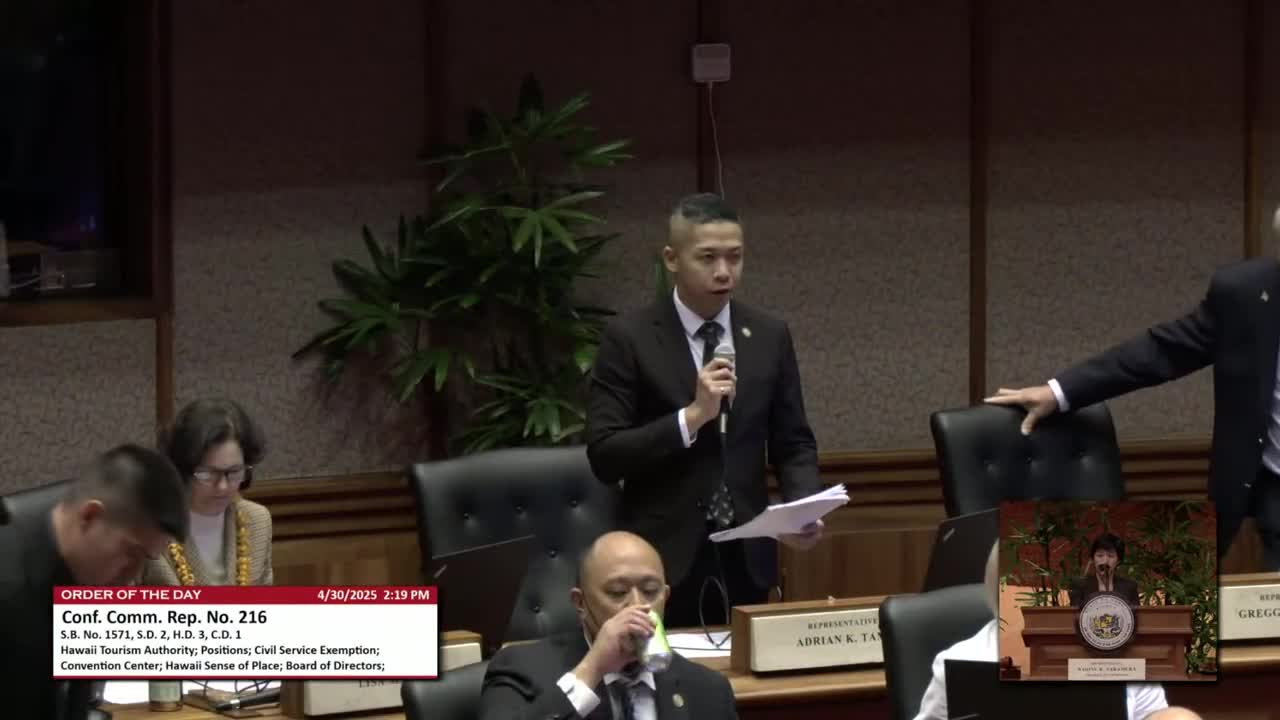 18MIN
House Floor
 32MIN
Senate Floor
 2MIN
Conference Committee
 8MIN
Conference Committee
 1MIN
Conference Committee
 1MIN
Conference Committee
 1H
Conference Committee
 1MIN
House Floor
Bill Author

Bill Co-Author(s):