SB 2835: Intoxicating Liquor; Liquor License; Class 10 Special License; Liquor Commission; Fines; Educational and Enforcement Programs
- Session Year: 2025-2026
- House: Senate
- Latest Version Date: 2026-04-29
Current Status:
Passed
(2026-06-09: Act 106, on 06/08/2026 (Gov. Msg. No. 1206).)
Introduced
In Committee
First Chamber
In Committee
Second Chamber
Final Decking
Enacted
What does this bill do?
The bill makes it easier for nonprofits, political candidates, and parties to get a class 10 temporary liquor license by clarifying licenses can cover up to three days per application and simplifying application rules in counties with 100,000–200,000 residents. It allows electronic filing and signatures, lets one application cover adjacent parcels under the same owner, bars conditioning approval on extra visual or safety clearances, and waives some hearings and background checks. The bill also raises the share of fines county liquor commissions may spend on public liquor-related education or enforcement from 10% to 20%.
The summary is provided by generative AI which can make mistakes. For original language, please view the details in the table below.
Part I: Clarifies that class 10 special licenses may be granted for a period not to exceed three days per application. In counties with fewer than two hundred thousand residents but more than one hundred thousand residents, amends application requirements for class 10 special licenses, including requirements related to electronic submission, naming, and single applications for certain adjacent parcels of land, and prohibits the conditional acceptance of applications based on certain factors. Part II: Increases the maximum percentage of fines assessed by county liquor commissions that may be used to fund public liquor-related educational or enforcement programs. (CD1)
Part I: Clarifies that class 10 special licenses may be granted for a period not to exceed three days per application. In counties with fewer than two hundred thousand residents but more than one hundred thousand residents, amends application requirements for class 10 special licenses, including requirements related to electronic submission, naming, and single applications for certain adjacent parcels of land, and prohibits the conditional acceptance of applications based on certain factors. Part II: Increases the maximum percentage of fines assessed by county liquor commissions that may be used to fund public liquor-related educational or enforcement programs. Effective 3/22/2075. (HD2)
Part I: Clarifies that class 10 special licenses may be granted for a period not to exceed three days per application. In counties with fewer than two hundred thousand residents but more than one hundred thousand residents, amends application requirements for class 10 special licenses, including requirements related to electronic submission, naming, and single applications for certain adjacent parcels of land, and prohibits the conditional acceptance of applications based on certain factors. Part II: Increases the maximum percentage of fines assessed by county liquor commissions that may be used to fund public liquor-related educational or enforcement programs. Effective 3/22/2075. (HD1)
Part I: In counties of fewer than 200,000 residents, but more than 100,000 residents, exempts the three-day temporary liquor licenses for fundraising events, known as class 10 special licenses, from any requirement to obtain fire-related clearances. Allows applications for class 10 special licenses to be submitted electronically and for a single application to apply any fundraising event that spans multiple parcels of land owned by the same entity. Part II: Increases the percentage of fines assessed by all county liquor commissions that may be used to fund public liquor-related educational or enforcement programs. Effective 3/22/2075. (SD1)
In counties of fewer than 200,000 residents, but more than 100,000 residents, exempts the 3-day temporary liquor licenses for fundraising events, known as class 10 special licenses, from any requirement to obtain fire-related clearances. Allows applications for class 10 special licenses to be submitted electronically and for a single application to apply any fundraising event that spans multiple parcels of land owned by the same entity. Increases the percentage of fines assessed by all county liquor commissions that may be used to fund public liquor-related educational or enforcement programs.
|
THE SENATE |
S.B. NO. |
2835 |
|
THIRTY-THIRD LEGISLATURE, 2026 |
S.D. 1 |
|
|
STATE OF HAWAII |
H.D. 2 |
|
|
|
C.D. 1 |
|
|
|
||
|
|
||
A BILL FOR AN ACT
RELATING TO LIQUOR.
BE IT ENACTED BY THE LEGISLATURE OF THE STATE OF HAWAII:
SECTION 1. The legislature finds that some of the requirements for a temporary liquor license in the county of Maui are oppressively burdensome without providing any public benefit. A temporary liquor license, known as a class 10 special license, allows a nonprofit group, political candidate, or political party to serve alcohol at a fundraising event lasting no longer than three days. Among the onerous requirements that are only imposed in the county of Maui are the requirements to submit the special license application in person and provide a handwritten signature on the application. The applicant must also obtain various separate departmental clearances and produce detailed illustrative materials that are duplicative of existing enforcement mechanisms. In addition, if the applicant holds the fundraising event at a location involving multiple parcels with separate tax map key numbers, such as many golf courses, the applicant must submit a separate application for each parcel, despite the event occurring in what is otherwise a single location. Many of these requirements do not apply to comparable temporary liquor licenses in other counties.
The legislature believes that these requirements discourage community organizations from hosting fundraisers, are not necessary for the effective regulation of a temporary event, and may encourage community organizations to hold their fundraisers without obtaining a liquor license.
Accordingly, the purpose of this part is to:
(1) Clarify that class 10 special licenses may be granted for a period not to exceed three days per application; and
(2) Streamline the class 10 special license application process to reduce fundraising costs in a manner that maintains public safety and the protection of event participants.
SECTION 2. Section 281-31, Hawaii Revised Statutes, is amended by amending subsection (j) to read as follows:
"(j) Class 10. Special license.
(1) A special license may be
granted for the sale of liquor for a period not to exceed three days [and
pursuant to commission rule may be approved by the administrator
for] per application. Special
licenses for certain fundraising events by nonprofit organizations,
political candidates, and political parties[;], pursuant to
commission rule, may be approved by the administrator; provided that any
registered educational or charitable nonprofit organization may sell liquors in
their original packages for off-premises consumption; provided further that any
social club granted tax‑exempt status pursuant to section 501(c)(7) of
the Internal Revenue Code of 1986, as amended, may sell wine from the social
club's inventory to the club's members for off-premises consumption. Of this class, there shall
be the following kinds:
(A) General (includes all liquor except alcohol);
(B) Beer and wine; and
(C) Beer.
Liquor
sold under a class 10 license shall be consumed on the premises[.],
except as otherwise allowed under this subsection.
(2) Notwithstanding any other section of this chapter to the contrary, the commission shall waive any hearings, fees, notarization of documents, submission of floor plans and other governmental clearances, and other requirements for the issuance of a class 10 license. The class 10 license granted under this subsection for a fundraising event shall include the ability to auction off, at a live or silent auction, liquor in sealed or covered glass, ceramic, or metal containers or services that provide liquor. No criminal history record check under section 281-53.5 or 846-2.7 or any other section of this chapter shall be required. The commission may require proof of liquor liability insurance for the fundraising event and a current list of officers and directors if the applicant is a nonprofit organization.
(3) This paragraph shall only apply to a county with a population of fewer than two hundred thousand residents but more than one hundred thousand residents. Notwithstanding any other section of this chapter to the contrary, an application for a class 10 license:
(A) May be submitted electronically and, if submitted electronically, the inclusion of an electronic signature shall satisfy any requirement for a physical, handwritten signature or other signature;
(B) May include an applicant's first and last name in satisfaction of any requirement for the submission of the applicant's full name;
(C) May be applicable to two or more adjacent parcels of land; provided that all parcels of land are controlled by the same entity; and
(D) Shall not be conditioned upon the submission, approval, or completion of any visual renderings, illustrative materials, fire-related clearances, safety inspections, or miscellaneous inspections conducted by any other county department or agency.
An application under this paragraph shall be sufficient if it satisfies all of the requirements of this subsection. No county or county liquor commission shall require, request, or condition the issuance of a class 10 license upon compliance with any other approval, clearance, inspection, certification, or condition not expressly required by this subsection. Nothing in this subsection shall be construed to limit the authority of a county to enforce applicable fire or building codes through independent enforcement actions."
PART II
SECTION 3. The legislature finds that effective educational and enforcement programs are necessary to mitigate the significant impact that alcohol consumption has on public health and safety. The responsible management of alcohol sales and consumption is essential to fostering a safe and healthy community for all residents and visitors. Under existing state law, county liquor commissions are authorized to use a portion of the fines assessed against liquor licensees to fund public liquor-related educational or enforcement programs. However, the amount of funds authorized may not be sufficient to support the educational initiatives and enforcement programs needed to reduce alcohol-related harm.
The legislature further finds that enhancing educational efforts regarding responsible drinking, the risks associated with alcohol misuse, and the promotion of healthy lifestyle choices is vital to ensuring a safer future for our youth and community.
Accordingly, the purpose of this part is to increase the maximum percentage of fines assessed by county liquor commissions that may be used to fund public liquor-related educational or enforcement programs.
SECTION 4. Section 281-17, Hawaii Revised Statutes, is amended by amending subsection (a) to read as follows:
"(a) The liquor commission, within its own county, shall have the jurisdiction, power, authority, and discretion, subject only to this chapter:
(1) To grant, refuse, suspend, and revoke any license for the manufacture, importation, and sale of liquors;
(2) To take appropriate action against a person who, directly or indirectly, manufactures, sells, or purchases any liquor without being authorized pursuant to this chapter; provided that in counties that have established by charter a liquor control adjudication board, the board shall have the jurisdiction, power, authority, and discretion to hear and determine administrative complaints of the director regarding violations of the liquor laws of the State or of the rules of the liquor commission, and impose penalties for violations thereof as may be provided by law;
(3) To control, supervise, and regulate the
manufacture, importation, and sale of liquors by investigation, enforcement,
and education; provided that any educational program shall be limited to the
commission staff, commissioners, liquor control adjudication board members, and
licensees and their employees, and shall be financed through the money
collected from the assessment of fines against licensees; provided further
that fine moneys, not to exceed [ten] twenty per cent a year of
fines accumulated, may be used to fund public liquor-related educational or
enforcement programs;
(4) From time to time to make, amend, and
repeal rules, not inconsistent with this chapter, as in the judgment of the
commission are deemed appropriate for carrying out this chapter and for the
efficient administration thereof, and the proper conduct of the business of all
licensees, including every matter or thing required to be done or [which]
that may be done with the approval or consent, by order, under the
direction or supervision of, or as prescribed by the commission; which rules,
when adopted as provided in chapter 91 shall have the force and effect of law;
(5) Subject to chapter 76, to appoint and remove an administrator, who may also be appointed an investigator and who shall be responsible for the operations and activities of the staff. The administrator may hire and remove hearing officers, investigators, and clerical or other assistants as its business may from time to time require, prescribe their duties and fix their compensation, and engage the services of experts and persons engaged in the practice of a profession, if deemed expedient. Every investigator, within the scope of the investigator's duties, shall have the powers of a police officer;
(6) To limit the number of licenses of any
class or kind within the county, or the number of licenses of any class or kind
to do business in any given locality, when in the judgment of the commission [such]
the limitations are in the public interest;
(7) To prescribe the nature of the proof to be furnished, the notices to be given, and the conditions to be met or observed in case of the issuance of a duplicate license in place of one alleged to have been lost or destroyed, including a requirement of any indemnity deemed appropriate to the case;
(8) To fix the hours between which licensed premises of any class or classes may regularly be open for the transaction of business, which shall be uniform throughout the county as to each class respectively;
(9) To prescribe all forms to be used for the purposes of this chapter not otherwise provided for in this chapter, and the character and manner of keeping of books, records, and accounts to be kept by licensees in any matter pertaining to their business;
(10) To investigate violations of this chapter and, notwithstanding any law to the contrary, violations of the applicable department of health's allowable noise levels, through its investigators or otherwise, to include covert operations, and to report violations to the prosecuting officer for prosecution where appropriate. Investigations of violations of chapter 244D shall be referred to the director of taxation to hear and determine complaints against any licensee;
(11) To prescribe, by rule, the terms, conditions, and circumstances under which persons or any class of persons may be employed by holders of licenses;
(12) To prescribe, by rule, the term of any license or solicitor's and representative's permit authorized by this chapter, the annual or prorated amount, the manner of payment of fees for the licenses and permits, and the amount of filing fees;
(13) To prescribe, by rule, regulations on dancing in licensed premises; and
(14) To prescribe, by rule, the circumstances and penalty for the unauthorized manufacturing or selling of any liquor."
PART III
SECTION 5. Statutory material to be repealed is bracketed and stricken. New statutory material is underscored.
SECTION 6. This Act shall take effect upon its approval.
Report Title:
Intoxicating Liquor; Liquor License; Class 10 Special License; Liquor Commission; Fines; Educational and Enforcement Programs
Description:
Part I: Clarifies that class 10 special licenses may be granted for a period not to exceed three days per application. In counties with fewer than two hundred thousand residents but more than one hundred thousand residents, amends application requirements for class 10 special licenses, including requirements related to electronic submission, naming, and single applications for certain adjacent parcels of land, and prohibits the conditional acceptance of applications based on certain factors. Part II: Increases the maximum percentage of fines assessed by county liquor commissions that may be used to fund public liquor-related educational or enforcement programs. (CD1)
The summary description of legislation appearing on this page is for informational purposes only and is not legislation or evidence of legislative intent.
|
THE SENATE |
S.B. NO. |
2835 |
|
THIRTY-THIRD LEGISLATURE, 2026 |
S.D. 1 |
|
|
STATE OF HAWAII |
H.D. 2 |
|
|
|
|
|
|
|
||
|
|
||
A BILL FOR AN ACT
RELATING TO LIQUOR.
BE IT ENACTED BY THE LEGISLATURE OF THE STATE OF HAWAII:
SECTION 1. The legislature finds that some of the requirements for a temporary liquor license in the county of Maui are oppressively burdensome without providing any public benefit. A temporary liquor license, known as a class 10 special license, allows a nonprofit group, political candidate, or political party to serve alcohol at a fundraising event lasting no longer than three days. Among the onerous requirements that are only imposed in the county of Maui are the requirements to submit the special license application in person and provide a handwritten signature on the application. The applicant must also obtain various separate departmental clearances and produce detailed illustrative materials that are duplicative of existing enforcement mechanisms. In addition, if the applicant holds the fundraising event at a location involving multiple parcels with separate tax map key numbers, such as many golf courses, the applicant must submit a separate application for each parcel, despite the event occurring in what is otherwise a single location. Many of these requirements do not apply to comparable temporary liquor licenses in other counties.
The legislature believes that these requirements discourage community organizations from hosting fundraisers, are not necessary for the effective regulation of a temporary event, and may encourage community organizations to hold their fundraisers without obtaining a liquor license.
Accordingly, the purpose of this part is to:
(1) Clarify that class 10 special licenses may be granted for a period not to exceed three days per application; and
(2) Streamline the class 10 special license application process to reduce fundraising costs in a manner that maintains public safety and the protection of event participants.
SECTION 2. Section 281-31, Hawaii Revised Statutes, is amended by amending subsection (j) to read as follows:
"(j) Class 10. Special license.
(1) A special license may be
granted for the sale of liquor for a period not to exceed three days [and
pursuant to commission rule may be approved by the administrator
for] per application. Special
licenses for certain fundraising events by nonprofit organizations,
political candidates, and political parties[;], pursuant to
commission rule, may be approved by the administrator; provided that any
registered educational or charitable nonprofit organization may sell liquors in
their original packages for off-premises consumption; provided further that any
social club granted tax‑exempt status pursuant to section 501(c)(7) of
the Internal Revenue Code of 1986, as amended, may sell wine from the social
club's inventory to the club's members for off-premises consumption. Of this class, there shall
be the following kinds:
(A) General (includes all liquor except alcohol);
(B) Beer and wine; and
(C) Beer.
Liquor
sold under a class 10 license shall be consumed on the premises[.],
except as otherwise allowed under this subsection.
(2) Notwithstanding any other section of this chapter to the contrary, the commission shall waive any hearings, fees, notarization of documents, submission of floor plans and other governmental clearances, and other requirements for the issuance of a class 10 license. The class 10 license granted under this subsection for a fundraising event shall include the ability to auction off, at a live or silent auction, liquor in sealed or covered glass, ceramic, or metal containers or services that provide liquor. No criminal history record check under section 281-53.5 or 846-2.7 or any other section of this chapter shall be required. The commission may require proof of liquor liability insurance for the fundraising event and a current list of officers and directors if the applicant is a nonprofit organization.
(3) This paragraph shall only apply to a county with a population of fewer than two hundred thousand residents but more than one hundred thousand residents. Notwithstanding any other section of this chapter to the contrary, an application for a class 10 license:
(A) May be submitted electronically and, if submitted electronically, the inclusion of an electronic signature shall satisfy any requirement for a physical, handwritten signature or other signature;
(B) May include an applicant's first and last name in satisfaction of any requirement for the submission of the applicant's full name;
(C) May be applicable to two or more adjacent parcels of land; provided that all parcels of land are controlled by the same entity; and
(D) Shall not be conditioned upon the submission, approval, or completion of any visual renderings, illustrative materials, fire-related clearances, safety inspections, or miscellaneous inspections conducted by any other county department or agency.
An application under this paragraph shall be sufficient if it satisfies all of the requirements of this subsection. No county or county liquor commission shall require, request, or condition the issuance of a class 10 license upon compliance with any other approval, clearance, inspection, certification, or condition not expressly required by this subsection. Nothing in this subsection shall be construed to limit the authority of a county to enforce applicable fire or building codes through independent enforcement actions."
PART II
SECTION 3. The legislature finds that effective educational and enforcement programs are necessary to mitigate the significant impact that alcohol consumption has on public health and safety. The responsible management of alcohol sales and consumption is essential to fostering a safe and healthy community for all residents and visitors. Under existing state law, county liquor commissions are authorized to use a portion of the fines assessed against liquor licensees to fund public liquor-related educational or enforcement programs. However, the amount of funds authorized may not be sufficient to support the educational initiatives and enforcement programs needed to reduce alcohol-related harm.
The legislature further finds that enhancing educational efforts regarding responsible drinking, the risks associated with alcohol misuse, and the promotion of healthy lifestyle choices is vital to ensuring a safer future for our youth and community.
Accordingly, the purpose of this part is to increase the maximum percentage of fines assessed by county liquor commissions that may be used to fund public liquor-related educational or enforcement programs.
SECTION 4. Section 281-17, Hawaii Revised Statutes, is amended by amending subsection (a) to read as follows:
"(a) The liquor commission, within its own county, shall have the jurisdiction, power, authority, and discretion, subject only to this chapter:
(1) To grant, refuse, suspend, and revoke any license for the manufacture, importation, and sale of liquors;
(2) To take appropriate action against a person who, directly or indirectly, manufactures, sells, or purchases any liquor without being authorized pursuant to this chapter; provided that in counties that have established by charter a liquor control adjudication board, the board shall have the jurisdiction, power, authority, and discretion to hear and determine administrative complaints of the director regarding violations of the liquor laws of the State or of the rules of the liquor commission, and impose penalties for violations thereof as may be provided by law;
(3) To control, supervise, and regulate the
manufacture, importation, and sale of liquors by investigation, enforcement,
and education; provided that any educational program shall be limited to the
commission staff, commissioners, liquor control adjudication board members, and
licensees and their employees, and shall be financed through the money
collected from the assessment of fines against licensees; provided further
that fine moneys, not to exceed [ten] twenty per cent a year of
fines accumulated, may be used to fund public liquor-related educational or
enforcement programs;
(4) From time to time to make, amend, and
repeal rules, not inconsistent with this chapter, as in the judgment of the
commission are deemed appropriate for carrying out this chapter and for the
efficient administration thereof, and the proper conduct of the business of all
licensees, including every matter or thing required to be done or [which]
that may be done with the approval or consent, by order, under the
direction or supervision of, or as prescribed by the commission; which rules,
when adopted as provided in chapter 91 shall have the force and effect of law;
(5) Subject to chapter 76, to appoint and remove an administrator, who may also be appointed an investigator and who shall be responsible for the operations and activities of the staff. The administrator may hire and remove hearing officers, investigators, and clerical or other assistants as its business may from time to time require, prescribe their duties and fix their compensation, and engage the services of experts and persons engaged in the practice of a profession, if deemed expedient. Every investigator, within the scope of the investigator's duties, shall have the powers of a police officer;
(6) To limit the number of licenses of any
class or kind within the county, or the number of licenses of any class or kind
to do business in any given locality, when in the judgment of the commission [such]
the limitations are in the public interest;
(7) To prescribe the nature of the proof to be furnished, the notices to be given, and the conditions to be met or observed in case of the issuance of a duplicate license in place of one alleged to have been lost or destroyed, including a requirement of any indemnity deemed appropriate to the case;
(8) To fix the hours between which licensed premises of any class or classes may regularly be open for the transaction of business, which shall be uniform throughout the county as to each class respectively;
(9) To prescribe all forms to be used for the purposes of this chapter not otherwise provided for in this chapter, and the character and manner of keeping of books, records, and accounts to be kept by licensees in any matter pertaining to their business;
(10) To investigate violations of this chapter and, notwithstanding any law to the contrary, violations of the applicable department of health's allowable noise levels, through its investigators or otherwise, to include covert operations, and to report violations to the prosecuting officer for prosecution where appropriate. Investigations of violations of chapter 244D shall be referred to the director of taxation to hear and determine complaints against any licensee;
(11) To prescribe, by rule, the terms, conditions, and circumstances under which persons or any class of persons may be employed by holders of licenses;
(12) To prescribe, by rule, the term of any license or solicitor's and representative's permit authorized by this chapter, the annual or prorated amount, the manner of payment of fees for the licenses and permits, and the amount of filing fees;
(13) To prescribe, by rule, regulations on dancing in licensed premises; and
(14) To prescribe, by rule, the circumstances and penalty for the unauthorized manufacturing or selling of any liquor."
PART III
SECTION 5. Statutory material to be repealed is bracketed and stricken. New statutory material is underscored.
SECTION 6. This Act shall take effect on March 22, 2075.
Report Title:
Intoxicating Liquor; Liquor License; Class 10 Special License; Liquor Commission; Fines; Educational and Enforcement Programs
Description:
Part I: Clarifies that class 10 special licenses may be granted for a period not to exceed three days per application. In counties with fewer than two hundred thousand residents but more than one hundred thousand residents, amends application requirements for class 10 special licenses, including requirements related to electronic submission, naming, and single applications for certain adjacent parcels of land, and prohibits the conditional acceptance of applications based on certain factors. Part II: Increases the maximum percentage of fines assessed by county liquor commissions that may be used to fund public liquor-related educational or enforcement programs. Effective 3/22/2075. (HD2)
The summary description of legislation appearing on this page is for informational purposes only and is not legislation or evidence of legislative intent.
|
THE SENATE |
S.B. NO. |
2835 |
|
THIRTY-THIRD LEGISLATURE, 2026 |
S.D. 1 |
|
|
STATE OF HAWAII |
H.D. 1 |
|
|
|
|
|
|
|
||
|
|
||
A BILL FOR AN ACT
RELATING TO LIQUOR.
BE IT ENACTED BY THE LEGISLATURE OF THE STATE OF HAWAII:
SECTION 1. The legislature finds that some of the requirements for a temporary liquor license in the county of Maui are oppressively burdensome without providing any public benefit. A temporary liquor license, known as a class 10 special license, allows a nonprofit group, political candidate, or political party to serve alcohol at a fundraising event lasting no longer than three days. Among the onerous requirements that are only imposed in the county of Maui are the requirements to submit the special license application in person and provide a handwritten signature on the application. The applicant must also obtain various separate departmental clearances and produce detailed illustrative materials that are duplicative of existing enforcement mechanisms. In addition, if the applicant holds the fundraising event at a location involving multiple parcels with separate tax map key numbers, such as many golf courses, the applicant must submit a separate application for each parcel, despite the event occurring in what is otherwise a single location. Many of these requirements do not apply to comparable temporary liquor licenses in other counties.
The legislature believes that these requirements discourage community organizations from hosting fundraisers, are not necessary for the effective regulation of a temporary event, and may encourage community organizations to hold their fundraisers without obtaining a liquor license.
Accordingly, the purpose of this part is to:
(1) Clarify that class 10 special licenses may be granted for a period not to exceed three days per application; and
(2) Streamline the class 10 special license application process to reduce fundraising costs in a manner that maintains public safety and the protection of event participants.
SECTION 2. Section 281-31, Hawaii Revised Statutes, is amended by amending subsection (j) to read as follows:
"(j) Class 10. Special license.
(1) A special license may be
granted for the sale of liquor for a period not to exceed three days [and
pursuant to commission rule may be approved by the administrator
for] per application. Special
licenses for certain fundraising events by nonprofit organizations,
political candidates, and political parties; provided that any registered
educational or charitable nonprofit organization may sell liquors in their
original packages for off-premises consumption; provided further that any
social club granted tax‑exempt status pursuant to section 501(c)(7) of
the Internal Revenue Code of 1986, as amended, may sell wine from the social
club's inventory to the club's members for off-premises consumption. Of this class, there shall
be the following kinds:
(A) General (includes all liquor except alcohol);
(B) Beer and wine; and
(C) Beer.
Liquor sold under a class 10 license shall be consumed on the premises.
(2) Notwithstanding any other section of this chapter to the contrary, the commission shall waive any hearings, fees, notarization of documents, submission of floor plans and other governmental clearances, and other requirements for the issuance of a class 10 license. The class 10 license granted under this subsection for a fundraising event shall include the ability to auction off, at a live or silent auction, liquor in sealed or covered glass, ceramic, or metal containers or services that provide liquor. No criminal history record check under section 281-53.5 or 846-2.7 or any other section of this chapter shall be required. The commission may require proof of liquor liability insurance for the fundraising event and a current list of officers and directors if the applicant is a nonprofit organization.
(3) Notwithstanding any other section of this chapter to the contrary, in any county with a population of fewer than two hundred thousand residents but more than one hundred thousand residents, an application for a class 10 license:
(A) May be submitted electronically and, if submitted electronically, the inclusion of an electronic signature shall satisfy any requirement for a physical, handwritten signature or other signature;
(B) May include an applicant's first and last name in satisfaction of any requirement for the submission of the applicant's full name;
(C) May be applicable to two or more adjacent parcels of land; provided that all parcels of land are controlled by the same entity; and
(D) Shall not be conditioned upon the submission, approval, or completion of any visual renderings, illustrative materials, fire-related clearances, safety inspections, or miscellaneous inspections conducted by any other county department or agency.
An application under this subsection shall be sufficient if it satisfies all of the requirements of this subsection. No county or county liquor commission shall require, request, or condition the issuance of a class 10 license upon compliance with any other approval, clearance, inspection, certification, or condition not expressly required by this subsection. Nothing in this subsection shall be construed to limit the authority of a county to enforce applicable fire or building codes through independent enforcement actions."
PART II
SECTION 3. The legislature finds that effective educational and enforcement programs are necessary to mitigate the significant impact that alcohol consumption has on public health and safety. The responsible management of alcohol sales and consumption is essential to fostering a safe and healthy community for all residents and visitors. Under current state law, county liquor commissions are authorized to use a portion of the fines assessed against liquor licensees to fund public liquor-related educational or enforcement programs. However, the amount of funds authorized may not be sufficient to support the educational initiatives and enforcement programs needed to reduce alcohol-related harm.
The legislature further finds that enhancing educational efforts regarding responsible drinking, the risks associated with alcohol misuse, and the promotion of healthy lifestyle choices is vital to ensuring a safer future for our youth and community.
Accordingly, the purpose of this part is to increase the maximum percentage of fines assessed by county liquor commissions that may be used to fund public liquor-related educational or enforcement programs.
SECTION 4. Section 281-17, Hawaii Revised Statutes, is amended by amending subsection (a) to read as follows:
"(a) The liquor commission, within its own county, shall have the jurisdiction, power, authority, and discretion, subject only to this chapter:
(1) To grant, refuse, suspend, and revoke any license for the manufacture, importation, and sale of liquors;
(2) To take appropriate action against a person who, directly or indirectly, manufactures, sells, or purchases any liquor without being authorized pursuant to this chapter; provided that in counties that have established by charter a liquor control adjudication board, the board shall have the jurisdiction, power, authority, and discretion to hear and determine administrative complaints of the director regarding violations of the liquor laws of the State or of the rules of the liquor commission, and impose penalties for violations thereof as may be provided by law;
(3) To control, supervise, and regulate the
manufacture, importation, and sale of liquors by investigation, enforcement,
and education; provided that any educational program shall be limited to the
commission staff, commissioners, liquor control adjudication board members, and
licensees and their employees, and shall be financed through the money
collected from the assessment of fines against licensees; provided further
that fine moneys, not to exceed [ten] twenty per cent a year of
fines accumulated, may be used to fund public liquor-related educational or
enforcement programs;
(4) From time to time to make, amend, and
repeal rules, not inconsistent with this chapter, as in the judgment of the
commission are deemed appropriate for carrying out this chapter and for the
efficient administration thereof, and the proper conduct of the business of all
licensees, including every matter or thing required to be done or [which]
that may be done with the approval or consent, by order, under the
direction or supervision of, or as prescribed by the commission; which rules,
when adopted as provided in chapter 91 shall have the force and effect of law;
(5) Subject to chapter 76, to appoint and remove an administrator, who may also be appointed an investigator and who shall be responsible for the operations and activities of the staff. The administrator may hire and remove hearing officers, investigators, and clerical or other assistants as its business may from time to time require, prescribe their duties and fix their compensation, and engage the services of experts and persons engaged in the practice of a profession, if deemed expedient. Every investigator, within the scope of the investigator's duties, shall have the powers of a police officer;
(6) To limit the number of licenses of any
class or kind within the county, or the number of licenses of any class or kind
to do business in any given locality, when in the judgment of the commission [such]
the limitations are in the public interest;
(7) To prescribe the nature of the proof to be furnished, the notices to be given, and the conditions to be met or observed in case of the issuance of a duplicate license in place of one alleged to have been lost or destroyed, including a requirement of any indemnity deemed appropriate to the case;
(8) To fix the hours between which licensed premises of any class or classes may regularly be open for the transaction of business, which shall be uniform throughout the county as to each class respectively;
(9) To prescribe all forms to be used for the purposes of this chapter not otherwise provided for in this chapter, and the character and manner of keeping of books, records, and accounts to be kept by licensees in any matter pertaining to their business;
(10) To investigate violations of this chapter and, notwithstanding any law to the contrary, violations of the applicable department of health's allowable noise levels, through its investigators or otherwise, to include covert operations, and to report violations to the prosecuting officer for prosecution where appropriate. Investigations of violations of chapter 244D shall be referred to the director of taxation to hear and determine complaints against any licensee;
(11) To prescribe, by rule, the terms, conditions, and circumstances under which persons or any class of persons may be employed by holders of licenses;
(12) To prescribe, by rule, the term of any license or solicitor's and representative's permit authorized by this chapter, the annual or prorated amount, the manner of payment of fees for the licenses and permits, and the amount of filing fees;
(13) To prescribe, by rule, regulations on dancing in licensed premises; and
(14) To prescribe, by rule, the circumstances and penalty for the unauthorized manufacturing or selling of any liquor."
PART III
SECTION 5. Statutory material to be repealed is bracketed and stricken. New statutory material is underscored.
SECTION 6. This Act shall take effect on March 22, 2075.
Report Title:
Intoxicating Liquor; Liquor License; Class 10 Special License; Liquor Commission; Fines; Educational and Enforcement Programs
Description:
Part I: Clarifies that class 10 special licenses may be granted for a period not to exceed three days per application. In counties with fewer than two hundred thousand residents but more than one hundred thousand residents, amends application requirements for class 10 special licenses, including requirements related to electronic submission, naming, and single applications for certain adjacent parcels of land, and prohibits the conditional acceptance of applications based on certain factors. Part II: Increases the maximum percentage of fines assessed by county liquor commissions that may be used to fund public liquor-related educational or enforcement programs. Effective 3/22/2075. (HD1)
The summary description of legislation appearing on this page is for informational purposes only and is not legislation or evidence of legislative intent.
|
THE SENATE |
S.B. NO. |
2835 |
|
THIRTY-THIRD LEGISLATURE, 2026 |
S.D. 1 |
|
|
STATE OF HAWAII |
|
|
|
|
|
|
|
|
||
|
|
||
A BILL FOR AN ACT
RELATING TO LIQUOR.
BE IT ENACTED BY THE LEGISLATURE OF THE STATE OF HAWAII:
SECTION 1. The legislature finds that some of the requirements for a temporary liquor license in the county of Maui are oppressively burdensome without providing any public benefit. A temporary liquor license, known as a class 10 special license, allows a nonprofit group, political candidate, or political party to serve alcohol at a fundraising event lasting no longer than three days. Among the onerous requirements that are only imposed in the county of Maui are the requirements to submit the special license application in person and to provide a handwritten signature on the application. The applicant must also obtain various separate departmental clearances and produce detailed illustrative materials that are duplicative of existing enforcement mechanisms. In addition, if the applicant holds the fundraising event at a location involving multiple parcels with separate tax map key numbers, such as many golf courses, the applicant must submit a separate application for each parcel, despite the event occurring in what is otherwise a single location. Many of these requirements do not apply to comparable temporary liquor licenses in other counties.
The legislature believes that these requirements discourage community organizations from hosting fundraisers, are not necessary for the effective regulation of a temporary event, and may encourage community organizations to hold their fundraisers without obtaining a liquor license.
Accordingly, the purpose of this part is to streamline the class 10 special license application process to reduce fundraising costs in a manner that maintains public safety and the protection of event participants.
SECTION 2. Section 281-31, Hawaii Revised Statutes, is amended by amending subsection (j) to read as follows:
"(j) Class 10. Special license.
(1) A special license may be granted for the sale of liquor for a period not to exceed three days and pursuant to commission rule may be approved by the administrator for fundraising events by nonprofit organizations, political candidates, and political parties; provided that any registered educational or charitable nonprofit organization may sell liquors in their original packages for off-premises consumption; provided further that any social club granted tax‑exempt status pursuant to section 501(c)(7) of the Internal Revenue Code of 1986, as amended, may sell wine from the social club's inventory to the club's members for off-premises consumption. Of this class, there shall be the following kinds:
(A) General (includes all liquor except alcohol);
(B) Beer and wine; and
(C) Beer.
Liquor sold under a class 10 license shall be consumed on the premises.
(2) Notwithstanding any other section of this chapter to the contrary, the commission shall waive any hearings, fees, notarization of documents, submission of floor plans and other governmental clearances, and other requirements for the issuance of a class 10 license. The class 10 license granted under this subsection for a fundraising event shall include the ability to auction off, at a live or silent auction, liquor in sealed or covered glass, ceramic, or metal containers or services that provide liquor. No criminal history record check under section 281-53.5 or 846-2.7 or any other section of this chapter shall be required. The commission may require proof of liquor liability insurance for the fundraising event and a current list of officers and directors if the applicant is a nonprofit organization.
(3) Notwithstanding any other section of this chapter to the contrary, in any county with a population of fewer than two hundred thousand residents but more than one hundred thousand residents, an application for a class 10 license:
(A) May be submitted electronically and, if submitted electronically, the inclusion of an electronic signature shall satisfy any requirement for a physical, handwritten signature or other signature;
(B) May include an applicant's first and last name in satisfaction of any requirement for the submission of the applicant's full name;
(C) May be applicable to two or more adjacent parcels of land; provided that all parcels of land are controlled by the same entity; and
(D) Shall not be conditioned upon the submission, approval, or completion of any visual renderings, illustrative materials, fire-related clearances, safety inspections, or miscellaneous inspections conducted by any other county department or agency.
An application under this subsection shall be sufficient if it satisfies all of the requirements specified under this subsection. No county or county liquor commission shall require, request, or condition the issuance of a class 10 license upon compliance with any other approval, clearance, inspection, certification, or condition not expressly required by this subsection. Nothing in this subsection shall be construed to limit the authority of a county to enforce applicable fire or building codes through independent enforcement actions."
PART II
SECTION 3. The legislature finds that effective educational and enforcement programs are necessary to mitigate the significant impact that alcohol consumption has on public health and safety. The responsible management of alcohol sales and consumption is essential to fostering a safe and healthy community for all residents and visitors. Under current state law, county liquor commissions are authorized to use a portion of the fines assessed against liquor licensees to fund public liquor-related educational or enforcement programs. However, the amount of funds authorized may not be sufficient to support the educational initiatives and enforcement programs needed to reduce alcohol-related harm.
The legislature further finds that enhancing educational efforts regarding responsible drinking, the risks associated with alcohol misuse, and the promotion of healthy lifestyle choices is vital to ensuring a safer future for our youth and community.
Accordingly, the purpose of this part is to increase the percentage of fines assessed by county liquor commissions that may be used to fund public liquor-related educational or enforcement programs.
SECTION 4. Section 281-17, Hawaii Revised Statutes, is amended by amending subsection (a) to read as follows:
"(a) The liquor commission, within its own county, shall have the jurisdiction, power, authority, and discretion, subject only to this chapter:
(1) To grant, refuse, suspend, and revoke any license for the manufacture, importation, and sale of liquors;
(2) To take appropriate action against a person who, directly or indirectly, manufactures, sells, or purchases any liquor without being authorized pursuant to this chapter; provided that in counties that have established by charter a liquor control adjudication board, the board shall have the jurisdiction, power, authority, and discretion to hear and determine administrative complaints of the director regarding violations of the liquor laws of the State or of the rules of the liquor commission, and impose penalties for violations thereof as may be provided by law;
(3) To control, supervise, and regulate the
manufacture, importation, and sale of liquors by investigation, enforcement,
and education; provided that any educational program shall be limited to the
commission staff, commissioners, liquor control adjudication board members, and
licensees and their employees, and shall be financed through the money
collected from the assessment of fines against licensees; provided further
that fine moneys, not to exceed [ten] twenty per cent a year of
fines accumulated, may be used to fund public liquor-related educational or
enforcement programs;
(4) From time to time to make, amend, and
repeal rules, not inconsistent with this chapter, as in the judgment of the
commission are deemed appropriate for carrying out this chapter and for the
efficient administration thereof, and the proper conduct of the business of all
licensees, including every matter or thing required to be done or [which]
that may be done with the approval or consent, by order, under the
direction or supervision of, or as prescribed by the commission; which rules,
when adopted as provided in chapter 91 shall have the force and effect of law;
(5) Subject to chapter 76, to appoint and remove an administrator, who may also be appointed an investigator and who shall be responsible for the operations and activities of the staff. The administrator may hire and remove hearing officers, investigators, and clerical or other assistants as its business may from time to time require, prescribe their duties and fix their compensation, and engage the services of experts and persons engaged in the practice of a profession, if deemed expedient. Every investigator, within the scope of the investigator's duties, shall have the powers of a police officer;
(6) To limit the number of licenses of any
class or kind within the county, or the number of licenses of any class or kind
to do business in any given locality, when in the judgment of the commission [such]
the limitations are in the public interest;
(7) To prescribe the nature of the proof to be furnished, the notices to be given, and the conditions to be met or observed in case of the issuance of a duplicate license in place of one alleged to have been lost or destroyed, including a requirement of any indemnity deemed appropriate to the case;
(8) To fix the hours between which licensed premises of any class or classes may regularly be open for the transaction of business, which shall be uniform throughout the county as to each class respectively;
(9) To prescribe all forms to be used for the purposes of this chapter not otherwise provided for in this chapter, and the character and manner of keeping of books, records, and accounts to be kept by licensees in any matter pertaining to their business;
(10) To investigate violations of this chapter and, notwithstanding any law to the contrary, violations of the applicable department of health's allowable noise levels, through its investigators or otherwise, to include covert operations, and to report violations to the prosecuting officer for prosecution where appropriate. Investigations of violations of chapter 244D shall be referred to the director of taxation to hear and determine complaints against any licensee;
(11) To prescribe, by rule, the terms, conditions, and circumstances under which persons or any class of persons may be employed by holders of licenses;
(12) To prescribe, by rule, the term of any license or solicitor's and representative's permit authorized by this chapter, the annual or prorated amount, the manner of payment of fees for the licenses and permits, and the amount of filing fees;
(13) To prescribe, by rule, regulations on dancing in licensed premises; and
(14) To prescribe, by rule, the circumstances and penalty for the unauthorized manufacturing or selling of any liquor."
PART III
SECTION 5. Statutory material to be repealed is bracketed and stricken. New statutory material is underscored.
SECTION 6. This Act shall take effect on March 22, 2075.
Report Title:
Intoxicating Liquor; Liquor License; Class 10 Special License; Liquor Commission; Fines; Educational and Enforcement Programs
Description:
Part I: In counties of fewer than 200,000 residents, but more than 100,000 residents, exempts the three-day temporary liquor licenses for fundraising events, known as class 10 special licenses, from any requirement to obtain fire-related clearances. Allows applications for class 10 special licenses to be submitted electronically and for a single application to apply any fundraising event that spans multiple parcels of land owned by the same entity. Part II: Increases the percentage of fines assessed by all county liquor commissions that may be used to fund public liquor-related educational or enforcement programs. Effective 3/22/2075. (SD1)
The summary description of legislation appearing on this page is for informational purposes only and is not legislation or evidence of legislative intent.
|
THE SENATE |
S.B. NO. |
2835 |
|
THIRTY-THIRD LEGISLATURE, 2026 |
|
|
|
STATE OF HAWAII |
|
|
|
|
|
|
|
|
||
|
|
||
A BILL FOR AN ACT
relating to liquor.
BE IT ENACTED BY THE LEGISLATURE OF THE STATE OF HAWAII:
SECTION 1. The legislature finds that some of the requirements for a temporary liquor license in the county of Maui are oppressively burdensome without providing any public benefit. A temporary liquor license, known as a class 10 special license, allows a nonprofit group, political candidate, or political party to serve alcohol at a fundraising event lasting no longer than three days. Among the onerous requirements that are only imposed in the county of Maui are the requirements to submit the special license application in person and to provide a handwritten signature on the application. The applicant must also obtain various separate departmental clearances and produce detailed illustrative materials that are duplicative of existing enforcement mechanisms. In addition, if the applicant holds the fundraising event at a location involving multiple parcels with separate tax map key numbers, such as many golf courses, the applicant must submit a separate application for each parcel, despite the event occurring in what is otherwise a single location. Many of these requirements do not apply to comparable temporary liquor licenses in other counties.
The legislature believes that these requirements discourage community organizations from hosting fundraisers, are not necessary for the effective regulation of a temporary event, and may encourage community organizations to hold their fundraisers without obtaining a liquor license.
Accordingly, the purpose of this part is to streamline the class 10 special license application process to reduce fundraising costs in a manner that maintains public safety and the protection of event participants.
SECTION 2. Section 281-31, Hawaii Revised Statutes, is amended by amending subsection (j) to read as follows:
"(j) Class 10. Special license.
(1) A special license may be granted for the sale of liquor for a period not to exceed three days and pursuant to commission rule may be approved by the administrator for fundraising events by nonprofit organizations, political candidates, and political parties; provided that any registered educational or charitable nonprofit organization may sell liquors in their original packages for off-premises consumption; provided further that any social club granted tax‑exempt status pursuant to section 501(c)(7) of the Internal Revenue Code of 1986, as amended, may sell wine from the social club's inventory to the club's members for off-premises consumption. Of this class, there shall be the following kinds:
(A) General (includes all liquor except alcohol);
(B) Beer and wine; and
(C) Beer.
Liquor sold under a class 10 license shall be consumed on the premises.
(2) Notwithstanding any other section of this chapter to the contrary, the commission shall waive any hearings, fees, notarization of documents, submission of floor plans and other governmental clearances, and other requirements for the issuance of a class 10 license. The class 10 license granted under this subsection for a fundraising event shall include the ability to auction off, at a live or silent auction, liquor in sealed or covered glass, ceramic, or metal containers or services that provide liquor. No criminal history record check under section 281-53.5 or 846-2.7 or any other section of this chapter shall be required. The commission may require proof of liquor liability insurance for the fundraising event and a current list of officers and directors if the applicant is a nonprofit organization.
(3) Notwithstanding any other section of this chapter to the contrary, in any county with a population of fewer than two hundred thousand residents but more than one hundred thousand residents, an application for a class 10 license:
(A) May be submitted electronically and, if submitted electronically, the inclusion of an electronic signature shall satisfy any requirement for a physical, handwritten signature or other signature;
(B) May include an applicant's first and last name in satisfaction of any requirement for the submission of the applicant's full name;
(C) May be applicable to two or more adjacent parcels of land; provided that all parcels of land are controlled by the same entity; and
(D) Shall not be conditioned upon the submission, approval, or completion of any visual renderings, illustrative materials, fire-related clearances, safety inspections, or miscellaneous inspections conducted by any other county department or agency.
An application under this subsection shall be sufficient if it satisfies all of the requirements specified under this subsection. No county or county liquor commission shall require, request, or condition the issuance of a class 10 license upon compliance with any other approval, clearance, inspection, certification, or condition not expressly required by this subsection. Nothing in this subsection shall be construed to limit the authority of a county to enforce applicable fire or building codes through independent enforcement actions."
PART II
SECTION 3. The legislature finds that effective educational and enforcement programs are necessary to mitigate the significant impact that alcohol consumption has on public health and safety. The legislature also finds that the responsible management of alcohol sales and consumption is essential to fostering a safe and healthy community for all residents and visitors. Under current state law, county liquor commissions are authorized to use a portion of the fines assessed against liquor licensees to fund public liquor-related educational or enforcement programs. However, the amount of funds authorized may not be sufficient to support the educational initiatives and enforcement programs needed to reduce alcohol-related harm. The legislature further finds that enhancing educational efforts regarding responsible drinking, the risks associated with alcohol misuse, and the promotion of healthy lifestyle choices is vital to ensuring a safer future for our youth and community.
Accordingly, the purpose of this part is to increase the percentage of fines assessed by county liquor commissions that may be used to fund public liquor-related educational or enforcement programs.
SECTION 4. Section 281-17, Hawaii Revised Statutes, is amended by amending subsection (a) to read as follows:
"(a) The liquor commission, within its own county, shall have the jurisdiction, power, authority, and discretion, subject only to this chapter:
(1) To grant, refuse, suspend, and revoke any license for the manufacture, importation, and sale of liquors;
(2) To take appropriate action against a person who, directly or indirectly, manufactures, sells, or purchases any liquor without being authorized pursuant to this chapter; provided that in counties that have established by charter a liquor control adjudication board, the board shall have the jurisdiction, power, authority, and discretion to hear and determine administrative complaints of the director regarding violations of the liquor laws of the State or of the rules of the liquor commission, and impose penalties for violations thereof as may be provided by law;
(3) To control, supervise, and regulate the
manufacture, importation, and sale of liquors by investigation, enforcement,
and education; provided that any educational program shall be limited to the
commission staff, commissioners, liquor control adjudication board members, and
licensees and their employees, and shall be financed through the money
collected from the assessment of fines against licensees; provided that fine
moneys, not to exceed [ten] twenty per cent a year of fines
accumulated, may be used to fund public liquor-related educational or
enforcement programs;
(4) From time to time to make, amend, and
repeal rules, not inconsistent with this chapter, as in the judgment of the
commission are deemed appropriate for carrying out this chapter and for the
efficient administration thereof, and the proper conduct of the business of all
licensees, including every matter or thing required to be done or [which]
that may be done with the approval or consent, by order, under the
direction or supervision of, or as prescribed by the commission; which rules,
when adopted as provided in chapter 91 shall have the force and effect of law;
(5) Subject to chapter 76, to appoint and remove an administrator, who may also be appointed an investigator and who shall be responsible for the operations and activities of the staff. The administrator may hire and remove hearing officers, investigators, and clerical or other assistants as its business may from time to time require, prescribe their duties and fix their compensation, and engage the services of experts and persons engaged in the practice of a profession, if deemed expedient. Every investigator, within the scope of the investigator's duties, shall have the powers of a police officer;
(6) To limit the number of licenses of any
class or kind within the county, or the number of licenses of any class or kind
to do business in any given locality, when in the judgment of the commission [such]
the limitations are in the public interest;
(7) To prescribe the nature of the proof to be furnished, the notices to be given, and the conditions to be met or observed in case of the issuance of a duplicate license in place of one alleged to have been lost or destroyed, including a requirement of any indemnity deemed appropriate to the case;
(8) To fix the hours between which licensed premises of any class or classes may regularly be open for the transaction of business, which shall be uniform throughout the county as to each class respectively;
(9) To prescribe all forms to be used for the purposes of this chapter not otherwise provided for in this chapter, and the character and manner of keeping of books, records, and accounts to be kept by licensees in any matter pertaining to their business;
(10) To investigate violations of this chapter and, notwithstanding any law to the contrary, violations of the applicable department of health's allowable noise levels, through its investigators or otherwise, to include covert operations, and to report violations to the prosecuting officer for prosecution where appropriate. Investigations of violations of chapter 244D shall be referred to the director of taxation to hear and determine complaints against any licensee;
(11) To prescribe, by rule, the terms, conditions, and circumstances under which persons or any class of persons may be employed by holders of licenses;
(12) To prescribe, by rule, the term of any license or solicitor's and representative's permit authorized by this chapter, the annual or prorated amount, the manner of payment of fees for the licenses and permits, and the amount of filing fees;
(13) To prescribe, by rule, regulations on dancing in licensed premises; and
(14) To prescribe, by rule, the circumstances and penalty for the unauthorized manufacturing or selling of any liquor."
PART III
SECTION 5. Statutory material to be repealed is bracketed and stricken. New statutory material is underscored.
SECTION 6. This Act shall take effect upon its approval.
|
INTRODUCED BY: |
_____________________________ |
|
|
|
Report Title:
Intoxicating Liquor; Liquor License; Class 10 Special License; Liquor Commission; Fines; Educational and Enforcement Programs
Description:
In counties of fewer than 200,000 residents, but more than 100,000 residents, exempts the 3-day temporary liquor licenses for fundraising events, known as class 10 special licenses, from any requirement to obtain fire-related clearances. Allows applications for class 10 special licenses to be submitted electronically and for a single application to apply any fundraising event that spans multiple parcels of land owned by the same entity. Increases the percentage of fines assessed by all county liquor commissions that may be used to fund public liquor-related educational or enforcement programs.
The summary description of legislation appearing on this page is for informational purposes only and is not legislation or evidence of legislative intent.
|
Date
|
Status
|
|---|---|
| Jun 9, 2026 | Act 106, on 06/08/2026 (Gov. Msg. No. 1206). |
| Jun 9, 2026 | Act 106, 06/08/2026 (Gov. Msg. No. 1206). |
| May 7, 2026 | Enrolled to Governor. |
| May 8, 2026 | Received notice of passage on Final Reading in House (Hse. Com. No. 888). |
| May 6, 2026 | Passed Final Reading as amended in CD 1 with none voting aye with reservations; Representative(s) Muraoka voting no (1) and none excused (0). |
| May 5, 2026 | Received notice of Final Reading (Sen. Com. No. 814). |
| May 1, 2026 | Passed Final Reading, as amended (CD 1). Ayes, 24; Aye(s) with reservations: none. Noes, 0 (none). Excused, 1 (Senator(s) Fukunaga). |
| May 1, 2026 | Deferred one day 05-06-26. |
| Apr 29, 2026 | Forty-eight (48) hours notice Friday, 05-01-26. |
| Apr 29, 2026 | Reported from Conference Committee (Conf Com. Rep. No. 35-26) as amended in (CD 1). |
| Apr 29, 2026 | 48 Hrs. Notice (as amended CD 1) 05-01-26. |
| Apr 29, 2026 | Reported from Conference Committee as amended CD 1 (Conf. Com. Rep. No. 35-26). |
| Apr 27, 2026 | The Conference Committee recommends that the measure be Passed, with Amendments. The votes were as follows: 3 Ayes: Representative(s) Ilagan, Matayoshi, Tam; Ayes with reservations: none; 0 Noes: none; and 1 Excused: Representative(s) Gedeon. |
| Apr 27, 2026 | The Conference committee recommends that the measure be PASSED, WITH AMENDMENTS. The votes of the Senate Conference Managers were as follows: 3 Aye(s): Senator(s) Wakai, Rhoads, Keohokalole; Aye(s) with reservations: none ; 0 No(es): none; and 0 Excused: none. |
| Apr 23, 2026 | Conference committee meeting scheduled for 04-27-26 10:31AM; Conference Room 325. |
| Apr 21, 2026 | Received notice of Senate conferees (Sen. Com. No. 718). |
| Apr 21, 2026 | Senate Conferees Appointed: Wakai Chair; Rhoads Co-Chair; Keohokalole. |
| Apr 20, 2026 | Received notice of appointment of House conferees (Hse. Com. No. 787). |
| Apr 20, 2026 | House Conferees Appointed: Ilagan, Matayoshi Co-Chairs; Tam, Gedeon. |
| Apr 10, 2026 | Received notice of disagreement (Sen. Com. No. 564). |
| Apr 10, 2026 | Senate disagrees with House amendments. |
| Apr 10, 2026 | Received from House (Hse. Com. No. 522). |
| Apr 9, 2026 | Passed Third Reading as amended in HD 2 with none voting aye with reservations; Representative(s) Muraoka voting no (1) and Representative(s) Cochran excused (1). Transmitted to Senate. |
| Apr 7, 2026 | Forty-eight (48) hours notice Thursday, 04-09-26. |
| Apr 7, 2026 | Reported from CPC (Stand. Com. Rep. No. 1814-26) as amended in HD 2, recommending passage on Third Reading. |
| Apr 1, 2026 | The committee on CPC recommend that the measure be PASSED, WITH AMENDMENTS. The votes were as follows: 11 Ayes: Representative(s) Matayoshi, Grandinetti, Chun, Ilagan, Ichiyama, Iwamoto, Kong, Lowen, Marten, Tam, Pierick; Ayes with reservations: none; Noes: none; and Excused: none. |
| Mar 30, 2026 | Bill scheduled to be heard by CPC on Wednesday, 04-01-26 2:00PM in House conference room 329 VIA VIDEOCONFERENCE. |
| Mar 25, 2026 | Passed Second Reading as amended in HD 1 and referred to the committee(s) on CPC with Representative(s) Cochran voting aye with reservations; none voting no (0) and Representative(s) Matsumoto, Perruso excused (2). |
| Mar 25, 2026 | Reported from ECD (Stand. Com. Rep. No. 1427-26) as amended in HD 1, recommending passage on Second Reading and referral to CPC. |
| Mar 20, 2026 | The committee on ECD recommend that the measure be PASSED, WITH AMENDMENTS. The votes were as follows: 6 Ayes: Representative(s) Ilagan, Hussey, Tam, Templo, Yamashita, Gedeon; Ayes with reservations: none; Noes: none; and Excused: none. |
| Mar 16, 2026 | Bill scheduled to be heard by ECD on Friday, 03-20-26 9:30AM in House conference room 423 VIA VIDEOCONFERENCE. |
| Mar 12, 2026 | Referred to ECD, CPC, referral sheet 17 |
| Mar 12, 2026 | Pass First Reading |
| Mar 10, 2026 | Received from Senate (Sen. Com. No. 307) in amended form (SD 1). |
| Mar 10, 2026 | Report adopted; Passed Third Reading, as amended (SD 1). Ayes, 25; Aye(s) with reservations: none . Noes, 0 (none). Excused, 0 (none). Transmitted to House. |
| Mar 6, 2026 | 48 Hrs. Notice 03-10-26. |
| Mar 6, 2026 | Reported from JDC (Stand. Com. Rep. No. 3016) with recommendation of passage on Third Reading, as amended (SD 1). |
| Mar 3, 2026 | The committee(s) on JDC recommend(s) that the measure be PASSED, WITH AMENDMENTS. The votes in JDC were as follows: 5 Aye(s): Senator(s) Rhoads, Gabbard, Chang, San Buenaventura, Awa; Aye(s) with reservations: none ; 0 No(es): none; and 0 Excused: none. |
| Feb 24, 2026 | The committee(s) on JDC will hold a public decision making on 03-03-26 10:15AM; Conference Room 016 & Videoconference. |
| Feb 11, 2026 | Report adopted; Passed Second Reading and referred to JDC. |
| Feb 11, 2026 | Reported from EIG (Stand. Com. Rep. No. 2177) with recommendation of passage on Second Reading and referral to JDC. |
| Feb 3, 2026 | The committee(s) on EIG recommend(s) that the measure be PASSED, UNAMENDED. The votes in EIG were as follows: 4 Aye(s): Senator(s) Wakai, Chang, DeCoite, Richards; Aye(s) with reservations: none ; 0 No(es): none; and 1 Excused: Senator(s) Fevella. |
| Jan 30, 2026 | The committee(s) on EIG has scheduled a public hearing on 02-03-26 3:01PM; CR 224 & Videoconference. |
| Jan 30, 2026 | Referred to EIG, JDC. |
| Jan 26, 2026 | Passed First Reading. |
| Jan 23, 2026 | Introduced. |
|
Date
|
Description
|
Location
|
Votes
|
|
|---|---|---|---|---|
| May 6, 2026 | Final Reading | House Floor |
Passed |
|
| May 1, 2026 | Final Reading | Senate Floor |
Passed |
|
| Apr 1, 2026 | The committee on CPC recommend that the measure be PASSED, WITH AMENDMENTS | House Standing Committee on Consumer Protection & Commerce |
Passed |
|
| Mar 20, 2026 | The committee on ECD recommend that the measure be PASSED, WITH AMENDMENTS | House Standing Committee on Economic Development & Technology |
Passed |
|
| Mar 10, 2026 | Third Reading | Senate Floor |
Passed |
|
| Mar 3, 2026 | The committee(s) on JDC recommend(s) that the measure be PASSED, WITH AMENDMENTS | Senate Standing Committee on Judiciary |
Passed |
|
| Feb 3, 2026 | The committee(s) on EIG recommend(s) that the measure be PASSED, UNAMENDED | Senate Standing Committee on Energy and Intergovernmental Affairs |
Passed |
This list shows positions taken on this bill by organizations on the date displayed, which is linked to the original source.
Positions by individuals are not included.
|
Organization
|
Position
|
Date
|
|---|---|---|
| Big Island Brewhaus | *** Support | Feb 3, 2026 |
| City and County of Honolulu | *** Support | Apr 1, 2026 |
| EVENTS INTERNATIONAL, INC. | *** Support | Mar 20, 2026 |
| Highgate | *** Support | Mar 20, 2026 |
| Highgate Hawaii | *** Support | Mar 20, 2026 |
| Highgate Hotels | *** Support | Mar 20, 2026 |
| Honolulu City Council | *** Support | Apr 1, 2026 |
| Honolulu Liquor Commission | *** Support | Apr 1, 2026 |
| LahainaTown Action Committee | *** Support | Feb 3, 2026 |
| Lanikai Brewing Company | *** Support | Mar 20, 2026 |
| Liquor Commission, City and County of Honolulu | *** Support | Apr 1, 2026 |
| Maui Brewing Co. | *** Support | Mar 20, 2026 |
| Maui Chamber of Commerce | *** Support | Apr 1, 2026 |
| Maui County Council | *** Support | Apr 1, 2026 |
| Maui Hotel & Lodging Association | ** Support |
STAND. COM. REP. NO. 3016
Honolulu, Hawaii
RE: S.B. No. 2835
S.D. 1
Honorable Ronald D. Kouchi
President of the Senate
Thirty-Third State Legislature
Regular Session of 2026
State of Hawaii
Sir:
Your Committee on Judiciary, to which was referred S.B. No. 2835 entitled:
"A BILL FOR AN ACT RELATING TO LIQUOR,"
begs leave to report as follows:
The purpose and intent of this measure is to:
(1) In counties of fewer than two hundred thousand residents, but more than one hundred thousand residents, exempt the three-day temporary liquor licenses for fundraising events, known as class 10 special licenses, from any requirement to obtain fire-related clearances;
(2) Allow applications for class 10 special licenses to be submitted electronically and for a single application to apply any fundraising event that spans multiple parcels of land owned by the same entity; and
(3) Increase the percentage of fines assessed by all county liquor commissions that may be used to fund public liquor-related educational or enforcement programs.
Your Committee received testimony in support of this measure from one member of the Maui County Council, Maui Brewing Co., Maui Chamber of Commerce, Maui Hotel & Lodging Association, and one individual.
Your Committee finds that class 10 special licenses allow nonprofit organizations to responsibly serve or sell liquor at limited events, often including school fundraisers, cultural festivals, charitable galas, and community celebrations. The ability to obtain one of these licenses can significantly increase fundraising capacity, directly benefitting programs that serve local families, youth, and vulnerable populations. Your Committee further finds that the existing process for obtaining a class 10 special license lacks sufficient clarity, consistency, and enforceable standards. This measure will strengthen oversight, clarify compliance expectations, and ensure that the privilege of serving alcohol at temporary events is exercised responsibly.
Your Committee has amended this measure by:
(1) Inserting an effective date of March 22, 2075, to encourage further discussion; and
(2) Making technical, nonsubstantive amendments for the purposes of clarity and consistency.
As affirmed by the record of votes of the members of your Committee on Judiciary that is attached to this report, your Committee is in accord with the intent and purpose of S.B. No. 2835, as amended herein, and recommends that it pass Third Reading in the form attached hereto as S.B. No. 2835, S.D. 1.
Respectfully submitted on behalf of the members of the Committee on Judiciary,
|
|
|
________________________________ KARL RHOADS, Chair |
|
|
|
|
STAND. COM. REP. NO. 2177
Honolulu, Hawaii
RE: S.B. No. 2835
Honorable Ronald D. Kouchi
President of the Senate
Thirty-Third State Legislature
Regular Session of 2026
State of Hawaii
Sir:
Your Committee on Energy and Intergovernmental Affairs, to which was referred S.B. No. 2835 entitled:
"A BILL FOR AN ACT RELATING TO LIQUOR,"
begs leave to report as follows:
The purpose and intent of this measure is to:
(1) In counties of fewer than two hundred thousand residents, but more than one hundred thousand residents, exempt the three-day temporary liquor licenses for fundraising events, known as class 10 special licenses, from any requirement to obtain fire-related clearances;
(2) Allow applications for class 10 special licenses to be submitted electronically and for a single application to apply to any fundraising event that spans multiple parcels of land owned by the same entity; and
(3) Increase the percentage of fines assessed by all county liquor commissions that may be used to fund public liquor-related educational or enforcement programs.
Your Committee received testimony in support of this measure from the Maui Chamber of Commerce; Big Island Brewhaus; Maui Brewing Co.; Lanikai Brewing Company LLC, dba Lanikai Spirits; and LahainaTown Action Committee.
Your Committee finds that a temporary liquor license grants the ability for nonprofit groups, political candidates, or political parties to serve alcohol at a fundraising event lasting no longer than three days. However, the system for granting temporary liquor licenses in certain regions in the State is currently overly restrictive. Some of the onerous regulations include requiring an applicant for a temporary liquor license to submit separate applications for each tax map key numbers for a single event regardless of whether that event is in a single location and prohibiting the electronic submission of an application. This measure will allow for a more accessible and equitable process for obtaining temporary liquor licenses across the State by allowing licensure to move forward without additional fire clearances, permitting electronic application submissions, and allowing one application to cover events across multiple parcels of land.
As affirmed by the record of votes of the members of your Committee on Energy and Intergovernmental Affairs that is attached to this report, your Committee is in accord with the intent and purpose of S.B. No. 2835 and recommends that it pass Second Reading and be referred to your Committee on Judiciary.
Respectfully submitted on behalf of the members of the Committee on Energy and Intergovernmental Affairs,
|
|
|
________________________________ GLENN WAKAI, Chair |
|
|
|
|
|
Date
|
Testimony PDF
|
|---|---|
| Apr 1, 2026 | SB2835_HD1_TESTIMONY_CPC_04-01-26_.PDF |
| Mar 20, 2026 | SB2835_SD1_TESTIMONY_ECD_03-20-26_.PDF |
| Mar 2, 2026 | SB2835_TESTIMONY_JDC_03-03-26_.PDF |
| Feb 3, 2026 | SB2835_TESTIMONY_EIG_02-03-26_.PDF |
Discussed in Hearing
 3MIN
Conference Committee
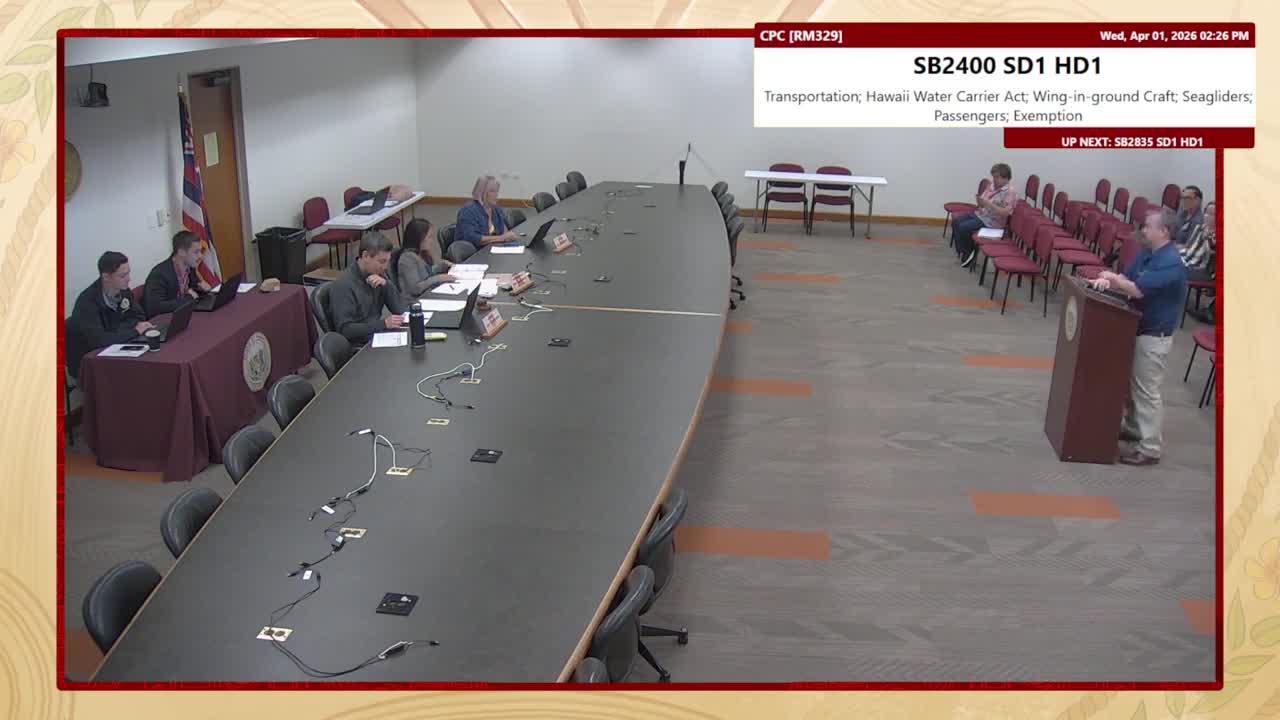 10MIN
House Standing Committee on Consumer Protection & Commerce
58SEC
House Standing Committee on Consumer Protection & Commerce
 2MIN
House Standing Committee on Economic Development & Technology
 1MIN
House Standing Committee on Economic Development & Technology
 51SEC
Senate Standing Committee on Judiciary
 26SEC
Senate Standing Committee on Labor and Technology
26SEC
Senate Standing Committee on Energy and Intergovernmental Affairs
Bill Author