SB 125: State Enterprise Zones; Qualified Business; Tax Incentives; Eligible Business Activities; Retail Sales; Value-Added Agricultural Products; Health Care Services; Advanced Manufacturing; Cybersecurity
- Session Year: 2025-2026
- House: Senate
- Latest Version Date: 2025-03-13
Current Status:
Failed
(2026-03-20: Received notice of all Senate conferees being discharged (Sen. Com. No. 409).)
Introduced
In Committee
First Chamber
In Committee
Second Chamber
Final Decking
Enacted
Amends the definition of "eligible business activity" for State Enterprise Zone Program purposes to include retail sales of tangible personal property manufactured and sold in the enterprise zone to the final consumer, the processing of value-added agricultural products grown within an enterprise zone, the provision of professional services by health care professionals in health-care-related sectors, the use of advanced manufacturing to produce products, or the development of cybersecurity technology. Extends the eligibility period of the state business tax credit and general excise tax exemption for qualified businesses within state enterprise zones from 7 years to 9 years. Extends the eligibility period of the general excise tax exemption for qualified businesses within state enterprise zones engaged in the manufacturing of tangible personal property or the producing or processing of agricultural products from 10 years to 12 years. Makes the extension of the state business tax credit eligibility period applicable to taxable years beginning after 12/31/2025. Makes the extension of the general excise tax exemption eligibility period take effect on 1/1/2027. Effective 7/1/3000. (HD1)
Amends the definition of "eligible business activity" for Enterprise Zone Program purposes to include retail sales of tangible personal property manufactured and sold in the enterprise zone that is to be used or consumed by the purchaser and not for resale, the processing of value-added agricultural products grown within an enterprise zone, and the provision of professional services by health care professionals in health-care related sectors. Extends the eligibility period of the state business tax credit and general excise tax exemption for qualified businesses within state Enterprise Zones from 7 years to 9 years. Extends the eligibility period of the general excise tax exemption for qualified businesses within state Enterprise Zones engaged in the manufacturing of tangible personal property or the producing or processing of agricultural products from 10 years to 12 years. Makes the extension of the state business tax credit eligibility period applicable to taxable years beginning after 12/31/2025. Makes the extension of the general excise tax exemption eligibility period take effect on 1/1/2027. Effective 7/1/2050. (SD2)
Amends the definition of "eligible business activity" for Enterprise Zone Program purposes to include retail sales of tangible personal property manufactured and sold in the enterprise zone that is to be used or consumed by the purchaser and not for resale, the processing of value-added agricultural products grown within an enterprise zone, and the provision of professional services by health care professionals in health-care related sectors. Extends the eligibility period of the state business tax credit and general excise tax exemption for qualified businesses within State Enterprise Zones from seven years to nine years. Extends the eligibility period of the State business tax credit and general excise tax exemption for qualified businesses within State Enterprise Zones engaged in the manufacturing of tangible personal property or the producing or processing of agricultural products from ten years to twelve years. Makes the extension of the state business tax credit eligibility period applicable to taxable years beginning after 12/31/2025. Makes the extension of the general excise tax exemption eligibility period applicable to taxable years beginning after 12/31/2026. Effective 7/1/2050. (SD1)
Extends the eligibility period of the State business tax credit and general excise tax exemption for qualified businesses within State Enterprise Zones from seven years to nine years. Extends the eligibility period of the State business tax credit and general excise tax exemption for qualified businesses within State Enterprise Zones engaged in the manufacturing of tangible personal property or the producing or processing of agricultural products from ten years to twelve years. Applies to taxable years beginning after 12/31/2025.
|
THE SENATE |
S.B. NO. |
125 |
|
THIRTY-THIRD LEGISLATURE, 2025 |
S.D. 2 |
|
|
STATE OF HAWAII |
H.D. 1 |
|
|
|
|
|
|
|
||
|
|
||
A BILL FOR AN ACT
RELATING TO STATE ENTERPRISE ZONES.
BE IT ENACTED BY THE LEGISLATURE OF THE STATE OF HAWAII:
SECTION 1. The legislature finds that the enterprise zone program was established in 1986 for the purpose of stimulating business, agricultural, and industrial growth in areas to revitalize neighborhoods by providing public benefits to local companies. In addition to stimulating business activity, the enterprise zone program also promotes job preservation and job creation in areas designated by the counties and approved by the governor. Benefits for local companies include permitting and zoning assistance, fee waivers, tax relief, and more.
The legislature further finds that the most common industries participating in the enterprise zone program are agricultural production or processing, manufacturing, and wholesaling and distribution. Other eligible industries include aviation or maritime repair or maintenance; telecommunications switching and delivery systems; information technology design and production; medical research and clinical trials; for-profit training programs in international business management or environmental remediation; biotechnology research, development, production, or sales; repair or maintenance of assisted technology equipment; certain call centers; and wind energy producers.
The legislature additionally finds that, for decades, a manufacturer of tangible products has only been eligible for enterprise zone program benefits if over one-half of the gross sales of its products are to wholesalers and the sale takes place within the enterprise zone. This qualification was established before modern revolutions in manufacturing and retail sales. Since the program's establishment, business models have significantly changed, and local manufacturers now often skip selling to wholesalers and go directly to retail, making those manufacturers ineligible to participate in the enterprise zone program. Allowing local manufacturers that sell directly to retail to be eligible for the enterprise zone program will help support local businesses and promote job creation and preservation for local families looking to thrive in Hawaii.
Accordingly, the purpose of this part is to modernize the enterprise zone program by allowing additional activities within an enterprise zone to qualify for enterprise zone benefits, specifically:
(1) Retail and wholesale activity by a local manufacturer made within the enterprise zone;
(2) The processing of value-added agriculture products;
(3) The provision of professional services by health care professionals in health-care-related sectors;
(4) The use of advanced manufacturing to produce products; and
(5) The development of cybersecurity technology.
SECTION 2. Section 209E-2, Hawaii Revised Statutes, is amended as follows:
1. By adding two new definitions to be appropriately inserted and to read:
""Tangible personal property" means property that can be touched or felt and can be relocated. "Tangible personal property" does not include electricity, real property, or intellectual property.
"Value-added agricultural product" means a product that has been processed, enhanced, or otherwise modified beyond its raw state in a manner that increases its economic value and that meets the criteria established for the seal of quality program by the department of agriculture under section 148-63."
2. By amending the definition of "eligible business activity" to read:
""Eligible business activity" means the:
(1) Manufacture of tangible personal property, the wholesale sale of tangible personal property as described in section 237-4, the sale of tangible personal property manufactured and sold at retail in the enterprise zone for consumption or use by the purchaser and not for resale, or a service business as defined in this section;
(2) Production of agricultural products
where the business is a producer as defined in section 237-5, [or] the
processing of agricultural products[,] or value-added agricultural
products, all or some of which were grown within an enterprise zone;
(3) Research, development, sale, or
production of all types of genetically-engineered medical, agricultural, or
maritime biotechnology products; [or]
(4) Production of electric power from wind energy for sale primarily to a public utility company for resale to the public;
(5) Provision of professional services by health care professionals in health-care-related sectors, including but not limited to home health care agencies, specialized care practices, and health coaching;
(6) Use of advanced manufacturing to produce products; or
(7) Development of cybersecurity technology.
provided that medical cannabis dispensary activities pursuant to chapter 329D shall not be considered an eligible business activity for the purposes of this chapter."
PART II
SECTION 3. This part shall apply to business firms that are designated as a qualified business for the purposes of chapter 209E, Hawaii Revised Statutes, on or after July 1, 2025.
SECTION 4. Section 209E-9, Hawaii Revised Statutes, is amended by amending subsection (b) to read as follows:
"(b) A business firm may also be eligible to be designated a qualified business for purposes of this chapter if the business:
(1) Is actively engaged in the conduct of a
trade or business in an eligible business activity in an area immediately [prior
to] before the area being designated an enterprise zone;
(2) Meets the requirements of subsection (a)(2); and
(3) Either:
(A) Increases its average annual number of
full-time employees employed at the business' establishment or establishments
within enterprise zones located within the same county by at least ten per cent
by the end of the first year of operation, and by at least
fifteen per cent by the end of each of the fourth, fifth, sixth, [and]
seventh, eighth, and ninth years of operation, and for businesses
eligible for tax credits extending past the [seventh] ninth year,
at least maintains that higher level of employment during each subsequent
taxable year; provided that the percentage increase shall be based upon the
employee count at the beginning of the initial year of operation within the
enterprise zone or zones; or
(B) Increases its gross sales of agricultural crops produced, or agricultural products processed within enterprise zones located within the same county by two per cent annually."
SECTION 5. Section 209E-10, Hawaii Revised Statutes, is amended as follows:
1. By amending subsection (a) to read:
"(a)
The department shall certify annually to the department of taxation the
applicability of the tax credit provided in this chapter for a qualified
business against any taxes due the State.
Except for the general excise tax, the credit shall be eighty per cent
of the tax due for the first tax year, seventy per cent of the tax due for the
second tax year, sixty per cent of the tax due for the third tax year,
fifty per cent of the tax due for the fourth tax year, forty per
cent of the tax due for the fifth tax year, thirty per cent of
the tax due for the sixth tax year, and twenty per cent of the
taxes due for each of the seventh [year.], eighth, and ninth
tax years. For qualified businesses engaged in the manufacturing of
tangible personal property or the producing or processing of agricultural
products, the credit shall continue after the [seventh] ninth tax
year at the rate of twenty per cent of the tax due for each of the subsequent
three tax years. Any tax credit
not usable shall not be applied to future tax years."
2. By amending subsection (c) to read:
"(c)
In addition to any tax credit authorized under this section, any
qualified business shall be entitled to a tax credit against any taxes due the
State in an amount equal to a percentage of unemployment taxes paid. The amount of the credit shall be equal to
eighty per cent of the unemployment taxes paid during the first year, seventy
per cent of the taxes paid during the second year, sixty per cent of the taxes
paid during the third year, fifty per cent of the taxes paid during the fourth
year, forty per cent of the taxes paid during the fifth year, thirty per cent
of the taxes paid during the sixth year, and twenty per cent of the taxes paid
during each of the seventh [year.], eighth, and ninth years. For qualified businesses
engaged in the manufacturing of tangible personal property or the producing or
processing of agricultural products, the credit shall continue after the [seventh]
ninth year in an amount equal to twenty per cent of the taxes paid
during each of the subsequent three tax years."
SECTION 6. Section 209E-11, Hawaii Revised Statutes, is amended to read as follows:
"§209E-11 State general excise exemptions. The department shall certify annually to
the department of taxation that any qualified business is exempt from the
payment of general excise taxes on the gross proceeds from an
eligible business activity as defined in this chapter; provided
that agricultural businesses other than those engaged in the production of
genetically-engineered agricultural products shall not be exempt from the
payment of general excise taxes on the gross proceeds of agricultural retail
sales. The gross proceeds received by a
contractor licensed under chapter 444 shall be exempt from the general excise
tax for construction within an enterprise zone performed for a qualified
business within an enterprise zone or a business that has been approved by the
department to enroll into the enterprise zone program. The exemption shall extend for a period not
to exceed [seven] nine years; provided that for qualified businesses engaged in the
manufacturing of tangible personal property or the producing or processing of
agricultural products, the exemption shall extend for a period not to exceed [ten]
twelve years; provided further that if a force majeure event occurs,
then the period of time shall be tolled until the force majeure event ceases."
PART III
SECTION 7. Statutory material to be repealed is bracketed and stricken. New statutory material is underscored.
SECTION 8. This Act shall take effect on July 1, 3000; provided that:
(1) Section 5 shall apply to taxable years beginning after December 31, 2025; and
(2) Section 6 shall take effect on January 1, 2027.
Report Title:
State Enterprise Zones; Qualified Business; Tax Incentives; Eligible Business Activities; Retail Sales; Value-Added Agricultural Products; Health Care Services; Advanced Manufacturing; Cybersecurity
Description:
Amends the definition of "eligible business activity" for State Enterprise Zone Program purposes to include retail sales of tangible personal property manufactured and sold in the enterprise zone to the final consumer, the processing of value-added agricultural products grown within an enterprise zone, the provision of professional services by health care professionals in health-care-related sectors, the use of advanced manufacturing to produce products, or the development of cybersecurity technology. Extends the eligibility period of the state business tax credit and general excise tax exemption for qualified businesses within state enterprise zones from 7 years to 9 years. Extends the eligibility period of the general excise tax exemption for qualified businesses within state enterprise zones engaged in the manufacturing of tangible personal property or the producing or processing of agricultural products from 10 years to 12 years. Makes the extension of the state business tax credit eligibility period applicable to taxable years beginning after 12/31/2025. Makes the extension of the general excise tax exemption eligibility period take effect on 1/1/2027. Effective 7/1/3000. (HD1)
The summary description of legislation appearing on this page is for informational purposes only and is not legislation or evidence of legislative intent.
|
THE SENATE |
S.B. NO. |
125 |
|
THIRTY-THIRD LEGISLATURE, 2025 |
S.D. 2 |
|
|
STATE OF HAWAII |
|
|
|
|
|
|
|
|
||
|
|
||
A BILL FOR AN ACT
RELATING TO STATE ENTERPRISE ZONES.
BE IT ENACTED BY THE LEGISLATURE OF THE STATE OF HAWAII:
SECTION 1. The legislature finds that the enterprise zone program was established in 1986 for the purpose of stimulating business, agricultural, and industrial growth in areas to revitalize neighborhoods by providing public benefits to local companies. In addition to stimulating business activity, the enterprise zone program also promotes job preservation and job creation in areas designated by the counties and approved by the governor. Benefits for local companies include permitting and zoning assistance, fee waivers, tax relief, and more.
The legislature further finds that the most common industries participating in the enterprise zone program are agricultural production or processing, manufacturing, and wholesaling and distribution. Other eligible industries include aviation or maritime repair or maintenance; telecommunications switching and delivery systems; information technology design and production; medical research and clinical trials; for-profit training programs in international business management or environmental remediation; biotechnology research, development, production, or sales; repair or maintenance of assisted technology equipment; certain call centers; and wind energy producers.
The legislature additionally finds that, for decades, a manufacturer of tangible products has only been eligible for enterprise zone program benefits if over one-half of the gross sales of its products are to wholesalers and the sale takes place within the enterprise zone. This qualification was established before modern revolutions in manufacturing and retail sales. Since the program's establishment, business models have significantly changed, and local manufacturers now often skip selling to wholesalers and go directly to retail, making those manufacturers ineligible to participate in the enterprise zone program. Allowing local manufacturers that sell directly to retail to be eligible for the enterprise zone program will help lift local businesses and promote job creation and job preservation for local families looking to thrive in Hawaii.
Accordingly, the purpose of this part is to modernize the enterprise zone program by allowing additional activities within an enterprise zone to qualify for enterprise zone benefits, specifically:
(1) Retail and wholesale activity by a local manufacturer made within the enterprise zone;
(2) The processing of value-added agriculture products; and
(3) The provision of professional services by health care professionals in health-care related sectors.
SECTION 2. Section 209E-2, Hawaii Revised Statutes, is amended as follows:
1. By adding two new definitions to be appropriately inserted and to read:
""Tangible personal property" means property that can be touched or felt and can be relocated. "Tangible personal property" does not include electricity, real property, or intellectual property.
"Value-added agricultural product" means a product that has been processed, enhanced, or otherwise modified beyond its raw state in a manner that increases its economic value and that meets the criteria established for the seal of quality program by the department of agriculture under section 148-63."
2. By amending the definition of "eligible business activity" to read:
""Eligible business activity" means the:
(1) Manufacture of tangible personal property, the wholesale sale of tangible personal property as described in section 237-4, the sale of tangible personal property manufactured and sold at retail in the enterprise zone for consumption or use by the purchaser and not for resale, or a service business as defined in this section;
(2) Production of agricultural products
where the business is a producer as defined in section 237-5, [or] the
processing of agricultural products[,] or value-added agricultural
products, all or some of which were grown within an enterprise zone;
(3) Research, development, sale, or
production of all types of genetically-engineered medical, agricultural, or
maritime biotechnology products; [or]
(4) Production of electric power from wind energy for sale primarily to a public utility company for resale to the public; or
(5) The provision of professional services by health care professionals in health-care related sectors, including but not limited to home health care agencies, specialized care practices, and health coaching;
provided that medical cannabis dispensary activities pursuant to chapter 329D shall not be considered an eligible business activity for the purposes of this chapter."
PART II
SECTION 3. This part shall apply to business firms that are designated as a qualified business for the purposes of chapter 209E, Hawaii Revised Statutes, on or after July 1, 2025.
SECTION 4. Section 209E-9, Hawaii Revised Statutes, is amended by amending subsection (b) to read as follows:
"(b) A business firm may also be eligible to be designated a qualified business for purposes of this chapter if the business:
(1) Is actively engaged in the conduct of a
trade or business in an eligible business activity in an area immediately [prior
to] before the area being designated an enterprise zone;
(2) Meets the requirements of subsection (a)(2); and
(3) Either:
(A) Increases its average annual number of
full-time employees employed at the business' establishment or establishments
within enterprise zones located within the same county by at least ten per cent
by the end of the first year of operation, and by at least
fifteen per cent by the end of each of the fourth, fifth, sixth, [and]
seventh, eighth, and ninth years of operation, and for businesses
eligible for tax credits extending past the [seventh] ninth year,
at least maintains that higher level of employment during each subsequent
taxable year; provided that the percentage increase shall be based upon the
employee count at the beginning of the initial year of operation within the
enterprise zone or zones; or
(B) Increases its gross sales of agricultural crops produced, or agricultural products processed within enterprise zones located within the same county by two per cent annually."
SECTION 5. Section 209E-10, Hawaii Revised Statutes, is amended as follows:
1. By amending subsection (a) to read:
"(a)
The department shall certify annually to the department of taxation the
applicability of the tax credit provided in this chapter for a qualified
business against any taxes due the State.
Except for the general excise tax, the credit shall be eighty per cent
of the tax due for the first tax year, seventy per cent of the tax due for the
second tax year, sixty per cent of the tax due for the third tax year,
fifty per cent of the tax due for the fourth tax year, forty per
cent of the tax due for the fifth tax year, thirty per cent of
the tax due for the sixth tax year, and twenty per cent of the
taxes due for each of the seventh [year.], eighth, and ninth
tax years. For qualified businesses engaged in the manufacturing of
tangible personal property or the producing or processing of agricultural
products, the credit shall continue after the [seventh] ninth tax
year at the rate of twenty per cent of the tax due for each of the subsequent three
tax years. Any tax credit not
usable shall not be applied to future tax years."
2. By amending subsection (c) to read:
"(c)
In addition to any tax credit authorized under this section, any
qualified business shall be entitled to a tax credit against any taxes due the
State in an amount equal to a percentage of unemployment taxes paid. The amount of the credit shall be equal to
eighty per cent of the unemployment taxes paid during the first year, seventy
per cent of the taxes paid during the second year, sixty per cent of the taxes
paid during the third year, fifty per cent of the taxes paid during the fourth
year, forty per cent of the taxes paid during the fifth year, thirty per cent
of the taxes paid during the sixth year, and twenty per cent of the taxes paid
during each of the seventh [year.], eighth, and ninth years. For qualified businesses
engaged in the manufacturing of tangible personal property or the producing or
processing of agricultural products, the credit shall continue after the [seventh]
ninth year in an amount equal to twenty per cent of the taxes paid
during each of the subsequent three tax years."
SECTION 6. Section 209E-11, Hawaii Revised Statutes, is amended to read as follows:
"§209E-11 State general excise exemptions. The department shall certify annually to
the department of taxation that any qualified business is exempt from the
payment of general excise taxes on the gross proceeds from an
eligible business activity as defined in this chapter; provided
that agricultural businesses other than those engaged in the production of
genetically-engineered agricultural products shall not be exempt from the
payment of general excise taxes on the gross proceeds of agricultural retail
sales. The gross proceeds received by a
contractor licensed under chapter 444 shall be exempt from the general excise
tax for construction within an enterprise zone performed for a qualified
business within an enterprise zone or a business that has been approved by the
department to enroll into the enterprise zone program. The exemption shall extend for a period not
to exceed [seven] nine years; provided that for qualified businesses engaged in the
manufacturing of tangible personal property or the producing or processing of
agricultural products, the exemption shall extend for a period not to exceed [ten]
twelve years; provided further that if a force majeure event occurs,
then the period of time shall be tolled until the force majeure event ceases."
PART III
SECTION 7. Statutory material to be repealed is bracketed and stricken. New statutory material is underscored.
SECTION 8. This Act shall take effect on July 1, 2050; provided that:
(1) Section 5 shall apply to taxable years beginning after December 31, 2025; and
(2) Section 6 shall take effect on January 1, 2027.
Report Title:
State Enterprise Zones; Qualified Business; State Business Tax Credit; General Excise Tax; Eligible Business Activities; Retail Sales; Value-Added Agricultural Products; Health Care Services; Exemption; Extension
Description:
Amends the definition of "eligible business activity" for Enterprise Zone Program purposes to include retail sales of tangible personal property manufactured and sold in the enterprise zone that is to be used or consumed by the purchaser and not for resale, the processing of value-added agricultural products grown within an enterprise zone, and the provision of professional services by health care professionals in health-care related sectors. Extends the eligibility period of the state business tax credit and general excise tax exemption for qualified businesses within state Enterprise Zones from 7 years to 9 years. Extends the eligibility period of the general excise tax exemption for qualified businesses within state Enterprise Zones engaged in the manufacturing of tangible personal property or the producing or processing of agricultural products from 10 years to 12 years. Makes the extension of the state business tax credit eligibility period applicable to taxable years beginning after 12/31/2025. Makes the extension of the general excise tax exemption eligibility period take effect on 1/1/2027. Effective 7/1/2050. (SD2)
The summary description of legislation appearing on this page is for informational purposes only and is not legislation or evidence of legislative intent.
|
THE SENATE |
S.B. NO. |
125 |
|
THIRTY-THIRD LEGISLATURE, 2025 |
S.D. 1 |
|
|
STATE OF HAWAII |
|
|
|
|
|
|
|
|
||
|
|
||
A BILL FOR AN ACT
RELATING TO STATE ENTERPRISE ZONES.
BE IT ENACTED BY THE LEGISLATURE OF THE STATE OF HAWAII:
SECTION 1. The legislature finds that the enterprise zone program was established in 1986 for the purpose of stimulating business, agricultural, and industrial growth in areas to revitalize neighborhoods by providing public benefits to local companies. In addition to stimulating business activity, the enterprise zone program also promotes job preservation and job creation in areas designated by the counties and approved by the governor. Benefits for local companies include permitting and zoning assistance, fee waivers, tax relief, and more.
The legislature further finds that the most common industries participating in the enterprise zone program are agricultural production or processing, manufacturing, and wholesaling and distribution. Other eligible industries include aviation or maritime repair or maintenance; telecommunications switching and delivery systems; information technology design and production; medical research and clinical trials; for-profit training programs in international business management or environmental remediation; biotechnology research, development, production, or sales; repair or maintenance of assisted technology equipment; certain call centers; and wind energy producers.
The legislature additionally finds that, for decades, a manufacturer of tangible products has only been eligible for enterprise zone program benefits if over one-half of the gross sales of its products are to wholesalers and the sale takes place within the enterprise zone. This qualification was established before modern revolutions in manufacturing and retail sales. Since the program's establishment, business models have significantly changed, and local manufacturers now often skip selling to wholesalers and go directly to retail, making those manufacturers ineligible to participate in the enterprise zone program. Allowing local manufacturers that sell directly to retail to be eligible for the enterprise zone program will help lift local businesses and promote job creation and job preservation for local families looking to thrive in Hawaii.
Accordingly, the purpose of this part is to modernize the enterprise zone program by allowing additional activities within an enterprise zone to qualify for enterprise zone benefits, specifically:
(1) Retail and wholesale activity by a local manufacturer made within the enterprise zone;
(2) The processing of value-added agriculture products; and
(3) The provision of professional services by health care professionals in health-care related sectors.
SECTION 2. Section 209E-2, Hawaii Revised Statutes, is amended as follows:
1. By adding a new definition to be appropriately inserted and to read:
""Tangible personal property" means property that can be touched or felt and can be relocated. "Tangible personal property" does not include electricity, real property, or intellectual property."
2. By amending the definition of "eligible business activity" to read:
""Eligible business activity" means the:
(1) Manufacture of tangible personal property, the wholesale sale of tangible personal property as described in section 237-4, the sale of tangible personal property manufactured and sold at retail in the enterprise zone for consumption or use by the purchaser and not for resale, or a service business as defined in this section;
(2) Production of agricultural products
where the business is a producer as defined in section 237-5, [or] the
processing of agricultural products[,] or value-added agricultural
products, all or some of which were grown within an enterprise zone;
(3) Research, development, sale, or
production of all types of genetically-engineered medical, agricultural, or
maritime biotechnology products; [or]
(4) Production of electric power from wind energy for sale primarily to a public utility company for resale to the public; or
(5) The provision of professional services by health care professionals in health-care related sectors, including but not limited to home health care agencies, specialized care practices, and health coaching;
provided that medical cannabis dispensary activities pursuant to chapter 329D shall not be considered an eligible business activity for the purposes of this chapter."
PART II
SECTION 3. This part shall apply to business firms that are designated as a qualified business for the purposes of chapter 209E, Hawaii Revised Statutes, on or after July 1, 2025.
SECTION 4. Section 209E-9, Hawaii Revised Statutes, is amended by amending subsection (b) to read as follows:
"(b) A business firm may also be eligible to be designated a qualified business for purposes of this chapter if the business:
(1) Is actively engaged in the conduct of a
trade or business in an eligible business activity in an area immediately [prior
to] before the area being designated an enterprise zone;
(2) Meets the requirements of subsection (a)(2); and
(3) Either:
(A) Increases its average annual number of
full-time employees employed at the business' establishment or establishments
within enterprise zones located within the same county by at least ten per cent
by the end of the first year of operation, and by at least
fifteen per cent by the end of each of the fourth, fifth, sixth, [and]
seventh, eighth, and ninth years of operation, and for businesses
eligible for tax credits extending past the [seventh] ninth year,
at least maintains that higher level of employment during each subsequent
taxable year; provided that the percentage increase shall be based upon the
employee count at the beginning of the initial year of operation within the
enterprise zone or zones; or
(B) Increases its gross sales of agricultural crops produced, or agricultural products processed within enterprise zones located within the same county by two per cent annually."
SECTION 5. Section 209E-10, Hawaii Revised Statutes, is amended as follows:
1. By amending subsection (a) to read:
"(a)
The department shall certify annually to the department of taxation the
applicability of the tax credit provided in this chapter for a qualified
business against any taxes due the State.
Except for the general excise tax, the credit shall be eighty per cent
of the tax due for the first tax year, seventy per cent of the tax due for the
second tax year, sixty per cent of the tax due for the third tax year,
fifty per cent of the tax due for the fourth tax year, forty per
cent of the tax due for the fifth tax year, thirty per cent of
the tax due for the sixth tax year, and twenty per cent of the
taxes due for each of the seventh [year.], eighth, and ninth
tax years. For qualified businesses engaged in the manufacturing of
tangible personal property or the producing or processing of agricultural
products, the credit shall continue after the [seventh] ninth tax
year at the rate of twenty per cent of the tax due for each of the subsequent three
tax years. Any tax credit not
usable shall not be applied to future tax years."
2. By amending subsection (c) to read:
"(c)
In addition to any tax credit authorized under this section, any
qualified business shall be entitled to a tax credit against any taxes due the
State in an amount equal to a percentage of unemployment taxes paid. The amount of the credit shall be equal to
eighty per cent of the unemployment taxes paid during the first year, seventy
per cent of the taxes paid during the second year, sixty per cent of the taxes
paid during the third year, fifty per cent of the taxes paid during the fourth
year, forty per cent of the taxes paid during the fifth year, thirty per cent
of the taxes paid during the sixth year, and twenty per cent of the taxes paid
during each of the seventh [year.], eighth, and ninth years. For qualified businesses
engaged in the manufacturing of tangible personal property or the producing or
processing of agricultural products, the credit shall continue after the [seventh]
ninth year in an amount equal to twenty per cent of the taxes paid
during each of the subsequent three tax years."
SECTION 6. Section 209E-11, Hawaii Revised Statutes, is amended to read as follows:
"§209E-11 State general excise exemptions. The department shall certify annually to
the department of taxation that any qualified business is exempt from the
payment of general excise taxes on the gross proceeds from an
eligible business activity as defined in this chapter; provided
that agricultural businesses other than those engaged in the production of
genetically-engineered agricultural products shall not be exempt from the
payment of general excise taxes on the gross proceeds of agricultural retail
sales. The gross proceeds received by a
contractor licensed under chapter 444 shall be exempt from the general excise
tax for construction within an enterprise zone performed for a qualified
business within an enterprise zone or a business that has been approved by the
department to enroll into the enterprise zone program. The exemption shall extend for a period not
to exceed [seven] nine years; provided that for qualified businesses engaged in the
manufacturing of tangible personal property or the producing or processing of
agricultural products, the exemption shall extend for a period not to exceed [ten]
twelve years; provided further that if a force majeure event occurs,
then the period of time shall be tolled until the force majeure event ceases."
PART III
SECTION 7. Statutory material to be repealed is bracketed and stricken. New statutory material is underscored.
SECTION 8. This Act shall take effect on July 1, 2050; provided that:
(1) Section 5 shall apply to taxable years beginning after December 31, 2025; and
(2) Section 6 shall apply to taxable years beginning after December 31, 2026.
Report Title:
State Enterprise Zones; Qualified Business; State Business Tax Credit; General Excise Tax; Eligible Business Activities; Retail Sales; Value-added Agricultural Products; Health Care Services; Exemption; Extension
Description:
Amends the definition of "eligible business activity" for Enterprise Zone Program purposes to include retail sales of tangible personal property manufactured and sold in the enterprise zone that is to be used or consumed by the purchaser and not for resale, the processing of value-added agricultural products grown within an enterprise zone, and the provision of professional services by health care professionals in health-care related sectors. Extends the eligibility period of the state business tax credit and general excise tax exemption for qualified businesses within State Enterprise Zones from seven years to nine years. Extends the eligibility period of the State business tax credit and general excise tax exemption for qualified businesses within State Enterprise Zones engaged in the manufacturing of tangible personal property or the producing or processing of agricultural products from ten years to twelve years. Makes the extension of the state business tax credit eligibility period applicable to taxable years beginning after 12/31/2025. Makes the extension of the general excise tax exemption eligibility period applicable to taxable years beginning after 12/31/2026. Effective 7/1/2050. (SD1)
The summary description of legislation appearing on this page is for informational purposes only and is not legislation or evidence of legislative intent.
|
THE SENATE |
S.B. NO. |
125 |
|
THIRTY-THIRD LEGISLATURE, 2025 |
|
|
|
STATE OF HAWAII |
|
|
|
|
|
|
|
|
||
|
|
||
A BILL FOR AN ACT
relating to state enterprise zones.
BE IT ENACTED BY THE LEGISLATURE OF THE STATE OF HAWAII:
SECTION 1. Section 209E-9, Hawaii Revised Statutes, is amended by amending subsection (b) to read as follows:
"(b) A business firm may also be eligible to be designated a qualified business for purposes of this chapter if the business:
(1) Is actively engaged in the conduct of a trade or business in an eligible business activity in an area immediately prior to the area being designated an enterprise zone;
(2) Meets the requirements of subsection (a)(2); and
(3) Either:
(A) Increases its average annual number of
full-time employees employed at the business' establishment or establishments
within enterprise zones located within the same county by at least ten per cent
by the end of the first year of operation, and by at least
fifteen per cent by the end of each of the fourth, fifth, sixth, [and]
seventh, eighth, and ninth years of operation, and for businesses
eligible for tax credits extending past the [seventh] ninth year,
at least maintains that higher level of employment during each subsequent
taxable year; provided that the percentage increase shall be based upon the
employee count at the beginning of the initial year of operation within the
enterprise zone or zones; or
(B) Increases its gross sales of agricultural crops produced, or agricultural products processed within enterprise zones located within the same county by two per cent annually."
SECTION 2. Section 209E-10, Hawaii Revised Statutes, is amended as follows:
1. By amending subsection (a) to read:
"(a)
The department shall certify annually to the department of taxation the
applicability of the tax credit provided in this chapter for a qualified
business against any taxes due the State.
Except for the general excise tax, the credit shall be eighty per cent
of the tax due for the first tax year, seventy per cent of the tax due for the
second tax year, sixty per cent of the tax due for the third tax year,
fifty per cent of the tax due for the fourth tax year, forty per
cent of the tax due for the fifth tax year, thirty per cent of
the tax due for the sixth tax year, and twenty per cent of the
taxes due for each of the seventh [year.], eighth, and ninth
tax years. For qualified businesses engaged in the manufacturing of
tangible personal property or the producing or processing of agricultural
products, the credit shall continue after the [seventh] ninth tax
year at the rate of twenty per cent of the tax due for each of the subsequent three
tax years. Any tax credit not
usable shall not be applied to future tax years."
2. By amending subsection (c) to read:
"(c)
In addition to any tax credit authorized under this section, any
qualified business shall be entitled to a tax credit against any taxes due the
State in an amount equal to a percentage of unemployment taxes paid. The amount of the credit shall be equal to
eighty per cent of the unemployment taxes paid during the first year, seventy
per cent of the taxes paid during the second year, sixty per cent of the taxes
paid during the third year, fifty per cent of the taxes paid during the fourth
year, forty per cent of the taxes paid during the fifth year, thirty per cent
of the taxes paid during the sixth year, and twenty per cent of the taxes paid
during each of the seventh [year.], eighth, and ninth years. For qualified businesses
engaged in the manufacturing of tangible personal property or the producing or
processing of agricultural products, the credit shall continue after the [seventh]
ninth year in an amount equal to twenty per cent of the taxes paid
during each of the subsequent three tax years."
SECTION 3. Section 209E-11, Hawaii Revised Statutes, is amended to read as follows:
"§209E-11 State general excise exemptions. The department shall certify annually to
the department of taxation that any qualified business is exempt from the
payment of general excise taxes on the gross proceeds from an
eligible business activity as defined in this chapter; provided
that agricultural businesses other than those engaged in the production of
genetically-engineered agricultural products shall not be exempt from the
payment of general excise taxes on the gross proceeds of agricultural retail
sales. The gross proceeds received by a
contractor licensed under chapter 444 shall be exempt from the general excise
tax for construction within an enterprise zone performed for a qualified
business within an enterprise zone or a business that has been approved by the
department to enroll into the enterprise zone program. The exemption shall extend for a period not
to exceed [seven] nine years; provided that for qualified businesses engaged in the
manufacturing of tangible personal property or the producing or processing of
agricultural products, the exemption shall extend for a period not to exceed [ten]
twelve years; provided further that if a force majeure event occurs,
then the period of time shall be tolled until the force majeure event ceases."
SECTION 4. Statutory material to be repealed is bracketed and stricken. New statutory material is underscored.
SECTION 5. This Act, upon its approval, shall apply to taxable years beginning after December 31, 2025.
|
INTRODUCED BY: |
_____________________________ |
|
|
|
Report Title:
State Enterprise Zones; Qualified Business; State Business Tax Credit; General Excise Tax; Exemption; Extension
Description:
Extends the eligibility period of the State business tax credit and general excise tax exemption for qualified businesses within State Enterprise Zones from seven years to nine years. Extends the eligibility period of the State business tax credit and general excise tax exemption for qualified businesses within State Enterprise Zones engaged in the manufacturing of tangible personal property or the producing or processing of agricultural products from ten years to twelve years. Applies to taxable years beginning after 12/31/2025.
The summary description of legislation appearing on this page is for informational purposes only and is not legislation or evidence of legislative intent.
|
Date
|
Status
|
|---|---|
| Mar 20, 2026 | Received notice of all Senate conferees being discharged (Sen. Com. No. 409). |
| Mar 20, 2026 | Senate Conferee(s) discharged. |
| Dec 8, 2025 | Carried over to 2026 Regular Session. |
| Apr 22, 2025 | Received notice of Senate conferees (Sen. Com. No. 863). |
| Apr 22, 2025 | Senate Conferees Appointed: DeCoite Chair; Kim, Kanuha Co-Chairs; Awa. |
| Apr 4, 2025 | Received notice of disagreement (Sen. Com. No. 590). |
| Apr 4, 2025 | Senate disagrees with House amendments. |
| Apr 4, 2025 | Received from House (Hse. Com. No. 457). |
| Apr 3, 2025 | Passed Third Reading with none voting aye with reservations; none voting no (0) and Representative(s) Cochran, Woodson excused (2). Transmitted to Senate. |
| Apr 3, 2025 | Reported from FIN (Stand. Com. Rep. No. 1900), recommending passage on Third Reading. |
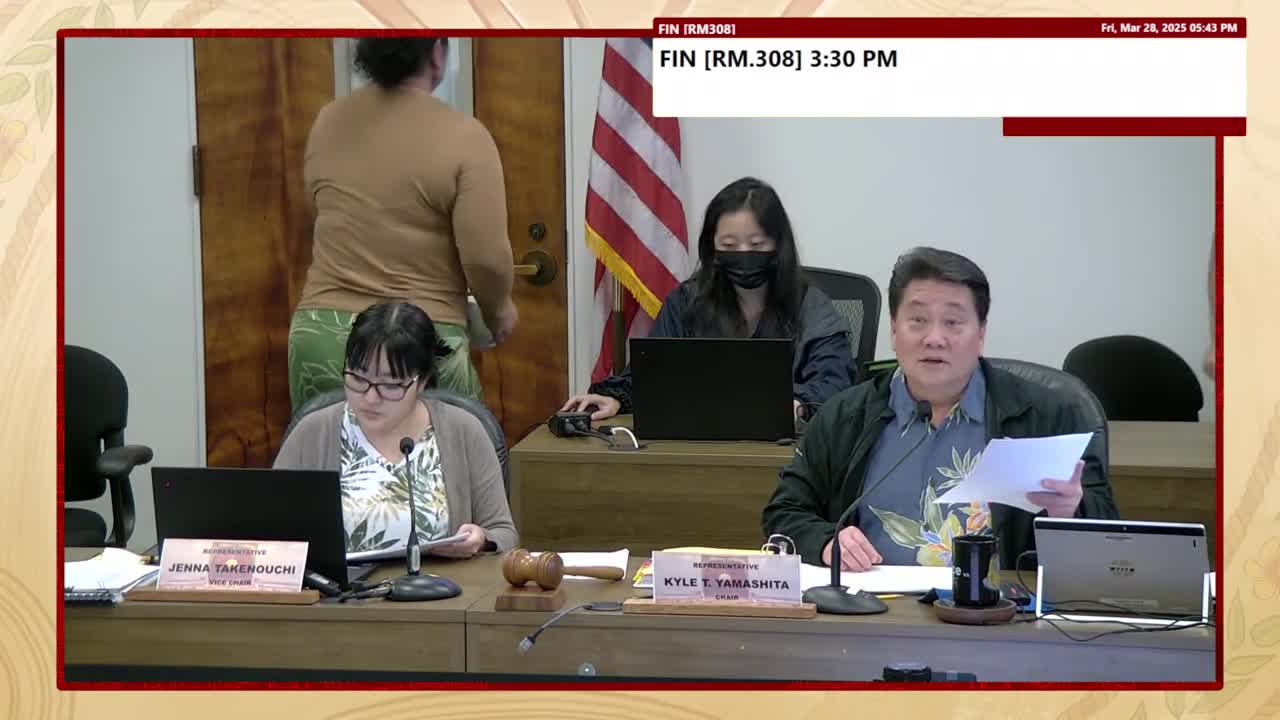
| Mar 28, 2025 | The committee on FIN recommend that the measure be PASSED, UNAMENDED. The votes were as follows: 14 Ayes: Representative(s) Yamashita, Takenouchi, Grandinetti, Holt, Keohokapu-Lee Loy, Kitagawa, Kusch, Lamosao, Lee, M., Miyake, Morikawa, Templo, Alcos, Reyes Oda; Ayes with reservations: none; 0 Noes: none; and 2 Excused: Representative(s) Hussey, Ward. |
| Mar 25, 2025 | Bill scheduled to be heard by FIN on Friday, 03-28-25 3:30PM in House conference room 308 VIA VIDEOCONFERENCE. |
| Mar 21, 2025 | Report adopted; referred to the committee(s) on FIN with none voting aye with reservations; none voting no (0) and Representative(s) Cochran, Garrett, Kapela, Kitagawa, Ward excused (5). |
| Mar 21, 2025 | Reported from AGR (Stand. Com. Rep. No. 1407), recommending referral to FIN. |
| Mar 19, 2025 | The committee on AGR recommend that the measure be PASSED, UNAMENDED. The votes were as follows: 5 Ayes: Representative(s) Kahaloa, Kusch, Lowen, Perruso, Quinlan; Ayes with reservations: none; 0 Noes: none; and 1 Excused: Representative(s) Ward. |
| Mar 14, 2025 | Bill scheduled to be heard by AGR on Wednesday, 03-19-25 9:30AM in House conference room 325 VIA VIDEOCONFERENCE. |
| Mar 14, 2025 | Re-referred to ECD, AGR, FIN, referral sheet 23 |
| Mar 14, 2025 | Passed Second Reading as amended in HD 1 and referred to the committee(s) on AGR/HLT with none voting aye with reservations; none voting no (0) and Representative(s) Cochran, Holt, Iwamoto, Ward excused (4). |
| Mar 14, 2025 | Reported from ECD (Stand. Com. Rep. No. 1238) as amended in HD 1, recommending passage on Second Reading and referral to AGR/HLT. |
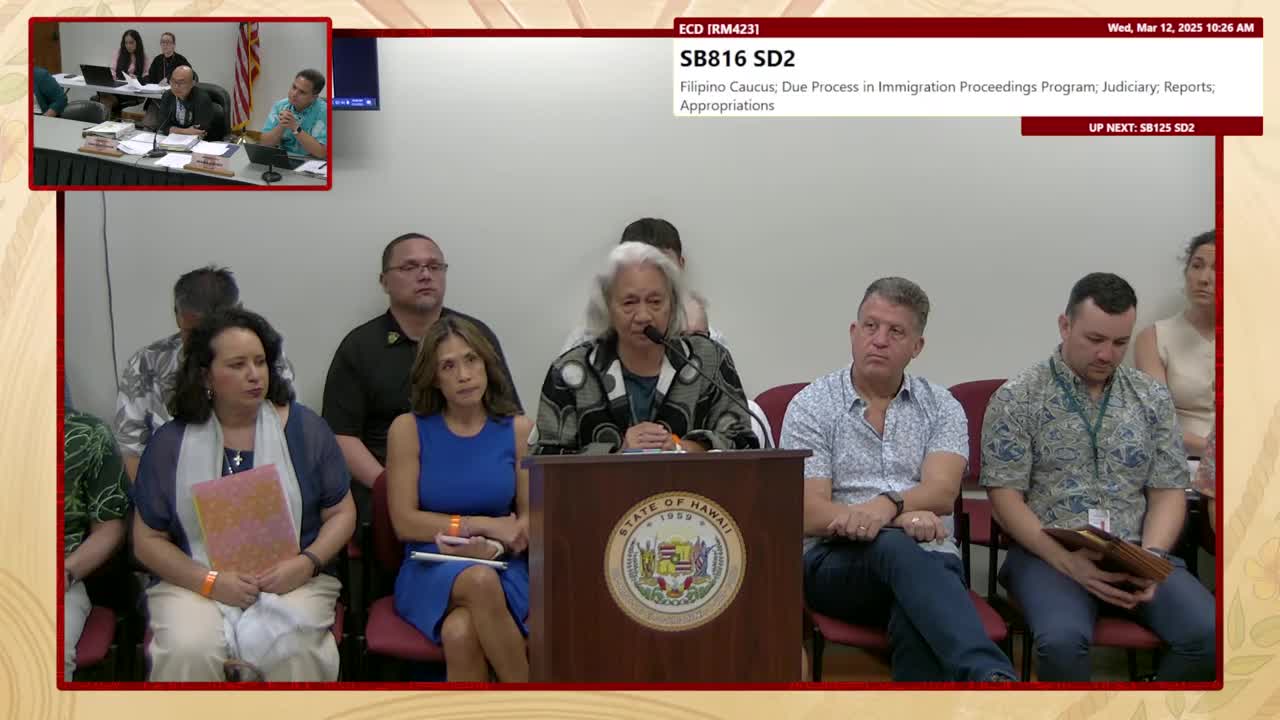
| Mar 12, 2025 | The committee on ECD recommend that the measure be PASSED, WITH AMENDMENTS. The votes were as follows: 6 Ayes: Representative(s) Ilagan, Hussey, Tam, Templo, Todd, Matsumoto; Ayes with reservations: none; 0 Noes: none; and 1 Excused: Representative(s) Holt. |
| Mar 7, 2025 | Bill scheduled to be heard by ECD on Wednesday, 03-12-25 10:00AM in House conference room 423 VIA VIDEOCONFERENCE. |
| Mar 6, 2025 | Referred to ECD, AGR/HLT, FIN, referral sheet 19 |
| Mar 6, 2025 | Pass First Reading |
| Mar 4, 2025 | Received from Senate (Sen. Com. No. 93) in amended form (SD 2). |
| Mar 4, 2025 | Report adopted; Passed Third Reading, as amended (SD 2). Ayes, 25; Aye(s) with reservations: none . Noes, 0 (none). Excused, 0 (none). Transmitted to House. |
| Feb 28, 2025 | 48 Hrs. Notice 03-04-25. |
| Feb 28, 2025 | Reported from WAM (Stand. Com. Rep. No. 827) with recommendation of passage on Third Reading, as amended (SD 2). |
| Feb 18, 2025 | The committee(s) on WAM recommend(s) that the measure be PASSED, WITH AMENDMENTS. The votes in WAM were as follows: 12 Aye(s): Senator(s) Dela Cruz, Moriwaki, Aquino, Elefante, Hashimoto, Inouye, Kanuha, Kidani, Kim, Lee, C., Wakai, Fevella; Aye(s) with reservations: none ; 0 No(es): none; and 1 Excused: Senator(s) DeCoite. |
| Feb 14, 2025 | The committee(s) on WAM will hold a public decision making on 02-18-25 10:01AM; Conference Room 211 & Videoconference. |
| Feb 10, 2025 | Report adopted; Passed Second Reading, as amended (SD 1) and referred to WAM. |
| Feb 10, 2025 | Reported from EDT (Stand. Com. Rep. No. 123) with recommendation of passage on Second Reading, as amended (SD 1) and referral to WAM. |
| Jan 30, 2025 | The committee(s) on EDT recommend(s) that the measure be PASSED, WITH AMENDMENTS. The votes in EDT were as follows: 3 Aye(s): Senator(s) DeCoite, Wakai, Kim; Aye(s) with reservations: none ; 0 No(es): none; and 2 Excused: Senator(s) Fukunaga, Awa. |
| Jan 27, 2025 | The committee(s) on EDT has scheduled a public hearing on 01-30-25 1:00PM; Conference Room 229 & Videoconference. |
| Jan 17, 2025 | Referred to EDT, WAM. |
| Jan 15, 2025 | Introduced and passed First Reading. |
| Jan 10, 2025 | Pending Introduction. |
|
Date
|
Description
|
Location
|
Votes
|
|
|---|---|---|---|---|
| Apr 3, 2025 | Third Reading | House Floor |
Passed |
|
| Mar 28, 2025 | The committee on FIN recommend that the measure be PASSED, UNAMENDED | House Standing Committee on Finance |
Passed |
|
| Mar 19, 2025 | The committee on AGR recommend that the measure be PASSED, UNAMENDED | House Standing Committee on Agriculture & Food Systems |
Passed |
|
| Mar 12, 2025 | The committee on ECD recommend that the measure be PASSED, WITH AMENDMENTS | House Standing Committee on Economic Development & Technology |
Passed |
|
| Mar 4, 2025 | Third Reading | Senate Floor |
Passed |
|
| Feb 18, 2025 | The committee(s) on WAM recommend(s) that the measure be PASSED, WITH AMENDMENTS | Senate Standing Committee on Ways and Means |
Passed |
|
| Jan 30, 2025 | The committee(s) on EDT recommend(s) that the measure be PASSED, WITH AMENDMENTS | Senate Standing Committee on Economic Development and Tourism |
Passed |
This list shows positions taken on this bill by organizations on the date displayed, which is linked to the original source.
Positions by individuals are not included.
|
Organization
|
Position
|
Date
|
|---|---|---|
| Agribusiness Development Corporation | ** Support | |
| Chamber of Commerce Hawaii | ** Support | |
| Department of Business, Economic Development, and Tourism | ** Support | |
| Grassroot Institute of Hawaii | ** Support | |
| Hawaii Food Industry Association | ** Support | |
| Hawaii Military Affairs Council | ** Support | |
| Hawaii Forest Industry Association | ** Support | |
| Hawaii Community Foundation | ** Support | |
| Hawaiʻi Community Foundation | ** Support | |
| Hawaiʻi Farmers Union | ** Support | |
| Hawaiʻi Farm Bureau | ** Support | |
| Hawaiʻi Forest Industry Association | ** Support | |
| Holomua Collaborative | ** Support | |
| HPM BUILDING SUPPLY | ** Support | |
| Mana Up | ** Support | |
| Maui Chamber of Commerce | ** Support | |
| Title Guaranty of Hawaiʻi | ** Support | |
| Tori Richard | ** Support | |
| Tori Richard, Ltd | ** Support | |
| Young Democrats of Hawaiʻi | ** Support |
STAND. COM. REP. NO. 1900
Honolulu, Hawaii
, 2025
RE: S.B. No. 125
S.D. 2
H.D. 1
Honorable Nadine K. Nakamura
Speaker, House of Representatives
Thirty-Third State Legislature
Regular Session of 2025
State of Hawaii
Madame:
Your Committee on Finance, to which was referred S.B. No. 125, S.D. 2, H.D. 1, entitled:
"A BILL FOR AN ACT RELATING TO STATE ENTERPRISE ZONES,"
begs leave to report as follows:
The purpose of this measure is to:
(1) Make the following business activities eligible for State Enterprise Zone Program incentives: retail sales of tangible personal property manufactured and sold in the enterprise zone to the final consumer, the processing of value-added agricultural products grown within an enterprise zone, the provision of professional services by health care professionals in health-care-related sectors, the use of advanced manufacturing to produce products, and the development of cybersecurity technology;
(2) Extend the eligibility period of the State Business Tax Credit and General Excise Tax exemption for qualified businesses; and
(3) Extend the eligibility period of the General Excise Tax exemption for qualified businesses engaged in the manufacturing of tangible personal property or the producing or processing of agricultural products.
Your Committee received testimony in support of this measure from the Hawaii Military Affairs Council; Young Democrats of Hawaiʻi; Hawaii Food Industry Association; Holomua Collaborative; Mana Up; Hawaiʻi Community Foundation; Tori Richard, Ltd; Title Guaranty of Hawaiʻi; HPM Building Supply; Hawaiʻi Forest Industry Association; Hawaiʻi Farm Bureau; Chamber of Commerce Hawaii; Grassroot Institute of Hawaii; Hawaiʻi Farmers Union; Maui Chamber of Commerce; and two individuals. Your Committee received comments on this measure from the Department of Business, Economic Development, and Tourism; Department of Taxation; Agribusiness Development Corporation; and Tax Foundation of Hawaii.
As affirmed by the record of votes of the members of your Committee on Finance that is attached to this report, your Committee is in accord with the intent and purpose of S.B. No. 125, S.D. 2, H.D. 1, and recommends that it pass Third Reading.
Respectfully submitted on behalf of the members of the Committee on Finance,
|
|
|
____________________________ KYLE T. YAMASHITA, Chair |
|
|
|
|
STAND. COM. REP. NO. 1407
Honolulu, Hawaii
, 2025
RE: S.B. No. 125
S.D. 2
H.D. 1
Honorable Nadine K. Nakamura
Speaker, House of Representatives
Thirty-Third State Legislature
Regular Session of 2025
State of Hawaii
Madame:
Your Committee on Agriculture & Food Systems, to which was referred S.B. No. 125, S.D. 2, H.D. 1, entitled:
"A BILL FOR AN ACT RELATING TO STATE ENTERPRISE ZONES,"
begs leave to report as follows:
The purpose of this measure is to:
(1) Expand the definition of "eligible business activity" for purposes of the State Enterprise Zone Program by including:
(A) The sale of tangible personal property manufactured and sold at retail in an enterprise zone for consumption or use by the purchaser and not for resale;
(B) The processing of value-added agricultural products, all or some of which were grown within an enterprise zone;
(C) The provision of professional services by health care professionals in health-care-related sectors; and
(D) The use of advanced manufacturing to produce products and the development of cybersecurity technology;
(2) Extend from seven years to nine years the eligibility period of the state business tax credit and general excise tax exemption for qualified businesses within enterprise zones; and
(3) Extend from ten years to twelve years the eligibility period of the general excise tax exemption for qualified businesses within enterprise zones engaged in the manufacturing of tangible personal property or the producing or processing of agricultural products.
Your Committee received testimony in support of this measure from the Department of Business, Economic Development, and Tourism; Agribusiness Development Corporation; Holomua Collaborative; Hawaii Military Affairs Council; Hawaii Community Foundation; Mana Up; HPM Building Supply; Tori Richard; Title Guaranty of Hawaiʻi; Hawaii Food Industry Association; Hawaii Forest Industry Association; Hawaii Farm Bureau; Grassroot Institute of Hawaii; Chamber of Commerce Hawaii; Maui Chamber of Commerce; and three individuals. Your Committee received comments on this measure from the Department of Taxation and Tax Foundation of Hawaii.
Your Committee finds that the State Enterprise Zone Program was established to stimulate economic growth by providing tax and regulatory incentives to businesses operating in designated areas. While traditionally benefiting industries such as agriculture, manufacturing, and distribution, the State Enterprise Zone Program's eligibility requirements have not kept pace with emerging industries or technologies or evolving business models, particularly for local manufacturers who sell directly to consumers rather than through wholesalers. By updating the State Enterprise Zone Program to reflect current economic realities, this measure strengthens local businesses, fosters job creation, and enhances economic opportunities for Hawaii's communities.
As affirmed by the record of votes of the members of your Committee on Agriculture & Food Systems that is attached to this report, your Committee is in accord with the intent and purpose of S.B. No. 125, S.D. 2, H.D. 1, and recommends that it be referred to your Committee on Finance.
Respectfully submitted on behalf of the members of the Committee on Agriculture & Food Systems,
|
|
|
____________________________ KIRSTIN KAHALOA, Chair |
|
|
|
|
STAND. COM. REP. NO. 1238
Honolulu, Hawaii
, 2025
RE: S.B. No. 125
S.D. 2
H.D. 1
Honorable Nadine K. Nakamura
Speaker, House of Representatives
Thirty-Third State Legislature
Regular Session of 2025
State of Hawaii
Madame:
Your Committee on Economic Development & Technology, to which was referred S.B. No. 125, S.D. 2, entitled:
"A BILL FOR AN ACT RELATING TO STATE ENTERPRISE ZONES,"
begs leave to report as follows:
The purpose of this measure is to:
(1) Expand the definition of "eligible business activity" for purposes of the State Enterprise Zone Program by including:
(A) The sale of tangible personal property manufactured and sold at retail in an enterprise zone for consumption or use by the purchaser and not for resale;
(B) The processing of value-added agricultural products, all or some of which were grown within an enterprise zone; and
(C) The provision of professional services by health care professionals in health-care-related sectors;
(2) Extend from seven years to nine years the eligibility period of the state business tax credit and general excise tax exemption for qualified businesses within enterprise zones; and
(3) Extend from ten years to twelve years the eligibility period of the general excise tax exemption for qualified businesses within enterprise zones engaged in the manufacturing of tangible personal property or the producing or processing of agricultural products.
Your Committee received testimony in support of this measure from the Department of Business, Economic Development, and Tourism; Agribusiness Development Corporation; Holomua Collaborative; Mana Up; Hawaiʻi Community Foundation; Title Guaranty of Hawaiʻi; HPM Building Supply; Tori Richard; Hawaii Food Industry Association; Maui Chamber of Commerce; Hawaiʻi Forest Industry Association; Hawaiʻi Farm Bureau; Grassroot Institute of Hawaii; Hawaii Military Affairs Council; Chamber of Commerce of Hawaii; and two individuals. Your Committee received comments on this measure from the Department of Taxation and Tax Foundation of Hawaii.
Your Committee finds that the State Enterprise Zone Program, which provides tax incentives and other benefits to businesses that engage in eligible business activities in designated enterprise zones, excludes certain manufacturers that sell directly to consumers, which is now a common business model among manufacturers. Your Committee further finds that there is a need to expand the eligibility periods for tax incentives provided to certain qualified businesses within enterprise zones. This measure allows additional activities within an enterprise zone to qualify for State Enterprise Zone Program benefits and extends the eligibility period for the state business tax credit and general excise tax exemption for certain qualified businesses.
Your Committee has amended this measure by:
(1) Expanding the definition of "eligible business activity" to include the use of advanced manufacturing to produce products and the development of cybersecurity technology;
(2) Changing the effective date to July 1, 3000, to encourage further discussion; and
(3) Making technical, nonsubstantive amendments for the purposes of clarity, consistency, and style.
As affirmed by the record of votes of the members of your Committee on Economic Development & Technology that is attached to this report, your Committee is in accord with the intent and purpose of S.B. No. 125, S.D. 2, as amended herein, and recommends that it pass Second Reading in the form attached hereto as S.B. No. 125, S.D. 2, H.D. 1, and be referred to your Committees on Agriculture & Food Systems and Health.
Respectfully submitted on behalf of the members of the Committee on Economic Development & Technology,
|
|
|
____________________________ GREGGOR ILAGAN, Chair |
|
|
|
|
STAND. COM. REP. NO. 827
Honolulu, Hawaii
RE: S.B. No. 125
S.D. 2
Honorable Ronald D. Kouchi
President of the Senate
Thirty-Third State Legislature
Regular Session of 2025
State of Hawaii
Sir:
Your Committee on Ways and Means, to which was referred S.B. No. 125, S.D. 1, entitled:
"A BILL FOR AN ACT RELATING TO STATE ENTERPRISE ZONES,"
begs leave to report as follows:
The purpose and intent of this measure is to amend the state Enterprise Zone program.
More specifically, this measure:
(1) Amends the definition of "eligible business activity" to include:
(A) The sale of certain property at retail within the Enterprise Zone;
(B) The processing of value-added agricultural products; and
(C) The provision of professional services by health care professionals in health-care related sectors;
(2) Extends from seven years to nine years the eligibility period of the state business tax credit and general excise tax exemption for qualified businesses within state Enterprise Zones; and
(3) Extends from ten years to twelve years the eligibility period of the general excise tax exemption for qualified businesses within state Enterprise Zones engaged in the manufacturing of tangible personal property or the producing or processing of agricultural products.
Your Committee received written comments in support of this measure from the Department of Business, Economic Development, and Tourism; Agribusiness Development Corporation; Hawaii Community Foundation; Hawaii Farm Bureau; Hawaii Food Industry Association; Holomua Collaborative; HPM Building Supply; Mana Up; Maui Chamber of Commerce; Title Guaranty of Hawaii; and Tori Richard.
Your Committee received written comments on this measure from the Department of Taxation and Tax Foundation of Hawaii.
Your Committee finds that the Enterprise Zone program was established in 1986 for the purpose of stimulating business, agricultural, and industrial growth in areas to revitalize neighborhoods by providing public benefits to local companies. Your Committee also finds that, for decades, a manufacturer of tangible products has only been eligible for Enterprise Zone program benefits if more than one-half of the gross sales of its products are to wholesalers and the sale takes place within the Enterprise Zone. Your Committee further finds that, since the program's establishment, business models have significantly changed, and local manufacturers now often skip wholesalers and make direct retail sales, making those manufacturers ineligible to participate in the Enterprise Zone program.
Your Committee has amended this measure by:
(1) Adding a definition for the term "value-added agricultural product"; and
(2) Clarifying that the extension of the eligibility period of the general excise tax exemption for qualified businesses within state Enterprise Zones shall take effect on January 1, 2027.
As affirmed by the record of votes of the members of your Committee on Ways and Means that is attached to this report, your Committee is in accord with the intent and purpose of S.B. No. 125, S.D. 1, as amended herein, and recommends that it pass Third Reading in the form attached hereto as S.B. No. 125, S.D. 2.
Respectfully submitted on behalf of the members of the Committee on Ways and Means,
|
|
|
________________________________ DONOVAN M. DELA CRUZ, Chair |
|
|
|
|
STAND. COM. REP. NO. 123
Honolulu, Hawaii
RE: S.B. No. 125
S.D. 1
Honorable Ronald D. Kouchi
President of the Senate
Thirty-Third State Legislature
Regular Session of 2025
State of Hawaii
Sir:
Your Committee on Economic Development and Tourism, to which was referred S.B. No. 125 entitled:
"A BILL FOR AN ACT RELATING TO STATE ENTERPRISE ZONES,"
begs leave to report as follows:
The purpose and intent of this measure is to:
(1) Extend the eligibility periods of the State business tax credit and general excise tax exemption for qualified businesses within State Enterprise Zones from seven years to nine years; and
(2) Extend the eligibility periods of the State business tax credit and general excise tax exemption for qualified businesses within State Enterprise Zones engaged in the manufacturing of tangible personal property or the producing or processing of agricultural products from ten years to twelve years.
Your Committee received testimony in support of this measure from the Department of Business, Economic Development, and Tourism; Hawaii Food Industry Association; Hawaiʻi Farm Bureau; and Hawaiʻi Farmers Union United.
Your Committee received comments on this measure from the Department of Taxation and Tax Foundation of Hawaii.
Your Committee finds that the State's Enterprise Zone Program (EZ Program) was established and tasked with the role of stimulating certain types of business activity, particularly by developing and encouraging businesses and employment opportunities to the residents of less affluent areas within the State. To achieve this directive, qualified businesses obtain benefits through the EZ program that include but are not limited to permitting and zoning assistance, fee waivers, and tax exemptions and relief. By extending the eligibility period for business tax credit and general excise tax exemption for qualified businesses under the EZ Program, this measure provides much needed support for wide variety of businesses to grow, support the local economy, and create job opportunities for the local community.
Your Committee further finds that the language of S.B. No. 729, Regular Session of 2025, also relates to qualified businesses under the EZ Program. The purpose and intent of S.B. No. 729, is to expand the types of local businesses that would qualify for the EZ program. Your Committee believes that a singular measure that combines the contents of this measure and S.B. No. 729 is preferable to effectively enhance the EZ Program to better serve businesses and communities within the state enterprise zones.
Accordingly, your Committee has amended this measure by:
(1) Inserting as Part I, the contents of S.B. No. 729, a measure which amends the definition of "eligible business activity" for Enterprise Zone Program purposes to include retail sales of tangible personal property manufactured and sold in the enterprise zone that is to be used or consumed by the purchaser and not for resale, the processing of value-added agricultural products grown within an enterprise zone, and the provision of professional services by health care professionals in health-care related sectors;
(2) Specifying that the extension of the eligibility periods for the State business tax credit and general excise tax exemption applies only to business firms that are designated as a qualified business on or after July 1, 2025;
(3) Making the extension of the general excise tax exemption eligible period applicable to taxable years beginning after December 31, 2026, rather than December 31, 2025;
(4) Inserting an effective date of July 1, 2050, to encourage further discussion; and
(5) Making technical, nonsubstantive amendments for the purposes of clarity and consistency.
As affirmed by the record of votes of the members of your Committee on Economic Development and Tourism that is attached to this report, your Committee is in accord with the intent and purpose of S.B. No. 125, as amended herein, and recommends that it pass Second Reading in the form attached hereto as S.B. No. 125, S.D. 1, and be referred to your Committee on Ways and Means.
Respectfully submitted on behalf of the members of the Committee on Economic Development and Tourism,
|
|
|
________________________________ LYNN DECOITE, Chair |
|
|
|
|
Discussed in Hearing
 2MIN
House Standing Committee on Finance
 5MIN
House Standing Committee on Agriculture & Food Systems
 3MIN
House Standing Committee on Economic Development & Technology
 18SEC
Senate Standing Committee on Economic Development and Tourism
Bill Author

Bill Co-Author(s):