SB 589: PUC; Renewable Energy; Customer-Sited Distributed Energy Resources; Installation Goal; Tariffs; Microgrids; Compensation; Wheeling
- Session Year: 2025-2026
- House: Senate
- Latest Version Date: 2025-04-25
Current Status:
In Progress
(2025-07-02: Act 266, on 07/02/2025 (Gov. Msg. No. 1369).)
Introduced
In Committee
First Chamber
In Committee
Second Chamber
Final Decking
Enacted
Requires the Public Utilities Commission to establish an installation goal for customer-sited distributed energy resources in the State. Requires the Public Utilities Commission to establish tariffs to achieve the installation goal and for grid services programs, microgrids, and community-based renewable energy. Ensures that certain levels of compensation are provided for solar and energy storage exports from customer‑sited distributed energy resources as part of grid service programs and requires the Public Utilities Commission to establish grid service compensation values. Clarifies when a person who constructs, maintains, or operates a new microgrid is not considered a public utility. Authorizes wheeling of renewable energy and requires the Public Utilities Commission to establish policies and procedures to implement wheeling and microgrid service tariffs. (CD1)
Establishes an installation goal for customer-sited distributed energy resources in the State. Requires the Public Utilities Commission to use tariffs for grid services programs, microgrids, and community-based renewable energy. Ensures that certain levels of compensation are provided for solar and energy storage exports from customer-sited distributed energy resources as part of grid service programs and requires the Public Utilities Commission to establish grid service compensation values. Clarifies when a person who constructs, maintains, or operates a new microgrid is not considered a public utility. Authorizes intragovernmental wheeling of renewable energy and requires the Public Utilities Commission to establish policies and procedures to implement intragovernmental wheeling and microgrid service tariffs. Effective 7/1/3000. (HD3)
Establishes an installation goal for customer-sited distributed energy resources in the State. Requires the Public Utilities Commission to use tariffs for grid services programs, microgrids, and community-based renewable energy. Ensures that certain levels of compensation are provided for solar and energy storage exports from customer-sited distributed energy resources as part of grid service programs and requires the Public Utilities Commission to establish grid service compensation values. Clarifies when a person who constructs, maintains, or operates a new microgrid is not considered a public utility. Authorizes intragovernmental wheeling of renewable energy and requires the Public Utilities Commission to establish policies and procedures to implement intergovernmental wheeling and microgrid service tariffs. Effective 7/1/3000. (HD2)
Establishes an installation goal for customer-sited distributed energy resources in the State. Authorizes retail wheeling of renewable energy and requires the Public Utilities Commission to establish policies and procedures to implement retail wheeling and microgrid service tariffs. Ensures that certain levels of compensation are provided for solar and energy storage exports from customer-sited distributed energy resources that are part of grid service programs. Effective 7/1/3000. (HD1)
Authorizes retail wheeling of renewable energy and requires the Public Utilities Commission to establish policies and procedures to implement retail wheeling and microgrid service tariffs. Ensures that fair compensation is provided for solar and energy storage exports. Effective 7/1/2050. (SD1)
|
THE SENATE |
S.B. NO. |
589 |
|
THIRTY-THIRD LEGISLATURE, 2025 |
S.D. 1 |
|
|
STATE OF HAWAII |
H.D. 3 |
|
|
|
C.D. 1 |
|
|
|
||
|
|
||
A BILL FOR AN ACT
RELATING TO RENEWABLE ENERGY.
BE IT ENACTED BY THE LEGISLATURE OF THE STATE OF HAWAII:
SECTION 1. The legislature finds that Hawaii has committed to achieving a one hundred per cent renewable portfolio standard by December 31, 2045. The transition away from imported fossil fuels toward locally available renewable energy sources is critical for ensuring the State's energy independence, economic sustainability, and environmental resilience.
The legislature further finds that customer-sited distributed energy resources, such as rooftop solar and energy storage systems, are technologies essential to reaching the State's renewable energy goals. As of September 2024, Hawaiian Electric's service territories achieved a renewable portfolio standard of 36.7 per cent, with nearly half of that progress attributable to customer-sited rooftop solar systems. Kauai Island Utility Cooperative achieved an even higher renewable portfolio standard of 57.9 per cent, with 23.2 per cent attributable to rooftop solar installations.
Hawaii leads the nation in the integration of solar‑plus‑storage systems, with ninety-six per cent of all residential rooftop solar installation in the State now including energy storage. These distributed energy resources lower customer and grid electricity costs, provide energy resilience during outages, and support grid reliability by balancing supply and demand. Notably, programs like Hawaiian Electric's battery bonus program have demonstrated the potential of distributed energy resources to address critical capacity needs, enrolling forty megawatts of storage on Oahu and six megawatts on Maui to respond to energy adequacy and reliability emergencies.
The legislature acknowledges that Hawaii's electric grid is confronting significant challenges, including aging fossil‑fuel‑dependent infrastructure, heightened risks from climate-related extreme weather events, and persistent utility management issues. These challenges have been underscored by recent grid reliability emergencies on Oahu and Hawaii island, as well as the devastating 2023 Maui wildfires. Recognizing the urgent need for decisive action, it is crucial for the legislature to act promptly to secure a robust and resilient energy future.
The legislature also finds that to ensure grid stability and system resilience, Hawaii must invest in distributed energy resource grid service programs, microgrids, and community-based or shared renewable energy programs. These solutions empower customers to take decisive action to meet their energy needs with low-cost, clean, and reliable energy while supporting broader grid stability and community resilience. Microgrids and shared renewable energy systems enable localized energy generation and resilience, ensuring continuity of power during emergencies or outages.
To meet these challenges, Hawaii should encourage the deployment of distributed energy resources, emphasizing systems that integrate solar and energy storage to maximize benefits for the grid and customers alike. Accelerated distributed energy resources adoption will provide critical support for grid stability, reduce reliance on imported fossil fuels, and ensure resilience in the face of emergencies and infrastructure failures.
Fair compensation mechanisms are also essential to incentivize the widespread adoption of distributed energy resources and maximize their value to customers and the grid. These mechanisms must include sufficiently valued crediting for exported energy as a minimum customer protection and capacity and performance payments for the provision of grid services by distributed energy resources and virtual power plants. Such compensation ensures equitable returns on customer investments while enhancing grid reliability and resilience.
The purpose of this Act is to:
(1) Require the public utilities commission to establish an installation goal for new customer-sited distributed energy resources in the State;
(2) Require the public utilities commission to establish tariffs to achieve the installation goal and for grid services programs, microgrids, and community-based renewable energy;
(3) Ensure that sufficient compensation is provided to distributed energy resources exports as part of grid service programs and require the public utilities commission to establish grid service compensation values;
(4) Clarify when a person who constructs, maintains, or operates a new microgrid is not considered a public utility; and
(5) Authorize wheeling of renewable energy and require the public utilities commission to establish policies and procedures to implement wheeling and microgrid service tariffs.
SECTION 2. Chapter 269, Hawaii Revised Statutes, is amended by adding four new sections to be appropriately designated and to read as follows:
"§269-A Distributed energy resources installation goal; tariffs; requirements. (a) The public utilities commission shall establish a goal for new customer-sited distributed energy resources, to be installed in the State by December 31, 2030.
(b) The public utilities commission shall establish tariffs for grid services programs, microgrids, and community-based renewable energy with fair compensation to achieve the goal established pursuant to subsection (a).
(c) Any tariffs or tariff amendments filed pursuant to this section shall:
(1) Include a rider for new and existing energy storage devices;
(2) Include provisions that allow aggregators to:
(A) Participate in grid service programs;
(B) Automatically enroll and manage their customers' participation;
(C) Receive dispatch signals and other communications from the electric utility;
(D) Deliver performance measurement and verification data to the electric utility; and
(E) Receive grid service program payments directly from the electric utility; and
(3) Provide for measurement and verification of energy storage device performance directly at the device without the requirement for the installation of an additional meter, and other measurement standards for non-energy-storage and electric vehicle technologies for approval by the commission.
§269-B Compensation for solar and energy storage exports. (a) Notwithstanding any law to the contrary, energy exported to the electric grid past a participating customer-generator's point of common coupling from photovoltaic solar systems paired with energy storage as part of a grid service program shall be credited at a rate of electricity to be established by the public utilities commission for the relevant time period. The rate shall be sufficient to encourage deployment of customer‑sited distributed energy resources to meet the goal established pursuant to section 269-A.
(b) The public utilities commission shall establish grid service compensation values that compensate system owners for the resiliency, capacity, and ancillary service value provided by their system. The compensation values shall be sufficient to encourage participation in grid service programs.
(c) This section shall not apply to a member-owned cooperative electric utility.
§269-C Microgrids; public utility; exception. Notwithstanding any other law to the contrary, a person that constructs, maintains, or operates a new microgrid shall not be considered a public utility under section 269-1 solely as a result of furnishing service through that new microgrid to participating consumers. This section shall not apply to a member-owned cooperative electric utility.
§269-D Wheeling; renewable energy; rules. (a) Notwithstanding any provision of this chapter to the contrary, the authorization for wheeling under this chapter shall be restricted to wheeling of renewable electricity.
(b) No later than January 1, 2027, the public utilities commission shall establish, by rule or order, policies and procedures to implement wheeling and microgrid service tariffs that include appropriate charges for wheeling participants and any consumer protection measures the commission deems necessary; provided that any wheeling project eligible under the rule or order shall have a capacity of not less than one hundred kilowatts alternating current and not more than two megawatts alternating current.
(c) This section shall not apply to a member-owned cooperative electric utility."
SECTION 3. Section 269-1, Hawaii Revised Statutes, is amended as follows:
1. By adding a new definition to be appropriately inserted and to read:
""Wheeling" means the transmission of renewable electric power from a storage or energy generation system through the utility meter for consumption by a separate utility account holder."
2. By amending the definition of "public utility" to read:
""Public utility":
(1) Includes every person who may own, control, operate, or manage as owner, lessee, trustee, receiver, or otherwise, whether under a franchise, charter, license, articles of association, or otherwise, any plant or equipment, or any part thereof, directly or indirectly for public use for the transportation of passengers or freight; for the conveyance or transmission of telecommunications messages; for the furnishing of facilities for the transmission of intelligence by electricity within the State or between points within the State by land, water, or air; for the production, conveyance, transmission, delivery, or furnishing of light, power, heat, cold, water, gas, or oil; for the storage or warehousing of goods; or for the disposal of sewage; provided that the term shall include:
(A) An owner or operator of a private sewer company or sewer facility; and
(B) A telecommunications carrier or telecommunications common carrier; and
(2) Shall not include:
(A) An owner or operator of an aerial transportation enterprise;
(B) An owner or operator of a taxicab as defined in this section;
(C) Common carriers that transport only freight on the public highways, unless operating within localities, along routes, or between points that the public utilities commission finds to be inadequately serviced without regulation under this chapter;
(D) Persons engaged in the business of warehousing or storage unless the commission finds that regulation is necessary in the public interest;
(E) A carrier by water to the extent that the carrier enters into private contracts for towage, salvage, hauling, or carriage between points within the State; provided that the towing, salvage, hauling, or carriage is not pursuant to either an established schedule or an undertaking to perform carriage services on behalf of the public generally;
(F) A carrier by water, substantially engaged in interstate or foreign commerce, that transports passengers on luxury cruises between points within the State or on luxury round-trip cruises returning to the point of departure;
(G) Any user, owner, or operator of the Hawaii electric system as defined under section 269-141;
(H) A telecommunications provider only to the extent determined by the public utilities commission pursuant to section 269-16.9;
(I) Any person who controls, operates, or manages plants or facilities developed pursuant to chapter 167 for conveying, distributing, and transmitting water for irrigation and other purposes for public use and purpose;
(J) Any person who owns, controls, operates, or manages plants or facilities for the reclamation of wastewater; provided that:
(i) The services of the facility are provided pursuant to a service contract between the person and a state or county agency and at least ten per cent of the wastewater processed is used directly by the state or county agency that entered into the service contract;
(ii) The primary function of the facility is the processing of secondary treated wastewater that has been produced by a municipal wastewater treatment facility owned by a state or county agency;
(iii) The facility does not make sales of water to residential customers;
(iv) The facility may distribute and sell recycled or reclaimed water to entities not covered by a state or county service contract; provided that, in the absence of regulatory oversight and direct competition, the distribution and sale of recycled or reclaimed water shall be voluntary and its pricing fair and reasonable. For purposes of this subparagraph, "recycled water" and "reclaimed water" means treated wastewater that by design is intended or used for a beneficial purpose; and
(v) The facility is not engaged, either directly or indirectly, in the processing of food wastes;
(K) Any person who owns, controls, operates, or manages any seawater air conditioning district cooling project; provided that at least fifty per cent of the energy required for the seawater air conditioning district cooling system is provided by a renewable energy resource, such as cold, deep seawater;
(L) Any person who owns, controls, operates, or manages plants or facilities primarily used to charge or discharge a vehicle battery that provides power for vehicle propulsion;
(M) Any person who:
(i) Owns, controls, operates, or manages a renewable energy system that is located on a customer's property; and
(ii) Provides, sells, or transmits the power generated from that renewable energy system to an electric utility or to the customer on whose property the renewable energy system is located; provided that, for purposes of this subparagraph, a customer's property shall include all contiguous property owned or leased by the customer without regard to interruptions in contiguity caused by easements, public thoroughfares, transportation rights-of-way, and utility rights-of-way; and
(N) Any person who
owns, controls, operates, or manages a renewable energy system that is located
on [such] the person's property and provides, sells, or transmits
the power generated from that renewable energy system to an electric utility or
to lessees or tenants on the person's property where the renewable energy
system is located; provided that:
(i) An interconnection, as defined in section 269-141, is maintained with an electric public utility to preserve the lessees' or tenants' ability to be served by an electric utility;
(ii) [Such] The
person does not use an electric public utility's transmission or distribution
lines to provide, sell, or transmit electricity to lessees or tenants;
(iii) At the time that the lease agreement is signed, the rate charged to the lessee or tenant for the power generated by the renewable energy system shall be no greater than the effective rate charged per kilowatt hour from the applicable electric utility schedule filed with the public utilities commission;
(iv) The rate schedule
or formula shall be established for the duration of the lease, and the lease
agreement entered into by the lessee or tenant shall reflect [such] the
rate schedule or formula;
(v) The lease agreement shall not abrogate any terms or conditions of applicable tariffs for termination of services for nonpayment of electric utility services or rules regarding health, safety, and welfare; and
(vi) The lease
agreement shall disclose: (1) the rate
schedule or formula for the duration of the lease agreement; (2) that, at the
time that the lease agreement is signed, the rate charged to the lessee or
tenant for the power generated by the renewable energy system shall be no
greater than the effective rate charged per kilowatt hour from the applicable
electric utility schedule filed with the public utilities commission; (3) that
the lease agreement shall not abrogate any terms or conditions of applicable tariffs
for termination of services for nonpayment of electric utility services or
rules regarding health, safety, and welfare; and (4) whether the lease is
contingent upon the purchase of electricity from the renewable energy system;
provided further that any disputes concerning the requirements of this
provision shall be resolved pursuant to the provisions of the lease agreement
or chapter 521, if applicable[; and
(vii) Nothing
in this section shall be construed to permit wheeling].
If the application of this chapter is ordered by the commission in any case provided in paragraph (2)(C), (D), (H), and (I), the business of any public utility that presents evidence of bona fide operation on the date of the commencement of the proceedings resulting in the order shall be presumed to be necessary to the public convenience and necessity, but any certificate issued under this proviso shall nevertheless be subject to terms and conditions as the public utilities commission may prescribe, as provided in sections 269-16.9 and 269-20."
SECTION 4. In codifying the new sections added by section 2 of this Act, the revisor of statutes shall substitute appropriate section numbers for the letters used in designating the new sections in this Act.
SECTION 5. Statutory material to be repealed is bracketed and stricken. New statutory material is underscored.
SECTION 6. This Act shall take effect upon its approval.
Report Title:
PUC; Renewable Energy; Customer-Sited Distributed Energy Resources; Installation Goal; Tariffs; Microgrids; Compensation; Wheeling
Description:
Requires the Public Utilities Commission to establish an installation goal for customer-sited distributed energy resources in the State. Requires the Public Utilities Commission to establish tariffs to achieve the installation goal and for grid services programs, microgrids, and community-based renewable energy. Ensures that certain levels of compensation are provided for solar and energy storage exports from customer‑sited distributed energy resources as part of grid service programs and requires the Public Utilities Commission to establish grid service compensation values. Clarifies when a person who constructs, maintains, or operates a new microgrid is not considered a public utility. Authorizes wheeling of renewable energy and requires the Public Utilities Commission to establish policies and procedures to implement wheeling and microgrid service tariffs. (CD1)
The summary description of legislation appearing on this page is for informational purposes only and is not legislation or evidence of legislative intent.
|
THE SENATE |
S.B. NO. |
589 |
|
THIRTY-THIRD LEGISLATURE, 2025 |
S.D. 1 |
|
|
STATE OF HAWAII |
H.D. 3 |
|
|
|
|
|
|
|
||
|
|
||
A BILL FOR AN ACT
RELATING TO RENEWABLE ENERGY.
BE IT ENACTED BY THE LEGISLATURE OF THE STATE OF HAWAII:
SECTION 1. The legislature finds that Hawaii has committed to achieving a one hundred per cent renewable portfolio standard by December 31, 2045. The transition away from imported fossil fuels toward locally available renewable energy sources is critical for ensuring the State's energy independence, economic sustainability, and environmental resilience.
The legislature further finds that customer-sited distributed energy resources, such as rooftop solar and energy storage systems, are technologies essential to reaching the State's renewable energy goals. As of September 2024, Hawaiian Electric's service territories achieved a renewable portfolio standard of 36.7 per cent, with nearly half of that progress attributable to customer-sited rooftop solar systems. Kauai Island Utility Cooperative achieved an even higher renewable portfolio standard of 57.9 per cent, with 23.2 per cent attributable to rooftop solar installations.
Hawaii leads the nation in the integration of solar-plus- storage systems, with ninety-six per cent of all residential rooftop solar installation in the State now including energy storage. These distributed energy resources lower customer and grid electricity costs, provide energy resilience during outages, and support grid reliability by balancing supply and demand. Notably, programs like Hawaiian Electric's battery bonus program have demonstrated the potential of distributed energy resources to address critical capacity needs, enrolling forty megawatts of storage on Oahu and six megawatts on Maui to respond to energy adequacy and reliability emergencies.
The legislature acknowledges that Hawaii's electric grid is confronting significant challenges, including aging fossil-fuel-dependent infrastructure, heightened risks from climate-related extreme weather events, and persistent utility management issues. These challenges have been underscored by recent grid reliability emergencies on Oahu and Hawaii island, as well as the devastating 2023 Maui wildfires. Recognizing the urgent need for decisive action, it is crucial for the legislature to act promptly to secure a robust and resilient energy future.
The legislature also finds that to ensure grid stability and system resilience, Hawaii must invest in distributed energy resource grid service programs, microgrids, and community-based or shared renewable energy programs. These solutions empower customers to take decisive action to meet their energy needs with low-cost, clean, and reliable energy while supporting broader grid stability and community resilience. Microgrids and shared renewable energy systems enable localized energy generation and resilience, ensuring continuity of power during emergencies or outages.
To meet these challenges, Hawaii should encourage the deployment of distributed energy resources, emphasizing systems that integrate solar and energy storage to maximize benefits for the grid and customers alike. Accelerated distributed energy resources adoption will provide critical support for grid stability, reduce reliance on imported fossil fuels, and ensure resilience in the face of emergencies and infrastructure failures.
Fair compensation mechanisms are also essential to incentivize the widespread adoption of distributed energy resources and maximize their value to customers and the grid. These mechanisms must include sufficiently valued crediting for exported energy as a minimum customer protection and capacity and performance payments for the provision of grid services by distributed energy resources and virtual power plants. Such compensation ensures equitable returns on customer investments while enhancing grid reliability and resilience.
The purpose of this Act is to:
(1) Establish an installation goal for customer-sited distributed energy resources in the State;
(2) Require the public utilities commission to use tariffs for grid services programs, microgrids, and community-based renewable energy;
(3) Ensure that sufficient compensation is provided to distributed energy resources exports as part of grid service programs and require the public utilities commission to establish grid service compensation values;
(4) Clarify when a person who constructs, maintains, or operates a new microgrid is not considered a public utility; and
(5) Authorize intragovernmental wheeling of renewable energy and require the public utilities commission to establish policies and procedures to implement intragovernmental wheeling and microgrid service tariffs.
SECTION 2. Chapter 269, Hawaii Revised Statutes, is amended by adding five new sections to be appropriately designated and to read as follows:
"§269-A Distributed energy resources installation goal. (a) The public utilities commission shall establish a goal of installing fifty thousand new installations of customer-sited distributed energy resources in the State by December 31, 2030.
(b) The public utilities commission may use tariffs for grid services programs and community-based renewable energy with fair compensation to achieve the goal in subsection (a).
(c) Any tariffs or tariff amendments filed pursuant to this section shall:
(1) Include a rider for new and existing energy storage devices;
(2) Include provisions that allow aggregators to:
(A) Participate in grid service programs;
(B) Automatically enroll and manage their customers' participation;
(C) Receive dispatch signals and other communications from the electric utility;
(D) Deliver performance measurement and verification data to the electric utility; and
(E) Receive grid service program payments directly from the electric utility; and
(3) Provide for measurement and verification of energy storage device performance directly at the device without the requirement for the installation of an additional meter, and other measurement standards for non-energy-storage and electric vehicle technologies for approval by the commission.
§269-B Tariffs; requirements. (a) The public utilities commission shall use tariffs for grid services programs, microgrids, and community-based renewable energy.
(b) Any tariffs or tariff amendments filed pursuant to this section shall:
(1) Include a rider for new and existing energy storage devices;
(2) Include provisions that allow aggregators to:
(A) Participate in grid service programs;
(B) Automatically enroll and manage their customers' participation;
(C) Receive dispatch signals and other communications from the electric utility;
(D) Deliver performance measurement and verification data to the electric utility; and
(E) Receive grid service program payments directly from the electric utility; and
(3) Provide for measurement and verification of energy storage device performance directly at the device without the requirement for the installation of an additional meter, and other measurement standards for non-energy-storage and electric vehicle technologies for approval by the commission.
(c) This section shall not apply to a member-owned cooperative electric utility.
§269-C Compensation for solar and energy storage exports. (a) Notwithstanding any law to the contrary, energy exported to the electric grid past a participating customer-generator's point of common coupling from photovoltaic solar systems paired with energy storage as part of a grid service program shall be credited at a rate of electricity to be established by the public utilities commission for the relevant time period. The rate shall be sufficient to encourage deployment of customer-sited distributed energy resources in order to meet the goal established in section 269-A.
(b) The public utilities commission shall establish grid service compensation values that compensate system owners for the resiliency, capacity, and ancillary service value provided by their system. The compensation values shall be sufficient to encourage participation in grid service programs.
(c) This section shall not apply to a member-owned cooperative electric utility.
§269-D Microgrids; public utility; exception. Notwithstanding any other law to the contrary, a person that constructs, maintains, or operates a new microgrid shall not be considered a public utility under section 269-1 solely as a result of furnishing service through that new microgrid to participating consumers. This section shall not apply to a member-owned cooperative electric utility.
§269-E Intragovernmental wheeling; renewable energy; rules. (a) Notwithstanding any provision of this chapter to the contrary, the authorization for wheeling under this chapter shall be restricted to intragovernmental wheeling of renewable electricity.
(b) No later than , 2025, the public utilities commission shall establish, by rule or order, policies and procedures to implement intragovernmental wheeling and microgrid service tariffs that include appropriate charges for intragovernmental wheeling participants and any consumer protection measures the commission deems necessary.
(c) This section shall not apply to a member-owned cooperative electric utility.
(d) For the purposes of this section, "intragovernmental wheeling" means retail wheeling where the buyer and seller are agencies or departments of the State or any county government."
SECTION 3. Section 269-1, Hawaii Revised Statutes, is amended as follows:
1. By adding a new definition to be appropriately inserted and to read:
""Retail wheeling" means the transmission of electric power from a storage or energy generation system through the utility meter for consumption by a separate utility account holder."
2. By amending the definition of "public utility" to read:
""Public utility":
(1) Includes every person who may own, control, operate, or manage as owner, lessee, trustee, receiver, or otherwise, whether under a franchise, charter, license, articles of association, or otherwise, any plant or equipment, or any part thereof, directly or indirectly for public use for the transportation of passengers or freight; for the conveyance or transmission of telecommunications messages; for the furnishing of facilities for the transmission of intelligence by electricity within the State or between points within the State by land, water, or air; for the production, conveyance, transmission, delivery, or furnishing of light, power, heat, cold, water, gas, or oil; for the storage or warehousing of goods; or for the disposal of sewage; provided that the term shall include:
(A) An owner or operator of a private sewer company or sewer facility; and
(B) A telecommunications carrier or telecommunications common carrier; and
(2) Shall not include:
(A) An owner or operator of an aerial transportation enterprise;
(B) An owner or operator of a taxicab as defined in this section;
(C) Common carriers that transport only freight on the public highways, unless operating within localities, along routes, or between points that the public utilities commission finds to be inadequately serviced without regulation under this chapter;
(D) Persons engaged in the business of warehousing or storage unless the commission finds that regulation is necessary in the public interest;
(E) A carrier by water to the extent that the carrier enters into private contracts for towage, salvage, hauling, or carriage between points within the State; provided that the towing, salvage, hauling, or carriage is not pursuant to either an established schedule or an undertaking to perform carriage services on behalf of the public generally;
(F) A carrier by water, substantially engaged in interstate or foreign commerce, that transports passengers on luxury cruises between points within the State or on luxury round-trip cruises returning to the point of departure;
(G) Any user, owner, or operator of the Hawaii electric system as defined under section 269-141;
(H) A telecommunications provider only to the extent determined by the public utilities commission pursuant to section 269-16.9;
(I) Any person who controls, operates, or manages plants or facilities developed pursuant to chapter 167 for conveying, distributing, and transmitting water for irrigation and other purposes for public use and purpose;
(J) Any person who owns, controls, operates, or manages plants or facilities for the reclamation of wastewater; provided that:
(i) The services of the facility are provided pursuant to a service contract between the person and a state or county agency and at least ten per cent of the wastewater processed is used directly by the state or county agency that entered into the service contract;
(ii) The primary function of the facility is the processing of secondary treated wastewater that has been produced by a municipal wastewater treatment facility owned by a state or county agency;
(iii) The facility does not make sales of water to residential customers;
(iv) The facility may distribute and sell recycled or reclaimed water to entities not covered by a state or county service contract; provided that, in the absence of regulatory oversight and direct competition, the distribution and sale of recycled or reclaimed water shall be voluntary and its pricing fair and reasonable. For purposes of this subparagraph, "recycled water" and "reclaimed water" means treated wastewater that by design is intended or used for a beneficial purpose; and
(v) The facility is not engaged, either directly or indirectly, in the processing of food wastes;
(K) Any person who owns, controls, operates, or manages any seawater air conditioning district cooling project; provided that at least fifty per cent of the energy required for the seawater air conditioning district cooling system is provided by a renewable energy resource, such as cold, deep seawater;
(L) Any person who owns, controls, operates, or manages plants or facilities primarily used to charge or discharge a vehicle battery that provides power for vehicle propulsion;
(M) Any person who:
(i) Owns, controls, operates, or manages a renewable energy system that is located on a customer's property; and
(ii) Provides, sells, or transmits the power generated from that renewable energy system to an electric utility or to the customer on whose property the renewable energy system is located; provided that, for purposes of this subparagraph, a customer's property shall include all contiguous property owned or leased by the customer without regard to interruptions in contiguity caused by easements, public thoroughfares, transportation rights-of-way, and utility rights-of-way; and
(N) Any person who
owns, controls, operates, or manages a renewable energy system that is located
on [such] the person's property and provides, sells, or transmits
the power generated from that renewable energy system to an electric utility or
to lessees or tenants on the person's property where the renewable energy
system is located; provided that:
(i) An interconnection, as defined in section 269-141, is maintained with an electric public utility to preserve the lessees' or tenants' ability to be served by an electric utility;
(ii) [Such] The
person does not use an electric public utility's transmission or distribution
lines to provide, sell, or transmit electricity to lessees or tenants;
(iii) At the time that the lease agreement is signed, the rate charged to the lessee or tenant for the power generated by the renewable energy system shall be no greater than the effective rate charged per kilowatt hour from the applicable electric utility schedule filed with the public utilities commission;
(iv) The rate schedule
or formula shall be established for the duration of the lease, and the lease
agreement entered into by the lessee or tenant shall reflect [such] the
rate schedule or formula;
(v) The lease agreement shall not abrogate any terms or conditions of applicable tariffs for termination of services for nonpayment of electric utility services or rules regarding health, safety, and welfare; and
(vi) The lease
agreement shall disclose: (1) the rate
schedule or formula for the duration of the lease agreement; (2) that, at the
time that the lease agreement is signed, the rate charged to the lessee or
tenant for the power generated by the renewable energy system shall be no
greater than the effective rate charged per kilowatt hour from the applicable
electric utility schedule filed with the public utilities commission; (3) that
the lease agreement shall not abrogate any terms or conditions of applicable tariffs
for termination of services for nonpayment of electric utility services or
rules regarding health, safety, and welfare; and (4) whether the lease is
contingent upon the purchase of electricity from the renewable energy system;
provided further that any disputes concerning the requirements of this
provision shall be resolved pursuant to the provisions of the lease agreement
or chapter 521, if applicable[; and
(vii) Nothing
in this section shall be construed to permit wheeling].
If the application of this chapter is ordered by the commission in any case provided in paragraph (2)(C), (D), (H), and (I), the business of any public utility that presents evidence of bona fide operation on the date of the commencement of the proceedings resulting in the order shall be presumed to be necessary to the public convenience and necessity, but any certificate issued under this proviso shall nevertheless be subject to terms and conditions as the public utilities commission may prescribe, as provided in sections 269-16.9 and 269-20."
SECTION 4. In codifying the new sections added by section 2 of this Act, the revisor of statutes shall substitute appropriate section numbers for the letters used in designating the new sections in this Act.
SECTION 5. Statutory material to be repealed is bracketed and stricken. New statutory material is underscored.
SECTION 6. This Act shall take effect on July 1, 3000.
Report Title:
PUC; Tariffs; Renewable Energy; Intragovernmental Wheeling; Customer-Sited Distributed Energy Resources; Installation Goal; Compensation; Microgrids; Tariffs
Description:
Establishes an installation goal for customer-sited distributed energy resources in the State. Requires the Public Utilities Commission to use tariffs for grid services programs, microgrids, and community-based renewable energy. Ensures that certain levels of compensation are provided for solar and energy storage exports from customer-sited distributed energy resources as part of grid service programs and requires the Public Utilities Commission to establish grid service compensation values. Clarifies when a person who constructs, maintains, or operates a new microgrid is not considered a public utility. Authorizes intragovernmental wheeling of renewable energy and requires the Public Utilities Commission to establish policies and procedures to implement intragovernmental wheeling and microgrid service tariffs. Effective 7/1/3000. (HD3)
The summary description of legislation appearing on this page is for informational purposes only and is not legislation or evidence of legislative intent.
|
THE SENATE |
S.B. NO. |
589 |
|
THIRTY-THIRD LEGISLATURE, 2025 |
S.D. 1 |
|
|
STATE OF HAWAII |
H.D. 2 |
|
|
|
|
|
|
|
||
|
|
||
A BILL FOR AN ACT
RELATING TO RENEWABLE ENERGY.
BE IT ENACTED BY THE LEGISLATURE OF THE STATE OF HAWAII:
SECTION 1. The legislature finds that Hawaii has committed to achieving a one hundred per cent renewable portfolio standard by December 31, 2045. The transition away from imported fossil fuels toward locally available renewable energy sources is critical for ensuring the State's energy independence, economic sustainability, and environmental resilience.
The legislature further finds that customer-sited distributed energy resources, such as rooftop solar and energy storage systems, are technologies essential to reaching the State's renewable energy goals. As of September 2024, Hawaiian Electric's service territories achieved a renewable portfolio standard of 36.7 per cent, with nearly half of that progress attributable to customer-sited rooftop solar systems. Kauai Island Utility Cooperative achieved an even higher renewable portfolio standard of 57.9 per cent, with 23.2 per cent attributable to rooftop solar installations.
Hawaii leads the nation in the integration of solar-plus- storage systems, with ninety-six per cent of all residential rooftop solar installation in the State now including energy storage. These distributed energy resources lower customer and grid electricity costs, provide energy resilience during outages, and support grid reliability by balancing supply and demand. Notably, programs like Hawaiian Electric's battery bonus program have demonstrated the potential of distributed energy resources to address critical capacity needs, enrolling forty megawatts of storage on Oahu and six megawatts on Maui to respond to energy adequacy and reliability emergencies.
The legislature acknowledges that Hawaii's electric grid is confronting significant challenges, including aging fossil-fuel-dependent infrastructure, heightened risks from climate-related extreme weather events, and persistent utility management issues. These challenges have been underscored by recent grid reliability emergencies on Oahu and Hawaii island, as well as the devastating 2023 Maui wildfires. Recognizing the urgent need for decisive action, it is crucial for the legislature to act promptly to secure a robust and resilient energy future.
The legislature also finds that to ensure grid stability and system resilience, Hawaii must invest in distributed energy resource grid service programs, microgrids, and community-based or shared renewable energy programs. These solutions empower customers to take decisive action to meet their energy needs with low-cost, clean, and reliable energy while supporting broader grid stability and community resilience. Microgrids and shared renewable energy systems enable localized energy generation and resilience, ensuring continuity of power during emergencies or outages.
To meet these challenges, Hawaii should encourage the deployment of distributed energy resources, emphasizing systems that integrate solar and energy storage to maximize benefits for the grid and customers alike. Accelerated distributed energy resources adoption will provide critical support for grid stability, reduce reliance on imported fossil fuels, and ensure resilience in the face of emergencies and infrastructure failures.
Fair compensation mechanisms are also essential to incentivize the widespread adoption of distributed energy resources and maximize their value to customers and the grid. These mechanisms must include sufficiently valued crediting for exported energy as a minimum customer protection and capacity and performance payments for the provision of grid services by distributed energy resources and virtual power plants. Such compensation ensures equitable returns on customer investments while enhancing grid reliability and resilience.
The purpose of this Act is to:
(1) Establish an installation goal for customer-sited distributed energy resources in the State;
(2) Require the public utilities commission to use tariffs for grid services programs, microgrids, and community-based renewable energy;
(3) Ensure that compensation is provided to distributed energy resources exports as part of grid service programs and require the public utilities commission to establish grid service compensation values;
(4) Clarify when a person who constructs, maintains, or operates a new microgrid is not considered a public utility; and
(5) Authorize intragovernmental wheeling of renewable energy and require the public utilities commission to establish policies and procedures to implement intragovernmental wheeling and microgrid service tariffs.
SECTION 2. Chapter 269, Hawaii Revised Statutes, is amended by adding five new sections to be appropriately designated and to read as follows:
"§269-A Distributed energy resources installation goal. (a) The public utilities commission shall establish a goal of installing fifty thousand new installations of customer-sited distributed energy resources in the State by December 31, 2030.
(b) The public utilities commission may use tariffs for grid services programs and community-based renewable energy with fair compensation to achieve the goal in subsection (a).
(c) Any tariffs or tariff amendments filed pursuant to this section shall:
(1) Include a rider for new and existing energy storage devices;
(2) Include provisions that allow aggregators to:
(A) Participate in grid service programs;
(B) Automatically enroll and manage their customers' participation;
(C) Receive dispatch signals and other communications from the electric utility;
(D) Deliver performance measurement and verification data to the electric utility; and
(E) Receive grid service program payments directly from the electric utility; and
(3) Provide for measurement and verification of energy storage device performance directly at the device without the requirement for the installation of an additional meter, and such other measurement standards for non-energy-storage and electric vehicle technologies for approval by the commission.
§269-B Tariffs; requirements. (a) The public utilities commission shall use tariffs for grid services programs, microgrids, and community-based renewable energy.
(b) Any tariffs or tariff amendments filed pursuant to this section shall:
(1) Include a rider for new and existing energy storage devices;
(2) Include provisions that allow aggregators to:
(A) Participate in grid service programs;
(B) Automatically enroll and manage their customers' participation;
(C) Receive dispatch signals and other communications from the electric utility;
(D) Deliver performance measurement and verification data to the electric utility; and
(E) Receive grid service program payments directly from the electric utility; and
(3) Provide for measurement and verification of energy storage device performance directly at the device without the requirement for the installation of an additional meter, and other measurement standards for non-energy-storage and electric vehicle technologies for approval by the commission.
(c) This section shall not apply to a member-owned cooperative electric utility.
§269-C Compensation for solar and energy storage exports. (a) Notwithstanding any law to the contrary, energy exported to the electric grid past a participating customer-generator's point of common coupling from photovoltaic solar systems paired with energy storage as part of a grid service program shall be credited at a rate of electricity to be established by the public utilities commission for the relevant time period. The rate shall be sufficient to encourage deployment of customer-sited distributed energy resources in order to meet the goal established in section 269-A.
(b) The public utilities commission shall establish grid service compensation values that compensate system owners for resiliency, capacity, and ancillary service value provided by their system. The compensation values shall be sufficient to encourage participation in grid service programs.
(c) This section shall not apply to a member-owned cooperative electric utility.
§269-D Microgrids; public utility; exception. Notwithstanding any other law to the contrary, a person that constructs, maintains, or operates a new microgrid shall not be considered a public utility under section 269-1 solely as a result of furnishing service through that new microgrid to participating consumers. This section shall not apply to a member-owned cooperative electric utility.
§269-E Intragovernmental wheeling; renewable energy; rules. (a) Notwithstanding any provision of this chapter to the contrary, the authorization for wheeling under this chapter shall be restricted to intragovernmental wheeling of renewable electricity.
(b) No later than , 2025, the public utilities commission shall establish, by rule or order, policies and procedures to implement intragovernmental wheeling and microgrid service tariffs that include appropriate charges for intragovernmental wheeling participants and any consumer protection measures the commission deems necessary.
(c) This section shall not apply to a member-owned cooperative electric utility.
(d) For the purposes of this section, "intragovernmental wheeling" means retail wheeling where the buyer and seller are agencies or departments of the State or any county government."
SECTION 3. Section 269-1, Hawaii Revised Statutes, is amended as follows:
1. By adding a new definition to be appropriately inserted and to read:
""Retail wheeling" means the transmission of electric power from a storage or energy generation system through the utility meter for consumption by a separate utility account holder."
2. By amending the definition of "public utility" to read:
""Public utility":
(1) Includes every person who may own, control, operate, or manage as owner, lessee, trustee, receiver, or otherwise, whether under a franchise, charter, license, articles of association, or otherwise, any plant or equipment, or any part thereof, directly or indirectly for public use for the transportation of passengers or freight; for the conveyance or transmission of telecommunications messages; for the furnishing of facilities for the transmission of intelligence by electricity within the State or between points within the State by land, water, or air; for the production, conveyance, transmission, delivery, or furnishing of light, power, heat, cold, water, gas, or oil; for the storage or warehousing of goods; or for the disposal of sewage; provided that the term shall include:
(A) An owner or operator of a private sewer company or sewer facility; and
(B) A telecommunications carrier or telecommunications common carrier; and
(2) Shall not include:
(A) An owner or operator of an aerial transportation enterprise;
(B) An owner or operator of a taxicab as defined in this section;
(C) Common carriers that transport only freight on the public highways, unless operating within localities, along routes, or between points that the public utilities commission finds to be inadequately serviced without regulation under this chapter;
(D) Persons engaged in the business of warehousing or storage unless the commission finds that regulation is necessary in the public interest;
(E) A carrier by water to the extent that the carrier enters into private contracts for towage, salvage, hauling, or carriage between points within the State; provided that the towing, salvage, hauling, or carriage is not pursuant to either an established schedule or an undertaking to perform carriage services on behalf of the public generally;
(F) A carrier by water, substantially engaged in interstate or foreign commerce, that transports passengers on luxury cruises between points within the State or on luxury round-trip cruises returning to the point of departure;
(G) Any user, owner, or operator of the Hawaii electric system as defined under section 269-141;
(H) A telecommunications provider only to the extent determined by the public utilities commission pursuant to section 269-16.9;
(I) Any person who controls, operates, or manages plants or facilities developed pursuant to chapter 167 for conveying, distributing, and transmitting water for irrigation and other purposes for public use and purpose;
(J) Any person who owns, controls, operates, or manages plants or facilities for the reclamation of wastewater; provided that:
(i) The services of the facility are provided pursuant to a service contract between the person and a state or county agency and at least ten per cent of the wastewater processed is used directly by the state or county agency that entered into the service contract;
(ii) The primary function of the facility is the processing of secondary treated wastewater that has been produced by a municipal wastewater treatment facility owned by a state or county agency;
(iii) The facility does not make sales of water to residential customers;
(iv) The facility may distribute and sell recycled or reclaimed water to entities not covered by a state or county service contract; provided that, in the absence of regulatory oversight and direct competition, the distribution and sale of recycled or reclaimed water shall be voluntary and its pricing fair and reasonable. For purposes of this subparagraph, "recycled water" and "reclaimed water" means treated wastewater that by design is intended or used for a beneficial purpose; and
(v) The facility is not engaged, either directly or indirectly, in the processing of food wastes;
(K) Any person who owns, controls, operates, or manages any seawater air conditioning district cooling project; provided that at least fifty per cent of the energy required for the seawater air conditioning district cooling system is provided by a renewable energy resource, such as cold, deep seawater;
(L) Any person who owns, controls, operates, or manages plants or facilities primarily used to charge or discharge a vehicle battery that provides power for vehicle propulsion;
(M) Any person who:
(i) Owns, controls, operates, or manages a renewable energy system that is located on a customer's property; and
(ii) Provides, sells, or transmits the power generated from that renewable energy system to an electric utility or to the customer on whose property the renewable energy system is located; provided that, for purposes of this subparagraph, a customer's property shall include all contiguous property owned or leased by the customer without regard to interruptions in contiguity caused by easements, public thoroughfares, transportation rights-of-way, and utility rights-of-way; and
(N) Any person who
owns, controls, operates, or manages a renewable energy system that is located
on [such] the person's property and provides, sells, or transmits
the power generated from that renewable energy system to an electric utility or
to lessees or tenants on the person's property where the renewable energy
system is located; provided that:
(i) An interconnection, as defined in section 269-141, is maintained with an electric public utility to preserve the lessees' or tenants' ability to be served by an electric utility;
(ii) [Such] The
person does not use an electric public utility's transmission or distribution
lines to provide, sell, or transmit electricity to lessees or tenants;
(iii) At the time that the lease agreement is signed, the rate charged to the lessee or tenant for the power generated by the renewable energy system shall be no greater than the effective rate charged per kilowatt hour from the applicable electric utility schedule filed with the public utilities commission;
(iv) The rate schedule
or formula shall be established for the duration of the lease, and the lease
agreement entered into by the lessee or tenant shall reflect [such] the
rate schedule or formula;
(v) The lease agreement shall not abrogate any terms or conditions of applicable tariffs for termination of services for nonpayment of electric utility services or rules regarding health, safety, and welfare; and
(vi) The lease
agreement shall disclose: (1) the rate
schedule or formula for the duration of the lease agreement; (2) that, at the
time that the lease agreement is signed, the rate charged to the lessee or
tenant for the power generated by the renewable energy system shall be no
greater than the effective rate charged per kilowatt hour from the applicable
electric utility schedule filed with the public utilities commission; (3) that
the lease agreement shall not abrogate any terms or conditions of applicable tariffs
for termination of services for nonpayment of electric utility services or
rules regarding health, safety, and welfare; and (4) whether the lease is
contingent upon the purchase of electricity from the renewable energy system;
provided further that any disputes concerning the requirements of this
provision shall be resolved pursuant to the provisions of the lease agreement
or chapter 521, if applicable[; and
(vii) Nothing
in this section shall be construed to permit wheeling].
If the application of this chapter is ordered by the commission in any case provided in paragraph (2)(C), (D), (H), and (I), the business of any public utility that presents evidence of bona fide operation on the date of the commencement of the proceedings resulting in the order shall be presumed to be necessary to the public convenience and necessity, but any certificate issued under this proviso shall nevertheless be subject to terms and conditions as the public utilities commission may prescribe, as provided in sections 269-16.9 and 269-20."
SECTION 4. In codifying the new sections added by section 2 of this Act, the revisor of statutes shall substitute appropriate section numbers for the letters used in designating the new sections in this Act.
SECTION 5. Statutory material to be repealed is bracketed and stricken. New statutory material is underscored.
SECTION 6. This Act shall take effect on July 1, 3000.
Report Title:
PUC; Tariffs; Renewable Energy; Intragovernmental Wheeling; Customer-Sited Distributed Energy Resources; Installation Goal; Compensation; Microgrids; Tariffs
Description:
Establishes an installation goal for customer-sited distributed energy resources in the State. Requires the Public Utilities Commission to use tariffs for grid services programs, microgrids, and community-based renewable energy. Ensures that certain levels of compensation are provided for solar and energy storage exports from customer-sited distributed energy resources as part of grid service programs and requires the Public Utilities Commission to establish grid service compensation values. Clarifies when a person who constructs, maintains, or operates a new microgrid is not considered a public utility. Authorizes intragovernmental wheeling of renewable energy and requires the Public Utilities Commission to establish policies and procedures to implement intergovernmental wheeling and microgrid service tariffs. Effective 7/1/3000. (HD2)
The summary description of legislation appearing on this page is for informational purposes only and is not legislation or evidence of legislative intent.
|
THE SENATE |
S.B. NO. |
589 |
|
THIRTY-THIRD LEGISLATURE, 2025 |
S.D. 1 |
|
|
STATE OF HAWAII |
H.D. 1 |
|
|
|
|
|
|
|
||
|
|
||
A BILL FOR AN ACT
RELATING TO RENEWABLE ENERGY.
BE IT ENACTED BY THE LEGISLATURE OF THE STATE OF HAWAII:
SECTION 1. The legislature finds that Hawaii has committed to achieving a one hundred per cent renewable portfolio standard by December 31, 2045, pursuant to section 269-92, Hawaii Revised Statutes. The transition away from imported fossil fuels toward locally available renewable energy sources is critical for ensuring the State's energy independence, economic sustainability, and environmental resilience.
The legislature further finds that customer-sited distributed energy resources, such as rooftop solar and energy storage systems, are technologies essential to reaching the State's renewable energy goals. As of September 2024, Hawaiian Electric's service territories achieved a renewable portfolio standard of 36.7 per cent, with nearly half of that progress attributable to customer-sited rooftop solar systems. Kauai Island Utility Cooperative achieved an even higher renewable portfolio standard of 57.9 per cent, with 23.2 per cent attributable to rooftop solar installations.
Hawaii leads the nation in the integration of solar-plus- storage systems, with ninety-six per cent of all residential rooftop solar installation in the State now including energy storage. These distributed energy resources lower customer and grid electricity costs, provide energy resilience during outages, and support grid reliability by balancing supply and demand. Notably, programs like Hawaiian Electric's battery bonus program have demonstrated the potential of distributed energy resources to address critical capacity needs, enrolling forty megawatts of storage on Oahu and six megawatts on Maui to respond to energy adequacy and reliability emergencies.
The legislature acknowledges that Hawaii's electric grid is confronting significant challenges, including aging fossil-fuel-dependent infrastructure, heightened risks from climate-related extreme weather events, and persistent utility management issues. These challenges have been underscored by recent grid reliability emergencies on Oahu and Hawaii island, as well as the devastating 2023 Maui wildfires. Recognizing the urgent need for decisive action, it is crucial for the legislature to act promptly to secure a robust and resilient energy future.
The legislature also finds that to ensure grid stability and system resilience, Hawaii must invest in distributed energy resource grid service programs, microgrids, community-based or shared renewable energy programs, and retail wheeling. These solutions empower customers to take decisive action to meet their energy needs with low-cost, clean, and reliable energy while supporting broader grid stability and community resilience. Microgrids and shared renewable energy systems enable localized energy generation and resilience, ensuring continuity of power during emergencies or outages. Retail wheeling allows customers to purchase electricity from competitive suppliers expeditiously, further promoting consumer choice, cost savings, and energy independence.
To meet these challenges, Hawaii should encourage the deployment of distributed energy resources, emphasizing systems that integrate solar and energy storage to maximize benefits for the grid and customers alike. Accelerated distributed energy resources adoption will provide critical support for grid stability, reduce reliance on imported fossil fuels, and ensure resilience in the face of emergencies and infrastructure failures.
Fair compensation mechanisms are also essential to incentivize the widespread adoption of distributed energy resources and maximize their value to customers and the grid. These mechanisms must include sufficiently valued crediting for exported energy as a minimum customer protection and capacity and performance payments for the provision of grid services by distributed energy resources and virtual power plants. Such compensation ensures equitable returns on customer investments while enhancing grid reliability and resilience.
The purpose of this Act is to:
(1) Establish an installation goal for customer-sited distributed energy resources in the State;
(2) Authorize retail wheeling of renewable energy and require the public utilities commission to establish policies and procedures to implement retail wheeling and microgrid service tariffs; and
(3) Ensure that compensation is provided to distributed energy resources exports as part of grid service programs.
SECTION 2. Chapter 269, Hawaii Revised Statutes, is amended by adding five new sections to be appropriately designated and to read as follows:
"§269-A Distributed energy resources installation goal. (a) The public utilities commission shall establish a goal of installing fifty thousand new installations of customer-sited distributed energy resources in the State by December 31, 2030.
(b) The public utilities commission may use tariffs for grid services programs and community-based renewable energy with fair compensation to achieve the goal in subsection (a).
(c) Any tariffs or tariff amendments filed pursuant to this section shall:
(1) Include a rider for new and existing energy storage devices;
(2) Include provisions that allow aggregators to:
(A) Participate in grid service programs;
(B) Automatically enroll and manage their customers' participation;
(C) Receive dispatch signals and other communications from the electric utility;
(D) Deliver performance measurement and verification data to the electric utility; and
(E) Receive grid service program payments directly from the electric utility; and
(3) Provide for measurement and verification of energy storage device performance directly at the device without the requirement for the installation of an additional meter, and such other measurement standards for non-energy-storage and electric vehicle technologies for approval by the commission.
§269-B Tariffs; retail wheeling; requirements. (a) The public utilities commission shall use tariffs for grid services programs, microgrids, community-based renewable energy, and retail wheeling with fair compensation.
(b) Any tariffs or tariff amendments filed pursuant to this section shall:
(1) Include a rider for new and existing energy storage devices;
(2) Include provisions that allow aggregators to:
(A) Participate in grid service programs;
(B) Automatically enroll and manage their customers' participation;
(C) Receive dispatch signals and other communications from the electric utility;
(D) Deliver performance measurement and verification data to the electric utility; and
(E) Receive grid service program payments directly from the electric utility; and
(3) Provide for measurement and verification of energy storage device performance directly at the device without the requirement for the installation of an additional meter, and other measurement standards for non-energy-storage and electric vehicle technologies for approval by the commission.
(c) This section shall not apply to a member-owned cooperative electric utility.
§269-C Compensation for solar and energy storage exports. (a) Notwithstanding any law to the contrary, energy exported to the electric grid past a participating customer-generator's point of common coupling from photovoltaic solar systems paired with energy storage as part of a grid service program shall be credited at a rate of electricity to be established by the public utilities commission for the relevant time period. The rate shall be sufficient to encourage deployment of customer-sited distributed energy resources in order to meet the goal established in section 269-A.
(b) The public utilities commission shall establish grid service compensation values that compensate system owners for resiliency, capacity, and ancillary service value provided by their system. The compensation values shall be sufficient to encourage participation in grid service programs.
(c) This section shall not apply to a member-owned cooperative electric utility.
§269-D Microgrids; public utility; exception. Notwithstanding any other law to the contrary, a person that constructs, maintains, or operates a new microgrid shall not be considered a public utility under section 269-1 solely as a result of furnishing service through that new microgrid to participating consumers. This section shall not apply to a member-owned cooperative electric utility.
§269-E Retail wheeling; renewable energy; rules. (a) Owners of renewable energy generation and storage systems may engage in retail wheeling of renewable electricity.
(b) No later than , 2025, the public utilities commission shall establish, by rule or order, policies and procedures to implement retail wheeling and microgrid service tariffs that include appropriate charges for retail wheeling participants and any consumer protection measures the commission deems necessary.
(c) This section shall not apply to a member-owned cooperative electric utility."
SECTION 3. Section 269-1, Hawaii Revised Statutes, is amended as follows:
1. By adding a new definition to be appropriately inserted and to read:
""Retail wheeling" means the transmission of electric power from a storage or energy generation system through the utility meter for consumption by a separate utility account holder."
2. By amending the definition of "public utility" to read:
""Public utility":
(1) Includes every person who may own, control, operate, or manage as owner, lessee, trustee, receiver, or otherwise, whether under a franchise, charter, license, articles of association, or otherwise, any plant or equipment, or any part thereof, directly or indirectly for public use for the transportation of passengers or freight; for the conveyance or transmission of telecommunications messages; for the furnishing of facilities for the transmission of intelligence by electricity within the State or between points within the State by land, water, or air; for the production, conveyance, transmission, delivery, or furnishing of light, power, heat, cold, water, gas, or oil; for the storage or warehousing of goods; or for the disposal of sewage; provided that the term shall include:
(A) An owner or operator of a private sewer company or sewer facility; and
(B) A telecommunications carrier or telecommunications common carrier; and
(2) Shall not include:
(A) An owner or operator of an aerial transportation enterprise;
(B) An owner or operator of a taxicab as defined in this section;
(C) Common carriers that transport only freight on the public highways, unless operating within localities, along routes, or between points that the public utilities commission finds to be inadequately serviced without regulation under this chapter;
(D) Persons engaged in the business of warehousing or storage unless the commission finds that regulation is necessary in the public interest;
(E) A carrier by water to the extent that the carrier enters into private contracts for towage, salvage, hauling, or carriage between points within the State; provided that the towing, salvage, hauling, or carriage is not pursuant to either an established schedule or an undertaking to perform carriage services on behalf of the public generally;
(F) A carrier by water, substantially engaged in interstate or foreign commerce, that transports passengers on luxury cruises between points within the State or on luxury round-trip cruises returning to the point of departure;
(G) Any user, owner, or operator of the Hawaii electric system as defined under section 269-141;
(H) A telecommunications provider only to the extent determined by the public utilities commission pursuant to section 269-16.9;
(I) Any person who controls, operates, or manages plants or facilities developed pursuant to chapter 167 for conveying, distributing, and transmitting water for irrigation and other purposes for public use and purpose;
(J) Any person who owns, controls, operates, or manages plants or facilities for the reclamation of wastewater; provided that:
(i) The services of the facility are provided pursuant to a service contract between the person and a state or county agency and at least ten per cent of the wastewater processed is used directly by the state or county agency that entered into the service contract;
(ii) The primary function of the facility is the processing of secondary treated wastewater that has been produced by a municipal wastewater treatment facility owned by a state or county agency;
(iii) The facility does not make sales of water to residential customers;
(iv) The facility may distribute and sell recycled or reclaimed water to entities not covered by a state or county service contract; provided that, in the absence of regulatory oversight and direct competition, the distribution and sale of recycled or reclaimed water shall be voluntary and its pricing fair and reasonable. For purposes of this subparagraph, "recycled water" and "reclaimed water" means treated wastewater that by design is intended or used for a beneficial purpose; and
(v) The facility is not engaged, either directly or indirectly, in the processing of food wastes;
(K) Any person who owns, controls, operates, or manages any seawater air conditioning district cooling project; provided that at least fifty per cent of the energy required for the seawater air conditioning district cooling system is provided by a renewable energy resource, such as cold, deep seawater;
(L) Any person who owns, controls, operates, or manages plants or facilities primarily used to charge or discharge a vehicle battery that provides power for vehicle propulsion;
(M) Any person who:
(i) Owns, controls, operates, or manages a renewable energy system that is located on a customer's property; and
(ii) Provides, sells, or transmits the power generated from that renewable energy system to an electric utility or to the customer on whose property the renewable energy system is located; provided that, for purposes of this subparagraph, a customer's property shall include all contiguous property owned or leased by the customer without regard to interruptions in contiguity caused by easements, public thoroughfares, transportation rights-of-way, and utility rights-of-way; and
(N) Any person who
owns, controls, operates, or manages a renewable energy system that is located
on [such] the person's property and provides, sells, or transmits
the power generated from that renewable energy system to an electric utility or
to lessees or tenants on the person's property where the renewable energy
system is located; provided that:
(i) An interconnection, as defined in section 269-141, is maintained with an electric public utility to preserve the lessees' or tenants' ability to be served by an electric utility;
(ii) [Such] The
person does not use an electric public utility's transmission or distribution
lines to provide, sell, or transmit electricity to lessees or tenants;
(iii) At the time that the lease agreement is signed, the rate charged to the lessee or tenant for the power generated by the renewable energy system shall be no greater than the effective rate charged per kilowatt hour from the applicable electric utility schedule filed with the public utilities commission;
(iv) The rate schedule
or formula shall be established for the duration of the lease, and the lease
agreement entered into by the lessee or tenant shall reflect [such] the
rate schedule or formula;
(v) The lease agreement shall not abrogate any terms or conditions of applicable tariffs for termination of services for nonpayment of electric utility services or rules regarding health, safety, and welfare; and
(vi) The lease
agreement shall disclose: (1) the rate
schedule or formula for the duration of the lease agreement; (2) that, at the
time that the lease agreement is signed, the rate charged to the lessee or
tenant for the power generated by the renewable energy system shall be no
greater than the effective rate charged per kilowatt hour from the applicable
electric utility schedule filed with the public utilities commission; (3) that
the lease agreement shall not abrogate any terms or conditions of applicable tariffs
for termination of services for nonpayment of electric utility services or
rules regarding health, safety, and welfare; and (4) whether the lease is
contingent upon the purchase of electricity from the renewable energy system;
provided further that any disputes concerning the requirements of this
provision shall be resolved pursuant to the provisions of the lease agreement
or chapter 521, if applicable[; and
(vii) Nothing
in this section shall be construed to permit wheeling].
If the application of this chapter is ordered by the commission in any case provided in paragraph (2)(C), (D), (H), and (I), the business of any public utility that presents evidence of bona fide operation on the date of the commencement of the proceedings resulting in the order shall be presumed to be necessary to the public convenience and necessity, but any certificate issued under this proviso shall nevertheless be subject to terms and conditions as the public utilities commission may prescribe, as provided in sections 269-16.9 and 269-20."
SECTION 4. In codifying the new sections added by section 2 of this Act, the revisor of statutes shall substitute appropriate section numbers for the letters used in designating the new sections in this Act.
SECTION 5. Statutory material to be repealed is bracketed and stricken. New statutory material is underscored.
SECTION 6. This Act shall take effect on July 1, 3000.
Report Title:
PUC; Tariffs; Renewable Energy; Retail Wheeling; Customer-sited Distributed Energy Resources; Installation Goal
Description:
Establishes an installation goal for customer-sited distributed energy resources in the State. Authorizes retail wheeling of renewable energy and requires the Public Utilities Commission to establish policies and procedures to implement retail wheeling and microgrid service tariffs. Ensures that certain levels of compensation are provided for solar and energy storage exports from customer-sited distributed energy resources that are part of grid service programs. Effective 7/1/3000. (HD1)
The summary description of legislation appearing on this page is for informational purposes only and is not legislation or evidence of legislative intent.
|
THE SENATE |
S.B. NO. |
589 |
|
THIRTY-THIRD LEGISLATURE, 2025 |
S.D. 1 |
|
|
STATE OF HAWAII |
|
|
|
|
|
|
|
|
||
|
|
||
A BILL FOR AN ACT
RELATING TO RENEWABLE ENERGY.
BE IT ENACTED BY THE LEGISLATURE OF THE STATE OF HAWAII:
SECTION 1. The legislature finds that Hawaii has committed to achieving a one hundred per cent renewable portfolio standard by December 31, 2045, pursuant to section 269-92, Hawaii Revised Statutes. The transition away from imported fossil fuels toward locally available renewable energy sources is critical for ensuring the State's energy independence, economic sustainability, and environmental resilience.
The legislature further finds that customer-sited distributed energy resources, such as rooftop solar and energy storage systems, are technologies essential to reaching the State's renewable energy goals. As of September 2024, Hawaiian Electric's service territories achieved a renewable portfolio standard of 36.7 per cent, with nearly half of that progress attributable to customer-sited rooftop solar systems. Kauai Island Utility Cooperative achieved an even higher renewable portfolio standard of 57.9 per cent, with 23.2 per cent attributable to rooftop solar installations.
Hawaii leads the nation in the integration of solar-plus storage systems, with ninety-six per cent of all residential rooftop solar installation in the State now including energy storage. These distributed energy resources lower customer and grid electricity costs, provide energy resilience during outages, and support grid reliability by balancing supply and demand. Notably, programs like Hawaiian Electric's battery bonus program have demonstrated the potential of distributed energy resources to address critical capacity needs, enrolling forty megawatts of storage on Oahu and six megawatts on Maui to respond to energy adequacy and reliability emergencies.
The legislature acknowledges that Hawaii's electric grid is confronting significant challenges, including aging fossil-fuel-dependent infrastructure, heightened risks from climate-related extreme weather events, and persistent utility management issues. These challenges have been underscored by recent grid reliability emergencies on Oahu and Hawaii island, as well as the devastating 2023 Maui wildfires. Recognizing the urgent need for decisive action, it is crucial for the legislature to act promptly to secure a robust and resilient energy future.
The legislature finds that to ensure grid stability and system resilience, Hawaii must invest in distributed energy resource grid service programs, microgrids, community-based or shared renewable energy programs, and retail wheeling. These solutions empower customers to take decisive action to meet their energy needs with low-cost, clean, and reliable energy while supporting broader grid stability and community resilience. Microgrids and shared renewable energy systems enable localized energy generation and resilience, ensuring continuity of power during emergencies or outages. Retail wheeling allows customer to purchase electricity from competitive suppliers expeditiously, further promoting consumer choice, cost savings, and energy independence.
To meet these challenges, Hawaii should encourage the deployment of distributed energy resources, emphasizing systems that integrate solar and energy storage to maximize benefits for the grid and customers alike. Accelerated distributed energy resources adoption will provide critical support for grid stability, reduce reliance on imported fossil fuels, and ensure resilience in the face of emergencies and infrastructure failures.
Fair compensation mechanisms are also essential to incentivize the widespread adoption of distributed energy resources and maximize their value to customers and the grid. These mechanisms must include sufficiently valued crediting for exported energy as a minimum customer protection and capacity and performance payments for the provision of grid services by distributed energy resources and virtual power plants. Such compensation ensures equitable returns on customer investments while enhancing grid reliability and resilience.
The purpose of this Act is to:
(1) Authorize retail wheeling of renewable energy and require the public utilities commission to establish policies and procedures to implement retail wheeling and microgrid service tariffs; and
(2) Ensure that fair compensation is provided to distributed energy resources exports as part of grid service programs.
SECTION 2. Chapter 269, Hawaii Revised Statutes, is amended by adding four new sections to be appropriately designated and to read as follows:
"§269- Tariffs; retail wheeling; requirements. (a) The public utilities commission shall use tariffs for grid services programs, microgrids, community-based renewable energy, and retail wheeling with fair compensation.
(b) Any tariffs or tariff amendments filed pursuant to this section shall:
(1) Include a rider for new and existing energy storage devices;
(2) Include provisions that allow aggregators to:
(A) Participate in grid service programs;
(B) Automatically enroll and manage their customers' participation;
(C) Receive dispatch signals and other communications from the electric utility;
(D) Deliver performance measurement and verification data to the electric utility; and
(E) Receive grid service program payments directly from the electric utility; and
(3) Provide for measurement and verification of energy storage device performance directly at the device without the requirement for the installation of an additional meter, and other measurement standards for non-energy-storage and electric vehicle technologies for approval by the commission.
(c) This section shall not apply to a member-owned cooperative electric utility.
§269- Fair compensation for solar and energy storage exports. (a) Notwithstanding any law to the contrary, energy exported to the electric grid past a participating customer-generator's point of common coupling from photovoltaic solar systems paired with energy storage as part of a grid service program shall be credited at a rate of electricity to be established by the public utilities commission for the relevant time period.
(b) The public utilities commission shall establish grid service compensation values that fairly compensate system owners for resiliency, capacity, and ancillary service value provided by their system.
(c) This section shall not apply to a member-owned cooperative electric utility.
§269- Microgrids; public utility; exception. Notwithstanding any other law to the contrary, a person that constructs, maintains, or operates a new microgrid shall not be considered a public utility under section 269-1 solely as a result of furnishing service through that new microgrid to participating consumers. This section shall not apply to a member-owned cooperative electric utility.
§269- Retail wheeling; renewable energy; rules. (a) Owners of renewable energy generation and storage systems may engage in retail wheeling of renewable electricity.
(b) No later than , 2025, the public utilities commission shall establish, by rule or order, policies and procedures to implement retail wheeling and microgrid service tariffs that include appropriate charges for retail wheeling participants and any consumer protection measures the commission deems necessary.
(c) This section shall not apply to a member-owned cooperative electric utility.
(d) For the purposes of this section, "retail wheeling" means the transmission of electric power from a storage or energy generation system through the utility meter for consumption by a separate utility account holder."
SECTION 3. Section 269-1, Hawaii Revised Statutes, is amended by amending the definition of "public utility" to read as follows:
""Public utility":
(1) Includes every person who may own, control, operate, or manage as owner, lessee, trustee, receiver, or otherwise, whether under a franchise, charter, license, articles of association, or otherwise, any plant or equipment, or any part thereof, directly or indirectly for public use for the transportation of passengers or freight; for the conveyance or transmission of telecommunications messages; for the furnishing of facilities for the transmission of intelligence by electricity within the State or between points within the State by land, water, or air; for the production, conveyance, transmission, delivery, or furnishing of light, power, heat, cold, water, gas, or oil; for the storage or warehousing of goods; or for the disposal of sewage; provided that the term shall include:
(A) An owner or operator of a private sewer company or sewer facility; and
(B) A telecommunications carrier or telecommunications common carrier; and
(2) Shall not include:
(A) An owner or operator of an aerial transportation enterprise;
(B) An owner or operator of a taxicab as defined in this section;
(C) Common carriers that transport only freight on the public highways, unless operating within localities, along routes, or between points that the public utilities commission finds to be inadequately serviced without regulation under this chapter;
(D) Persons engaged in the business of warehousing or storage unless the commission finds that regulation is necessary in the public interest;
(E) A carrier by water to the extent that the carrier enters into private contracts for towage, salvage, hauling, or carriage between points within the State; provided that the towing, salvage, hauling, or carriage is not pursuant to either an established schedule or an undertaking to perform carriage services on behalf of the public generally;
(F) A carrier by water, substantially engaged in interstate or foreign commerce, that transports passengers on luxury cruises between points within the State or on luxury round-trip cruises returning to the point of departure;
(G) Any user, owner, or operator of the Hawaii electric system as defined under section 269-141;
(H) A telecommunications provider only to the extent determined by the public utilities commission pursuant to section 269-16.9;
(I) Any person who controls, operates, or manages plants or facilities developed pursuant to chapter 167 for conveying, distributing, and transmitting water for irrigation and other purposes for public use and purpose;
(J) Any person who owns, controls, operates, or manages plants or facilities for the reclamation of wastewater; provided that:
(i) The services of the facility are provided pursuant to a service contract between the person and a state or county agency and at least ten per cent of the wastewater processed is used directly by the state or county agency that entered into the service contract;
(ii) The primary function of the facility is the processing of secondary treated wastewater that has been produced by a municipal wastewater treatment facility owned by a state or county agency;
(iii) The facility does not make sales of water to residential customers;
(iv) The facility may distribute and sell recycled or reclaimed water to entities not covered by a state or county service contract; provided that, in the absence of regulatory oversight and direct competition, the distribution and sale of recycled or reclaimed water shall be voluntary and its pricing fair and reasonable. For purposes of this subparagraph, "recycled water" and "reclaimed water" means treated wastewater that by design is intended or used for a beneficial purpose; and
(v) The facility is not engaged, either directly or indirectly, in the processing of food wastes;
(K) Any person who owns, controls, operates, or manages any seawater air conditioning district cooling project; provided that at least fifty per cent of the energy required for the seawater air conditioning district cooling system is provided by a renewable energy resource, such as cold, deep seawater;
(L) Any person who owns, controls, operates, or manages plants or facilities primarily used to charge or discharge a vehicle battery that provides power for vehicle propulsion;
(M) Any person who:
(i) Owns, controls, operates, or manages a renewable energy system that is located on a customer's property; and
(ii) Provides, sells, or transmits the power generated from that renewable energy system to an electric utility or to the customer on whose property the renewable energy system is located; provided that, for purposes of this subparagraph, a customer's property shall include all contiguous property owned or leased by the customer without regard to interruptions in contiguity caused by easements, public thoroughfares, transportation rights-of-way, and utility rights-of-way; and
(N) Any person who
owns, controls, operates, or manages a renewable energy system that is located
on [such] the person's property and provides, sells, or transmits
the power generated from that renewable energy system to an electric utility or
to lessees or tenants on the person's property where the renewable energy
system is located; provided that:
(i) An interconnection, as defined in section 269-141, is maintained with an electric public utility to preserve the lessees' or tenants' ability to be served by an electric utility;
(ii) [Such] The
person does not use an electric public utility's transmission or distribution
lines to provide, sell, or transmit electricity to lessees or tenants;
(iii) At the time that the lease agreement is signed, the rate charged to the lessee or tenant for the power generated by the renewable energy system shall be no greater than the effective rate charged per kilowatt hour from the applicable electric utility schedule filed with the public utilities commission;
(iv) The rate schedule
or formula shall be established for the duration of the lease, and the lease
agreement entered into by the lessee or tenant shall reflect [such] the
rate schedule or formula;
(v) The lease agreement shall not abrogate any terms or conditions of applicable tariffs for termination of services for nonpayment of electric utility services or rules regarding health, safety, and welfare; and
(vi) The lease
agreement shall disclose: (1) the rate
schedule or formula for the duration of the lease agreement; (2) that, at the
time that the lease agreement is signed, the rate charged to the lessee or
tenant for the power generated by the renewable energy system shall be no
greater than the effective rate charged per kilowatt hour from the applicable
electric utility schedule filed with the public utilities commission; (3) that
the lease agreement shall not abrogate any terms or conditions of applicable tariffs
for termination of services for nonpayment of electric utility services or
rules regarding health, safety, and welfare; and (4) whether the lease is
contingent upon the purchase of electricity from the renewable energy system;
provided further that any disputes concerning the requirements of this
provision shall be resolved pursuant to the provisions of the lease agreement
or chapter 521, if applicable[; and
(vii) Nothing
in this section shall be construed to permit wheeling].
If the application of this chapter is ordered by the commission in any case provided in paragraph (2)(C), (D), (H), and (I), the business of any public utility that presents evidence of bona fide operation on the date of the commencement of the proceedings resulting in the order shall be presumed to be necessary to the public convenience and necessity, but any certificate issued under this proviso shall nevertheless be subject to terms and conditions as the public utilities commission may prescribe, as provided in sections 269-16.9 and 269-20."
SECTION 4. Statutory material to be repealed is bracketed and stricken. New statutory material is underscored.
SECTION 5. This Act shall take effect on July 1, 2050.
Report Title:
PUC; Tariffs; Renewable Energy; Retail Wheeling
Description:
Authorizes retail wheeling of renewable energy and requires the Public Utilities Commission to establish policies and procedures to implement retail wheeling and microgrid service tariffs. Ensures that fair compensation is provided for solar and energy storage exports. Effective 7/1/2050. (SD1)
The summary description of legislation appearing on this page is for informational purposes only and is not legislation or evidence of legislative intent.
|
THE SENATE |
S.B. NO. |
589 |
|
THIRTY-THIRD LEGISLATURE, 2025 |
|
|
|
STATE OF HAWAII |
|
|
|
|
|
|
|
|
||
|
|
||
A BILL FOR AN ACT
relating to renewable energy.
BE IT ENACTED BY THE LEGISLATURE OF THE STATE OF HAWAII:
SECTION 1. The legislature finds that Hawaii has committed to achieving a one hundred per cent renewable portfolio standard by December 31, 2045, pursuant to section 269-92, Hawaii Revised Statutes. The transition away from imported fossil fuels toward locally available renewable energy sources is critical for ensuring the State's energy independence, economic sustainability, and environmental resilience.
The legislature further finds that customer-sited distributed energy resources, such as rooftop solar and energy storage systems, are technologies essential to reaching the State's renewable energy goals. As of September 2024, Hawaiian Electric service territories achieved a renewable portfolio standard of 36.7 per cent, with nearly half of that progress attributable to customer-sited rooftop solar systems. Kauai Island Utility Cooperative achieved an even higher renewable portfolio standard of 57.9 per cent, with 23.2 per cent coming from rooftop solar installations.
Hawaii leads the nation in the integration of solar-plus storage systems, with ninety-six per cent of all residential rooftop solar installation in the State now including energy storage. These distributed energy resources lower customer and grid electricity costs, provide energy resilience during outages, and support grid reliability by balancing supply and demand. Notably, programs like Hawaiian Electric's battery bonus program have demonstrated the potential of distributed energy resources to address critical capacity needs, enrolling forty megawatts of storage on Oahu and six megawatts on Maui to respond to energy adequacy and reliability emergencies.
The legislature acknowledges that Hawaii's electric grid is confronting significant challenges, including aging fossil-fuel-dependent infrastructure, heightened risks from climate-related extreme weather events, and persistent utility management issues. These challenges have been underscored by recent grid reliability emergencies on Oahu and Hawaii island, as well as the devastating 2023 Lahaina wildfires. Recognizing the urgent need for decisive action, it is crucial for the legislature to act promptly to secure a robust and resilient energy future.
The legislature finds that to ensure grid stability and system resilience, Hawaii must invest in distributed energy resource grid service programs, microgrids, community-based or shared renewable energy programs, and retail wheeling. These solutions empower customers to take decisive action to meet their energy needs with low-cost, clean, and reliable energy while supporting broader grid stability and community resilience. Microgrids and shared renewable energy systems enable localized energy generation and resilience, ensuring continuity of power during emergencies or outages. Retail wheeling allows customer to purchase electricity from competitive suppliers expeditiously, further promoting consumer choice, cost savings, and energy independence.
To meet these challenges, Hawaii should target the deployment of fifty thousand new distributed energy resources within five years, emphasizing systems that integrate solar and energy storage to maximize benefits for the grid and customers alike. Accelerated distributed energy resources adoption will provide critical support for grid stability, reduce reliance on imported fossil fuels, and ensure resilience in the face of emergencies and infrastructure failures.
Fair compensation mechanisms are also essential to incentivize the widespread adoption of distributed energy resources and maximize their value to customers and the grid. These mechanisms must include sufficiently valued crediting for exported energy as a minimum customer protection and capacity and performance payments for the provision of grid services by distributed energy resources and virtual power plants. Such compensation ensures equitable returns on customer investments while enhancing grid reliability and resilience.
The purpose of this Act is to:
(1) Establish an installation goal for customer-sited distributed energy resources in the State;
(2) Ensure that fair compensation is provided to distributed energy resources exports as part of grid service programs; and
(3) Authorize retail wheeling of renewable energy and require the public utilities commission to establish policies and procedures to implement retail wheeling and microgrid service tariffs.
SECTION 2. Chapter 269, Hawaii Revised Statutes, is amended by adding four new sections to be appropriately designated and to read as follows:
"§269- Distributed energy resources installation goal. (a) The public utilities commission shall establish a goal of installing fifty thousand new installations of customer-sited distributed energy resources in the State by 2030.
(b) The public utilities commission shall use tariffs for grid services programs, microgrids, community-based renewable energy, and retail wheeling with fair compensation to achieve the goal in subsection (a).
(c) Any tariffs or tariff amendments filed pursuant to this section shall:
(1) Include a rider for new and existing energy storage devices;
(2) Include provisions that allow aggregators to:
(A) Participate in grid service programs;
(B) Automatically enroll and manage their customers' participation;
(C) Receive dispatch signals and other communications from the electric utility;
(D) Deliver performance measurement and verification data to the electric utility; and
(E) Receive grid service program payments directly from the electric utility; and
(3) Provide for measurement and verification of energy storage device performance directly at the device without the requirement for the installation of an additional meter, and such other measurement standards for non-energy-storage and electric vehicle technologies for approval by the commission.
§269- Fair compensation for solar and energy storage exports. (a) Notwithstanding any law to the contrary, energy exported to the electric grid past a participating customer-generator's point of common coupling from photovoltaic solar systems paired with energy storage as part of a grid service program shall be credited at the full retail rate of electricity for the relevant time period.
(b) The public utilities commission shall establish grid service compensation values that fairly compensate system owners for resiliency, capacity, and ancillary service value provided by their system.
§269- Microgrids; public utility; exception. Notwithstanding any other law to the contrary, a person that constructs, maintains, or operates a new microgrid does not, solely as a result of furnishing service through that new microgrid to participating consumers, be considered a public utility under section 269-1.
§269- Retail wheeling; renewable energy; rules. (a) Owners of renewable energy generation and storage systems may engage in retail wheeling of renewable electricity.
(b) No later than , 2025, the public utilities commission shall establish, by rule or order, policies and procedures to implement retail wheeling and microgrid service tariffs that include appropriate charges for retail wheeling participants and any consumer protection measures it deems necessary.
(c) For the purposes of this section, "retail wheeling" means the transmission of electric power from a storage or energy generation system through the utility meter for consumption by a separate utility account holder."
SECTION 3. Section 269-1, Hawaii Revised Statutes, is amended by amending the definition of "public utility" to read as follows:
""Public utility":
(1) Includes every person who may own, control, operate, or manage as owner, lessee, trustee, receiver, or otherwise, whether under a franchise, charter, license, articles of association, or otherwise, any plant or equipment, or any part thereof, directly or indirectly for public use for the transportation of passengers or freight; for the conveyance or transmission of telecommunications messages; for the furnishing of facilities for the transmission of intelligence by electricity within the State or between points within the State by land, water, or air; for the production, conveyance, transmission, delivery, or furnishing of light, power, heat, cold, water, gas, or oil; for the storage or warehousing of goods; or for the disposal of sewage; provided that the term shall include:
(A) An owner or operator of a private sewer company or sewer facility; and
(B) A telecommunications carrier or telecommunications common carrier; and
(2) Shall not include:
(A) An owner or operator of an aerial transportation enterprise;
(B) An owner or operator of a taxicab as defined in this section;
(C) Common carriers that transport only freight on the public highways, unless operating within localities, along routes, or between points that the public utilities commission finds to be inadequately serviced without regulation under this chapter;
(D) Persons engaged in the business of warehousing or storage unless the commission finds that regulation is necessary in the public interest;
(E) A carrier by water to the extent that the carrier enters into private contracts for towage, salvage, hauling, or carriage between points within the State; provided that the towing, salvage, hauling, or carriage is not pursuant to either an established schedule or an undertaking to perform carriage services on behalf of the public generally;
(F) A carrier by water, substantially engaged in interstate or foreign commerce, that transports passengers on luxury cruises between points within the State or on luxury round-trip cruises returning to the point of departure;
(G) Any user, owner, or operator of the Hawaii electric system as defined under section 269-141;
(H) A telecommunications provider only to the extent determined by the public utilities commission pursuant to section 269-16.9;
(I) Any person who controls, operates, or manages plants or facilities developed pursuant to chapter 167 for conveying, distributing, and transmitting water for irrigation and other purposes for public use and purpose;
(J) Any person who owns, controls, operates, or manages plants or facilities for the reclamation of wastewater; provided that:
(i) The services of the facility are provided pursuant to a service contract between the person and a state or county agency and at least ten per cent of the wastewater processed is used directly by the state or county agency that entered into the service contract;
(ii) The primary function of the facility is the processing of secondary treated wastewater that has been produced by a municipal wastewater treatment facility owned by a state or county agency;
(iii) The facility does not make sales of water to residential customers;
(iv) The facility may distribute and sell recycled or reclaimed water to entities not covered by a state or county service contract; provided that, in the absence of regulatory oversight and direct competition, the distribution and sale of recycled or reclaimed water shall be voluntary and its pricing fair and reasonable. For purposes of this subparagraph, "recycled water" and "reclaimed water" means treated wastewater that by design is intended or used for a beneficial purpose; and
(v) The facility is not engaged, either directly or indirectly, in the processing of food wastes;
(K) Any person who owns, controls, operates, or manages any seawater air conditioning district cooling project; provided that at least fifty per cent of the energy required for the seawater air conditioning district cooling system is provided by a renewable energy resource, such as cold, deep seawater;
(L) Any person who owns, controls, operates, or manages plants or facilities primarily used to charge or discharge a vehicle battery that provides power for vehicle propulsion;
(M) Any person who:
(i) Owns, controls, operates, or manages a renewable energy system that is located on a customer's property; and
(ii) Provides, sells, or transmits the power generated from that renewable energy system to an electric utility or to the customer on whose property the renewable energy system is located; provided that, for purposes of this subparagraph, a customer's property shall include all contiguous property owned or leased by the customer without regard to interruptions in contiguity caused by easements, public thoroughfares, transportation rights-of-way, and utility rights-of-way; and
(N) Any person who owns, controls, operates, or manages a renewable energy system that is located on such person's property and provides, sells, or transmits the power generated from that renewable energy system to an electric utility or to lessees or tenants on the person's property where the renewable energy system is located; provided that:
(i) An interconnection, as defined in section 269-141, is maintained with an electric public utility to preserve the lessees' or tenants' ability to be served by an electric utility;
(ii) Such person does not use an electric public utility's transmission or distribution lines to provide, sell, or transmit electricity to lessees or tenants;
(iii) At the time that the lease agreement is signed, the rate charged to the lessee or tenant for the power generated by the renewable energy system shall be no greater than the effective rate charged per kilowatt hour from the applicable electric utility schedule filed with the public utilities commission;
(iv) The rate schedule or formula shall be established for the duration of the lease, and the lease agreement entered into by the lessee or tenant shall reflect such rate schedule or formula;
(v) The lease agreement shall not abrogate any terms or conditions of applicable tariffs for termination of services for nonpayment of electric utility services or rules regarding health, safety, and welfare; and
(vi) The lease
agreement shall disclose: (1) the rate
schedule or formula for the duration of the lease agreement; (2) that, at the
time that the lease agreement is signed, the rate charged to the lessee or
tenant for the power generated by the renewable energy system shall be no
greater than the effective rate charged per kilowatt hour from the applicable
electric utility schedule filed with the public utilities commission; (3) that
the lease agreement shall not abrogate any terms or conditions of applicable tariffs
for termination of services for nonpayment of electric utility services or
rules regarding health, safety, and welfare; and (4) whether the lease is
contingent upon the purchase of electricity from the renewable energy system;
provided further that any disputes concerning the requirements of this
provision shall be resolved pursuant to the provisions of the lease agreement
or chapter 521, if applicable[; and
(vii) Nothing
in this section shall be construed to permit wheeling].
If the application of this chapter is ordered by the commission in any case provided in paragraph (2)(C), (D), (H), and (I), the business of any public utility that presents evidence of bona fide operation on the date of the commencement of the proceedings resulting in the order shall be presumed to be necessary to the public convenience and necessity, but any certificate issued under this proviso shall nevertheless be subject to terms and conditions as the public utilities commission may prescribe, as provided in sections 269-16.9 and 269-20."
SECTION 4. Statutory material to be repealed is bracketed and stricken. New statutory material is underscored.
SECTION 5. This Act shall take effect upon its approval.
|
INTRODUCED BY: |
_____________________________ |
|
|
|
Report Title:
PUC; Renewable Energy; Customer-sited Distributed Energy Resources; Installation Goal; Retail Wheeling
Description:
Establishes an installation goal for customer-sited distributed energy resources in the State. Ensures that fair compensation is provided to distributed energy resources exports as part of grid service programs. Authorizes retail wheeling of renewable energy and requires the PUC to establish policies and procedures to implement retail wheeling and microgrid service tariffs.
The summary description of legislation appearing on this page is for informational purposes only and is not legislation or evidence of legislative intent.
|
Date
|
Status
|
|---|---|
| Jul 2, 2025 | Act 266, on 07/02/2025 (Gov. Msg. No. 1369). |
| Jul 2, 2025 | Act 266, 07/02/2025 (Gov. Msg. No. 1369). |
| Jun 6, 2025 | Notice of intent to veto (Gov. Msg. No. 1301) |
| Jun 6, 2025 | Notice of Intent to veto dated 06/06/2025 (Gov. Msg. No. 1301) |
| May 2, 2025 | Enrolled to Governor. |
| May 2, 2025 | Received notice of passage on Final Reading in House (Hse. Com. No. 821). |
| May 1, 2025 | Received notice of Final Reading (Sen. Com. No. 888). |
| Apr 30, 2025 | Passed Final Reading as amended in CD 1 with none voting aye with reservations; Representative(s) Alcos, Garcia, Kong, Matsumoto, Muraoka, Pierick, Reyes Oda voting no (7) and Representative(s) Cochran excused (1). |
| Apr 30, 2025 | Passed Final Reading, as amended (CD 1). Ayes, 23; Aye(s) with reservations: none. Noes, 2 (Senator(s) Awa, DeCorte). Excused, 0 (none). |
| Apr 25, 2025 | Forty-eight (48) hours notice Wednesday, 04-30-25. |
| Apr 25, 2025 | Reported from Conference Committee (Conf Com. Rep. No. 191) as amended in (CD 1). |
| Apr 25, 2025 | 48 Hrs. Notice (as amended CD 1) 04-30-25. |
| Apr 25, 2025 | Reported from Conference Committee as amended CD 1 (Conf. Com. Rep. No. 191). |
| Apr 25, 2025 | The Conference Committee recommends that the measure be Passed, with Amendments. The votes were as follows: 3 Ayes: Representative(s) Lowen, Takenouchi, Perruso; Ayes with reservations: none; 0 Noes: none; and 2 Excused: Representative(s) Matayoshi, Pierick. |
| Apr 25, 2025 | The Conference committee recommends that the measure be PASSED, WITH AMENDMENTS. The votes of the Senate Conference Managers were as follows: 3 Aye(s): Senator(s) Wakai, Keohokalole, Lee, C.; Aye(s) with reservations: none ; 0 No(es): none; and 1 Excused: Senator(s) Fevella. |
| Apr 25, 2025 | Conference Committee Meeting will reconvene on Friday, 04-25-25 at 5:55PM in Conference Room 325. |
| Apr 25, 2025 | Conference Committee Meeting will reconvene on Friday, 04-25-25 at 5:10PM in Conference Room 325. |
| Apr 25, 2025 | Conference Committee Meeting will reconvene on Friday, 04-25-25 at 4:05PM in Conference Room 325. |
| Apr 24, 2025 | Bill scheduled for Conference Committee Meeting on Friday, 04-25-25 11:15AM in conference room 325. |
| Apr 22, 2025 | Received notice of Senate conferees (Sen. Com. No. 863). |
| Apr 22, 2025 | Senate Conferees Appointed: Wakai Chair; Keohokalole, Lee, C. Co-Chairs; Fevella. |
| Apr 15, 2025 | Received notice of appointment of House conferees (Hse. Com. No. 731). |
| Apr 14, 2025 | House Conferees Appointed: Lowen, Matayoshi, Takenouchi Co-Chairs; Perruso, Pierick. |
| Apr 10, 2025 | Received notice of disagreement (Sen. Com. No. 779). |
| Apr 10, 2025 | Senate disagrees with House amendments. |
| Apr 10, 2025 | Received from House (Hse. Com. No. 652). |
| Apr 8, 2025 | Passed Third Reading as amended in HD 3 with none voting aye with reservations; Representative(s) Alcos, Garcia, Kong, Reyes Oda voting no (4) and Representative(s) Cochran excused (1). Transmitted to Senate. |
| Apr 4, 2025 | Forty-eight (48) hours notice Tuesday, 04-08-25. |
| Apr 4, 2025 | Reported from FIN (Stand. Com. Rep. No. 2022) as amended in HD 3, recommending passage on Third Reading. |
| Mar 31, 2025 | The committee on FIN recommend that the measure be PASSED, WITH AMENDMENTS. The votes were as follows: 12 Ayes: Representative(s) Yamashita, Takenouchi, Keohokapu-Lee Loy, Kitagawa, Kusch, Lamosao, Lee, M., Miyake, Morikawa, Templo; Ayes with reservations: Representative(s) Grandinetti, Hussey; 2 Noes: Representative(s) Alcos, Reyes Oda; and 2 Excused: Representative(s) Holt, Ward. |
| Mar 28, 2025 | Bill scheduled to be heard by FIN on Monday, 03-31-25 3:15PM in House conference room 308 VIA VIDEOCONFERENCE. |
| Mar 21, 2025 | Report adopted; referred to the committee(s) on FIN as amended in HD 2 with none voting aye with reservations; Representative(s) Garcia, Pierick, Reyes Oda voting no (3) and Representative(s) Cochran, Garrett, Kapela, Kitagawa, Ward excused (5). |
| Mar 21, 2025 | Reported from CPC (Stand. Com. Rep. No. 1500) as amended in HD 2, recommending referral to FIN. |
| Mar 19, 2025 | The committee on CPC recommend that the measure be PASSED, WITH AMENDMENTS. The votes were as follows: 7 Ayes: Representative(s) Matayoshi, Chun, Ichiyama, Lowen, Tam, Pierick; Ayes with reservations: Representative(s) Iwamoto; 1 Noes: Representative(s) Kong; and 2 Excused: Representative(s) Ilagan, Marten. |
| Mar 14, 2025 | Bill scheduled to be heard by CPC on Wednesday, 03-19-25 2:00PM in House conference room 329 VIA VIDEOCONFERENCE. |
| Mar 13, 2025 | Passed Second Reading as amended in HD 1 and referred to the committee(s) on CPC with none voting aye with reservations; Representative(s) Pierick voting no (1) and Representative(s) Cochran, Holt, Ward, Woodson excused (4). |
| Mar 13, 2025 | Reported from EEP (Stand. Com. Rep. No. 1205) as amended in HD 1, recommending passage on Second Reading and referral to CPC. |
| Mar 11, 2025 | The committee on EEP recommend that the measure be PASSED, WITH AMENDMENTS. The votes were as follows: 5 Ayes: Representative(s) Lowen, Perruso, Kahaloa, Kusch, Quinlan; Ayes with reservations: none; Noes: none; and 1 Excused: Representative(s) Ward. |
| Mar 7, 2025 | Bill scheduled to be heard by EEP on Tuesday, 03-11-25 9:00AM in House conference room 325 VIA VIDEOCONFERENCE. |
| Mar 6, 2025 | Referred to EEP, CPC, FIN, referral sheet 19 |
| Mar 6, 2025 | Pass First Reading |
| Mar 4, 2025 | Received from Senate (Sen. Com. No. 173) in amended form (SD 1). |
| Mar 4, 2025 | Report adopted; Passed Third Reading. Ayes, 25; Aye(s) with reservations: none . Noes, 0 (none). Excused, 0 (none). Transmitted to House. |
| Feb 28, 2025 | One Day Notice 03-04-25. |
| Feb 28, 2025 | Reported from WAM (Stand. Com. Rep. No. 940) with recommendation of passage on Third Reading. |
| Feb 27, 2025 | The committee(s) on WAM recommend(s) that the measure be PASSED, UNAMENDED. The votes in WAM were as follows: 13 Aye(s): Senator(s) Dela Cruz, Moriwaki, Aquino, DeCoite, Elefante, Hashimoto, Inouye, Kanuha, Kidani, Kim, Lee, C., Wakai, Fevella; Aye(s) with reservations: none ; 0 No(es): none; and 0 Excused: none. |
| Feb 24, 2025 | The committee(s) on WAM will hold a public decision making on 02-27-25 10:26AM; Conference Room 211 & Videoconference. |
| Feb 7, 2025 | Report adopted; Passed Second Reading, as amended (SD 1) and referred to WAM. |
| Feb 7, 2025 | Reported from EIG/CPN (Stand. Com. Rep. No. 91) with recommendation of passage on Second Reading, as amended (SD 1) and referral to WAM. |
| Jan 29, 2025 | The committee(s) on EIG recommend(s) that the measure be PASSED, WITH AMENDMENTS. The votes in EIG were as follows: 3 Aye(s): Senator(s) Wakai, Chang, DeCoite; Aye(s) with reservations: none ; 1 No(es): Senator(s) Fevella; and 1 Excused: Senator(s) Richards. |
| Jan 29, 2025 | The committee(s) on CPN recommend(s) that the measure be PASSED, WITH AMENDMENTS. The votes in CPN were as follows: 3 Aye(s): Senator(s) Keohokalole; Aye(s) with reservations: Senator(s) Fukunaga, McKelvey ; 0 No(es): none; and 2 Excused: Senator(s) Richards, Awa. |
| Jan 24, 2025 | The committee(s) on EIG/CPN has scheduled a public hearing on 01-29-25 9:45AM; Conference Room 229 & Videoconference. |
| Jan 23, 2025 | Referred to EIG/CPN, WAM. |
| Jan 17, 2025 | Passed First Reading. |
| Jan 17, 2025 | Introduced. |
|
Date
|
Description
|
Location
|
Votes
|
|
|---|---|---|---|---|
| Apr 30, 2025 | Final Reading | House Floor |
Passed |
|
| Apr 30, 2025 | Final Reading | Senate Floor |
Passed |
|
| Apr 8, 2025 | Third Reading | House Floor |
Passed |
|
| Mar 31, 2025 | The committee on FIN recommend that the measure be PASSED, WITH AMENDMENTS | House Standing Committee on Finance |
Passed |
|
| Mar 19, 2025 | The committee on CPC recommend that the measure be PASSED, WITH AMENDMENTS | House Standing Committee on Consumer Protection & Commerce |
Passed |
|
| Mar 11, 2025 | The committee on EEP recommend that the measure be PASSED, WITH AMENDMENTS | House Standing Committee on Energy & Environmental Protection |
Passed |
|
| Mar 4, 2025 | Third Reading | Senate Floor |
Passed |
|
| Feb 27, 2025 | The committee(s) on WAM recommend(s) that the measure be PASSED, UNAMENDED | Senate Standing Committee on Ways and Means |
Passed |
|
| Jan 29, 2025 | The committee(s) on EIG recommend(s) that the measure be PASSED, WITH AMENDMENTS | Senate Standing Committee on Energy and Intergovernmental Affairs |
Passed |
|
| Jan 29, 2025 | The committee(s) on CPN recommend(s) that the measure be PASSED, WITH AMENDMENTS | Senate Standing Committee on Commerce and Consumer Protection |
Passed |
This list shows positions taken on this bill by organizations on the date displayed, which is linked to the original source.
Positions by individuals are not included.
|
Organization
|
Position
|
Date
|
|---|---|---|
| Alternate Energy Hawaii | ** Support | |
| Blue Planet Foundation | *** Support | Mar 31, 2025 |
| Coalition Earth | ** Support | |
| Credence Projects LLC | *** Support | Feb 26, 2025 |
| Energy Advisors | ** Support | |
| Enphase Energy, Inc. | *** Support | Feb 26, 2025 |
| Fair Wind Inc | ** Support | |
| Grand Solar, Inc. | ** Support | |
| Grand Solar, Inc. | *** Support | Mar 11, 2025 |
| Green Power Projects LLC | ** Support | |
| Green Power Projects LLC | ** Support | |
| Hawaii Energy Connection | ** Support | |
| Hawaii Green Infrastructure Authority | *** Support | Feb 26, 2025 |
| Hawaii Solar Energy Association | ** Support | |
| Hawaiian Electric | ** Against | |
| Holu Hou Energy | ** Support | |
| Holu Hou Energy | ** Support | |
| Holu Hou Energy | *** Support | Mar 31, 2025 |
| Inter-Island Solar Supply | ** Support | |
| International Brotherhood of Electrical Workers Local Union 1260 | ** Against | |
| Kauaʻi Island Utility Cooperative | ** Against | |
| LegaSea Energy | ** Support | |
| Life of the Land | *** Against | Mar 11, 2025 |
| Malama Solar | ** Support | |
| Pacific Panel Cleaners | ** Support | |
| Pacific Panel Cleaners | *** Support | Jan 29, 2025 |
| Photonworks Engineering | ** Support | |
| Photonworks Engineering | *** Support | Mar 11, 2025 |
| Sol-Ark | ** Support | |
| Solar Services Hawaii LLP | ** Support | |
| Solaray Corporation | ** Support | |
| Solaray Corporation (Inter-Island Solar Supply) | *** Support | Feb 26, 2025 |
| Solaray Corporation / Inter-Island Solar Supply | *** Support | Mar 31, 2025 |
| Sunrun Inc. | ** Support | |
| Sunspear Energy | ** Support | |
| The Solaray Corporation | *** Support | Mar 19, 2025 |
CONFERENCE COMMITTEE REP. NO. 191
Honolulu, Hawaii
, 2025
RE: S.B. No. 589
S.D. 1
H.D. 3
C.D. 1
Honorable Ronald D. Kouchi
President of the Senate
Thirty-Third State Legislature
Regular Session of 2025
State of Hawaii
Honorable Nadine K. Nakamura
Speaker, House of Representatives
Thirty-Third State Legislature
Regular Session of 2025
State of Hawaii
Sir and Madam:
Your Committee on Conference on the disagreeing vote of the Senate to the amendments proposed by the House of Representatives in S.B. No. 589, S.D. 1, H.D. 3, entitled:
"A BILL FOR AN ACT RELATING TO RENEWABLE ENERGY,"
having met, and after full and free discussion, has agreed to recommend and does recommend to the respective Houses the final passage of this bill in an amended form.
The purpose of this measure is to:
(1) Establish a goal of installing fifty thousand new installations of customer-sited distributed energy resources by December 31, 2030;
(2) Require the Public Utilities Commission to use tariffs for grid services programs, microgrids, and community-based renewable energy;
(3) Require sufficient compensation for solar and energy storage exports to the electric grid;
(4) Require the Public Utilities Commission to establish grid service compensation values;
(5) Specify that persons who construct, maintain, or operate a new microgrid are not considered a public utility solely due to furnishing service to consumers through that new microgrid;
(6) Authorize intragovernmental wheeling of renewable energy; and
(7) Require the Public Utilities Commission to establish policies and procedures to implement intragovernmental wheeling and microgrid service tariffs.
Your Committee on Conference finds that the State's electric grid faces significant challenges, including aging fossil fuel dependent infrastructure, heightened risks from extreme climate-related weather events, and persistent utility management issues. Your Committee on Conference further finds that the State must invest in solutions, such as microgrids, community-based or shared renewable energy programs, and wheeling, to ensure grid stability and system resilience. The programs and policies supported by this measure will help the State meet its renewable energy goals by increasing access to affordable energy, stabilizing grid costs, and driving economic growth and job creation.
Your Committee on Conference has amended this measure by:
(1) Requiring the Public Utilities Commission to establish a goal for new customer-sited distributed energy resources, to be installed in the State by December 31, 2030, rather than specifying a goal of fifty thousand new installations of customer-sited distributed energy resources by December 31, 2030;
(2) Requiring that the Public Utilities Commission establish, rather than use, tariffs to achieve the installation goal and for grid services programs, microgrids, and community‑based renewable energy;
(3) Specifying that the type of wheeling authorized and implemented by this measure is the wheeling of renewable energy, rather than intragovernmental wheeling and requiring the Public Utilities Commission to establish policies and procedures to implement wheeling and microgrid service tariffs no later than January 1, 2027; provided that any wheeling project eligible under the rule or order shall have a capacity of not less than one hundred kilowatts alternating current and not more than two megawatts alternating current;
(4) Deleting the definitions for "intragovernmental wheeling" and "retail wheeling";
(5) Defining "wheeling" as the transmission of renewable electric power from a storage or energy generation system through the utility meter for consumption by a separate utility account holder;
(6) Amending section 1 to reflect its amended purpose;
(7) Making it effective upon its approval; and
(8) Making technical, nonsubstantive amendments for the purposes of clarity and consistency.
As affirmed by the record of votes of the managers of your Committee on Conference that is attached to this report, your Committee on Conference is in accord with the intent and purpose of S.B. No. 589, S.D. 1, H.D. 3, as amended herein, and recommends that it pass Final Reading in the form attached hereto as S.B. No. 589, S.D. 1, H.D. 3, C.D. 1.
Respectfully submitted on behalf of the managers:
|
ON THE PART OF THE HOUSE |
|
ON THE PART OF THE SENATE |
|
____________________________ NICOLE E. LOWEN Co-Chair |
|
____________________________ GLENN WAKAI Chair |
|
____________________________ SCOT Z. MATAYOSHI Co-Chair |
|
____________________________ JARRETT KEOHOKALOLE Co-Chair |
|
____________________________ JENNA TAKENOUCHI Co-Chair |
|
____________________________ CHRIS LEE Co-Chair |
|
|
|
|
STAND. COM. REP. NO. 2022
Honolulu, Hawaii
, 2025
RE: S.B. No. 589
S.D. 1
H.D. 3
Honorable Nadine K. Nakamura
Speaker, House of Representatives
Thirty-Third State Legislature
Regular Session of 2025
State of Hawaii
Madame:
Your Committee on Finance, to which was referred S.B. No. 589, S.D. 1, H.D. 2, entitled:
"A BILL FOR AN ACT RELATING TO RENEWABLE ENERGY,"
begs leave to report as follows:
The purpose of this measure is to:
(1) Require the Public Utilities Commission to establish a goal of installing fifty thousand new installations of customer-sited distributed energy resources by December 31, 2030;
(2) Require the Public Utilities Commission to use tariffs for grid services programs, microgrids, and community-based renewable energy;
(3) Require sufficient compensation for solar and energy storage exports to the electric grid and require the Public Utilities Commission to establish grid service compensation values;
(4) Specify that persons who construct, maintain, or operate a new microgrid are not considered a public utility solely due to furnishing service to consumers through that new microgrid; and
(5) Authorize intragovernmental wheeling of renewable energy and require the Public Utilities Commission to establish policies and procedures to implement intragovernmental wheeling and microgrid service tariffs.
Your Committee has amended this measure by making technical, nonsubstantive amendments for the purposes of clarity, consistency, and style.
As affirmed by the record of votes of the members of your Committee on Finance that is attached to this report, your Committee is in accord with the intent and purpose of S.B. No. 589, S.D. 1, H.D. 2, as amended herein, and recommends that it pass Third Reading in the form attached hereto as S.B. No. 589, S.D. 1, H.D. 3.
Respectfully submitted on behalf of the members of the Committee on Finance,
|
|
|
____________________________ KYLE T. YAMASHITA, Chair |
|
|
|
|
STAND. COM. REP. NO. 1500
Honolulu, Hawaii
, 2025
RE: S.B. No. 589
S.D. 1
H.D. 2
Honorable Nadine K. Nakamura
Speaker, House of Representatives
Thirty-Third State Legislature
Regular Session of 2025
State of Hawaii
Madame:
Your Committee on Consumer Protection & Commerce, to which was referred S.B. No. 589, S.D. 1, H.D. 1, entitled:
"A BILL FOR AN ACT RELATING TO RENEWABLE ENERGY,"
begs leave to report as follows:
The purpose of this measure is to
(1) Require the Public Utilities Commission to establish a goal of installing fifty thousand new installations of customer-sited distributed energy resources by December 31, 2030;
(2) Require the Public Utilities Commission to use tariffs for grid services programs, microgrids, community-based renewable energy, and retail wheeling;
(3) Require compensation for solar and energy storage exports to the electric grid and require the Public Utilities Commission to establish grid service compensation values;
(4) Specify that persons who construct, maintain, or operate a new microgrid are not considered a public utility solely due to furnishing service through that new microgrid; and
(5) Authorize retail wheeling of renewable energy and require the Public Utilities Commission to establish policies and procedures to implement retail wheeling and microgrid service tariffs.
Your Committee finds that retail wheeling is the transmission of electric power from an electricity generator to consumers over transmission lines of a third-party electric utility. Your Committee further finds that retail wheeling may be a mechanism to encourage further renewable energy generation that would aid the State in achieving the State's renewable energy goals. However, the implementation of retail wheeling requires an examination of many complex and interrelated issues to ensure reliability and cost-effectiveness, such as interconnection, availability of transmission and distribution capacity, appropriate rates and rate design, and back-up power requirements.
Accordingly, your Committee has amended this measure by:
(1) Restricting the authorization for retail wheeling under this measure to intragovernmental wheeling; and
(2) Making technical, nonsubstantive amendments for the purposes of clarity, consistency, and style.
As affirmed by the record of votes of the members of your Committee on Consumer Protection & Commerce that is attached to this report, your Committee is in accord with the intent and purpose of S.B. No. 589, S.D. 1, H.D. 1, as amended herein, and recommends that it be referred to your Committee on Finance in the form attached hereto as S.B. No. 589, S.D. 1, H.D. 2.
Respectfully submitted on behalf of the members of the Committee on Consumer Protection & Commerce,
|
|
|
____________________________ SCOT Z. MATAYOSHI, Chair |
|
|
|
|
STAND. COM. REP. NO. 1205
Honolulu, Hawaii
, 2025
RE: S.B. No. 589
S.D. 1
H.D. 1
Honorable Nadine K. Nakamura
Speaker, House of Representatives
Thirty-Third State Legislature
Regular Session of 2025
State of Hawaii
Madame:
Your Committee on Energy & Environmental Protection, to which was referred S.B. No. 589, S.D. 1, entitled:
"A BILL FOR AN ACT RELATING TO RENEWABLE ENERGY,"
begs leave to report as follows:
The purpose of this measure is to:
(1) Require the Public Utilities Commission to use tariffs for grid services programs, microgrids, community-based renewable energy, and retail wheeling with fair compensation;
(2) Ensure that fair compensation is provided for distributed energy resources exports as part of grid service programs;
(3) Clarify that a person that constructs, maintains, or operates a new microgrid shall not be considered a public utility solely as a result of furnishing service through that new microgrid to participating customers; and
(4) Authorize retail wheeling.
Your Committee finds that the transition away from imported fossil fuels toward renewable energy sources is critical for ensuring the State's energy independence, economic sustainability, and environmental resilience. Your Committee further finds that to ensure grid stability and resilience, the State must invest in grid services programs, microgrids, community-based renewable energy programs, and allow retail wheeling.
Your Committee has amended this measure by:
(1) Adding an installation goal for customer-sited distributed energy resources;
(2) Clarifying that energy exported from customer-sited distributed energy resources as part of a grid service program to the electric grid shall be credited at a rate sufficient to encourage deployment of customer-sited distributed energy resources in order to meet the installation goal;
(3) Clarifying that grid service compensation values shall be sufficient to encourage participation in grid service programs;
(4) Changing the effective date to July 1, 3000, to encourage further discussion; and
(5) Making technical, nonsubstantive amendments for the purposes of clarity, consistency, and style.
As affirmed by the record of votes of the members of your Committee on Energy & Environmental Protection that is attached to this report, your Committee is in accord with the intent and purpose of S.B. No. 589, S.D. 1, as amended herein, and recommends that it pass Second Reading in the form attached hereto as S.B. No. 589, S.D. 1, H.D. 1, and be referred to your Committee on Consumer Protection & Commerce.
Respectfully submitted on behalf of the members of the Committee on Energy & Environmental Protection,
|
|
|
____________________________ NICOLE E. LOWEN, Chair |
|
|
|
|
STAND. COM. REP. NO. 940
Honolulu, Hawaii
RE: S.B. No. 589
S.D. 1
Honorable Ronald D. Kouchi
President of the Senate
Thirty-Third State Legislature
Regular Session of 2025
State of Hawaii
Sir:
Your Committee on Ways and Means, to which was referred S.B. No. 589, S.D. 1, entitled:
"A BILL FOR AN ACT RELATING TO RENEWABLE ENERGY,"
begs leave to report as follows:
The purpose and intent of this measure is to increase the availability, affordability, and production of renewable energy.
More specifically, the measure:
(1) Authorizes the retail wheeling of renewable energy;
(2) Requires the Public Utilities Commission to establish policies and procedures to implement retail wheeling and microgrid service tariffs; and
(3) Requires the Public Utilities Commission to establish grid service compensation values that fairly compensate system owners.
Your Committee received written comments in support of this measure from the Hawaii Green Infrastructure Authority; Sunrun Inc.; Solaray Corporation; Hawaii Solar Energy Association; Grand Solar Inc.; Solar Services Hawaii; Green Power Projects LLC; Photonworks Engineering; Malama Solar; Enphase Energy, Inc.; Credence Projects LLC; LegaSea Energy; Hawaii Energy Connection; Alternate Energy Inc.; and numerous individuals.
Your Committee received written comments in opposition to this measure from the International Brotherhood of Electrical Workers Local Union 1260, Hawaiian Electric, and Ulupono Initiative.
Your Committee received written comments on this measure from the Division of Consumer Advocacy of the Department of Commerce and Consumer Affairs and Public Utilities Commission.
Your Committee finds that the programs and policies supported by this measure will help the State meet its renewable energy goals by increasing access to affordable energy, stabilizing grid costs, and driving economic growth and job creation.
As affirmed by the record of votes of the members of your Committee on Ways and Means that is attached to this report, your Committee is in accord with the intent and purpose of S.B. No. 589, S.D. 1, and recommends that it pass Third Reading.
Respectfully submitted on behalf of the members of the Committee on Ways and Means,
|
|
|
________________________________ DONOVAN M. DELA CRUZ, Chair |
|
|
|
|
STAND. COM. REP. NO. 91
Honolulu, Hawaii
RE: S.B. No. 589
S.D. 1
Honorable Ronald D. Kouchi
President of the Senate
Thirty-Third State Legislature
Regular Session of 2025
State of Hawaii
Sir:
Your Committees on Energy and Intergovernmental Affairs and Commerce and Consumer Protection, to which was referred S.B. No. 589 entitled:
"A BILL FOR AN ACT RELATING TO RENEWABLE ENERGY,"
beg leave to report as follows:
The purpose and intent of this measure is to:
(1) Establish a goal to install fifty thousand additional customer-sited distributed energy resources in the State by 2030;
(2) Ensure that fair compensation is provided to distributed energy resources exports as part of grid service programs;
(3) Authorize retail wheeling of renewable energy; and
(4) Require the Public Utilities Commission to establish policies and procedures to implement retail wheeling and microgrid service tariffs.
Your Committees received testimony in support of this measure from Credence Projects LLC; Hawaii Solar Energy Association; Inter-Island Solar Supply; Pacific Panel Cleaners; Sol-Ark; Alternate Energy, Inc.; Alternate Energy Hawaii; Mālama Solar; Green Power Projects LLC; and eight individuals.
Your Committees received testimony in opposition to this measure from Hawaiian Electric, IBEW Local 1260, and Kauaʻi Island Utility Cooperative.
Your Committees received comments on this measure from the Department of Commerce and Consumer Affairs and Public Utilities Commission.
Your Committees find that the State's electric grid is confronting significant challenges, including aging fossil fuel-dependent infrastructure, heightened risks from extreme climate-related weather events, and persistent utility management issues. Your Committees further find that the State must invest in solutions, such as microgrids, community-based or shared renewable energy programs, and retail wheeling, to ensure grid stability and system resilience. This measure seeks to ensure the State can meet its energy needs with low-cost, clean, and reliable energy while supporting broader grid stability and community resilience.
According to testimony received by your Committees, because Hawaiian Electric has already set a goal to install fifty thousand new customer-sited distributed energy resource systems (i.e., rooftop solar systems) in the State by 2030, the establishment of the installation goal in this measure, in its current form, is duplicative and unnecessary.
Your Committees also find that fair compensation mechanisms are essential to encourage the export of customer-sited solar energy to the electric grid. Your Committees note the testimony raising equity concerns regarding the requirement that compensation for solar and energy exports be credited at the full retail rate, as full usage rates recover a range of costs beyond the cost of generating electricity. Your Committees also recognize that this measure encompasses all electric utilities in the State, including member-owned cooperative electric utilities where the customers are the owners, and therefore, the compensation mechanisms proposed in this measure may not be appropriate for member-owned cooperative structures. Amendments to this measure are therefore necessary to address these concerns.
Accordingly, your Committees have amended this measure by:
(1) Deleting language that would have established an installation goal for fifty thousand new customer-sited distributed energy resources in the State by 2030;
(2) Requiring the compensation for solar and energy exports to be credited at a rate to be established by the Public Utilities Commission rather than at the full retail rate;
(3) Inserting language to exempt member-owned cooperative electric utilities from the provisions of this measure;
(4) Amending section 1 to reflect its amended purpose;
(5) Inserting an effective date of July 1, 2050, to encourage further discussion; and
(6) Making technical, nonsubstantive amendments for the purposes of clarity and consistency.
As affirmed by the records of votes of the members of your Committees on Energy and Intergovernmental Affairs and Commerce and Consumer Protection that are attached to this report, your Committees are in accord with the intent and purpose of S.B. No. 589, as amended herein, and recommend that it pass Second Reading in the form attached hereto as S.B. No. 589, S.D. 1, and be referred to your Committee on Ways and Means.
Respectfully submitted on behalf of the members of the Committees on Energy and Intergovernmental Affairs and Commerce and Consumer Protection,
|
________________________________ JARRETT KEOHOKALOLE, Chair |
|
________________________________ GLENN WAKAI, Chair |
|
|
|
|
|
Date
|
Testimony PDF
|
|---|---|
| Mar 31, 2025 | SB589_HD2_TESTIMONY_FIN_03-31-25_.PDF |
| Mar 19, 2025 | SB589_HD1_TESTIMONY_CPC_03-19-25_.PDF |
| Mar 11, 2025 | SB589_SD1_TESTIMONY_EEP_03-11-25_.PDF |
| Feb 26, 2025 | SB589_SD1_TESTIMONY_WAM_02-27-25_.PDF |
| Jan 29, 2025 | SB589_TESTIMONY_CPN-EIG_01-29-25_.PDF |
Discussed in Hearing
 46SEC
Conference Committee
 21SEC
Conference Committee
 3MIN
Conference Committee
 30SEC
Conference Committee
 29SEC
House Floor
1MIN
House Floor
 5MIN
House Standing Committee on Finance
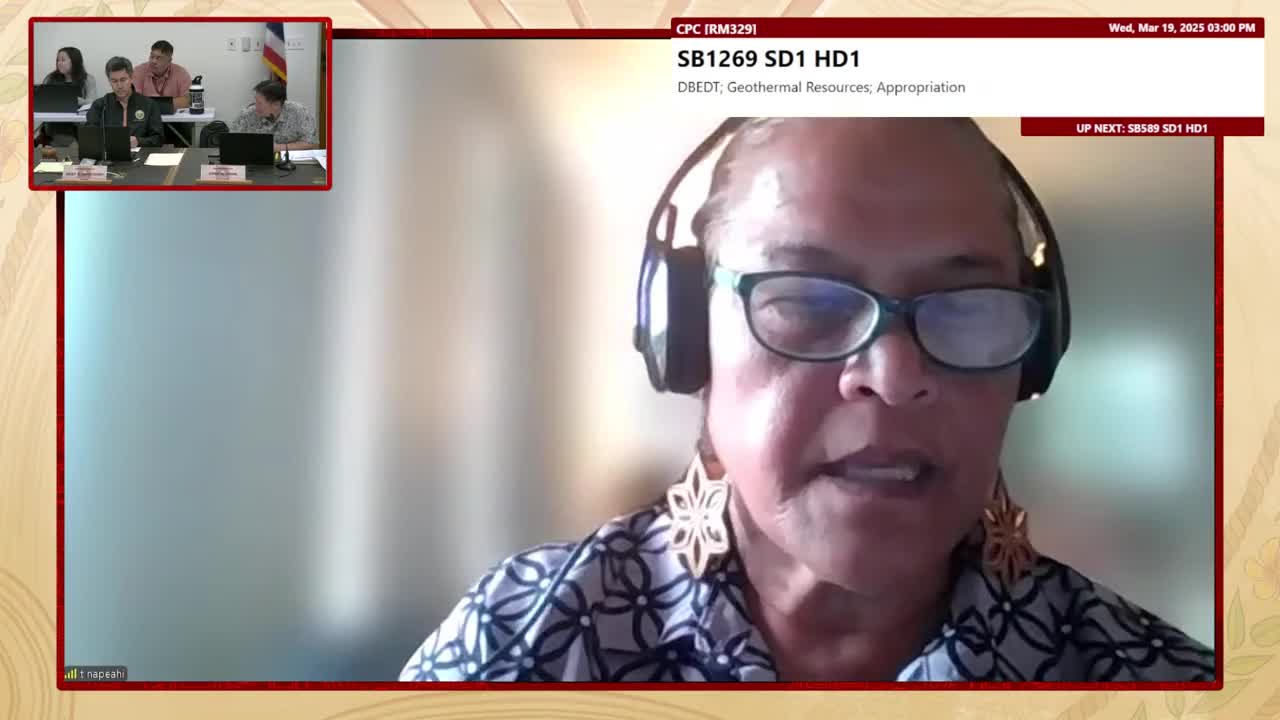 7MIN
House Standing Committee on Consumer Protection & Commerce
Bill Author

Bill Co-Author(s):