SB 3073: Forensic Identification; Biological Evidence; Retention
- Session Year: 2025-2026
- House: Senate
- Latest Version Date: 2026-04-28
Current Status:
Passed
(2026-06-26: Act 150, on 06/25/2026 (Gov. Msg. No. 1251).)
Introduced
In Committee
First Chamber
In Committee
Second Chamber
Final Decking
Enacted
What does this bill do?
This bill changes when law enforcement, prosecutors, courts, and evidence custodians must keep biological evidence after a conviction by limiting required long-term retention to certain serious felonies (like murder, manslaughter, kidnapping, first- and second‑degree sexual assault, and first‑degree assault and related attempts) where the defendant’s identity was disputed (for example, by claiming misidentification, an alibi, or a third‑party perpetrator) and the item could reasonably contain material usable for DNA testing. It also lets agencies ask a court to dispose of evidence sooner, requires notice so defendants can file objections and get a hearing, and lets a court order retention in any felony if biological evidence exists and could help prove or disprove who committed the crime.
The summary is provided by generative AI which can make mistakes. For original language, please view the details in the table below.
Specifies the types of cases in which evidence must be retained post-conviction and the process by which evidence may be disposed of earlier than the standard period of retention, which includes a procedure for defendants to oppose the disposal of biological evidence by filing an objection with the court. Authorizes the court, upon motion of a defendant or prosecutor or on the court's own motion, to order the retention of biological evidence in any felony case for a certain period under certain circumstances. Effective 9/1/2026. (CD1)
Specifies the types of cases in which evidence must be retained post-conviction and the process by which evidence may be disposed of earlier than the standard period of retention, which includes a procedure for defendants to oppose the disposal of biological evidence by filing an objection with the court. Authorizes the court, upon motion of a defendant or prosecutor or on the court's own motion, to order the retention of biological evidence in any felony case for a certain period under certain circumstances. Effective 7/1/3000. (HD1)
Specifies the types of cases in which evidence must be retained post-conviction and the process by which evidence may be disposed of earlier than the standard period of retention, which includes a procedure for defendants to oppose the disposal of biological evidence by filing an objection with the court. Provides that upon the motion of a defendant or prosecutor or on the court's own motion, the court may order retention of biological evidence in any felon case for a certain period under certain circumstances. Effective 3/22/2075. (SD1)
Specifies the types of cases in which evidence must be retained post-conviction and the process by which evidence may be disposed of earlier than the standard period of retention, which includes a procedure for defendants to oppose the disposal of biological evidence by filing an objection with the court.
|
THE SENATE |
S.B. NO. |
3073 |
|
THIRTY-THIRD LEGISLATURE, 2026 |
S.D. 1 |
|
|
STATE OF HAWAII |
H.D. 1 |
|
|
|
C.D. 1 |
|
|
|
||
|
|
||
A BILL FOR AN ACT
RELATING TO THE RETENTION OF BIOLOGICAL EVIDENCE.
BE IT ENACTED BY THE LEGISLATURE OF THE STATE OF HAWAII:
SECTION 1. The legislature finds that section 844D-126, Hawaii Revised Statutes, appears to require all evidence custodians in all post-conviction cases to retain all evidence that "may" contain biological evidence. As a result, evidence must be retained in all felony, misdemeanor, petty misdemeanor, and violation cases resulting in conviction, even when the actual presence of biological evidence is extremely unlikely; even when that evidence would have been irrelevant to the identification of the perpetrator; and even when the identity of the perpetrator was not at issue.
The legislature further finds that this broad evidence retention requirement has caused storage problems statewide. Reasonable guidelines and limitations for the post-conviction retention of biological evidence by law enforcement agencies and the courts are needed, as well as a clear procedure that allows defendants to object to the proposed disposal of biological evidence.
The purpose of this Act is to establish a more practical and balanced framework for post-conviction evidence retention by:
(1) Limiting mandatory post-conviction evidence retention to certain serious felony offenses in which the identity of the perpetrator was a contested issue and the evidence could reasonably be determined to contain biological material that could be used for DNA analysis to identify or exclude the defendant as the perpetrator;
(2) Allowing the disposal of evidence, upon court approval, before the exhaustion of all appeals or completion of a sentence in cases in which the identity of the perpetrator was not a contested issue or the evidence does not contain biological material that could reasonably be used for DNA analysis to identify or exclude the defendant as the perpetrator;
(3) Providing defendants with an opportunity to object to the proposed disposal of evidence; and
(4) Authorizing the court, upon motion of a defendant or prosecutor or on the court's own motion, to order the retention of biological evidence in felony cases for a certain period under specified circumstances.
SECTION 2. Section 844D-1, Hawaii Revised Statutes, is amended by adding a new definition to be appropriately inserted and to read as follows:
""Contested issue in the case" means, as reflected in the record, the defendant affirmatively disputed being the perpetrator of the charged offense by raising or relying on misidentification, alibi, mistaken identity, third-party perpetrator, or similar theory, or by otherwise placing the perpetrator's identity in issue through motion, argument, cross-examination, evidence, or proffer."
SECTION 3. Section 844D-121, Hawaii Revised Statutes, is amended to read as follows:
"§844D-121 Petition for post-conviction DNA testing. Notwithstanding any other law or rule of court governing post-conviction relief to the contrary, a person who was convicted of and sentenced for a crime, or acquitted of a crime on the ground of physical or mental disease, disorder, or defect excluding responsibility, may file a motion, at any time, for DNA analysis of any evidence that:
(1) Is
in the custody or control of a [police department,] law enforcement
agency, prosecuting [attorney,] agency, laboratory, or court[;],
consistent with section 844D-126;
(2) Is related to the investigation or prosecution that resulted in the judgment of conviction or of acquittal of a crime on the ground of physical or mental disease, disorder, or defect excluding responsibility; and
(3) [May
contain] Contains biological evidence[.] that could
reasonably be used for DNA analysis to:
(A) Establish the identity of the person who committed the offense that resulted in the judgment of conviction; or
(B) Exclude a person from the group of persons who could have committed the offense that resulted in the judgment of conviction."
SECTION 4. Section 844D-126, Hawaii Revised Statutes, is amended to read as follows:
"[[]§844D-126[]] Retention of biological evidence. (a)
[All] Any evidence in the custody or control of an
evidence custodian, including a [police department,] law
enforcement agency, prosecuting [attorney,] agency,
laboratory, or court [that], shall be retained if:
(1) The identity of the defendant, as the perpetrator of the offense that resulted in the judgment of conviction, was a contested issue in the case;
(2) The
evidence is related to the investigation or prosecution of a case in which
there has been a judgment of conviction [and that may] for:
(A) Murder;
(B) Manslaughter;
(C) Kidnapping;
(D) Sexual assault in the first degree;
(E) Sexual assault in the second degree;
(F) Assault in the first degree; or
(G) An attempt or criminal conspiracy to commit any of the offenses set forth in this paragraph; and
(3) The evidence could reasonably be determined to contain biological evidence that could be used for DNA analysis to:
(A) Establish the identity of the person who committed the offense that resulted in the judgment of conviction; or
(B) Exclude a person from the group of persons who could have committed the offense that resulted in the judgment of conviction.
(b) The evidence retained pursuant to subsection (a) shall be retained at least until the later occurring of either:
(1) The exhaustion of all appeals of the case to which the evidence is related; or
(2) The completion of any sentence, including any term of probation or parole, imposed on the defendant in the case to which the evidence relates.
[(b)
The attorney general shall establish procedures and protocols, which
shall be uniform throughout the State, for the collection and preservation of
evidence retained pursuant to this section.]
(c) The evidence custodian may dispose of evidence retained pursuant to subsection (a) before the expiration of the time period specified in subsection (b) if:
(2) The prosecuting agency or evidence custodian files with the court a notification of proposed disposal of evidence consistent with this section, and either:
(A) The defendant does not file a statement of objection pursuant to subsection (f); or
(B) If the defendant files a statement of objection pursuant to subsection (f), the court, after a hearing on the objection, allows disposal of the evidence pursuant to subsection (g).
(d) If a notification of proposed disposal of the evidence is filed, a copy shall be served upon:
(1) The defendant against whom the judgment of conviction was entered, by personal service or, after a reasonable and documented good faith attempt for personal service was made, by first-class mail to the defendant's last known address;
(2) The defendant's parole or probation officer, if service cannot be made upon the defendant by personal service and the defendant remains under parole or probation supervision;
(3) The defendant's attorney of record, if applicable;
(4) The prosecuting agency, if that agency did not file the notification; and
(5) The evidence custodian, if the evidence custodian did not file the notification.
(e) The notification of proposed disposal of the evidence shall include:
(1) A description of the evidence proposed for disposal; and
(2) Notice that the evidence custodian may dispose of the evidence before the expiration of the time period specified in subsection (b) unless, within ninety days of service of the notification, the defendant files a written statement of objection with the court and serves the statement of objection on the prosecuting agency and the evidence custodian.
(f) If, within ninety days of service of the notification of proposed disposal of the evidence on the defendant, the defendant's parole or probation officer, or the defendant's attorney of record, whichever service is completed last, the defendant files a written statement of objection with the court and serves the statement of objection on the prosecuting agency and the evidence custodian, the court shall schedule a hearing on the objection and provide notice of the hearing to the prosecuting agency and the evidence custodian.
(g) If, after a hearing on a motion for disposal of evidence or a hearing on the objection to a notification of proposed disposal of the evidence, the court determines by a preponderance of the evidence that:
(1) The identity of the defendant, as the perpetrator of the offense that resulted in the judgment of conviction, was not a contested issue in the case; or
(2) The evidence does not contain biological evidence that could reasonably be used for DNA analysis to:
(A) Establish the identity of the person who committed the offense for which the defendant was convicted; or
(B) Exclude a person from the group of persons who could have committed the offense for which the defendant was convicted,
the court may allow the evidence custodian to dispose of the evidence.
(h) Notwithstanding any other provision of this chapter, upon the motion of a defendant or prosecutor or on the court's own motion, the court may order retention of biological evidence in any felony case for the period otherwise required under this chapter if the court finds, based on the record, that:
(1) Biological evidence exists or was collected in the case; and
(2) Biological evidence could reasonably be material to establishing or disproving the identity of the perpetrator.
(i) For the purposes of this section, "biological evidence" means an individual's blood, semen, hair, saliva, skin tissue, fingernail scrapings, teeth, bone, bodily fluids, or other identifiable biological material, including the contents of a sexual assault examination kit."
SECTION 5. This Act does not affect rights and duties that matured, penalties that were incurred, and proceedings that were begun before its effective date.
SECTION 6. Statutory material to be repealed is bracketed and stricken. New statutory material is underscored.
SECTION 7. This Act shall take effect on September 1, 2026.
Report Title:
Forensic Identification; Biological Evidence; Retention
Description:
Specifies the types of cases in which evidence must be retained post-conviction and the process by which evidence may be disposed of earlier than the standard period of retention, which includes a procedure for defendants to oppose the disposal of biological evidence by filing an objection with the court. Authorizes the court, upon motion of a defendant or prosecutor or on the court's own motion, to order the retention of biological evidence in any felony case for a certain period under certain circumstances. Effective 9/1/2026. (CD1)
The summary description of legislation appearing on this page is for informational purposes only and is not legislation or evidence of legislative intent.
|
THE SENATE |
S.B. NO. |
3073 |
|
THIRTY-THIRD LEGISLATURE, 2026 |
S.D. 1 |
|
|
STATE OF HAWAII |
H.D. 1 |
|
|
|
|
|
|
|
||
|
|
||
A BILL FOR AN ACT
RELATING TO THE RETENTION OF BIOLOGICAL EVIDENCE.
BE IT ENACTED BY THE LEGISLATURE OF THE STATE OF HAWAII:
SECTION 1. The legislature finds that section 844D-126, Hawaii Revised Statutes, appears to require all evidence custodians in all post-conviction cases to retain all evidence that "may" contain biological evidence. As a result, evidence must be retained in all felony, misdemeanor, petty misdemeanor, and violation cases resulting in conviction, even when the actual presence of biological evidence is extremely unlikely; even when that evidence would have been irrelevant to the identification of the perpetrator; and even when the identity of the perpetrator was not at issue.
The legislature further finds that this broad evidence retention requirement has caused storage problems statewide. Reasonable guidelines and limitations for the post-conviction retention of biological evidence by law enforcement agencies and the courts are needed, as well as a clear procedure that allows defendants to object to the proposed disposal of biological evidence.
The purpose of this Act is to establish a more practical and balanced framework for post-conviction evidence retention by:
(1) Limiting mandatory post-conviction evidence retention to certain serious felony offenses in which the identity of the perpetrator was a contested issue and the evidence could reasonably be determined to contain biological material that could be used for DNA analysis to identify or exclude the defendant as the perpetrator;
(2) Allowing the disposal of evidence, upon court approval, before the exhaustion of all appeals or completion of a sentence in cases in which the identity of the perpetrator was not a contested issue or the evidence does not contain biological material that could reasonably be used for DNA analysis to identify or exclude the defendant as the perpetrator;
(3) Providing defendants with an opportunity to object to the proposed disposal of evidence; and
(4) Authorizing the court, upon motion of a defendant or prosecutor or on the court's own motion, to order the retention of biological evidence in felony cases for a certain period under specified circumstances.
SECTION 2. Section 844D-1, Hawaii Revised Statutes, is amended by adding a new definition to be appropriately inserted and to read as follows:
""Contested issue in the case" means, as reflected in the record, the defendant affirmatively disputed being the perpetrator of the charged offense by raising or relying on misidentification, alibi, mistaken identity, third-party perpetrator, or similar theory, or by otherwise placing the perpetrator's identity in issue through motion, argument, cross-examination, evidence, or proffer."
SECTION 3. Section 844D-121, Hawaii Revised Statutes, is amended to read as follows:
"§844D-121 Petition for post-conviction DNA testing. Notwithstanding any other law or rule of court governing post-conviction relief to the contrary, a person who was convicted of and sentenced for a crime, or acquitted of a crime on the ground of physical or mental disease, disorder, or defect excluding responsibility, may file a motion, at any time, for DNA analysis of any evidence that:
(1) Is
in the custody or control of a [police department,] law enforcement
agency, prosecuting [attorney,] agency, laboratory, or court[;],
consistent with section 844D-126;
(2) Is related to the investigation or prosecution that resulted in the judgment of conviction or of acquittal of a crime on the ground of physical or mental disease, disorder, or defect excluding responsibility; and
(3) [May
contain] Contains biological evidence[.] that could
reasonably be used for DNA analysis to:
(A) Establish the identity of the person who committed the offense that resulted in the judgment of conviction; or
(B) Exclude a person from the group of persons who could have committed the offense that resulted in the judgment of conviction."
SECTION 4. Section 844D-126, Hawaii Revised Statutes, is amended to read as follows:
"[[]§844D-126[]] Retention of biological evidence. (a)
[All] Any evidence in the custody or control of an
evidence custodian, including a [police department,] law
enforcement agency, prosecuting [attorney,] agency,
laboratory, or court [that], shall be retained if:
(1) The identity of the defendant, as the perpetrator of the offense that resulted in the judgment of conviction, was a contested issue in the case;
(2) The
evidence is related to the investigation or prosecution of a case in which
there has been a judgment of conviction [and that may] for:
(A) Murder;
(B) Manslaughter;
(C) Kidnapping;
(D) Sexual assault in the first degree;
(E) Sexual assault in the second degree;
(F) Assault in the first degree; or
(G) An attempt or criminal conspiracy to commit any of the offenses set forth in this paragraph; and
(3) The evidence could reasonably be determined to contain biological evidence that could be used for DNA analysis to:
(A) Establish the identity of the person who committed the offense that resulted in the judgment of conviction; or
(B) Exclude a person from the group of persons who could have committed the offense that resulted in the judgment of conviction.
(b) The evidence retained pursuant to subsection (a) shall be retained at least until the later occurring of either:
(1) The exhaustion of all appeals of the case to which the evidence is related; or
(2) The completion of any sentence, including any term of probation or parole, imposed on the defendant in the case to which the evidence relates.
[(b)
The attorney general shall establish procedures and protocols, which
shall be uniform throughout the State, for the collection and preservation of
evidence retained pursuant to this section.]
(c) The evidence custodian may dispose of evidence retained pursuant to subsection (a) before the expiration of the time period specified in subsection (b) if:
(2) The prosecuting agency or evidence custodian files with the court a notification of proposed disposal of evidence consistent with this section, and either:
(A) The defendant does not file a statement of objection pursuant to subsection (f); or
(B) If the defendant files a statement of objection pursuant to subsection (f), the court, after a hearing on the objection, allows disposal of the evidence pursuant to subsection (g).
(d) If a notification of proposed disposal of the evidence is filed, a copy shall be served upon:
(1) The defendant against whom the judgment of conviction was entered, by personal service or, after a reasonable and documented good faith attempt for personal service was made, by first-class mail to the defendant's last known address;
(2) The defendant's parole or probation officer, if service cannot be made upon the defendant by personal service and the defendant remains under parole or probation supervision;
(3) The defendant's attorney of record, if applicable;
(4) The prosecuting agency, if that agency did not file the notification; and
(5) The evidence custodian, if the evidence custodian did not file the notification.
(e) The notification of proposed disposal of the evidence shall include:
(1) A description of the evidence proposed for disposal; and
(2) Notice that the evidence custodian may dispose of the evidence before the expiration of the time period specified in subsection (b) unless, within ninety days of service of the notification, the defendant files a written statement of objection with the court and serves the statement of objection on the prosecuting agency and the evidence custodian.
(f) If, within ninety days of service of the notification of proposed disposal of the evidence on the defendant, the defendant's parole or probation officer, or the defendant's attorney of record, whichever service is completed last, the defendant files a written statement of objection with the court and serves the statement of objection on the prosecuting agency and the evidence custodian, the court shall schedule a hearing on the objection and provide notice of the hearing to the prosecuting agency and the evidence custodian.
(g) If, after a hearing on a motion for disposal of evidence or a hearing on the objection to a notification of proposed disposal of the evidence, the court determines by a preponderance of the evidence that:
(1) The identity of the defendant, as the perpetrator of the offense that resulted in the judgment of conviction, was not a contested issue in the case; or
(2) The evidence does not contain biological evidence that could reasonably be used for DNA analysis to:
(A) Establish the identity of the person who committed the offense for which the defendant was convicted; or
(B) Exclude a person from the group of persons who could have committed the offense for which the defendant was convicted,
the court may allow the evidence custodian to dispose of the evidence.
(h) Notwithstanding any other provision of this chapter, upon the motion of a defendant or prosecutor or on the court's own motion, the court may order the retention of any evidence related to the investigation or prosecution of a felony case, for the period stated in subsection (b), if:
(1) The identity of the defendant, as the perpetrator of the offense that resulted in the judgment of conviction, was a contested issue in the case; and
(2) The evidence could reasonably be used for DNA analysis to:
(A) Establish the identity of the person who committed the offense that resulted in the judgment of conviction; or
(B) Exclude a person from the group of persons who could have committed the offense that resulted in the judgment of conviction.
(i) For the purposes of this section, "biological evidence" means an individual's blood, semen, hair, saliva, skin tissue, fingernail scrapings, teeth, bone, bodily fluids, or other identifiable biological material, including the contents of a sexual assault examination kit."
SECTION 5. This Act does not affect rights and duties that matured, penalties that were incurred, and proceedings that were begun before its effective date.
SECTION 6. Statutory material to be repealed is bracketed and stricken. New statutory material is underscored.
SECTION 7. This Act shall take effect on July 1, 3000.
Report Title:
Forensic Identification; Biological Evidence; Retention
Description:
Specifies the types of cases in which evidence must be retained post-conviction and the process by which evidence may be disposed of earlier than the standard period of retention, which includes a procedure for defendants to oppose the disposal of biological evidence by filing an objection with the court. Authorizes the court, upon motion of a defendant or prosecutor or on the court's own motion, to order the retention of biological evidence in any felony case for a certain period under certain circumstances. Effective 7/1/3000. (HD1)
The summary description of legislation appearing on this page is for informational purposes only and is not legislation or evidence of legislative intent.
|
THE SENATE |
S.B. NO. |
3073 |
|
THIRTY-THIRD LEGISLATURE, 2026 |
S.D. 1 |
|
|
STATE OF HAWAII |
|
|
|
|
|
|
|
|
||
|
|
||
A BILL FOR AN ACT
RELATING TO THE RETENTION OF BIOLOGICAL EVIDENCE.
BE IT ENACTED BY THE LEGISLATURE OF THE STATE OF HAWAII:
SECTION 1. The legislature finds that section 844D-126, Hawaii Revised Statutes, appears to require all evidence custodians in all post-conviction cases to retain all evidence that "may" contain biological evidence. As a result, evidence must be retained in all felony, misdemeanor, petty misdemeanor, and violation cases resulting in conviction, even when the actual presence of biological evidence is extremely unlikely; even when that evidence would have been irrelevant to the identification of the perpetrator; and even when the identity of the perpetrator was not at issue.
The legislature further finds that this broad evidence retention requirement has caused storage problems statewide. Reasonable guidelines and limitations for the post-conviction retention of biological evidence by law enforcement agencies and the courts are needed, as well as a clear procedure that allows defendants to object to the proposed disposal of biological evidence.
The purpose of this Act is to establish a more practical and balanced framework for post-conviction evidence retention by:
(1) Defining "contested issue of identity";
(2) Limiting the post-conviction retention requirements to certain serious felony offenses in which the identity of the perpetrator was in question and the evidence could reasonably be determined to contain biological material that could be used for DNA analysis to identify or exclude the defendant as the perpetrator of the offense;
(3) Allowing the disposal of evidence before the exhaustion of all appeals or the completion of a sentence if the court determines that the identity of the defendant as the perpetrator of the offense was not a contested issue in the case, or that the evidence does not contain biological evidence that could reasonably be used for DNA analysis to identify or exclude the defendant as the perpetrator;
(4) Providing defendants with an opportunity to object to the proposed disposal of evidence;
(5) Providing that upon the motion of a defendant or prosecutor or on the court's own motion, the court may order retention of biological evidence in any felony case for a certain period under certain circumstances; and
(6) Defining "biological evidence".
SECTION 2. Section 844D-1, Hawaii Revised Statutes, is amended by adding a new definition to be appropriately inserted and to read as follows:
""Contested issue of identity" means, as reflected in the record, the defendant affirmatively disputed being the perpetrator of the charged offense by raising or relying on misidentification, alibi, mistaken identity, third-party perpetrator, or similar theory, or by otherwise placing the perpetrator's identity in issue through motion, argument, cross-examination, evidence, or proffer."
SECTION 3. Section 844D-121, Hawaii Revised Statutes, is amended to read as follows:
"§844D-121 Petition for post-conviction DNA testing. Notwithstanding any other law or rule of court governing post-conviction relief to the contrary, a person who was convicted of and sentenced for a crime, or acquitted of a crime on the ground of physical or mental disease, disorder, or defect excluding responsibility, may file a motion, at any time, for DNA analysis of any evidence that:
(1) Is
in the custody or control of a police department, prosecuting attorney,
laboratory, or court[;], consistent with section 844D-126;
(2) Is related to the investigation or prosecution that resulted in the judgment of conviction or of acquittal of a crime on the ground of physical or mental disease, disorder, or defect excluding responsibility; and
(3) [May
contain] Contains biological evidence[.] that could
reasonably be used for DNA analysis to:
(A) Establish the identity of the person who committed the offense that resulted in the judgment of conviction; or
(B) Exclude a person from the group of persons who could have committed the offense that resulted in the judgment of conviction."
SECTION 4. Section 844D-126, Hawaii Revised Statutes, is amended to read as follows:
"[[]§844D-126[]] Retention of biological evidence. (a)
[All] Any evidence in the custody or control of an
evidence custodian, including a [police department,] law
enforcement agency, prosecuting [attorney,] agency,
laboratory, or court [that], shall be retained if:
(1) The identity of the defendant, as the perpetrator of the offense that resulted in the judgment of conviction, was a contested issue in the case;
(2) The
evidence is related to the investigation or prosecution of a case in which
there has been a judgment of conviction [and that may] for:
(A) Murder;
(B) Manslaughter;
(C) Kidnapping;
(D) Sexual assault in the first degree;
(E) Sexual assault in the second degree;
(F) Assault in the first degree; or
(G) An attempt or criminal conspiracy to commit any of the offenses set forth in this paragraph; and
(3) The evidence could reasonably be determined to contain biological evidence that could be used for DNA analysis to:
(A) Establish the identity of the person who committed the offense that resulted in the judgment of conviction; or
(B) Exclude a person from the group of persons who could have committed the offense that resulted in the judgment of conviction.
(b) The evidence retained pursuant to subsection (a) shall be retained at least until the later occurring of either:
(1) The exhaustion of all appeals of the case to which the evidence is related; or
(2) The completion of any sentence, including any term of probation or parole, imposed on the defendant in the case to which the evidence relates.
[(b)
The attorney general shall establish procedures and protocols, which
shall be uniform throughout the State, for the collection and preservation of
evidence retained pursuant to this section.]
(c) The evidence custodian may dispose of evidence retained pursuant to subsection (a) before the expiration of the time period specified in subsection (b) if:
(2) The prosecuting agency or evidence custodian files with the court a notification of proposed disposal of evidence consistent with this section, and either:
(A) The defendant does not file a statement of objection pursuant to subsection (f); or
(B) If the defendant files a statement of objection pursuant to subsection (f), the court, after a hearing on the objection, allows disposal of the evidence pursuant to subsection (g).
(d) If a notification of proposed disposal of the evidence is filed, a copy shall be served upon:
(1) The defendant against whom the judgment of conviction was entered, by personal service or, after a reasonable and documented good faith attempt for personal service was made, by first class mail to the defendant's last known address;
(2) The defendant's parole officer or probation officer, if service cannot be made upon the defendant by personal service and the defendant remains under parole or probation supervision;
(3) The defendant's attorney of record, if applicable;
(4) The prosecuting agency, if that agency did not file the notification; and
(5) The evidence custodian, if the evidence custodian did not file the notification.
(e) The notification of proposed disposal of the evidence shall include:
(1) A description of the evidence proposed for disposal; and
(2) Notice that the evidence custodian may dispose of the evidence before the expiration of the time period specified in subsection (b) unless, within ninety days of service of the notification, the defendant files a written statement of objection with the court and serves the statement of objection on the prosecuting agency and the evidence custodian.
(f) If within ninety days of service of the notification of proposed disposal of the evidence on the defendant, defendant's parole or probation officer, or defendant's attorney of record, whichever service is last completed, the defendant files a written statement of objection with the court and serves the statement of objection on the prosecuting agency and the evidence custodian, the court shall schedule a hearing on the objection and provide notice of the hearing to the prosecuting agency and the evidence custodian.
(g) If, after a hearing on the objection to a notification of proposed disposal of the evidence or a hearing on a motion for disposal of evidence, the court determines by a preponderance of the evidence that:
(1) The identity of the defendant, as the perpetrator of the offense that resulted in the judgment of conviction, was not a contested issue in the case; or
(2) The evidence does not contain biological evidence that could reasonably be used for DNA analysis to:
(A) Establish the identity of the person who committed the offense for which the defendant was convicted; or
(B) Exclude a person from the group of persons who could have committed the offense for which the defendant was convicted,
the court may allow the evidence custodian to dispose of the evidence.
(h) Notwithstanding any other provision of this chapter, upon the motion of a defendant or prosecutor or on the court's own motion, the court may order retention of biological evidence in any felony case for the period otherwise required under this chapter if the court finds, based on the record, that:
(1) Biological evidence exists or was collected in the case; and
(2) Biological evidence could reasonably be material to establishing or disproving the identity of the perpetrator.
(i) For the purposes of this section, "biological evidence" means an individual's blood, semen, hair, saliva, skin tissue, fingernail scrapings, teeth, bone, bodily fluids, or other identifiable biological material, including the contents of a sexual assault examination kit."
SECTION 5. This Act does not affect rights and duties that matured, penalties that were incurred, and proceedings that were begun before its effective date.
SECTION 6. Statutory material to be repealed is bracketed and stricken. New statutory material is underscored.
SECTION 7. This Act shall take effect on March 22, 2075.
Report Title:
Forensic Identification; Biological Evidence; Retention
Description:
Specifies the types of cases in which evidence must be retained post-conviction and the process by which evidence may be disposed of earlier than the standard period of retention, which includes a procedure for defendants to oppose the disposal of biological evidence by filing an objection with the court. Provides that upon the motion of a defendant or prosecutor or on the court's own motion, the court may order retention of biological evidence in any felon case for a certain period under certain circumstances. Effective 3/22/2075. (SD1)
The summary description of legislation appearing on this page is for informational purposes only and is not legislation or evidence of legislative intent.
|
THE SENATE |
S.B. NO. |
3073 |
|
THIRTY-THIRD LEGISLATURE, 2026 |
|
|
|
STATE OF HAWAII |
|
|
|
|
|
|
|
|
||
|
|
||
A BILL FOR AN ACT
RELATING TO THE RETENTION OF BIOLOGICAL EVIDENCE.
BE IT ENACTED BY THE LEGISLATURE OF THE STATE OF HAWAII:
SECTION 1. The Legislature finds that section 844D-126, Hawaii Revised Statutes, appears to require all evidence custodians in all post-conviction cases to retain all evidence that "may" contain biological evidence. As a result, evidence must be retained in all felony, misdemeanor, petty misdemeanor, and violation cases resulting in conviction, even when the actual presence of biological evidence is extremely unlikely; even when that evidence would have been irrelevant to the identification of the perpetrator; and even when the identity of the perpetrator was not at issue.
The legislature further finds that this broad evidence retention requirement has caused storage problems statewide. Reasonable guidelines and limitations for the post-conviction retention of biological evidence by law enforcement agencies and the courts are needed, as well as a clear procedure that allows defendants to object to the proposed disposal of biological evidence.
The purpose of this Act is to establish a more practical and balanced framework for post-conviction evidence retention by:
(1) Limiting the post-conviction retention requirements to certain serious felony offenses in which the identity of the perpetrator was in question and the evidence could reasonably be determined to contain biological material that could be used for DNA analysis to identify or exclude the defendant as the perpetrator of the offense;
(2) Allowing the disposal of evidence before the exhaustion of all appeals or the completion of a sentence if the court determines that the identity of the defendant as the perpetrator of the offense was not a contested issue in the case, or that the evidence does not contain biological evidence that could reasonably be used for DNA analysis to identify or exclude the defendant as the perpetrator;
(3) Providing defendants with an opportunity to object to the proposed disposal of evidence; and
(4) Defining "biological evidence."
SECTION 2. Section 844D-121, Hawaii Revised Statutes, is amended to read as follows:
"§844D-121 Petition for post-conviction DNA testing. Notwithstanding any other law or rule of court governing post-conviction relief to the contrary, a person who was convicted of and sentenced for a crime, or acquitted of a crime on the ground of physical or mental disease, disorder, or defect excluding responsibility, may file a motion, at any time, for DNA analysis of any evidence that:
(1) Is
in the custody or control of a police department, prosecuting attorney,
laboratory, or court[;], consistent with section 844D-126;
(2) Is related to the investigation or prosecution that resulted in the judgment of conviction or of acquittal of a crime on the ground of physical or mental disease, disorder, or defect excluding responsibility; and
(3) [May
contain] Contains biological evidence[.] that could
reasonably be used for DNA analysis to:
(A) Establish the identity of the person who committed the offense that resulted in the judgment of conviction; or
(B) Exclude a person from the group of persons who could have committed the offense that resulted in the judgment of conviction."
SECTION 3. Section 844D-126, Hawaii Revised Statutes, is amended to read as follows:
"[[]§844D-126[]] Retention of biological evidence. (a)
[All] Any evidence in the custody or control of an
evidence custodian, including a [police department,] law
enforcement agency, prosecuting [attorney,] agency,
laboratory, or court [that], shall be retained if:
(1) The identity of the defendant, as the perpetrator of the offense that resulted in the judgment of conviction, was a contested issue in the case;
(2) The
evidence is related to the investigation or prosecution of a case in which
there has been a judgment of conviction [and that may] for:
(A) Murder;
(B) Manslaughter;
(C) Kidnapping;
(D) Sexual assault in the first degree;
(E) Sexual assault in the second degree;
(F) Assault in the first degree; or
(G) An attempt or criminal conspiracy to commit any of the offenses set forth in this paragraph; and
(3) The evidence could reasonably be determined to contain biological evidence that could be used for DNA analysis to:
(A) Establish the identity of the person who committed the offense that resulted in the judgment of conviction; or
(B) Exclude a person from the group of persons who could have committed the offense that resulted in the judgment of conviction.
(b) The evidence retained pursuant to subsection (a) shall be retained at least until the later occurring of either:
(1) The exhaustion of all appeals of the case to which the evidence is related; or
(2) The completion of any sentence, including any term of probation or parole, imposed on the defendant in the case to which the evidence relates.
[(b)
The attorney general shall establish procedures and protocols, which
shall be uniform throughout the State, for the collection and preservation of
evidence retained pursuant to this section.]
(c) The evidence custodian may dispose of evidence retained pursuant to subsection (a) before the expiration of the time period specified in subsection (b) if:
(2) The prosecuting agency or evidence custodian files with the court a notification of proposed disposal of evidence consistent with this section, and either:
(A) The defendant does not file a statement of objection pursuant to subsection (f); or
(B) If the defendant files a statement of objection pursuant to subsection (f), the court, after a hearing on the objection, allows disposal of the evidence pursuant to subsection (g).
(d) If a notification of proposed disposal of the evidence is filed, a copy shall be served upon:
(1) The defendant against whom the judgment of conviction was entered, by personal service or, after a reasonable and documented good faith attempt for personal service was made, by first class mail to the defendant's last known address;
(2) The defendant's parole officer or probation officer, if service cannot be made upon the defendant by personal service and the defendant remains under parole or probation supervision;
(3) The defendant's attorney of record, if applicable;
(4) The prosecuting agency, if that agency did not file the notification; and
(5) The evidence custodian, if the evidence custodian did not file the notification.
(e) The notification of proposed disposal of the evidence shall include:
(1) A description of the evidence proposed for disposal; and
(2) Notice that the evidence custodian may dispose of the evidence before the expiration of the time period specified in subsection (b) unless, within ninety days of service of the notification, the defendant files a written statement of objection with the court and serves the statement of objection on the prosecuting agency and the evidence custodian.
(f) If within ninety days of service of the notification of proposed disposal of the evidence on the defendant, defendant's parole or probation officer, or defendant's attorney of record, whichever service is last completed, the defendant files a written statement of objection with the court and serves the statement of objection on the prosecuting agency and the evidence custodian, the court shall schedule a hearing on the objection and provide notice of the hearing to the prosecuting agency and the evidence custodian.
(g) If, after a hearing on the objection to a notification of proposed disposal of the evidence or a hearing on a motion for disposal of evidence, the court determines by a preponderance of the evidence that:
(1) The identity of the defendant, as the perpetrator of the offense that resulted in the judgment of conviction, was not a contested issue in the case; or
(2) The evidence does not contain biological evidence that could reasonably be used for DNA analysis to:
(A) Establish the identity of the person who committed the offense for which the defendant was convicted; or
(B) Exclude a person from the group of persons who could have committed the offense for which the defendant was convicted,
the court may allow the evidence custodian to dispose of the evidence.
(h) As used in this section, "biological evidence" means an individual's blood, semen, hair, saliva, skin tissue, fingernail scrapings, teeth, bone, bodily fluids, or other identifiable biological material, including the contents of a sexual assault examination kit."
SECTION 3. This Act does not affect rights and duties that matured, penalties that were incurred, and proceedings that were begun before its effective date.
SECTION 4. Statutory material to be repealed is bracketed and stricken. New statutory material is underscored.
SECTION 5. This Act shall take effect upon its approval.
|
INTRODUCED BY: |
_____________________________ |
|
|
BY REQUEST |
Report Title:
Forensic Identification; Biological Evidence; Retention
Description:
Specifies the types of cases in which evidence must be retained post-conviction and the process by which evidence may be disposed of earlier than the standard period of retention, which includes a procedure for defendants to oppose the disposal of biological evidence by filing an objection with the court.
The summary description of legislation appearing on this page is for informational purposes only and is not legislation or evidence of legislative intent.
|
Date
|
Status
|
|---|---|
| Jun 26, 2026 | Act 150, on 06/25/2026 (Gov. Msg. No. 1251). |
| Jun 26, 2026 | Act 150, 06/25/2026 (Gov. Msg. No. 1251). |
| May 7, 2026 | Enrolled to Governor. |
| May 8, 2026 | Received notice of passage on Final Reading in House (Hse. Com. No. 888). |
| May 6, 2026 | Passed Final Reading as amended in CD 1 with none voting aye with reservations; none voting no (0) and none excused (0). |
| May 5, 2026 | Received notice of Final Reading (Sen. Com. No. 814). |
| May 1, 2026 | Passed Final Reading, as amended (CD 1). Ayes, 24; Aye(s) with reservations: none. Noes, 0 (none). Excused, 1 (Senator(s) Fukunaga). |
| May 1, 2026 | Deferred one day 05-06-26. |
| Apr 29, 2026 | Forty-eight (48) hours notice Friday, 05-01-26. |
| Apr 29, 2026 | Reported from Conference Committee (Conf Com. Rep. No. 14-26) as amended in (CD 1). |
| Apr 29, 2026 | 48 Hrs. Notice (as amended CD 1) 05-01-26. |
| Apr 29, 2026 | Reported from Conference Committee as amended CD 1 (Conf. Com. Rep. No. 14-26). |
| Apr 23, 2026 | The Conference Committee recommends that the measure be Passed, with Amendments. The votes were as follows: 4 Ayes: Representative(s) Tarnas, Belatti, Poepoe, Shimizu; Ayes with reservations: none; 0 Noes: none; and 0 Excused: none. |
| Apr 23, 2026 | The Conference committee recommends that the measure be PASSED, WITH AMENDMENTS. The votes of the Senate Conference Managers were as follows: 3 Aye(s): Senator(s) Rhoads, Gabbard, Awa; Aye(s) with reservations: none ; 0 No(es): none; and 0 Excused: none. |
| Apr 22, 2026 | Conference committee meeting scheduled for 04-23-26 2:35PM; Conference Room 325. |
| Apr 22, 2026 | Received notice of Senate conferees (Sen. Com. No. 720). |
| Apr 21, 2026 | Senate Conferees Appointed: Rhoads Chair; Gabbard, Awa. |
| Apr 21, 2026 | Received notice of appointment of House conferees (Hse. Com. No. 800). |
| Apr 21, 2026 | House Conferees Appointed: Tarnas Chair; Belatti, Poepoe, Shimizu. |
| Apr 16, 2026 | Received notice of disagreement (Sen. Com. No. 710). |
| Apr 16, 2026 | Senate disagrees with House amendments. |
| Apr 16, 2026 | Received from House (Hse. Com. No. 738). |
| Apr 14, 2026 | Passed Third Reading with none voting aye with reservations; none voting no (0) and none excused (0). Transmitted to Senate. |
| Apr 9, 2026 | Passed Second Reading as amended in HD 1; placed on the calendar for Third Reading with none voting aye with reservations; none voting no (0) and Representative(s) Cochran excused (1). |
| Apr 9, 2026 | Reported from JHA (Stand. Com. Rep. No. 1978-26) as amended in HD 1, recommending passage on Second Reading and placement on the calendar for Third Reading. |
| Mar 19, 2026 | The committee on JHA recommend that the measure be PASSED, WITH AMENDMENTS. The votes were as follows: 8 Ayes: Representative(s) Tarnas, Poepoe, Hashem, Kahaloa, Takayama, Cochran, Garcia, Shimizu; Ayes with reservations: none; Noes: none; and 2 Excused: Representative(s) Belatti, Sayama. |
| Mar 17, 2026 | Bill scheduled to be heard by JHA on Thursday, 03-19-26 2:00PM in House conference room 325 VIA VIDEOCONFERENCE. |
| Mar 12, 2026 | Referred to JHA, referral sheet 17 |
| Mar 12, 2026 | Pass First Reading |
| Mar 10, 2026 | Received from Senate (Sen. Com. No. 356) in amended form (SD 1). |
| Mar 10, 2026 | Passed Third Reading, as amended (SD 1). Ayes, 25; Aye(s) with reservations: none . Noes, 0 (none). Excused, 0 (none). Transmitted to House. |
| Mar 6, 2026 | 48 Hrs. Notice 3-10-26. |
| Mar 6, 2026 | Report adopted; Passed Second Reading, as amended (SD 1). |
| Mar 6, 2026 | Reported from JDC (Stand. Com. Rep. No. 2889) with recommendation of passage on Second Reading, as amended (SD 1) and placement on the calendar for Third Reading. |
| Feb 24, 2026 | The committee(s) on JDC recommend(s) that the measure be PASSED, WITH AMENDMENTS. The votes in JDC were as follows: 4 Aye(s): Senator(s) Rhoads, Chang, San Buenaventura, Awa; Aye(s) with reservations: none ; 0 No(es): none; and 1 Excused: Senator(s) Gabbard. |
| Feb 13, 2026 | The committee(s) on JDC has scheduled a public hearing on 02-24-26 9:45AM; Conference Room 016 & Videoconference. |
| Feb 10, 2026 | Re-Referred to JDC. |
| Jan 30, 2026 | Referred to PSM, JDC. |
| Jan 28, 2026 | Passed First Reading. |
| Jan 28, 2026 | Introduced. |
| Jan 26, 2026 | Pending Introduction. |
|
Date
|
Description
|
Location
|
Votes
|
|
|---|---|---|---|---|
| May 6, 2026 | Final Reading | House Floor |
Passed |
|
| May 1, 2026 | Final Reading | Senate Floor |
Passed |
|
| Apr 14, 2026 | Third Reading | House Floor |
Passed |
|
| Mar 19, 2026 | The committee on JHA recommend that the measure be PASSED, WITH AMENDMENTS | House Standing Committee on Judiciary & Hawaiian Affairs |
Passed |
|
| Mar 10, 2026 | Third Reading | Senate Floor |
Passed |
|
| Feb 24, 2026 | The committee(s) on JDC recommend(s) that the measure be PASSED, WITH AMENDMENTS | Senate Standing Committee on Judiciary |
Passed |
This list shows positions taken on this bill by organizations on the date displayed, which is linked to the original source.
Positions by individuals are not included.
|
Organization
|
Position
|
Date
|
|---|---|---|
| Department of the Attorney General | ** Support | |
| Department of the Attorney General | *** Support | Mar 19, 2026 |
| Department of the Prosecuting Attorney, County of Maui | *** Support | Mar 19, 2026 |
| Honolulu Police Department | *** Support | Mar 19, 2026 |
| Office of the Public Defender | *** Against | Mar 19, 2026 |
STAND. COM. REP. NO. 2889
Honolulu, Hawaii
RE: S.B. No. 3073
S.D. 1
Honorable Ronald D. Kouchi
President of the Senate
Thirty-Third State Legislature
Regular Session of 2026
State of Hawaii
Sir:
Your Committee on Judiciary, to which was referred S.B. No. 3073 entitled:
"A BILL FOR AN ACT RELATING TO THE RETENTION OF BIOLOGICAL EVIDENCE,"
begs leave to report as follows:
The purpose and intent of this measure is to specify the types of cases in which evidence must be retained post-conviction and the process by which evidence may be disposed of earlier than the standard period of retention, which includes a procedure for defendants to oppose the disposal of biological evidence by filing an objection with the court.
Your Committee received testimony in support of this measure from the Department of the Attorney General, Honolulu Police Department, and Department of the Prosecuting Attorney of the County of Maui.
Your Committee received testimony in opposition to this measure from the Office of the Public Defender.
Your Committee finds that existing law requires all evidence custodians to retain all evidence that may contain biological evidence post-conviction. Because of this broad evidence retention requirement, all evidence that may contain biological evidence must be retained, even if the actual presence of biological evidence is extremely unlikely. Consequently, evidence custodians statewide are experiencing storage capacity and cannot store all of the evidence. This measure will establish reasonable guidelines and limitations for the post-conviction retention of biological evidence to ensure that limited space and resources are used to preserve post-conviction evidence that could reasonably be used for future DNA analysis to assist in accurately identifying perpetrators of serious crimes.
Your Committee has amended this measure by:
(1) Inserting a definition of "contested issue of identity";
(2) Inserting language authorizing a court to order the retention of biological evidence in any felony case for a certain period under certain circumstances upon the motion of a defendant or prosecutor or on the court's own motion;
(3) Amending section 1 to reflect its amended purpose;
(4) Inserting an effective date of March 22, 2075, to encourage further discussion; and
(5) Making technical, nonsubstantive amendments for the purposes of clarity and consistency.
As affirmed by the record of votes of the members of your Committee on Judiciary that is attached to this report, your Committee is in accord with the intent and purpose of S.B. No. 3073, as amended herein, and recommends that it pass Second Reading in the form attached hereto as S.B. No. 3073, S.D. 1, and be placed on the calendar for Third Reading.
Respectfully submitted on behalf of the members of the Committee on Judiciary,
|
|
|
________________________________ KARL RHOADS, Chair |
|
Date
|
Testimony PDF
|
|---|---|
| Mar 19, 2026 | SB3073_SD1_TESTIMONY_JHA_03-19-26_.PDF |
| Feb 24, 2026 | SB3073_TESTIMONY_JDC_02-24-26_.PDF |
Discussed in Hearing
 2MIN
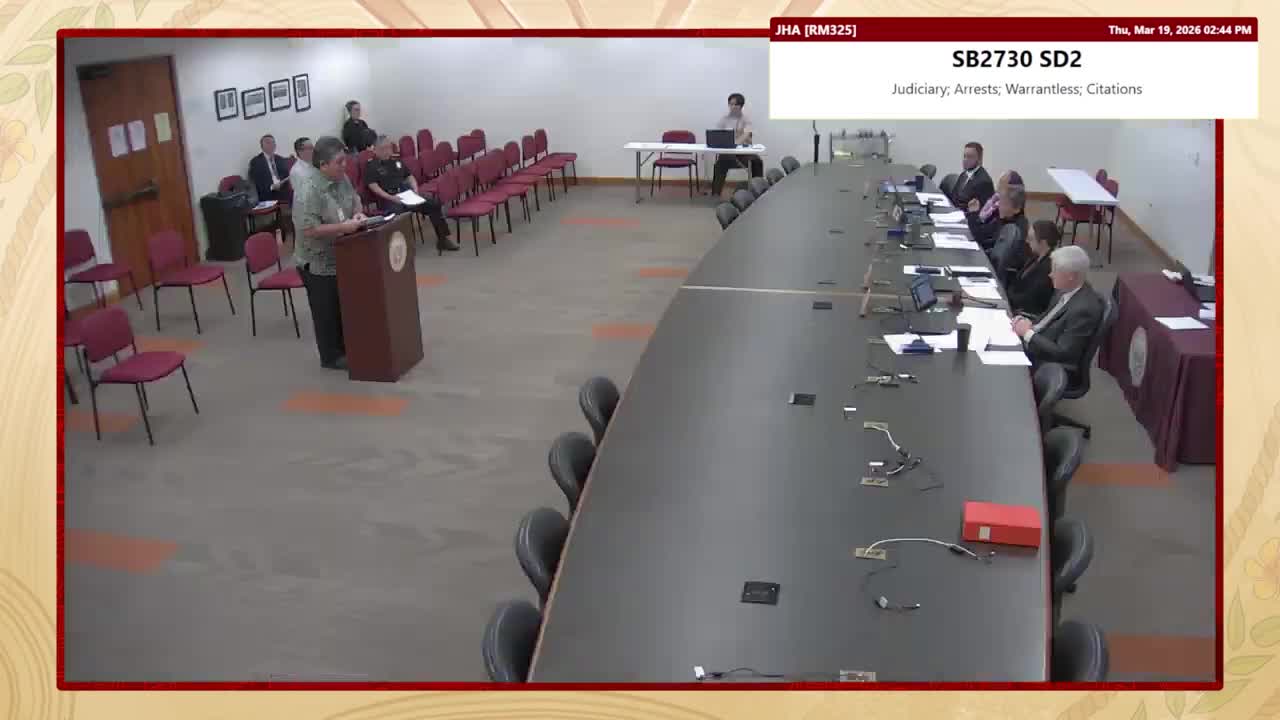
Conference Committee
 11MIN
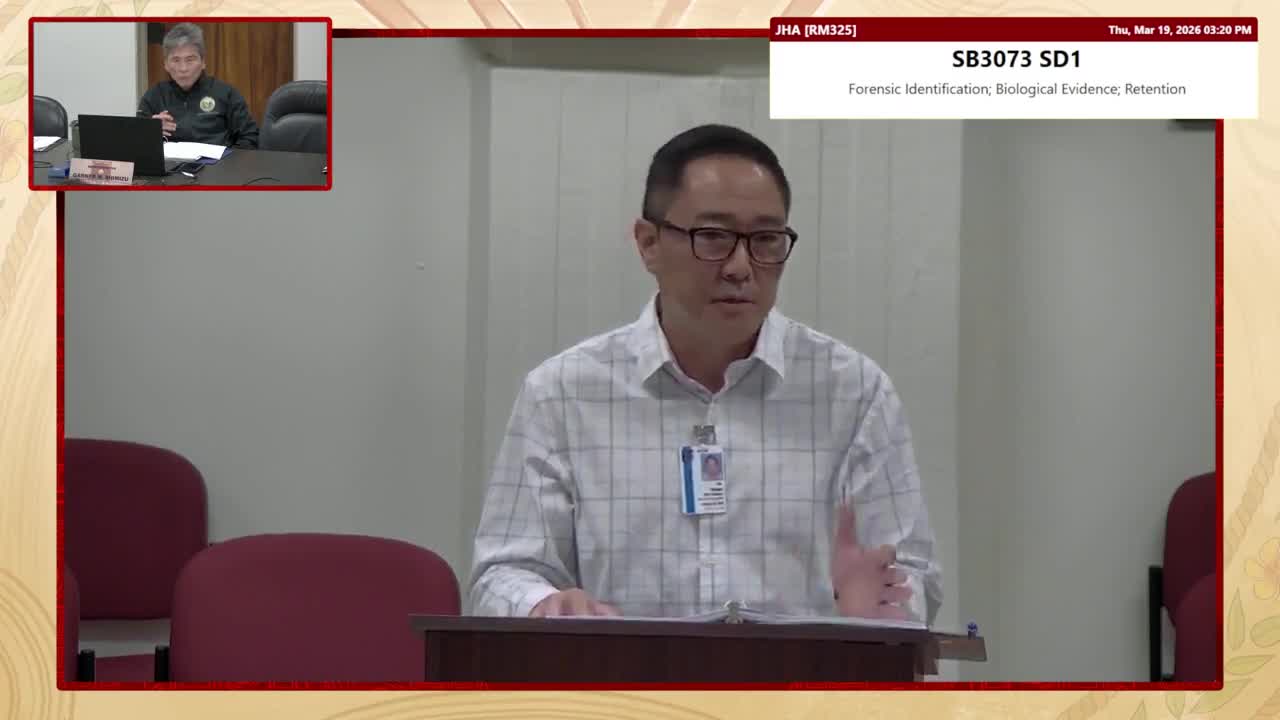
House Standing Committee on Judiciary & Hawaiian Affairs
 3MIN
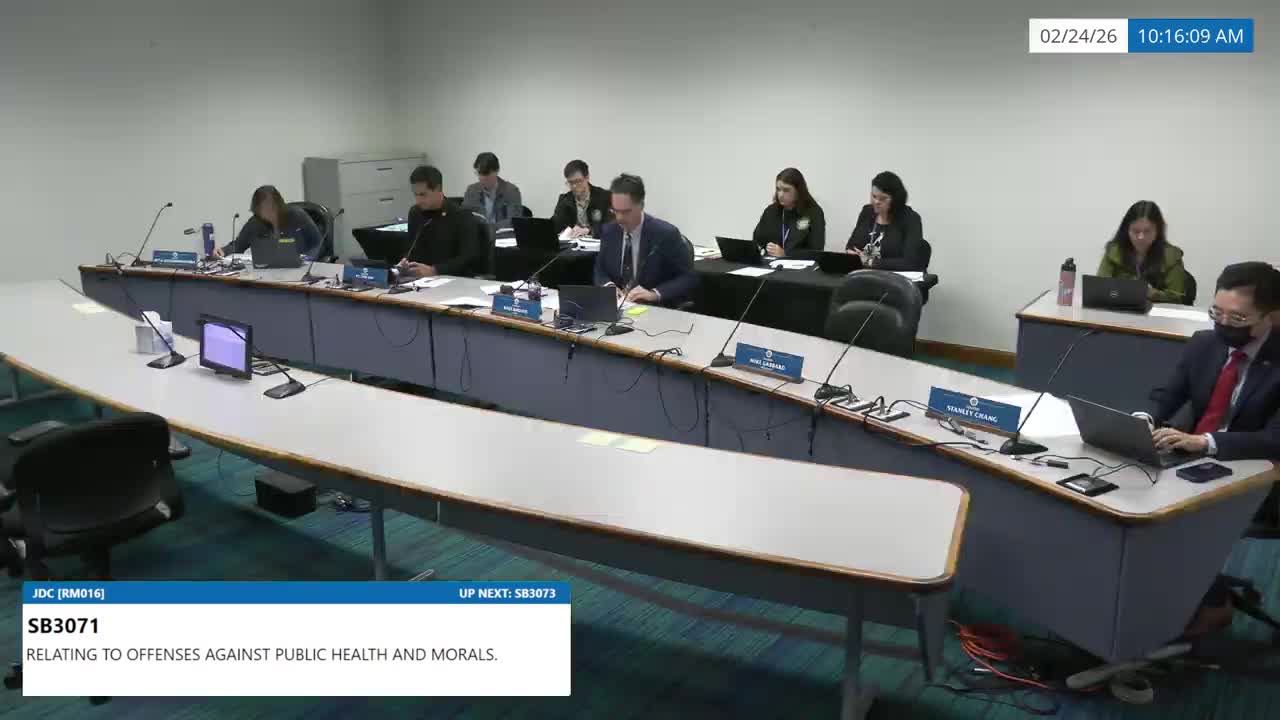
House Standing Committee on Judiciary & Hawaiian Affairs
 10MIN
Senate Standing Committee on Judiciary
1MIN
Senate Standing Committee on Judiciary
Bill Author
Bill Co-Author(s):