SB 1186: DBEDT; ADC; Statewide Interagency Food Systems Coordination Team; Interagency Food Systems Working Group; Reports; Appropriation
- Session Year: 2025-2026
- House: Senate
- Latest Version Date: 2025-04-25
Current Status:
In Progress
(2025-06-27: Act 239, on 06/27/2025 (Gov. Msg. No. 1341).)
Introduced
In Committee
First Chamber
In Committee
Second Chamber
Final Decking
Enacted
Establishes the Statewide Interagency Food Systems Coordination Team and the Interagency Food Systems Working Group within the Agribusiness Development Corporation. Requires reports to the Legislature. Appropriates funds. (CD1)
Establishes the Statewide Interagency Food Systems Coordination Team and the Interagency Food Systems Working Group within the Agribusiness Development Corporation. Requires reports to the Legislature. Appropriates funds. Effective 7/1/3000. (HD3)
Establishes the Statewide Interagency Food Systems Coordination Team and the Interagency Food Systems Working Group within the Agribusiness Development Corporation. Requires reports to the Legislature. Appropriates funds. Effective 7/1/3000. (HD2)
Establishes the Statewide Interagency Food Systems Coordination Team and the Interagency Food Systems Working Group within the Agribusiness Development Corporation. Requires reports to the Legislature. Appropriates funds. Effective 7/1/3000. (HD1)
Establishes the Statewide Interagency Food Systems Coordination Team and the Interagency Food Systems Working Group within the Agribusiness Development Corporation. Requires reports to the Legislature. (SD2)
Establishes the Statewide Interagency Food Systems Coordination Team and the Interagency Food Systems Working Group within the Department of Agriculture. Requires reports to the Legislature. Establishes positions. Appropriates funds. (SD1)
Establishes the Statewide Interagency Food Systems Coordination Team and the Interagency Food Systems Working Group within the Department of Agriculture. Requires reports to the Legislature. Establishes positions. Appropriates funds.
|
THE SENATE |
S.B. NO. |
1186 |
|
THIRTY-THIRD LEGISLATURE, 2025 |
S.D. 2 |
|
|
STATE OF HAWAII |
H.D. 3 |
|
|
|
C.D. 1 |
|
|
|
||
|
|
||
A BILL FOR AN ACT
RELATING TO SUSTAINABLE FOOD SYSTEMS.
BE IT ENACTED BY THE LEGISLATURE OF THE STATE OF HAWAII:
(1) The Hawaii 2050 sustainability plan, which highlights Hawaii's overall economic, climate, and food system‑related goals;
(2) Act 151, Session Laws of Hawaii 2019, which mandates doubling local food production and increasing food exports by 2030; and
(3) Acts 175 and 176, Session Laws of Hawaii 2021, which establish goals for local food procurement in schools and other government entities, with a target of fifty per cent locally sourced food by 2050.
Despite these efforts and more, high food insecurity and barriers to local food production in Hawaii remain. According to a recent report by the Hawaii Foodbank, nearly one-third of households are food insecure, and food insecurity rates are consistently higher than the national average. Additionally, a recent study found that only twelve per cent of households maintain a fourteen-day emergency supply of food, water, and medicine, as recommended by emergency managers.
The legislature further finds that achieving a sustainable, resilient, and equitable food system requires collaboration across state agencies, producers, retailers, non-governmental organizations, and community members. Such a system can enhance environmental, economic, social, and cultural health; well‑being; and equity while also helping the State respond effectively to disasters and crises. Interagency coordination and an integrated approach are essential to maximizing efficiencies and achieving impact.
Accordingly, the purpose of this Act is to:
(1) Establish a statewide interagency food systems coordination team and an interagency food systems working group within the agribusiness development corporation; and
(2) Appropriate funds for operating costs of the team and working group.
SECTION 2. Chapter 163D, Hawaii Revised Statutes, is amended by adding a new part to be appropriately designated and to read as follows:
"PART . INTERAGENCY FOOD SYSTEMS COORDINATION
§163D-A Statewide interagency food systems coordination team. There is established within the corporation the statewide interagency food systems coordination team. The statewide interagency food systems coordination team shall coordinate and oversee the interagency food systems working group established under section 163D-B and develop a process to implement interagency food systems plans and actions.
§163D-B Interagency food systems working group. (a) There is established within the corporation an interagency food systems working group.
(b) The working group shall consist of the following members:
(1) The chairperson of the board of agriculture, or the chairperson's designee, who shall serve as co-chair;
(2) The director of business, economic development, and tourism, or the director's designee, who shall serve as co-chair;
(3) One member of the house of representatives, to be selected by the speaker of the house of representatives;
(4) One member of the senate, to be selected by the president of the senate; and
(5) Members with relevant experience, to be invited by the co-chairs.
(c) The interagency food systems working group shall:
(1) Develop governance, decision-making, and operating protocols;
(2) Coordinate with county and community-led organizations that are involved with food systems planning;
(3) Identify resources to support interagency food systems coordination and implementation efforts;
(4) Develop internal and external communication processes;
(5) Create time-bound implementation plans and ways to measure progress toward statewide food systems goals; and
(6) Utilize policy impact analysis tools to evaluate proposed actions.
(d) The interagency food systems working group shall submit a report of its activities and any recommendations, including any proposed legislation, to the legislature no later than twenty days prior to the convening of each regular session.
(e) The department of business, economic development, and tourism shall provide any necessary administrative support to the statewide interagency food systems coordination team and the interagency food systems working group established under this part."
SECTION 3. There is appropriated out of the general revenues of the State of Hawaii the sum of $100,000 or so much thereof as may be necessary for fiscal year 2025-2026 for operating costs for the statewide interagency food systems coordination team and interagency food systems working group.
The sum appropriated shall be expended by the department of business, economic development, and tourism for the purposes of this Act.
SECTION 4. In codifying the new sections added by section 2 of this Act, the revisor of statutes shall substitute appropriate section numbers for the letters used in designating the new sections in this Act.
SECTION 5. This Act shall take effect on July 1, 2025.
Report Title:
DBEDT; ADC; Statewide Interagency Food Systems Coordination Team; Interagency Food Systems Working Group; Reports; Appropriation
Description:
Establishes the Statewide Interagency Food Systems Coordination Team and the Interagency Food Systems Working Group within the Agribusiness Development Corporation. Requires reports to the Legislature. Appropriates funds. (CD1)
The summary description of legislation appearing on this page is for informational purposes only and is not legislation or evidence of legislative intent.
|
THE SENATE |
S.B. NO. |
1186 |
|
THIRTY-THIRD LEGISLATURE, 2025 |
S.D. 2 |
|
|
STATE OF HAWAII |
H.D. 3 |
|
|
|
|
|
|
|
||
|
|
||
A BILL FOR AN ACT
RELATING TO SUSTAINABLE FOOD SYSTEMS.
BE IT ENACTED BY THE LEGISLATURE OF THE STATE OF HAWAII:
(1) The Hawaii sustainability 2050 plan, which highlights Hawaii's overall economic, climate, and food system‑related goals;
(2) Act 151, Session Laws of Hawaii 2019, which mandates doubling local food production and increasing food exports by 2030; and
(3) Acts 175 and 176, Session Laws of Hawaii 2021, which establish goals for local food procurement in schools and other government entities, with a target of fifty per cent locally sourced food by 2050.
Despite these efforts and more, high food insecurity and barriers to local food production in Hawaii remain. According to a recent report by the Hawaii Foodbank, nearly one-third of households are food insecure, and food insecurity rates are consistently higher than the national average. Additionally, a recent study found that only twelve per cent of households maintain a fourteen-day emergency supply of food, water, and medicine, as recommended by emergency managers.
The legislature further finds that achieving a sustainable, resilient, and equitable food system requires collaboration across state agencies, producers, retailers, non-governmental organizations, and community members. Such a system can enhance environmental, economic, social, and cultural health; well‑being; and equity while also helping the State respond effectively to disasters and crises. Interagency coordination and an integrated approach are essential to maximizing efficiencies and achieving impact.
Accordingly, the purpose of this Act is to:
(1) Establish a statewide interagency food systems coordination team and an interagency food systems working group within the agribusiness development corporation; and
(2) Appropriate funds for staff and operating costs of the team and working group.
SECTION 2. Chapter 163D, Hawaii Revised Statutes, is amended by adding a new part to be appropriately designated and to read as follows:
"PART . INTERAGENCY FOOD SYSTEMS COORDINATION
§163D-A Statewide interagency food systems coordination team. There is established within the corporation the statewide interagency food systems coordination team. The statewide interagency food systems coordination team shall coordinate and oversee the interagency food systems working group established under section 163D-B and develop a process to implement interagency food systems plans and actions.
§163D-B Interagency food systems working group. (a) There is established within the corporation an interagency food systems working group.
(b) The working group shall consist of the following members:
(1) The chairperson of the board of agriculture, or the chairperson's designee, who shall serve as co-chair;
(2) The director of business, economic development, and tourism, or the director's designee, who shall serve as co-chair;
(3) One member of the house of representatives, to be selected by the speaker of the house of representatives;
(4) One member of the senate, to be selected by the president of the senate; and
(5) Five members with relevant experience, to be invited by the co-chairs.
(c) The interagency food systems working group shall:
(1) Develop governance, decision-making, and operating protocols;
(2) Coordinate with county and community-led organizations that are involved with food systems planning;
(3) Identify resources to support interagency food systems coordination and implementation efforts;
(4) Develop internal and external communication processes;
(5) Create time-bound implementation plans and ways to measure progress toward statewide food systems goals; and
(6) Utilize policy impact analysis tools to evaluate proposed actions.
(d) The interagency food systems working group shall submit a report of its activities and any recommendations, including any proposed legislation, to the legislature no later than twenty days prior to the convening of each regular session.
(e) The department of business, economic development, and tourism shall provide any necessary administrative support to the statewide interagency food systems coordination team and the interagency food systems working group established under this section."
SECTION 3. There is appropriated out of the general revenues of the State of Hawaii the sum of $ or so much thereof as may be necessary for fiscal year 2025-2026 and the same sum or so much thereof as may be necessary for fiscal year 2026-2027 for the statewide interagency food systems coordination team and interagency food systems working group; provided that the sums shall be allocated as follows:
(1) $ for full-time equivalent ( FTE) temporary food systems specialist position;
(2) $ for full-time equivalent ( FTE) temporary policy analyst position;
(3) $ for full-time equivalent ( FTE) temporary administrative assistant position; and
(4) $ for operating costs for the statewide interagency food systems coordination team and interagency food systems working group.
The sums appropriated shall be expended by the department of business, economic development, and tourism for the purposes of this Act.
SECTION 4. In codifying the new sections added by section 2 of this Act, the revisor of statutes shall substitute appropriate section numbers for the letters used in designating the new sections in this Act.
SECTION 5. This Act shall take effect on July 1, 3000.
Report Title:
DBEDT; ADC; Statewide Interagency Food Systems Coordination Team; Interagency Food Systems Working Group; Reports; Positions; Appropriation
Description:
Establishes the Statewide Interagency Food Systems Coordination Team and the Interagency Food Systems Working Group within the Agribusiness Development Corporation. Requires reports to the Legislature. Appropriates funds. Effective 7/1/3000. (HD3)
The summary description of legislation appearing on this page is for informational purposes only and is not legislation or evidence of legislative intent.
|
THE SENATE |
S.B. NO. |
1186 |
|
THIRTY-THIRD LEGISLATURE, 2025 |
S.D. 2 |
|
|
STATE OF HAWAII |
H.D. 2 |
|
|
|
|
|
|
|
||
|
|
||
A BILL FOR AN ACT
RELATING TO SUSTAINABLE FOOD SYSTEMS.
BE IT ENACTED BY THE LEGISLATURE OF THE STATE OF HAWAII:
(1) The Hawaii sustainability 2050 plan, which highlights Hawaii's overall economic, climate, and food system‑related goals;
(2) Act 151, Session Laws of Hawaii 2019, which mandates doubling local food production and increasing food exports by 2030; and
(3) Acts 175 and 176, Session Laws of Hawaii 2021, which establish goals for local food procurement in schools and other government entities, with a target of fifty per cent locally sourced food by 2050.
Despite these efforts and more, high food insecurity and barriers to local food production in Hawaii remain. According to a recent report by the Hawaii Foodbank, nearly one-third of households are food insecure, and food insecurity rates are consistently higher than the national average. Additionally, a recent study found that only twelve per cent of households maintain a fourteen-day emergency supply of food, water, and medicine, as recommended by emergency managers.
The legislature further finds that achieving a sustainable, resilient, and equitable food system requires collaboration across state agencies, producers, retailers, non-governmental organizations, and community members. Such a system can enhance environmental, economic, social, and cultural health; well‑being; and equity while also helping the State respond effectively to disasters and crises. Interagency coordination and an integrated approach are essential to maximizing efficiencies and achieving impact.
Accordingly, the purpose of this Act is to:
(1) Establish a statewide interagency food systems coordination team and an interagency food systems working group within the agribusiness development corporation; and
(2) Appropriate funds for staff and operating costs of the team and working group.
SECTION 2. Chapter 163D, Hawaii Revised Statutes, is amended by adding a new part to be appropriately designated and to read as follows:
"PART . INTERAGENCY FOOD SYSTEMS COORDINATION
§163D-A Statewide interagency food systems coordination team. There is established within the corporation the statewide interagency food systems coordination team. The statewide interagency food systems coordination team shall coordinate and oversee the interagency food systems working group established under section 163D-B and develop a process to implement interagency food systems plans and actions.
§163D-B Interagency food systems working group. (a) There is established within the corporation an interagency food systems working group.
(b) The working group shall consist of the following members:
(1) The chairperson of the board of agriculture, or the chairperson's designee, who shall serve as co-chair;
(2) The director of business, economic development, and tourism, or the director's designee, who shall serve as co-chair;
(3) One member of the house of representatives, to be selected by the speaker of the house of representatives;
(4) One member of the senate, to be selected by the president of the senate; and
(5) Five members with relevant experience, to be invited by the co-chairs.
(c) The interagency food systems working group shall:
(1) Develop governance, decision-making, and operating protocols;
(2) Coordinate with county and community-led organizations that are involved with food systems planning;
(3) Identify resources to support interagency food systems coordination and implementation efforts;
(4) Develop internal and external communication processes;
(5) Create time-bound implementation plans and ways to measure progress toward statewide food systems goals; and
(6) Utilize policy impact analysis tools to evaluate proposed actions.
(d) The interagency food systems working group shall submit a report of its activities and any recommendations, including any proposed legislation, to the legislature no later than twenty days prior to the convening of each regular session.
(e) The department of business, economic development, and tourism shall provide any necessary administrative support to the statewide interagency food systems coordination team and the interagency food systems working group established under this section."
SECTION 3. There is appropriated out of the general revenues of the State of Hawaii the sum of $ or so much thereof as may be necessary for fiscal year 2025-2026 and the same sum or so much thereof as may be necessary for fiscal year 2026-2027 for the statewide interagency food systems coordination team and interagency food systems working group; provided that the sums shall be allocated as follows:
(1) $ for one full-time equivalent (1.0 FTE) temporary food systems specialist position;
(2) $ for one full-time equivalent (1.0 FTE) temporary policy analyst position;
(3) $ for one full-time equivalent (1.0 FTE) temporary administrative assistant position; and
(4) $ for operating costs for the statewide interagency food systems coordination team and interagency food systems working group.
The sums appropriated shall be expended by the department of business, economic development, and tourism for the purposes of this Act.
SECTION 4. In codifying the new sections added by section 2 of this Act, the revisor of statutes shall substitute appropriate section numbers for the letters used in designating the new sections in this Act.
SECTION 5. This Act shall take effect on July 1, 3000.
Report Title:
DBEDT; ADC; Statewide Interagency Food Systems Coordination Team; Interagency Food Systems Working Group; Reports; Positions; Appropriation
Description:
Establishes the Statewide Interagency Food Systems Coordination Team and the Interagency Food Systems Working Group within the Agribusiness Development Corporation. Requires reports to the Legislature. Appropriates funds. Effective 7/1/3000. (HD2)
The summary description of legislation appearing on this page is for informational purposes only and is not legislation or evidence of legislative intent.
|
THE SENATE |
S.B. NO. |
1186 |
|
THIRTY-THIRD LEGISLATURE, 2025 |
S.D. 2 |
|
|
STATE OF HAWAII |
H.D. 1 |
|
|
|
|
|
|
|
||
|
|
||
A BILL FOR AN ACT
RELATING TO SUSTAINABLE FOOD SYSTEMS.
BE IT ENACTED BY THE LEGISLATURE OF THE STATE OF HAWAII:
(1) The Hawaii sustainability 2050 plan, which highlights Hawaii's overall economic, climate, and food system‑related goals;
(2) Act 151, Session Laws of Hawaii 2019, which mandates doubling local food production and increasing food exports by 2030; and
(3) Acts 175 and 176, Session Laws of Hawaii 2021, which establish goals for local food procurement in schools and other government entities, with a target of fifty per cent locally sourced food by 2050.
Despite these efforts and more, high food insecurity and barriers to local food production in Hawaii remain. According to a recent report by the Hawaii Foodbank, nearly one-third of households are food insecure, and food insecurity rates are consistently higher than the national average. Additionally, a recent study found that only twelve per cent of households maintain a fourteen-day emergency supply of food, water, and medicine, as recommended by emergency managers.
The legislature further finds that achieving a sustainable, resilient, and equitable food system requires collaboration across state agencies, producers, retailers, non-governmental organizations, and community members. Such a system can enhance environmental, economic, social, and cultural health; well‑being; and equity, while also helping the State respond effectively to disasters and crises. Interagency coordination and an integrated approach are essential to maximizing efficiencies and achieving impact.
Accordingly, the purpose of this Act is to:
(1) Establish a statewide interagency food systems coordination team and an interagency food systems working group within the agribusiness development corporation; and
(2) Appropriate funds for staff within the department of business, economic development, and tourism.
SECTION 2. Chapter 163D, Hawaii Revised Statutes, is amended by adding a new part to be appropriately designated and to read as follows:
"PART . INTERAGENCY FOOD SYSTEMS COORDINATION
§163D-A Interagency food systems coordination team. There is established within the corporation the statewide interagency food systems coordination team. The statewide interagency food systems coordination team shall coordinate and oversee the interagency food systems working group established under section 163D-B and develop a process to implement interagency food systems plans and actions.
§163D-B Interagency food systems working group. (a) There is established within the corporation an interagency food systems working group.
(b) The interagency food systems working group shall:
(1) Develop governance, decision-making, and operating protocols;
(2) Coordinate with county and community-led organizations that are involved with food systems planning;
(3) Identify resources to support interagency food systems coordination and implementation efforts;
(4) Develop internal and external communication processes;
(5) Create time-bound implementation plans and ways to measure progress toward statewide food systems goals; and
(6) Utilize policy impact analysis tools to evaluate proposed actions.
(c) The interagency food systems working group shall submit a report of its activities and any recommendations, including any proposed legislation, to the legislature no later than twenty days prior to the convening of each regular session.
(d) The department of business, economic development, and tourism shall provide any necessary administrative support to the statewide interagency food systems coordination team and the interagency food systems working group established under this section."
SECTION 3. There is appropriated out of the general revenues of the State of Hawaii the sum of $ or so much thereof as may be necessary for fiscal year 2025-2026 and the same sum or so much thereof as may be necessary for fiscal year 2026-2027 for full-time equivalent ( FTE) temporary position for the department of business, economic development, and tourism for the purposes of this Act.
The sums appropriated shall be expended by the department of business, economic development, and tourism for the purposes of this Act.
SECTION 4. In codifying the new sections added by section 2 of this Act, the revisor of statutes shall substitute appropriate section numbers for the letters used in designating the new sections in this Act.
SECTION 5. This Act shall take effect on July 1, 3000.
Report Title:
DBEDT; ADC; Statewide Interagency Food Systems Coordination Team; Interagency Food Systems Working Group; Reports; Appropriation
Description:
Establishes the Statewide Interagency Food Systems Coordination Team and the Interagency Food Systems Working Group within the Agribusiness Development Corporation. Requires reports to the Legislature. Appropriates funds. Effective 7/1/3000. (HD1)
The summary description of legislation appearing on this page is for informational purposes only and is not legislation or evidence of legislative intent.
|
THE SENATE |
S.B. NO. |
1186 |
|
THIRTY-THIRD LEGISLATURE, 2025 |
S.D. 2 |
|
|
STATE OF HAWAII |
|
|
|
|
|
|
|
|
||
|
|
||
A BILL FOR AN ACT
RELATING TO SUSTAINABLE FOOD SYSTEMS.
BE IT ENACTED BY THE LEGISLATURE OF THE STATE OF HAWAII:
(1) The Hawaii sustainability 2050 plan, which highlights Hawaii's overall economic, climate, and food system‑related goals;
(2) Act 151, Session Laws of Hawaii 2019, which mandates doubling local food production and increasing food exports by 2030; and
(3) Acts 175 and 176, Session Laws of Hawaii 2021, which establish goals for local food procurement in schools and other government entities, with a target of fifty per cent locally sourced food by 2050.
Despite these efforts and more, high food insecurity and barriers to local food production in Hawaii remain. According to a recent report by the Hawaii Food Bank, nearly one-third of households are food insecure, and food insecurity rates are consistently higher than the national average. Additionally, a recent study found that only twelve per cent of households maintain a fourteen-day emergency supply of food, water, and medicine, as recommended by emergency managers.
The legislature further finds that achieving a sustainable, resilient, and equitable food system requires collaboration across state agencies, producers, retailers, non-governmental organizations, and community members. Such a system can enhance environmental, economic, social, and cultural health, well‑being, and equity while also helping the State respond effectively to disasters and crises. Interagency coordination and an integrated approach are essential to maximizing efficiencies and achieving impact.
Accordingly, the purpose of this Act is to establish a statewide interagency food systems coordination team and an interagency food systems working group within the agribusiness development corporation.
SECTION 2. Chapter 163D, Hawaii Revised Statutes, is amended by adding a new part to be appropriately designated and to read as follows:
"PART . INTERAGENCY FOOD SYSTEMS COORDINATION
§163D-A Interagency food systems coordination team. (a) There is established within the corporation the statewide interagency food systems coordination team. The statewide interagency food systems coordination team shall coordinate and oversee the interagency food systems working group established under section 163D-B and develop a process to implement interagency food systems plans and actions.
§163D-B Interagency food systems working group. (a) There is established within the corporation an interagency food systems working group
(b) The interagency food systems working group shall:
(1) Develop governance, decision-making, and operating protocols;
(2) Coordinate with county and community-led organizations that are involved with food systems planning;
(3) Identify resources to support interagency food systems coordination and implementation efforts;
(4) Develop internal and external communication processes;
(5) Create time-bound implementation plans and ways to measure progress toward statewide food systems goals; and
(6) Utilize policy impact analysis tools to evaluate proposed actions.
(c) The interagency food systems working group shall submit a report of its activities and any recommendations, including any proposed legislation, to the legislature no later than twenty days prior to the convening of each regular session.
(d) The department of business, economic development, and tourism shall provide any necessary administrative support to the statewide interagency food systems coordination team and the interagency food systems working group established under this section."
SECTION 3. In codifying the new sections added by section 2 of this Act, the revisor of statutes shall substitute appropriate section numbers for the letters used in designating the new sections in this Act.
SECTION 4. This Act shall take effect upon its approval.
Report Title:
DBEDT; ADC; Statewide Interagency Food Systems Coordination Team; Interagency Food Systems Working Group; Reports
Description:
Establishes the Statewide Interagency Food Systems Coordination Team and the Interagency Food Systems Working Group within the Agribusiness Development Corporation. Requires reports to the Legislature. (SD2)
The summary description of legislation appearing on this page is for informational purposes only and is not legislation or evidence of legislative intent.
|
THE SENATE |
S.B. NO. |
1186 |
|
THIRTY-THIRD LEGISLATURE, 2025 |
S.D. 1 |
|
|
STATE OF HAWAII |
|
|
|
|
|
|
|
|
||
|
|
||
A BILL FOR AN ACT
RELATING TO SUSTAINABLE FOOD SYSTEMS.
BE IT ENACTED BY THE LEGISLATURE OF THE STATE OF HAWAII:
(1) The Hawaii sustainability 2050 plan highlights Hawaii's overall economic, climate, and food system‑related goals;
(2) Act 151, Session Laws of Hawaii 2019, which mandates doubling local food production and increasing food exports by 2030; and
(3) Acts 175 and 176, Session Laws of Hawaii 2021, which establish goals for local food procurement in schools and other government entities, with a target of fifty per cent locally sourced food by 2050.
Despite these efforts and more, high food insecurity and barriers to local food production in Hawaii remain. According to a recent report by the Hawaii Food Bank, nearly one-third of households are food insecure, and food insecurity rates are consistently higher than the national average. Additionally, a recent study found that only twelve per cent of households maintain a fourteen-day emergency supply of food, water, and medicine, as recommended by emergency managers.
The legislature further finds that achieving a sustainable, resilient, and equitable food system requires collaboration across state agencies, producers, retailers, non-governmental organizations, and community members. Such a system can enhance environmental, economic, social, and cultural health, well‑being, and equity while also responding effectively to disasters and crises. Interagency coordination and an integrated approach are essential to maximizing efficiencies and achieving impact.
Accordingly, the purpose of this Act is to establish a statewide interagency food systems coordination team and an interagency food systems working group within the department of agriculture.
SECTION 2. (a) There is established the statewide interagency food systems coordination team within the department of agriculture for administrative purposes. The statewide interagency food systems coordination team shall develop and oversee the interagency food systems working group established under subsection (b) and develop a planning process to implement interagency food systems plans and actions.
(b) There is established an interagency food systems working group within the department of agriculture for administrative purposes, whose members shall include but not be limited to:
(1) The chairperson of the board of agriculture, or the chairperson's designee, and the director of business, economic development, and tourism, or the director's designee, who shall serve as co-chairs of the working group;
(2) One member of the house of representatives, to be selected by the speaker of the house of representatives;
(3) One member of the senate, to be selected by the president of the senate;
(4) One representative from the department of education;
(5) One representative from the department of health;
(6) One representative from the office of Hawaiian affairs;
(7) One representative from the office of planning and sustainable development; and
(8) One representative from the agribusiness development corporation.
(c) The co-chairs may invite other representatives of interested organizations with relevant experience and expertise to participate in the interagency food systems working group, as necessary.
(d) The interagency food systems working group shall:
(1) Develop governance, decision-making, and operating protocols;
(2) Coordinate with county and community-led food systems planning processes;
(3) Identify resources for interagency coordination and implementation;
(4) Develop internal and external communication processes;
(5) Create time-bound implementation plans and ways of measuring progress toward statewide food system goals; and
(6) Utilize policy impact analysis tools to evaluate proposed actions.
(e) The interagency food systems working group shall submit a report of its activities and any recommendations, including any proposed legislation, to the legislature no later than twenty days prior to the convening of each regular session.
(f) The department of agriculture shall provide any necessary administrative support to the statewide interagency food systems coordination team and the interagency food systems working group established under this section.
SECTION 3. There is appropriated out of the general revenues of the State of Hawaii the sum of $944,100 or so much thereof as may be necessary for fiscal year 2025-2026 and the same sum or so much thereof as may be necessary for fiscal year 2026-2027 to be allocated as follows:
(1) $399,300 for the establishment of one full-time equivalent (1.0 FTE) food system specialist position within the department of agriculture;
(2) $253,400 for the establishment of one full-time equivalent (1.0 FTE) policy analyst position within the department of agriculture;
(3) $191,400 for the establishment of one full-time equivalent (1.0 FTE) administrative assistant position within the department of agriculture; and
(4) $100,000 for the establishment and operation of the interagency food systems working group established pursuant to section 2 of this Act, to include conducting stakeholder coordination, public meetings, and information management.
The sums appropriated shall be expended by the department of agriculture for the purposes of this Act.
SECTION 4. This Act shall take effect on July 1, 2025.
Report Title:
DOA; Statewide Interagency Food Systems Coordination Team; Interagency Food Systems Working Group; Reports; Positions; Appropriations
Description:
Establishes the Statewide Interagency Food Systems Coordination Team and the Interagency Food Systems Working Group within the Department of Agriculture. Requires reports to the Legislature. Establishes positions. Appropriates funds. (SD1)
The summary description of legislation appearing on this page is for informational purposes only and is not legislation or evidence of legislative intent.
|
THE SENATE |
S.B. NO. |
1186 |
|
THIRTY-THIRD LEGISLATURE, 2025 |
|
|
|
STATE OF HAWAII |
|
|
|
|
|
|
|
|
||
|
|
||
A BILL FOR AN ACT
RELATING TO SUSTAINABLE FOOD SYSTEMS.
BE IT ENACTED BY THE LEGISLATURE OF THE STATE OF HAWAII:
(1) The Hawaii sustainability 2050 plan highlights Hawaii's overall economic, climate, and food system-related goals;
(2) Act 151, Session Laws of Hawaii 2019, which mandates doubling local food production and increasing food exports by 2030; and
(3) Acts 175 and 176, Session Laws of Hawaii 2021, which establish goals for local food procurement in schools and other government entities, with a target of fifty per cent locally sourced food by 2050.
Despite these efforts and more, high food insecurity and barriers to local food production in Hawaii remain. According to a recent report by the Hawaii Food Bank, nearly one-third of households are food insecure, and food insecurity rates are consistently higher than the national average. Additionally, a recent study found that only twelve per cent of households maintain a fourteen-day emergency supply of food, water, and medicine, as recommended by emergency managers.
The legislature further finds that achieving a sustainable, resilient, and equitable food system requires collaboration across state agencies, producers, retailers, non-governmental organizations, and community members. Such a system can enhance environmental, economic, social, and cultural health, well-being, and equity while also responding effectively to disasters and crises. Interagency coordination and an integrated approach are essential to maximizing efficiencies and achieving impact.
Accordingly, the purpose of this Act is to establish a statewide interagency food systems coordination team and an interagency food systems working group within the department of agriculture.
SECTION 2. (a) There is established the statewide interagency food systems coordination team within the department of agriculture for administrative purposes. The statewide interagency food systems coordination team shall develop and oversee the interagency food systems working group established under subsection (b) and a planning process to implement interagency food systems plans and actions.
(b) There is established an interagency food systems working group within the department of agriculture for administrative purposes, whose members shall include but not be limited to:
(1) The chairperson of the board of agriculture, or the chairperson's designee, and the director of business, economic development, and tourism, or the director's designee, who shall serve as co-chairs of the working group;
(2) One member of the house of representatives, to be selected by the speaker of the house of representatives;
(3) One member of the senate, to be selected by the president of the senate;
(4) One representative from the department of education;
(5) One representative from the department of health;
(6) One representative from the office of Hawaiian affairs;
(7) One representative from the office of planning and sustainable development; and
(8) One representative from the agribusiness development corporation.
(c) The co-chairs may invite other representatives of interested organizations with relevant experience and expertise to participate in the interagency food systems working group, as necessary.
(d) The interagency food systems working group shall:
(1) Develop governance, decision-making, and operating protocols;
(2) Coordinate with county and community-led food systems planning processes;
(3) Identify resources for interagency coordination and implementation;
(4) Develop internal and external communication processes;
(5) Create time-bound implementation plans and ways of measuring progress toward statewide food system goals; and
(6) Utilize policy impact analysis tools to evaluate proposed actions.
(e) The interagency food systems working group shall submit a report of its activities and any recommendations, including any proposed legislation, to the legislature no later than twenty days prior to the convening of each regular session.
(f) The department of agriculture shall provide any necessary administrative support to the statewide interagency food systems coordination team and the interagency food systems working group established under this section.
SECTION 3. There is appropriated out of the general revenues of the State of Hawaii the sum of $944,100 or so much thereof as may be necessary for fiscal year 2025-2026 and the same sum or so much thereof as may be necessary for fiscal year 2026-2027 to be allocated as follows:
(1) $399,300 for the establishment of one full-time equivalent (1.0 FTE) food system specialist position within the department of agriculture;
(2) $253,400 for the establishment of one full-time equivalent (1.0 FTE) policy analyst position within the department of agriculture;
(3) $191,400 for the establishment of one full-time equivalent (1.0 FTE) administrative assistant position within the department of agriculture; and
(4) $100,000 for the establishment and operation of the interagency food systems working group established pursuant to section 2 of this Act, to include conducting stakeholder coordination, public meetings, and information management.
The sums appropriated shall be expended by the department of agriculture for the purposes of this Act.
SECTION 4. This Act shall take effect on July 1, 2025.
|
INTRODUCED BY: |
_____________________________ |
|
|
|
|
|
|
|
|
|
|
|
|
|
|
|
|
|
|
Report Title:
DOA; Statewide Interagency Food Systems Coordination Team; Interagency Food Systems Working Group; Reports; Positions; Appropriations
Description:
Establishes the Statewide Interagency Food Systems Coordination Team and the Interagency Food Systems Working Group within the Department of Agriculture. Requires reports to the Legislature. Establishes positions. Appropriates funds.
The summary description of legislation appearing on this page is for informational purposes only and is not legislation or evidence of legislative intent.
|
Date
|
Status
|
|---|---|
| Jun 27, 2025 | Act 239, on 06/27/2025 (Gov. Msg. No. 1341). |
| Jun 27, 2025 | Act 239, 06/27/2025 (Gov. Msg. No. 1341). |
| May 2, 2025 | Enrolled to Governor. |
| May 2, 2025 | Received notice of passage on Final Reading in House (Hse. Com. No. 821). |
| May 1, 2025 | Received notice of Final Reading (Sen. Com. No. 888). |
| Apr 30, 2025 | Passed Final Reading as amended in CD 1 with none voting aye with reservations; none voting no (0) and Representative(s) Cochran, Pierick excused (2). |
| Apr 30, 2025 | Passed Final Reading, as amended (CD 1). Ayes, 25; Aye(s) with reservations: none. Noes, 0 (none). Excused, 0 (none). |
| Apr 25, 2025 | Forty-eight (48) hours notice Wednesday, 04-30-25. |
| Apr 25, 2025 | Reported from Conference Committee (Conf Com. Rep. No. 112) as amended in (CD 1). |
| Apr 25, 2025 | 48 Hrs. Notice (as amended CD 1) 04-30-25. |
| Apr 25, 2025 | Reported from Conference Committee as amended CD 1 (Conf. Com. Rep. No. 112). |
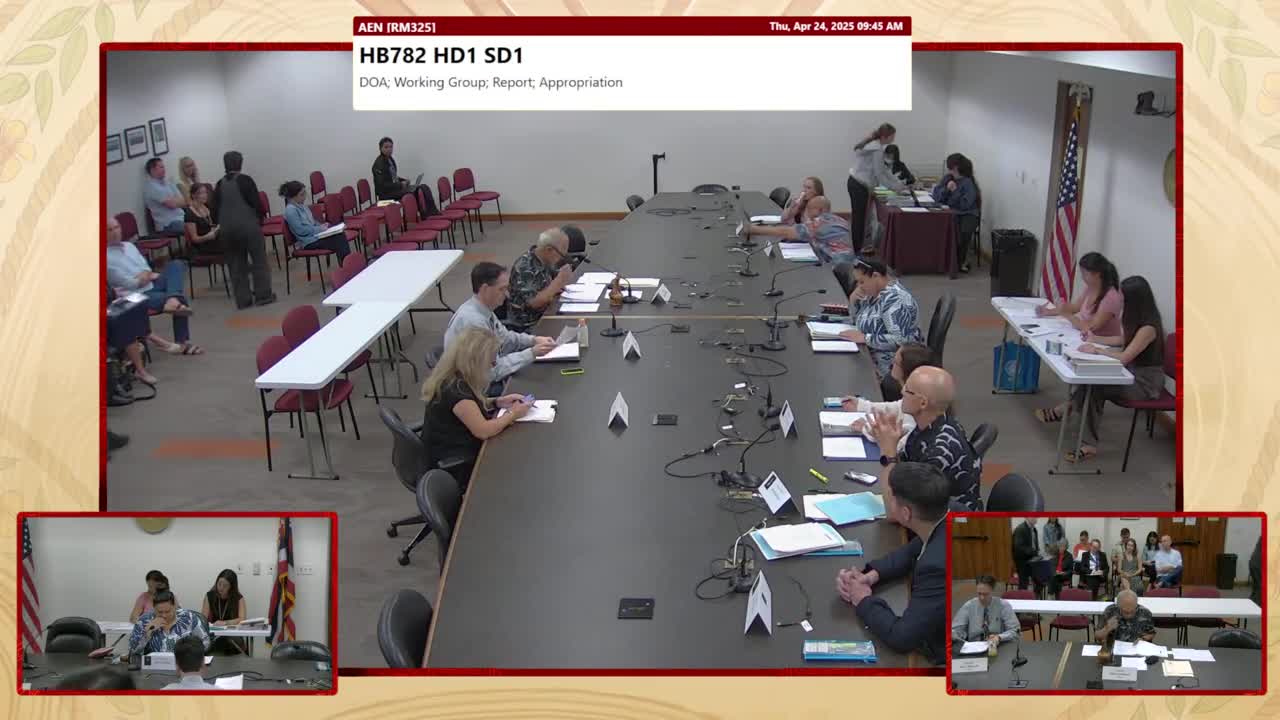
| Apr 24, 2025 | The Conference Committee recommends that the measure be Passed, with Amendments. The votes were as follows: 3 Ayes: Representative(s) Kahaloa, Ilagan, Kusch; Ayes with reservations: none; 0 Noes: none; and 1 Excused: Representative(s) Matsumoto. |
| Apr 24, 2025 | The Conference committee recommends that the measure be PASSED, WITH AMENDMENTS. The votes of the Senate Conference Managers were as follows: 3 Aye(s): Senator(s) Gabbard, DeCoite, Rhoads; Aye(s) with reservations: none ; 0 No(es): none; and 1 Excused: Senator(s) Awa. |
| Apr 22, 2025 | Received notice of Senate conferees (Sen. Com. No. 863). |
| Apr 22, 2025 | Conference committee meeting scheduled for 04-24-25 9:31AM; Conference Room 325. |
| Apr 22, 2025 | Senate Conferees Appointed: Gabbard Chair; DeCoite Co-Chair; Rhoads, Awa. |
| Apr 22, 2025 | Received notice of appointment of House conferees (Hse. Com. No. 784). |
| Apr 21, 2025 | House Conferees Appointed: Kahaloa, Ilagan, Kusch Co-Chairs; Matsumoto. |
| Apr 10, 2025 | Received notice of disagreement (Sen. Com. No. 779). |
| Apr 10, 2025 | Senate disagrees with House amendments. |
| Apr 10, 2025 | Received from House (Hse. Com. No. 673). |
| Apr 8, 2025 | Passed Third Reading as amended in HD 3 with none voting aye with reservations; none voting no (0) and Representative(s) Cochran, Marten excused (2). Transmitted to Senate. |
| Apr 4, 2025 | Forty-eight (48) hours notice Tuesday, 04-08-25. |
| Apr 4, 2025 | Reported from FIN (Stand. Com. Rep. No. 2000) as amended in HD 3, recommending passage on Third Reading. |
| Apr 1, 2025 | The committee on FIN recommend that the measure be PASSED, WITH AMENDMENTS. The votes were as follows: 14 Ayes: Representative(s) Yamashita, Takenouchi, Grandinetti, Holt, Hussey, Keohokapu-Lee Loy, Kitagawa, Kusch, Lamosao, Lee, M., Miyake, Morikawa, Templo, Reyes Oda; Ayes with reservations: none; Noes: none; and 1 Excused: Representative(s) Alcos. |
| Mar 28, 2025 | Bill scheduled to be heard by FIN on Tuesday, 04-01-25 2:00PM in House conference room 308 VIA VIDEOCONFERENCE. |
| Mar 21, 2025 | Report adopted; referred to the committee(s) on FIN as amended in HD 2 with none voting aye with reservations; none voting no (0) and Representative(s) Cochran, Garrett, Kapela, Kitagawa, Ward excused (5). |
| Mar 21, 2025 | Reported from ECD (Stand. Com. Rep. No. 1445) as amended in HD 2, recommending referral to FIN. |
| Mar 19, 2025 | The committee on ECD recommend that the measure be PASSED, WITH AMENDMENTS. The votes were as follows: 7 Ayes: Representative(s) Ilagan, Hussey, Holt, Tam, Templo, Todd, Matsumoto; Ayes with reservations: none; 0 Noes: none; and 0 Excused: none. |
| Mar 14, 2025 | Bill scheduled to be heard by ECD on Wednesday, 03-19-25 10:00AM in House conference room 423 VIA VIDEOCONFERENCE. |
| Mar 11, 2025 | Passed Second Reading as amended in HD 1 and referred to the committee(s) on ECD with none voting aye with reservations; none voting no (0) and Representative(s) Cochran, Ward excused (2). |
| Mar 11, 2025 | Reported from AGR (Stand. Com. Rep. No. 1175) as amended in HD 1, recommending passage on Second Reading and referral to ECD. |
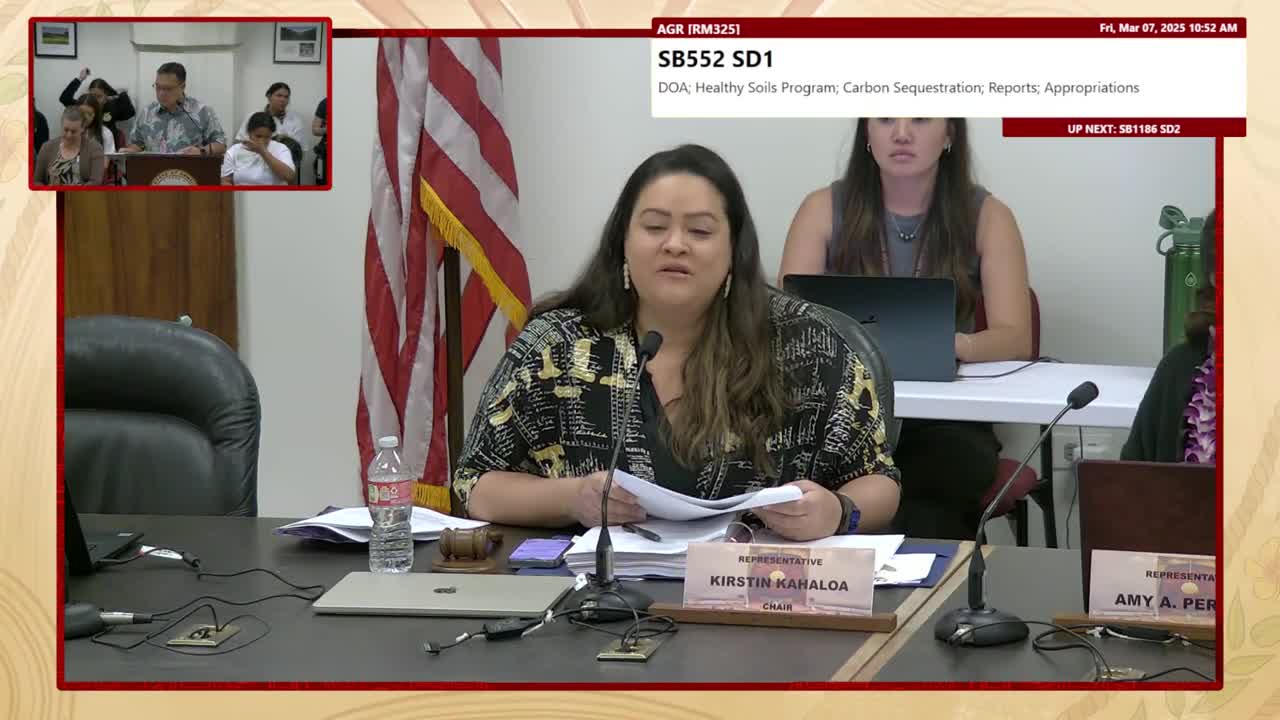
| Mar 7, 2025 | The committee on AGR recommend that the measure be PASSED, WITH AMENDMENTS. The votes were as follows: 4 Ayes: Representative(s) Kahaloa, Lowen, Perruso, Quinlan; Ayes with reservations: none; Noes: none; and 2 Excused: Representative(s) Kusch, Ward. |
| Mar 5, 2025 | Bill scheduled to be heard by AGR on Friday, 03-07-25 10:30AM in House conference room 325 VIA VIDEOCONFERENCE. |
| Mar 4, 2025 | Referred to AGR, ECD, FIN, referral sheet 18 |
| Feb 28, 2025 | Pass First Reading |
| Feb 27, 2025 | Received from Senate (Sen. Com. No. 31) in amended form (SD 2). |
| Feb 27, 2025 | Report Adopted; Passed Third Reading, as amended (SD 2). Ayes, 25; Aye(s) with reservations: none. Noes, 0 (none). Excused, 0 (none). Transmitted to House. |
| Feb 18, 2025 | 48 Hrs. Notice 02-27-25. |
| Feb 18, 2025 | Reported from WAM (Stand. Com. Rep. No. 687) with recommendation of passage on Third Reading, as amended (SD 2). |
| Feb 12, 2025 | The committee(s) on WAM recommend(s) that the measure be PASSED, WITH AMENDMENTS. The votes in WAM were as follows: 13 Aye(s): Senator(s) Dela Cruz, Moriwaki, Aquino, DeCoite, Elefante, Hashimoto, Inouye, Kanuha, Kidani, Kim, Lee, C., Wakai, Fevella; Aye(s) with reservations: none ; 0 No(es): none; and 0 Excused: none. |
| Feb 10, 2025 | The committee(s) on WAM will hold a public decision making on 02-12-25 10:01AM; Conference Room 211 & Videoconference. |
| Feb 6, 2025 | Report adopted; Passed Second Reading, as amended (SD 1) and referred to WAM. |
| Feb 6, 2025 | Reported from AEN (Stand. Com. Rep. No. 68) with recommendation of passage on Second Reading, as amended (SD 1) and referral to WAM. |
| Feb 3, 2025 | The committee(s) on AEN recommend(s) that the measure be PASSED, WITH AMENDMENTS. The votes in AEN were as follows: 4 Aye(s): Senator(s) Gabbard, Richards, Rhoads, Awa; Aye(s) with reservations: none ; 0 No(es): none; and 1 Excused: Senator(s) DeCoite. |
| Jan 31, 2025 | The committee(s) on AEN has scheduled a public hearing on 02-03-25 1:02PM; Conference Room 224 & Videoconference. |
| Jan 27, 2025 | Referred to AEN, WAM. |
| Jan 21, 2025 | Passed First Reading. |
| Jan 17, 2025 | Introduced. |
|
Date
|
Description
|
Location
|
Votes
|
|
|---|---|---|---|---|
| Apr 30, 2025 | Final Reading | House Floor |
Passed |
|
| Apr 30, 2025 | Final Reading | Senate Floor |
Passed |
|
| Apr 8, 2025 | Third Reading | House Floor |
Passed |
|
| Apr 1, 2025 | The committee on FIN recommend that the measure be PASSED, WITH AMENDMENTS | House Standing Committee on Finance |
Passed |
|
| Mar 19, 2025 | The committee on ECD recommend that the measure be PASSED, WITH AMENDMENTS | House Standing Committee on Economic Development & Technology |
Passed |
|
| Mar 7, 2025 | The committee on AGR recommend that the measure be PASSED, WITH AMENDMENTS | House Standing Committee on Agriculture & Food Systems |
Passed |
|
| Feb 27, 2025 | Third Reading | Senate Floor |
Passed |
|
| Feb 12, 2025 | The committee(s) on WAM recommend(s) that the measure be PASSED, WITH AMENDMENTS | Senate Standing Committee on Ways and Means |
Passed |
|
| Feb 3, 2025 | The committee(s) on AEN recommend(s) that the measure be PASSED, WITH AMENDMENTS | Senate Standing Committee on Agriculture and Environment |
Passed |
This list shows positions taken on this bill by organizations on the date displayed, which is linked to the original source.
Positions by individuals are not included.
|
Organization
|
Position
|
Date
|
|---|---|---|
| Agribusiness Development Corporation | ** Support | |
| Board of Agriculture | *** Support | Mar 19, 2025 |
| City and County of Honolulu Office of Climate Change, Sustainability and Resiliency | ** Support | |
| Climate Protectors Hawaii | ** Support | |
| County of Hawaiʻi Department of Research and Development | *** Support | Apr 1, 2025 |
| Department of Research and Development of the County of Hawaii | ** Support | |
| Department of Agriculture | ** Support | |
| Department of Business, Economic Development, and Tourism (DBEDT) | *** Support | Apr 1, 2025 |
| Department of Health | *** Support | Feb 12, 2025 |
| Hawaii Appleseed Center for Law & Economic Justice | ** Support | |
| Hawaii Aquaculture and Aquaponics Association | ** Support | |
| Hawaii Cattlemen's Council, Inc. | ** Support | |
| Hawaii Food Industry Association | ** Support | |
| Hawaii Youth Food Council | ** Support | |
| Hawaii Farm Bureau | ** Support | |
| Hawaii Farmers Union | ** Support | |
| Hawaii Food Bank | ** Support | |
| Hawaii Food+ Policy | ** Support | |
| Hawaii Reef and Ocean Coalition | ** Support | |
| Hawaii Alliance for Progressive Action | ** Support | |
| Hawaiʻi Public Health Institute | ** Support | |
| Hawai‘i Farm Bureau | *** Support | Apr 1, 2025 |
| Hawai‘i Farm to School Network | *** Support | Mar 19, 2025 |
| Ka Ohana O Na Pua | ** Support | |
| Ka Ohana O Na Pua | *** Support | Feb 12, 2025 |
| Kanalani Ohana Farm | ** Support | |
| Kapanaia Farms | ** Support | |
| Ke O Mau Center for Sustainable Island Food Systems | *** Support | Feb 12, 2025 |
| MetroGrow Hawaii | ** Support | |
| MetroGrow Hawaii | *** Support | Feb 3, 2025 |
| Namnama Farms | ** Support | |
| Oahu Resource Conservation & Development Council | ** Support | |
| Office of Planning and Sustainable Development | ** Support | |
| O`ahu RC&D | *** Support | Feb 3, 2025 |
| Oahu Resource Conservation & Development Council | ** Support | |
| Oʻahu Resource Conservation and Development Council | ** Support | |
| Oʻahu RC&D | *** Support | Apr 1, 2025 |
| Oʻahu Resource Conservation & Development Council | ** Support | |
| Restore the Commons | ** Support | |
| Ulupono Initiative | ** Support | |
| University of Hawaiʻi - West Oʻahu | *** Support | Feb 12, 2025 |
| University of Hawaiʻi at Manoa | *** Support | Feb 3, 2025 |
CONFERENCE COMMITTEE REP. NO. 112
Honolulu, Hawaii
, 2025
RE: S.B. No. 1186
S.D. 2
H.D. 3
C.D. 1
Honorable Ronald D. Kouchi
President of the Senate
Thirty-Third State Legislature
Regular Session of 2025
State of Hawaii
Honorable Nadine K. Nakamura
Speaker, House of Representatives
Thirty-Third State Legislature
Regular Session of 2025
State of Hawaii
Sir and Madam:
Your Committee on Conference on the disagreeing vote of the Senate to the amendments proposed by the House of Representatives in S.B. No. 1186, S.D. 2, H.D. 3, entitled:
"A BILL FOR AN ACT RELATING TO SUSTAINABLE FOOD SYSTEMS,"
having met, and after full and free discussion, has agreed to recommend and does recommend to the respective Houses the final passage of this bill in an amended form.
The purpose of this measure is to establish and appropriate funds for a Statewide Interagency Food Systems Coordination Team and an Interagency Food Systems Working Group within the Agribusiness Development Corporation.
Your Committee on Conference finds that an efficient and effective sustainable food system is crucial for the long-term resiliency of the State. Your Committee on Conference notes that, because of the complex and interconnected nature of food systems, a coordinated approach that involves state agencies, producers, retailers, non-governmental organizations, and community members is necessary to successfully implement interagency food systems plans and actions to achieve the food systems goals of the State. This measure seeks to help reduce Hawaii's dependence on food imports and ensure food security in the State.
Your Committee on Conference has amended this measure by:
(1) Requiring that the composition of the Interagency Food Systems Working Group consist of members with relevant experience, rather than specifically five members with relevant experience;
(2) Deleting language that would have appropriated funds for the establishment of certain positions for the Statewide Interagency Food Systems Coordination Team and Interagency Food Systems Working Group;
(3) Inserting an appropriation amount of $100,000 for fiscal year 2025-2026 for operating costs for the Statewide Interagency Food Systems Coordination Team and Interagency Food Systems Working Group;
(4) Deleting language that would have appropriated funds for fiscal year 2026-2027 for operating costs for the Statewide Interagency Food Systems Coordination Team and Interagency Food Systems Working Group;
(5) Changing its effective date to July 1, 2025; and
(6) Making technical, nonsubstantive amendments for the purposes of clarity and consistency.
As affirmed by the record of votes of the managers of your Committee on Conference that is attached to this report, your Committee on Conference is in accord with the intent and purpose of S.B. No. 1186, S.D. 2, H.D. 3, as amended herein, and recommends that it pass Final Reading in the form attached hereto as S.B. No. 1186, S.D. 2, H.D. 3, C.D. 1.
Respectfully submitted on behalf of the managers:
|
ON THE PART OF THE HOUSE |
|
ON THE PART OF THE SENATE |
|
____________________________ KIRSTIN KAHALOA Co-Chair |
|
____________________________ MIKE GABBARD Chair |
|
____________________________ GREGGOR ILAGAN Co-Chair |
|
____________________________ LYNN DECOITE Co-Chair |
|
____________________________ MATTHIAS KUSCH Co-Chair |
|
|
|
|
|
|
STAND. COM. REP. NO. 2000
Honolulu, Hawaii
, 2025
RE: S.B. No. 1186
S.D. 2
H.D. 3
Honorable Nadine K. Nakamura
Speaker, House of Representatives
Thirty-Third State Legislature
Regular Session of 2025
State of Hawaii
Madame:
Your Committee on Finance, to which was referred S.B. No. 1186, S.D. 2, H.D. 2, entitled:
"A BILL FOR AN ACT RELATING TO SUSTAINABLE FOOD SYSTEMS,"
begs leave to report as follows:
Your Committee received testimony in support of this measure from the Agribusiness Development Corporation; Office of Planning and Sustainable Development; Department of Research and Development of the County of Hawaii; City and County of Honolulu Office of Climate Change, Sustainability and Resiliency; Ulupono Initiative; Hawaii Reef and Ocean Coalition; Hawaii Farm Bureau; Hawaii Cattlemen's Council, Inc.; Hawaii Alliance for Progressive Action; Oahu Resource Conservation & Development Council; Hawaii Food Industry Association; Hawaii Food Bank; Hawaii Food+ Policy; Hawaii Farmers Union; Hawaii Appleseed Center for Law & Economic Justice; and two individuals. Your Committee received comments on this measure from the Department of Business, Economic Development, and Tourism; and Hawaii Emergency Management Agency.
Your Committee has amended this measure by changing the number of authorized positions to unspecified numbers.
As affirmed by the record of votes of the members of your Committee on Finance that is attached to this report, your Committee is in accord with the intent and purpose of S.B. No. 1186, S.D. 2, H.D. 2, as amended herein, and recommends that it pass Third Reading in the form attached hereto as S.B. No. 1186, S.D. 2, H.D. 3.
Respectfully submitted on behalf of the members of the Committee on Finance,
|
|
|
____________________________ KYLE T. YAMASHITA, Chair |
|
|
|
|
STAND. COM. REP. NO. 1445
Honolulu, Hawaii
, 2025
RE: S.B. No. 1186
S.D. 2
H.D. 2
Honorable Nadine K. Nakamura
Speaker, House of Representatives
Thirty-Third State Legislature
Regular Session of 2025
State of Hawaii
Madame:
Your Committee on Economic Development & Technology, to which was referred S.B. No. 1186, S.D. 2, H.D. 1, entitled:
"A BILL FOR AN ACT RELATING TO SUSTAINABLE FOOD SYSTEMS,"
begs leave to report as follows:
The purpose of this measure is to:
(1) Establish a Statewide Interagency Food Systems Coordination Team and an Interagency Food Systems Working Group within the Agribusiness Development Corporation; and
(2) Appropriate funds for staff within the Department of Business, Economic Development, and Tourism.
Your Committee received testimony in support of this measure from the Department of Agriculture; Department of Business, Economic Development, and Tourism; Office of Planning and Sustainable Development; Agribusiness Development Corporation; Office of Economic Revitalization of the City and County of Honolulu; Department of Research and Development of the County of Hawaiʻi; Office of Climate Change, Sustainability, and Resiliency of the City and County of Honolulu; Hawaiʻi Foodbank; Ulupono Initiative; Hawaiʻi Appleseed Center for Law & Economic Justice; Hawaiʻi Alliance for Progressive Action; Oʻahu Resource Conservation & Development Council; Hawaiʻi Food+ Policy; Hawaii Food Industry Association; Hawaiʻi Farm Bureau; Hawaiʻi Public Health Institute; Hawaii Cattlemen's Council; Hawaii Youth Food Council; and two individuals. Your Committee received comments on this measure from the Hawaii Emergency Management Agency.
Your Committee finds that a strong and resilient food system is essential to Hawaii's economic sustainability, disaster preparedness, and long-term self-sufficiency. Your Committee further finds that achieving a sustainable and resilient food system requires collaboration across state agencies, producers, retailers, non-governmental organizations, and community members. This measure helps facilitate a coordinated, interagency approach to addressing food system challenges.
Your Committee has amended this measure by:
(1) Designating the members of the Interagency Food Systems Working Group;
(2) Clarifying that the appropriation will be used for three temporary positions and operating costs for the Statewide Interagency Food Systems Coordination Team and Interagency Food Systems Working Group; and
(3) Making technical, nonsubstantive amendments for the purposes of clarity, consistency, and style.
Your Committee respectfully requests your Committee on Finance, should it deliberate on this measure, to consider an appropriation amount of $380,000, allocated as follows:
(1) $120,000 for one full-time equivalent (1.0 FTE) temporary food systems specialist position;
(2) $100,000 for one full-time equivalent (1.0 FTE) temporary policy analyst position;
(3) $60,000 for one full-time equivalent (1.0 FTE) temporary administrative assistant position; and
(4) $100,000 for operating costs for the Statewide Interagency Food Systems Coordination Team and Interagency Food Systems Working Group.
As affirmed by the record of votes of the members of your Committee on Economic Development & Technology that is attached to this report, your Committee is in accord with the intent and purpose of S.B. No. 1186, S.D. 2, H.D. 1, as amended herein, and recommends that it be referred to your Committee on Finance in the form attached hereto as S.B. No. 1186, S.D. 2, H.D. 2.
Respectfully submitted on behalf of the members of the Committee on Economic Development & Technology,
|
|
|
____________________________ GREGGOR ILAGAN, Chair |
|
|
|
|
STAND. COM. REP. NO. 1175
Honolulu, Hawaii
, 2025
RE: S.B. No. 1186
S.D. 2
H.D. 1
Honorable Nadine K. Nakamura
Speaker, House of Representatives
Thirty-Third State Legislature
Regular Session of 2025
State of Hawaii
Madame:
Your Committee on Agriculture & Food Systems, to which was referred S.B. No. 1186, S.D. 2, entitled:
"A BILL FOR AN ACT RELATING TO SUSTAINABLE FOOD SYSTEMS,"
begs leave to report as follows:
Your Committee received testimony in support of this measure from the Department of Agriculture; Department of Business, Economic Development, and Tourism; Agribusiness Development Corporation; Office of Planning and Sustainable Development; Department of Research and Development of the County of Hawaiʻi; City and County of Honolulu Office of Climate Change, Sustainability, and Resiliency; Ulupono Initiative; Hawaii Farm Bureau; Hawaii Reef and Ocean Coalition; Climate Protectors Hawaii; Namnama Farms; Kanalani Ohana Farm; Hawaii Food+ Policy; Hawaii Alliance for Progressive Action; Hawaii Cattlemen's Council; Hawaii Farmers Union; Hawaii Food Industry Association; Hawaii Farmers Union - Haleakala Chapter; Oahu Resource Conservation & Development Council; and numerous individuals. Your Committee received comments on this measure from the Hawaii Emergency Management Agency and Eden Farms Hawaii, Inc.
Your Committee finds that Hawaii is committed to sustainable economic growth, strengthening local food production, improving food access, addressing climate change, and reducing food insecurity. Your Committee further finds that achieving a resilient and equitable food system requires collaboration among state agencies, farmers, retailers, non-profits, and communities to enhance efficiency, sustainability, and disaster response. This measure establishes the Statewide Interagency Food Systems Coordination Team and the Interagency Food Systems Working Group within the Agribusiness Development Corporation to strengthen strategic planning and cross-sector collaboration.
Your Committee has amended this measure by:
(1) Inserting an appropriation for an unspecified amount for a temporary full-time equivalent position for the Department of Business, Economic Development, and Tourism;
(2) Changing the effective date to July 1, 3000, to encourage further discussion; and
(3) Making technical, nonsubstantive amendments for the purposes of clarity, consistency, and style.
Your Committee respectfully requests your Committee on Finance, should it deliberate on this measure, to consider the requests of the Department of Business, Economic Development, and Tourism and Agribusiness Development Corporation for one full-time equivalent position each to effectuate the purposes of this measure.
As affirmed by the record of votes of the members of your Committee on Agriculture & Food Systems that is attached to this report, your Committee is in accord with the intent and purpose of S.B. No. 1186, S.D. 2, as amended herein, and recommends that it pass Second Reading in the form attached hereto as S.B. No. 1186, S.D. 2, H.D. 1, and be referred to your Committee on Economic Development & Technology.
Respectfully submitted on behalf of the members of the Committee on Agriculture & Food Systems,
|
|
|
____________________________ KIRSTIN KAHALOA, Chair |
|
|
|
|
STAND. COM. REP. NO. 687
Honolulu, Hawaii
RE: S.B. No. 1186
S.D. 2
Honorable Ronald D. Kouchi
President of the Senate
Thirty-Third State Legislature
Regular Session of 2025
State of Hawaii
Sir:
Your Committee on Ways and Means, to which was referred S.B. No. 1186, S.D. 1, entitled:
"A BILL FOR AN ACT RELATING TO SUSTAINABLE FOOD SYSTEMS,"
begs leave to report as follows:
The purpose and intent of this measure is to establish a statewide interagency food systems coordination team and an interagency food systems working group within the Department of Agriculture.
Your Committee received written comments in support of this measure from the Department of Health; Department of Business, Economic Development, and Tourism; County of Hawaii Department of Research and Development; City and County of Honolulu Office of Economic Revitalization; Ulupono Initiative; Hawaii Farm Bureau; Purple Maia Foundation; Hawaii Farmers Union; Hawaii Food Industry Association; Oahu Resource Conservation and Development Council; Hawaii Appleseed; Hawaii Food and Policy; Hawaii Aquaculture and Aquaponics Association; Climate Protectors Hawaii; Kanalani Ohana Farm; Ka Ohana O Na Pua; and three individuals.
Your Committee received written comments on this measure from the Department of Agriculture and Hawaii Emergency Management Agency.
Your Committee finds that the collaborative efforts supported by this measure will help reduce Hawaii's dependence on food imports, strengthen the State's food security ecosystem, and support the construction of resilient food production facilities. Your Committee also finds, based upon written comments from the Department of Business, Economic Development, and Tourism, that the Agribusiness Development Corporation is already working to double local food production and food exports.
Your Committee has amended this measure by:
(1) Deleting the proposed members of the interagency food systems working group;
(2) Placing the proposed statewide interagency food systems coordination team and interagency food systems working group within the Agribusiness Development Corporation;
(3) Deleting the appropriation in section 3 of the measure;
(4) Making the measure effective upon its approval; and
(5) Making technical, nonsubstantive edits for purposes of clarity, consistency, and style.
As affirmed by the record of votes of the members of your Committee on Ways and Means that is attached to this report, your Committee is in accord with the intent and purpose of S.B. No. 1186, S.D. 1, as amended herein, and recommends that it pass Third Reading in the form attached hereto as S.B. No. 1186, S.D. 2.
Respectfully submitted on behalf of the members of the Committee on Ways and Means,
|
|
|
________________________________ DONOVAN M. DELA CRUZ, Chair |
|
|
|
|
STAND. COM. REP. NO. 68
Honolulu, Hawaii
RE: S.B. No. 1186
S.D. 1
Honorable Ronald D. Kouchi
President of the Senate
Thirty-Third State Legislature
Regular Session of 2025
State of Hawaii
Sir:
Your Committee on Agriculture and Environment, to which was referred S.B. No. 1186 entitled:
"A BILL FOR AN ACT RELATING TO SUSTAINABLE FOOD SYSTEMS,"
begs leave to report as follows:
The purpose and intent of this measure is to:
(1) Establish a Statewide Interagency Food Systems Coordination Team and an Interagency Food Systems Working Group within the Department of Agriculture;
(2) Require annual reports to the Legislature; and
(3) Appropriate funds.
Your Committee received testimony in support of this measure from the Department of Agriculture; Department of Business, Economic Development, and Tourism; Office of Planning and Sustainable Development; Hawaiʻi Farmers Union United; Ulupono Initiative; Hawaii Cattlemen's Council, Inc.; MetroGrow Hawaii; Oʻahu Resource Conservation and Development Council; Kanalani Ohana Farm; Ka Ohana O Na Pua; Kapanaia Farms; Hawaiʻi Food+ Policy; Hawaii Aquaculture and Aquaponics Association; Restore the Commons; Hawaiʻi Farm Bureau; Hawaii Food Industry Association; Hawaiʻi Youth Food Council; and eleven individuals.
Your Committee received comments on this measure from the Hawaiʻi Emergency Management Agency and one individual.
Your Committee finds that food insecurity in the State is alarmingly high, and that there are many barriers that make it challenging for businesses that want to produce food locally. Your Committee further finds that because of the complex and interconnected nature of food systems, a coordinated approach is essential to address these challenges. This measure promotes collaboration between government agencies and agricultural stakeholders to ensure food security in the State.
Your Committee has amended this measure by:
(1) Changing the appropriations to an unspecified amount;
(2) Inserting an effective date of July 1, 2050, to encourage further discussion; and
(3) Making technical, nonsubstantive amendments for the purposes of clarity and consistency.
Your Committee notes that this measure, as amended, contains an unspecified appropriation amount. Should your Committee on Ways and Means choose to deliberate on this measure, your Committee respectfully requests that it consider inserting an appropriation amount of $944,100 for both fiscal years to the Department of Agriculture, to be allocated as follows:
(1) $399,300 for the establishment of one full-time equivalent (1.0 FTE) food systems specialist position within the Department of Agriculture;
(2) $253,400 for the establishment of one full-time equivalent (1.0 FTE) policy analyst position within the Department of Agriculture;
(3) $191,400 for the establishment of one full-time equivalent (1.0 FTE) administrative assistant position within the Department of Agriculture; and
(4) $100,000 for the establishment and operation of the Interagency Food Systems Working Group, to include conducting stakeholder coordination, public meetings, and information management.
As affirmed by the record of votes of the members of your Committee on Agriculture and Environment that is attached to this report, your Committee is in accord with the intent and purpose of S.B. No. 1186, as amended herein, and recommends that it pass Second Reading in the form attached hereto as S.B. No. 1186, S.D. 1, and be referred to your Committee on Ways and Means.
Respectfully submitted on behalf of the members of the Committee on Agriculture and Environment,
|
|
|
________________________________ MIKE GABBARD, Chair |
|
|
|
|
|
Date
|
Testimony PDF
|
|---|---|
| Apr 1, 2025 | SB1186_HD2_TESTIMONY_FIN_04-01-25_.PDF |
| Mar 19, 2025 | SB1186_HD1_TESTIMONY_ECD_03-19-25_.PDF |
| Mar 6, 2025 | SB1186_SD2_TESTIMONY_AGR_03-07-25_.PDF |
| Feb 12, 2025 | SB1186_SD1_TESTIMONY_WAM_02-12-25_.PDF |
| Feb 3, 2025 | SB1186_TESTIMONY_AEN_02-03-25_.PDF |
Discussed in Hearing
 3MIN
Senate Floor
 1MIN
Conference Committee
 3MIN
Conference Committee
 1MIN
House Standing Committee on Finance
 5MIN
House Standing Committee on Economic Development & Technology
 22MIN
House Standing Committee on Agriculture & Food Systems
 41SEC
Senate Standing Committee on Ways and Means
Bill Author