HB 1695: Fuel Tax Credit; Renewable Fuel; Sustainable Aviation Fuel; Renewable Fuels Production Tax Credit
- Session Year: 2025-2026
- House: House
- Latest Version Date: 2026-03-24
Current Status:
Failed
(2026-03-25: Report adopted; Passed Second Reading, as amended (SD 1) and referred to WAM.)
Introduced
In Committee
First Chamber
In Committee
Second Chamber
Final Decking
Enacted
What does this bill do?
The bill expands Hawaii's renewable fuels production tax credit for in-state producers, raising the base credit to 35 cents per 76,000 British thermal units and increasing the annual cap per taxpayer from $3.5 million to $7 million. It adds $1-per-gallon bonuses for low‑lifecycle‑emission fuels and for sustainable aviation fuel, limits the credit to fuels produced and sold in Hawaii that meet lifecycle and transportation emissions tests (total greenhouse gases from production through delivery), requires third‑party reporting and state certification, and keeps a $20 million annual program cap with half available for SAF.
The summary is provided by generative AI which can make mistakes. For original language, please view the details in the table below.
Expands the provisions of the Renewable Fuels Production Tax Credit. Clarifies that the Renewable Fuels Production Tax Credit shall only be claimed by taxpayers for which qualified renewable fuels production costs are incurred within the State and sold for distribution within the State. Applies to taxable years beginning after 12/31/2026. Effective 7/1/3000. (SD1)
Expands the provisions of the renewable fuels production tax credit. Applies to taxable years beginning after December 31, 2025. Effective 7/1/3000. (HD2)
Expands the provisions of the renewable fuels production tax credit. Applies to taxable years beginning after December 31, 2025. Effective 7/1/3000. (HD1)
Expands the provisions of the renewable fuels production tax credit.
|
HOUSE OF REPRESENTATIVES |
H.B. NO. |
1695 |
|
THIRTY-THIRD LEGISLATURE, 2026 |
H.D. 2 |
|
|
STATE OF HAWAII |
S.D. 1 |
|
|
|
|
|
|
|
||
|
|
||
A BILL FOR AN ACT
RELATING TO RENEWABLE FUEL.
BE IT ENACTED BY THE LEGISLATURE OF THE STATE OF HAWAII:
SECTION 1. The legislature finds that, because of the recent Navahine F. v. Hawaiʻi Department of Transportation (Hawaii Cir. Ct. 2024) settlement, there is a clear need for the State to take meaningful and coordinated action to reduce its greenhouse gas emissions, particularly within the transportation sector. The settlement underscores the State's constitutional responsibility to ensure a life‑sustaining climate for current and future generations. It also calls for the development and implementation of a comprehensive energy security and waste reduction plan to guide decarbonization efforts over the next twenty years, including the adoption of sustainable aviation fuel as a key strategy.
The legislature further finds that the transportation sector is the single largest contributor to greenhouse gas emissions in Hawaii, accounting for forty-eight per cent of statewide emissions, well above the national average. Within that sector, aviation plays a critical role, supporting commerce, tourism, and essential interisland travel, and contributes significantly to overall emissions. Hawaii consumes approximately seventeen million barrels, or seven hundred fourteen million gallons, of jet fuel annually. Transitioning away from fossil fuels is essential to achieving the State's climate goals. Even producing a modest portion of that fuel locally, using renewable feedstocks, can yield outsized benefits, stimulating local agriculture, creating economic opportunities, reducing emissions, and building energy resilience. Rather than continuing to grow the State's annual fossil fuel demand by small increments each year, Hawaii has the opportunity to stop that trajectory and instead take a bold, measurable step toward emissions reduction and local sustainability in a single year.
The legislature recognizes that renewable fuel used for sustainable aviation fuel offers a near-term and scalable solution to decarbonize aviation without requiring changes to aircraft or infrastructure. However, sustainable aviation fuel remains several times more expensive than conventional fuels. Without targeted policy support, including financial incentives, local sustainable aviation fuel production and adoption will remain cost-prohibitive. Other states have enacted policy tools and tax credits to bridge this gap. The State must act similarly to remain competitive, meet its legal obligations, and seize the economic opportunities offered by renewable fuel production.
Updating the renewable fuels production tax credit to increase incentives is a critical component of this effort. Revising this tax credit will support local production of sustainable aviation fuel and other renewable fuels, enabling investment in energy infrastructure, job creation, and economic development. These fuels benefit a broad spectrum of the State's residents, from households that rely on propane for cooking to patients who depend on affordable interisland flights for medical care, ensuring that climate action is equitable and far-reaching.
The legislature believes that an updated renewable fuels production tax credit also encourages agricultural innovation by supporting energy crops that serve as regenerative cover crops, helping to restore soil health while complementing food production and requiring minimal water. These crops offer farmers an additional source of revenue and generate byproducts that can be used as feed for local livestock and aquaculture, reinforcing food and energy resilience. Importantly, this transition creates new jobs in agriculture, a sector that will play a vital role in the State's renewable fuels future and long-term sustainability. Moreover, local renewable fuel production supports skilled employment, allowing Hawaii's refinery workforce to adapt and thrive in a clean energy economy. These jobs offer long-term, high-value career pathways for residents and contribute to workforce development aligned with the State's decarbonization goals.
Accordingly, the purpose of this Act is to:
(1) Fulfill the State's climate commitments by expanding the renewable fuels production tax credit; and
(2) Clarify that the renewable fuels production tax credit shall only be claimed by taxpayers for which qualified renewable fuel production costs are incurred within the State and sold for distribution within the State.
SECTION 2. Section 235-110.32, Hawaii Revised Statutes, is amended to read as follows:
1. By amending subsection (a) to read:
"(a) Each year during the credit period, there shall be allowed to each taxpayer subject to the taxes imposed by this chapter a renewable fuels production tax credit that shall be applied to the taxpayer's net income tax liability, if any, imposed by this chapter for the taxable year in which the credit is properly claimed.
For each taxpayer producing renewable
fuels, the annual dollar amount of the renewable fuels
production tax credit during the ten-year credit period shall be equal to [20]
35 cents per seventy-six thousand British thermal
units of renewable fuels using the lower heating value for which
qualified renewable fuel production costs are incurred within the State and
sold for distribution in the State; provided that [the]:
(1) The
taxpayer's production of renewable fuels is not less than two billion five
hundred million British thermal units of renewable fuels per calendar year;
provided further that the amount of the tax credit claimed under this section
by a taxpayer shall not exceed [$3,500,000] $7,000,000 per
taxable year; provided further that the tax credit shall only be claimed for
fuels with lifecycle emissions below that of fossil fuels. No other tax credit may be claimed under this
chapter for the costs incurred to produce the renewable fuels that are used to
properly claim a tax credit under this section for the taxable year[.];
(2) The tax credit shall only be claimed for fuels that meet the lifecycle greenhouse gas emissions reduction threshold and product transportation emissions threshold;
(3) There shall be an additional credit value of $1.00 per diesel gallon equivalent for low lifecycle emissions renewable fuels; and
(4) There shall be an additional credit value equal to $1.00 per gallon if the renewable fuel is sustainable aviation fuel.
Each taxpayer, together with all of its
related entities as determined under section 267(b) of the Internal Revenue
Code and all business entities under common control, as determined under
sections 414(b), 414(c), and 1563(a) of the Internal Revenue Code, shall not be
eligible for more than a single [ten-year] credit period[.];
provided that taxpayers who previously claimed the tax credit for a single
credit period for taxable years beginning before January 1, 2027, may claim
another tax credit for taxable years beginning after December 31, 2026."
2. By amending subsections (c) and (d) to read:
"(c) No later than thirty days following the close of the calendar year, every taxpayer claiming a credit under this section shall complete and file an independent, third-party certified statement, at the taxpayer's sole expense, with and in the form prescribed by the Hawaii state energy office, providing the following information:
(1) The type, quantity, and British thermal unit value, using the lower heating value, of each qualified fuel, broken down by the type of fuel, produced and sold during the previous calendar year;
(2) The feedstock used for each type of qualified fuel;
(3) The proposed total amount of credit to which the taxpayer is entitled for each calendar year and the cumulative amount of the tax credit the taxpayer received during the credit period;
(4) The
number of full-time and [number of] part-time employees of the facility [and
those employees' states of residency, totaled per state];
(5) The
number and location of all renewable fuel production facilities within [and
outside of] the State; [and]
(6) The
lifecycle greenhouse gas emissions [per] in kilograms of carbon
dioxide equivalent per million British thermal units for each type of
qualified fuel produced[.]; and
(7) The lifecycle greenhouse gas emissions reported to the United States Department of the Treasury, if different than the emissions reported pursuant to paragraph (6).
(d) Within thirty calendar days after the due date of the statement required under subsection (c), the Hawaii state energy office shall:
(1) Acknowledge, in writing, receipt of the statement;
(2) Issue
a certificate to the taxpayer reporting the amount of renewable fuels produced
and sold, the amount of credit that the taxpayer is entitled to claim for the
previous calendar year, and the cumulative amount of the tax credit during the
credit period; and
(3) Provide
the taxpayer with a determination of whether the lifecycle greenhouse gas
emissions for each type of qualified fuel produced [is lower than that of
fossil fuels.] meets the lifecycle greenhouse gas emissions reduction
threshold, product transportation emissions threshold, and feedstock
transportation emissions threshold."
3. By amending subsection (f) to read:
"(f)
The total amount of tax credits allowed under this section for all
eligible taxpayers in the aggregate in any calendar year shall not exceed [$20,000,000
for all eligible taxpayers in any calendar year.] the program cap. In the event that the credit claims under
this section exceed [$20,000,000] the program cap for all
eligible taxpayers in any given calendar year, the [$20,000,000] total
amount allowed shall be [divided between all] allocated to
eligible taxpayers [for that year] in proportion to the total amount of
renewable fuels [produced by all eligible taxpayers.] production tax
credit claims under this section for the calendar year. Upon reaching [$20,000,000 in the
aggregate,] the program cap the Hawaii state energy office shall
immediately discontinue issuing certificates and notify the department of taxation. [In no instance shall the total dollar
amount of certificates issued exceed $20,000,000 per calendar year.] The
total aggregate amount of additional credit value for sustainable aviation fuel
under subsection (a)(4) shall not exceed the sustainable aviation fuel
additional value cap. To the extent that
the proportional allocation and applications of the cap on the amount of the
credit claimed by a single taxpayer pursuant to subsection (a)(1) and
sustainable aviation fuel additional value cap results in total credits lower
than the program cap, the difference between the program cap and the total
shall be allocated to any remaining eligible claims from taxpayers that have
not exceeded either the cap on the amount of the credit claimed by a single
taxpayer pursuant to subsection (a)(1) or sustainable aviation fuel additional
value cap in proportion to the renewable fuels production tax credit claims for
those taxpayers in the calendar year. To
the extent that the limitations of this subsection reduce the amount of a
taxpayer's credit, the amount of the reduction shall be available to the
taxpayer to be used as a credit in the subsequent calendar year; provided that
the credit shall not be carried over for any calendar year thereafter; provided
further that the carryover credit shall be subject to the limitations of this
subsection."
4. By amending subsection (h) to read:
"(h)
[If the credit under this section exceeds the taxpayer's net income
tax liability, the excess of the credit over liability may be used as a credit
against the taxpayer's net income tax liability in subsequent years until
exhausted, unless otherwise elected by the taxpayer pursuant to subsections (i)
or (j).] All claims for a credit
under this section shall be properly filed on or before the end of the twelfth
month following the close of the taxable year for which the credit may be
claimed. Failure to comply with the
foregoing provision or to provide the certified statement required under
subsection (c) shall constitute a waiver of the right to claim the credit."
5. By amending subsection (k) to read:
"(k) Before the production of any renewable fuels for the calendar year, the taxpayer shall provide written notice of the taxpayer's intention to begin production of renewable fuels. The written notice shall be provided to the department of taxation and the Hawaii state energy office and shall include information on the taxpayer, state facility location, facility production capacity, anticipated production start date, and the taxpayer's contact information. Notwithstanding any other law to the contrary, the written notice described in this subsection, including taxpayer and facility information, shall be available for public inspection and dissemination, subject to chapter 92F."
6. By amending subsection (m) to read:
"(m) Following each calendar year in which a credit under this section has been claimed, the chief energy officer of the Hawaii state energy office shall submit a written report to the governor and legislature regarding the production and sale of renewable fuels. The report shall include:
(1) The
number and location of renewable fuels production facilities in the State [and
outside the State] that have claimed a credit under this section;
(2) The total number of British thermal units of renewable fuels, itemized by type of fuel produced and sold during the previous calendar year; and
(3) The projected number of British thermal units of renewable fuels production for the succeeding year."
7. By amending subsection (o) to read:
"(o) [As used in] For the
purposes of this section:
"Credit
period" means a maximum period of ten consecutive years, beginning from [the
first taxable year in which a taxpayer begins renewable fuels production at a
level of at least two billion five-hundred million British thermal units of
renewable fuels per calendar year.] July 1, 2026.
"Feedstock transportation emissions threshold" means the carbon intensity contribution associated with the oceangoing transportation of the feedstock from the feedstock producer to the renewable fuel producer is less than 0.48 kilogram per million British thermal units as determined by the lifecycle greenhouse gas emissions analysis.
"Lifecycle greenhouse gas emissions" means the aggregate attributional core lifecycle greenhouse gas emissions values utilizing one of the following:
(1) The most recent version of the United States Department of Energy's Argonne National Laboratory's greenhouse gases, regulated emissions, and energy use in technologies (GREET) model, including agricultural practices and carbon capture and sequestration; or
(2) Another lifecycle methodology approved by the Hawaii state energy office.
"Lifecycle greenhouse gas emissions reduction threshold" means a reduction in lifecycle greenhouse gas emissions of fifty per cent compared to the fossil fuel for which the renewable fuel is most likely to replace.
"Low lifecycle emissions renewable fuels" means renewable fuel that meets the lifecycle greenhouse gas emissions reduction threshold, product transportation emissions threshold, and feedstock transportation emissions threshold.
"Net income tax liability" means income tax liability reduced by all other credits allowed under this chapter.
"Product transportation emissions threshold" means the carbon intensity contribution associated with the oceangoing transportation of the finished fuel from the renewable fuel producer to the final distribution storage facility is less than 0.48 kilogram per million British thermal units as determined by the lifecycle greenhouse gas emissions analysis.
"Program cap" means $20,000,000.
"Product transportation emissions threshold" means the carbon intensity contribution associated with the oceangoing transportation of the finished fuel from the renewable fuel producer to the final distribution storage facility is less than 0.48 kilogram per million British thermal units as determined by the lifecycle greenhouse gas emissions analysis.
"Qualified renewable fuel production costs" means the costs incurred by a qualified production within the State that are subject to the general excise tax under chapter 237 at the highest rate of tax or income tax under this chapter if the costs are not subject to the general excise tax.
"Renewable feedstocks" means:
(1) Biomass crops and other renewable organic material, including but not limited to logs, wood chips, wood pellets, and wood bark;
(2) Agricultural residue;
(3) Oil crops, including but not limited to algae, canola, jatropha, palm, soybean, and sunflower;
(4) Sugar and starch crops, including but not limited to sugar cane and cassava;
(5) Other agricultural crops;
(6) Grease, fats, tallows, and waste cooking oil;
(7) Food wastes;
(8) Municipal
solid wastes [and], industrial wastes[;], and
construction and demolition wastes;
(9) Water,
including wastewater; [and]
(10) Bio-intermediate ethanol produced from renewable feedstock;
[(10)] (11) Animal residues and wastes[,];
(12) Biogas or renewable natural gas;
(13) Gaseous carbon dioxide; and
(14) Renewable or zero carbon energy resources,
that can be used to generate energy.
"Renewable fuels" means fuels produced from renewable feedstocks; provided that the fuel:
(1) Is
sold and consumed as a fuel in the State; [and]
(2) Meets the lifecycle greenhouse gas emissions reduction threshold; and
[(2)] (3) Meets the relevant ASTM International
specifications or other industry specifications for the particular fuel,
including but not limited to:
(A) Methanol, ethanol, or other alcohols;
(B) Hydrogen;
(C) Biodiesel or renewable diesel;
(D) Biogas;
(E) Other biofuels;
(F) Renewable
[jet fuel or renewable] gasoline[;] or renewable naphtha;
(G) Renewable propane or renewable liquid petroleum gases;
(H) Sustainable aviation fuel; or
[(G)] (I)
Logs, wood chips, wood pellets, or wood bark.
"Sustainable aviation fuel" means liquid fuel that:
(1) Consists of synthesized hydrocarbons and meets the requirements of the American Society for Testing and Materials International Standard D7566 or D1655; and
(2) Is derived from renewable feedstocks.
"Sustainable aviation fuel additional value cap" means fifty per cent of the total aggregate amount of renewable fuels production tax credits allowed in any year."
SECTION 3. Statutory material to be repealed is bracketed and stricken. New statutory material is underscored.
SECTION 4. This Act shall take effect on July 1, 3000, and shall apply to taxable years beginning after December 31, 2026.
Report Title:
Fuel Tax Credit; Renewable Fuel; Sustainable Aviation Fuel; Renewable Fuels Production Tax Credit
Description:
Expands the provisions of the Renewable Fuels Production Tax Credit. Clarifies that the Renewable Fuels Production Tax Credit shall only be claimed by taxpayers for which qualified renewable fuels production costs are incurred within the State and sold for distribution within the State. Applies to taxable years beginning after 12/31/2026. Effective 7/1/3000. (SD1)
The summary description of legislation appearing on this page is for informational purposes only and is not legislation or evidence of legislative intent.
|
HOUSE OF REPRESENTATIVES |
H.B. NO. |
1695 |
|
THIRTY-THIRD LEGISLATURE, 2026 |
H.D. 2 |
|
|
STATE OF HAWAII |
|
|
|
|
|
|
|
|
||
|
|
||
A BILL FOR AN ACT
RELATING TO RENEWABLE FUEL.
BE IT ENACTED BY THE LEGISLATURE OF THE STATE OF HAWAII:
SECTION 1. The legislature finds that, because of the recent Navahine F. v. Hawaiʻi Department of Transportation (Hawaii Cir. Ct. 2024) settlement, there is a clear need for the State to take meaningful and coordinated action to reduce its greenhouse gas emissions, particularly within the transportation sector. The settlement underscores the State's constitutional responsibility to ensure a life‑sustaining climate for current and future generations. It also calls for the development and implementation of a comprehensive energy security and waste reduction plan to guide decarbonization efforts over the next twenty years, including the adoption of sustainable aviation fuel as a key strategy.
The legislature further finds that the transportation sector is the single largest contributor to greenhouse gas emissions in Hawaii, accounting for forty-eight per cent of statewide emissions, well above the national average. Within that sector, aviation plays a critical role, supporting commerce, tourism, and essential interisland travel, and contributes significantly to overall emissions. Hawaii consumes approximately seventeen million barrels, or seven hundred fourteen million gallons, of jet fuel annually. Transitioning away from fossil fuels is essential to achieving the State's climate goals. Even producing a modest portion of that fuel locally, using renewable feedstocks, can yield outsized benefits, stimulating local agriculture, creating economic opportunities, reducing emissions, and building energy resilience. Rather than continuing to grow the State's annual fossil fuel demand by small increments each year, Hawaii has the opportunity to stop that trajectory and instead take a bold, measurable step toward emissions reduction and local sustainability in a single year.
The legislature recognizes that renewable fuel used for sustainable aviation fuel offers a near-term and scalable solution to decarbonize aviation without requiring changes to aircraft or infrastructure. However, sustainable aviation fuel remains several times more expensive than conventional fuels. Without targeted policy support, including financial incentives, local sustainable aviation fuel production and adoption will remain cost-prohibitive. Other states have enacted policy tools and tax credits to bridge this gap. The State must act similarly to remain competitive, meet its legal obligations, and seize the economic opportunities offered by renewable fuel production.
Updating the renewable fuels production tax credit to increase incentives is a critical component of this effort. Revising this tax credit will support local production of sustainable aviation fuel and other renewable fuels, enabling investment in energy infrastructure, job creation, and economic development. These fuels benefit a broad spectrum of the State's residents, from households that rely on propane for cooking to patients who depend on affordable interisland flights for medical care, ensuring that climate action is equitable and far-reaching.
The legislature believes that an updated renewable fuels production tax credit also encourages agricultural innovation by supporting energy crops that serve as regenerative cover crops, helping to restore soil health while complementing food production and requiring minimal water. These crops offer farmers an additional source of revenue and generate byproducts that can be used as feed for local livestock and aquaculture, reinforcing food and energy resilience. Importantly, this transition creates new jobs in agriculture, a sector that will play a vital role in the State's renewable fuels future and long-term sustainability. Moreover, local renewable fuel production supports skilled employment, allowing Hawaii's refinery workforce to adapt and thrive in a clean energy economy. These jobs offer long-term, high-value career pathways for residents and contribute to workforce development aligned with the State's decarbonization goals.
Accordingly, the purpose of this Act is to fulfill the State's climate commitments by expanding the renewable fuels production tax credit.
SECTION 2. Section 235-110.32, Hawaii Revised Statutes, is amended as follows:
1. By amending subsection (a) to read:
"(a) Each year during the credit period, there shall be allowed to each taxpayer subject to the taxes imposed by this chapter a renewable fuels production tax credit that shall be applied to the taxpayer's net income tax liability, if any, imposed by this chapter for the taxable year in which the credit is properly claimed.
For each taxpayer producing renewable
fuels, the annual dollar amount of the renewable fuels
production tax credit during the ten-year credit period shall be equal to [20]
35 cents per seventy-six thousand British thermal
units of renewable fuels using the lower heating value sold for
distribution in the State; provided that [the]:
(1) The
taxpayer's production of renewable fuels is not less than two billion five
hundred million British thermal units of renewable fuels per calendar year;
provided further that the amount of the tax credit claimed under this section
by a taxpayer shall not exceed [$3,500,000] $
per taxable year; provided further that the tax credit shall only be claimed
for fuels with lifecycle emissions below that of fossil fuels. No other tax credit may be claimed under this
chapter for the costs incurred to produce the renewable fuels that are used to
properly claim a tax credit under this section for the taxable year[.];
(2) The tax credit shall only be claimed for fuels that meet the lifecycle greenhouse gas emissions reduction threshold and product transportation emissions threshold;
(3) There shall be an additional credit value of $1.00 per diesel gallon equivalent for low lifecycle emissions renewable fuels; and
(4) There shall be an additional credit value equal to $1.00 per gallon if the renewable fuel is sustainable aviation fuel.
Each taxpayer, together with all of its
related entities as determined under section 267(b) of the Internal Revenue
Code and all business entities under common control, as determined under
sections 414(b), 414(c), and 1563(a) of the Internal Revenue Code, shall not be
eligible for more than a single [ten-year] credit period[.];
provided that taxpayers who previously claimed the tax credit for a single
credit period for taxable years beginning before January 1, 2027, may claim
another tax credit for taxable years beginning after December 31, 2026."
2. By amending subsections (c) and (d) to read:
"(c) No later than thirty days following the close of the calendar year, every taxpayer claiming a credit under this section shall complete and file an independent, third-party certified statement, at the taxpayer's sole expense, with and in the form prescribed by the Hawaii state energy office, providing the following information:
(1) The type, quantity, and British thermal unit value, using the lower heating value, of each qualified fuel, broken down by the type of fuel, produced and sold during the previous calendar year;
(2) The feedstock used for each type of qualified fuel;
(3) The proposed total amount of credit to which the taxpayer is entitled for each calendar year and the cumulative amount of the tax credit the taxpayer received during the credit period;
(4) The
number of full-time and [number of] part-time employees of the facility
and those employees' states of residency, totaled per state;
(5) The
number and location of all renewable fuel production facilities within and
outside of the State; [and]
(6) The
lifecycle greenhouse gas emissions [per] in kilograms of carbon
dioxide equivalent per million British thermal units for each type of
qualified fuel produced[.]; and
(7) The lifecycle greenhouse gas emissions reported to the United States Department of the Treasury, if different than the emissions reported pursuant to paragraph (6).
(d) Within thirty calendar days after the due date of the statement required under subsection (c), the Hawaii state energy office shall:
(1) Acknowledge, in writing, receipt of the statement;
(2) Issue
a certificate to the taxpayer reporting the amount of renewable fuels produced
and sold, the amount of credit that the taxpayer is entitled to claim for the
previous calendar year, and the cumulative amount of the tax credit during the
credit period; and
(3) Provide
the taxpayer with a determination of whether the lifecycle greenhouse gas
emissions for each type of qualified fuel produced [is lower than that of
fossil fuels.] meets the lifecycle greenhouse gas emissions reduction
threshold, product transportation emissions threshold, and feedstock
transportation emissions threshold."
3. By amending subsection (f) to read:
"(f)
The total amount of tax credits allowed under this section for all
eligible taxpayers in the aggregate in any calendar year shall not exceed [$20,000,000
for all eligible taxpayers in any calendar year.] the program cap. In the event that the credit claims under
this section exceed [$20,000,000] the program cap for all
eligible taxpayers in any given calendar year, the [$20,000,000] total
amount allowed shall be [divided between all] allocated to
eligible taxpayers [for that year] in proportion to the total amount of
renewable fuels [produced by all eligible taxpayers.] production tax
credit claims under this section for the calendar year. Upon reaching [$20,000,000 in the
aggregate,] the program cap the Hawaii state energy office shall
immediately discontinue issuing certificates and notify the department of
taxation. [In no instance shall the
total dollar amount of certificates issued exceed $20,000,000 per calendar
year.] The total aggregate amount of additional credit value for
sustainable aviation fuel under subsection (a)(4) shall not exceed the
sustainable aviation fuel additional value cap.
To the extent that the proportional allocation and applications of the cap
on the amount of the credit claimed by a single taxpayer pursuant to subsection
(a)(1) and sustainable aviation fuel additional value cap results in total
credits lower than the program cap, the difference between the program cap and
the total shall be allocated to any remaining eligible claims from taxpayers
that have not exceeded either the cap on the amount of the credit claimed by a
single taxpayer pursuant to subsection (a)(1) or sustainable aviation fuel
additional value cap in proportion to the renewable fuels production tax credit
claims for those taxpayers in the calendar year. To the extent that the limitations of this
subsection reduce the amount of a taxpayer's credit, the amount of the
reduction shall be available to the taxpayer to be used as a credit in the
subsequent calendar year; provided that the credit shall not be carried over
for any calendar year thereafter; provided further that the carryover credit
shall be subject to the limitations of this subsection."
4. By amending subsection (o) to read:
"(o) [As used in] For the
purposes of this section:
"Credit
period" means a maximum period of ten consecutive years, beginning from [the
first taxable year in which a taxpayer begins renewable fuels production at a
level of at least two billion five-hundred million British thermal units of
renewable fuels per calendar year.] July 1, 2026.
"Feedstock transportation emissions threshold" means the carbon intensity contribution associated with the oceangoing transportation of the feedstock from the feedstock producer to the renewable fuel producer is less than 0.48 kilogram per million British thermal units as determined by the lifecycle greenhouse gas emissions analysis.
"Lifecycle greenhouse gas emissions" means the aggregate attributional core lifecycle greenhouse gas emissions values utilizing one of the following:
(1) The most recent version of the United States Department of Energy's Argonne National Laboratory's greenhouse gases, regulated emissions, and energy use in technologies (GREET) model, including agricultural practices and carbon capture and sequestration; or
(2) Another lifecycle methodology approved by the Hawaii state energy office.
"Lifecycle greenhouse gas emissions reduction threshold" means a reduction in lifecycle greenhouse gas emissions of fifty per cent compared to the fossil fuel for which the renewable fuel is most likely to replace.
"Low lifecycle emissions renewable fuels" means renewable fuel that meets the lifecycle greenhouse gas emissions reduction threshold, product transportation emissions threshold, and feedstock transportation emissions threshold.
"Net income tax liability" means income tax liability reduced by all other credits allowed under this chapter.
"Product transportation emissions threshold" means the carbon intensity contribution associated with the oceangoing transportation of the finished fuel from the renewable fuel producer to the final distribution storage facility is less than 0.48 kilogram per million British thermal units as determined by the lifecycle greenhouse gas emissions analysis.
"Program cap" means $20,000,000.
"Renewable feedstocks" means:
(1) Biomass crops and other renewable organic material, including but not limited to logs, wood chips, wood pellets, and wood bark;
(2) Agricultural residue;
(3) Oil crops, including but not limited to algae, canola, jatropha, palm, soybean, and sunflower;
(4) Sugar and starch crops, including but not limited to sugar cane and cassava;
(5) Other agricultural crops;
(6) Grease, fats, tallows, and waste cooking oil;
(7) Food wastes;
(8) Municipal
solid wastes [and], industrial wastes[;], and
construction and demolition wastes;
(9) Water,
including wastewater; [and]
(10) Bio-intermediate ethanol produced from renewable feedstock;
[(10)] (11) Animal residues and wastes[,];
(12) Biogas or renewable natural gas;
(13) Gaseous carbon dioxide; and
(14) Renewable or zero carbon energy resources,
that can be used to generate energy.
"Renewable fuels" means fuels produced from renewable feedstocks; provided that the fuel:
(1) Is
sold and consumed as a fuel in the State; [and]
(2) Meets the lifecycle greenhouse gas emissions reduction threshold; and
[(2)] (3) Meets the relevant ASTM International
specifications or other industry specifications for the particular fuel,
including but not limited to:
(A) Methanol, ethanol, or other alcohols;
(B) Hydrogen;
(C) Biodiesel or renewable diesel;
(D) Biogas;
(E) Other biofuels;
(F) Renewable
[jet fuel or renewable] gasoline[;] or renewable naphtha;
(G) Renewable propane or renewable liquid petroleum gases;
(H) Sustainable aviation fuel; or
[(G)] (I) Logs, wood chips,
wood pellets, or wood bark.
"Sustainable aviation fuel" means liquid fuel that:
(1) Consists of synthesized hydrocarbons and meets the requirements of the American Society for Testing and Materials International Standard D7566 or D1655; and
(2) Is derived from renewable feedstocks.
"Sustainable aviation fuel additional value cap" means fifty per cent of the total aggregate amount of renewable fuels production tax credits allowed in any year."
SECTION 3. Statutory material to be repealed is bracketed and stricken. New statutory material is underscored.
SECTION 4. This Act shall take effect on July 1, 3000, and shall apply to taxable years beginning after December 31, 2025.
Report Title:
Fuel Tax Credit; Renewable Fuel; Sustainable Aviation Fuel; Renewable Fuels Production Tax Credit
Description:
Expands the provisions of the renewable fuels production tax credit. Applies to taxable years beginning after December 31, 2025. Effective 7/1/3000. (HD2)
The summary description of legislation appearing on this page is for informational purposes only and is not legislation or evidence of legislative intent.
|
HOUSE OF REPRESENTATIVES |
H.B. NO. |
1695 |
|
THIRTY-THIRD LEGISLATURE, 2026 |
H.D. 1 |
|
|
STATE OF HAWAII |
|
|
|
|
|
|
|
|
||
|
|
||
A BILL FOR AN ACT
RELATING TO RENEWABLE FUEL.
BE IT ENACTED BY THE LEGISLATURE OF THE STATE OF HAWAII:
SECTION 1. The legislature finds that, because of the recent Navahine F. v. Hawaiʻi Department of Transportation (Hawaii Cir. Ct. 2024) settlement, there is a clear need for the State to take meaningful and coordinated action to reduce its greenhouse gas emissions, particularly within the transportation sector. The settlement underscores the State's constitutional responsibility to ensure a life‑sustaining climate for current and future generations. It also calls for the development and implementation of a comprehensive energy security and waste reduction plan to guide decarbonization efforts over the next twenty years, including the adoption of sustainable aviation fuel as a key strategy.
The legislature further finds that the transportation sector is the single largest contributor to greenhouse gas emissions in Hawaii, accounting for forty-eight per cent of statewide emissions, well above the national average. Within that sector, aviation plays a critical role, supporting commerce, tourism, and essential interisland travel, and contributes significantly to overall emissions. Hawaii consumes approximately seventeen million barrels, or seven hundred fourteen million gallons, of jet fuel annually. Transitioning this system away from fossil fuels is essential to achieving the State's climate goals. Even producing a modest portion of that fuel locally, using renewable feedstocks, can yield outsized benefits, stimulating local agriculture, creating economic opportunities, reducing emissions, and building energy resilience. Rather than continuing to grow the State's annual fossil fuel demand by small increments each year, Hawaii has the opportunity to stop that trajectory and instead take a bold, measurable step toward emissions reduction and local sustainability in a single year.
The legislature recognizes that renewable fuel used for sustainable aviation fuel offers a near-term and scalable solution to decarbonize aviation without requiring changes to aircraft or infrastructure. However, sustainable aviation fuel remains several times more expensive than conventional fuels. Without targeted policy support, including financial incentives, local sustainable aviation fuel production and adoption will remain cost-prohibitive. Other states have enacted policy tools and tax credits to bridge this gap. The State must act similarly to remain competitive, meet its legal obligations, and seize the economic opportunities offered by renewable fuel production.
Updating the renewable fuels production tax credit to increase incentives is a critical component of this effort. Revising this tax credit will support local production of sustainable aviation fuel and other renewable fuels, enabling investment in energy infrastructure, job creation, and economic development. These fuels benefit a broad spectrum of the State's residents, from households that rely on propane for cooking to patients who depend on affordable interisland flights for medical care, ensuring that climate action is equitable and far-reaching.
The legislature believes that an updated renewable fuels production tax credit also encourages agricultural innovation by supporting energy crops that serve as regenerative cover crops, helping to restore soil health while complementing food production and requiring minimal water. These crops offer farmers an additional source of revenue and generate byproducts that can be used as feed for local livestock and aquaculture, reinforcing food and energy resilience. Importantly, this transition creates new jobs in agriculture, a sector that will play a vital role in the State's renewable fuels future and long-term sustainability. Moreover, local renewable fuel production supports skilled employment, allowing Hawaii's refinery workforce to adapt and thrive in a clean energy economy. These jobs offer long-term, high-value career pathways for residents and contribute to workforce development aligned with the State's decarbonization goals.
Accordingly, the purpose of this Act is to fulfill the State's climate commitments by expanding the renewable fuels production tax credit.
SECTION 2. Section 235-110.32, Hawaii Revised Statutes, is amended as follows:
1. By amending subsection (a) to read:
"(a) Each year during the credit period, there shall be allowed to each taxpayer subject to the taxes imposed by this chapter a renewable fuels production tax credit that shall be applied to the taxpayer's net income tax liability, if any, imposed by this chapter for the taxable year in which the credit is properly claimed.
For each taxpayer producing renewable
fuels, the annual dollar amount of the renewable fuels
production tax credit during the ten-year credit period shall be equal to [20]
35 cents per seventy-six thousand British thermal
units of renewable fuels using the lower heating value sold for
distribution in the State; provided that [the]:
(1) The
taxpayer's production of renewable fuels is not less than two billion five
hundred million British thermal units of renewable fuels per calendar year;
provided further that [the amount of the tax credit claimed under this
section by a taxpayer shall not exceed $3,500,000 per taxable year; provided
further that the tax credit shall only be claimed for fuels with lifecycle
emissions below that of fossil fuels. No]
no other tax credit may be claimed under this chapter for the costs
incurred to produce the renewable fuels that are used to properly claim a tax
credit under this section for the taxable year[.];
(2) The tax credit shall only be claimed for fuels that meet the lifecycle greenhouse gas emissions reduction threshold and product transportation emissions threshold;
(3) There shall be an additional credit value of $1.00 per diesel gallon equivalent for low lifecycle emissions renewable fuels; and
(4) There shall be an additional credit value equal to $1.00 per gallon if the renewable fuel is sustainable aviation fuel.
Each taxpayer, together with all of its
related entities as determined under section 267(b) of the Internal Revenue
Code and all business entities under common control, as determined under
sections 414(b), 414(c), and 1563(a) of the Internal Revenue Code, shall not be
eligible for more than a single [ten-year] credit period[.];
provided that taxpayers who previously claimed a tax credit under this section
before July 1, 2026, may claim another tax credit for taxable years beginning
after December 31, 2025."
2. By amending subsections (c) and (d) to read:
"(c) No later than thirty days following the close of the calendar year, every taxpayer claiming a credit under this section shall complete and file an independent, third-party certified statement, at the taxpayer's sole expense, with and in the form prescribed by the Hawaii state energy office, providing the following information:
(1) The type, quantity, and British thermal unit value, using the lower heating value, of each qualified fuel, broken down by the type of fuel, produced and sold during the previous calendar year;
(2) The feedstock used for each type of qualified fuel;
(3) The proposed total amount of credit to which the taxpayer is entitled for each calendar year and the cumulative amount of the tax credit the taxpayer received during the credit period;
(4) The
number of full-time and [number of] part-time employees of the facility
and those employees' states of residency, totaled per state;
(5) The
number and location of all renewable fuel production facilities within and
outside of the State; [and]
(6) The
lifecycle greenhouse gas emissions [per] in kilograms of carbon
dioxide equivalent per million British thermal units for each type of
qualified fuel produced[.]; and
(7) The lifecycle greenhouse gas emissions reported to the United States Department of the Treasury, if different than the emissions reported pursuant to paragraph (6).
(d) Within thirty calendar days after the due date of the statement required under subsection (c), the Hawaii state energy office shall:
(1) Acknowledge, in writing, receipt of the statement; and
(2) Issue
a certificate to the taxpayer reporting the amount of renewable fuels produced
and sold, the amount of credit that the taxpayer is entitled to claim for the
previous calendar year, and the cumulative amount of the tax credit during the
credit period[; and
(3) Provide
the taxpayer with a determination of whether the lifecycle greenhouse gas
emissions for each type of qualified fuel produced is lower than that of fossil
fuels]."
3. By amending subsection (f) to read:
"(f)
The total amount of tax credits allowed under this section for all
eligible taxpayers in the aggregate in any calendar year shall not exceed [$20,000,000
for all eligible taxpayers in any calendar year.] the program cap. In the event that the credit claims under
this section exceed [$20,000,000] the program cap for all
eligible taxpayers in any given calendar year, the [$20,000,000] total
amount allowed shall be [divided between all] allocated to
eligible taxpayers [for that year] in proportion to the total amount of
renewable fuels [produced by all eligible taxpayers. Upon reaching $20,000,000 in the aggregate,
the Hawaii state energy office shall immediately discontinue issuing
certificates and notify the department of taxation. In no instance shall the total dollar amount
of certificates issued exceed $20,000,000 per calendar year.] production
tax credit claims under this section for the calendar year. No taxpayer shall be eligible for more
credits than allowed under the single producer cap. The total aggregate amount of additional
credit value for sustainable aviation fuel under subsection (a)(4) shall not
exceed the sustainable aviation fuel additional value cap. To the extent that the proportional allocation
and applications of the single producer cap and sustainable aviation fuel
additional value cap results in total credits lower than the program cap, the
difference between the program cap and the total shall be allocated to any
remaining eligible claims from taxpayers that have not exceeded either the
single producer cap or sustainable aviation fuel additional value cap in
proportion to the renewable fuels production tax credit claims for those
taxpayers in the calendar year. To the
extent that the limitations of this subsection reduce the amount of a
taxpayer's credit, the amount of the reduction shall be available to the
taxpayer to be used as a credit in the subsequent calendar year; provided that
the credit shall not be carried over for any calendar year thereafter; provided
further that the carryover credit shall be subject to the limitations of this
subsection."
4. By amending subsection (o) to read:
"(o) [As used in] For the
purposes of this section:
"Credit
period" means a maximum period of ten consecutive years, beginning from [the
first taxable year in which a taxpayer begins renewable fuels production at a
level of at least two billion five-hundred million British thermal units of
renewable fuels per calendar year.] July 1, 2026.
"Feedstock transportation emissions threshold" means the carbon intensity contribution associated with the oceangoing transportation of the feedstock from the feedstock producer to the renewable fuel producer is less than grams per megajoule as determined by the lifecycle greenhouse gas emissions analysis.
"Lifecycle greenhouse gas emissions" means the aggregate attributional core lifecycle greenhouse gas emissions values utilizing one of the following:
(1) The most recent version of the United States Department of Energy's Argonne National Laboratory's greenhouse gases, regulated emissions, and energy use in technologies (GREET) model, including agricultural practices and carbon capture and sequestration; or
(2) Another lifecycle methodology approved by the Hawaii state energy office.
"Lifecycle greenhouse gas emissions reduction threshold" means a reduction in lifecycle greenhouse gas emissions of fifty per cent compared to the fossil fuel for which the renewable fuel is most likely to replace.
"Low lifecycle emissions renewable fuels" means renewable fuel that meets the lifecycle greenhouse gas emissions reduction threshold, product transportation emissions threshold, and feedstock transportation emissions threshold.
"Net income tax liability" means income tax liability reduced by all other credits allowed under this chapter.
"Product transportation emissions threshold" means the carbon intensity contribution associated with the oceangoing transportation of the finished fuel from the renewable fuel producer to the final distribution storage facility is less than grams per megajoule as determined by the lifecycle greenhouse gas emissions analysis.
"Program cap" means $20,000,000.
"Renewable feedstocks" means:
(1) Biomass crops and other renewable organic material, including but not limited to logs, wood chips, wood pellets, and wood bark;
(2) Agricultural residue;
(3) Oil crops, including but not limited to algae, canola, jatropha, palm, soybean, and sunflower;
(4) Sugar and starch crops, including but not limited to sugar cane and cassava;
(5) Other agricultural crops;
(6) Grease, fats, tallows, and waste cooking oil;
(7) Food wastes;
(8) Municipal
solid wastes [and], industrial wastes[;], and
construction and demolition wastes;
(9) Water,
including wastewater; [and]
(10) Bio-intermediate ethanol produced from renewable feedstock;
[(10)] (11) Animal residues and wastes[,];
(12) Biogas or renewable natural gas;
(13) Gaseous carbon dioxide; and
(14) Renewable or zero carbon energy resources,
that can be used to generate energy.
"Renewable fuels" means fuels produced from renewable feedstocks; provided that the fuel:
(1) Is
sold as a fuel in the State; [and]
(2) Meets the lifecycle greenhouse gas emissions reduction threshold; and
[(2)] (3) Meets the relevant ASTM International
specifications or other industry specifications for the particular fuel,
including but not limited to:
(A) Methanol, ethanol, or other alcohols;
(B) Hydrogen;
(C) Biodiesel or renewable diesel;
(D) Biogas;
(E) Other biofuels;
(F) Renewable
[jet fuel or renewable] gasoline[;] or renewable naphtha;
(G) Renewable propane or renewable liquid petroleum gases;
(H) Sustainable aviation fuel; or
[(G)] (I) Logs, wood chips,
wood pellets, or wood bark.
"Single producer cap" means seventy-five per cent of the total amount of credits allowed in any calendar year.
"Sustainable aviation fuel" means liquid fuel that:
(1) Consists of synthesized hydrocarbons and meets the requirements of the American Society for Testing and Materials International Standard D7566 or D1655; and
(2) Is derived from renewable feedstocks.
"Sustainable aviation fuel additional value cap" means fifty per cent of the total aggregate amount of renewable fuels production tax credits allowed in any year."
SECTION 3. Statutory material to be repealed is bracketed and stricken. New statutory material is underscored.
SECTION 4. This Act shall take effect on July 1, 3000, and shall apply to taxable years beginning after December 31, 2025.
Report Title:
Fuel Tax Credit; Renewable Fuel; Sustainable Aviation Fuel; Renewable Fuels Production Tax Credit
Description:
Expands the provisions of the renewable fuels production tax credit. Applies to taxable years beginning after December 31, 2025. Effective 7/1/3000. (HD1)
The summary description of legislation appearing on this page is for informational purposes only and is not legislation or evidence of legislative intent.
|
HOUSE OF REPRESENTATIVES |
H.B. NO. |
1695 |
|
THIRTY-THIRD LEGISLATURE, 2026 |
|
|
|
STATE OF HAWAII |
|
|
|
|
|
|
|
|
||
|
|
||
A BILL FOR AN ACT
relating to renewable fuel.
BE IT ENACTED BY THE LEGISLATURE OF THE STATE OF HAWAII:
SECTION 1. The legislature finds that, because of the recent Navahine F. v. Hawaiʻi Department of Transportation CIV. NO. 1CCV-24-0000631 (Hawaiʻi Cir. Ct.) settlement, there is a clear need for the State to take meaningful and coordinated action to reduce its greenhouse gas emissions, particularly within the transportation sector. The settlement underscores the State's constitutional responsibility to ensure a life‑sustaining climate for current and future generations. It also calls for the development and implementation of a comprehensive energy security and waste reduction plan to guide decarbonization efforts over the next twenty years, including the adoption of sustainable aviation fuel as a key strategy.
The legislature further finds that the transportation sector is the single largest contributor to greenhouse gas emissions in Hawaii, accounting for forty-eight per cent of statewide emissions, well above the national average. Within that sector, aviation plays a critical role, supporting commerce, tourism, and essential interisland travel, and contributes significantly to overall emissions. Hawaii consumes approximately seventeen million barrels, or seven hundred fourteen million gallons of jet fuel annually. Transitioning this system away from fossil fuels is essential to achieving the State's climate goals. Even producing a modest portion of that fuel locally, using renewable feedstocks, can yield outsized benefits, stimulating local agriculture, creating economic opportunities, reducing emissions, and building energy resilience. Rather than continuing to grow the State's annual fossil fuel demand by small increments each year, Hawaii has the opportunity to stop that trajectory and instead take a bold, measurable step toward emissions reduction and local sustainability in a single year.
The legislature recognizes that renewable fuel used for sustainable aviation fuel (SAF) offers a near-term and scalable solution to decarbonize aviation without requiring changes to aircraft or infrastructure. However, SAF remains several times more expensive than conventional fuels. Without targeted policy support, including financial incentives, local SAF production and adoption will remain cost-prohibitive. Other states have enacted policy tools and tax credits to bridge this gap. The State must act similarly to remain competitive, meet its legal obligations, and seize the economic opportunities offered by renewable fuel production.
Updating the renewable fuels production tax credit to increase incentives is a critical component of this effort. Revising this tax credit will support local production of SAF and other renewable fuels, enabling investment in energy infrastructure, job creation, and economic development. These fuels benefit a broad spectrum of the State's residents, from households that rely on propane for cooking to patients who depend on affordable interisland flights for medical care, ensuring that climate action is equitable and far-reaching.
The legislature believes that an updated renewable fuels production tax credit also encourages agricultural innovation by supporting energy crops that serve as regenerative cover crops, helping to restore soil health while complementing food production and requiring minimal water. These crops offer farmers an additional source of revenue and generate byproducts that can be used as feed for local livestock and aquaculture, reinforcing both food and energy resilience. Importantly, this transition creates new jobs in agriculture, a sector that will play a vital role in the State's renewable fuels future and long-term sustainability. Moreover, local renewable fuel production supports skilled employment, allowing Hawaii's refinery workforce to adapt and thrive in a clean energy economy. These jobs offer long-term, high-value career pathways for residents and contribute to workforce development aligned with the State's decarbonization goals.
Accordingly, the purpose of this Act is to fulfill the State's climate commitments by expanding the renewable fuels production tax credit.
SECTION 2. Section 235-110.32, Hawaii Revised Statutes, is amended as follows:
1. By amending subsection (a) to read:
"(a) Each year during the credit period, there shall be allowed to each taxpayer subject to the taxes imposed by this chapter a renewable fuels production tax credit that shall be applied to the taxpayer's net income tax liability, if any, imposed by this chapter for the taxable year in which the credit is properly claimed.
For each taxpayer producing renewable
fuels, the annual dollar amount of the renewable fuels
production tax credit during the ten-year credit period shall be equal to [20]
35 cents per seventy-six thousand British thermal
units of renewable fuels using the lower heating value sold for
distribution in the State; provided that [the]:
(1) The
taxpayer's production of renewable fuels is not less than two billion five
hundred million British thermal units of renewable fuels per calendar year;
provided further that [the amount of the tax credit claimed under this
section by a taxpayer shall not exceed $3,500,000 per taxable year; provided
further that the tax credit shall only be claimed for fuels with lifecycle
emissions below that of fossil fuels. No]
no other tax credit may be claimed under this chapter for the costs
incurred to produce the renewable fuels that are used to properly claim a tax
credit under this section for the taxable year[.];
(2) The tax credit shall only be claimed for fuels that meet the lifecycle greenhouse gas emissions reduction threshold and product transportation emissions threshold;
(3) There shall be an additional credit value of $1.00 per diesel gallon equivalent for low lifecycle emissions renewable fuels; and
(4) There shall be an additional credit value equal to $1.00 per gallon if the renewable fuel is sustainable aviation fuel.
Each taxpayer, together with all of its
related entities as determined under section 267(b) of the Internal Revenue
Code and all business entities under common control, as determined under
sections 414(b), 414(c), and 1563(a) of the Internal Revenue Code, shall not be
eligible for more than a single [ten-year] credit period[.];
provided that taxpayers who previously claimed a tax credit under this section
before July 1, 2026, may claim another tax credit for taxable years beginning
after December 31, 2025."
2. By amending subsections (c) and (d) to read:
"(c) No later than thirty days following the close of the calendar year, every taxpayer claiming a credit under this section shall complete and file an independent, third-party certified statement, at the taxpayer's sole expense, with and in the form prescribed by the Hawaii state energy office, providing the following information:
(1) The type, quantity, and British thermal unit value, using the lower heating value, of each qualified fuel, broken down by the type of fuel, produced and sold during the previous calendar year;
(2) The feedstock used for each type of qualified fuel;
(3) The proposed total amount of credit to which the taxpayer is entitled for each calendar year and the cumulative amount of the tax credit the taxpayer received during the credit period;
(4) The
number of full-time and [number of] part-time employees of the facility
and those employees' states of residency, totaled per state;
(5) The
number and location of all renewable fuel production facilities within and
outside of the State; [and]
(6) The
lifecycle greenhouse gas emissions [per] in kilograms of carbon
dioxide equivalent per million British thermal units for each type of
qualified fuel produced[.]; and
(7) The lifecycle greenhouse gas emissions reported to the United States Department of the Treasury, if different than the emissions reported pursuant to paragraph (6).
(d) Within thirty calendar days after the due date of the statement required under subsection (c), the Hawaii state energy office shall:
(1) Acknowledge, in writing, receipt of the statement; and
(2) Issue
a certificate to the taxpayer reporting the amount of renewable fuels produced
and sold, the amount of credit that the taxpayer is entitled to claim for the
previous calendar year, and the cumulative amount of the tax credit during the
credit period[; and
(3) Provide
the taxpayer with a determination of whether the lifecycle greenhouse gas
emissions for each type of qualified fuel produced is lower than that of fossil
fuels]."
3. By amending subsection (f) to read:
"(f)
The total amount of tax credits allowed under this section for all
eligible taxpayers in the aggregate in any calendar year shall not exceed [$20,000,000
for all eligible taxpayers in any calendar year.] the program cap. In the event that the credit claims under
this section exceed [$20,000,000] the program cap for all
eligible taxpayers in any given calendar year, the [$20,000,000] total
amount allowed shall be [divided between all] allocated to
eligible taxpayers [for that year] in proportion to the total amount of
renewable fuels [produced by all eligible taxpayers. Upon reaching $20,000,000 in the aggregate,
the Hawaii state energy office shall immediately discontinue issuing
certificates and notify the department of taxation. In no instance shall the total dollar amount
of certificates issued exceed $20,000,000 per calendar year.] production
tax credit claims under this section for the calendar year. No taxpayer shall be eligible for more
credits than allowed under the single producer cap. The total aggregate amount of additional
credit value for sustainable aviation fuel under subsection (a)(4) shall not
exceed the sustainable aviation fuel additional value cap. To the extent that the proportional allocation
and applications of the single producer cap and sustainable aviation fuel
additional value cap results in total credits lower than the program cap, the
difference between the program cap and the total shall be allocated to any
remaining eligible claims from taxpayers that have not exceeded either the single
producer cap or sustainable aviation fuel additional value cap in proportion to
the renewable fuels production tax credit claims for those taxpayers in the
calendar year. To the extent that the
limitations of this subsection reduce the amount of a taxpayer's credit, the
amount of the reduction shall be available to the taxpayer to be used as a
credit in the subsequent calendar year; provided that the credit shall not be
carried over for any calendar year thereafter; provided further that the
carryover credit shall be subject to the limitations of this subsection."
4. By amending subsection (o) to read:
"(o) [As used in] For the
purposes of this section:
"Credit
period" means a maximum period of ten consecutive years, beginning from [the
first taxable year in which a taxpayer begins renewable fuels production at a
level of at least two billion five-hundred million British thermal units of
renewable fuels per calendar year.] July 1, 2026.
"Feedstock transportation emissions threshold" means the carbon intensity contribution associated with the oceangoing transportation of the feedstock from the feedstock producer to the renewable fuel producer is less than grams per megajoule as determined by the lifecycle greenhouse gas emissions analysis.
"Lifecycle greenhouse gas emissions" means the aggregate attributional core lifecycle greenhouse gas emissions values utilizing one of the following:
(1) The most recent version of the United States Department of Energy's Argonne National Laboratory's greenhouse gases, regulated emissions, and energy use in technologies (GREET) model, including agricultural practices and carbon capture and sequestration; or
(2) Another lifecycle methodology approved by the Hawaii state energy office.
"Lifecycle greenhouse gas emissions reduction threshold" means a reduction in lifecycle greenhouse gas emissions of fifty per cent compared to the fossil fuel for which the renewable fuel is most likely to replace.
"Low lifecycle emissions renewable fuels" means renewable fuel that meets the lifecycle greenhouse gas emissions reduction threshold, product transportation emissions threshold, and feedstock transportation emissions threshold.
"Net income tax liability" means income tax liability reduced by all other credits allowed under this chapter.
"Product transportation emissions threshold" means the carbon intensity contribution associated with the oceangoing transportation of the finished fuel from the renewable fuel producer to the final distribution storage facility is less than grams per megajoule as determined by the lifecycle greenhouse gas emissions analysis.
"Program cap" means $20,000,000.
"Renewable feedstocks" means:
(1) Biomass crops and other renewable organic material, including but not limited to logs, wood chips, wood pellets, and wood bark;
(2) Agricultural residue;
(3) Oil crops, including but not limited to algae, canola, jatropha, palm, soybean, and sunflower;
(4) Sugar and starch crops, including but not limited to sugar cane and cassava;
(5) Other agricultural crops;
(6) Grease, fats, tallows, and waste cooking oil;
(7) Food wastes;
(8) Municipal
solid wastes [and], industrial wastes[;], and
construction and demolition wastes;
(9) Water,
including wastewater; [and]
(10) Bio-intermediate ethanol produced from renewable feedstock;
[(10)] (11) Animal residues and wastes[,];
(12) Biogas or renewable natural gas;
(13) Gaseous carbon dioxide; and
(14) Renewable or zero carbon energy resources,
that can be used to generate energy.
"Renewable fuels" means fuels produced from renewable feedstocks; provided that the fuel:
(1) Is
sold as a fuel in the State; [and]
(2) Meets the lifecycle greenhouse gas emissions reduction threshold; and
[(2)] (3) Meets the relevant ASTM International
specifications or other industry specifications for the particular fuel,
including but not limited to:
(A) Methanol, ethanol, or other alcohols;
(B) Hydrogen;
(C) Biodiesel or renewable diesel;
(D) Biogas;
(E) Other biofuels;
(F) Renewable
[jet fuel or renewable] gasoline[;] or renewable naphtha;
(G) Renewable propane or renewable liquid petroleum gases;
(H) Sustainable aviation fuel; or
[(G)] (I) Logs,
wood chips, wood pellets, or wood bark.
"Single producer cap" means seventy-five per cent of the total amount of credits allowed in any calendar year.
"Sustainable aviation fuel" means liquid fuel that:
(1) Consists of synthesized hydrocarbons and meets the requirements of the American Society for Testing and Materials International Standard D7566 or D1655; and
(2) Is derived from renewable feedstocks.
"Sustainable aviation fuel additional value cap" means fifty per cent of the total aggregate amount of renewable fuels production tax credits allowed in any year."
SECTION 3. Statutory material to be repealed is bracketed and stricken. New statutory material is underscored.
SECTION 4. This Act shall take effect on July 1, 2026, and shall apply to taxable years beginning after December 31, 2025.
|
INTRODUCED BY: |
_____________________________ |
|
|
|
Report Title:
Fuel Tax Credit; Renewable Fuel; Sustainable Aviation Fuel; Renewable Fuels Production Tax Credit
Description:
Expands the provisions of the renewable fuels production tax credit.
The summary description of legislation appearing on this page is for informational purposes only and is not legislation or evidence of legislative intent.
|
Date
|
Status
|
|---|---|
| Mar 25, 2026 | Report adopted; Passed Second Reading, as amended (SD 1) and referred to WAM. |
| Mar 25, 2026 | Reported from EIG/AEN (Stand. Com. Rep. No. 3187) with recommendation of passage on Second Reading, as amended (SD 1) and referral to WAM. |
| Mar 18, 2026 | The committee(s) on AEN recommend(s) that the measure be PASSED, WITH AMENDMENTS. The votes in AEN were as follows: 4 Aye(s): Senator(s) Gabbard, Richards, DeCoite, Rhoads; Aye(s) with reservations: none ; 1 No(es): Senator(s) Awa; and 0 Excused: none. |
| Mar 18, 2026 | The committee(s) on EIG recommend(s) that the measure be PASSED, WITH AMENDMENTS. The votes in EIG were as follows: 5 Aye(s): Senator(s) Wakai, Chang, DeCoite, Richards; Aye(s) with reservations: Senator(s) Fevella ; 0 No(es): none; and 0 Excused: none. |
| Mar 13, 2026 | The committee(s) on EIG/AEN has scheduled a public hearing on 03-18-26 3:10PM; Conference Room 224 & Videoconference. |
| Mar 12, 2026 | Referred to EIG/AEN, WAM. |
| Mar 12, 2026 | Passed First Reading. |
| Mar 12, 2026 | Received from House (Hse. Com. No. 266). |
| Mar 10, 2026 | Passed Third Reading with Representative(s) Gedeon, Reyes Oda voting aye with reservations; Representative(s) Alcos, Garcia, Kong, Pierick voting no (4) and none excused (0). Transmitted to Senate. |
| Mar 6, 2026 | Reported from FIN (Stand. Com. Rep. No. 1166-26), recommending passage on Third Reading. |
| Mar 5, 2026 | The committee on FIN recommend that the measure be PASSED, UNAMENDED. The votes were as follows: 15 Ayes: Representative(s) Todd, Takenouchi, Hussey, Keohokapu-Lee Loy, Kitagawa, Kusch, Lee, M., Miyake, Morikawa, Templo, Yamashita, Gedeon; Ayes with reservations: Representative(s) Hartsfield, Alcos, Reyes Oda; Noes: none; and 1 Excused: Representative(s) Perruso. |
| Mar 5, 2026 | Bill scheduled to be heard by FIN on Thursday, 03-05-26 2:00PM in House conference room 308 VIA VIDEOCONFERENCE. |
| Feb 20, 2026 | Report adopted; referred to the committee(s) on FIN as amended in HD 2 with Representative(s) Gedeon voting aye with reservations; Representative(s) Alcos, Garcia, Pierick voting no (3) and Representative(s) Quinlan excused (1). |
| Feb 20, 2026 | Reported from EEP (Stand. Com. Rep. No. 722-26) as amended in HD 2, recommending referral to FIN. |
| Feb 19, 2026 | The committee on EEP recommend that the measure be PASSED, WITH AMENDMENTS. The votes were as follows: 7 Ayes: Representative(s) Lowen, Perruso, Chun, Kahaloa, Kusch, Quinlan, Matsumoto; Ayes with reservations: none; Noes: none; and Excused: none. |
| Feb 13, 2026 | Bill scheduled to be heard by EEP on Thursday, 02-19-26 9:45AM in House conference room 325 VIA VIDEOCONFERENCE. |
| Feb 10, 2026 | Passed Second Reading as amended in HD 1 and referred to the committee(s) on EEP with Representative(s) Gedeon voting aye with reservations; Representative(s) Garcia, Muraoka voting no (2) and none excused (0). |
| Feb 9, 2026 | Reported from TRN (Stand. Com. Rep. No. 94-26) as amended in HD 1, recommending passage on Second Reading and referral to EEP. |
| Feb 5, 2026 | The committee on TRN recommend that the measure be PASSED, WITH AMENDMENTS. The votes were as follows: 7 Ayes: Representative(s) Kila, Miyake, Cochran, Evslin, Grandinetti, Kitagawa, La Chica; Ayes with reservations: none; 1 Noes: Representative(s) Muraoka; and 1 Excused: Representative(s) Pierick. |
| Feb 3, 2026 | Bill scheduled for decision making on Thursday, 02-05-26 9:30AM in conference room 430 VIA VIDEOCONFERENCE. |
| Feb 3, 2026 | The committee(s) on TRN recommend(s) that the measure be deferred until 02-05-26 9:30AM. |
| Jan 30, 2026 | Bill scheduled to be heard by TRN on Tuesday, 02-03-26 10:30AM in House conference room 430 VIA VIDEOCONFERENCE. |
| Jan 26, 2026 | Referred to TRN, EEP, FIN, referral sheet 1 |
| Jan 21, 2026 | Introduced and Pass First Reading. |
| Jan 20, 2026 | Prefiled. |
|
Date
|
Description
|
Location
|
Votes
|
|
|---|---|---|---|---|
| Mar 18, 2026 | The committee(s) on AEN recommend(s) that the measure be PASSED, WITH AMENDMENTS | Senate Standing Committee on Agriculture and Environment |
Passed |
|
| Mar 18, 2026 | The committee(s) on EIG recommend(s) that the measure be PASSED, WITH AMENDMENTS | Senate Standing Committee on Energy and Intergovernmental Affairs |
Passed |
|
| Mar 10, 2026 | Third Reading | House Floor |
Passed |
|
| Mar 5, 2026 | The committee on FIN recommend that the measure be PASSED, UNAMENDED | House Standing Committee on Finance |
Passed |
|
| Feb 19, 2026 | The committee on EEP recommend that the measure be PASSED, WITH AMENDMENTS | House Standing Committee on Energy & Environmental Protection |
Passed |
|
| Feb 5, 2026 | The committee on TRN recommend that the measure be PASSED, WITH AMENDMENTS | House Standing Committee on Transportation |
Passed |
This list shows positions taken on this bill by organizations on the date displayed, which is linked to the original source.
Positions by individuals are not included.
|
Organization
|
Position
|
Date
|
|---|---|---|
| Alaska Airlines | *** Support | Mar 18, 2026 |
| Aloha Carbon | *** Support | Feb 20, 2026 |
| Department of Transportation | *** Support | Mar 18, 2026 |
| Department of Transportation | *** Support | Feb 20, 2026 |
| Energy Justice Network | *** Against | Mar 18, 2026 |
| Environmental Caucus of the Democratic Party of Hawai‘i | *** Against | Feb 20, 2026 |
| Hawai'i Farm Bureau | *** Support | Mar 5, 2026 |
| Hawaii Transportation Association | *** Support | Mar 18, 2026 |
| Hawaiian Airlines | *** Support | Mar 18, 2026 |
| Hawaiʻi Farm Bureau | *** Support | Mar 18, 2026 |
| Hawai‘i Renewable Fuels Coalition | *** Support | Mar 18, 2026 |
| Kapolei Chamber of Commerce | *** Support | Mar 18, 2026 |
| Kohala Coast Resort Association | *** Support | Mar 18, 2026 |
| Life of the Land | ** Support | |
| Maui Chamber of Commerce | *** Support | Mar 18, 2026 |
| Pacific Biodiesel | *** Support | Mar 18, 2026 |
| Par Hawaii | *** Support | Mar 18, 2026 |
| Pono Energy Inc. | *** Support | Mar 18, 2026 |
| Pono Energy, Inc. | *** Support | Mar 5, 2026 |
| Pono Pacific Land Management, LLC | *** Support | Mar 18, 2026 |
| RNG Coalition | ** Support | |
| RNG Coalition | *** Support | Feb 20, 2026 |
| Simonpietri Enterprises LLC | ** Support | |
| Simonpietri Enterprises LLC | *** Support | Feb 20, 2026 |
| Twelve | *** Support | Feb 3, 2026 |
| Twelve Benefit Corporation | ** Support |
STAND. COM. REP. NO. 1166-26
Honolulu, Hawaii
, 2026
RE: H.B. No. 1695
H.D. 2
Honorable Nadine K. Nakamura
Speaker, House of Representatives
Thirty-Third State Legislature
Regular Session of 2026
State of Hawaii
Madame:
Your Committee on Finance, to which was referred H.B. No. 1695, H.D. 2, entitled:
"A BILL FOR AN ACT RELATING TO RENEWABLE FUEL,"
begs leave to report as follows:
The purpose of this measure is to amend the Renewable Fuels Production Tax Credit by:
(1) Increasing the credit amount and allowing only fuels that meet certain emissions thresholds to be eligible for the credit;
(2) Offering additional credit values for low lifecycle emissions renewable fuels and sustainable aviation fuel;
(3) Allowing taxpayers who previously claimed a tax credit for a single credit period for taxable years beginning before January 1, 2027, to claim another credit for taxable years beginning after December 31, 2026;
(4) Amending various credit cap amounts and the distribution process for available credits; and
(5) Expanding the types of feedstocks that can be used to produce renewable fuels eligible for credits.
Your Committee received testimony in support of this measure from the Hawaiʻi Farm Bureau; Par Hawaii; Hawaiʻi Renewable Fuels Coalition; Alaska Airlines and Hawaiian Airlines; and Pono Pacific.
As affirmed by the record of votes of the members of your Committee on Finance that is attached to this report, your Committee is in accord with the intent and purpose of H.B. No. 1695, H.D. 2, and recommends that it pass Third Reading.
Respectfully submitted on behalf of the members of the Committee on Finance,
|
|
|
____________________________ CHRIS TODD, Chair |
|
|
|
|
STAND. COM. REP. NO. 722-26
Honolulu, Hawaii
, 2026
RE: H.B. No. 1695
H.D. 2
Honorable Nadine K. Nakamura
Speaker, House of Representatives
Thirty-Third State Legislature
Regular Session of 2026
State of Hawaii
Madame:
Your Committee on Energy & Environmental Protection, to which was referred H.B. No. 1695, H.D. 1, entitled:
"A BILL FOR AN ACT RELATING TO RENEWABLE FUEL,"
begs leave to report as follows:
The purpose of this measure is to amend the renewable fuels production tax credit by:
(1) Increasing the credit amount and allowing only fuels that meet certain emissions thresholds to be eligible for the credit;
(2) Offering additional credit values for low lifecycle emissions renewable fuels and sustainable aviation fuel;
(3) Reopening the credit period during which taxpayers who previously claimed a credit may claim an additional credit;
(4) Amending various credit cap amounts and the distribution process for available credits; and
(5) Expanding the types of feedstocks that can be used to produce renewable fuels eligible for credits.
Your Committee received testimony in support of this measure from the Department of Transportation; Kohala Coast Resort Association; Alaska Airlines and Hawaiian Airlines; Pono Pacific; Hawaiʻi Farm Bureau; Par Hawaii; Hawaiʻi Renewable Fuels Coalition; Hawaii Transportation Association; Pacific Biodiesel Technologies; Simonpietri Enterprises LLC; Life of the Land; and one individual. Your Committee received testimony in opposition to this measure from Energy Justice Network; Environmental Caucus of the Democratic Party of Hawaiʻi; and three individuals. Your Committee received comments on this measure from the Department of Taxation; Hawaii State Energy Office; Island Energy Services, LLC; and Tax Foundation of Hawaii.
Your Committee finds that the transportation sector is the single largest contributor to greenhouse gas emissions in Hawaii, accounting for forty-eight percent of statewide emissions. Your Committee further finds that renewable fuels, including sustainable aviation fuels, offer a cleaner, more sustainable option for Hawaii's transportation sector. Your Committee recognizes that renewable fuels are expensive to produce and that sustainable aviation fuel remains several times more expensive than conventional fuels. Your Committee believes that the State must encourage the financial viability of these fuels and that the Renewable Fuels Production Tax Credit is the proper mechanism to achieve this. This measure seeks to promote a green transportation sector by expanding the Renewable Fuels Production Tax Credit.
Your Committee has amended this measure by:
(1) Reinstating a provision establishing a maximum amount of the tax credit that can be claimed by a taxpayer and changing it to an unspecified amount;
(2) Specifying that taxpayers who previously claimed a tax credit for a single credit period for taxable years beginning before January 1, 2027, may claim another credit for taxable years beginning after December 31, 2026;
(3) Reinstating language requiring the Hawaii State Energy Office to provide taxpayers with a determination of whether qualified fuel produced meets certain greenhouse gas emissions requirements and amending the requirements to include meeting certain thresholds;
(4) Reinstating a provision requiring the Hawaii State Energy Office to discontinue issuing certifications upon reaching the program cap and notify the Department of Taxation;
(5) Amending the definitions of "feedstock transportation emissions threshold", "product transportation emissions threshold", and "renewable fuels" and removing the definition of "single producer cap"; and
(6) Making technical, nonsubstantive amendments for the purposes of clarity, consistency, and style.
As affirmed by the record of votes of the members of your Committee on Energy & Environmental Protection that is attached to this report, your Committee is in accord with the intent and purpose of H.B. No. 1695, H.D. 1, as amended herein, and recommends that it be referred to your Committee on Finance in the form attached hereto as H.B. No. 1695, H.D. 2.
Respectfully submitted on behalf of the members of the Committee on Energy & Environmental Protection,
|
|
|
____________________________ NICOLE E. LOWEN, Chair |
|
|
|
|
STAND. COM. REP. NO. 94-26
Honolulu, Hawaii
, 2026
RE: H.B. No. 1695
H.D. 1
Honorable Nadine K. Nakamura
Speaker, House of Representatives
Thirty-Third State Legislature
Regular Session of 2026
State of Hawaii
Madame:
Your Committee on Transportation, to which was referred H.B. No. 1695 entitled:
"A BILL FOR AN ACT RELATING TO RENEWABLE FUEL,"
begs leave to report as follows:
Your Committee received testimony in support of this measure from Alaska Airlines and Hawaiian Airlines; Par Hawaii; Pono Pacific; Kohala Coast Resort Association; Hawaiʻi Farm Bureau; Twelve Benefit Corporation; Hawaiʻi Renewable Fuels Coalition; Pacific Biodiesel Technologies; RNG COALITION; and one individual. Your Committee received testimony in opposition to this measure from the Energy Justice Network and one individual. Your Committee received comments on this measure from the Department of Taxation; Hawaii State Energy Office; Life of the Land; Tax Foundation of Hawaii; Airlines for America; and Island Energy Services.
Your Committee finds that Hawaii's transportation sector is the largest source of greenhouse gas emissions in the State, with aviation accounting for nearly half of those emissions. Transitioning this sector to renewable energy is essential to meeting the State's decarbonization and climate resilience goals. This measure expands the renewable fuels production tax credit to incentivize local production, support agricultural innovation, stimulate job creation, and strengthen Hawaii's food and energy security through a clean energy economy.
Your Committee notes the concerns expressed by the Hawaii State Energy Office related to the impacts that removing the individual taxpayer or single producer cap could have on limiting the number of producers or fuel pathways.
Your Committee has amended this measure by:
(1) Changing the effective date to July 1, 3000, to encourage further discussion; and
(2) Making technical, nonsubstantive amendments for the purposes of clarity, consistency, and style.
As affirmed by the record of votes of the members of your Committee on Transportation that is attached to this report, your Committee is in accord with the intent and purpose of H.B. No. 1695, as amended herein, and recommends that it pass Second Reading in the form attached hereto as H.B. No. 1695, H.D. 1, and be referred to your Committee on Energy & Environmental Protection.
Respectfully submitted on behalf of the members of the Committee on Transportation,
|
|
|
____________________________ DARIUS KILA, Chair |
|
|
|
|
|
Date
|
Testimony PDF
|
|---|---|
| Mar 18, 2026 | HB1695_HD2_TESTIMONY_AEN-EIG_03-18-26_.PDF |
| Mar 5, 2026 | HB1695_HD2_TESTIMONY_FIN_03-05-26_.PDF |
| Feb 20, 2026 | HB1695_HD1_TESTIMONY_EEP_02-19-26_.PDF |
| Feb 3, 2026 | HB1695_TESTIMONY_TRN_02-03-26_.PDF |
Discussed in Hearing
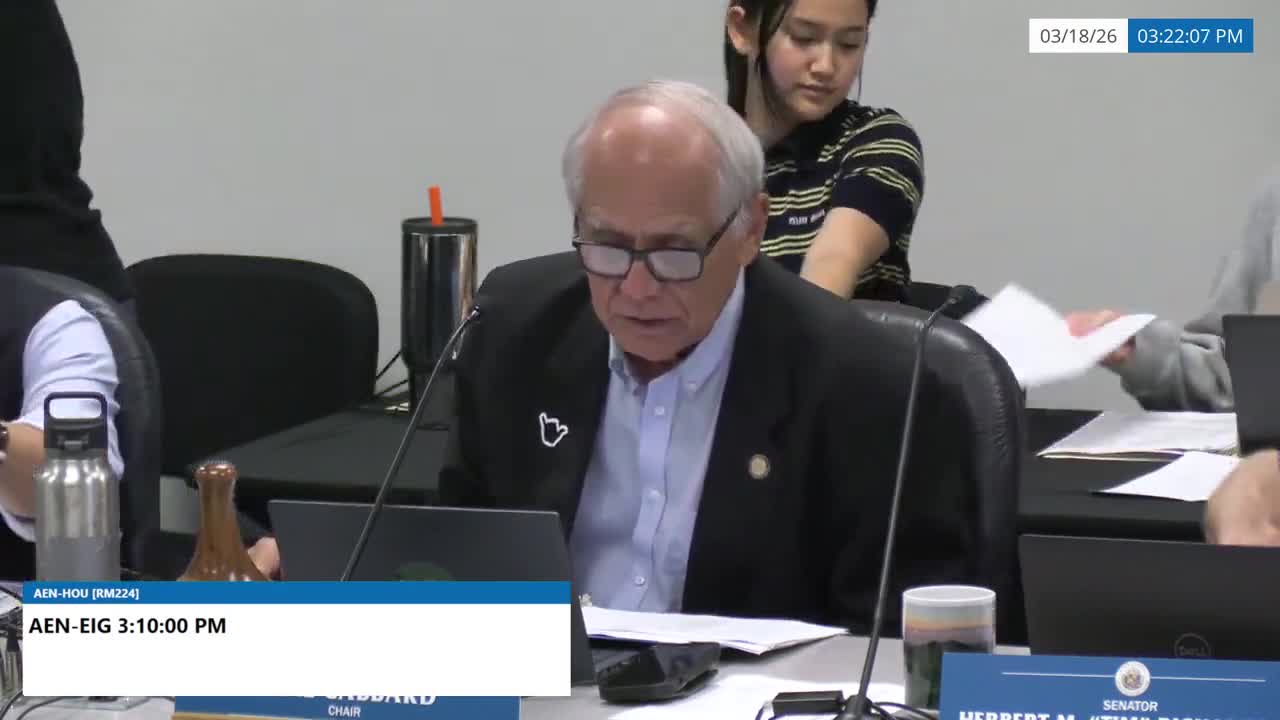 28MIN
Senate Standing Committee on Agriculture and Environment
28MIN
Senate Standing Committee on Housing
28MIN
Senate Standing Committee on Energy and Intergovernmental Affairs
 3MIN
Senate Standing Committee on Agriculture and Environment
3MIN
Senate Standing Committee on Housing
3MIN
Senate Standing Committee on Energy and Intergovernmental Affairs
 7MIN
House Standing Committee on Finance
 48SEC
House Standing Committee on Finance
Bill Author