SB 2875: J-1 Visa Program; Hawaii Teacher Standards Board; Visiting International Educator Permit
- Session Year: 2025-2026
- House: Senate
- Latest Version Date: 2026-03-05
Current Status:
Failed
(2026-03-12: Referred to EDN, CPC, referral sheet 17)
Introduced
In Committee
First Chamber
In Committee
Second Chamber
Final Decking
Enacted
Requires the Hawaii Teacher Standards Board to develop an alternative pathway for a visiting international educator permit aligned to the duration of the educator's J-1 visa program. Repeals 6/30/2031. Effective 7/1/2050. (SD1)
Requires the Hawaii Teacher Standards Board to develop an alternative pathway for a visiting international educator permit aligned to the duration of the educator's J-1 visa program. Repeals 6/30/2031.
|
THE SENATE |
S.B. NO. |
2875 |
|
THIRTY-THIRD LEGISLATURE, 2026 |
S.D. 1 |
|
|
STATE OF HAWAII |
|
|
|
|
|
|
|
|
||
|
|
||
A BILL FOR AN ACT
RELATING TO EDUCATION.
BE IT ENACTED BY THE LEGISLATURE OF THE STATE OF HAWAII:
SECTION 1. The legislature finds that the BridgeUSA J-1 visa program, administered by the United States Department of State, offers foreign teachers an opportunity to teach in accredited schools in the United States serving students in grades kindergarten through twelve. The J-1 visa program was also designed to help address the ongoing chronic teacher shortage while providing academic and cultural exchange opportunities to visiting teachers. Furthermore, the J-1 visa program offers the opportunity for foreign teachers of various backgrounds to become a part of educational communities to reflect the diversity of student populations across the nation.
The legislature further finds that although 22.4 per cent of the public school student population in Hawaii identifies as Filipino, only 7.4 per cent of educators share the same ethnic background. According to the federal Institute of Education Sciences, diverse educator representation has a significantly positive effect on student learning. Teachers of color can often help close achievement gaps and improve attendance and behavioral outcomes and are highly rated by students of all backgrounds. Beyond academic benefits, having educators who reflect their students' backgrounds can inspire future goals. Seeing role models in the classroom can encourage students to pursue similar career paths. Presently, the State's implementation of the J-1 visa program has aimed to expose Filipino children to Filipino educators, inspiring them to consider careers in education. Moreover, the J-1 visa program has contributed to classroom diversity while eliminating certain barriers to academic achievement.
Since its implementation, the J-1 visa program has been a resounding success. To date, three hundred sixty-five internationally certified educators, primarily from the Philippines, serve in one hundred and one public schools statewide. Similar to the Philippines, Kenya also has strong educational equivalencies, and the State currently employs four educators from Kenya with twenty-five additional educators from Africa set to arrive in the 2026-2027 school year. Educators from the J-1 visa program are beneficially affecting the State's diverse classrooms, and the program has strong support from community organizations, including groups from the Filipino community.
However, the State's existing licensing rules limit the full potential of prospective international teachers participating in the J-1 visa program. Because the State does not recognize foreign teaching licenses for reciprocity, visiting international teachers are required to complete a series of additional examinations that often cost more than $1,000 and demand extensive preparation time. These requirements place a disproportionate burden on educators who are already adapting to a new cultural and professional environment.
As a result, many teachers in the J-1 visa program are unable to complete the State's full licensure requirements within the three-year duration of their visa program. This inability prevents them from remaining for the optional two-year extension permitted under federal rules -- an extension that many other states use by offering streamlined visiting‑international-teacher permits for the full duration of the teachers' visas. States such as Florida, Indiana, Ohio, and Texas have implemented specialized permits that allow teachers to serve for the full five years of their exchange program.
Accordingly, the purpose of this Act is to require the Hawaii teacher standards board to develop an alternative pathway for a visiting international educator permit aligned to the duration of the educator's J-1 visa program. By doing so, the State would create a more equitable and culturally responsive public educational system, strengthening teacher retention, increasing instructional continuity for students, and ensuring that Hawaii benefits from the full five years of service that these highly qualified teachers are eligible to provide.
SECTION 2. Section 302A-802, Hawaii Revised Statutes, is amended by amending subsection (c) to read as follows:
"(c) The board shall adopt policies, exempt from chapters 91 and 92, to initiate the following:
(1) Develop criteria allowing more individuals with trade or industry experience to teach in vocational, technical, and career pathway programs, and criteria for the issuance of permits allowing qualified individuals to teach when recommended by the superintendent or the commission, when appropriate. The department or the commission, when appropriate, shall be responsible for the review and acceptance of the relevant licenses, certificates, or other qualifications related to an individual's vocational, technical, or career pathway education-related experience that the department or the commission, when appropriate, deems necessary for a permit. The department or the commission, when appropriate, shall have the authority to waive the requirement of a bachelor's degree to teach in a vocation, technical, or career pathway education program;
(2) Develop a plan to accept teachers from any state as long as they have completed state-approved teacher education programs and pass relevant Hawaii teacher examinations or their equivalent;
(3) Clarify the requirements, on a state-by-state basis, for out-of-state licensed teachers to obtain a license in Hawaii;
(4) Develop a plan to facilitate licensing for those who intend to teach in Hawaii immersion programs, the island of Niihau, or any other extraordinary situation as defined by the superintendent or the superintendent's designee, or by the commission, when appropriate;
(5) Pursue full teacher license
reciprocity with all other states; [and]
(6) Develop a plan to
facilitate an optional certification for those who teach or intend to teach at
private schools[.]; and
(7) Develop an alternative pathway for a visiting international educator permit to promote cultural exchange between the State and foreign nations. The permit shall authorize a visiting international educator who agrees to come to the United States temporarily as a full-time teacher of record in an accredited primary or secondary school to teach all subjects and grade levels for which the educator is qualified and is employed by the department. A visiting international educator permit developed by the department shall remain valid for the duration necessary to complete the educator's participation in a visiting international educator exchange program."
SECTION 3. Statutory material to be repealed is bracketed and stricken. New statutory material is underscored.
SECTION 4. This Act shall take effect July 1, 2050 and shall be repealed on June 30, 2031; provided that section 302A‑802, Hawaii Revised Statutes, shall be reenacted in the form in which it read on the day prior to the effective date of this Act.
Report Title:
J-1 Visa Program; Hawaii Teacher Standards Board; Visiting International Educator Permit
Description:
Requires the Hawaii Teacher Standards Board to develop an alternative pathway for a visiting international educator permit aligned to the duration of the educator's J-1 visa program. Repeals 6/30/2031. Effective 7/1/2050. (SD1)
The summary description of legislation appearing on this page is for informational purposes only and is not legislation or evidence of legislative intent.
|
THE SENATE |
S.B. NO. |
2875 |
|
THIRTY-THIRD LEGISLATURE, 2026 |
|
|
|
STATE OF HAWAII |
|
|
|
|
|
|
|
|
||
|
|
||
A BILL FOR AN ACT
relating to education.
BE IT ENACTED BY THE LEGISLATURE OF THE STATE OF HAWAII:
SECTION 1. The legislature finds that the BridgeUSA J-1 visa program, administered by the United States Department of State, offers foreign teachers an opportunity to teach in accredited schools in the United States serving students in grades kindergarten through twelve. The J-1 visa program was also designed to help address the ongoing chronic teacher shortage while providing academic and cultural exchange opportunities to visiting teachers. Furthermore, the J-1 visa program offers the opportunity for foreign teachers of various backgrounds to become a part of educational communities to reflect the diversity of student populations across the nation.
The legislature further finds that although 22.4 per cent of the public school student population in Hawaii identifies as Filipino, only 7.4 per cent of educators share the same ethnic background. According to the federal Institute of Education Sciences, diverse educator representation has a significantly positive effect on student learning. Teachers of color can often help close achievement gaps and improve attendance and behavioral outcomes and are highly rated by students of all backgrounds. Beyond academic benefits, having educators who reflect their students' backgrounds can inspire future goals. Seeing role models in the classroom can encourage students to pursue similar career paths. Presently, the State's implementation of the J-1 visa program has aimed to expose Filipino children to Filipino educators, inspiring them to consider careers in education. Moreover, the J-1 visa program has contributed to classroom diversity while eliminating certain barriers to academic achievement.
Since its implementation, the J-1 visa program has been a resounding success. To date, three hundred sixty-five internationally certified educators, primarily from the Philippines, serve in one hundred and one public schools statewide. Similar to the Philippines, Kenya also has strong educational equivalencies, and the State currently employs four educators from Kenya with twenty-five additional educators from Africa set to arrive in the 2026-2027 school year. Educators from the J-1 visa program are beneficially affecting the State's diverse classrooms, and the program has strong support from community organizations, including groups from the Filipino community.
However, the State's existing licensing rules limit the full potential of prospective international teachers participating in the J-1 visa program. Because the State does not recognize foreign teaching licenses for reciprocity, visiting international teachers are required to complete a series of additional examinations that often cost more than $1,000 and demand extensive preparation time. These requirements place a disproportionate burden on educators who are already adapting to a new cultural and professional environment.
As a result, many teachers in the J-1 visa program are unable to complete the State's full licensure requirements within the three-year duration of their visa program. This inability prevents them from remaining for the optional two-year extension permitted under federal rules -- an extension that many other states use by offering streamlined visiting-international-teacher permits for the full duration of the teachers' visas. States such as Florida, Indiana, Ohio, and Texas have implemented specialized permits that allow teachers to serve for the full five years of their exchange program.
Accordingly, the purpose of this Act is to require the Hawaii teacher standards board to develop an alternative pathway for a visiting international educator permit aligned to the duration of the educator's J-1 visa program. By doing so, the State would create a more equitable and culturally responsive public educational system, strengthening teacher retention, increasing instructional continuity for students, and ensuring that Hawaii benefits from the full five years of service that these highly qualified teachers are eligible to provide.
SECTION 2. Section 302A-802, Hawaii Revised Statutes, is amended by amending subsection (c) to read as follows:
"(c) The board shall adopt policies, exempt from chapters 91 and 92, to initiate the following:
(1) Develop criteria allowing more individuals with trade or industry experience to teach in vocational, technical, and career pathway programs, and criteria for the issuance of permits allowing qualified individuals to teach when recommended by the superintendent or the commission, when appropriate. The department or the commission, when appropriate, shall be responsible for the review and acceptance of the relevant licenses, certificates, or other qualifications related to an individual's vocational, technical, or career pathway education-related experience that the department or the commission, when appropriate, deems necessary for a permit. The department or the commission, when appropriate, shall have the authority to waive the requirement of a bachelor's degree to teach in a vocation, technical, or career pathway education program;
(2) Develop a plan to accept teachers from any state as long as they have completed state-approved teacher education programs and pass relevant Hawaii teacher examinations or their equivalent;
(3) Clarify the requirements, on a state-by-state basis, for out-of-state licensed teachers to obtain a license in Hawaii;
(4) Develop a plan to facilitate licensing for those who intend to teach in Hawaii immersion programs, the island of Niihau, or any other extraordinary situation as defined by the superintendent or the superintendent's designee, or by the commission, when appropriate;
(5) Pursue full teacher license
reciprocity with all other states; [and]
(6) Develop a plan to
facilitate an optional certification for those who teach or intend to teach at
private schools[.]; and
(7) Develop an alternative pathway for a visiting international educator permit to promote cultural exchange between the State and foreign nations. The permit shall authorize a visiting international educator who agrees to come to the United States temporarily as a full-time teacher of record in an accredited primary or secondary school to teach all subjects and grade levels for which the educator is qualified and is employed by the department. A visiting international educator permit developed by the department shall remain valid for the duration necessary to complete the educator's participation in a visiting international educator exchange program."
SECTION 3. Statutory material to be repealed is bracketed and stricken. New statutory material is underscored.
SECTION 4. This Act shall take effect upon its approval and shall be repealed on June 30, 2031; provided that section 302A-802, Hawaii Revised Statutes, shall be reenacted in the form in which it read on the day prior to the effective date of this Act.
|
INTRODUCED BY: |
_____________________________ |
|
|
|
Report Title:
J-1 Visa Program; Hawaii Teacher Standards Board; Visiting International Educator Permit
Description:
Requires the Hawaii Teacher Standards Board to develop an alternative pathway for a visiting international educator permit aligned to the duration of the educator's J-1 visa program. Repeals 6/30/2031.
The summary description of legislation appearing on this page is for informational purposes only and is not legislation or evidence of legislative intent.
|
Date
|
Status
|
|---|---|
| Mar 12, 2026 | Referred to EDN, CPC, referral sheet 17 |
| Mar 12, 2026 | Pass First Reading |
| Mar 10, 2026 | Received from Senate (Sen. Com. No. 312) in amended form (SD 1). |
| Mar 10, 2026 | Report Adopted; Passed Third Reading, as amended (SD 1). Ayes, 24; Aye(s) with reservations: none. Noes, 1 (Senator(s) Awa). Excused, 0 (none). Transmitted to House. |
| Mar 6, 2026 | 48 Hrs. Notice 03-10-26. |
| Mar 6, 2026 | Reported from WAM (Stand. Com. Rep. No. 2946) with recommendation of passage on Third Reading, as amended (SD 1). |
| Mar 2, 2026 | The committee(s) on WAM recommend(s) that the measure be PASSED, WITH AMENDMENTS. The votes in WAM were as follows: 13 Aye(s): Senator(s) Dela Cruz, Moriwaki, DeCoite, Elefante, Hashimoto, Inouye, Kanuha, Kidani, Kim, Lee, C., Richards, Wakai, Fevella; Aye(s) with reservations: none ; 0 No(es): none; and 0 Excused: none. |
| Feb 27, 2026 | The committee on WAM has rescheduled its decision making to 03-02-26 10:02AM; CR 211 & Videoconference. |
| Feb 23, 2026 | The committee(s) on WAM will hold a public decision making on 03-02-26 10:31AM; Conference Room 211 & Videoconference. |
| Feb 18, 2026 | Report adopted; Passed Second Reading and referred to WAM. |
| Feb 18, 2026 | Reported from EDU (Stand. Com. Rep. No. 2341) with recommendation of passage on Second Reading and referral to WAM. |
| Feb 13, 2026 | The committee(s) on EDU recommend(s) that the measure be PASSED, UNAMENDED. The votes in EDU were as follows: 3 Aye(s): Senator(s) Kim, Kidani, DeCorte; Aye(s) with reservations: none ; 0 No(es): none; and 2 Excused: Senator(s) Fukunaga, Hashimoto. |
| Feb 10, 2026 | The committee(s) on EDU has scheduled a public hearing on 02-13-26 1:05PM; CR 229 & Videoconference. |
| Jan 30, 2026 | Referred to EDU, WAM. |
| Jan 26, 2026 | Passed First Reading. |
| Jan 23, 2026 | Introduced. |
|
Date
|
Description
|
Location
|
Votes
|
|
|---|---|---|---|---|
| Mar 10, 2026 | Third Reading | Senate Floor |
Passed |
|
| Mar 2, 2026 | The committee(s) on WAM recommend(s) that the measure be PASSED, WITH AMENDMENTS | Senate Standing Committee on Ways and Means |
Passed |
|
| Feb 13, 2026 | The committee(s) on EDU recommend(s) that the measure be PASSED, UNAMENDED | Senate Standing Committee on Education |
Passed |
This list shows positions taken on this bill by organizations on the date displayed, which is linked to the original source.
Positions by individuals are not included.
|
Organization
|
Position
|
Date
|
|---|---|---|
| El Pueblo en Acción (EPA) Maui | *** Support | Mar 1, 2026 |
| Hawaii State Department of Education (HIDOE) | *** Support | Mar 1, 2026 |
| Hawaiʻi Coalition for Immigrant Rights (HCIR) | *** Support | Mar 1, 2026 |
| Hawaiʻi Teacher Standards Board | ** Against | |
| Hawai‘i Teacher Standards Board | *** Against | Feb 13, 2026 |
| Hawai‘i Teacher Standards Board (HTSB) | *** Against | Mar 1, 2026 |
| Roots Reborn | *** Support | Mar 1, 2026 |
| The Legal Clinic (TLC) | *** Support | Mar 1, 2026 |
STAND. COM. REP. NO. 2946
Honolulu, Hawaii
RE: S.B. No. 2875
S.D. 1
Honorable Ronald D. Kouchi
President of the Senate
Thirty-Third State Legislature
Regular Session of 2026
State of Hawaii
Sir:
Your Committee on Ways and Means, to which was referred S.B. No. 2875 entitled:
"A BILL FOR AN ACT RELATING TO EDUCATION,"
begs leave to report as follows:
The purpose and intent of this measure is to address the State's teacher shortage, promote teacher retention, and support international exchange efforts by easing administrative burdens on qualified visiting international educators who teach in Hawaii's public schools.
More specifically, the measure requires the Hawaii Teacher Standards Board to develop an alternative pathway for a visiting international educator permit that:
(1) Authorizes a visiting international educator to teach all subjects and grade levels for which the educator is qualified; and
(2) Remains valid for a duration aligned with the educator's J-1 program, including J-1 visa extensions.
Your Committee received written comments in support of this measure from the Department of Education, State Health Planning and Development Agency, The Legal Clinic, Hawaii Coalition for Immigrant Rights, Roots Reborn Maui, and five individuals.
Your Committee received written comments in opposition to this measure from the Hawaii Teacher Standards Board and one individual.
Your Committee received written comments on this measure from two individuals.
Your Committee finds that the State's schools benefit from stability when qualified teachers are employed and retained. This is especially true for hard-to-staff schools. Teachers working in Hawaii under the J-1 visa program are fully qualified, licensed professionals in their home countries and often serve as core instructional staff in the State's public schools. However, your Committee recognizes that traditional state licensing exams can be expensive and time consuming and can make it difficult for J-1 educators to qualify for visa extensions. Creating an alternative licensing pathway to allow J-1 teachers to serve the full authorized term of their visa will help to improve teacher retention, strengthen workforce stability, and ensure that Hawaii's students receive the greatest benefit from these experienced educators.
Your Committee has amended this measure by changing the effective date to July 1, 2050, to facilitate further discussion on the measure.
As affirmed by the record of votes of the members of your Committee on Ways and Means that is attached to this report, your Committee is in accord with the intent and purpose of S.B. No. 2875, as amended herein, and recommends that it pass Third Reading in the form attached hereto as S.B. No. 2875, S.D. 1.
Respectfully submitted on behalf of the members of the Committee on Ways and Means,
|
|
|
________________________________ DONOVAN M. DELA CRUZ, Chair |
|
|
|
|
STAND. COM. REP. NO. 2341
Honolulu, Hawaii
RE: S.B. No. 2875
Honorable Ronald D. Kouchi
President of the Senate
Thirty-Third State Legislature
Regular Session of 2026
State of Hawaii
Sir:
Your Committee on Education, to which was referred S.B. No. 2875 entitled:
"A BILL FOR AN ACT RELATING TO EDUCATION,"
begs leave to report as follows:
The purpose and intent of this measure is to require the Hawaii Teacher Standards Board to develop a temporary alternative pathway for a visiting international educator permit aligned to the duration of the educator's J-1 visa program, which would repeal on June 30, 2031.
Your Committee received testimony in support of this measure from the Department of Education, The Legal Clinic, and one individual.
Your Committee received testimony in opposition to this measure from the Hawaiʻi Teacher Standards Board and one individual.
Your Committee finds that the State is facing a persistent teacher shortage, particularly in hard-to-staff schools and high-need subject areas. In an effort to fill this gap, the State allows unlicensed teachers from out-of-state or overseas to teach in the State for a maximum of three years. Currently, international teachers must leave the State after the three-year period, despite the federal J-1 teacher exchange visitor visa allowing an international teacher to remain in the United States for up to five years. This results in a lost opportunity for the State to retain the benefit of an international teacher filling a short-staffed position for an additional two years. This measure would enable the State to create a pathway for international teachers to remain in the State for the full five years permitted under the J-1 visa, which would help strengthen the educational community for students and teachers in the State.
As affirmed by the record of votes of the members of your Committee on Education that is attached to this report, your Committee is in accord with the intent and purpose of S.B. No. 2875 and recommends that it pass Second Reading and be referred to your Committee on Ways and Means.
Respectfully submitted on behalf of the members of the Committee on Education,
|
|
|
________________________________ DONNA MERCADO KIM, Chair |
|
|
|
|
|
Date
|
Testimony PDF
|
|---|---|
| Mar 1, 2026 | SB2875_TESTIMONY_WAM_03-02-26_.PDF |
| Feb 13, 2026 | SB2875_TESTIMONY_EDU_02-13-26_.PDF |
Discussed in Hearing
 18SEC
Senate Standing Committee on Ways and Means
 35SEC
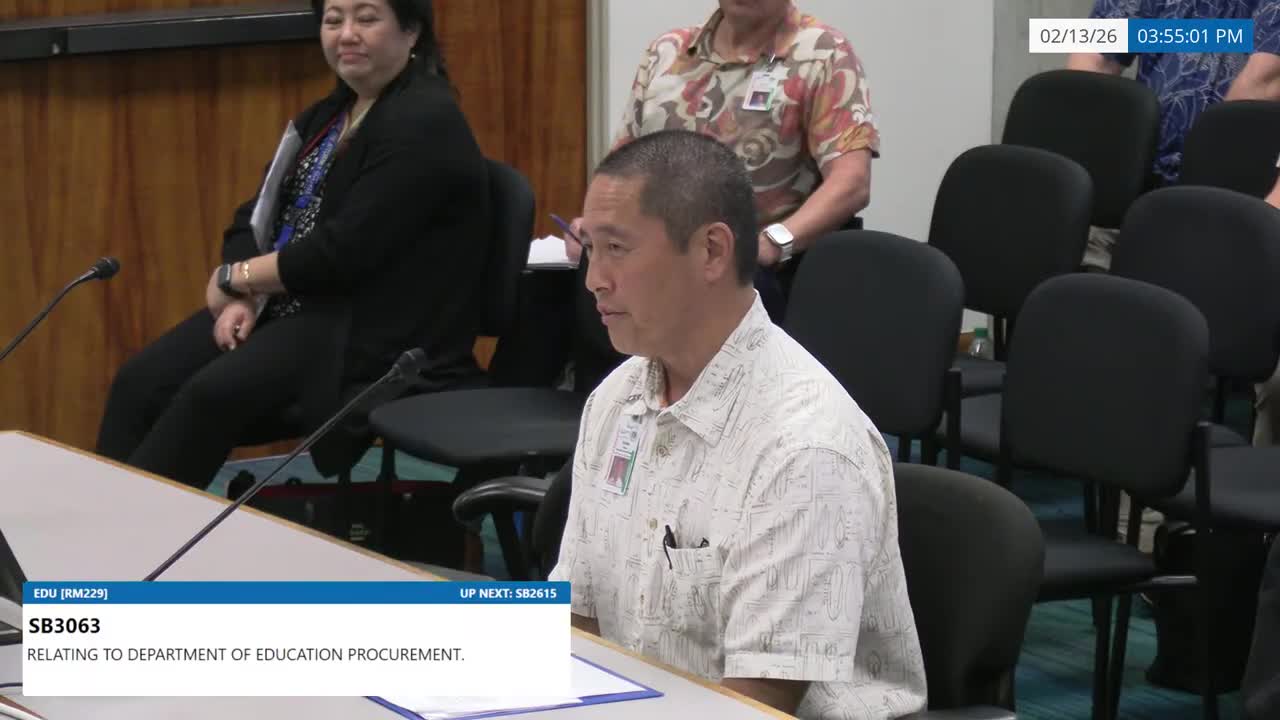
Senate Standing Committee on Education
35SEC
Senate Standing Committee on Water, Land, Culture and the Arts
Bill Author