SB 1316: Penal Code; Fees, Fines, and Restitution; Collections; Consequences of Nonpayment; Appropriations
- Session Year: 2025-2026
- House: Senate
- Latest Version Date: 2025-04-04
Current Status:
Failed
(2026-04-02: Received notice of the discharge of all House Conferees (Hse. Com. No. 457).)
Introduced
In Committee
First Chamber
In Committee
Second Chamber
Final Decking
Enacted
Requires the Judiciary to contract with a collection agency or licensed attorney to collect delinquent court-ordered fees, fines, sanctions, and court costs. Repeals the authority of the Judiciary to contract with a collection agency or licensed attorney to collect delinquent restitution. Expressly allows courts to specify a period of time or installments for payment of fees and restitution. Requires district courts to hold payment compliance hearings once per year or as soon as practicable, until all fees, fines, and restitution are fully paid, and requires a defendant in district court to appear and show cause if the defendant fails to pay in full within a time specified by the court or fails to pay three consecutive installments. Makes conforming amendments to related statutes. Appropriates funds. Effective 7/1/3000. (HD2)
Requires the Judiciary to contract with a collection agency or licensed attorney to collect delinquent court-ordered fees, fines, sanctions, and court costs. Repeals the authority of the Judiciary to contract with a collection agency or licensed attorney to collect delinquent restitution. Expressly allows courts to specify a period of time or installments for payment of fees and restitution. Requires district courts to hold payment compliance hearings once per year or as soon as practicable, until all fees, fines, and restitution are fully paid, and requires a defendant in district court to appear and show cause if the defendant fails to pay in full within a time specified by the court or fails to pay three consecutive installments. Makes conforming amendments to related statutes. Appropriates funds. Effective 4/23/2057. (HD1)
Requires the Judiciary to contract with a collection agency or licensed attorney to collect delinquent court-ordered fees, fines, sanctions, and court costs. Repeals the authority of the Judiciary to contract with a collection agency or licensed attorney to collect delinquent restitution. Expressly allows courts to specify a period of time or installments for payment of fees and restitution. Requires district courts to hold payment compliance hearings once per year or as soon as practicable, until all fees, fines, and restitution are fully paid, and requires a defendant in district court to appear and show cause if the defendant fails to pay in full within a time specified by the court or fails to pay three consecutive installments. Makes corresponding amendments to related statutes. Appropriates funds. Effective 4/23/2057. (SD1)
Requires the Judiciary to contract with a collection agency or licensed attorney to collect delinquent court-ordered fees, fines, sanctions, and court costs. Repeals the authority of the Judiciary to contract with a collection agency or licensed attorney to collect delinquent restitution. Expressly allows courts to specify a period of time or installments for payment of fees and restitution. Requires courts to hold payment compliance hearings once per year or as soon as practicable, until all fees, fines, and restitution are fully paid, and requires a defendant to appear and show cause if the defendant fails to pay in full within a time specified by the court or fails to pay three consecutive installments. Makes corresponding amendments to related statutes.
|
THE SENATE |
S.B. NO. |
1316 |
|
THIRTY-THIRD LEGISLATURE, 2025 |
S.D. 1 |
|
|
STATE OF HAWAII |
H.D. 2 |
|
|
|
|
|
|
|
||
|
|
||
A BILL FOR AN ACT
RELATING TO COURT-ORDERED PAYMENTS.
BE IT ENACTED BY THE LEGISLATURE OF THE STATE OF HAWAII:
SECTION 1. Section 601-17.5, Hawaii Revised Statutes, is amended to read as follows:
"§601-17.5 Collection of delinquent court-ordered
payments. The judiciary [may]
shall contract with a collection agency bonded under chapter 443B or
with a licensed attorney to collect any delinquent court-ordered [penalties,]
fees, fines, [restitution,] sanctions, and court costs[,
including juvenile monetary assessments].
Any fees or costs associated with the collection efforts shall be added
to the amount due and retained by the collection agency as its payment;
provided that no fees or costs shall exceed fifty per cent of the amount
collected."
SECTION 2. Section 706-642, Hawaii Revised Statutes, is amended to read as follows:
"§706-642 Time and method of payment. (1)
When a defendant is sentenced to pay a fee,
fine, or restitution, the court may grant permission for the payment
to be made within a specified period of time or in specified installments. If no such permission is embodied in the
sentence, the fee, fine, or restitution shall be payable
forthwith by cash, check, or [by] a credit card approved by the court.
(2) When a defendant sentenced to pay a fee, fine, or restitution is also sentenced to probation, the court may make the payment of the fee, fine, or restitution a condition of probation.
(3) When a defendant sentenced to pay a fee or fine is also ordered to make restitution or reparation to the victim or victims, or to the person or party who has incurred loss or damage because of the defendant's crime, the payment of restitution or reparation shall have priority over the payment of the fee or fine, pursuant to section 706-651. No fee or fine shall be collected until the restitution or reparation order has been satisfied."
SECTION 3. Section 706-644, Hawaii Revised Statutes, is amended to read as follows:
"§706-644 Consequences of nonpayment; imprisonment for
contumacious nonpayment; summary collection. (1)
When a defendant in district court is sentenced pursuant to
section 706-605, granted a conditional discharge pursuant to section 712-1255,
or granted a deferred plea pursuant to chapter 853, and the defendant is
ordered to pay a fee, fine, or restitution, whether as an independent order, as
part of a judgment and sentence, or as a condition of probation or deferred
plea[, and]:
(a) If
the defendant was ordered to pay restitution, the court shall set a proof of
compliance hearing for the defendant; provided that the court may further order
that the defendant need not appear for the proof of compliance hearing if all
fees, fines, and restitution have been paid in full and all other sentencing
requirements have been met before a designated date, which may be earlier than
the proof of compliance date. At each
proof of compliance hearing for a defendant in district court, if the defendant
appears and is in compliance, but has not yet paid all fees, fines, and
restitution in full, the court shall order a further proof of compliance
hearing within one year or as soon as practicable until the fees, fines, or
restitution have been paid in full. If
the defendant defaults in the payment thereof [or of any installment],
the court[, upon the motion of the prosecuting attorney or upon its own
motion, may] shall require the defendant to show cause why the
defendant's default should not be treated as contumacious, and [may],
if the defendant fails to appear, the court shall issue a summons or a
warrant of arrest for the defendant's appearance. Unless the defendant shows that the
defendant's default was not attributable to an intentional refusal to obey the
order of the court, or to a failure on the defendant's part to make a good
faith effort to obtain the funds required for the payment, the court shall find
that the defendant's default was contumacious and may order the defendant
committed until the fee, fine, restitution, or a specified part thereof is
paid[.]; provided that for a defendant in district court, if the
fees, fines, and restitution are not paid in full, the court shall order
further proof of compliance hearings every six months or less until the court
is satisfied that the defendant will appear and remain in compliance; or
(b) If the defendant was ordered to pay fines, fees, or both, but no restitution, the district court shall refer the outstanding fines or fees to the collection agency contracted pursuant to section 601-17.5. A proof of compliance hearing shall not be required in cases where no restitution was ordered.
(2) When a fee, fine, or restitution is imposed
on a corporation or unincorporated association, it [is] shall be
the duty of the person or persons authorized to make disbursement from the
assets of the corporation or association to pay it from those assets, and their
failure to do so may be held contumacious unless they make the showing required
in subsection (1).
(3) The term of imprisonment for nonpayment of fee, fine, or restitution shall be specified in the order of commitment, and shall not exceed one day for each $250 of the fee or fine, thirty days if the fee or fine was imposed upon conviction of a violation or a petty misdemeanor, or one year in any other case, whichever is the shorter period. A person committed for nonpayment of a fee or fine shall be given credit toward payment of the fee or fine for each day of imprisonment, at the rate of $250 per day.
(4) If it appears that the defendant's default in the payment of a fee, fine, or restitution is not contumacious, the court may make an order allowing the defendant additional time for payment, reducing the amount of each installment, or revoking the fee, fine, or the unpaid portion thereof in whole or in part, or converting the unpaid portion of the fee or fine to community service. A defendant shall not be discharged from an order to pay restitution until the full amount of the restitution has actually been collected or accounted for.
(5) Unless discharged by payment or, in the case of a fee or fine, service of imprisonment pursuant to subsection (3), an order to pay a fee, fine, or restitution, whether as an independent order, as a part of a judgment and sentence, or as a condition of probation or deferred plea pursuant to chapter 853, may be collected in the same manner as a judgment in a civil action. The State or the victim named in the order may collect the restitution, including costs, interest, and attorney's fees, pursuant to section 706-646. The State may collect the fee or fine, including costs, interest, and attorney's fees, pursuant to section 706-647.
(6) Attorney's fees, costs, and interest shall not be deemed part of the penalty, and no person shall be imprisoned under this section in default of payment of attorney's fees, costs, and interest.
(7) For purposes of this section, "default" means failure to pay a fee, fine, or restitution within a period of time specified by the court pursuant to section 706-642, or failure to pay three consecutive installments of a fee, fine, or restitution, whichever occurs first."
SECTION 4. Section 806-73, Hawaii Revised Statutes, is amended by amending subsection (b) to read as follows:
"(b)
All adult probation records shall be confidential and shall not be
deemed to be public records. As used in
this section, [the term] "records" includes but is not limited
to all records made by any adult probation officer in the course of performing
the probation officer's official duties.
The records, or the content of the records, shall be divulged only as
follows:
(1) A copy of any adult probation case record or of a portion of it, or the case record itself, upon request, may be provided to:
(A) An adult probation officer, a court officer, a social worker of a Hawaii state adult probation unit, or a family court officer who is preparing a report for the courts; or
(B) A state or federal
criminal justice agency, or state or federal court program that[:] is:
(i) [Is providing] Providing
supervision of a defendant or offender convicted and sentenced by the courts of
Hawaii; or
(ii) [Is responsible] Responsible
for the preparation of a report for a court;
(2) The residence address, work address, home telephone number, or work telephone number of a current or former defendant shall be provided only to:
(A) A law enforcement officer as defined in section 710-1000 to locate the probationer for the purpose of serving a summons or bench warrant in a civil, criminal, or deportation hearing, or for the purpose of a criminal investigation; or
(B) A collection
agency or licensed attorney contracted by the judiciary to collect any
delinquent court-ordered [penalties,] fees, fines, [restitution,]
sanctions, and court costs
pursuant to section 601-17.5;
(3) A copy of a presentence report or investigative report shall be provided only to:
(A) The persons or entities named in section 706-604;
(B) The Hawaii paroling authority;
(C) Any psychiatrist, psychologist, or other treatment practitioner who is treating the defendant pursuant to a court order or parole order for that treatment;
(D) The intake service centers;
(E) In accordance with applicable law, persons or entities doing research; and
(F) Any Hawaii state adult probation
officer or adult probation officer of another state or federal jurisdiction
who[:] is engaged in the:
(i) [Is engaged in the supervision] Supervision
of a defendant or offender convicted and sentenced in the courts of Hawaii; or
(ii) [Is engaged in the preparation] Preparation
of a report for a court regarding a defendant or offender convicted and
sentenced in the courts of Hawaii;
(4) Access to adult probation records by a victim, as defined in section 706-646 to enforce an order filed pursuant to section 706-647, shall be limited to the:
(A) Name and contact information of the defendant's adult probation officer;
(B) Compliance record of the defendant with court‑ordered payments;
(C) Amounts paid by the defendant;
(D) Dates of the payments made by the defendant;
(E) Payee of payments made by the defendant; and
(F) Remaining unpaid balance,
without the assessment of a filing fee or surcharge;
(5) Upon written request, the victim, or the parent or guardian of a minor victim or incapacitated victim, of a defendant who has been placed on probation for an offense under section 580-10(d)(1), 586-4(e), 586‑11(a), or 709-906 may be notified by the defendant's probation officer when the probation officer has any information relating to the safety and welfare of the victim;
(6) Notwithstanding paragraph (3) and upon notice
to the defendant, records and information relating to the defendant's risk
assessment and need for treatment services; information related to the
defendant's past treatment and assessments, with the prior written consent of
the defendant for information from a treatment service provider; provided that
[for] any substance abuse records [such] release shall be subject
to title 42 Code of Federal Regulations part 2, relating to the confidentiality
of alcohol and drug abuse patient records; and information that has therapeutic
or rehabilitative benefit, may be provided to:
(A) A case management, assessment, or treatment
service provider assigned by adult probation to service the defendant; provided
that [such] the information shall be given only upon the
acceptance or admittance of the defendant into a treatment
program;
(B) Correctional case manager, correctional unit manager, and parole officers involved with the defendant's treatment or supervision; and
(C) In accordance with applicable law, persons or entities doing research;
(7) Probation drug test results may be released
with prior written consent of a defendant to the defendant's treating physician
when test results indicate substance use [which] that may be
compromising the defendant's medical care or treatment;
(8) Records obtained pursuant to section 704-404(9) may be made available as provided in that section;
(9) Any person, agency, or entity receiving records, or contents of records, pursuant to this subsection shall be subject to the same restrictions on disclosure of the records as Hawaii state adult probation offices; and
(10) Any person who uses the information covered by this subsection for purposes inconsistent with the intent of this subsection or outside of the scope of the person's official duties shall be fined no more than $500."
SECTION 5. There is appropriated out of the general revenues of the State of Hawaii the sum of $ or so much thereof as may be necessary for fiscal year 2025-2026 and the same sum or so much thereof as may be necessary for fiscal year 2026-2027 for the purposes of this Act, including the hiring of necessary staff.
The sums appropriated shall be expended by the judiciary for the purposes of this Act.
SECTION 6. This Act does not affect rights and duties that matured, penalties that were incurred, and proceedings that were begun before its effective date.
SECTION 7. Statutory material to be repealed is bracketed and stricken. New statutory material is underscored.
SECTION 8. This Act shall take effect on July 1, 3000.
Report Title:
Penal Code; Fees, Fines, and Restitution; Collections; Consequences of Nonpayment; Appropriations
Description:
Requires the Judiciary to contract with a collection agency or licensed attorney to collect delinquent court-ordered fees, fines, sanctions, and court costs. Repeals the authority of the Judiciary to contract with a collection agency or licensed attorney to collect delinquent restitution. Expressly allows courts to specify a period of time or installments for payment of fees and restitution. Requires district courts to hold payment compliance hearings once per year or as soon as practicable, until all fees, fines, and restitution are fully paid, and requires a defendant in district court to appear and show cause if the defendant fails to pay in full within a time specified by the court or fails to pay three consecutive installments. Makes conforming amendments to related statutes. Appropriates funds. Effective 7/1/3000. (HD2)
The summary description of legislation appearing on this page is for informational purposes only and is not legislation or evidence of legislative intent.
|
THE SENATE |
S.B. NO. |
1316 |
|
THIRTY-THIRD LEGISLATURE, 2025 |
S.D. 1 |
|
|
STATE OF HAWAII |
H.D. 1 |
|
|
|
|
|
|
|
||
|
|
||
A BILL FOR AN ACT
RELATING TO COURT-ORDERED PAYMENTS.
BE IT ENACTED BY THE LEGISLATURE OF THE STATE OF HAWAII:
SECTION 1. Section 601-17.5, Hawaii Revised Statutes, is amended to read as follows:
"§601-17.5 Collection of delinquent court-ordered payments. The judiciary [may] shall contract
with a collection agency bonded under chapter 443B or with a licensed attorney to
collect any delinquent court-ordered [penalties,] fees, fines, [restitution,]
sanctions, and court costs[, including juvenile monetary assessments]. Any fees or costs associated with the collection
efforts shall be added to the amount due and retained by the collection agency as
its payment; provided that no fees or costs shall exceed fifty per cent of the amount
collected."
SECTION 2. Section 706-642, Hawaii Revised Statutes, is amended to read as follows:
"§706-642 Time and method of payment. (1) When
a defendant is sentenced to pay a fee, fine, or
restitution, the court may grant permission for the payment to be made within
a specified period of time or in specified installments. If no such permission is embodied in the sentence,
the fee, fine, or restitution shall be payable forthwith by cash,
check, or [by] a credit card approved by the court.
(2) When a defendant sentenced to pay a fee, fine, or restitution is also sentenced to probation, the court may make the payment of the fee, fine, or restitution a condition of probation.
(3) When a defendant sentenced to pay a fee or fine is also ordered to make restitution or reparation to the victim or victims, or to the person or party who has incurred loss or damage because of the defendant's crime, the payment of restitution or reparation shall have priority over the payment of the fee or fine, pursuant to section 706-651. No fee or fine shall be collected until the restitution or reparation order has been satisfied."
SECTION 3. Section 706-644, Hawaii Revised Statutes, is amended to read as follows:
"§706-644 Consequences of nonpayment; imprisonment for contumacious
nonpayment; summary collection. (1) When a defendant in district court is sentenced
pursuant to section 706-605, granted a conditional discharge pursuant to section
712-1255, or granted a deferred plea pursuant to chapter 853, and the defendant
is ordered to pay a fee, fine, or restitution, whether as an independent order,
as part of a judgment and sentence, or as a condition of probation or deferred plea[,
and]:
(a) If
the defendant was ordered to pay restitution, the court shall set a proof of
compliance hearing for the defendant; provided that the court may further order
that the defendant need not appear for the proof of compliance hearing if all
fees, fines, and restitution have been paid in full and all other sentencing
requirements have been met before a designated date, which may be earlier than
the proof of compliance date. At each
proof of compliance hearing for a defendant in district court, if the defendant
appears and is in compliance, but has not yet paid all fees, fines, and
restitution in full, the court shall order a further proof of compliance
hearing within one year or as soon as practicable until the fees, fines, or
restitution have been paid in full. If
the defendant defaults in the payment thereof [or of any installment], the
court[, upon the motion of the prosecuting attorney or upon its own motion, may]
shall require the defendant to show cause why the defendant's default should
not be treated as contumacious, and [may], if the defendant fails
to appear, the court shall issue a summons or a warrant of arrest for the defendant's
appearance. Unless the defendant shows that
the defendant's default was not attributable to an intentional refusal to obey the
order of the court, or to a failure on the defendant's part to make a good faith
effort to obtain the funds required for the payment, the court shall find that the
defendant's default was contumacious and may order the defendant committed until
the fee, fine, restitution, or a specified part thereof is paid[.]; provided
that for a defendant in district court, if the fees, fines, and restitution are
not paid in full, the court shall order further proof of compliance hearings
every six months or less until the court is satisfied that the defendant will
appear and remain in compliance; or
(b) If the defendant was ordered to pay fines, fees, or both, but no restitution, the district court shall refer the outstanding fines or fees to the collection agency contracted pursuant to section 601-17.5. A proof of compliance hearing shall not be required in cases where no restitution was ordered.
(2) When a fee, fine, or restitution is imposed on
a corporation or unincorporated association, it [is] shall be the
duty of the person or persons authorized to make disbursement from the assets of
the corporation or association to pay it from those assets, and their failure to
do so may be held contumacious unless they make the showing required in subsection (1).
(3) The term of imprisonment for nonpayment of fee, fine, or restitution shall be specified in the order of commitment, and shall not exceed one day for each $250 of the fee or fine, thirty days if the fee or fine was imposed upon conviction of a violation or a petty misdemeanor, or one year in any other case, whichever is the shorter period. A person committed for nonpayment of a fee or fine shall be given credit toward payment of the fee or fine for each day of imprisonment, at the rate of $250 per day.
(4) If it appears that the defendant's default in the payment of a fee, fine, or restitution is not contumacious, the court may make an order allowing the defendant additional time for payment, reducing the amount of each installment, or revoking the fee, fine, or the unpaid portion thereof in whole or in part, or converting the unpaid portion of the fee or fine to community service. A defendant shall not be discharged from an order to pay restitution until the full amount of the restitution has actually been collected or accounted for.
(5) Unless discharged by payment or, in the case of a fee or fine, service of imprisonment pursuant to subsection (3), an order to pay a fee, fine, or restitution, whether as an independent order, as a part of a judgment and sentence, or as a condition of probation or deferred plea pursuant to chapter 853, may be collected in the same manner as a judgment in a civil action. The State or the victim named in the order may collect the restitution, including costs, interest, and attorney's fees, pursuant to section 706-646. The State may collect the fee or fine, including costs, interest, and attorney's fees, pursuant to section 706-647.
(6) Attorney's fees, costs, and interest shall not be deemed part of the penalty, and no person shall be imprisoned under this section in default of payment of attorney's fees, costs, and interest.
(7) For purposes of this section, "default" means failure to pay a fee, fine, or restitution within a period of time specified by the court pursuant to section 706-642, or failure to pay three consecutive installments of a fee, fine, or restitution, whichever occurs first."
SECTION 4. Section 806-73, Hawaii Revised Statutes, is amended by amending subsection (b) to read as follows:
"(b)
All adult probation records shall be confidential and shall not be deemed
to be public records. As used in this section,
[the term] "records" includes but is not limited to all records
made by any adult probation officer in the course of performing the probation officer's
official duties. The records, or the content
of the records, shall be divulged only as follows:
(1) A copy of any adult probation case record or of a portion of it, or the case record itself, upon request, may be provided to:
(A) An adult probation officer, a court officer, a social worker of a Hawaii state adult probation unit, or a family court officer who is preparing a report for the courts; or
(B) A state or federal criminal
justice agency, or state or federal court program that[:] is:
(i) [Is providing] Providing
supervision of a defendant or offender convicted and sentenced by the courts of
Hawaii; or
(ii) [Is responsible] Responsible
for the preparation of a report for a court;
(2) The residence address, work address, home telephone number, or work telephone number of a current or former defendant shall be provided only to:
(A) A law enforcement officer as defined in section 710-1000 to locate the probationer for the purpose of serving a summons or bench warrant in a civil, criminal, or deportation hearing, or for the purpose of a criminal investigation; or
(B) A collection
agency or licensed attorney contracted by the judiciary to collect any
delinquent court-ordered [penalties,] fees, fines, [restitution,]
sanctions, and court costs
pursuant to section 601-17.5;
(3) A copy of a presentence report or investigative report shall be provided only to:
(A) The persons or entities named in section 706-604;
(B) The Hawaii paroling authority;
(C) Any psychiatrist, psychologist, or other treatment practitioner who is treating the defendant pursuant to a court order or parole order for that treatment;
(D) The intake service centers;
(E) In accordance with applicable law, persons or entities doing research; and
(F) Any Hawaii state adult probation officer
or adult probation officer of another state or federal jurisdiction who[:]
is engaged in the:
(i) [Is engaged in the supervision] Supervision
of a defendant or offender convicted and sentenced in the courts of Hawaii; or
(ii) [Is engaged in the preparation] Preparation
of a report for a court regarding a defendant or offender convicted and sentenced
in the courts of Hawaii;
(4) Access to adult probation records by a victim, as defined in section 706-646 to enforce an order filed pursuant to section 706-647, shall be limited to the:
(A) Name and contact information of the defendant's adult probation officer;
(B) Compliance record of the defendant with court‑ordered payments;
(C) Amounts paid by the defendant;
(D) Dates of the payments made by the defendant;
(E) Payee of payments made by the defendant; and
(F) Remaining unpaid balance,
without the assessment of a filing fee or surcharge;
(5) Upon written request, the victim, or the parent or guardian of a minor victim or incapacitated victim, of a defendant who has been placed on probation for an offense under section 580-10(d)(1), 586-4(e), 586‑11(a), or 709-906 may be notified by the defendant's probation officer when the probation officer has any information relating to the safety and welfare of the victim;
(6) Notwithstanding paragraph (3) and upon notice to
the defendant, records and information relating to the defendant's risk assessment
and need for treatment services; information related to the defendant's past treatment
and assessments, with the prior written consent of the defendant for information
from a treatment service provider; provided that [for] any substance abuse
records [such] release shall be subject to title 42 Code of Federal Regulations
part 2, relating to the confidentiality of alcohol and drug abuse patient records;
and information that has therapeutic or rehabilitative benefit, may be provided
to:
(A) A case management, assessment, or treatment service
provider assigned by adult probation to service the defendant; provided that [such]
the information shall be given only upon the acceptance or admittance of
the defendant into a treatment program;
(B) Correctional case manager, correctional unit manager, and parole officers involved with the defendant's treatment or supervision; and
(C) In accordance with applicable law, persons or entities doing research;
(7) Probation drug test results may be released with
prior written consent of a defendant to the defendant's treating physician when
test results indicate substance use [which] that may be compromising
the defendant's medical care or treatment;
(8) Records obtained pursuant to section 704-404(9) may be made available as provided in that section;
(9) Any person, agency, or entity receiving records, or contents of records, pursuant to this subsection shall be subject to the same restrictions on disclosure of the records as Hawaii state adult probation offices; and
(10) Any person who uses the information covered by this subsection for purposes inconsistent with the intent of this subsection or outside of the scope of the person's official duties shall be fined no more than $500."
SECTION 5. There is appropriated out of the general revenues of the State of Hawaii the sum of $ or so much thereof as may be necessary for fiscal year 2025-2026 and the same sum or so much thereof as may be necessary for fiscal year 2026-2027 for the purposes of this Act, including the hiring of necessary staff.
The sums appropriated shall be expended by the judiciary for the purposes of this Act.
SECTION 6. This Act does not affect rights and duties that matured, penalties that were incurred, and proceedings that were begun before its effective date.
SECTION 7. Statutory material to be repealed is bracketed and stricken. New statutory material is underscored.
SECTION 8. This Act shall take effect on April 23, 2057.
Report Title:
Penal Code; Fees, Fines, and Restitution; Collections; Consequences of Nonpayment; Appropriations
Description:
Requires the Judiciary to contract with a collection agency or licensed attorney to collect delinquent court-ordered fees, fines, sanctions, and court costs. Repeals the authority of the Judiciary to contract with a collection agency or licensed attorney to collect delinquent restitution. Expressly allows courts to specify a period of time or installments for payment of fees and restitution. Requires district courts to hold payment compliance hearings once per year or as soon as practicable, until all fees, fines, and restitution are fully paid, and requires a defendant in district court to appear and show cause if the defendant fails to pay in full within a time specified by the court or fails to pay three consecutive installments. Makes conforming amendments to related statutes. Appropriates funds. Effective 4/23/2057. (HD1)
The summary description of legislation appearing on this page is for informational purposes only and is not legislation or evidence of legislative intent.
|
THE SENATE |
S.B. NO. |
1316 |
|
THIRTY-THIRD LEGISLATURE, 2025 |
S.D. 1 |
|
|
STATE OF HAWAII |
|
|
|
|
|
|
|
|
||
|
|
||
A BILL FOR AN ACT
RELATING TO COURT-ORDERED PAYMENTS.
BE IT ENACTED BY THE LEGISLATURE OF THE STATE OF HAWAII:
SECTION 1. Section 601-17.5, Hawaii Revised Statutes, is amended to read as follows:
"§601-17.5 Collection of delinquent court-ordered payments. The judiciary [may] shall contract
with a collection agency bonded under chapter 443B or with a licensed attorney to
collect any delinquent court-ordered [penalties,] fees, fines, [restitution,]
sanctions, and court costs[, including juvenile monetary assessments]. Any fees or costs associated with the collection
efforts shall be added to the amount due and retained by the collection agency as
its payment; provided that no fees or costs shall exceed fifty per cent of the amount
collected."
SECTION 2. Section 706-642, Hawaii Revised Statutes, is amended to read as follows:
"§706-642 Time and method of payment. (1) When a defendant is sentenced to pay a fee, fine, or restitution, the court may grant permission for the payment to be made within a specified period of time or in specified installments. If no such permission is embodied in the sentence, the fee, fine, or restitution shall be payable forthwith by cash, check, or by a credit card approved by the court.
(2) When a defendant sentenced to pay a fee, fine, or restitution is also sentenced to probation, the court may make the payment of the fee, fine, or restitution a condition of probation.
(3) When a defendant sentenced to pay a fee or fine is also ordered to make restitution or reparation to the victim or victims, or to the person or party who has incurred loss or damage because of the defendant's crime, the payment of restitution or reparation shall have priority over the payment of the fee or fine, pursuant to section 706-651. No fee or fine shall be collected until the restitution or reparation order has been satisfied."
SECTION 3. Section 706-644, Hawaii Revised Statutes, is amended to read as follows:
"§706-644 Consequences of nonpayment; imprisonment for contumacious
nonpayment; summary collection. (1) When a defendant is sentenced pursuant to section
706-605, granted a conditional discharge pursuant to section 712-1255, or granted
a deferred plea pursuant to chapter 853, and the defendant is ordered to pay a fee,
fine, or restitution, whether as an independent order, as part of a judgment and
sentence, or as a condition of probation or deferred plea, [and] the
court shall set a proof of compliance hearing for a defendant in district court;
provided that the court may further order that the defendant need not appear
for the proof of compliance hearing if all fees, fines, and restitution have
been paid in full and all other sentencing requirements have been met before a
designated date, which may be earlier than the proof of compliance date. At each proof of compliance hearing for a
defendant in district court, if the defendant appears and is in compliance, but
has not yet paid all fees, fines, and restitution in full, the court shall
order a further proof of compliance hearing within one year or as soon as
practicable until the fees, fines, or restitution have been paid in full. If the defendant defaults in the payment thereof
[or of any installment], the court[, upon the motion of the prosecuting
attorney or upon its own motion, may] shall require the defendant to
show cause why the defendant's default should not be treated as contumacious,
and [may], if the defendant fails to appear, the court shall issue
a summons or a warrant of arrest for the defendant's appearance. Unless the defendant shows that the defendant's
default was not attributable to an intentional refusal to obey the order of the
court, or to a failure on the defendant's part to make a good faith effort to obtain
the funds required for the payment, the court shall find that the defendant's default
was contumacious and may order the defendant committed until the fee, fine, restitution,
or a specified part thereof is paid[.]; provided that for a defendant
in district court, if the fees, fines, and restitution are not paid in full the
court shall order further proof of compliance hearings every six months or less
until the court is satisfied that the defendant will appear and remain in
compliance.
(2) When a fee, fine, or restitution is imposed on
a corporation or unincorporated association, it [is] shall be the
duty of the person or persons authorized to make disbursement from the assets of
the corporation or association to pay it from those assets, and their failure to
do so may be held contumacious unless they make the showing required in subsection (1).
(3) The term of imprisonment for nonpayment of fee, fine, or restitution shall be specified in the order of commitment, and shall not exceed one day for each $250 of the fee or fine, thirty days if the fee or fine was imposed upon conviction of a violation or a petty misdemeanor, or one year in any other case, whichever is the shorter period. A person committed for nonpayment of a fee or fine shall be given credit toward payment of the fee or fine for each day of imprisonment, at the rate of $250 per day.
(4) If it appears that the defendant's default in the payment of a fee, fine, or restitution is not contumacious, the court may make an order allowing the defendant additional time for payment, reducing the amount of each installment, or revoking the fee, fine, or the unpaid portion thereof in whole or in part, or converting the unpaid portion of the fee or fine to community service. A defendant shall not be discharged from an order to pay restitution until the full amount of the restitution has actually been collected or accounted for.
(5) Unless discharged by payment or, in the case of a fee or fine, service of imprisonment pursuant to subsection (3), an order to pay a fee, fine, or restitution, whether as an independent order, as a part of a judgment and sentence, or as a condition of probation or deferred plea pursuant to chapter 853, may be collected in the same manner as a judgment in a civil action. The State or the victim named in the order may collect the restitution, including costs, interest, and attorney's fees, pursuant to section 706-646. The State may collect the fee or fine, including costs, interest, and attorney's fees, pursuant to section 706-647.
(6) Attorney's fees, costs, and interest shall not be deemed part of the penalty, and no person shall be imprisoned under this section in default of payment of attorney's fees, costs, and interest.
(7) For purposes of this section, "default" means failure to pay a fee, fine, or restitution within a period of time specified by the court pursuant to section 706-642, or failure to pay three consecutive installments of a fee, fine, or restitution, whichever occurs first."
SECTION 4. Section 806-73, Hawaii Revised Statutes, is amended by amending subsection (b) to read as follows:
"(b) All adult probation records shall be confidential and shall not be deemed to be public records. As used in this section, the term "records" includes but is not limited to all records made by any adult probation officer in the course of performing the probation officer's official duties. The records, or the content of the records, shall be divulged only as follows:
(1) A copy of any adult probation case record or of a portion of it, or the case record itself, upon request, may be provided to:
(A) An adult probation officer, court officer, social worker of a Hawaii state adult probation unit, or a family court officer who is preparing a report for the courts; or
(B) A state or federal criminal justice agency, or state or federal court program that:
(i) Is providing supervision of a defendant or offender convicted and sentenced by the courts of Hawaii; or
(ii) Is responsible for the preparation of a report for a court;
(2) The residence address, work address, home telephone number, or work telephone number of a current or former defendant shall be provided only to:
(A) A law enforcement officer as defined in section 710-1000 to locate the probationer for the purpose of serving a summons or bench warrant in a civil, criminal, or deportation hearing, or for the purpose of a criminal investigation; or
(B) A collection
agency or licensed attorney contracted by the judiciary to collect any
delinquent court-ordered [penalties,] fees, fines, [restitution,]
sanctions, and court costs
pursuant to section 601-17.5;
(3) A copy of a presentence report or investigative report shall be provided only to:
(A) The persons or entities named in section 706-604;
(B) The Hawaii paroling authority;
(C) Any psychiatrist, psychologist, or other treatment practitioner who is treating the defendant pursuant to a court order or parole order for that treatment;
(D) The intake service centers;
(E) In accordance with applicable law, persons or entities doing research; and
(F) Any Hawaii state adult probation officer or adult probation officer of another state or federal jurisdiction who:
(i) Is engaged in the supervision of a defendant or offender convicted and sentenced in the courts of Hawaii; or
(ii) Is engaged in the preparation of a report for a court regarding a defendant or offender convicted and sentenced in the courts of Hawaii;
(4) Access to adult probation records by a victim, as defined in section 706-646 to enforce an order filed pursuant to section 706-647, shall be limited to the:
(A) Name and contact information of the defendant's adult probation officer;
(B) Compliance record of the defendant with court‑ordered payments;
(C) Amounts paid by the defendant;
(D) Dates of the payments made by the defendant;
(E) Payee of payments made by the defendant; and
(F) Remaining unpaid balance,
without the assessment of a filing fee or surcharge;
(5) Upon written request, the victim, or the parent or guardian of a minor victim or incapacitated victim, of a defendant who has been placed on probation for an offense under section 580-10(d)(1), 586-4(e), 586‑11(a), or 709-906 may be notified by the defendant's probation officer when the probation officer has any information relating to the safety and welfare of the victim;
(6) Notwithstanding paragraph (3) and upon notice to the defendant, records and information relating to the defendant's risk assessment and need for treatment services; information related to the defendant's past treatment and assessments, with the prior written consent of the defendant for information from a treatment service provider; provided that for any substance abuse records such release shall be subject to title 42 Code of Federal Regulations part 2, relating to the confidentiality of alcohol and drug abuse patient records; and information that has therapeutic or rehabilitative benefit, may be provided to:
(A) A case management, assessment, or treatment service provider assigned by adult probation to service the defendant; provided that such information shall be given only upon the acceptance or admittance of the defendant into a treatment program;
(B) Correctional case manager, correctional unit manager, and parole officers involved with the defendant's treatment or supervision; and
(C) In accordance with applicable law, persons or entities doing research;
(7) Probation drug test results may be released with prior written consent of a defendant to the defendant's treating physician when test results indicate substance use which may be compromising the defendant's medical care or treatment;
(8) Records obtained pursuant to section 704-404(9) may be made available as provided in that section;
(9) Any person, agency, or entity receiving records, or contents of records, pursuant to this subsection shall be subject to the same restrictions on disclosure of the records as Hawaii state adult probation offices; and
(10) Any person who uses the information covered by this subsection for purposes inconsistent with the intent of this subsection or outside of the scope of the person's official duties shall be fined no more than $500."
SECTION 5. There is appropriated out of the general revenues of the State of Hawaii the sum of $ or so much thereof as may be necessary for fiscal year 2025-2026 and the same sum or so much thereof as may be necessary for fiscal year 2026-2027 for the purposes of this Act, including the hiring of necessary staff.
The sums appropriated shall be expended by the judiciary for the purposes of this Act.
SECTION 6. This Act does not affect rights and duties that matured, penalties that were incurred, and proceedings that were begun before its effective date.
SECTION 7. Statutory material to be repealed is bracketed and stricken. New statutory material is underscored.
SECTION 8. This Act shall take effect on April 23, 2057.
Report Title:
Penal Code; Fees, Fines, and Restitution; Collections; Consequences of Nonpayment; Appropriations
Description:
Requires the Judiciary to contract with a collection agency or licensed attorney to collect delinquent court-ordered fees, fines, sanctions, and court costs. Repeals the authority of the Judiciary to contract with a collection agency or licensed attorney to collect delinquent restitution. Expressly allows courts to specify a period of time or installments for payment of fees and restitution. Requires district courts to hold payment compliance hearings once per year or as soon as practicable, until all fees, fines, and restitution are fully paid, and requires a defendant in district court to appear and show cause if the defendant fails to pay in full within a time specified by the court or fails to pay three consecutive installments. Makes corresponding amendments to related statutes. Appropriates funds. Effective 4/23/2057. (SD1)
The summary description of legislation appearing on this page is for informational purposes only and is not legislation or evidence of legislative intent.
|
THE SENATE |
S.B. NO. |
1316 |
|
THIRTY-THIRD LEGISLATURE, 2025 |
|
|
|
STATE OF HAWAII |
|
|
|
|
|
|
|
|
||
|
|
||
A BILL FOR AN ACT
RELATING TO COURT-ORDERED PAYMENTS.
BE IT ENACTED BY THE LEGISLATURE OF THE STATE OF HAWAII:
SECTION 1. Section 601-17.5, Hawaii Revised Statutes, is amended to read as follows:
"§601-17.5 Collection of delinquent court-ordered payments. The judiciary [may] shall contract
with a collection agency bonded under chapter 443B or with a licensed attorney to
collect any delinquent court-ordered [penalties,] fees, fines, [restitution,]
sanctions, and court costs[, including juvenile monetary assessments]. Any fees or costs associated with the collection
efforts shall be added to the amount due and retained by the collection agency as
its payment; provided that no fees or costs shall exceed fifty per cent of the amount
collected."
SECTION 2. Section 706-642, Hawaii Revised Statutes, is amended to read as follows:
"§706-642 Time and method of payment. (1) When a defendant is sentenced to pay a fee, fine, or restitution, the court may grant permission for the payment to be made within a specified period of time or in specified installments. If no such permission is embodied in the sentence, the fee, fine, or restitution shall be payable forthwith by cash, check, or by a credit card approved by the court.
(2) When a defendant sentenced to pay a fee, fine, or restitution is also sentenced to probation, the court may make the payment of the fee, fine, or restitution a condition of probation.
(3) When a defendant sentenced to pay a fee or fine is also ordered to make restitution or reparation to the victim or victims, or to the person or party who has incurred loss or damage because of the defendant's crime, the payment of restitution or reparation shall have priority over the payment of the fee or fine, pursuant to section 706-651. No fee or fine shall be collected until the restitution or reparation order has been satisfied."
SECTION 3. Section 706-644, Hawaii Revised Statutes, is amended to read as follows:
"§706-644 Consequences of nonpayment; imprisonment for contumacious
nonpayment; summary collection. (1) When a defendant is sentenced pursuant to section
706-605, granted a conditional discharge pursuant to section 712-1255, or granted
a deferred plea pursuant to chapter 853, and the defendant is ordered to pay a fee,
fine, or restitution, whether as an independent order, as part of a judgment and
sentence, or as a condition of probation or deferred plea, [and] the court
shall set a proof of compliance hearing; provided that the court may further order
that the defendant need not appear for the proof of compliance hearing if all fees,
fines, and restitution have been paid in full and all other sentencing requirements
have been met before a designated date, which may be earlier than the proof of compliance
date. At each proof of compliance hearing,
if the defendant appears and is in compliance, but has not yet paid all fees, fines,
and restitution in full, the court shall order a further proof of compliance hearing
within one year or as soon as practicable until the fees, fines, or restitution
have been paid in full. If the defendant
defaults in the payment thereof [or of any installment], the court[, upon
the motion of the prosecuting attorney or upon its own motion, may] shall
require the defendant to show cause why the defendant's default should not be treated
as contumacious, and [may], if the defendant fails to appear, the
court shall issue a summons or a warrant of arrest for the defendant's appearance. Unless the defendant shows that the defendant's
default was not attributable to an intentional refusal to obey the order of the
court, or to a failure on the defendant's part to make a good faith effort to obtain
the funds required for the payment, the court shall find that the defendant's default
was contumacious and may order the defendant committed until the fee, fine, restitution,
or a specified part thereof is paid[.]; provided that if the fees, fines,
and restitution are not paid in full the court shall order further proof of compliance
hearings every six months or less until the court is satisfied that the defendant
will appear and remain in compliance.
(2) When a fee, fine, or restitution is imposed on
a corporation or unincorporated association, it [is] shall be the
duty of the person or persons authorized to make disbursement from the assets of
the corporation or association to pay it from those assets, and their failure to
do so may be held contumacious unless they make the showing required in subsection
(1).
(3) The term of imprisonment for nonpayment of fee, fine, or restitution shall be specified in the order of commitment, and shall not exceed one day for each $250 of the fee or fine, thirty days if the fee or fine was imposed upon conviction of a violation or a petty misdemeanor, or one year in any other case, whichever is the shorter period. A person committed for nonpayment of a fee or fine shall be given credit toward payment of the fee or fine for each day of imprisonment, at the rate of $250 per day.
(4) If it appears that the defendant's default in the payment of a fee, fine, or restitution is not contumacious, the court may make an order allowing the defendant additional time for payment, reducing the amount of each installment, or revoking the fee, fine, or the unpaid portion thereof in whole or in part, or converting the unpaid portion of the fee or fine to community service. A defendant shall not be discharged from an order to pay restitution until the full amount of the restitution has actually been collected or accounted for.
(5) Unless discharged by payment or, in the case of a fee or fine, service of imprisonment pursuant to subsection (3), an order to pay a fee, fine, or restitution, whether as an independent order, as a part of a judgment and sentence, or as a condition of probation or deferred plea pursuant to chapter 853, may be collected in the same manner as a judgment in a civil action. The State or the victim named in the order may collect the restitution, including costs, interest, and attorney's fees, pursuant to section 706-646. The State may collect the fee or fine, including costs, interest, and attorney's fees, pursuant to section 706-647.
(6) Attorney's fees, costs, and interest shall not be deemed part of the penalty, and no person shall be imprisoned under this section in default of payment of attorney's fees, costs, and interest.
(7) For purposes of this section, "default" means failure to pay a fee, fine, or restitution within a period of time specified by the court pursuant to section 706-642, or failure to pay three consecutive installments of a fee, fine, or restitution, whichever occurs first."
SECTION 4. Section 806-73, Hawaii Revised Statutes, is amended by amending subsection (b) to read as follows:
"(b) All adult probation records shall be confidential and shall not be deemed to be public records. As used in this section, the term "records" includes but is not limited to all records made by any adult probation officer in the course of performing the probation officer's official duties. The records, or the content of the records, shall be divulged only as follows:
(1) A copy of any adult probation case record or of a portion of it, or the case record itself, upon request, may be provided to:
(A) An adult probation officer, court officer, social worker of a Hawaii state adult probation unit, or a family court officer who is preparing a report for the courts; or
(B) A state or federal criminal justice agency, or state or federal court program that:
(i) Is providing supervision of a defendant or offender convicted and sentenced by the courts of Hawaii; or
(ii) Is responsible for the preparation of a report for a court;
(2) The residence address, work address, home telephone number, or work telephone number of a current or former defendant shall be provided only to:
(A) A law enforcement officer as defined in section 710-1000 to locate the probationer for the purpose of serving a summons or bench warrant in a civil, criminal, or deportation hearing, or for the purpose of a criminal investigation; or
(B) A collection
agency or licensed attorney contracted by the judiciary to collect any delinquent
court-ordered [penalties,] fees, fines, [restitution,] sanctions,
and court costs
pursuant to section 601-17.5;
(3) A copy of a presentence report or investigative report shall be provided only to:
(A) The persons or entities named in section 706-604;
(B) The Hawaii paroling authority;
(C) Any psychiatrist, psychologist, or other treatment practitioner who is treating the defendant pursuant to a court order or parole order for that treatment;
(D) The intake service centers;
(E) In accordance with applicable law, persons or entities doing research; and
(F) Any Hawaii state adult probation officer or adult probation officer of another state or federal jurisdiction who:
(i) Is engaged in the supervision of a defendant or offender convicted and sentenced in the courts of Hawaii; or
(ii) Is engaged in the preparation of a report for a court regarding a defendant or offender convicted and sentenced in the courts of Hawaii;
(4) Access to adult probation records by a victim, as defined in section 706-646 to enforce an order filed pursuant to section 706-647, shall be limited to the:
(A) Name and contact information of the defendant's adult probation officer;
(B) Compliance record of the defendant with court-ordered payments;
(C) Amounts paid by the defendant;
(D) Dates of the payments made by the defendant;
(E) Payee of payments made by the defendant; and
(F) Remaining unpaid balance,
without the assessment of a filing fee or surcharge;
(5) Upon written request, the victim, or the parent or guardian of a minor victim or incapacitated victim, of a defendant who has been placed on probation for an offense under section 580-10(d)(1), 586-4(e), 586‑11(a), or 709-906 may be notified by the defendant's probation officer when the probation officer has any information relating to the safety and welfare of the victim;
(6) Notwithstanding paragraph (3) and upon notice to the defendant, records and information relating to the defendant's risk assessment and need for treatment services; information related to the defendant's past treatment and assessments, with the prior written consent of the defendant for information from a treatment service provider; provided that for any substance abuse records such release shall be subject to title 42 Code of Federal Regulations part 2, relating to the confidentiality of alcohol and drug abuse patient records; and information that has therapeutic or rehabilitative benefit, may be provided to:
(A) A case management, assessment, or treatment service provider assigned by adult probation to service the defendant; provided that such information shall be given only upon the acceptance or admittance of the defendant into a treatment program;
(B) Correctional case manager, correctional unit manager, and parole officers involved with the defendant's treatment or supervision; and
(C) In accordance with applicable law, persons or entities doing research;
(7) Probation drug test results may be released with prior written consent of a defendant to the defendant's treating physician when test results indicate substance use which may be compromising the defendant's medical care or treatment;
(8) Records obtained pursuant to section 704-404(9) may be made available as provided in that section;
(9) Any person, agency, or entity receiving records, or contents of records, pursuant to this subsection shall be subject to the same restrictions on disclosure of the records as Hawaii state adult probation offices; and
(10) Any person who uses the information covered by this subsection for purposes inconsistent with the intent of this subsection or outside of the scope of the person's official duties shall be fined no more than $500."
SECTION 5. This Act does not affect rights and duties that matured, penalties that were incurred, and proceedings that were begun before its effective date.
SECTION 6. Statutory material to be repealed is bracketed and stricken. New statutory material is underscored.
SECTION 7. This Act shall take effect upon its approval.
|
INTRODUCED BY: |
_____________________________ |
|
|
BY REQUEST |
Report Title:
Penal Code; Fees, Fines, and Restitution; Collections; Consequences of Nonpayment
Description:
Requires the Judiciary to contract with a collection agency or licensed attorney to collect delinquent court-ordered fees, fines, sanctions, and court costs. Repeals the authority of the Judiciary to contract with a collection agency or licensed attorney to collect delinquent restitution. Expressly allows courts to specify a period of time or installments for payment of fees and restitution. Requires courts to hold payment compliance hearings once per year or as soon as practicable, until all fees, fines, and restitution are fully paid, and requires a defendant to appear and show cause if the defendant fails to pay in full within a time specified by the court or fails to pay three consecutive installments. Makes corresponding amendments to related statutes.
The summary description of legislation appearing on this page is for informational purposes only and is not legislation or evidence of legislative intent.
|
Date
|
Status
|
|---|---|
| Apr 2, 2026 | Received notice of the discharge of all House Conferees (Hse. Com. No. 457). |
| Apr 1, 2026 | House Conferee(s) discharged. |
| Mar 20, 2026 | Received notice of all Senate conferees being discharged (Sen. Com. No. 409). |
| Mar 20, 2026 | Senate Conferee(s) discharged. |
| Dec 8, 2025 | Carried over to 2026 Regular Session. |
| Apr 17, 2025 | Received notice of Senate conferees (Sen. Com. No. 829). |
| Apr 17, 2025 | Senate Conferees Appointed: Rhoads Chair; Elefante Co-Chair; Awa. |
| Apr 21, 2025 | Received notice of appointment of House conferees (Hse. Com. No. 754). |
| Apr 17, 2025 | House Conferees Appointed: Tarnas, Kitagawa Co-Chairs; Shimizu. |
| Apr 10, 2025 | Received notice of disagreement (Sen. Com. No. 779). |
| Apr 10, 2025 | Senate disagrees with House amendments. |
| Apr 10, 2025 | Received from House (Hse. Com. No. 678). |
| Apr 8, 2025 | Passed Third Reading as amended in HD 2 with none voting aye with reservations; none voting no (0) and Representative(s) Cochran, Marten excused (2). Transmitted to Senate. |
| Apr 4, 2025 | Forty-eight (48) hours notice Tuesday, 04-08-25. |
| Apr 4, 2025 | Reported from FIN (Stand. Com. Rep. No. 1990) as amended in HD 2, recommending passage on Third Reading. |
| Mar 28, 2025 | The committee on FIN recommend that the measure be PASSED, WITH AMENDMENTS. The votes were as follows: 14 Ayes: Representative(s) Yamashita, Takenouchi, Grandinetti, Holt, Keohokapu-Lee Loy, Kitagawa, Kusch, Lamosao, Lee, M., Miyake, Morikawa, Templo, Alcos, Reyes Oda; Ayes with reservations: none; 0 Noes: none; and 2 Excused: Representative(s) Hussey, Ward. |
| Mar 27, 2025 | Bill scheduled for decision making on Friday, 03-28-25 1:59PM in conference room 308 VIA VIDEOCONFERENCE. |
| Mar 27, 2025 | The committee(s) on FIN recommend(s) that the measure be deferred until 03-28-25. |
| Mar 24, 2025 | Bill scheduled to be heard by FIN on Thursday, 03-27-25 3:30PM in House conference room 308 VIA VIDEOCONFERENCE. |
| Mar 18, 2025 | Passed Second Reading as amended in HD 1 and referred to the committee(s) on FIN with none voting aye with reservations; none voting no (0) and Representative(s) Cochran, Ward excused (2). |
| Mar 18, 2025 | Reported from JHA (Stand. Com. Rep. No. 1334) as amended in HD 1, recommending passage on Second Reading and referral to FIN. |
| Mar 11, 2025 | The committee on JHA recommend that the measure be PASSED, WITH AMENDMENTS. The votes were as follows: 10 Ayes: Representative(s) Tarnas, Poepoe, Belatti, Hashem, Kahaloa, Perruso, Takayama, Todd, Garcia, Shimizu; Ayes with reservations: none; Noes: none; and 1 Excused: Representative(s) Cochran. |
| Mar 7, 2025 | Bill scheduled to be heard by JHA on Tuesday, 03-11-25 2:00PM in House conference room 325 VIA VIDEOCONFERENCE. |
| Mar 6, 2025 | Referred to JHA, FIN, referral sheet 19 |
| Mar 6, 2025 | Pass First Reading |
| Mar 4, 2025 | Received from Senate (Sen. Com. No. 301) in amended form (SD 1). |
| Mar 4, 2025 | Report Adopted; Passed Third Reading. Ayes, 24; Aye(s) with reservations: none. Noes, 1 (Senator(s) DeCorte). Excused, 0 (none). Transmitted to House. |
| Feb 28, 2025 | One Day Notice 03-04-25. |
| Feb 28, 2025 | Reported from WAM (Stand. Com. Rep. No. 863) with recommendation of passage on Third Reading. |
| Feb 26, 2025 | The committee(s) on WAM recommend(s) that the measure be PASSED, UNAMENDED. The votes in WAM were as follows: 13 Aye(s): Senator(s) Dela Cruz, Moriwaki, Aquino, DeCoite, Elefante, Hashimoto, Inouye, Kanuha, Kidani, Kim, Lee, C., Wakai, Fevella; Aye(s) with reservations: none ; 0 No(es): none; and 0 Excused: none. |
| Feb 20, 2025 | The committee(s) on WAM will hold a public decision making on 02-26-25 10:03AM; Conference Room 211 & Videoconference. |
| Feb 14, 2025 | Report adopted; Passed Second Reading, as amended (SD 1) and referred to WAM. |
| Feb 14, 2025 | Reported from JDC (Stand. Com. Rep. No. 575) with recommendation of passage on Second Reading, as amended (SD 1) and referral to WAM. |
| Feb 12, 2025 | The committee(s) on JDC recommend(s) that the measure be PASSED, WITH AMENDMENTS. The votes in JDC were as follows: 3 Aye(s): Senator(s) Rhoads, Gabbard, Chang; Aye(s) with reservations: none ; 0 No(es): none; and 2 Excused: Senator(s) San Buenaventura, Awa. |
| Feb 11, 2025 | The committee(s) on JDC deferred the measure until 02-12-25 9:45AM; Conference Room 016 & Videoconference. |
| Feb 7, 2025 | The committee(s) on JDC has scheduled a public hearing on 02-11-25 9:31AM; Conference Room 016 & Videoconference. |
| Jan 27, 2025 | Referred to JDC, WAM. |
| Jan 23, 2025 | Introduced and passed First Reading. |
| Jan 21, 2025 | Pending Introduction. |
|
Date
|
Description
|
Location
|
Votes
|
|
|---|---|---|---|---|
| Apr 8, 2025 | Third Reading | House Floor |
Passed |
|
| Mar 28, 2025 | The committee on FIN recommend that the measure be PASSED, WITH AMENDMENTS | House Standing Committee on Finance |
Passed |
|
| Mar 11, 2025 | The committee on JHA recommend that the measure be PASSED, WITH AMENDMENTS | House Standing Committee on Judiciary & Hawaiian Affairs |
Passed |
|
| Mar 4, 2025 | Third Reading | Senate Floor |
Passed |
|
| Feb 26, 2025 | The committee(s) on WAM recommend(s) that the measure be PASSED, UNAMENDED | Senate Standing Committee on Ways and Means |
Passed |
|
| Feb 12, 2025 | The committee(s) on JDC recommend(s) that the measure be PASSED, WITH AMENDMENTS | Senate Standing Committee on Judiciary |
Passed |
This list shows positions taken on this bill by organizations on the date displayed, which is linked to the original source.
Positions by individuals are not included.
|
Organization
|
Position
|
Date
|
|---|---|---|
| Crime Victim Compensation Commission | ** Support | |
| Department of the Attorney General and Crime Victim Compensation Commission | ** Support | |
| Department of the Attorney General | *** Support | Mar 27, 2025 |
| Office of the Public Defender | *** Against | Mar 27, 2025 |
| The Judiciary, State of Hawai‘i | *** Support | Mar 27, 2025 |
STAND. COM. REP. NO. 1990
Honolulu, Hawaii
, 2025
RE: S.B. No. 1316
S.D. 1
H.D. 2
Honorable Nadine K. Nakamura
Speaker, House of Representatives
Thirty-Third State Legislature
Regular Session of 2025
State of Hawaii
Madame:
Your Committee on Finance, to which was referred S.B. No. 1316, S.D. 1, H.D. 1, entitled:
"A BILL FOR AN ACT RELATING TO COURT-ORDERED PAYMENTS,"
begs leave to report as follows:
The purpose of this measure is to:
(1) Require the Judiciary to contract with a collection agency or licensed attorney to collect delinquent court-ordered fees, fines, sanctions, and court costs;
(2) Repeal the authority of the Judiciary to contract with a collection agency or licensed attorney to collect delinquent restitution;
(3) Expressly allow courts to specify a period of time or installments for payment of fees and restitution;
(4) Require district courts to hold payment compliance hearings once per year or as soon as practicable, until all fees, fines, and restitution are fully paid, and require a defendant to appear and show cause if the defendant fails to pay in full within a time specified by the court or fails to pay three consecutive installments; and
(5) Specify that when restitution is not ordered by a court, the fines or fees are to be referred to a collection agency and no proof of compliance hearing is required.
Your Committee has amended this measure by changing its effective date to July 1, 3000, to encourage further discussion.
As affirmed by the record of votes of the members of your Committee on Finance that is attached to this report, your Committee is in accord with the intent and purpose of S.B. No. 1316, S.D. 1, H.D. 1, as amended herein, and recommends that it pass Third Reading in the form attached hereto as S.B. No. 1316, S.D. 1, H.D. 2.
Respectfully submitted on behalf of the members of the Committee on Finance,
|
|
|
____________________________ KYLE T. YAMASHITA, Chair |
|
|
|
|
STAND. COM. REP. NO. 1334
Honolulu, Hawaii
, 2025
RE: S.B. No. 1316
S.D. 1
H.D. 1
Honorable Nadine K. Nakamura
Speaker, House of Representatives
Thirty-Third State Legislature
Regular Session of 2025
State of Hawaii
Madame:
Your Committee on Judiciary & Hawaiian Affairs, to which was referred S.B. No. 1316, S.D. 1, entitled:
"A BILL FOR AN ACT RELATING TO COURT-ORDERED PAYMENTS,"
begs leave to report as follows:
The purpose of this measure is to:
(1) Require the Judiciary to contract with a collection agency or licensed attorney to collect delinquent court-ordered fees, fines, sanctions, and court costs;
(2) Repeal the authority of the Judiciary to contract with a collection agency or licensed attorney to collect delinquent restitution;
(3) Expressly allow courts to specify a period of time or installments for payment of fees and restitution; and
(4) Require district courts to hold payment compliance hearings once per year or as soon as practicable, until all fees, fines, and restitution are fully paid, and requires a defendant to appear and show cause if the defendant fails to pay in full within a time specified by the court or fails to pay three consecutive installments.
Your Committee finds that the Hawaii Supreme Court interpreted section 706-644, Hawaii Revised Statutes, to mean that courts can only hold compliance hearings for restitution payments if the defendant is on probation or defaults on payments. If the defendant is not on probation, the court cannot hold compliance hearings unless the defendant defaults, making it harder for victims to ensure they are compensated. This measure would provide victims with a clearer court procedure to enforce restitution orders and prevent them from having to pursue restitution through civil lawsuits.
Your Committee has amended this measure by:
(1) Specifying that when restitution is not ordered by a court, the fines or fees are referred to a collection agency and no proof of compliance hearing is required; and
(2) Making technical, nonsubstantive amendments for the purposes of clarity, consistency, and style.
As affirmed by the record of votes of the members of your Committee on Judiciary & Hawaiian Affairs that is attached to this report, your Committee is in accord with the intent and purpose of S.B. No. 1316, S.D. 1, as amended herein, and recommends that it pass Second Reading in the form attached hereto as S.B. No. 1316, S.D. 1, H.D. 1, and be referred to your Committee on Finance.
Respectfully submitted on behalf of the members of the Committee on Judiciary & Hawaiian Affairs,
|
|
|
____________________________ DAVID A. TARNAS, Chair |
|
|
|
|
STAND. COM. REP. NO. 863
Honolulu, Hawaii
RE: S.B. No. 1316
S.D. 1
Honorable Ronald D. Kouchi
President of the Senate
Thirty-Third State Legislature
Regular Session of 2025
State of Hawaii
Sir:
Your Committee on Ways and Means, to which was referred S.B. No. 1316, S.D. 1, entitled:
"A BILL FOR AN ACT RELATING TO COURT-ORDERED PAYMENTS,"
begs leave to report as follows:
The purpose and intent of this measure is to clarify the State's laws regarding victim restitution and other court-ordered payments in response to the Hawaii Supreme Court's decision in State v. Fay (2024).
More specifically, the measure:
(1) Requires the Judiciary to contract with a collection agency or licensed attorney to collect delinquent court‑ordered fees, fines, sanctions, and court costs;
(2) Repeals the Judiciary's authority to contract with a collection agency or licensed attorney to collect delinquent restitution;
(3) Authorizes courts to specify a time period or establish installments for the payment of court-ordered fees and restitution;
(4) Establishes requirements for district courts to hold payment compliance hearings until all fees, fines, and restitution are paid in full; and
(5) Requires a defendant in district court to appear and show cause if the defendant fails to pay three consecutive installment payments.
Your Committee received written comments in support of this measure from the Department of the Attorney General and one individual.
Your Committee received written comments on this measure from the Judiciary.
Your Committee finds that, as interpreted by the Hawaii Supreme Court, the existing law allows the court to order a compliance hearing for restitution payments only if the defendant is on probation or after the defendant defaults on payments. Your Committee believes that clarifying the court procedures for court‑ordered restitution will help ensure that convicted defendants comply with orders for restitution and that victims are properly compensated for their losses.
As affirmed by the record of votes of the members of your Committee on Ways and Means that is attached to this report, your Committee is in accord with the intent and purpose of S.B. No. 1316, S.D. 1, and recommends that it pass Third Reading.
Respectfully submitted on behalf of the members of the Committee on Ways and Means,
|
|
|
________________________________ DONOVAN M. DELA CRUZ, Chair |
|
|
|
|
STAND. COM. REP. NO. 575
Honolulu, Hawaii
RE: S.B. No. 1316
S.D. 1
Honorable Ronald D. Kouchi
President of the Senate
Thirty-Third State Legislature
Regular Session of 2025
State of Hawaii
Sir:
Your Committee on Judiciary, to which was referred S.B. No. 1316 entitled:
"A BILL FOR AN ACT RELATING TO COURT-ORDERED PAYMENTS,"
begs leave to report as follows:
The purpose and intent of this measure is to:
(1) Require the Judiciary to contract with a collection agency or licensed attorney to collect delinquent court‑ordered fees, fines, sanctions, and court costs;
(2) Repeal the authority of the Judiciary to contract with a collection agency or licensed attorney to collect delinquent restitution;
(3) Expressly allow courts to specify a period of time or installments for payment of fees and restitution;
(4) Require courts to hold payment compliance hearings once per year or as soon as practicable, until all fees, fines, and restitution are fully paid; and
(5) Require a defendant to appear and show cause if the defendant fails to pay in full within a time specified by the court or fails to pay three consecutive installments.
Your Committee received testimony in support of this measure from the Department of the Attorney General and Crime Victim Compensation Commission.
Your Committee received testimony in opposition to this measure from the Office of the Public Defender.
Your Committee received comments on this measure from the Judiciary.
Your Committee finds that in State v. Fay, the Hawaii Supreme Court interpreted section 706-644, Hawaii Revised Statutes, to mean that the court may only order a compliance hearing regarding restitution payments if a defendant is on probation or defaults on payments. If a defendant is not on probation, but the court has issued a freestanding restitution order, the court cannot hold compliance hearings but can only act if the person defaults on restitution payments. The ruling made it more difficult to ensure that convicted defendants complied with orders for restitution and victims were properly compensated for their losses. As a result, victims of crime could potentially face the unjust recourse of having to file a civil lawsuit to personally pursue court-ordered restitution from uncooperative or unapologetic defendants. This measure will assist victims by re-establishing a clear court procedure for court-ordered restitution.
Your Committee has amended this measure by:
(1) Requiring only district courts, rather than both district and circuit courts, to hold payment compliance hearings once per year, or as soon as practicable, until all fees, fines, and restitution are fully paid;
(2) Requiring only defendants in district court, rather than defendants in any state court, to appear and show cause if the defendant fails to pay under certain conditions;
(3) Inserting a blank appropriation amount for the Judiciary to meet the obligations established by this measure, including for the hiring of necessary staff;
(4) Inserting an effective date of April 23, 2057, to encourage further discussion; and
(5) Making technical, nonsubstantive amendments for the purposes of clarity and consistency.
As affirmed by the record of votes of the members of your Committee on Judiciary that is attached to this report, your Committee is in accord with the intent and purpose of S.B. No. 1316, as amended herein, and recommends that it pass Second Reading in the form attached hereto as S.B. No. 1316, S.D. 1, and be referred to your Committee on Ways and Means.
Respectfully submitted on behalf of the members of the Committee on Judiciary,
|
|
|
________________________________ KARL RHOADS, Chair |
|
|
|
|
|
Date
|
Testimony PDF
|
|---|---|
| Mar 27, 2025 | SB1316_HD1_TESTIMONY_FIN_03-27-25_.PDF |
| Mar 11, 2025 | SB1316_SD1_TESTIMONY_JHA_03-11-25_.PDF |
| Feb 25, 2025 | SB1316_SD1_TESTIMONY_WAM_02-26-25_.PDF |
| Feb 12, 2025 | SB1316_TESTIMONY_JDC_02-11-25_.PDF |
Discussed in Hearing
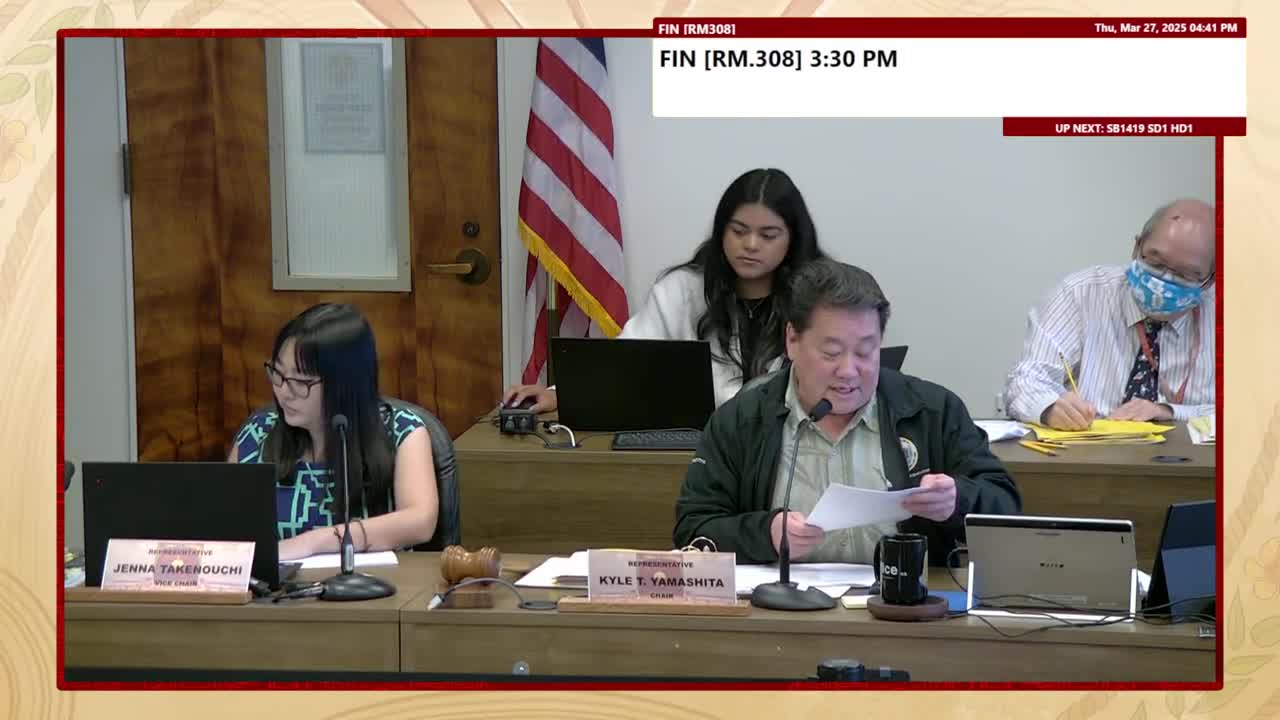 2MIN
House Standing Committee on Finance
 13MIN
House Standing Committee on Judiciary & Hawaiian Affairs
 33SEC
Senate Floor
 6MIN
Senate Standing Committee on Judiciary
1MIN
Senate Standing Committee on Judiciary
Bill Author
Bill Co-Author(s):