HB 563: UH; Institute for Astronomy; Space Sciences and Engineering Initiative; Workforce Development Program; Maunakea Scholars Program; Internship Program; Equipment and Supplies; Stipends; Positions; Appropriations
- Session Year: 2025-2026
- House: House
- Latest Version Date: 2025-03-18
Current Status:
Failed
(2026-04-17: Re-Referred to EDU, WAM.)
Introduced
In Committee
First Chamber
In Committee
Second Chamber
Final Decking
Enacted
Appropriates funds for salaries and fringe benefits of positions for the University of Hawaii Institute for Astronomy's Space Science and Engineering Initiative Workforce Development Program, Maunakea Scholars Program, and Internship Program. Appropriates funds for office equipment and supplies, operational costs, and stipends for high school and college students. Effective 7/31/2050. (SD1)
Appropriates funds for salaries and fringe benefits of positions for the University of Hawaii Institute for Astronomy's Space Science and Engineering Initiative Workforce Development Program, Maunakea Scholars Program, and Internship Program. Appropriates funds for office equipment and supplies, operational costs, and stipends for the Maunakea Scholars Program and Internship Program. Effective 7/1/3000. (HD1)
Appropriates funds for salaries and fringe benefits of positions for the University of Hawaii Institute for Astronomy's Space Science and Engineering Initiative Workforce Development Program, Maunakea Scholars Program, and Internship Program. Appropriates funds for office equipment and supplies, operational costs, and stipends for the Maunakea Scholars Program and Internship Program.
|
HOUSE OF REPRESENTATIVES |
H.B. NO. |
563 |
|
THIRTY-THIRD LEGISLATURE, 2025 |
H.D. 1 |
|
|
STATE OF HAWAII |
S.D. 1 |
|
|
|
|
|
|
|
||
|
|
||
A BILL FOR AN ACT
RELATING TO THE UNIVERSITY OF HAWAII'S SPACE SCIENCE AND ENGINEERING INITIATIVE.
BE IT ENACTED BY THE LEGISLATURE OF THE STATE OF HAWAII:
SECTION 1. The legislature finds that there is a need in the State for long-term science, technology, engineering, and mathematics (STEM) workforce development programs to foster a sustainable and economically diverse base for advanced-technology-sector companies, particularly on the neighbor islands. Supporting such industries in the State will stimulate economic growth and ensure that Hawaii's youth are able to remain in Hawaii to pursue long-term, stable career paths in these high-need areas.
The legislature further finds that the university of Hawaii is uniquely situated to create viable STEM career pathways through its network of campuses and engagements with the K-12 educational system. The demand for more formal educational, research, and career opportunities in space sciences and engineering fields continues to grow, especially with renewed federal and international interest in expanded space exploration. However, less than fifteen per cent of engineering schools nationwide have focused or dedicated aerospace or related programs directly supporting these career paths.
The legislature also finds that increased space mission and monitoring activities in Hawaii as well as the existing ground-based observatory facilities on Maunakea and Haleakala are appropriate platforms for instrumentation and detector technology development, facility innovation, and operational upgrade and advancement investigations and could thus expand employment opportunities for Hawaii's local high-tech workforce. In addition, a new facility dedicated to engineering education and the development and fabrication of astronomical instruments is in the design phase via funds previously provided by the legislature. This new building on the university of Hawaii at Hilo campus adjacent to the institute for astronomy building would increase the instructional and educational offerings to Hawaii's students by providing student internships, undergraduate research opportunities, and exposure to engineering careers in astronomy and other fields.
In addition, the legislature finds that the university of Hawaii's new space sciences and engineering initiative is recruiting an initial cohort of dedicated engineering faculty within the college of engineering through recent appropriations from the legislature. These new faculty will be located at the university of Hawaii's Manoa campus and the institute for astronomy's facility on the university of Hawaii at Hilo campus. This engineering cohort will focus on teaching, research, and engineering applied to astronomy, aerospace, and advanced technologies, offering for the first time an engineering degree pathway for university of Hawaii at Hilo students. A cornerstone of the program is integrating this team with high‑tech development and instrumentation at the observatories on Maunakea and Haleakala, which combined have facilities worth over $1 billion and regularly sustain research, education, and technology development advancements.
Furthermore, the legislature recognizes that these globally significant investments in Hawaii, which together generate more than $200 million in annual economic impact statewide, can serve as the basis for a workforce development program that substantially deepens the long-term benefits of these investments for local students, businesses, and communities. The most cost-effective approach to creating such a workforce development program is to expand upon programs that have demonstrated success; integrate them into a continuum of support from kindergarten to careers; and link students to a multitude of educational hands-on learning opportunities and, ultimately, employers. The building blocks for such a program are substantially in place, but additional resources are needed to integrate and expand them, providing a robust, globally unique, end-to-end STEM workforce development program.
The legislature additionally finds that premier examples of programs that serve as vital tracks at the high school and undergraduate levels for the proposed next-generation workforce development program include the Maunakea scholars program and the new Maunakea observatories internship program. The Maunakea scholars program is made possible through a partnership between the department of education, university of Hawaii, and Maunakea Observatories. The program started as a pilot program in 2016 involving students at both Kapolei and Waiakea high schools, and over one thousand two hundred students have since participated in the program in schools on Oahu, Lanai, Molokai, Maui, and Hawaii island. This program, the first and only one of its kind in the world, pairs high school students with mentors, predominantly graduate students at the university of Hawaii institute for astronomy, to help the students design and execute their own research projects utilizing all of the observatories on Maunakea and several observatories on Haleakala. This program focuses on rural public schools, working with students at a wide range of academic levels, from credit recovery to advanced placement research. The program is designed to empower students to envision themselves as individuals who can engage in a variety of STEM professions, including astronomy, engineering, computer science, data analytics, and systems design.
The legislature further notes that through mentoring and collaboration, numerous Maunakea scholars have gone on to pursue STEM degrees, including astronomy degrees at the university of Hawaii at Manoa and university of Hawaii at Hilo, and employment in the astronomy, education, and engineering fields. Spin-off programs include the new Waipahu high school observatory, the only professional-grade high school observatory in the State. The program involves ten public high schools and is already at capacity given currently available resources. Expanding the program to all public high schools and including additional disciplines, such as engineering, is viable but will require additional staff and resources.
The legislature believes that integrating distinct programs, such as those developed by the institute for astronomy and the college of engineering, to provide career pathway continuity into jobs for local students is central to the envisioned workforce development program. Persistent mentoring to help bridge the historic gaps between education and employment tracks for local students, leading them to fulfilling, long-term careers, is the holistic approach that is needed.
Moreover, the legislature finds that at the nexus of so many workforce development components, the institute for astronomy is the logical place to host a next-generation workforce development program that connects local students with hands-on STEM training and careers. Coordinating all of this activity and sustained funding to cover operational costs will be essential to leveraging investments in place now and enabling the kindergarten-to-career approach needed, which is intended to grow the pool of Hawaiiꞌs workforce, not only in space sciences but in the engineering field as a whole.
Therefore, the purpose of this Act is to appropriate funds to the university of Hawaii institute for astronomy, in collaboration with the college of engineering, to support the university of Hawaiiꞌs space science and engineering initiative.
SECTION 2. There is appropriated out of the general revenues of the State of Hawaii the sum of $ or so much thereof as may be necessary for fiscal year 2025-2026 and the same sum or so much thereof as may be necessary for fiscal year 2026-2027 to provide salaries, office supplies, stipends and other operational expenses for the university of Hawaii institute for astronomy, to be allocated as follows:
(1) $ for salaries and fringe benefits for the following positions:
(A) full-time equivalent ( FTE) university of Hawaii space science and engineering initiative workforce development program manager;
(B) full-time equivalent ( FTE) Maunakea scholars program coordinator; and
(C) full-time equivalent ( FTE) administrative clerk for the university of Hawaii space science and engineering initiative workforce development program; and
(2) $ for office equipment and supplies, operational costs, and internship stipends for high school and college students.
The sums appropriated shall be expended by the university of Hawaii for the purposes of this Act.
SECTION 3. This Act shall take effect on July 31, 2050.
Report Title:
UH; Institute for Astronomy; Space Sciences and Engineering Initiative; Workforce Development Program; Maunakea Scholars Program; Internship Program; Equipment and Supplies; Stipends; Positions; Appropriations
Description:
Appropriates funds for salaries and fringe benefits of positions for the University of Hawaii Institute for Astronomy's Space Science and Engineering Initiative Workforce Development Program, Maunakea Scholars Program, and Internship Program. Appropriates funds for office equipment and supplies, operational costs, and stipends for high school and college students. Effective 7/31/2050. (SD1)
The summary description of legislation appearing on this page is for informational purposes only and is not legislation or evidence of legislative intent.
|
HOUSE OF REPRESENTATIVES |
H.B. NO. |
563 |
|
THIRTY-THIRD LEGISLATURE, 2025 |
H.D. 1 |
|
|
STATE OF HAWAII |
|
|
|
|
|
|
|
|
||
|
|
||
A BILL FOR AN ACT
RELATING TO THE UNIVERSITY OF HAWAII'S SPACE SCIENCE AND ENGINEERING INITIATIVE.
BE IT ENACTED BY THE LEGISLATURE OF THE STATE OF HAWAII:
SECTION 1. The legislature finds that there is a need in the State for long-term science, technology, engineering, and mathematics (STEM) workforce development programs to foster a sustainable and economically diverse base for advanced-technology-sector companies, particularly on the neighbor islands. Supporting such industries in the State will stimulate economic growth and ensure that Hawaii's youth are able to remain in Hawaii to pursue long-term, stable career paths in these high-need areas.
The legislature further finds that the university of Hawaii is uniquely situated to create viable STEM career pathways through its network of campuses and engagements with the K-12 educational system. The demand for more formal educational, research, and career opportunities in space sciences and engineering fields continues to grow, especially with renewed federal and international interest in expanded space exploration. However, less than fifteen per cent of engineering schools nationwide have focused or dedicated aerospace or related programs directly supporting these career paths.
The legislature also finds that increased space mission and monitoring activities in Hawaii as well as the existing ground-based observatory facilities on Maunakea and Haleakala are appropriate platforms for instrumentation and detector technology development, facility innovation, and operational upgrade and advancement investigations and could thus expand employment opportunities for Hawaii's local high-tech workforce. In addition, a new facility dedicated to engineering education and the development and fabrication of astronomical instruments is in the design phase via funds previously provided by the legislature. This new building on the university of Hawaii at Hilo campus adjacent to the institute for astronomy building would increase the instructional and educational offerings to Hawaii's students by providing student internships, undergraduate research opportunities, and exposure to engineering careers in astronomy and other fields.
In addition, the legislature finds that the university of Hawaii's new space sciences and engineering initiative is recruiting an initial cohort of dedicated engineering faculty within the college of engineering through recent appropriations from the legislature. These new faculty will be located at the university of Hawaii's Manoa campus and the institute for astronomy's facility on the university of Hawaii at Hilo campus. This engineering cohort will focus on teaching, research, and engineering applied to astronomy, aerospace, and advanced technologies, offering for the first time an engineering degree pathway for university of Hawaii at Hilo students. A cornerstone of the program is integrating this team with high‑tech development and instrumentation at the observatories on Maunakea and Haleakala, which combined have facilities worth over $1,000,000,000 and regularly sustain research, education, and technology development advancements.
Furthermore, the legislature recognizes that these globally significant investments in Hawaii, which together generate more than $200,000,000 in annual economic impact statewide, can serve as the basis for a workforce development program that substantially deepens the long-term benefits of these investments for local students, businesses, and communities. The most cost-effective approach to creating such a workforce development program is to expand upon programs that have demonstrated success; integrate them into a continuum of support from kindergarten to careers; and link students to a multitude of educational hands-on learning opportunities and, ultimately, employers. The building blocks for such a program are substantially in place, but additional resources are needed to integrate and expand them, providing a robust, globally unique, end-to-end STEM workforce development program.
The legislature additionally finds that premier examples of programs that serve as vital tracks at the high school and undergraduate levels for the proposed next-generation workforce development program include the Maunakea scholars program and the new Maunakea observatories internship program. The Maunakea scholars program is made possible through a partnership between the department of education, university of Hawaii, and Maunakea Observatories. The program started as a pilot program in 2016 involving students at both Kapolei and Waiakea high schools, and over 1,200 students have since participated in the program in schools on Oahu, Lanai, Molokai, Maui, and Hawaii island. This program, the first and only one of its kind in the world, pairs high school students with mentors, predominantly graduate students at the university of Hawaii institute for astronomy, to help the students design and execute their own research projects utilizing all of the observatories on Maunakea and several observatories on Haleakala. This program focuses on rural public schools, working with students at a wide range of academic levels, from credit recovery to advanced placement research. The program is designed to empower students to envision themselves as individuals who can engage in a variety of STEM professions, including astronomy, engineering, computer science, data analytics, and systems design.
The legislature further notes that through mentoring and collaboration, numerous Maunakea scholars have gone on to pursue STEM degrees, including astronomy degrees at the university of Hawaii at Manoa and university of Hawaii at Hilo, and employment in the astronomy, education, and engineering fields. Spin-off programs include the new Waipahu high school observatory, the only professional-grade high school observatory in the State. The program involves ten public high schools and is already at capacity given currently available resources. Expanding the program to all public high schools and including additional disciplines, such as engineering, is viable but will require additional staff and resources.
The legislature believes that integrating distinct programs, such as those developed by the institute for astronomy and the college of engineering, to provide career pathway continuity into jobs for local students is central to the envisioned workforce development program. Persistent mentoring to help bridge the historic gaps between education and employment tracks for local students, leading them to fulfilling, long-term careers, is the holistic approach that is needed.
Moreover, the legislature finds that at the nexus of so many workforce development components, the institute for astronomy is the logical place to host a next-generation workforce development program that connects local students with hands-on STEM training and careers. Coordinating all of this activity and sustained funding to cover operational costs will be essential to leveraging investments in place now and enabling the kindergarten-to-career approach needed, which is intended to grow the pool of Hawaiiꞌs workforce, not only in space sciences but in the engineering field as a whole.
Therefore, the purpose of this Act is to appropriate funds to the institute for astronomy, in collaboration with the college of engineering, to support the university of Hawaiiꞌs space science and engineering initiative.
SECTION 2. There is appropriated out of the general revenues of the State of Hawaii the sum of $ or so much thereof as may be necessary for fiscal year 2025-2026 and the same sum or so much thereof as may be necessary for fiscal year 2026-2027 to provide salaries, office supplies, stipends and other operational expenses for these programs for the university of Hawaii at Manoa institute for astronomy, to be allocated as follows:
(1) $ for salaries and fringe benefits for the following positions:
(A) full-time equivalent ( FTE) university of Hawaii space science and engineering initiative workforce development program manager;
(B) full-time equivalent ( FTE) Maunakea scholars program coordinator; and
(C) full-time equivalent ( FTE) administrative clerk for the university of Hawaii space science and engineering initiative workforce development program; and
(2) $ for office equipment and supplies, operational costs, and internship stipends for high school and college students.
The sums appropriated shall be expended by the university of Hawaii for the purposes of this Act.
SECTION 3. This Act shall take effect on July 1, 3000.
Report Title:
University of Hawaii; Space Sciences Workforce Development Program; Maunakea Scholars Program; Internship Program; Equipment and Supplies; Stipends; Positions; Appropriation
Description:
Appropriates funds for salaries and fringe benefits of positions for the University of Hawaii Institute for Astronomy's Space Science and Engineering Initiative Workforce Development Program, Maunakea Scholars Program, and Internship Program. Appropriates funds for office equipment and supplies, operational costs, and stipends for the Maunakea Scholars Program and Internship Program. Effective 7/1/3000. (HD1)
The summary description of legislation appearing on this page is for informational purposes only and is not legislation or evidence of legislative intent.
|
HOUSE OF REPRESENTATIVES |
H.B. NO. |
563 |
|
THIRTY-THIRD LEGISLATURE, 2025 |
|
|
|
STATE OF HAWAII |
|
|
|
|
|
|
|
|
||
|
|
||
A BILL FOR AN ACT
RELATING TO THE UNIVERSITY OF HAWAII's SPACE SCIENCE AND ENGINEERING INITIATIVE.
BE IT ENACTED BY THE LEGISLATURE OF THE STATE OF HAWAII:
SECTION 1. The legislature finds that there is a need in the State for long-term science, technology, engineering, and mathematics (STEM) workforce development programs to foster a sustainable and economically diverse base for advanced-technology-sector companies, particularly on the neighbor islands. Supporting such industries in the State will stimulate economic growth and ensure that Hawaii's youth are able to remain in Hawaii to pursue long-term, stable career paths in these high-need areas.
The legislature further finds that the university of Hawaii is uniquely situated to create viable STEM career pathways through its network of campuses and engagements with the K-12 educational system. The demand for more formal educational, research, and career opportunities in space sciences and engineering fields continues to grow, especially with renewed federal and international interest in expanded space exploration. However, less than fifteen per cent of engineering schools nationwide have focused or dedicated aerospace or related programs directly supporting these career paths.
The legislature also finds that increased space mission and monitoring activities in Hawaii as well as the existing ground-based observatory facilities on Maunakea and Haleakala are appropriate platforms for instrumentation and detector technology development, facility innovation, and operational upgrade and advancement investigations and could thus expand employment opportunities for Hawaii's local high-tech workforce. In addition, a new facility dedicated to engineering education and the development and fabrication of astronomical instruments is in the design phase via funds previously provided by the legislature. This new building on the university of Hawaii at Hilo campus adjacent to the institute for astronomy building would increase the instructional and educational offerings to Hawaii's students by providing student internships, undergraduate research opportunities, and exposure to engineering careers in astronomy and other fields.
In addition, the legislature finds that the university of Hawaii's new space sciences and engineering initiative (SSEI) is recruiting an initial cohort of dedicated engineering faculty within the college of engineering through recent appropriations from the legislature. These new faculty will be located at the university of Hawaii's Manoa campus and the institute for astronomy's facility on the university of Hawaii at Hilo campus. This engineering cohort will focus on teaching, research, and engineering applied to astronomy, aerospace, and advanced technologies, offering for the first time an engineering degree pathway for university of Hawaii at Hilo students. A cornerstone of the program is integrating this team with high‑tech development and instrumentation at the observatories on Maunakea and Haleakala, which combined have facilities worth over $1,000,000,000 and regularly sustain research, education, and technology development advancements.
Furthermore, the legislature recognizes that these globally significant investments in Hawaii, which together generate more than $200,000,000 in annual economic impact statewide, can serve as the basis for a workforce development program that substantially deepens the long-term benefits of these investments for local students, businesses, and communities. The most cost-effective approach to creating such a workforce development program is to expand upon programs that have demonstrated success; integrate them into a continuum of support from kindergarten to careers; and link students to a multitude of educational hands-on learning opportunities and, ultimately, employers. The building blocks for such a program are substantially in place, but additional resources are needed to integrate and expand them, providing a robust, globally unique, end-to-end STEM workforce development program.
The legislature additionally finds that premier examples of programs that serve as vital tracks at the high school and undergraduate levels for the proposed next-generation workforce development program include the Maunakea scholars program and the new Maunakea observatories internship program. The Maunakea scholars program is made possible through a partnership between the department of education, university of Hawaii, and Maunakea Observatories. The program started as a pilot program in 2016 involving students at both Kapolei and Waiakea high schools, and over 1,200 students have since participated in the program in schools on Oahu, Lanai, Molokai, Maui, and Hawaii island. This program, the first and only one of its kind in the world, pairs high school students with mentors, predominantly graduate students at the university of Hawaii institute for astronomy, to help the students design and execute their own research projects utilizing all of the observatories on Maunakea and several observatories on Haleakala. This program focuses on rural public schools, working with students at a wide range of academic levels, from credit recovery to advanced placement research. The program is designed to empower students to envision themselves as individuals who can engage in a variety of STEM professions, including astronomy, engineering, computer science, data analytics, and systems design.
The legislature further notes that through mentoring and collaboration, numerous Maunakea scholars have gone on to pursue STEM degrees, including astronomy degrees at the university of Hawaii at Manoa and university of Hawaii at Hilo, and employment in the astronomy, education, and engineering fields. Spin-off programs include the new Waipahu high school observatory, the only professional-grade high school observatory in the State. The program involves ten public high schools and is already at capacity given currently available resources. Expanding the program to all public high schools and including additional disciplines, such as engineering, is viable but will require additional staff and resources.
The legislature believes that integrating distinct programs, such as those developed by the institute for astronomy and the college of engineering, to provide career pathway continuity into jobs for local students is central to the envisioned workforce development program. Persistent mentoring to help bridge the historic gaps between education and employment tracks for local students, leading them to fulfilling, long-term careers, is the holistic approach that is needed.
Moreover, the legislature finds that at the nexus of so many workforce development components, the institute for astronomy is the logical place to host a next-generation workforce development program that connects local students with hands-on STEM training and careers. Coordinating all of this activity and sustained funding to cover operational costs will be essential to leveraging investments in place now and enabling the kindergarten-to-career approach needed, which is intended to grow the pool of Hawaiiꞌs workforce, not only in space sciences but in the engineering field as a whole.
Therefore, the purpose of this Act is to appropriate funds to the institute for astronomy, in collaboration with the college of engineering, to support the university of Hawaiiꞌs space science and engineering initiative.
SECTION 2. There is appropriated out of the general revenues of the State of Hawaii the sum of $650,000 or so much thereof as may be necessary for fiscal year 2025-2026 and the same sum or so much thereof as may be necessary for fiscal year 2026-2027 to provide salaries, office supplies, stipends and other operational expenses for these programs for the university of Hawaii at Manoa institute for astronomy, to be allocated as follows:
(1) $400,000 for salaries and fringe benefits for the following positions:
(A) One full-time equivalent (1.0 FTE) university of Hawaii space science and engineering initiative workforce development program manager;
(B) One full-time equivalent (1.0 FTE) Maunakea scholars program coordinator; and
(C) One full-time equivalent (1.0 FTE) administrative clerk for the university of Hawaii space science and engineering initiative workforce development program; and
(2) $250,000 for office equipment and supplies, operational costs, and internship stipends for high school and college students.
The sums appropriated shall be expended by the university of Hawaii for the purposes of this Act.
SECTION 3. This Act shall take effect on July 1, 2025.
|
INTRODUCED BY: |
_____________________________ |
|
|
|
Report Title:
University of Hawaii; Space Sciences Workforce Development Program; Maunakea Scholars Program; Internship Program; Equipment and Supplies; Stipends; Positions; Appropriation
Description:
Appropriates funds for salaries and fringe benefits of positions for the University of Hawaii Institute for Astronomy's Space Science and Engineering Initiative Workforce Development Program, Maunakea Scholars Program, and Internship Program. Appropriates funds for office equipment and supplies, operational costs, and stipends for the Maunakea Scholars Program and Internship Program.
The summary description of legislation appearing on this page is for informational purposes only and is not legislation or evidence of legislative intent.
|
Date
|
Status
|
|---|---|
| Apr 17, 2026 | Re-Referred to EDU, WAM. |
| Apr 2, 2026 | Received notice of the discharge of all House Conferees (Hse. Com. No. 457). |
| Apr 1, 2026 | House Conferee(s) discharged. |
| Mar 20, 2026 | Received notice of all Senate conferees being discharged (Sen. Com. No. 409). |
| Mar 20, 2026 | Senate Conferee(s) discharged. |
| Dec 8, 2025 | Carried over to 2026 Regular Session. |
| Apr 24, 2025 | Conference committee meeting to reconvene on 04-25-25 3:05PM; Conference Room 229. |
| Apr 23, 2025 | Bill scheduled for Conference Committee Meeting on Thursday, 04-24-25 1:45PM in conference room 229. |
| Apr 22, 2025 | Received notice of Senate conferees (Sen. Com. No. 862). |
| Apr 22, 2025 | Senate Conferees Appointed: Kim Chair; Kanuha Co-Chair; Fevella. |
| Apr 15, 2025 | Received notice of appointment of House conferees (Hse. Com. No. 732). |
| Apr 14, 2025 | House Conferees Appointed: Garrett, Holt Co-Chairs; Keohokapu-Lee Loy, Kusch, Souza. |
| Apr 11, 2025 | Received notice of disagreement (Hse. Com. No. 704). |
| Apr 10, 2025 | House disagrees with Senate amendment (s). |
| Apr 8, 2025 | Returned from Senate (Sen. Com. No. 655) in amended form (SD 1). |
| Apr 8, 2025 | Report adopted; Passed Third Reading. Ayes, 25; Aye(s) with reservations: none . Noes, 0 (none). Excused, 0 (none). Transmitted to House. |
| Apr 4, 2025 | One Day Notice 04-08-25. |
| Apr 4, 2025 | Reported from WAM (Stand. Com. Rep. No. 1769) with recommendation of passage on Third Reading. |
| Apr 2, 2025 | The committee(s) on WAM recommend(s) that the measure be PASSED, UNAMENDED. The votes in WAM were as follows: 13 Aye(s): Senator(s) Dela Cruz, Moriwaki, Aquino, DeCoite, Elefante, Hashimoto, Inouye, Kanuha, Kidani, Kim, Lee, C., Wakai, Fevella; Aye(s) with reservations: none ; 0 No(es): none; and 0 Excused: none. |
| Mar 31, 2025 | The committee on WAM has added the measure to decision making scheduled on 04-02-25 10:01AM; CR 211 & Videoconference. |
| Mar 18, 2025 | Report adopted; Passed Second Reading, as amended (SD 1) and referred to WAM. |
| Mar 18, 2025 | Reported from HRE (Stand. Com. Rep. No. 1133) with recommendation of passage on Second Reading, as amended (SD 1) and referral to WAM. |
| Mar 13, 2025 | The committee(s) on HRE recommend(s) that the measure be PASSED, WITH AMENDMENTS. The votes in HRE were as follows: 3 Aye(s): Senator(s) Kim, Kidani, Hashimoto; Aye(s) with reservations: none ; 0 No(es): none; and 2 Excused: Senator(s) Fukunaga, Fevella. |
| Mar 10, 2025 | The committee(s) on HRE has scheduled a public hearing on 03-13-25 3:05PM; Conference Room 229 & Videoconference. |
| Mar 6, 2025 | Referred to HRE, WAM. |
| Mar 6, 2025 | Passed First Reading. |
| Mar 6, 2025 | Received from House (Hse. Com. No. 257). |
| Mar 4, 2025 | Passed Third Reading with none voting aye with reservations; Representative(s) Perruso voting no (1) and Representative(s) Pierick, Ward excused (2). Transmitted to Senate. |
| Feb 28, 2025 | Reported from FIN (Stand. Com. Rep. No. 1103), recommending passage on Third Reading. |
| Feb 26, 2025 | The committee on FIN recommend that the measure be PASSED, UNAMENDED. The votes were as follows: 15 Ayes: Representative(s) Yamashita, Takenouchi, Grandinetti, Holt, Hussey, Keohokapu-Lee Loy, Kitagawa, Kusch, Lamosao, Lee, M., Miyake, Morikawa, Templo, Alcos, Reyes Oda; Ayes with reservations: none; Noes: none; and 1 Excused: Representative(s) Ward. |
| Feb 26, 2025 | Bill scheduled for decision making on Wednesday, 02-26-25 11:00AM in conference room 308 VIA VIDEOCONFERENCE. |
| Feb 25, 2025 | The committee(s) on FIN recommend(s) that the measure be deferred until 02-26-25. |
| Feb 21, 2025 | Bill scheduled to be heard by FIN on Tuesday, 02-25-25 2:00PM in House conference room 308 VIA VIDEOCONFERENCE. |
| Feb 11, 2025 | Passed Second Reading as amended in HD 1 and referred to the committee(s) on FIN with none voting aye with reservations; Representative(s) Pierick voting no (1) and Representative(s) Cochran, Ward excused (2). |
| Feb 11, 2025 | Reported from HED (Stand. Com. Rep. No. 401) as amended in HD 1, recommending passage on Second Reading and referral to FIN. |
| Feb 5, 2025 | The committee on HED recommend that the measure be PASSED, WITH AMENDMENTS. The votes were as follows: 11 Ayes: Representative(s) Garrett, Amato, Evslin, Kapela, Kila, La Chica, Olds, Sayama, Woodson, Muraoka, Souza; Ayes with reservations: none; 0 Noes: none; and 0 Excused: none. |
| Jan 31, 2025 | Bill scheduled to be heard by HED on Wednesday, 02-05-25 2:00PM in House conference room 309 VIA VIDEOCONFERENCE. |
| Jan 21, 2025 | Referred to HED, FIN, referral sheet 2 |
| Jan 21, 2025 | Introduced and Pass First Reading. |
| Jan 17, 2025 | Pending introduction. |
|
Date
|
Description
|
Location
|
Votes
|
|
|---|---|---|---|---|
| Apr 8, 2025 | Third Reading | Senate Floor |
Passed |
|
| Apr 2, 2025 | The committee(s) on WAM recommend(s) that the measure be PASSED, UNAMENDED | Senate Standing Committee on Ways and Means |
Passed |
|
| Mar 13, 2025 | The committee(s) on HRE recommend(s) that the measure be PASSED, WITH AMENDMENTS | Senate Standing Committee on Higher Education |
Passed |
|
| Mar 4, 2025 | Third Reading | House Floor |
Passed |
|
| Feb 26, 2025 | The committee on FIN recommend that the measure be PASSED, UNAMENDED | House Standing Committee on Finance |
Passed |
|
| Feb 5, 2025 | The committee on HED recommend that the measure be PASSED, WITH AMENDMENTS | House Standing Committee on Higher Education |
Passed |
This list shows positions taken on this bill by organizations on the date displayed, which is linked to the original source.
Positions by individuals are not included.
|
Organization
|
Position
|
Date
|
|---|---|---|
| Chamber of Commerce Hawaii | ** Support | |
| College of Engineering | *** Support | Apr 2, 2025 |
| College of Engineering (University of Hawaiʻi) | *** Support | Mar 13, 2025 |
| County of Hawaiʻi Department of Research and Development | *** Support | Apr 2, 2025 |
| Department of Research and Development of the County of Hawaii | ** Support | |
| Department of Research and Development of the County of Hawaiʻi | ** Support | |
| Department of Research and Development of the County of Hawaiʻi | ** Support | |
| Hawaii International Science Experience | *** Support | Apr 2, 2025 |
| Hawaii Technology Development Corporation | ** Support | |
| Hawaiʻi Island Chamber of Commerce | ** Support | |
| Hawai‘i Island Chamber of Commerce | *** Support | Apr 2, 2025 |
| Honokaʻa High and Intermediate | *** Support | Feb 5, 2025 |
| Independent / Ahupua‘a ‘o ‘O‘oma (resident) | *** Support | Mar 13, 2025 |
| Institute for Astronomy | *** Support | Apr 2, 2025 |
| Institute for Astronomy (University of Hawaiʻi) | *** Support | Mar 13, 2025 |
| Japanese Chamber of Commerce & Industry of Hawaii | *** Support | Apr 2, 2025 |
| Kealakehe High School | *** Support | Apr 2, 2025 |
| Kona-Kohala Chamber of Commerce | *** Support | Apr 2, 2025 |
| Maunakea Scholars | ** Support | |
| Maunakea Observatories | ** Support | |
| Maunakea Observatories | *** Support | Apr 2, 2025 |
| Maunakea Scholars | *** Support | Apr 2, 2025 |
| Molokai High School | *** Support | Apr 2, 2025 |
| NexTech Hawaii | *** Support | Apr 2, 2025 |
| Rotary Club of Hilo (RYLA involvement) | *** Support | Mar 13, 2025 |
| RYLA (Rotary Youth Leadership Awards, The Rotary Club of Hilo) | *** Support | Apr 2, 2025 |
| Tamimi Engineering (licensed professional engineer) | *** Support | Mar 13, 2025 |
| The Maunakea Observatories | *** Support | Feb 5, 2025 |
| The Success Factory - NexTech Hawaiʻi | ** Support | |
| University of Hawaiʻi at Manoa | *** Support | Apr 2, 2025 |
| University of Hawaiʻi System | *** Support | Apr 2, 2025 |
| Waipahu High School | *** Support | Mar 13, 2025 |
STAND. COM. REP. NO. 1769
Honolulu, Hawaii
RE: H.B. No. 563
H.D. 1
S.D. 1
Honorable Ronald D. Kouchi
President of the Senate
Thirty-Third State Legislature
Regular Session of 2025
State of Hawaii
Sir:
Your Committee on Ways and Means, to which was referred H.B. No. 563, H.D. 1, S.D. 1, entitled:
"A BILL FOR AN ACT RELATING TO THE UNIVERSITY OF HAWAII'S SPACE SCIENCE AND ENGINEERING INITIATIVE,"
begs leave to report as follows:
The purpose and intent of this measure is to appropriate moneys for the University of Hawaii Institute for Astronomy to fund workforce development under the Space Sciences and Engineering Initiative.
Your Committee received written comments in support of this measure from the University of Hawaii System; County of Hawaii, Department of Research and Development; Maunakea Observatories; Hawaii Island Chamber of Commerce; Japanese Chamber of Commerce and Industry of Hawaii; Kona-Kohala Chamber of Commerce; Molokai High School; NexTech Hawaii; and twelve individuals.
Your Committee finds that workforce development under the Space Sciences and Engineering Initiative will help to increase opportunities for Hawaii youth to enter into high-paying science, technology, engineering, and math careers in the State.
As affirmed by the record of votes of the members of your Committee on Ways and Means that is attached to this report, your Committee is in accord with the intent and purpose of H.B. No. 563, H.D. 1, S.D. 1, and recommends that it pass Third Reading.
Respectfully submitted on behalf of the members of the Committee on Ways and Means,
|
|
|
________________________________ DONOVAN M. DELA CRUZ, Chair |
|
|
|
|
STAND. COM. REP. NO. 1133
Honolulu, Hawaii
RE: H.B. No. 563
H.D. 1
S.D. 1
Honorable Ronald D. Kouchi
President of the Senate
Thirty-Third State Legislature
Regular Session of 2025
State of Hawaii
Sir:
Your Committee on Higher Education, to which was referred H.B. No. 563, H.D. 1, entitled:
"A BILL FOR AN ACT RELATING TO THE UNIVERSITY OF HAWAII'S SPACE SCIENCE AND ENGINEERING INITIATIVE,"
begs leave to report as follows:
The purpose and intent of this measure is to appropriate funds to the Institute of Astronomy, in collaboration with the College of Engineering, to support the University of Hawaii's Space Sciences and Engineering Initiative.
Your Committee received testimony in support of this measure from the University of Hawaiʻi System, Department of Research and Development of the County of Hawaii, Hawaiʻi Island Chamber of Commerce, NexTech Hawaii, Kona-Kohala Chamber of Commerce, Chamber of Commerce Hawaii, and fourteen individuals.
Your Committee finds that there is an opportunity for the State to foster a diverse and sustainable advanced-technology sector of the State's economy. Your Committee further finds that investment in the University of Hawaii's Space Sciences and Engineering Initiative will yield a dedicated workforce development program designed to engage with local schools, engineering firms, teachers, and community organizations that will produce long-term benefits for the State and its communities. Your Committee also finds that a dedicated workforce development program that takes a K-career approach will establish a bridge between students and STEM jobs. This measure will enable a workforce development program under the University of Hawaii Space Sciences and Engineering Initiative as a long-term investment in STEM education and workforce development for the State.
Your Committee notes that while the University of Hawaii's Space Sciences and Engineering Initiative has succeeded in establishing a two-year pre-engineering program at the University of Hawaii at Hilo, it has not yet established a four-year engineering degree program. Your Committee further notes that the Legislature invested in the Space Sciences and Engineering Initiative with the expectation that it would culminate in a four-year engineering degree program at the University of Hawaii at Hilo. Your Committee also notes that a four-year engineering degree program at the University of Hawaii at Hilo would allow prospective engineering students from Hawaiʻi Island to remain close to home while completing their studies and strengthen Hawaiʻi Island's STEM workforce. Therefore, your Committee believes that the University of Hawaii at Hilo should prioritize the development and establishment of a four-year engineering degree program.
Your Committee has amended this measure by:
(1) Inserting an effective date of July 31, 2050, to encourage further discussion; and
(2) Making technical, nonsubstantive amendments for the purposes of clarity and consistency.
As affirmed by the record of votes of the members of your Committee on Higher Education that is attached to this report, your Committee is in accord with the intent and purpose of H.B. No. 563, H.D. 1, as amended herein, and recommends that it pass Second Reading in the form attached hereto as H.B. No. 563, H.D. 1, S.D. 1, and be referred to your Committee on Ways and Means.
Respectfully submitted on behalf of the members of the Committee on Higher Education,
|
|
|
________________________________ DONNA MERCADO KIM, Chair |
|
|
|
|
STAND. COM. REP. NO. 1103
Honolulu, Hawaii
, 2025
RE: H.B. No. 563
H.D. 1
Honorable Nadine K. Nakamura
Speaker, House of Representatives
Thirty-Third State Legislature
Regular Session of 2025
State of Hawaii
Madame:
Your Committee on Finance, to which was referred H.B. No. 563, H.D. 1, entitled:
"A BILL FOR AN ACT RELATING TO THE UNIVERSITY OF HAWAII'S SPACE SCIENCE AND ENGINEERING INITIATIVE,"
begs leave to report as follows:
Your Committee received testimony in support of this measure from the Hawaii Technology Development Corporation; Department of Research and Development of the County of Hawaiʻi; Hawaiʻi Island Chamber of Commerce; Japanese Chamber of Commerce & Industry of Hawaii; The Success Factory - NexTech Hawaiʻi; Maunakea Observatories; Kona-Kohala Chamber of Commerce; and numerous individuals. Your Committee received comments on this measure from the University of Hawaiʻi System.
As affirmed by the record of votes of the members of your Committee on Finance that is attached to this report, your Committee is in accord with the intent and purpose of H.B. No. 563, H.D. 1, and recommends that it pass Third Reading.
Respectfully submitted on behalf of the members of the Committee on Finance,
|
|
|
____________________________ KYLE T. YAMASHITA, Chair |
|
|
|
|
STAND. COM. REP. NO. 401
Honolulu, Hawaii
, 2025
RE: H.B. No. 563
H.D. 1
Honorable Nadine K. Nakamura
Speaker, House of Representatives
Thirty-Third State Legislature
Regular Session of 2025
State of Hawaii
Madame:
Your Committee on Higher Education, to which was referred H.B. No. 563 entitled:
"A BILL FOR AN ACT RELATING TO THE UNIVERSITY OF HAWAII'S SPACE SCIENCE AND ENGINEERING INITIATIVE,"
begs leave to report as follows:
Your Committee received testimony in support of this measure from the University of Hawaiʻi System; Department of Research and Development of the County of Hawaiʻi; Hawaiʻi Island Chamber of Commerce; Maunakea Scholars; Kona-Kohala Chamber of Commerce; Maunakea Observatories; and numerous individuals. Your Committee received testimony in opposition to this measure from one individual.
Your Committee finds that there is a need in the State for long-term science, technology, engineering, and mathematics (STEM) workforce development programs to foster a sustainable and economically diverse base for advanced-technology-sector companies. Your Committee further finds that investing funds into the University of Hawaii at Manoa Institute for Astronomy's space science and engineering initiative will grow the pool of Hawaii's workforce in the STEM field and is critical for the continued growth and success of the State's economy and its people.
Your Committee has amended this measure by:
(1) Changing the amounts appropriated and positions to be funded to unspecified amounts;
(2) Changing the effective date to July 1, 3000, to encourage further discussion; and
(3) Making technical, nonsubstantive amendments for the purposes of clarity, consistency, and style.
Your Committee respectfully requests your Committee on Finance, should it deliberate on this measure, to appropriate an amount of $650,000, to be allocated as follows:
(1) $400,000 for salaries and fringe benefits for the following positions:
(A) One full-time equivalent (1.0 FTE) University of Hawaii space science and engineering initiative workforce development program manager;
(B) One full-time equivalent (1.0 FTE) Maunakea Scholars program coordinator; and
(C) One full-time equivalent (1.0 FTE) administrative clerk for the University of Hawaii space science and engineering initiative workforce development program; and
(2) $250,000 for office equipment and supplies, operational costs, and internship stipends for high school and college students.
As affirmed by the record of votes of the members of your Committee on Higher Education that is attached to this report, your Committee is in accord with the intent and purpose of H.B. No. 563, as amended herein, and recommends that it pass Second Reading in the form attached hereto as H.B. No. 563, H.D. 1, and be referred to your Committee on Finance.
Respectfully submitted on behalf of the members of the Committee on Higher Education,
|
|
|
____________________________ ANDREW TAKUYA GARRETT, Chair |
|
|
|
|
|
Date
|
Testimony PDF
|
|---|---|
| Apr 2, 2025 | HB563_SD1_TESTIMONY_WAM_04-02-25_.PDF |
| Mar 13, 2025 | HB563_HD1_TESTIMONY_HRE_03-13-25_.PDF |
| Feb 25, 2025 | HB563_HD1_TESTIMONY_FIN_02-25-25_.PDF |
| Feb 5, 2025 | HB563_TESTIMONY_HED-EDN_02-05-25_.PDF |
Discussed in Hearing
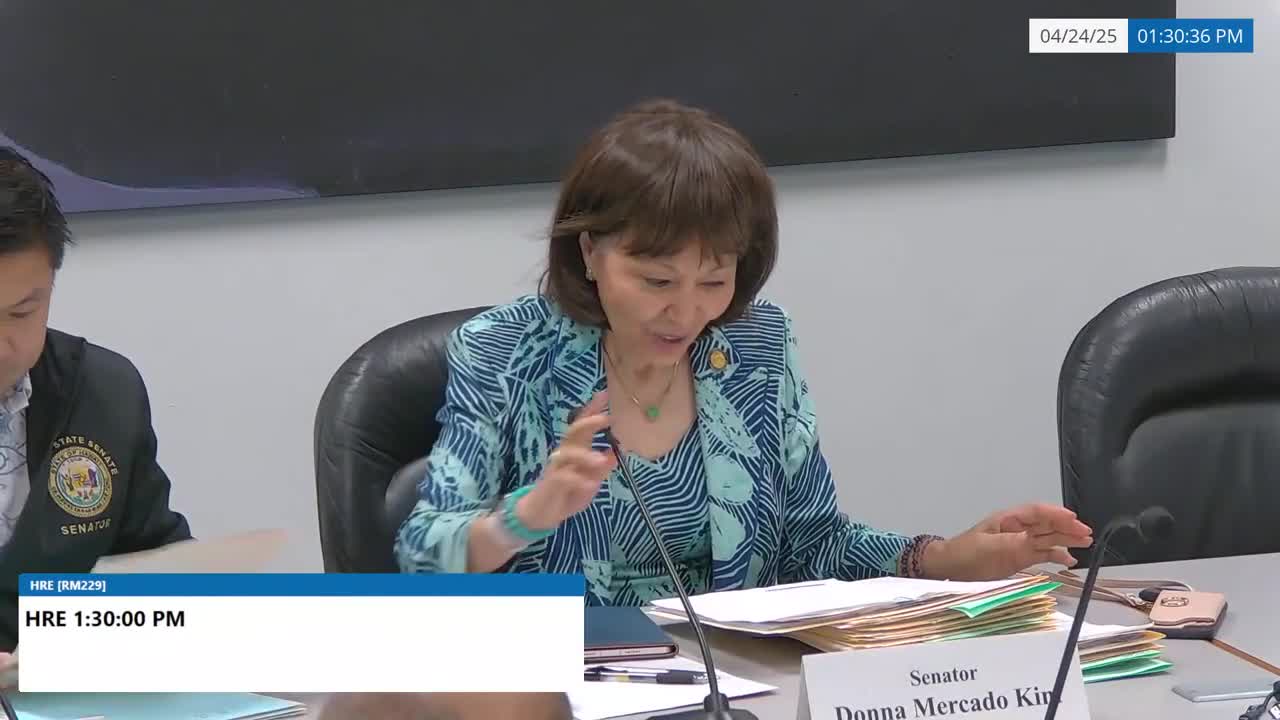 1MIN
Conference Committee
 10MIN
Senate Standing Committee on Higher Education
10MIN
Senate Standing Committee on Economic Development and Tourism
 6MIN
House Standing Committee on Finance
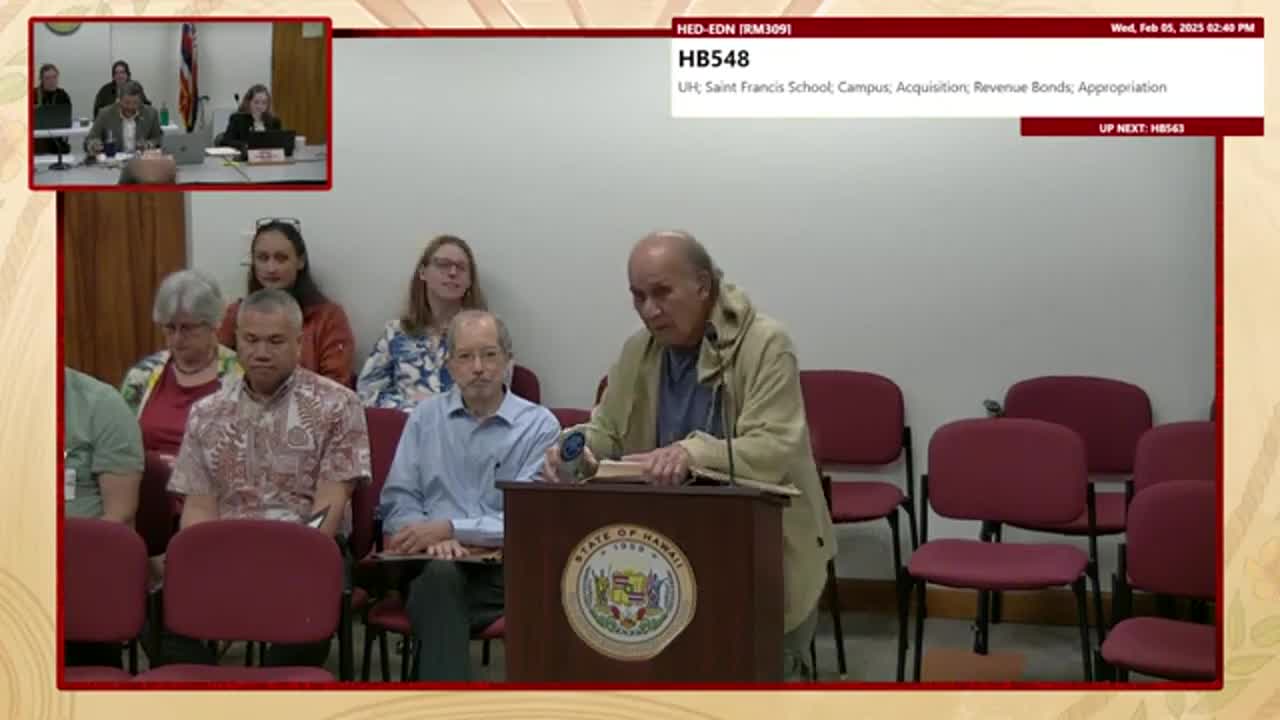 8MIN
House Standing Committee on Education
8MIN
House Standing Committee on Higher Education
Bill Author