HB 2429: DBEDT; Department of Taxation; Taxation; Tax Expenditure Disclosure and Evaluation; Income Tax Credits; General Excise and Related Use Tax Exemptions
- Session Year: 2025-2026
- House: House
- Latest Version Date: 2026-05-01
Current Status:
Passed
(2026-06-26: Act 160, on 06/25/2026 (Gov. Msg. No. 1261).)
Introduced
In Committee
First Chamber
In Committee
Second Chamber
Final Decking
Enacted
What does this bill do?
The bill requires the state Department of Business, Economic Development, and Tourism, working with the Department of Taxation, to study and report annually on the effectiveness of tax expenditures—meaning income tax credits and general excise and use tax exemptions—and to create tax schedules and forms to collect evaluation data. It also allows DBEDT staff to access certain tax return information to conduct those evaluations while keeping returns confidential and making unauthorized disclosure a felony.
The summary is provided by generative AI which can make mistakes. For original language, please view the details in the table below.
Requires the Department of Business, Economic Development, and Tourism, in collaboration with the Department of Taxation, to study the effectiveness of tax expenditures, prepare summary descriptive statistics, submit annual reports to the Legislature, and develop appropriate schedules and tax return forms to collect adequate information for evaluation of tax expenditures. Authorizes Department of Business, Economic Development, and Tourism staff to access certain information on tax returns to conduct evaluations of tax expenditures. Applies to taxable years beginning after 12/31/2026. (CD1)
Requires the Department of Business, Economic Development, and Tourism to study the effectiveness of tax expenditures and prepare summary descriptive statistics. Requires annual reports. Authorizes Department of Business, Economic Development, and Tourism staff to access certain information on tax returns for the purpose of studying the effectiveness of tax expenditures. Applies to taxable years beginning after 12/31/2026. Effective 7/1/3050. (SD2)
Requires the filing of tax expenditure disclosure forms to the Department of Taxation to be used by the Department of Business, Economic Development, and Tourism for evaluation as a condition for claiming certain income tax credits and general excise and use tax exemptions. Applies to tax years beginning after 12/31/2026. Effective 7/1/3050. (SD1)
Requires tax expenditure disclosure statements to, and evaluation by, the Department of Business, Economic Development, and Tourism for certain income tax credits and general excise and use tax exemptions. Applies to tax years beginning after 12/31/2026. Effective 7/1/3000. (HD2)
Requires tax expenditure disclosure to, and evaluation by, the Department of Business, Economic Development, and Tourism for certain income tax credits and general excise and use tax exemptions. Applies to tax years beginning after 12/31/2026. Effective 7/1/3000. (HD1)
Requires tax expenditure disclosure to, and evaluation by, the Department of Business, Economic Development, and Tourism for certain income tax credits and general excise and use tax exemptions.
|
HOUSE OF REPRESENTATIVES |
H.B. NO. |
2429 |
|
THIRTY-THIRD LEGISLATURE, 2026 |
H.D. 2 |
|
|
STATE OF HAWAII |
S.D. 2 |
|
|
|
C.D. 1 |
|
|
|
||
|
|
||
A BILL FOR AN ACT
RELATING TO TAX EXPENDITURE EVALUATION.
BE IT ENACTED BY THE LEGISLATURE OF THE STATE OF HAWAII:
SECTION 1. The legislature finds that certain tax expenditures should be evaluated annually to determine whether they are efficiently fulfilling their intended purpose.
Once enacted, these provisions often remain in place for years with limited reassessment. Periodic review and evaluation of tax expenditures is essential to ensure they remain effective, fair, and aligned with evolving public priorities. Regular evaluation strengthens accountability, supports sound budget decisions, ensures equitable competition, and ultimately maximizes benefits for taxpayers.
The legislature further finds that income tax credits and general excise and use tax exemptions represent a form of public spending, even though they appear as reduced revenue rather than direct expenditures. Without systematic evaluation, policymakers and the public may lack clear insight, or even hard data, that can show how public resources are being used and whether anticipated outcomes are being achieved.
Especially in this uncertain economic climate, there is constant pressure to allocate limited resources among competing needs, such as education, health care, infrastructure, and public safety. Tax expenditures that were justified under past economic or social conditions may no longer reflect current priorities. Reviewing these provisions allows lawmakers to determine whether funds tied up in tax incentives could be better directed elsewhere or whether successful programs merit continued or expanded support. Periodic evaluation helps to align tax incentives with current budget priorities.
The legislature believes that effective tax policy should be guided by data, rather than assumptions. Periodic reviews allow for the measurement of outcomes, such as job creation, economic growth, investment levels, or targeted social benefits, relative to the cost of the incentive. When returns are clearly defined and measured, policymakers can distinguish between programs that deliver strong value and those that fall short.
The legislature recognizes that regular review can determine if initial objectives have been achieved. Some tax expenditures are enacted with specific goals, such as encouraging renewable energy development, revitalizing distressed communities, or supporting research and development. Over time, circumstances may change or goals may be met. Periodic review can provide the data that can point to whether a credit or exemption should be continued, modified, phased out, or replaced with a more effective approach. A tax expenditure that made sense decades ago may no longer be relevant or efficient today. Periodic evaluation ensures that tax policy adapts to changing realities and necessary adjustments are made to maintain effectiveness and fairness.
Most importantly, regular review provides better data for long-term oversight. Collecting and analyzing consistent information on tax expenditures improves legislative oversight and policy design. High-quality data enables evidence-based decision-making, reduces reliance on anecdotal claims, and strengthens the overall integrity of the tax system.
The legislature also recognizes that one possible benefit of regular review is ensuring equitable competition among key industry sectors. Long-standing tax expenditures can unintentionally favor certain industries or firms, creating market distortions and competitive imbalances. Periodic review helps determine whether incentives continue to serve a legitimate public purpose or whether they provide unfair advantages that hinder innovation and competition. A level playing field encourages efficiency and economic resilience across sectors.
Additionally, from the taxpayer's perspective, periodic evaluation helps identify tangible benefits. Taxpayers deserve assurance that foregone revenue translates into public value, such as economic opportunity, improved services, or long-term fiscal stability.
The legislature notes that the periodic review and evaluation of tax expenditures is not merely a best practice, but a necessity for responsible fiscal management. By promoting accountability, aligning incentives with budget priorities, measuring returns, ensuring fair competition, and adapting to change, government can ensure that tax policies serve their intended purpose and deliver meaningful value to taxpayers. Regular evaluation strengthens public trust and helps build a more effective, equitable, and sustainable tax system. Periodic evaluations can clarify whether tax incentives truly benefit the broader public or primarily serve narrow interests.
Accordingly, the purpose of this Act is to facilitate tax reviews and the State's evaluation of tax policies by:
(1) Requiring the department of business, economic development, and tourism, in collaboration with the department of taxation, to study the effectiveness of tax expenditures, prepare summary descriptive statistics, submit annual reports to the legislature, and develop appropriate schedules and tax return forms to collect adequate information for evaluation of tax expenditures; and
(2) Authorizing department of business, economic development, and tourism staff to access certain information on tax returns to conduct evaluations of tax expenditures.
SECTION 2. Chapter 201, Hawaii Revised Statutes, is amended by adding a new section to part I to be appropriately designated and to read as follows:
"§201- Evaluation of tax expenditures. (a) The department, in collaboration with the department of taxation, shall study the effectiveness of tax expenditures and prepare summary descriptive statistics. The department shall submit a report on the information required under this section to the legislature by September 1 of each year.
(b) The department, in collaboration with the department of taxation, shall develop the appropriate schedules and tax return forms to collect adequate information for the evaluation of tax expenditures."
SECTION 3. Section 235-116, Hawaii Revised Statutes, is amended to read as follows:
"§235-116
Disclosure of returns unlawful; penalty. All tax returns and return information
required to be filed under this chapter shall be confidential, including any
copy of any portion of a federal return that may be attached to a state tax
return, or any information reflected in the copy of the federal return. It shall be unlawful for any person, or any
officer or employee of the State, including the auditor or the auditor's agent
with regard to tax return information obtained pursuant to section 23-5(a), to
make known intentionally information imparted by any income tax return or
estimate made under sections 235-92, 235-94, 235-95, and 235-97 or wilfully to
permit any income tax return or estimate so made or copy thereof to be seen or
examined by any person other than [the]:
(1) The taxpayer or the taxpayer's
authorized agent[, persons];
(2) Persons duly authorized by the State in
connection with their official duties, [the] including staff of the
department of business, economic development, and tourism conducting an
evaluation of tax expenditures pursuant to section 201- ; or
(3) The Multistate Tax Commission or the authorized representative thereof,
except as otherwise provided by law. Any offense against the foregoing provisions shall be punishable as a class C felony."
SECTION 4. Section 237-34, Hawaii Revised Statutes, is amended by amending subsection (b) to read as follows:
"(b) All tax returns and return information required to be filed under this chapter, and the report of any investigation of the return or of the subject matter of the return, shall be confidential. It shall be unlawful for any person or any officer or employee of the State, including the auditor or the auditor's agent with regard to tax return information obtained pursuant to section 23-5(a), to intentionally make known information imparted by any tax return or return information filed pursuant to this chapter, or any report of any investigation of the return or of the subject matter of the return, or to wilfully permit any return, return information, or report so made, or any copy thereof, to be seen or examined by any person; provided that for tax purposes only, the taxpayer, the taxpayer's authorized agent, or persons with a material interest in the return, return information, or report may examine them. Unless otherwise provided by law, persons with a material interest in the return, return information, or report shall include:
(1) Trustees;
(2) Partners;
(3) Persons named in a board resolution or a one per cent shareholder in the case of a corporate return;
(4) The person authorized to act for a corporation in dissolution;
(5) The shareholder of an S corporation;
(6) The personal representative, trustee, heir, or beneficiary of an estate or trust in the case of the estate's or decedent's return;
(7) The committee, trustee, or guardian of any person in paragraphs (1) through (6) who is incompetent;
(8) The trustee in bankruptcy or receiver, and the attorney-in-fact of any person in paragraphs (1) through (7);
(9) Persons duly
authorized by the State in connection with their official duties[;],
including staff of the department of business, economic development, and
tourism conducting an evaluation of tax expenditures pursuant to section 201- ;
(10) Any duly accredited tax official of the United States or of any state or territory;
(11) The Multistate Tax Commission or its authorized representative;
(12) Members of a limited liability company; and
(13) A person contractually obligated to pay the taxes assessed against another when the latter person is under audit by the department.
Any violation of this subsection shall be a class C felony."
SECTION 5. Statutory material to be repealed is bracketed and stricken. New statutory material is underscored.
SECTION 6. This Act shall take effect on July 1, 2026, and shall apply to taxable years beginning after December 31, 2026.
Report Title:
DBEDT; Department of Taxation; Taxation; Tax Expenditure Disclosure and Evaluation; Income Tax Credits; General Excise and Related Use Tax Exemptions
Description:
Requires the Department of Business, Economic Development, and Tourism, in collaboration with the Department of Taxation, to study the effectiveness of tax expenditures, prepare summary descriptive statistics, submit annual reports to the Legislature, and develop appropriate schedules and tax return forms to collect adequate information for evaluation of tax expenditures. Authorizes Department of Business, Economic Development, and Tourism staff to access certain information on tax returns to conduct evaluations of tax expenditures. Applies to taxable years beginning after 12/31/2026. (CD1)
The summary description of legislation appearing on this page is for informational purposes only and is not legislation or evidence of legislative intent.
|
HOUSE OF REPRESENTATIVES |
H.B. NO. |
2429 |
|
THIRTY-THIRD LEGISLATURE, 2026 |
H.D. 2 |
|
|
STATE OF HAWAII |
S.D. 2 |
|
|
|
|
|
|
|
||
|
|
||
A BILL FOR AN ACT
RELATING TO TAX EXPENDITURE EVALUATION.
BE IT ENACTED BY THE LEGISLATURE OF THE STATE OF HAWAII:
SECTION 1. The legislature finds that certain tax expenditures should be evaluated annually to determine whether they are efficiently fulfilling their intended purpose.
Once enacted, these provisions often remain in place for years with limited reassessment. Periodic review and evaluation of tax expenditures is essential to ensure they remain effective, fair, and aligned with evolving public priorities. Regular evaluation strengthens accountability, supports sound budget decisions, ensures equitable competition, and ultimately maximizes benefits for taxpayers.
The legislature further finds that income tax credits and general excise and use tax exemptions represent a form of public spending, even though they appear as reduced revenue rather than direct expenditures. Without systematic evaluation, policymakers and the public may lack clear insight, or even hard data, that can show how public resources are being used and whether anticipated outcomes are being achieved.
Especially in this uncertain economic climate, there is constant pressure to allocate limited resources among competing needs, such as education, health care, infrastructure, and public safety. Tax expenditures that were justified under past economic or social conditions may no longer reflect current priorities. Reviewing these provisions allows lawmakers to determine whether funds tied up in tax incentives could be better directed elsewhere or whether successful programs merit continued or expanded support. Periodic evaluation helps to align tax incentives with current budget priorities.
The legislature believes that effective tax policy should be guided by data, rather than assumptions. Periodic reviews allow for the measurement of outcomes, such as job creation, economic growth, investment levels, or targeted social benefits, relative to the cost of the incentive. When returns are clearly defined and measured, policymakers can distinguish between programs that deliver strong value and those that fall short.
The legislature recognizes that regular review can determine if initial objectives have been achieved. Some tax expenditures are enacted with specific goals, such as encouraging renewable energy development, revitalizing distressed communities, or supporting research and development. Over time, circumstances may change or goals may be met. Periodic review can provide the data that can point to whether a credit or exemption should be continued, modified, phased out, or replaced with a more effective approach. A tax expenditure that made sense decades ago may no longer be relevant or efficient today. Periodic evaluation makes sense to ensure that tax policy adapts to changing realities and that necessary adjustments are made to maintain effectiveness and fairness.
Most importantly, regular review provides better data for long-term oversight. Collecting and analyzing consistent information on tax expenditures improves legislative oversight and policy design. High-quality data enables evidence-based decision-making, reduces reliance on anecdotal claims, and strengthens the overall integrity of the tax system.
The legislature also recognizes that one possible benefit of regular review is ensuring equitable competition among key industry sectors. Long-standing tax expenditures can unintentionally favor certain industries or firms, creating market distortions and competitive imbalances. Periodic review helps determine whether incentives continue to serve a legitimate public purpose or whether they provide unfair advantages that hinder innovation and competition. A level playing field encourages efficiency and economic resilience across sectors.
Additionally, from the taxpayer's perspective, periodic evaluation helps identify tangible benefits. Taxpayers deserve assurance that foregone revenue translates into public value, such as economic opportunity, improved services, or long-term fiscal stability.
The legislature notes that the periodic review and evaluation of tax expenditures is not merely a best practice, but a necessity for responsible fiscal management. By promoting accountability, aligning incentives with budget priorities, measuring returns, ensuring fair competition, and adapting to change, government can ensure that tax policies serve their intended purpose and deliver meaningful value to taxpayers. Regular evaluation strengthens public trust and helps build a more effective, equitable, and sustainable tax system. Periodic evaluations can clarify whether tax incentives truly benefit the broader public or primarily serve narrow interests.
Accordingly, the purpose of this Act is to facilitate tax reviews and the State's evaluation of tax policies by requiring the department of business, economic development, and tourism to study the effectiveness of tax expenditures, prepare summary descriptive statistics, and submit annual reports to the legislature.
SECTION 2. Chapter 201, Hawaii Revised Statutes, is amended by adding a new section to part I to be appropriately designated and to read as follows:
"§201- Evaluation of tax expenditures. (a) The department, in collaboration with the department of taxation, shall study the effectiveness of tax expenditures and prepare summary descriptive statistics. The department shall submit a report on the information required under this section to the legislature by September 1 of each year.
(b) The department, in collaboration with the department of taxation, shall develop the appropriate schedules and tax return forms to collect adequate information for the evaluation of tax expenditures."
SECTION 3. Section 235-116, Hawaii Revised Statutes, is amended to read as follows:
"§235-116
Disclosure of returns unlawful; penalty. All tax returns and return information
required to be filed under this chapter shall be confidential, including any
copy of any portion of a federal return that may be attached to a state tax
return, or any information reflected in the copy of the federal return. It shall be unlawful for any person, or any
officer or employee of the State, including the auditor or the auditor's agent
with regard to tax return information obtained pursuant to section 23-5(a), to
make known intentionally information imparted by any income tax return or
estimate made under sections 235-92, 235-94, 235-95, and 235-97 or wilfully to
permit any income tax return or estimate so made or copy thereof to be seen or
examined by any person other than [the]:
(1) The taxpayer or the taxpayer's
authorized agent[, persons];
(2) Persons duly authorized by the State in
connection with their official duties, [the] including staff of the
department of business, economic development, and tourism conducting an
evaluation of tax expenditures pursuant to section 201- ; or
(3) The Multistate Tax Commission or the authorized representative thereof,
except as otherwise provided by law. Any offense against the foregoing provisions shall be punishable as a class C felony."
SECTION 4. Section 237-34, Hawaii Revised Statutes, is amended by amending subsection (b) to read as follows:
"(b) All tax returns and return information required to be filed under this chapter, and the report of any investigation of the return or of the subject matter of the return, shall be confidential. It shall be unlawful for any person or any officer or employee of the State, including the auditor or the auditor's agent with regard to tax return information obtained pursuant to section 23-5(a), to intentionally make known information imparted by any tax return or return information filed pursuant to this chapter, or any report of any investigation of the return or of the subject matter of the return, or to wilfully permit any return, return information, or report so made, or any copy thereof, to be seen or examined by any person; provided that for tax purposes only, the taxpayer, the taxpayer's authorized agent, or persons with a material interest in the return, return information, or report may examine them. Unless otherwise provided by law, persons with a material interest in the return, return information, or report shall include:
(1) Trustees;
(2) Partners;
(3) Persons named in a board resolution or a one per cent shareholder in the case of a corporate return;
(4) The person authorized to act for a corporation in dissolution;
(5) The shareholder of an S corporation;
(6) The personal representative, trustee, heir, or beneficiary of an estate or trust in the case of the estate's or decedent's return;
(7) The committee, trustee, or guardian of any person in paragraphs (1) through (6) who is incompetent;
(8) The trustee in bankruptcy or receiver, and the attorney-in-fact of any person in paragraphs (1) through (7);
(9) Persons duly
authorized by the State in connection with their official duties[;],
including staff of the department of business, economic development, and
tourism conducting an evaluation of tax expenditures pursuant to section
201- ;
(10) Any duly accredited tax official of the United States or of any state or territory;
(11) The Multistate Tax Commission or its authorized representative;
(12) Members of a limited liability company; and
(13) A person contractually obligated to pay the taxes assessed against another when the latter person is under audit by the department.
Any violation of this subsection shall be a class C felony."
SECTION 5. Statutory material to be repealed is bracketed and stricken. New statutory material is underscored.
SECTION 6. This Act shall take effect on July 1, 3050, and shall apply to taxable years beginning after December 31, 2026.
Report Title:
DBEDT; Department of Taxation; Taxation; Tax Expenditure Disclosure and Evaluation; Income Tax Credits; General Excise and Related Use Tax Exemptions
Description:
Requires the Department of Business, Economic Development, and Tourism to study the effectiveness of tax expenditures and prepare summary descriptive statistics. Requires annual reports. Authorizes Department of Business, Economic Development, and Tourism staff to access certain information on tax returns for the purpose of studying the effectiveness of tax expenditures. Applies to taxable years beginning after 12/31/2026. Effective 7/1/3050. (SD2)
The summary description of legislation appearing on this page is for informational purposes only and is not legislation or evidence of legislative intent.
|
HOUSE OF REPRESENTATIVES |
H.B. NO. |
2429 |
|
THIRTY-THIRD LEGISLATURE, 2026 |
H.D. 2 |
|
|
STATE OF HAWAII |
S.D. 1 |
|
|
|
|
|
|
|
||
|
|
||
A BILL FOR AN ACT
RELATING TO TAX EXPENDITURE EVALUATION.
BE IT ENACTED BY THE LEGISLATURE OF THE STATE OF HAWAII:
SECTION 1. The legislature finds that certain tax expenditures should be evaluated annually to determine whether they are efficiently fulfilling their intended purpose.
Once enacted, these provisions often remain in place for years with limited reassessment. Periodic review and evaluation of tax expenditures is essential to ensure they remain effective, fair, and aligned with evolving public priorities. Regular evaluation strengthens accountability, supports sound budget decisions, ensures equitable competition, and ultimately maximizes benefits for taxpayers.
The legislature further finds that income tax credits and general excise and use tax exemptions represent a form of public spending, even though they appear as reduced revenue rather than direct expenditures. Without systematic evaluation, policymakers and the public may lack clear insight, or even hard data, that can show how public resources are being used and whether anticipated outcomes are being achieved.
Especially in this uncertain economic climate, there is constant pressure to allocate limited resources among competing needs, such as education, health care, infrastructure, and public safety. Tax expenditures that were justified under past economic or social conditions may no longer reflect current priorities. Reviewing these provisions allows lawmakers to determine whether funds tied up in tax incentives could be better directed elsewhere or whether successful programs merit continued or expanded support. Periodic evaluation helps to align tax incentives with current budget priorities.
The legislature believes that effective tax policy should be guided by data, rather than assumptions. Periodic reviews allow for the measurement of outcomes, such as job creation, economic growth, investment levels, or targeted social benefits, relative to the cost of the incentive. When returns are clearly defined and measured, policymakers can distinguish between programs that deliver strong value and those that fall short.
The legislature recognizes that regular review can determine if initial objectives have been achieved. Some tax expenditures are enacted with specific goals, such as encouraging renewable energy development, revitalizing distressed communities, or supporting research and development. Over time, circumstances may change or goals may be met. Periodic review can provide the data that can point to whether a credit or exemption should be continued, modified, phased out, or replaced with a more effective approach. A tax expenditure that made sense decades ago may no longer be relevant or efficient today. Periodic evaluation makes sense to ensure that tax policy adapts to changing realities and that necessary adjustments are made to maintain effectiveness and fairness.
Most importantly, regular review provides better data for long-term oversight. Collecting and analyzing consistent information on tax expenditures improves legislative oversight and policy design. High-quality data enables evidence-based decision-making, reduces reliance on anecdotal claims, and strengthens the overall integrity of the tax system.
The legislature also recognizes that one possible benefit of regular review is ensuring equitable competition among key industry sectors. Long-standing tax expenditures can unintentionally favor certain industries or firms, creating market distortions and competitive imbalances. Periodic review helps determine whether incentives continue to serve a legitimate public purpose or whether they provide unfair advantages that hinder innovation and competition. A level playing field encourages efficiency and economic resilience across sectors.
Additionally, from the taxpayer's perspective, periodic evaluation helps identify tangible benefits. Taxpayers deserve assurance that foregone revenue translates into public value, such as economic opportunity, improved services, or long-term fiscal stability.
The legislature notes that the periodic review and evaluation of tax expenditures is not merely a best practice, but a necessity for responsible fiscal management. By promoting accountability, aligning incentives with budget priorities, measuring returns, ensuring fair competition, and adapting to change, government can ensure that tax policies serve their intended purpose and deliver meaningful value to taxpayers. Regular evaluation strengthens public trust and helps build a more effective, equitable, and sustainable tax system. Periodic evaluations can clarify whether tax incentives truly benefit the broader public or primarily serve narrow interests.
Accordingly, the purpose of this Act is to facilitate tax reviews and the State's evaluation of tax policies by requiring certain taxpayers to make disclosures in tax returns for their income tax credits or general excise and use tax exemptions.
SECTION 2. Chapter 201, Hawaii Revised Statutes, is amended by adding a new section to part I to be appropriately designated and to read as follows:
"§201- Evaluation of tax expenditures. (a) The department, in collaboration with the department of taxation, shall use the information reported in the statements filed pursuant to sections 235- , 237- , and 238- to study the effectiveness of the tax expenditures and to prepare summary descriptive statistics. The department shall submit a report on the information required under this section to the legislature by September 1 of each year.
(b) The department, in collaboration with the department of taxation, shall develop the appropriate schedules and tax return forms to collect adequate information for the evaluation of tax expenditures to be filed with the department of taxation pursuant to sections 235- , 237- , and 238- .
(c) The department of taxation shall share the tax expenditure disclosure forms filed pursuant to sections 235- , 237- , and 238- with the department upon request.
(d) Notwithstanding any other law to the contrary, as a condition to claiming a tax credit under chapter 235 or tax exemption under chapter 237 or 238, except a tax credit claimed under section 235-15 or under part III of chapter 235, the department of taxation may require taxpayers to authorize the disclosure of additional tax expenditure information requested by the department for the purpose of evaluating the effectiveness of tax expenditures to be filed with the department of taxation pursuant to sections 235- , 237- , and 238- ; provided that the department of taxation shall not require the disclosure of any tax records or information prohibited from disclosure under federal law."
SECTION 3. Chapter 235, Hawaii Revised Statutes, is amended by adding a new section to be appropriately designated and to read as follows:
"§235- Statement as condition to claiming income tax
credits. (a) As a condition to claiming an income tax credit under this chapter, a taxpayer shall file with the department of taxation a form prescribed by the director of taxation which shall include but not be limited to the following information:
(1) The taxpayer's name;
(2) The name of the tax credit being claimed;
(3) The amount of tax credit being claimed for the taxable year;
(4) The total cost of the tax credit to the State for the taxable year;
(5) The type of claimant;
(6) The location of use of the tax credit;
(7) The annual revenue impact of the tax credit;
(8) The number of jobs created by the tax credit;
(9) The amount of any additional capital investments created by the use of the tax credit; and
(10) Any additional information regarding the tax credit requested by the director of taxation.
(b) The form shall be filed on or before the date the credit is claimed on the taxpayer's income tax return. Failure to timely file the form shall constitute a waiver of the right to claim the credit.
(c) Notwithstanding any other law to the contrary, the form filed by the taxpayer shall be available for public inspection and dissemination, subject to chapter 92F.
(d) This section shall not apply to a credit claimed under section 235-15 or under part III of this chapter."
SECTION 4. Chapter 237, Hawaii Revised Statutes, is amended by adding a new section to be appropriately designated and to read as follows:
"§237- Statement as condition to claiming exemption. (a) As a condition to claiming a tax exemption under this chapter, a taxpayer shall file with the department of taxation a form prescribed by the director of taxation which shall include but not be limited to the following information:
(1) The taxpayer's name;
(2) The taxpayer's general excise tax license number;
(3) The name of the tax exemption being claimed;
(4) The amount of the tax exemption claimed for the taxable year;
(5) The total cost of the tax exemption to the State for the taxable year; and
(6) Any additional information regarding the tax exemption requested by the director of taxation.
(b) The form shall be filed on or before the twentieth day of the fourth month following the close of the taxable year. Failure to timely file the form shall constitute a waiver of the right to claim the exemption.
(c) Notwithstanding any other law to the contrary, the form filed by the taxpayer shall be available for public inspection and dissemination, subject to chapter 92F."
SECTION 5. Chapter 238, Hawaii Revised Statutes, is amended by adding a new section to be appropriately designated and to read as follows:
"§238- Statement as condition to claiming exemption. (a) As a condition to claiming a tax exemption under this chapter, a taxpayer shall file with the department of taxation a form prescribed by the director of taxation which shall include but not be limited to the following information:
(1) The taxpayer's name;
(2) The taxpayer's general excise tax license number;
(3) The name of the tax exemption being claimed;
(4) The amount of the tax exemption claimed for the taxable year;
(5) The total cost of the tax exemption to the State for the taxable year; and
(6) Any additional information regarding the tax exemption requested by the director of taxation.
(b) The form shall be filed on or before the twentieth day of the fourth month following the close of the taxable year. Failure to timely file the form shall constitute a waiver of the right to claim the exemption.
(c) Notwithstanding any other law to the contrary, the form filed by the taxpayer shall be available for public inspection and dissemination, subject to chapter 92F."
SECTION 6. New statutory material is underscored.
SECTION 7. This Act shall take effect on July 1, 3050, and shall apply to taxable years beginning after December 31, 2026.
Report Title:
DBEDT; DOTAX; Taxation; Tax Expenditure Disclosure and Evaluation; Income Tax Credits; General Excise and Related Use Tax Exemptions
Description:
Requires the filing of tax expenditure disclosure forms to the Department of Taxation to be used by the Department of Business, Economic Development, and Tourism for evaluation as a condition for claiming certain income tax credits and general excise and use tax exemptions. Applies to tax years beginning after 12/31/2026. Effective 7/1/3050. (SD1)
The summary description of legislation appearing on this page is for informational purposes only and is not legislation or evidence of legislative intent.
|
HOUSE OF REPRESENTATIVES |
H.B. NO. |
2429 |
|
THIRTY-THIRD LEGISLATURE, 2026 |
H.D. 2 |
|
|
STATE OF HAWAII |
|
|
|
|
|
|
|
|
||
|
|
||
A BILL FOR AN ACT
RELATING TO TAX EXPENDITURE EVALUATION.
BE IT ENACTED BY THE LEGISLATURE OF THE STATE OF HAWAII:
SECTION 1. The legislature finds that certain tax expenditures should be evaluated annually to determine whether they are efficiently fulfilling their intended purpose.
Once enacted, these provisions often remain in place for years with limited reassessment. Periodic review and evaluation of tax expenditures is essential to ensure they remain effective, fair, and aligned with evolving public priorities. Regular evaluation strengthens accountability, supports sound budget decisions, ensures equitable competition, and ultimately maximizes benefits for taxpayers.
The legislature further finds that income tax credits and general excise and use tax exemptions represent a form of public spending, even though they appear as reduced revenue rather than direct expenditures. Without systematic evaluation, policymakers and the public may lack clear insight, or even hard data, that can show how public resources are being used and whether anticipated outcomes are being achieved.
Especially in this uncertain economic climate, there is constant pressure to allocate limited resources among competing needs, such as education, health care, infrastructure, and public safety. Tax expenditures that were justified under past economic or social conditions may no longer reflect current priorities. Reviewing these provisions allows lawmakers to determine whether funds tied up in tax incentives could be better directed elsewhere or whether successful programs merit continued or expanded support. Periodic evaluation helps to align tax incentives with current budget priorities.
The legislature believes that effective tax policy should be guided by data, rather than assumptions. Periodic reviews allow for the measurement of outcomes, such as job creation, economic growth, investment levels, or targeted social benefits, relative to the cost of the incentive. When returns are clearly defined and measured, policymakers can distinguish between programs that deliver strong value and those that fall short.
The legislature recognizes that regular review can determine if initial objectives have been achieved. Some tax expenditures are enacted with specific goals, such as encouraging renewable energy development, revitalizing distressed communities, or supporting research and development. Over time, circumstances may change or goals may be met. Periodic review can provide the data that can point to whether a credit or exemption should be continued, modified, phased out, or replaced with a more effective approach. A tax expenditure that made sense decades ago may no longer be relevant or efficient today. Periodic evaluation makes sense to ensure that tax policy adapts to changing realities and that necessary adjustments are made to maintain effectiveness and fairness.
Most importantly, regular review provides better data for long-term oversight. Collecting and analyzing consistent information on tax expenditures improves legislative oversight and policy design. High-quality data enables evidence-based decision-making, reduces reliance on anecdotal claims, and strengthens the overall integrity of the tax system.
The legislature also recognizes that one possible benefit of regular review is ensuring equitable competition among key industry sectors. Long-standing tax expenditures can unintentionally favor certain industries or firms, creating market distortions and competitive imbalances. Periodic review helps determine whether incentives continue to serve a legitimate public purpose or whether they provide unfair advantages that hinder innovation and competition. A level playing field encourages efficiency and economic resilience across sectors.
Additionally, from the taxpayer's perspective, periodic evaluation helps identify tangible benefits. Taxpayers deserve assurance that foregone revenue translates into public value, such as economic opportunity, improved services, or long-term fiscal stability.
The legislature notes that the periodic review and evaluation of tax expenditures is not merely a best practice, but a necessity for responsible fiscal management. By promoting accountability, aligning incentives with budget priorities, measuring returns, ensuring fair competition, and adapting to change, government can ensure that tax policies serve their intended purpose and deliver meaningful value to taxpayers. Regular evaluation strengthens public trust and helps build a more effective, equitable, and sustainable tax system. Periodic evaluations can clarify whether tax incentives truly benefit the broader public or primarily serve narrow interests.
Accordingly, the purpose of this Act is to facilitate tax reviews and the State's evaluation of tax policies by requiring certain taxpayers to make disclosures in return for their income tax credits or general excise and use tax exemptions.
SECTION 2. Chapter 201, Hawaii Revised Statutes, is amended by adding a new section to part I to be appropriately designated and to read as follows:
"§201- Evaluation of tax expenditures. The department, in collaboration with the department of taxation, shall use the information reported in the statements filed pursuant to sections 235- , 237- , and 238- to study the effectiveness of the tax expenditures and to prepare summary descriptive statistics. The department shall submit a report on the information required under this section to the legislature by September 1 of each year."
SECTION 3. Chapter 235, Hawaii Revised Statutes, is amended by adding a new section to be appropriately designated and to read as follows:
"§235- Statement as condition to claiming income tax
credits. (a) As a condition to claiming an income tax credit under this chapter, a taxpayer shall file a statement with the department of business, economic development, and tourism, providing the following information:
(1) The taxpayer's name;
(2) The name of the credit being claimed;
(3) The amount of credit being claimed for the taxable year; and
(4) The total cost of the tax credit to the State for the taxable year.
(b) The statement shall be filed on or before the date the credit is claimed on the taxpayer's income tax return. Failure to timely file the statement shall constitute a waiver of the right to claim the credit.
(c) Notwithstanding any other law to the contrary, the statement filed by the taxpayer shall be available for public inspection and dissemination, subject to chapter 92F.
(d) This section shall not apply to a credit claimed under section 235-15 or under part III of this chapter."
SECTION 4. Chapter 237, Hawaii Revised Statutes, is amended by adding a new section to be appropriately designated and to read as follows:
"§237- Statement as condition to claiming exemption. (a) As a condition to claiming an exemption under this chapter, a taxpayer shall file a statement with the department of business, economic development and tourism, providing the following information:
(1) The taxpayer's name;
(2) The taxpayer's general excise tax license number;
(3) The name of the exemption being claimed;
(4) The amount of the exemption claimed for the taxable year; and
(5) The total cost of the exemption to the State for the taxable year.
(b) The statement shall be filed on or before the twentieth day of the fourth month following the close of the taxable year. Failure to timely file the statement shall constitute a waiver of the right to claim the exemption.
(c) Notwithstanding any other law to the contrary, the statement filed by the taxpayer shall be available for public inspection and dissemination, subject to chapter 92F."
SECTION 5. Chapter 238, Hawaii Revised Statutes, is amended by adding a new section to be appropriately designated and to read as follows:
"§238- Statement as condition to claiming exemption. (a) As a condition to claiming an exemption under this chapter, a taxpayer shall file a statement with the department of business, economic development and tourism, providing the following information:
(1) The taxpayer's name;
(2) The taxpayer's general excise tax license number;
(3) The name of the exemption being claimed;
(4) The amount of the exemption claimed for the taxable year; and
(5) The total cost of the exemption to the State for the taxable year.
(b) The statement shall be filed on or before the twentieth day of the fourth month following the close of the taxable year. Failure to timely file the statement shall constitute a waiver of the right to claim the exemption.
(c) Notwithstanding any other law to the contrary, the statement filed by the taxpayer shall be available for public inspection and dissemination, subject to chapter 92F."
SECTION 6. New statutory material is underscored.
SECTION 7. This Act shall take effect on July 1, 3000, and shall apply to taxable years beginning after December 31, 2026.
Report Title:
DBEDT; DOTAX; Taxation; Tax Expenditure Disclosure and Evaluation; Income Tax Credits; General Excise and Related Use Tax Exemptions
Description:
Requires tax expenditure disclosure statements to, and evaluation by, the Department of Business, Economic Development, and Tourism for certain income tax credits and general excise and use tax exemptions. Applies to tax years beginning after 12/31/2026. Effective 7/1/3000. (HD2)
The summary description of legislation appearing on this page is for informational purposes only and is not legislation or evidence of legislative intent.
|
HOUSE OF REPRESENTATIVES |
H.B. NO. |
2429 |
|
THIRTY-THIRD LEGISLATURE, 2026 |
H.D. 1 |
|
|
STATE OF HAWAII |
|
|
|
|
|
|
|
|
||
|
|
||
A BILL FOR AN ACT
RELATING TO TAX EXPENDITURE EVALUATION.
BE IT ENACTED BY THE LEGISLATURE OF THE STATE OF HAWAII:
SECTION 1. The legislature finds that certain tax expenditures should be evaluated annually to determine whether they are efficiently fulfilling their intended purpose.
Once enacted, these provisions often remain in place for years with limited reassessment. Periodic review and evaluation of tax expenditures is essential to ensure they remain effective, fair, and aligned with evolving public priorities. Regular evaluation strengthens accountability, supports sound budget decisions, ensures equitable competition, and ultimately maximizes benefits for taxpayers.
The legislature further finds that income tax credits and general excise and use tax exemptions represent a form of public spending, even though they appear as reduced revenue rather than direct expenditures. Without systematic evaluation, policymakers and the public may lack clear insight, or even hard data, that can show how public resources are being used and whether anticipated outcomes are being achieved.
Especially in this uncertain economic climate, there is constant pressure to allocate limited resources among competing needs, such as education, health care, infrastructure, and public safety. Tax expenditures that were justified under past economic or social conditions may no longer reflect current priorities. Reviewing these provisions allows lawmakers to determine whether funds tied up in tax incentives could be better directed elsewhere or whether successful programs merit continued or expanded support. Periodic evaluation helps to align tax incentives with current budget priorities.
The legislature believes that effective tax policy should be guided by data, rather than assumptions. Periodic reviews allow for the measurement of outcomes, such as job creation, economic growth, investment levels, or targeted social benefits, relative to the cost of the incentive. When returns are clearly defined and measured, policymakers can distinguish between programs that deliver strong value and those that fall short.
The legislature recognizes that regular review can determine if initial objectives have been achieved. Some tax expenditures are enacted with specific goals, such as encouraging renewable energy development, revitalizing distressed communities, or supporting research and development. Over time, circumstances may change or goals may be met. Periodic review can provide the data that can point to whether a credit or exemption should be continued, modified, phased out, or replaced with a more effective approach. A tax expenditure that made sense decades ago may no longer be relevant or efficient today. Periodic evaluation makes sense to ensure that tax policy adapts to changing realities and that necessary adjustments are made to maintain effectiveness and fairness.
Most importantly, regular review provides better data for long-term oversight. Collecting and analyzing consistent information on tax expenditures improves legislative oversight and policy design. High-quality data enables evidence-based decision-making, reduces reliance on anecdotal claims, and strengthens the overall integrity of the tax system.
The legislature also recognizes that one possible benefit of regular review is ensuring equitable competition among key industry sectors. Long-standing tax expenditures can unintentionally favor certain industries or firms, creating market distortions and competitive imbalances. Periodic review helps determine whether incentives continue to serve a legitimate public purpose or whether they provide unfair advantages that hinder innovation and competition. A level playing field encourages efficiency and economic resilience across sectors.
Additionally, from the taxpayer's perspective, periodic evaluation helps identify tangible benefits. Taxpayers deserve assurance that foregone revenue translates into public value, such as economic opportunity, improved services, or long-term fiscal stability.
The legislature notes that the periodic review and evaluation of tax expenditures is not merely a best practice, but a necessity for responsible fiscal management. By promoting accountability, aligning incentives with budget priorities, measuring returns, ensuring fair competition, and adapting to change, government can ensure that tax policies serve their intended purpose and deliver meaningful value to taxpayers. Regular evaluation strengthens public trust and helps build a more effective, equitable, and sustainable tax system. Periodic evaluations can clarify whether tax incentives truly benefit the broader public or primarily serve narrow interests.
Accordingly, the purpose of this Act is to facilitate tax reviews and the State's evaluation of tax policies by requiring certain taxpayers to make disclosures in return for their income tax credits or general excise and use tax exemptions.
SECTION 2. Chapter 201, Hawaii Revised Statutes, is amended by adding a new section to part I to be appropriately designated and to read as follows:
"§201- Evaluation of tax expenditures. (a) As a condition to claiming the credit, each taxpayer claiming an income tax credit under chapter 235, other than a tax credit claimed under section 235-15 or under part III of chapter 235, for a period of five tax years following the initial claiming of the credit, shall provide to the department annually on the due date, including extensions, of the taxpayer's income tax return the taxpayer's name and the total cost of the tax credit to the State during the taxable year.
(b) As a condition to claiming the exemption, each taxpayer claiming a general excise tax exemption under chapter 237 and any related use tax exemption under chapter 238, shall provide to the department annually on the due date, including extensions, of the taxpayer's general excise and use tax return the taxpayer's name, general excise tax license number, the amount exempted, and the total cost of the exemption to the State for the taxable year.
(c) The department, in collaboration with the department of taxation, shall use the information collected to study the effectiveness of the tax expenditures under this section and to prepare summary descriptive statistics. The department shall report the information required under this subsection to the legislature by September 1 of each year.
(d) Notwithstanding any other law to the contrary, the information collected and compiled by the department under this section shall be available for public inspection and dissemination, subject to chapter 92F.
(e) The director of business, economic development, and tourism and the director of taxation shall adopt rules pursuant to chapter 91 and prepare any forms necessary to carry out this section."
SECTION 3. Chapter 231, Hawaii Revised Statutes, is amended by adding a new section to be appropriately designated and to read as follows:
"§231- Department of business, economic development, and tourism; access to tax records or other information for the evaluation of tax expenditures. Notwithstanding any other law to the contrary, the department shall provide to the department of business, economic development, and tourism any tax records and other information maintained by the department that are requested by the department of business, economic development, and tourism pursuant to section 201- . The information provided by the department to the department of business, economic development, and tourism under this section shall be available for public inspection and dissemination, subject to chapter 92F."
SECTION 4. New statutory material is underscored.
SECTION 5. This Act shall take effect on July 1, 3000, and shall apply to taxable years beginning after December 31, 2026.
Report Title:
DBEDT; DOTAX; Taxation; Tax Expenditure Disclosure and Evaluation; Income Tax Credits; General Excise and Related Use Tax Exemptions
Description:
Requires tax expenditure disclosure to, and evaluation by, the Department of Business, Economic Development, and Tourism for certain income tax credits and general excise and use tax exemptions. Applies to tax years beginning after 12/31/2026. Effective 7/1/3000. (HD1)
The summary description of legislation appearing on this page is for informational purposes only and is not legislation or evidence of legislative intent.
|
HOUSE OF REPRESENTATIVES |
H.B. NO. |
2429 |
|
THIRTY-THIRD LEGISLATURE, 2026 |
|
|
|
STATE OF HAWAII |
|
|
|
|
|
|
|
|
||
|
|
||
A BILL FOR AN ACT
RELATING TO TAX EXPENDITURE EVALUATION.
BE IT ENACTED BY THE LEGISLATURE OF THE STATE OF HAWAII:
SECTION 1. The legislature finds that certain tax expenditures should be evaluated annually to determine whether they are efficiently fulfilling their intended purpose.
Once enacted, these provisions often remain in place for years with limited reassessment. Periodic review and evaluation of tax expenditures is essential to ensure they remain effective, fair, and aligned with evolving public priorities. Regular evaluation strengthens accountability, supports sound budget decisions, ensures equitable competition, and ultimately maximizes benefits for taxpayers.
Income tax credits and general excise and use tax exemptions represent a form of public spending, even though they appear as reduced revenue rather than direct expenditures. Without systematic evaluation, policymakers and the public may lack clear insight, or even hard data, that can show how public resources are being used and whether anticipated outcomes are being achieved.
Especially in this uncertain economic climate, there is constant pressure to allocate limited resources among competing needs, such as education, healthcare, infrastructure, and public safety. Tax expenditures that were justified under past economic or social conditions may no longer reflect current priorities. Reviewing these provisions allows lawmakers to determine whether funds tied up in tax incentives could be better directed elsewhere or whether successful programs merit continued or expanded support. Periodic evaluation helps to align tax incentives with current budget priorities.
The legislature believes that effective tax policy should be guided by data, rather than assumptions. Periodic reviews allow for the measurement of outcomes, such as job creation, economic growth, investment levels, or targeted social benefits, relative to the cost of the incentive. When returns are clearly defined and measured, policymakers can distinguish between programs that deliver strong value and those that fall short.
The legislature recognizes that regular review can determine if initial objectives have been achieved. Some tax expenditures are enacted with specific goals, such as encouraging renewable energy development, revitalizing distressed communities, or supporting research and development. Over time, circumstances may change or goals may be met. Periodic review can provide the data that can point to whether a credit or exemption should be continued, modified, phased out, or replaced with a more effective approach. A tax expenditure that made sense decades ago may no longer be relevant or efficient today. Periodic evaluation makes sense to ensure that tax policy adapts to changing realities and that necessary adjustments are made to maintain effectiveness and fairness.
Most importantly, regular review provides better data for long-term oversight. Collecting and analyzing consistent information on tax expenditures improves legislative oversight and policy design. High-quality data enables evidence-based decision-making, reduces reliance on anecdotal claims, and strengthens the overall integrity of the tax system.
The legislature also recognizes that one possible benefit of regular review is ensuring equitable competition among key industry sectors. Long-standing tax expenditures can unintentionally favor certain industries or firms, creating market distortions and competitive imbalances. Periodic review helps determine whether incentives continue to serve a legitimate public purpose or whether they provide unfair advantages that hinder innovation and competition. A level playing field encourages efficiency and economic resilience across sectors.
Additionally, from the taxpayer's perspective, periodic evaluation helps identify tangible benefits. Taxpayers deserve assurance that foregone revenue translates into public value, such as economic opportunity, improved services, or long-term fiscal stability.
The legislature notes that the periodic review and evaluation of tax expenditures is not merely a best practice, but a necessity for responsible fiscal management. By promoting accountability, aligning incentives with budget priorities, measuring returns, ensuring fair competition, and adapting to change, government can ensure that tax policies serve their intended purpose and deliver meaningful value to taxpayers. Regular evaluation strengthens public trust and helps build a more effective, equitable, and sustainable tax system. Periodic evaluations can clarify whether tax incentives truly benefit the broader public or primarily serve narrow interests.
Accordingly, the purpose of this Act is to facilitate tax reviews and the State's evaluation of tax policies by requiring certain taxpayers to make disclosures in return for their income tax credits or general excise and use tax exemptions.
SECTION 2. Chapter 201, Hawaii Revised Statutes, is amended by adding a new section to part I to be appropriately designated and to read as follows:
"§201- Evaluation of tax expenditures. (a) As a condition to claiming the credit, each taxpayer claiming an income tax credit under chapter 235, other than a tax credit claimed under section 235-15 or under part III of chapter 235, for a period of five tax years following the initial claiming of the credit, shall provide to the department annually on the due date, including extensions, of the taxpayer's income tax return the taxpayer's name and the total cost of the tax credit to the State during the taxable year.
(b) As a condition to claiming the exemption, each taxpayer claiming a general excise tax exemption under chapter 237 and any related use tax exemption under chapter 238, shall provide to the department annually on the due date, including extensions, of the taxpayer's general excise and use tax return the taxpayer's name, general excise tax license number, the amount exempted, and the total cost of the exemption to the State for the taxable year.
(c) The department, in collaboration with the department of taxation, shall use the information collected to study the effectiveness of the tax expenditures under this section and to prepare summary descriptive statistics. The department shall report the information required under this subsection to the legislature by September 1 of each year.
(d) Notwithstanding any other law to the contrary, the information collected and compiled by the department under this section shall be available for public inspection and dissemination, subject to chapter 92F.
(e) The director of business, economic development, and tourism and the director of taxation shall adopt rules pursuant to chapter 91 and prepare any forms necessary to carry out this section."
SECTION 3. Chapter 231, Hawaii Revised Statutes, is amended by adding a new section to be appropriately designated and to read as follows:
"§231- Department of business, economic development, and tourism; access to tax records or other information for the evaluation of tax expenditures. Notwithstanding any other law to the contrary, the department shall provide to the department of business, economic development, and tourism any tax records and other information maintained by the department that are requested by the department of business, economic development, and tourism pursuant to section 201- . The information provided by the department to the department of business, economic development, and tourism under this section shall be available for public inspection and dissemination, subject to chapter 92F."
SECTION 4. New statutory material is underscored.
SECTION 5. This Act shall take effect on July 1, 2026, and shall apply to taxable years beginning after December 31, 2026.
|
INTRODUCED BY: |
_____________________________ |
|
|
|
Report Title:
DBEDT; DOTAX; Taxation; Tax Expenditure Disclosure and Evaluation; Income Tax Credits; General Excise and Related Use Tax Exemptions
Description:
Requires tax expenditure disclosure to, and evaluation by, the Department of Business, Economic Development, and Tourism for certain income tax credits and general excise and use tax exemptions.
The summary description of legislation appearing on this page is for informational purposes only and is not legislation or evidence of legislative intent.
|
Date
|
Status
|
|---|---|
| Jun 26, 2026 | Act 160, on 06/25/2026 (Gov. Msg. No. 1261). |
| Jun 26, 2026 | Act 160, 06/25/2026 (Gov. Msg. No. 1261). |
| May 8, 2026 | Received notice of passage on Final Reading in House (Hse. Com. No. 888). |
| May 7, 2026 | Transmitted to Governor. |
| May 6, 2026 | Received notice of Final Reading (Sen. Com. No. 816). |
| May 6, 2026 | Passed Final Reading as amended in CD 1 with Representative(s) Amato voting aye with reservations; Representative(s) Alcos, Cochran, Garcia, Gedeon, Muraoka voting no (5) and none excused (0). |
| May 6, 2026 | Passed Final Reading, as amended (CD 1). Ayes, 25; Aye(s) with reservations: none . 0 No(es): none. 0 Excused: none. |
| May 1, 2026 | 48 Hrs. Notice (as amended CD 1) 05-06-26 |
| May 1, 2026 | Reported from Conference Committee as amended CD 1 (Conf. Com. Rep. No. 185-26). |
| May 1, 2026 | Forty-eight (48) hours notice Wednesday, 05-06-26. |
| May 1, 2026 | Reported from Conference Committee (Conf Com. Rep. No. 185-26) as amended in (CD 1). |
| May 1, 2026 | The Conference Committee recommends that the measure be Passed, with Amendments. The votes were as follows: 5 Ayes: Representative(s) Ilagan, Yamashita, Hussey, Tam, Gedeon; Ayes with reservations: none; 0 Noes: none; and 0 Excused: none. |
| May 1, 2026 | Conference committee meeting to reconvene on 05-01-26 5:40 PM; Conference Room 309. |
| May 1, 2026 | The Conference committee recommends that the measure be PASSED, WITH AMENDMENTS. The votes of the Senate Conference Managers were as follows: 2 Aye(s): Senator(s) DeCoite, Wakai; Aye(s) with reservations: none ; 0 No(es): none; and 1 Excused: Senator(s) Fevella. |
| May 1, 2026 | Conference committee meeting to reconvene on 05-01-26 5:37 PM; Conference Room 329. |
| May 1, 2026 | Conference Committee Meeting will reconvene on Friday, 05-01-26 at 4:31PM in Conference Room 411. |
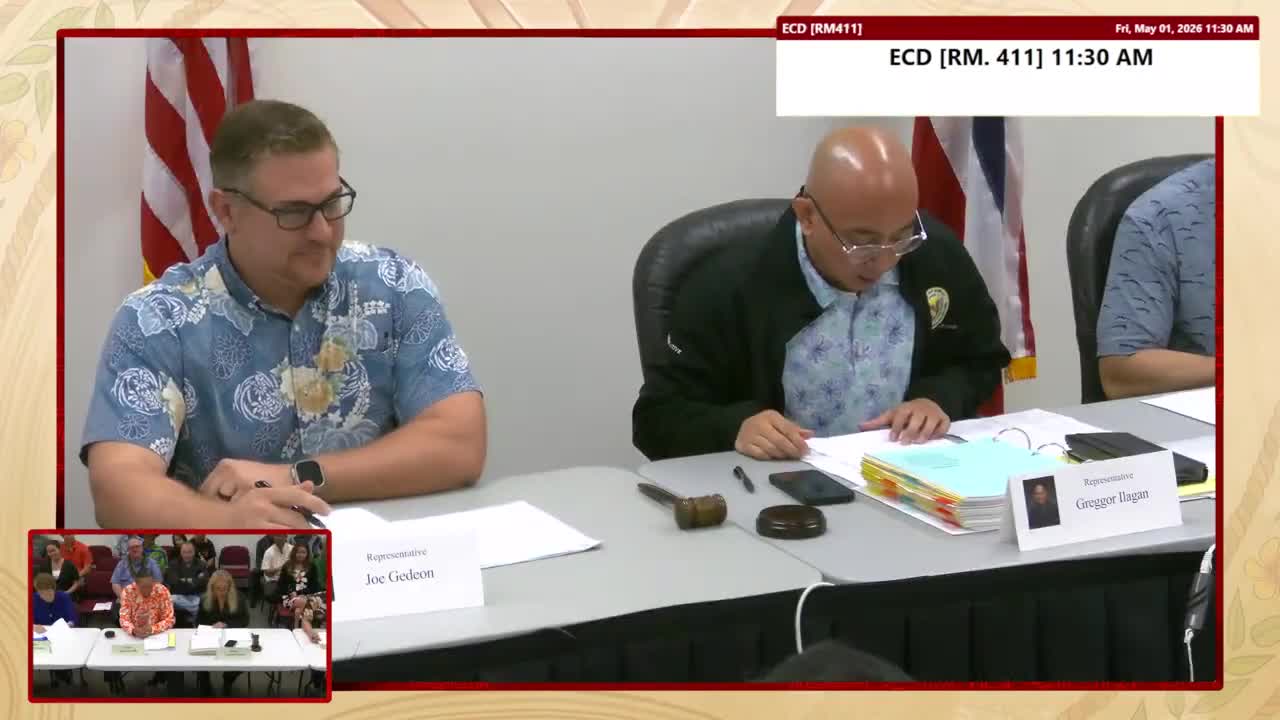
| May 1, 2026 | Conference Committee Meeting will reconvene on Friday, 05-01-26 at 11:30AM in Conference Room 411. |
| Apr 30, 2026 | Conference Committee Meeting will reconvene on Friday 05-01-26 8:01AM in conference room 411. |
| Apr 28, 2026 | Bill scheduled for Conference Committee Meeting on Thursday, 04-30-26 8:30AM in conference room 411. |
| Apr 27, 2026 | Received notice of Senate conferees (Sen. Com. No. 778). |
| Apr 27, 2026 | Senate Conferees Appointed: DeCoite Chair; Wakai Co-Chair; Fevella. |
| Apr 21, 2026 | Received notice of appointment of House conferees (Hse. Com. No. 799). |
| Apr 21, 2026 | House Conferees Appointed: Ilagan, Yamashita Co-Chairs; Hussey, Tam, Gedeon. |
| Apr 17, 2026 | Received notice of disagreement (Hse. Com. No. 780). |
| Apr 16, 2026 | House disagrees with Senate amendment (s). |
| Apr 14, 2026 | Returned from Senate (Sen. Com. No. 690) in amended form (SD 2). |
| Apr 14, 2026 | Report adopted; Passed Third Reading, as amended (SD 2). Ayes, 25; Aye(s) with reservations: none . Noes, 0 (none). Excused, 0 (none). Transmitted to House. |
| Apr 10, 2026 | 48 Hrs. Notice 04-14-26. |
| Apr 10, 2026 | Reported from WAM (Stand. Com. Rep. No. 3735) with recommendation of passage on Third Reading, as amended (SD 2). |
| Apr 8, 2026 | The committee(s) on WAM recommend(s) that the measure be PASSED, WITH AMENDMENTS. The votes in WAM were as follows: 13 Aye(s): Senator(s) Dela Cruz, Moriwaki, DeCoite, Elefante, Hashimoto, Inouye, Kanuha, Kidani, Kim, Lee, C., Richards, Wakai, Fevella; Aye(s) with reservations: none ; 0 No(es): none; and 0 Excused: none. |
| Apr 6, 2026 | The committee(s) on WAM will hold a public decision making on 04-08-26 10:02AM; Conference Room 211 & Videoconference. |
| Mar 30, 2026 | Report adopted; Passed Second Reading, as amended (SD 1) and referred to WAM. |
| Mar 30, 2026 | Reported from EDT (Stand. Com. Rep. No. 3347) with recommendation of passage on Second Reading, as amended (SD 1) and referral to WAM. |
| Mar 24, 2026 | The committee(s) on EDT recommend(s) that the measure be PASSED, WITH AMENDMENTS. The votes in EDT were as follows: 4 Aye(s): Senator(s) DeCoite, Wakai, Kim, Fevella; Aye(s) with reservations: none ; 0 No(es): none; and 1 Excused: Senator(s) Fukunaga. |
| Mar 20, 2026 | The committee(s) on EDT has scheduled a public hearing on 03-24-26 1:04PM; Conference Room 229 & Videoconference. |
| Mar 12, 2026 | Referred to EDT, WAM. |
| Mar 12, 2026 | Passed First Reading. |
| Mar 12, 2026 | Received from House (Hse. Com. No. 417). |
| Mar 10, 2026 | Passed Third Reading as amended in HD 2 with Representative(s) Gedeon, Shimizu voting aye with reservations; Representative(s) Alcos, Garcia, Muraoka voting no (3) and Representative(s) Pierick excused (1). Transmitted to Senate. |
| Mar 6, 2026 | Forty-eight (48) hours notice Tuesday, 03-10-26. |
| Mar 6, 2026 | Reported from FIN (Stand. Com. Rep. No. 1115-26) as amended in HD 2, recommending passage on Third Reading. |
| Mar 4, 2026 | The committee on FIN recommend that the measure be PASSED, WITH AMENDMENTS. The votes were as follows: 16 Ayes: Representative(s) Todd, Takenouchi, Hartsfield, Hussey, Keohokapu-Lee Loy, Kitagawa, Kusch, Lee, M., Miyake, Morikawa, Perruso, Templo, Yamashita, Reyes Oda; Ayes with reservations: Representative(s) Alcos, Gedeon; Noes: none; and Excused: none. |
| Mar 2, 2026 | Bill scheduled for decision making on Wednesday, 03-04-26 10:00AM in conference room 308 VIA VIDEOCONFERENCE. |
| Mar 2, 2026 | The committee(s) on FIN recommend(s) that the measure be deferred until 03-04-26. |
| Feb 27, 2026 | Bill scheduled to be heard by FIN on Monday, 03-02-26 2:00PM in House conference room 308 VIA VIDEOCONFERENCE. |
| Feb 18, 2026 | Passed Second Reading as amended in HD 1 and referred to the committee(s) on FIN with none voting aye with reservations; none voting no (0) and none excused (0). |
| Feb 18, 2026 | Reported from ECD (Stand. Com. Rep. No. 417-26) as amended in HD 1, recommending passage on Second Reading and referral to FIN. |
| Feb 13, 2026 | The committee on ECD recommend that the measure be PASSED, WITH AMENDMENTS. The votes were as follows: 7 Ayes: Representative(s) Ilagan, Hussey, Holt, Tam, Templo, Yamashita, Gedeon; Ayes with reservations: none; Noes: none; and Excused: none. |
| Feb 13, 2026 | The committee on ECD recommend that the measure be PASSED, WITH AMENDMENTS. The votes were as follows: 6 Ayes: Representative(s) Ilagan, Hussey, Tam, Templo, Yamashita; Ayes with reservations: Representative(s) Gedeon; Noes: none; and 0 Excused: none. |
| Feb 10, 2026 | Bill scheduled to be heard by ECD on Friday, 02-13-26 8:30AM in House conference room 423 VIA VIDEOCONFERENCE. |
| Feb 2, 2026 | Referred to ECD, FIN, referral sheet 6 |
| Jan 28, 2026 | Introduced and Pass First Reading. |
| Jan 27, 2026 | Pending introduction. |
|
Date
|
Description
|
Location
|
Votes
|
|
|---|---|---|---|---|
| May 6, 2026 | Final Reading | House Floor |
Passed |
|
| May 6, 2026 | Final Reading | Senate Floor |
Passed |
|
| Apr 14, 2026 | Third Reading | Senate Floor |
Passed |
|
| Apr 8, 2026 | The committee(s) on WAM recommend(s) that the measure be PASSED, WITH AMENDMENTS | Senate Standing Committee on Ways and Means |
Passed |
|
| Mar 24, 2026 | The committee(s) on EDT recommend(s) that the measure be PASSED, WITH AMENDMENTS | Senate Standing Committee on Economic Development and Tourism |
Passed |
|
| Mar 10, 2026 | Third Reading | House Floor |
Passed |
|
| Mar 4, 2026 | The committee on FIN recommend that the measure be PASSED, WITH AMENDMENTS | House Standing Committee on Finance |
Passed |
|
| Feb 13, 2026 | The committee on ECD recommend that the measure be PASSED, WITH AMENDMENTS | House Standing Committee on Economic Development & Technology |
Passed |
|
| Feb 13, 2026 | The committee on ECD recommend that the measure be PASSED, WITH AMENDMENTS | House Standing Committee on Economic Development & Technology |
Passed |
This list shows positions taken on this bill by organizations on the date displayed, which is linked to the original source.
Positions by individuals are not included.
STAND. COM. REP. NO. 1115-26
Honolulu, Hawaii
, 2026
RE: H.B. No. 2429
H.D. 2
Honorable Nadine K. Nakamura
Speaker, House of Representatives
Thirty-Third State Legislature
Regular Session of 2026
State of Hawaii
Madame:
Your Committee on Finance, to which was referred H.B. No. 2429, H.D. 1, entitled:
"A BILL FOR AN ACT RELATING TO TAX EXPENDITURE EVALUATION,"
begs leave to report as follows:
Your Committee received comments on this measure from the Department of Taxation; Department of Business, Economic Development, and Tourism, including its Creative Industries Division; and Tax Foundation of Hawaiʻi.
Your Committee has amended this measure by:
(1) Requiring taxpayers who claim certain tax credits and general excise and use tax exemptions to submit certain information to the Department of Business, Economic Development, and Tourism in order to claim the credit or exemption; and
(2) Making technical, nonsubstantive amendments for the purposes of clarity, consistency, and style.
As affirmed by the record of votes of the members of your Committee on Finance that is attached to this report, your Committee is in accord with the intent and purpose of H.B. No. 2429, H.D. 1, as amended herein, and recommends that it pass Third Reading in the form attached hereto as H.B. No. 2429, H.D. 2.
Respectfully submitted on behalf of the members of the Committee on Finance,
|
|
|
____________________________ CHRIS TODD, Chair |
|
|
|
|
STAND. COM. REP. NO. 417-26
Honolulu, Hawaii
, 2026
RE: H.B. No. 2429
H.D. 1
Honorable Nadine K. Nakamura
Speaker, House of Representatives
Thirty-Third State Legislature
Regular Session of 2026
State of Hawaii
Madame:
Your Committee on Economic Development & Technology, to which was referred H.B. No. 2429 entitled:
"A BILL FOR AN ACT RELATING TO TAX EXPENDITURE EVALUATION,"
begs leave to report as follows:
Your Committee received comments on this measure from the Department of Business, Economic Development, and Tourism; Department of Taxation; and Tax Foundation of Hawaii.
Your Committee finds that there is a need to periodically review certain tax incentives, such as tax credits and general excise and use tax exemptions, to ensure these incentives are being appropriately used and the intended outcomes are being achieved. Your Committee further finds that periodic reviews allow for the collection of data on important metrics such as job creation, economic growth, investment levels, or targeted social benefits relative to the cost of the tax incentive. This measure facilitates the review of tax incentives and the State's tax policies and enhances transparency by requiring taxpayers who claim certain credits and exemptions to report basic information that will enable meaningful evaluation of tax expenditures.
Your Committee has amended this measure by:
(1) Changing the effective date to July 1, 3000, to encourage further discussion; and
(2) Making technical, nonsubstantive amendments for the purposes of clarity, consistency, and style.
As affirmed by the record of votes of the members of your Committee on Economic Development & Technology that is attached to this report, your Committee is in accord with the intent and purpose of H.B. No. 2429, as amended herein, and recommends that it pass Second Reading in the form attached hereto as H.B. No. 2429, H.D. 1, and be referred to your Committee on Finance.
Respectfully submitted on behalf of the members of the Committee on Economic Development & Technology,
|
|
|
____________________________ GREGGOR ILAGAN, Chair |
|
|
|
|
|
Date
|
Testimony PDF
|
|---|---|
| Apr 8, 2026 | HB2429_SD1_TESTIMONY_WAM_04-08-26_.PDF |
| Mar 24, 2026 | HB2429_HD2_TESTIMONY_EDT_03-24-26_.PDF |
| Mar 3, 2026 | HB2429_HD1_TESTIMONY_FIN_03-02-26_.PDF |
| Feb 13, 2026 | HB2429_TESTIMONY_ECD_02-13-26_.PDF |
Discussed in Hearing
 1MIN
Conference Committee
 38SEC
Conference Committee
 51SEC
Conference Committee
 2MIN
Conference Committee
 1MIN
Conference Committee
 19SEC
Senate Standing Committee on Judiciary
19SEC
Senate Standing Committee on Ways and Means
 35SEC
Senate Standing Committee on Housing
Bill Author

Bill Co-Author(s):