HB 2243: PUC; Electric Utilities; Bill Impact Analyses; Customer Transparency; Ratepayers; Reports
- Session Year: 2025-2026
- House: House
- Latest Version Date: 2026-02-17
Current Status:
Failed
(2026-02-18: Passed Second Reading as amended in HD 1 and referred to the committee(s) on CPC with none voting aye with reservations; none voting no (0) and none excused (0).)
Introduced
In Committee
First Chamber
In Committee
Second Chamber
Final Decking
Enacted
Requires all electric utilities to provide transparent customer bill impact analyses that are accessible to the public in an electronic format reasonably usable by ratepayers. Establishes requirements for bill impact analyses. Requires electric utilities to submit annual reports to the Public Utilities Commission. Effective 7/1/3000. (HD1)
Requires all electric utilities to provide transparent customer bill impact analyses that are accessible to the public in an electronic format reasonably usable by ratepayers. Establishes requirements for bill impact analyses. Requires electric utilities to submit annual reports to the Public Utilities Commission.
|
HOUSE OF REPRESENTATIVES |
H.B. NO. |
2243 |
|
THIRTY-THIRD LEGISLATURE, 2026 |
H.D. 1 |
|
|
STATE OF HAWAII |
|
|
|
|
|
|
|
|
||
|
|
||
A BILL FOR AN ACT
RELATING TO ELECTRIC ENERGY.
BE IT ENACTED BY THE LEGISLATURE OF THE STATE OF HAWAII:
SECTION 1. The legislature finds that the public utilities commission relies on bill impact analyses prepared and modeled by electric utilities for proposed energy projects that estimate residential customer bill impacts to evaluate affordability. Electric utilities routinely submit customer bill impact analyses to the public utilities commission in applications for approval of energy generation power purchase agreements and other major resource additions, which inform the commission's public-interest determinations. However, in generation-related proceedings, these analyses rely heavily on assumptions developed by the electric utilities that are not fully disclosed to ratepayers. Instead, ratepayers are typically presented only with an estimated monthly dollar impact for a residential customer using five hundred kilowatt hours per month, with little to no transparency of the assumptions, calculations, or modeling underlying those estimates, limiting meaningful evaluation of the appropriateness of the utilities' bill impact analyses.
The legislature further finds that according to the United States Energy Information Administration, Hawaii's cost of electric energy for residential, commercial, and industrial ratepayers consistently ranks the highest in the nation, despite progress made toward integrating renewable energy resources into the electric system in a manner intended to improve affordability. Previously contracted energy generation and energy storage projects that have been delayed or terminated due to inflation, supply chain constraints, and changes in federal incentives have only exacerbated this affordability problem. Additionally, long-range utility forecast changes materially affect projected resource needs, costs, and rates. As a result, failure to disclose and update the assumptions behind customer bill impact projections prevents ratepayers from evaluating and determining whether a proposed project is in the public interest and whether the projected bill impacts are reasonable, current, and accurate.
The legislature also finds that access to and transparency of assumptions, methodology, and outputs of the bill impact analyses can empower ratepayers, increase cost‑effectiveness, enable economic analysis for affordability, improve decision‑making, maximize the value of investments and technologies, promote economic development, improve operational efficiency, and assist in evaluating grid stabilizing investments. Additionally, annual reporting and examination of actual monthly dispatch and levelized cost of energy data based on such dispatch are practical and highly useful for transparency and comparison purposes.
Therefore, the purpose of this Act is to require electric utilities to provide transparent customer bill impact analyses that are accessible to the public and updated with current data and assumptions prior to the commission's decision‑making.
SECTION 2. Section 269-47, Hawaii Revised Statutes, is amended to read as follows:
"[[]§269-47[]] Electric power systems data access and
transparency; principles. (a) The commission, in carrying out its
responsibilities under this chapter, shall consider the value of improving
electric power systems data access and transparency within the State in order
to empower ratepayers, improve decision-making related to reliability and
operational efficiency of the electric system, maximize the value of grid
modernization technologies and investments, and promote innovation and economic
development opportunities related to electric power systems data analysis.
(b) In advancing the public interest, the commission shall balance consumer privacy, critical infrastructure security, grid modernization, and economic innovation considerations associated with electric power systems data access and transparency, including but not limited to the following principles:
(1) Enabling ratepayers to access their energy consumption and production data;
(2) Enabling ratepayers to authorize third-party data access, and allow verification of third-party authorization through electronic signature;
(3) Increasing the amount of publicly-available data related to utility generation, transmission, and distribution systems, as well as non-utility data from third parties that provide generation or non-wire alternatives to individual customers or the grid; and
(4) Ensuring that electric power systems data is made available through simple, electronic, consistent, machine-readable formats with temporal and geographic granularity.
(c) In addition to any requirements under this chapter, each electric utility that sells electricity for consumption in the State shall submit a bill impact analysis for a proposed electric generation or storage project to the commission, which shall provide full disclosure to ratepayers of all modeling assumptions used to calculate the projected impact on customer bills.
(d) The bill impact analysis disclosure required under subsection (c) shall be submitted in an electronic format reasonably usable by ratepayers and others for purposes of reviewing and analyzing the underlying assumptions and calculations and sufficient to allow sensitivity analysis and scenario testing. The bill impact analysis shall include but not be limited to the following:
(1) Resource assumptions that include:
(A) The type, capacity size, and timing of operations for all resources assumed to be on the grid during the term of the proposed project;
(B) Pricing assumptions for each resource, including fuel costs, energy costs, average annual dispatch, and any other relevant cost components; and
(C) The analysis period, identification of specific forecasts used in modeling, and any sensitivity cases considered;
(2) Project-specific assumptions that include pricing assumptions for the proposed project, including contractual pricing, annual dispatch assumed, and escalation factors;
(3) Modeling methodology that includes:
(A) A description of the modeling framework and approach used to estimate bill impacts; and
(B) Key variables, sensitivity analyses, and any scenarios considered in the modeling process; and
(4) A clear explanation of how the assumptions translate into the estimated monthly bill impact for a typical customer, including formulas or step-by-step calculations where practicable.
(e) For the submitted bill impact analysis disclosure data required under this section:
(1) The data shall be:
(A) Made available through simple, electronic, consistent, machine-readable formats with temporal and geographic granularity reasonably usable by ratepayers and others and for purposes of reviewing and analyzing the underlying assumptions and calculations; and
(B) Sufficient to allow sensitivity analysis and scenario testing; and
(2) The information shall be made publicly available without redaction, except for data that the commission determines to be confidential for reasons of cybersecurity or system security; provided that confidentiality shall not apply to cost, pricing, or operational assumptions necessary for ratepayer understanding.
(f) The electric utility shall update the bill impact analysis required under this section if, during the pendency of the proceeding, any material assumption changes, including but not limited to the delay, cancellation, or non-selection of a planned project included in the analysis.
(g) Each electric utility shall submit an annual report to the commission of the levelized costs for energy generation and storage regarding the actual monthly dispatch and levelized cost based on the dispatch for all approved and operating energy generation and storage projects. The report shall include:
(1) The total energy dispatched from each energy project by month;
(2) The total cost incurred for each energy project by month;
(3) The calculation of the levelized cost of energy for each project based on actual dispatch and in dollars per kilowatt hour based on the dispatch; and
(4) Any adjustments or reconciliations applied to determine ratepayer charges."
SECTION 3. Statutory material to be repealed is bracketed and stricken. New statutory material is underscored.
SECTION 4. This Act shall take effect on July 1, 3000.
Report Title:
PUC; Electric Utilities; Bill Impact Analyses; Customer Transparency; Ratepayers; Reports
Description:
Requires all electric utilities to provide transparent customer bill impact analyses that are accessible to the public in an electronic format reasonably usable by ratepayers. Establishes requirements for bill impact analyses. Requires electric utilities to submit annual reports to the Public Utilities Commission. Effective 7/1/3000. (HD1)
The summary description of legislation appearing on this page is for informational purposes only and is not legislation or evidence of legislative intent.
|
HOUSE OF REPRESENTATIVES |
H.B. NO. |
2243 |
|
THIRTY-THIRD LEGISLATURE, 2026 |
|
|
|
STATE OF HAWAII |
|
|
|
|
|
|
|
|
||
|
|
||
A BILL FOR AN ACT
relating to electric energy.
BE IT ENACTED BY THE LEGISLATURE OF THE STATE OF HAWAII:
SECTION 1. The legislature finds that the public utilities commission relies on bill impact analyses prepared and modeled by electric utilities for proposed energy projects that estimate residential customer bill impacts to evaluate affordability. Electric utilities routinely submit customer bill impact analyses to the public utilities commission in applications for approval of energy generation power purchase agreements and other major resource additions, which inform the commission's public-interest determinations. However, in generation-related proceedings, these analyses rely heavily on assumptions developed by the electric utilities that are not fully disclosed to ratepayers. Instead, ratepayers are typically presented only with an estimated monthly dollar impact for a residential customer using five hundred kilowatt hours per month, with little to no transparency into the assumptions, calculations, or modeling underlying those estimates, limiting meaningful evaluation and appropriateness of the utilities' bill impact analyses.
The legislature further finds that according to the United States Energy Information Administration, Hawaii's cost of electric energy for residential, commercial, and industrial ratepayers consistently ranks the highest in the nation, despite progress made toward integrating renewable energy resources into the electric system in a manner intended to improve affordability. Previously contracted energy generation and energy storage projects that have been delayed or terminated due to inflation, supply chain constraints, and changes in federal incentives have only exacerbated this affordability problem. Additionally, long-range utility forecast changes materially affect projected resource needs, costs, and rates. As a result, failure to disclose and update the assumptions behind customer bill impact projections prevents ratepayers from evaluating and determining whether a proposed project is in the public interest and whether the projected bill impacts are reasonable, current, and accurate.
The legislature also finds that access to and transparency of assumptions, methodology, and outputs of the bill impact analyses can empower ratepayers, increase cost‑effectiveness, enable economic analysis for affordability, improve decision‑making, maximize the value of investments and technologies, promote economic development, improve operational efficiency, and assist in evaluating grid stabilizing investments. Additionally, annual reporting and examination of actual monthly dispatch and levelized cost of energy data based on such dispatch is practical and highly useful for transparency and comparison purposes.
Therefore, the purpose of this Act is to require electric utilities to provide transparent customer bill impact analyses that are accessible to the public and updated with current data and assumptions prior to the commission's decision‑making.
SECTION 2. Section 269-47, Hawaii Revised Statutes, is amended to read as follows:
"[[]§269-47[]] Electric power systems data access and
transparency; principles. (a) The commission, in carrying out its
responsibilities under this chapter, shall consider the value of improving
electric power systems data access and transparency within the State in order
to empower ratepayers, improve decision-making related to reliability and
operational efficiency of the electric system, maximize the value of grid
modernization technologies and investments, and promote innovation and economic
development opportunities related to electric power systems data analysis.
(b) In advancing the public interest, the commission shall balance consumer privacy, critical infrastructure security, grid modernization, and economic innovation considerations associated with electric power systems data access and transparency, including but not limited to the following principles:
(1) Enabling ratepayers to access their energy consumption and production data;
(2) Enabling ratepayers to authorize third-party data access, and allow verification of third-party authorization through electronic signature;
(3) Increasing the amount of publicly-available data related to utility generation, transmission, and distribution systems, as well as non-utility data from third parties that provide generation or non-wire alternatives to individual customers or the grid; and
(4) Ensuring that electric power systems data is made available through simple, electronic, consistent, machine-readable formats with temporal and geographic granularity.
(c) In addition to any requirements under this chapter, each electric utility that sells electricity for consumption in the State shall submit a bill impact analysis for a proposed electric generation or storage project to the commission, which shall provide full disclosure to ratepayers of all modeling assumptions used to calculate the projected impact on customer bills.
(d) The bill impact analysis disclosure required under subsection (c) shall be submitted in an electronic format reasonably usable by ratepayers and others and for purposes of reviewing and analyzing the underlying assumptions and calculations and sufficient to allow sensitivity analysis and scenario testing. The bill impact analysis shall include, at a minimum, but shall not be limited to the following:
(1) Resource assumptions that include:
(A) The type, capacity size, and timing of operations for all resources assumed to be on the grid during the term of the proposed project;
(B) Pricing assumptions for each resource, including fuel costs, energy costs, average annual dispatch, and any other relevant cost components; and
(C) The analysis period, identification of specific forecasts used in modeling, and any sensitivity cases considered;
(2) Project-specific assumptions that include pricing assumptions for the proposed project, including contractual pricing, annual dispatch assumed, and escalation factors;
(3) Modeling methodology that includes:
(A) A description of the modeling framework and approach used to estimate bill impacts; and
(B) Key variables, sensitivity analyses, and any scenarios considered in the modeling process; and
(4) A clear explanation of how the assumptions translate into the estimated monthly bill impact for a typical customer, including formulas or step-by-step calculations where practicable.
(e) For the submitted bill impact analysis disclosure data required under this section:
(1) The data shall be made available through simple, electronic, consistent, machine-readable formats with temporal and geographic granularity in an electronic format reasonably usable by ratepayers and others and for purposes of reviewing and analyzing the underlying assumptions and calculations and sufficient to allow sensitivity analysis and scenario testing; and
(2) The information shall be made publicly available without redaction, except for data that the commission determines to be confidential for reasons of cybersecurity or system security; provided that confidentiality shall not apply to cost, pricing, or operational assumptions necessary for ratepayer understanding.
(f) The electric utility shall update the bill impact analysis required under this section if, during the pendency of the proceeding, any material assumption changes, including but not limited to the delay, cancellation, or non-selection of a planned project included in the analysis.
(g) Each electric utility shall submit an annual report to the commission of the levelized costs for energy generation and storage regarding the actual monthly dispatch and levelized cost based on the dispatch for all approved and operating energy generation and storage projects. The report shall include:
(1) The total energy dispatched from each energy project by month;
(2) The total cost incurred for each energy project by month;
(3) The calculation of the levelized cost of energy for each project based on actual dispatch and in dollars per kilowatt hour based on the dispatch; and
(4) Any adjustments or reconciliations applied to determine ratepayer charges."
SECTION 3. Statutory material to be repealed is bracketed and stricken. New statutory material is underscored.
SECTION 4. This Act shall take effect upon its approval.
|
INTRODUCED BY: |
_____________________________ |
|
|
|
|
|
|
Report Title:
PUC; Electric Utilities; Bill Impact Analyses; Customer Transparency; Ratepayers; Reports
Description:
Requires all electric utilities to provide transparent customer bill impact analyses that are accessible to the public in an electronic format reasonably usable by ratepayers. Establishes requirements for bill impact analyses. Requires electric utilities to submit annual reports to the Public Utilities Commission.
The summary description of legislation appearing on this page is for informational purposes only and is not legislation or evidence of legislative intent.
|
Date
|
Status
|
|---|---|
| Feb 18, 2026 | Passed Second Reading as amended in HD 1 and referred to the committee(s) on CPC with none voting aye with reservations; none voting no (0) and none excused (0). |
| Feb 18, 2026 | Reported from EEP (Stand. Com. Rep. No. 446-26) as amended in HD 1, recommending passage on Second Reading and referral to CPC. |
| Feb 17, 2026 | The committee on EEP recommend that the measure be PASSED, WITH AMENDMENTS. The votes were as follows: 6 Ayes: Representative(s) Lowen, Perruso, Chun, Kahaloa, Kusch, Matsumoto; Ayes with reservations: none; Noes: none; and 1 Excused: Representative(s) Quinlan. |
| Feb 12, 2026 | Bill scheduled for decision making on Tuesday, 02-17-26 9:30AM in conference room 325 VIA VIDEOCONFERENCE. |
| Feb 12, 2026 | The committee(s) on EEP recommend(s) that the measure be deferred until 02-17-26. |
| Feb 6, 2026 | Bill scheduled to be heard by EEP on Thursday, 02-12-26 9:45AM in House conference room 325 VIA VIDEOCONFERENCE. |
| Jan 30, 2026 | Referred to EEP, CPC, referral sheet 5 |
| Jan 28, 2026 | Introduced and Pass First Reading. |
| Jan 26, 2026 | Pending introduction. |
|
Date
|
Description
|
Location
|
Votes
|
|
|---|---|---|---|---|
| Feb 17, 2026 | The committee on EEP recommend that the measure be PASSED, WITH AMENDMENTS | House Standing Committee on Energy & Environmental Protection |
Passed |
This list shows positions taken on this bill by organizations on the date displayed, which is linked to the original source.
Positions by individuals are not included.
|
Organization
|
Position
|
Date
|
|---|---|---|
| Hawaii Clean Power Alliance | ** Support | |
| Life of the Land and Kauai Island Utility Cooperative | ** Against | |
| Life of the Land | *** Against | Feb 12, 2026 |
STAND. COM. REP. NO. 446-26
Honolulu, Hawaii
, 2026
RE: H.B. No. 2243
H.D. 1
Honorable Nadine K. Nakamura
Speaker, House of Representatives
Thirty-Third State Legislature
Regular Session of 2026
State of Hawaii
Madame:
Your Committee on Energy & Environmental Protection, to which was referred H.B. No. 2243 entitled:
"A BILL FOR AN ACT RELATING TO ELECTRIC ENERGY,"
begs leave to report as follows:
The purpose of this measure is to:
(1) Require all electric utilities to provide transparent customer bill impact analyses that are accessible to the public in an electronic format reasonably usable by ratepayers;
(2) Establish requirements for bill impact analyses; and
(3) Require electric utilities to submit annual reports to the Public Utilities Commission.
Your Committee finds that ratepayers currently lack visibility into the assumptions, methodologies, and modeling used by electric utilities when presenting projected customer bill impacts for proposed generation and storage projects, limiting the public's ability to assess affordability and evaluate whether such projects are in the public interest. Your Committee further finds that increasing transparency around bill‑impact modeling will enhance ratepayer understanding, support more informed participation in regulatory proceedings, and improve accountability in utility planning. This measure addresses these concerns by requiring electric utilities to disclose the assumptions, data, and calculations underlying bill impact analyses and to update those analyses when material changes occur.
Your Committee has amended this measure by:
(1) Changing the effective date to July 1, 3000, to encourage further discussion; and
(2) Making technical, nonsubstantive amendments for the purposes of clarity, consistency, and style.
As affirmed by the record of votes of the members of your Committee on Energy & Environmental Protection that is attached to this report, your Committee is in accord with the intent and purpose of H.B. No. 2243, as amended herein, and recommends that it pass Second Reading in the form attached hereto as H.B. No. 2243, H.D. 1, and be referred to your Committee on Consumer Protection & Commerce.
Respectfully submitted on behalf of the members of the Committee on Energy & Environmental Protection,
|
|
|
____________________________ NICOLE E. LOWEN, Chair |
|
Date
|
Testimony PDF
|
|---|---|
| Feb 12, 2026 | HB2243_TESTIMONY_EEP_02-12-26_.PDF |
Discussed in Hearing
 58SEC
House Standing Committee on Energy & Environmental Protection
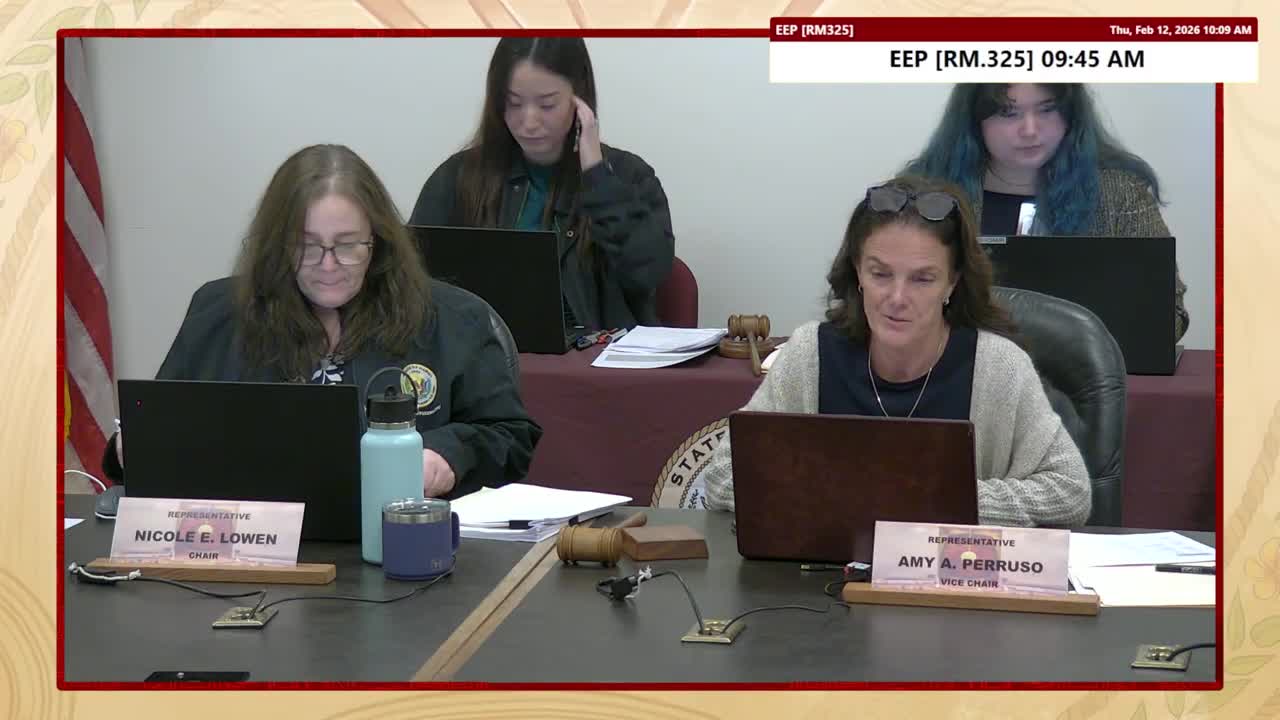 16MIN
House Standing Committee on Energy & Environmental Protection
16MIN
House Standing Committee on Tourism
 19SEC
House Standing Committee on Energy & Environmental Protection
19SEC