HB 2186: Pedestrian Safety; Crosswalks
- Session Year: 2025-2026
- House: House
- Latest Version Date: 2026-02-17
Current Status:
Failed
(2026-02-18: Passed Second Reading as amended in HD 1 and referred to the committee(s) on JHA with none voting aye with reservations; none voting no (0) and none excused (0).)
Introduced
In Committee
First Chamber
In Committee
Second Chamber
Final Decking
Enacted
Clarifies driver's obligations at crosswalks. Requires drivers to stop and remain stopped for pedestrians in crosswalks. Strengthens penalties for traffic violations, particularly in school zones. Creates additional criminal penalties when pedestrians suffer bodily injury. Provides heightened protections for blind and visually impaired pedestrians. Effective 7/1/3000. (HD1)
Clarifies driver's obligations at crosswalks. Requires drivers to stop and remain stopped for pedestrians in crosswalks. Strengthens penalties for traffic violations, particularly in school zones. Creates additional criminal penalties when pedestrians suffer bodily injury. Provides heightened protections for blind and visually impaired pedestrians.
|
HOUSE OF REPRESENTATIVES |
H.B. NO. |
2186 |
|
THIRTY-THIRD LEGISLATURE, 2026 |
H.D. 1 |
|
|
STATE OF HAWAII |
|
|
|
|
|
|
|
|
||
|
|
||
A BILL FOR AN ACT
RELATING TO PEDESTRIAN SAFETY.
BE IT ENACTED BY THE LEGISLATURE OF THE STATE OF HAWAII:
SECTION 1. The legislature finds that Hawaii has experienced persistently high levels of traffic-related fatalities over recent years, with pedestrians representing a disproportionate and growing share of those deaths. In recent years, pedestrians have accounted for a significant percentage of all traffic fatalities statewide, reflecting a sustained pattern of danger for individuals walking along Hawaii's roadways. Many of the fatalities and serious injuries suffered by pedestrians have occurred while individuals were lawfully using marked or unmarked crosswalks, including in residential neighborhoods, school-adjacent areas, and other locations with regular pedestrian activity.
The legislature further finds that the State, through the department of transportation and in coordination with county governments, has committed to reducing traffic deaths and serious injuries through comprehensive roadway safety planning consistent with vision zero principles, which recognize that traffic fatalities are preventable and that roadway systems must prioritize the safety of the most vulnerable road users. These commitments emphasize safer speeds, safer streets, safer behavior, and clearer legal standards governing driver conduct.
The legislature also finds that walking is a fundamental, equitable, and environmentally sustainable mode of transportation and that residents and visitors cannot reasonably be expected to walk, access public transit, or support sustainable transportation goals unless pedestrians are afforded clear, enforceable, and meaningful legal protections when crossing public roadways.
The legislature additionally finds that section 291C-72, Hawaii Revised Statutes, while requiring drivers to stop for pedestrians in crosswalks, lacks sufficient specificity regarding when the duty to stop is triggered and how long a driver must remain stopped, creating ambiguity that undermines enforcement, accountability, and compliance. Other jurisdictions with better pedestrian safety outcomes, such as Oregon and Washington state, have adopted explicit "stop and remain stopped" standards and lane-based trigger points that clearly allocate responsibility to the operator of the motor vehicle, which is the heavier and more dangerous instrument.
Furthermore, the legislature finds that children walking to and from school, older adults, and individuals with visual impairments face heightened risk and require enhanced statutory protections, particularly in school zones and other high-pedestrian-use areas. Existing penalties for crosswalk violations may be insufficient to deter dangerous driving behavior and do not adequately reflect the severity of harm caused when violations result in serious bodily injury.
Accordingly, the purpose of this Act is to advance the State's traffic safety and vision zero–aligned commitments by:
(1) Clarifying driver obligations at crosswalks and establishing a clear and enforceable duty to stop and remain stopped for pedestrians;
(2) Strengthening penalties for violations, particularly in school zones;
(3) Creating additional criminal penalties when violations cause bodily injury; and
(4) Providing heightened protections for blind and visually impaired pedestrians in order to reduce preventable deaths and serious injuries on Hawaii's roadways.
SECTION 2. Chapter 707, Hawaii Revised Statutes, is amended by adding three new sections to be appropriately designated and to read as follows:
"§707- Negligent injury to a pedestrian in a crosswalk in the first degree. (1) A person commits the offense of negligent injury to a pedestrian in a crosswalk in the first degree if that person negligently operates a motor vehicle within the area of a marked or unmarked crosswalk and causes serious bodily injury to a pedestrian who is lawfully within the crosswalk.
(2) Negligent injury to a pedestrian in a crosswalk in the first degree is a class C felony.
(3) The penalties under this section shall be in addition to any other penalties under chapter 291C.
§707- Negligent injury to a pedestrian in a crosswalk in the second degree. (1) A person commits the offense of negligent injury to a pedestrian in a crosswalk in the second degree if that person negligently operates a motor vehicle within the area of a marked or unmarked crosswalk and causes bodily injury to a pedestrian who is lawfully within the crosswalk.
(2) Negligent injury to a pedestrian in a crosswalk in the second degree is a misdemeanor.
(3) The penalties under this section shall be in addition to any other penalties under chapter 291C.
§707- Failure to stop for a blind or visually impaired pedestrian. (1) A person commits the offense of failure to stop for a blind or visually impaired pedestrian if that person does not stop and remain stopped for a blind or visually impaired pedestrian who is crossing at any crosswalk or roadway.
(2) Failure to stop for a blind or visually impaired pedestrian is a misdemeanor that shall be punishable by:
(a) A fine of no less than $500 and no more than $1,000;
(b) Imprisonment of no more than six months; or
(c) Both.
(3) As used in this section, "blind or visually impaired pedestrian" means a blind or visually impaired person who is carrying or using an exposed cane or walking stick that is painted white in color or painted white tipped with red, or a person who is blind or visually impaired and using a guide dog."
SECTION 3. Section 291C-72, Hawaii Revised Statutes, is amended to read as follows:
"§291C-72 Pedestrians' right-of-way
in crosswalks. (a) The driver of a vehicle shall stop and
remain stopped to allow [for] a pedestrian who is crossing the
roadway within a crosswalk when the pedestrian is [either:
(1) Upon the half
of the roadway upon which the vehicle is traveling; or
(2) Approaching the
vehicle so closely from the opposite half of the roadway as to be in danger,]
upon, entering, or within one lane of the half of the roadway upon which the
vehicle is traveling or onto which the vehicle is turning,
and shall not proceed until the pedestrian has passed the vehicle and has cleared the lane of travel and any adjacent lane into which the vehicle would proceed, and the driver can safely proceed.
For roadways consisting of a single lane of travel in each direction, a pedestrian who is upon or entering a crosswalk shall be deemed to be within one lane of the half of the roadway upon which the vehicle is traveling.
For purposes of this [section,]
subsection, "a pedestrian who is crossing the roadway within a
crosswalk" occurs when any part or extension of the pedestrian, including
any part of the pedestrian's body, wheelchair, cane, crutch, or bicycle, is
beyond the curb or edges of the traversable roadway and moves onto the roadway
within an intersection or crosswalk.
(b) No pedestrian shall suddenly leave a curb or other place of safety and walk or run into the path of a vehicle which is so close that it is impossible for the driver to yield.
(c) Subsection (a) shall not apply under the conditions stated in section 291C-73(b).
(d) Whenever any vehicle is stopped at a marked crosswalk or at any unmarked crosswalk at an intersection to permit a pedestrian to cross the roadway, the driver of any other vehicle approaching from the rear shall not overtake and pass the stopped vehicle.
(e) Every person who violates this section shall be subject to the following penalties:
(1) For a first
infraction, or any infraction not preceded within one year by a prior violation
of this section, a fine of [$150;] $250;
(2) For an infraction
that occurs within one year of a prior violation of this section, a fine of [$300]
$500 and revocation of the person's driver's license and privilege to
operate a vehicle for a period of ninety days; and
(3) For an infraction
that occurs within two years of two prior violations of this section, and for
the fourth and each additional infraction of this section, regardless of when
committed, a fine of [$1,000,] $1,500, and revocation of the person's driver's license and privilege to operate
a vehicle for a period of one hundred eighty days.
(f) Any violation of this section that occurs within a school zone shall be subject to double the applicable penalty in subsection (e), including fines and revocation of the person's driver's license and privilege to operate a vehicle.
As used in this subsection, "school zone" has the same meaning as in 291C-104."
SECTION 4. If any provision of this Act, or the application thereof to any person or circumstance, is held invalid, the invalidity does not affect other provisions or applications of the Act that can be given effect without the invalid provision or application, and to this end the provisions of this Act are severable.
SECTION 5. Statutory material to be repealed is bracketed and stricken. New statutory material is underscored.
SECTION 6. This Act shall take effect on July 1, 3000.
Report Title:
Pedestrian Safety; Crosswalks
Description:
Clarifies driver's obligations at crosswalks. Requires drivers to stop and remain stopped for pedestrians in crosswalks. Strengthens penalties for traffic violations, particularly in school zones. Creates additional criminal penalties when pedestrians suffer bodily injury. Provides heightened protections for blind and visually impaired pedestrians. Effective 7/1/3000. (HD1)
The summary description of legislation appearing on this page is for informational purposes only and is not legislation or evidence of legislative intent.
|
HOUSE OF REPRESENTATIVES |
H.B. NO. |
2186 |
|
THIRTY-THIRD LEGISLATURE, 2026 |
|
|
|
STATE OF HAWAII |
|
|
|
|
|
|
|
|
||
|
|
||
A BILL FOR AN ACT
Relating to pedestrian Safety.
BE IT ENACTED BY THE LEGISLATURE OF THE STATE OF HAWAII:
SECTION 1. The legislature finds that Hawaii has experienced persistently high levels of traffic-related fatalities over recent years, with pedestrians representing a disproportionate and growing share of those deaths. In recent years, pedestrians have accounted for a significant percentage of all traffic fatalities statewide, reflecting a sustained pattern of vulnerability for individuals walking along Hawaii's roadways. Many of the fatalities and serious injuries suffered by pedestrians have occurred while individuals were lawfully using marked or unmarked crosswalks, including in residential neighborhoods, school-adjacent areas, and other locations with regular pedestrian activity.
The legislature further finds that the State, through the department of transportation and in coordination with county governments, has committed to reducing traffic deaths and serious injuries through comprehensive roadway safety planning consistent with vision zero principles, which recognize that traffic fatalities are preventable and that roadway systems must prioritize the safety of the most vulnerable road users. These commitments emphasize safer speeds, safer streets, safer behavior, and clearer legal standards governing driver conduct.
The legislature also finds that walking is a fundamental, equitable, and environmentally sustainable mode of transportation and that residents and visitors cannot reasonably be expected to walk, access public transit, or support sustainable transportation goals unless pedestrians are afforded clear, enforceable, and meaningful legal protections when crossing public roadways.
The legislature additionally finds that section 291C-72, Hawaii Revised Statutes, while requiring drivers to stop for pedestrians in crosswalks, lacks sufficient specificity regarding when the duty to stop is triggered and how long a driver must remain stopped, creating ambiguity that undermines enforcement, accountability, and compliance. Other jurisdictions with better pedestrian safety outcomes, such as Oregon and Washington state, have adopted explicit "stop and remain stopped" standards and lane-based trigger points that clearly allocate responsibility to the operator of the motor vehicle, which is the heavier and more dangerous instrument.
Furthermore, the legislature finds that children walking to and from school, older adults, and individuals with visual impairments face heightened risk and require enhanced statutory protections, particularly in school zones and other high-pedestrian-use areas. Existing penalties for crosswalk violations may be insufficient to deter dangerous driving behavior and do not adequately reflect the severity of harm caused when violations result in serious bodily injury.
Accordingly, the purpose of this Act is to advance the State's traffic safety and vision zero–aligned commitments by:
(1) Clarifying driver obligations at crosswalks; establishing a clear and enforceable duty to stop and remain stopped for pedestrians;
(2) Strengthening penalties for violations, particularly in school zones;
(3) Creating additional criminal penalties when violations cause bodily injury; and
(4) Providing heightened protections for blind and visually impaired pedestrians in order to reduce preventable deaths and serious injuries on Hawaii's roadways.
SECTION 2. Chapter 707, Hawaii Revised Statutes, is amended by adding three new sections to be appropriately designated and to read as follows:
"§707- Negligent injury to a pedestrian in a crosswalk in the first degree. (1) A person commits the offense of negligent injury to a pedestrian in a crosswalk in the first degree if that person negligently operates a motor vehicle within the area of a marked or unmarked crosswalk and causes serious bodily injury to a pedestrian who is lawfully within the crosswalk.
(2) Negligent injury to a pedestrian in a crosswalk in the first degree is a class C felony.
(3) The penalties under this section shall be in addition to any other penalties under chapter 291C.
§707- Negligent injury to a pedestrian in a crosswalk in the second degree. (1) A person commits the offense of negligent injury to a pedestrian in a crosswalk in the second degree if that person negligently operates a motor vehicle within the area of a marked or unmarked crosswalk and causes bodily injury to a pedestrian who is lawfully within the crosswalk.
(2) Negligent injury to a pedestrian in a crosswalk in the second degree is a misdemeanor.
(3) The penalties under this section shall be in addition to any other penalties under chapter 291C.
§707- Failure to stop for a blind or visually impaired pedestrian. (1) A person commits the offense of failure to stop for a blind or visually impaired pedestrian if that person does not stop and remain stopped for a blind or visually impaired pedestrian who is crossing at any crosswalk or roadway.
(2) Failure to stop for a blind or visually impaired pedestrian is a misdemeanor that shall be punishable by:
(a) A fine of no less than $500 and no more than $1,000;
(b) Imprisonment of no more than six months; or
(c) Both.
(3) As used in this section, "blind or visually impaired pedestrian" means a blind or visually impaired person who is carrying or using an exposed cane or walking stick that is painted white in color or painted white tipped with red, or a person who is blind or visually impaired and using a guide dog."
SECTION 3. Section 291C-72, Hawaii Revised Statutes, is amended to read as follows:
"§291C-72 Pedestrians' right-of-way
in crosswalks. (a) The driver of a vehicle shall stop and
remain stopped to allow [for] a pedestrian who is crossing the
roadway within a crosswalk when the pedestrian is [either:
(1) Upon the half
of the roadway upon which the vehicle is traveling; or
(2) Approaching the
vehicle so closely from the opposite half of the roadway as to be in danger,]
upon, entering, or within one lane of the half of the roadway upon which the
vehicle is traveling or onto which the vehicle is turning,
and shall not proceed until the pedestrian has passed the vehicle and has cleared the lane of travel and any adjacent lane into which the vehicle would proceed, and the driver can safely proceed.
For roadways consisting of a single lane of travel in each direction, a pedestrian who is upon or entering a crosswalk shall be deemed to be within one lane of the half of the roadway upon which the vehicle is traveling.
For purposes of this section, "a pedestrian who is crossing the roadway within a crosswalk" occurs when any part or extension of the pedestrian, including any part of the pedestrian's body, wheelchair, cane, crutch, or bicycle, is beyond the curb or edges of the traversable roadway and moves onto the roadway within an intersection or crosswalk.
(b) No pedestrian shall suddenly leave a curb or other place of safety and walk or run into the path of a vehicle which is so close that it is impossible for the driver to yield.
(c) Subsection (a) shall not apply under the conditions stated in section 291C-73(b).
(d) Whenever any vehicle is stopped at a marked crosswalk or at any unmarked crosswalk at an intersection to permit a pedestrian to cross the roadway, the driver of any other vehicle approaching from the rear shall not overtake and pass the stopped vehicle.
(e) Every person who violates this section shall be subject to the following penalties:
(1) For a first
infraction, or any infraction not preceded within one year by a prior violation
of this section, a fine of [$150;] $250;
(2) For an infraction
that occurs within one year of a prior violation of this section, a fine of [$300]
$500 and revocation of the person's driver's license and privilege to
operate a vehicle for a period of ninety days; and
(3) For an infraction
that occurs within two years of two prior violations of this section, and for
the fourth and each additional infraction of this section, regardless of when
committed, a fine of [$1,000,] $1,500, and revocation of the person's driver's license and privilege to operate
a vehicle for a period of one hundred eighty days.
(f) Any violation of this section that occurs within a school zone shall be subject to double the applicable penalty in subsection (e), including fines and revocation of the person's driver's license and privilege to operate a vehicle.
As used in this subsection, "school zone" has the same meaning as in 291C-104."
SECTION 4. If any provision of this Act, or the application thereof to any person or circumstance, is held invalid, the invalidity does not affect other provisions or applications of the Act that can be given effect without the invalid provision or application, and to this end the provisions of this Act are severable.
SECTION 5. Statutory material to be repealed is bracketed and stricken. New statutory material is underscored.
SECTION 6. This Act shall take effect on July 1, 2026.
|
INTRODUCED BY: |
_____________________________ |
|
|
|
Report Title:
Pedestrian Safety; Crosswalks
Description:
Clarifies driver's obligations at crosswalks. Requires drivers to stop and remain stopped for pedestrians in crosswalks. Strengthens penalties for traffic violations, particularly in school zones. Creates additional criminal penalties when pedestrians suffer bodily injury. Provides heightened protections for blind and visually impaired pedestrians.
The summary description of legislation appearing on this page is for informational purposes only and is not legislation or evidence of legislative intent.
|
Date
|
Status
|
|---|---|
| Feb 18, 2026 | Passed Second Reading as amended in HD 1 and referred to the committee(s) on JHA with none voting aye with reservations; none voting no (0) and none excused (0). |
| Feb 18, 2026 | Reported from TRN (Stand. Com. Rep. No. 443-26) as amended in HD 1, recommending passage on Second Reading and referral to JHA. |
| Feb 17, 2026 | The committee on TRN recommend that the measure be PASSED, WITH AMENDMENTS. The votes were as follows: 7 Ayes: Representative(s) Kila, Miyake, Evslin, Grandinetti, Kitagawa, La Chica, Muraoka; Ayes with reservations: none; Noes: none; and 2 Excused: Representative(s) Cochran, Pierick. |
| Feb 12, 2026 | Bill scheduled for decision making on Tuesday, 02-17-26 9:15AM in conference room 430 VIA VIDEOCONFERENCE. |
| Feb 12, 2026 | The committee(s) on TRN recommend(s) that the measure be deferred until 02-17-26 at 9:15AM. |
| Feb 10, 2026 | Bill scheduled to be heard by TRN on Thursday, 02-12-26 8:30AM in House conference room 430 VIA VIDEOCONFERENCE. |
| Jan 30, 2026 | Referred to TRN, JHA, referral sheet 5 |
| Jan 28, 2026 | Introduced and Pass First Reading. |
| Jan 26, 2026 | Pending introduction. |
|
Date
|
Description
|
Location
|
Votes
|
|
|---|---|---|---|---|
| Feb 17, 2026 | The committee on TRN recommend that the measure be PASSED, WITH AMENDMENTS | House Standing Committee on Transportation |
Passed |
This list shows positions taken on this bill by organizations on the date displayed, which is linked to the original source.
Positions by individuals are not included.
|
Organization
|
Position
|
Date
|
|---|---|---|
| Department of Transportation | ** Support | |
| Department of Health | ** Support | |
| Department of Health | *** Support | Feb 12, 2026 |
| Department of Transportation | *** Support | Feb 12, 2026 |
| Hawaiʻi Bicycling League | ** Support | |
| Hawai‘i Bicycling League | *** Support | Feb 12, 2026 |
| Kauaʻi Police Department | ** Support | |
| National Federation of the Blind of Hawaii | ** Support | |
| National Federation of the Blind of Hawaii | *** Support | Feb 12, 2026 |
| Oahu Metropolitan Planning Organization | ** Support | |
| PATH - People for Active Transportation Hawaii | *** Support | Feb 12, 2026 |
| PATH People for Active Transportation Hawaii | ** Support |
STAND. COM. REP. NO. 443-26
Honolulu, Hawaii
, 2026
RE: H.B. No. 2186
H.D. 1
Honorable Nadine K. Nakamura
Speaker, House of Representatives
Thirty-Third State Legislature
Regular Session of 2026
State of Hawaii
Madame:
Your Committee on Transportation, to which was referred H.B. No. 2186 entitled:
"A BILL FOR AN ACT RELATING TO PEDESTRIAN SAFETY,"
begs leave to report as follows:
The purpose of this measure is to:
(1) Clarify driver obligations at crosswalks and establish a clear and enforceable duty to stop and remain stopped for pedestrians;
(2) Strengthen penalties for violations, particularly in school zones;
(3) Create additional criminal penalties when violations cause bodily injury; and
(4) Provide heightened protections for blind and visually impaired pedestrians in order to reduce preventable deaths and serious injuries on Hawaii's roadways.
Your Committee received testimony in support of this measure from the Department of Transportation; Department of Health; Oahu Metropolitan Planning Organization; Kauaʻi Police Department; Hawaiʻi Bicycling League; PATH People for Active Transportation Hawaii; National Federation of the Blind of Hawaii; and two individuals. Your Committee received testimony in opposition to this measure from the Office of the Public Defender. Your Committee received comments on this measure from one individual.
Your Committee finds that pedestrians continue to face disproportionate risks on Hawaii's roadways, with a troubling number of fatalities and serious injuries occurring within marked and unmarked crosswalks. Vulnerable roadway users, including children, kupuna, and individuals who are blind or visually impaired, require clearer statutory safeguards and stronger deterrents against dangerous driving behavior. This measure advances the State's commitment to reducing preventable traffic deaths and promoting safer crosswalks for all.
Your Committee has amended this measure by:
(1) Changing the effective date to July 1, 3000, to encourage further discussion; and
(2) Making technical, nonsubstantive amendments for the purposes of clarity, consistency, and style.
As affirmed by the record of votes of the members of your Committee on Transportation that is attached to this report, your Committee is in accord with the intent and purpose of H.B. No. 2186, as amended herein, and recommends that it pass Second Reading in the form attached hereto as H.B. No. 2186, H.D. 1, and be referred to your Committee on Judiciary & Hawaiian Affairs.
Respectfully submitted on behalf of the members of the Committee on Transportation,
|
|
|
____________________________ DARIUS KILA, Chair |
|
Date
|
Testimony PDF
|
|---|---|
| Feb 12, 2026 | HB2186_TESTIMONY_TRN_02-12-26_.PDF |
Discussed in Hearing
 18SEC
House Standing Committee on Transportation
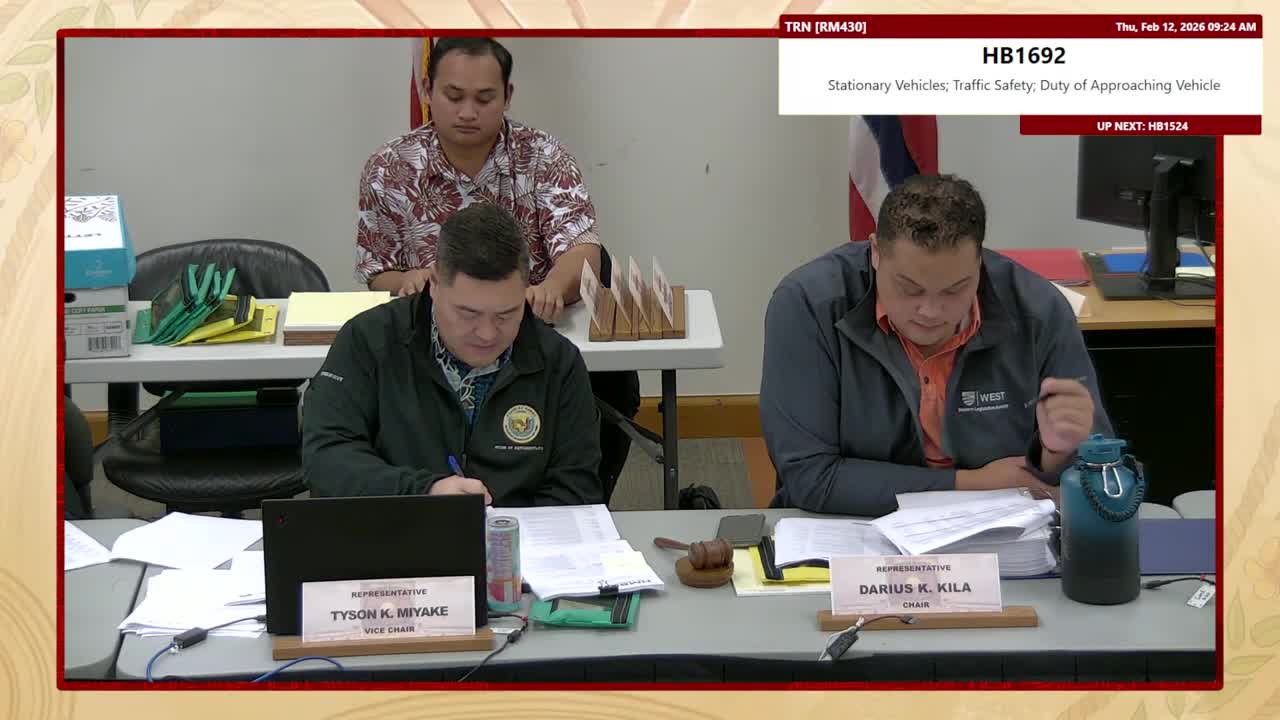 6MIN
House Standing Committee on Transportation
Bill Author

Bill Co-Author(s):