HB 1979: Environmental Review; Affordable Housing Projects; Clean Energy Projects; Judicial Proceedings; Supreme Court; Appeals; Transfer
- Session Year: 2025-2026
- House: House
- Latest Version Date: 2026-03-06
Current Status:
Failed
(2026-03-20: The committee on AEN deferred the measure.)
Introduced
In Committee
First Chamber
In Committee
Second Chamber
Final Decking
Enacted
Shortens the period during which certain judicial proceedings involving environmental assessments and environmental impact statements on actions that propose the use of land for, or construction of, affordable housing or clean energy projects must be initiated. Specifies that appeals from environmental courts that involve actions that propose the use of land for, or construction of, affordable housing or clean energy projects meet one of the grounds for transfer to the Supreme Court. Effective 7/1/3000. (HD3)
Shortens the period during which certain judicial proceedings involving environmental assessments and environmental impact statements on actions that propose the use of land for, or construction of, affordable housing or clean energy projects must be initiated. Specifies that appeals from environmental courts that involve actions that propose the use of land for, or construction of, affordable housing or clean energy projects meet one of the grounds for transfer to the Supreme Court and prohibits any court from awarding attorneys' fees in these judicial proceedings. Effective 7/1/3000. (HD2)
Shortens the period for certain judicial proceedings involving environmental assessments and environmental impact statements on actions that propose the use of land for, or construction of, affordable housing or clean energy projects must be initiated. Specifies that appeals from environmental courts that involve actions that propose the use of land for, or construction of, affordable housing or clean energy projects meet one of the grounds for transfer to the Supreme Court and prohibits any court from awarding attorneys' fees in these judicial proceedings. Effective 7/1/3000. (HD1)
Shortens the period within which certain judicial proceedings involving environmental assessments and environmental impact statements for actions that propose the use of land for, or construction of, affordable housing or clean energy projects must be initiated. Requires judicial proceedings involving actions that propose the use of land for, or construction of, affordable housing or clean energy projects to be filed directly with the Supreme Court and prohibits the Supreme Court from awarding attorneys' fees in these judicial proceedings.
|
HOUSE OF REPRESENTATIVES |
H.B. NO. |
1979 |
|
THIRTY-THIRD LEGISLATURE, 2026 |
H.D. 3 |
|
|
STATE OF HAWAII |
|
|
|
|
|
|
|
|
||
|
|
||
A BILL FOR AN ACT
RELATING TO ENVIRONMENTAL REVIEW.
BE IT ENACTED BY THE LEGISLATURE OF THE STATE OF HAWAII:
SECTION 1. The legislature finds that the State faces urgent and interconnected challenges in achieving its clean energy goals and increasing the supply of affordable housing. The legislature further finds that environmental review under chapter 343, Hawaii Revised Statutes, plays an essential role in protecting the State's natural and cultural resources and ensuring informed public decision-making.
The legislature also finds that uncertainty and the threat of prolonged judicial challenges to environmental review determinations can delay projects and increase costs, particularly for affordable housing and clean energy projects that depend on time-sensitive financing and approvals. In some cases, projects become infeasible and are abandoned because challenges can extend for long periods, regardless of the project's merits.
Accordingly, this Act establishes clearer and more predictable timelines for certain judicial proceedings involving environmental assessments and environmental impact statements for actions that propose the use of land for, or construction of, affordable housing projects and clean energy projects, including by shortening the period within which specified challenges must be initiated and providing a more streamlined path for appellate review.
This Act does not eliminate or diminish environmental review requirements. Through these changes, this Act seeks to balance environmental stewardship with the urgent public need to accelerate renewable energy deployment and the development of affordable housing, while maintaining meaningful opportunities for public participation and accountability.
Accordingly, the purpose of this Act is to:
(1) Shorten the period during which certain judicial proceedings involving environmental assessments and environmental impact statements on actions that propose the use of land for, or construction of, affordable housing or clean energy projects must be initiated; and
(2) Specify that appeals from environmental courts that involve actions that propose the use of land for, or construction of, affordable housing or clean energy projects meet one of the grounds for transfer to the supreme court.
SECTION 2. Section 343-7, Hawaii Revised Statutes, is amended to read as follows:
"§343-7 Limitation of actions. (a)
Any judicial proceeding, the subject of which is the lack of assessment
required under section 343-5, shall be initiated within one hundred twenty days
of the agency's decision to carry out or approve the action[, or, if];
provided that if the judicial proceeding involves the lack of an assessment
required under section 343-5 for an action that proposes the use of land for,
or construction of, an affordable housing project or clean energy project, the
proceeding shall be initiated within thirty days of the agency's decision to
carry out or approve the action. If
a proposed action is undertaken without a formal determination by the agency
that a statement is or is not required, a judicial proceeding shall be
instituted within one hundred twenty days after the proposed action is started[.];
provided that if the proposed action is for the use of land for, or
construction of, an affordable housing project or clean energy project, the
judicial proceeding shall be instituted within thirty days after the proposed
action is started. The office, any
agency responsible for approval of the action, or the applicant shall be
adjudged an aggrieved party for the purposes of bringing judicial action under
this subsection. Others, by
environmental court action, may be adjudged aggrieved.
(b) Any judicial proceeding, the subject of which is the determination that a statement is required for a proposed action, shall be initiated within sixty days after the public has been informed of such determination pursuant to section 343-3. Any judicial proceeding, the subject of which is the determination that a statement is not required for a proposed action, shall be initiated within thirty days after the public has been informed of such determination pursuant to section 343-3. The applicant shall be adjudged an aggrieved party for the purposes of bringing judicial action under this subsection. Others, by environmental court action, may be adjudged aggrieved.
(c)
Any judicial proceeding, the subject of which is the acceptance or
nonacceptance of an environmental impact statement required under section
343-5, shall be initiated within sixty days after the public has been informed
pursuant to section 343-3 of the acceptance or nonacceptance of [such] the
statement[.]; provided that if the subject of the judicial proceeding
is the acceptance or nonacceptance of a statement for an action that proposes the
use of land for, or construction of, an affordable housing project or clean energy project, the
proceeding shall be initiated within thirty days after the public has been
informed pursuant to section 343-3 of the acceptance or nonacceptance of the
statement. Affected agencies and persons who provided
written comment to an accepted statement during the designated review period
shall be adjudged aggrieved parties for the purpose of bringing judicial action
under this subsection; provided that, for aggrieved parties, the
contestable issues shall be limited to issues identified and discussed in the
written comment, and for applicants bringing judicial action under this section
on the nonacceptance of a statement, the contestable issues shall be limited to
those issues identified by the accepting authority as the basis for
nonacceptance of the statement.
(d) An appeal from a decision of the environmental court that involves an action that proposes the use of land for, or construction of, an affordable housing project or clean energy project shall constitute a case involving a question of imperative or fundamental public importance under section 602-58(a)(1) for purposes of transferring the case to the supreme court pursuant to section 602-58.
(e) For the purposes of this section:
"Affordable housing project" means a housing project:
(1) As defined by the controlling law or ordinance governing a state or county agency proposing or approving an affordable housing project;
(2) In which the owner has executed a declaration of restrictive covenants or other legally binding agreement that ensures compliance with county affordable housing ordinances;
(3) Under county jurisdiction pursuant to section 46-15.1 or that is subject to any county ordinance or funding that has an income restriction requirement; or
(4) In which the acquisition, financing, construction, development, redevelopment, repair, renovation, and occupancy have been directly facilitated by a state or county program.
"Affordable housing project" includes a housing project with ancillary on-site mixed uses and any necessary on-site or off-site infrastructure, and that satisfies at least one criterion under this definition.
"Clean energy project" means a project, facility, or installation that is primarily for the purpose of generating or producing energy using the following sources:
(1) Wind;
(2) The sun;
(3) Falling water;
(4) Geothermal; and
(5) Ocean water, currents, and waves, including ocean thermal energy conversion."
SECTION 3. Statutory material to be repealed is bracketed and stricken. New statutory material is underscored.
SECTION 4. This Act shall take effect on July 1, 3000.
Report Title:
Environmental Review; Affordable Housing Projects; Clean Energy Projects; Judicial Proceedings; Supreme Court; Appeals; Transfer
Description:
Shortens the period during which certain judicial proceedings involving environmental assessments and environmental impact statements on actions that propose the use of land for, or construction of, affordable housing or clean energy projects must be initiated. Specifies that appeals from environmental courts that involve actions that propose the use of land for, or construction of, affordable housing or clean energy projects meet one of the grounds for transfer to the Supreme Court. Effective 7/1/3000. (HD3)
The summary description of legislation appearing on this page is for informational purposes only and is not legislation or evidence of legislative intent.
|
HOUSE OF REPRESENTATIVES |
H.B. NO. |
1979 |
|
THIRTY-THIRD LEGISLATURE, 2026 |
H.D. 2 |
|
|
STATE OF HAWAII |
|
|
|
|
|
|
|
|
||
|
|
||
A BILL FOR AN ACT
RELATING TO ENVIRONMENTAL REVIEW.
BE IT ENACTED BY THE LEGISLATURE OF THE STATE OF HAWAII:
SECTION 1. The legislature finds that the State faces urgent and interconnected challenges in achieving its clean energy goals and increasing the supply of affordable housing. The legislature further finds that environmental review under chapter 343, Hawaii Revised Statutes, plays an essential role in protecting the State's natural and cultural resources and ensuring informed public decision-making.
The legislature also finds that uncertainty and the threat of prolonged judicial challenges to environmental review determinations can delay projects and increase costs, particularly for affordable housing and clean energy projects that depend on time-sensitive financing and approvals. In some cases, projects become infeasible and are abandoned because challenges can extend for long periods, regardless of the project's merits.
Accordingly, this Act establishes clearer and more predictable timelines for certain judicial proceedings involving environmental assessments and environmental impact statements for actions that propose the use of land for, or construction of, affordable housing projects and clean energy projects, including by shortening the period within which specified challenges must be initiated and providing a more streamlined path for appellate review.
This Act does not eliminate or diminish environmental review requirements. Through these changes, this Act seeks to balance environmental stewardship with the urgent public need to accelerate renewable energy deployment and the development of affordable housing, while maintaining meaningful opportunities for public participation and accountability.
Accordingly, the purpose of this Act is to:
(1) Shorten the period during which certain judicial proceedings involving environmental assessments and environmental impact statements on actions that propose the use of land for, or construction of, affordable housing or clean energy projects must be initiated; and
(2) Specify that appeals from environmental courts that involve actions that propose the use of land for, or construction of, affordable housing or clean energy projects meet one of the grounds for transfer to the Supreme Court and prohibits any court from awarding attorneys' fees in these judicial proceedings.
SECTION 2. Section 343-7, Hawaii Revised Statutes, is amended to read as follows:
"§343-7 Limitation of actions[.];
attorneys' fees. (a) Any judicial proceeding, the subject of which
is the lack of assessment required under section 343-5, shall be initiated
within one hundred twenty days of the agency's decision to carry out or approve
the action[, or, if]; provided that if the judicial proceeding
involves the lack of an assessment required under section 343-5 for an action
that proposes the use of land for, or construction of, an affordable housing
project or clean energy project, the proceeding shall be initiated within
thirty days of the agency's decision to carry out or approve the action. If a proposed action is undertaken
without a formal determination by the agency that a statement is or is not
required, a judicial proceeding shall be instituted within one hundred twenty
days after the proposed action is started[.]; provided that if the
proposed action is for the use of land for, or construction of, an affordable
housing or clean energy project, the judicial proceeding shall be instituted
within thirty days after the proposed action is started. The office, any agency responsible for
approval of the action, or the applicant shall be adjudged an aggrieved party
for the purposes of bringing judicial action under this subsection. Others, by environmental court action, may be
adjudged aggrieved.
(b) Any judicial proceeding, the subject of which is the determination that a statement is required for a proposed action, shall be initiated within sixty days after the public has been informed of such determination pursuant to section 343-3. Any judicial proceeding, the subject of which is the determination that a statement is not required for a proposed action, shall be initiated within thirty days after the public has been informed of such determination pursuant to section 343-3. The applicant shall be adjudged an aggrieved party for the purposes of bringing judicial action under this subsection. Others, by environmental court action, may be adjudged aggrieved.
(c)
Any judicial proceeding, the subject of which is the acceptance or
nonacceptance of an environmental impact statement required under section
343-5, shall be initiated within sixty days after the public has been informed
pursuant to section 343-3 of the acceptance or nonacceptance of such statement[.];
provided that if the subject of the judicial proceeding is the acceptance or
nonacceptance of a statement for an action that proposes the use
of land for, or construction of, an
affordable housing project or clean energy project, the proceeding shall be
initiated within thirty days after the public has been informed pursuant to
section 343-3 of the acceptance or nonacceptance of the statement.
Affected agencies and persons who provided written comment to an
accepted statement during the designated review period shall be adjudged
aggrieved parties for the purpose of bringing judicial action under this
subsection; provided that for aggrieved parties, the contestable issues shall
be limited to issues identified and discussed in the written comment, and for
applicants bringing judicial action under this section on the nonacceptance of
a statement, the contestable issues shall be limited to those issues identified
by the accepting authority as the basis for nonacceptance of the statement.
(d) An appeal from a decision of the environmental court that involves an action that proposes the use of land for, or construction of, an affordable housing or clean energy project shall constitute a case involving a question of imperative or fundamental public importance under section 602-58(a)(1) for purposes of transferring the case to the supreme court pursuant to section 602-58.
(e) No court shall award attorneys' fees in a judicial proceeding initiated pursuant to this section that involves an action that proposes the use of land for, or construction of, an affordable housing project or clean energy project.
(f) For the purposes of this section:
"Affordable housing project" means a housing project:
(1) As defined by the controlling law or ordinance governing a state or county agency proposing or approving an affordable housing project;
(2) In which the owner has executed a declaration of restrictive covenants or other legally binding agreement that ensures compliance with county affordable housing ordinances;
(3) Under county jurisdiction pursuant to section 46-15.1 or that is subject to any county ordinance or funding that has an income restriction requirement; or
(4) In which the acquisition, financing, construction, development, redevelopment, repair, renovation, and occupancy have been directly facilitated by a state or county program.
"Affordable housing project" includes a housing project with ancillary on-site mixed uses and any necessary on-site or off-site infrastructure, and that satisfies at least one criterion under this definition.
"Clean energy project" means a project, facility, or installation that is primarily for the purpose of generating or producing energy using the following sources:
(1) Wind;
(2) Sun;
(3) Falling water;
(4) Geothermal; and
(5) Ocean water, currents, and waves, including ocean thermal energy conversion."
SECTION 3. Statutory material to be repealed is bracketed and stricken. New statutory material is underscored.
SECTION 4. This Act shall take effect on July 1, 3000.
Report Title:
Environmental Review; Clean Energy Projects; Affordable Housing Projects; Judicial Proceedings; Supreme Court; Appeals; Transfer; Attorneys' Fees
Description:
Shortens the period during which certain judicial proceedings involving environmental assessments and environmental impact statements on actions that propose the use of land for, or construction of, affordable housing or clean energy projects must be initiated. Specifies that appeals from environmental courts that involve actions that propose the use of land for, or construction of, affordable housing or clean energy projects meet one of the grounds for transfer to the Supreme Court and prohibits any court from awarding attorneys' fees in these judicial proceedings. Effective 7/1/3000. (HD2)
The summary description of legislation appearing on this page is for informational purposes only and is not legislation or evidence of legislative intent.
|
HOUSE OF REPRESENTATIVES |
H.B. NO. |
1979 |
|
THIRTY-THIRD LEGISLATURE, 2026 |
H.D. 1 |
|
|
STATE OF HAWAII |
|
|
|
|
|
|
|
|
||
|
|
||
A BILL FOR AN ACT
RELATING TO ENVIRONMENTAL REVIEW.
BE IT ENACTED BY THE LEGISLATURE OF THE STATE OF HAWAII:
SECTION 1. Section 343-7, Hawaii Revised Statutes, is amended to read as follows:
"§343-7 Limitation of actions[.];
attorneys' fees. (a) Any judicial proceeding, the subject of which
is the lack of assessment required under section 343-5, shall be initiated
within one hundred twenty days of the agency's decision to carry out or approve
the action[, or, if]; provided that if the judicial proceeding
involves the lack of an assessment required under section 343-5 for an action
that proposes the use of land for, or construction of, an affordable housing
project or clean energy project, the proceeding shall be initiated within
thirty days of the agency's decision to carry out or approve the action. If a proposed action is undertaken
without a formal determination by the agency that a statement is or is not
required, a judicial proceeding shall be instituted within one hundred twenty
days after the proposed action is started[.]; provided that if the
proposed action is for the use of land for, or construction of, an affordable
housing or clean energy project, the judicial proceeding shall be instituted
within thirty days after the proposed action is started. The office, any agency responsible for
approval of the action, or the applicant shall be adjudged an aggrieved party
for the purposes of bringing judicial action under this subsection. Others, by environmental court action, may be
adjudged aggrieved.
(b) Any judicial proceeding, the subject of which is the determination that a statement is required for a proposed action, shall be initiated within sixty days after the public has been informed of such determination pursuant to section 343-3. Any judicial proceeding, the subject of which is the determination that a statement is not required for a proposed action, shall be initiated within thirty days after the public has been informed of such determination pursuant to section 343-3. The applicant shall be adjudged an aggrieved party for the purposes of bringing judicial action under this subsection. Others, by environmental court action, may be adjudged aggrieved.
(c)
Any judicial proceeding, the subject of which is the acceptance or
nonacceptance of an environmental impact statement required under section
343-5, shall be initiated within sixty days after the public has been informed
pursuant to section 343-3 of the acceptance or nonacceptance of such statement[.];
provided that if the subject of the judicial proceeding is the acceptance or
nonacceptance of a statement for an action that proposes the use
of land for, or construction of, an
affordable housing project or clean energy project, the proceeding shall be
initiated within thirty days after the public has been informed pursuant to
section 343-3 of the acceptance or nonacceptance of the statement.
Affected agencies and persons who provided written comment to an
accepted statement during the designated review period shall be adjudged
aggrieved parties for the purpose of bringing judicial action under this
subsection; provided that for aggrieved parties, the contestable issues shall
be limited to issues identified and discussed in the written comment, and for
applicants bringing judicial action under this section on the nonacceptance of
a statement, the contestable issues shall be limited to those issues identified
by the accepting authority as the basis for nonacceptance of the statement.
(d) An appeal from a decision of the environmental court that involves an action that proposes the use of land for, or construction of, an affordable housing or clean energy project shall constitute a case involving a question of imperative or fundamental public importance under section 602-58(a)(1) for purposes of transferring the case to the supreme court pursuant to section 602-58.
(e) No court shall award attorneys' fees in a judicial proceeding initiated pursuant to this section that involves an action that proposes the use of land for, or construction of, an affordable housing project or clean energy project.
(f) For the purposes of this section:
"Affordable housing project" means a housing project:
(1) As defined by the controlling law or ordinance governing a state or county agency proposing or approving an affordable housing project;
(2) In which the owner has executed a declaration of restrictive covenants or other legally binding agreement that ensures compliance with county affordable housing ordinances;
(3) Under county jurisdiction pursuant to section 46-15.1 or that is subject to any county ordinance or funding that has an income restriction requirement; or
(4) In which the acquisition, financing, construction, development, redevelopment, repair, renovation, and occupancy have been directly facilitated by a state or county program.
"Clean energy project" means a project, facility, or installation that is primarily for the purpose of generating or producing energy using the following sources:
(1) Wind;
(2) Sun;
(3) Falling water;
(4) Geothermal; and
(5) Ocean water, currents, and waves, including ocean thermal energy conversion."
SECTION 2. Statutory material to be repealed is bracketed and stricken. New statutory material is underscored.
SECTION 3. This Act shall take effect on July 1, 3000.
Report Title:
Environmental Review; Clean Energy Projects; Affordable Housing Projects; Judicial Proceedings; Supreme Court; Appeals; Transfer; Attorneys' Fees
Description:
Shortens the period for certain judicial proceedings involving environmental assessments and environmental impact statements on actions that propose the use of land for, or construction of, affordable housing or clean energy projects must be initiated. Specifies that appeals from environmental courts that involve actions that propose the use of land for, or construction of, affordable housing or clean energy projects meet one of the grounds for transfer to the Supreme Court and prohibits any court from awarding attorneys' fees in these judicial proceedings. Effective 7/1/3000. (HD1)
The summary description of legislation appearing on this page is for informational purposes only and is not legislation or evidence of legislative intent.
|
HOUSE OF REPRESENTATIVES |
H.B. NO. |
1979 |
|
THIRTY-THIRD LEGISLATURE, 2026 |
|
|
|
STATE OF HAWAII |
|
|
|
|
|
|
|
|
||
|
|
||
A BILL FOR AN ACT
relating to ENVIRONMENTAL REVIEW.
BE IT ENACTED BY THE LEGISLATURE OF THE STATE OF HAWAII:
SECTION 1. Section 343-7, Hawaii Revised Statutes, is amended to read as follows:
"§343-7 Limitation of actions[.]; attorneys'
fees. (a) Any judicial proceeding, the subject of which
is the lack of assessment required under section 343-5, shall be initiated
within one hundred twenty days of the agency's decision to carry out or approve
the action[, or, if]; provided that if the judicial proceeding
involves the lack of an assessment required under section 343-5 for an action
that proposes the use of land for, or construction of, an affordable housing project
or clean energy project, the proceeding shall be initiated within thirty days
of the agency's decision to carry out or approve the action. If a proposed action is undertaken
without a formal determination by the agency that a statement is or is not
required, a judicial proceeding shall be instituted within one hundred twenty
days after the proposed action is started[.]; provided that if the proposed
action is for the use of land for, or construction of, an affordable housing or
clean energy project, the judicial proceeding shall be instituted within thirty
days after the proposed action is started.
The office, any agency responsible for approval of the action, or the
applicant shall be adjudged an aggrieved party for the purposes of bringing
judicial action under this subsection.
Others, by environmental court action, may be adjudged aggrieved.
(b) Any judicial proceeding, the subject of which is the determination that a statement is required for a proposed action, shall be initiated within sixty days after the public has been informed of such determination pursuant to section 343-3. Any judicial proceeding, the subject of which is the determination that a statement is not required for a proposed action, shall be initiated within thirty days after the public has been informed of such determination pursuant to section 343-3. The applicant shall be adjudged an aggrieved party for the purposes of bringing judicial action under this subsection. Others, by environmental court action, may be adjudged aggrieved.
(c)
Any judicial proceeding, the subject of which is the acceptance or
nonacceptance of an environmental impact statement required under section
343-5, shall be initiated within sixty days after the public has been informed
pursuant to section 343-3 of the acceptance or nonacceptance of such statement[.];
provided that if the subject of the judicial proceeding is the acceptance or
nonacceptance of a statement for an action that proposes the use
of land for, or construction of, an
affordable housing project or clean energy project, the proceeding shall be
initiated within thirty days after the public has been informed pursuant to
section 343-3 of the acceptance or nonacceptance of the statement.
Affected agencies and persons who provided written comment to an
accepted statement during the designated review period shall be adjudged
aggrieved parties for the purpose of bringing judicial action under this subsection;
provided that for aggrieved parties, the contestable issues shall be limited to
issues identified and discussed in the written comment, and for applicants
bringing judicial action under this section on the nonacceptance of a
statement, the contestable issues shall be limited to those issues identified
by the accepting authority as the basis for nonacceptance of the statement.
(d) Any judicial proceeding initiated pursuant to this section that involves an action that proposes the use of land for, or construction of, an affordable housing or clean energy project shall be filed directly with the supreme court, which shall have original jurisdiction over the proceeding.
(e) The supreme court shall be prohibited from awarding attorneys' fees in a judicial proceeding initiated pursuant to this section that involves an action that proposes the use of land for, or construction of, an affordable housing project or clean energy project.
(f) For the purposes of this section:
"Affordable housing project" means a housing project:
(1) As defined by the controlling law or ordinance governing a state or county agency proposing or approving an affordable housing project;
(2) In which the owner has executed a declaration of restrictive covenants or other legally binding agreement that ensures compliance with county affordable housing ordinances;
(3) Under county jurisdiction pursuant to section 46-15.1 or that is subject to any county ordinance or funding that has an income restriction requirement; or
(4) In which the acquisition, financing, construction, development, redevelopment, repair, renovation, and occupancy has been directly facilitated by a state or county program.
"Clean energy project" means a project, facility, or installation that is primarily for the purpose of generating or producing energy using the following sources:
(1) Wind;
(2) Sun;
(3) Falling water;
(4) Geothermal; and
(5) Ocean water, currents, and waves, including ocean thermal energy conversion."
SECTION 2. Statutory material to be repealed is bracketed and stricken. New statutory material is underscored.
SECTION 3. This Act shall take effect upon its approval.
|
INTRODUCED BY: |
_____________________________ |
|
|
|
Report Title:
Environmental Review; Clean Energy Projects; Affordable Housing Projects; Judicial Proceedings; Supreme Court; Attorneys' Fees
Description:
Shortens the period within which certain judicial proceedings involving environmental assessments and environmental impact statements for actions that propose the use of land for, or construction of, affordable housing or clean energy projects must be initiated. Requires judicial proceedings involving actions that propose the use of land for, or construction of, affordable housing or clean energy projects to be filed directly with the Supreme Court and prohibits the Supreme Court from awarding attorneys' fees in these judicial proceedings.
The summary description of legislation appearing on this page is for informational purposes only and is not legislation or evidence of legislative intent.
|
Date
|
Status
|
|---|---|
| Mar 20, 2026 | The committee on AEN deferred the measure. |
| Mar 20, 2026 | The committee on WLA deferred the measure. |
| Mar 20, 2026 | The committee on EIG deferred the measure. |
| Mar 17, 2026 | The committee(s) on AEN/WLA/EIG has scheduled a public hearing on 03-20-26 1:00PM; Conference Room 224 & Videoconference. |
| Mar 12, 2026 | Referred to AEN/WLA/EIG, JDC. |
| Mar 12, 2026 | Passed First Reading. |
| Mar 12, 2026 | Received from House (Hse. Com. No. 333). |
| Mar 10, 2026 | Passed Third Reading as amended in HD 3 with Representative(s) Shimizu voting aye with reservations; Representative(s) Amato, Cochran, Grandinetti, Hussey, Iwamoto, Perruso, Poepoe voting no (7) and none excused (0). Transmitted to Senate. |
| Mar 6, 2026 | Forty-eight (48) hours notice Tuesday, 03-10-26. |
| Mar 6, 2026 | Reported from JHA (Stand. Com. Rep. No. 1204-26) as amended in HD 3, recommending passage on Third Reading. |
| Mar 5, 2026 | The committee on JHA recommend that the measure be PASSED, WITH AMENDMENTS. The votes were as follows: 5 Ayes: Representative(s) Tarnas, Kahaloa, Takayama; Ayes with reservations: Representative(s) Garcia, Shimizu; 2 Noes: Representative(s) Poepoe, Cochran; and 3 Excused: Representative(s) Belatti, Hashem, Sayama. |
| Mar 3, 2026 | Bill scheduled to be heard by JHA on Thursday, 03-05-26 2:00PM in House conference room 325 VIA VIDEOCONFERENCE. |
| Feb 19, 2026 | Report adopted; referred to the committee(s) on JHA as amended in HD 2 with Representative(s) Amato, Cochran, Garcia, Muraoka, Perruso, Poepoe voting aye with reservations; none voting no (0) and none excused (0). |
| Feb 19, 2026 | Reported from HSG (Stand. Com. Rep. No. 580-26) as amended in HD 2, recommending referral to JHA. |
| Feb 13, 2026 | The committee on HSG recommend that the measure be PASSED, WITH AMENDMENTS. The votes were as follows: 9 Ayes: Representative(s) Evslin, Miyake, Kila, Kitagawa, La Chica, Pierick; Ayes with reservations: Representative(s) Cochran, Grandinetti, Muraoka; Noes: none; and Excused: none. |
| Feb 10, 2026 | Bill scheduled to be heard by HSG on Friday, 02-13-26 9:00AM in House conference room 430 VIA VIDEOCONFERENCE. |
| Feb 5, 2026 | Passed Second Reading as amended in HD 1 and referred to the committee(s) on HSG with none voting aye with reservations; none voting no (0) and Representative(s) Woodson excused (1). |
| Feb 5, 2026 | Reported from EEP (Stand. Com. Rep. No. 28-26) as amended in HD 1, recommending passage on Second Reading and referral to HSG. |
| Feb 3, 2026 | The committee on EEP recommend that the measure be PASSED, WITH AMENDMENTS. The votes were as follows: 7 Ayes: Representative(s) Lowen, Perruso, Chun, Kahaloa, Kusch, Quinlan, Matsumoto; Ayes with reservations: none; Noes: none; and Excused: none. |
| Jan 30, 2026 | Bill scheduled to be heard by EEP on Tuesday, 02-03-26 9:30AM in House conference room 325 VIA VIDEOCONFERENCE. |
| Jan 28, 2026 | Referred to EEP, HSG, JHA, referral sheet 3 |
| Jan 26, 2026 | Introduced and Pass First Reading. |
| Jan 23, 2026 | Pending introduction. |
|
Date
|
Description
|
Location
|
Votes
|
|
|---|---|---|---|---|
| Mar 10, 2026 | Third Reading | House Floor |
Passed |
|
| Mar 5, 2026 | The committee on JHA recommend that the measure be PASSED, WITH AMENDMENTS | House Standing Committee on Judiciary & Hawaiian Affairs |
Passed |
|
| Feb 13, 2026 | The committee on HSG recommend that the measure be PASSED, WITH AMENDMENTS | House Standing Committee on Housing |
Passed |
|
| Feb 3, 2026 | The committee on EEP recommend that the measure be PASSED, WITH AMENDMENTS | House Standing Committee on Energy & Environmental Protection |
Passed |
This list shows positions taken on this bill by organizations on the date displayed, which is linked to the original source.
Positions by individuals are not included.
|
Organization
|
Position
|
Date
|
|---|---|---|
| 350Hawaii.org | *** Against | Mar 5, 2026 |
| Avalon Development Company LLC | ** Support | |
| Earthjustice, Mid‑Pacific Office | *** Against | Mar 5, 2026 |
| Hawaii Community Development Authority | ** Support | |
| Hawaii's Thousand Friends | *** Against | Mar 5, 2026 |
| KahuPuna | *** Against | Mar 5, 2026 |
| Kauaʻi Island Utility Cooperative | ** Support | |
| Lauae kekahuna ʻO Makuʻu ke kahua | *** Against | Mar 5, 2026 |
| Maui Chamber of Commerce | ** Support | |
| Na Wai Ho'ola Nui La'au Lapa'au Foundation | *** Against | Mar 5, 2026 |
| Na Wai Hoʻola Nui Laʻau Lapaʻau Foundation & Truth for the People | ** Against | |
| Na Wai Ho’ola Nui La’au Lapa’au Foundation | *** Against | Feb 12, 2026 |
| The Outdoor Circle | ** Against | |
| The Judiciary, State of Hawaiʻi | *** Against | Feb 3, 2026 |
| Truth for the People | *** Against | Mar 5, 2026 |
STAND. COM. REP. NO. 1204-26
Honolulu, Hawaii
, 2026
RE: H.B. No. 1979
H.D. 3
Honorable Nadine K. Nakamura
Speaker, House of Representatives
Thirty-Third State Legislature
Regular Session of 2026
State of Hawaii
Madame:
Your Committee on Judiciary & Hawaiian Affairs, to which was referred H.B. No. 1979, H.D. 2, entitled:
"A BILL FOR AN ACT RELATING TO ENVIRONMENTAL REVIEW,"
begs leave to report as follows:
The purpose of this measure is to:
(1) Shorten the period during which certain judicial proceedings involving environmental assessments and environmental impact statements on actions that propose the use of land for, or construction of, affordable housing or clean energy projects must be initiated; and
(2) Specify that appeals from environmental courts that involve actions that propose the use of land for, or construction of, affordable housing or clean energy projects meet one of the grounds for transfer to the Hawaii Supreme Court and prohibits any court from awarding attorneys' fees in these judicial proceedings.
Your Committee received testimony in support of this measure from the Kauaʻi Island Utility Cooperative; Maui Chamber of Commerce; and Avalon Development Company LLC. Your Committee received testimony in opposition to this measure from KahuPuna; 350Hawaii.org; Na Wai Hoʻola Nui Laʻau Lapaʻau Foundation; ʻO Makuʻu ke kahua; Earthjustice; Hawaii's Thousand Friends; and eight individuals. Your Committee received comments on this measure from the Office of Planning and Sustainable Development and Office of Hawaiian Affairs.
Your Committee finds that environmental review is a critical safeguard for protecting natural and cultural resources and ensuring informed public decision-making. Your Committee further finds that prolonged uncertainty and extended judicial proceedings can delay or prevent the timely development of affordable housing and clean energy projects that serve urgent public needs. Establishing clearer and more predictable timelines for judicial review, while preserving substantive environmental protections and public participation, promotes regulatory certainty and supports the State's clean energy and housing goals.
Your Committee has amended this measure by:
(1) Deleting language that would have prohibited courts from awarding attorneys' fees in a judicial proceeding initiated pursuant to this measure; and
(2) Making technical, nonsubstantive amendments for the purposes of clarity, consistency, and style.
As affirmed by the record of votes of the members of your Committee on Judiciary & Hawaiian Affairs that is attached to this report, your Committee is in accord with the intent and purpose of H.B. No. 1979, H.D. 2, as amended herein, and recommends that it pass Third Reading in the form attached hereto as H.B. No. 1979, H.D. 3.
Respectfully submitted on behalf of the members of the Committee on Judiciary & Hawaiian Affairs,
|
|
|
____________________________ DAVID A. TARNAS, Chair |
STAND. COM. REP. NO. 580-26
Honolulu, Hawaii
, 2026
RE: H.B. No. 1979
H.D. 2
Honorable Nadine K. Nakamura
Speaker, House of Representatives
Thirty-Third State Legislature
Regular Session of 2026
State of Hawaii
Madame:
Your Committee on Housing, to which was referred H.B. No. 1979, H.D. 1, entitled:
"A BILL FOR AN ACT RELATING TO ENVIRONMENTAL REVIEW,"
begs leave to report as follows:
The purpose of this measure is to:
(1) Shorten the period by which certain judicial proceedings involving environmental assessments and environmental impact statements on actions that propose the use of land for, or construction of, affordable housing or clean energy projects must be initiated; and
(2) Specify that appeals from environmental courts that involve actions that propose the use of land for, or construction of, affordable housing or clean energy projects meet one of the grounds for transfer to the Supreme Court and prohibits any court from awarding attorneys' fees in these judicial proceedings.
Your Committee received testimony in support of this measure from the Kauaʻi Island Utility Cooperative; Avalon Development Company LLC; and one individual. Your Committee received testimony in opposition to this measure from The Outdoor Circle; 350Hawaii.org; Na Wai Hoʻola Nui Laʻau Lapaʻau Foundation & Truth for the People; and one individual. Your Committee received comments on this measure from the Office of Planning and Sustainable Development; Hawaii Community Development Authority; and Earth Justice.
Your Committee finds that delays and uncertainty in judicial challenges to environmental determinations create barriers for affordable housing and clean energy projects, which already face tight financing timelines and high development risks. Your Committee further finds that protracted litigation windows can stall or derail projects even after environmental review is completed, increasing costs and limiting the State's ability to meet housing and renewable energy goals. This measure promotes fairness, certainty, and the ability to deliver housing and clean energy projects that serve the public interest.
Your Committee has amended this measure by:
(1) Inserting a preamble;
(2) Clarifying the definition of "affordable housing project" to includes a housing project with ancillary on-site mixed uses and any necessary on- or off-site infrastructure; and
(3) Making technical, nonsubstantive amendments for the purposes of clarity, consistency, and style.
Your Committee notes the concern that prohibiting the award of attorneys' fees may be unnecessarily punitive and that prohibiting such awards will not effectively dissuade challenges but may unduly penalize those who have legitimate and successful claims.
As affirmed by the record of votes of the members of your Committee on Housing that is attached to this report, your Committee is in accord with the intent and purpose of H.B. No. 1979, H.D. 1, as amended herein, and recommends that it be referred to your Committee on Judiciary & Hawaiian Affairs in the form attached hereto as H.B. No. 1979, H.D. 2.
Respectfully submitted on behalf of the members of the Committee on Housing,
|
|
|
____________________________ LUKE A. EVSLIN, Chair |
|
|
|
|
STAND. COM. REP. NO. 28-26
Honolulu, Hawaii
, 2026
RE: H.B. No. 1979
H.D. 1
Honorable Nadine K. Nakamura
Speaker, House of Representatives
Thirty-Third State Legislature
Regular Session of 2026
State of Hawaii
Madame:
Your Committee on Energy & Environmental Protection, to which was referred H.B. No. 1979 entitled:
"A BILL FOR AN ACT RELATING TO ENVIRONMENTAL REVIEW,"
begs leave to report as follows:
The purpose of this measure is to:
(1) Shorten the period for certain judicial proceedings involving environmental assessments and environmental impact statements on actions that propose the use of land for, or construction of, affordable housing or clean energy projects must be initiated; and
(2) Require judicial proceedings involving actions that propose the use of land for, or construction of, affordable housing or clean energy projects to be filed directly with the Supreme Court and prohibit the Supreme Court from awarding attorneys' fees in these judicial proceedings.
Your Committee received testimony in support of this measure from the Hawaii Community Development Authority; Kauaʻi Island Utility Cooperative; and five individuals. Your Committee received testimony in opposition to this measure from the Judiciary; 350Hawaii.org; The Outdoor Circle; Truth For the People; and numerous individuals. Your Committee received comments on this measure from the Office of Planning and Sustainable Development and Earthjustice.
Your Committee finds that promoting affordable housing and clean energy development is a major priority for the State and that judicial proceedings can significantly delay these projects. Your Committee recognizes the need to promote procedural efficiency so that any legal challenges to these projects can be brought and decided in a timely manner. This measure seeks to enhance judicial efficiency by establishing stricter time limits for the initiation of judicial proceedings and expedited appeals processes for cases involving environmental assessments and environmental impact statements for certain affordable housing and clean energy projects.
Your Committee has amended this measure by:
(1) Specifying that decisions involving these specific actions that are appealed from environmental courts meet one of the grounds for transfer to the Supreme Court, rather than providing the Supreme Court original jurisdiction;
(2) Changing the effective date to July 1, 3000, to encourage further discussion; and
(3) Making a technical, nonsubstantive amendment for the purposes of clarity, consistency, and style.
Your Committee notes the testimony from the Hawaii Community Development Authority recommending an amendment to the definition of "affordable housing project" to include certain ancillary uses and on-site or off-site infrastructure and requests your Committee on Housing to consider these amendments.
As affirmed by the record of votes of the members of your Committee on Energy & Environmental Protection that is attached to this report, your Committee is in accord with the intent and purpose of H.B. No. 1979, as amended herein, and recommends that it pass Second Reading in the form attached hereto as H.B. No. 1979, H.D. 1, and be referred to your Committee on Housing.
Respectfully submitted on behalf of the members of the Committee on Energy & Environmental Protection,
|
|
|
____________________________ NICOLE E. LOWEN, Chair |
|
|
|
|
|
Date
|
Testimony PDF
|
|---|---|
| Mar 20, 2026 | HB1979_HD3_TESTIMONY_AEN-WLA-EIG_03-20-26_.PDF |
| Mar 5, 2026 | HB1979_HD2_TESTIMONY_JHA_03-05-26_.PDF |
| Feb 12, 2026 | HB1979_HD1_TESTIMONY_HSG_02-13-26_.PDF |
| Feb 3, 2026 | HB1979_TESTIMONY_EEP_02-03-26_.PDF |
Discussed in Hearing
 16MIN
Senate Standing Committee on Agriculture and Environment
16MIN
Senate Standing Committee on Economic Development and Tourism
16MIN
Senate Standing Committee on Energy and Intergovernmental Affairs
16MIN
Senate Standing Committee on Public Safety and Military Affairs
16MIN
Senate Standing Committee on Water, Land, Culture and the Arts
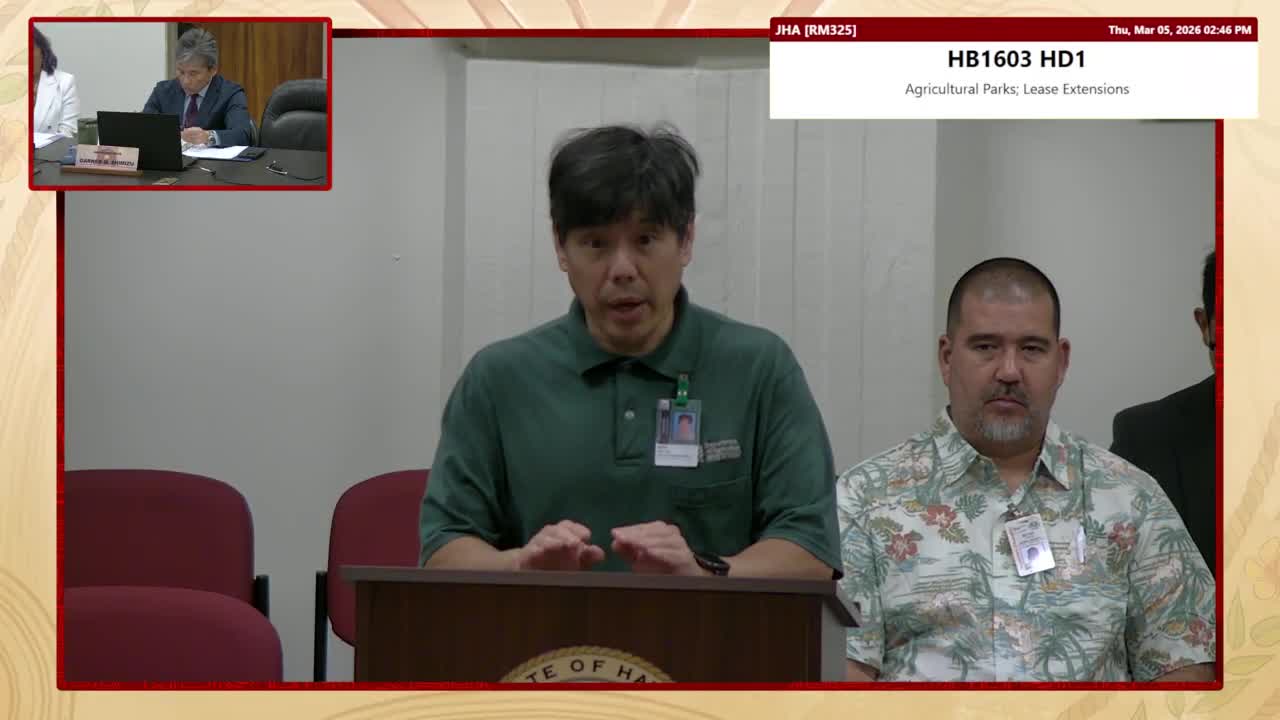 9MIN
House Standing Committee on Judiciary & Hawaiian Affairs
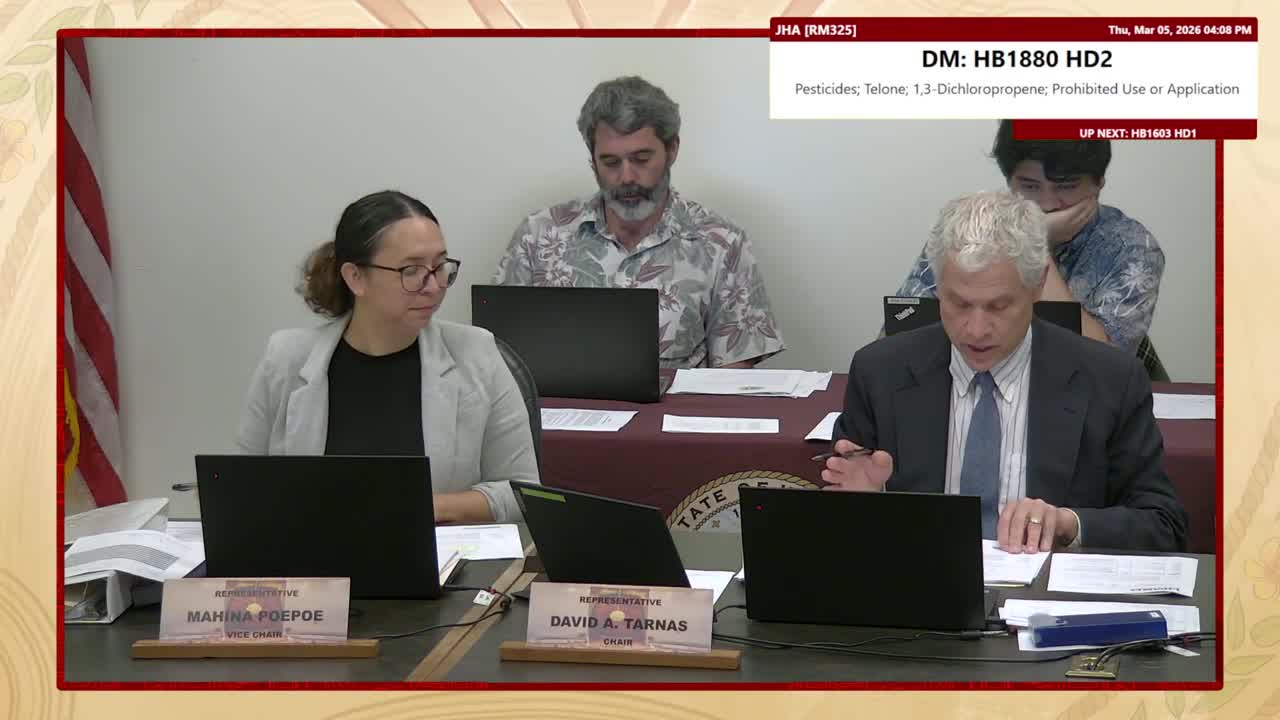 2MIN
House Standing Committee on Judiciary & Hawaiian Affairs
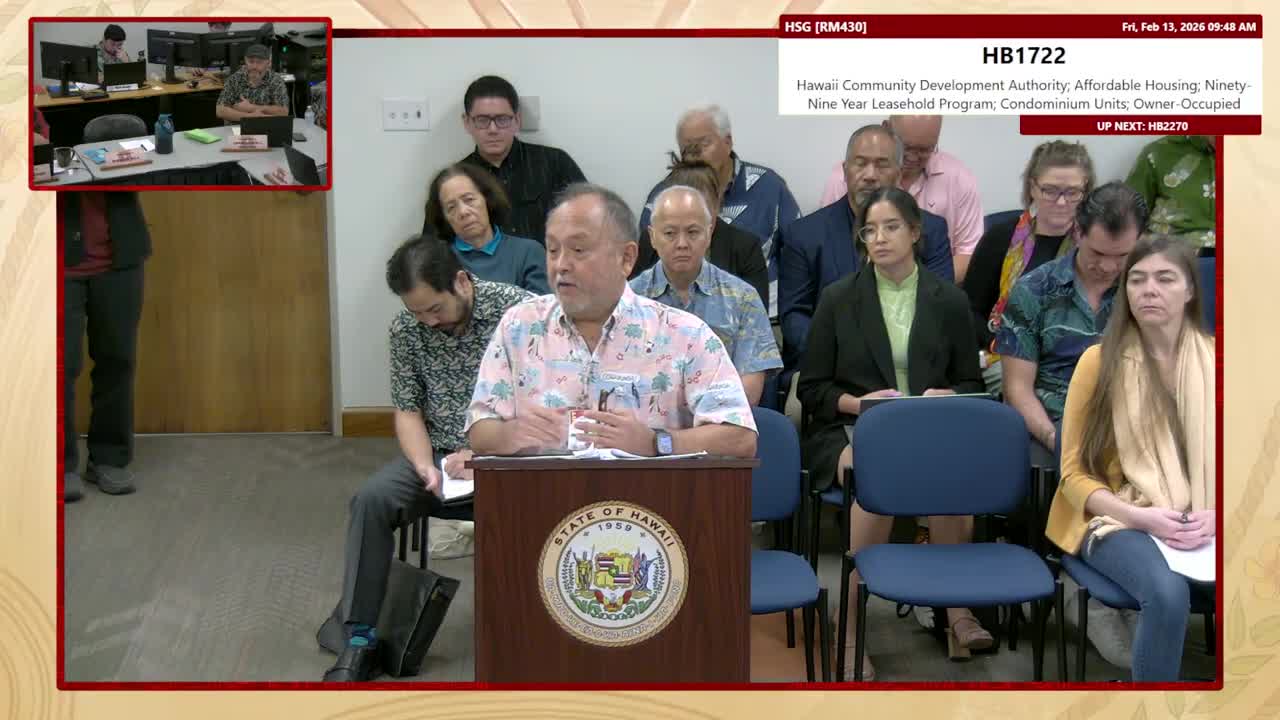 13MIN
House Standing Committee on Housing
Bill Author