HB 1840: DOE; HTSB; Charter Schools; Visiting International Educator Permit; Emergency Hires; Rules; Support
- Session Year: 2025-2026
- House: House
- Latest Version Date: 2026-03-25
Current Status:
Failed
(2026-04-16: Received notice of disagreement (Hse. Com. No. 599).)
Introduced
In Committee
First Chamber
In Committee
Second Chamber
Final Decking
Enacted
What does this bill do?
The bill lets the Hawaii Teacher Standards Board create a special visiting international educator permit that matches the length of an educator's J-1 exchange visa so temporary international teachers can teach for the duration of their exchange. It also lets the Department of Education and charter schools keep people without teaching licenses on emergency hire for up to five years (instead of three), requires the board to extend that limit during a declared state emergency, and requires the DOE to provide and mandate support and training for emergency hires in their fourth and fifth years to help them earn full teacher licenses.
The summary is provided by generative AI which can make mistakes. For original language, please view the details in the table below.
Requires the Hawaii Teacher Standards Board to develop an alternative pathway for a visiting international educator permit aligned to the duration of the educator's J-1 visa program. Permits the Department of Education and charter schools to hire unlicensed individuals as teachers on an emergency basis for five, rather than three, years. Requires HTSB to extend the five-year period in the case of a declared state of emergency. Requires the Department of Education to provide support to assist emergency hires in meeting the requirements of licensure and require the training be mandatory for emergency hires in their fourth and fifth years. Effective 7/31/2055. (SD1)
Permits the Department of Education and charter schools to hire unlicensed individuals as teachers on an emergency basis for five, rather than three, years. Requires the Hawaii Teacher Standards Board extend the five-year period in the case of a declared state of emergency. Establishes a graduation goal for the University of Hawaii and requires a report to the Legislature on the progress toward achieving that goal. Requires the Department of Education to provide training to assist emergency hires in passing the Praxis examination and require the training be mandatory for emergency hires in their fourth and fifth years as a condition of employment. Effective 7/1/3000. (HD2)
Requires the Hawaii Teacher Standards Board to develop an alternative pathway for a visiting international educator permit aligned to the duration of the educator's J-1 visa program. Repeals 6/30/2031. Effective 7/1/3000. (HD1)
Requires the Hawaii Teacher Standards Board to develop an alternative pathway for a visiting international educator permit aligned to the duration of the educator's J-1 visa program. Repeals 6/30/2031.
|
HOUSE OF REPRESENTATIVES |
H.B. NO. |
1840 |
|
THIRTY-THIRD LEGISLATURE, 2026 |
H.D. 2 |
|
|
STATE OF HAWAII |
S.D. 1 |
|
|
|
|
|
|
|
||
|
|
||
A BILL FOR AN ACT
RELATING TO EDUCATION.
BE IT ENACTED BY THE LEGISLATURE OF THE STATE OF HAWAII:
SECTION 1. The legislature finds that it is important for the State's schools to have enough teachers to create a stable and qualified teaching workforce that can maintain educational quality and improve academic outcomes for students across the State.
The legislature further finds that employing unlicensed individuals as teachers on an emergency basis offers a critical mechanism for schools to ensure every classroom, from kindergarten through grade twelve, is staffed by a dedicated educator. The existing emergency hiring policy was designed to address the ongoing chronic teacher shortage by allowing schools to utilize qualified individuals from diverse professional backgrounds and locations while those individuals work to attain teaching credentials.
To continue as educators on a non-emergency basis, prospective teachers must complete the appropriate undergraduate coursework, standardized tests, an accredited certification program, fieldwork, and successful teaching evaluations to earn their teaching credentials in the State within three years. The legislature recognizes, however, that many prospective teachers are not able to complete these requirements within the existing timeline. Completing a licensure program, which often includes student teaching and rigorous exams, while managing a full-time classroom workload is incredibly difficult. Under existing law, a teacher who is performing well in the classroom but has not completed each licensure requirement by the end of the third year as an emergency hire will be let go and replaced with a new, untrained recruit.
The legislature therefore finds that extending the term to five years for an unlicensed individual to be employed on an emergency basis while earning their teaching credentials will acknowledge the difficulty of the teachers' dual workloads and reduce the turnover of new teachers who are close to completing licensure requirements but need more time. Extending the emergency hiring timeline will also allow the education system to capitalize on the valuable experience an emergency hire has gained and circumvent the difficulties associated with vacant positions and employing a replacement as a long-term substitute or new hire. Furthermore, allowing for more time to complete a licensure program can help retain those teachers who are passionate about education but need additional time to attain licensure.
The legislature also finds that the current three-year timeline often hinders the ability of schools to maintain long-term classroom stability through consistent, uninterrupted instruction; foster stronger connections between educators, students, and the community; and provide ample time to allow emergency hires to complete the path to becoming licensed teachers. Granting emergency hires an additional two years to teach would provide for five years of continuous instruction at the same school. This extended term would facilitate stronger relationships within the school community, particularly by affording educators better opportunities to support struggling students. Additionally, studies indicate that teacher effectiveness significantly improves with experience and that teachers require up to five years to reach peak effectiveness. Forcing emergency hires to exit the classroom after only three years creates unnecessary disruption to student progress and a loss of valuable skill sets developed through on-the-job experience.
The legislature further finds that the J-1 visa program has been a resounding success, but the State's existing licensure rules limit the full potential of prospective international teachers participating in the J-1 visa program.
Accordingly, the purpose of this Act is to:
(1) Require the Hawaii teacher standards board to develop an alternative pathway for a visiting international educator permit aligned to the duration of the educator's J-1 visa program;
(2) Allow the department of education and charter schools to employ unlicensed individuals on an emergency basis for up to five years;
(3) Require the Hawaii teacher standards board to extend the five-year limitation in the case of a declared state of emergency; and
(4) Require the department of education to provide support to assist emergency hire teachers in meeting the requirements of licensure and require the training to be mandatory for certain emergency hire teachers.
SECTION 2. Section 302A-802, Hawaii Revised Statutes, is amended by amending subsection (c) to read as follows:
"(c) The board shall adopt policies, exempt from chapters 91 and 92, to initiate the following:
(1) Develop criteria allowing more individuals with trade or industry experience to teach in vocational, technical, and career pathway programs, and criteria for the issuance of permits allowing qualified individuals to teach when recommended by the superintendent or the commission, when appropriate. The department or the commission, when appropriate, shall be responsible for the review and acceptance of the relevant licenses, certificates, or other qualifications related to an individual's vocational, technical, or career pathway education-related experience that the department or the commission, when appropriate, deems necessary for a permit. The department or the commission, when appropriate, shall have the authority to waive the requirement of a bachelor's degree to teach in a vocation, technical, or career pathway education program;
(2) Develop a plan to accept teachers from any state as long as they have completed state-approved teacher education programs and pass relevant Hawaii teacher examinations or their equivalent;
(3) Clarify the requirements, on a state-by-state basis, for out-of-state licensed teachers to obtain a license in Hawaii;
(4) Develop a plan to facilitate licensing for those who intend to teach in Hawaii immersion programs, the island of Niihau, or any other extraordinary situation as defined by the superintendent or the superintendent's designee, or by the commission, when appropriate;
(5) Pursue full teacher license
reciprocity with all other states; [and]
(6) Develop a plan to
facilitate an optional certification for those who teach or intend to teach at
private schools[.]; and
(7) Develop an alternative pathway for a visiting international educator permit to promote cultural exchange between the State and foreign nations. The permit shall authorize a visiting international educator who agrees to come to the United States temporarily as a full-time teacher of record in an accredited primary or secondary school to teach all subjects and grade levels for which the educator is qualified and is employed by the department. A visiting international educator permit developed by the department shall remain valid for the duration necessary to complete the educator's participation in a visiting international educator exchange program."
SECTION 3. Section 302A-804, Hawaii Revised Statutes, is amended as follows:
1. By amending subsection (b) to read:
"(b) The department's powers and duties under this subpart shall be limited to:
(1) Hiring, except in emergency situations as described in this chapter, licensed teachers to teach in their fields of licensing;
(2) Reporting data annually to the board about the supply of, and demand for, teachers in department schools, including the identification of shortage areas, out‑of-field teaching assignments, number of classrooms without a licensed teacher for a quarter or more, numbers of teachers teaching out-of-field, numbers and types of courses and classes taught by out-of-field teachers, and numbers and types of students taught by out-of-field teachers;
(3) On an emergency and case-by-case basis, hiring unlicensed individuals; provided that:
(A) A list of the names, work sites, teaching assignments, and progress toward licensing of these individuals shall be reported to the board and any changes shall be updated on a monthly basis by the department;
(B) There are no properly licensed teachers for the specific assignments for which the individuals are being hired; and
(C) No individual [may]
shall be employed by the department on an emergency basis for more than [three]
five years; provided that in the case of a declaration of a state of
emergency pursuant to section 127A-14, the board, pursuant to its powers in
section 302A‑803(a)(18), [may] shall extend the [three-year]
five-year period by authorizing an extension to complete licensing
requirements. During this time, the
individual shall demonstrate active pursuit of licensing in each year of
employment;
(4) Submitting an annual report to the board documenting:
(A) The number of emergency hires in department schools by subject matter areas and by school;
(B) The reasons and duration of employment for the emergency hiring enumerated in subparagraph (A); and
(C) The department's efforts to address the shortages described in subparagraph (A); and
(5) Providing any other information requested by the board that is pertinent to its powers and duties."
2. By amending subsection (d) to read:
"(d) A charter school's powers and duties under this subpart shall be limited to:
(1) Except in emergency situations as described in this chapter, hiring licensed teachers to teach in their fields of licensing;
(2) On an emergency and case-by-case basis, hiring unlicensed individuals; provided that:
(A) A list of the names, work sites, teaching assignments, and progress toward licensing of these individuals shall be reported to the board and any changes shall be updated on a monthly basis by the charter schools;
(B) There are no properly licensed teachers for the specific assignments for which the individuals are being hired; and
(C) No individual [may]
shall be employed by the charter school on an emergency basis for more
than [three] five years; provided that in the case of a
declaration of a state of emergency pursuant to section 127A-14, the board,
pursuant to its powers in section 302A‑803(a)(18), [may] shall
extend the [three-year] five-year period by authorizing an
extension to complete licensing requirements.
During this time, the individual shall demonstrate active pursuit of
licensing in each year of employment;
(3) Submitting an annual report to the board documenting:
(A) The number of emergency hires in the charter school by subject matter areas;
(B) The reasons and duration of employment for the emergency hiring enumerated in subparagraph (A);
(C) The number of classrooms without a licensed teacher for a quarter or more;
(D) The number and type of courses and classes taught by out-of-field teachers; and
(E) The number and type of students taught by out-of-field teachers; and
(4) Providing any other information requested by the board that is pertinent to the charter school's powers and duties."
SECTION 4. (a) The department of education shall provide support to assist emergency hires in meeting requirements of teacher licensure. The support under this section shall be mandatory for an emergency hire in the individual's fourth and fifth years as an emergency hire.
(b) This section shall apply to all persons employed or hired as an emergency hire by the department of education after the effective date of this Act.
(c) For the purposes of this section, "emergency hire" means a person hired by the department of education pursuant to its authority under section 302A-804(b)(3), Hawaii Revised Statutes.
SECTION 5. Statutory material to be repealed is bracketed and stricken. New statutory material is underscored.
SECTION 6. This Act shall take effect on July 31, 2055; provided that on June 30, 2031, this Act shall be repealed and section 302A-804, Hawaii Revised Statutes, shall be reenacted in the form in which it read on the day prior to the effective date of this Act.
Report Title:
DOE; HTSB; Charter Schools; Visiting International Educator Permit; Emergency Hires; Rules; Support
Description:
Requires the Hawaii Teacher Standards Board to develop an alternative pathway for a visiting international educator permit aligned to the duration of the educator's J-1 visa program. Permits the Department of Education and charter schools to hire unlicensed individuals as teachers on an emergency basis for five, rather than three, years. Requires HTSB to extend the five-year period in the case of a declared state of emergency. Requires the Department of Education to provide support to assist emergency hires in meeting the requirements of licensure and require the training be mandatory for emergency hires in their fourth and fifth years. Effective 7/31/2055. (SD1)
The summary description of legislation appearing on this page is for informational purposes only and is not legislation or evidence of legislative intent.
|
HOUSE OF REPRESENTATIVES |
H.B. NO. |
1840 |
|
THIRTY-THIRD LEGISLATURE, 2026 |
H.D. 2 |
|
|
STATE OF HAWAII |
|
|
|
|
|
|
|
|
||
|
|
||
A BILL FOR AN ACT
RELATING TO EDUCATION.
BE IT ENACTED BY THE LEGISLATURE OF THE STATE OF HAWAII:
SECTION 1. The legislature finds that it is important for the State's schools to have enough teachers to create a stable and qualified teaching workforce that can maintain educational quality and improve academic outcomes for students across the State.
The legislature further finds that employing unlicensed individuals as teachers on an emergency basis offers a critical mechanism for schools to ensure every classroom, from kindergarten through grade twelve, is staffed by a dedicated educator. The existing emergency hiring policy was designed to address the ongoing chronic teacher shortage by allowing schools to utilize qualified individuals from diverse professional backgrounds and locations while those individuals work to attain teaching credentials.
To continue as educators on a non-emergency basis, prospective teachers must complete the appropriate undergraduate coursework, standardized tests, an accredited certification program, fieldwork, and successful teaching evaluations to earn their teaching credentials in the State within three years. However, the legislature recognizes that many prospective teachers are not able to complete these requirements within the existing timeline. Completing a licensure program, which often includes student teaching and rigorous exams, while managing a full-time classroom workload is incredibly difficult. Under existing law, a teacher who is performing well in the classroom but has not completed each licensure requirement by the end of the third year as an emergency hire will be let go and replaced with a new, untrained recruit.
The legislature therefore finds that extending the term to five years for an unlicensed individual to be employed on an emergency basis while earning the teaching credentials will acknowledge the difficulty of the teachers' dual workloads and reduce the turnover of new teachers who are close to completing licensure requirements but need more time. Extending the emergency hiring timeline will also allow the education system to capitalize on the valuable experience an emergency hire has gained and circumvent the difficulties associated with vacant positions and employing a replacement as a long-term substitute or new hire. Furthermore, allowing for more time to complete a licensure program can help retain those teachers who are passionate about education but need additional time to attain licensure.
The legislature also finds that the current three-year timeline often hinders the ability of schools to maintain long-term classroom stability through consistent, uninterrupted instruction; foster stronger connections between educators, students, and the community; and provide ample time to allow emergency hires to complete the path to becoming licensed teachers. Granting emergency hires an additional two years to teach would provide for five years of continuous instruction at the same school. This extended term would facilitate stronger relationships within the school community, particularly by affording educators better opportunities to support struggling students. Additionally, studies indicate that teacher effectiveness significantly improves with experience and that teachers require up to five years to reach peak effectiveness. Forcing emergency hires to exit the classroom after only three years creates unnecessary disruption to student progress and a loss of valuable skillsets developed through on-the-job experience.
Accordingly, the purpose of this Act is to:
(1) Allow the department of education and charter schools to employ unlicensed individuals on an emergency basis for up to five years;
(2) Require the Hawaii teachers standards board to extend the five year limitation in the case of a declared state of emergency;
(3) Establish a goal for the university of Hawaii to double the number of persons who graduate as newly licensed teachers; and
(4) Require the department of education to provide training to assist emergency hire teachers in passing the Praxis examination and require the training to be mandatory for certain emergency hire teachers.
SECTION 2. Section 302A-804, Hawaii Revised Statutes, is amended as follows:
1. By amending subsection (b) to read:
"(b) The department's powers and duties under this subpart shall be limited to:
(1) Hiring, except in emergency situations as described in this chapter, licensed teachers to teach in their fields of licensing;
(2) Reporting data annually to the board about the supply of, and demand for, teachers in department schools, including the identification of shortage areas, out‑of-field teaching assignments, number of classrooms without a licensed teacher for a quarter or more, numbers of teachers teaching out-of-field, numbers and types of courses and classes taught by out-of-field teachers, and numbers and types of students taught by out-of-field teachers;
(3) On an emergency and case-by-case basis, hiring unlicensed individuals; provided that:
(A) A list of the names, work sites, teaching assignments, and progress toward licensing of these individuals shall be reported to the board and any changes shall be updated on a monthly basis by the department;
(B) There are no properly licensed teachers for the specific assignments for which the individuals are being hired; and
(C) No individual [may]
shall be employed by the department on an emergency basis for more than [three]
five years; provided that in the case of a declaration of a state of
emergency pursuant to section 127A-14, the board, pursuant to its powers in
section 302A‑803(a)(18), [may] shall extend the [three-year]
five-year period by authorizing an extension to complete licensing
requirements. During this time, the
individual shall demonstrate active pursuit of licensing in each year of
employment;
(4) Submitting an annual report to the board documenting:
(A) The number of emergency hires in department schools by subject matter areas and by school;
(B) The reasons and duration of employment for the emergency hiring enumerated in subparagraph (A); and
(C) The department's efforts to address the shortages described in subparagraph (A); and
(5) Providing any other information requested by the board that is pertinent to its powers and duties."
2. By amending subsection (d) to read:
"(d) A charter school's powers and duties under this subpart shall be limited to:
(1) Except in emergency situations as described in this chapter, hiring licensed teachers to teach in their fields of licensing;
(2) On an emergency and case-by-case basis, hiring unlicensed individuals; provided that:
(A) A list of the names, work sites, teaching assignments, and progress toward licensing of these individuals shall be reported to the board and any changes shall be updated on a monthly basis by the charter schools;
(B) There are no properly licensed teachers for the specific assignments for which the individuals are being hired; and
(C) No individual [may]
shall be employed by the charter school on an emergency basis for more
than [three] five years; provided that in the case of a
declaration of a state of emergency pursuant to section 127A-14, the board,
pursuant to its powers in section 302A‑803(a)(18), [may] shall
extend the [three-year] five-year period by authorizing an
extension to complete licensing requirements.
During this time, the individual shall demonstrate active pursuit of
licensing in each year of employment;
(3) Submitting an annual report to the board documenting:
(A) The number of emergency hires in the charter school by subject matter areas;
(B) The reasons and duration of employment for the emergency hiring enumerated in subparagraph (A);
(C) The number of classrooms without a licensed teacher for a quarter or more;
(D) The number and type of courses and classes taught by out-of-field teachers; and
(E) The number and type of students taught by out-of-field teachers; and
(4) Providing any other information requested by the board that is pertinent to the charter school's powers and duties."
SECTION 3. (a) The university of Hawaii shall endeavor to increase the number of persons who graduate as newly licensed teachers on an annual basis with the number of persons who are projected to graduate as newly licensed teachers in the class of 2031 to be at least one hundred per cent more than the number of persons who graduated as newly licensed teachers in the class of 2026.
(b) The university of Hawaii shall submit a report of its progress toward achieving the benchmark established under subsection (a) to the legislature no later than twenty days prior to the convening of the regular sessions of 2027, 2028, 2029, 2030, and 2031.
SECTION 4. (a) The department of education shall provide training to assist emergency hires in passing the Praxis examination. The training under this section shall be mandatory for an emergency hire in the individual's fourth and fifth years as an emergency hire and shall be a condition of employment to remain employed as an emergency hire after three years.
(b) This section shall apply to all persons employed or hired as an emergency hire by the department of education after the effective date of this Act.
(c) For the purposes of this section, "emergency hire" means persons hired by the department of education pursuant to the authority under section 302A-804(b)(3), Hawaii Revised Statutes.
SECTION 5. Statutory material to be repealed is bracketed and stricken. New statutory material is underscored.
SECTION 6. This Act shall take effect on July 1, 3000; provided that on June 30, 2031, this Act shall be repealed and section 302A-804, Hawaii Revised Statutes, shall be reenacted in the form in which it read on the day prior to the effective date of this Act.
Report Title:
DOE; HTSB; Charter Schools; Emergency Hires; Rules; UH; Graduation Goal Report; Training
Description:
Permits the Department of Education and charter schools to hire unlicensed individuals as teachers on an emergency basis for five, rather than three, years. Requires the Hawaii Teacher Standards Board extend the five-year period in the case of a declared state of emergency. Establishes a graduation goal for the University of Hawaii and requires a report to the Legislature on the progress toward achieving that goal. Requires the Department of Education to provide training to assist emergency hires in passing the Praxis examination and require the training be mandatory for emergency hires in their fourth and fifth years as a condition of employment. Effective 7/1/3000. (HD2)
The summary description of legislation appearing on this page is for informational purposes only and is not legislation or evidence of legislative intent.
|
HOUSE OF REPRESENTATIVES |
H.B. NO. |
1840 |
|
THIRTY-THIRD LEGISLATURE, 2026 |
H.D. 1 |
|
|
STATE OF HAWAII |
|
|
|
|
|
|
|
|
||
|
|
||
A BILL FOR AN ACT
RELATING TO EDUCATION.
BE IT ENACTED BY THE LEGISLATURE OF THE STATE OF HAWAII:
SECTION 1. The legislature finds that the BridgeUSA J-1 visa program, administered by the United States Department of State, offers foreign teachers an opportunity to teach in accredited schools in the United States serving students in grades kindergarten through twelve. The J-1 visa program was also designed to help address the ongoing chronic teacher shortage while providing academic and cultural exchange opportunities to visiting teachers. Furthermore, the J-1 visa program offers the opportunity for foreign teachers of various backgrounds to become a part of educational communities to reflect the diversity of student populations across the nation.
The legislature further finds that although 22.4 per cent of the public school student population in Hawaii identifies as Filipino, only 7.4 per cent of educators share the same ethnic background. According to the federal Institute of Education Sciences, diverse educator representation has a significantly positive effect on student learning. Teachers of color can often help close achievement gaps and improve attendance and behavioral outcomes and are highly rated by students of all backgrounds. Beyond academic benefits, having educators who reflect their students' backgrounds can inspire future goals. Seeing role models in the classroom can encourage students to pursue similar career paths. Presently, the State's implementation of the J-1 visa program has aimed to expose Filipino children to Filipino educators, inspiring them to consider careers in education. Moreover, the J-1 visa program has contributed to classroom diversity while eliminating certain barriers to academic achievement.
Since its implementation, the J-1 visa program has been a resounding success. To date, three hundred sixty-five internationally certified educators, primarily from the Philippines, serve in one hundred and one public schools statewide. Similar to the Philippines, Kenya also has strong educational equivalencies, and the State currently employs four educators from Kenya with twenty-five additional educators from Africa set to arrive in the 2026-2027 school year. Educators from the J-1 visa program are beneficially affecting the State's diverse classrooms, and the program has strong support from community organizations, including groups from the Filipino community.
However, the State's existing licensing rules limit the full potential of prospective international teachers participating in the J-1 visa program. Because the State does not recognize foreign teaching licenses for reciprocity, visiting international teachers are required to complete a series of additional examinations that often cost more than $1,000 and demand extensive preparation time. These requirements place a disproportionate burden on educators who are already adapting to a new cultural and professional environment.
As a result, many teachers in the J-1 visa program are unable to complete the State's full licensure requirements within the three-year duration of their visa program. This inability prevents them from remaining for the optional two-year extension permitted under federal rules -- an extension that many other states use by offering streamlined visiting-international-teacher permits for the full duration of the teachers' visas. States such as Florida, Indiana, Ohio, and Texas have implemented specialized permits that allow teachers to serve for the full five years of their exchange program.
Accordingly, the purpose of this Act is to require the Hawaii teacher standards board to develop an alternative pathway for a visiting international educator permit aligned to the duration of the educator's J-1 visa program. By doing so, the State would create a more equitable and culturally responsive public educational system, strengthening teacher retention, increasing instructional continuity for students, and ensuring that Hawaii benefits from the full five years of service that these highly qualified teachers are eligible to provide.
SECTION 2. Section 302A-802, Hawaii Revised Statutes, is amended by amending subsection (c) to read as follows:
"(c) The board shall adopt policies, exempt from chapters 91 and 92, to initiate the following:
(1) Develop criteria allowing more individuals with trade or industry experience to teach in vocational, technical, and career pathway programs, and criteria for the issuance of permits allowing qualified individuals to teach when recommended by the superintendent or the commission, when appropriate. The department or the commission, when appropriate, shall be responsible for the review and acceptance of the relevant licenses, certificates, or other qualifications related to an individual's vocational, technical, or career pathway education-related experience that the department or the commission, when appropriate, deems necessary for a permit. The department or the commission, when appropriate, shall have the authority to waive the requirement of a bachelor's degree to teach in a vocation, technical, or career pathway education program;
(2) Develop a plan to accept teachers from any state as long as they have completed state-approved teacher education programs and pass relevant Hawaii teacher examinations or their equivalent;
(3) Clarify the requirements, on a state-by-state basis, for out-of-state licensed teachers to obtain a license in Hawaii;
(4) Develop a plan to facilitate licensing for those who intend to teach in Hawaii immersion programs, the island of Niihau, or any other extraordinary situation as defined by the superintendent or the superintendent's designee, or by the commission, when appropriate;
(5) Pursue full teacher license
reciprocity with all other states; [and]
(6) Develop a plan to
facilitate an optional certification for those who teach or intend to teach at
private schools[.]; and
(7) Develop an alternative pathway for a visiting international educator permit to promote cultural exchange between the State and foreign nations; provided that the permit shall authorize a visiting international educator who agrees to come to the United States temporarily as a full-time teacher of record in an accredited primary or secondary school to teach all subjects and grade levels for which the educator is qualified and is employed by the department; provided further that a visiting international educator permit developed by the department shall remain valid for the duration necessary to complete the educator's participation in a visiting international educator exchange program."
SECTION 3. Statutory material to be repealed is bracketed and stricken. New statutory material is underscored.
SECTION 4. This Act shall take effect on July 1, 3000, and shall be repealed on June 30, 2031; provided that section 302A-802, Hawaii Revised Statutes, shall be reenacted in the form in which it read on the day prior to the effective date of this Act.
Report Title:
J-1 Visa Program; Hawaii Teacher Standards Board; Visiting International Educator Permit
Description:
Requires the Hawaii Teacher Standards Board to develop an alternative pathway for a visiting international educator permit aligned to the duration of the educator's J-1 visa program. Repeals 6/30/2031. Effective 7/1/3000. (HD1)
The summary description of legislation appearing on this page is for informational purposes only and is not legislation or evidence of legislative intent.
|
HOUSE OF REPRESENTATIVES |
H.B. NO. |
1840 |
|
THIRTY-THIRD LEGISLATURE, 2026 |
|
|
|
STATE OF HAWAII |
|
|
|
|
|
|
|
|
||
|
|
||
A BILL FOR AN ACT
relating to education.
BE IT ENACTED BY THE LEGISLATURE OF THE STATE OF HAWAII:
SECTION 1. The legislature finds that the BridgeUSA J-1 visa program, administered by the United States Department of State, offers foreign teachers an opportunity to teach in accredited schools in the United States serving students in grades kindergarten through twelve. The J-1 visa program was also designed to help address the ongoing chronic teacher shortage while providing academic and cultural exchange opportunities to visiting teachers. Furthermore, the J-1 visa program offers the opportunity for foreign teachers of various backgrounds to become a part of educational communities to reflect the diversity of student populations across the nation.
The legislature further finds that although 22.4 per cent of the public school student population in Hawaii identifies as Filipino, only 7.4 per cent of educators share the same ethnic background. According to the federal Institute of Education Sciences, diverse educator representation has a significantly positive effect on student learning. Teachers of color can often help close achievement gaps and improve attendance and behavioral outcomes and are highly rated by students of all backgrounds. Beyond academic benefits, having educators who reflect their students' backgrounds can inspire future goals. Seeing role models in the classroom can encourage students to pursue similar career paths. Presently, the State's implementation of the J-1 visa program has aimed to expose Filipino children to Filipino educators, inspiring them to consider careers in education. Moreover, the J-1 visa program has contributed to classroom diversity while eliminating certain barriers to academic achievement.
Since its implementation, the J-1 visa program has been a resounding success. To date, three hundred sixty-five internationally certified educators, primarily from the Philippines, serve in one hundred and one public schools statewide. Similar to the Philippines, Kenya also has strong educational equivalencies, and the State currently employs four educators from Kenya with twenty-five additional educators from Africa set to arrive in the 2026-2027 school year. Educators from the J-1 visa program are beneficially affecting the State's diverse classrooms, and the program has strong support from community organizations, including groups from the Filipino community.
However, the State's existing licensing rules limit the full potential of prospective international teachers participating in the J-1 visa program. Because the State does not recognize foreign teaching licenses for reciprocity, visiting international teachers are required to complete a series of additional examinations that often cost more than $1,000 and demand extensive preparation time. These requirements place a disproportionate burden on educators who are already adapting to a new cultural and professional environment.
As a result, many teachers in the J-1 visa program are unable to complete the State's full licensure requirements within the three-year duration of their visa program. This inability prevents them from remaining for the optional two-year extension permitted under federal rules -- an extension that many other states use by offering streamlined visiting-international-teacher permits for the full duration of the teachers' visas. States such as Florida, Indiana, Ohio, and Texas have implemented specialized permits that allow teachers to serve for the full five years of their exchange program.
Accordingly, the purpose of this Act is to require the Hawaii teacher standards board to develop an alternative pathway for a visiting international educator permit aligned to the duration of the educator's J-1 visa program. By doing so, the State would create a more equitable and culturally responsive public educational system, strengthening teacher retention, increasing instructional continuity for students, and ensuring that Hawaii benefits from the full five years of service that these highly qualified teachers are eligible to provide.
SECTION 2. Section 302A-802, Hawaii Revised Statutes, is amended by amending subsection (c) to read as follows:
"(c) The board shall adopt policies, exempt from chapters 91 and 92, to initiate the following:
(1) Develop criteria allowing more individuals with trade or industry experience to teach in vocational, technical, and career pathway programs, and criteria for the issuance of permits allowing qualified individuals to teach when recommended by the superintendent or the commission, when appropriate. The department or the commission, when appropriate, shall be responsible for the review and acceptance of the relevant licenses, certificates, or other qualifications related to an individual's vocational, technical, or career pathway education-related experience that the department or the commission, when appropriate, deems necessary for a permit. The department or the commission, when appropriate, shall have the authority to waive the requirement of a bachelor's degree to teach in a vocation, technical, or career pathway education program;
(2) Develop a plan to accept teachers from any state as long as they have completed state-approved teacher education programs and pass relevant Hawaii teacher examinations or their equivalent;
(3) Clarify the requirements, on a state-by-state basis, for out-of-state licensed teachers to obtain a license in Hawaii;
(4) Develop a plan to facilitate licensing for those who intend to teach in Hawaii immersion programs, the island of Niihau, or any other extraordinary situation as defined by the superintendent or the superintendent's designee, or by the commission, when appropriate;
(5) Pursue full teacher license
reciprocity with all other states; [and]
(6) Develop a plan to
facilitate an optional certification for those who teach or intend to teach at
private schools[.]; and
(7) Develop an alternative pathway for a visiting international educator permit to promote cultural exchange between the State and foreign nations. The permit shall authorize a visiting international educator who agrees to come to the United States temporarily as a full-time teacher of record in an accredited primary or secondary school to teach all subjects and grade levels for which the educator is qualified and is employed by the department. A visiting international educator permit developed by the department shall remain valid for the duration necessary to complete the educator's participation in a visiting international educator exchange program."
SECTION 3. Statutory material to be repealed is bracketed and stricken. New statutory material is underscored.
SECTION 4. This Act shall take effect upon its approval and shall be repealed on June 30, 2031; provided that section 302A-802, Hawaii Revised Statutes, shall be reenacted in the form in which it read on the day prior to the effective date of this Act.
|
INTRODUCED BY: |
_____________________________ |
|
|
|
Report Title:
J-1 Visa Program; Hawaii Teacher Standards Board; Visiting International Educator Permit
Description:
Requires the Hawaii Teacher Standards Board to develop an alternative pathway for a visiting international educator permit aligned to the duration of the educator's J-1 visa program. Repeals 6/30/2031.
The summary description of legislation appearing on this page is for informational purposes only and is not legislation or evidence of legislative intent.
|
Date
|
Status
|
|---|---|
| Apr 16, 2026 | Received notice of disagreement (Hse. Com. No. 599). |
| Apr 14, 2026 | House disagrees with Senate amendment (s). |
| Apr 10, 2026 | Returned from Senate (Sen. Com. No. 533) in amended form (SD 1). |
| Apr 10, 2026 | Report Adopted; Passed Third Reading. Ayes, 25; Aye(s) with reservations: none. Noes, 0 (none). Excused, 0 (none). Transmitted to House. |
| Apr 9, 2026 | One Day Notice 04-10-26. |
| Apr 9, 2026 | Reported from WAM (Stand. Com. Rep. No. 3636) with recommendation of passage on Third Reading. |
| Apr 6, 2026 | The committee(s) on WAM recommend(s) that the measure be PASSED, UNAMENDED. The votes in WAM were as follows: 12 Aye(s): Senator(s) Dela Cruz, Moriwaki, DeCoite, Elefante, Hashimoto, Inouye, Kanuha, Kidani, Kim, Richards, Wakai, Fevella; Aye(s) with reservations: none ; 0 No(es): none; and 1 Excused: Senator(s) Lee, C.. |
| Apr 1, 2026 | The committee(s) on WAM will hold a public decision making on 04-06-26 10:32AM; Conference Room 211 & Videoconference. |
| Mar 30, 2026 | Report adopted; Passed Second Reading, as amended (SD 1) and referred to WAM. |
| Mar 30, 2026 | Reported from EDU (Stand. Com. Rep. No. 3260) with recommendation of passage on Second Reading, as amended (SD 1) and referral to WAM. |
| Mar 23, 2026 | The committee(s) on EDU recommend(s) that the measure be PASSED, WITH AMENDMENTS. The votes in EDU were as follows: 4 Aye(s): Senator(s) Kim, Kidani, Hashimoto, DeCorte; Aye(s) with reservations: none ; 0 No(es): none; and 1 Excused: Senator(s) Fukunaga. |
| Mar 20, 2026 | The committee(s) on EDU has scheduled a public hearing on 03-23-26 1:11PM; Conference Room 229 & Videoconference. |
| Mar 12, 2026 | Referred to EDU, WAM. |
| Mar 12, 2026 | Passed First Reading. |
| Mar 12, 2026 | Received from House (Hse. Com. No. 296). |
| Mar 10, 2026 | Passed Third Reading as amended in HD 2 with Representative(s) Perruso voting aye with reservations; Representative(s) Iwamoto voting no (1) and none excused (0). Transmitted to Senate. |
| Mar 6, 2026 | Forty-eight (48) hours notice Tuesday, 03-10-26. |
| Mar 6, 2026 | Reported from CPC (Stand. Com. Rep. No. 1042-26) as amended in HD 2, recommending passage on Third Reading. |
| Feb 26, 2026 | The committee on CPC recommend that the measure be PASSED, WITH AMENDMENTS. The votes were as follows: 8 Ayes: Representative(s) Matayoshi, Grandinetti, Chun, Ilagan, Ichiyama, Kong, Lowen, Tam; Ayes with reservations: none; Noes: none; and 3 Excused: Representative(s) Iwamoto, Marten, Pierick. |
| Feb 24, 2026 | Bill scheduled to be heard by CPC on Thursday, 02-26-26 2:00PM in House conference room 329 VIA VIDEOCONFERENCE. |
| Feb 17, 2026 | Passed Second Reading as amended in HD 1 and referred to the committee(s) on CPC with none voting aye with reservations; none voting no (0) and Representative(s) Cochran, Lee, M., Poepoe excused (3). |
| Feb 17, 2026 | Reported from EDN (Stand. Com. Rep. No. 321-26) as amended in HD 1, recommending passage on Second Reading and referral to CPC. |
| Feb 10, 2026 | The committee on EDN recommend that the measure be PASSED, WITH AMENDMENTS. The votes were as follows: 10 Ayes: Representative(s) Woodson, La Chica, Evslin, Garrett, Kapela, Kila, Olds, Souza; Ayes with reservations: Representative(s) Amato, Muraoka; Noes: none; and Excused: none. |
| Feb 6, 2026 | Bill scheduled to be heard by EDN on Tuesday, 02-10-26 2:15PM in House conference room 309 VIA VIDEOCONFERENCE. |
| Jan 26, 2026 | Referred to EDN, CPC, referral sheet 1 |
| Jan 23, 2026 | Introduced and Pass First Reading. |
| Jan 22, 2026 | Pending introduction. |
|
Date
|
Description
|
Location
|
Votes
|
|
|---|---|---|---|---|
| Apr 10, 2026 | Third Reading | Senate Floor |
Passed |
|
| Apr 6, 2026 | The committee(s) on WAM recommend(s) that the measure be PASSED, UNAMENDED | Senate Standing Committee on Ways and Means |
Passed |
|
| Mar 23, 2026 | The committee(s) on EDU recommend(s) that the measure be PASSED, WITH AMENDMENTS | Senate Standing Committee on Education |
Passed |
|
| Mar 10, 2026 | Third Reading | House Floor |
Passed |
|
| Feb 26, 2026 | The committee on CPC recommend that the measure be PASSED, WITH AMENDMENTS | House Standing Committee on Consumer Protection & Commerce |
Passed |
|
| Feb 10, 2026 | The committee on EDN recommend that the measure be PASSED, WITH AMENDMENTS | House Standing Committee on Education |
Passed |
This list shows positions taken on this bill by organizations on the date displayed, which is linked to the original source.
Positions by individuals are not included.
|
Organization
|
Position
|
Date
|
|---|---|---|
| CARES | ** Support | |
| Department of Education | *** Support | Apr 5, 2026 |
| El Pueblo en Acción Maui | *** Support | Apr 5, 2026 |
| Executive Office on Early Learning | *** Support | Apr 5, 2026 |
| Hawaiʻi State Teachers Association | *** Support | Apr 5, 2026 |
| Hawai‘i Coalition for Immigrant Rights | *** Support | Mar 23, 2026 |
| Hawai‘i Teacher Standards Board | *** Against | Apr 5, 2026 |
| Hawai‘i Teacher Standards Board (HTSB) | *** Against | Feb 10, 2026 |
| Indivisible Windward | *** Support | Feb 26, 2026 |
| League of Women Voters of Hawaii | ** Support | |
| MARALIT | *** Support | Feb 10, 2026 |
| Mercado de la Raza | ** Support | |
| Roots Reborn | *** Support | Apr 5, 2026 |
| State Health Planning and Development Agency | ** Support | |
| State Public Charter School Commission | *** Support | Mar 23, 2026 |
| Teacher Lounge | ** Support | |
| Teacher Lounge | ** Support | |
| The Legal Clinic | *** Support | Apr 5, 2026 |
| The Teacher Lounge | *** Support | Apr 5, 2026 |
| Waipahu Safe Haven Immigrant/Migrant Resource Center | ** Support |
STAND. COM. REP. NO. 1042-26
Honolulu, Hawaii
, 2026
RE: H.B. No. 1840
H.D. 2
Honorable Nadine K. Nakamura
Speaker, House of Representatives
Thirty-Third State Legislature
Regular Session of 2026
State of Hawaii
Madame:
Your Committee on Consumer Protection & Commerce, to which was referred H.B. No. 1840, H.D. 1, entitled:
"A BILL FOR AN ACT RELATING TO EDUCATION,"
begs leave to report as follows:
Your Committee received testimony in support of this measure from the Department of Education; Teacher Lounge; The Legal Clinic; Waipahu Safe Haven Immigrant/Migrant Resource Center; Mercado de La Raza; Roots Reborn; Hawaiʻi Coalition for Immigrant Rights; CARES; and numerous individuals. Your Committee received testimony in opposition to this measure from the Hawaiʻi Teacher Standards Board.
Your Committee finds that the State continues to experience a chronic teacher shortage. However, your Committee further finds that this shortage may be more adequately addressed by extending the period for which an emergency hire may be employed to achieve the licensing requirements.
Accordingly, your Committee has amended this measure by:
(1) Deleting language that required the Hawaii Teacher Standards Board to develop an alternative pathway for a visiting international educator permit aligned to the duration of the educator's J-1 visa program;
(2) Inserting language that extends from three to five years the period for which emergency hire teachers may be employed by the Department of Education and charter schools;
(3) Requiring the Hawaii Teacher Standards Board to extend the five-year period in the case of a declared state of emergency;
(4) Establishing a goal for the University of Hawaii to double the number of newly licensed teacher graduates in the class of 2031 compared to the class of 2026, and requiring the University to submit an annual progress report to the Legislature;
(5) Requiring the Department of Education to provide training to assist emergency hire teachers in passing the Praxis examination and requiring the training to be mandatory for emergency hire teachers in their fourth and fifth years of employment as an emergency hire teacher;
(6) Updating the preamble;
(7) Inserting a sunset date of June 30, 2031; and
(8) Making technical, nonsubstantive amendments for the purposes of clarity, consistency, and style.
As affirmed by the record of votes of the members of your Committee on Consumer Protection & Commerce that is attached to this report, your Committee is in accord with the intent and purpose of H.B. No. 1840, H.D. 1, as amended herein, and recommends that it pass Third Reading in the form attached hereto as H.B. No. 1840, H.D. 2.
Respectfully submitted on behalf of the members of the Committee on Consumer Protection & Commerce,
|
|
|
____________________________ SCOT Z. MATAYOSHI, Chair |
|
|
|
|
STAND. COM. REP. NO. 321-26
Honolulu, Hawaii
, 2026
RE: H.B. No. 1840
H.D. 1
Honorable Nadine K. Nakamura
Speaker, House of Representatives
Thirty-Third State Legislature
Regular Session of 2026
State of Hawaii
Madame:
Your Committee on Education, to which was referred H.B. No. 1840 entitled:
"A BILL FOR AN ACT RELATING TO EDUCATION,"
begs leave to report as follows:
Your Committee received testimony in support of this measure from the Department of Education; State Health Planning and Development Agency; The Legal Clinic; Hawaiʻi Coalition for Immigrant Rights; League of Women Voters of Hawaii; Roots Reborn; Teacher Lounge; and numerous individuals. Your Committee received testimony in opposition to this measure from the Hawaiʻi Teacher Standards Board.
Your Committee finds that the BridgeUSA J-1 visa program, administered by the United States Department of State, offers foreign teachers an opportunity to teach in accredited schools in the United States servicing students in grades kindergarten through twelve. Since its implementation, the J-1 visa program has been of great success, bringing in 365 internationally certified educators, primarily from the Philippines, to serve in 101 public schools statewide.
Your Committee further finds that the State's existing licensing rules hinder the full potential of prospective teachers for the J-1 visa program. The State's existing licensure reciprocity policies also do not adequately recognize the international qualifications of J-1 teachers. By requiring the Hawaii Teachers Standards Board to develop an alternative licensing pathway for these teachers, this measure will ensure that the State recognizes and benefits from having highly qualified internationally certified educators.
Your Committee has amended this measure by:
(1) Changing the effective date to July 1, 3000; and
(2) Making technical, nonsubstantive amendments for the purposes of clarity, consistency, and style.
As affirmed by the record of votes of the members of your Committee on Education that is attached to this report, your Committee is in accord with the intent and purpose of H.B. No. 1840, as amended herein, and recommends that it pass Second Reading in the form attached hereto as H.B. No. 1840, H.D. 1, and be referred to your Committee on Consumer Protection & Commerce.
Respectfully submitted on behalf of the members of the Committee on Education,
|
|
|
____________________________ JUSTIN H. WOODSON, Chair |
|
|
|
|
|
Date
|
Testimony PDF
|
|---|---|
| Apr 5, 2026 | HB1840_SD1_TESTIMONY_WAM_04-06-26_.PDF |
| Mar 23, 2026 | HB1840_HD2_TESTIMONY_EDU_03-23-26_.PDF |
| Feb 26, 2026 | HB1840_HD1_TESTIMONY_CPC_02-26-26_.PDF |
| Feb 10, 2026 | HB1840_TESTIMONY_EDN_02-10-26_.PDF |
Discussed in Hearing
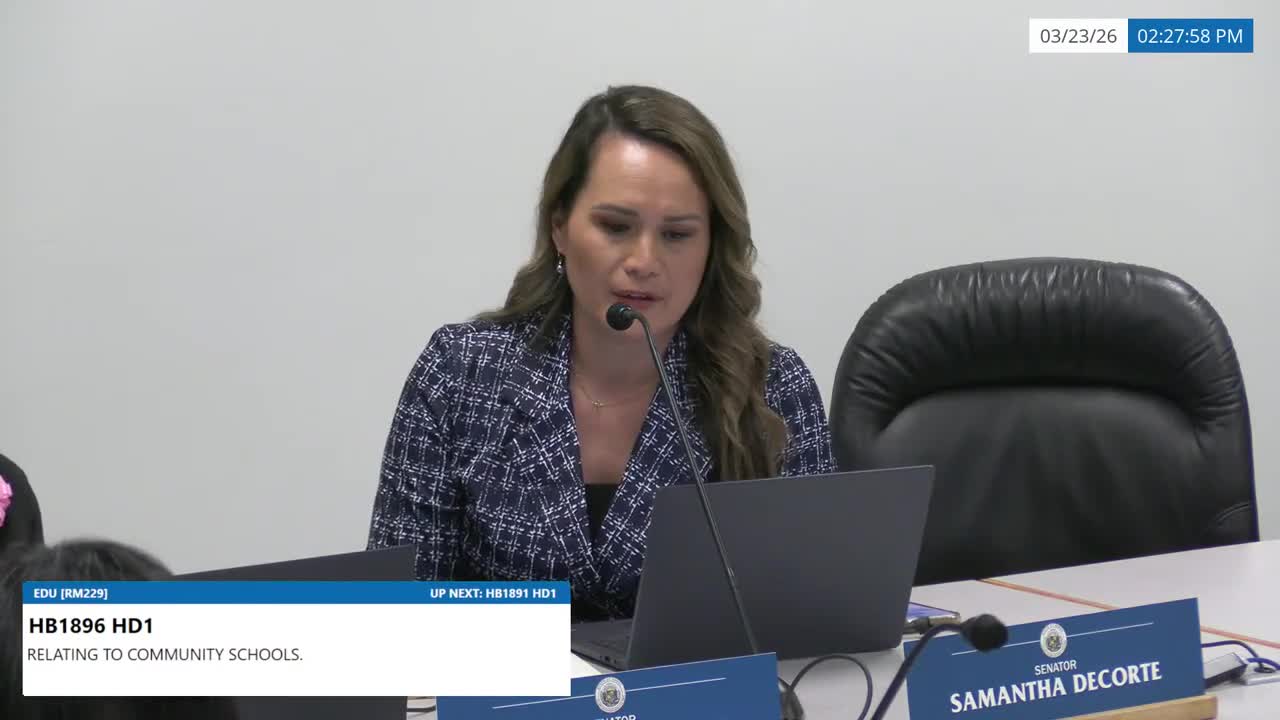 25MIN
Senate Standing Committee on Education
25MIN
Senate Standing Committee on Labor and Technology
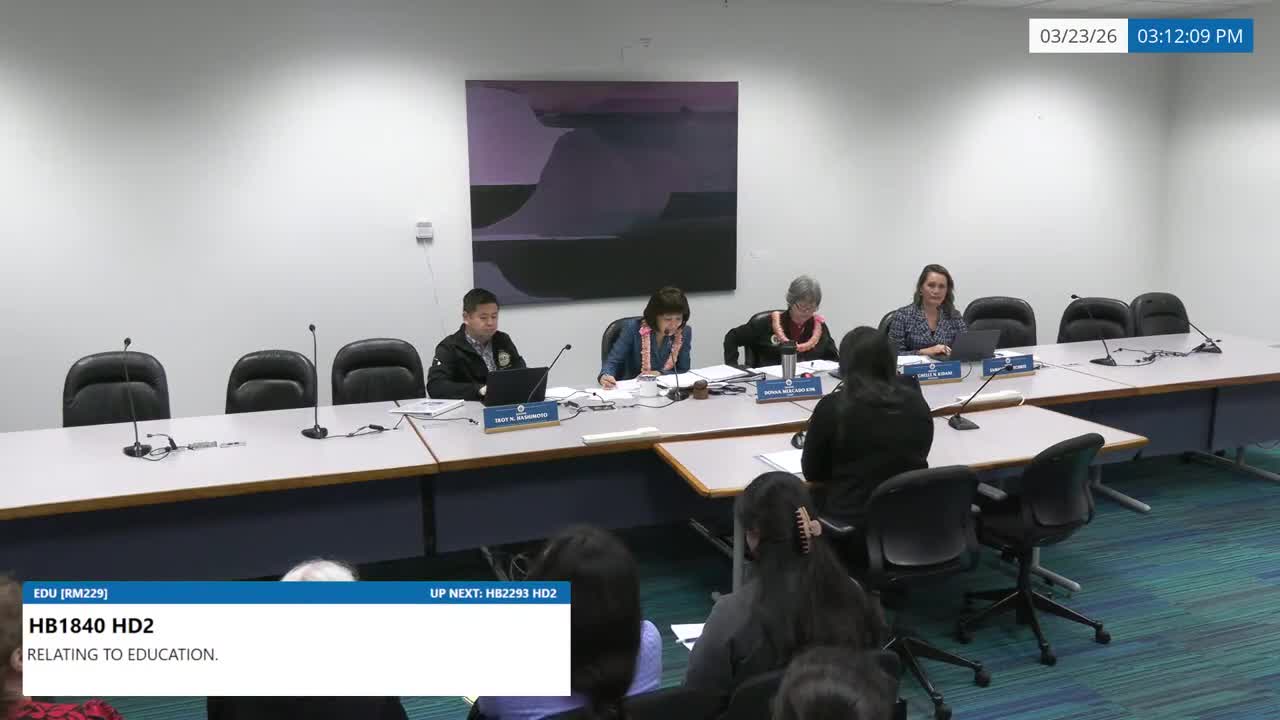 2MIN
Senate Standing Committee on Education
2MIN
Senate Standing Committee on Labor and Technology
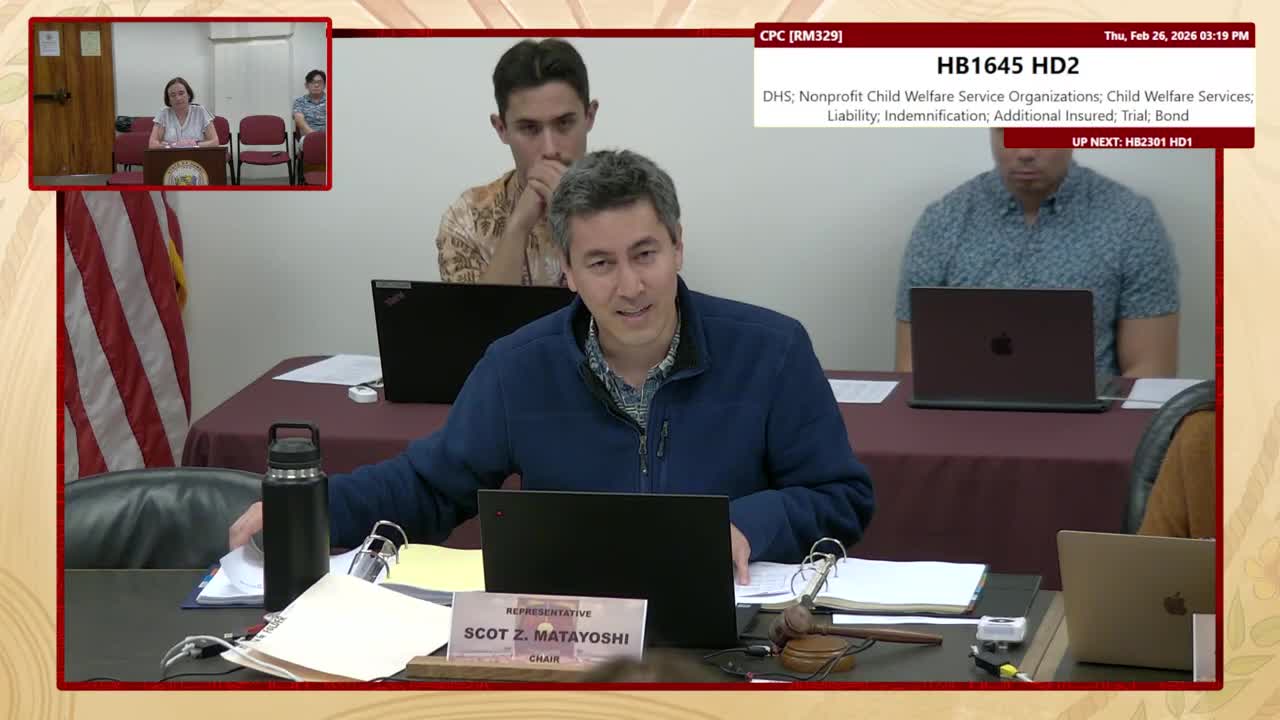 32MIN
House Standing Committee on Consumer Protection & Commerce
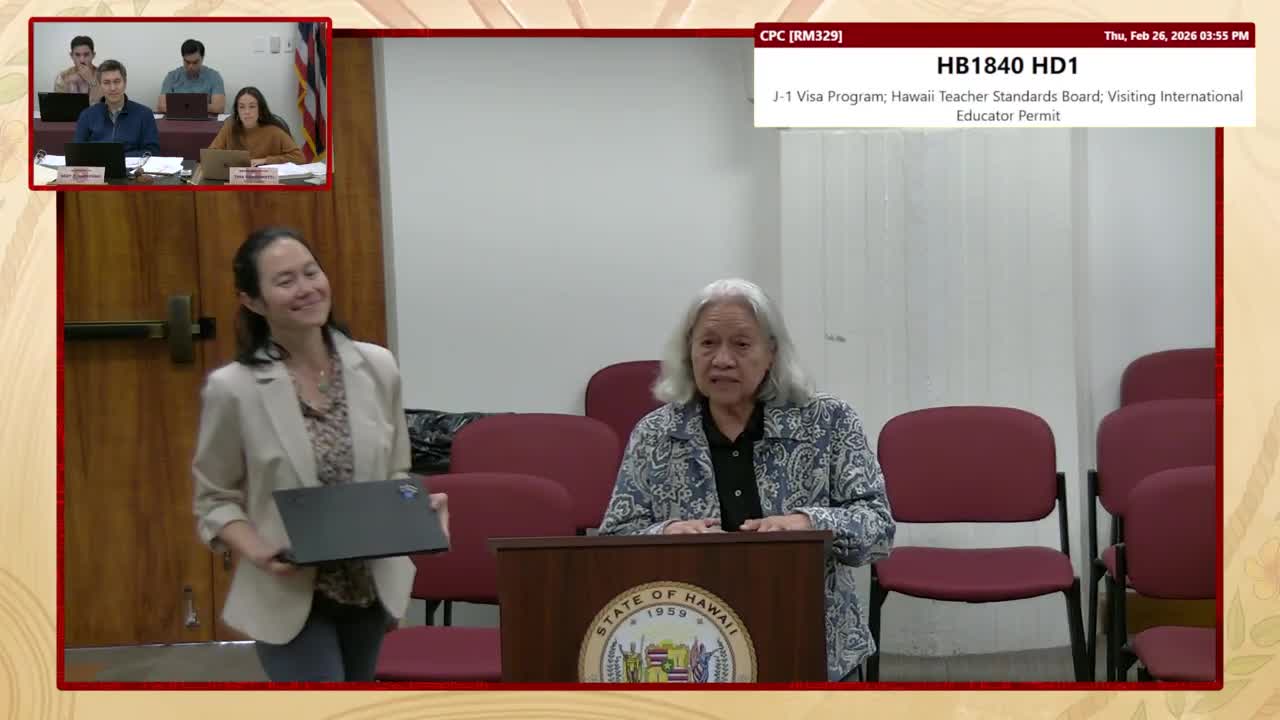 3MIN
House Standing Committee on Consumer Protection & Commerce
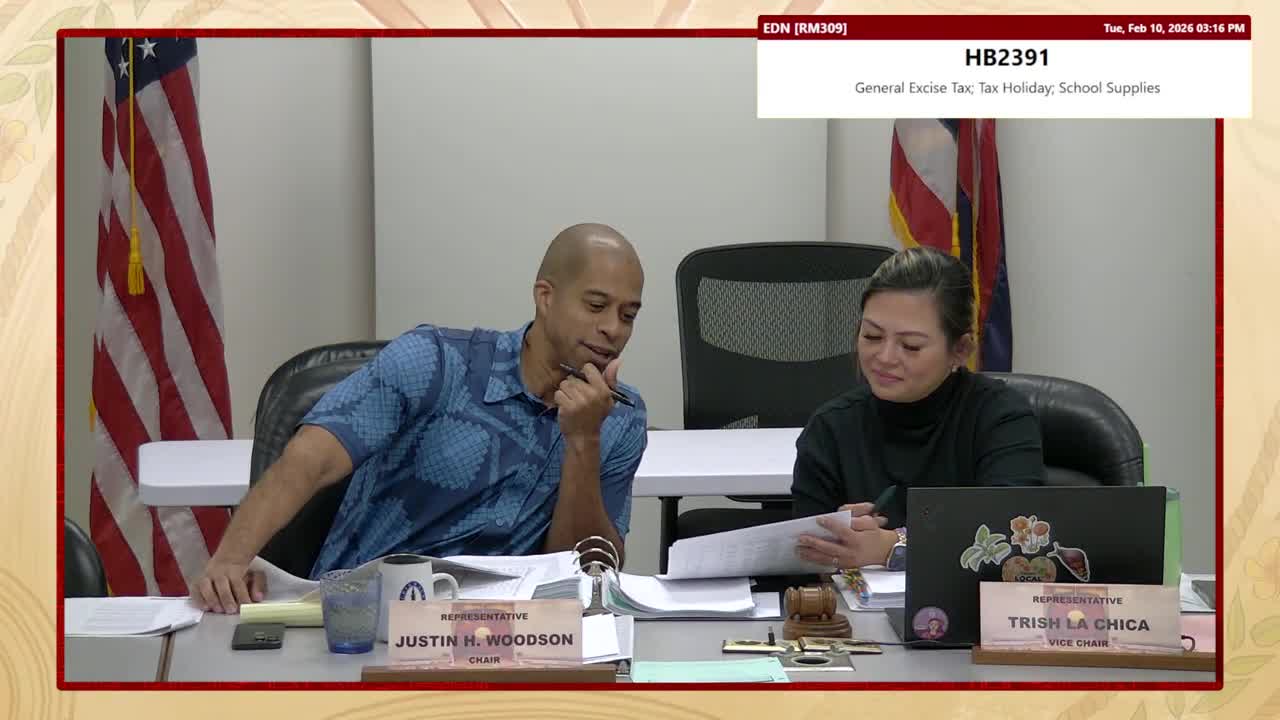 29MIN
House Standing Committee on Education
29MIN