HB 1741: Inclusionary Mandate; Housing Affordability Impact Fee; Needs Assessment Study; Essential Nexus; Rough Proportionality; Financial Feasibility
- Session Year: 2025-2026
- House: House
- Latest Version Date: 2026-05-01
Current Status:
Passed
(2026-07-09: Act 211, on 07/08/2026 (Gov. Msg. No. 1313).)
Introduced
In Committee
First Chamber
In Committee
Second Chamber
Final Decking
Enacted
Deems a county inclusionary mandate as a form of development exaction and treats the mandate as a housing affordability impact fee. Provides parameters for a county's adoption or amendment of an inclusionary mandate for residential or mixed-use development. Establishes additional components for a needs assessment study for a county-imposed inclusionary mandate. Conditions the adoption or amendment of a county inclusionary mandate for residential or mixed-use development on written findings of essential nexus and rough proportionality and a determination of financial feasibility. (CD1)
Deems a county inclusionary mandate as a form of development exaction and treats the mandate as a housing affordability impact fee, with certain exemptions. Prohibits a county from adopting, amending, or enforcing an inclusionary mandate or inclusionary mandates for residential or mixed-use development, under certain circumstances. Establishes additional requirements for a needs assessment study for a county-imposed inclusionary mandate. Effective 7/1/2050. (SD1)
Deems a county inclusionary mandate as a form of development exaction and treats the mandate as a housing affordability impact fee, with certain exemptions. Prohibits a county from adopting, amending, or enforcing an inclusionary mandate or inclusionary mandates for residential or mixed-use development, under certain circumstances. Establishes additional requirements for a needs assessment study for a county-imposed inclusionary mandate. Establishes a criterion that allows luxury residential projects or projects that receive certain discretionary value increases to be subject to inclusionary mandates. Effective 7/1/3000. (HD2)
Deems a county inclusionary mandate as a form of development exaction and treats the mandate as a housing affordability impact fee, with certain exemptions. Prohibits a county from adopting, amending, or enforcing an inclusionary mandate or inclusionary mandates for residential or mixed-use development, under certain circumstances. Establishes additional requirements for a needs assessment study for a county-imposed inclusionary mandate. Establishes a criterion that allows luxury residential projects or projects that receive certain discretionary value increases to be subject to inclusionary mandates. Effective 7/1/3000. (HD1)
Deems a county affordable housing mandate as a form of development exaction and treats the mandate as a housing affordability impact fee, with certain exemptions. Prohibits a county from adopting, amending, or enforcing an affordable housing mandate or inclusionary requirements for residential or mixed-use development, under certain circumstances. Establishes additional requirements for a needs assessment study for a county-imposed affordable housing mandate. Establishes a criterion that allows luxury residential projects or projects that receive discretionary value-add approvals to be subject to inclusionary requirements.
|
HOUSE OF REPRESENTATIVES |
H.B. NO. |
1741 |
|
THIRTY-THIRD LEGISLATURE, 2026 |
H.D. 2 |
|
|
STATE OF HAWAII |
S.D. 1 |
|
|
|
C.D. 1 |
|
|
|
||
|
|
||
A BILL FOR AN ACT
RELATING TO HOUSING.
BE IT ENACTED BY THE LEGISLATURE OF THE STATE OF HAWAII:
SECTION 1. The legislature finds that building homes that local families can afford is essential to keeping Hawaii's communities intact and perpetuating our way of life. Inclusionary requirements, which ask market-rate developments to contribute to the production of income-restricted housing, have been an important county tool for decades and should be strengthened by a clear evidentiary foundation.
Since 1992, Hawaii law has required counties to conduct a needs assessment study before imposing development impact fees. No comparable study has been required for affordable housing requirements based on a percentage of units. Yet just as fees for sewers and roads are reflected in the cost of homes purchased by local working professionals, including firefighters, teachers, and nurses, the cost of inclusionary requirements is reflected in those prices. Buyers and renters of market-rate homes are entitled to know how much of their home cost is contributing to the county's affordability policy.
In Sheetz v. County of El Dorado, 144 S. Ct. 893 (2024), the United States Supreme Court held that legislatively imposed land-use permit conditions, including impact fees, must satisfy a two-part test of essential nexus and rough proportionality. Because inclusionary mandates operate as permit-linked exactions, they are subject to the same constitutional standards. A clear evidentiary record protects county affordability policies from legal challenge.
The legislature further finds that inclusionary mandates can, depending on their design, reduce overall housing production, shift it away from the multi-family and attached formats that most efficiently add units in already-urbanized areas, and increase the share of luxury units by making lower-priced and mid-market projects financially infeasible. The required percentage, income targeting, and available compliance options materially affect whether projects are financially feasible and whether the policy delivers income-restricted units at scale. Adequate production also reduces pressure on the existing housing stock and expands options across income levels. A financial feasibility analysis allows counties to set inclusionary requirements at levels that produce affordable units without suppressing the production needed to expand housing access for local residents and families.
The legislature additionally finds that an inclusionary requirement of ten per cent or less is consistent with widely adopted practice, including in high-cost housing markets. This Act establishes that benchmark as a threshold below which no additional study is required and asks counties seeking to impose a higher requirement to support that decision with a data-based assessment of housing needs and project feasibility.
This Act is intended to support, not displace, county housing policy. Counties retain full authority to design and implement inclusionary requirements. This Act also ensures only that requirements above the threshold rest on a foundation of disclosed data, financial feasibility analysis, and constitutional findings.
Accordingly, the purpose of this Act is to:
(1) Deem a county inclusionary mandate as a form of development exaction and treat the mandate as a housing affordability impact fee, with certain exemptions;
(2) Provide parameters for a county's adoption or amendment of an inclusionary mandate for residential or mixed-use development;
(3) Establish additional components for a needs assessment study for a county-imposed inclusionary mandate; and
(4) Condition the adoption or amendment of a county inclusionary mandate above a specified threshold on written findings of essential nexus and rough proportionality and a determination of financial feasibility.
"§46- Inclusionary mandates; housing affordability impact fee; needs assessment study. (a) Any county inclusionary mandate shall be deemed a form of development exaction and shall be treated as a housing affordability impact fee pursuant to this part. Beginning July 1, 2029, no county shall adopt or amend an inclusionary mandate applicable to residential or mixed-use development unless the county council has first approved, by ordinance or resolution, a needs assessment study that:
(1) Complies with this section and section 46-143; and
(2) Includes the analyses described in subsection (b).
(b) In addition to the requirements of section 46-143, the needs assessment study required by this section shall evaluate the financial feasibility and general economic impacts of the proposed inclusionary mandate to ensure it supports, and does not suppress, overall housing production. The needs assessment study may also:
(1) Disclose data sources and methodology;
(2) Analyze various representative market-rate prototypes commonly produced in the county, which may include single‑family, duplex, townhome, condominium, and apartment formats;
(3) Evaluate various compliance options, which may include on-site units, off-site units, in-lieu fees, or land dedication; and
(4) Publish a residential nexus and affordability-gap analysis and summary tables of results.
(c) Beginning July 1, 2029, a county may adopt or amend an inclusionary mandate on a residential or mixed-use residential project only if:
(1) The county makes written findings demonstrating compliance with essential nexus and rough proportionality; and
(2) A needs assessment study approved by the county pursuant to this section finds that the applicable prototypes are financially feasible under the inclusionary mandate.
(d) Notwithstanding any other law to the contrary, any inclusionary mandate enacted before July 1, 2029, shall be unenforceable with respect to applications deemed complete on or after July 1, 2029, until a needs assessment study is conducted pursuant to this section and section 46-143. Once a needs assessment study demonstrates compliance with subsection (c), enforcement of an inclusionary mandate may resume prospectively for applications deemed complete thereafter.
(e) Each county shall provide a clear process by which an applicant may contest the application of an inclusionary mandate or any findings made under this section, including findings made under subsection (c)(2).
(f) This section shall not apply to:
(1) Projects located on lands classified within the agricultural district or conservation district pursuant to chapter 205;
(2) Resort or vacation-rental construction, including any dwelling unit or building that is used, intended, designed, or marketed, or that may be used for transient accommodation purposes, including hotels, time shares, resort condominiums, transient vacation units, or other transient accommodations as defined by county ordinance or chapter 237D;
(3) Conditions required by federal or state funding or financing programs; voluntary commitments not required by county law, including codified voluntary opt-in incentives programs established by county ordinance; or generally applicable impact fees unrelated to inclusionary obligations;
(4) Projects undertaken by, or subject to approvals, permits, exemptions, rules, or actions of, the Hawaii housing finance and development corporation under chapter 201H or Hawaii community development authority under chapter 206E;
(5) Minor amendments to county ordinances, including amendments that repeal ordinances, reduce regulatory burdens, or make changes solely for administrative purposes; or
(6) Any county inclusionary mandate that requires ten per cent or less of the total dwelling units in a residential or mixed-use development to be provided or funded as below-market-rate dwelling units.
(g) For purposes of this section:
"Inclusionary mandate" means any county requirement that a development provide or fund below-market-rate dwelling units on site or off site, pay an in-lieu fee, dedicate land, or comply with equivalent exactions tied to permits, approvals, or development agreements.
"Transient accommodations" has the same meaning as in section 237D-1."
SECTION 3. New statutory material is underscored.
SECTION 4. This Act shall take effect upon its approval.
Report Title:
Inclusionary Mandate; Housing Affordability Impact Fee; Needs Assessment Study; Essential Nexus; Rough Proportionality; Financial Feasibility
Description:
Deems a county inclusionary mandate as a form of development exaction and treats the mandate as a housing affordability impact fee. Provides parameters for a county's adoption or amendment of an inclusionary mandate for residential or mixed-use development. Establishes additional components for a needs assessment study for a county-imposed inclusionary mandate. Conditions the adoption or amendment of a county inclusionary mandate for residential or mixed-use development on written findings of essential nexus and rough proportionality and a determination of financial feasibility. (CD1)
The summary description of legislation appearing on this page is for informational purposes only and is not legislation or evidence of legislative intent.
|
HOUSE OF REPRESENTATIVES |
H.B. NO. |
1741 |
|
THIRTY-THIRD LEGISLATURE, 2026 |
H.D. 2 |
|
|
STATE OF HAWAII |
S.D. 1 |
|
|
|
|
|
|
|
||
|
|
||
A BILL FOR AN ACT
RELATING TO HOUSING.
BE IT ENACTED BY THE LEGISLATURE OF THE STATE OF HAWAII:
SECTION 1. The legislature finds that Hawaii cannot close its housing shortage without a large increase in homebuilding, especially in formats that add meaningful unit count in already‑urbanized areas. In Sheetz v. County of El Dorado, 144 S. Ct. 893 (2024), the United States Supreme Court held that legislatively imposed land-use permit conditions, including impact fees, must satisfy the two-part test requiring (1) essential nexus and (2) rough proportionality. These constitutional limits require a publicly available record that identifies the specific, project-related impact being mitigated and caps any exaction at an amount proportionate to that impact. Yet many jurisdictions adopt inclusionary or other development exactions based on generalized affordability goals or regional "housing need" tallies rather than a quantified, project-caused impact and proportional remedy, an approach that misstates causation and is legally vulnerable under Sheetz v. County of El Dorado unless the county's record identifies a project-caused impact and a proportionate remedy.
The legislature further finds that because inclusionary mandates operate as permit-linked exactions, they must satisfy constitutional essential nexus and rough proportionality. The assumption that new market-rate housing causes unaffordability and therefore must be offset by a surcharge on that same housing is contradicted by the preponderance of evidence. In most cases, adding homes lowers rents and prices through filtering and moving chains, so imposing a surcharge on by-right, non‑luxury projects rests on a flawed methodology and risks suppressing production and increasing prices. Income-restricted housing is an important component of overall affordability, but it should be funded transparently by the government rather than by loading undisclosed costs onto new homebuyers through mandates embedded in private development.
The legislature also finds that workforce mandates have repeatedly failed to deliver housing at scale in Hawaii and, in practice, have deterred feasible projects, particularly multifamily apartments and condominiums, while shifting production toward higher-price, lower-density development. Experience from other jurisdictions likewise shows that when not narrowly tailored, inclusionary mandates reduce overall supply and increase the share of luxury units. Exceptions may be appropriate where new development is low-density and requires extensive infrastructure or where development is visitor-serving and increases local workforce demand tied to tourism.
Accordingly, the purpose of this Act is to:
(1) Treat county inclusionary mandates as housing affordability impact fees; and
(2) Require a straightforward, professional study showing feasibility and market prices or rents with and without any inclusionary mandate across common prototypes.
This Act does not apply to resort or vacation-rental construction and does not limit actions of the Hawaii housing finance and development corporation or Hawaii community development authority.
"§46- Inclusionary mandates; housing affordability impact fee; needs assessment study. (a) Any county inclusionary mandate shall be deemed a form of development exaction and shall be treated as a housing affordability impact fee pursuant to this part. Beginning July 1, 2028, no county shall adopt, amend, or enforce an inclusionary mandate applicable to residential or mixed-use development unless the county council has first approved, by ordinance or resolution, a needs assessment study that:
(1) Complies with this section and section 46-143; and
(2) Includes the analyses described in subsection (b).
(b) In addition to the requirements of section 46-143, the needs assessment study required by this section shall:
(1) Disclose data sources and methodology;
(2) Analyze various representative market-rate prototypes commonly produced in the county, which may include single‑family, duplex, townhome, condominium, and apartment formats;
(3) Evaluate various compliance options, which may include on-site units, off-site units, in-lieu fees, or land dedication;
(4) Evaluate the financial feasibility and general economic impacts of the proposed inclusionary mandate to ensure it supports, and does not suppress, overall housing production; and
(5) Publish a residential nexus and affordability-gap analysis and summary tables of results.
(c) Beginning July 1, 2028, no county shall adopt, amend, or enforce an inclusionary mandate on a residential or mixed-use residential project unless the county makes written findings demonstrating compliance with essential nexus and rough proportionality.
(d) Notwithstanding any other law to the contrary, any inclusionary mandate enacted before July 1, 2028, shall be unenforceable with respect to applications deemed complete on or after July 1, 2028, until a needs assessment study is conducted pursuant to this section and section 46-143. Once a needs assessment study demonstrates compliance with subsection (c), enforcement of an inclusionary mandate may resume prospectively for applications deemed complete thereafter.
(e) Each county shall provide a clear process by which an applicant may contest the application of an inclusionary mandate or any findings made under this section, including a determination under subsection (c)(1).
(f) This section shall not apply to:
(1) Projects located on lands classified within the agricultural district or conservation district pursuant to chapter 205;
(2) Resort or vacation-rental construction, including any dwelling unit or building that is used, intended, designed, or marketed, or that may be used for transient accommodation purposes, including hotels, timeshares, resort condominiums, transient vacation units, or other transient accommodations as defined by county ordinance or chapter 237D;
(3) Conditions required by federal or state funding or financing programs; voluntary commitments not required by county law, including codified voluntary opt-in incentives programs established by county ordinance; or generally applicable impact fees unrelated to inclusionary obligations;
(4) Projects undertaken by, or subject to approvals, permits, exemptions, rules, or actions of, the Hawaii housing finance and development corporation under chapter 201H or Hawaii community development authority under chapter 206E; or
(5) Minor amendments to county ordinances, including amendments that repeal ordinances, reduce regulatory burdens, or make changes solely for administrative purposes.
(g) For purposes of this section:
"Inclusionary mandate" means any county requirement that a development provide or fund below-market-rate dwelling units on site or off site, pay an in-lieu fee, dedicate land, or comply with equivalent exactions tied to permits, approvals, or development agreements.
"Single-family detached" means a dwelling unit in a freestanding building designed for occupancy by one household, not attached to any other dwelling unit by a common wall or floor or ceiling.
"Transient accommodations" has the same meaning as in section 237D-1."
SECTION 3. New statutory material is underscored.
SECTION 4. This Act shall take effect on July 1, 2050.
Report Title:
Inclusionary Mandate; Housing Affordability Impact Fee; Needs Assessment Study
Description:
Deems a county inclusionary mandate as a form of development exaction and treats the mandate as a housing affordability impact fee, with certain exemptions. Prohibits a county from adopting, amending, or enforcing an inclusionary mandate or inclusionary mandates for residential or mixed-use development, under certain circumstances. Establishes additional requirements for a needs assessment study for a county-imposed inclusionary mandate. Effective 7/1/2050. (SD1)
The summary description of legislation appearing on this page is for informational purposes only and is not legislation or evidence of legislative intent.
|
HOUSE OF REPRESENTATIVES |
H.B. NO. |
1741 |
|
THIRTY-THIRD LEGISLATURE, 2026 |
H.D. 2 |
|
|
STATE OF HAWAII |
|
|
|
|
|
|
|
|
||
|
|
||
A BILL FOR AN ACT
RELATING TO HOUSING.
BE IT ENACTED BY THE LEGISLATURE OF THE STATE OF HAWAII:
SECTION 1. The legislature finds that Hawaii cannot close its housing shortage without a large increase in homebuilding, especially in formats that add meaningful unit count in already-urbanized areas. In Sheetz v. County of El Dorado, 144 S. Ct. 893 (2024), the United States Supreme Court held that legislatively imposed land-use permit conditions, including impact fees, must satisfy the two-part test requiring (1) essential nexus and (2) rough proportionality. These constitutional limits require a publicly available record that identifies the specific, project-related impact being mitigated and caps any exaction at an amount proportionate to that impact. Yet many jurisdictions adopt inclusionary or other development exactions based on generalized affordability goals or regional "housing need" tallies rather than a quantified, project-caused impact and proportional remedy, an approach that misstates causation and is legally vulnerable under Sheetz v. County of El Dorado unless the county's record identifies a project-caused impact and a proportionate remedy.
The legislature further finds that because inclusionary mandates operate as permit-linked exactions, they must satisfy constitutional essential nexus and rough proportionality. The assumption that new market-rate housing causes unaffordability and therefore must be offset by a surcharge on that same housing is contradicted by the preponderance of evidence. In most cases, adding homes lowers rents and prices through filtering and moving chains, so imposing a surcharge on by-right, non‑luxury projects rests on a flawed methodology and risks suppressing production and increasing prices. Income-restricted housing is an important component of overall affordability, but it should be funded transparently by the government rather than by loading undisclosed costs onto new homebuyers through mandates embedded in private development.
The legislature also finds that workforce mandates have repeatedly failed to deliver housing at scale in Hawaii and, in practice, have deterred feasible projects, particularly multifamily apartments and condominiums, while shifting production toward higher-price, lower-density development. Experience from other jurisdictions likewise shows that when not narrowly tailored, inclusionary mandates reduce overall supply and increase the share of luxury units. Exceptions may be appropriate where new development is low-density and requires extensive infrastructure, where development is visitor-serving and increases local workforce demand tied to tourism, or where the product is luxury and does less to relieve price pressures.
Accordingly, the purpose of this Act is to:
(1) Treat county inclusionary mandates as housing affordability impact fees;
(2) Require a straightforward, professional study showing feasibility and market prices or rents with and without any inclusionary mandate across common prototypes; and
(3) Adopt a dual compliance framework under which non-luxury, by-right housing is protected by a no-price-increase or full-offset standard, while luxury housing and projects that receive discretionary increases in entitlements may be subject to proportionate inclusionary mandates supported by a needs assessment study.
This Act does not apply to resort or vacation-rental construction and does not limit actions of the Hawaii housing finance and development corporation or Hawaii community development authority.
"§46- Inclusionary mandates; housing affordability impact fee; needs assessment study. (a) Any county inclusionary mandate shall be deemed a form of development exaction and shall be treated as a housing affordability impact fee pursuant to this part. No county shall adopt, amend, or enforce an inclusionary mandate applicable to residential or mixed-use development unless the county council has first approved, by ordinance or resolution, a needs assessment study that:
(1) Complies with this section and section 46-143; and
(2) Includes the analyses described in subsection (b).
(b) In addition to the requirements of section 46-143, the needs assessment study required by this section shall:
(1) Disclose data sources and methodology;
(2) Analyze various representative market-rate prototypes commonly produced in the county, including single‑family, duplex, townhome, condominium, and apartment formats;
(3) Evaluate each compliance option, such as on-site units, off-site units, in-lieu fees, or land dedication;
(4) For each representative market-rate prototype, state principal assumptions for prices or rents, costs, financing, and target returns, and show feasibility and market-rate prices or rents with and without the inclusionary mandate; and
(5) Publish a residential nexus and affordability-gap analysis and summary tables of results.
(c) No county shall adopt, amend, or enforce an inclusionary mandate on a residential or mixed-use residential project that does not receive a discretionary increase in density, floor area ratio, or height and is not a luxury residential project, unless the county makes written findings demonstrating compliance with essential nexus and rough proportionality and satisfies at least one of the following:
(1) A needs assessment study approved by the county finds that the requirement will not increase the price of market-rate dwelling units nor suppress feasible production for the applicable prototypes; or
(2) The county concurrently adopts incentives, including off-site infrastructure and property tax and fee waivers, that fully offset all compliance costs, including the fair market value of any required land or units and any quantifiable lost revenue or density, such that there is no net price increase or feasibility suppression.
(d) For a luxury residential project, or for any residential project that receives a discretionary increase in maximum allowable density, floor area ratio, or height, a county may adopt or enforce an inclusionary mandate only if:
(1) A needs assessment study approved by the county establishes essential nexus and rough proportionality between the requirement and the development's impacts; and
(2) The requirement does not exceed the lesser of:
(A) The full mitigation cost for attributable workforce-housing demand; or
(B) One hundred per cent of the net land-value increment conferred by the discretionary approval; provided that this subparagraph shall not apply to luxury residential projects that do not receive a discretionary increase.
Enforcement under this subsection shall apply prospectively to applications determined complete after approval of the study.
(e) Notwithstanding any other law to the contrary, any inclusionary mandate enacted before the effective date of this Act shall be unenforceable with respect to applications deemed complete on or after the effective date of this Act until a needs assessment study is conducted pursuant to this section and section 46-143. Once a needs assessment study demonstrates compliance with subsection (c), enforcement of an inclusionary mandate may resume prospectively for applications deemed complete thereafter, including any enforcement taken pursuant to the findings under subsection (d).
For any inclusionary mandate adopted or enforced pursuant to subsection (d), the requirement to establish an essential nexus and rough proportionality shall be presumed satisfied if the inclusionary mandate is based on a county‑commissioned financial feasibility study or nexus analysis that is no more than five years old at the time the mandate is adopted or enforced. This presumption shall be rebuttable only by clear and convincing evidence demonstrating that the existing study's methodology is flawed or the resulting inclusionary mandate exceeds the actual cost of providing the required housing.
(f) Each county shall provide a clear process by which an applicant may contest the application of an inclusionary mandate or any findings made under this section, including a determination under subsection (c)(1).
(g) This section shall not apply to:
(1) Projects located on lands classified within the agricultural district or conservation district pursuant to chapter 205;
(2) Resort or vacation-rental construction, including any dwelling unit or building that is used, intended, designed, or marketed, or that may be used for transient accommodation purposes, including hotels, timeshares, resort condominiums, transient vacation units, or other transient accommodations as defined by county ordinance or chapter 237D;
(3) Conditions required by federal or state funding or financing programs, voluntary commitments not required by county law, or generally applicable impact fees unrelated to inclusionary obligations; or
(4) Projects undertaken by, or subject to approvals, permits, exemptions, rules, or actions of, the Hawaii housing finance and development corporation under chapter 201H or Hawaii community development authority under chapter 206E.
(h) For purposes of this section:
"Federal Housing Finance Agency conforming-loan limit" means the one-unit conforming-loan limit published annually by the Federal Housing Finance Agency for the county.
"Inclusionary mandate" means any county requirement that a development provide or fund below-market-rate dwelling units on site or off site, pay an in-lieu fee, dedicate land, or comply with equivalent exactions tied to permits, approvals, or development agreements.
"Initial monthly contract rent" means the first base rent stated in the lease at initial occupancy, excluding promotional concessions and separately metered utilities.
"Initial sales price" means the first bona fide arm's‑length sale price recorded against the unit or lot, net of seller credits and excluding optional upgrades not required for certificate of occupancy.
"Luxury residential project" means a residential or mixed‑use residential project in which, at initial sale or initial lease, any of the following apply:
(1) Ownership units: a majority of the dwelling units have a published initial sales price that exceeds one hundred twenty-five per cent of the Federal Housing Finance Agency conforming‑loan limit for a one-unit property in the county on the date of building-permit application;
(2) Rental units: a majority of the units for rent have a published initial monthly contract rent that exceeds two hundred per cent of the United States Department of Housing and Urban Development fair market rent for a unit of the same bedroom count in the county for the applicable fiscal year;
(3) Density: the project's net residential density is less than ten dwelling units per acre; or
(4) Building type: a majority of the project's dwelling units are single-family detached dwellings.
"Net land-value increment" means the increase in residual land value attributable to a discretionary approval, calculated using the same pro-forma assumptions (costs, prices or rents, and target returns) used in the study conducted pursuant to section 46-143, and equal to residual land value with the discretionary approval minus residual land value under base zoning.
"Net residential density" means dwelling units per acre measured on the net residential site area as defined by county ordinance; provided that if "net residential site area" is not defined by ordinance, "net residential site area" excludes public rights-of-way dedicated with the project and areas required to be reserved as public open space or protected natural-resource buffers.
"Single-family detached" means a dwelling unit in a freestanding building designed for occupancy by one household, not attached to any other dwelling unit by a common wall or floor or ceiling.
"Transient accommodations" has the same meaning as in section 237D-1.
"United States Department of Housing and Urban Development fair market rent" means the value published by the United States Department of Housing and Urban Development pursuant to title 24 Code of Federal Regulations part 888 for the county and bedroom count."
SECTION 3. New statutory material is underscored.
SECTION 4. This Act shall take effect on July 1, 3000.
Report Title:
Inclusionary Mandate; Housing Affordability Impact Fee; Luxury Residential Projects; Needs Assessment Study
Description:
Deems a county inclusionary mandate as a form of development exaction and treats the mandate as a housing affordability impact fee, with certain exemptions. Prohibits a county from adopting, amending, or enforcing an inclusionary mandate or inclusionary mandates for residential or mixed-use development, under certain circumstances. Establishes additional requirements for a needs assessment study for a county-imposed inclusionary mandate. Establishes a criterion that allows luxury residential projects or projects that receive certain discretionary value increases to be subject to inclusionary mandates. Effective 7/1/3000. (HD2)
The summary description of legislation appearing on this page is for informational purposes only and is not legislation or evidence of legislative intent.
|
HOUSE OF REPRESENTATIVES |
H.B. NO. |
1741 |
|
THIRTY-THIRD LEGISLATURE, 2026 |
H.D. 1 |
|
|
STATE OF HAWAII |
|
|
|
|
|
|
|
|
||
|
|
||
A BILL FOR AN ACT
RELATING TO HOUSING.
BE IT ENACTED BY THE LEGISLATURE OF THE STATE OF HAWAII:
SECTION 1. The legislature finds that Hawaii cannot close its housing shortage without a large increase in homebuilding, especially in formats that add meaningful unit count in already-urbanized areas. In Sheetz v. County of El Dorado (144 S. Ct. 893 (2024)), the United States Supreme Court held that legislatively imposed land-use permit conditions—including impact fees—must satisfy the two-part tests of essential nexus and rough proportionality. These constitutional limits require a publicly available record that identifies the specific, project-related impact being mitigated and caps any exaction at an amount proportionate to that impact. Yet many jurisdictions adopt inclusionary or other development exactions based on generalized affordability goals or regional "housing need" tallies rather than a quantified, project-caused impact and proportional remedy, an approach that misstates causation and is legally vulnerable under Sheetz v. County of El Dorado unless the county's record identifies a project-caused impact and a proportionate remedy.
The legislature further finds that because inclusionary mandates operate as permit-linked exactions, they must satisfy constitutional essential nexus and rough proportionality. The assumption that new market-rate housing causes unaffordability and therefore must be offset by a surcharge on that same housing is contradicted by the preponderance of evidence. In most cases, adding homes lowers rents and prices through filtering and moving chains, so imposing a surcharge on by-right, non‑luxury projects rests on a flawed methodology and risks suppressing production and increasing prices. Income-restricted housing is an important component of overall affordability, but it should be funded transparently by the government rather than by loading undisclosed costs onto new homebuyers through mandates embedded in private development.
The legislature also finds that workforce mandates have repeatedly failed to deliver housing at scale in Hawaii and, in practice, have deterred feasible projects, particularly multifamily apartments and condominiums, while shifting production toward higher-price, lower-density product. Experience from other jurisdictions likewise shows that when not narrowly tailored, inclusionary mandates reduce overall supply and increase the share of luxury units. Exceptions may be appropriate where new development is low-density and requires extensive infrastructure, where development is visitor-serving and increases local workforce demand tied to tourism, or where the product is luxury and does less to relieve price pressures.
Accordingly, the purpose of this Act is to:
(1) Treat county inclusionary mandates as housing affordability impact fees;
(2) Require a straightforward, professional study showing feasibility and market prices or rents with and without any inclusionary mandate across common prototypes; and
(3) Adopt a dual compliance framework under which non-luxury, by-right housing is protected by a no-price-increase or full-offset standard, while luxury housing and projects that receive discretionary increases in entitlements may be subject to proportionate inclusionary mandates supported by a needs assessment study.
This Act does not apply to resort or vacation-rental construction and does not limit actions of the Hawaii housing finance and development corporation or Hawaii community development authority.
"§46- Inclusionary mandates; housing affordability impact fee; needs assessment study. (a) Any county inclusionary mandate shall be deemed a form of development exaction and shall be treated as a housing affordability impact fee pursuant to this part. No county shall adopt, amend, or enforce an inclusionary mandate applicable to residential or mixed-use development unless the county council has first approved, by ordinance or resolution, a needs assessment study that:
(1) Complies with this section and section 46-143; and
(2) Includes the analyses described in subsection (b).
(b) In addition to the requirements of section 46-143, the needs assessment study required by this section shall:
(1) Disclose data sources and methodology;
(2) Analyze various representative market-rate prototypes commonly produced in the county, including single‑family, duplex, townhome, condominium, and apartment formats;
(3) Evaluate each compliance option, such as on-site units, off-site units, in-lieu fees, or land dedication;
(4) For each representative market-rate prototype, state principal assumptions for prices or rents, costs, financing, and target returns, and show feasibility and market-rate prices or rents with and without the inclusionary mandate; and
(5) Publish a residential nexus and affordability-gap analysis and summary tables of results.
(c) No county shall adopt, amend, or enforce an inclusionary mandate on a residential or mixed-use residential project that does not receive a discretionary increase in density, floor area ratio, or height and is not a luxury residential project, unless the county makes written findings demonstrating compliance with essential nexus and rough proportionality and satisfies at least one of the following:
(1) A needs assessment study approved by the county finds that the requirement will not increase the price of market-rate dwelling units nor suppress feasible production for the applicable prototypes; or
(2) The county concurrently adopts incentives, including off-site infrastructure and property tax and fee waivers, that fully offset all compliance costs, including the fair market value of any required land or units and any quantifiable lost revenue or density, such that there is no net price increase or feasibility suppression.
(d) For a luxury residential project, or for any residential project that receives a discretionary increase in maximum allowable density, floor area ratio, or height, a county may adopt or enforce an inclusionary mandate only if:
(1) A needs assessment study approved by the county establishes essential nexus and rough proportionality between the requirement and the development's impacts; and
(2) The requirement does not exceed the lesser of:
(A) The full mitigation cost for attributable workforce-housing demand; or
(B) One hundred per cent of the net land-value increment conferred by the discretionary approval; provided that this subparagraph shall not apply to luxury residential projects that do not receive a discretionary increase.
Enforcement under this subsection shall apply prospectively to applications determined complete after approval of the study.
(e) Notwithstanding any other law to the contrary, any inclusionary mandate enacted before the effective date of this Act shall be unenforceable with respect to applications deemed complete on or after the effective date of this Act until a needs assessment study is conducted pursuant to this section and section 46-143. Once a needs assessment study demonstrates compliance with subsection (c), enforcement of an inclusionary mandate may resume prospectively for applications deemed complete thereafter, including any enforcement taken pursuant to the findings under subsection (d).
For any inclusionary mandate adopted or enforced pursuant to subsection (d), the requirement to establish an essential nexus and rough proportionality shall be presumed satisfied if the inclusionary mandate is based on a county‑commissioned financial feasibility study or nexus analysis that is no more than five years old at the time the mandate is adopted or enforced. This presumption shall be rebuttable only by clear and convincing evidence demonstrating that the existing study's methodology is flawed or the resulting inclusionary mandate exceeds the actual cost of providing the required housing.
(f) Each county shall provide a clear process by which an applicant may contest the application of an inclusionary mandate or any findings made under this section, including a determination under subsection (c)(1).
(g) This section shall not apply to:
(1) Projects located on lands classified within the agricultural district or conservation district pursuant to chapter 205;
(2) Resort or vacation-rental construction, including any dwelling unit or building that is used, intended, designed, or marketed, or that may be used for transient accommodation purposes, including hotels, timeshares, resort condominiums, transient vacation units, or other transient accommodations as defined by county ordinance or chapter 237D;
(3) Conditions required by federal or state funding or financing programs, voluntary commitments not required by county law, or generally applicable impact fees unrelated to inclusionary obligations; or
(4) Projects undertaken by, or subject to approvals, permits, exemptions, rules, or actions of, the Hawaii housing finance and development corporation under chapter 201H or Hawaii community development authority under chapter 206E.
(h) For purposes of this section:
"Federal Housing Finance Agency conforming-loan limit" means the one-unit conforming-loan limit published annually by the Federal Housing Finance Agency for the county.
"Inclusionary mandate" means any county requirement that a development provide or fund below-market-rate dwelling units on site or off site, pay an in-lieu fee, dedicate land, or comply with equivalent exactions tied to permits, approvals, or development agreements.
"Initial monthly contract rent" means the first base rent stated in the lease at initial occupancy, excluding promotional concessions and separately metered utilities.
"Initial sales price" means the first bona fide arm's‑length sale price recorded against the unit or lot, net of seller credits and excluding optional upgrades not required for certificate of occupancy.
"Luxury residential project" means a residential or mixed‑use residential project in which, at initial sale or initial lease, any of the following apply:
(1) Ownership units: a majority of the dwelling units have a published initial sales price that exceeds one hundred twenty-five per cent of the Federal Housing Finance Agency conforming‑loan limit for a one-unit property in the county on the date of building-permit application;
(2) Rental units: a majority of the units for rent have a published initial monthly contract rent that exceeds two hundred per cent of the United States Department of Housing and Urban Development fair market rent for a unit of the same bedroom count in the county for the applicable fiscal year;
(3) Density: the project's net residential density is less than ten dwelling units per acre; or
(4) Building type: a majority of the project's dwelling units are single-family detached dwellings.
"Net land-value increment" means the increase in residual land value attributable to a discretionary approval, calculated using the same pro-forma assumptions (costs, prices or rents, and target returns) used in the study conducted pursuant to section 46-143, and equal to residual land value with the discretionary approval minus residual land value under base zoning.
"Net residential density" means dwelling units per acre measured on the net residential site area as defined by county ordinance; provided that if "net residential site area" is not defined by ordinance, "net residential site area" excludes public rights-of-way dedicated with the project and areas required to be reserved as public open space or protected natural-resource buffers.
"Single-family detached" means a dwelling unit in a freestanding building designed for occupancy by one household, not attached to any other dwelling unit by a common wall or floor or ceiling.
"Transient accommodations" has the same meaning as in section 237D-1.
"United States Department of Housing and Urban Development fair market rent" means the value published by the United States Department of Housing and Urban Development pursuant to title 24 Code of Federal Regulations part 888 for the county and bedroom count."
SECTION 3. New statutory material is underscored.
SECTION 4. This Act shall take effect on July 1, 3000.
Report Title:
Inclusionary Mandate; Housing Affordability Impact Fee; Luxury Residential Projects; Needs Assessment Study
Description:
Deems a county inclusionary mandate as a form of development exaction and treats the mandate as a housing affordability impact fee, with certain exemptions. Prohibits a county from adopting, amending, or enforcing an inclusionary mandate or inclusionary mandates for residential or mixed-use development, under certain circumstances. Establishes additional requirements for a needs assessment study for a county-imposed inclusionary mandate. Establishes a criterion that allows luxury residential projects or projects that receive certain discretionary value increases to be subject to inclusionary mandates. Effective 7/1/3000. (HD1)
The summary description of legislation appearing on this page is for informational purposes only and is not legislation or evidence of legislative intent.
|
HOUSE OF REPRESENTATIVES |
H.B. NO. |
1741 |
|
THIRTY-THIRD LEGISLATURE, 2026 |
|
|
|
STATE OF HAWAII |
|
|
|
|
|
|
|
|
||
|
|
||
A BILL FOR AN ACT
relating to housing.
BE IT ENACTED BY THE LEGISLATURE OF THE STATE OF HAWAII:
SECTION 1. The legislature finds that Hawaii cannot close its housing shortage without a large increase in homebuilding, especially in formats that add meaningful unit count in already-urbanized areas. In Sheetz v. County of El Dorado (144 S. Ct. 893 (2024)), the United States Supreme Court held that legislatively imposed land-use permit conditions—including impact fees—must satisfy the two-part tests of essential nexus and rough proportionality. These constitutional limits require a publicly available record that identifies the specific, project-related impact being mitigated and caps any exaction at an amount proportionate to that impact. Yet many jurisdictions adopt inclusionary or other development exactions based on generalized affordability goals or regional "housing need" tallies rather than a quantified, project-caused impact and proportional remedy, an approach that misstates causation and is legally vulnerable under Sheetz v. County of El Dorado unless the county's record identifies a project-caused impact and a proportionate remedy.
The legislature further finds that because inclusionary mandates operate as permit-linked exactions, they must satisfy constitutional essential nexus and rough proportionality. The assumption that new market-rate housing causes unaffordability and therefore must be offset by a surcharge on that same housing is contradicted by the preponderance of evidence. In most cases, adding homes lowers rents and prices through filtering and moving chains, so imposing a surcharge on by-right, non‑luxury projects rests on a flawed methodology and risks suppressing production and increasing prices. Income-restricted housing is an important component of overall affordability, but it should be funded transparently by government rather than by loading undisclosed costs onto new homebuyers through mandates embedded in private development.
The legislature also finds that workforce mandates have repeatedly failed to deliver housing at scale in Hawaii and, in practice, have deterred feasible projects, particularly multifamily apartments and condominiums, while shifting production toward higher-price, lower-density product. Experience from other jurisdictions likewise shows that when not narrowly tailored, inclusionary mandates reduce overall supply and increase the share of luxury units. Exceptions may be appropriate where new development is low-density and requires extensive infrastructure, where development is visitor-serving and increases local workforce demand tied to tourism, or where the product is luxury and does less to relieve price pressures.
Accordingly, the purpose of this Act is to:
(1) Treat county inclusionary mandates as housing affordability impact fees under section 46-143, Hawaii Revised Statutes;
(2) Require a straightforward, professional study showing feasibility and market prices or rents with and without any inclusionary requirement across common prototypes; and
(3) Adopt a dual compliance framework under which non-luxury, by-right housing is protected by a no-price-increase or full-offset standard, while luxury housing and projects that receive discretionary increases in entitlements may be subject to proportionate inclusionary requirements supported by a needs assessment study.
This Act does not apply to resort or vacation-rental construction and does not limit actions of the Hawaii housing finance and development corporation or Hawaii community development authority.
"§46- Affordable housing mandates; housing affordability impact fee; needs assessment study. (a) Any county affordable housing mandate shall be deemed a form of development exaction and shall be treated as a housing affordability impact fee pursuant to this part and conform to subsection (c). No county shall adopt, amend, or enforce an affordable housing mandate applicable to residential or mixed-use development unless the county council has first approved, by ordinance or resolution, a needs assessment study that:
(1) Complies with this section and section 46-143; and
(2) Includes the analyses described in subsection (b).
(b) In addition to the requirements of section 46-143, the needs assessment study required by this section shall:
(1) Disclose data sources and methodology;
(2) Analyze various representative market-rate prototypes commonly produced in the county, including single‑family, duplex, townhome, condominium, and apartment formats;
(3) Evaluate each compliance option, such as on-site units, off-site units, in-lieu fees, or land dedication;
(4) For each representative market-rate prototype, state principal assumptions for prices or rents, costs, financing, and target returns, and show feasibility and market-rate prices or rents with and without the affordable housing mandate; and
(5) Publish a residential nexus and affordability-gap analysis and summary tables of results.
(c) No county shall adopt, amend, or enforce an inclusionary requirement on a residential or mixed-use residential project that does not receive a discretionary increase in density, floor area ratio, or height and is not a luxury residential project, unless the county makes written findings demonstrating compliance with essential nexus and rough proportionality and satisfies at least one of the following:
(1) A needs assessment study approved by the county finds that the requirement will not increase the price of market-rate dwelling units nor suppress feasible production for the applicable prototypes; or
(2) The county concurrently adopts incentives that fully offset all compliance costs, including the fair market value of any required land or units and any quantifiable lost revenue or density, such that there is no net price increase or feasibility suppression.
(d) For a luxury residential project, or for any residential project that receives a discretionary increase in maximum allowable density, floor area ratio, or height, a county may adopt or enforce an inclusionary requirement only if:
(1) A needs assessment study approved by the county establishes essential nexus and rough proportionality between the requirement and the development's impacts; and
(2) The requirement does not exceed the lesser of:
(A) The full mitigation cost for attributable workforce-housing demand; or
(B) One hundred per cent of the net land-value increment conferred by the discretionary approval; provided that this subparagraph shall not apply to luxury residential projects that do not receive a discretionary increase.
Enforcement under this subsection shall apply prospectively to applications determined complete after approval of the study.
(e) For mixed-use residential projects, determination of whether the project is a luxury residential project under:
(1) Paragraphs (1) and (2) of that definition shall be determined on a unit-by-unit basis, and a county may apply any monetary exaction only to units that meet paragraph (1) or (2) of that definition; and
(2) Paragraphs (3) and (4) of that definition shall be determined at the project level, and a county may apply any monetary exaction to a project that meets paragraph (3) or (4) of that definition.
Contiguous or commonly controlled parcels permitted within twenty-four months shall be evaluated in the aggregate.
(f) Notwithstanding any other law to the contrary, any affordable housing mandate enacted before the effective date of this Act shall be unenforceable with respect to applications deemed complete on or after the effective date of this Act until a needs assessment study is conducted pursuant to this section and section 46-143. Once a needs assessment study demonstrates compliance with subsection (c), enforcement may resume prospectively for applications deemed complete thereafter, including enforcement pursuant to subsection (d) upon the findings required therein.
For any inclusionary requirement adopted or enforced pursuant to subsection (d), the requirement to establish an essential nexus and rough proportionality shall be presumed satisfied if the inclusionary requirement is based on a county‑commissioned financial feasibility study or nexus analysis that is no more than five years old at the time the mandate is adopted or enforced. This presumption shall be rebuttable only by clear and convincing evidence demonstrating that the existing study's methodology is flawed or the resulting inclusionary requirement exceeds the actual cost of providing the required housing.
(g) Each county shall provide a clear process by which an applicant may contest the application of an affordable housing mandate or any findings made under this section, including a determination under subsection (c)(1).
(h) This section shall not apply to:
(1) Projects located on lands classified within the agricultural district pursuant to chapter 205;
(2) Projects located on lands classified within the conservation district pursuant to chapter 205;
(3) Resort or vacation-rental construction, including any dwelling unit or building that is used, intended, designed, or marketed, or that may be used for transient accommodation purposes, including hotels, timeshares, resort condominiums, transient vacation units, or other transient accommodations as defined by county ordinance or chapter 237D;
(4) Conditions required by federal or state funding or financing programs, voluntary commitments not required by county law, or generally applicable impact fees unrelated to inclusionary obligations; or
(5) Projects undertaken by, or subject to approvals, permits, exemptions, rules, or actions of, the Hawaii housing finance and development corporation under chapter 201H or Hawaii community development authority under chapter 206E.
(i) For purposes of this section:
"Affordable housing mandate" means any county requirement that a development provide or fund below-market-rate dwelling units on site or off site, pay an in-lieu fee, dedicate land, or comply with equivalent exactions tied to permits, approvals, or development agreements.
"Federal Housing Finance Agency conforming-loan limit" means the one-unit conforming-loan limit published annually by the Federal Housing Finance Agency for the county.
"Initial monthly contract rent" means the first base rent stated in the lease at initial occupancy, excluding promotional concessions and separately metered utilities.
"Initial sales price" means the first bona fide arm's‑length sale price recorded against the unit or lot, net of seller credits and excluding optional upgrades not required for certificate of occupancy.
"Luxury residential project" means a residential or mixed‑use residential project in which, at initial sale or initial lease, any of the following apply:
(1) Ownership units: the published initial sales price per dwelling unit exceeds one hundred twenty-five per cent of the Federal Housing Finance Agency conforming‑loan limit for a one-unit property in the county on the date of building-permit application;
(2) Rental units: the published initial monthly contract rent for the unit exceeds two hundred per cent of the United States Department of Housing and Urban Development fair market rent for a unit of the same bedroom count in the county for the applicable fiscal year;
(3) Density: the project's net residential density is less than ten dwelling units per acre; or
(4) Building type: a majority of the project's dwelling units are single-family detached dwellings.
"Net land-value increment" means the increase in residual land value attributable to a discretionary approval, calculated using the same pro-forma assumptions (costs, prices or rents, and target returns) used in the study conducted pursuant to section 46-143, and equal to residual land value with the discretionary approval minus residual land value under base zoning.
"Net residential density" means dwelling units per acre measured on the net residential site area as defined by county ordinance; provided that if "net residential site area" is not defined by ordinance, "net residential site area" excludes public rights-of-way dedicated with the project and areas required to be reserved as public open space or protected natural-resource buffers.
"Single-family detached" means a dwelling unit in a freestanding building designed for occupancy by one household, not attached to any other dwelling unit by a common wall or floor or ceiling.
"Transient accommodations" has the same meaning as in section 237D-1.
"United States Department of Housing and Urban Development fair market rent" means the value published by the United States Department of Housing and Urban Development pursuant to title 24 Code of Federal Regulations part 888 for the county and bedroom count."
SECTION 3. New statutory material is underscored.
SECTION 4. This Act shall take effect on July 1, 2026.
|
INTRODUCED BY: |
_____________________________ |
|
|
|
Report Title:
Affordable Housing Mandate; Housing Affordability Impact Fee; Luxury Residential Projects; Needs Assessment Study
Description:
Deems a county affordable housing mandate as a form of development exaction and treats the mandate as a housing affordability impact fee, with certain exemptions. Prohibits a county from adopting, amending, or enforcing an affordable housing mandate or inclusionary requirements for residential or mixed-use development, under certain circumstances. Establishes additional requirements for a needs assessment study for a county-imposed affordable housing mandate. Establishes a criterion that allows luxury residential projects or projects that receive discretionary value-add approvals to be subject to inclusionary requirements.
The summary description of legislation appearing on this page is for informational purposes only and is not legislation or evidence of legislative intent.
|
Date
|
Status
|
|---|---|
| Jul 9, 2026 | Act 211, on 07/08/2026 (Gov. Msg. No. 1313). |
| Jul 9, 2026 | Act 211, 07/08/2026 (Gov. Msg. No. 1313). |
| May 8, 2026 | Received notice of passage on Final Reading in House (Hse. Com. No. 888). |
| May 7, 2026 | Transmitted to Governor. |
| May 6, 2026 | Received notice of Final Reading (Sen. Com. No. 816). |
| May 6, 2026 | Passed Final Reading as amended in CD 1 with Representative(s) Shimizu voting aye with reservations; Representative(s) Cochran, Grandinetti voting no (2) and none excused (0). |
| May 6, 2026 | Passed Final Reading, as amended (CD 1). Ayes, 25; Aye(s) with reservations: none. Noes, 0 (none). Excused, 0 (none). |
| May 1, 2026 | 48 Hrs. Notice (as amended CD 1) 05-06-26 |
| May 1, 2026 | Reported from Conference Committee as amended CD 1 (Conf. Com. Rep. No. 131-26). |
| May 1, 2026 | Forty-eight (48) hours notice Wednesday, 05-06-26. |
| May 1, 2026 | Reported from Conference Committee (Conf Com. Rep. No. 131-26) as amended in (CD 1). |
| May 1, 2026 | The Conference Committee recommends that the measure be Passed, with Amendments. The votes were as follows: 4 Ayes: Representative(s) Evslin, Hashem, Tarnas, Miyake; Ayes with reservations: none; 1 Noes: Representative(s) Cochran; and 0 Excused: none. |
| May 1, 2026 | The Conference committee recommends that the measure be PASSED, WITH AMENDMENTS. The votes of the Senate Conference Managers were as follows: 3 Aye(s): Senator(s) Wakai, Chang, Hashimoto; Aye(s) with reservations: none ; 0 No(es): none; and 0 Excused: none. |
| Apr 30, 2026 | Conference committee meeting to reconvene on 05-01-26 10:10AM; Conference Room 224. |
| Apr 29, 2026 | Conference committee meeting to reconvene on 04-30-26 10:10AM; Conference Room 224. |
| Apr 28, 2026 | Conference committee meeting to reconvene on 04-29-26 10:10AM; Conference Room 224. |
| Apr 27, 2026 | Bill scheduled for Conference Committee Meeting on Tuesday, 04-28-26 10:11AM in conference room 224. |
| Apr 27, 2026 | Received notice of Senate conferees (Sen. Com. No. 759). |
| Apr 24, 2026 | Senate Conferees Appointed: Wakai Chair; Chang, Hashimoto Co-Chairs. |
| Apr 20, 2026 | Received notice of appointment of House conferees (Hse. Com. No. 786). |
| Apr 20, 2026 | House Conferees Appointed: Evslin, Hashem, Tarnas, Miyake Co-Chairs; Cochran. |
| Apr 20, 2026 | Re-referred to HSG, WAL, JHA, FIN, referral sheet 30 |
| Apr 17, 2026 | Received notice of disagreement (Hse. Com. No. 780). |
| Apr 16, 2026 | House disagrees with Senate amendment (s). |
| Apr 14, 2026 | Returned from Senate (Sen. Com. No. 617) in amended form (SD 1). |
| Apr 14, 2026 | Report adopted; Passed Third Reading, as amended (SD 1). Ayes, 25; Aye(s) with reservations: none . Noes, 0 (none). Excused, 0 (none). Transmitted to House. |
| Apr 10, 2026 | 48 Hrs. Notice 04-14-26. |
| Apr 10, 2026 | Reported from WAM (Stand. Com. Rep. No. 3773) with recommendation of passage on Third Reading, as amended (SD 1). |
| Apr 9, 2026 | The committee(s) on WAM recommend(s) that the measure be PASSED, WITH AMENDMENTS. The votes in WAM were as follows: 13 Aye(s): Senator(s) Dela Cruz, Moriwaki, DeCoite, Elefante, Hashimoto, Inouye, Kanuha, Kidani, Kim, Lee, C., Richards, Wakai, Fevella; Aye(s) with reservations: none ; 0 No(es): none; and 0 Excused: none. |
| Apr 7, 2026 | The committee(s) on WAM will hold a public decision making on 04-09-26 10:55AM; Conference Room 211 & Videoconference. |
| Mar 25, 2026 | Report adopted; Passed Second Reading and referred to WAM. |
| Mar 25, 2026 | Reported from EIG/HOU (Stand. Com. Rep. No. 3199) with recommendation of passage on Second Reading and referral to WAM. |
| Mar 19, 2026 | The committee(s) on HOU recommend(s) that the measure be PASSED, UNAMENDED. The votes in HOU were as follows: 3 Aye(s): Senator(s) Chang, Hashimoto, Rhoads; Aye(s) with reservations: none ; 2 No(es): Senator(s) Elefante, Fevella; and 0 Excused: none. |
| Mar 19, 2026 | The committee(s) on EIG recommend(s) that the measure be PASSED, UNAMENDED. The votes in EIG were as follows: 3 Aye(s): Senator(s) Wakai, Chang; Aye(s) with reservations: Senator(s) Richards ; 2 No(es): Senator(s) DeCoite, Fevella; and 0 Excused: none. |
| Mar 16, 2026 | The committee(s) on EIG/HOU has scheduled a public hearing on 03-19-26 3:02PM; Conference Room 224 & Videoconference. |
| Mar 12, 2026 | Referred to EIG/HOU, WAM. |
| Mar 12, 2026 | Passed First Reading. |
| Mar 12, 2026 | Received from House (Hse. Com. No. 280). |
| Mar 10, 2026 | Passed Third Reading as amended in HD 2 with Representative(s) Grandinetti, Iwamoto, Matayoshi, Poepoe, Sayama, Shimizu voting aye with reservations; Representative(s) Cochran voting no (1) and none excused (0). Transmitted to Senate. |
| Mar 6, 2026 | Forty-eight (48) hours notice Tuesday, 03-10-26. |
| Mar 6, 2026 | Reported from JHA (Stand. Com. Rep. No. 1201-26) as amended in HD 2, recommending passage on Third Reading. |
| Feb 26, 2026 | The committee on JHA recommend that the measure be PASSED, WITH AMENDMENTS. The votes were as follows: 7 Ayes: Representative(s) Tarnas, Poepoe, Hashem, Kahaloa, Sayama, Takayama, Garcia; Ayes with reservations: none; 1 Noes: Representative(s) Shimizu; and 2 Excused: Representative(s) Belatti, Cochran. |
| Feb 24, 2026 | Bill scheduled to be heard by JHA on Thursday, 02-26-26 2:00PM in House conference room 325 VIA VIDEOCONFERENCE. |
| Feb 20, 2026 | Report adopted; referred to the committee(s) on JHA with Representative(s) Shimizu voting aye with reservations; none voting no (0) and Representative(s) Quinlan excused (1). |
| Feb 20, 2026 | Reported from WAL (Stand. Com. Rep. No. 718-26), recommending referral to JHA. |
| Feb 19, 2026 | The committee on WAL recommend that the measure be PASSED, UNAMENDED. The votes were as follows: 9 Ayes: Representative(s) Hashem, Morikawa, Belatti, Ichiyama, Poepoe, Woodson, Souza; Ayes with reservations: Representative(s) Iwamoto, Shimizu; Noes: none; and Excused: none. |
| Feb 13, 2026 | Bill scheduled to be heard by WAL on Thursday, 02-19-26 9:00AM in House conference room 411 VIA VIDEOCONFERENCE. |
| Feb 10, 2026 | Passed Second Reading as amended in HD 1 and referred to the committee(s) on WAL with none voting aye with reservations; none voting no (0) and none excused (0). |
| Feb 9, 2026 | Reported from HSG (Stand. Com. Rep. No. 112-26) as amended in HD 1, recommending passage on Second Reading and referral to WAL. |
| Feb 4, 2026 | The committee on HSG recommend that the measure be PASSED, WITH AMENDMENTS. The votes were as follows: 8 Ayes: Representative(s) Evslin, Miyake, Cochran, Grandinetti, Kila, La Chica, Muraoka, Pierick; Ayes with reservations: none; 0 Noes: none; and 1 Excused: Representative(s) Kitagawa. |
| Jan 30, 2026 | Bill scheduled to be heard by HSG on Wednesday, 02-04-26 9:00AM in House conference room 430 VIA VIDEOCONFERENCE. |
| Jan 26, 2026 | Referred to HSG, WAL, JHA, referral sheet 1 |
| Jan 21, 2026 | Introduced and Pass First Reading. |
| Jan 20, 2026 | Prefiled. |
|
Date
|
Description
|
Location
|
Votes
|
|
|---|---|---|---|---|
| May 6, 2026 | Final Reading | House Floor |
Passed |
|
| May 6, 2026 | Final Reading | Senate Floor |
Passed |
|
| Apr 14, 2026 | Third Reading | Senate Floor |
Passed |
|
| Apr 9, 2026 | The committee(s) on WAM recommend(s) that the measure be PASSED, WITH AMENDMENTS | Senate Standing Committee on Ways and Means |
Passed |
|
| Mar 19, 2026 | The committee(s) on HOU recommend(s) that the measure be PASSED, UNAMENDED | Senate Standing Committee on Housing |
Passed |
|
| Mar 19, 2026 | The committee(s) on EIG recommend(s) that the measure be PASSED, UNAMENDED | Senate Standing Committee on Energy and Intergovernmental Affairs |
Passed |
|
| Mar 10, 2026 | Third Reading | House Floor |
Passed |
|
| Feb 26, 2026 | The committee on JHA recommend that the measure be PASSED, WITH AMENDMENTS | House Standing Committee on Judiciary & Hawaiian Affairs |
Passed |
|
| Feb 19, 2026 | The committee on WAL recommend that the measure be PASSED, UNAMENDED | House Standing Committee on Water & Land |
Passed |
|
| Feb 4, 2026 | The committee on HSG recommend that the measure be PASSED, WITH AMENDMENTS | House Standing Committee on Housing |
Passed |
This list shows positions taken on this bill by organizations on the date displayed, which is linked to the original source.
Positions by individuals are not included.
|
Organization
|
Position
|
Date
|
|---|---|---|
| Aloha Independent Living Hawaii | *** Against | Mar 19, 2026 |
| Avalon Development Company | *** Support | Apr 9, 2026 |
| Democratic Party of Hawaiʻi | ** Support | |
| Grassroot Institute of Hawaii | *** Support | Apr 9, 2026 |
| Hawai‘i Appleseed Center for Law and Economic Justice | *** Support | Apr 9, 2026 |
| Hawai‘i YIMBY | *** Support | Apr 9, 2026 |
| Housing Hawai‘i’s Future | *** Support | Apr 9, 2026 |
| Land Use Research Foundation of Hawai’i | *** Support | Apr 9, 2026 |
| LIMBY Hawaiʻi | *** Against | Apr 9, 2026 |
| Unite Here Local 5 | *** Against | Apr 9, 2026 |
STAND. COM. REP. NO. 1201-26
Honolulu, Hawaii
, 2026
RE: H.B. No. 1741
H.D. 2
Honorable Nadine K. Nakamura
Speaker, House of Representatives
Thirty-Third State Legislature
Regular Session of 2026
State of Hawaii
Madame:
Your Committee on Judiciary & Hawaiian Affairs, to which was referred H.B. No. 1741, H.D. 1, entitled:
"A BILL FOR AN ACT RELATING TO HOUSING,"
begs leave to report as follows:
The purpose of this measure is to:
(1) Deem a county inclusionary mandate as a form of development exaction and treat the mandate as a housing affordability impact fee, with certain exemptions;
(2) Prohibit a county from adopting, amending, or enforcing an inclusionary mandate for residential or mixed-use projects, under certain circumstances;
(3) Establish additional requirements for a needs assessment study for a county-imposed inclusionary mandate; and
(4) Establish a criterion that allows luxury residential projects or projects that receive certain discretionary value increases to be subject to inclusionary mandates.
Your Committee received testimony in support of this measure from the Hawaii Appleseed Center for Law & Economic Justice; Housing Hawaiʻi's Future; Grassroot Institute of Hawaii; Democratic Party of Hawaiʻi; Hawaiʻi YIMBY; and one individual. Your Committee received testimony in opposition to this measure from LIMBY Hawaii and three individuals. Your Committee received comments on this measure from the Office of Hawaiian Affairs.
Your Committee finds that inclusionary mandates can be well‑intentioned tools to generate affordable units. However, in practicality, they function as unpredictable cost burdens that reduce overall housing production. This measure creates a targeted framework that allows inclusionary mandates to apply in circumstances where there is a clear policy rational, which will encourage affordability and overall housing production.
Your Committee has amended this measure by making technical, nonsubstantive amendments for the purposes of clarity, consistency, and style.
As affirmed by the record of votes of the members of your Committee on Judiciary & Hawaiian Affairs that is attached to this report, your Committee is in accord with the intent and purpose of H.B. No. 1741, H.D. 1, as amended herein, and recommends that it pass Third Reading in the form attached hereto as H.B. No. 1741, H.D. 2.
Respectfully submitted on behalf of the members of the Committee on Judiciary & Hawaiian Affairs,
|
|
|
____________________________ DAVID A. TARNAS, Chair |
|
|
|
|
STAND. COM. REP. NO. 718-26
Honolulu, Hawaii
, 2026
RE: H.B. No. 1741
H.D. 1
Honorable Nadine K. Nakamura
Speaker, House of Representatives
Thirty-Third State Legislature
Regular Session of 2026
State of Hawaii
Madame:
Your Committee on Water & Land, to which was referred H.B. No. 1741, H.D. 1, entitled:
"A BILL FOR AN ACT RELATING TO HOUSING,"
begs leave to report as follows:
The purpose of this measure is to:
(1) Deem a county inclusionary mandate as a form of development exaction and treats the mandate as a housing affordability impact fee, with certain exemptions;
(2) Prohibit a county from adopting, amending, or enforcing an inclusionary mandate or inclusionary mandates for residential or mixed-use development, under certain circumstances;
(3) Establish additional requirements for a needs assessment study for a county-imposed inclusionary mandate; and
(4) Establish a criterion that allows luxury residential projects or projects that receive certain discretionary value increases to be subject to inclusionary mandates.
Your Committee received testimony in support of this measure from Hawaiʻi YIMBY; Grassroot Institute of Hawaii; Housing Hawaiʻi's Future; Hawaii Appleseed Center for Law & Economic Justice; and three individuals.
Your Committee finds that this measure would require the counties to conduct a study analyzing the costs of mandating that housing projects include a certain amount of affordable housing as a condition of permit approval before imposing such a requirement. If the study found that the requirement would increase the cost of market-rate housing, the county would not be allowed to enforce inclusionary zoning unless it provided incentives to offset all of the costs associated with it. Your Committee further finds that this measure is a prudent approach to dealing with affordable housing mandates that have been shown to actually stifle homebuilding.
As affirmed by the record of votes of the members of your Committee on Water & Land that is attached to this report, your Committee is in accord with the intent and purpose of H.B. No. 1741, H.D. 1, and recommends that it be referred to your Committee on Judiciary & Hawaiian Affairs.
Respectfully submitted on behalf of the members of the Committee on Water & Land,
|
|
|
____________________________ MARK J. HASHEM, Chair |
|
|
|
|
STAND. COM. REP. NO. 112-26
Honolulu, Hawaii
, 2026
RE: H.B. No. 1741
H.D. 1
Honorable Nadine K. Nakamura
Speaker, House of Representatives
Thirty-Third State Legislature
Regular Session of 2026
State of Hawaii
Madame:
Your Committee on Housing, to which was referred H.B. No. 1741 entitled:
"A BILL FOR AN ACT RELATING TO HOUSING,"
begs leave to report as follows:
The purpose of this measure is to:
(1) Deem a county affordable housing mandate as a form of development exaction and treat the mandate as a housing affordability impact fee, with certain exemptions;
(2) Prohibit a county from adopting, amending, or enforcing an affordable housing mandate or inclusionary requirements for residential or mixed‑use development, under certain circumstances;
(3) Establish additional requirements for a needs assessment study for a county‑imposed affordable housing mandate; and
(4) Establish a criterion that allows luxury residential projects or projects that receive certain discretionary value increases to be subject to inclusionary requirements.
Your Committee received testimony in support of this measure from Hawaiʻi YIMBY; Grassroot Institute of Hawaii; Hawaiʻi Appleseed Center for Law and Economic Justice; and Democratic Party of Hawaiʻi.
Your Committee finds that counties often impose affordable housing or inclusionary mandates without demonstrating a project‑specific impact or a proportional relationship between the required exaction and the development's actual effects, creating legal vulnerability under constitutional nexus and proportionality standards. Research shows that inclusionary zoning can help reduce income-restricted units, but only when requirements and incentives are balanced correctly. Your Committee further finds that broad affordability surcharges placed on by‑right, non‑luxury housing can suppress feasible development, distort market conditions, and inadvertently contribute to higher housing prices. This measure protects non-luxury housing that adds meaningful supply to the State's housing market, while still allowing proportionate affordability requirements for luxury projects or developments that receive discretionary value increases.
Your Committee has amended this measure by:
(1) Changing references to "affordable housing mandate" and "inclusionary requirement" to "inclusionary mandate";
(2) Clarifying language that would have combined the housing affordability impact fee with requirements associated with discretionary increases;
(3) Clarifying that an incentive a county must adopt in order to adopt, amend, or enforce an inclusionary mandate includes off-site infrastructure and property tax and fee waivers;
(4) Deleting language that would have determined how a mixed-use residential project would be considered a luxury residential project, including language relating to how contiguous or commonly controlled parcels are evaluated;
(5) Clarifying the definition of "luxury residential project" for ownership units and rental units;
(6) Changing the effective date to July 1, 3000, to encourage further discussion; and
(7) Making technical, nonsubstantive amendments for clarity, consistency, and style.
As affirmed by the record of votes of the members of your Committee on Housing that is attached to this report, your Committee is in accord with the intent and purpose of H.B. No. 1741, as amended herein, and recommends that it pass Second Reading in the form attached hereto as H.B. No. 1741, H.D. 1, and be referred to your Committee on Water & Land.
Respectfully submitted on behalf of the members of the Committee on Housing,
|
|
|
____________________________ LUKE A. EVSLIN, Chair |
|
|
|
|
|
Date
|
Testimony PDF
|
|---|---|
| Apr 9, 2026 | HB1741_HD2_TESTIMONY_WAM_04-09-26_.PDF |
| Mar 19, 2026 | HB1741_HD2_TESTIMONY_EIG-HOU_03-19-26_.PDF |
| Feb 26, 2026 | HB1741_HD1_TESTIMONY_JHA_02-26-26_.PDF |
| Feb 19, 2026 | HB1741_HD1_TESTIMONY_WAL_02-19-26_.PDF |
| Feb 4, 2026 | HB1741_TESTIMONY_HSG_02-04-26_.PDF |
Discussed in Hearing
 21SEC
Senate Floor
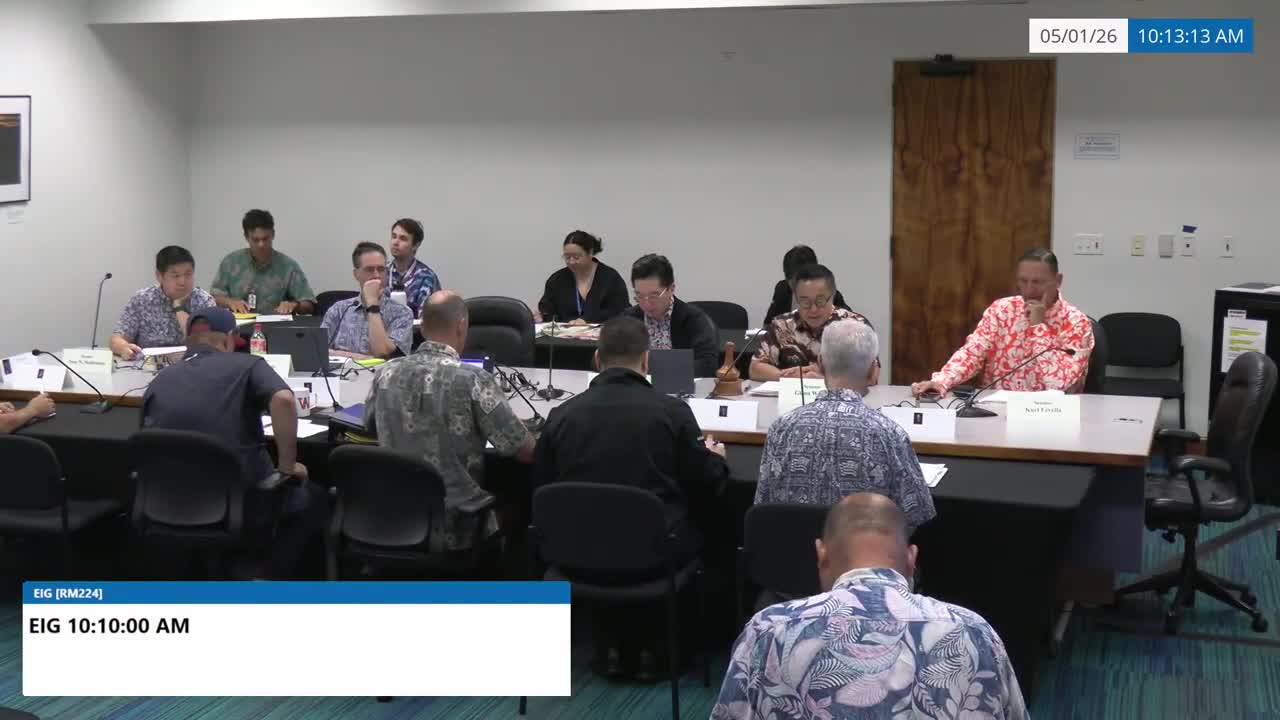 4MIN
Conference Committee
 52SEC
Conference Committee
 2MIN
Conference Committee
 9MIN
Conference Committee
 1MIN
Senate Standing Committee on Housing
1MIN
Senate Standing Committee on Energy and Intergovernmental Affairs
1MIN
Senate Standing Committee on Water, Land, Culture and the Arts
Bill Author