HB 1567: PUC; Lifeline Baseline Performance Standard; Medically Essential Needs Energy Program; Electric Utilities
- Session Year: 2025-2026
- House: House
- Latest Version Date: 2026-02-06
Current Status:
Failed
(2026-02-10: Passed Second Reading as amended in HD 1 and referred to the committee(s) on CPC with none voting aye with reservations; Representative(s) Garcia voting no (1) and none excused (0).)
Introduced
In Committee
First Chamber
In Committee
Second Chamber
Final Decking
Enacted
Allows the Public Utilities Commission to establish a lifeline baseline performance standard and medically essential needs energy program based on proposals from electric utilities. Effective 7/1/3000. (HD1)
Requires the Public Utilities Commission to establish residential electricity rate structures that prioritize affordability and equity. Requires the Public Utilities Commission to establish a lifeline baseline performance standard, a medical essential needs energy program, and a new tariff. Requires electric utilities to file revised tariffs no later than twelve months after the Public Utilities Commission has issued a final decision and order under this Act. Requires the Public Utilities Commission to convene a stakeholder process for developing and implementing this Act.
|
HOUSE OF REPRESENTATIVES |
H.B. NO. |
1567 |
|
THIRTY-THIRD LEGISLATURE, 2026 |
H.D. 1 |
|
|
STATE OF HAWAII |
|
|
|
|
|
|
|
|
||
|
|
||
A BILL FOR AN ACT
RELATING TO ENERGY EQUITY.
BE IT ENACTED BY THE LEGISLATURE OF THE STATE OF HAWAII:
SECTION 1. The legislature finds that Hawaiʻi's electricity costs create disproportionately high energy burdens on low-income households and medically fragile individuals. High electricity burden is associated with adverse health outcomes, increased hardship for seniors and caregivers, barriers to distributed energy resource adoption, and increased risk of disconnection during extreme heat and climate-driven emergencies.
The legislature further finds that allowing the public utilities commission to develop standards and programs that reduce energy burdens, advance public health, and align with the performance-based regulation framework would improve affordable access to essential electricity for all residents and strengthen protections for households with medically essential electricity needs.
Accordingly, the purpose of this Act is to allow the public utilities commission to establish a lifeline baseline performance standard and medically essential needs energy program based on proposals from electric utilities.
SECTION 2. Chapter 269, Hawaii Revised Statutes, is amended by adding a new section to part I to be appropriately designated and to read as follows:
"§269- Lifeline baseline performance standard; medically essential needs energy program. (a) The public utilities commission may establish a lifeline baseline performance standard and medically essential needs energy program based on electric utility proposals, while considering the following objectives:
(1) Addressing affordability for essential household electricity use;
(2) Addressing energy burdens for low-income and medically fragile households;
(3) Supporting medically necessary electricity consumption;
(4) Promoting resilience during outages and service disruptions; and
(5) Supporting energy equity and climate resilience objectives.
(b) In response to electric utility proposals submitted pursuant to subsection (a), the public utilities commission may establish a lifeline baseline performance standard that reflects the monthly electricity consumption necessary to meet essential household needs, including considerations for:
(1) Household size and multigenerational residence;
(2) Climate zone, island-specific heat risk, and extreme temperature trends; and
(3) Household medical and health-related electricity needs.
(c) In response to electric utility proposals submitted pursuant to subsection (a), the public utilities commission may establish a medically essential needs energy program to protect households with medically essential electricity requirements. The program may include:
(1) Providing for an enhanced baseline allowance at the lifeline rate for certified medical need;
(2) Allowing for certification by licensed health care providers, including via telehealth;
(3) Prohibiting disconnection of certified households during conditions such as heat advisories, grid reliability disruptions, and health care emergencies;
(4) Ensuring that participation does not affect eligibility for any other assistance or energy customer program; and
(5) Incentivizing distributed energy resource adoption to address reliability and affordability concerns.
(d) If a lifeline baseline performance standard or medically essential needs program is proposed or established, the public utilities commission and electric utilities shall submit a report of their findings and recommendations, including any proposed legislation, to the legislature no later than twenty days prior to the convening of each regular session. The report shall include:
(1) Lifeline and medical program enrollment;
(2) Disconnection notices and completed disconnections, disaggregated by island and zip code;
(3) Household electricity burden by income decile;
(4) Access to and enrollment in distributed energy resource programs; and
(5) Heat-risk and emergency event data affecting household energy stability."
SECTION 3. New statutory material is underscored.
SECTION 4. This Act shall take effect on July 1, 3000.
Report Title:
PUC; Lifeline Baseline Performance Standard; Medically Essential Needs Energy Program; Electric Utilities
Description:
Allows the Public Utilities Commission to establish a lifeline baseline performance standard and medically essential needs energy program based on proposals from electric utilities. Effective 7/1/3000. (HD1)
The summary description of legislation appearing on this page is for informational purposes only and is not legislation or evidence of legislative intent.
|
HOUSE OF REPRESENTATIVES |
H.B. NO. |
1567 |
|
THIRTY-THIRD LEGISLATURE, 2026 |
|
|
|
STATE OF HAWAII |
|
|
|
|
|
|
|
|
||
|
|
||
A BILL FOR AN ACT
relating to energy Equity.
BE IT ENACTED BY THE LEGISLATURE OF THE STATE OF HAWAII:
SECTION 1. The purpose of this Act is to ensure affordable access to essential electricity for all residents, strengthen protections for households with medically essential electricity needs, and direct the public utilities commission to develop rate structures that reduce energy burden, advance public health, and align with the performance-based regulation framework.
The legislature finds that Hawaiʻi's electricity costs create disproportionately high energy burdens on low-income households and medically fragile individuals. High electricity burden is associated with adverse health outcomes, increased hardship for seniors and caregivers, barriers to distributed energy resource adoption, and increased risk of disconnection during extreme heat and climate-driven emergencies. Modernized rate design consistent with performance-based regulation is necessary to support equitable access to essential services, protect medically essential needs, and strengthen community resilience.
The legislature further finds that aligning rate design with medically essential needs, household size and configuration, and heat-risk conditions is consistent with the mission of the public utilities commission to ensure just and reasonable rates, protect consumers, and advance the public interest.
Accordingly, the purpose of this Act is to:
(1) Require the public utilities commission to establish residential electricity rate structures that prioritize affordability and equity;
(2) Require the public utilities commission to establish a lifeline baseline performance standard, a medical essential needs energy program, and a new tariff;
(3) Require electric utilities to file revised tariffs no later than twelve months after the commission has issued a final decision and order under this Act; and
(4) Require the public utilities commission to convene a stakeholder process for developing and implementing this Act.
SECTION 2. Chapter 269, Hawaii Revised Statutes, is amended by adding a new section to part I to be appropriately designated and to read as follows:
"§269- Lifeline and medical essential needs electricity protections. (a) The public utilities commission shall initiate a docketed proceeding to establish residential electricity rate structures that:
(1) Maintain affordability for essential household electricity use;
(2) Reduce energy burden for low-income and medically fragile households;
(3) Support medically necessary electricity consumption;
(4) Align with the performance-based regulation framework under section 269-16.1; and
(5) Support equitable access to distributed energy resources and climate resilience objectives.
(b) The public utilities commission shall establish a lifeline baseline performance standard that reflects the monthly electricity consumption necessary to meet essential household needs, determined through the docket record and based on evidence related to:
(1) Household size and multigenerational residence;
(2) Climate zone, island-specific heat risk, and extreme temperature trends;
(3) Household medical and health-related electricity needs; and
(4) Relevant data required under section 269-124.
The public utilities commission may approve regionally differentiated baselines supported by evidence in the docket record.
(c) The public utilities commission shall establish a medical essential needs energy program to protect households with medically essential electricity requirements. The program shall:
(1) Provide an enhanced baseline allowance at the lifeline rate for certified medical need;
(2) Allow certification by licensed healthcare providers, including via telehealth;
(3) Prohibit disconnection of certified households:
(A) During National Weather Service heat advisories;
(B) During declared grid reliability or healthcare emergencies; and
(C) Without a documented offer of a payment arrangement and individualized assessment of health risk; and
(4) Ensure that participation does not affect eligibility for any other assistance or distributed energy resource program.
(d) The public utilities commission shall establish, in the docket required under this section, either a rising block tariff for residential customers or a time-varying or alternative tariff that achieves affordability and equity outcomes equivalent to a rising block tariff, as demonstrated in the docket record.
Any tariff approved under this subsection shall:
(1) Preserve affordable access to essential and medically essential electricity use;
(2) Avoid regressive cost shifts that disproportionately burden low-income or medically fragile households;
(3) Encourage efficient electricity use and distributed energy resource integration;
(4) Integrate with performance incentive mechanisms and multi-year rate planning under section 269-16.1; and
(5) Be supported by an equity impact analysis included in the final decision and order.
(e) The public utilities commission shall ensure that any fixed charge or minimum bill approved under this section:
(1) Does not increase the average energy burden of low-income or medically fragile households;
(2) Is demonstrated in the docket record to be non-regressive; and
(3) Includes a published equity impact analysis as part of the final decision and order.
The public utilities commission shall consider alternatives to fixed charges, including performance incentive mechanisms, where necessary to achieve the objectives of this section.
(f) Costs incurred to implement this section may only be recovered through customer rates if the public utilities commission finds, in the docket record, that the costs are prudent and will not increase the energy burden of low-income or medically fragile households. The public utilities commission may require shareholder contributions when appropriate under performance-based regulation.
(g) The public utilities commission and electric utilities shall submit a report of its findings and recommendations, including any proposed legislation, to the legislature no later than twenty days prior to the convening of each regular session. The report shall include:
(1) Lifeline and medical program enrollment;
(2) Disconnection notices and completed disconnections, disaggregated by island and zip code;
(3) Household electricity burden by income decile;
(4) Access to and enrollment in distributed energy resource programs; and
(5) Heat-risk and emergency event data affecting household energy stability."
SECTION 3. Each electric utility shall file revised residential tariffs implementing section 269- , Hawaii Revised Statutes, as added by this Act, within twelve months after the public utilities commission issues a final decision and order in the docketed proceeding required under this Act.
SECTION 4. (a) The public utilities commission shall convene a stakeholder process to support implementation of this Act.
(b) Stakeholders shall include, at minimum, the consumer advocate and Hawaii state energy office. The public utilities commission shall invite the following to be participants:
(1) Disability rights organizations;
(2) Health care providers and elder care organizations;
(3) Environmental and energy justice organizations; and
(4) Electric utilities.
(c) To the extent practicable, this process shall be integrated with ongoing public utilities commission proceedings related to advanced rate design, energy equity, or utility disconnection policies.
SECTION 5. New statutory material is underscored.
SECTION 6. This Act shall take effect on July 1, 2026.
|
INTRODUCED BY: |
_____________________________ |
|
|
|
Report Title:
PUC; Residential Electricity Rate Structures; Medical Essential Needs Energy Program; Rising-Block Tariff
Description:
Requires the Public Utilities Commission to establish residential electricity rate structures that prioritize affordability and equity. Requires the Public Utilities Commission to establish a lifeline baseline performance standard, a medical essential needs energy program, and a new tariff. Requires electric utilities to file revised tariffs no later than twelve months after the Public Utilities Commission has issued a final decision and order under this Act. Requires the Public Utilities Commission to convene a stakeholder process for developing and implementing this Act.
The summary description of legislation appearing on this page is for informational purposes only and is not legislation or evidence of legislative intent.
|
Date
|
Status
|
|---|---|
| Feb 10, 2026 | Passed Second Reading as amended in HD 1 and referred to the committee(s) on CPC with none voting aye with reservations; Representative(s) Garcia voting no (1) and none excused (0). |
| Feb 9, 2026 | Reported from EEP (Stand. Com. Rep. No. 80-26) as amended in HD 1, recommending passage on Second Reading and referral to CPC. |
| Feb 5, 2026 | The committee on EEP recommend that the measure be PASSED, WITH AMENDMENTS. The votes were as follows: 7 Ayes: Representative(s) Lowen, Perruso, Chun, Kahaloa, Kusch, Quinlan, Matsumoto; Ayes with reservations: none; Noes: none; and Excused: none. |
| Feb 2, 2026 | Bill scheduled to be heard by EEP on Thursday, 02-05-26 9:00AM in House conference room 325 VIA VIDEOCONFERENCE. |
| Jan 26, 2026 | Referred to EEP, CPC, FIN, referral sheet 1 |
| Jan 21, 2026 | Introduced and Pass First Reading. |
| Jan 16, 2026 | Prefiled. |
|
Date
|
Description
|
Location
|
Votes
|
|
|---|---|---|---|---|
| Feb 5, 2026 | The committee on EEP recommend that the measure be PASSED, WITH AMENDMENTS | House Standing Committee on Energy & Environmental Protection |
Passed |
This list shows positions taken on this bill by organizations on the date displayed, which is linked to the original source.
Positions by individuals are not included.
|
Organization
|
Position
|
Date
|
|---|---|---|
| Democratic Party of Hawaii | *** Support | Feb 5, 2026 |
| Free Access Coalition | ** Support | |
| Kauaʻi Island Utility Cooperative | *** Against | Feb 5, 2026 |
| Kupuna for the Moopuna | ** Support | |
| PowerBack Project | *** Support | Feb 5, 2026 |
| Public Utilities Commission | ** Support | |
| Sierra Club of Hawaiʻi | ** Support | |
| Upcountry Energy Resilience Project | *** Support | Feb 5, 2026 |
STAND. COM. REP. NO. 80-26
Honolulu, Hawaii
, 2026
RE: H.B. No. 1567
H.D. 1
Honorable Nadine K. Nakamura
Speaker, House of Representatives
Thirty-Third State Legislature
Regular Session of 2026
State of Hawaii
Madame:
Your Committee on Energy & Environmental Protection, to which was referred H.B. No. 1567 entitled:
"A BILL FOR AN ACT RELATING TO ENERGY EQUITY,"
begs leave to report as follows:
The purpose of this measure is to require:
(1) The Public Utilities Commission to:
(A) Establish residential electricity rate structures that prioritize affordability and equity;
(B) Establish a lifeline baseline performance standard, a medically essential needs energy program, and a new tariff; and
(C) Convene a stakeholder process for developing and implementing this measure; and
(2) Electric utilities to file revised tariffs no later than twelve months after the Public Utilities Commission has issued a final decision and order under this measure.
Your Committee received testimony in support of this measure from the Public Utilities Commission; Kupuna for the Moopuna; Free Access Coalition; Sierra Club of Hawaiʻi; and numerous individuals. Your Committee received testimony in opposition to this measure from Kauaʻi Island Utility Cooperative. Your Committee received comments on this measure from the Department of Commerce and Consumer Affairs.
Your Committee finds that Hawaii's high electricity costs create disproportionately high financial burdens for low‑income households and medically fragile residents, contributing to adverse health outcomes and increased risk during heat and climate‑driven emergencies. Your Committee further finds that the State has a duty to ensure equitable access to electricity and protect vulnerable populations from potential disruptions. This measure seeks to establish initiatives that would address these concerns.
Your Committee has amended this measure by:
(1) Removing the requirement that the Public Utilities Commission establish certain rate structures and tariffs and convene a stakeholder process;
(2) Allowing, rather than requiring, the Public Utilities Commission to establish a lifeline baseline performance standard and medically essential needs energy program and amending the objectives of the standard and program;
(3) Removing the requirement that each electric utility file revised residential tariffs;
(4) Changing the effective date to July 1, 3000, to encourage further discussion; and
(5) Making technical, nonsubstantive amendments for the purposes of clarity, consistency, and style.
As affirmed by the record of votes of the members of your Committee on Energy & Environmental Protection that is attached to this report, your Committee is in accord with the intent and purpose of H.B. No. 1567, as amended herein, and recommends that it pass Second Reading in the form attached hereto as H.B. No. 1567, H.D. 1, and be referred to your Committee on Consumer Protection & Commerce.
Respectfully submitted on behalf of the members of the Committee on Energy & Environmental Protection,
|
|
|
____________________________ NICOLE E. LOWEN, Chair |
|
|
|
|
|
Date
|
Testimony PDF
|
|---|---|
| Feb 5, 2026 | HB1567_TESTIMONY_EEP_02-05-26_.PDF |
Discussed in Hearing
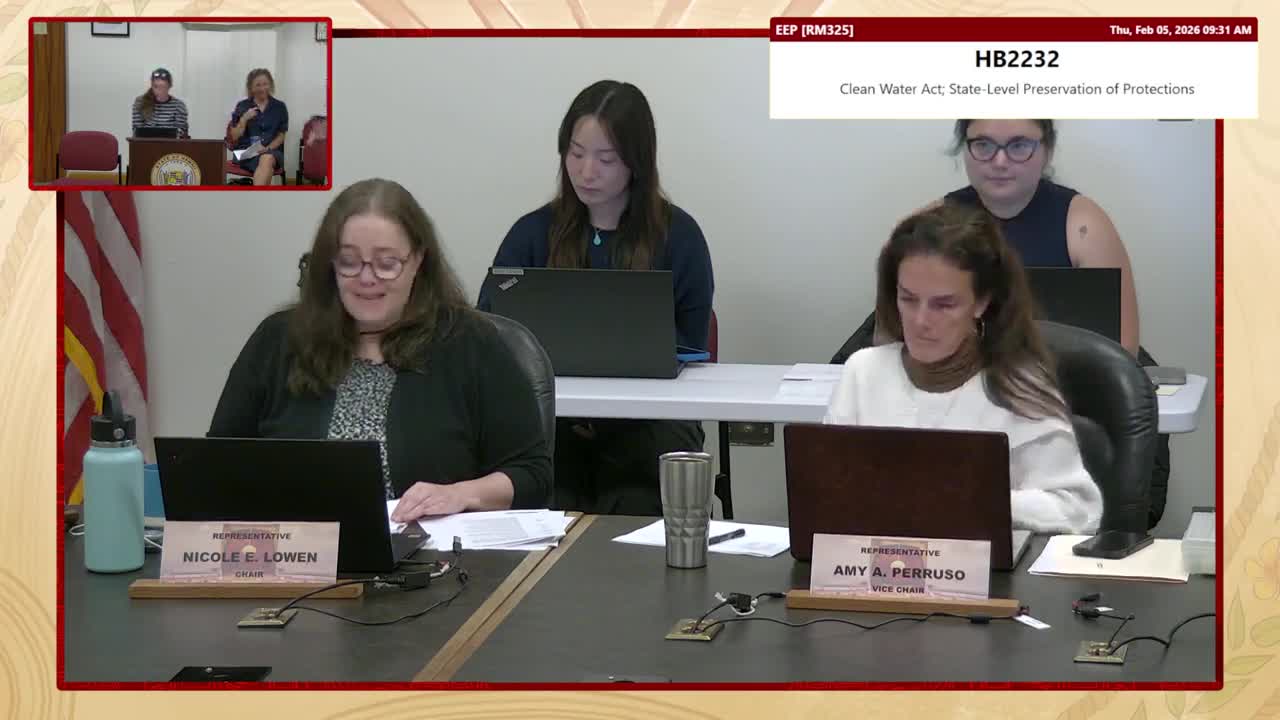 2MIN
House Standing Committee on Energy & Environmental Protection
35SEC
House Standing Committee on Energy & Environmental Protection
Bill Author