HB 1295: Clean Energy; State and County Agencies; Renewable Energy Projects; Zero-Emission Vehicles; Inflation Reduction Act of 2022
- Session Year: 2025-2026
- House: House
- Latest Version Date: 2025-04-04
Current Status:
Failed
(2026-04-02: Received notice of the discharge of all House Conferees (Hse. Com. No. 457).)
Introduced
In Committee
First Chamber
In Committee
Second Chamber
Final Decking
Enacted
Requires all state and county agencies to utilize applicable federal clean energy tax credits, pursuant to the Inflation Reduction Act of 2022, for the purchase and financing of capital improvement projects that use clean energy technology and zero-emission vehicles. Effective 7/1/2050. (SD1)
Requires all state and county agencies to utilize applicable federal clean energy tax credits, pursuant to the Inflation Reduction Act of 2022, for the purchase and financing of capital improvement projects that use clean energy technology and zero-emission vehicles. Effective 7/1/3000. (HD2)
Requires all state and county agencies to utilize applicable federal clean energy tax credits, pursuant to the Inflation Reduction Act of 2022, for the purchase and financing of capital improvement projects that use clean energy technology and zero-emission vehicles. Effective 7/1/3000. (HD1)
Requires all state and county agencies to utilize applicable federal clean energy tax credits, pursuant to the Inflation Reduction Act of 2022, for the purchase and financing of renewable energy projects and zero-emission vehicles.
|
HOUSE OF REPRESENTATIVES |
H.B. NO. |
1295 |
|
THIRTY-THIRD LEGISLATURE, 2025 |
H.D. 2 |
|
|
STATE OF HAWAII |
S.D. 1 |
|
|
|
|
|
|
|
||
|
|
||
A BILL FOR AN ACT
RELATING TO CLEAN ENERGY.
BE IT ENACTED BY THE LEGISLATURE OF THE STATE OF HAWAII:
SECTION 1. The legislature finds that the Inflation Reduction Act of 2022 introduced and expanded tax credits for clean energy technologies to accelerate the transition to a clean energy economy. In addition to providing incentives to spur private-sector investment, the Inflation Reduction Act includes provisions to enable tax-exempt and governmental entities to take an active role in building the clean energy economy. The Inflation Reduction Act allows for "elective pay", a tax credit monetization option commonly known as "direct pay", which makes clean energy tax benefits available to those historically excluded from claiming them, such as state and local governments, nonprofit organizations, and public utilities. Since these tax-exempt and governmental entities are not subject to federal income tax, they could not previously claim the credits, making those benefits available only to private energy developers. The elective pay provisions of the Inflation Reduction Act levels the playing field for tax-exempt and governmental entities and offers a tremendous opportunity to expand the reach of clean energy incentives.
Accordingly, the purpose of this Act is to require all state and county agencies to utilize applicable federal clean energy tax credits, pursuant to the Inflation Reduction Act of 2022, for the purchase and financing of renewable energy projects and zero-emission vehicles.
SECTION 2. Beginning July 1, 2025, all state and county agencies shall utilize applicable federal clean energy tax credits under the elective pay, also known as direct pay, provisions of the Inflation Reduction Act of 2022, Pub. L. 117‑169, 136 Stat. 1818, as amended, for the purchase or financing of each of the following:
(1) Capital improvement projects that utilize clean energy technology, as defined in section 269-121, Hawaii Revised Statutes; and
(2) Vehicles that qualify as zero-emission vehicles under title 40 Code of Federal Regulations section 88.1;
SECTION 3. This Act does not affect rights and duties that matured, penalties that were incurred, and proceedings that were begun before its effective date.
SECTION 4. This Act shall take effect on July 1, 2050.
Report Title:
Clean Energy; State and County Agencies; Renewable Energy Projects; Zero-Emission Vehicles; Inflation Reduction Act of 2022
Description:
Requires all state and county agencies to utilize applicable federal clean energy tax credits, pursuant to the Inflation Reduction Act of 2022, for the purchase and financing of capital improvement projects that use clean energy technology and zero-emission vehicles. Effective 7/1/2050. (SD1)
The summary description of legislation appearing on this page is for informational purposes only and is not legislation or evidence of legislative intent.
|
HOUSE OF REPRESENTATIVES |
H.B. NO. |
1295 |
|
THIRTY-THIRD LEGISLATURE, 2025 |
H.D. 2 |
|
|
STATE OF HAWAII |
|
|
|
|
|
|
|
|
||
|
|
||
A BILL FOR AN ACT
RELATING TO CLEAN ENERGY.
BE IT ENACTED BY THE LEGISLATURE OF THE STATE OF HAWAII:
SECTION 1. The legislature finds that the Inflation Reduction Act of 2022 introduced and expanded tax credits for clean energy technologies to accelerate the transition to a clean energy economy. In addition to providing incentives to spur private-sector investment, the Inflation Reduction Act includes provisions to enable tax-exempt and governmental entities to take an active role in building the clean energy economy. The Inflation Reduction Act allows for "elective pay", a tax credit monetization option commonly known as "direct pay", which makes clean energy tax benefits available to those historically excluded from claiming them, such as state and local governments, nonprofit organizations, and public utilities. Since these tax-exempt and governmental entities are not subject to federal income tax, they could not previously claim the credits, making those benefits available only to private energy developers. The elective pay provisions of the Inflation Reduction Act levels the playing field for tax-exempt and governmental entities and offers a tremendous opportunity to expand the reach of clean energy incentives.
Accordingly, the purpose of this Act is to require all state and county agencies to utilize applicable federal clean energy tax credits, pursuant to the Inflation Reduction Act of 2022, for the purchase and financing of renewable energy projects and zero-emission vehicles.
SECTION 2. Beginning July 1, 2025, all state and county agencies shall utilize applicable federal clean energy tax credits under the elective pay, also known as direct pay, provisions of the Inflation Reduction Act of 2022, Pub. L. 117‑169, 136 Stat. 1818, as amended, for the purchase or financing of each of the following:
(1) Capital improvement projects that utilize clean energy technology, as defined in section 269-121, Hawaii Revised Statutes; and
(2) Vehicles that qualify as zero-emission vehicles under title 40 Code of Federal Regulations section 88.1;
SECTION 3. This Act does not affect rights and duties that matured, penalties that were incurred, and proceedings that were begun before its effective date.
SECTION 4. This Act shall take effect on July 1, 3000.
Report Title:
Clean Energy; State and County Agencies; Renewable Energy Projects; Zero-Emission Vehicles; Inflation Reduction Act of 2022
Description:
Requires all state and county agencies to utilize applicable federal clean energy tax credits, pursuant to the Inflation Reduction Act of 2022, for the purchase and financing of capital improvement projects that use clean energy technology and zero-emission vehicles. Effective 7/1/3000. (HD2)
The summary description of legislation appearing on this page is for informational purposes only and is not legislation or evidence of legislative intent.
|
HOUSE OF REPRESENTATIVES |
H.B. NO. |
1295 |
|
THIRTY-THIRD LEGISLATURE, 2025 |
H.D. 1 |
|
|
STATE OF HAWAII |
|
|
|
|
|
|
|
|
||
|
|
||
A BILL FOR AN ACT
RELATING TO CLEAN ENERGY.
BE IT ENACTED BY THE LEGISLATURE OF THE STATE OF HAWAII:
SECTION 1. The legislature finds that the Inflation Reduction Act of 2022 introduced and expanded tax credits for clean energy technologies to accelerate the transition to a clean energy economy. In addition to providing incentives to spur private-sector investment, the Inflation Reduction Act includes provisions to enable tax-exempt and governmental entities to take an active role in building the clean energy economy. The Inflation Reduction Act allows for "elective pay", a tax credit monetization option commonly known as "direct pay", which makes clean energy tax benefits available to those historically excluded from claiming them, such as state and local governments, nonprofit organizations, and public utilities. Since these tax-exempt and governmental entities are not subject to federal income tax, they could not previously claim the credits, making those benefits available only to private energy developers. The elective pay provisions of the Inflation Reduction Act levels the playing field for tax-exempt and governmental entities and offers a tremendous opportunity to expand the reach of clean energy incentives.
Accordingly, the purpose of this Act is to require all state and county agencies to utilize applicable federal clean energy tax credits, pursuant to the Inflation Reduction Act of 2022, for the purchase and financing of renewable energy projects and zero-emission vehicles.
SECTION 2. Beginning July 1, 2025, all state and county agencies shall utilize applicable federal clean energy tax credits under the elective pay, also known as direct pay, provisions of the Inflation Reduction Act of 2022, Pub. L. 117‑169, 136 Stat. 1818, as amended, for the purchase or financing of each of the following:
(1) Capital improvement projects that utilize clean energy technology, as defined in section 269-121, Hawaii Revised Statutes; and
(2) Vehicles that qualify as zero-emission vehicles under title 40 Code of Federal Regulations section 88.1.
SECTION 3. This Act does not affect rights and duties that matured, penalties that were incurred, and proceedings that were begun before its effective date.
SECTION 4. This Act shall take effect on July 1, 3000.
Report Title:
Clean Energy; State and County Agencies; Renewable Energy Projects; Zero-Emission Vehicles; Inflation Reduction Act of 2022
Description:
Requires all state and county agencies to utilize applicable federal clean energy tax credits, pursuant to the Inflation Reduction Act of 2022, for the purchase and financing of capital improvement projects that use clean energy technology and zero-emission vehicles. Effective 7/1/3000. (HD1)
The summary description of legislation appearing on this page is for informational purposes only and is not legislation or evidence of legislative intent.
|
HOUSE OF REPRESENTATIVES |
H.B. NO. |
1295 |
|
THIRTY-THIRD LEGISLATURE, 2025 |
|
|
|
STATE OF HAWAII |
|
|
|
|
|
|
|
|
||
|
|
||
A BILL FOR AN ACT
relating to clean energy.
BE IT ENACTED BY THE LEGISLATURE OF THE STATE OF HAWAII:
SECTION 1. The legislature finds that the Inflation Reduction Act of 2022 introduced and expanded tax credits for clean energy technologies to accelerate the transition to a clean energy economy. In addition to providing incentives to spur private-sector investment, the Inflation Reduction Act includes provisions to enable tax-exempt and governmental entities to take an active role in building the clean energy economy. The Inflation Reduction Act allows for "elective pay", a tax credit monetization option commonly known as "direct pay", which makes clean energy tax benefits available to those historically excluded from claiming them, such as state and local governments, nonprofit organizations, and public utilities. Since these tax-exempt and governmental entities are not subject to federal income tax, they could not previously claim the credits, making those benefits available only to private energy developers. The elective pay provisions of the Inflation Reduction Act levels the playing field for tax-exempt and governmental entities and offers a tremendous opportunity to expand the reach of clean energy incentives.
Accordingly, the purpose of this Act is to require all state and county agencies to utilize applicable federal clean energy tax credits, pursuant to the Inflation Reduction Act of 2022, for the purchase and financing of renewable energy projects and zero-emission vehicles.
SECTION 2. Beginning July 1, 2025, all state and county agencies shall utilize applicable federal clean energy tax credits under the elective pay, also known as direct pay, provisions of the Inflation Reduction Act of 2022, Pub. L. 117‑169, 136 Stat. 1818, as amended, for the purchase or financing of each of the following:
(1) Capital improvement projects that utilize clean energy technology, as defined in section 269-121, Hawaii Revised Statutes; and
(2) Zero-emission vehicles, as defined in title 40 Code of Federal Regulations section 88.102-94.
SECTION 3. This Act does not affect rights and duties that matured, penalties that were incurred, and proceedings that were begun before its effective date.
SECTION 4. This Act shall take effect on July 1, 2025.
|
INTRODUCED BY: |
_____________________________ |
|
|
|
Report Title:
Clean Energy; State and County Agencies; Renewable Energy Projects; Zero-Emission Vehicles; Inflation Reduction Act of 2022
Description:
Requires all state and county agencies to utilize applicable federal clean energy tax credits, pursuant to the Inflation Reduction Act of 2022, for the purchase and financing of renewable energy projects and zero-emission vehicles.
The summary description of legislation appearing on this page is for informational purposes only and is not legislation or evidence of legislative intent.
|
Date
|
Status
|
|---|---|
| Apr 2, 2026 | Received notice of the discharge of all House Conferees (Hse. Com. No. 457). |
| Apr 1, 2026 | House Conferee(s) discharged. |
| Dec 8, 2025 | Carried over to 2026 Regular Session. |
| Apr 21, 2025 | Received notice of appointment of House conferees (Hse. Com. No. 755). |
| Apr 17, 2025 | House Conferees Appointed: Lowen, Takenouchi Co-Chairs; Kusch, Perruso, Alcos. |
| Apr 11, 2025 | Received notice of disagreement (Hse. Com. No. 704). |
| Apr 10, 2025 | House disagrees with Senate amendment (s). |
| Apr 8, 2025 | Returned from Senate (Sen. Com. No. 754) in amended form (SD 1). |
| Apr 8, 2025 | Report Adopted; Passed Third Reading, as amended (SD 1). Ayes, 23; Aye(s) with reservations: none. Noes, 2 (Senator(s) Awa, DeCorte). Excused, 0 (none). Transmitted to House. |
| Apr 4, 2025 | 48 Hrs. Notice 04-08-25. |
| Apr 4, 2025 | Reported from WAM (Stand. Com. Rep. No. 1805) with recommendation of passage on Third Reading, as amended (SD 1). |
| Apr 3, 2025 | The committee(s) on WAM recommend(s) that the measure be PASSED, WITH AMENDMENTS. The votes in WAM were as follows: 13 Aye(s): Senator(s) Dela Cruz, Moriwaki, Aquino, DeCoite, Elefante, Hashimoto, Inouye, Kanuha, Kidani, Kim, Lee, C., Wakai, Fevella; Aye(s) with reservations: none ; 0 No(es): none; and 0 Excused: none. |
| Apr 1, 2025 | The committee(s) on WAM will hold a public decision making on 04-03-25 10:01AM; Conference Room 211 & Videoconference. |
| Mar 21, 2025 | Report adopted; Passed Second Reading and referred to WAM. |
| Mar 21, 2025 | Reported from EIG (Stand. Com. Rep. No. 1284) with recommendation of passage on Second Reading and referral to WAM. |
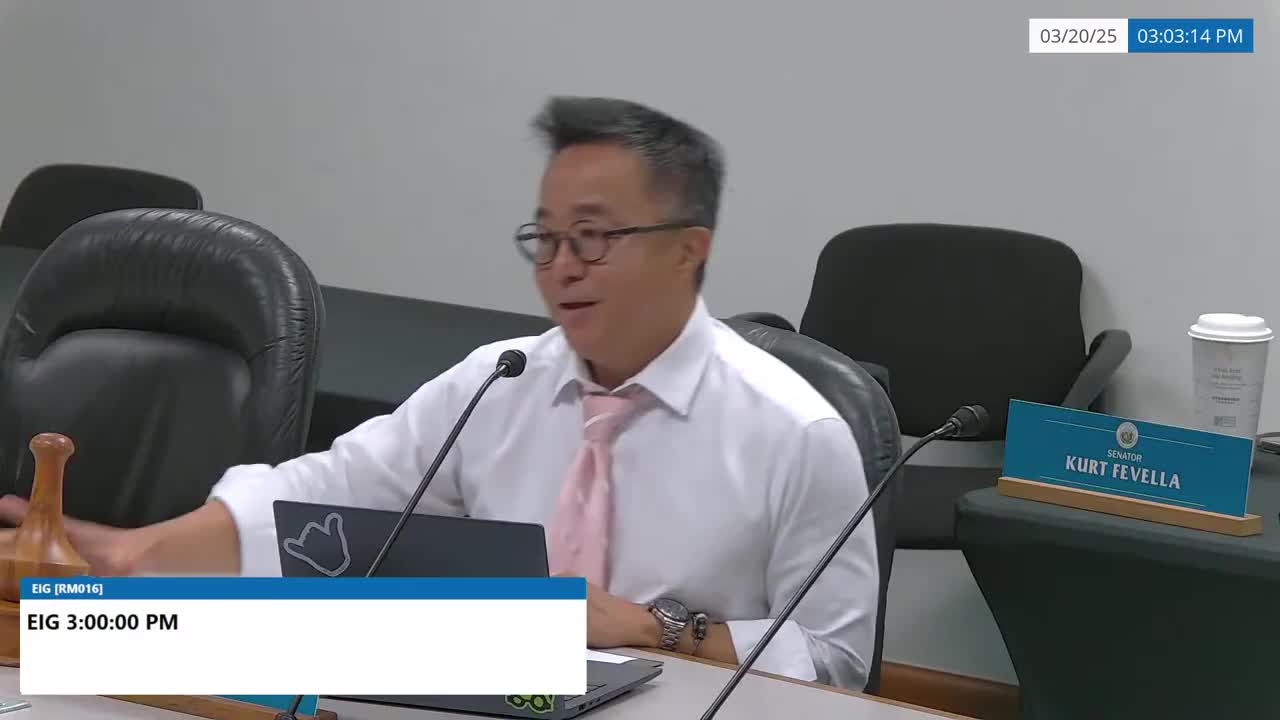
| Mar 20, 2025 | The committee(s) on EIG recommend(s) that the measure be PASSED, UNAMENDED. The votes in EIG were as follows: 4 Aye(s): Senator(s) Wakai, Chang, DeCoite, Richards; Aye(s) with reservations: none ; 0 No(es): none; and 1 Excused: Senator(s) Fevella. |
| Mar 17, 2025 | The committee(s) on EIG has scheduled a public hearing on 03-20-25 3:00PM; Conference Room 016 & Videoconference. |
| Mar 6, 2025 | Referred to EIG, WAM. |
| Mar 6, 2025 | Passed First Reading. |
| Mar 6, 2025 | Received from House (Hse. Com. No. 352). |
| Mar 4, 2025 | Passed Third Reading as amended in HD 2 with none voting aye with reservations; Representative(s) Garcia, Kong voting no (2) and Representative(s) Pierick, Ward excused (2). Transmitted to Senate. |
| Feb 28, 2025 | Forty-eight (48) hours notice Tuesday, 03-04-25. |
| Feb 28, 2025 | Reported from FIN (Stand. Com. Rep. No. 1016) as amended in HD 2, recommending passage on Third Reading. |
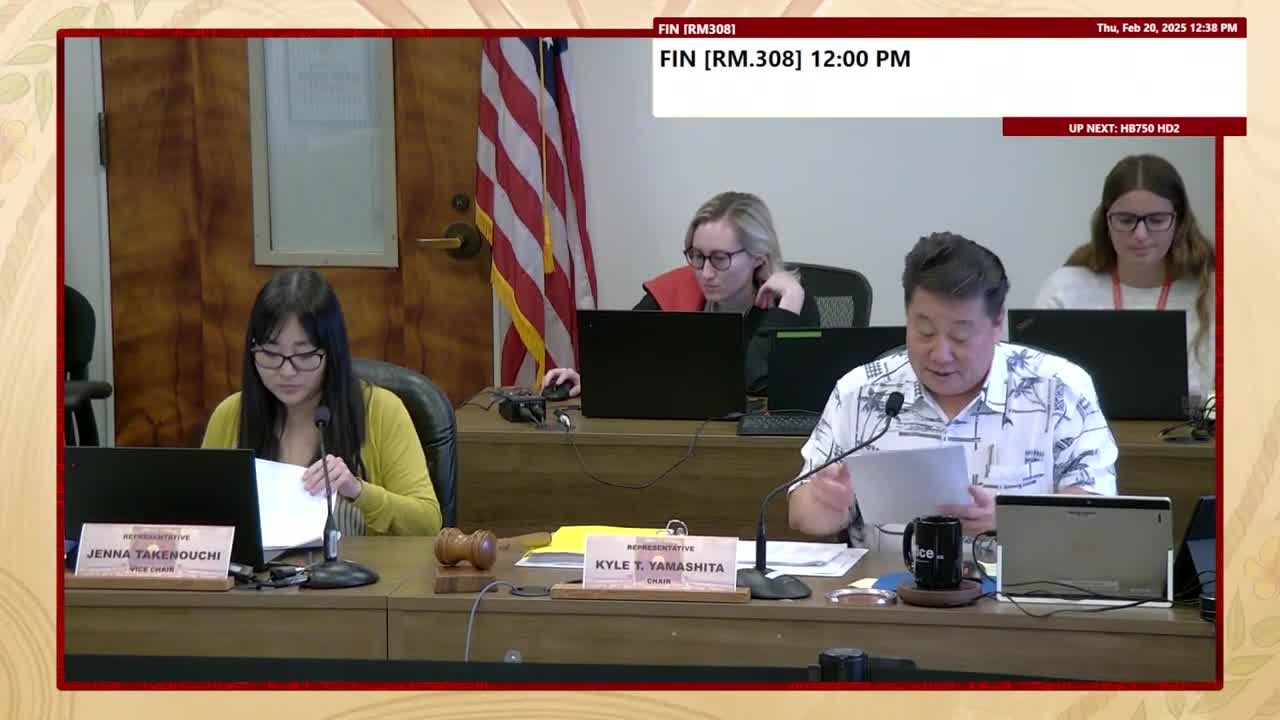
| Feb 20, 2025 | The committee on FIN recommend that the measure be PASSED, WITH AMENDMENTS. The votes were as follows: 14 Ayes: Representative(s) Yamashita, Takenouchi, Grandinetti, Holt, Hussey, Keohokapu-Lee Loy, Kitagawa, Kusch, Lamosao, Lee, M., Miyake, Morikawa, Templo, Reyes Oda; Ayes with reservations: none; Noes: none; and 2 Excused: Representative(s) Alcos, Ward. |
| Feb 18, 2025 | Bill scheduled to be heard by FIN on Thursday, 02-20-25 12:00PM in House conference room 308 VIA VIDEOCONFERENCE. |
| Feb 11, 2025 | Passed Second Reading as amended in HD 1 and referred to the committee(s) on FIN with none voting aye with reservations; Representative(s) Garcia voting no (1) and Representative(s) Cochran, Ward excused (2). |
| Feb 11, 2025 | Reported from EEP (Stand. Com. Rep. No. 352) as amended in HD 1, recommending passage on Second Reading and referral to FIN. |
| Feb 6, 2025 | The committee on EEP recommend that the measure be PASSED, WITH AMENDMENTS. The votes were as follows: 5 Ayes: Representative(s) Lowen, Perruso, Kahaloa, Kusch, Quinlan; Ayes with reservations: none; Noes: none; and 1 Excused: Representative(s) Ward. |
| Jan 29, 2025 | Bill scheduled to be heard by EEP on Thursday, 02-06-25 9:00AM in House conference room 325 VIA VIDEOCONFERENCE. |
| Jan 27, 2025 | Referred to EEP, FIN, referral sheet 4 |
| Jan 23, 2025 | Introduced and Pass First Reading. |
| Jan 22, 2025 | Pending introduction. |
|
Date
|
Description
|
Location
|
Votes
|
|
|---|---|---|---|---|
| Apr 8, 2025 | Third Reading | Senate Floor |
Passed |
|
| Apr 3, 2025 | The committee(s) on WAM recommend(s) that the measure be PASSED, WITH AMENDMENTS | Senate Standing Committee on Ways and Means |
Passed |
|
| Mar 20, 2025 | The committee(s) on EIG recommend(s) that the measure be PASSED, UNAMENDED | Senate Standing Committee on Energy and Intergovernmental Affairs |
Passed |
|
| Mar 4, 2025 | Third Reading | House Floor |
Passed |
|
| Feb 20, 2025 | The committee on FIN recommend that the measure be PASSED, WITH AMENDMENTS | House Standing Committee on Finance |
Passed |
|
| Feb 6, 2025 | The committee on EEP recommend that the measure be PASSED, WITH AMENDMENTS | House Standing Committee on Energy & Environmental Protection |
Passed |
This list shows positions taken on this bill by organizations on the date displayed, which is linked to the original source.
Positions by individuals are not included.
|
Organization
|
Position
|
Date
|
|---|---|---|
| American Lung Association in Hawaii | ** Support | |
| American Lung Association in Hawaiʻi | *** Support | Mar 20, 2025 |
| Kingdom of The Hawaiian Islands | *** Support | Mar 20, 2025 |
| Ohana Unity Party | *** Support | Mar 20, 2025 |
| Public Utilities Commission | *** Support | Apr 3, 2025 |
| Public Utilities Commission | ** Support | |
| Ulupono Initiative | *** Support | Apr 3, 2025 |
STAND. COM. REP. NO. 1805
Honolulu, Hawaii
RE: H.B. No. 1295
H.D. 2
S.D. 1
Honorable Ronald D. Kouchi
President of the Senate
Thirty-Third State Legislature
Regular Session of 2025
State of Hawaii
Sir:
Your Committee on Ways and Means, to which was referred H.B. No. 1295, H.D. 2, entitled:
"A BILL FOR AN ACT RELATING TO CLEAN ENERGY,"
begs leave to report as follows:
The purpose and intent of this measure is to require all state and county agencies to utilize applicable federal clean energy tax credits, pursuant to the Inflation Reduction Act of 2022, for the purchase and financing of renewable energy projects and zero-emission vehicles.
Your Committee received written comments in support of this measure from the Hawaii Public Utilities Commission, Ulupono Initiative, and one individual.
Your Committee received written comments on this measure from the Department of Budget and Finance.
Your Committee finds that the Inflation Reduction Act of 2022 authorized a tax credit monetization option known as "elective pay" or "direct pay," which made clean energy tax benefits available to state and local governments, nonprofit organizations, and public utilities, which have historically been excluded from the tax benefits. Your Committee further finds that the availability of these clean energy tax credits presents an opportunity for the State and counties to expand the reach of clean energy incentives and take an active role in building a clean energy economy.
Your Committee has amended this measure by changing the effective date to July 1, 2050, to facilitate further discussion on the measure.
As affirmed by the record of votes of the members of your Committee on Ways and Means that is attached to this report, your Committee is in accord with the intent and purpose of H.B. No. 1295, H.D. 2, as amended herein, and recommends that it pass Third Reading in the form attached hereto as H.B. No. 1295, H.D. 2, S.D. 1.
Respectfully submitted on behalf of the members of the Committee on Ways and Means,
|
|
|
________________________________ DONOVAN M. DELA CRUZ, Chair |
|
|
|
|
STAND. COM. REP. NO. 1284
Honolulu, Hawaii
RE: H.B. No. 1295
H.D. 2
Honorable Ronald D. Kouchi
President of the Senate
Thirty-Third State Legislature
Regular Session of 2025
State of Hawaii
Sir:
Your Committee on Energy and Intergovernmental Affairs, to which was referred H.B. No. 1295, H.D. 2, entitled:
"A BILL FOR AN ACT RELATING TO CLEAN ENERGY,"
begs leave to report as follows:
The purpose and intent of this measure is to require all state and county agencies to utilize applicable federal clean energy tax credits, pursuant to the Inflation Reduction Act of 2022, for the purchase and financing of capital improvement projects that use clean energy technology and zero-emission vehicles.
Your Committee received testimony in support of this measure from Ulupono Initiative, American Lung Association in Hawaii, and two individuals.
Your Committee finds that the Inflation Reduction Act of 2022 makes clean energy tax credits available to those historically excluded from claiming them, such as state and local governments, nonprofit organizations, and public utilities. According to testimony received by your Committee, requiring all state and county agencies to pursue and leverage these federal funds, to the extent that the funding remains available and accessible, for capital improvement projects that use clean energy technology will mitigate cost impacts for local projects and create an ongoing skillset to engage at the federal level to secure vital resources. Your Committee further notes that the utilization of the clean energy tax credits for zero-emission vehicles would reduce carbon emissions from ground transportation. This forward-thinking measure will further help the State meet its ambitious decarbonization goals and accelerate its transition to a clean energy economy.
As affirmed by the record of votes of the members of your Committee on Energy and Intergovernmental Affairs that is attached to this report, your Committee is in accord with the intent and purpose of H.B. No. 1295, H.D. 2, and recommends that it pass Second Reading and be referred to your Committee on Ways and Means.
Respectfully submitted on behalf of the members of the Committee on Energy and Intergovernmental Affairs,
|
|
|
________________________________ GLENN WAKAI, Chair |
|
|
|
|
STAND. COM. REP. NO. 1016
Honolulu, Hawaii
, 2025
RE: H.B. No. 1295
H.D. 2
Honorable Nadine K. Nakamura
Speaker, House of Representatives
Thirty-Third State Legislature
Regular Session of 2025
State of Hawaii
Madame:
Your Committee on Finance, to which was referred H.B. No. 1295, H.D. 1, entitled:
"A BILL FOR AN ACT RELATING TO CLEAN ENERGY,"
begs leave to report as follows:
Your Committee has amended this measure by specifying that any state or county agency that utilizes the elective pay, also known as direct pay, provisions of the federal Inflation Reduction Act of 2022 shall not be eligible for applicable state tax credits for the same capital improvement project or vehicle.
As affirmed by the record of votes of the members of your Committee on Finance that is attached to this report, your Committee is in accord with the intent and purpose of H.B. No. 1295, H.D. 1, as amended herein, and recommends that it pass Third Reading in the form attached hereto as H.B. No. 1295, H.D. 2.
Respectfully submitted on behalf of the members of the Committee on Finance,
|
|
|
____________________________ KYLE T. YAMASHITA, Chair |
|
|
|
|
STAND. COM. REP. NO. 352
Honolulu, Hawaii
, 2025
RE: H.B. No. 1295
H.D. 1
Honorable Nadine K. Nakamura
Speaker, House of Representatives
Thirty-Third State Legislature
Regular Session of 2025
State of Hawaii
Madame:
Your Committee on Energy & Environmental Protection, to which was referred H.B. No. 1295 entitled:
"A BILL FOR AN ACT RELATING TO CLEAN ENERGY,"
begs leave to report as follows:
Your Committee finds that the Inflation Reduction Act of 2022 allows for "elective pay", a tax credit monetization option commonly known as "direct pay", which makes clean energy tax benefits available to state and local governments, amongst other entities. This measure requires all state and county agencies to utilize applicable federal clean energy tax credits, pursuant to the Inflation Reduction Act, for the purchase and financing of capital improvement projects that use clean energy and zero-emission vehicles.
Your Committee has amended this measure by:
(1) Changing the effective date to July 1, 3000, to encourage further discussion; and
(2) Making technical, nonsubstantive amendments for the purposes of clarity, consistency, and style.
As affirmed by the record of votes of the members of your Committee on Energy & Environmental Protection that is attached to this report, your Committee is in accord with the intent and purpose of H.B. No. 1295, as amended herein, and recommends that it pass Second Reading in the form attached hereto as H.B. No. 1295, H.D. 1, and be referred to your Committee on Finance.
Respectfully submitted on behalf of the members of the Committee on Energy & Environmental Protection,
|
|
|
____________________________ NICOLE E. LOWEN, Chair |
|
|
|
|
|
Date
|
Testimony PDF
|
|---|---|
| Apr 3, 2025 | HB1295_HD2_TESTIMONY_WAM_04-03-25_.PDF |
| Mar 20, 2025 | HB1295_HD2_TESTIMONY_EIG_03-20-25_.PDF |
| Feb 20, 2025 | HB1295_HD1_TESTIMONY_FIN_02-20-25_.PDF |
| Feb 6, 2025 | HB1295_TESTIMONY_EEP_02-06-25_.PDF |
Discussed in Hearing
 2MIN
Senate Standing Committee on Energy and Intergovernmental Affairs
 37SEC
House Standing Committee on Finance
 51SEC
House Standing Committee on Energy & Environmental Protection
Bill Author

Bill Co-Author(s):