HB 1118: Immunizations; Non-Medical Exemptions; Repeal
- Session Year: 2025-2026
- House: House
- Latest Version Date: 2025-02-28
Current Status:
Failed
(2025-12-08: Carried over to 2026 Regular Session.)
Introduced
In Committee
First Chamber
In Committee
Second Chamber
Final Decking
Enacted
Prohibits new non-medical immunization exemptions for school-aged children. Effective 7/1/3000. (HD2)
Prohibits new non-medical immunization exemptions for school-aged children. Effective 7/1/3000. (HD1)
Repeals the non-medical exemption from immunization requirements.
|
HOUSE OF REPRESENTATIVES |
H.B. NO. |
1118 |
|
THIRTY-THIRD LEGISLATURE, 2025 |
H.D. 2 |
|
|
STATE OF HAWAII |
|
|
|
|
|
|
|
|
||
|
|
||
A BILL FOR AN ACT
RELATING TO NON-MEDICAL EXEMPTIONS TO IMMUNIZATION REQUIREMENTS.
BE IT ENACTED BY THE LEGISLATURE OF THE STATE OF HAWAII:
SECTION 1. The legislature finds that school entry immunization requirements have been shown to be effective in improving immunization coverage rates. Based on decades of strong evidence of effectiveness, the United States Department of Health and Human Services Task Force on Community Preventive Services recommended the continued implementation of school immunization requirements as a means of increasing immunization coverage, thereby reducing disease incidence. When ninety-five per cent of individuals in a community are immunized, those persons serve as a protective barrier against the likelihood of transmission of vaccine-preventable diseases in the community. This occurrence is referred to as "herd immunity".
High immunization rates at schools are especially important for medically fragile children. Some children have conditions that affect their immunity, such as illnesses that require chemotherapy. These children cannot be safely immunized, and, at the same time, they are less able to fight off illness when they are infected. They depend on herd immunity for their health and their lives. In Hawaii for the 2023-2024 school year, two hundred ninety-six students had a medical exemption from immunization; they were unable to get immunized due to a medical condition and relied on herd immunity to attend school safely.
The legislature further finds that decreasing immunization coverage due to non-medical exemptions increases the risk for vaccine-preventable disease outbreaks that can be fatal to children. In Hawaii for the 2015–2016 school year, the rate of non-medical immunization exemption was 2.5 per cent. The rate of non-medical immunization exemption more than doubled to 5.3 per cent for the 2023–2024 school year. The rate of non-medical exemptions varied by school with fifty-five of the three hundred eighty-two schools that reported for school year 2023-2024 having a non-medical immunization exemption rate greater than ten per cent.
The legislature finds that since the health and safety of Hawaii's keiki are paramount, the State has a compelling interest in protecting the public against deadly diseases considering an increasing trend in non-medical immunization exemptions, while honoring certain non-medical exemptions that previously have been approved.
Accordingly, the purpose of this Act is to improve the health and safety of school-aged children by minimizing exemptions from school immunization requirements.
SECTION 2. Section 302A-1156, Hawaii Revised Statutes, is amended to read as follows:
"§302A-1156 Exemptions. (a)
A child
[may] shall be exempted from the required immunizations[:
(1) If] if a licensed physician,
physician assistant, or advanced practice registered nurse certifies that the physical
condition of the child is such that immunizations would endanger the child's life
or health[; or
(2) If any parent, custodian, guardian, or any other
person in loco parentis to a child objects to immunization in writing on the grounds
that the immunization conflicts with that person's bona fide religious tenets
and practices. Upon showing the appropriate
school official satisfactory evidence of the exemption, no certificate or other
evidence of immunization shall be required for entry into school].
(b) Any child attending school who had an approved religious exemption from required immunizations for the 2024-2025 school year shall be permitted to remain exempt while continuing to attend school in Hawaii.
(c) This section shall not prohibit a pupil who qualifies for an individualized education program pursuant to federal and state law, from accessing any special education and related services required by their individualized education program."
SECTION 3. Section 321-11, Hawaii Revised Statutes, is amended to read as follows:
"§321-11 Subjects of health rules, generally. The department of health pursuant to chapter 91 may adopt rules that it deems necessary for the public health and safety respecting:
(1) Nuisances, foul or noxious odors, gases, vapors, waters in which mosquitoes breed or may breed, sources of filth, and causes of sickness or disease, within the respective districts of the State, and on board any vessel;
(2) Adulteration and misbranding of food or drugs;
(3) Location, air space, ventilation, sanitation, drainage, sewage disposal, and other health conditions of buildings, courts, construction projects, excavations, pools, watercourses, areas, and alleys. For purposes of this paragraph, "pool" means a watertight artificial structure containing a body of water that does not exchange water with any other body of water, either naturally or mechanically, and is used for swimming, diving, recreational bathing, or therapy by humans;
(4) Privy vaults and cesspools;
(5) Fish and fishing;
(6) Interments and dead bodies;
(7) Disinterments of dead human bodies, including the exposing, disturbing, or removing of these bodies from their place of burial, or the opening, removing, or disturbing after due interment of any receptacle, coffin, or container holding human remains or a dead human body or a part thereof and the issuance and terms of permits for the aforesaid disinterments of dead human bodies;
(8) Cemeteries and burying grounds;
(9) Laundries, and the laundering, sanitation, and sterilization of articles including linen and uniforms used by or in the following businesses and professions: barber shops, manicure shops, beauty parlors, electrology shops, restaurants, soda fountains, hotels, rooming and boarding houses, bakeries, butcher shops, public bathhouses, midwives, masseurs, and others in similar calling, public or private hospitals, and canneries and bottling works where foods or beverages are canned or bottled for public consumption or sale; provided that nothing in this chapter shall be construed as authorizing the prohibiting of laundering, sanitation, and sterilization by those conducting any of these businesses or professions where the laundering or sterilization is done in an efficient and sanitary manner;
(10) Hospitals, freestanding surgical outpatient facilities, skilled nursing facilities, intermediate care facilities, adult residential care homes, adult foster homes, assisted living facilities, special treatment facilities and programs, home health agencies, home care agencies, hospices, freestanding birthing facilities, adult day health centers, independent group residences, and therapeutic living programs, but excluding youth shelter facilities unless clinical treatment of mental, emotional, or physical disease or handicap is a part of the routine program or constitutes the main purpose of the facility, as defined in section 346-16 under "child caring institution". For the purpose of this paragraph, "adult foster home" has the same meaning as provided in section 321-11.2;
(11) Hotels, rooming houses, lodging houses, apartment houses, tenements, and residences for persons with developmental disabilities including those built under federal funding;
(12) Laboratories;
(13) Any place or building where noisome or noxious trades or manufacturing is carried on, or intended to be carried on;
(14) Milk;
(15) Poisons and hazardous substances, the latter term including any substance or mixture of substances that:
(A) Is corrosive;
(B) Is an irritant;
(C) Is a strong sensitizer;
(D) Is inflammable; or
(E) Generates pressure through decomposition, heat, or other means,
if the substance or mixture of substances may cause substantial personal injury or substantial illness during or as a proximate result of any customary or reasonably foreseeable handling or use, including reasonably foreseeable ingestion by children;
(16) Pig and duck ranches;
(17) Places of business, industry, employment, and commerce, and the processes, materials, tools, machinery, and methods of work done therein; and places of public gathering, recreation, or entertainment;
(18) Any restaurant, theater, market, stand, shop, store, factory, building, wagon, vehicle, or place where any food, drug, or cosmetic is manufactured, compounded, processed, extracted, prepared, stored, distributed, sold, offered for sale, or offered for human consumption or use;
(19) Foods, drugs, and cosmetics, and the manufacture, compounding, processing, extracting, preparing, storing, selling, and offering for sale, consumption, or use of any food, drug, or cosmetic;
(20) Device as defined in section 328-1;
(21) Sources of ionizing radiation;
(22) Medical examination, vaccination,
revaccination, and immunization of school children[. No child shall be subjected to medical examination,
vaccination, revaccination, or immunization, whose parent or guardian objects in
writing thereto on grounds that the requirements are not in accordance with the
religious tenets of an established church of which the parent or guardian is a member
or adherent, but no objection shall be recognized when, in the opinion of the department,
there is danger of an epidemic from any communicable disease];
(23) Disinsectization of aircraft entering or within the State as may be necessary to prevent the introduction, transmission, or spread of disease or the introduction or spread of any insect or other vector of significance to health;
(24) Fumigation, including the process by which substances emit or liberate gases, fumes, or vapors that may be used for the destruction or control of insects, vermin, rodents, or other pests, which, in the opinion of the department, may be lethal, poisonous, noxious, or dangerous to human life;
(25) Ambulances and ambulance equipment;
(26) Development, review, approval, or disapproval of management plans submitted pursuant to the Asbestos Hazard Emergency Response Act of 1986, Public Law 99-519; and
(27) Development, review, approval, or disapproval of an accreditation program for specially trained persons pursuant to the Residential Lead-Based Paint Hazard Reduction Act of 1992, Public Law 102-550.
The department of health may require any certificates, permits, or licenses that it may deem necessary to adequately regulate the conditions or businesses referred to in this section."
SECTION 4. Section 325-34, Hawaii Revised Statutes, is amended to read as follows:
"§325-34 Exemptions. (a) Section 325-32 shall be construed not to require the vaccination or immunization of any person for three months after a duly licensed physician, physician assistant, or advanced practice registered nurse, or an authorized representative of the department of health, has signed two copies of a certificate stating the name and address of the person and that because of a stated cause the health of the person would be endangered by the vaccination or immunization, and has forwarded the original copy of the certificate to the person or, if the person is a minor or under guardianship, to the person's parent or guardian, and has forwarded the duplicate copy of the certificate to the department for its files.
[No] (b) Except as required under section 302A-1154,
no person shall be subjected to vaccination, revaccination, or immunization,
who shall in writing object [thereto] on the grounds that [the
requirements are not in accordance with the religious tenets of an established church
of which the person is a member or adherent,] immunization
conflicts with the person's bona fide religious tenets and practices, or, if
the person is a minor or under guardianship, whose parent or guardian shall in writing
object [thereto] on such grounds[, but]; provided that no objection
shall be recognized when, in the opinion of the director of health, there is danger
of an epidemic from any communicable disease."
SECTION 5. Statutory material to be repealed is bracketed and stricken. New statutory material is underscored.
SECTION 6. This Act shall take effect on July 1, 3000.
Report Title:
Immunizations; Non-Medical Exemptions; Repeal
Description:
Prohibits new non-medical immunization exemptions for school-aged children. Effective 7/1/3000. (HD2)
The summary description of legislation appearing on this page is for informational purposes only and is not legislation or evidence of legislative intent.
|
HOUSE OF REPRESENTATIVES |
H.B. NO. |
1118 |
|
THIRTY-THIRD LEGISLATURE, 2025 |
H.D. 1 |
|
|
STATE OF HAWAII |
|
|
|
|
|
|
|
|
||
|
|
||
A BILL FOR AN ACT
RELATING TO NON-MEDICAL EXEMPTIONS TO IMMUNIZATION REQUIREMENTS.
BE IT ENACTED BY THE LEGISLATURE OF THE STATE OF HAWAII:
SECTION 1. The legislature finds that school entry immunization requirements have been shown to be effective in improving immunization coverage rates. Based on decades of strong evidence of effectiveness, the United States Department of Health and Human Services Task Force on Community Preventive Services recommended the continued implementation of school immunization requirements as a means of increasing immunization coverage, thereby reducing disease incidence. When ninety-five per cent of individuals in a community are immunized, those persons serve as a protective barrier against the likelihood of transmission of vaccine-preventable diseases in the community. This occurrence is referred to as "herd immunity".
High immunization rates at schools are especially important for medically fragile children. Some children have conditions that affect their immunity, such as illnesses that require chemotherapy. These children cannot be safely immunized, and, at the same time, they are less able to fight off illness when they are infected. They depend on herd immunity for their health and their lives. In Hawaii for the 2023-2024 school year, two hundred ninety-six students had a medical exemption from immunization; they were unable to get immunized due to a medical condition and relied on herd immunity to attend school safely.
The legislature further finds that decreasing immunization coverage due to non-medical exemptions increases the risk for vaccine-preventable disease outbreaks that can be fatal to children. In Hawaii for the 2015–2016 school year, the rate of non-medical immunization exemption was 2.5 per cent. The rate of non-medical immunization exemption more than doubled to 5.3 per cent for the 2023–2024 school year. The rate of non-medical exemptions varied by school with fifty-five of the three hundred eighty-two schools that reported for school year 2023-2024 having a non-medical immunization exemption rate greater than ten per cent.
The legislature finds that since the health and safety of Hawaii's keiki are paramount, the State has a compelling interest in protecting the public against deadly diseases considering an increasing trend in non-medical immunization exemptions, while honoring certain non-medical exemptions that previously have been approved.
Accordingly, the purpose of this Act is to improve the health and safety of school-aged children by minimizing exemptions from school immunization requirements.
SECTION 2. Section 302A-1156, Hawaii Revised Statutes, is amended to read as follows:
"§302A-1156 Exemptions. (a)
A child
[may] shall be exempted from the required immunizations[:
(1) If] if a licensed physician,
physician assistant, or advanced practice registered nurse certifies that the physical
condition of the child is such that immunizations would endanger the child's life
or health[; or
(2) If any parent, custodian, guardian, or any other
person in loco parentis to a child objects to immunization in writing on the grounds
that the immunization conflicts with that person's bona fide religious tenets
and practices. Upon showing the appropriate
school official satisfactory evidence of the exemption, no certificate or other
evidence of immunization shall be required for entry into school].
(b) Any child attending school who had an approved religious exemption from required immunizations for the 2024-2025 school year shall be permitted to remain exempt while continuing to attend school in Hawaii.
(c) This section does not prohibit a pupil who qualifies for an individualized education action program pursuant to federal and state law, from accessing any special education and related services required by their individualized education program."
SECTION 3. Section 321-11, Hawaii Revised Statutes, is amended to read as follows:
"§321-11 Subjects of health rules, generally. The department of health pursuant to chapter 91 may adopt rules that it deems necessary for the public health and safety respecting:
(1) Nuisances, foul or noxious odors, gases, vapors, waters in which mosquitoes breed or may breed, sources of filth, and causes of sickness or disease, within the respective districts of the State, and on board any vessel;
(2) Adulteration and misbranding of food or drugs;
(3) Location, air space, ventilation, sanitation, drainage, sewage disposal, and other health conditions of buildings, courts, construction projects, excavations, pools, watercourses, areas, and alleys. For purposes of this paragraph, "pool" means a watertight artificial structure containing a body of water that does not exchange water with any other body of water, either naturally or mechanically, and is used for swimming, diving, recreational bathing, or therapy by humans;
(4) Privy vaults and cesspools;
(5) Fish and fishing;
(6) Interments and dead bodies;
(7) Disinterments of dead human bodies, including the exposing, disturbing, or removing of these bodies from their place of burial, or the opening, removing, or disturbing after due interment of any receptacle, coffin, or container holding human remains or a dead human body or a part thereof and the issuance and terms of permits for the aforesaid disinterments of dead human bodies;
(8) Cemeteries and burying grounds;
(9) Laundries, and the laundering, sanitation, and sterilization of articles including linen and uniforms used by or in the following businesses and professions: barber shops, manicure shops, beauty parlors, electrology shops, restaurants, soda fountains, hotels, rooming and boarding houses, bakeries, butcher shops, public bathhouses, midwives, masseurs, and others in similar calling, public or private hospitals, and canneries and bottling works where foods or beverages are canned or bottled for public consumption or sale; provided that nothing in this chapter shall be construed as authorizing the prohibiting of laundering, sanitation, and sterilization by those conducting any of these businesses or professions where the laundering or sterilization is done in an efficient and sanitary manner;
(10) Hospitals, freestanding surgical outpatient facilities, skilled nursing facilities, intermediate care facilities, adult residential care homes, adult foster homes, assisted living facilities, special treatment facilities and programs, home health agencies, home care agencies, hospices, freestanding birthing facilities, adult day health centers, independent group residences, and therapeutic living programs, but excluding youth shelter facilities unless clinical treatment of mental, emotional, or physical disease or handicap is a part of the routine program or constitutes the main purpose of the facility, as defined in section 346-16 under "child caring institution". For the purpose of this paragraph, "adult foster home" has the same meaning as provided in section 321-11.2;
(11) Hotels, rooming houses, lodging houses, apartment houses, tenements, and residences for persons with developmental disabilities including those built under federal funding;
(12) Laboratories;
(13) Any place or building where noisome or noxious trades or manufacturing is carried on, or intended to be carried on;
(14) Milk;
(15) Poisons and hazardous substances, the latter term including any substance or mixture of substances that:
(A) Is corrosive;
(B) Is an irritant;
(C) Is a strong sensitizer;
(D) Is inflammable; or
(E) Generates pressure through decomposition, heat, or other means,
if the substance or mixture of substances may cause substantial personal injury or substantial illness during or as a proximate result of any customary or reasonably foreseeable handling or use, including reasonably foreseeable ingestion by children;
(16) Pig and duck ranches;
(17) Places of business, industry, employment, and commerce, and the processes, materials, tools, machinery, and methods of work done therein; and places of public gathering, recreation, or entertainment;
(18) Any restaurant, theater, market, stand, shop, store, factory, building, wagon, vehicle, or place where any food, drug, or cosmetic is manufactured, compounded, processed, extracted, prepared, stored, distributed, sold, offered for sale, or offered for human consumption or use;
(19) Foods, drugs, and cosmetics, and the manufacture, compounding, processing, extracting, preparing, storing, selling, and offering for sale, consumption, or use of any food, drug, or cosmetic;
(20) Device as defined in section 328-1;
(21) Sources of ionizing radiation;
(22) Medical examination, vaccination,
revaccination, and immunization of school children[. No child shall be subjected to medical examination,
vaccination, revaccination, or immunization, whose parent or guardian objects in
writing thereto on grounds that the requirements are not in accordance with the
religious tenets of an established church of which the parent or guardian is a member
or adherent, but no objection shall be recognized when, in the opinion of the department,
there is danger of an epidemic from any communicable disease];
(23) Disinsectization of aircraft entering or within the State as may be necessary to prevent the introduction, transmission, or spread of disease or the introduction or spread of any insect or other vector of significance to health;
(24) Fumigation, including the process by which substances emit or liberate gases, fumes, or vapors that may be used for the destruction or control of insects, vermin, rodents, or other pests, which, in the opinion of the department, may be lethal, poisonous, noxious, or dangerous to human life;
(25) Ambulances and ambulance equipment;
(26) Development, review, approval, or disapproval of management plans submitted pursuant to the Asbestos Hazard Emergency Response Act of 1986, Public Law 99-519; and
(27) Development, review, approval, or disapproval of an accreditation program for specially trained persons pursuant to the Residential Lead-Based Paint Hazard Reduction Act of 1992, Public Law 102-550.
The department of health may require any certificates, permits, or licenses that it may deem necessary to adequately regulate the conditions or businesses referred to in this section."
SECTION 4. Section 325-34, Hawaii Revised Statutes, is amended to read as follows:
"§325-34 Exemptions. (a) Section 325-32 shall be construed not to require the vaccination or immunization of any person for three months after a duly licensed physician, physician assistant, advanced practice registered nurse, or an authorized representative of the department of health has signed two copies of a certificate stating the name and address of the person and that because of a stated cause the health of the person would be endangered by the vaccination or immunization, and has forwarded the original copy of the certificate to the person or, if the person is a minor or under guardianship, to the person's parent or guardian, and has forwarded the duplicate copy of the certificate to the department for its files.
[No] (b) Except as required under section 302A-1154,
no person shall be subjected to vaccination, revaccination, or immunization,
who shall in writing object [thereto] on the grounds that [the
requirements are not in accordance with the religious tenets of an established church
of which the person is a member or adherent,] immunization
conflicts with the person's bona fide religious tenets and practices, or, if
the person is a minor or under guardianship, whose parent or guardian shall in writing
object [thereto] on such grounds[, but]; provided that no objection
shall be recognized when, in the opinion of the director of health, there is danger
of an epidemic from any communicable disease."
SECTION 5. Statutory material to be repealed is bracketed and stricken. New statutory material is underscored.
SECTION 6. This Act shall take effect on July 1, 3000.
Report Title:
Immunizations; Non-Medical Exemptions; Repeal
Description:
Prohibits new non-medical immunization exemptions for school-aged children. Effective 7/1/3000. (HD1)
The summary description of legislation appearing on this page is for informational purposes only and is not legislation or evidence of legislative intent.
|
HOUSE OF REPRESENTATIVES |
H.B. NO. |
1118 |
|
THIRTY-THIRD LEGISLATURE, 2025 |
|
|
|
STATE OF HAWAII |
|
|
|
|
|
|
|
|
||
|
|
||
A BILL FOR AN ACT
RELATING TO NON-MEDICAL EXEMPTIONS TO IMMUNIZATION REQUIREMENTS.
BE IT ENACTED BY THE LEGISLATURE OF THE STATE OF HAWAII:
SECTION 1. The legislature finds that school entry immunization requirements have been shown to be effective in improving immunization coverage rates. Based on decades of strong evidence of effectiveness, the United States Department of Health and Human Services Task Force on Community Preventive Services recommended the continued implementation of school immunization requirements as a means of increasing immunization coverage, thereby reducing disease incidence. When ninety-five per cent of individuals in a community are immunized, those persons serve as a protective barrier against the likelihood of transmission of vaccine-preventable diseases in the community. This occurrence is referred to as "herd immunity."
High immunization rates at schools are especially important for medically fragile children. Some children have conditions that affect their immunity, such as illnesses that require chemotherapy. These children cannot be safely immunized, and, at the same time, they are less able to fight off illness when they are infected. They depend on herd immunity for their health and their lives. In Hawaii for the 2023-2024 school year, 296 students had a medical exemption from immunization; they were unable to get immunized due to a medical condition and relied on herd immunity to attend school safely.
The legislature further finds that decreasing immunization coverage due to non-medical exemptions increases the risk for vaccine-preventable disease outbreaks that can be fatal to children. In Hawaii for the 2015–2016 school year, the rate of non-medical immunization exemption was 2.5 per cent. The rate of non-medical immunization exemption more than doubled to 5.3 per cent for the 2023–2024 school year. The rate of non-medical exemptions varied by school with fifty-five of the 382 schools that reported for school year 2023-2024 having a non-medical immunization exemption rate greater than ten per cent.
The legislature finds that since the health and safety of Hawaii's keiki are paramount, the State has a compelling interest in protecting the public against deadly diseases considering an increasing trend in non-medical immunization exemptions, while honoring certain non-medical exemptions that previously have been approved.
Accordingly, the purpose of this Act is to improve the health and safety of school-aged children by minimizing exemptions from school immunization requirements.
SECTION 2. Section 302A-1156, Hawaii Revised Statutes, is amended to read as follows:
"§302A-1156 Exemptions. (a)
A child
[may] shall be exempted from the required immunizations[:
(1) If] if a licensed physician,
physician assistant, or advanced practice registered nurse certifies that the physical
condition of the child is such that immunizations would endanger the child's life
or health[; or
(2) If any parent, custodian, guardian, or any other
person in loco parentis to a child objects to immunization in writing on the grounds
that the immunization conflicts with that person's bona fide religious tenets
and practices. Upon showing the appropriate
school official satisfactory evidence of the exemption, no certificate or other
evidence of immunization shall be required for entry into school].
(b) Any child attending school who had an approved religious exemption from required immunizations for the 2024-2025 school year shall be permitted to remain exempt while continuing to attend school in Hawaii.
(c) This section does not prohibit a pupil who qualifies for an individualized education action program pursuant to federal and state law, from accessing any special education and related services required by their individualized education program."
SECTION 3. Section 321-11, Hawaii Revised Statutes, is amended to read as follows:
"§321-11 Subjects of health rules, generally. The department of health pursuant to chapter 91 may adopt rules that it deems necessary for the public health and safety respecting:
(1) Nuisances, foul or noxious odors, gases, vapors, waters in which mosquitoes breed or may breed, sources of filth, and causes of sickness or disease, within the respective districts of the State, and on board any vessel;
(2) Adulteration and misbranding of food or drugs;
(3) Location, air space, ventilation, sanitation, drainage, sewage disposal, and other health conditions of buildings, courts, construction projects, excavations, pools, watercourses, areas, and alleys. For purposes of this paragraph, "pool" means a watertight artificial structure containing a body of water that does not exchange water with any other body of water, either naturally or mechanically, and is used for swimming, diving, recreational bathing, or therapy by humans;
(4) Privy vaults and cesspools;
(5) Fish and fishing;
(6) Interments and dead bodies;
(7) Disinterments of dead human bodies, including the exposing, disturbing, or removing of these bodies from their place of burial, or the opening, removing, or disturbing after due interment of any receptacle, coffin, or container holding human remains or a dead human body or a part thereof and the issuance and terms of permits for the aforesaid disinterments of dead human bodies;
(8) Cemeteries and burying grounds;
(9) Laundries, and the laundering, sanitation, and sterilization of articles including linen and uniforms used by or in the following businesses and professions: barber shops, manicure shops, beauty parlors, electrology shops, restaurants, soda fountains, hotels, rooming and boarding houses, bakeries, butcher shops, public bathhouses, midwives, masseurs, and others in similar calling, public or private hospitals, and canneries and bottling works where foods or beverages are canned or bottled for public consumption or sale; provided that nothing in this chapter shall be construed as authorizing the prohibiting of laundering, sanitation, and sterilization by those conducting any of these businesses or professions where the laundering or sterilization is done in an efficient and sanitary manner;
(10) Hospitals, freestanding surgical outpatient facilities, skilled nursing facilities, intermediate care facilities, adult residential care homes, adult foster homes, assisted living facilities, special treatment facilities and programs, home health agencies, home care agencies, hospices, freestanding birthing facilities, adult day health centers, independent group residences, and therapeutic living programs, but excluding youth shelter facilities unless clinical treatment of mental, emotional, or physical disease or handicap is a part of the routine program or constitutes the main purpose of the facility, as defined in section 346-16 under "child caring institution". For the purpose of this paragraph, "adult foster home" has the same meaning as provided in section 321-11.2;
(11) Hotels, rooming houses, lodging houses, apartment houses, tenements, and residences for persons with developmental disabilities including those built under federal funding;
(12) Laboratories;
(13) Any place or building where noisome or noxious trades or manufacturing is carried on, or intended to be carried on;
(14) Milk;
(15) Poisons and hazardous substances, the latter term including any substance or mixture of substances that:
(A) Is corrosive;
(B) Is an irritant;
(C) Is a strong sensitizer;
(D) Is inflammable; or
(E) Generates pressure through decomposition, heat, or other means,
if the substance or mixture of substances may cause substantial personal injury or substantial illness during or as a proximate result of any customary or reasonably foreseeable handling or use, including reasonably foreseeable ingestion by children;
(16) Pig and duck ranches;
(17) Places of business, industry, employment, and commerce, and the processes, materials, tools, machinery, and methods of work done therein; and places of public gathering, recreation, or entertainment;
(18) Any restaurant, theater, market, stand, shop, store, factory, building, wagon, vehicle, or place where any food, drug, or cosmetic is manufactured, compounded, processed, extracted, prepared, stored, distributed, sold, offered for sale, or offered for human consumption or use;
(19) Foods, drugs, and cosmetics, and the manufacture, compounding, processing, extracting, preparing, storing, selling, and offering for sale, consumption, or use of any food, drug, or cosmetic;
(20) Device as defined in section 328-1;
(21) Sources of ionizing radiation;
(22) Medical examination, vaccination,
revaccination, and immunization of school children[. No child shall be subjected to medical examination,
vaccination, revaccination, or immunization, whose parent or guardian objects in
writing thereto on grounds that the requirements are not in accordance with the
religious tenets of an established church of which the parent or guardian is a member
or adherent, but no objection shall be recognized when, in the opinion of the department,
there is danger of an epidemic from any communicable disease];
(23) Disinsectization of aircraft entering or within the State as may be necessary to prevent the introduction, transmission, or spread of disease or the introduction or spread of any insect or other vector of significance to health;
(24) Fumigation, including the process by which substances emit or liberate gases, fumes, or vapors that may be used for the destruction or control of insects, vermin, rodents, or other pests, which, in the opinion of the department, may be lethal, poisonous, noxious, or dangerous to human life;
(25) Ambulances and ambulance equipment;
(26) Development, review, approval, or disapproval of management plans submitted pursuant to the Asbestos Hazard Emergency Response Act of 1986, Public Law 99-519; and
(27) Development, review, approval, or disapproval of an accreditation program for specially trained persons pursuant to the Residential Lead-Based Paint Hazard Reduction Act of 1992, Public Law 102-550.
The department of health may require any certificates, permits, or licenses that it may deem necessary to adequately regulate the conditions or businesses referred to in this section."
SECTION 4. Section 325-34, Hawaii Revised Statutes, is amended to read as follows:
"§325-34 Exemptions. Section 325-32 shall be construed not to require the vaccination or immunization of any person for three months after a duly licensed physician, physician assistant, advanced practice registered nurse, or an authorized representative of the department of health has signed two copies of a certificate stating the name and address of the person and that because of a stated cause the health of the person would be endangered by the vaccination or immunization, and has forwarded the original copy of the certificate to the person or, if the person is a minor or under guardianship, to the person's parent or guardian, and has forwarded the duplicate copy of the certificate to the department for its files.
[No] Except as required under section
302A-1154, no person shall be subjected to vaccination, revaccination,
or immunization, who shall in writing object thereto on the grounds that the requirements
are not in accordance with the religious tenets of an established church of
which the person is a member or adherent, or, if the person is a minor or under
guardianship, whose parent or guardian shall in writing object thereto on such grounds,
but no objection shall be recognized when, in the opinion of the director of health,
there is danger of an epidemic from any communicable disease."
SECTION 5. Statutory material to be repealed is bracketed and stricken. New statutory material is underscored.
SECTION 6. This Act shall take effect upon its approval.
|
INTRODUCED BY: |
_____________________________ |
|
|
BY REQUEST |
|
Date
|
Status
|
|---|---|
| Dec 8, 2025 | Carried over to 2026 Regular Session. |
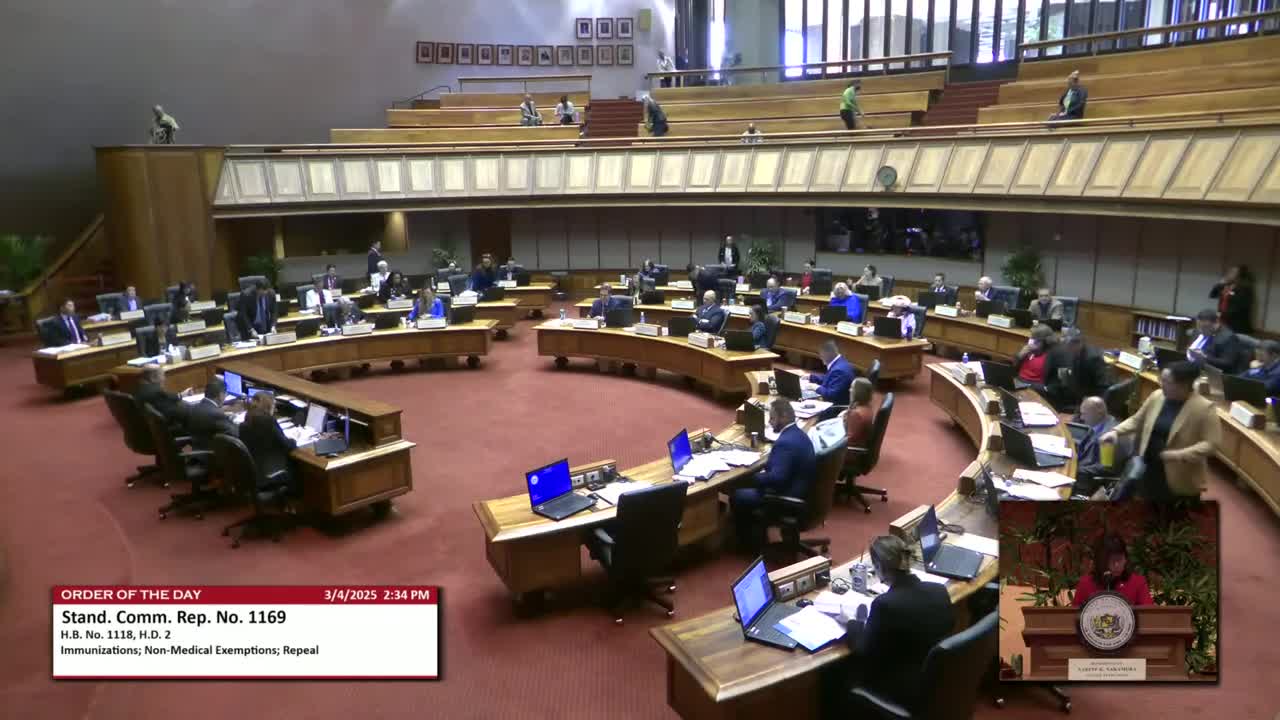
| Mar 4, 2025 | Recommitted to JHA with none voting no and Representative(s) Pierick, Ward excused. |
| Feb 28, 2025 | Forty-eight (48) hours notice Tuesday, 03-04-25. |
| Feb 28, 2025 | Reported from JHA (Stand. Com. Rep. No. 1169) as amended in HD 2, recommending passage on Third Reading. |
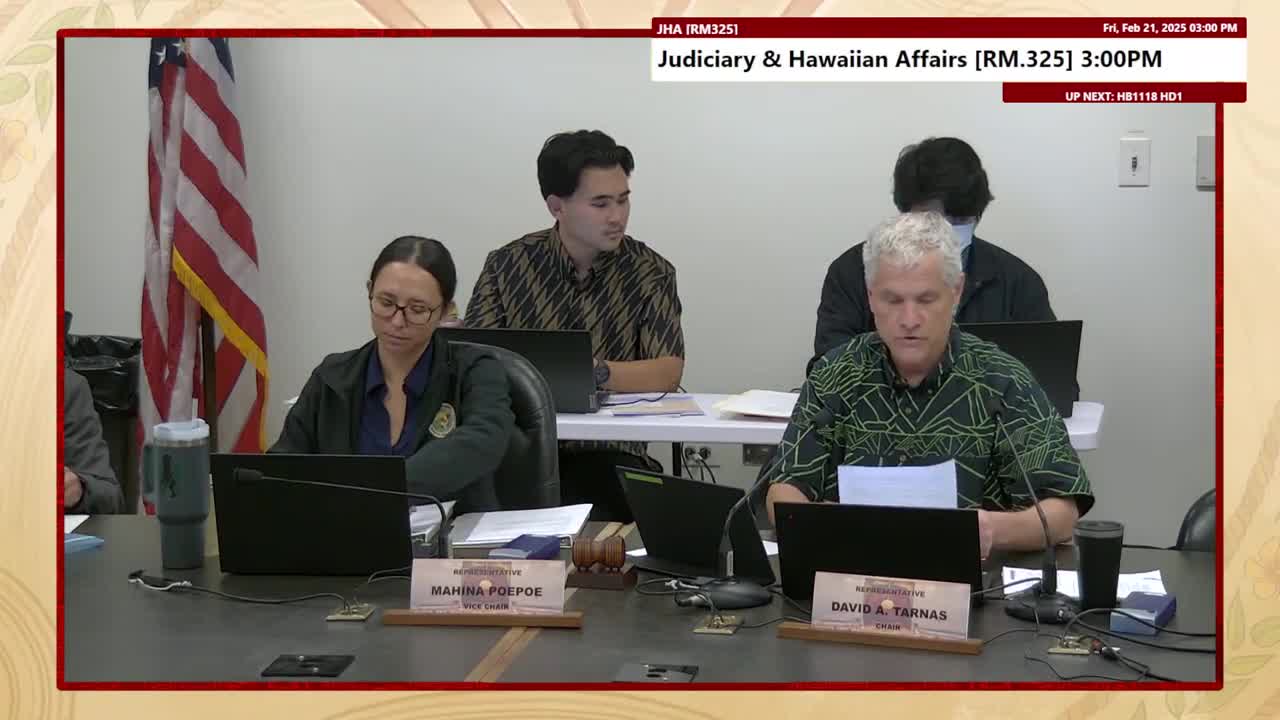
| Feb 21, 2025 | The committee on JHA recommend that the measure be PASSED, WITH AMENDMENTS. The votes were as follows: 5 Ayes: Representative(s) Tarnas, Hashem, Takayama; Ayes with reservations: Representative(s) Poepoe, Belatti; 3 Noes: Representative(s) Perruso, Garcia, Shimizu; and 3 Excused: Representative(s) Cochran, Kahaloa, Todd. |
| Feb 19, 2025 | Bill scheduled to be heard by JHA on Friday, 02-21-25 3:00PM in House conference room 325 VIA VIDEOCONFERENCE. |
| Feb 12, 2025 | Passed Second Reading as amended in HD 1 and referred to the committee(s) on JHA with Representative(s) Belatti, Chun, Hussey, Lamosao, Olds, Poepoe voting aye with reservations; Representative(s) Alcos, Garcia, Kila, Kong, Matsumoto, Muraoka, Perruso, Pierick, Reyes Oda, Shimizu, Souza voting no (11) and Representative(s) Cochran, Sayama, Ward excused (3). |
| Feb 12, 2025 | Reported from HLT (Stand. Com. Rep. No. 532) as amended in HD 1, recommending passage on Second Reading and referral to JHA. |
| Feb 7, 2025 | The committee on HLT recommend that the measure be PASSED, WITH AMENDMENTS. The votes were as follows: 7 Ayes: Representative(s) Takayama, Keohokapu-Lee Loy, Amato, Chun, Marten, Takenouchi; Ayes with reservations: Representative(s) Olds; 2 Noes: Representative(s) Alcos, Garcia; and Excused: none. |
| Feb 5, 2025 | Bill scheduled to be heard by HLT on Friday, 02-07-25 8:45AM in House conference room 329 VIA VIDEOCONFERENCE. |
| Jan 23, 2025 | Referred to HLT, JHA, referral sheet 3 |
| Jan 23, 2025 | Introduced and Pass First Reading. |
| Jan 21, 2025 | Pending introduction. |
|
Date
|
Description
|
Location
|
Votes
|
|
|---|---|---|---|---|
| Feb 21, 2025 | The committee on JHA recommend that the measure be PASSED, WITH AMENDMENTS | House Standing Committee on Judiciary & Hawaiian Affairs |
Passed |
|
| Feb 7, 2025 | The committee on HLT recommend that the measure be PASSED, WITH AMENDMENTS | House Standing Committee on Health |
Passed |
This list shows positions taken on this bill by organizations on the date displayed, which is linked to the original source.
Positions by individuals are not included.
|
Organization
|
Position
|
Date
|
|---|---|---|
| AFC/Hawaii For Informed Consent/UNJECTED | *** Against | Feb 8, 2025 |
| Aloha 1st Athletics | *** Against | Feb 23, 2025 |
| Aloha Freedom Coalition | *** Against | Feb 23, 2025 |
| Aloha Freedom Coalition / Hawaii For Informed Consent / Unjected / Hawaii Parents United | *** Against | Feb 23, 2025 |
| American Atheists | ** Support | |
| American Academy of Pediatrics, Hawaiʻi Chapter | ** Support | |
| American College of Obstetricians and Gynecologists Hawaiʻi Section | ** Support | |
| Calvary Chapel Westside | *** Against | Feb 8, 2025 |
| Christian Science Committee on Publication for Hawaii | *** Against | Feb 23, 2025 |
| Church of Satanism, Coeur d'Alene Chapter | *** Against | Feb 23, 2025 |
| Classical Conversation | *** Against | Feb 23, 2025 |
| Clementine's Closet LLC | *** Against | Feb 23, 2025 |
| Department of Health | ** Support | |
| Faith in Action Church | *** Against | Feb 23, 2025 |
| Faith in Action Church of God | *** Against | Feb 23, 2025 |
| Faith In Action Hawaii | *** Against | Feb 23, 2025 |
| Fathers and Mothers for Children Kauai Chapter | *** Against | Feb 8, 2025 |
| Father’s and mothers for children | *** Against | Feb 23, 2025 |
| Free Citizens of Maunalua | *** Against | Feb 23, 2025 |
| Gibson Law Firm, PLLC | *** Against | Feb 8, 2025 |
| Hawaii Christian Coalition | ** Against | |
| Hawaii Federation of Republican Women | ** Against | |
| Hawaii Federation of Republican Women | *** Against | Feb 8, 2025 |
| Hawaii For Informed Consent | ** Against | |
| Hawaii For Informed Consent | *** Against | Feb 23, 2025 |
| Hawaiian Islands Republican Women | *** Against | Feb 23, 2025 |
| Hawaiian Islands Republican Women | ** Against | |
| Hawaiʻi Pacific Health | ** Support | |
| Hawaiʻi Public Health Institute | ** Support | |
| Hawaiʻi State Council on Developmental Disabilities | ** Support | |
| Hawai’i Christian Coalition | *** Against | Feb 23, 2025 |
| Huihui | *** Against | Feb 23, 2025 |
| Inspire Church Kapolei | *** Against | Feb 23, 2025 |
| Ka Ohana O Na Pua | ** Against | |
| Ka Ulukoa | *** Against | Feb 23, 2025 |
| Kaua‘i County Council | *** Against | Feb 23, 2025 |
| KELII Foundation | *** Against | Feb 23, 2025 |
| King’s Chapel | *** Against | Feb 23, 2025 |
| Kumu Foundation | *** Against | Feb 23, 2025 |
| Libertarian Party of Hawaii | *** Against | Feb 23, 2025 |
| Na Iwi Kupuna | *** Against | Feb 8, 2025 |
| Nanakuli Maili Neighborhood Board, Hawaiian Affairs Chair | *** Against | Feb 23, 2025 |
| Nana’s Early Childcare | *** Against | Feb 23, 2025 |
| National Vaccine Information Center | ** Against | |
| Outlawz Athletics | *** Against | Feb 23, 2025 |
| Pearl City Medical Associates | *** Support | Feb 23, 2025 |
| Pono Records | *** Against | Feb 23, 2025 |
| Pride at Work - Hawaiʻi | ** Support | |
| Pride at Work – Hawai‘i | *** Support | Feb 23, 2025 |
| Project Nehemiah Hawaii | *** Against | Feb 23, 2025 |
| ProspectsHI | *** Against | Feb 23, 2025 |
| Pure Wellness LLC | *** Against | Feb 23, 2025 |
| Retore Aloha | *** Against | Feb 23, 2025 |
| Roldan Ohana family of 6 | *** Against | Feb 23, 2025 |
| Say His Name Foundation | ** Against | |
| Straub Benioff Medical Center | *** Support | Feb 8, 2025 |
| The Beauty Way Of The Four Directions Native American Church of Kaua'i | *** Against | Feb 23, 2025 |
| The First Church of Christ, Scientist | *** Against | Feb 8, 2025 |
| The Yeshua Nation of Amnesty Coalition | *** Against | Feb 8, 2025 |
| We, the people (Art.1 Sec.1,2,4,5,8) | *** Against | Feb 8, 2025 |
| Yeshua Nation of Amnesty Coalition | ** Against |
STAND. COM. REP. NO. 1169
Honolulu, Hawaii
, 2025
RE: H.B. No. 1118
H.D. 2
Honorable Nadine K. Nakamura
Speaker, House of Representatives
Thirty-Third State Legislature
Regular Session of 2025
State of Hawaii
Madame:
Your Committee on Judiciary & Hawaiian Affairs, to which was referred H.B. No. 1118, H.D. 1, entitled:
"A BILL FOR AN ACT RELATING TO NON-MEDICAL EXEMPTIONS TO IMMUNIZATION REQUIREMENTS,"
begs leave to report as follows:
Your Committee received testimony in support of this measure from the Department of Health; Hawaiʻi State Council on Developmental Disabilities; Hawaiʻi Public Health Institute; Pride at Work - Hawaiʻi; Hawaiʻi Pacific Health; American College of Obstetricians and Gynecologists Hawaiʻi Section; American Academy of Pediatrics, Hawaiʻi Chapter; and numerous individuals.
Your Committee received testimony in opposition to this measure from one member of the Kauaʻi County Council; Free Citizens of Maunalua; Hawaiian Islands Republican Women; Project Nehemiah Hawaii; Outlawz Athletics; Aloha 1st Athletics; Aloha Freedom Coalition; Nana's Early Childcare; Pono Records; Retore Aloha; Hawaiʻi Christian Coalition; Christian Science Committee on Publication for Hawaii; Faith in Action Church of God; King's Chapel; Beauty Way of the Four Directions Native American Church of Kauaʻi; Hawaii for Informed Consent; Libertarian Party of Hawaii; Pure Wellness LLC; Clementine's Closet LLC; KELII Foundation; KUMU Foundation; and numerous individuals.
Your Committee received comments on this measure from the Department of Education and Church of Satanism, Coeur d'Alene Chapter.
Your Committee finds that school immunization requirements are a critical tool for preventing the spread of infectious diseases and maintaining public health. Studies confirm that high vaccination rates create herd immunity, which is essential for protecting medically fragile children who cannot be immunized due to health conditions. In recent years, Hawaii has seen a significant rise in non-medical immunization exemptions, more than doubling since the 20152016 school year. This measure aims to enhance the safety of school-aged children by reducing non-medical exemptions while continuing to safeguard those with valid medical exemptions.
Your Committee has amended this measure by making technical, nonsubstantive amendments for the purposes of clarity, consistency, and style.
As affirmed by the record of votes of the members of your Committee on Judiciary & Hawaiian Affairs that is attached to this report, your Committee is in accord with the intent and purpose of H.B. No. 1118, H.D. 1, as amended herein, and recommends that it pass Third Reading in the form attached hereto as H.B. No. 1118, H.D. 2.
Respectfully submitted on behalf of the members of the Committee on Judiciary & Hawaiian Affairs,
|
|
|
____________________________ DAVID A. TARNAS, Chair |
|
|
|
|
STAND. COM. REP. NO. 532
Honolulu, Hawaii
, 2025
RE: H.B. No. 1118
H.D. 1
Honorable Nadine K. Nakamura
Speaker, House of Representatives
Thirty-Third State Legislature
Regular Session of 2025
State of Hawaii
Madame:
Your Committee on Health, to which was referred H.B. No. 1118 entitled:
"A BILL FOR AN ACT RELATING TO NON-MEDICAL EXEMPTIONS TO IMMUNIZATION REQUIREMENTS,"
begs leave to report as follows:
Your Committee received testimony in support of this measure from the Department of Health; Hawaiʻi State Council on Developmental Disabilities; American Academy of Pediatrics, Hawaiʻi Chapter; Hawaiʻi Pacific Health; Hawaiʻi Public Health Institute; American Atheists; and numerous individuals. Your Committee received testimony in opposition to this measure from one member of the Kauai County Council; Hawaiian Islands Republican Women; Hawaii For Informed Consent; Yeshua Nation of Amnesty Coalition; Hawaii Federation of Republican Women; Christian Science Committee on Publication for Hawaii; National Vaccine Information Center; Say His Name Foundation; Hawaii Christian Coalition; Ka Ohana O Na Pua; Libertarian Party of Hawaii; and numerous individuals. Your Committee received comments on this measure from the Department of the Attorney General and Department of Education.
Your Committee finds that school entry immunization requirements have been shown to be effective in improving immunization coverage rates, thereby reducing disease incidence. High immunization rates are important at schools to protect medically fragile children, especially children who are unable to be immunized and must rely on their vaccinated peers to prevent the introduction of vaccine preventable diseases in schools.
Your Committee further finds that decreasing immunization coverage due to non-medical exemptions increases the risk for vaccine-preventable disease outbreaks that can be fatal to children. For the 20152016 school year in the State, the rate of non-medical immunization exemption was 2.5 percent. The rate of non-medical immunization exemption more than doubled to 5.3 percent for the 20232024 school year. The rate of non-medical exemptions varied by school with fifty-five of the three hundred eighty-two schools that reported for school year 2023-2024 having a non-medical immunization exemption rate greater than ten percent.
Your Committee believes that since the health and safety of the State's children are paramount, there is a compelling state interest in protecting the public against deadly diseases, especially considering an increasing trend in non-medical immunity exemptions, while honoring certain non-medical exemptions that previously have been approved. This measure will minimize exemptions from school immunization requirements to improve the health and safety of school-aged children in the State.
Your Committee has amended this measure by:
(1) Clarifying that, for purposes of the state law relating to communicable diseases, a person may object in writing on the grounds that immunization conflicts with the person's bona fide religious tenets and practices;
(2) Changing the effective date to July 1, 3000, to encourage further discussion; and
(3) Making technical, nonsubstantive amendments for the purposes of clarity, consistency, and style.
As affirmed by the record of votes of the members of your Committee on Health that is attached to this report, your Committee is in accord with the intent and purpose of H.B. No. 1118, as amended herein, and recommends that it pass Second Reading in the form attached hereto as H.B. No. 1118, H.D. 1, and be referred to your Committee on Judiciary & Hawaiian Affairs.
Respectfully submitted on behalf of the members of the Committee on Health,
|
|
|
____________________________ GREGG TAKAYAMA, Chair |
|
|
|
|
|
Date
|
Testimony PDF
|
|---|---|
| Feb 23, 2025 | HB1118_HD1_TESTIMONY_JHA_02-21-25_.PDF |
| Feb 8, 2025 | HB1118_TESTIMONY_HLT_02-07-25_.PDF |
Discussed in Hearing
 2MIN
House Floor
 3H
House Standing Committee on Judiciary & Hawaiian Affairs
 1H
House Standing Committee on Health
1H
House Standing Committee on Human Services & Homelessness
Bill Author
Bill Co-Author(s):